It’s been quite a ride. Here’s episode six of “Exploding Spray Myths”. Real Agriculture helps us share an important message about why sprayer clean out involves so much more than just the tank. If you think you know what we’re covered with, we’re accepting guesses.
And please, don’t blow into nozzles, even if they don’t touch your lips. Blowback is a real thing…
On the morning of February 27, 2016 (a Saturday) a Twitter conversation sprung up that deserved to be captured in an article. Tom was waiting in the Prince Edward Island Airport with time on his hands and I was home in Southern Ontario. He dropped me a line on twitter, and I responded. When two creative people have an idyll conversation, you can count on it going sideways – you just never know how.
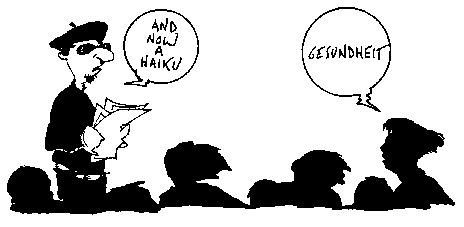
In this case, one of us wrote a short poem about spraying. Don’t judge… we like what we do so this is what we call “fun”. We noticed it was very much like a Haiku. Here’s a definition snatched from Wikipedia:
The haiku is a Japanese verse in three lines. Line one has 5 syllables, line two has 7 syllables and line three has 5 syllables. Haiku is a mood poem and it doesn’t use any metaphors or similes.”
They’re often quite beautiful and evocative of natural scenes… ours assuredly weren’t. They were, however, pretty darn funny and a couple bordered on clever! As we fired them back and forth, others jumped into the conversation with #SprayerHaiku of their own.
And so, for posterity, and in no particular order, here are the poems that flew through Twitter that Saturday. Snap your fingers appreciatively.
Spray hits canopy Drops bounce, move, try to find way Stochastic forces.
Beautiful hills, slopes Speed goes up, down constantly PWM
Drops in canopy Lots on top, few in bottom Sorry, that’s normal.
Your goal: more acres. You want to drive really fast. Don’t! Fill fast instead.
Clear skies early morn. Temperature Inversion! Don’t dare spray right now.
His girlfriend was wrong. Three inch very effective for sprayer fill line.
Spray boom like bird wings: Proper distance just theory, without height control.
Agitator churns. Chemistry runs through plumbing. Protecting our crops
Nozzles spray gently. Some drops coarse, many too small. Pressure and speed fall
Spray cloud flows downhill in the peaceful morning calm. Dangerous beauty
Pressure reads 50 on the fancy new touchscreen. Should you believe it?
Just trying to do my best. Haikus make you think. This will work out well.
Sprayer moves swiftly across green plain, swath by swath, protecting young crop.
Spray drift is real bad says everyone all the time. Well, it’s very true!
My tank is Jell-O. Mixing is not the problem. Just blame the chem rep. (@PennerBrian)
Seriously these Haikus need to be a thing. Lots of potential. (@jddyck)
Filled tank in minutes. Now filters are full of sh!t. Productivity? (@PennerBrian)
Spring sun melting snow Walking yard in rubber boots We’ll calibrate soon.
Small targets, small drops And for large targets, large drops. That’s my rule of thumb.
Should you really get up before the birds to spray? There are a lot of good reasons for early morning and night spraying, but if you’re in a strong inversion, you might be in a world of hurt. Here’s episode 5 in our series of short, educational and irreverent videos made with Real Agriculture.
Here’s the third in our series of short, educational and irreverent videos made with Real Agriculture. We wanted to explain where pressure readings are taken on a sprayer and why it’s so important to know what pressure your nozzle is experiencing, rather than what the screens in your cab are telling you. Not only does pressure affect your application rate, but it affects your spray quality, which can be critical if your rate controller allows the pressure to drop below 30 psi.
This is the second of a series of short, educational and irreverent videos made with Real Agriculture to bring a little levity to sprayer education. Let’s face it – ironically, nozzles can be pretty dry.
Here we enjoy an early morning soy bean scout and a light breakfast of toast as we demonstrate how pressure, droplet size and canopy penetration interact.