- A consistent vocabulary is needed for describing spray drone use. Standardized definitions for swath, swath width, ESW, route spacing are essential.
This text was generated by OpenAI GPT 5 Mini
Spray drones arrived in Canadian agriculture faster than the language to describe them. Operators borrowed terms from aerial application, manufacturers coined their own, and researchers (myself included) used whatever seemed to fit at the time. The result is a vocabulary where swath, swath width, effective swath width, pass width and route spacing are often used interchangeably, even though they describe very different things.
Those differences matter. A drone deposits spray over a measurable span. Only part of that span gives a uniform deposit when passes overlap, and the width that actually controls the pest depends on the product, the dose and the target. In a dense crop canopy, that portion is narrower still. When route spacing is set from the deposition span or a manufacturer’s stated width, rather than the effective swath width for the job, the result is striping and possible failures in crop protection.
Since June 30, 2026, Health Canada’s SPN2026-02 has allowed drone application of products registered for aerial use, subject to the label and to federal, provincial and territorial licensing. Operators, regulators, agronomists and researchers now need to describe the same things in the same way. Some definitions taught to conventional aerial applicators, such as those used at Operation S.A.F.E. fly-ins, still fit. Others need adapting, and some new terms are needed to describe qualities unique to drones.
The following glossary is limited to terms with particular relevance to spray drones.
The Aircraft
Drone: A remotely piloted aircraft; in agriculture, commonly the aircraft and its spray system together. Also: RPA (Canada), UAV (US and international).
Remotely Piloted Aircraft System (RPAS): A drone together with its control station, command-and-control link and other components required to fly it. Also: UAS (US and international).
Remotely Piloted Aerial Application System (RPAAS): An RPAS equipped to apply crop protection products or other materials. Also: UASS (liquid sprays) or UAAS (liquid or dry materials).
Rotary-wing, fixed-wing and hybrid drones: Drones lifted by rotors (vertical take-off and hover), by wings (runway required), or by a combination of the two.
Small, medium and large RPA: Transport Canada weight categories: 250 g to 25 kg, over 25 kg to 150 kg, and over 150 kg.
Spans and Spacing
Deposition span: The full lateral distance over which a single pass leaves a measurable deposit.
Swath width: The portion of the deposition span that produces an acceptably uniform deposit when adjacent passes overlap.
Effective swath width (ESW): The widest route spacing that delivers at least the minimum effective dose of a product to its target.
In-canopy effective swath width: The effective swath width measured at the position of the target within a crop canopy.
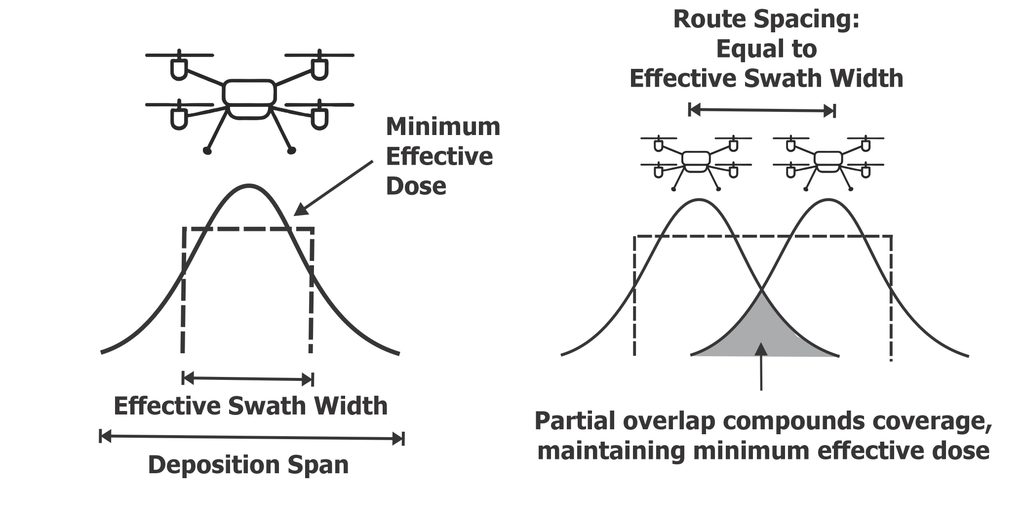
Route spacing: The lateral distance between the centrelines of adjacent passes (single traverses of a flight line with the spray on), as entered in the flight controller.

Overlap: The portion of one pass’s deposit that falls within the deposit of an adjacent pass.
Striping: Alternating bands of uneven deposit between adjacent passes, seen as poor pest control where under-applied or crop injury where over-applied.
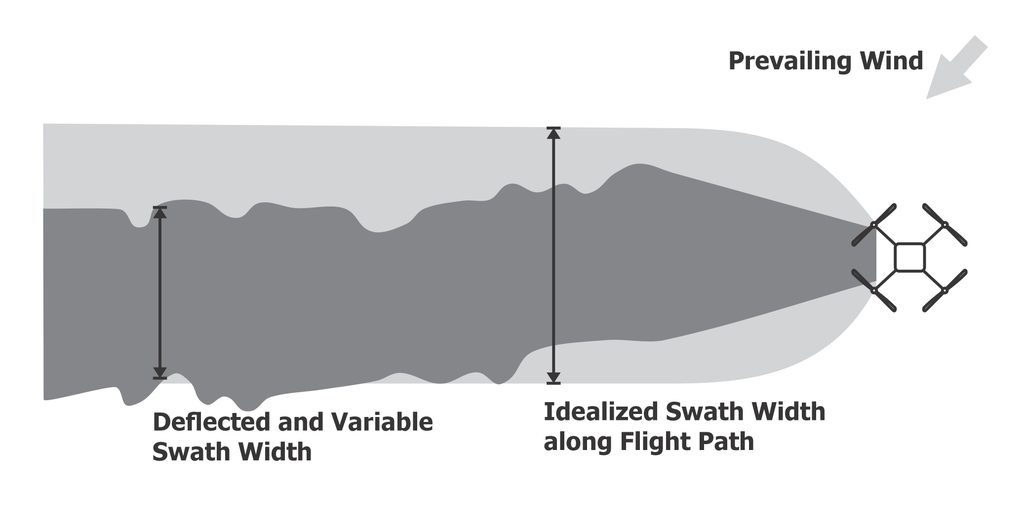
Swath displacement: The lateral shift of a deposit away from the flight line.
Edge offset: The distance between the field edge and the first flight line.
Drift: Spray carried out of the target area while airborne.
Operational use case: The combination of drone, operational settings and weather that determines the deposition pattern.
Agronomic use case: The combination of product, spray mix and target location that determines how much of the deposit is effective.
Minimum effective dose (efficacy threshold): The smallest dose of a product that produces the intended biological result.
Measuring the Swath
Pattern test: A measurement of the deposit across a flight path, made by flying over a line of separate collectors or a continuous strip (such as string or paper) laid perpendicular to it.
Fly-in: A calibration clinic in which aircraft fly standardized test passes over collectors for on-site analysis.
Calibration threshold: The deposit level, typically 90% of the maximum deposit in a pattern test, against which over- and under-dosing are measured when calculating swath width.
Coefficient of variation (CV): The standard deviation of the deposit divided by its mean, expressed as a percentage.
Racetrack pattern: A flight or overlap pattern in which every pass is made in the same direction.
Back-and-forth (shuttle) pattern: A flight or overlap pattern in which successive passes alternate direction.
Coverage: The extent of spray deposit on a target or collector, usually reported as deposit density (deposits per unit area) or percent area covered.
Acceleration distance: The distance a drone travels between starting a pass and reaching target speed.
Flight and Airflow
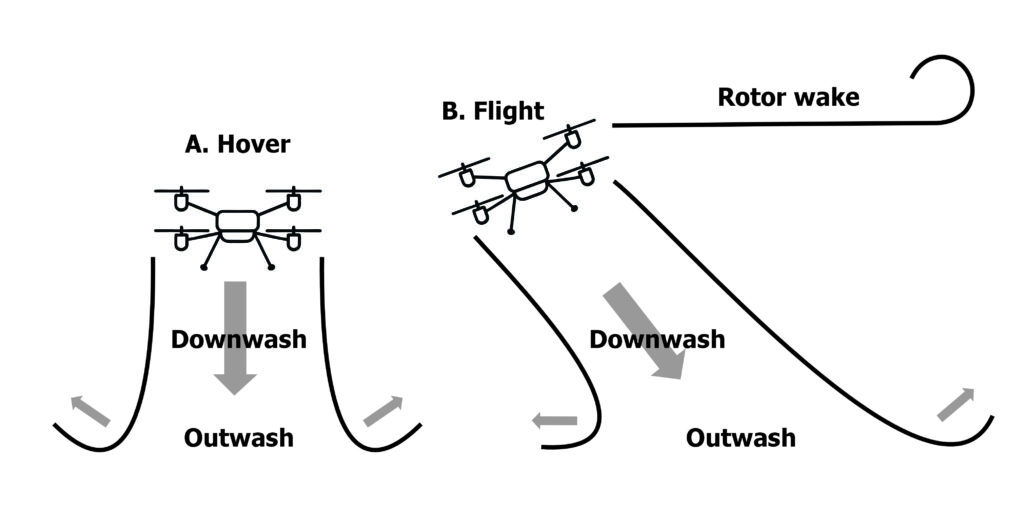
Downwash: The column of air driven downward by the rotors.
Outwash: The lateral spread of downwash after it strikes the ground or crop canopy.
Rotor wake: The vortices shed from the rotor tips that trail behind the drone.
Disc loading: The weight of a drone divided by the total area swept by its rotors.
Dwell time: The length of time the downwash acts on one location as the drone passes.
Effective translational lift (ETL): The forward speed at which a rotary-wing aircraft outruns its own downwash and gains lift from undisturbed air.
Altitude: The height of the nozzles above the target surface.
Terrain following: Automatic altitude control that maintains a set height above the ground or crop.
Rotary atomizer: A spinning disc or cage that breaks liquid into droplets by centrifugal force.
Flooding: A condition in which excess flow to a rotary atomizer produces a coarser, less uniform spray.
Application volume: The volume of spray mix applied per unit area.
Operations
Mission planning: Mapping a target area, its hazards and restrictions, and setting the flight route and operational settings before application.
No-spray zone: An area the drone may fly over but must not spray.
Obstacle zone: An area the drone must not fly through.
Buffer zone: The untreated distance required by a pesticide label between the application and a sensitive area.
Sortie: One flight cycle: take-off to landing, plus the refill and battery change that follow.
Staging area: The site where the drone takes off, lands, is refilled and has its battery changed.
Tender: The ground unit that supplies power, stores and mixes spray materials, fills the drone and transports it.
Nurse tank: A tank used to pre-mix and agitate spray mix before it is transferred to the drone.
Ferrying: Non-spraying flight between the staging area and the start or end of spraying.
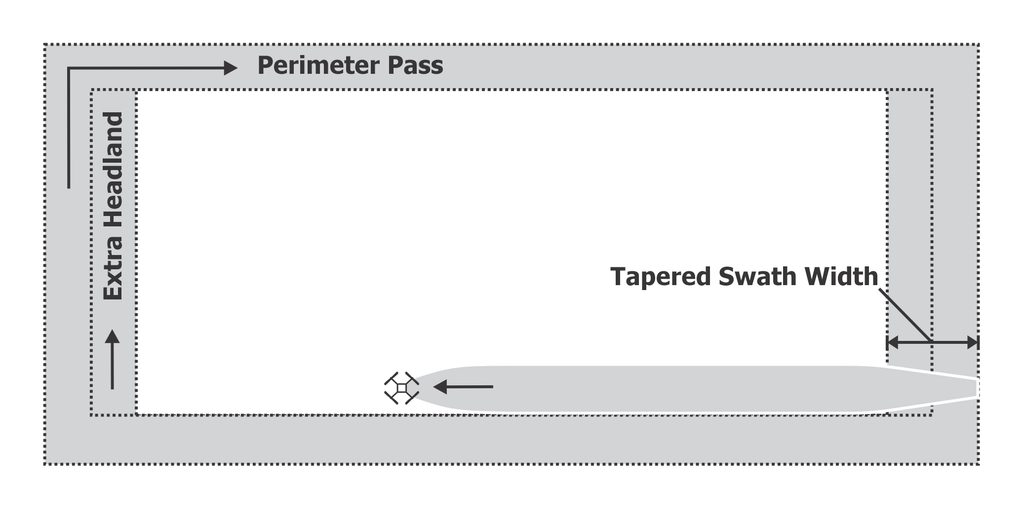
Headland pass: A pass along the end of a field.
Perimeter pass: A pass along the boundary of a field.
Cleanup pass: A pass flown to treat areas missed by the main passes, often crosswise around obstructions.
Multi-drone operation (swarming): The simultaneous operation of more than one RPA by a single pilot.
Productivity: The area treated per hour of total operating time.
Real-Time Kinematic (RTK) positioning: A satellite positioning correction method that provides centimetre-level accuracy.
Canadian Regulatory Terms
Visual line-of-sight (VLOS): Operation in which the pilot or a visual observer can see the RPA unaided.
Extended visual line-of-sight (EVLOS): Operation within a set distance of the pilot, with a visual observer scanning the airspace.
Beyond visual line-of-sight (BVLOS): Operation in which the RPA is beyond the sight of the pilot and any visual observer.
Sheltered operation: Operation within a set distance of a building or structure without direct line of sight.
Advanced pilot certificate: The Transport Canada certificate for operations near people, in controlled airspace, with medium RPA, and for EVLOS and sheltered operations.
Level 1 Complex pilot certificate: The Transport Canada certificate for lower-risk BVLOS operations below 400 ft over sparsely populated areas in uncontrolled airspace.
RPAS Operator Certificate (RPOC): The organization-level Transport Canada certificate required for BVLOS operations.
Special Flight Operations Certificate (SFOC): A Transport Canada authorization for operations outside the standard categories.
Declaration: A manufacturer’s statement to Transport Canada that an RPA meets the safety assurance standard for an operating environment.
Pre-Validated Declaration (PVD): A declaration made after Transport Canada has reviewed the RPA design.
SPN2026-02: The Health Canada Science Policy Note permitting RPAS application of pesticides registered for aerial application.
Pesticides Regulatory Directorate (PRD): The Health Canada directorate that registers pesticides, formerly the Pest Management Regulatory Agency (PMRA).
