Tag: dilution

  • Diluting 20,000-Fold with a 30 Gallon Remaining Volume in a 1,200 Gallon Tank

    Diluting 20,000-Fold with a 30 Gallon Remaining Volume in a 1,200 Gallon Tank

    (This short article is an addendum to this article)

    Our goal in this example is to dilute by a factor of 20,000.

    The maximum amount of dilution possible with a 1,200 gallon tank and a 30 gallon remainder is 1200/30=40.

    The formulae:

    Dilution per Rinse = final dilution ^(1/# of rinses)

    Rinse Volume = (dilution per rinse * remaining volume) – remaining volume

    • One rinse diluting by 20,000 – impossible with a 1,200 gallon tank (max achievable is 40-fold);
    • Two sequential rinses, each diluting by a factor of 20,000^(1/2) = 141. Also impossible with a 1,200 gallon tank;
    • Three sequential rinses, each diluting by a factor of 20,000^(1/3) = 27. A volume of 780 gallons can do this  (27*30)-30=780 gallons. For three rinses, the total volume is 2,340 gallons.
    • Four sequential rinses, each diluting by a factor of 20,000^(1/4) = 12. A volume of 330 gallons can do this, for a total volume of 1,320 gallons;
    • Five sequential rinses, each diluting by a factor of 20,000^(1/5) = 7. A volume of 180 gallons can do this, for a total volume of 900 gallons;
    • Six sequential rinses, each diluting by a factor of 20,000^(1/6) = 5.2. A volume of 126 gallons can do this, for a total volume of 757 gallons.

    Second, let’s assume the operator is prepared to prime the boom where it doesn’t harm soybeans. Now the first new product tank takes care of the last dilution, lowering the cleanout dilution requirement by 1,200/30 = a factor of 40. Now the cleanout dilution requirement is only 20,000/40 = 500.

    • One 1,200 gallon tank rinse can only achieve 40-fold dilution.
    • Two rinses, each diluting by 500^(1/2) = 22. Rinse volumes of 640 gallons are sufficient, for a total of 1,280 gallons.
    • Three sequential rinses, each diluting by a factor of 500^(1/3) = 7.9. A volume of 210 gallons can do this, for a total volume of 630 gallons;
    • Four sequential rinses, each diluting by a factor of 500^(1/4) = 4.7. A volume of 112 gallons can do this, for a total volume of 448 gallons.
  • How Clean is Clean?

    How Clean is Clean?

    One of the more perplexing questions in tank cleanout is knowing when the cleaning process is good enough to prevent harm. This question is especially relevant to producers that grow canola and use Group 2 herbicide products, or grow soybeans and use dicamba on some of their area. In both of these examples, crops can be extremely sensitive to very small residues.

    When does an applicator know that the cleaning job was good enough? In about two weeks! There is no easy way to tell, except to be precautionary.

    A bit of math can help put us in the ballpark. First, we need to know the tolerance of a crop to the herbicide, preferably expressed as a proportion of the tank mix to be cleaned. Let’s use dicamba as an example. It’s been reported that non-dicamba tolerant soybeans can show leaf-cupping symptoms from dicamba at rates as low as 1/20,000 of the label rate.

    Recall that sprayer cleanout is really two separate processes that we’ve written about here, here, and here. The first is dilution of the remaining volume in the system. The second is decontaminating specific sprayer components (filters, boom ends, hoses). We’ll focus on dilution in this article.

    If you’re diluting, the second piece of information you need is how much liquid is left in the sprayer when you start cleaning. All sprayers have a certain amount of liquid left in the tank and associated plumbing after the tank is empty. The sump, the suction line feeding the pump, and the lines returning to the tank via agitation or sparge are most common. Even when the pump no longer draws liquid, those lines retain some volume of product. This volume can’t be pushed out to the boom, most of it goes back to the tank.

    The volume of this “remaining liquid” is likely somewhere between three and thirty US gallons.

    The remainder volume depends on the sprayer, and also how the tank is emptied. Some applicators simply spray until the solution pump pressure drops, others choose to drain the remaining liquid from a sump valve. When draining, product should be captured in pails rather than allowing it on the ground where it will harm the soil and possibly make its way into runoff.

    It’s always preferable to spray the tank empty in a field.

    As we’ll see below, a low remaining volume greatly improves the efficiency of the dilution process. It’s a sprayer feature that should be considered at purchase.

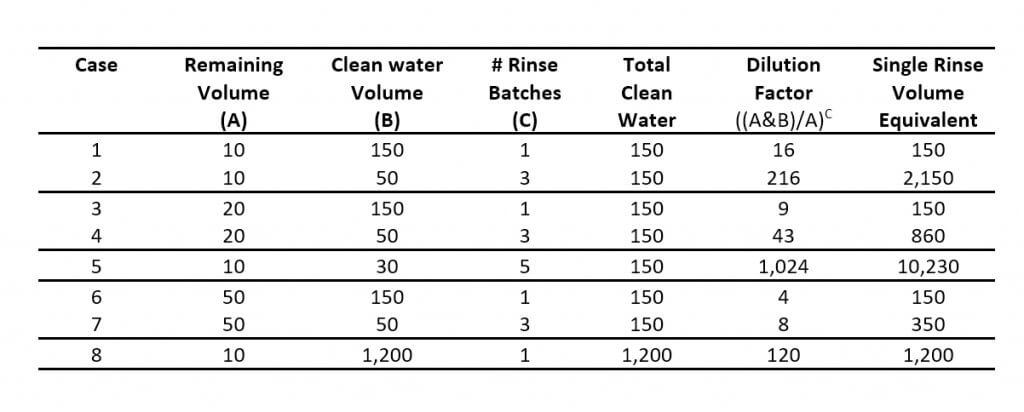
    The table below has some sample calculations. Note that the paired cases (1&2, 3&4, 6&7) all use the same total water volume, but compare a single vs triple rinse of three different remaining volumes.

    Comparing Case 1 to Case 3 or Case 6, (remaining volumes of 10, 20, and 50, respectively), it’s clear that minimizing the remaining volume is important.

    It’s also striking that the same amount of clean water, subdivided into three smaller repeat batches (Case 2, 4 and 7), is much more powerful than using single batches with the same total clean water amounts.

    Reducing the size of each batch even further and increasing the number of batches (Case 5) approaches what a properly executed continuous rinse can do.

    Is it necessary to dilute to the level that’s safe for the next crop? Not always. The next product in the tank acts to dilute the remainder once again, possibly by a factor of 100, depending on the remaining volume and the tank size (Case 8). The material in the boom, however, won’t be diluted by this additional volume, and therefore may harm the crop unless it is first sprayed out elsewhere, especially when section ends are not drained and rinsed.

    This is where a recirculating boom is valuable, providing an opportunity to charge the boom without spraying. The penalty is that the boom volume is then returned to the tank in the process, increasing the amount that needs to be diluted.

    Let’s return to the dicamba example with a 20,000-fold dilution requirement and a 1,200 gallon tank. We’ll consider two examples. In the first, the operator wants to prime the boom in the soybean field without any harm to the dicamba-susceptible beans. A 20,000-fold dilution is needed.

    We’ve looked at five options that each assume a remaining volume of 10 gallons. Note that our goal is the same – dilute by a factor of 20,000.

    The formulae:

    Dilution per Rinse = final dilution ^(1/# of rinses)

    Rinse Volume = (dilution per rinse * remaining volume) – remaining volume

    The maximum amount of dilution possible with a 1,200 gallon tank and a 10 gallon remainder is 120 (see Row 8, Table above).

    • One rinse diluting by 20,000 – impossible with a 1,200 gallon tank (max achievable is 120-fold);
    • Two sequential rinses each diluting by a factor of 20,000^(1/2) = 141. Also impossible with a 1,200 gallon tank;
    • Three sequential rinses, each diluting by a factor of 20,000^(1/3) = 27. A volume of 260 gallons can do this  (27*10)-10=260 gallons. For three rinses, the total volume is 780 gallons.
    • Four sequential rinses, each diluting by a factor of 20,000^(1/4) = 12. A volume of 110 gallons can do this, for a total volume of 440 gallons;
    • Five sequential rinses, each diluting by a factor of 20,000^(1/5) = 7. A volume of 60 gallons can do this, for a total volume of 300 gallons.

    The first two examples don’t work because the tank isn’t big enough. But the three remaining examples all work equally well, they just consume different amounts of clean water.

    If that doesn’t seem like a lot of work, then repeat this calculation with a 30 gallon remainder volume, common on many sprayers. Short on time? We did it for you here.

    Second, let’s assume the operator is prepared to prime the boom where it doesn’t harm soybeans. Now the first new product tank takes care of the last dilution, lowering the cleanout dilution requirement by 1,200/10 = a factor of 120. Now the cleanout dilution requirement is only 20,000/120 = 166.

    • One 1,200 gallon tank rinse can only achieve 120-fold dilution.
    • Two rinses, each diluting by 166^(1/2) = 13. Rinse volumes of 120 gallons are sufficient, for a total of 240 gallons.
    • Three sequential rinses, each diluting by a factor of 166^(1/3) = 6. A volume of 50 gallons can do this, for a total volume of 150 gallons.

    The math is simple, and can be done using the formula in the first table, or this app:

    The hard part is knowing what the remaining volume is. It would be very useful for a manufacturer to provide this information.

    In the meantime, you can estimate on your own. Add water with surfactant to your tank, and spray it empty. While spraying, turn the agitation on and off to fill and activate the sparge, if equipped. Once the tank is empty and the spray pressure drops, stop and drain the sump into pails. Ensure that the pump suction line and the pressure line up to and including the agitation and sparge lines also drain. Disconnect these if necessary. If there is a filter housing in this circuit, remove it as well.  Avoid collecting liquid from the pressure line beyond where the the agitation or sparge split off, as this will be pushed out to the boom.

    An alternative is to estimate the length of hose in this circuit, using the following table as a guide:

    And remember, diluting the remaining liquid is only one part of a cleaning process.

  • An Easier Way to Clean Your Sprayer

    An Easier Way to Clean Your Sprayer

    Farming can be divided into pleasant and unpleasant tasks.  Seeding is pleasant.  Hauling oats or barley not so much.  Sprayer cleaning is…not.  And yet it’s the unpleasant tasks that are often the most important.  How can we make them better?

    We all know the need for a properly cleaned sprayer.  Herbicide residue can harm a sprayed crop, and the damage might not show up for over a week.  When it does, it usually takes a while to identify the symptoms and damage patterns to be sure.  And then we wait for the inevitable yield loss.

    It wasn’t long after the introduction of the Group 2 Mode of Action that producers started noticing how even small residues of these products in sprayer tanks could damage crop yields, most noticeably canola, but also other broadleaf species.

    Thirty years later, the problems persist.  Let’s look at ways of preventing them.

    Cleaning a sprayer is a lot like doing the dishes.  Using the right detergent, soaking the hard stuff, being thorough, and rinsing properly – they all matter.

    It all starts, though, with preventing the problem.

    The main culprits that cause sprayer contamination have the following properties:

    • They are typically dry formulations,
    • they typically have poor water-solubility, and
    • they are potent in low doses.

    Many products in herbicide Group 2 MOA fit that bill.  The ones that rise to the top of the list have an additional characteristic:

    As a subgroup within the Group 2 MOA, the sulfonyl ureas are a top concern, with products like Refine, Express, and Ally on the most-wanted list. Another problem subgroup is the triazolopyrimidines, containing products like Frontline and Simplicity, which, like the SUs, have very pH-dependent solubilities (better solubility at higher pH). Other Group 2s have fewer issues. Everest and Varro have good overall water solubility, for example.  The solubility of imidazolinones like Odyssey, Pursuit, Raptor increases with low pH. We tend to see fewer problems with these products.

    Instances that add to the problem involve tank mixing with weak acid herbicides, including glyphosate, but especially those that are formulated as emulsifiable concentrates (oils, EC), appearing milky when mixed with water.  Most of our herbicides are weak acids.

    Two problems occur with these:

    • The weak-acid herbicide lowers the pH of the spray mix, possibly reducing the solubility of the problematic Group 2s.
    • Then, oily formulation can adhere the herbicide to plastic and rubber sprayer parts such as tanks, connectors, and hoses.

    The best advice on preventing a cleanout problem, is, therefore, to make sure the product is fully dissolved or suspended.   Proper mixing technique and time are the key components.  Some products, like Simplicity, can benefit from a pH increase (adding ammonia) prior to mixing the product.

    Once properly mixed, we can still have problems at the screens. Dry formulations require a screen mesh of 50 or coarser according to their labels.  But many sprayers contain 80 mesh screens, some even have 100 mesh.  All screens should be inspected both before, during, and after spraying these products.  Screen residues cause longer-term contamination, and their cleaning is an important part of this whole process.

    After spraying, the cleaning process relies on three main things:

    1. We need to remove as much of the problem mixture as possible.
    2. We need to dilute the remainder as much as possible and use it to clean the boom plumbing.
    3. Ensure anything that came in contact with spray mix has been cleaned.

    Removing the mixture

    The best way to remove the remainder is to spray it out in the field you’ve just treated.  You can overspray some products again, or if you have any land set aside it can be used for this purpose.  It’s never a good idea to drain the tank on any land.  Obviously, some experience and math is helpful to make sure the last tank empties nicely on the field.

    Diluting the remainder

    The next step is to dilute the remainder, using tank cleaning adjuvants like ammonia (this raises the pH and helps remove those products whose solubility benefits from this) and detergent (this removes the oily layer formed by EC formulations).  Commercial cleaners like All Clear or Cleanout combine these properties in one jug.

    Diluting is most effective when done in multiple smaller batches, as long as we can ensure the tank walls are reached.  Wash-down nozzles installed in the tank can do this for us.

    Let’s assume the sprayer has a 150 gallon clean water reservoir.  It’s tempting to empty the whole thing into the tank.  We can calculate the diluting power of this:  if we had a 10 gallon remainder in the tank and added 150 gallons water, the remainder would be diluted by a factor of 16.  After spraying this out, we’d then have to re-fill the rinse tank if we wanted to do more.

    If we rinsed in two 75 gallon batches (add 75 gallons, agitate via wash-down nozzle, spray out, repeat), we would dilute by a factor of 72.  If we did three rinses of 50 gallons each, our final dilution factor would be 216.  That’s the same dilution as adding about 2150 gallons to the first 10 gal spray tank remainder, and is about 14 times better than dumping the whole 150 gallons in at the beginning!

    An improvement in diluting power can be achieved by adding a separate clean water pump.  Introducing clean water to the tank as rinsate is sprayed out the boom reduces water use even further.

    Cleaning all spray mix contact points

    The last step is to pay attention to the things you can’t see: Screens, boom lines and boom ends. The total interior surface area of black rubber boom hoses on a 100 ft sprayer with 7 sections can be as much as several square metres, and this surface can bind residues. Seven sections, each with boom ends, can hold several gallons, as well as accumulated debris. Scrubbing screens, soaking boom lines, and flushing boom ends is the necessary detail that this job requires.

    A few final pointers:

    • Adding a surfactant or a commercial cleaner can generate a lot of foam. Have de-foamer handy, it will save a lot of frustration.
    • A bucket helps collect and clean screens and nozzles.
    • Consider upgrading to more steel components on your next sprayer – tanks and booms. Stainless steel cleans faster than plastic.
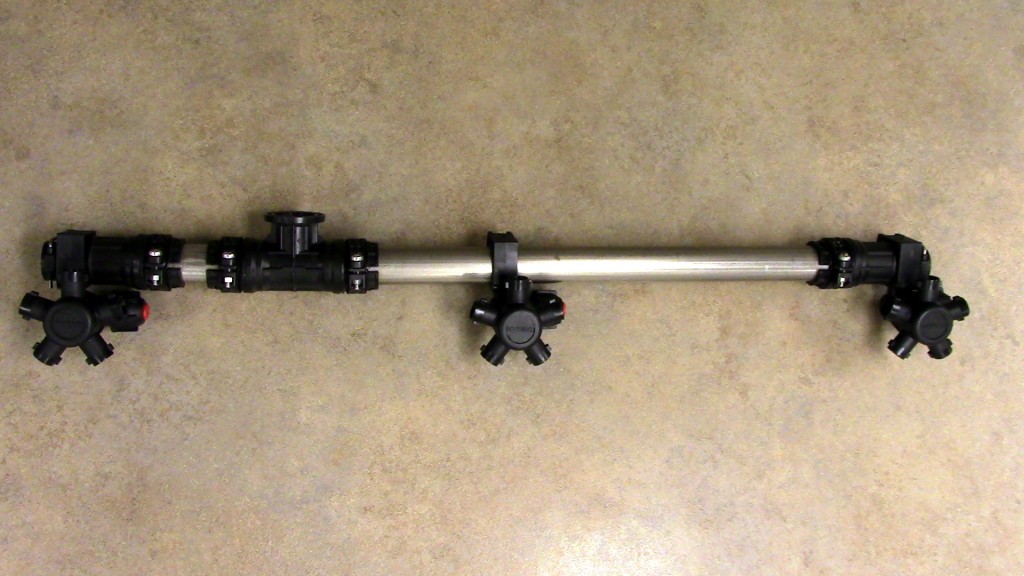
    • Install a way to flush your boom ends. Traditional ball valves do the job, but Hypro’s Express Nozzle Body End Caps do it automatically. These inexpensive units eliminate the dead space in boom ends and as a bonus, bleed air from the lines on the go.
    Hypro's Express Nozzle Body End Caps on a short length of stainless boom.
    Hypro’s Express Nozzle Body End Caps on a short length of stainless boom.

    Done well, sprayer cleaning doesn’t have to be unpleasant. And it certainly results in a better night’s sleep.