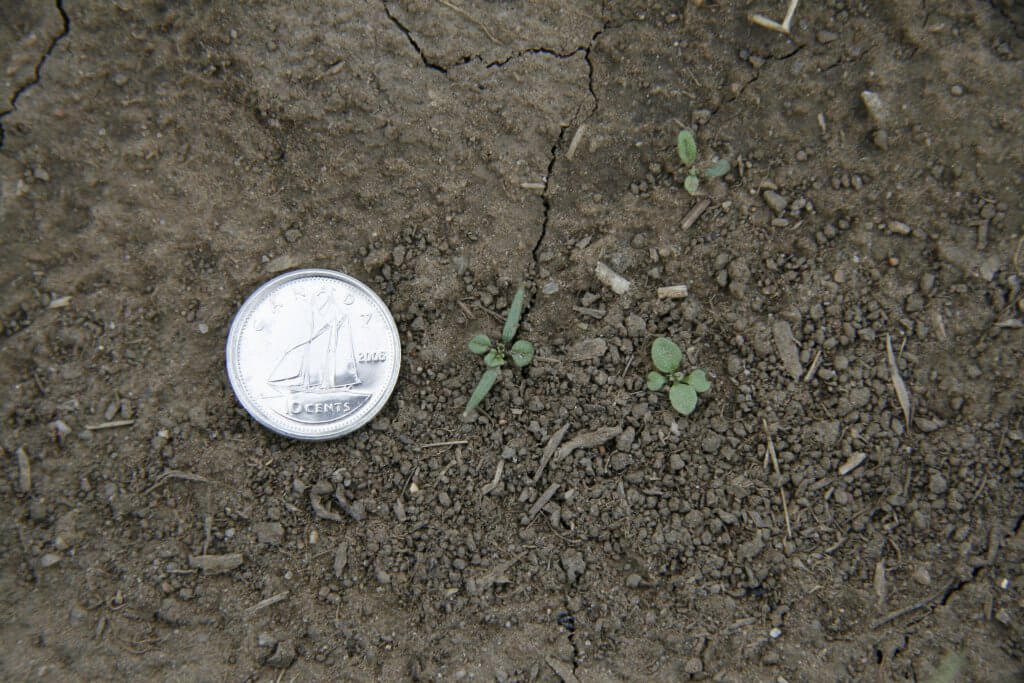
The decision on which application method is best for herbicides boils down to two main factors: (a) target type and (b) mode of action. In general, it’s easier for sprays to stick to broadleaf plants on account of their comparatively larger leaf size and better wettability compared to grassy plants. There are exceptions, of course – at the cotyledon stage, broadleaf plants can be very small and a finer spray with tighter droplet spacing may be needed. Water sensitive paper is a very useful tool to make that assessment. Imagine if a tiny cotyledon could fit between deposits – that could be a miss!
Some weeds are also more difficult to wet, and those may also need a finer spray or a better surfactant for proper leaf contact. An easy test is to apply plain water to the leaf with a spray bottle. If the water beads off or the droplets remain perched on top in discrete spheres, the surface is considered hard to wet. Most grassy weeds are hard to wet, while most broadleaf weeds are easy to wet.
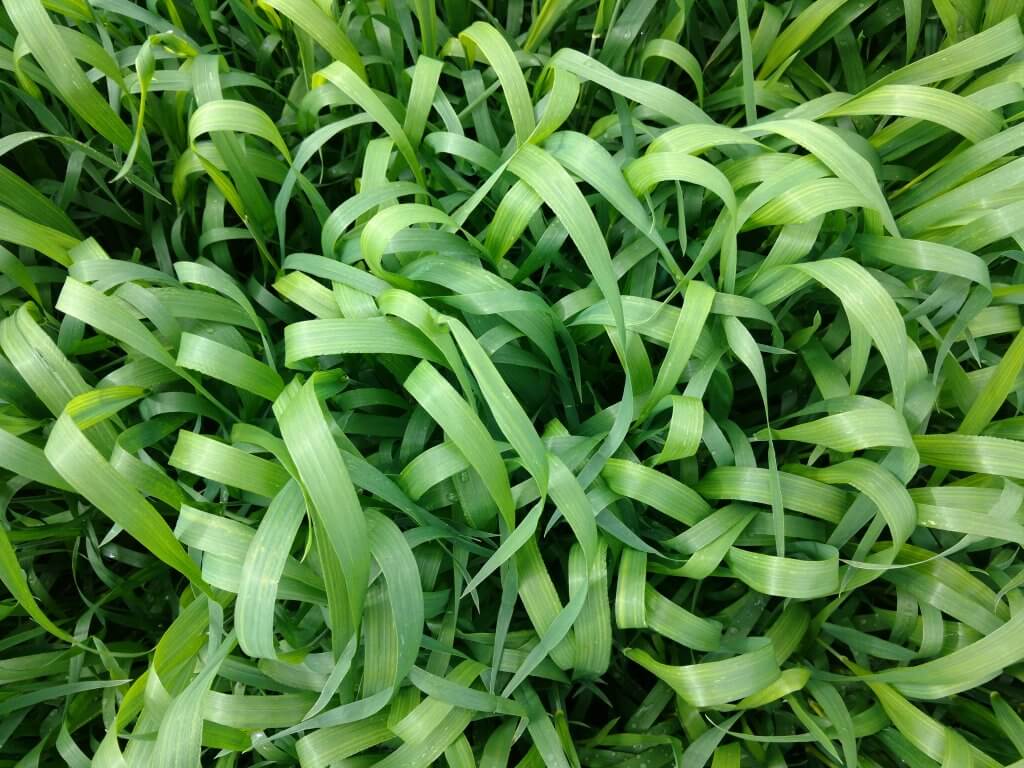
Grassy weeds are an especially difficult target because they have smaller, more vertically oriented leaves, and almost without exception are more difficult to wet than broadleaf species. All these factors call for finer sprays for effective targeting and spray retention.
Broadleaf weeds usually have more horizontally oriented leaves which also happen to be larger. As a result, they can intercept larger droplets quite efficiently.
There are about thirty mode of action (MOA) groups among the herbicides with about ten accounting for the majority in Canadian prairie agriculture. It’s probably an over-simplification to categorize them into just two groups – systemic and contact. But that grouping goes a long way to making an application decision.
Contact products (MOA Group 5, 6, 10, 14, 22, 27) must form a deposit that provides good coverage. Good coverage is an ambiguous term that basically means that droplets need to be closely spaced and cover a significant proportion of the surface area because their physiological effects occur under the droplet, and don’t spread far from there. One way to generate more droplets is to reduce droplet diameter, another is to add more water. A reasonable combination of both is ideal because simply making droplets smaller creates issues with evaporation and drift.
Systemic products (MOA Group 1, 2, 4, 9) will translocate within the plant to their site of action after uptake. As a result, coverage is less important as long as sufficient dose is presented to the plant. In practice, this means coarser sprays and/or less water may be acceptable.
When two factors are combined, either in a tank mix or a weed spectrum, the more limiting factor rules. Application of a tank mix or product that is active on both broadleaf and grass plants will be governed by the limitation placed on grass targets. A tank mix comprised of both systemic and contact products is governed by the limitations placed on contact products.
A factor we should also consider is soil activity and the presence of residue. Studies have shown that soil-active products are relatively insensitive to droplet size. But if they have to travel through a layer of trash to get to the soil surface, more application volume is the best tool.
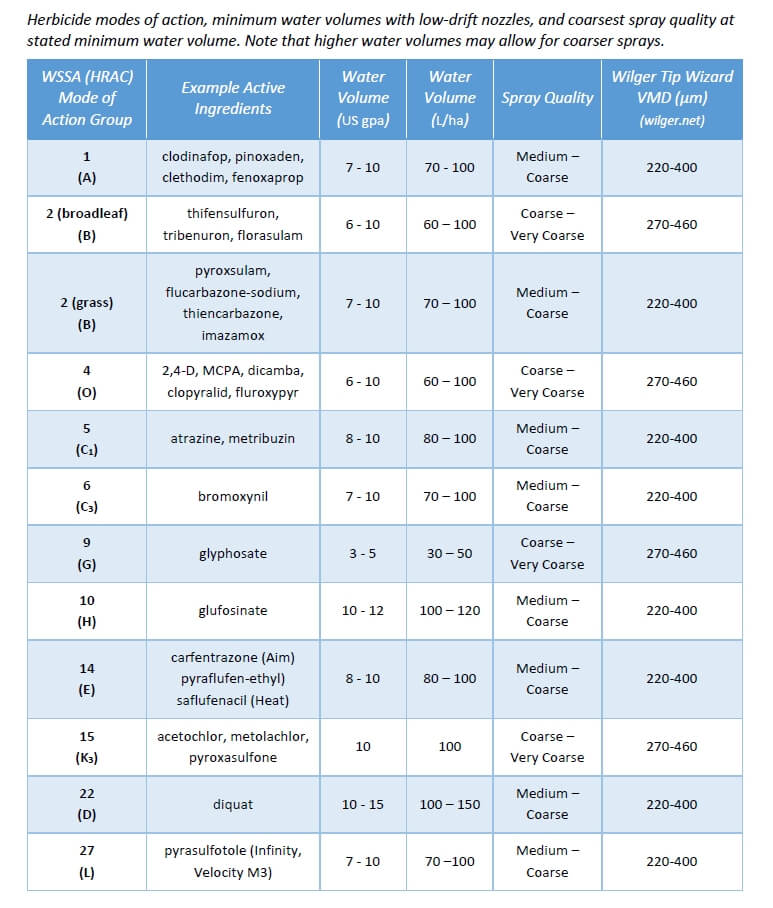
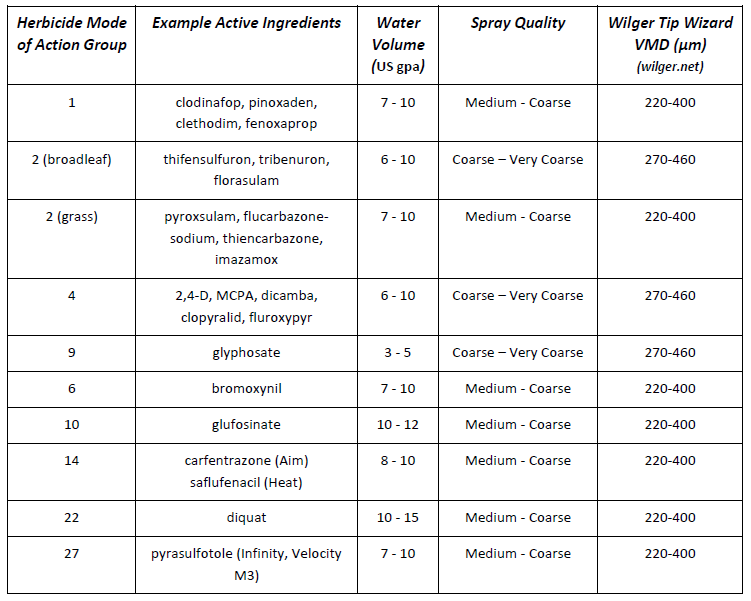
Below are some recommended spray qualities and water volumes for use in Canada. The spray qualities listed in the table can be matched to a specific nozzle by referring to nozzle manufacturer catalogues, websites, or apps. Note that Wilger also offers traditional VMD measurements on their site, allowing users to be a bit more specific if necessary.
A version of this article was originally written by @nozzle_guy as a guest blog for Farm At Hand, and is reproduced with permission.
One of the smartest decisions a grower could make is to consider a late-season harvest-aid application. Particularly in years with thinner stands, weeds can maintain a foothold. Late season moisture can give new life to late emerging plants or branches. When the crop is ready to cut, this could mean all sorts of cutterbar, pickup reel, feederchain, and sieve headaches.
A desiccant or pre-harvest herbicide application can help avoid those problems. The challenge is to get the spray into, or through, a mature crop canopy. Here are some pointers to do it right.
Evaluate where within the canopy the spray needs to go to do its job. If you’re considering a pre-harvest herbicide, are you looking to control dandelions or buckwheat near the bottom of the canopy, or are you trying to get thistles or quackgrass, whose leaves are near the top? If you’re mostly trying to accelerate drydown with a contact product, where in the canopy are the green stems and leaves that you need to contact?
Take a bird’s eye view of your canopy. That’s how the spray sees it. If you can clearly see your target, the spray application is pretty straightforward because most droplets will make their way there easily. But if the target is obscured by a lot of foliage, or if it’s vertical, the job is much more challenging and will require some combination of more water, slower speeds, angled tips or finer sprays.
To hit plant parts that you can’t see, one of the main tools is finer sprays. The smaller droplets have an easier time changing direction to get around obstacles like leaves, and they are also much more likely to be intercepted by petioles and stems, and to stick to them. This can be both an advantage and disadvantage – for example, the awns in bearded cereals are notoriously effective at capturing the smallest droplets before they can do any good further down. If you don’t want to install a different nozzle to get a finer spray, simply increase the spray pressure of your low-drift nozzle to 80, 90, even 100 psi. This will create enough fine droplets. But don’t expect the higher pressure to push the spray into the canopy. Only air-assist can do that.
To get more spray deeper into the canopy, slow down, add water, and point nozzles backward. The backward orientation helps offset the forward travel speed, giving the droplets a slower net forward velocity that helps their downward movement.
If you’re using contact products like diquat, paraquat, saflufenacil or carfentrazone, use generous amounts of water, and slightly finer sprays. Make sure that spray drift control remains a priority and pay attention to water quality.
Test your water and make sure your water doesn’t have turbidity (suspended clay or other organic matter), for glyphosate and diquat or paraquat, and hardness, for glyphosate. Aluminum sulphate can help get rid of turbidity in a pond, but it takes time (treat turbid water at least 24 to 48 h before you need it). If treating a storage vessel, expect a layer of sediment. Ammonium sulphate (AMS) and other water conditioners can remove antagonizing hard water ions like magnesium and calcium. This is especially important as we increase water volumes with glyphosate to get better coverage. The higher water volumes give a concentration advantage to the hardness minerals.
Diquat and paraquat’s mode of action benefits from being applied in the evening. The absence of the sun allows it to be taken up and slightly moved (by diffusion, not true translocation) within the leaf before morning sunlight activates it. Once activated by the sun, these products exert their activity and movement stops. If you’re not careful, the tighter window of evening-only applications could get you behind. And of course, be aware of the signs of inversions and know when to quit.
Plan ahead and make sure you give yourself enough time, because to do the job right you’ll be using more water and driving a bit slower. Focus on productivity tools like a fast, efficient fill to make up the lost time.
A good job with a pre-harvest herbicide or a harvest-aid can save many harvesting headaches, and can help dry down during less than ideal conditions. It’s another reason why the sprayer may be the most important implement on the farm.
“What is the right way to apply this pesticide?” It’s one of the classic questions. Applicators know that spray method determines the efficacy of the application as well as its environmental impact. And it has to use time and water resources efficiently to make sense.
To answer the question properly, we need to take things one step at a time.
Canopy: To start, we need to look at the canopy that our application will go into. If it’s an early season spray into a seedling crop, then the canopy won’t be much of a barrier. Lower water volumes can be possible. Droplet size will only depend on the target type and the pesticide mode of action.
Small weeds require more smaller droplets to secure effective targetting
If it’s a later application into the bottom of a maturing canopy, the foliage may intercept the spray before it reaches the target area. More water will likely be needed, and droplet size may become more critical for getting the spray to its destination. Dense canopies are a real challenge and lower-canopy deposition usually benefits from finer sprays because the small droplets can turn corners better.
Dense canopies are very difficult for a spray to penetrate. Higher water volumes and smaller droplets are the key tools that help.
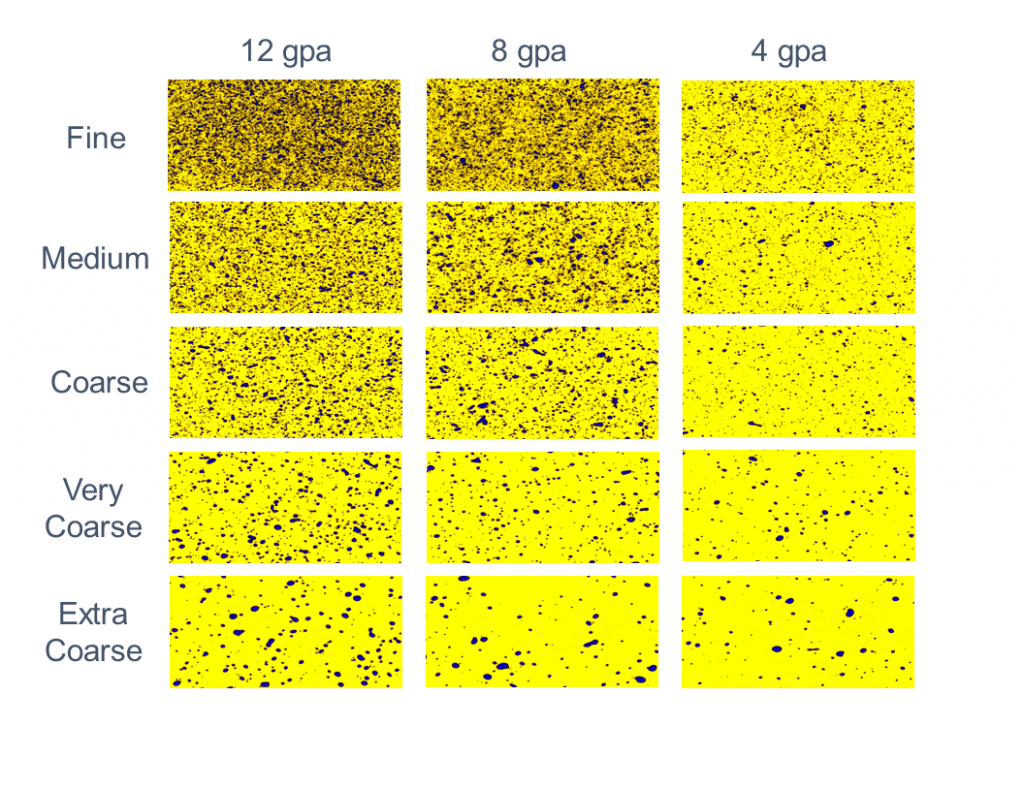
2. Water Volume: Regardless of canopy, the range of application possibilities will depend on the water volume and spray quality combination. It’s math: assuming some constant amount of coverage on each leaf, more layers of foliage will require more water. Using less water volume will make it necessary to use finer sprays to keep droplet numbers constant. More water will allow coarser sprays. This decision has implications for drift, and by extension, affects the number of hours we can spray in a day. More drift tolerance means better application timing and overall productivity.
The tradeoffs between water volumes and droplet sizes are seen in this figure. Once a certain threshold of coverage has been reached, a further increase in coverage may not provide any additional control.
3. Target Type and Droplet Behaviour: Whatever spray we use, the target plant or insect needs to intercept, collect, and retain the spray droplet. This is where the fun begins. Target leaves may be vertical or horizontal, large or small. Their waxy surface may be easy-to-wet or difficult-to-wet. The general rules of thumb are that larger, more horizontal and easy-to-wet surfaces are better suited for coarser sprays – these are intercepted more efficiently and stick readily. That is a reason why most broadleaf weeds and crops are very compatible with low-drift sprays.
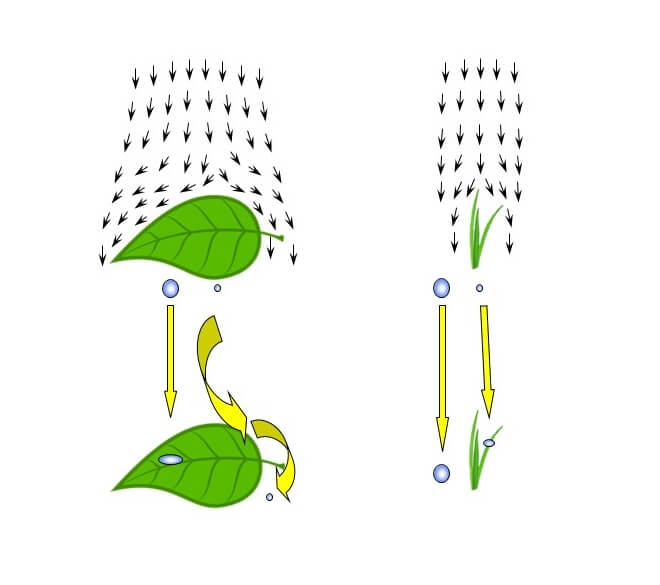
Large targets (left) are most efficient at intercepting larger droplets (provided droplet bounce is not a problem) because smaller droplets may evade capture. Smaller targets are usually missed by larger droplets but are very capable of capturing smaller droplets.
On the other hand, smaller, vertically oriented and difficult-to-wet plants require finer sprays for effective targetting. Larger drops tend to miss these targets or bounce off them. Most grassy, and some broadleaf weeds (especially at early growth stages) fall into this category.
4. Mode of Action: There are nearly 30 modes of action on the herbicide world, and another ten modes for insecticides and fifteen for fungicides. The effect of droplet size and water volume on their uptake and translocation varies, and it’s probably not correct to generalize too much. There is one notable product, glyphosate. For this product, research has consistently shown that large droplets and more concentrated mixtures provide better uptake. But we’ve also seen problems when this is over-done, causing localized toxicity and limiting translocation.
With many products, we’ve sometimes seen better performance with finer sprays due to improved coverage, yet at other times less performance due to rapid evaporation. On the whole, it’s probably still fair to say that contact modes of action require finer sprays and higher water volumes, even if there is the occasional exception. And systemic products can typically handle coarser sprays. We’ve always been surprised just how coarse we seem to be able to push the system before any loss of efficacy.
What does it all mean? In spraying, we need to accommodate a lot of diversity. The average application is broad-spectrum, targeting large and small broadleaf and grassy plants. Many sprays are tank mixes of several modes of action. It’s impossible to prescribe a specific spray for each situation. We need a little bit of everything. And the spray should not be drift-prone. It’s easy to see that we need to aim for the middle to accommodate everything.
The traditional flat fan nozzle, either in its conventional or low-drift form, generates a wide range of droplet sizes that can range from 5 µm to about 2000 µm. If we need fine droplets, they’re there. If we need larger droplets, they’re also there. The proportion of the total spray volume in each specific size fraction depends on the nozzle choice and size, the spray pressure, and the adjuvant mix in the tank. Overall, the system is very robust, and although it requires some tweaking, a well chosen average spray can achieve most tasks well enough.
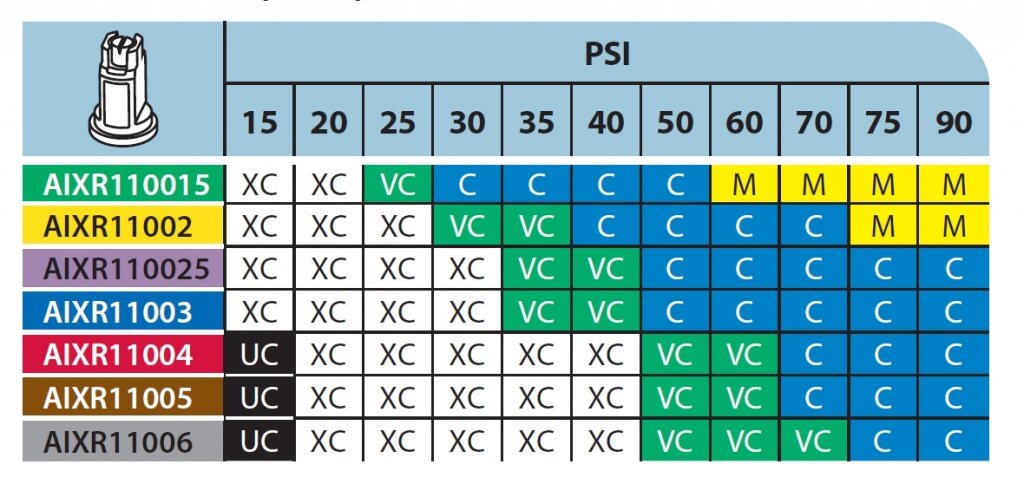
A typical spray quality chart shows the expected spray quality for a range of nozzle sizes and pressures. Spray quality measurements follow standards set by the ISO and ASABE, these change from time to time and therefore charts tend to become outdated.
Our research has repeatedly shown that a Coarse spray is a good starting point that does most things well. It is acceptable to move into a Very Coarse or coarser category provided water volumes are also raised, and provided the target types and modes of action are suited for this change.
It is rarely necessary to spray finer than Coarse, and when this is done, we recommend against spraying finer than a Medium spray. There is simply no advantage from product performance, and drift risk becomes unacceptable.
Tweaking the System. In order to maximize the performance of your spray, and the efficiency of your overall spray program, here is some advice:
Know the spray quality of your nozzles, and their response to spray pressure. Manufacturers publish this information in their catalogues and on-line. Make this your homework assignment.
Use the coarsest spray that you can afford to. This will make the application safer, it will widen the weather window, and it will simply let you get more done in a day or a season. Coarse sprays work.
Use spray pressure and water volume to fine tune the application for a specific purpose. If using a contact product, you can keep the same nozzle you used for a systemic product. Apply more water or use more spray pressure to generate more droplets.
Do not skimp on water. Higher water volumes tend to make an application more uniform, robust, and crop-safe. Spray coverage improves. Canopy penetration improves. Coarser sprays are possible. The only exception to this rule is glyphosate, which works better in lower water volumes. But with higher glyphosate rates and more tank mixing, even that exception is disappearing.
Learn as much as you can about how your pesticides work and where they need to be in your canopy. Apply your knowledge to select optimal water volumes and spray qualities.
Be wary of people who advise very low water volumes in conjunction with fine sprays. They want to appeal to your need for efficiency, but do so at the cost of consistency and environmental stewardship. Plus these types of applications are illegal for many of our products.
Low water volumes can mean less effort to apply pesticides. But there is a limit to how low water volumes can go before problems appear. To understand the reasons why, and help applicators use the right volume for a given situation, we briefly outline what happens to a spray cloud as it reaches the crop canopy.
Basic Principles
To choose the right water volume, we have to remember three criteria for sprays to be effective.
First, the spray must reach the target.
Second, there must be enough droplets to sufficiently cover the target.
Third, the droplets have to be in a form (size and pesticide concentration) that allows the pesticide to be efficiently taken up by the target.
Reaching the target
Let’s start with the first criteria, reaching the target. Droplet size is important for minimizing both spray drift and droplet evaporation. Small droplets move off-target easily, they also evaporate to dryness very quickly and may not have the expected performance as a result. Larger droplets clearly reduce drift, but may bounce off the target and offer less coverage per water volume.
Droplets of various sizes are actually important to cover all parts of a target, so we shouldn’t eliminate all the small ones. For example, penetration of dense broadleaf canopies, or coverage of small targets like stems is best achieved with smaller droplets, while larger droplets are useful for penetrating grassy canopies or targeting the top of a broadleaf canopy.
Target coverage
We need to get the right number of droplets to the target. The more leaf area to be covered (i.e., the taller or denser the crop canopy), the more droplets will be required. Leaf Area Index (LAI), defined as the total leaf area per unit ground area, is a good indicator of canopy density.
To put this in perspective, consider a pre-seed burnoff or an early post-emergent herbicide spray vs. a late season fungicide. In the first case, the canopy can be described as being in a single plane near ground level, with leaf areas of target plants fully exposed and with an LAI of <1. High droplet density on the leaves will be achievable with relatively low volumes.
In the second case, the canopy will have more depth, and will contain large leaf areas in each of the lower, mid, and upper canopy regions, with LAI >>1. Providing the same droplet number to each of the regions in the second case will require more droplets, and therefore more volume.
Taken as a whole, the exclusive use of finer droplets can be counterproductive due to evaporation and drift. Higher water volumes have the advantage of allowing larger average droplet sizes to be used, minimizing evaporation, drift, and enhancing deposition.
Deposit efficacy
The third criteria, maximizing the performance of specific pesticides with droplet size, is more complicated. Typically, contact modes of action and grassy or difficult-to-wet targets require somewhat finer sprays and higher water volumes (Table 1). With tank mixes, such as glyphosate and Heat or AIM, the higher water volume and finer spray criteria should be used. For any specific herbicide, use the higher volume with coarser sprays.
Table 1. Herbicide modes of action, minimum water volumes with low-drift nozzles, and maximum spray quality
In practice, an applicator rarely encounters just one type of targeting situation. Most herbicides are either broad-spectrum, or are tank mixed to target both grass and broadleaf weeds. As a result, the same spray operation has to be effective on grass weeds and broadleaf weeds, some of which may be near the top of the canopy, or be more mature, whereas others may be just emerging. In these cases, a number of different droplet sizes will be required.
Low-drift nozzles
A low-drift nozzle can be used for most applications, as long as small adjustments are made for specific conditions. Increases in pressure above 60 psi (for finer droplets, Medium to Coarse spray quality) and volume to at least 7 to 10 US gpa (for better penetration) with this nozzle optimizes performance for grassy weeds. Lower pressures (down to 40 psi, Coarse to Very Coarse spray quality) are sufficient for systemic broadleaf products or when additional drift control is necessary. Higher volumes (12 – 15 US gpa) may be needed to obtain coverage in dense canopies. Always check with nozzle manufacturer information to learn what spray quality is produced by the nozzle you’re using – this will vary with nozzle type, flow rate, and spray pressure.
Droplet sizes in sprays
All nozzles produce a wide variety of droplet sizes ranging from 5 µm to 1000 µm in diameter. The main difference between sprays is the proportion of their volume in any given size fraction, with low-drift sprays having less of their volume in the drift-prone sizes.
Size distribution (by volume) of two spray qualities. Not that both of these sprays contain small and large droplets. The difference is the volume (=dosage) in each of these size fractions. Shaded areas highlight drift-prone droplets (left) and bounce-prone droplets (right).
But even low-drift nozzles produce small droplets, and these provide sufficient coverage in most cases. Low-drift sprays do create more larger droplets, and these do not contribute to coverage due to their relatively low number and poor retention.
Our main tools for droplet size selection are spray pressure (higher pressure reduces droplet size) or nozzle choice.
Spray Pressure
Higher pressures are sometimes thought to increase canopy penetration because they force the spray into the canopy. This is not true. While higher pressures create faster moving droplets, this speed quickly diminishes. By the time the spray enters the canopy, the faster velocity is lost, especially for the smaller droplets, and the only effect that remains is the finer spray. Finer droplets will penetrate many canopies further, but only if they are protected from wind. On a windy day, the finer sprays are more likely to blow downstream, or perhaps evaporate. The main benefit of higher pressure is better operation of the nozzle, especially air-induced nozzles, leading to more uniform patterns and better overall results.
Large Droplet Advantages
Although coarser sprays are often thought to work less well, they offer certain advantages.
One advantage is that a coarser spray tends to provide the air assist mentioned above (dragging air into the canopy, and giving smaller droplets a greater chance of moving where they’re needed).
Larger droplets also take longer to evaporate, increasing opportunities for uptake and translocation within the plant.
Larger droplets are more efficient at targeting the exposed, large leaves of plants requiring disease protection, leading to greater deposition and fungicide performance.
Most importantly, coarser sprays produce less drift, enabling application under windier conditions and thus ensuring that the timing of the application with respect to the crop or disease stage can be optimized.
Water Volume
Higher water volumes are the single most effective way of increasing dense canopy penetration. Higher volumes will deliver a greater number of droplets to the lower canopy, leading to greater performance when lower canopy coverage is of importance. When used in combination with lower travel speeds, the downward air flow created by sprays can provide significant benefits in forcing the smaller droplets further down. Larger volumes also decrease sensitivity to droplet size, permitting coarser sprays that reduce spray drift.
Nozzle Angling
Research has shown that exposed (upper canopy) vertical targets such as heads or stems will benefit from an angled spray. Forward-pointed sprays offer a slight advantage over backward-pointed sprays. Since angled sprays must maintain this trajectory to be useful, it is recommended that coarser spray qualities be used to minimize fine droplet production. Angled fine droplets will quickly deflect from their initial angled path and move with prevailing winds. Low booms heights also help in maximizing the benefit of angled sprays. Canopy penetration has not been shown to be improved with forward angled sprays, but backward angled sprays can help place some spray deeper into grassy canopies.
Broadleaf vs Grassy Canopies
How can an applicator decide the most appropriate water volume and spray quality for a specific application scenario? The following guides should help.
First determine the canopy density and form (broadleaf or grassy), and the target site within it (upper, mid, or lower). If the canopy is dense, but fairly vertical (i.e., a cereal), and a significant portion of it needs to be protected, the best strategy is to apply a higher water volume using a reasonably slow ground speed to allow the spray’s built-in air assist to work. If, on the other hand, only the upper layer of leaves, or the heads, are to be targeted, slightly less water can be used. If the water volume is appropriately high for the canopy, larger droplet sizes do not significantly diminish coverage or pesticide performance.
If the canopy is dense but more horizontally oriented (broadleaf crops), similar rules apply for water volume and travel speed, but now the use of a somewhat finer spray may be of benefit. The smaller droplets will be better able to move around and through the leaves to reach deeper into the canopy. Ensuring a downward trajectory of the spray through travel speed and water volume selections will be important.
Nozzle suggestions
A very good starting point for a conventional rate-controlled sprayer is any one of the low-pressure air-induced tips that now form the majority of the market. These tips are similar enough in terms of pressure range (30 – 100 psi), spray quality (Medium-Coarse-Very Coarse, depending on pressure), and spray pattern fan angle (about 100 degrees) to have comparable performance with most pesticides. Such tips are best operated in the middle of their pressure range, which is about 50 – 70 psi, offering some room to move as travel speeds change.
For those with Pulse-Width Modulation (PWM), where most air-induced tips cannot be used, nozzle choice is more limited but growing