Tag: nurse

  • Drone Tendering – Considerations before Buying or Building

    Drone Tendering – Considerations before Buying or Building

    Much of this article is based on a session and tradeshow I attended at the 2026 Drone End-User Conference in Kansas City. I want to acknowledge the insightful information provided by the three session speakers, as well as the ~200 audience members that asked honest questions and shared their experiences. The speakers were Mr. Chase Plumer (Owner, ProBuilt Fabrication/ProDrone Spraying & Seeding, Seymour, IN), Mr. Klaytin Hunsinger (Owner, Hunsinger Ag Solutions, Rossville, IL) and Mr. Kyle Albertson (Owner, Albertson Drone Service LLC, Benton County IN).

    Tendering systems

    Drone-based crop protection is a rapidly growing industry and operator experience spans from novice to veteran. It follows that tendering systems are not a one-size-fits-all proposition. The best fit will be a configuration that is budget-conscious, reflects the size and nature of the operation, and accounts for future needs.

    We can categorize them by their complexity, cost and capacity.

    Entry-level tendering system: A starting point

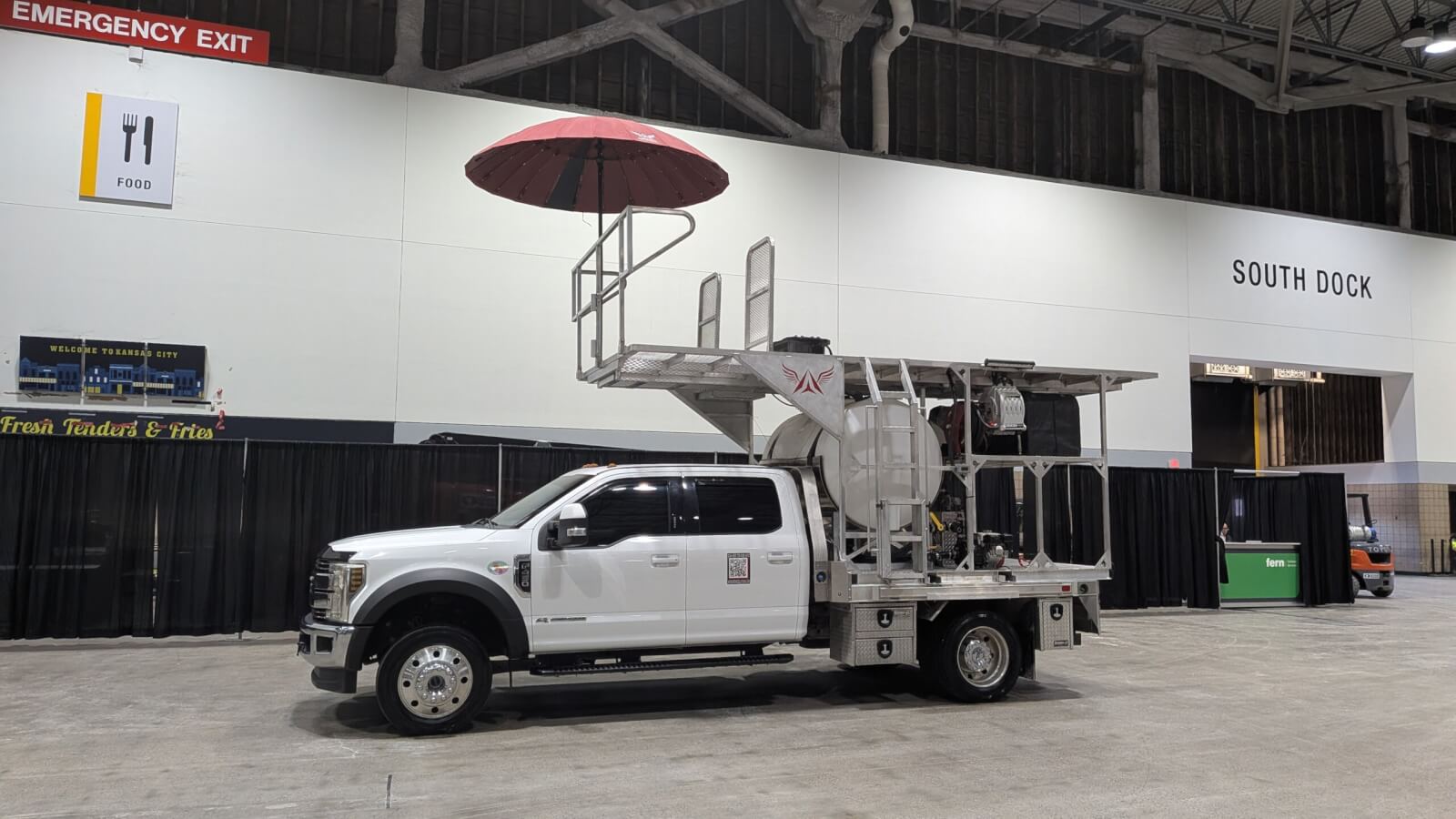
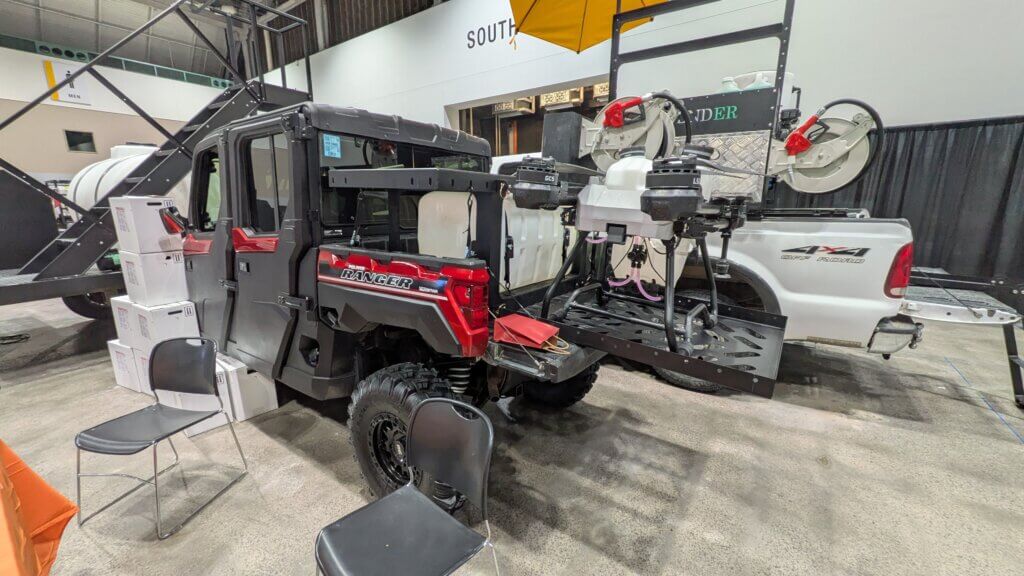
    For those just getting started, focus on affordability (lower initial investment) and simplicity (basic components). Examples include skid or truck builds, which are removeable or permanent systems that either rest on a vehicle bed or are built on-and-around the vehicle. This is an operator-friendly system that is small and portable for easy access to diverse fields. It’s the least durable configuration, and not particularly efficient or upgradeable, but it will serve until you know what you really need and how you like to work.
    Mid-level tender system: Second year

    By year two, you might want a larger and more efficient configuration with additional storage and a few creature comforts to reduce operator fatigue. A truck build might suit, but this is more likely a trailed system that is still capable of being towed by a mid-sized (1/2 to 3/4 tonne) truck. Some operators feel enclosing the trailer reduces efficiency, while others appreciate the security and protection afforded by defined spaces.

    A mid level system has some capacity for modification, but isn’t designed to support multiple drones, and likely won’t have enough capacity to store a day’s worth of water, chemical, or fuel. The operator may wish to detach the truck to run for supplies. Or perhaps it makes more sense to run a truck with a skid-mounted tender system that trails a second, mid-level system to divide-and-conquer, or scale up for larger projects.

    Beware going too big, too quickly. A 30-foot gooseneck can get caught on hilly terrain, where a 20-foot flat bed with a straight truck might be better suited. Small to mid-size trailers also take less time to set up and tear down. Consider performing site recon before dispatching a mid-level tender system. This is an additional step, but it allows the operator to scope out potential hazards and is ultimately more productive because it prevents tender systems getting stuck or placed in inefficient or unsafe locations. For example, if a client is “plant-out, pick-in”, the fields are hard to service because there’s no way to access them with large vehicles. Pilots become landscapers, spending valuable time clearing an operations area.
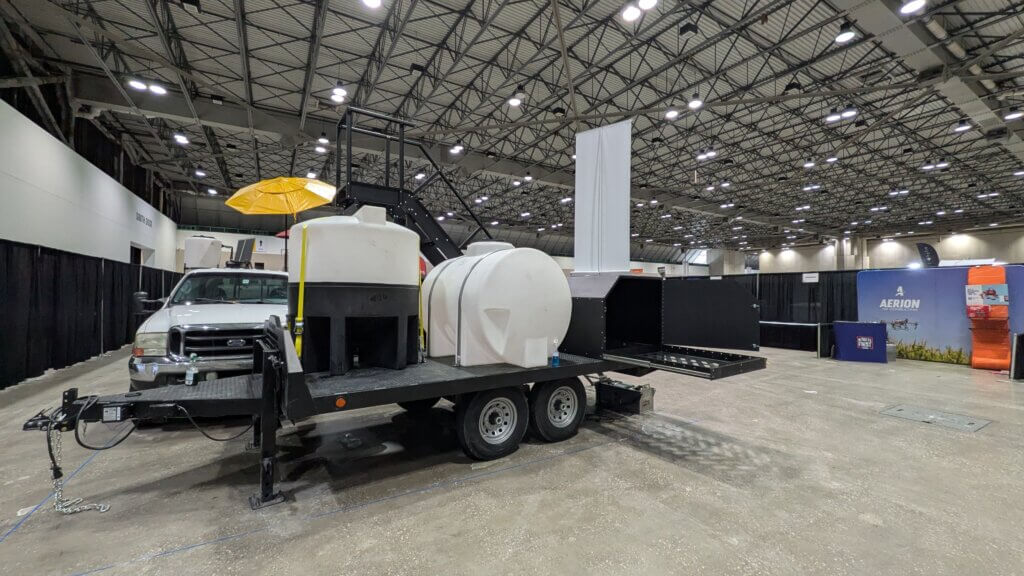
    High-level tender system: Large scale and Commercial interests

    Made for efficiency, the limiting factor of this system is the drone’s productivity. This category is comprised of the largest gooseneck trailers, which may include an upper deck and enclosed areas. It has the highest capacity for water storage, can service multiple drones and has ample storage. Intended for large fields, the size of this unit can make it physically incapable of reaching smaller fields. While a one tonne truck might be able to tow it, an even larger vehicle might be more suitable. It may also be prohibitively inefficient given the time required for setup and teardown. Consider an operator that requires a 15 minute start-up and a 15 minute teardown to spray 250 acres at 50 ac/hr; At $20/ac, that’s roughly $500.00.
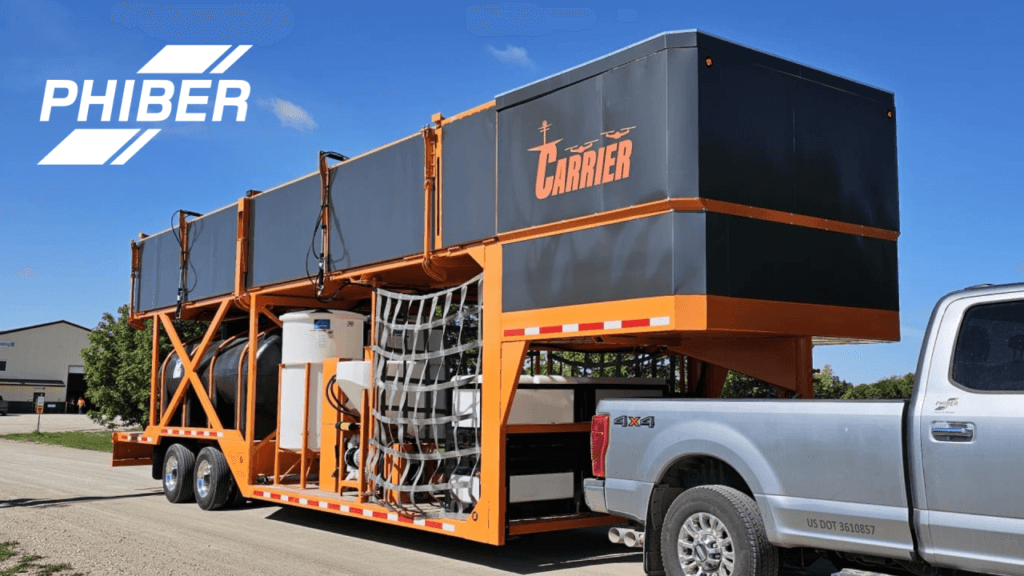
    Phiber’s DASH Carrier (image from website)

    Components

    Fundamentally, each tendering system has the same function, so they share the same basic components. Here’s an overview of common features and considerations.

    Trailer

    The trailer is (literally) the foundation of most tendering systems. Operators suggest building for your current budget but planning for future needs as best you can. Trailer size should reflect the nature of the farms you will be servicing and how best to access them. You should also consider the safest and most efficient workflow on and around the trailer before committing to a layout.

    Option 1 – Utility trailer

    AdvantagesDisadvantages
    Easy to get on/offLow ground clearance
    Less expensiveNarrow footprint for accessories (e.g. conventional tanks not fitting between wheel wells)
    Versatile (use for drones on season, and other tasks off season)Narrow if planning a top flight deck
    May be an insufficient trailer GVWR (Gross Vehicle Weight Rating). This is the maximum allowable total weight of a trailer when fully loaded.

    Option 2 – Flatbed gooseneck trailer

    AdvantagesDisadvantages
    More room for accessoriesMuch heavier. ¾ tonne truck likely not sufficient.
    Better ground clearanceHard to get into tight places (length dependent).
    Higher GVWRSet up / Tear down takes longer
    Potential for top flight deck. Typically, 102” wide, so top deck can be about the same.

    Option 3 – Enclosed trailer

    AdvantagesDisadvantages
    Protection from weather and elementsLimited clearance for large drones (e.g. 24’ long, 8.5’ wide)
    Increased security for equipmentHighest GVWR
    Could serve as mobile workspace / officeMost expensive
    Cleaner environment for charging batteries, and generators don’t need maintenance (e.g. filters changed) as often.Can get hot inside, both for people and battery overheating. Airflow on batteries is a necessity, and fans can only cool to ambient. Drone hasn’t got time to cool between fields.

    Vehicle

    Based on operator discussion, it seems many have a tendency to push their trucks to the limit… or beyond it. One operator uses a ¾ tonne truck to pull a 22-foot trailer with an upper deck. Another uses a 1 tonne (aka tonner) gas F350 which struggles to pull a 30-foot trailer. Others recommended the use of a single axle semi (e.g. a Kodiac or a Kenworth T300), which even used still has ample life left in it, and at ~15 to 17,000.00 USD is cheaper than buying a truck.

    Consider that if you run a two-person operation, you may want more than one vehicle. A smaller truck can be employed to run for parts or fuel, or as previously noted can be fitted with a skid mount and a 1,300 gal. poly tank to split up the duty.

    Tanks

    Tank size(s) will depend on how you choose to operate, how many acres you plan to do in a day, and the weight capacity of your truck and trailer. Again, there is no one solution, so consider the following scenarios before you commit.

    If you plan to hot load, perhaps you’ll just mix in a single, large tank. However, if you plan to switch between insecticides, fungicides and herbicides, one or two 100-gallon cone-bottom tanks with wash-down nozzles might make more sense. Then, you can carry clean water separately in a few repurposed IBC’s or go for the efficiency of a single, high-volume poly or stainless tank. Consider the most flexible and efficient arrangement.
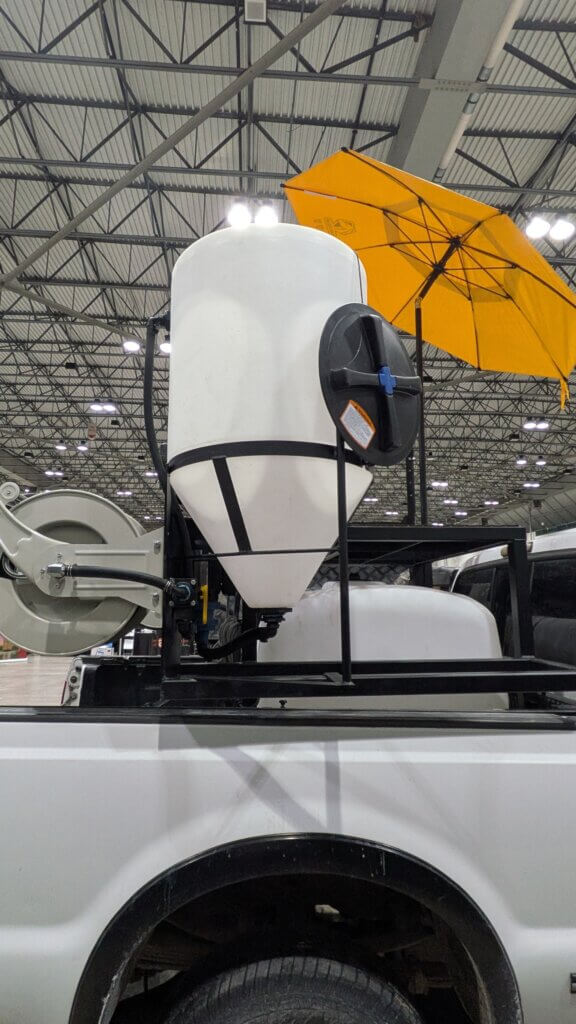
    Will you have access to water, will you have water tendered, or will you carry enough for the day? Will you fill from a 3-inch connector or suffer the lost time and fill with a garden hose? Will your truck and your trailer handle that weight, and will the vessel(s) fit between the wheel wells? Are the tanks black or shaded to prevent algae and do you have a plan to baffle the volume, so it doesn’t slosh when you drive over uneven terrain? Larger poly tanks (e.g. ~1,000-gallon tanks) have spots molded in to accept baffles, but some operators noted it’s difficult to install them after-market. Slosh suppressors such as floating balls or lengths of poly French drain can help.

    Pumps and Lines

    While some prefab trailers offer pneumatic pumps, most must choose between electric and gas pumps, and there are pros and cons to both.

    Electric PumpGas Pump
    Low noiseHigh noise
    No exhaustExhaust
    Taxes the generatorDoes not tax the generator
    No fuelRequires fuel
    Low maintenanceRegular maintance
    May limit head pressureAmple head pressure

    Gas-powered pumps (e.g. Drummond or Predator transfer pumps) are relatively cheap, but some claim they have a high failure rate. This not only incurs downtime, but operators must deal with the chemical in the pump and lines during repair.

    Electric may be a better choice, if only to avoid the noise and exhaust, and some operators run them continuously to recirculate chemistry when not filling a drone. Consider the horsepower, gallons per hour and head pressure, especially if you are pushing flow to an upper flight deck.
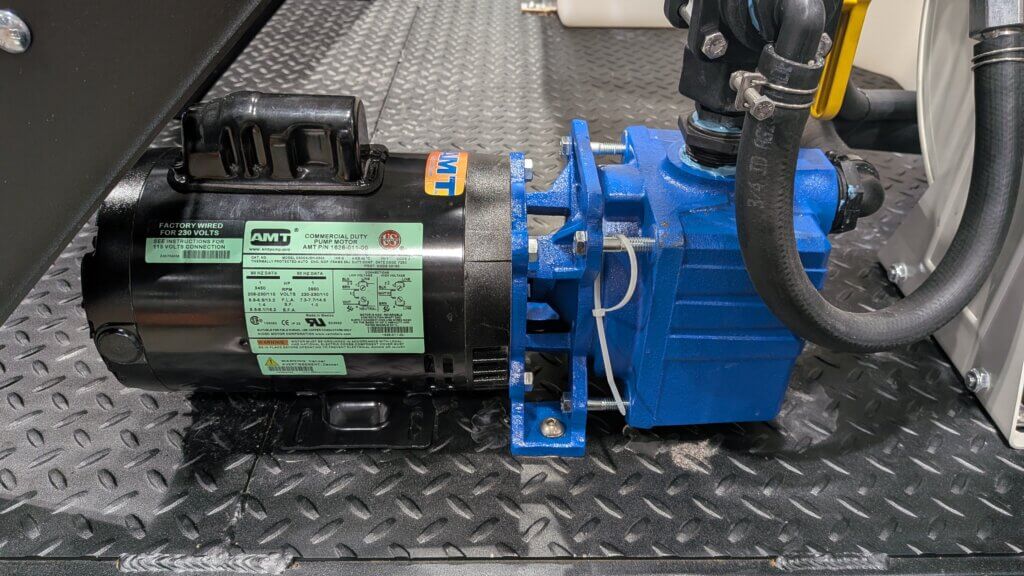
    An AMT electric transfer pump on a mid-level tender system.

    You should be able to fill a drone in about a minute. Some operators have begun increasing fill line diameter from 1-inch to 1.5-inch but feel 2-inch lines are too heavy to warrant the few seconds saved during filling. This may not be a limitation, however, if they are part of a top flight deck arrangement, and not dragged along the ground.

    The auto shutoff function of a fuel-pump-style filler is preferred over a quarter-turn-style. The former contributes to foaming but some operators say that can be mitigated by using an anti-foam adjuvant and it’s less likely to create an overflow situation.

    Perhaps a metered flow valve that shuts off once a predesignated volume has been dispensed would be a workable solution. This would preserve speed, but without foaming or potential overflows.
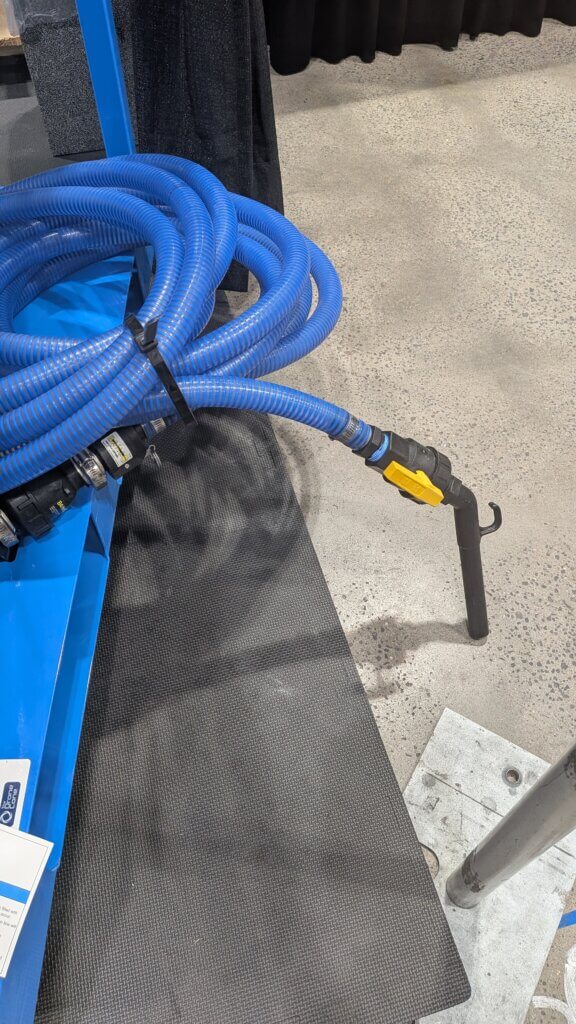
    A loose line terminating in a quarter-turn valve fills quickly and with few bubbles, but is ultimately not ideal. It’s prone to causing overflows which increase the potential for operator exposure and cause point source contamination.
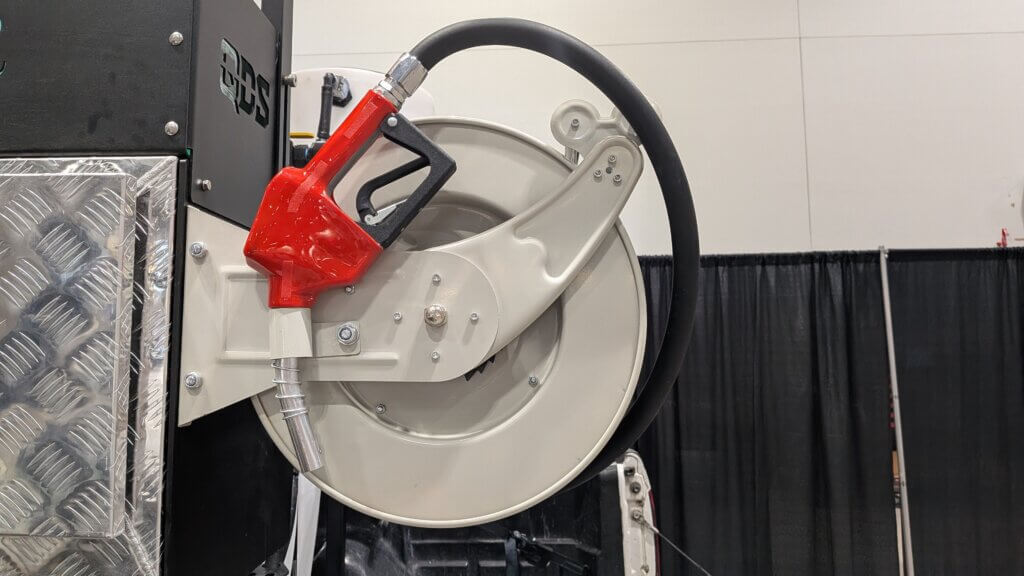
    A reeled hose and a fuel-pump style filler is a better approach. The hose can be recoiled to keep it from being underfoot, and the filler has a back pressure valve that shuts off when the drone is full. There is greater potential for foaming, but some suggest anti-foam adjuvants can help.

    Generator

    This proved to be a controversial subject at the conference. Many operators were unwilling to promote a single make or model, but the discussion resulted in some general guidance based on personal experiences. Generators will have a peak and a continuous performance rating. Ensure the sum total of all your draws does net exceed the continuous rating.

    Drones are getting bigger, and the number of electrically powered devices on the trailer is increasing. Smaller operations tend to employ mobile gas generators that produce less than 10 kW. Larger operations reported using 30 kW (or more) diesel standby generators to charge two drones, plus accessories, while ensuring room for future growth.

    A mobile gas generator (inverter or not) tends to be the cheaper, lighter alternative, depending on the wattage. They are a good choice for entry level systems and with regular maintenance will last longer, but are still a short-term proposition. Diesel generators tend to be more expensive, but are quieter, more fuel efficient and more reliable. A liquid propane standby generator is yet another option; Generally cheaper than diesel, consideration must be given to the weight and size of what is typically a 250-gallon propane tank.

    A few points raised by operators during the discussion:

    • Most standby generators do not need diesel emission fluid, while mobile generators do.
    • Many operators prefer the durability of mobile generators over standby generators. The former is built to be moved while the later presents issues with brackets, mounts and stators.
    • Warranties are advisable for inversion generators, as they are not easily repaired.
    • Standby gas generators (10 kW continuous / 13 kW surge) may require you to downrate the battery charger, or the heat can trip the breakers. It is not advisable to bypass breakers.

    Storage

    Storage is often overlooked but can be critical to efficiency. For example, if you plan to spray six, 50-acre farms in a day and it takes 10 minutes for set up and 10 for tear down, that’s two hours gone. Consider what you’ll need and where you’ll need it, and place storage accordingly to minimize downtime. PPE should be located near your flight deck or filling area. You’ll also want to consider carrying spare parts, such as an electronic speed controller, motor, pump and a full set or rotors.

    Batteries

    Some battery chargers feature water baths, misters or air conditioning, but at bare minimum batteries should charge in the shade and in a ventilated area (e.g. not enclosed in a storage or tool box). One operator vented air from a commercial blower fan to the batteries on the top flight deck.

    Connectivity

    A hotspot on your cellphone doesn’t always provide reliable service. Satellite internet providers such as Starlink or Xplore (depending on your location) might be a solution. If the controller drops a direct signal to drone, it can bridge to satellite to connect to the SIM card in most drones. Operators that use this system advise it’s best to rent the hardware (if possible) so if something damages it, you get a free replacement. 100 gb of monthly roaming has proven more than enough for most operators.

    Mounting solutions vary, but operators noted good experiences with companies such as Veritas Vans, which have a replacement policy. They warn against 3D printed options that tend to be produced using unsuitable filament materials. Operators that use magnetic mounts on their trucks have reported no issues. Some run wire through rear window or sliding door, and others pull the headliner down and run the power cord out through the third brake light.

    Operator safety

    Lastly but certainly not least, when it comes to the cost-benefit assessment of tender features, safety should always be a priority. Even simple comforts such as folding chairs combat operator fatigue, increase safety and happily also improve overall productivity. We’re none of us getting any younger.

    RV awnings, umbrellas, foldable Bimini-style tops or flip-up doors provide shade. Switching to lower-decibel equipment (e.g. inverter gas generators run at about 90 decibels and electric pumps are even quieter), enclosing loud systems, or positioning them far from the filling area, reduce noise and emission exposure. Chemical drift and exposure during filling should be considered, and PPE should be used and stored in convenient locations.

    Trailers that feature an upper flight deck sometimes include a central cable to tether belt harnesses. Stationary railings can help prevent falls, while a fold-up version provides clearance when backing the trailer into a shed.

    The drones themselves are a hazard. Long flight decks keep landings and lift-offs at a safe distance, and a protected cockpit area improves matters. Decks with pull-out platforms or hydraulic wings can increase the operating area and can be adjusted to account for adjacent roads and the slope of the ground. A short rail around the landing area can prevent a drone from slipping off; A falling drone is expensive, but falling or sliding into an operator is a disaster. The simplest approach might be to operate on the ground.
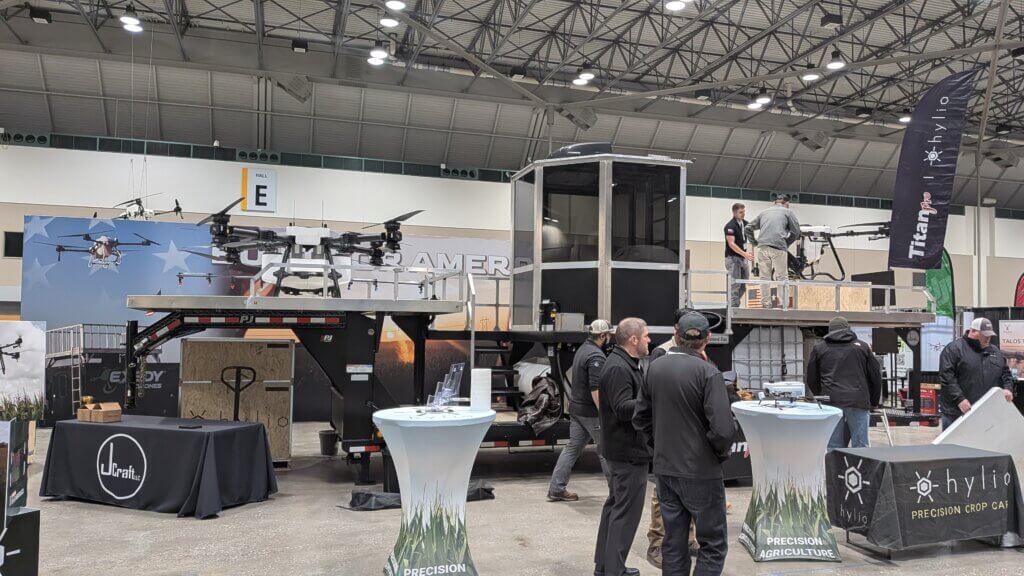
    An enclosed area for operators on a two-platform gooseneck trailer.
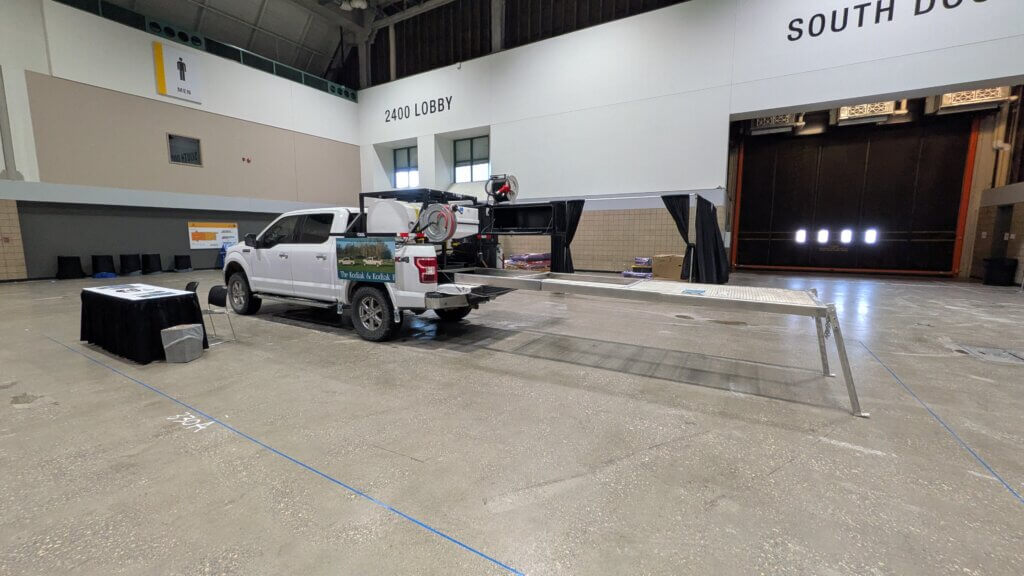
    Kodiak’s retractable flight deck on their skid-mounted system

    Take home

    The speakers left the session with some summary advice.

    • Trailer first, equipment second.
    • Build for today and tomorrow.
    • Function over form (stability, balance and access over appearance, bearing in mind that if it is a business, it can’t look terrible, either).
    • Efficiency from day one. Run a stopwatch (when the crew isn’t watching). Find and change the limiting factor, if it’s changeable. The right trailer improves efficiency even before the first acre is sprayed.

    Thanks to the many speakers, attendees and trades people that contributed to this article. If you want to share pictures and specs for your tender system, let us know! If we get enough interest we’ll publish an article showcasing your tender systems so others can learn from your experience.

  • Sprayer Nurse Truck Designs Part 2

    Sprayer Nurse Truck Designs Part 2

    One of our recent posts highlighted some great producer designed tender systems for the sprayer.  We posted four submissions, and are continuing the series with new submissions in this post.

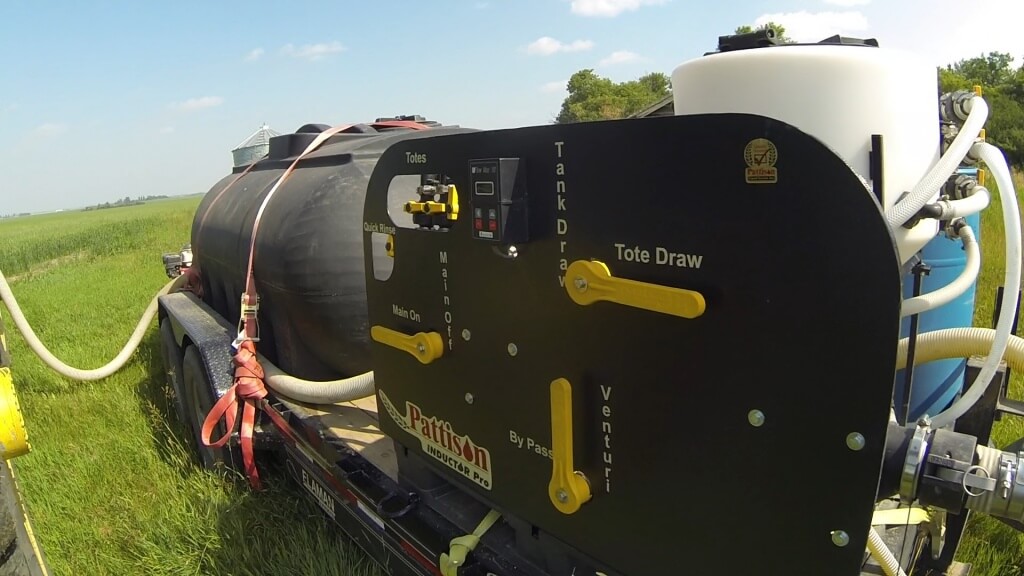
    Our fifth submission comes from the folks at Pattison Liquid Systems of Lemberg, Saskatchewan

    I recently saw Phil Lingelbach of Pattison at a sprayer clinic. Pattison has been designing and building  transfer systems for years, and have valuable experience to share.

    I asked Phil and John Young these questions about transfer system designs:

    1. Why is filling faster important? How does it reduce your operating cost?

    “Idle time costs money. Consider that trade in cost of an average high-clearance sprayer is approximately $185/hr on the meter.  So 100 hours of idle time per year is costing nearly $20,000 in reduced trade-in value.

    We also need to maximize “best spray condition” time. We know that application timing is critical to success, and need to take advantage of good weather conditions. Spraying under marginal conditions reduces the chance of good pesticide performance.

    Efficient filling can also reduce labour costs, this is a “snowball number”. Every unnecessary hour spent spraying could be used to do something more productive, in essence a wasted hour costs you two.”

    1. When designing a transfer system, what are the key considerations that separate a good from a bad system?

    “Make sure that the water pumps pushes water to the inductor system.  Do not use a water pump to pump chemical. Contamination is a huge issue with this.

    Keep your transfer system away from the rear of an open deck to minimize dust exposure.

    Front cover - Inductor Pro

    A good transfer system will be easy to clean and very user friendly, valves separated and clearly marked.

    Get the biggest, fastest pump available. Loading water after the chemical is in is key.

    Make it simple to operate, there is lots of hired help on the farm.

    Design it to keep operator from being exposed to chemical. Keep trip hazards to a minimum.

    Include fast product induction. There is no point filling water quickly and having to wait on a slow product pump.”

    IMG_20160330_111710818 resize


    1. You mentioned the speed of filling product. What flow meters are most accurate and reliable?

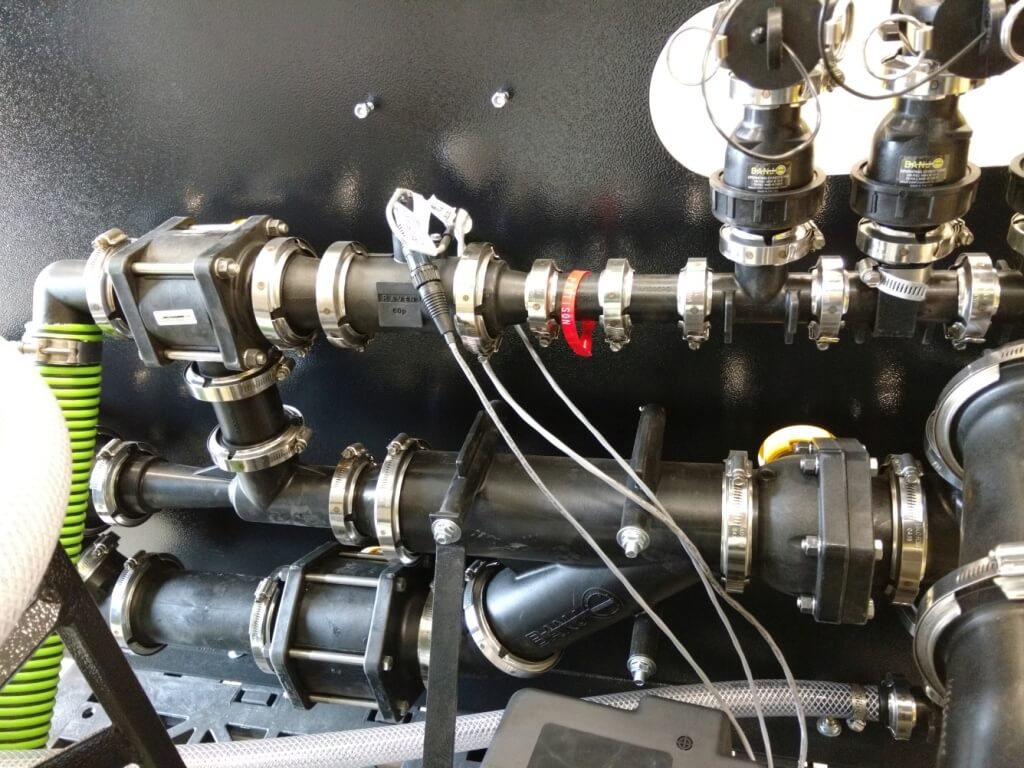
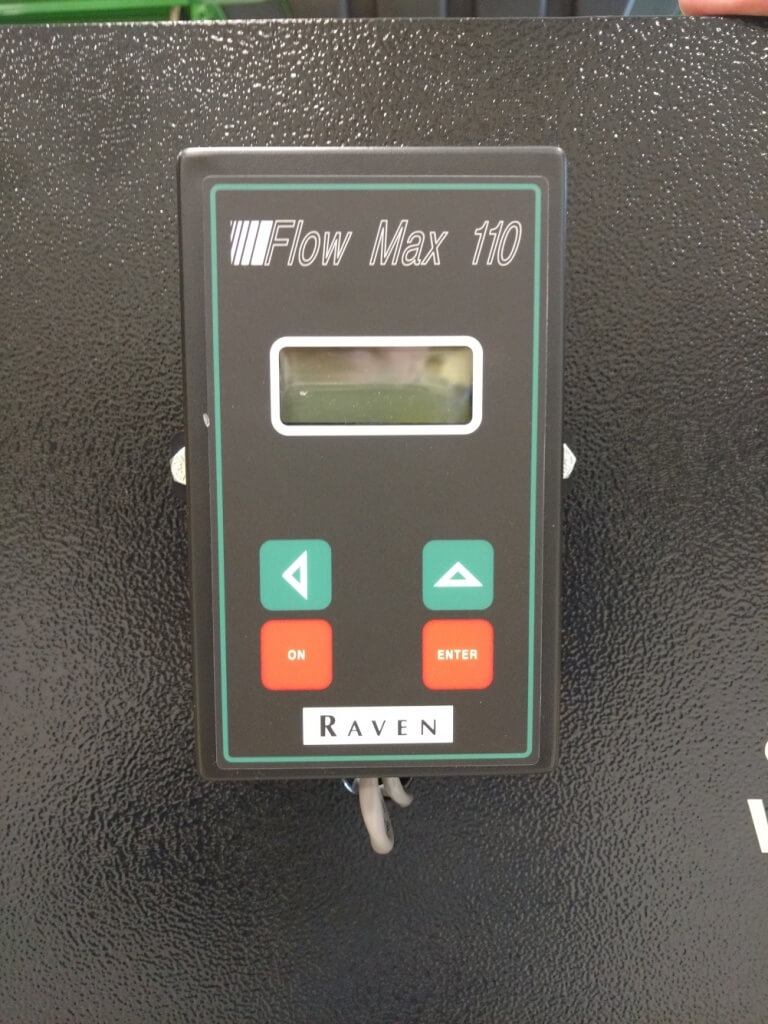
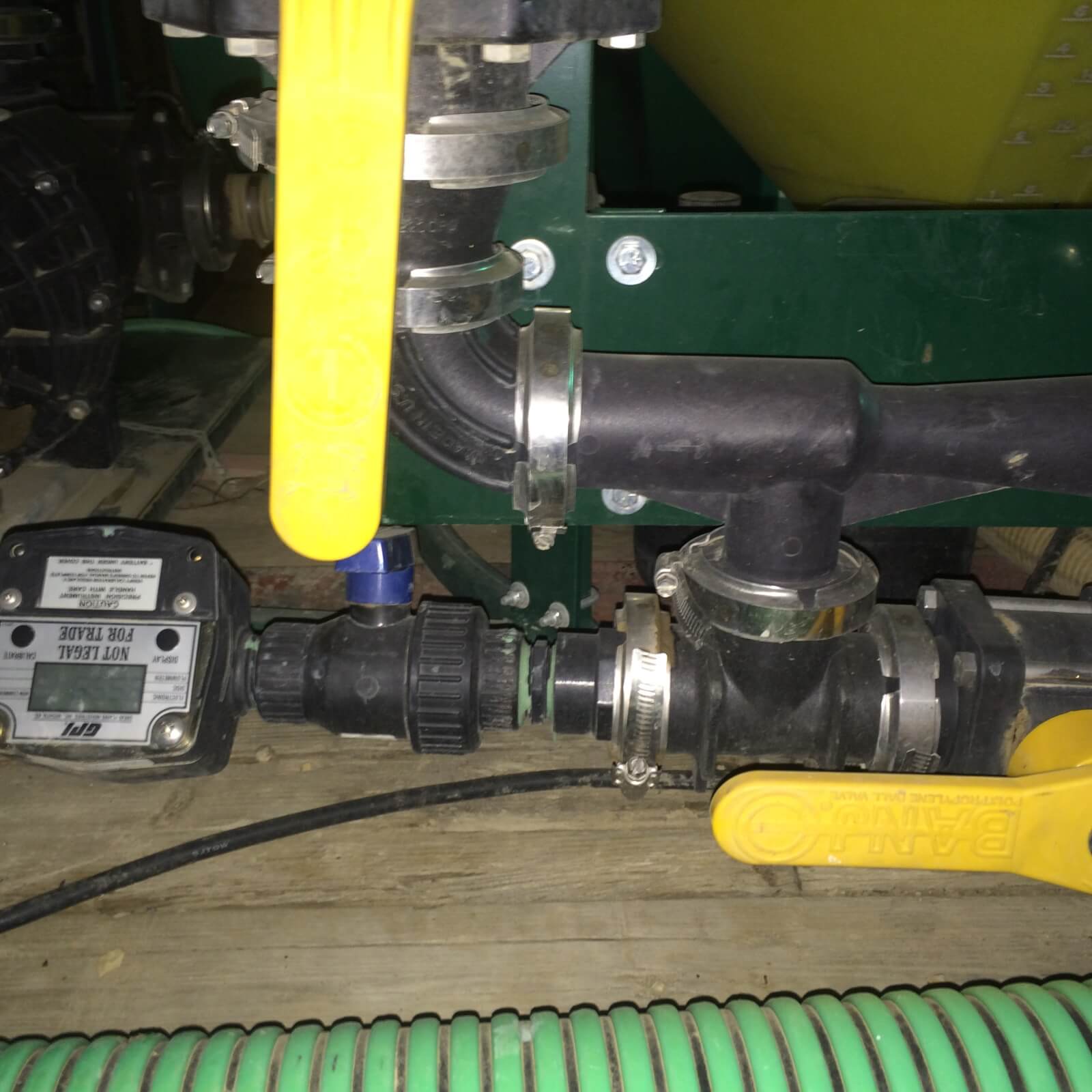
    “The Banjo Mag meters and the Raven FloMax 110 (combined with the 60P) and 221 are the most accurate that we have available, the Banjo is limited to non-petroleum based products though.

    IMG_20160330_111606467 resize

    Both the Raven 60P and Flomax 221 are turbine style meters, to be used with all ag chemicals, – 2” models.

    Banjo Mag meters should only be used with water based products – this meter is the best for measuring water when filling, comes in a 3” model.”

    1. What are the best ways to clean a transfer system? 

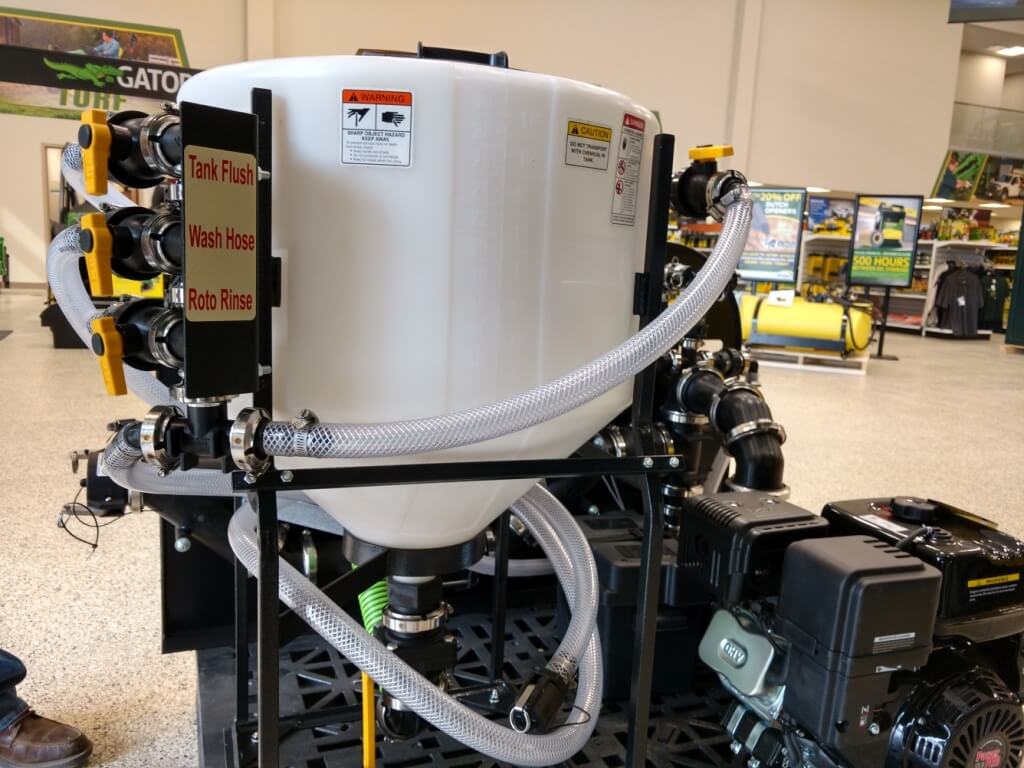
    “The best way to clean your jug rinse tank is THOROUGHLY!! There is no such thing as overkill when it comes to cleaning this tank, we use a tank that has no bulkhead (total drain, no bulkhead for product to get hung up on) in the drain, a rinser designed for an 800 gallon tank, and very minimal fittings for chemical to get hung up on.

    Use lots of water, when you think it’s clean, rinse it one more time!!

    All our inductor systems come with a quick attach clean water rinse system, that allows the operator to flush the complete metering/inductor system.”

    IMG_20160330_112122442_HDR resize


    1. What is usually the limiting factor when trying to fill a sprayer faster? 

    “Hose size, pump size, venturi efficiency, and planning are most critical. Consider your needs – a system should be designed specifically to the needs of the operator.”

    1. Do you need more than one inductor to handle multiple products in time?

    “Usually one will be sufficient so long as the suction line is of sufficient size and length.

    Our inductor systems are configured to handle more than one bulk product at one time. With just the turn of a valve you can switch from metering one product to another, or quickly change from metering a bulk product to handling jugs.”

  • Sprayer Nurse Truck Designs

    Sprayer Nurse Truck Designs

    We’ve recently been talking about how we can increase sprayer productivity by decreasing downtime. The main productivity robbers are time spent filling and cleaning. Using our productivity calculator, we’re able to show a 30% increase in acres per hour with some relatively simple changes to how we fill the sprayer. It’s important to actually measure the time spent filling, not estimate it.

    A few days ago, Jeff Calder of Letellier, Manitoba (@jcalder1983) tweeted a water truck project he’s been working on, and it generated a lot of interest. We decided to follow a suggestion made by Ron Krahn (@RonKrahn) last fall to show various designs so that everyone can learn from each other.

    This post will grow over the next few weeks as we gather more submissions. The first four submissions are below, the fifth and subsequent submissions will be here.

    Please use our e-mail link on the site to send us your picture and descriptions, and we’ll post them as they arrive.

    The first submission came from Landon Friesen (@landon707) who farms near Crystal City, Manitoba.

    “We bought the front half of a old fuel tanker, stripped it right down to nothing, flipped tank end for end for better weight distribution, and extended the kingpin for bridge length.  It’s just shy of 9000 gal to the lids (far from legal). Built the back frame/box etc.

    Landon Friesen-6

    Mix Tanks on rear platform, bulk totes up top, small boxes in the middle. Blast and paint are next. #westcndag
    Mix Tanks on rear platform, bulk totes up top, small boxes in the middle. Blast and paint are next. #westcndag

    “Starting at the drivers side, all three internal tanks come together in a manifold, you can select which tank you’re drawing from or filling from. You can fill with a 3, 4, and 6 inch pump, connected to the manifold is a stationary pump for only filling  ditches or water sources without pumps with a filter on it.

    Landon Friesen-5

    “Water then travels around the backside of the trailer under the 4 induction tanks, a check valve keeps any product from flowing back into the tanks to prevent contamination. Each induction tank has a 1.5 inch electric ball valve that feeds the three inch line. 

    Landon Friesen-8

    “Each inductor has a tank rinse and a jug rinse. Tank rinse and jug rinse are powered by 2 12 V water pumps drawing from manifold on the drivers side of tank. All electric solenoids control which induction tank gets rinsed.

    “Jugs are stored inside the large box under the bulk deck, keeps them dry and close by the the rear deck. Bulk containers go on the top deck, 900 L totes are gravity fed into the inductors, accurate measurements on the inductors let us know when to shut off the gravity valve, if barrels are used a chem pump is on the back now too.

    Landon Friesen-1

    Landon Friesen-2

    “Inductors are handy because it keeps all products “preloaded” and separate for chem safety until you need them.

    “After the inductors the hose travels to the suction side of the pump, was a 6.5 hp Honda and now replaced by a 13 hp Hypro pump, water or fertilizer then passes through a flow meter and out the 12 ft boom with hose doubled up for 24 ft reach across the ditch.

    Landon Friesen-11

    Landon Friesen-12“Our goal was to have the tanker operator stand by the pump and control panel the whole time, no valves to turn, when you engage the “unloading” of a induction tank on the control panel the auto rinse is activated for that inductor, keeping it cleaned out for the next batch.

    Landon Friesen-7

    “We can fill a 1200gal sprayer with all chem in just under 5 min with all chem included,  that’s from hose connection to disconnect. Gained many acres/day b/c of this trailer. Took us 2 years to build and I’d do another in a heartbeat!

    “We use it for seeding in spring to bring liquid fertilizer to the drill, can keep a skid of seed out of the rain and blend N, S, and liquid P with the flow meter.  Next to the sprayer it’s the most widely used piece of equipment on the farm!

     Landon Friesen-9
     Landon Friesen-10
     
     
     The second submission was made by Jay Schultz (@WheatlanderJay) of Rosebud, Alberta
     
    “Spray tender setup is near and dear to my heart and have set up 2-3 systems in the last few years with the help of my BIL Craig. I have the vision he has the know how. I scoured the internet for a few years for ideas and there is lots of great setups on various forums.

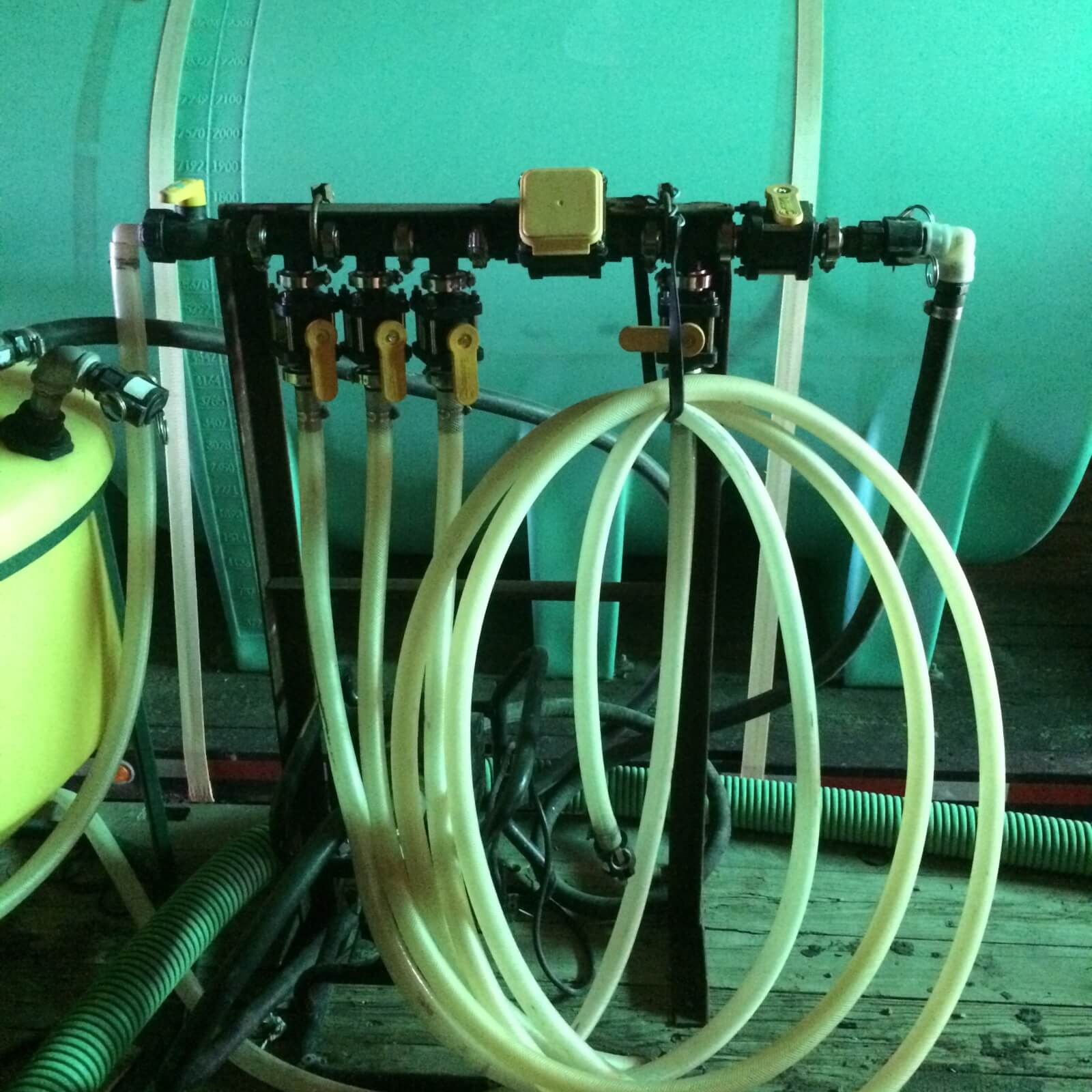
    ” My bulk chemical hose setup can suck out of three totes or barrels. It can dump into the chem handler using a 1 inch chemp pump or I can use the venturi to suck depending on what we want to do. This system is also plumbed with a fresh water line to be flushed. It also has a banjo flow meter. Banjo last a long time, other brands do not. BUT it measures EC not flow which does not work for all chemicals. Back up is measuring in the chem handler.

    Jay Schultz-1

     “When we use jugs we throw them in an old ICB tote so they don’t blow out down the road.

    Jay Schultz-2

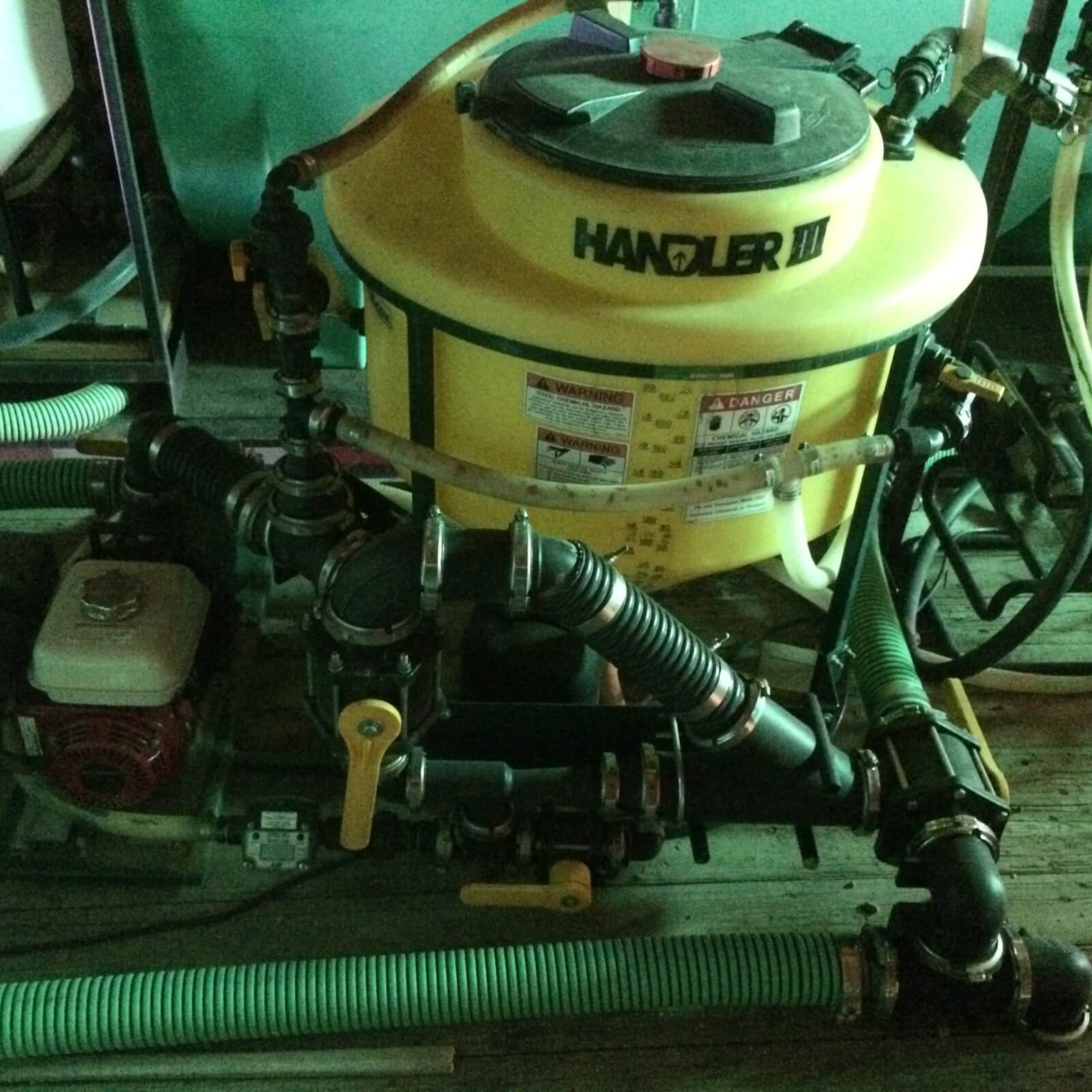
    “We are using a chem handler 3 with all three inch hoses.

    Jay Schultz-3

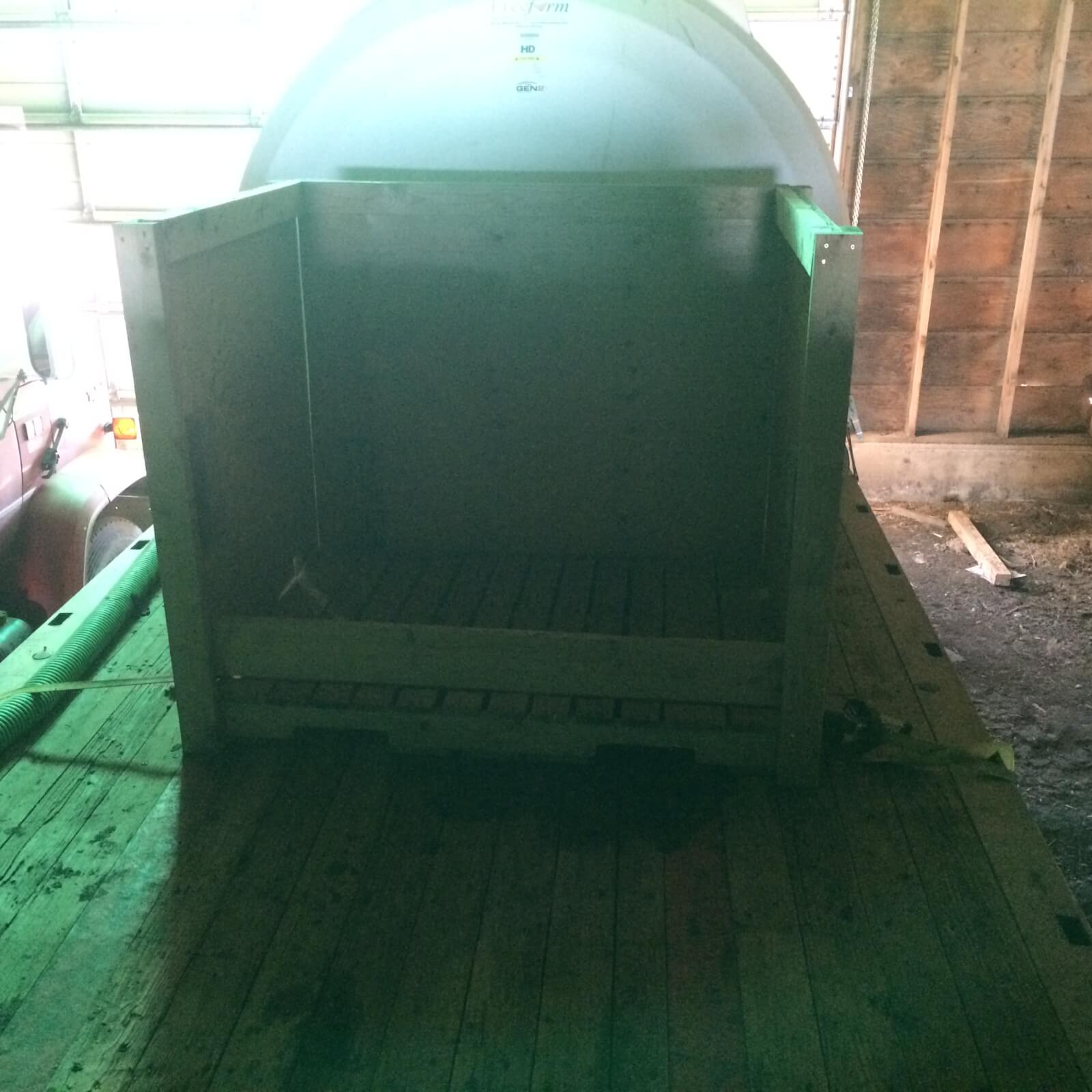
    “When we have barrels and or jugs we have a pallet they we built sides for that also has a shelf. We can remove it with one strap and reload or use 4 totes.

    Jay Schultz-4

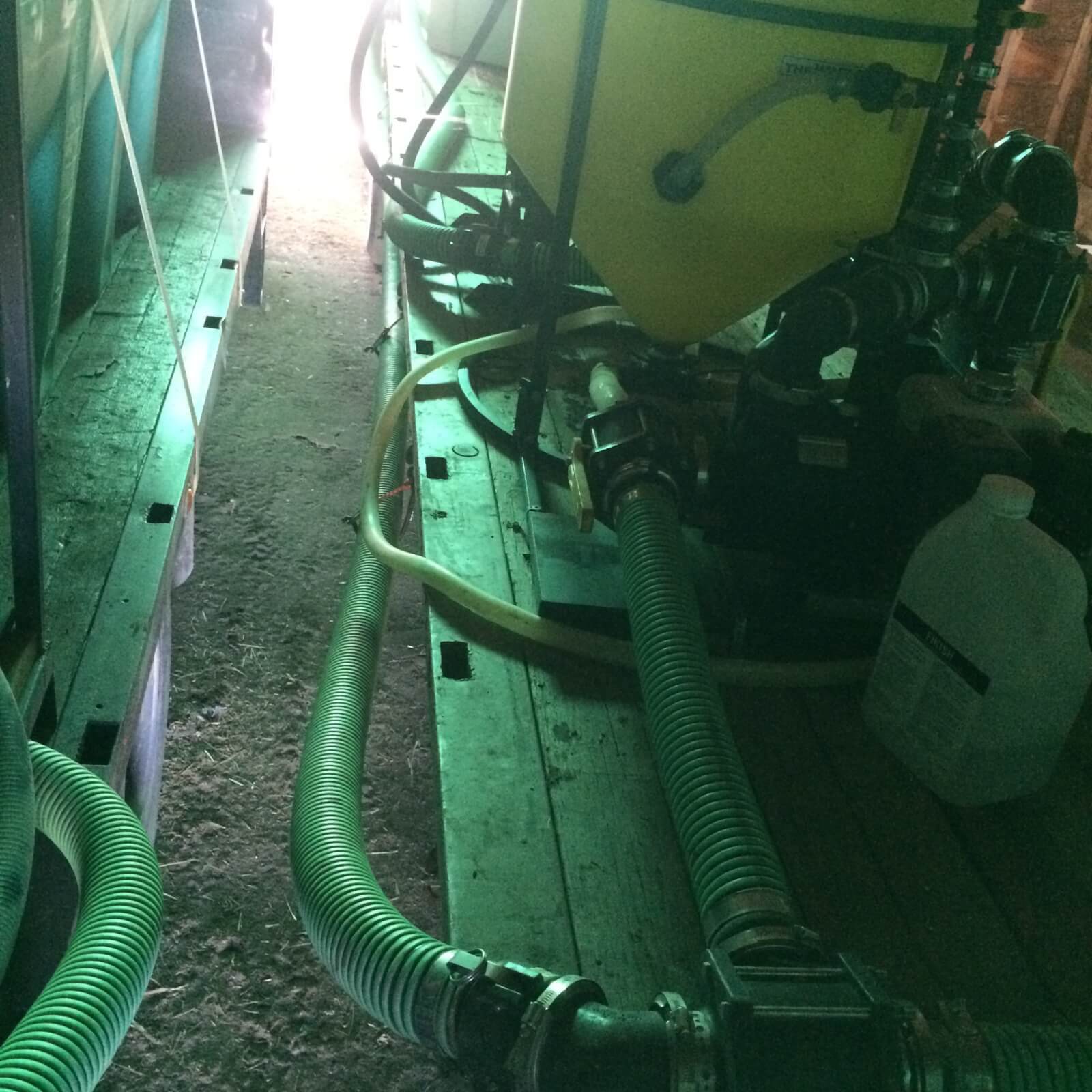
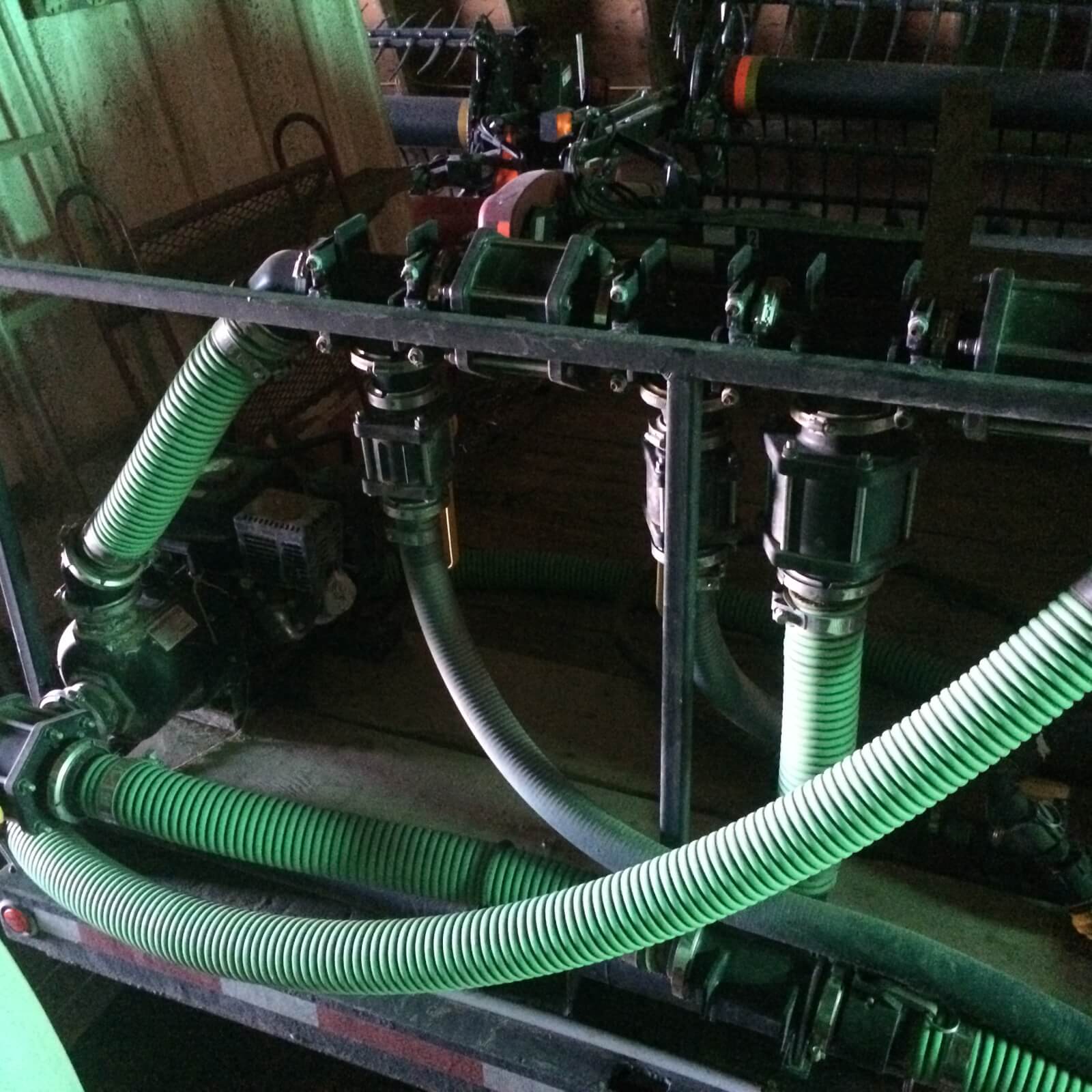
    “We have a long hose for filling that has hooks and bungy straps to hold it up. We empty the hose every time because its very heavy when full. To drain the water we just open a valve on the handler to let air in the hose.  We installed an air assists clean-out on the sprayer side so we can push the hose back into the chem handler if we need. The water is always murky so there must be some chemical in the hose. This is also where we fill the tanks on the truck with a three way valve on the suck side of our pump and a three way valve on the pressure side. We have free form tanks, tank 1 is 2350 gal and tank 2 is 3100 gal I think.

    Jay Schultz-6

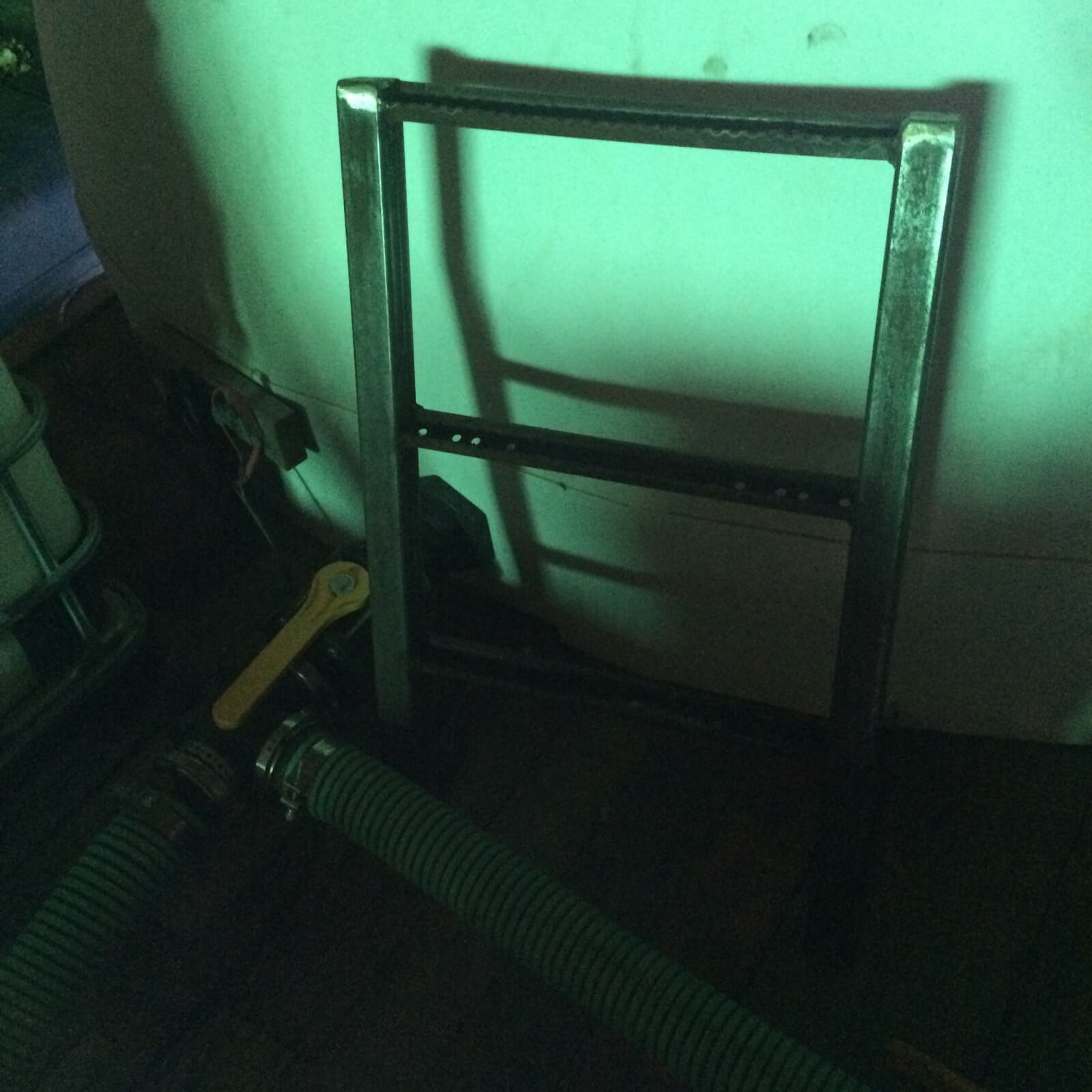
     “If you have broken feeder chains lying around, the slats make excellent ladder rungs.

    Jay Schultz-5

    “Showing the 3 way valve on the pressure side. Its positioned to fill the sprayer in the picture.

    Jay Schultz-7

    “They have since modified the chem handlers for this purpose but I teed into the venturi to use this for chem totes. I also had an old flow meter I added. I don’t trust it though.

    Jay Schultz-8

    “Our trailer is 48 ft which we bought used for about $8000. Its a bit on the long side for getting into fields. If we could slide the wheels forward it would help but this trailer we cannot. We can fill in about 20 min and our sprayer is 1135 gal. Some advice, when you buy a Rogator the tank size does not match the number on the machine. We though our rate was out but it was because the tank is 1135 gal not 1100 gal. We can spray 4 tanks out and have room for a sprayer clean. We fill the tender at home with a free form 9000 gal trailer tank that we also use for 10-34 during seeding. We fill with a garden hose but are setting up a 1 inch pump to pump out of our overflow spring water system.

    “We also have a tandem flat bed truck with a 2500 gal tank. We use this for 10-34 during seeding and fall desiccation instead of our trailer. Craig and I were much happier with the setup on this unit. We also used an old chem handler we had sitting around. I teed into the Venturi as well so I could suck out of totes. We also put an air clean out that was plumbed  from the truck air supply. When we load 10-34 the hose is messy and heavy. We just blow the last of it into the drill and no mess and easy storage.”
     
    Jay Schultz-9
    Jay Schultz-10
     
     The third submission was made by Tyler Burns (@windypopfarm) of Wynyard, Saskatchewan
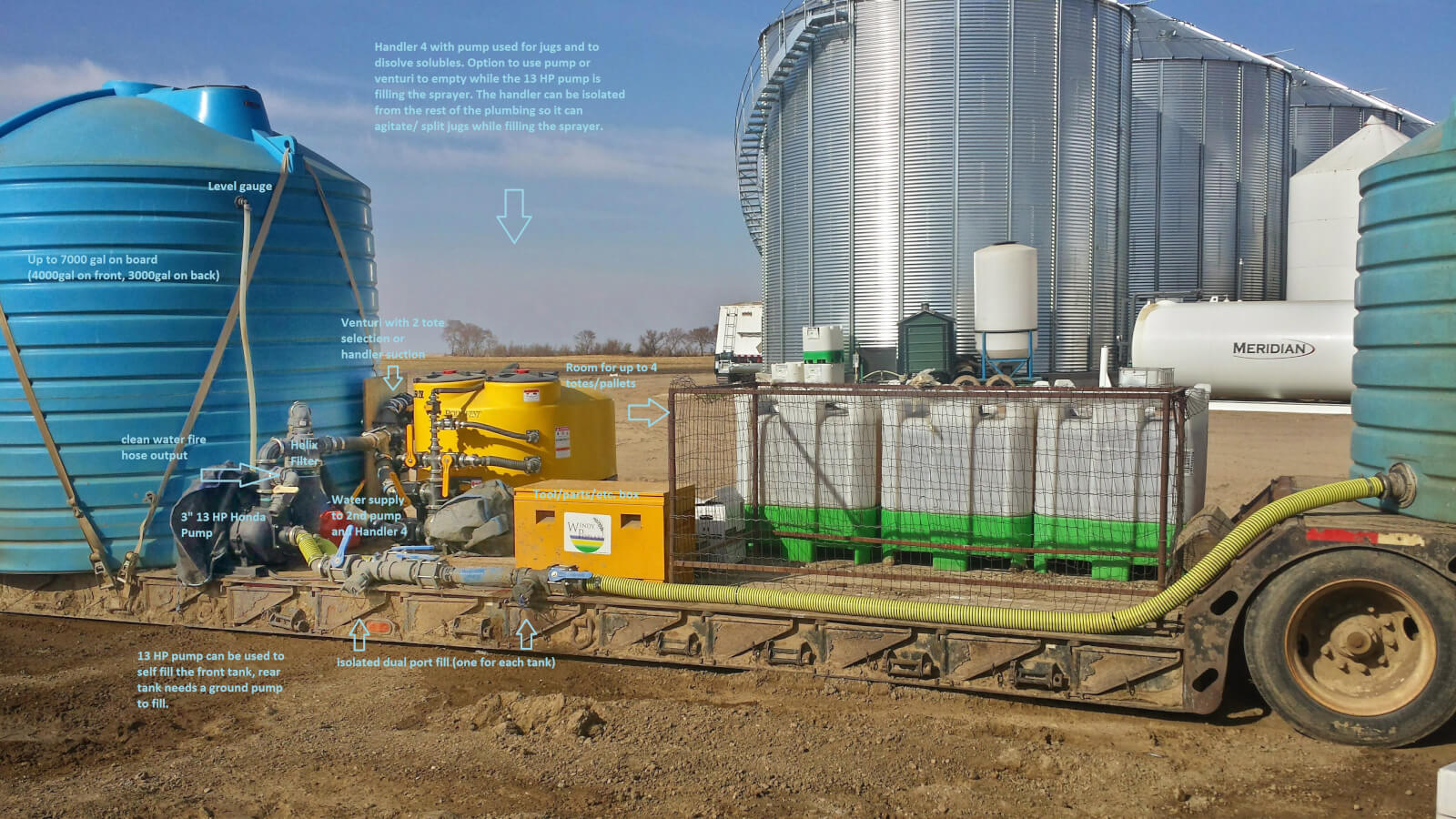
    • Dual 3” fill ports: ability to isolate the two tanks in order to fill each tank with it’s own port, front tank can be filled with on board 3” 13HP pump, back tank requires a ground pump to fill.

    Tyler Burns-6

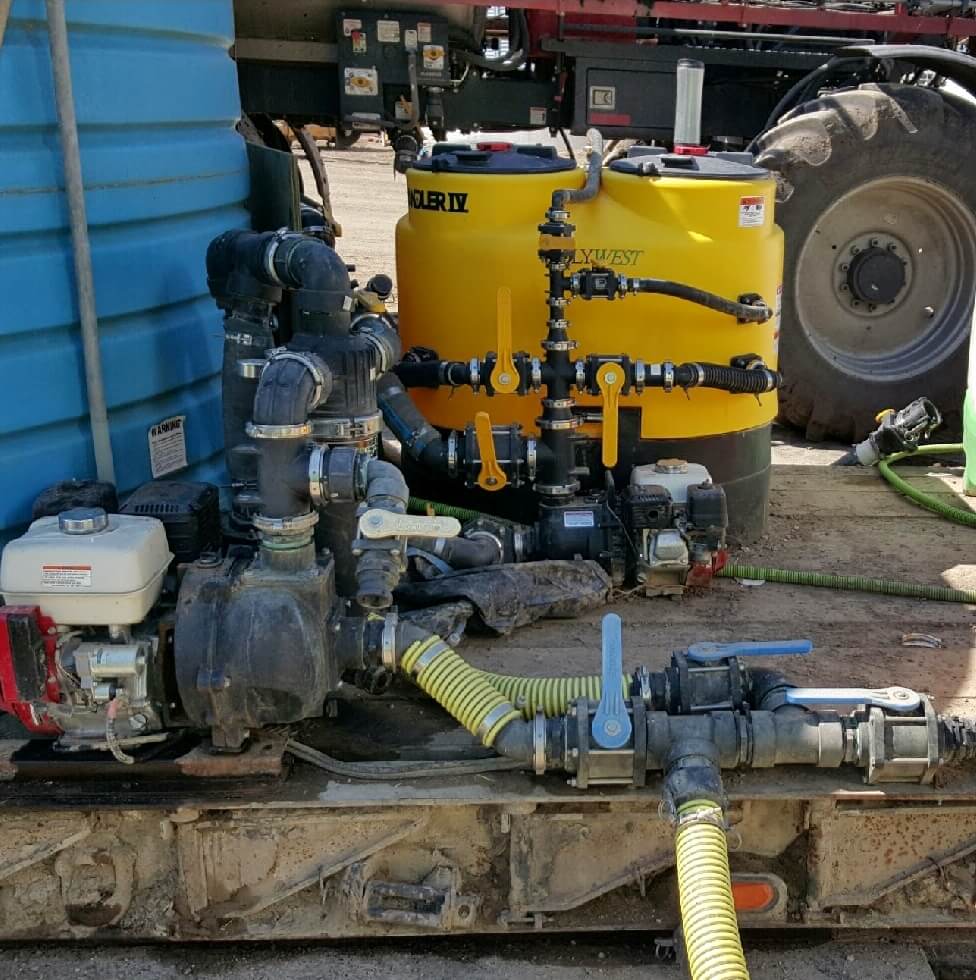
    • Main Pump: Banjo 333 Series Cast Iron Self-Priming Pumpwith 13 hp Honda electric start and pull rope capable of filling a 1200 gal sprayer in under 5 min if you’re only filling water and the filter is clean. Real time fill will range from 8 to 15 min dependant on what chem mix is being used. A future desired upgrade would be a 1200 gal SS tank on the empty upper front deck to pre-mix a complete tank so that every fill would be down to 5 min. This would require a knowledgeable person at the fill site though.

    Tyler Burns-3

    • Auxiliary outlet: 2” clean water outlet often used for washing equipment, grain bag slip n slides or fire control.
    • Filter:3” Helix filter with extra filter elements if you need to swap in the field. Two outlet ports off of the filter. One going straight to the venturi assembly/sprayer fill line, the other going to the Handler 4 or tank #1.
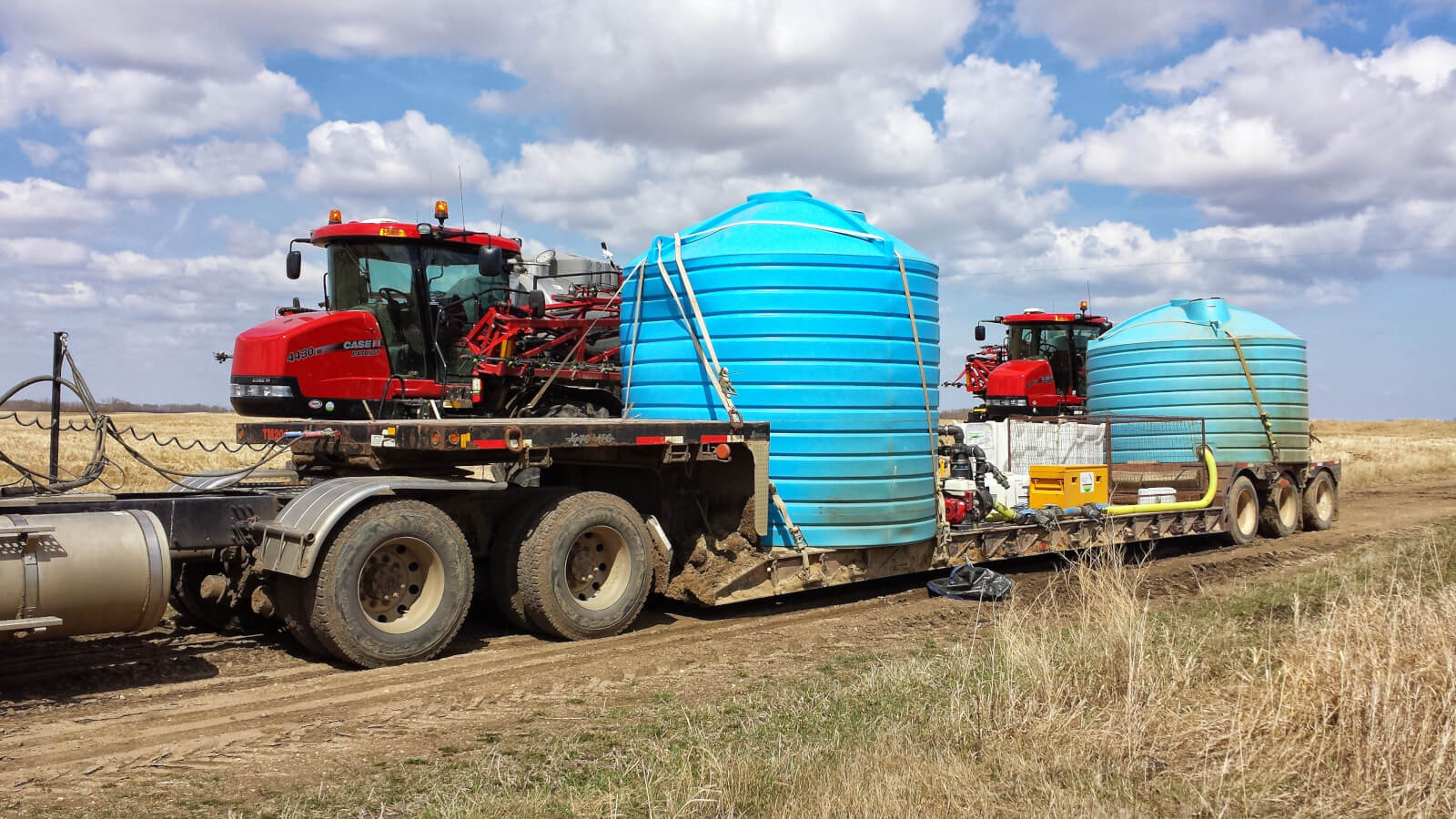
    • Tank #1: The front 4000 gal tank placed just after the upper deck.
    • Tank #2: The back 3000 gal tank placed on the upper rear deck over the tridem axles.

    Tyler Burns-5

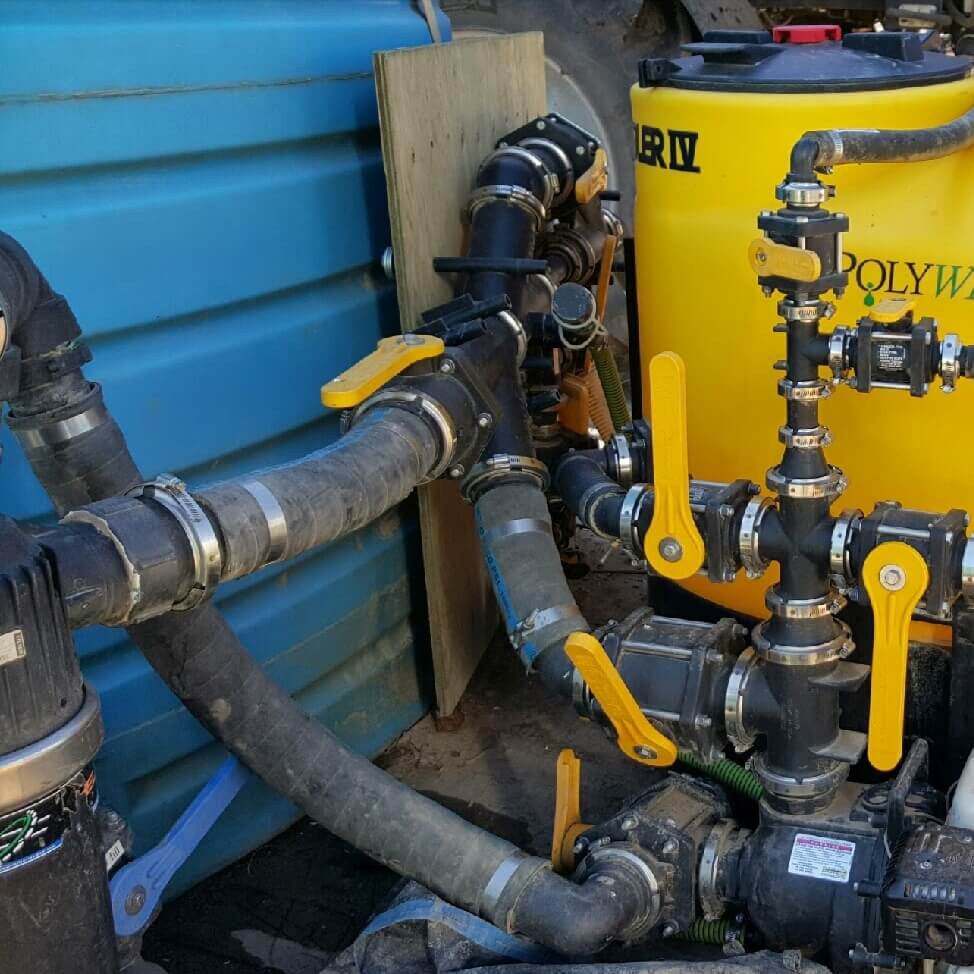
    • Chem Handler: A Handler IV with attached Honda pump. The secondary pump allows for the ability to agitate a chemical mix or dissolve a dry component. The pump can also quickly empty the handler in stream with the clean water while the 13 hp pump is filling if you don’t want to use the slower venturi option to suction out the product.  The secondary pump does not need to be running to get pressure to the Handler rise ports as you can open the valve on the outlet side of it to get a supply of water from the primary pumps flow.

    Tyler Burns-2

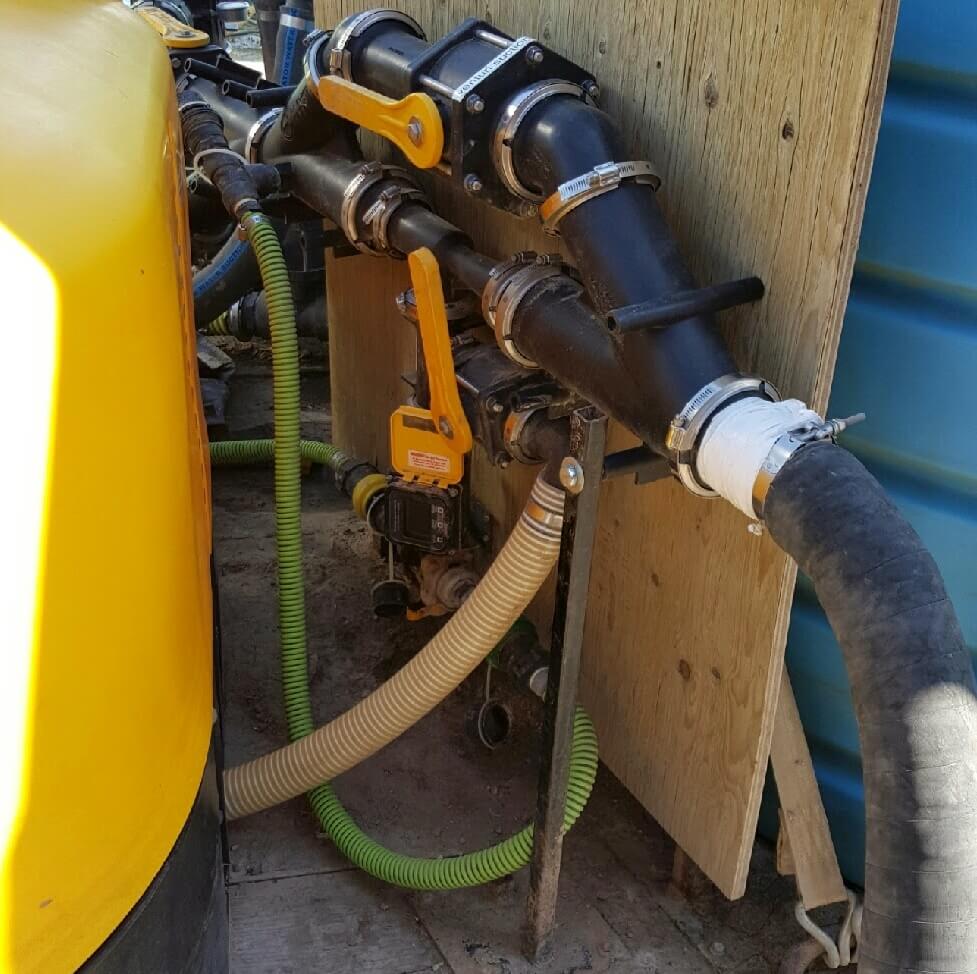
    • Venturi assembly: full 3” venturi and bypass. Venturi can suction either 2 different chemical barrels or totes and 2” suction of the Handler IV. The chemical induction ports are all dry poppet couplers and the lines 1” induction lines can be swapped if you change products. There’s also a clean dry poppet port to connect to easily flush any of the induction lines.

    Tyler Burns-4

    • Flow Meter: There’s a 1” Banjo flow meter to measure the volume of chemical induced. One issue with this meter is that it doesn’t work with all chemicals but I switched to this make because it doesn’t restrict the flow. As nice as it is to use a venturi to transfer chemical is it does significantly increase fill times. (5 min vs 8 to 15 min.)
    • Level gauge: the level gauge on the front tank helped to minimize overflows and to more accurately fill the tanks to the desired level.
    • Chemical Payload: Room to fit up to 4 pallets of jugs or 4 450L totes.
    • Cage: Empty jug and box cage.

    Tyler Burns-1

    Our fourth submission was made by Kelly Baillargeon (@k_baillargeon) of Edam, Saskatchewan

    “We have set up many spray trailers the last few years, each design has had its improvements.  We run two sprayers between our farm and custom spraying business.  It is very important to our operation to carry the sprayers, it allows the sprayer operator to be able to head out in the morning full of chemical and fuel and spray the entire day by himself.  Our trailers have a 3200 US gallon tank on them which will give us three full fills on our 1000 gallon 4830 John Deere sprayers.

    “We purchased a triaxle water tanker trailer from SGI salvage two years ago (sorry no picture right now as it is tucked away in a shed) that can haul 8000 US gallons per load that keeps our spray trailers full of water and allows my brother and I to spray all day.  We built a large cage underneath the tanker out of iron and expanded metal (8′ x 8′ x 2′) that allows us to throw all of our empty chemical boxes and jugs in it when the spray trailer is getting filled with water.

    “We used to buy older flat deck trailers and build sprayer cradles for them.  But two years ago we decided to buy two of these spray trailers from Flamans in Saskatoon.

    “The trailers are built for hauling a sprayer with the cradle being able to be folded up while not in use, which makes it nice for putting into storage or if needing to use the flat deck to haul anything else.  These trailers should last a very long time for us.

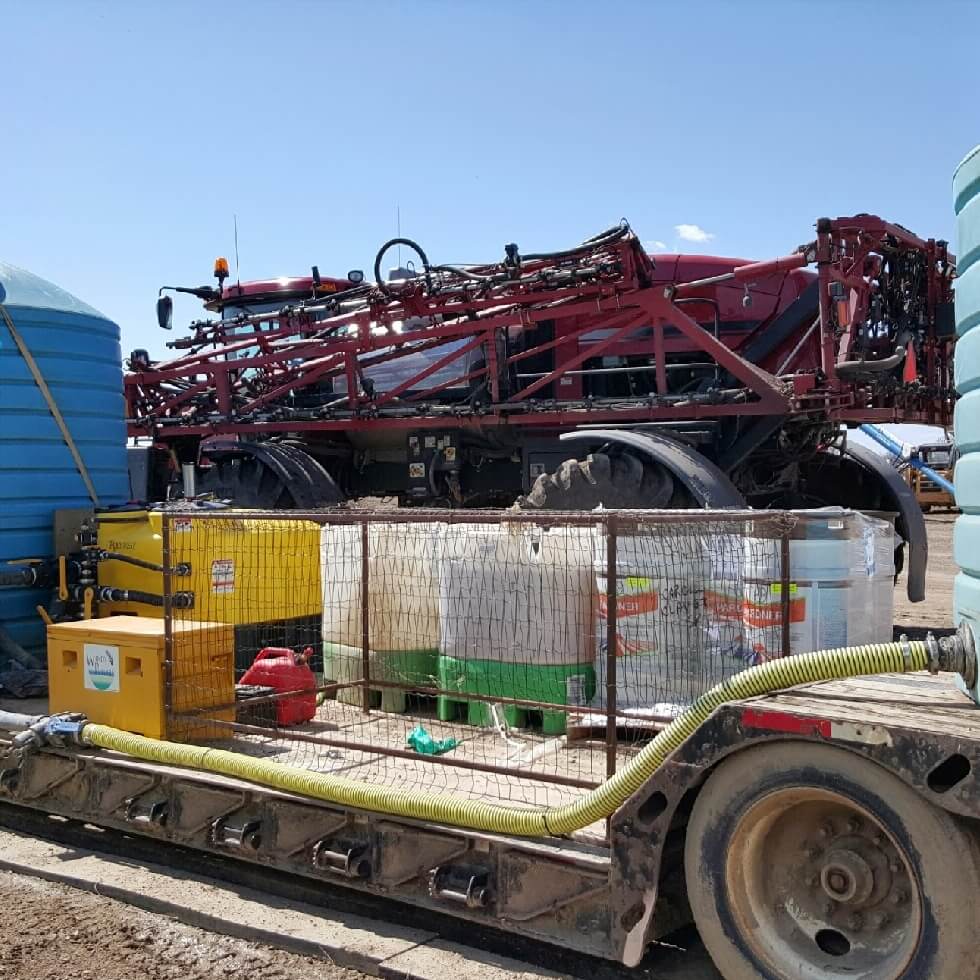
    “We mounted one 3200 gallon tank on the nose of the trailer.  This conserves valuable deck space, we used to use 2 smaller tanks, but this really compromised deck space on our trailer that can be used to haul lots of chemical.  It is also much safer to have lots of room while mixing and filling the sprayer.  We aren’t crowded or tripping over lots of hoses while working on the deck.  There is a ladder stored on the side of the tank to be used if we are parked at a water source that we are able to throw a hose in the top of the tank to fill while we are out spraying.

    Kelly Baillargeon-1

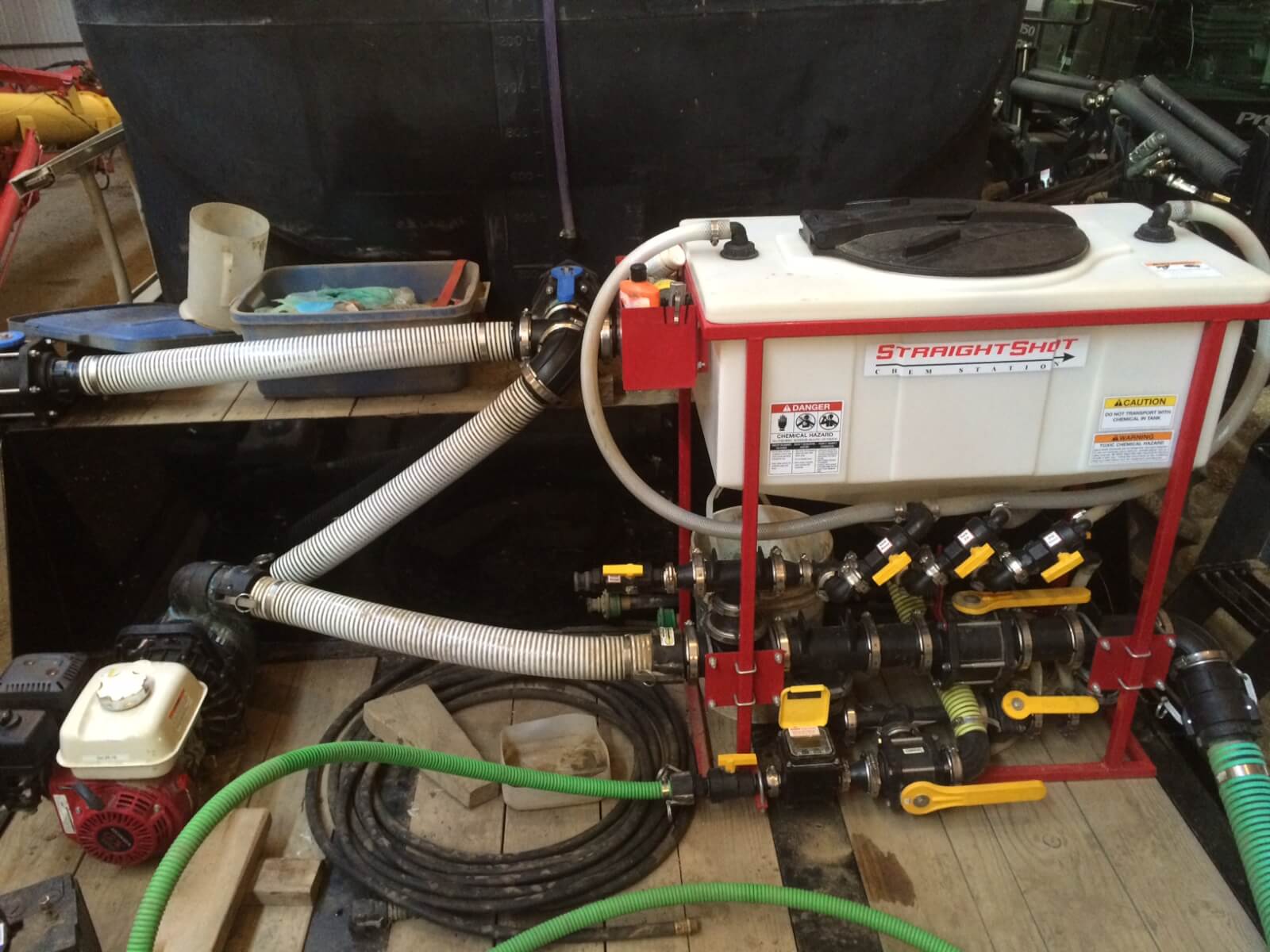
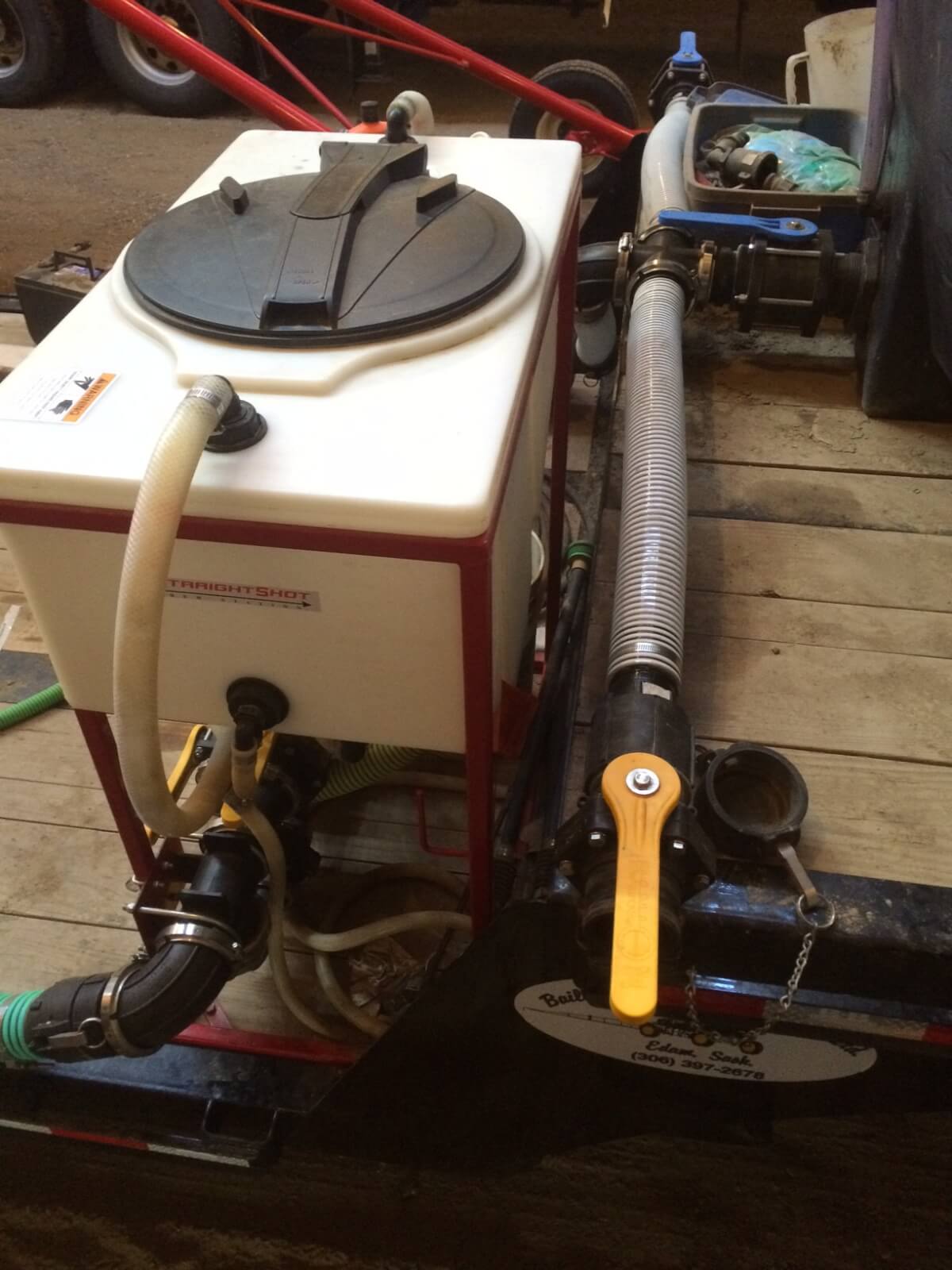
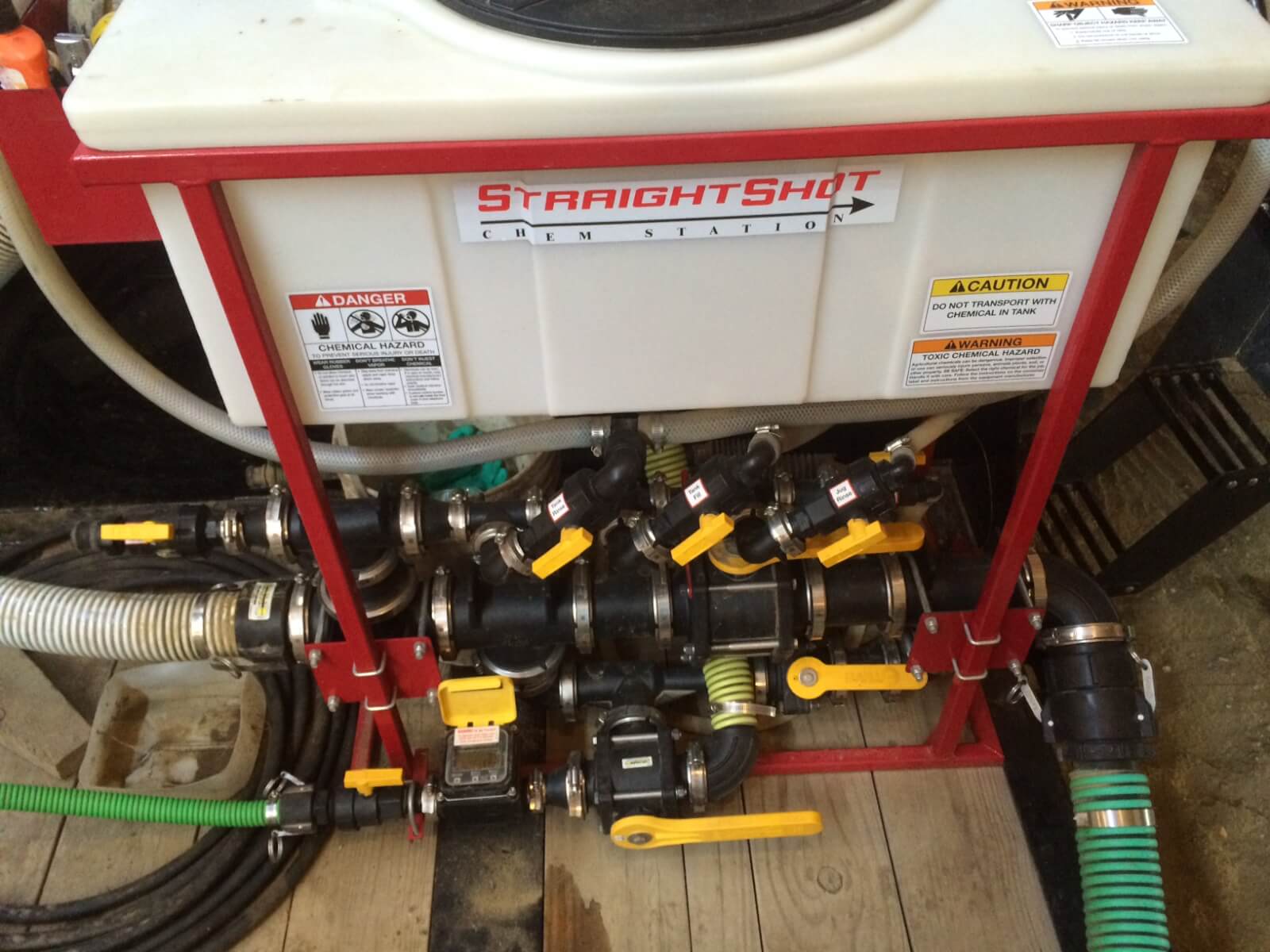
    “Each time we have built a spray trailer we try to make the design more simple.  In my opinion the less total plumbing I have on the trailer, the better.  This makes it easier to teach someone how to use it as well as less chances of making a mistake.  I installed a Straight Shot chem station this time, we always used Chemhandlers before and didn’t have any issues.  But I really liked the simple straight forward design of this chem station.  It is built very compact, saving on more deck space.  Everything is very clearly labelled.  It has 3” plumbing and when bypassing the handler to fill the sprayer with water, there are no bends or restrictions in the water stream, everything goes straight through.  I find that it fills quicker than our Chemhandler did because of this simple plumbing.

    “We use a 3″ Honda pump.  I replaced the Soterra flowmeter that came with the handler (I had lots of issues with them in a very short amount of time) with a 1” Banjo meter.  This meter has no restrictions inside of it, but will not meter products that are not electrically conductive.  I have a backup spinning wheel style meter that I attach to the hose when using these types of products.  The venturi on this Straightshot chemstation sucks extremely fast.  I am able to suck glyphosate out of totes at 78 litres/minute while filling sprayer with water at the same time.  Liberty is much slower, about 45 litres/minute.  Seat to seat fill times on my 1000 gallon sprayer is 5-8 minutes depending how many products are being used.
    Kelly Baillargeon-2

    “A rubbermaid tub with measuring jug, fittings, gloves and other safety equipment is located right beside work station.  The large tank also includes a sight tube on it to prevent overflowing when filling.

    Kelly Baillargeon-3

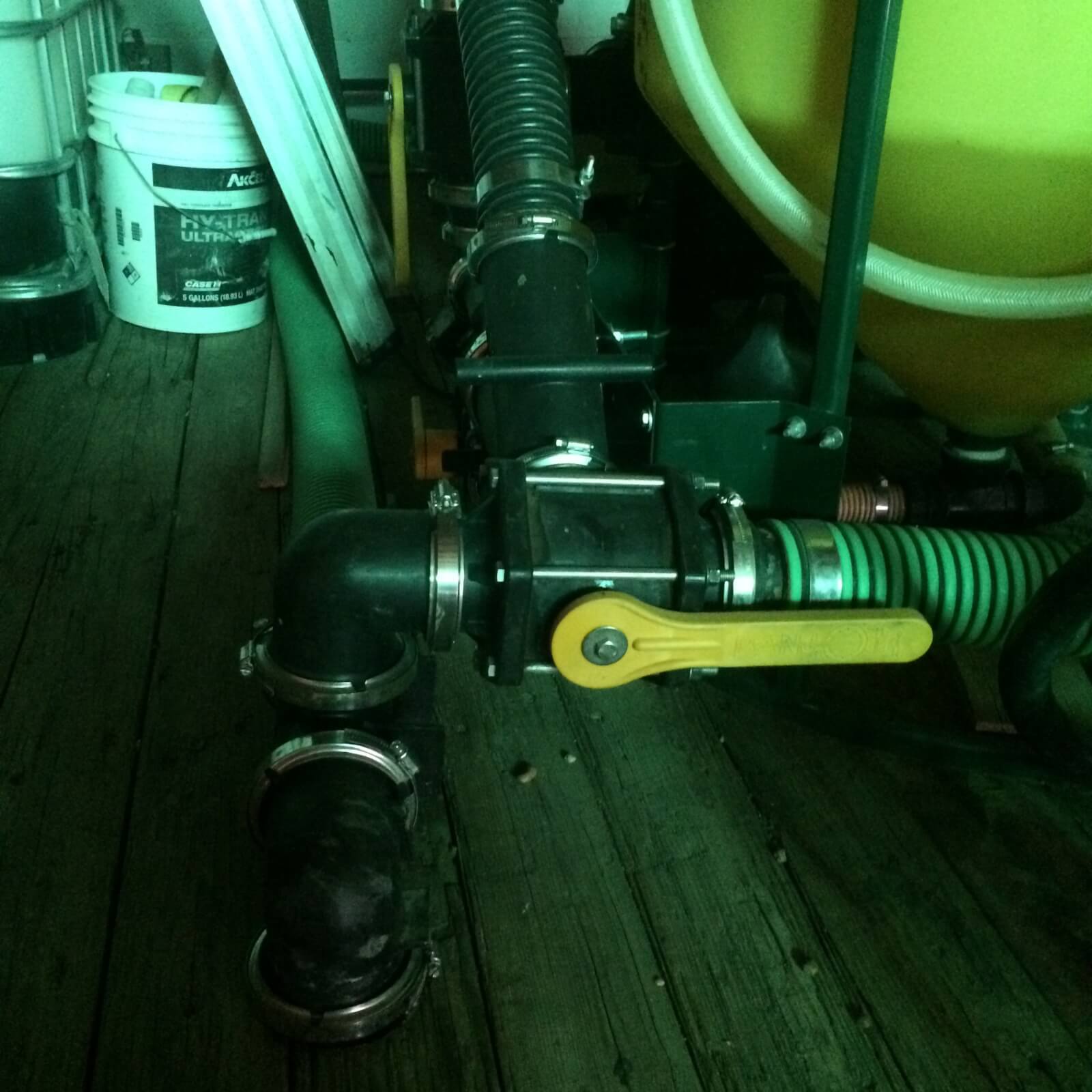
    “I used “sweep” 90 degree fittings everywhere the direction of water flow changes, these fittings are “wide open” and do not restrict flow.  Another lesson I have learned is to use the flange style fittings everywhere possible, threaded fittings work ok, but a few years down the road when you have leaks showing up, you need to take apart most of your plumbing in order to repair them.  Flange fittings don’t leak as much, most repairs involve tightening up the clamp and if you do need to take it apart, you won’t have to take apart any other fittings to change the seal.

    Kelly Baillargeon-4

    “A close up of the chemstation:

    “There is a connection on the left side that is used to flush out the chem induction hose.  The tank on the chem station rinses really well as it has two spinning rinse nozzles inside the top of the tank.  There is also a fresh water hose on it to help with rinsing tank or washing your hands.

    Kelly Baillargeon-5

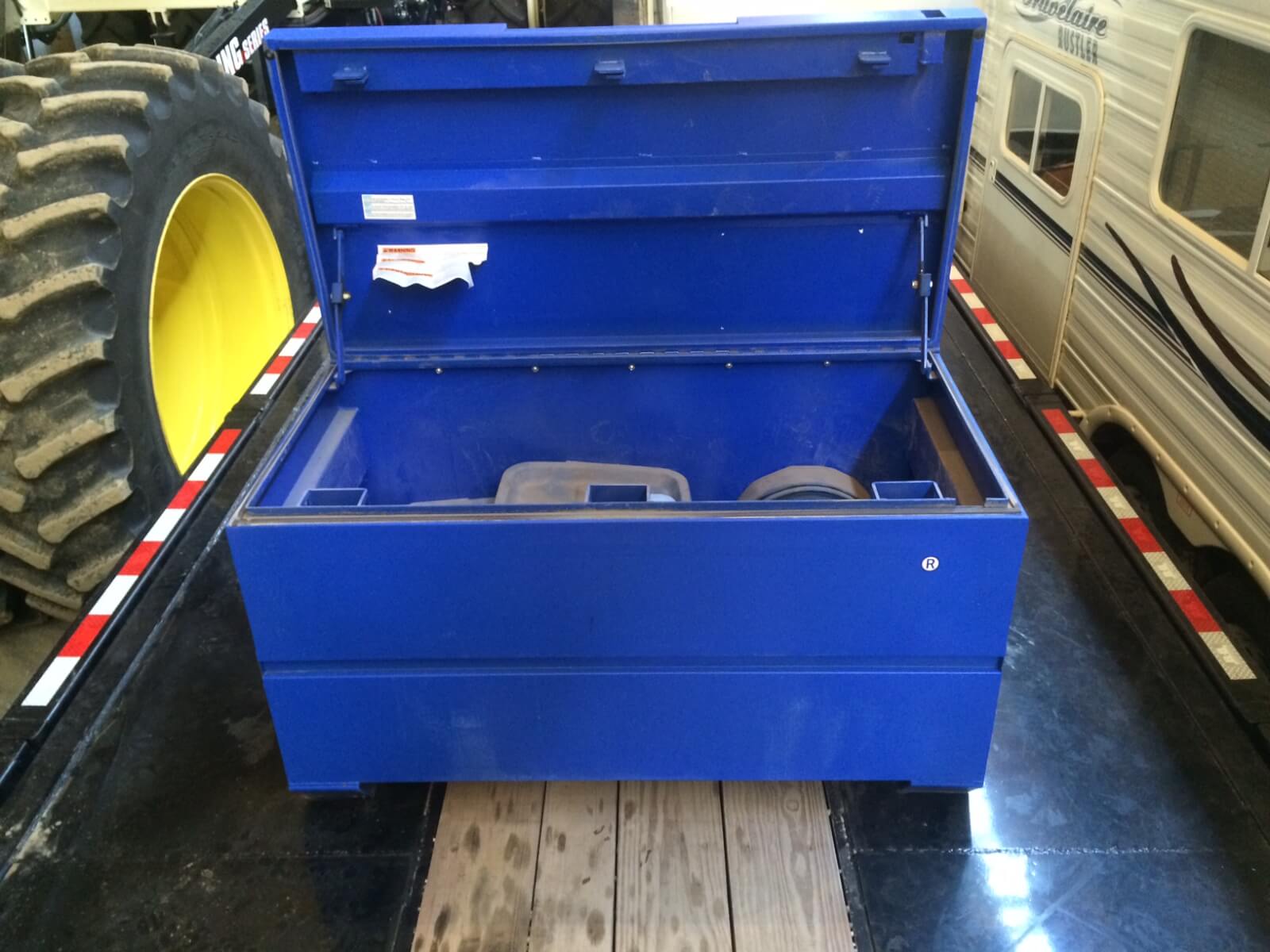
    “Located at the back of the trailer, underneath the sprayer, is a large toolbox.  I keep extra parts, safety equipment, small jugs of chemical, a firehose for fighting fires and ratchet straps for tying down chemical on the sprayer deck.

    Kelly Baillargeon-6

    “The water tank is able to be filled from either side of the trailer from the ground by the nurse truck, depending how we are parked at the field.

    Kelly Baillargeon-7

    “Long 3” flexible hose for attaching to sprayer:

    Kelly Baillargeon-8

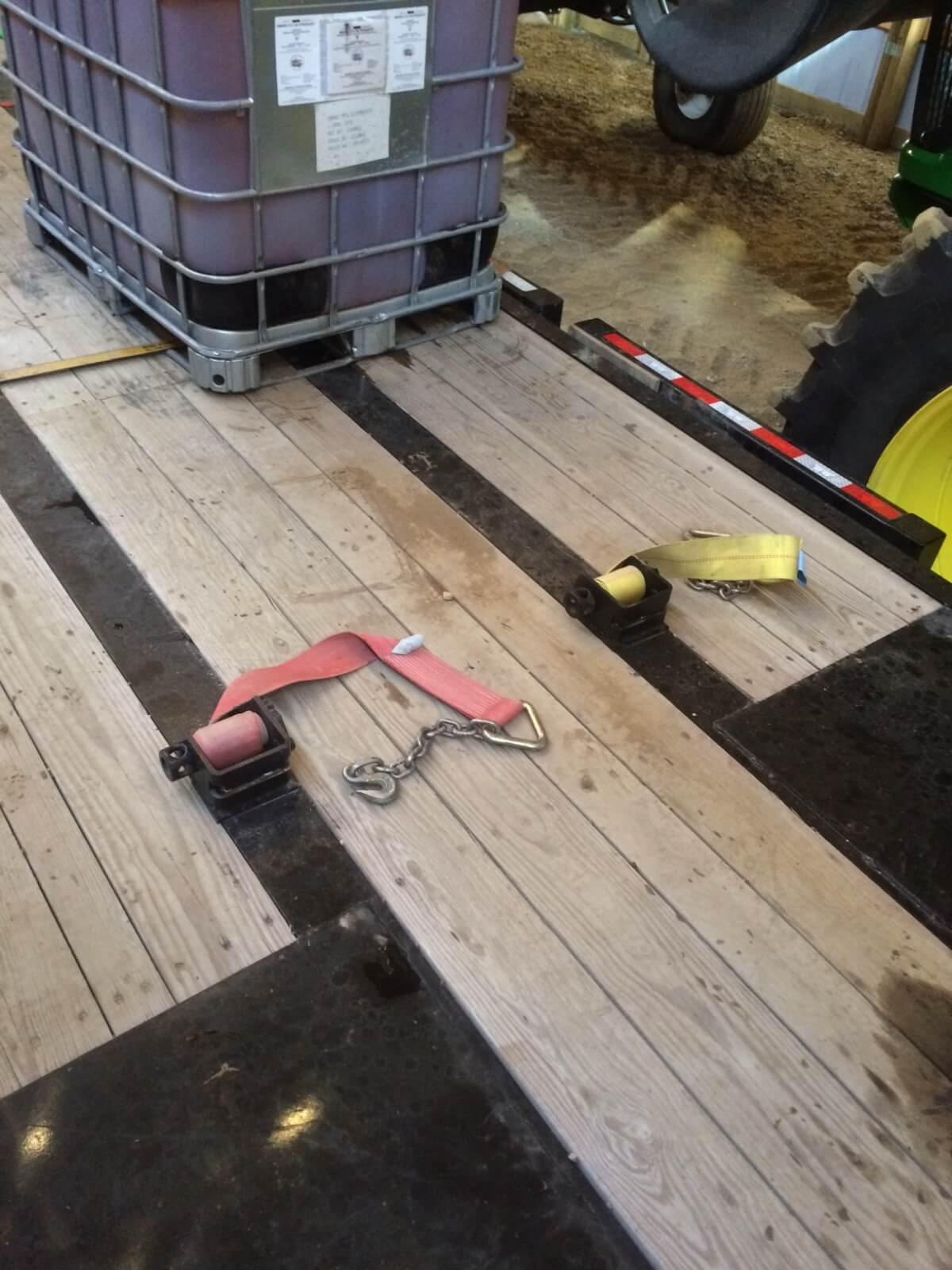
    “I bolted 4 large ratchets (2 at the front and 2 at the back) to the trailer deck for tying the sprayer down when in transport.  I find straps are much quicker and easier to handle than using chains to tie down the sprayer.  I didn’t want to weld the ratchets to the deck because then I would not be able to remove them if we needed to use the trailer for something else.

    Kelly Baillargeon-9

    “When I have the sprayer loaded on the trailer, I have lots of available deck space to carry chemical.  I have had as many as 4 1000 L shuttles on the trailer at one time with plenty of room to walk around and work safely.

    Kelly Baillargeon-10

    Bonus: Luymes Farm’s Spray Tender 2.0: Moorefield, Ontario

    Post continued here.