Month: December 2016

  • Spray Equipment From the 2016 Great Lakes EXPO

    Spray Equipment From the 2016 Great Lakes EXPO

    Michigan’s Great Lakes EXPO is a massive horticultural convention that draws international speakers and more than 4,000 attendees to Grand Rapids every December. Like any large agricultural conference, it can be challenging to run back and forth between lecture rooms to hear key presentations. And, of course, there is always disappointment when you have to choose between two talks in concurrent sessions. When your head is full and your posterior is numb, you move onto the trade show floor.

    I think the trade show might be my favourite part; Who doesn’t like filling a bag with swag? Candies, foam vegetables, pens, DVD’s, colourful brochures and all manner of gimmicks designed to get your attention in a sea of vendors that vie for “just a minute of your time”. But for me, I only have eyes for the sprayers. And wow, were there a lot of sprayers at GLEXPO.

    This article is a photo journal of those sprayers (or features) that caught my eye. For some readers, these features might be old news, but for me they were insight into a different way of spraying. For example, Europe’s tolerance for spray drift is practically nil, and sprayer manufacturers have had to develop equipment that comply with that reality. Many such sprayers were present, so I had a chance to see, and ask questions, about their claims of less than 5% drift. At the other end of the spectrum, there were sprayers that proudly boasted being able to cover multiple rows in a single pass by boiling the spray over great distances… which while appealing to producers looking to save time, still makes me wince. But then, I’ve never tried to spray almonds in California, or citrus in Florida. Then there were sprayers claiming to cover multitple rows and reduce drift, which would be quite a trick. I reserve the right to be a skeptic.

    So, I’m not promoting or condoning any of the equipment or claims described here. I’m just sharing what I found interesting and I’m giving the reader a peek onto a trade show floor they might not otherwise have seen.

    Shrouded Herbicide Application

    There are lots of approaches to making in-row or under-row herbicide applications. The concept is simple enough: You want to get the product on the ground either under or between rows without hitting the crop itself. If you don’t care about hitting a mature orchard trunk, the boomless nozzle is a good choice with it’s massive droplets and variable swath. But if you want to avoid off-target movement as much as possible, you need shrouds.

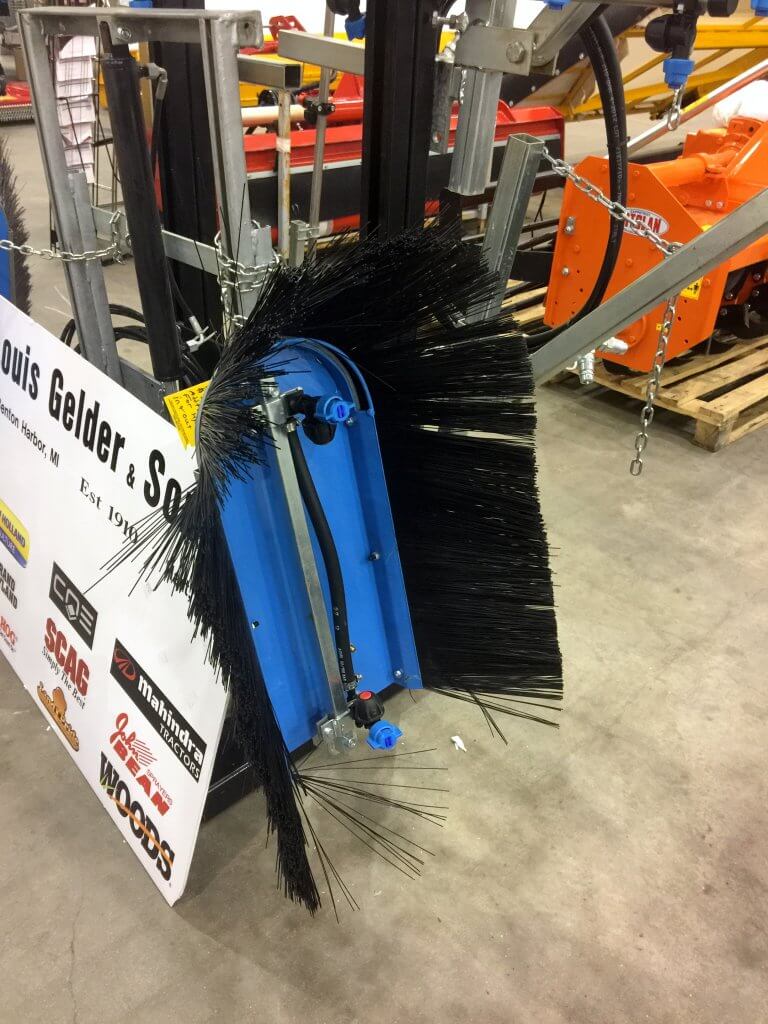
    I’ve seen brushes used to great effect in asparagus because they match the contour of moderately uneven ground by dragging over it. Gaps may open in the shroud as the bristles part, but that issue may be offset by the possible advantage of physical redistribution of herbicide as it rubs over the target weeds like a weed-wicker.
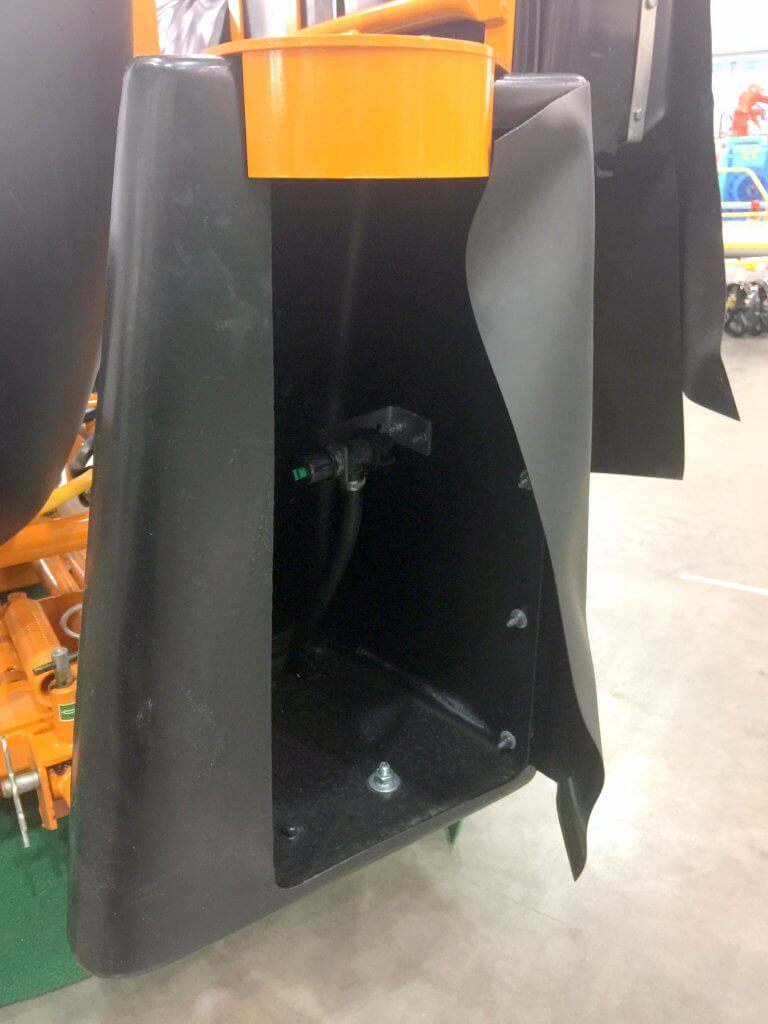
    Then there’s the classic flexible curtain. Similar to the brushes, it’s intended to “just” touch the ground and should maintain a reasonable seal even if said ground is moderately uneven. I often wonder how difficult it is to clean all the surfaces on these systems, but since they are only ever used with herbicide, I won’t speculate how often operators actually decontaminate (or even rinse) them.
    Other variations include a hard carapace with no contouring lip. They should only be used with Coarse spray qualities or larger. Note the hefty spring on the boom for those inattentive moments where the operator might whack a trunk or fence post. The wing flexes away from the impact and snaps back into position, giving the operator time to put  down the cell phone and tweak the steering wheel. The adjustable nozzle body on the far end is a nice feature for adjusting the swath without changing nozzle spacing, but beware to maintain proper overlap.
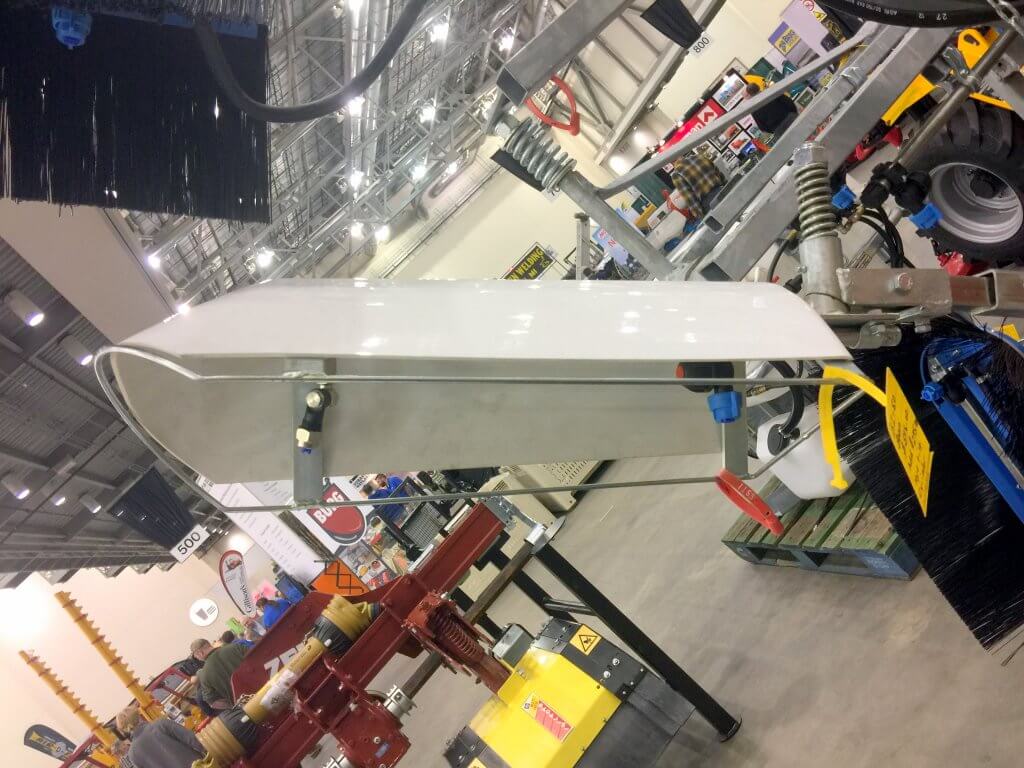
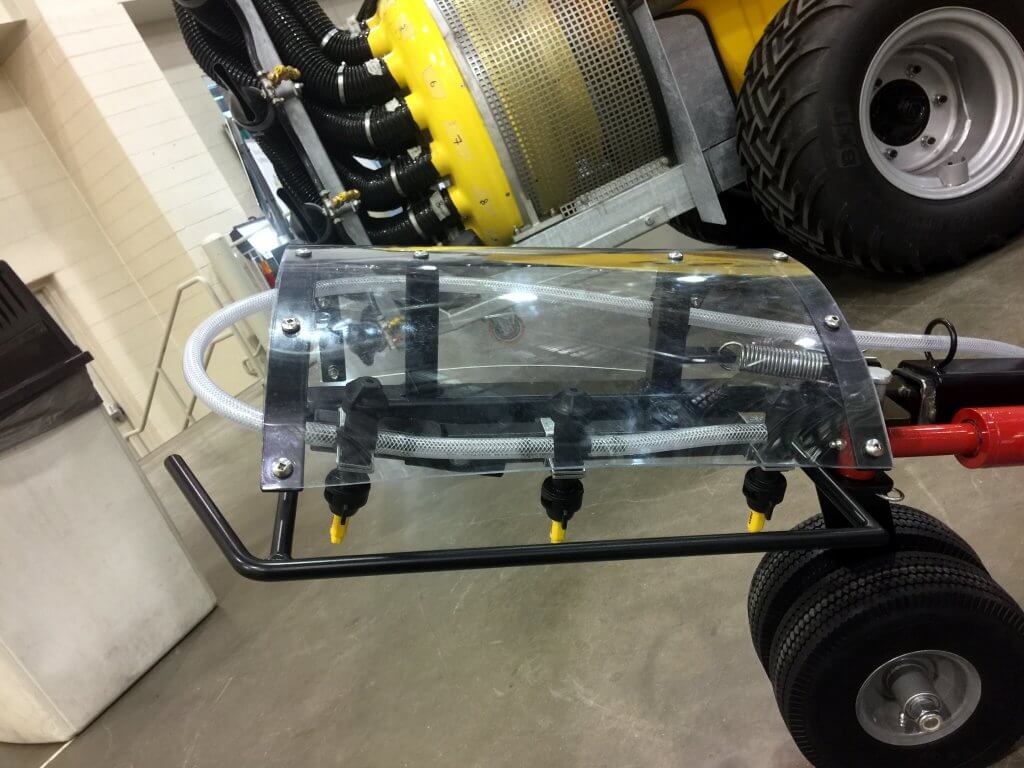
    And, if you want the heartiness of a solid carapace, wouldn’t it be nice to be able to see through it so you can spot a plugged nozzle before it becomes a problem? This variation with its heavy impact bar, tight nozzle spacing (to reduce the potential for misses) and guide wheel (to maintain correct boom height) looks ready to handle anything.
    Airblast – Multi-Row, Ducted Systems

    In the never-ending quest to do more in less time, multi-row airblast systems are very appealing. Delivering air to the vertical booms in each row can be challenging. I’ve seen suspended axial fans (e.g. Gregoire, not pictured) but they’ve always struck me as overkill because of the volume and speed of the air they deliver, and because they need fairly wide rows to be accommodated. Their weight is also a concern, requiring scaffolding that must be strong and still somewhat flexible to handle the inevitable pitch and yaw translated from uneven ground to the boom.

    Lightweight conduits that channel air through ducts (like the Berthoud sprayer below) are a popular solution. They can be suspended to any length and telescope to any row width. Head pressure, and friction from sharp bends in the ducts can influence the air delivered, so the shorter the ducts and the less bends, the better. It was a surprise to discover the ducts in this sprayer are corrugated inside as well as out, but apparently it’s not enough to disrupt air flow significantly.
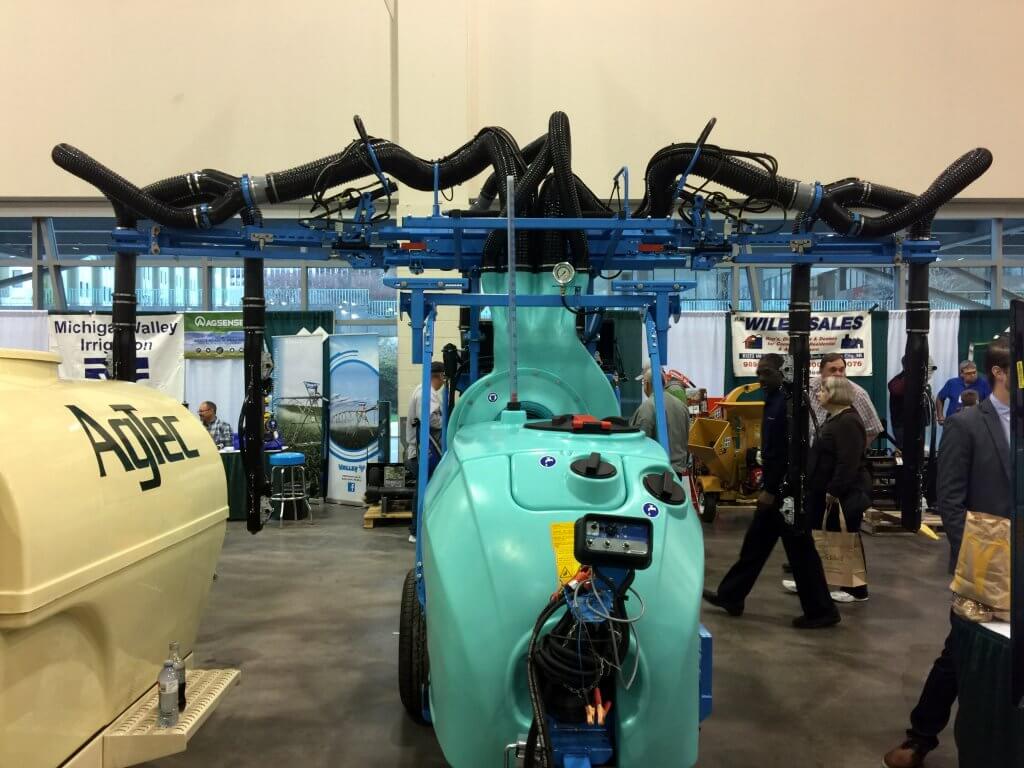
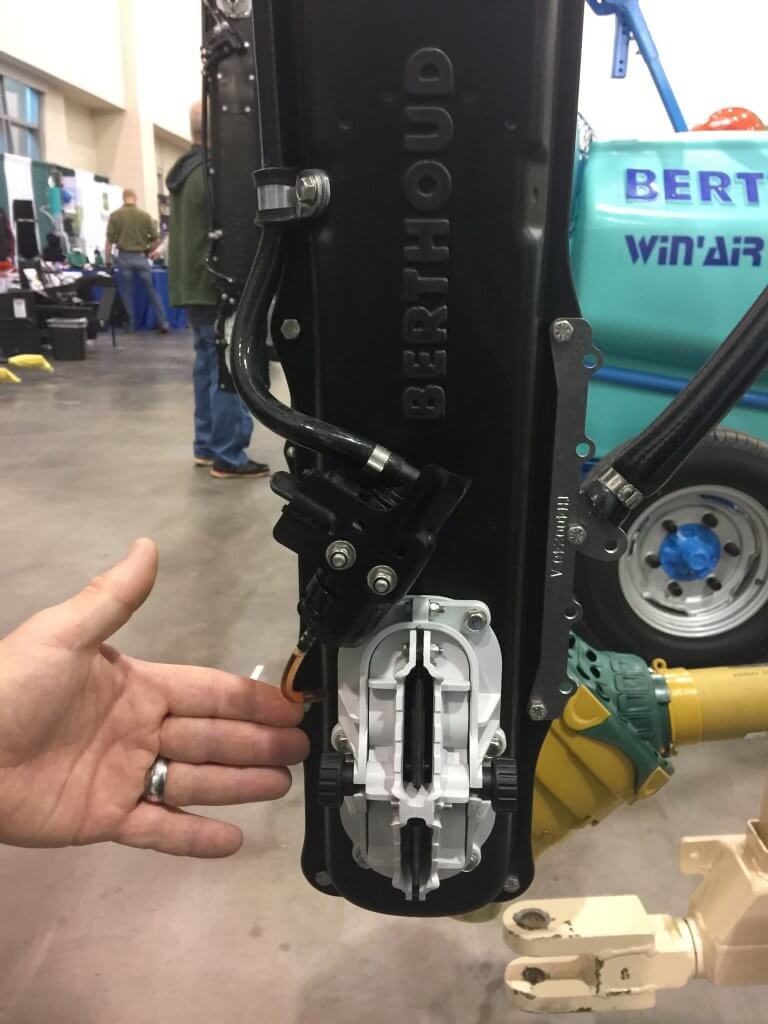
    This Berthoud sprayer offers many of the optional features I’ve seen on the Hol sprayer (not pictured) such as tandem axles, a hand wash tank, low residual volume tank, and built-in boom and tank rinse systems. What’s interesting is the light weight “Drop Legs” (i.e. the vertical booms) with dual-angled “airmist diffusers” (i.e. the air shear nozzles) for multi-row vineyard applications. The close-up below uses my hand for reference. There are options for two to four diffusers on each drop leg, and they can be single or double sided, giving a lot of flexibility to match the crop.

    How do you control flow? With a digital flow regulator. What if you want a different rate at each diffuser? Well, if I understand this correctly, instead of using a typical flow-metering disk placed in-line to restrict flow, you slot a conventional moulded hollowcone inline and use the nozzle manufacturer’s flow tables. And what if you are concerned about using a misting air-shear style nozzle? It appears they also offer an option to swap out the diffusers for air assisted swirl nozzles where the air flow is behind the nozzle to entrain the spray and limit dispersion. They look similar to the diffusers, except they have a nozzle cap between the slotted air outlets (not pictured).
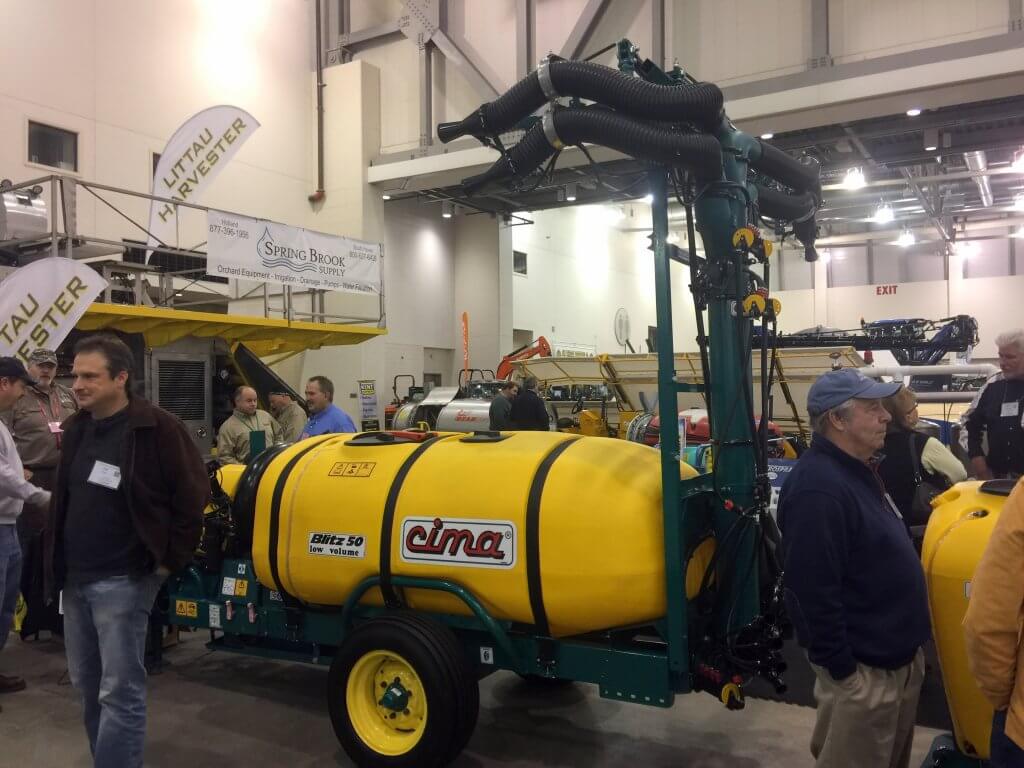
    Ducted air handling comes in many shapes and sizes. Rather than terminating in a blade-shaped diffuser, Cima has hourglass shaped distribution heads that use the venturi principle to deliver airspeeds up to 180 mph at the nozzle. That’s fast, and while it would help entrain spray as it travels longer distances, I wonder what it does to crops close-up?
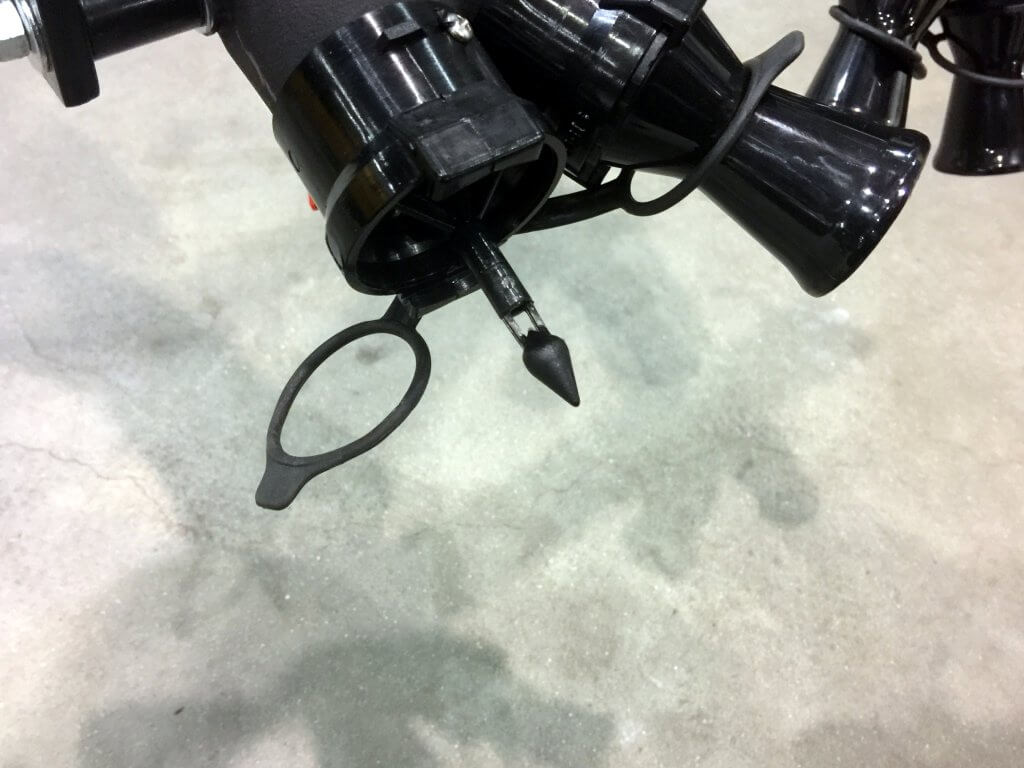
    In the centre of each head is the teardrop-shaped atomizer-style nozzle that produces a Very Fine spray quality between 100 and 150 µm in diameter. It was explained that the teardrop employs Bernoulli’s principle… and for the lay reader (like me), think of the teardrop the way you think of an airplane wing. Air moves over the contour at different rates, making a low pressure area at the tip. The upshot is that it creates lots of very small droplets that (according to the manufacturer) permit you to use much lower volumes that you would with an airblast sprayer using conventional hydraulic nozzles. As always, I suggest you let coverage be your guide to spray volume.
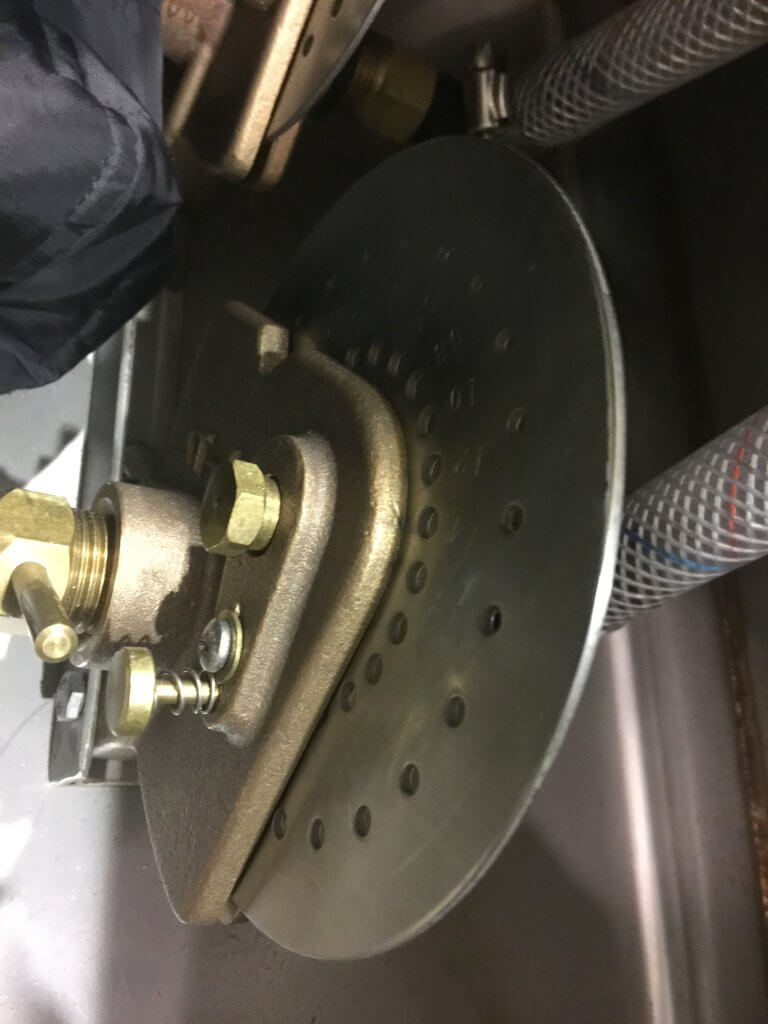
    Flow is controlled by an inline disc that allow the user to select from a series of flow-restricting orifices. Look back two photos and you’ll see them as yellow circles on the tower. The photo below is a stainless steel version from an AgTec.
    Air-Assist Horizontal Booms

    A ducted, vertical airblast sprayer is an air-assisted horizontal boom sprayer just waiting to happen. For vegetable and berry growers, air assisted spraying is an appealing prospect. Many still use axial airblast or cannon sprayers to spray row crops, but I don’t like that. It’s my opinion that while it may be effective, it’s not efficient because it’s not possible to consistently control drift or coverage. I prefer getting the air and nozzle closer to the crop, but sprayers that can do this are few and far between.

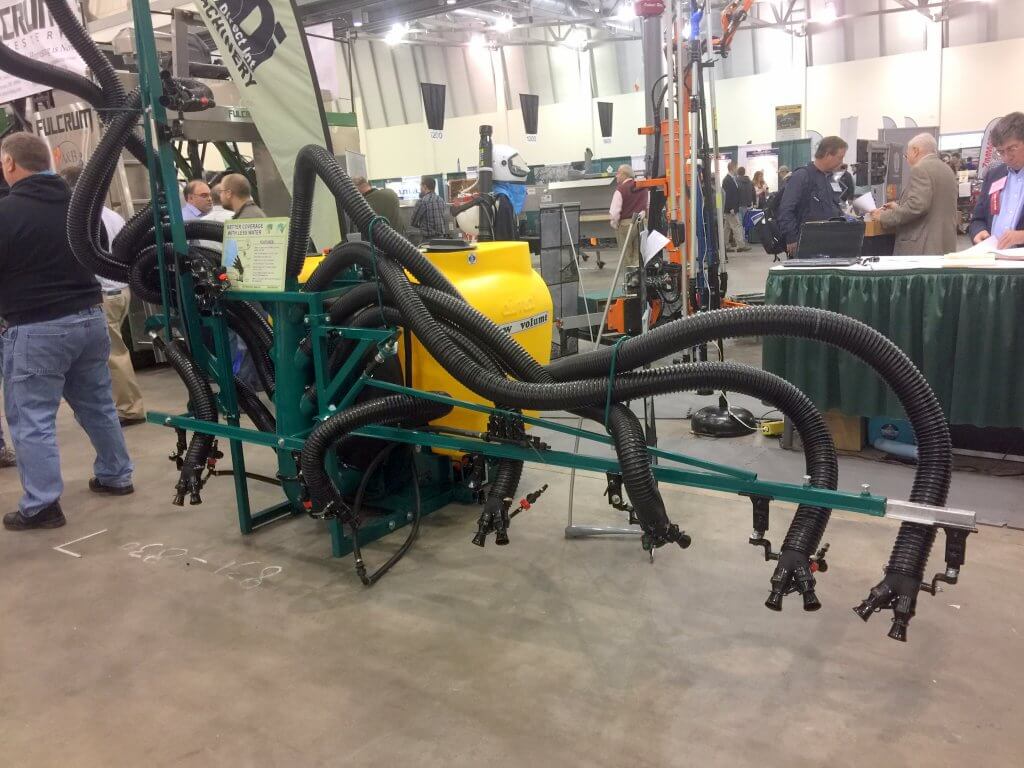
    There have been no after-market options I’m aware of for converting a horizontal boom to an air-assisted boom. That leaves only a few manufacturers of trailed boom sprayers to fill the need (e.g. the trailed Hardi Commander with Twinforce air or their new self-propelled Alpha evo). But this tradeshow opened other possibilities, as demonstrated by the Cima below. It uses all the same principles described above… it just aims down.
    Not interested in ducted air delivery on a three-point hitch system from France or Italy? No problem. How about a Florida company called Airtec that offers trailed air-assist booms up to 120 ft. I wasn’t able to photograph the sprayer at the show, so here’s a picture of one in the field (from their website), as well as several I took at a spinach operation in Ontario.
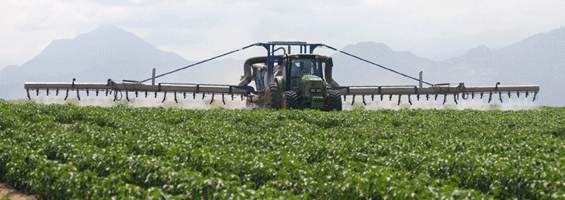
    Airtec offers a single axle, or a walking beam tandem axle reminiscent of the Argifac Condor. Note that the boom itself is the air conduit, which should open crop canopies, expose underleaf surfaces, entrain smaller droplets to reduce drift, and extend the spray window by allowing the operator to work in slightly windier conditions. I can’t speak to the manufacturer’s claims of reducing spray volumes (and by extension, chemicals), but you can read it on their glossy brochure.
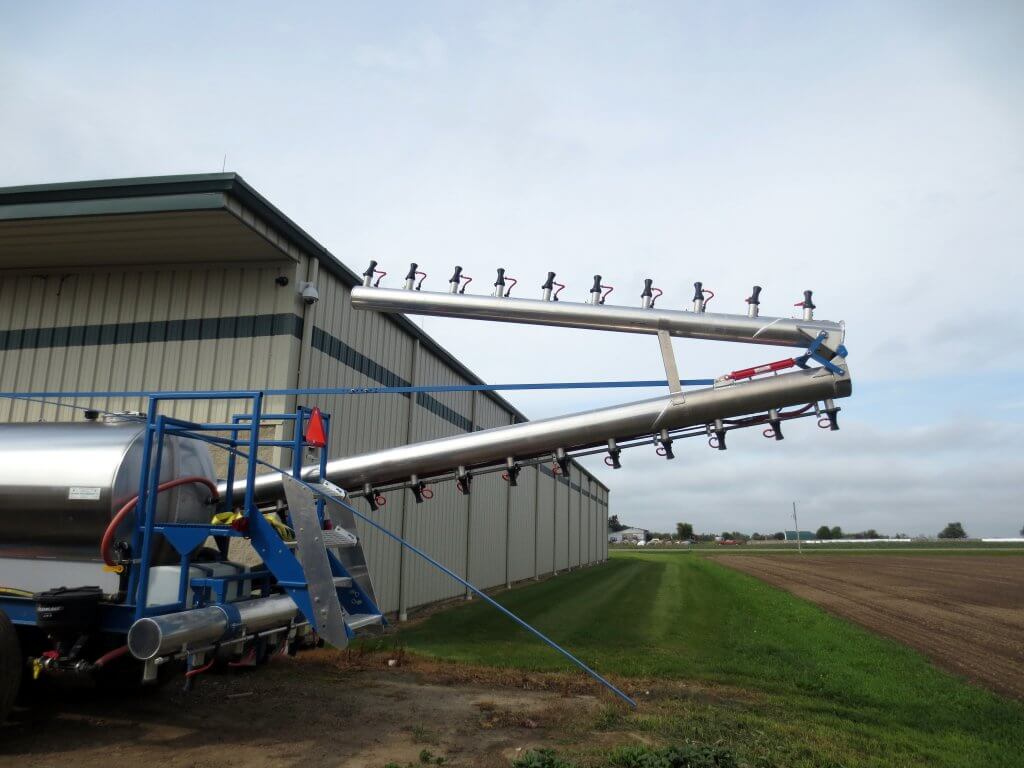
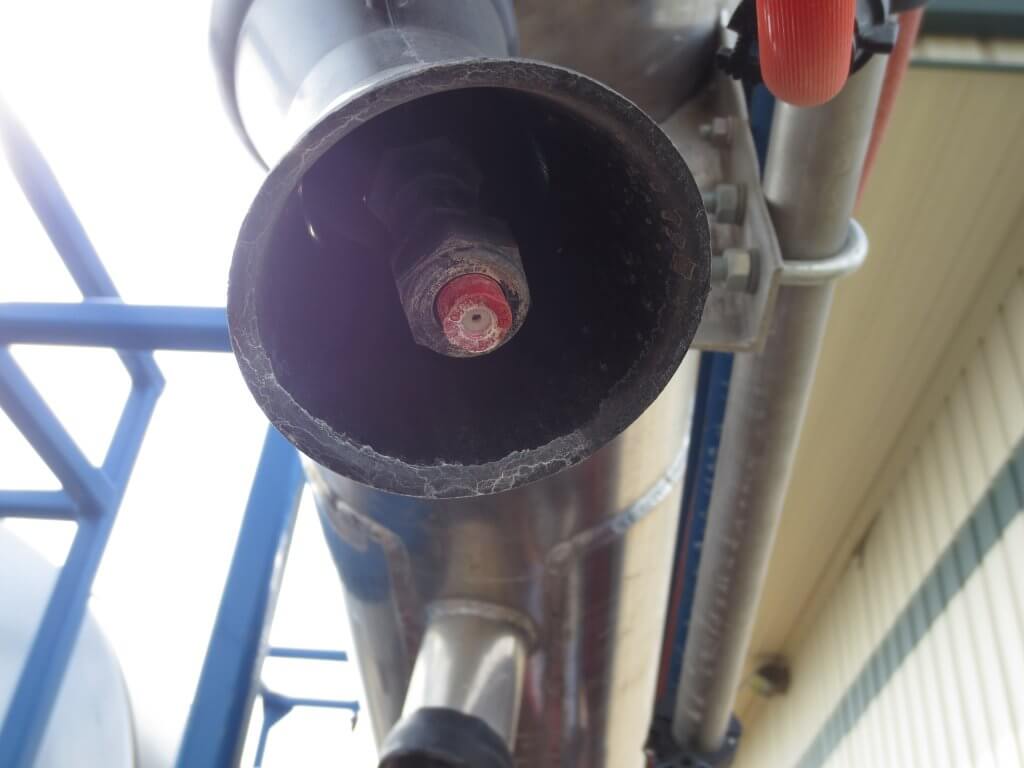
    Each air outlet terminates in an hourglass-shaped duct, similar to the Cima and ostensibly creating the same advantage, as they also claim 180 mph windspeed at the nozzle. Again, I wonder if that can be dialed back, or adjusted to match the density of the crop canopy? Unlike the Cima teardrop shear nozzle, conventional hollowcone nozzles are used (see below). They can also be suspended to match the contour of the row (look back at the first photo) improving coverage in a manner similar to using drop arms or row kits.
    Airblast – Unconventional Fans
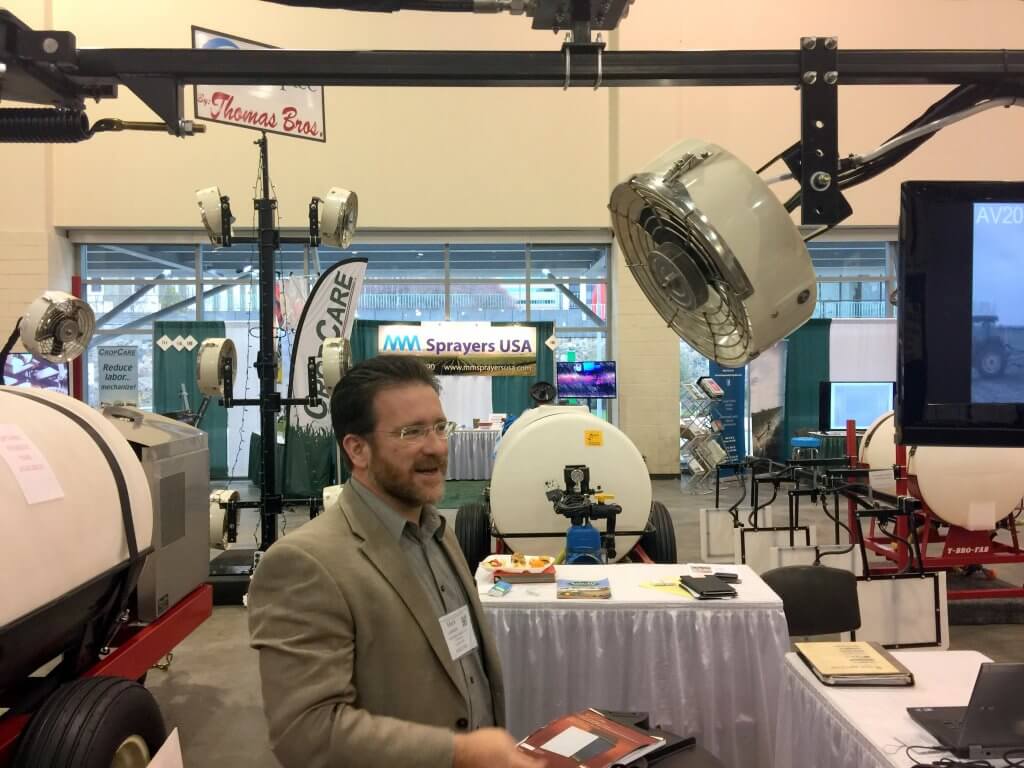
    Have you seen this man? Mark Ledebuhr is the co-author of the 2nd edition of Airblast101. He looks happy here… little did he know I’d one day lasso him into writing the new edition with me.

    Let’s get back to airblast sprayers. The majority do not use ducts to convey air to the target – they point and blow. Pictured below is the generous Mark Ledebuhr with a Proptec rotary atomizer. I call him generous because for several hours Mark led me through the tradeshow and introduced me to many of the vendors. Perhaps more importantly, he helped me interpret what they were explaining after we left each display. Developed with his father, the Proptec system suspends individual fans with rotary atomizers so each can be aimed and operated independently, offering a lot of targeting flexibility. The fans can be electrically or hydraulically driven. Some might be reminded of a Sardi fan (not pictured) but unlike that system which uses several conventional nozzles around the circumference of the fan, Proptec employs a rotary atomizer in the centre. Rotary atomizers can produce very, very small droplets and until GLEXPO I was only familiar with their use in aerial applications.

    I admit to a bias when it comes to airblast sprayers. In my mind, the further away the source of air and spray are from the target, the more opportunity there is to drift. Particularly when such small droplets are involved. I couldn’t find the Proptec video I saw looping at the tradeshow, but what I saw looked like tight columns of cycling spray, reminiscent of a tornado, firing into each row of a vineyard. I was told it was during a 15 mph wind, yet I didn’t see a lot of off target movement. A notable advantage to spraying down into the ground rather than sideways or up into the air. Here’s a good video I found of one operating in highbush blueberry (below). It seems I have a lot more to learn about this system.

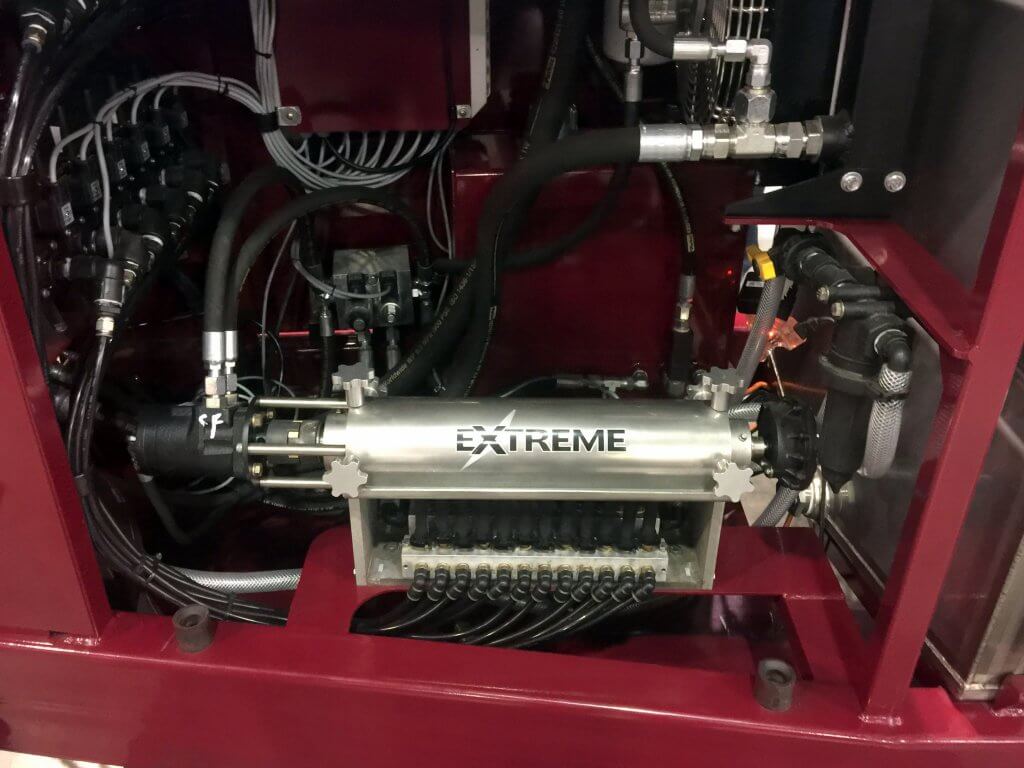
    Then Mark and I went over to see Michigan-based Precise Manufacturing’s EX III cross-flow rotary atomizing tower system. I was reminded of the Curtec tangential fan towers that, like this sprayer, employ rotary atomizers and a peristaltic pump. For Curtec, it’s the AccuStaltic pump. For Precise, it’s the Extreme pump. More on that shortly.
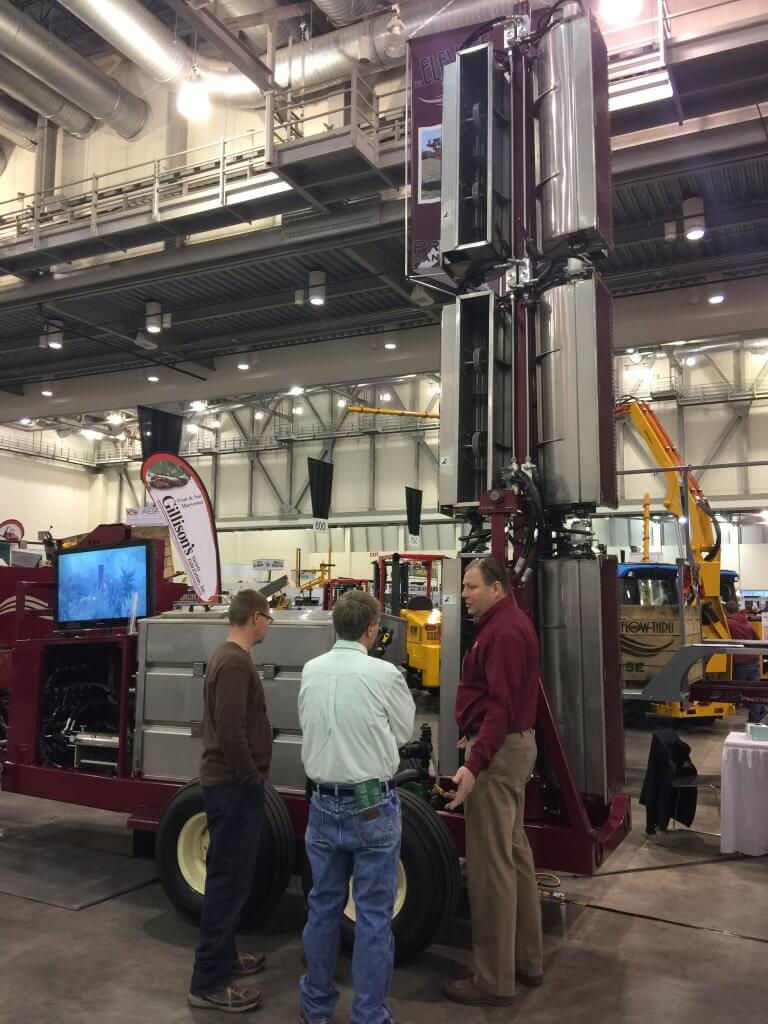
    Here’s a video of the EX III operating (sourced from the Precise Mfg. website). Obviously, we’re not talking grapes, berries or high-density orchards, here. This is for big, dense targets like standard cherry, nut trees and citrus. The rotary atomizers throw spray in a circle, but the air from the tangential fans capture it and blow it all out towards the target in very laminar (i.e. not turbulent) air that carries it over long distances to the target.

    Back to the peristaltic pump. It can run dry, is self-priming, is anti-backflow, low maintenance and can handle pretty much any manner of spray mix (i.e. viscosity and corrosion are non-issues). Each atomizer has its own flow channel, and by changing the diameter of each tube you change the relative flow rate to each atomizer. Certainly not something you’d do every  day, but it does allow you to match flow to the canopy density.
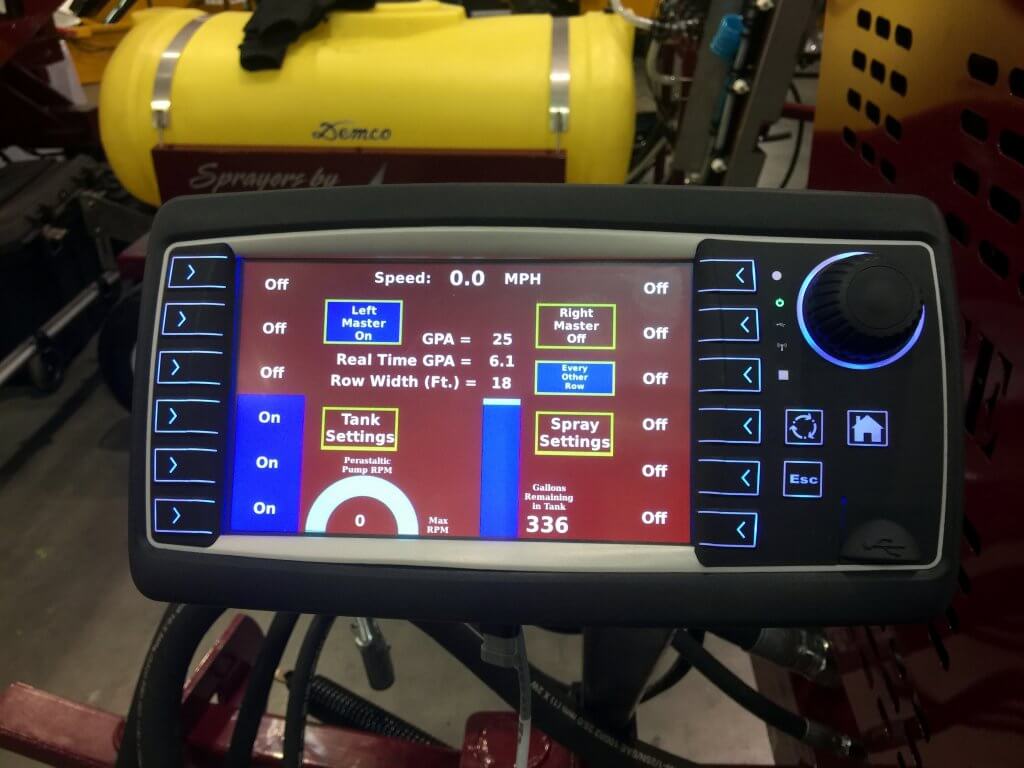
    The Precise Touch Screen Controller is very intuitive and I liked how much control the operator has. Fan speed can be adjusted quite easily (although it would require a very knowledgeable operator to ensure the correct speed is selected). It tracks GPS position and logs where the sprayer empties and the rates used per acre. It also calculates a kind of tree-row volume by determining savings when the operator turns off nozzles that would otherwise blow over the tops of targets, or when overall flow is reduced by slowing the rpms of the pump.
    Airblast – Cannons

    Well, there were lots of cannon sprayers. Most airblast manufacturers have one in their lineup. Squirrel-cage style fans feed air into a tower that allows spray to come out laterally, and on a downward angle from the top of the sprayer. AgTec, pictured below, has long sold such a sprayer.
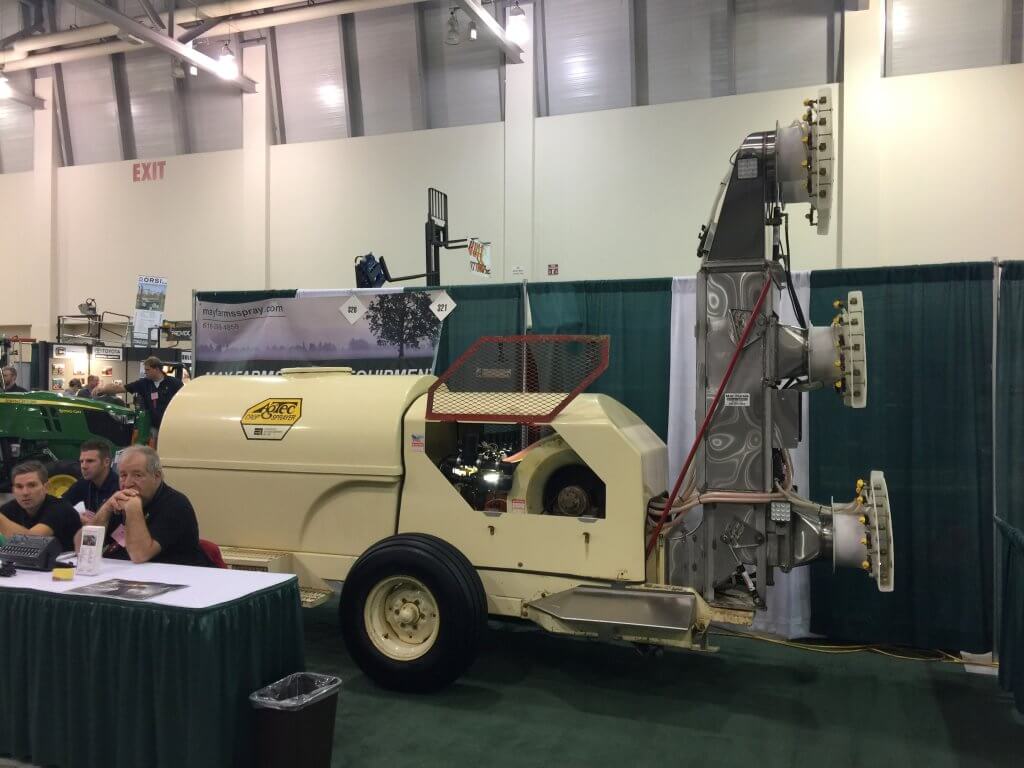
    The nozzles are air-shear style, relying on fast-moving air to shear the spray into finer droplets.
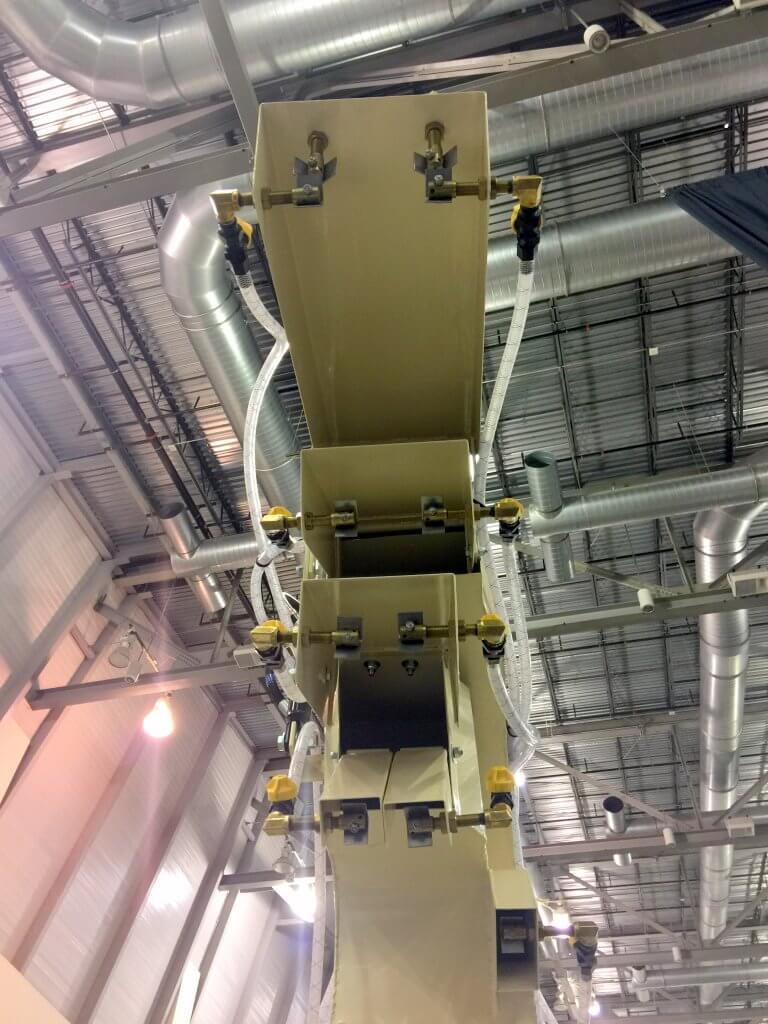
    They usually only have nozzles on one side and the cannon can be turned via a chain-driven gear, and aimed up or down from the cab. They are intended to spray larger areas to save the grower traveling every row, and to prevent physical damage to the crop as the sprayer passes (I’m thinking about knocking berries off, mostly).
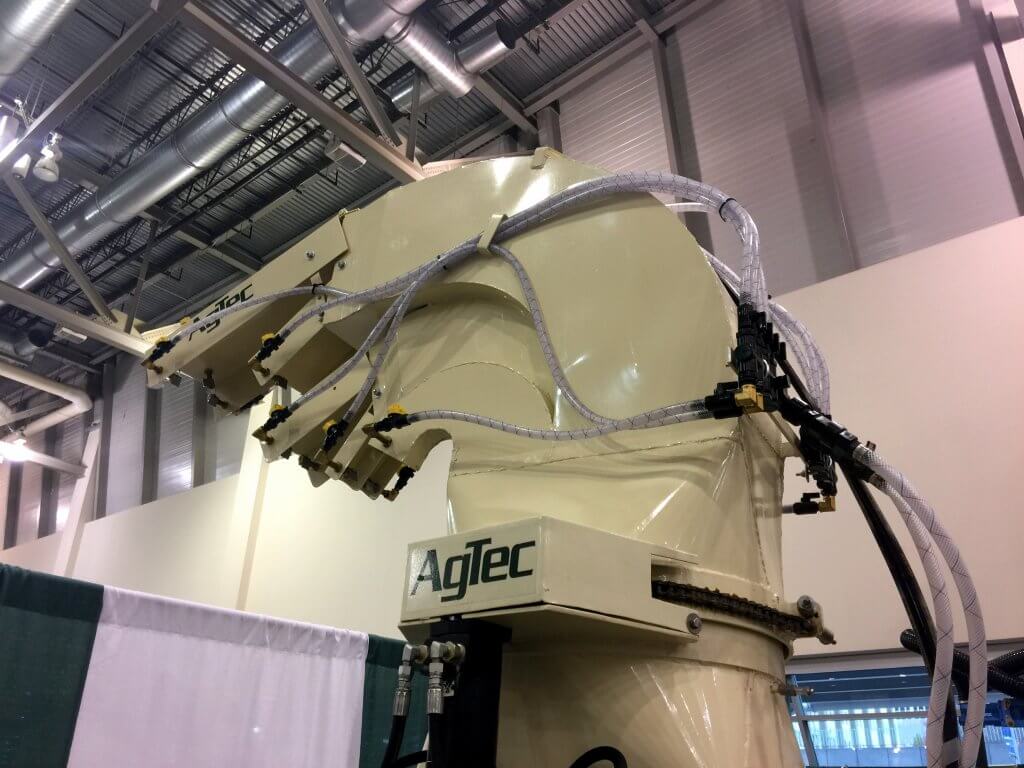
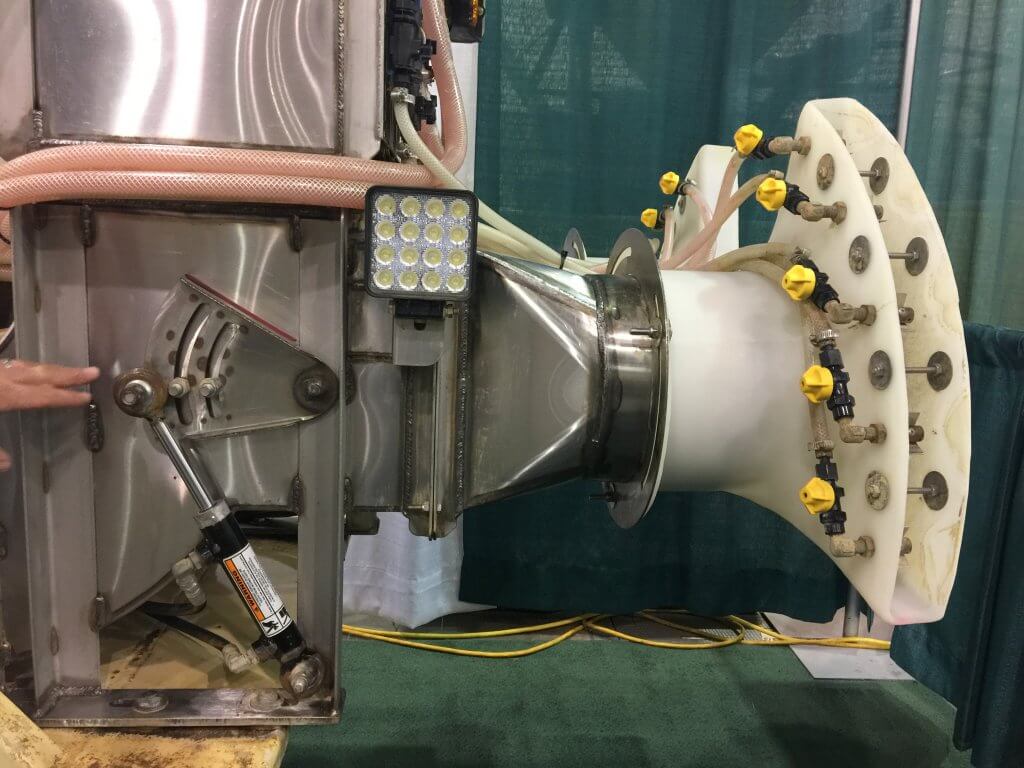
    Nurseries use cannon sprayers quite often because they spray whips (i.e. young trees), shrubs, container crops, and all manner of crops in dense plantings and they try to spray them all with a single sprayer. Generally, there’s a lot of drift potential and erratic coverage from cannon sprayers – especially when operators try to cover too much ground in a single pass. I’m always skeptical when I can’t adjust air settings without impacting spray quality, and considering the bad practice of trying to apply too wide a swath, I have a hard time with cannon sprayers. I will note that the AgTec now has baffles that allow the operator to distribute air over the height of the tower (see the hand near the hydraulic piston in the image below). However, I don’t know what that does to spray quality in each section of the tower.
    Airblast – Classic Axial Fans

    And, of course, there were many classic axial airblast sprayers. Even then, however, there were features to set them apart from one another. British Columbia’s Slimline TurboMist was there, featuring their turbine fans and adjustable air outlets (not pictured). Italy’s Carrarospray was there, and I’ve written about them in the past because they make a tiny sprayer that I like in cane fruit and highbush blueberry. You can hitch it to a mower and mow while you blow.
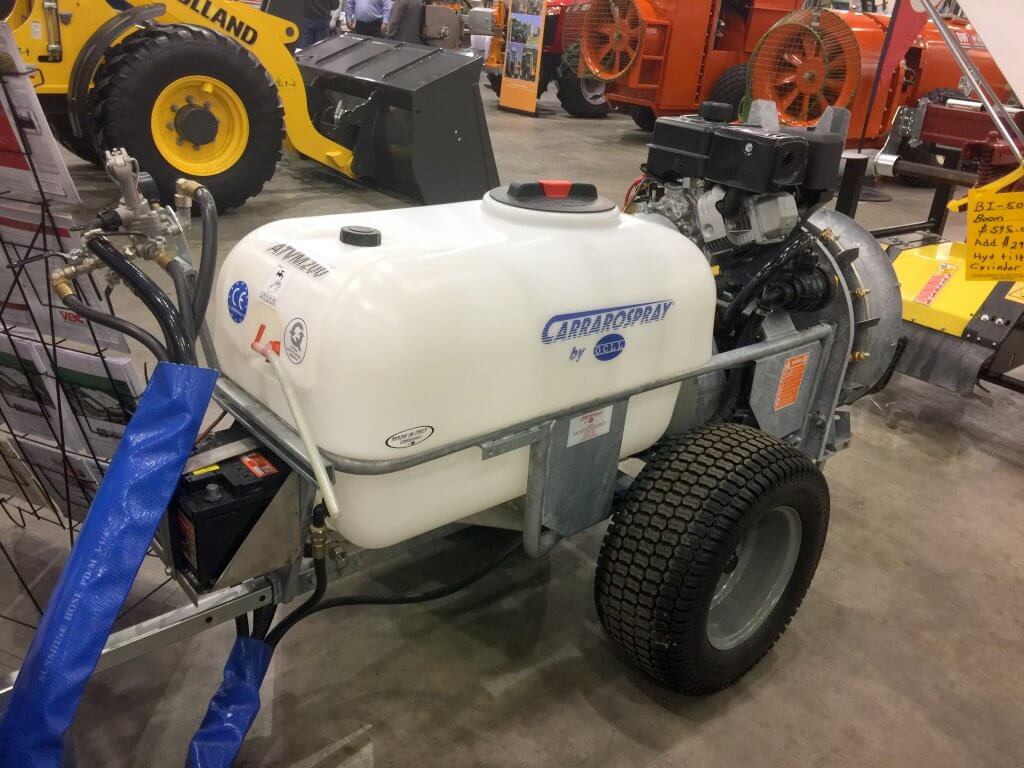
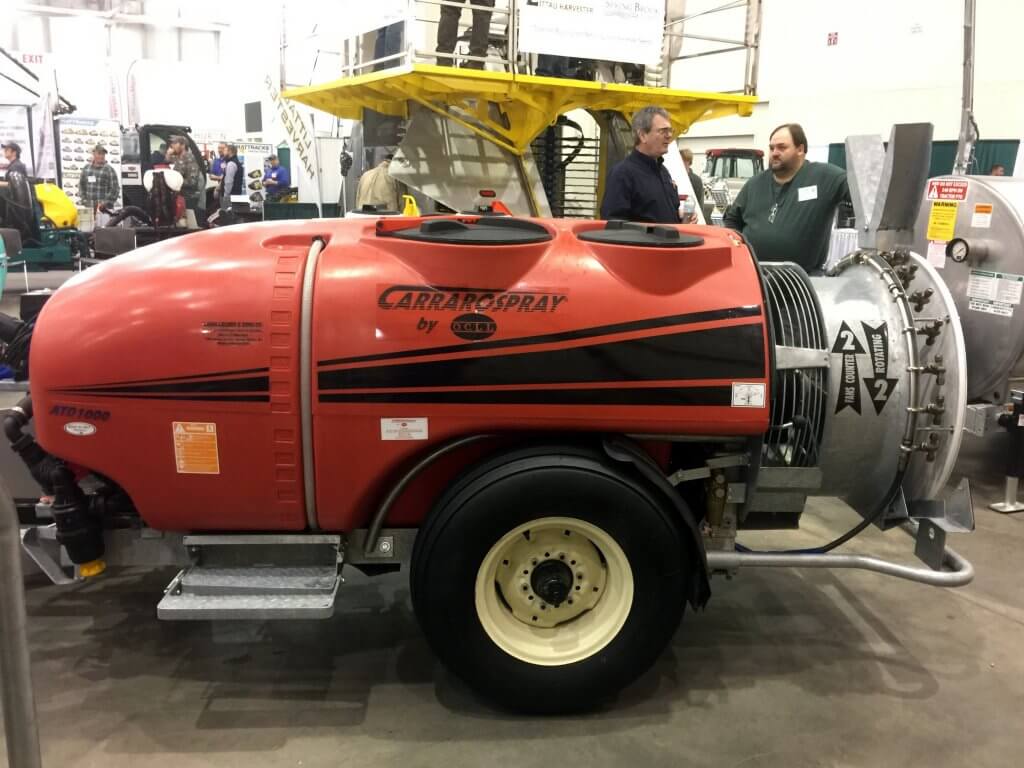
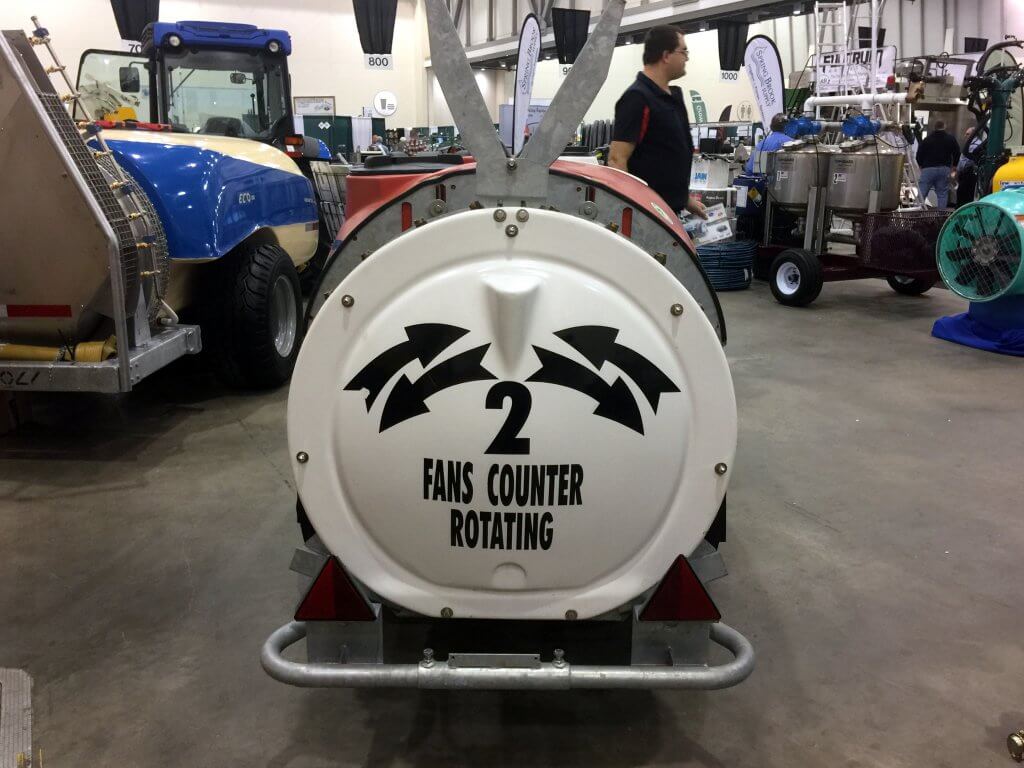
    More interesting to me was their sprayer boasting two axial fans that run counter to one another. Carrarospray claims this counter-rotation creates more uniform air than a single fan… but I have no idea how.
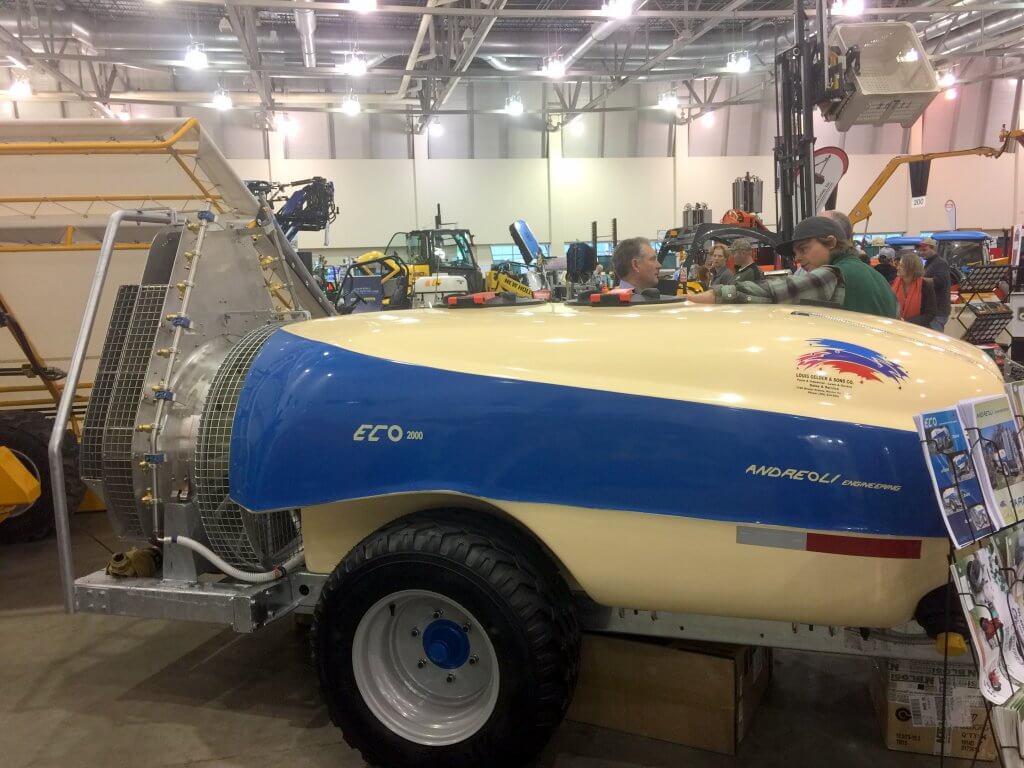
    Then there was the Andreoli Eco with it’s stainless steel high-efficiency vane system. Reminding me of the Turbomist, the suction is in the front, so the sprayer is a little less likely to draw spray into the fan when one side is shut down for border spraying and when turning at the end of a row. Louvers covering the outlets would be better, but still, this is an improvement. They also claim to have a symmetrical airflow pattern, unlike older axial fans that move air up on one side and down on the other.
    The Rears Pul-Tank reminded me of just that – a tank! Heavy-duty, stainless construction and intended (with care) to last a long, long time. No special features to boast of. It would seem this sprayer adheres to old-school ideas about airblast spraying. Certainly, simple and strong are two appealing features to those operators that don’t want to be bothered with complications.
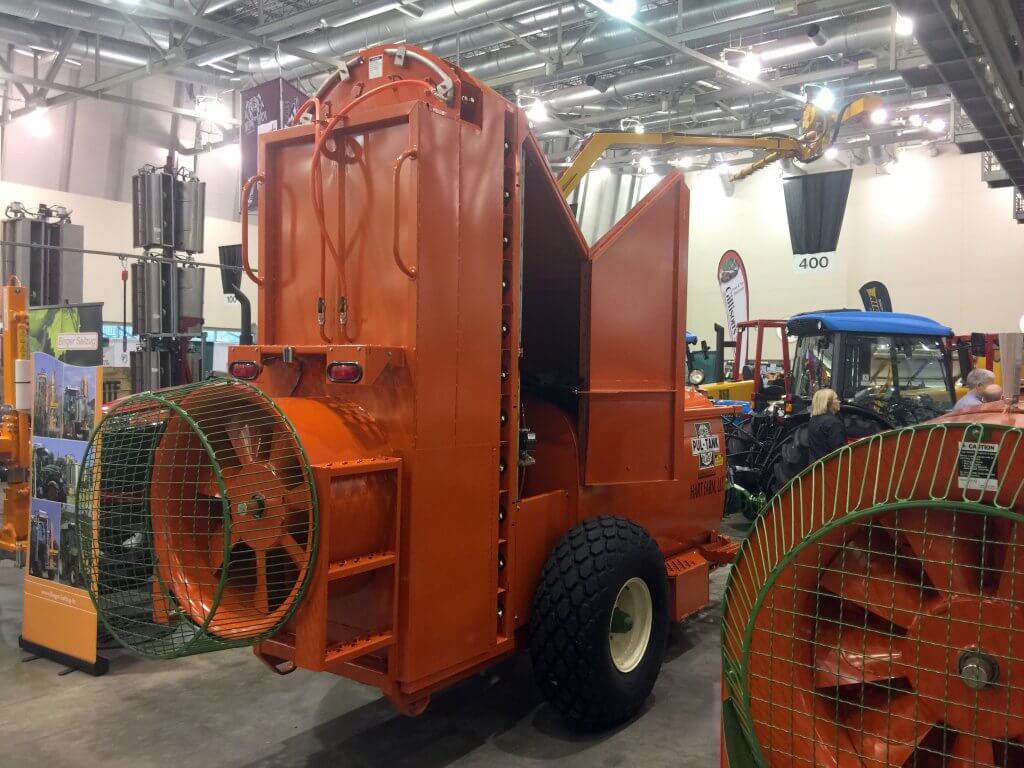
    And, lastly (not leastly), was the Air-O-Fan sprayer. Another solidly-built sprayer with a few interesting features. Not shown is the reverse-style propeller which like the Andreoli Eco, claims to draw from clean air, and not spray-laden air. This is undoubtedly the biggest trash guard I’ve ever seen to protect the fan blades from drawing in dirt and leaves (see below). Looks like a CAT steam shovel.
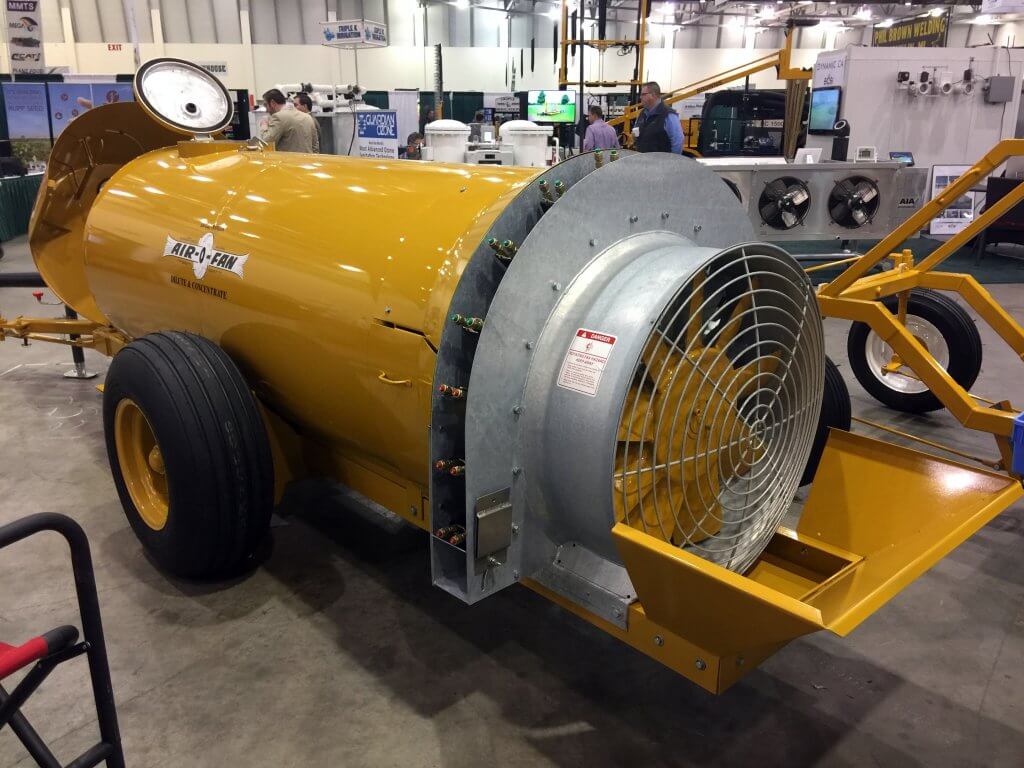
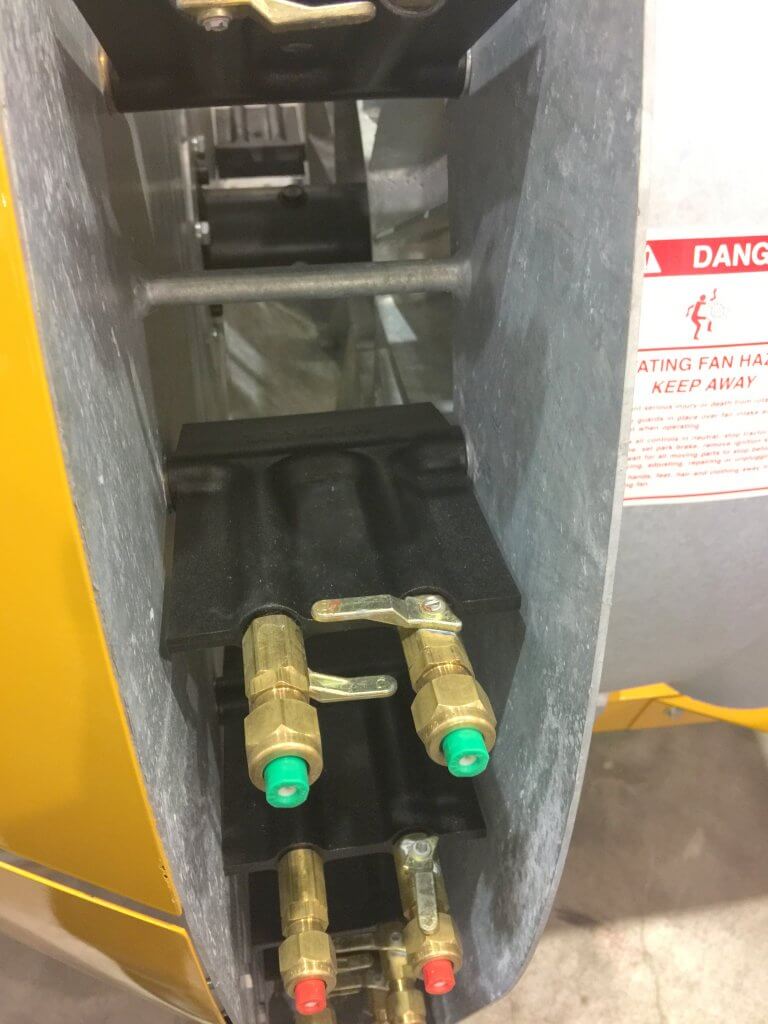
    Something that struck me was the air deflector blades inside the fan housing. In my experience, the nozzle bodies and blades are two separate components. But not here, and it makes so much sense! I’ve always taught operators to adjust the air speed/volume and direction first, then adjust nozzle direction and rates second. With this system, you aim the nozzles right along with the air. Expanded systems (e.g. for tree nut, citrus) can have as many as three nozzles per deflector blade.

    There was one other very exciting feature coming to this sprayer that I promised I wouldn’t reveal until they were ready, but I’ll just write “HVES” so you will remember you heard it here, first!
    Closing

    So, this was a massive, sprawling article. Congratulations for getting to the end and I hope it opens your mind to the possibilities for horticultural spray application. The GLEXPO tradeshow was a great experience and I’ll try to get back there in the future. Until then, I look forward to bringing some of this equipment to Ontario to try it out in our horticulture operations. There’s always more to learn.

  • Selecting a Field Sprayer Nozzle

    Selecting a Field Sprayer Nozzle

    nozzles

    This article is reproduced, with permission, from Ohio State University Extension’s factsheet FABE-528.

    Although nozzles are some of the least expensive components of a sprayer, they hold a high value in their ability to influence sprayer performance.

    Nozzles meter the amount of liquid sprayed per unit area, controlling application rate, as well as variability of spray over the width of the sprayer boom. Nozzles also influence droplet size, affecting both target coverage and spray drift risk.

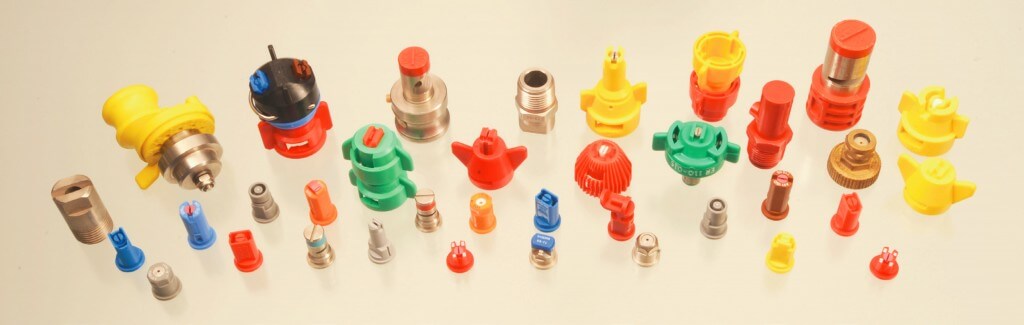
    Nozzles come in a wide variety of types and sizes. The best nozzle for a given application will maximize efficacy, minimize spray drift, and allow compliance with label requirements such as application rate (gallons per acre) and spray droplet size. Selecting the best nozzle requires careful consideration of all the factors listed below:

    Nozzle Type

    • Sprayer operation parameters
      • Application rate, spray pressure, travel speed
    • Type of chemical sprayed
      • Herbicides (soil incorporation, pre/post emergence)
      • Insecticides
      • Fungicides
      • Fertilizers and growth regulators
    • Mode of action of chemical (spray coverage requirement)
      • Systemic
      • Contact
    • Application type (broadcast, band, directed, air assisted)
    • Target crop (field crops, vegetables, vineyard, shrubs and trees, etc.)
    • Spray drift risk

    Nozzle Size

    Each nozzle type is designed for a specific type of target and application. For example, a nozzle designed for broadcast spraying is not good for spraying pesticides over a narrow band. Luckily, most nozzle manufacturers’ catalogues have charts showing which nozzle type will be best for a specific job. Check the websites of nozzle manufacturers to reach their catalogues. For more information, contact your county Extension office.

    Nozzle manufacturers’ catalogs provide tables and charts showing application rates (gallons per acre or gpa), given a nozzle’s flow rate (gallons per minute or gpm) delivered at various pressures (psi) and travel speeds (mph). These tables are useful tools for selecting the appropriate nozzles, pressure and speed to spray chemicals at application rates prescribed by product labels. However, the charts are only for a limited number of travel speed and nozzle spacing situations. There may be situations where the charts will not provide information associated with your sprayer setup (nozzle spacing) and operating conditions (travel speed and spray pressure). The Apps developed by most of the major nozzle manufacturers can provide you the exact nozzle flow rate required for any given set of application parameters, and identify a specific set of nozzle recommendations for the given application parameters.

    To find these Apps, simply visit the App Store in your smart phone or tablet and do a search under “Spray Nozzle Calculator”, or some other key words related to nozzle size selection. You may also want to do a search under the name of the nozzle company from which you are interested in buying the nozzles. However, some Apps are not user friendly and sometimes they do not take into account the droplet size requirements when recommending nozzles. Although the Apps and tables in catalogues may expedite the nozzle size selection process, it is best to understand the procedure and the maths nozzle manufacturers use to generate the values listed in tables and to recommend nozzles in their Apps. The procedure used by the nozzle manufacturers to generate numbers in tables and in their Apps is explained below. By following the steps mentioned below, you should be able to determine the exact nozzle flow rate (gpm) required for your spray application parameters.

    Once the exact nozzle flow rate is determined, you can then look at the catalogue to select the nozzle that will provide you the flow rate at a practical pressure setting.

    Steps to select the proper nozzle size:

    The following steps must be taken to determine the nozzle flow rate (gpm):

    1. Select the application rate in gallons per acre (gpa). This is a management decision you will have to make based on pesticide label recommendations, field conditions and water supply.
    2. Select a practical and safe ground speed in miles per hour (mph).
    3. Determine the spray width per nozzle (W). For broadcast applications, W = nozzle spacing (distance between two nozzles on the boom) in inches. For band spraying, W = band width in inches. For directed spraying, W = row spacing in inches (or band width) divided by the number of nozzles per row (or band).
    4. Determine the flow rate (gpm) required from each nozzle by using the following equation: gpm = (gpa x mph x W) / 5,940 (5,940 is a constant to convert gpa, mph and inches to gpm).
    5. Select a nozzle size from the manufacturer’s catalogue that will give the flow rate (gpm) determined in Step 4 when the nozzle is operated within the recommended pressure range. If a nozzle of this size is not available, change the travel speed in the equation above and determine the new flow rate required.

    An Example

    For example: You want to spray a pre-emergence herbicide at 15 gpa, at a speed of 8 mph. The distance between the nozzles on the boom is 20 inches. The herbicide label requires a spray quality of “Medium.” What should be the flow rate of the nozzle you will choose? 

    gpm = (gpa × mph × W) ÷ 5,940

    Since this is a broadcast application (pre-emergence), W is the distance between nozzles (W = 20″). Filling in the variables yields the following calculation:

    gpm = (15 gpa × 8 mph × 20 in) ÷ 5,940 = 0.4 gpm

    This means, to apply 15 gpa at a speed of 8 mph with this sprayer setup, we need to select a nozzle with a flow rate of 0.4 gpm.

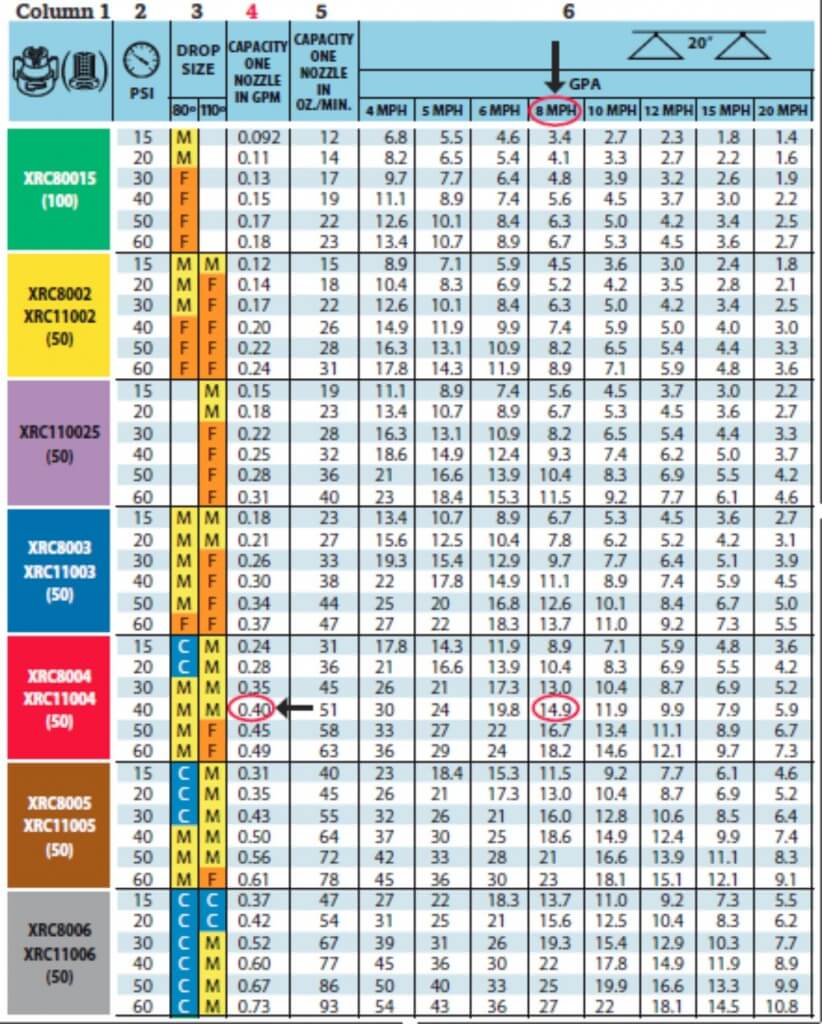
    Now, we go to the nozzle catalogue, and find a nozzle that will give us a flow rate of 0.4 gpm, while operating the sprayer at an applicable pressure and travelling at 8 mph. Catalogues have charts for each nozzle, similar to the one shown on the next page. The first column gives the color code of the nozzle (which indicates flow rate), nozzle ID number, and the appropriate filter type for the nozzle. Column 2 gives the pressure range at which the nozzle should be operated. Column 3 gives the spray quality, a measure of spray droplet size (fine, medium, coarse, etc.) produced at different pressure settings. Columns 4 and 5 give the flow rate of nozzles in gallons per minute and ounces per minute, respectively, at different pressure settings. Column 6 gives gallons per acre application rate at different travel speed settings.

    First, we need to find the best type of nozzle for our application. In their catalog, the nozzle manufacturer recommends a flat-fan pattern type nozzle for broadcast application of pre-emergence herbicides. Then we find a chart associated with the nozzle type recommended.

    The chart shown happens to be for that type of a nozzle. Now we proceed with the process to determine the appropriate size of the nozzle.

    Example of a typical nozzle rate table.

    In our example above, the equation in Step 4 resulted with a flow rate of 0.4 gpm. Now, we look at Column 4 (gpm per nozzle) to determine the nozzle that provides us 0.4 gpm. Using the chart, we see that the nozzles XRC8004 or XRC11004 (shown in red) provide 0.4 gpm flow rate at 40 psi operating pressure. This nozzle also happens to provide Medium (designated with “M”) spray quality as recommended on the herbicide label. Under these operating conditions, this sprayer should apply 15 gpa at 8 mph as we expected. The validation of this is also evident on the chart. If you look at Column 6, choose 8 mph ground speed, the nozzle we selected will spray approximately 15 gallons per acre (14.9 gpa shown on the chart) at 8 mph travel speed and 40 psi spray pressure.

    There may be multiple numbers of nozzles that can satisfy the 0.4 gpm flow rate requirements. However, they may not satisfy the desired spray quality and/or desired travel speed. It may be necessary to adjust pressure and/or travel speed according to nozzle selection. For example, the Brown XRC8005 nozzle is capable of producing 0.4 gpm, and achieving 15 gpa at 8 mph, if the spray pressure is reduced to about 25 psi. Similar calculations can be made using the equation below to come up with other GPM (flow rate) and PSI (pressure) combinations to satisfy the required 15 gpa application rate:

    (GPM₁ ÷ GPM₂) = (√PSI₁ ÷  √PSI₂)

    In this example, reducing the pressure to 25 psi alters the spray quality to “Coarse,” violating the label recommendation. When changing pressure is not an appropriate choice, the only other practical option is to change the travel speed. There is an inverse linear relationship between the travel speed (mph) and the application rate (gpa). The relationship is expressed by the equation:

    (GPA₁ ÷ GPA₂) = (MPH₁ ÷ MPH₂)
    or
    (GPA₁  ×  MPH₁) = (GPA₂  ×  MPH₂)

    Using the relationship above, we can determine that increasing the travel speed to 9.9 mph and keeping the sprayer operating at 40 psi will yield 15 gpa, as described below. The chart shown earlier indicates when using XRC11005, GPA₁ = 18.6 at 8 mph (MPH₁) at 40 psi. We want to find out what the new travel speed (MPH₂) should be to achieve 15 gpa (GPA₂). Using the equation above:

    (18.6 GPA  ×  8 MPH) = (15 GPA  ×  MPH₂)
    so
    MPH₂ = (18.6 GPA  ×  8 MPH) ÷  15 GPA = 9.9 MPH

    However, increasing travel speed to 9.9 mph may not be practical or safe. When changes to pressure or travel speed as dictated by the equations above are neither practical nor safe, it may be necessary to select a different nozzle.

    In this example, it looks like the best nozzles to use for our application situation are XRC8004 or XRC11004, both providing 0.4 gpm at 40 psi. The only difference between these two nozzles is in the angle of spray pattern: one produces an 80 degree fan pattern (XRC8004), while the other one (XRC11004) produces a 110 degree fan pattern. Due to the difference in the angle of the spray pattern, each of these nozzles require different boom heights to obtain proper overlap between two adjacent nozzles.

    Calibrate the sprayer

    Selecting the right type and size of a nozzle is not sufficient to end up with accurate, effective and efficient application of chemicals sprayed. Changes in ground conditions (tilled, un-tilled, grass, wet, dry), and the topography of the field sprayed (flat, sloped) will affect the ground speed which is one of the variables used in determining the correct nozzle size. Nozzle orifices wear out with time causing larger flow rates and distorted spray patterns than when they were new. The gpm flow rate values given in catalogues or in Apps are based on spraying water only. Spraying solutions with higher densities than water (most spray solutions are) will affect the flow rates of nozzles at the same spray pressure. For the reasons mentioned above, sprayers should be calibrated frequently, especially when the field conditions change, to determine the actual application rate.

    Calibration is easy, and there are many ways to do it. regardless of the method chose, three measurements will be taken:

    • actual ground speed,
    • the distance between nozzles, and
    • nozzle flow rate for a given length of time.

    One easy method is explained in an OSU Extension Publication (AEX 520) listed in the references at the end of this article.

    Keep several types of nozzles on the boom

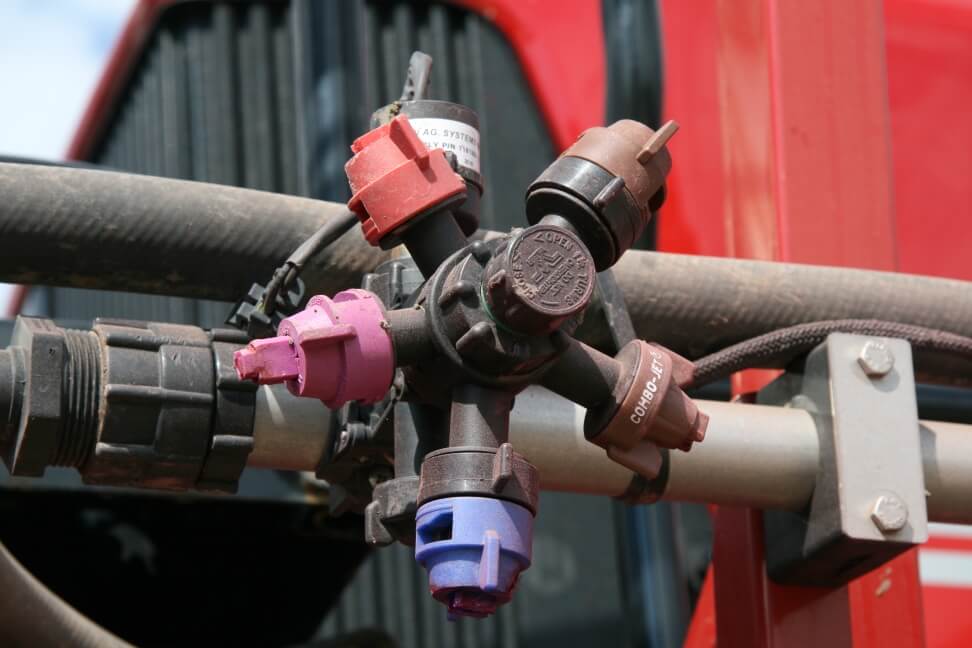
    Remember that one specific type of nozzle will not be best for all applications. For this reason, it is best to have several types and sizes of nozzles on the boom so that you can switch to the “best” nozzle choice for a given spraying job. As shown in the pictures below, there are various types of sprayer components and setups you can buy to configure your boom so the new set up allows you to easily switch from one nozzle to another instantly.

    Nozzle Turret

    Keep spray drift in mind when selecting nozzles

    One of the major problems challenging pesticide applicators is spray drift, which is defined as movement of pesticides by wind from the application site to an off target site. Drift is influenced by many factors which are discussed in detail in two OSU Extension publications (Bulletin 816 and AEX-525) listed in the references at the end of this article. Equipment, especially the nozzles, used to spray pesticides play a significant role in generating as well as reducing spray drift. In nozzle catalogues, you can see a number of different nozzles of the same type, in terms of spray pattern. For example, one can find nozzles within the same “flat-fan” category classified as “low-drift.” Research conducted at Ohio State and elsewhere clearly indicate that nozzles labelled as “low-drift” significantly reduce spray drift as discussed in OSU Extension publication AEX-523 (listed in the references below). If drift is, or becomes a concern, it may be best to switch from a conventional flat-fan nozzle to a “low-drift” flat-fan nozzle with the same flow rate. Therefore, it is best to have more than one type of a “flat-fan” pattern nozzle on the boom.

    Summary and conclusions

    Nozzles are typically the least costly items on a sprayer, but they play a key role in the final outcome from a spraying job: achieving maximum efficacy from the pesticide applied while reducing the off-target (drift) movement of pesticides to minimum. Pesticides work well if the rates on labels are achieved during application. This can be achieved only if the right nozzle type and the proper size of the nozzles are on the sprayer, and the sprayer is operated properly.

    Although the Apps and tables in catalogs may expedite the nozzle size selection process, it is best to understand the process and the math nozzle manufacturers use to generate the values listed in tables, and to generate nozzle recommendations in their Apps. This procedure, explained in this publication, hopefully will help you to determine the exact nozzle flow rate (gpm) required for your spray application parameters, while highlighting some other important parameters such as spray pressure, droplet size, spray coverage on the target, and drift, all of which should be given serious consideration when selecting the best nozzle for a spraying job.

    Acknowledgments

    The author thanks Mary Griffith, Agriculture and Natural Resources Extension Educator, OSU Extension; Dr. Larry C. Brown, Professor and Extension Specialist, Department of Food, Agricultural and Biological Engineering, The Ohio State University; and Dr. Robert “Bobby” Grisso, Professor and Associate Director, Virginia Cooperative Extension, Virginia Tech University, Department of Biological Systems Engineering; for reviewing this publication and for their editorial contributions.

    References

    1. Ozkan, E. Calibrating boom sprayers. Ohio State University Extension publication AEX-520, Columbus, Ohio.
    2. Ozkan, E. New nozzles for spray drift reduction. Ohio State University Extension publication AEX-523, Columbus, Ohio.
    3. Ozkan, E. and R.C. Derksen. Effectiveness of Turbodrop® and Turbo Teejet® nozzles in drift reduction. Ohio State University Extension publication AEX-524, Columbus, Ohio.
    4. Ozkan, E. and H. Zhu. Effect of Major Variables on Drift Distances of Spray Droplets. Ohio State University Extension publication AEX-525, Columbus, Ohio.
  • Steps to Calibrate your Field Sprayer

    Steps to Calibrate your Field Sprayer

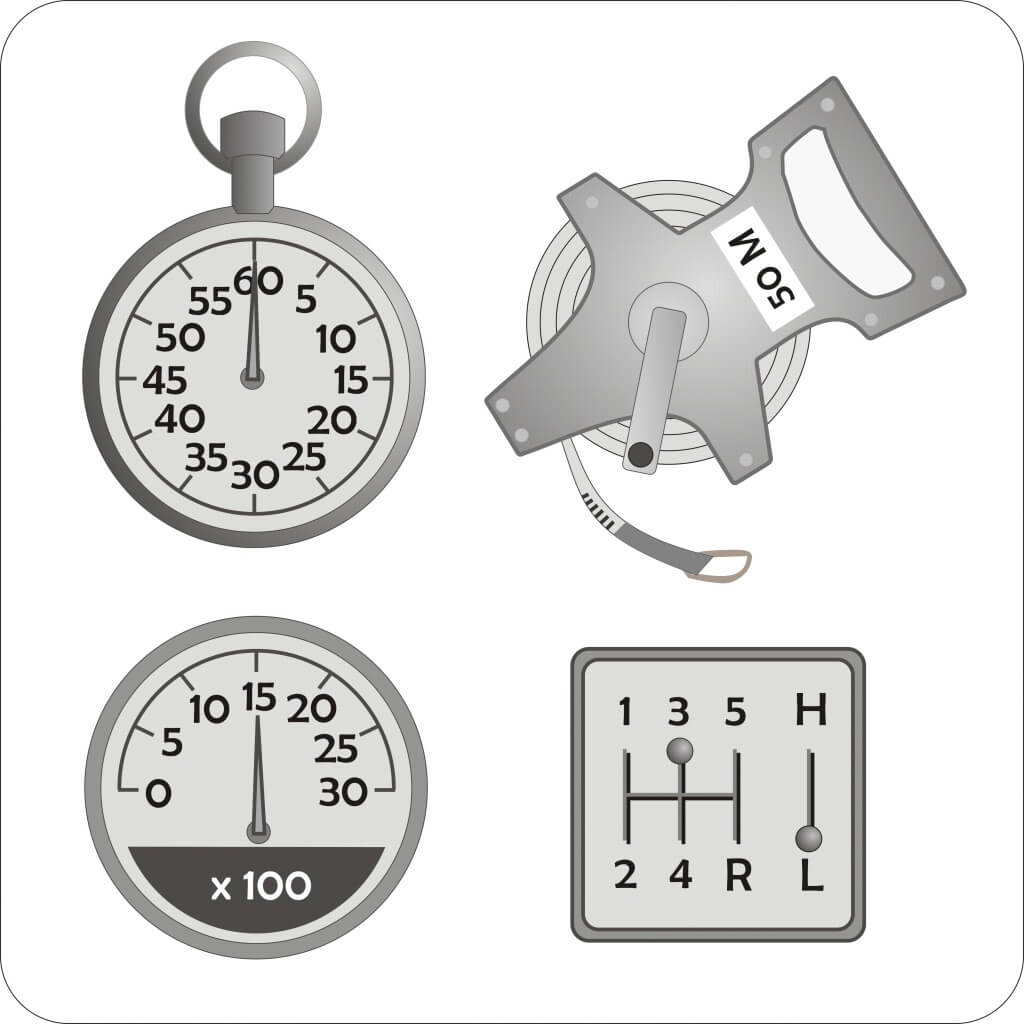
    Calibrating a boom sprayer is not as difficult as it sounds. There are several ways to calibrate a sprayer. Regardless of which method you choose, it usually doesn’t take more than 30 minutes, and only three things are needed:

    • a timer (or watch or smart phones) showing seconds,
    • a measuring tape, and
    • a jar graduated in ounces.

    Here, I will describe perhaps the easiest of all the methods to calibrate a field sprayer.

    Now is the time to get the field sprayer out of the shed and get it ready for the season. Check all the components of the sprayer to make sure they are in working order. Next step in preparations for the season is to calibrate the sprayer. The only way you can achieve maximum accuracy from a sprayer is by calibrating it once before the spraying season starts, and re-calibrating it frequently throughout the spraying season. While applying too little pesticide may result in ineffective pest control, too much pesticide wastes money, may damage the crop and increases the potential risk of contaminating ground water and environment. The primary goal with calibration is to determine the actual rate of application in gallons per acre, then to make adjustments if the difference between the actual rate and the intended rate is greater or less than 5% of the intended rate. This is a recommended guideline by USEPA and USDA.

    Before starting calibration, make sure you have a good set of nozzles on the sprayer. Nozzles wear through extended use causing over application, or some nozzles may be plugged. Clean and check the output of all the nozzles for a given length of time at a given spray pressure (usually 1 minute and 40 psi). Compare output from each nozzle’s output with the expected output shown in the nozzle catalog for that nozzle at the same pressure. Replace the nozzles showing an output error of more than 10% of the output of the new nozzle. Once you do this, now you are ready to calibrate your sprayer.

    1. Fill the sprayer tank (at least half full) with water.
    2. Run the sprayer, inspect it for leaks, and make sure all vital parts function properly.
    3. Measure the distance in inches between the nozzles.
    4. Measure an appropriate travel distance in the field based on this nozzle spacing. The appropriate distances for different nozzle spacing is as follows: 408 ft for a 10-inch spacing, 272 ft for a 15-inch spacing, 204 ft for 20-inch spacing, 136 feet for a 30-inch spacing, and 102 feet for a 40-inch spacing.
    5. Drive through the measured distance in the field at your normal spraying speed, and record the travel time in seconds. Repeat this procedure and average the two measurements.
    6. With the sprayer parked, run the sprayer at the same pressure level and catch the output from each nozzle in a measuring jar for the travel time required in step 5 above.
    7. Calculate the average nozzle output by adding the individual outputs and then dividing by the number of nozzles tested. The final average nozzle output in ounces you get is equal to the application rate in gallons per acre. For example, if you catch 15 ounces from a set of nozzles, the actual application rate of the sprayer is equal to 15 gallons per acre.
    8. Compare the actual application rate with the recommended or intended rate. If the actual rate is more than 5 percent higher or lower than the recommended or intended rate, you must make adjustments in either the spray pressure or the travel speed or in both. For example, to increase the flow rate you will need to either slow down, or increase the spray pressure. The opposite is true when you need to reduce application rate. As you make these changes stay within proper and safe operating condition of the sprayer. Remember increased pressure will result in increasing the number of small, drift-prone droplets.
    9. Repeat steps 5-8 above until the recommended application error of +5% or less is achieved.