Category: Drift

Articles about managing spray drift and inversions with horizontal boom sprayers

  • Thermal Inversions for Sprayer Operators

    Thermal Inversions for Sprayer Operators

    In April 2014, NDSU extension published an excellent factsheet explaining what thermal inversions are, how to detect them and how they affect pesticide spray drift. That factsheet inspired this article.

    The Atmosphere

    The Earth is surrounded by a layer of air called the atmosphere. Think of it as a sheet of liquid percolating and flowing over the Earth’s surface. Seems a bit precarious, doesn’t it?

    We define “layers” of atmosphere based on their distance from the Earth’s surface (see image below). We’ll focus on the lowest part of the Earth’s atmosphere: the Surface Boundary Layer. As it drags along the Earth’s surface it experiences rapid changes in wind speed, temperature and humidity (on a time scale of an hour or less).
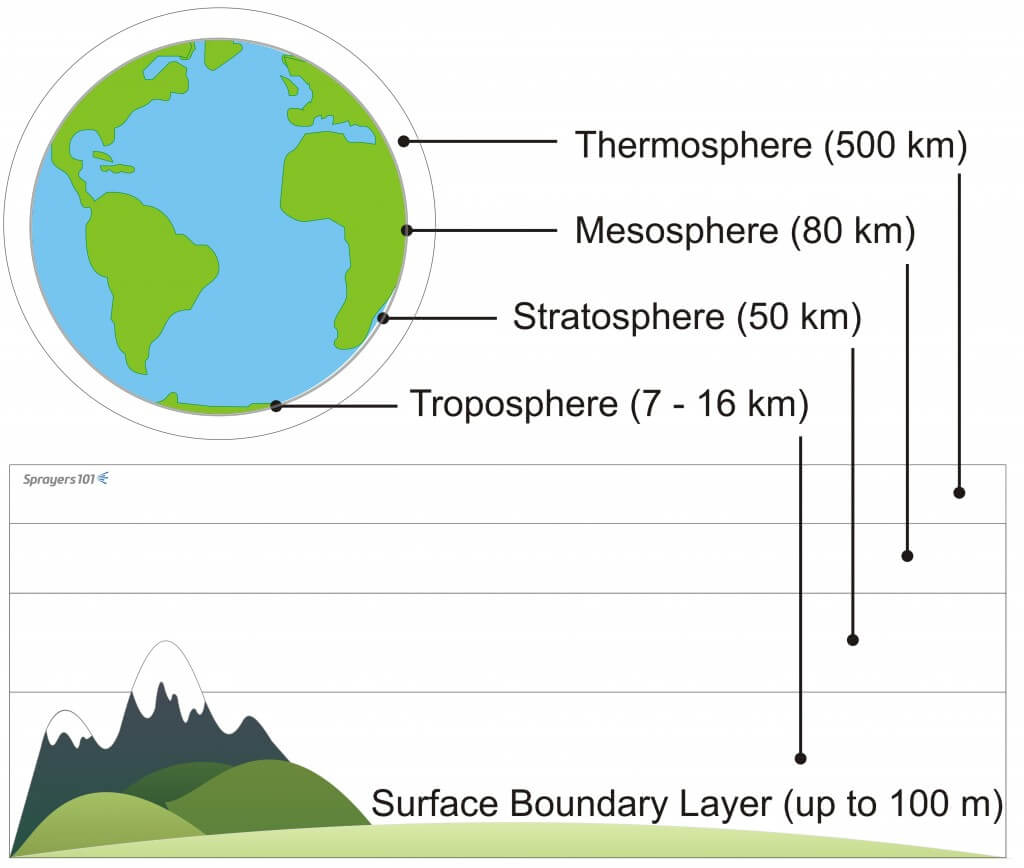
    The Earth’s Atmosphere. The illustration of the Earth is to scale, but the landscape is not. Our focus in on the Surface Boundary Layer.
    The Earth’s Atmosphere. The illustration of the Earth is to scale, but obviously the landscape is not. Our focus in on the Surface Boundary Layer.

    Atmospheric temperature

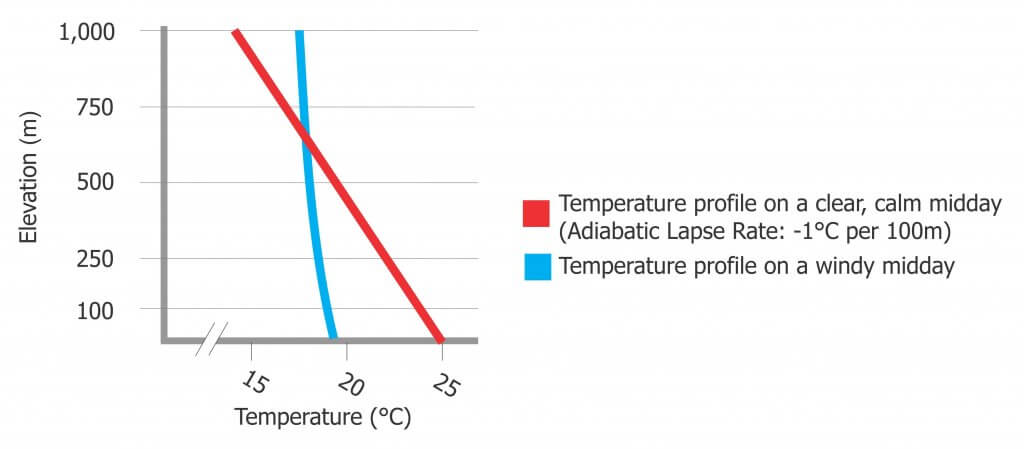
    In relatively calm, clear and dry conditions (e.g. a nice afternoon), air cools with elevation at a rate of about 1°C per 100m. This change is called the Adiabatic Lapse Rate and it’s caused by pressure changing with elevation. If your ears have popped when driving down a steep hill, you’ve experienced pressure change with elevation; there is more atmosphere overhead and the weight pushes down.

    With higher elevation, there is less atmosphere overhead. Less weight means less pressure and this gives air room to expand. Expansion takes work and work costs energy, which creates a cooling effect. See how simple thermodynamics are?

    In the graph below, the red line shows the Adiabatic Lapse Rate of air cooling with elevation. The blue line indicates wind stirring and homogenizing the atmosphere, reducing the degree of temperature change with elevation (more on that later).
    Day and night

    When we add the effect of daytime solar heating and nighttime cooling, the rate of temperature change is affected. Let’s consider how this works on a clear, relatively calm day:

    Early morning

    The morning sun emits short wave radiation, which is absorbed by the Earth’s surface. The surface conducts some of this energy deeper into the ground and also heats the air near the surface. This creates a temperature gradient wherein the surface is warmest and the air gets relatively cooler with elevation (remember the red line in the graph above).

    As the air near the surface warms, that energy causes air molecules to vibrate and push away from one another. Parcels of air become less dense and rise just like the gloop in a lava lamp. The cooler air around it falls to fill in the space left behind, and air begins to circulate in a Convection Cell. The rising parcel of air will eventually cool and shrink as it rises through the relatively cooler air above it.

    These convection cells create Thermal Turbulence, which is a very effective way for airborne particles, such as pesticide vapour, to be rapidly diluted. This is also how the atmosphere disperses pollution. More on the process of dispersion, later.

    Mid to late afternoon

    As the sun passes over and the wind starts to rise, the convection cells get disrupted by the wind and experience mechanical turbulence (remember the blue line in the graph above). So, mechanical turbulence also mixes warmer air near the ground with cooler air above it, but suppresses thermal turbulence.

    Mid-afternoon to night

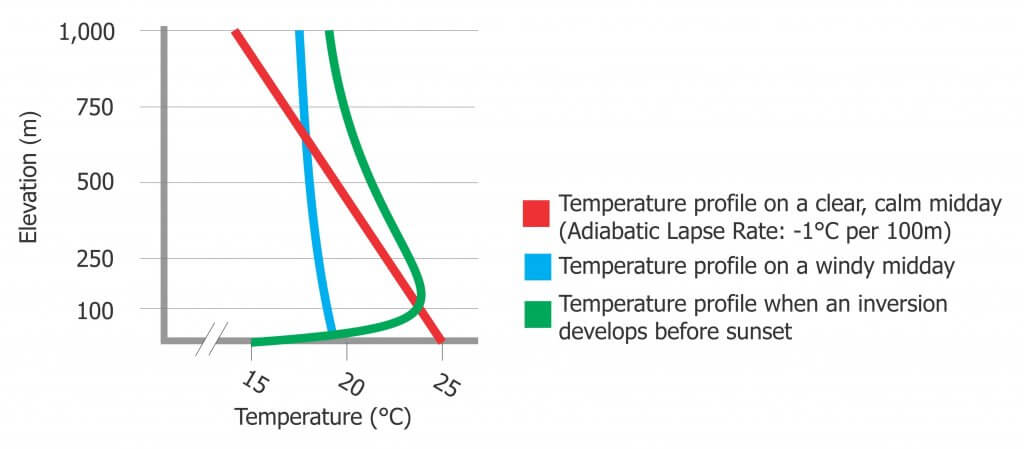
    As the energy from the sun lessens, the soil begins to cool and so does the air next to it. Once the air cools enough to be colder than the air above it, we have the beginning of a Radiation Inversion, which is a specific kind of Thermal Inversion (see the green line in the graph below). It is called that because we now have the reverse of the typical day-time temperature profile. The height of the inversion (the ceiling) grows with time, and can reach a maximum of about 100m by sunrise. Within the inversion layer (before the green line bends back at 100m), turbulence is suppressed. We have a stable air mass. More on that below.
    How inversions affect dispersion

    The rising portion of a convection cell carries whatever particles are in the air with it. Suspended particles become much less concentrated at ground level thanks to the thermal turbulence.
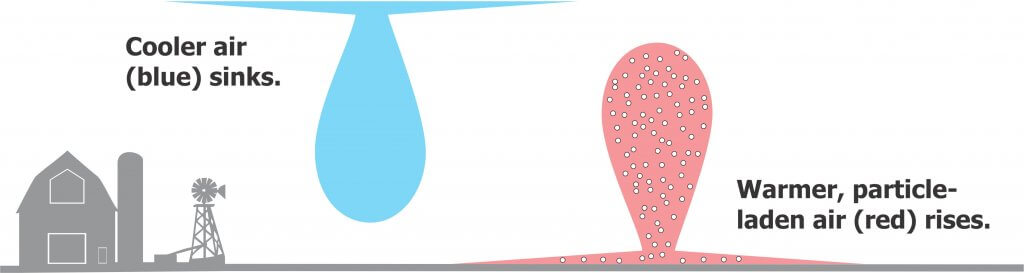
    Thermal Turbulence allows particle-laden warm air to rise and clean cool air to fall. This disperses air-borne particles like dust or pollution.

    Now let’s imagine we are in a thermal inversion. The cooler, particle laden air near the ground cannot rise and the cleaner air above, which is now relatively warmer, cannot sink. Thermal turbulence is suppressed, and so is any vertical dispersion.
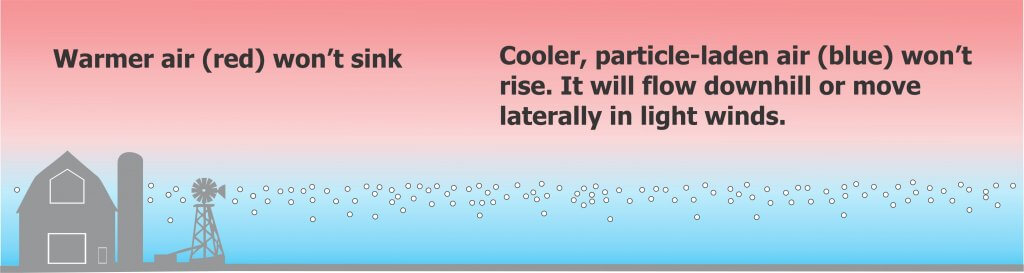
    Thermal Turbulence is suppressed during a Temperature Inversion. Particle-laden cool air at the surface cannot rise, and warm, clean air cannot fall. No dispersion occurs, and the concentrated, particle-laden air tends to move downhill or laterally with light winds.

    When spraying, the smallest spray droplets fall slowest, staying airborne for long periods of time. If spraying occurs during an inversion, those particles accumulate beneath the inversion layer. Remember we said our atmosphere behaves like a liquid? The colder, denser (pesticide-laden) air drains downhill into low-lying areas. It can also move laterally over great distances, in unpredictable directions, when light winds begin.

    Clouds

    If the morning were overcast instead of clear, the clouds would intercept much of the sun’s short-wave radiation, absorbing or reflecting it back into space. The Earth’s surface would still warm, but more slowly, suppressing thermal turbulence. As an aside, if clouds form in the evening, they reflect long-wave radiation from the Earth’s surface back down. This Greenhouse Effect is why overcast nights are warmer than clear ones.

    Therefore, extended periods of mostly clear skies in the evening or night means a high probability of strong temperature inversions. Conversely, cloud cover usually means a near-neutral atmosphere, so no strong inversion.

    Wind

    Inversions are only mildly affected by light wind (e.g. 6 to 8 km/h), but as the wind increases and mechanical turbulence mixes the air, the strength of the inversion will be reduced and the atmosphere will approach a neutral condition (see the blue line). In this condition, airborne particles are not dispersed by thermal turbulence, but some mixing will occur. So, there may not be a thermal inversion, but spraying would still be inadvisable if the wind got too high.

    Humidity

    Inversions form more rapidly when there is less water vapour in the air to absorb radiation. Once humid air has cooled to the dew point, water condensation gives off energy and warms the air a little. This slows the formation of the inversion. Be aware that inversion conditions can exist long before fog, dew or frost forms, so they are not a good indicator for the beginning of an inversion – you’re already in one!

    If you see fog, dew or frost, you’re already in an inversion. The air has become cold enough to condense or even freeze water.
    If you see fog, dew or frost, you’re already in an inversion. The air has become cold enough to condense or even freeze water.

    Soil conditions and topography

    This is a complex issue, but soil conditions that make inversions more intense include low soil moisture, freshly tilled soils, coarse soils, heavy residue and closed crop canopies. Topography matters, too. We’re discussing radiation inversions in arable regions, and the kind that form on mountains or deep valleys. Nevertheless, inversions in shaded areas (e.g., behind windbreaks) start sooner, and last longer. See the NDSU factsheet for more detail.

    Spray timing

    Inversions, once formed, persist until the sun rises and warms the Earth’s surface, or until winds increase and mix the stationary layers of air together, re-establishing a more neutral temperature profile.

    Sunset is not a good indicator of the beginning of an inversion – it can start a few hours before. Therefore, evening spraying may be just as risky as night spraying. Very early mornings (e.g. around sunrise) are not much better. Remember, at sunrise, the inversion will be at its maximum height.
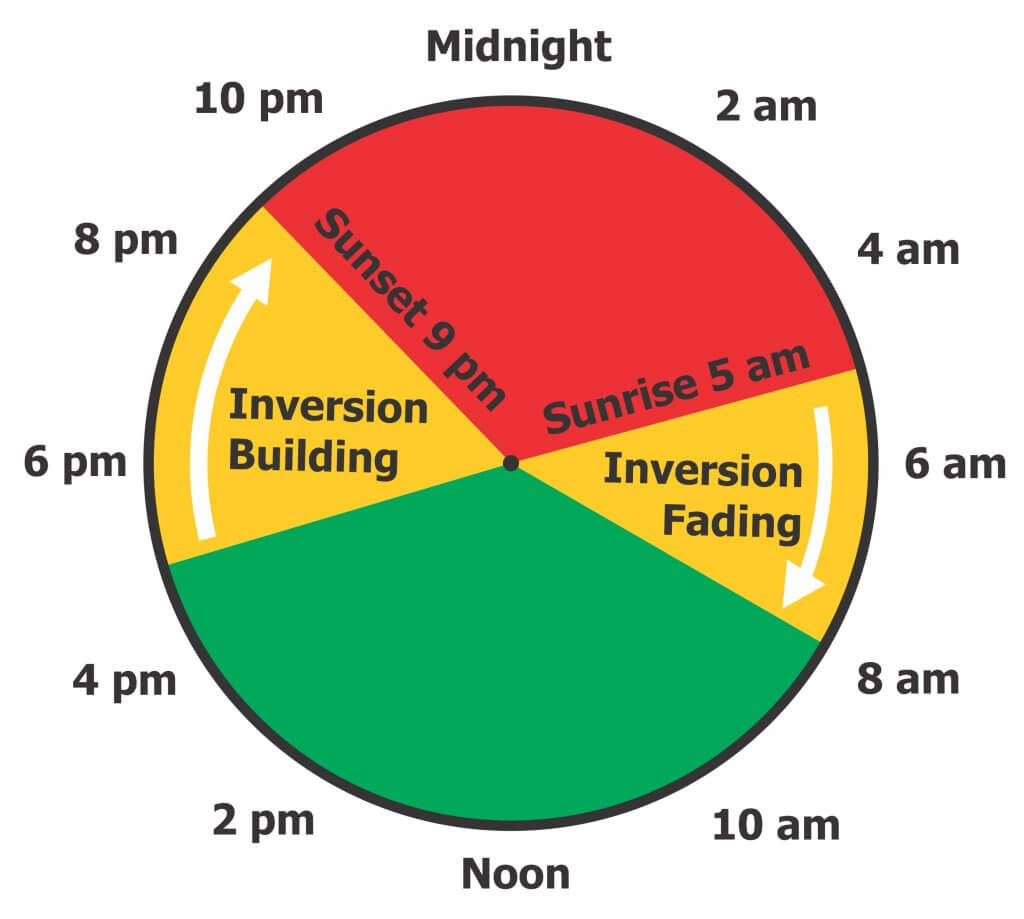
    The rising sun will warm the earth and create turbulent conditions, starting near its surface (e.g. a few metres). Most inversions will have dissipated two hours after sunrise, which may be the best choice for spraying.

    Detecting an inversion

    The only sure way to know if you are in an inversion is to take two air temperature readings: one near the ground and one about three metres higher. If the surface air temperature is cooler, you are in an inversion. The magnitude of the difference indicates how strong the inversion is.

    Accurate measurements are difficult to manage with conventional thermometers, but SpotOn now makes a hand-held detection unit. If you have one, be sure to let it acclimate before you use it. Leaving it in a hot, or cold, truck or sprayer cab prior to use means it may give a false reading.
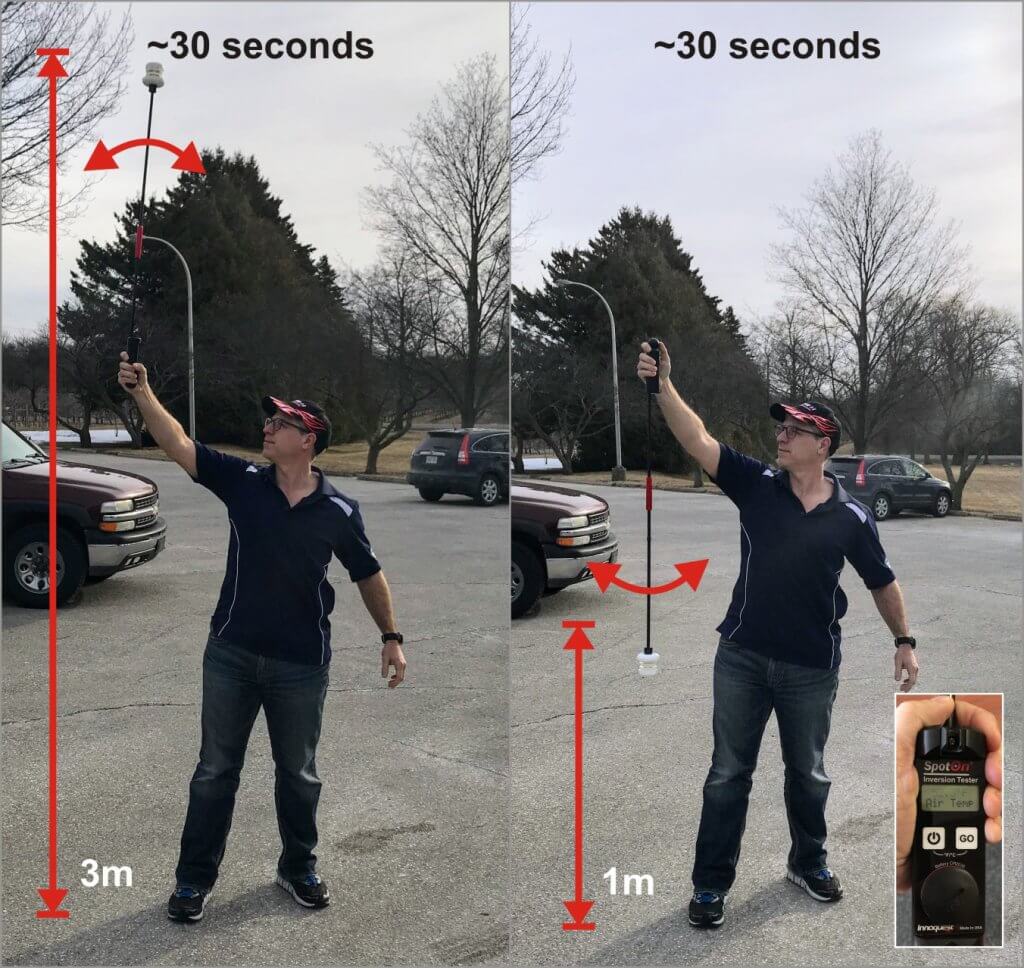
    Inversion forecasting is getting better, but it’s still location-specific and not entirely reliable. Sprayer operators should learn to watch for the following environmental cues:

    • Large temperature swings between daytime and the previous night.
    • Calm (e.g. less than 3 km/h wind) and clear conditions when the sun is low.
    • Intense high pressure systems (usually associated with clear skies) and low humidity where you intend to spray.
    • Dew or frost indicating cooler air near the ground (fog may be too late).
    • Smoke or dust hanging in the air or moving laterally.
    • Odours travelling large distances and seeming more intense.
    • Daytime cumulus clouds collapse toward the evening.
    • Overnight cloud cover is 25% or less.

    Note: If you suspect a temperature inversion, don’t spray.

    For more information on how weather affects drift, download this pamphlet from the Australian Government Bureau of Meteorology.

  • Exploding Sprayer Myths (ep.11): Drift

    Exploding Sprayer Myths (ep.11): Drift

    This video won the Gold 2019 Canadian Farm Writers Federation’s Jack McPherson Award for Electronic Media. This award is for the best video, news story or feature broadcast by a Canadian medium less than 15 minutes in length on an agricultural topic. We’d like to thank Jason Strove, Bern Tobin and the whole team at RealAgriculture for helping to bring Exploding Sprayer Myths to life.

    Welcome to season four of Exploding Sprayer Myths, featuring a new opening sequence and a special guest star. Have fun accidentally learning about reducing pesticide drift as we poke fun at Canadian and Australian stereotypes. If you’re unfamiliar with the McKenzie Brothers and the Great-White North, then be sure to educate yourself here before you take off, eh?

    Beauty.

    Thanks to Mary O’Brien (@SprayDriftGirl) and the Simcoe Research Station.

  • Pesticide Drift and Communication

    Pesticide Drift and Communication

    When it comes to information about mitigating pesticide drift, it’s plentiful and easily accessed. I have an archive of >30 articles written by Ontario Ministry of Agriculture staff spanning 1999 to present day. Many are on this website. In fact, there’s so much good information out there (see BeDriftAware) it feels like there’s nothing left to say. As a connoisseur (and author) of such materials, I’ve noticed they can be grouped into four common themes – see if you recognize any:

    • The Carrot: These articles describe the benefits of reduced drift, like solid neighbourly relations, reduced environmental impact, saving money in wasted pesticide and improved spray coverage.
    • The Stick: These articles feature insurance adjusters or regulators providing statistics from case studies on the financial, legal, and insurance impacts of drift. Not to mention the time it takes to deal with these issues.
    • The Heart: Many articles describe the frustration and emotional impact from the driftee’s perspective. Others chronicle the conflict, irritation and personal insult that come from being accused of drifting.
    • The Facts: Here we have technical specialists laying out math, such as weather models describing spray behaviour, buffer zones and drift reduction technologies like nozzles, shrouds and sprayer calibration.

    Beyond the written word there are also videos, PowerPoint presentations, workshops or demonstrations, government fact sheets, marketing brochures, social media content and smartphone apps. And yet, every May-July, the drift complaints seem to roll in regardless. For those that ask “why?” here are a few possible reasons:

    Why drift happens

    • Maybe the sprayer operator is pressed for time and chooses to ignore best practices in an effort to catch up. Haste can lead to mistakes.
    • Perhaps the sprayer operator is new and inexperienced, or falls into that small demographic without ready access to educational resources like ag meetings or the internet.
    • Maybe the operator is a veteran lulled into false security having successfully sprayed so many acres, for so many hours, for so many years. Why be so diligent when nothing bad ever seems to happen? Bad logic, but not uncommon.
    • Maybe the problem stemmed from poor communication. Perhaps the land is rented by one person, to a farmer that isn’t there, who has their fields sprayed by custom applicators, who don’t know what’s around the field.
    • Or, perhaps, even the best-intentioned sprayer operator can have bad luck.

    Where can drift take place?

    Agricultural spray (i.e. field crop or horticulture) has the potential to move between operations, or onto residential areas, or sensitive environmental areas. A single operation can even drift an incompatible chemistry onto itself. There are also residential applications (e.g. lawn care) that can negatively affect neighbours. Industrial applications such as roadside sprays can drift to agricultural or residential. Even organic operations spray products that can move outside the treatment area if conditions allow.

    It is important to recognize that every single spray application has the potential for off-target movement. That’s why it’s so important to know what and who is around the treated area.

    Communication helps

    Communication between neighbours can make a big difference, both in preventing drift damage and resolving matters should an incident occur. Here are two perspectives on the same chemical trespass incident. In the first, the parties do not know, and do not care to know, one another. In the second, the parties have communicated previously. Which scenario will be easier to resolve?

    1. A “field cropper that drives 20 miles per hour in high winds” is contacted by a MECP officer on behalf of a “vegetable grower that’s always complaining about spraying”. Accusations and defensiveness between the two parties escalate until they prevent them from speaking directly. Specialists, adjusters, and the officer find themselves acting as mediators. The process is slow and likely headed for court.
    2. Sarah knocks on Kevin’s door and says there might be something wrong with her crop – can he come have a look? She has (rightfully) contacted the MECP to collect samples just in case, and Kevin has all his spray records so they can figure it out. They call in a crop consultant and she contacts a university specialist to solve the problem and prevent it happening again. They follow the crop to yield to determine the impact and agree on a settlement between them.

    Regarding Scenario 1, it’s not my intention to slander field croppers or horticulturalists; I have actually heard parties involved in highly emotional drift disputes describe one another this way. My intent is to point out that you cannot label an entire industry based on the actions of an individual. When parties see each other in this fashion they are unlikely to work together to resolve the problem. No one will be satisfied with the outcome.

    Regarding Scenario 2, I have observed that once each party has a face and a name, it’s so much easier to find solutions. It doesn’t mean someone wasn’t at fault or that compensation isn’t required, but the dialogue facilitates a faster, easier and less emotional outcome. Obviously, in the case of repeated or large-scale incidents, communication may not yield satisfactory results. I’m hopeful, but not naive.

    Opening a dialogue

    Communication can be initiated from either direction: An applicator can inform a residential neighbour or fellow farmer with sensitive crops when and what they intend to spray. Likewise, the neighbour or sensitive crop grower can reach out to the applicator to let them know they are there and that they are concerned.

    There’s no need to wait until there’s a problem. Both parties benefit from keeping one another informed about when sprays go on and the state of any sensitive crops. And, if there is an issue, both parties should begin documenting conditions and suspected damage as soon as possible and over time during the resolution.

    Penn State produced a great article about speaking about pesticides with neighbours.

    Final thoughts

    So, the core of this article isn’t how to prevent drift, or what to do if you suspect it. That’s all been said and I’ve listed a few resources for reference at the end. This article is about being aware of drift potential and about opening lines of communication between those that share borders.

    So follow the links below to learn more about what you can do to mitigate drift. Then, go introduce yourself to your neighbours. Bring a pie. Everyone loves pie.

    Resources

    • Article – This link includes four videos and a factsheet about what drift is, how to prevent it and what to do if you suspect it.
    • Article – This link includes a video and a factsheet about surface inversions and drift.
    • Article – Spraying in the wind.
    • Video – The time of day can affect drift potential.
    • Video – Spray quality (i.e. droplet size) and how it relates to drift.
    • Two articles (one and two) on reducing travel speed and employing other means of improving productivity.
    • Article – Drift-reducing nozzles.
    • Website – This is a link to BeDriftAware, a collection of resources and tools to encourage the use of best application practices by farmers and sprayer operators to reduce the possibility of spray drift.
  • The Challenges of Spraying by Drone

    The Challenges of Spraying by Drone

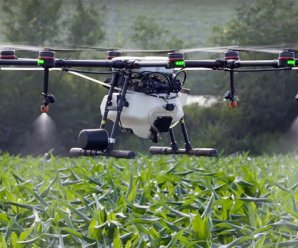
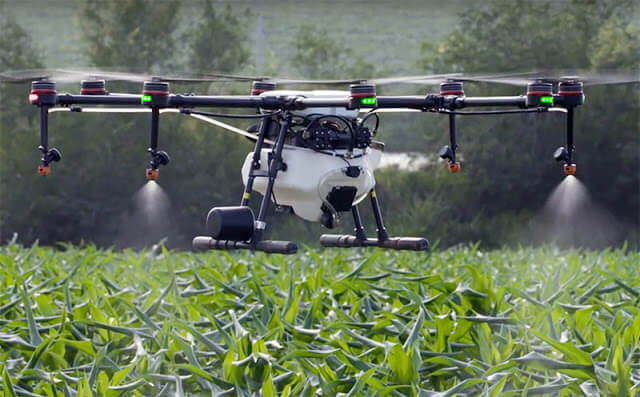
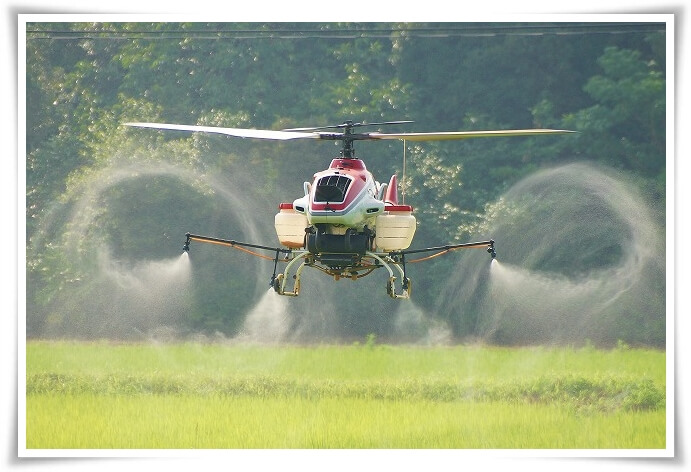
    Spray application by drone is here. It’s common practice in South East Asia, with a very significant proportion of ag areas now treated that way. Estimates from South Korea, for example, suggest about 30% of their ag area being sprayed by drone. It’s in the US, too. The Yamaha RMax and Fazer helicopters, which pioneered drone spraying in Japan dating back to the mid 1990s, have been approved for use in California since 2015.  DJI, the world’s largest drone manufacturer, introduced their ag model, the Agras MG-1, to North America in 2016. Many other spray drones are available or in development.

    As William Gibson, the author of Johnny Mnemonic, once said, “The future’s here, it’s just not widely distributed yet.”

    DJI Agras MG-1 spray drone (Source: DJI.com)

    Proponents of drone spraying cite a drone’s ability to access areas where topography is a problem, such as steep slopes, where productivity of manual application is much lower, or low areas where soil moisture prevents ground vehicles. Operator exposure is reduced compared to handheld application.

    Opponents talk about productivity and cost factors compared to manned aerial application, spray drift, and rogue use.

    Before drone spraying becomes commonplace, two important things need to happen.

    1. Federal laws need to be updated to accommodate the unique features of remotely piloted aircraft systems (RPAS), as they’re now called. Current laws make many assumptions unique to manned ships, and the process to correct that will require some patience. A thorough review for US laws, and their shortcomings, can be found here.
    2. Federal pesticide labels need to permit the use of drones for application. As of August, 2021, Canadian labels have no such registered use.

    There is no doubt that we need to prepare for a future that includes spraying by drones. Features such as topography adjustment for height consistency and autonomous swath control are already essentially standard, and the capabilities that improve control and safety will continue to develop.

    And yet I’ve been nervous about the prospect of pesticide application with drones. My primary concern is around – you guessed it – spray drift. Because a drone payload is relatively small (about 5 to 25 L, depending on the model), application volumes will need to be low to have any sort of productivity. How low? For manned aircraft with a 200 to 600 gallon hopper, 2 to 4 US gpa (18 to 36 L/ha) are the lowest commonplace volumes. The lower volumes require a Medium spray quality (among the finer sprays in modern boom spray practice) to achieve the required coverage.

    It’s a simple concept: the less water is used, the smaller the droplets need to be to provide the necessary droplet density on the target. Drift control with coarser sprays requires higher volumes, and true droplet-size-based low-drift spraying can’t really happen at volumes less then, say 5 to 7 US gpa.

    At 2 to 4 US gpa, a drone would be able to do perhaps 1 acre per load. While OK for spot spraying, it represents a serious productivity constraint for anything larger.  There will be a push toward lower volumes, perhaps 0.5 to 1 gpa (5 to 10 L/ha). The only way these will provide sufficient coverage is with finer sprays, ASABE Fine to Very Fine, with expected problematic effects on off-target movement and evaporation. These fine droplets are also more prone to the aerodynamic eccentricities of aircraft.

    Vortices from the rotor can create unpredictable droplet movement (Source: kasetforward.com)

    The current regulatory models for aerial drift assessment in North America, AgDISP and AgDRIFT, are not yet able to simulate drone application. But by entering finer sprays into these models for their conventional manned rotary wing aircraft, we can see that buffer zones will be higher. Much higher. And that outcome will give pause to regulators. Failure to control the movement of a spray is, and should be, a problem.

    Estimated Buffer Zones (calculated by AgDISP) for a reference rotary wing spray aircraft, using three pesticide toxicologies and two spray qualities.

    Furthermore, ultra-low volume (ULV) sprays can change the efficacy of some products, and these will require new performance studies. At this time, regulators are seeking information not just on spray drift, but on product efficacy, operator and bystander exposure, and crop residues.

    Regulators are currently collecting spray drift and efficacy data from drones. Since the drones available in today’s market do not conform to a common design standard like fixed or rotary winged manned aircraft, each model may have its own characteristics and need its own study. Some will have rotary atomizers, others will use hollow cone hydraulic sprays. Some will have electrostatic charging, others may propose special adjuvants.

    Once data are assessed, there will likely be restrictions in flight height, flight speed, wind speed, spray quality, water volume, perhaps air temperature and relative humidity (or Delta T). This is not new to spraying, as current labels already constrain use for both ground and aerial spray application, more so for aerial.

    The obvious question is how these proper application practices can possibly be assured. Operators will need more than just regulatory approval to use a drone, they will require proper training, similar to what a commercial aerial applicator now receives prior to operating a business.

    Recall that our aerial applicators are governed by national organizations, the NAAA in the US and the CAAA in Canada. These organizations are in regular contact with federal regulators to assure compliance. They also help fund research into application efficacy and safety. They organize conferences in the off-season and calibration clinics in the growing season. At these, flow rates are confirmed and deposited droplet size is measured. Spray pattern uniformity is assessed and corrected as necessary.

    Should drone applications be exempt from these controls? I don’t think that would be wise. Are we ready to implement them? Absolutely not.

    These requirements would change the drones’ economic model. And despite these precautions, a drone may still leave the control of a pilot due to unforeseen technical or human events.

    In the US, Yamaha does not sell their drone helicopters. Instead, they deploy their own teams to make the applications. This way, they have assurance that only trained and experienced pilots use the technology.

    As the industry gears up for the first registrations, we see drone service companies take a leading role in testing. Much is being learned via legal applications of liquid micronutrients, for example, or limited use of pesticides under approved research permits. And I’m pleased to see the recognition of drift management in these efforts through the use of low-drift nozzles. We are off to a promising start.

    Requests for drone use are in progress at our regulatory agencies. The outcomes of their risk assessments will provide important initial guidance, and food for thought and discussion. In the meantime, the drone development continues at a rapid pace, with new features and greater capacity at each iteration.

  • Do Labels Help us Apply Pesticides Properly?

    Do Labels Help us Apply Pesticides Properly?

    It happened three times this spring.  As is often the case, I was contacted by growers who wanted help with herbicide application.  In most of these calls, the discussion revolves around the proper choice of nozzles for a specific task, perhaps some questions on spray pressure, water volume and travel speed.

    But these three were different.  Instead of being seasoned applicators, all three were new to the business.  And more importantly, they had done their homework by looking at product labels before calling.

    Labels give us important information on product rates, crop and weed staging, mixing order, sprayer cleaning, and personal and environmental protection.  They’re very valuable there.  But they also provide application information, and that’s where the problems begin.

    Perseverance Required

    I have to commend my three clients:  they showed great tenacity by actually finding application information on a pesticide label in the first place.  This document is so mired in legalese protectionist language at the front that it discourages all but the most persistent.

    And often, the application information comes in several parts, interspersed among other information.  Mixing instructions.  A little later, application. Somewhere nearby, buffer zones.  Another paragraph for cleaning.  Rainfastness?  Keep looking.

    It forces the reader to skim through the document, hunting for relevant information.

    But once my clients found application instructions, they obviously questioned if they should believe it, or else they wouldn’t have called.  The application statements on many labels, simply put, are from long ago, and it’s obvious.

    Consider the following two label excerpts, the first from a product initially registered in the mid 1980s and still available, the second from one registered about 30 years later:

    1980s:

    Application should be made using a minimum of 55-110 litres of water per hectare, at a pressure of 275 kPa, or 310 kPa if using check valves, and at a ground speed of 6-8 kph.

    The use of 80° or 110° flat fan nozzles is recommended for optimum spray coverage.

    Do not use flood jet nozzles, controlled droplet application equipment or Sprafoil® equipment.

    Application of the spray at a 45° angle forward and higher water volumes will result in better spray coverage and penetration of the crop canopy.

    Uniform, thorough coverage is important to obtain consistent weed control. Higher water volumes should be used under dense crop and weed canopies to ensure thorough coverage of the target weeds.

    2010s:

    Apply in a spray volume of 46.8 – 93.5 L/ha unless otherwise specified in tankmix partner section of this label – at 207-345 kPa (30-50 PSI) pressure to ensure proper weed coverage.

    Flat fan nozzles of 80° or 110° are recommended for optimum coverage.

    Do not use floodjet or controlled droplet application equipment or Sprafoil® equipment.

    Nozzles may be oriented 45° forward to enhance crop penetration and to give better weed coverage.

    Uniform, thorough coverage is important to obtain consistent weed control. Higher water volumes should be used under dense crop and weed canopies to ensure thorough coverage of the target weeds.

    Thirty years apart, but remarkably similar.

    Crop protection companies spend about 10 yrs. and $250 million to produce a new pesticide and register it for use.  Having made this commitment, it would be most useful to see a small further investment to provide current application information that is relevant to applicators.

    After all, these applicators purchase the active ingredient to provide a return on this multi-million dollar investment, to the tune of about 2 billion dollars per year in Canada alone. They deserve good application information.

    Imagine this scene:

    “Doctor, thank you for this new high tech pharmaceutical engineered to help me with my serious illness.  How should I take it?”

    “Not sure.  Here, read this cough syrup label I found in my drawer.  Should be pretty close.”

    It’s clearly ridiculous

    Let’s dissect these labels to see how they could be improved.

    Flat fan nozzles of 80° or 110° are recommended for optimum coverage…

    Our sample labels refer to what we assume are conventional flat fan nozzles.  While popular in the 80s, these have all but disappeared from sprayers over the course of the past 20 years or so.  We haven’t recommended them since then because they drift too much. They’ve been replaced by low-drift nozzles, either pre-orifice, or air-induction.

    Nozzle fan angles are now generally 110 degrees or more, and frankly, the difference between 80 and 110 degrees is not that important.  What’s important is proper overlap, achievable with a visual assessment followed by boom height and pressure adjustments.  Unfortunately the label is silent on that.

    Application should be made … at a pressure of 275 kPa, or 310 kPa if using check valves…

    A nozzle’s recommended operating pressure depends on the specific nozzle model and on the spray quality (average droplet size) required. With literally many dozens of nozzles now available to each applicator, general pressure suggestions are likely to be wrong, and are more of a liability than a help. And they force label non-compliance when over-ruled by a nozzle manufacturer’s recommendations.

    Speaking of spray quality, growers crave to know at what spray quality a product should be applied for best performance and lowest drift. Some labels refer to spray quality (e.g. “apply with a Coarse spray”), but this is with reference to spray drift and buffer zone distances, not efficacy, and that distinction is not made.  Knowing the right quality for efficacy would help applicators choose the right nozzle and pressure to meet that criteria.

    Higher pressures if using check valves?  Nobody has brass screens with check valves anymore.  Sprayers have had modern diaphragm check valves for a generation, and those don’t produce pressure losses.

    And we all know that six to eight km/h is hardly a common speed these days.

    Do not use floodjet or controlled droplet application equipment or Sprafoil® equipment

    Sprafoil nozzles have not been produced in Canada for about 25 years, in fact their manufacturer is no longer in business.  Controlled droplet atomizers, while becoming more popular again on aircraft, were last seen on ground sprayers in the 1980s. Even then, total installed numbers were probably in the single digits.

    As for FloodJet nozzles, those went out of style for herbicides in the late 70s, and were replaced by the very successful TurboTeeJet nozzles shortly after.

    Nozzles may be oriented 45° forward…

    Nozzles are rarely tilted 45 degrees forward for herbicide application anymore.  Maybe that’s because spray booms aren’t built that way today, or because modern booms on self-propelled sprayers are now about 30” (75 cm) above ground, and we travel at about 15 mph (22 km/h).  So the forward tilting, though shown to be effective for grassy weeds at 5 mph (8 km/h) and 20” (50 cm) boom heights, as researched in the 1970s, isn’t relevant for herbicides with higher booms.

    Uniform, thorough coverage is important to obtain consistent weed control.

    Statements advocating for good coverage are nice, but they aren’t useful.  Everybody knows we want good coverage.  What applicators need to know is how they should measure coverage, and what good coverage actually is.  Can we use water-sensitive paper?  How much of the target should be covered?  How many droplets should be in each square centimetre?  How can we measure that in the field, right now? How does it depend on the crop canopy, on weed stage, and on spray quality? The more information an applicator gets, the higher the chance of success.

    Apply in a spray volume of 46.8 – 93.5 L/ha…

    The only statement that survives our little examination is about water volume. Water volume is important.  But even there we have a problem.  The volume is in L/ha.  This is useful in some parts of Canada, but not in the west, where producers communicate primarily in US gallons per acre.  And in the west, provincial guidelines have generated this odd hybrid of L/acre, which few people use for spray volume.  But 46.8 to 93.5 L/ha?  How is that level of precision justified? (I know that this is a conversion from 5 and 10 US gpa…so why not just say so?)

    A Solution

    The problem with having outdated or impractical information on labels is that it creates disrespect.  Since labels are documents enforceable by federal law, applicators want to comply. At this time, they can’t, and probably shouldn’t, if they want to do the job right.

    A vision for a good label should be one that respects the needs of the applicator.  Such a label:

    • places the information that applicators need at the top;
    • is updated regularly to reflect modern practice and useful advice;
    • helps a new applicator work out how to apply the product with any equipment;
    • identifies a spray quality that offers good coverage and low drift;
    • makes reference to research that supports variations in the application guidelines;
    • is available electronically, readable on a mobile device, i.e., not pdf.

    This label would protect the environment and bystanders, and would foster better pesticide performance.

    This label is easy to generate.

    This label would be read by applicators.

    What’s it going to take?

    Additional:

    This article created a great deal of discussion. We decided that if we were going to point out issues with the current labelling system, we should also propose a way forward. Read about our Label Summary Sheet proposal.