Category: Opinion Piece

  • How Spot Spraying will Affect Sprayer Design

    How Spot Spraying will Affect Sprayer Design

    Some years ago, a friend recommended that I read The Tipping Point by Malcolm Gladwell. In this book, Gladwell tries to understand why some things catch on, and others don’t. It’s a compelling read full of Gladwell’s trademark stories and his knack to deftly interpret scientific studies. He talks of connectors, mavens, and salesmen, as well as the “stickiness factor”, a measure of how memorable something is, as keys to success of products and ideas. I think of the book often as I ponder the many good ideas in agriculture, many of which never see widespread adoption.

    One of these good ideas is spot spraying. Green-on-brown detection was first introduced in the early 1990s. Anyone remember the Concord DetectSpray? It was great but had bad timing, as resistance wasn’t a big issue and glyphosate prices were about to slide. Green-on-brown grew to the NTech (later Trimble) WeedSeeker a few years later. Rometron’s WEEDit built on Trimble’s success and found widespread adoption in Australia in the past ten years. Spot spraying did not gain any traction in North America during this time.

    Australia is unique in many ways, not the least of which is their summer spraying practice. Summer is the hot, dry season where land is typically fallow and weeds are kept in check with herbicide sprays (aaaah, the serenity). Making several passes over a field, combined with the need to control some larger and hardy plants, is expensive, and a spot spray saves much of the cost. The savings can be put to use with more effective herbicide tank mixes that delay the onset of herbicide resistance. Spot sprays pay for themselves in short order Down Under.

    It’s more of a challenge in the northern plains of North America, where the fallow season involves snow cover and burnoff occurs in a short window before seeding and sometimes after harvest. But nonetheless, spot sprays have a fit for many of the same reasons.

    WEEDit is the first system to make serious inroads in North America, with several dozen systems having been retrofitted to high-clearance sprayers. High detection accuracy and hardware reliability is proven in three seasons.

    On March 2, 2021, John Deere entered the Green-on-brown spot spray area with See & Spray Select. This not to be mistaken as competition. Instead, the entry of a major brand provides validation of the concept like only a large manufacturer can. Yes, we’ve reached a tipping point.

    While the first Green-on-brown units are becoming established, Green-on-green, the ability to detect weeds within a crop, continues to be developed around the world. French startup Bilberry has made enough gains in Australia to bring its product to market with Agrifac, where it’s called AIC Plus. In farmer field trials, they have achieved 90 per cent detection accuracy of wild radish in Western Australia, and claim that they are ready for broadleaf weed identification in wheat, barley and oats. Bilberry’s technology will also be seen on Australia’s Goldacres and France’s Berthoud. Other startups, notably Israel’s Greeneye Technology, plan to introduce a Green-on-green system in the U.S. in the near future. Amazone, the German farm equipment giant, partnering with Xarvio and Bosch, announced plans at Agritechnica to have a commercial unit for sale by 2021.

    This technology will have significant impact on sprayer design philosophy. At present, productivity is synonymous with capacity, and large tanks with commensurate heavy and powerful tractor units dominate. Spot spraying savings will depend on weed density and hardware resolution, but 50 per cent to 90 per cent reductions in spray volume can be expected. A 1,600-gallon tank would no longer be necessary. The savings in frame weight and horsepower would be significant, as would the time savings from less intense tendering demands. These savings would offset the lower driving speeds that accompany sensing technologies, and, overall, provide a lower bar for autonomous operation. We may see lighter specialty spot sprayers.

    The savings in brute size will be countered by increased sophistication. Better boom height management is essential for spot spraying, not just for the sensor to properly see the target and estimate the time needed for the boom to reach that spot, but also for the spot spray itself to deliver the right dose. In any fan spray, band width at ground level changes with height, and that, of course, is related to dose. Trailed booms can address this issue easily.

    But not everyone wants a specialty spot sprayer that would require an extra pass over the field. With growing utility of soil residual herbicides, dual tank sprayers—small tank for the spot spray, large tank for the broadcast residual—make sense. Large sprayer frames can accommodate an additional smaller tank, second pump, and plumbed boom easily.

    Plant detection and identification bring other opportunities. Adjusting dose for plant size is one of the first, or for harder to control weed species.

    Spot sprays rely on fast, precise response of the nozzle, and this provided by fast-reacting solenoids that are part of pulse-width modulation (PWM) systems. On a broadcast sprayer, these solenoids can change the emitted dose instantly, within a certain envelope, by altering the duty cycle of the pulse. This, however, works best in the context of a boom with overlapping spray patterns. A single band spray would not change dose with duty cycle as easily.

    Higher dosing would be an opportunity for multiple nozzle bodies that are able to spray one, two or more nozzles in the same spot simultaneously. These are already widely available and popular in Europe.

    This also brings direct injection into play. Current systems introduce the active ingredient into the boom upstream of the nozzles, affording it time to mix into the water. For true spot spray utility, though, direct injection ought to be at the nozzle. Only then can custom mixes and rates be applied on a spot basis. It’s been done before, if only to show how difficult it would be to deliver uniform doses to a spot spray machine.

    Spot spray sensors have agronomic benefits. By recording the location sprayed, weed patches can be mapped. As plant identification becomes possible, it’s conceivable to obtain plant species and stage distribution maps from the spray pass That would turn the sprayer into a high-resolution crop scouting tool. As machine learning and sensor sophistication grows, other plant and soil parameters can be mapped. The agronomic value of such maps, especially if created over the course of the growing season, is immense. Of course, data density, handling, storage, and analysis will constrain this.

    If the past has taught us anything, it’s that there seems to be a appetite for investment in farm equipment. Sprayers have been the most-used implement on the farm for some time, and their popularity continues despite sharp price increases. These new capabilities will only add value to these implements. Prepare for sticker shock, followed by acceptance and adoption.

    What will a future spot sprayer look like? Although it will have tanks and booms, the level of electronic sophistication will make it so much more versatile we can’t yet imagine all the ways in which it might be used. But it seems to me the situation has tipped and we’re already accelerating toward that future.

  • Compulsory, Standardized Sprayer Inspections

    Compulsory, Standardized Sprayer Inspections

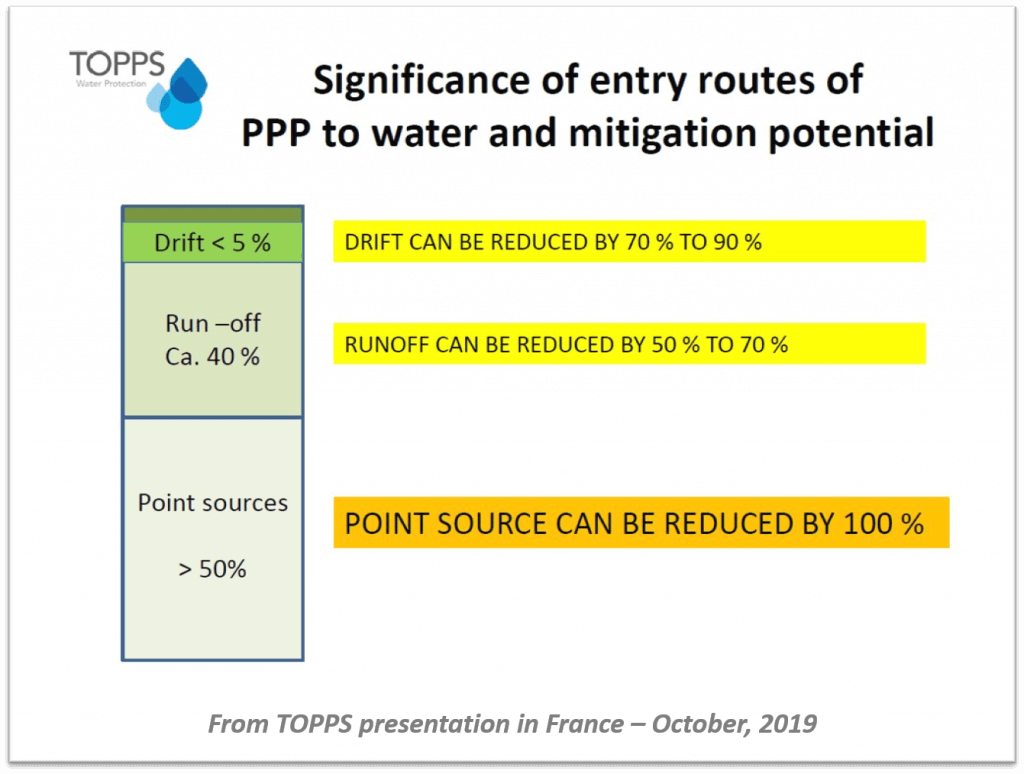
    Spring always brings renewed interest in sprayer calibration. This is good, because a well-maintained and calibrated sprayer will protect crops more effectively and efficiently, as well as reduce the potential for off-target drift and point source contamination.

    Presently, there is no nationally-recognized standard for sprayer calibration in either Canada or the United States. As a result there are many methods, some more stringent than others, spanning activities relating to seasonal maintenance through to precise diagnostic measurements. This means an operator can be in compliance with programs such as CanadaGAP (a food safety traceability standard for fruit and vegetables), and yet only perform the most rudimentary adjustments.

    I was first made aware of “compulsory inspections” in 2009 when I started noticing certification stickers on certain European import airblast sprayers. Some Ontario tender fruit and grape growers familiar with the European standards asked why we didn’t enforce standardized calibration program as they do in Europe. I was surprised to hear a farmer ask for more paperwork, so it made me wonder, are Canada and the US overdue for a change?

    All sprayers, from large, commercial field and airblast sprayers, to the more humble home-grown sprayers (see below) benefit from regular servicing and calibration. And yet, sprayer calibration in Canada and the US remains largely voluntary and highly variable depending on the size of the operation, sprayer design and the willingness/skill of the operator.

    Canada and the US: Then

    In the mid 1980’s, University of Nebraska engineers and Successful Farming Magazine published a study showing that un-calibrated spray applications were costing US farmers ~$1,000,000,000 per year. The article was infamously called “The Billion Dollar Blunder”. You can download the original journal article describing the survey here.  It was estimated that fewer than 5% of applications were within 5% of the desired rates. Spray overlaps and poor calibration resulted in over-applications of more than 20%.

    At the time it was eye-opening and received a lot of attention. In 2006 the original study was revisited (see here), and even with advances in precision application, there was a disappointing lack of improvement. Bill Casady, University of Missouri Extension agricultural engineer, estimated that if 20 minutes of calibration can save 5% on 500 acres in an application sprayed at $25/ac ($61.75/ha), then the 20 minutes of effort worked out to $1,875 / hour. Now that’s a solid return on investment!

    Belgium: Then

    Belgium recognized and addressed this issue more than twenty years ago. In 1995, following the lead of the Netherlands and Germany, Belgium’s Ministry of Agriculture mandated that all spraying equipment (save backpacks) be inspected every three years. At the time, other countries such as Sweden, Hungary and Austria had similar, albeit voluntary, programs.

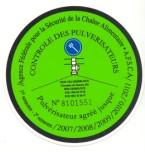
    Belgian farmers received letters asking them to make their sprayers available for testing by a Ministry-appointed institution, in locations no more than 10 kilometers from their operations. The institution’s trained technicians would subject the sprayers to a regimented, standardized inspection. When the equipment met the standard, they would receive a permit in the form of a sticker (see below) attached to the sprayer. The growers paid for this service, based in part on the size of the sprayer.

    In order to introduce the process to the Belgian farmer, a short documentary was produced. If you would rather not watch the preamble explaining why the prudent use of chemistry is critical to agriculture, and get right to the sprayer inspection process, skip ahead to 3:35.

    What follows is a brief outline of that 1995 process, which I’m told is similar to the process currently used in Belgium:

    1. Administrators perform visual checks to assess the general condition of the sprayer (e.g. obvious maintenance, safety and operational issues).
    2. Boom balance (where applicable), hinges, boom ends and boom sturdiness is checked.
    3. Nozzle spacing and orientation of nozzle bodies is inspected.
    4. All points of filtration are inspected.
    5. For boom sprayers, a spray pattern distribution used to be performed, but it wasn’t diagnostic enough. Instead, a pressure gauge / nozzle combo is used in each position to check for pressure fluctuation, and to ensure each tip had a flow rate within 5% of the average and no more than 10% deviation from the manufacturer’s rate.
    6. For airblast sprayers, the overall output of the sprayer is measured to determine nozzle wear using individual collectors clamped onto each position.
    7. For sprayers with rate controllers, calibrated collection bags are attached to a few nozzles and the sprayer drives a 100 metre course while spraying. The actual output is compared to the expected.
    8. Finally, the farmer receives a report outlining issues that need to be remedied before the sprayer is certified.

    SPISE: Today

    Today, collaborating European countries are members of SPISEStandardized Procedure for the Inspection of Sprayers in Europe. Established in 2004 by founding members from Belgium, France, Germany, Italy and the Netherlands, the SPISE Working Group aims to “further the harmonization and mutual acceptance of equipment inspections”. They also work to continually improve the inspection / calibration process.

    Their website hosts a number of sprayer-related resources, but the SPICE Advice handbooks are perhaps most valuable to the sprayer operator. Click either image below to download them as PDF for airblast or field sprayers:

    This more current video by AAMS-Salvarani goes though the inspection and adjustment process for airblast sprayers. While there is no mention of air speed adjustments, many of the steps in this video correspond with the airblast adjustments relating to Crop-Adapted Spraying which has proven very successful in Canada.

    Canada and the US: Tomorrow

    Regular, third-party mediated inspections offer many potential benefits to the average operator. But, in order to realize gains in crop protection and environmental stewardship, perhaps there are two programs required: One to certify the sprayer and the other to certify the sprayer operator.

    1. A sprayer inspection program would focus on sprayer maintenance rather than calibration. Maintenance occurs at regular intervals to ensure spray equipment is operating optimally. Calibration is an ongoing process intended to match the sprayer to the conditions in which it’s operating, and that requires an educated sprayer operator.
    2. Sprayer operator education programs such as Ontario’s Grower Pesticide Safety Course, or Penn State’s Pesticide Applicator Certification Course already exist, but they are not offered in every state or province, and they are often voluntary or perhaps specific to a particular expertise (e.g. not applying to custom applicators or airblast operators).

    They could start as voluntary, pay-for-service pilot programs to see if operators appreciate how much better their sprayers are functioning, and to quantify how much waste is been reduced. They wouldn’t necessarily have to be government-run; Industry or Academia may be better conduits. So, what would be required to develop and implement these two programs?

    • We would need to agree on a robust and generic sprayer inspection protocol. We have several European examples to draw on.
    • We would need to agree on the minimal content for a sprayer operator course. Again, we have many to draw on, with the obvious understanding that the core curriculum would be amended to reflect various state and provincial requirements.
    • We would need a trained, third-party organization to take responsibility for overseeing and implementing the two programs.
    • And, of course, we would need the funds to initiate both programs before they would eventually become self-sustaining.

    So, are we dreaming in Technicolor? If responses to this article are any indication, there are those in western society that lash out at the idea of mandatory requirements. But there are supporters, too. Maybe we can learn from those European countries that have been doing this for more than 20 years.

    Thanks to Jan Langenakens of aams for reviewing this article, and providing the videos.

  • For Sale: Gently Used 1950s Boom Sprayer

    For Sale: Gently Used 1950s Boom Sprayer

    This article isn’t about best practices, or social contracts, or innovative new technologies. It’s just a fascinating bit of history. If it has any moral at all, perhaps it’s to remember where we came from. I wonder where we’ll be tomorrow?

    Let’s be clear – the practices described in this article are anachronistic and while I shouldn’t judge from my 2020 high-horse, they’re flat-out terrible. Don’t see them through nostalgic eyes. Instead, be thankful that sprayers and practices have evolved.

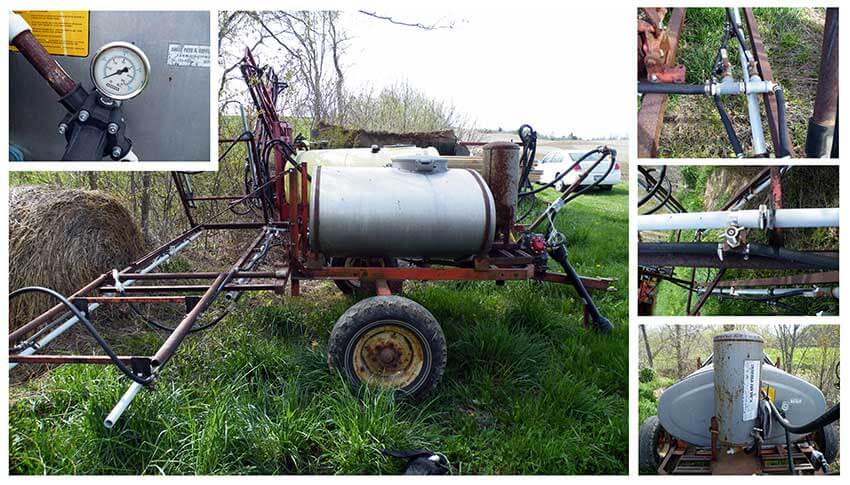
    Here’s the background. A colleague of mine, a grower and well-respected pesticide safety / sprayer expert, recently held a farm auction in Innerkip, Ontario. He sent me a photo of his family sprayer, used in Oxford county in the 50s and 60s. I fell in love with it.

    It was used to control broad leaf weeds in cereal crops. He recollected that thistle was a particularly painful issue. Especially when you had to grab hold of the grain sheaves and stook them. I confess I had to look up the term “stook“. They also sprayed a few cereal acres for neighbours, but never too far from home.

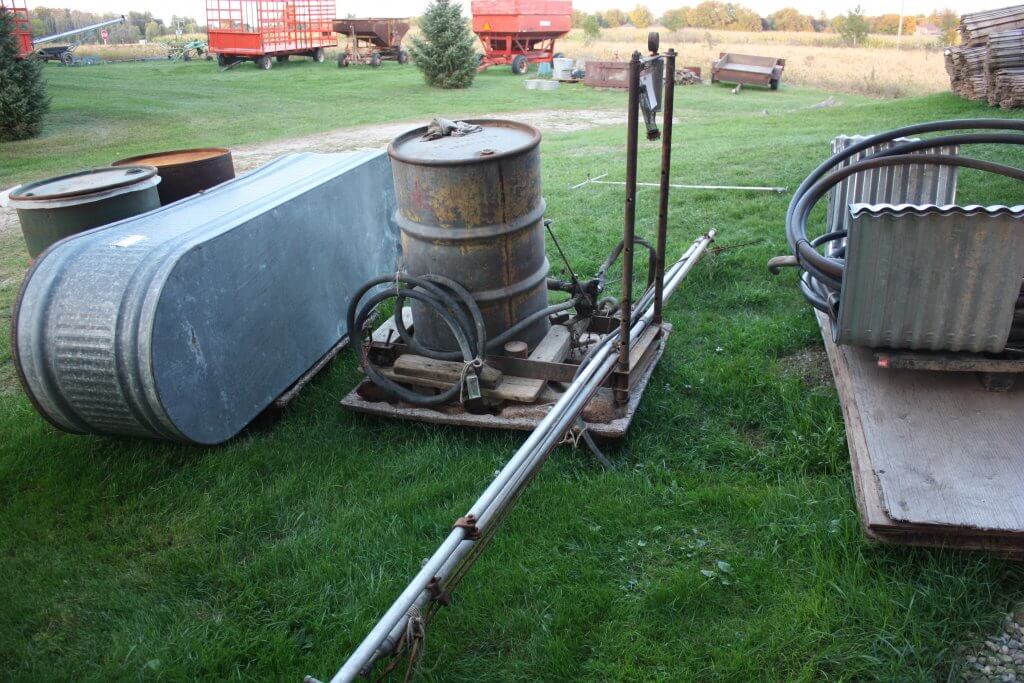
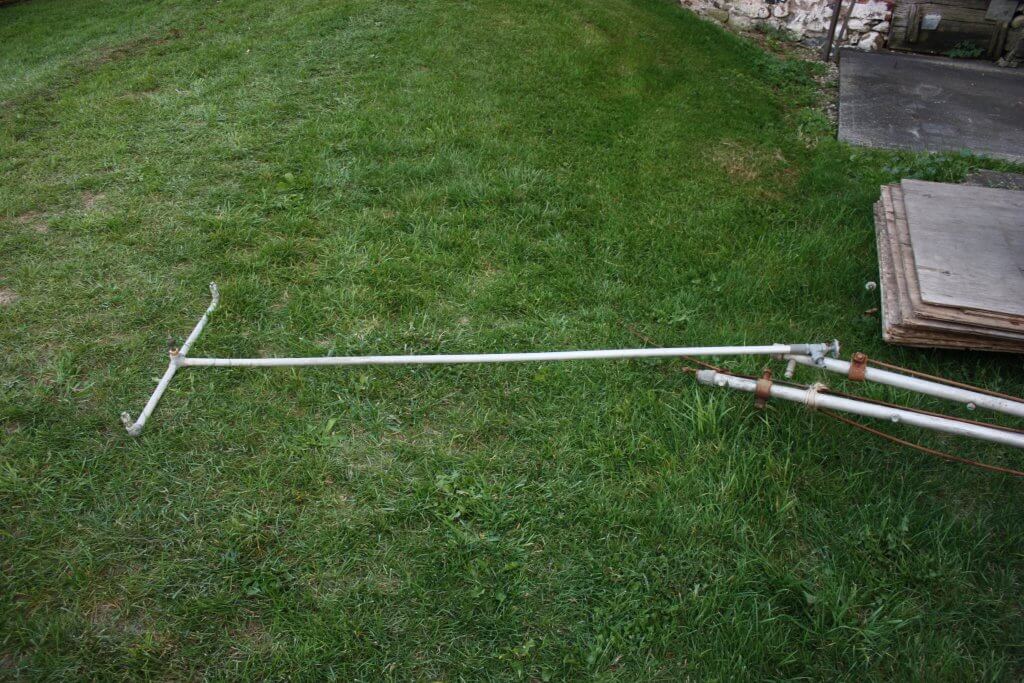
    A 1950s barrel sprayer. The frame would be attached to the front of a Massey Harris 44, suspending the 21 foot wet aluminum booms. The drum was supported on the tractor tongue. When you shut down, you picked up the booms and hung them on the fenders. The booms then leaked all over until they were empty.
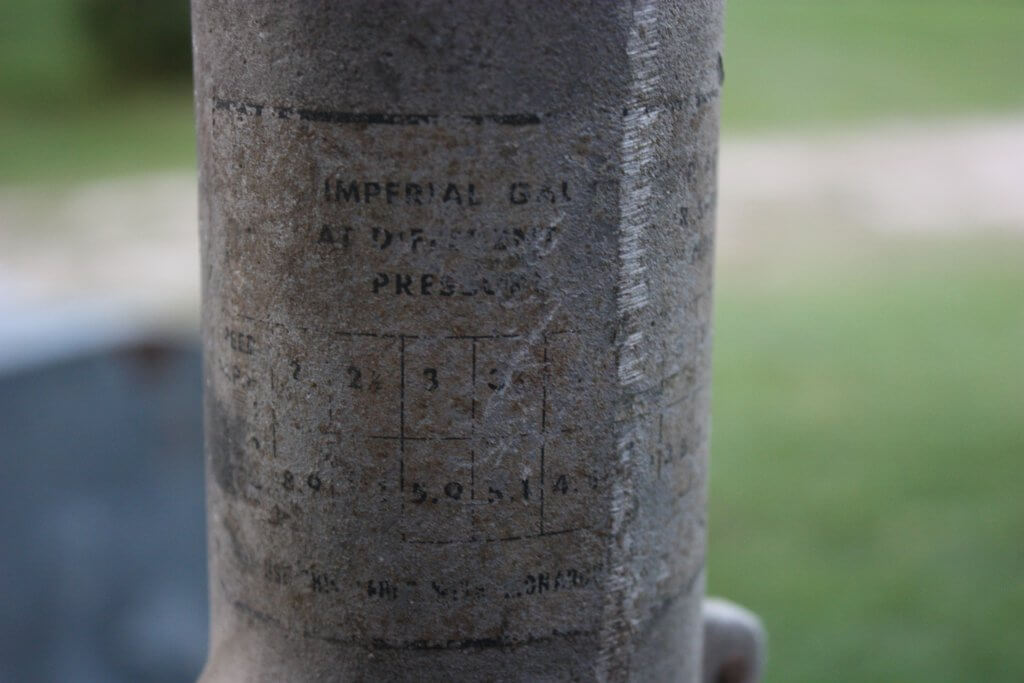
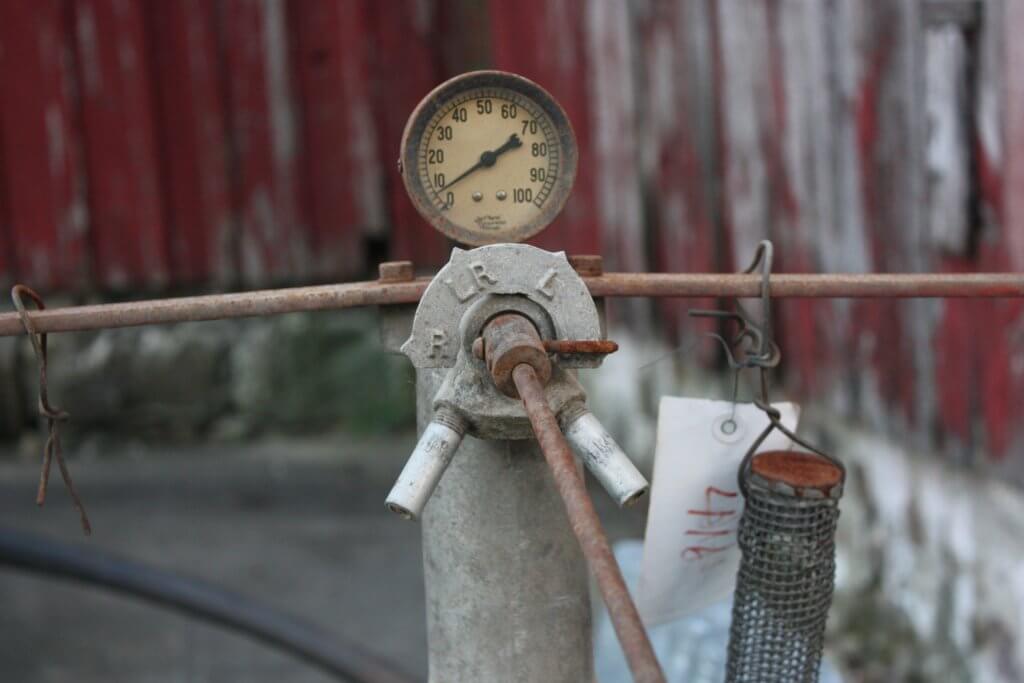
    Fortunately, there was clear guidance for the operator. The speed and rate was written on the distribution head. Still somewhat legible.
    A rod would extend from distribution head to the tractor, supported on the steering column. The driver could select the boom: left, right, both or off. The distribution/filter head/pressure gauge (shown here) was supported on front of tractor. On the up side, there was no need for the driver to do a shoulder check. Here the distribution selector is set to ‘off’. The filter, shown here as well, was a metal screen wrapped in a cotton cloth (typically a flour bag).
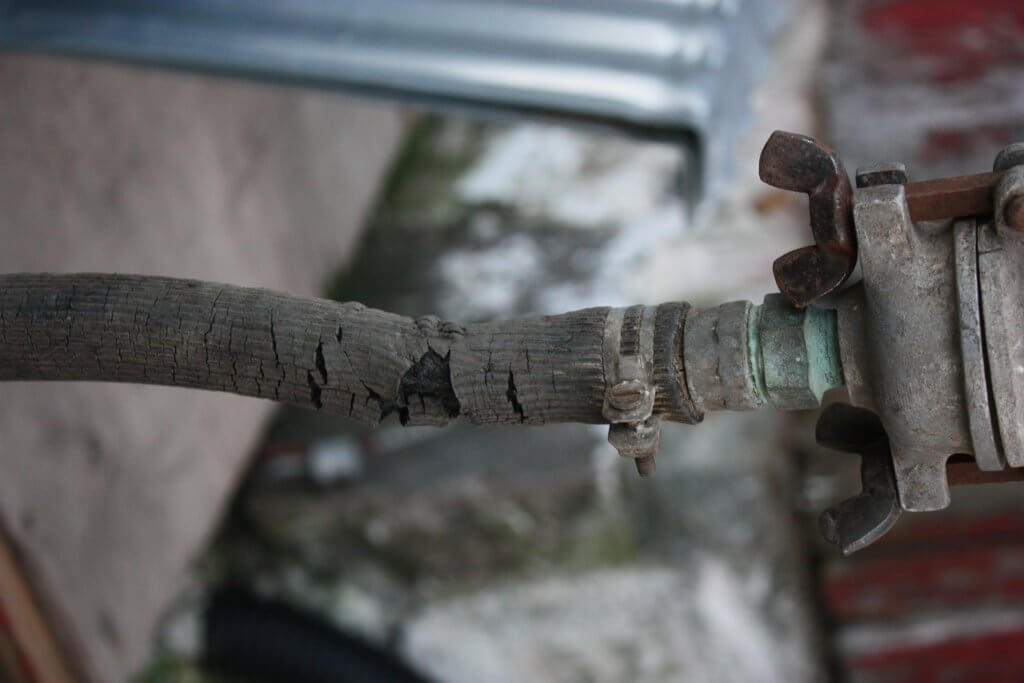
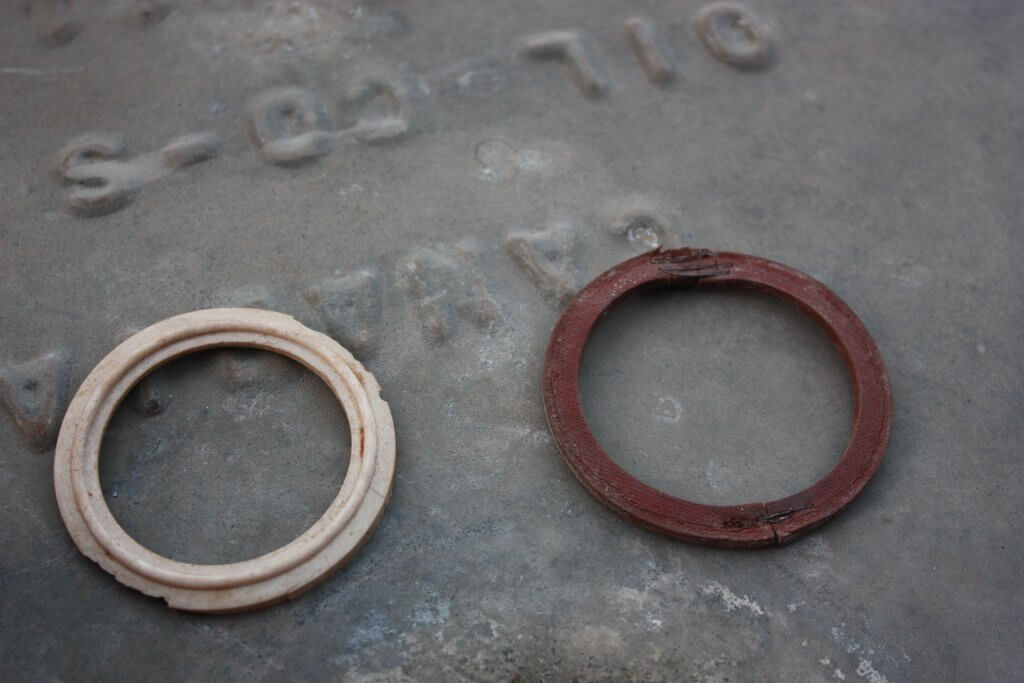
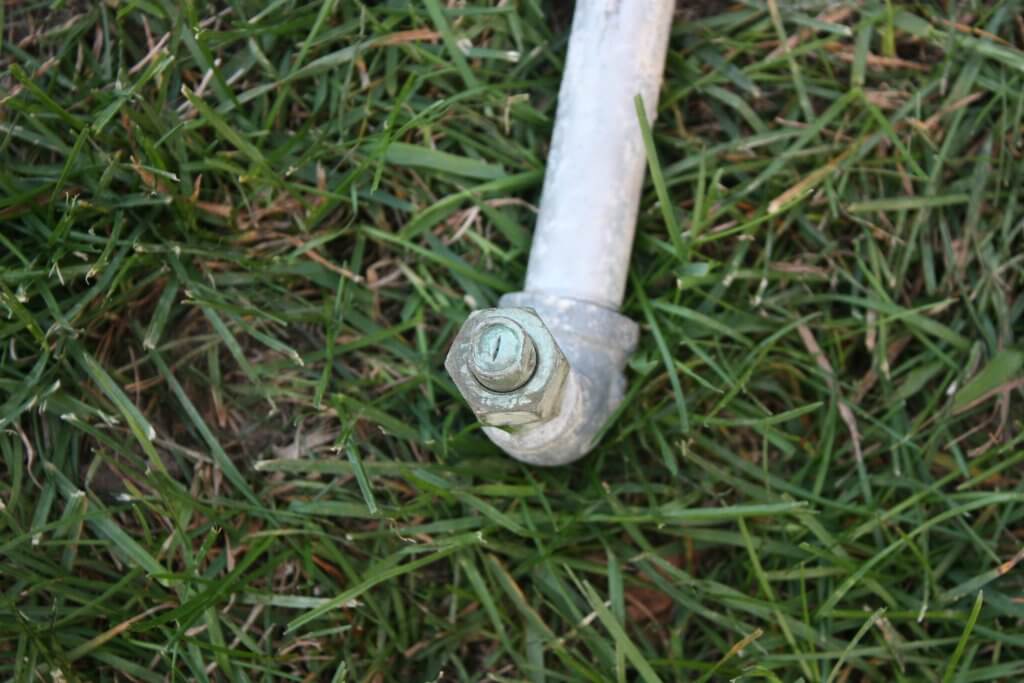
    This is the line from the pressure side of the pump, entering the distribution unit. The butterfly screws made a tight connection… using canning jar rings as gaskets!
    Both the cotton bag on the filter and the pressure line were sealed with canning jar rings.
    When the broadcast work was done, they would set up a hand boom and spray the fence posts. Bare hands were the order of the day.
    Spraying the fence posts was a two-person job, with a driver in the tractor and a kid aiming the boom. Here’s a close-up of a flat fan nozzle on the hand boom.
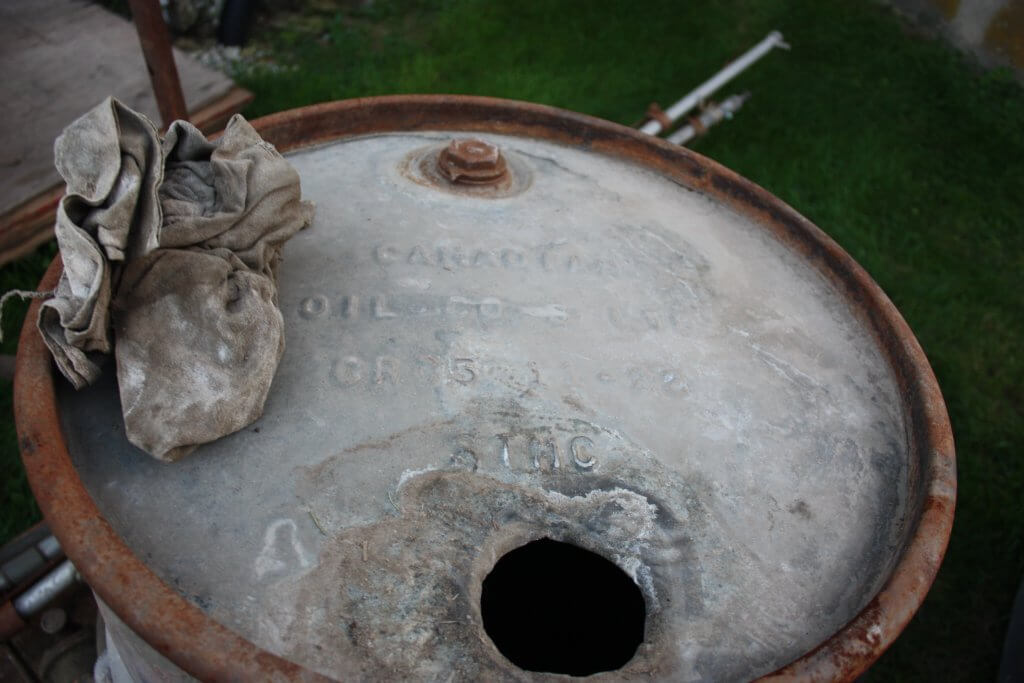
    Here is the supply drum with opening for suction hose and screen. It served double-duty as pesticide tank and seat for the person holding the hand boom. Pesticide swished out onto the person sitting on the drum. Getting their butt wet as a matter of course. The drum was filled with a 1/2 inch hose right from the well.

    When the long season was through, it was over-wintered (with whatever spray liquid remained) in the cellar.

    We’ve come a long way.

  • Pesticide Drift and Communication

    Pesticide Drift and Communication

    When it comes to information about mitigating pesticide drift, it’s plentiful and easily accessed. I have an archive of >30 articles written by Ontario Ministry of Agriculture staff spanning 1999 to present day. Many are on this website. In fact, there’s so much good information out there (see BeDriftAware) it feels like there’s nothing left to say. As a connoisseur (and author) of such materials, I’ve noticed they can be grouped into four common themes – see if you recognize any:

    • The Carrot: These articles describe the benefits of reduced drift, like solid neighbourly relations, reduced environmental impact, saving money in wasted pesticide and improved spray coverage.
    • The Stick: These articles feature insurance adjusters or regulators providing statistics from case studies on the financial, legal, and insurance impacts of drift. Not to mention the time it takes to deal with these issues.
    • The Heart: Many articles describe the frustration and emotional impact from the driftee’s perspective. Others chronicle the conflict, irritation and personal insult that come from being accused of drifting.
    • The Facts: Here we have technical specialists laying out math, such as weather models describing spray behaviour, buffer zones and drift reduction technologies like nozzles, shrouds and sprayer calibration.

    Beyond the written word there are also videos, PowerPoint presentations, workshops or demonstrations, government fact sheets, marketing brochures, social media content and smartphone apps. And yet, every May-July, the drift complaints seem to roll in regardless. For those that ask “why?” here are a few possible reasons:

    Why drift happens

    • Maybe the sprayer operator is pressed for time and chooses to ignore best practices in an effort to catch up. Haste can lead to mistakes.
    • Perhaps the sprayer operator is new and inexperienced, or falls into that small demographic without ready access to educational resources like ag meetings or the internet.
    • Maybe the operator is a veteran lulled into false security having successfully sprayed so many acres, for so many hours, for so many years. Why be so diligent when nothing bad ever seems to happen? Bad logic, but not uncommon.
    • Maybe the problem stemmed from poor communication. Perhaps the land is rented by one person, to a farmer that isn’t there, who has their fields sprayed by custom applicators, who don’t know what’s around the field.
    • Or, perhaps, even the best-intentioned sprayer operator can have bad luck.

    Where can drift take place?

    Agricultural spray (i.e. field crop or horticulture) has the potential to move between operations, or onto residential areas, or sensitive environmental areas. A single operation can even drift an incompatible chemistry onto itself. There are also residential applications (e.g. lawn care) that can negatively affect neighbours. Industrial applications such as roadside sprays can drift to agricultural or residential. Even organic operations spray products that can move outside the treatment area if conditions allow.

    It is important to recognize that every single spray application has the potential for off-target movement. That’s why it’s so important to know what and who is around the treated area.

    Communication helps

    Communication between neighbours can make a big difference, both in preventing drift damage and resolving matters should an incident occur. Here are two perspectives on the same chemical trespass incident. In the first, the parties do not know, and do not care to know, one another. In the second, the parties have communicated previously. Which scenario will be easier to resolve?

    1. A “field cropper that drives 20 miles per hour in high winds” is contacted by a MECP officer on behalf of a “vegetable grower that’s always complaining about spraying”. Accusations and defensiveness between the two parties escalate until they prevent them from speaking directly. Specialists, adjusters, and the officer find themselves acting as mediators. The process is slow and likely headed for court.
    2. Sarah knocks on Kevin’s door and says there might be something wrong with her crop – can he come have a look? She has (rightfully) contacted the MECP to collect samples just in case, and Kevin has all his spray records so they can figure it out. They call in a crop consultant and she contacts a university specialist to solve the problem and prevent it happening again. They follow the crop to yield to determine the impact and agree on a settlement between them.

    Regarding Scenario 1, it’s not my intention to slander field croppers or horticulturalists; I have actually heard parties involved in highly emotional drift disputes describe one another this way. My intent is to point out that you cannot label an entire industry based on the actions of an individual. When parties see each other in this fashion they are unlikely to work together to resolve the problem. No one will be satisfied with the outcome.

    Regarding Scenario 2, I have observed that once each party has a face and a name, it’s so much easier to find solutions. It doesn’t mean someone wasn’t at fault or that compensation isn’t required, but the dialogue facilitates a faster, easier and less emotional outcome. Obviously, in the case of repeated or large-scale incidents, communication may not yield satisfactory results. I’m hopeful, but not naive.

    Opening a dialogue

    Communication can be initiated from either direction: An applicator can inform a residential neighbour or fellow farmer with sensitive crops when and what they intend to spray. Likewise, the neighbour or sensitive crop grower can reach out to the applicator to let them know they are there and that they are concerned.

    There’s no need to wait until there’s a problem. Both parties benefit from keeping one another informed about when sprays go on and the state of any sensitive crops. And, if there is an issue, both parties should begin documenting conditions and suspected damage as soon as possible and over time during the resolution.

    Penn State produced a great article about speaking about pesticides with neighbours.

    Final thoughts

    So, the core of this article isn’t how to prevent drift, or what to do if you suspect it. That’s all been said and I’ve listed a few resources for reference at the end. This article is about being aware of drift potential and about opening lines of communication between those that share borders.

    So follow the links below to learn more about what you can do to mitigate drift. Then, go introduce yourself to your neighbours. Bring a pie. Everyone loves pie.

    Resources

    • Article – This link includes four videos and a factsheet about what drift is, how to prevent it and what to do if you suspect it.
    • Article – This link includes a video and a factsheet about surface inversions and drift.
    • Article – Spraying in the wind.
    • Video – The time of day can affect drift potential.
    • Video – Spray quality (i.e. droplet size) and how it relates to drift.
    • Two articles (one and two) on reducing travel speed and employing other means of improving productivity.
    • Article – Drift-reducing nozzles.
    • Website – This is a link to BeDriftAware, a collection of resources and tools to encourage the use of best application practices by farmers and sprayer operators to reduce the possibility of spray drift.
  • New Use for Bourgault 1460 Field Sprayer

    New Use for Bourgault 1460 Field Sprayer

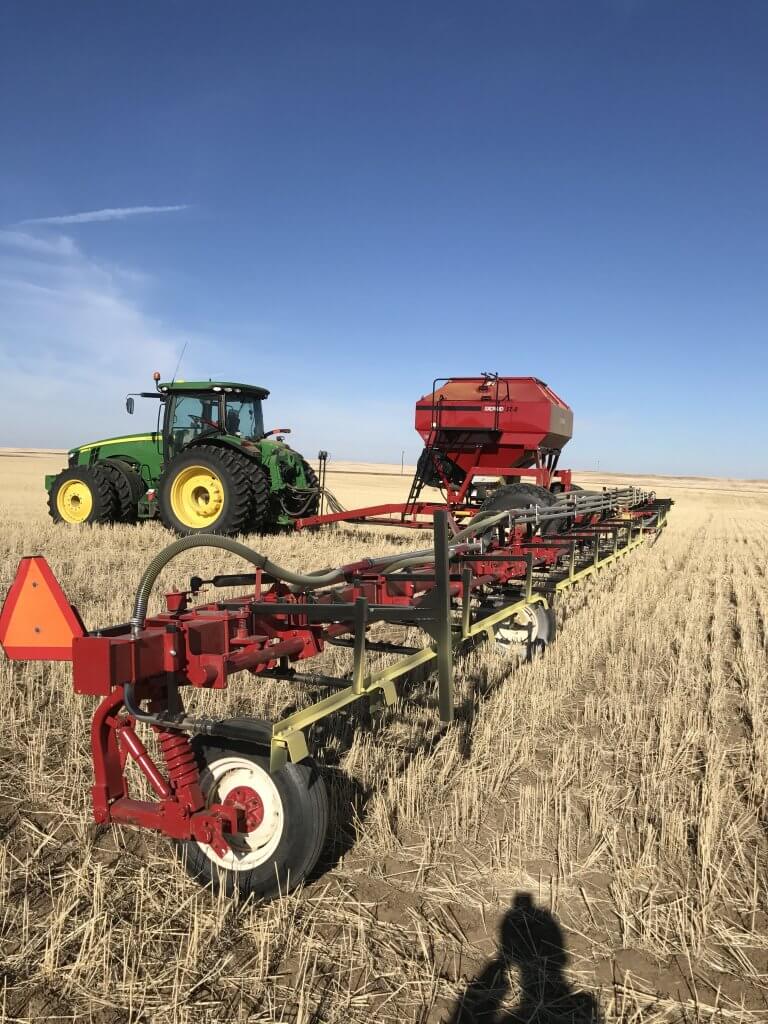
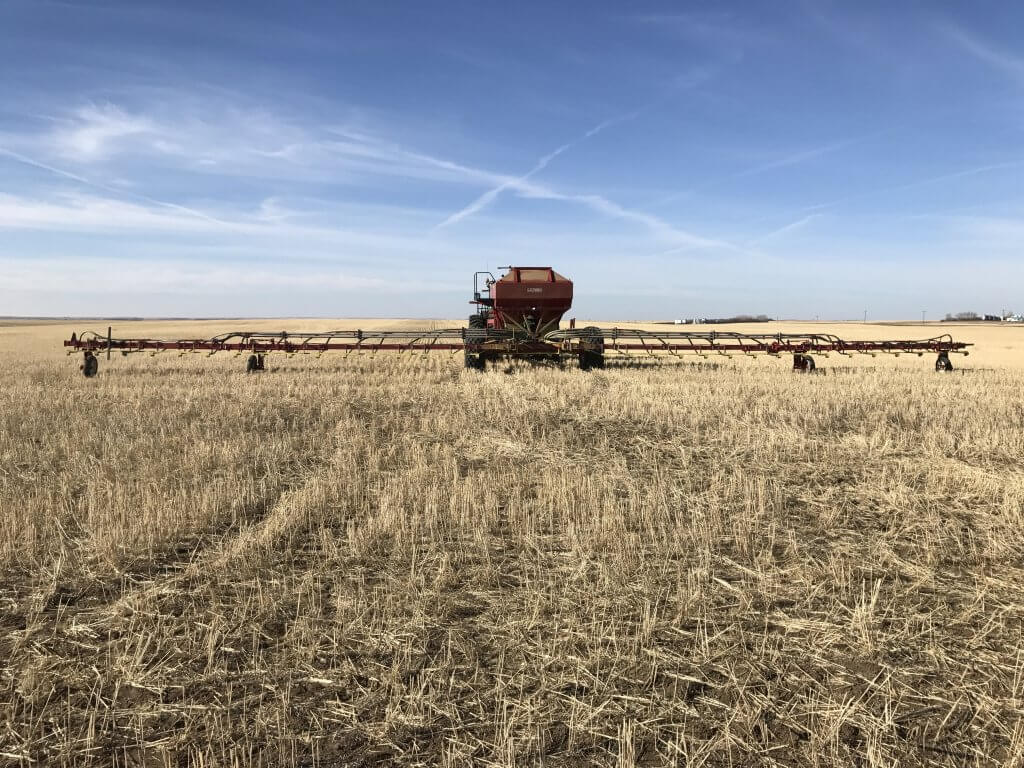
    This week I spoke with Gerry Bell, a producer from near Gravelbourg in southern Saskatchewan (a beautiful town with a historic downtown, church and school, also, home of the Gravelbourger at the local diner). He told me about a project he recently completed, converting his older pull-type sprayer to a granular spreader. It’s a great project, worth sharing.

    The concept was first popularized by Manitoba farmer Kyle Holman in 2012, who uses the #SprayMar hashtag on Twitter to promote it.

    Gerry wrote his project up for us and I’ve posted his description below.

    Bourgault 1460 Field Sprayer

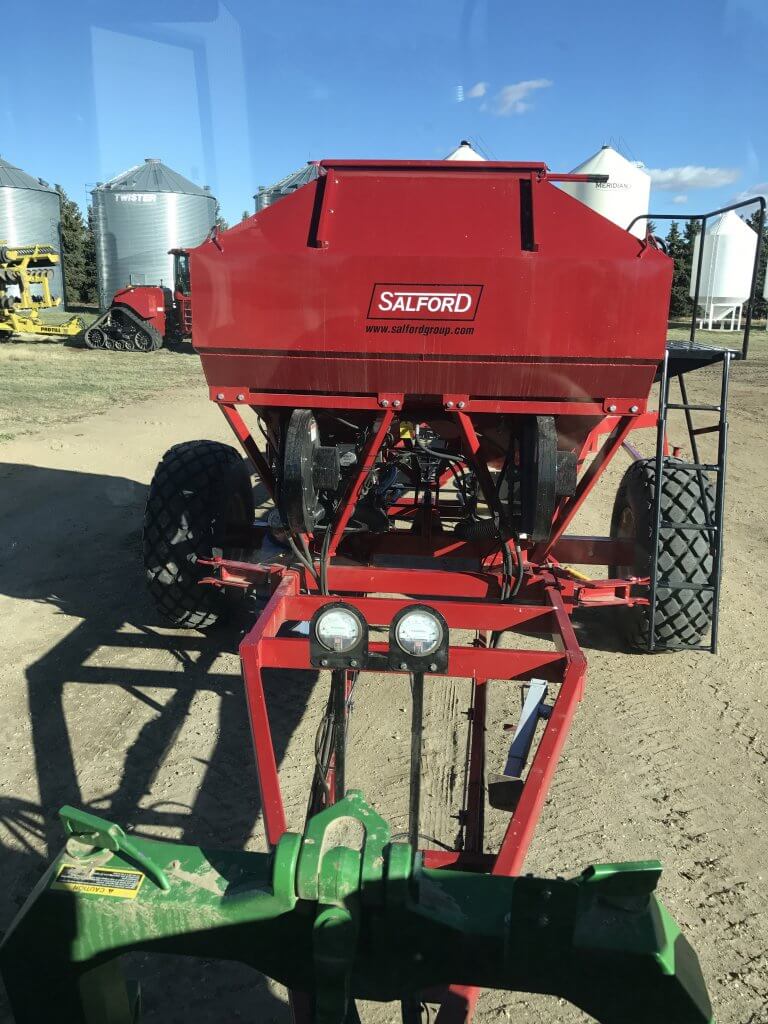
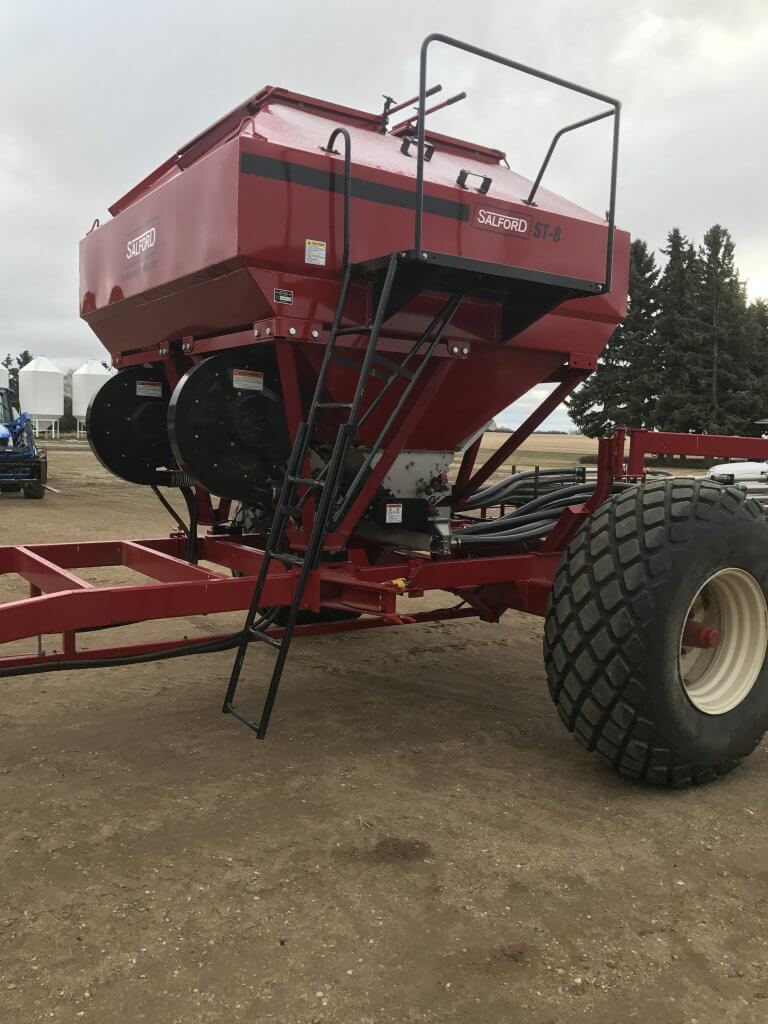
    The sprayer sat in a machine shed from 2011 when we purchased a Patriot 4420 sprayer. For many years we wondered if we couldn’t find a use for the sprayer as Bourgault had build a very rugged unit. So, in 2017 we decided to mount a Valmar tank (now owned by Salford) on the sprayer frame to be used for granular herbicides and granular fertilizer applications.

    Bourgault 1460 (Source: Bourgault.com)

    The liquid tank and plumbing were removed as well as the secondary boom with the wet boom. A few modifications to frame were made but for the most part the frame was left as is. The unit was painted with the Salford colours. (Case IH red)

    The Valmar/Salford unit is a ST8 which is used lots in Eastern Canada and the States for strip tilling for applying granular products. We purchased the tank, hoses, splitters and deflectors from Salford.

     The unit as purchased had the following features:

    • 8 imperial tons (16,000 lbs)
    • Stainless steel tank and duct systems
    • Mueller Hydraulic metering system with two sets of rollers – one pair for granular herbicides and one pair for granular fertilizers
    • Two hydraulic driven air fans – usually just one fan but we chose two fans – one for each boom
    • Weight scales for tank
    • ISOBus system with mapping, auto on off, sectional control (one for each boom)
    • 18 outlets – 9 outlets on each side of tank

    We designed unit in consultation with Salford engineers:

    • Each of the 18 outlets has a 2” flexible hose from the tank going to 2” stainless steel tubing stacked on the boom frame
    • Just prior to the deflectors each 2’ tubing is split into two 1-1/4 streams with special splitters supplied by Salford (according to Salford these are commonly used and have an accuracy of less than 2-3 % variation if mounted properly). Need to be horizontal.
    • The deflectors are mounted every 30” along the length of the boom (36 deflectors)
    • The sprayer boom was cut down from 110’ to 90’ to give the correct spacing

    Comments on use of the unit

    • Functionality seems to work very well as designed
    • Weigh scales, GPS, mapping, auto on/off, sectional control a real plus compared to original field sprayer with none of these features
    • Accuracy of product metering seems very good
    • Distribution across length of unit seems very good
    • Travel speeds of 10 mph
    • Product takes 2.5 seconds from time meter starts turning until product reaches far end of boom

    There is a difference of about thirty feet in travel distance with start and stop of product on the ground between inner side of boom and outer end of boom. Therefore, we have set look ahead time at 3.3 seconds and shut of time at 0.3 seconds.

    • Load products with a belt conveyor in yard
    • Apply 100 lbs of elemental sulphur (0-0-90) on 25% of the crop land each year

    (Tank does 160 acres)

    • Applied Avadex at 12.5 lbs per acre last fall on some acres prior to snow.
    • Apply Edge at 20 lbs per acre each fall just prior to snowfall  (for pulses)

    Tanks holds 10 minibulk bags – 12,000 lbs, and does 600 acres. On a long day have put out 1200 acres of Edge.

    We did extend the axles and also put on new hubs and new tires which were a bigger size. A Bourgault 1850 with 1600 gallons would have worked better but it is hard to find them. Plus they would probably have needed new tires anyways.

    It took a lot more time than we had imagined to build but that is true of most building projects. But I would say that we are very happy with the results. It is a pleasure to operate and appears to serve our needs very well.

    Thank you, Gerry, for sharing this with us!