Tag: boom

  • Recirculating Booms – Introduction to the Concept

    Recirculating Booms – Introduction to the Concept

    Listen to the audio version of this article here

    A lot of people are intimidated by sprayer plumbing. One look at the spaghetti bowl of spray mix and hydraulic hoses and valves, and they walk away. It hasn’t helped that much of it is concealed under the frame and all of it is in the same black colour, so figuring it out on your own is almost impossible.
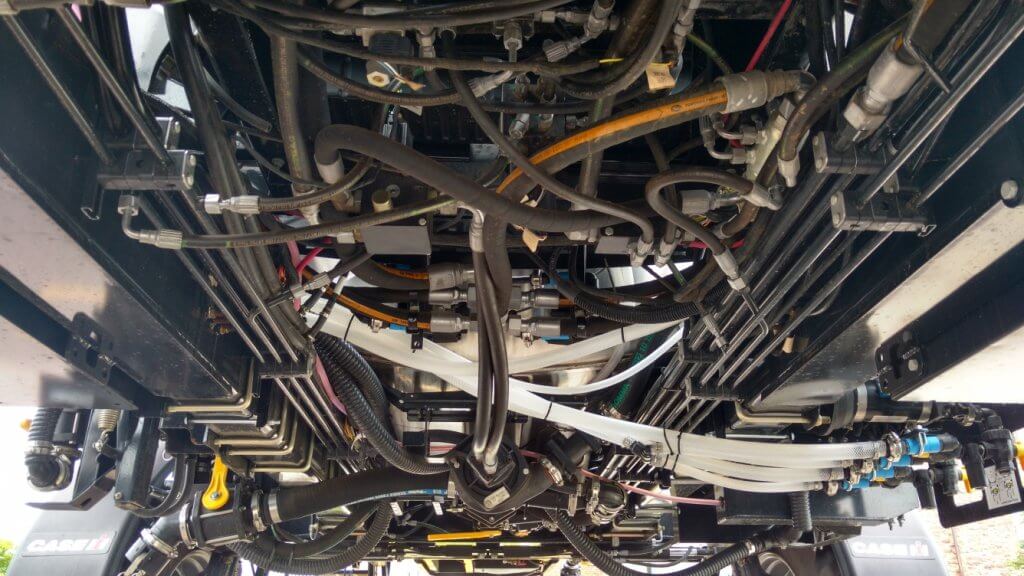
    Belly of a typical sprayer, showing black hydraulic and spray hoses.

    Let’s quickly review the basics. In all sprayers, the liquid in the tank is drawn out from the bottom and pressurized by a pump. The pressurized liquid is split into two main paths. One goes to the spray boom to hydraulic atomizers (nozzles). The other goes back to the tank to agitate the liquid and act as a pressure bypass when the booms are off. Bypass throttling changes pressure. That’s it.
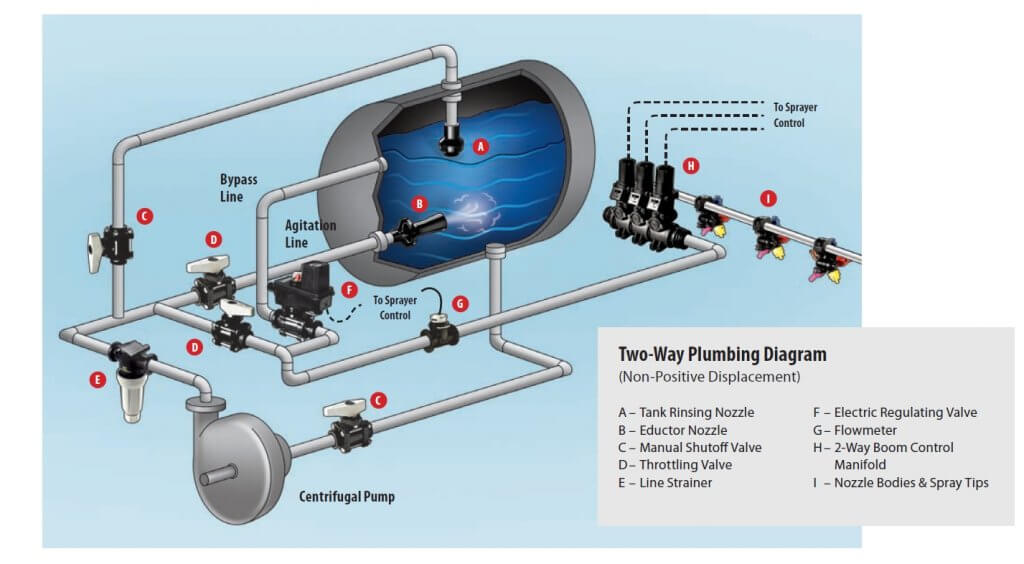
    Sprayer plumbing diagram (Source: TeeJet).

    By the way, has anyone ever thought of some colour-coding or labelling the hoses and valves on a sprayer? We’d definitely appreciate that.

    Conventional boom sections

    Most North-American sprayers feed the pressurized liquid to the boom, where the flow is subdivided into physical sections that define the various portions of the boom that can spray at any one time. Older sprayers might only have two sections, the left and the right boom. Wide booms now have anywhere from 5 to 13 sections, each about two to four metres wide. Each section has a pressure feed to its middle, and each section terminates at two dead ends, at which we place caps or valves for flushing.
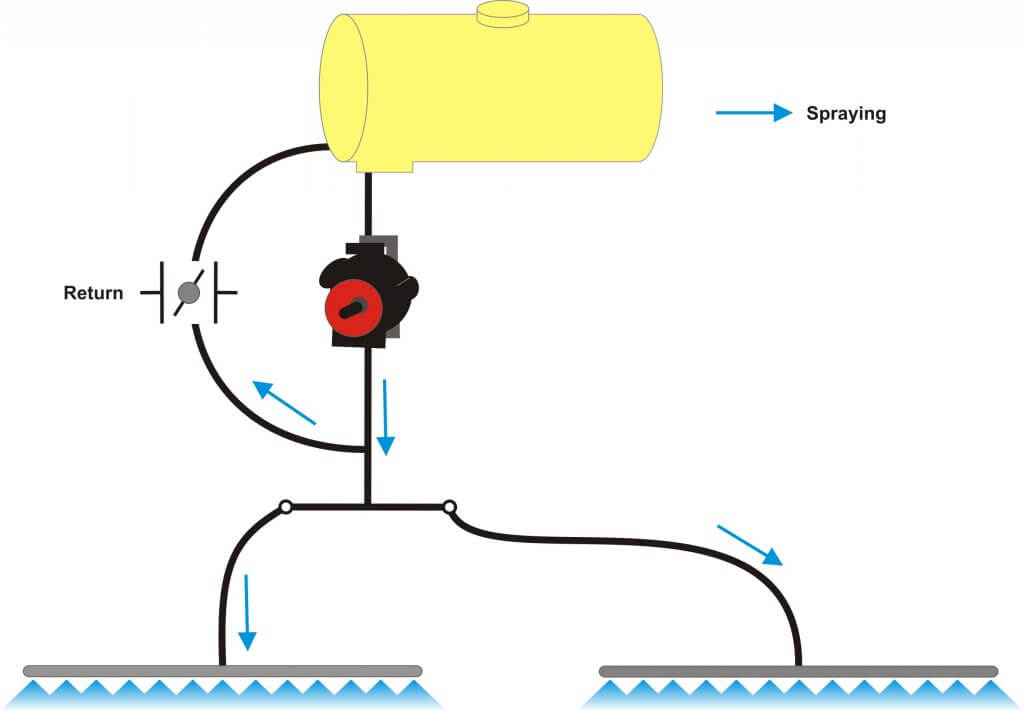
    A conventional plumbed boom with two sections. Each section has two terminal ends that require cleaning. Boom can only be flushed or primed by spraying or by opening boom end caps.

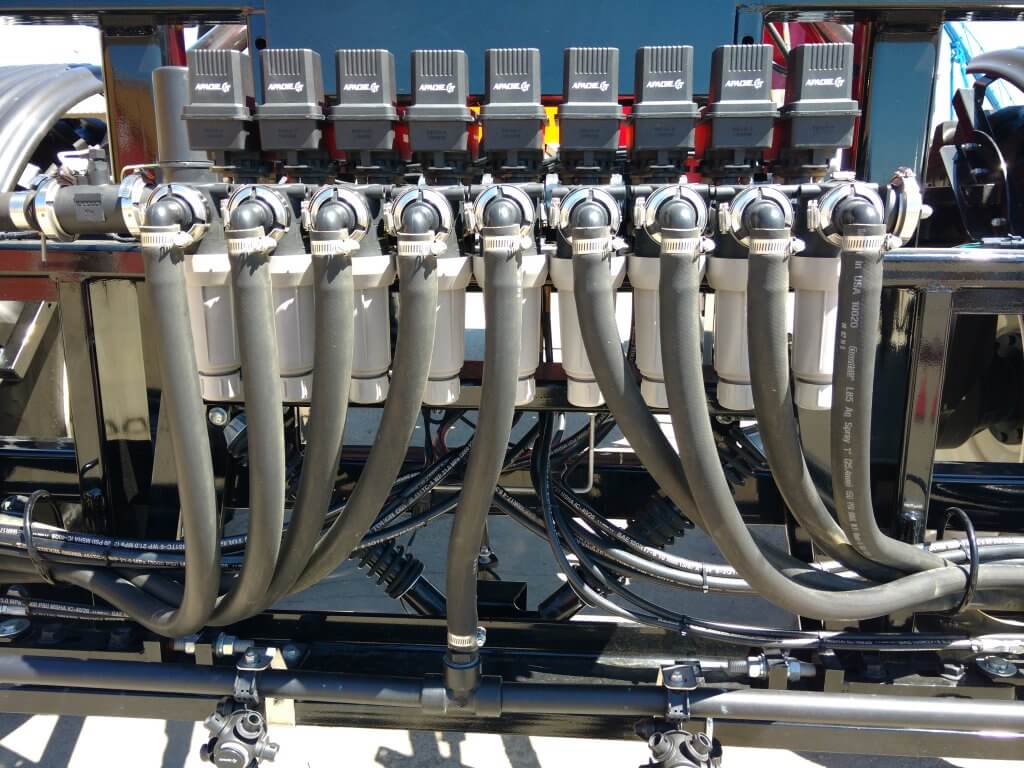
    Sprayer with nine sections, each controlled by its own valve and each running a dedicated feed hose.

    Two partial boom sections, each showing a central feed line and a capped boom end.

    Sectional boom end showing 10 cm of capped pipe beyond last nozzle body.

    Boom end with valve to facilitate draining and flushing.

    Any liquid that enters this type of boom must exit at the nozzle or the boom end. It must be sprayed out or drained. This poses three distinct problems.

    • If the boom contains water or a previous spray mix, the boom needs to be primed with the new product before spraying. We need to spray or drain the existing product out.
    • If we want to clean the boom or flush it with water, again we need to push the existing liquid out.
    • If we have dead spots in the boom section, such as a boom end, we need to take special care to flush those out as well.

    These characteristics complicate cleaning, create waste or contamination, and take time.

    Recirculating booms

    In a recirculating boom, the spray mixture enters the boom at one end and exits at the other, returning to the spray tank. In most cases, the left and right wing each has its own feed and return. Sectional control is achieved via individual valves (air or electric) placed on the nozzle bodies.

    There are two main types of recirculating booms on the market.

    The first system routes the pressurized mixture into the boom and shuts off the return line during spraying. When the nozzles are shut off for a turn, the return line opens automatically and the boom flow is pushed past the nozzles back to the tank. When the nozzles spray again, the return line closes to pressurize the boom. 
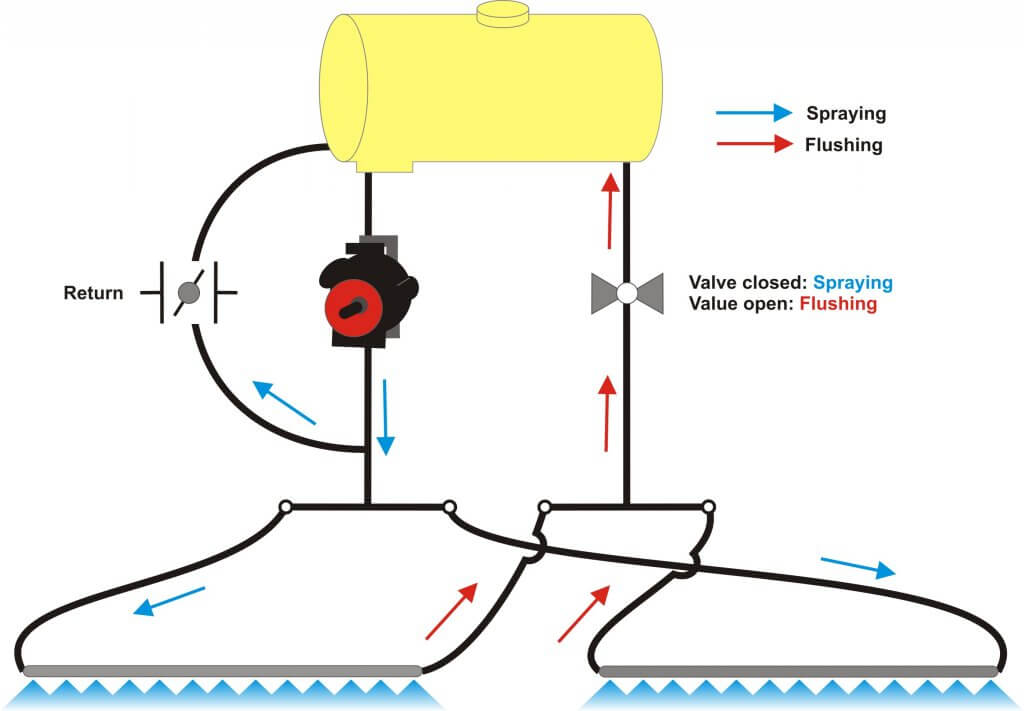
    Recirculating boom system offered by Pommier. One end of boom is pressurized, the other end is return. Return flows when boom spraying is shut off. Boom can be primed or flushed without spraying.

    This is the system used by Pommier, the French aluminum boom manufacturer who first introduced recirculating booms to North America.
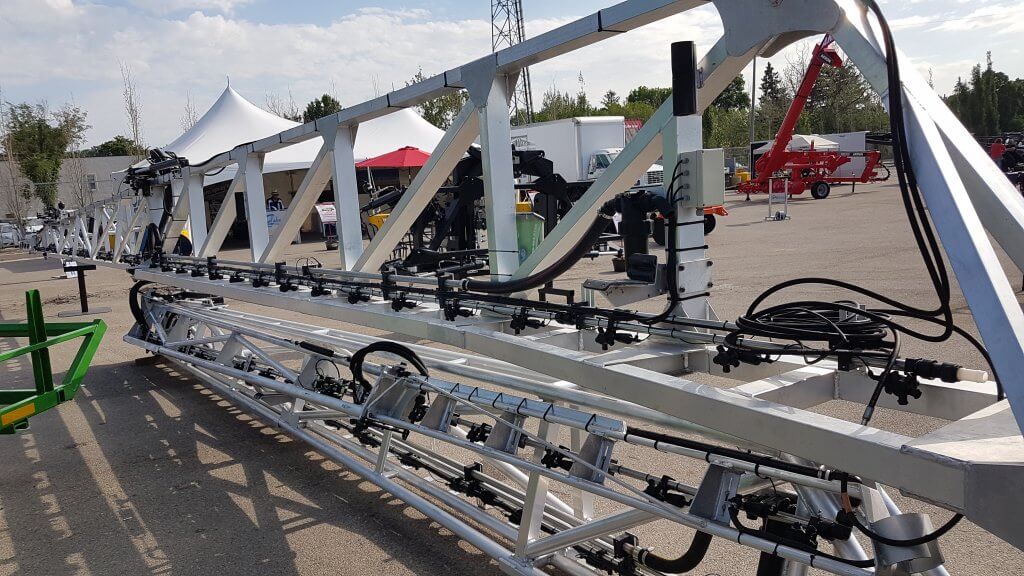
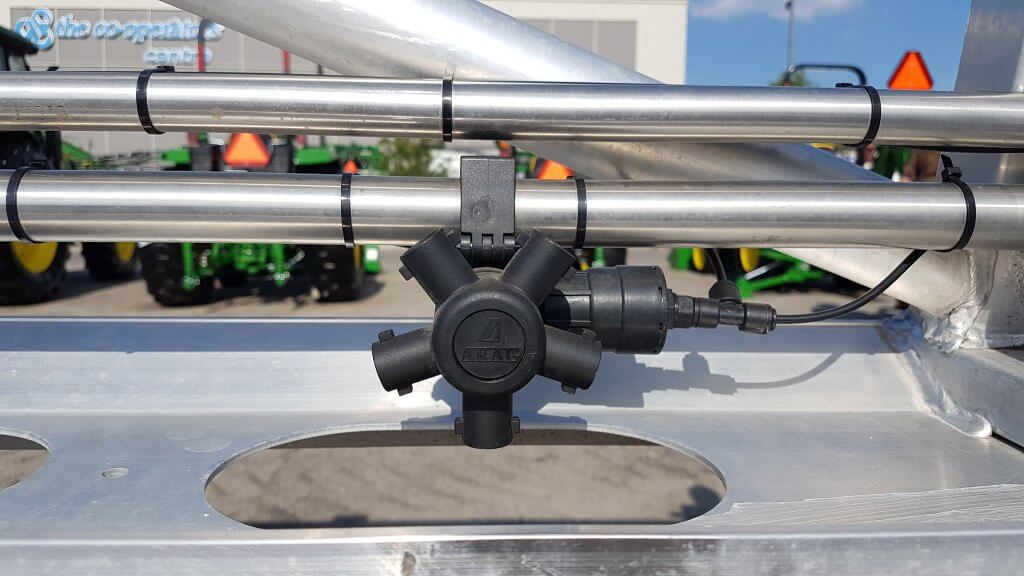
    Pommier recirculating boom.

    Pommier boom showing stainless steel supply and return lines, as well as air-activated shutoff valve on nozzle body.

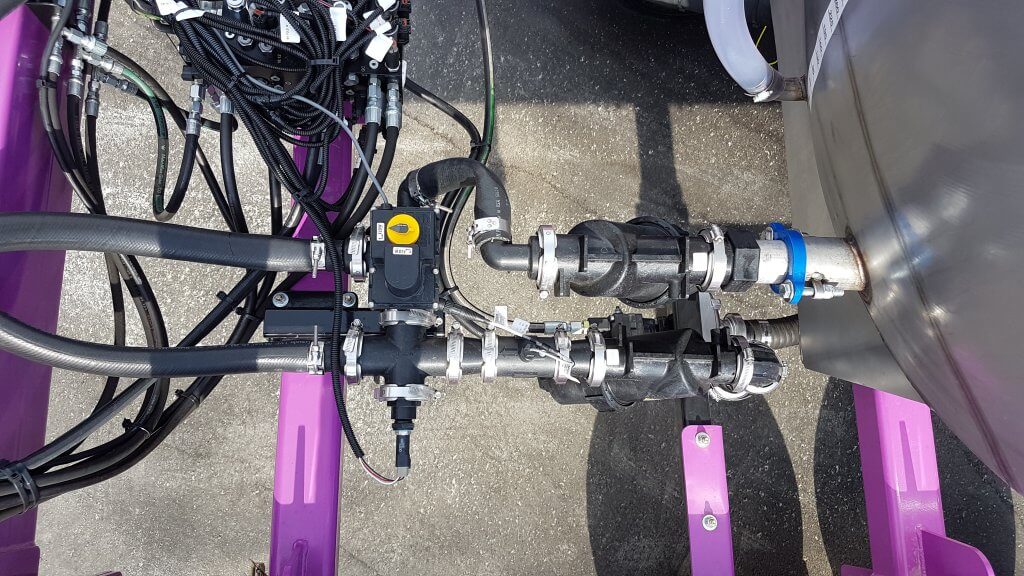
    The second type of system contains a 3-way valve, connected to the return line and the pressure side of the pump. This valve provides the option of either allowing the return line to go back to the tank, as above, or to also allow pumped flow to the return side so that the boom is pressurized at both ends.
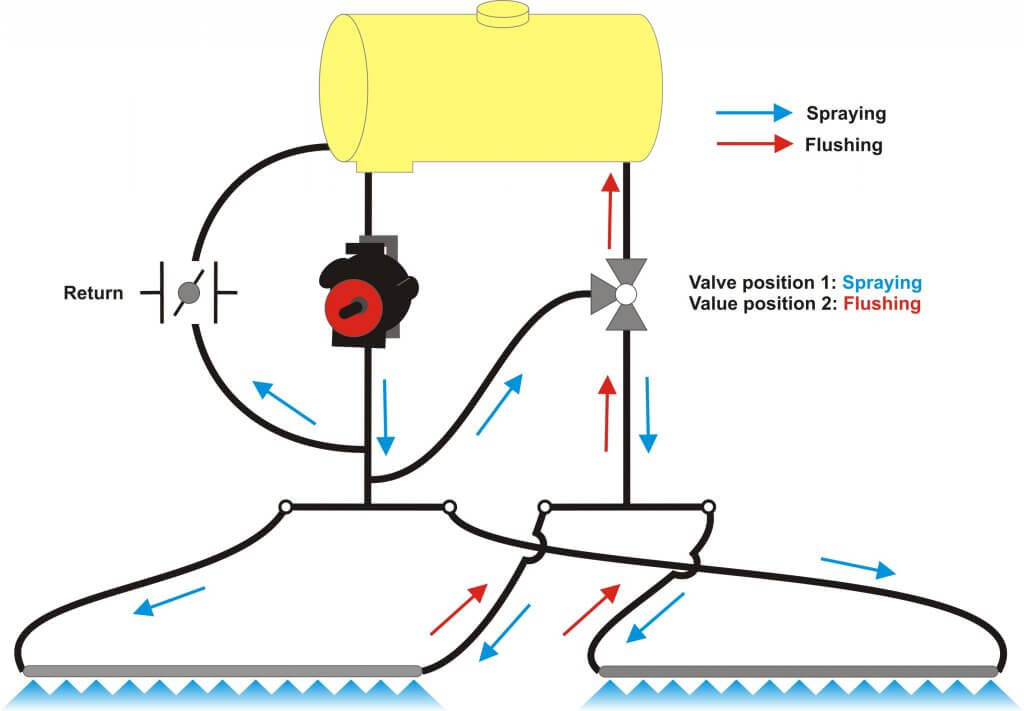
    Recirculating boom that allows return line to be either pressurized by pump, or return to tank.

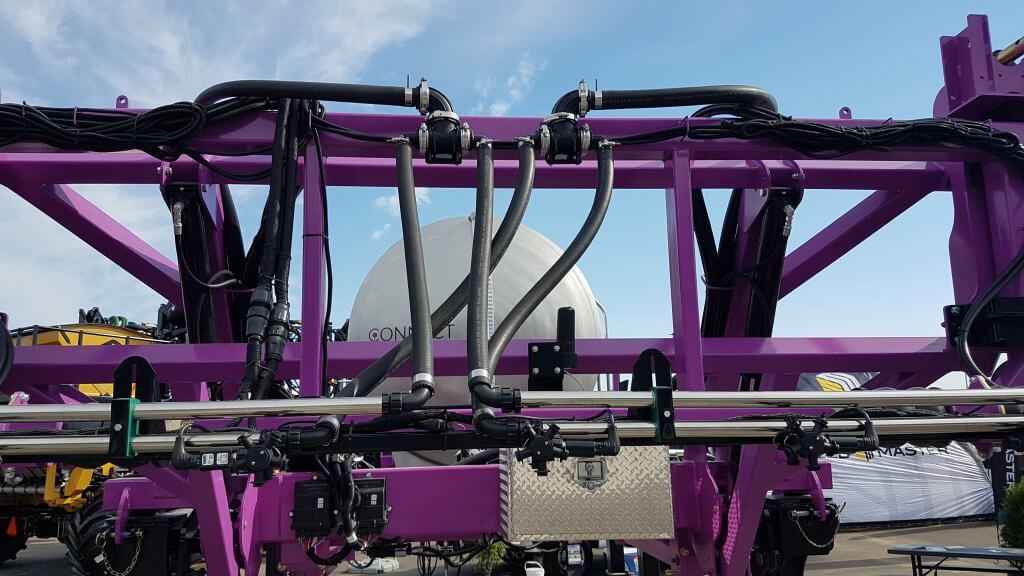
    Top view of D.O.T. Connect sprayer recirculating boom setup. Lower line is pressurized by pump. Upper line is return. Three-way valve allows return line to either go back to tank, or be pressurized by pump.

    Tidy setup of pressure and return lines on D.O.T. Connect system.

    This feature may be useful with long booms along which pressure drop is more likely to occur, or when very high flows are required, and was introduced to North America by the Dutch manufacturer Agrifac, about which we wrote here and reprinted Mick Robert’s article from Pro Operator here. A similar system is available from Rogator (starting in 2018) via their C-Series featuring LiquidLogic. It has also been used on the Connect sprayer, developed by Pattison Liquid Systems, for the D.O.T. autonomous platform.

    The main advantages of this design are that it provides the option of additional pressure to the spray boom to avoid pressure drop, and to allow any spray mix in the return line to be pushed and sprayed out to the boom for rinsing in the field. This lowers the remaining volume that needs to be diluted.
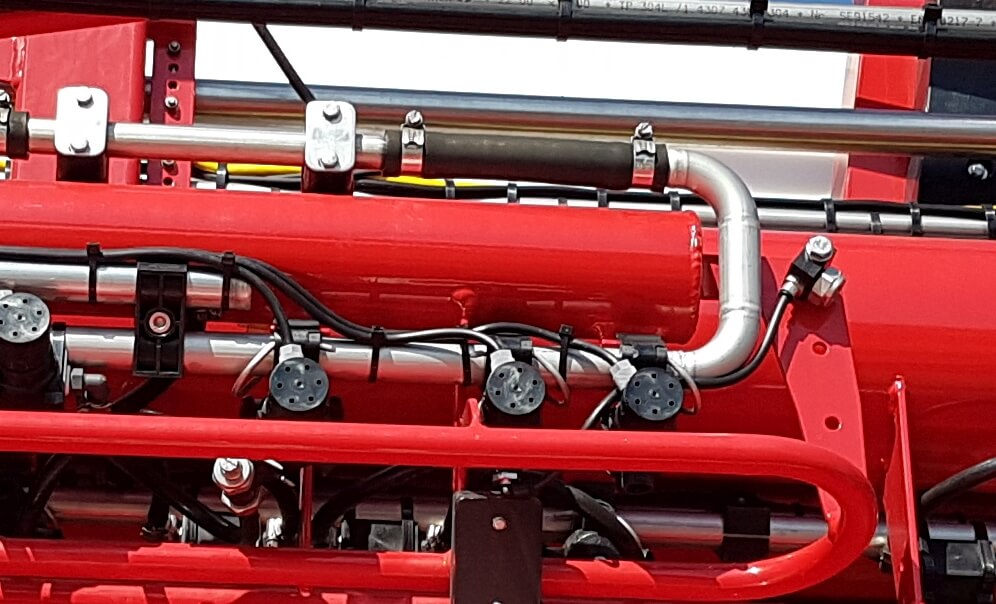
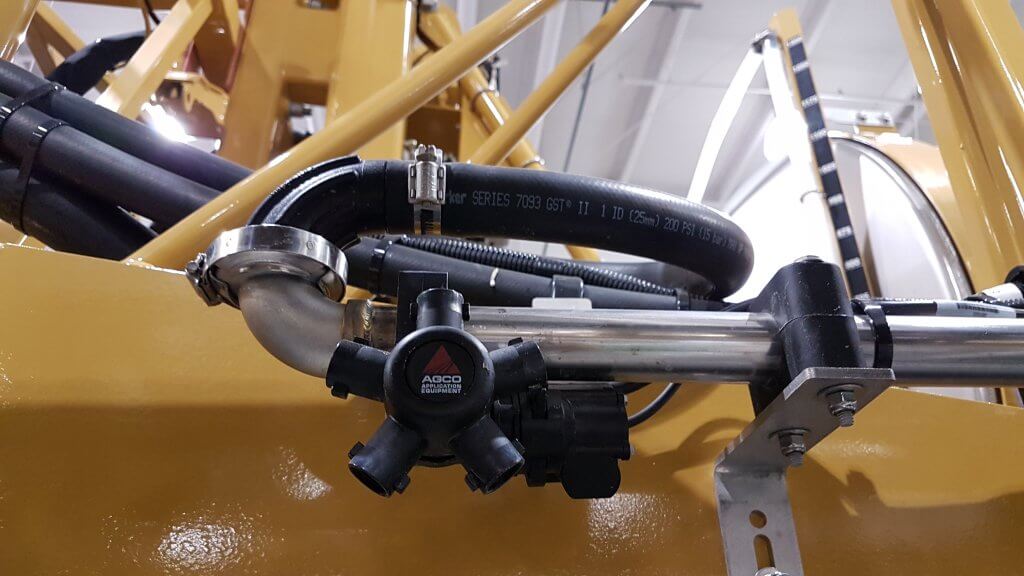
    Agrifac recirculating boom showing return loop at boom end.

    Boom end on Rogator Liquid Logic system. Note Hypro Pro-Stop E shutoff valve.

    Features

    Recirculating booms offer advantages in terms of preventing soil and water contamination and also in terms of simplifying the boom cleaning process. The design provides an opportunity to graduate to a better resolved sectional control as well due to the requirement for individual nozzle shutoff valves. 

    Due to shorter and less complex lengths of plumbing needed, stainless steel can be used for the return lines which decreases the potential for pesticide residue being adsorbed.

    To rinse a boom with product mix still in the tank, simply draw water from the on-board clean water tank and push it to the boom without activating any nozzle bodies. The mix in the boom is returned to the tank and replaced with water, nothing is sprayed or drained. The tank contents may become slightly diluted depending on the duration of the rinse.

    To rinse the tank as part of the sprayer cleanout, first spray the tank empty. Then introduce clean water into the product tank via the wash-down nozzles and spray that out. As always, either use several batches of  small clean water volumes, or a continuous rinse system, to dilute the remainder most effectively. There may be additional volume to dilute from the return lines compared to a conventional system, depending on the type of recirculating system is used. However, boom ends no longer exist and this saves effort and ensures a more thorough rinsing.

    To prime a boom that contains water, simply open the return lines back to the tank and allow the new mix to flow through the boom. Again, some dilution of the tank will occur due to the water in the boom.

    The value of spray-free rinsing and priming adds up. Each prime, for example, consumes about 30 US gallons before the spray reaches the last nozzle of the longest section. Much of that product ends up on the ground, probably while the sprayer is stationary, and probably in a similar place on the field year after year.

    Since a recirculating boom requires a powered individual nozzle shutoff, this adds some cost. However, the opportunity of improved sectional control via virtual sections is significant (most monitors offer 16 virtual sections that can be configured). Well-configured virtual sections can save several percent from overlaps.

    Recirculating booms remove many of the contamination problems associated with conventional plumbed sections. They save time, money, and reduce environmental impact. We think they should be offered on sprayers.

    Here’s a link to a nice article on recirculating booms written by Spencer Myers for the Manitoba Co-operator. A video that goes with the article can be found here.

  • Sprayer Turn Compensation

    Sprayer Turn Compensation

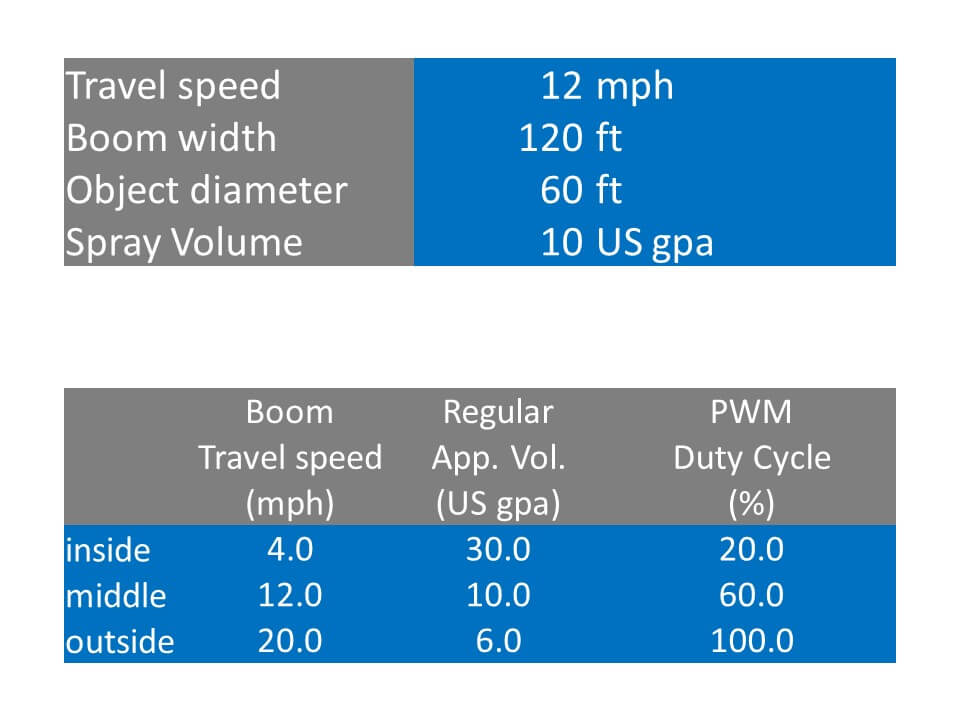
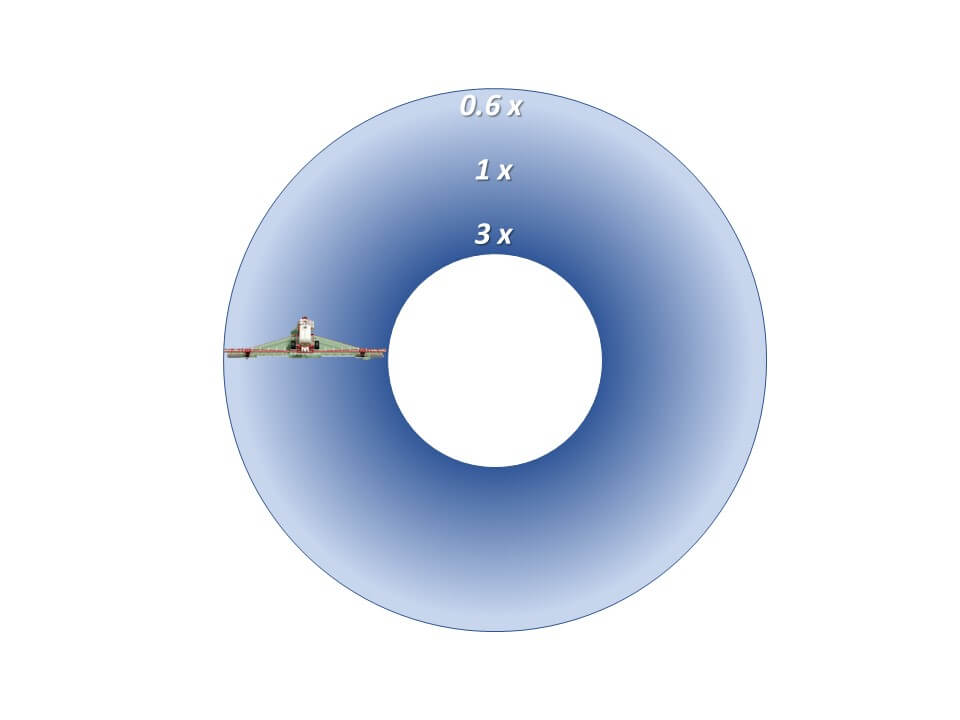
    Turn compensation is a feature in pulse width modulation (PWM) sprayers in which nozzle output matches the boom’s speed during a turn. When turning, the inside and outside of a boom travel at different speeds, resulting in over-dosing on the inside and under-dosing on the outside. Read about PWM systems here, here, and here.

    The degree of the problem depends on the inside turn diameter. Clearly, the tighter the turn, the more severe the over-and under-dosing. The ability of a PWM sprayer to compensate also depends on the turn tightness, as well as the Duty Cycle (DC) the system is operating at during the turn.

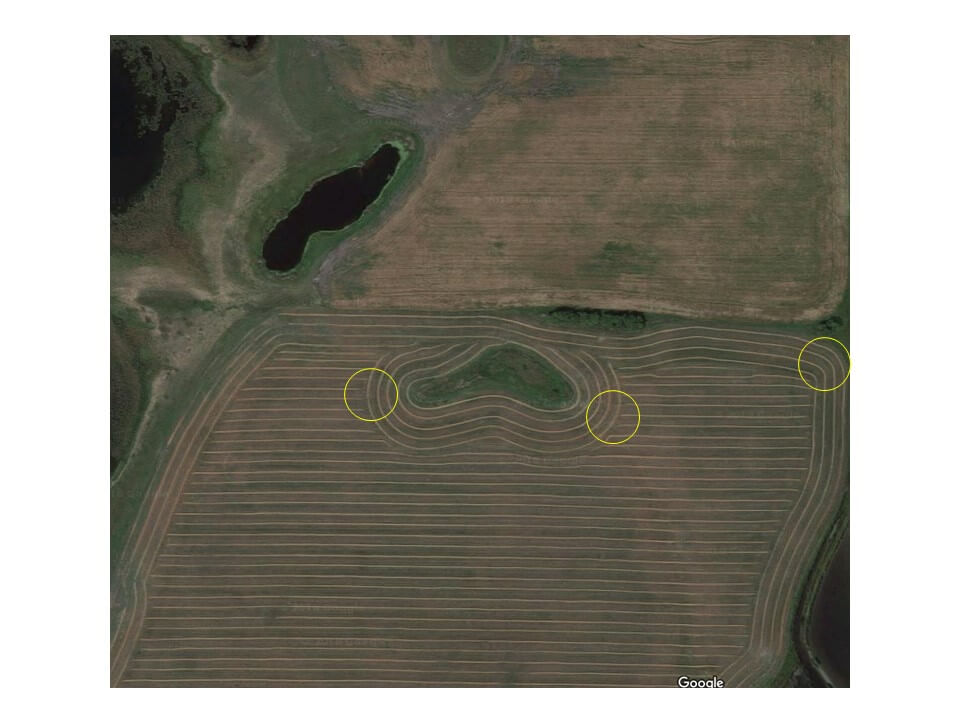
    In the above example, a 120 ft boom makes a turn around an object with a 60 ft diameter. Assuming a 12 mph speed and an application volume of 10 gpa, the inside of the boom travels at 4 mph and applies 30 gpa, or 3x. On the outermost nozzle, the speed is 20 mph with an application volume of 6 gpa, or 0.6 x. A sprayer operating at 60% DC would be able to correct the application in this turn by operating at 100% DC on the outside and 20% DC on the inside.

    But completing the turn at other DCs may be problematic. In this case, lower sprayer DC would require the inside DC to operate below 20%, which may not be possible, depending on the system. Conducting the turn at higher DC would prevent the outer boom from meeting the flow requirements, resulting in under-dosing.

    Optimizing the benefit of turn compensation requires the operator to enter the turn at a DC that meets the objectives. Is it more important to prevent under-dosing of the outside perimeter? If so, slow down in the turn (reducing DC) and maximize the extra capacity at the outside of the boom, possibly at the cost of over-dosing the inside.

    The agronomic benefit of turn compensation is to provide sufficient pesticide dosage where it’s needed. It’s been reported that repeatedly applying sublethal herbicide dosages at the same site can lead to the development of polygenic resistance in some outcrossing weed species. These areas are likely to occur at the outside boom location of a permanent landscape feature that the sprayer moves around year after year.

    Turn compensation is a valuable feature in all agricultural operations where input distribution uniformity is important. Spraying is no exception, and PWM makes it possible.

  • Exploding Sprayer Myths (ep.7): Boom Height

    Exploding Sprayer Myths (ep.7): Boom Height

    It’s a new season of Exploding Sprayer Myths so we’ve got a new opening sequence!

    In this episode we demonstrate the importance of nozzle spacing, spray angle and boom height. We also turn a hapless pineapple into a projectile and spray dyed antifreeze on a cold winter day.

    Learn more about how boom height affects spray deposit uniformity, and why that should concern you, by going here.

    This episode was filmed on location at the Syngenta Honeywood Research Facility in Plattsville, Ontario. We thank them for generously allowing us to commandeer their facility and staff for the day.

    And of course, none of this would be possible without the talented staff at Real Agriculture. Make sure you tune into RealAg radio.

    A little extra fun:

    We received this email after a grower heard Tom speak at a meeting. A compelling observation about how nozzle spacing and drift affects men everywhere:

    Tom: I really enjoyed your talk in Humboldt yesterday. During the coffee break immediately after, I went to the washroom and noticed 3 guys spread evenly across 5 urinals. Wow. Talk about worrying about spray drift. When I returned to my table and told my wife of my findings, she commented that it must have something to do about the distance to the target, as it couldn’t possibly be that the pressure was too high!

  • Boom Collisions on Twitter

    Boom Collisions on Twitter

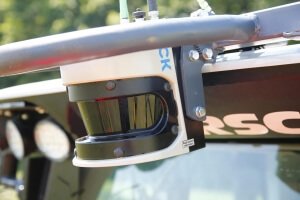
    An interesting technology recently came to our attention. The Horsch BoomSight detects potential obstacles and as the sprayer passes it raises the boom to avoid the impact. We figured it was worthy of a tweet, which read:

    The Horsch BoomSight

    @Spray_Guy:
    Ever accidentally hit something with your boom?
    <35 km/h, perhaps the Horsch BoomSight can help:
    http://bit.ly/2j6ShBx

    Now, when you tweet something, you hope it has some impact. That’s usually a few “likes”, maybe a few “retweets” and if you’re lucky someone may take the time to write a response. We received the following response:

    @WcropW:
    Yes, often bumping into kangaroos as they hop out of my crop.
    Got to be quick to lift boom above them!

    @Spray_Guy:
    Still can’t decide if that’s a joke or not, but it certainly made me laugh.

    @WcropW:
    Was looking for picture – definitely true! Has happened 3 or 4 times!

    @spraydriftgirl:
    Definitely true! Plague numbers in crops down here #strayamat.

    @ryan_milgate:
    Yep I’ve hit plenty of kangaroos, esp in canola.

    @Wilkshag:
    Kangaroo- out side window of sprayer. They get stuck jumping through canola.

    @Spray_Guy:
    Wow! What a photo!
    Is there any product registered for kangaroo in canola in Canada?

    Photo Credit: Randall Wilksch

    And so, it got us thinking… What other strange and unexpected things do sprayer operators hit, or nearly hit, during all those hours of spraying? So we asked:

    @Spray_Guy:
    Hey Twitterverse!
    What’s the strangest thing you’ve hit with spray boom?
    “Kangaroo” currently in lead.

    In less than 48 hours, that tweet earned more than 10,000 impressions as the Twitterverse shared all. What follows is a slightly edited transcript of that thread: snarky responses, pictures, videos and all. We don’t know if there’s any educational value, but it’s certainly fun and surprising. No one wrote “fencepost” or “tree”. They covered everything else, though.

    @SteveTwynstra:
    Wild Turkey!

    @Spray_Guy:
    Is that what you hit, or WHY you hit?

    @SteveTwynstra:
    Jumped right up outta the standing wheat 50 odd feet to my right.
    Next day, grazed a fawn 2 fields over…

    @Spray_Guy:
    Putting the “Bam” in Bambi.

    @SteveTwynstra:
    The doe did give me a dirty look…..

    @MarkDavis0129:
    I snagged a boat, dragged it 150 yds.
    The fisherman had quite the look on their faces once I stopped.

    @Spray_Guy:
    A BOAT!?
    Nope… I’m pretty imaginative, but this escapes me.
    How was that possible?

    @MarkDavis0129:
    It’s true, have land right to shoreline in few spots.
    Turning on head land and snagged it.

    @Spray_Guy:
    Priceless.
    I’m still laughing picturing that.

    @MarkDavis0129:
    Was last fall, 18′ alum flat bottom, they were nosed up to shore, snagged boweye on boom tip.

    @Paulvdb2016:
    I have hit an abandoned small liquid manure spreader in a fast turn.
    Boom hit at 30+ mph!

    @Spray_Guy:
    The $hit hit the flatfan…

    @AgronomoOz:
    @Pontaragrain has hit his own drone and put it on Youtube.
    #honesty

    @Spray_Guy:
    Ouch.
    UAV’s aren’t cheap.
    Got the link, Andrew?

    @CrystalSeedSeer:
    Let’s hope crop inspector isn’t in there! LOL!

    @Spray_Guy:
    From this thread, it seems like he’d be at risk of being hit, too!

    Turn up the volume on this video.
    Great soundtrack! Shared with permission from Michael Pfitzner (@farmingfitz)

    And believe it or not, it’s happened to more than one person. Bad time for battery to run low.
    Shared with permission from Warwick Holding (@Pontaragrain)

    @MattTolton2:
    I’d only run a sprayer a few months but once slapped a duck out of mid air.

    @Spray_Guy:
    A solid example of booms set too high… or ducks too low.
    Tell me you shouted “DUCK”!

    @JoannaMWallace:
    This thread is winning Twitter for me today.

    @vg_tim:
    Knocked over a wild turkey and porcupine at same time. Years ago, but can still remember.

    @Spray_Guy:
    Yikes… what were they doing when you hit them? #Darwinwouldntapprove

    @vg_tim:
    it seemed suspicious, they were just standing in a bean field looking at each other…

    @DavidKucher:
    I may have hit an oilwell or two.

    @MaizingPete:
    Almost hit a hippy sleeping off a punk party in the fence line.

    @Spray_Guy:
    LOL! You may have de-throned ‘kangaroo’ with ‘hippy’! We still have hippies?
    We have hipsters… we should hit more of them.

    @MaizingPete:
    For sure Hippy… That poor b@stard thought he was still in Woodstock.

    @BlackPearl152:
    I gave two coyotes a good spank with the boom once.

    @cropperandy2:
    Have hit deer, a coyote, in ON and a moose in AB.

    @jamesschiltz85:
    1982 International cab cover.

    @GregOldhaver:
    Had a flock of partridge lift up and get smacked out of the air with boom.

    @cjrnumber6:
    An endangered Lesser Prairie Chicken.

    @Spray_Guy:
    Somewhat more endangered now, it would seem…

    @DarLinFarms:
    Travel trailer.
    Guy drove into boom unfolding infield.
    He watching as unfold.
    Crash into me.

    @Joe_Widdup:
    Had a near miss with a guy who stopped to take photos.
    Scared the hell out of me.

    @Luckycangus:
    Deer and sharp tail grouse.

    @RowcropAust:
    Emus at night go crazy in the lights.
    I have hit a couple over the years.

    @Spray_Guy:
    I’ve heard of people jacking deer (headlights and hunting) but never emu.
    Educational!

    @kerriRaeMillar:
    Llama in the hills of south-central Manitoba.

    (Photo credit Lucas Millar)

    @Jeremycnobel:
    Hit a gopher in head with a foam cup as he came out of his hole.
    Ended with Blue dye foam ?

    @Spray_Guy:
    That’s one way to mark your A-B line. Trying to think of a #caddyshack joke…

    And that’s the thread. So look up from your smart phones occasionally while you’re spraying. It seems there are all kinds of unexpected obstacles in the field.

  • Selecting the Right Sprayer Boom Height – Tips with Tom #5

    Selecting the Right Sprayer Boom Height – Tips with Tom #5

    What’s the right choice for nozzle fan angle? 80 degrees or 110 degrees? This question leads us to boom height. How do we select the right boom height?

    Nozzle fan angle does play a role, but so does the type of sprayer you run and, more importantly, the height that creates the best overlap pattern. In this Spray Tips, Tom Wolf explains the drift risks and realities of boom height settings on high clearance sprayers, why high-set booms can negate the benefits of certain nozzle designs and why low-drift nozzles need 100% overlap. Then, it’s off to the white board to illustrate the relationship between nozzle spacing and ideal boom height.