Tag: video

  • What’s with dew? – Tips with Tom #9

    What’s with dew? – Tips with Tom #9

    When warm air is cooled, it loses some of its moisture-holding capabilities. This change often occurs at night, when plants (and other objects) cool. Once the temperature of the surface of the leaves, for example, drops below the dewpoint, it causes water to condense, forming the shiny dew that causes so many to question early morning spray applications.

    The question is often: will the spray run off the plant or will it get so diluted that it doesn’t work anymore?

    In a dew chamber, work has shown that large spray droplets are more likely to run off a plant saturated with dew than their smaller counterparts. However, similar work showed that spray efficacy was not altered by droplet size.

    Wolf discusses this work and the potential answer to the seemingly conflicting findings. Wolf also explains how grassy weeds compare to broadleaves, the role of surfactants, and what to consider when making the decision to spray through dew or not.

  • Exploding Sprayer Myths (ep.10): Airblast Coverage

    Exploding Sprayer Myths (ep.10): Airblast Coverage

    Here in Episode 10 of Exploding Sprayer Myths we’ve coaxed @Nozzle_Guy back into the orchard. This is part two of a two-part mini series on airblast calibration. In Episode 9 we talked about air settings and travel speed, and now we’re tackling nozzling and coverage.

    But here’s the twist: Rather than use spray math to determine the required nozzles to achieve ideal coverage, we do it backwards. This process uses ideal coverage to determine nozzles and finishes with sprayer math.

    Confused? Watch the video and this surprisingly simple and versatile approach will become clear. See if you catch the subtle visual joke about “coverage” realize that to pull this off, we had to film it backwards.

    Special thanks to the @RealAgriculture team, the Simcoe Research Station and Don Murdoch.

  • Dual Fan Nozzles in Broadleaf Crops

    Dual Fan Nozzles in Broadleaf Crops

    Wondering which (if any) dual fan nozzle to buy?

    • Symmetrical?
    • Alternating floods?
    • Asymmetrical?

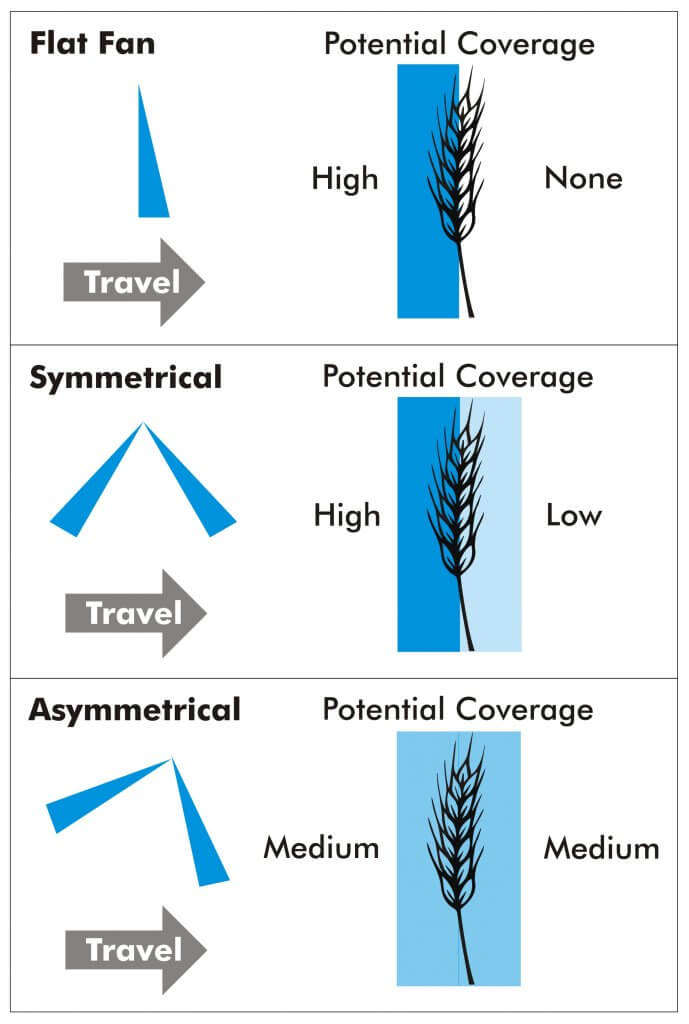
    Well, first, understand they are intended for vertical targets, like wheat heads. Here’s a diagram of how they are (ideally) supposed to work:

    Here’s is the ideal coverage from fan nozzles on a vertical target. Note that high booms, smaller droplet sizes, high travel speeds, high or changeable wind conditions and uneven emergence can negatively affect coverage.

    Here’s our very own Dr. Tom Wolf to tell you all about them.

    Now understand they don’t seem improve matters (at conventional pressures) in broad leaf crops. We compared spray coverage from several nozzles in soybean. The lack of any clear cut winner was disheartening, but even messy results can lead to valuable conclusions! Read more about the experiment here and watch the video below:

    And finally, understand that choosing a brand or variation of a dual fan nozzle arrangement is likely the least important factor. It falls, in our opinion, last in this sequence of factors:

    1. Spray timing (i.e. crop stage, pest stage)
    2. Product choice
    3. Boom height (Keep ’em low)
    4. Droplet size (Keep ’em Coarse or larger)
    5. Spray volume (Go with more gallons per acre, not less)
    6. Style/brand of dual fan nozzle
  • TechTour Live Promo Video

    TechTour Live Promo Video

    In 2018 Tom and I were invited to participate TechTour Live, Real Agriculture’s live educational event spanning four Prairie cities in four days. How do you promote an event when the co-presenters are separated by a province?

    Like this!

    It was a great experience. An educational and entertaining event that led us to propose the Label Summary Sheet initiative.

  • Exploding Sprayer Myths (ep.9): Airblast Air

    Exploding Sprayer Myths (ep.9): Airblast Air

    In this, the season three finale of Exploding Sprayer Myths, we join Jason and the Tom-inator as they “tackle” airblast air settings. There are a whole suite of articles dedicated to this topic, linked below the video. It is, arguably, the most important adjustment you can make to an airblast sprayer.

    Will there be more Exploding Spray Myths episodes? In the words of a great man: “We’ll be back.”

    Special thanks to Don Murdoch and the Simcoe Research Station.