Tag: video

  • Think Before Adding Adjuvants

    Think Before Adding Adjuvants

    It’s odd to begin an article by suggesting the reader consult another, but Dr. Tom Wolf wrote a great summary about adjuvants for SaskPulse in 2023 and you can and should download it here. While I’m at it, also grab this article by Rich Zollinger, Emeritus Extension Weed Scientist, North Dakota State University.

    OK, back to the article at hand. An adjuvant is “any substance in a formulation or added to the spray tank to modify the biological activity or application characteristics”. This means they have an array of functions, such as masking pesticide odor, conditioning carrier water, improving mixing and reducing drift (Utility modifier adjuvants). They can also improve the degree of contact between droplets and the plant surface, or enhance product uptake or rainfastness (Activator adjuvants which include a subset of products referred to as Surfactants [SURFace ACTive agENTS]).

    For example, this short video was filmed in 2015 to demonstrate how a sticker surfactant reduces runoff and how a penetrant surfactant can help a product pass through a waxy plant surface. This video was filmed and edited by former OMAFA summer student, Victoria Radauskas.

    Generally, pesticides already come preformulated with the requisite inerts, which include the utility modifier and activator adjuvants that ensure ease of use and optimal product performance. But sometimes the pesticide label requires the operator to add a particular name brand or category of adjuvant. In this case, the pesticide does not include the adjuvant because it might negatively impact product stability, increase bulk and/or increase expense.

    Canada is seeing an increase in the number of adjuvants for purchase (particularly utility modifiers). Claims of improved performance make it tempting to reflexively and proactively throw them in the mix. The grower is free to use any adjuvant provided it is registered for use on the crop and in combination with the pesticide being applied. You can learn more about the regulatory realities in our tank mix article.

    We suggest that adding any adjuvant is an optional last step in optimizing a sprayer’s performance. Dialing in all other aspects tend to reap the greatest rewards. Here are a few general guidelines when using surfactants in horticultural crops:

    • Do not use penetrant surfactants (including oils) with copper, sulphur or captan fungicides.
    • Do not use penetrant surfactants with contact or surface pesticides.
    • Stickers may impede the movement of systemic products.
    • Stickers may prevent redistribution to newly emerging leaves early in the growing season (but they may be desirable during wet springs).
    • Deposition utility modifiers may negatively affect canopy penetration when employing multi row or alternate row traffic patterns.
    • Spreaders are more likely to incur runoff so adjust volumes accordingly.

    Additional Resources

    The following video presentation was recorded for a 2021 adjuvant conference in Argentina. It’s a primer to introduce what adjuvants are and why we might consider using them. You’ll note that I speak slowly during the presentation – that’s because it was being translated and I wanted to make that process as easy as possible. Also, I think I mistakenly said captan was an insecticide – in fact it’s a fungicide. Oops.

    And here’s a 2022 interview from Real Agriculture’s “The Agronomists” featuring Tom Wolf of Agrimetrix, and Greg Dahl of Winfield United. For the adjuvant-related part of the conversation, you can pan ahead to the six-minute mark.

    And here’s a 2025 interview from Real Agriculture’s “The Agronomists” featuring Jason Deveau and and Austin Anderson of Helena.
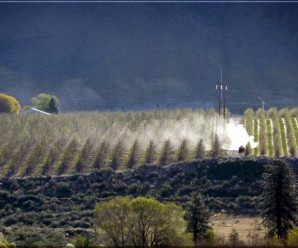
  • Three Manageable Factors that Affect Spray Drift

    Three Manageable Factors that Affect Spray Drift

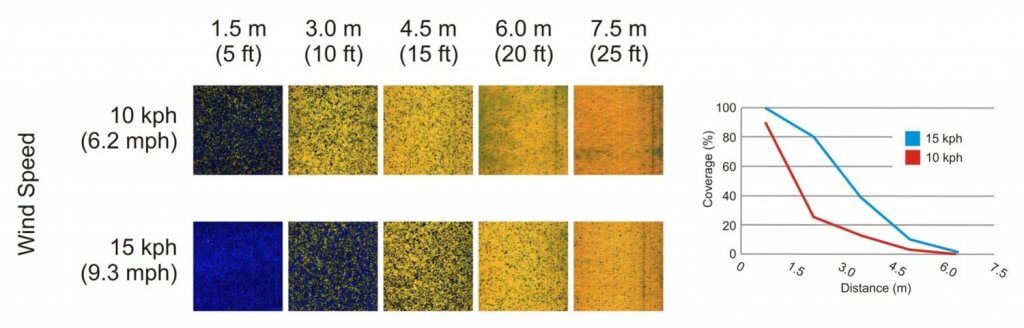
    In 2014 one of our OMAFRA summer students designed a short-and-gritty demonstration using a backpack sprayer, a variable-speed fan and some water-sensitive paper positioned downwind at 1.5 metre intervals. The intent was to illustrate how sprayer operators could reduce the potential for off-target drift by recognizing and accounting for three factors:

    • Apparent wind speed (i.e. the sum of wind speed and travel speed)
    • Boom height (i.e. release height)
    • Droplet size (i.e. nozzle spray quality)

    Apparent Wind Speed

    Spray operators know they should not spray when the air is calm or when the wind is too high, but they often forget that the nozzles experience “apparent wind speed” which means driving 10 km/h into a 10 km/h headwind is essentially spraying in a 20 km/h wind.

    The result of spraying with a Medium spray quality in 10 km/h and 15 km/h wind: water-sensitive papers indicated that there is more downwind drift in higher winds.

    Boom Height

    Spray operators raise their booms to ensure their nozzles clear the crops, but this contributes to off target drift and greatly reduces coverage – particularly when using twin-fan style tips. Dr. Tom Wolf explains how to set your boom height here, or you could watch one of our Exploding Sprayer Myths videos on the subject.

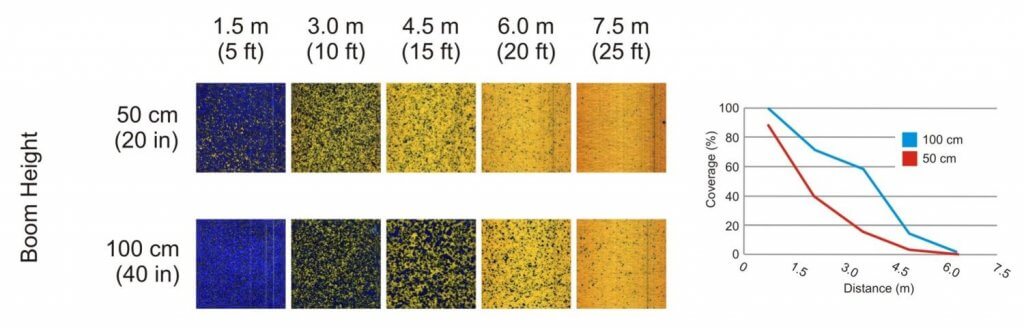
    The result of spraying with a Medium spray quality in a 10 km/h wind at 50 cm and 100 cm from the ground: water-sensitive papers indicated that downwind drift increases as the boom gets higher.

    Droplet Size

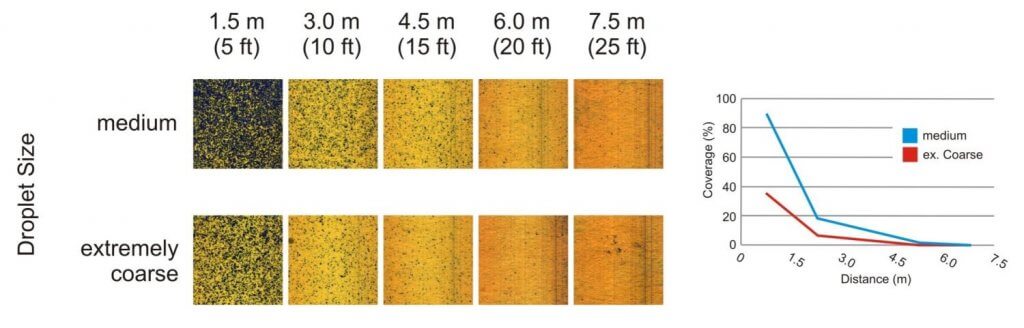
    The coarser the spray quality, the less likely the spray will drift off target. Remember, for a given volume, shifting to larger droplets means fewer droplets. Application volumes may have to increase to compensate for potentially reduced coverage.

    The result of spraying with a Medium spray quality versus spraying with an Extremely Coarse spray quality: water-sensitive papers indicated that there is more downwind drift from smaller droplets.

    Take-Home

    This demo used percent coverage as a metric, which is convenient but greatly underestimates drift. So even when the spray window is small and the spray has to go on, take a moment to drop the boom, use a coarser droplet size and if it’s too windy, just don’t spray.

    WUR Drift Calculator

    There are many drift calculators available for home use. Some require more expertise than others to get a reliable result. This free downloadable calculator from Wageningen University & Research was made available in 2021. It can quantify spray drift deposits onto surface waters and non-target terrestrial areas near a sprayed field or orchard

    The calculator uses statistically obtained regression curves to calculate spray deposition next to the sprayed field. The spray drift curves are based on the latest experimental data for field crops, fruit orchards and avenue tree nurseries.

    Download your copy here.


  • Micron Woman – Guide to the World of Spray Droplets

    Micron Woman – Guide to the World of Spray Droplets

    You just finished a great spray day. Everything felt right! Your timing and product choice were bang-on, the weather was good, and your sprayer was calibrated. But, do you know what happened to the spray once it left the nozzle?

    The behavior of spray droplets, and how they interact with the target, can be tough concepts to teach. Ironically, the big problem is how tiny everything is.

    What if you could see what was happening from the droplet’s perspective?
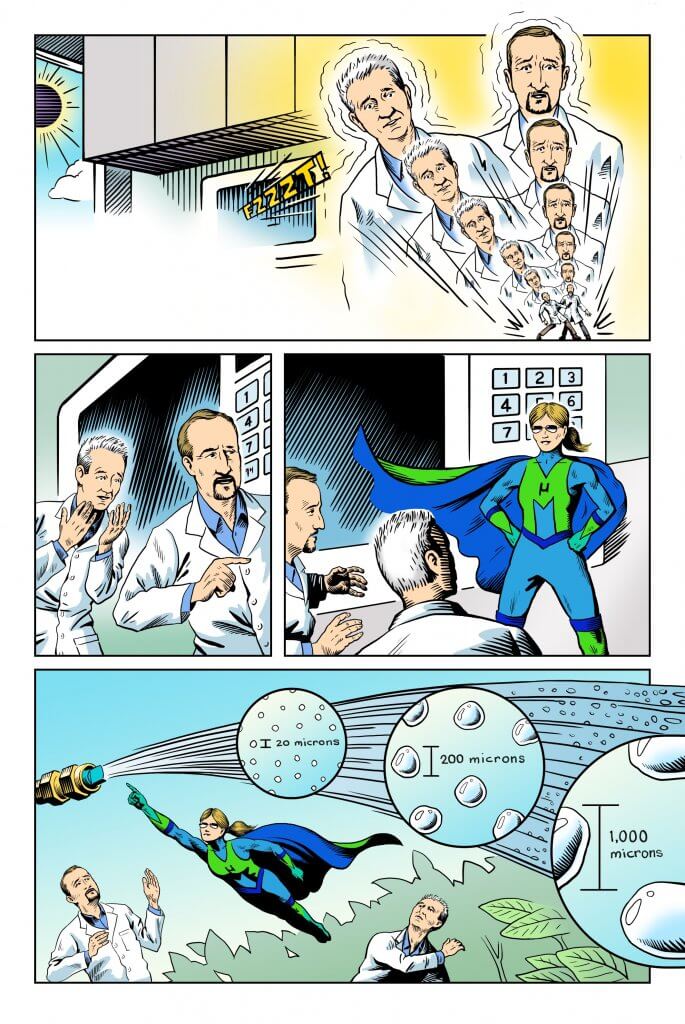
    Join Jason and Tom as a lab accident during a solar eclipse brings them face to face with a mighty new heroine:

    Micron Woman!

    If you enjoyed the video, it’s not over yet! We’ve printed actual comic books as fun and useful resources for anyone that wants a copy. We’ll distribute what we have to interested parties at conferences (just ask!). If you teach adults or children about agriculture, and you’re interested in copies, let us know and we’ll see what we can arrange.

    You can also download the comic book here:

    Thanks to everyone that helped bring Micron Woman to life! Who knows, maybe we’ll meet her arch nemesis in episode II? Write us if this is something you’d like to see!

  • Exploding Sprayer Myths (ep.4): Speed Spraying

    Exploding Sprayer Myths (ep.4): Speed Spraying

    All set for Star Wars VII
    All set for Star Wars VII

    With due respect to Mickey and Mr. Lucas, and the massive hype surrounding Star Wars Episode VII, we felt we should jump on the bandwagon. Here’s episode IV in our series of short, educational and irreverent videos made with Real Agriculture.

    If there’s a single take-home message in this episode it’s this:

    …may the force be with you – always.

  • Exploding Sprayer Myths (ep.11): Drift

    Exploding Sprayer Myths (ep.11): Drift

    This video won the Gold 2019 Canadian Farm Writers Federation’s Jack McPherson Award for Electronic Media. This award is for the best video, news story or feature broadcast by a Canadian medium less than 15 minutes in length on an agricultural topic. We’d like to thank Jason Strove, Bern Tobin and the whole team at RealAgriculture for helping to bring Exploding Sprayer Myths to life.

    Welcome to season four of Exploding Sprayer Myths, featuring a new opening sequence and a special guest star. Have fun accidentally learning about reducing pesticide drift as we poke fun at Canadian and Australian stereotypes. If you’re unfamiliar with the McKenzie Brothers and the Great-White North, then be sure to educate yourself here before you take off, eh?

    Beauty.

    Thanks to Mary O’Brien (@SprayDriftGirl) and the Simcoe Research Station.