Category: Mixing

Articles about mixing and pesticide in horizontal boom sprayers

  • Tank mixing Urease and Nitrification Inhibitors in Corn Weed-and-Feed Applications

    Tank mixing Urease and Nitrification Inhibitors in Corn Weed-and-Feed Applications

    This 2023 article is based on work performed by Mike Schryver, BASF Technical Service Specialist.

    Nitrogen is an essential nutrient required throughout a plant’s lifecycle. It is commonly applied to corn in either a granular form as urea or in a liquid form as urea-ammonium nitrate (UAN). Depending on soil type and precipitation, significant amounts of nitrogen can be lost to leaching, denitrification and volatilization as N2O (a greenhouse gas). Learn more about nitrogen in soil in this excellent overview by University of Minnesota Extension.

    With the 2020 announcement of Canada’s Strengthened Climate Plan, Ontario is committed to a 30% reduction of 2020 N2O emission levels by 2030. Adding urease and nitrification inhibitors (aka stabilizers) to nitrogen fertilizer applications is an environmentally sustainable practice that reduces nitrogen losses and improves yield.

    Another essential plant nutrient, Sulphur, is applied in liquid-form as ammonium thiosulphate (ATS). Primarily used to increase corn yields, high rates (approx. >10% by volume) of ATS can also inhibit urease and nitrification, albeit not as well as other nitrogen stabilizing options.

    In the pursuit of productivity, UAN and ATS are often combined to serve as an herbicide carrier in corn weed-and-feed applications. However, liquid fertilizers are dense solutions that contain charged ions and exhibit a reduced capacity for solubilizing pesticides. This complicates the tank mixing process. When micronutrients like sulfur are added to nitrogen-based formulations, physical incompatibilities can arise that cause uneven applications and can even clog sprayers.

    Given the known compatibility issues, questions have been raised about the best way to introduce urease and nitrification inhibitors to tank mixes of UAN, ATS and herbicide. Specifically:

    1. Stabilizer Compatibility: What is the impact of adding nitrogen stabilizers to UAN carriers containing leading corn herbicides formulated as emulsifiable concentrates (EC) or suspension concentrates (SC)?
    2. Mixing Order: When UAN and ATS are premixed, does their ratio, or the addition of nitrogen stabilizer affect tank mix compatibility with herbicides?

    To answer these questions, we performed a series of jar tests.

    Method

    300 ml jars with magnetic stir bars were mixed to reflect a 10 gpa application. UAN was chilled to approx. -5°C and herbicides were added at 2x the labelled rate to simulate a worse-case scenario. Nitrogen stabilizer was added at a ratio per manufacturer’s instructions. Products were introduced at 1 minute intervals to provide sufficient time for solubilization. Jars were left to rest for at least 1 hour after mixing, and then agitated to simulate interrupted spray jobs. The solution was then poured through a 100 mesh screen to simulate a worst case scenario for sprayers that typical employ 50 mesh filters.

    HerbicidesFertilizer carriersStabilizers
    Leading EC HerbicideUAN: 28%eNtrench NXTGEN (Corteva)
    Leading SC HerbicideATS: 12-0-0-26% SUAnvol (Koch)
    Tribune (Koch)
    Agrotain (Koch)
    Neon Surface (NexusBioAg)
    SylLock plus (Sylvite)
    Excelis Maxx (Timac)
    Table 1 Herbicides, carriers and stabilizers used in the study

    Results

    Stabilizer Compatibility

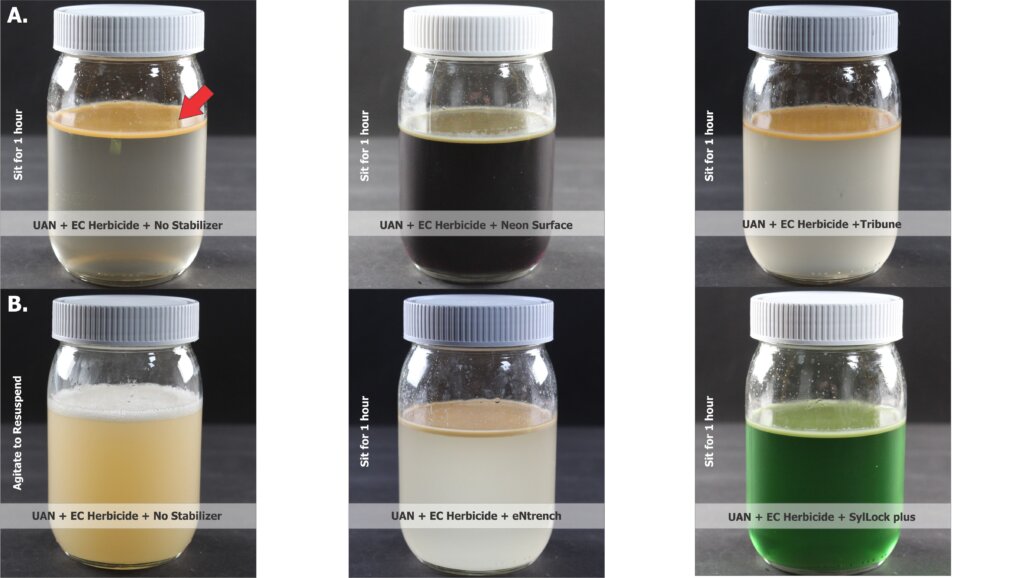
    EC herbicides have active ingredients that are soluble in water and include immiscible solvents. When added at 2x label rate to chilled UAN, followed by a stabilizer, agitation created an acceptable suspension (Figure 1). The EC separated to the top of the mixture following an hour rest but was easily reintegrated. There was no appreciable residue left behind when poured through a 100 mesh screen.

    Figure 1 UAN + EC Herbicide + Stabilizer after 1 hour rest. Image A is a control with no stabilizer and image B is the same control after agitation. The arrow indicates where ECs separate at the top of each jar. All products resuspended with agitation.

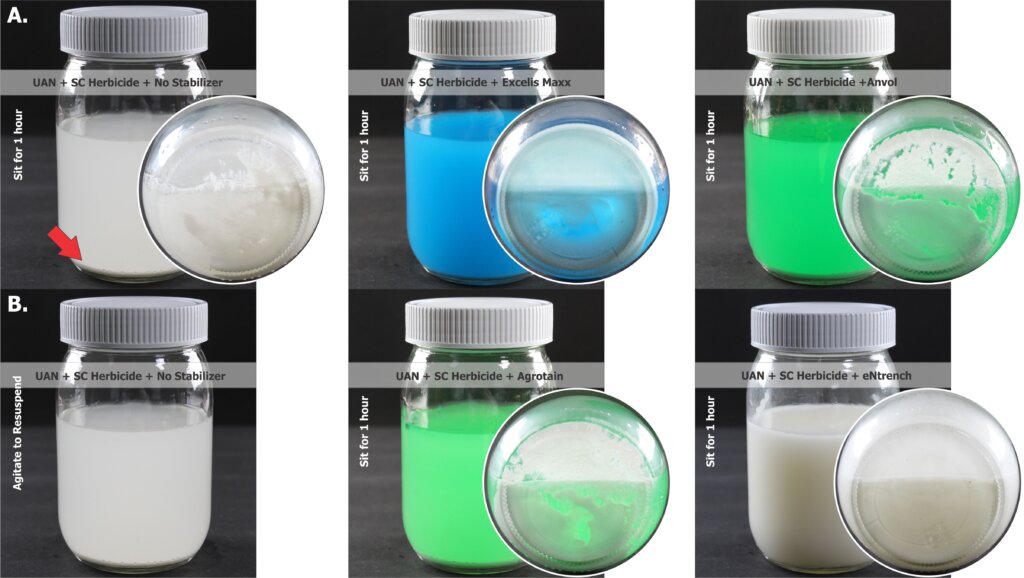
    SC herbicides have active ingredients that are water insoluble, but stable in an aqueous environment. When added at 2x label rate to chilled UAN, followed by a stabilizer, agitation created an acceptable suspension (Figure 2). The SC flocculated and formed a sediment at the bottom of the mixture following an hour rest but was easily reintegrated. There was no appreciable residue left behind when poured through a 100 mesh screen.

    Figure 2 UAN + SC Herbicide + Stabilizer after 1 hour rest. Image A is control with no stabilizer and image B is the same control after agitation. The arrow indicates where SCs settled, as depicted in the inset images showing the bottoms of each jar. All products resuspended with agitation.

    Best Practices

    • Contact manufacturers and conduct a jar test to confirm compatibility
    • Ensure thorough agitation (with or without a stabilizer, and especially after tank has settled)
    • Components may separate to the top (ECs) or settle on the bottom (SCs)

    Mixing Order

    Mixing order was tested using chilled UAN, ATS, and EC herbicide. It is well known that ATS should be added last in the tank mix order, and mixes that include a higher load of ATS relative to UAN exacerbate tank mix issues.

    This is seen in the following video where we combine 203 ml of chilled UAN, 30 ml of SC corn herbicide and 68 ml of ATS. On the left, UAN, then herbicide, then ATS mixes perfectly. However, when we start with UAN, then add ATS (which represents premixed fertilizer) then the herbicide does not suspend, and prolonged agitation does not improve the situation. The video is shown at 2x speed.

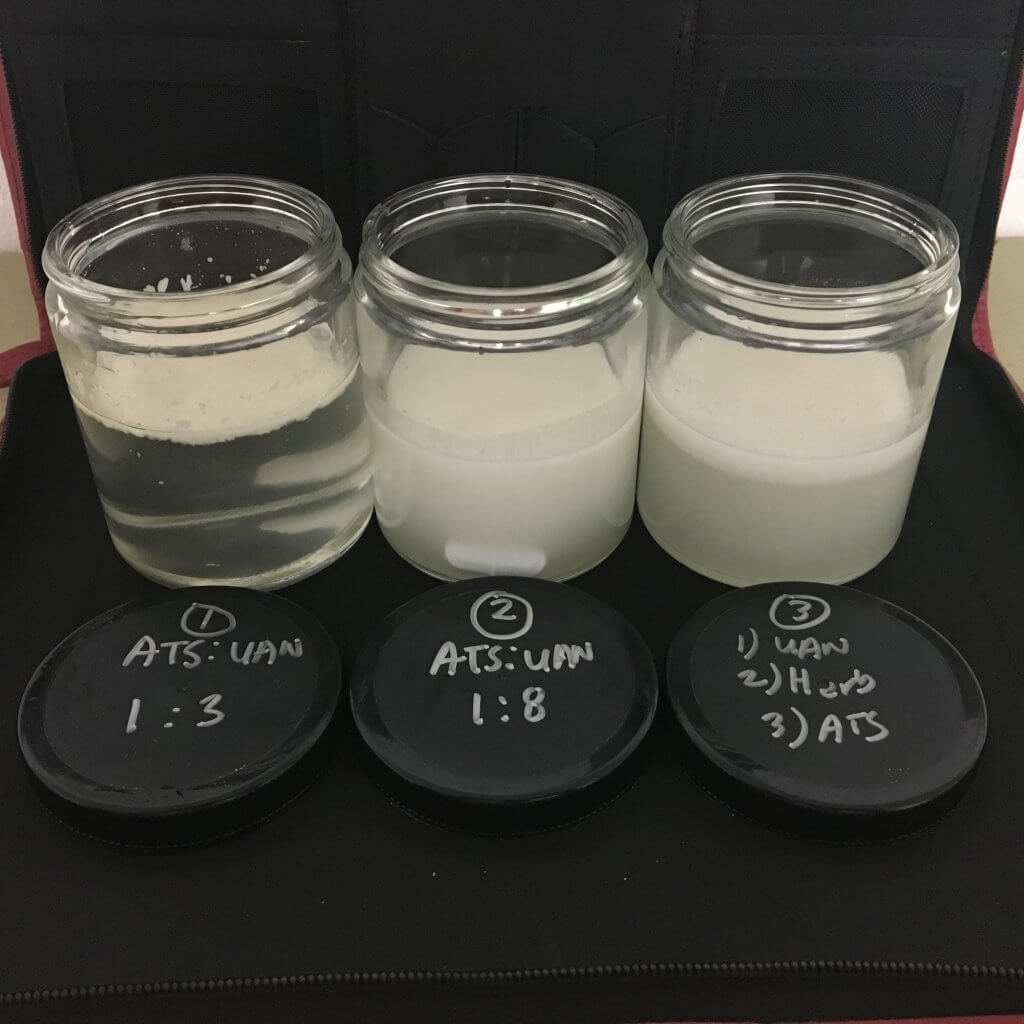
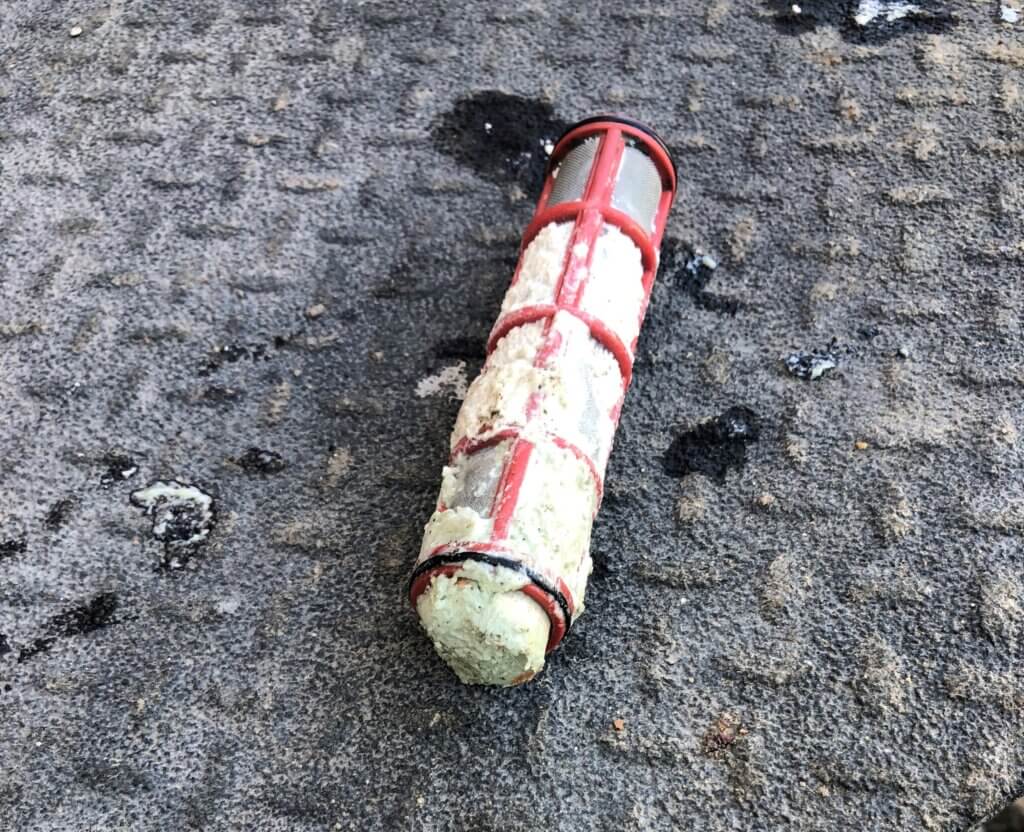
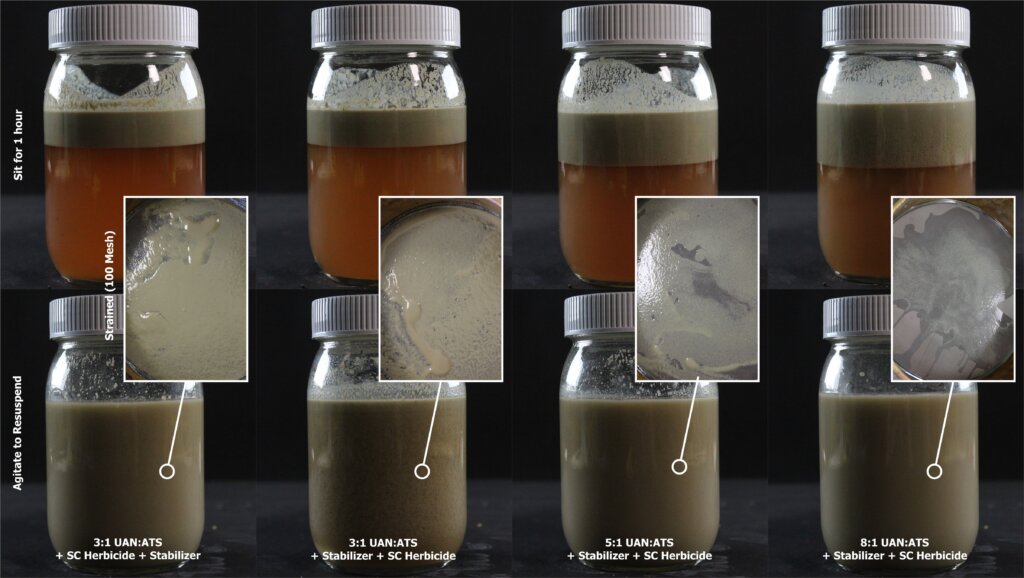
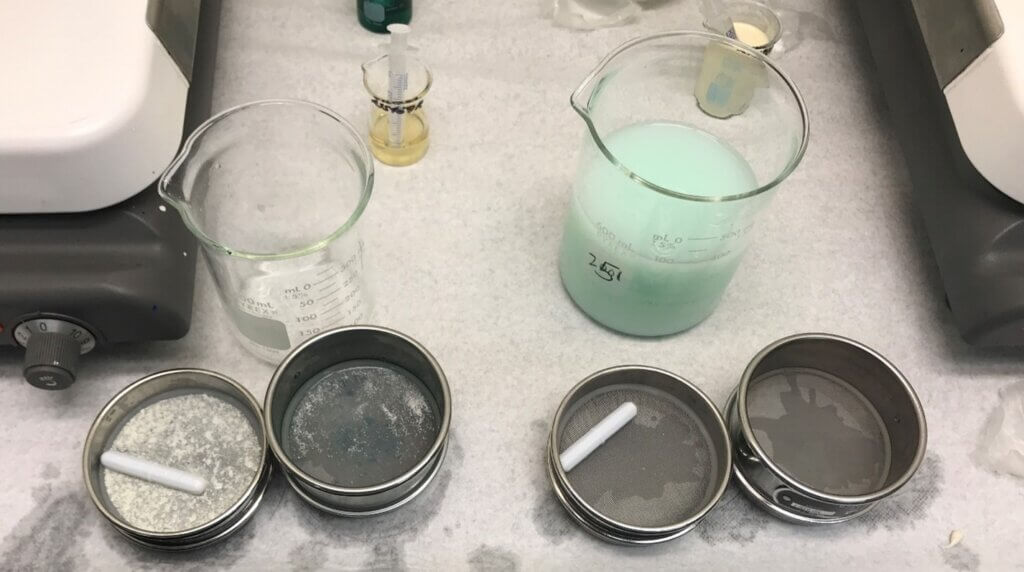
    We then added a nitrogen stabilizer to the series to see if it could correct the tank mix issue arising from adding ATS immediately after UAN. This replicates the situation an operator would face when purchasing UAN and ATS premixed. We also reduced the ratio of UAN to ATS from 3:1, to 5:1 to 8:1 to establish a threshold ratio that alleviated tank mix issues (Figure 3). All solutions were poured through 100 mesh screens to capture residue (Figure 4).

    Figure 3 SC Herbicide and stabilizer added to UAN and ATS premixed at different ratios. Agitated after 1 hour and poured through 100 mesh screens (inset images).
    Figure 4 Pouring EC jar test solutions through 100 mesh screens

    Best Practices

    • Contact manufacturers and conduct a jar test to confirm compatibility
    • ATS must be added after the herbicide (EC or SC). The stabilizer can be added last, but preferably ATS is the last ingredient in the tank.
    • Adding stabilizer will not reverse a tank mix error arising from adding ATS prior to the herbicide.
    • The higher the concentration of ATS, the higher the risk of incompatibility. A 5:1 ratio of UAN to ATS failed while a ratio of 8:1 succeeded. The threshold is likely 7:1.
  • Spray Water pH

    Spray Water pH

    The scuttlebut on coffee row is that acidifying a spray mixture improves its efficacy. There are also claims that pesticides break down in the sprayer tank if the pH is too high.

    But it’s not that simple. Low pH has a strong impact on pesticide solubility, and that means mixing and cleanout are affected. Acidifying the mixture can have profound negative effects for many products.

    It’s important to know what you’re doing.

    What is pH?

    pH is defined as the negative log of the molar concentration of hydrogen ions in a water-based solution. The more abundant the hydrogen, the lower the pH. It’s a log scale, so every unit of pH refers to a 10-fold change in the concentration of hydrogen ions.

    Both very low (acidic) or very high (basic) pH can be caustic. But having a low or high pH doesn’t mean it will burn your skin or clothes right away, it might just be a bit unpleasant. But at the extreme ends, protection is needed.

    Why is pH Important in Spray Mixtures?

    In spraying, the main effect of pH is on the pesticide’s solubility. Solubility matters when mixing and becomes important during cleanout as well.

    A minor effect on pH, at least for herbicides, is on chemical breakdown, usually through hydrolysis, when the pH is too high. The effect on breakdown is rarely meaningful during any given spray day, but may play a role if a spray mix is stored overnight or longer.

    The Basics: Strong vs Weak Acids

    Strong acids like hydrochloric acid (HCl) ionize completely in solution. When added to water, only H+ and Cl are present, there is no HCl. The water’s pH does not affect solubility of a strong acid.

    But weak acids do not completely ionize. The water pH affects the degree of ionization and therefore solubility.

    Most herbicides are weak acids. A weak acid is one that does not dissociate completely in solution. A typical example of a weak acid functional group is carboxylic acid (-COOH). In solution, compounds with a carboxylic moiety exist in an equilibrium, with some as -COOH (containing the hydrogen, also called “protonated”) and others as -COO and H+. In the dissociated form, the acid is more water soluble than in its protonated form due to the negative charge that makes it ionic.

    Weak acids have a dissociation constant known as the pKa. When the solution is at the molecule’s pKa, the acid is 50% dissociated. When the solution has a lower pH than the pKa, there is less dissociation and the protonated forms of the molecule dominate. That has two important implications for herbicides.

    • the molecule becomes less water-soluble at lower pH
    • the molecule has fewer opportunities to interact with positively charged items

     pH Dependent Solubility

    Water-solubility is a two-edged sword. On the one hand, having a highly water soluble product makes it easier to dissolve in water. This pays dividends when mixing a batch or cleaning a sprayer because a product formulated as a solution will easily go into a true solution and will stay mixed. Examples are glyphosate, glufosinate, and salts of 2,4-D, MCPA, and dicamba.

    On the other hand, most pesticides need to enter a plant to reach their site of action. And a plant cell, with its waxy cuticle and oily membranes, creates an effective barrier for water, and for water-loving molecules dissolved in it. As a result, a formulation that allows the water-soluble product to interact with an oily barrier is needed.

    The products that can do this are surfactants. Acting like detergents, surfactants have regions in their structure that are oil-loving (lipophilic) and other regions that are water-loving (hydrophilic). Surfactants can therefore bind to both oil and water and provide a bridge for water-soluble products across oily barriers.

    That’s also one of the reason that the most water-soluble products such as glyphosate and glufosinate contain a lot of surfactants in their formulation, reducing the concentration of active ingredient in the jug and possibly leading to foaming with agitation.

    Pesticides have a wide range of solubilities, and for some, water pH will play an important role. Below is a table of some water solubilities of selected herbicides.

             Solubility (ppm)
    Trade NameActive IngredientMode of Action GrouppH ~ 5pH ~ 7pH ~ 9
    Selectclethodim1535,45058,900
    Ally 2metsulfuron25502,800313,000
    Expresstribenuron2482,04018,300
    Pinnaclethifensulfuron22232,2408,830
    Everestflucarbazone244,00044,00044,000
    Simplicitypyroxsulam21632,00013,700
    Frontlineflorasulam20.1694
    Varrothiencarbazone2172436417
    Raptorimazamox2116,000 >626,000>628,000
    Pursuitimazethapyr22,570 12,8707,500
    2,4-D2,4-D salt429,93444,55843,134
    dicambadicamba salt4>250,000>250,000>250,000
    Roundupglyphosate9>500,000>500,000>500,000
    Libertyglufosinate10>500,000>500,000>500,000
    Heatsaflufenacil14302,100 >5000
    Distinctdiflufenzopyr19635,90010,550
    Infinitypyrasulfatole274,20069,10049,000

    Compare the solubility at pH 7 to that at pH 5. For most of these herbicides, water solubility is worse at lower pH. That is because they are more protonated and become more lipophilic.

    I’ve placed a lot of Group 2 products in this table because those products are most often implicated in tank cleanout issues. All Group 2 products in this table, with the exception of Everest (flucarbazone-sodium) have lower solubility at pH 5 than they do at pH 7. For some, like pyroxsulam and floarsulam, it’s a big change. Those products, when acifified, are prime candidates for poor mixability and poor cleanout.

    When it comes to dicamba, low pH has another side-effect. It makes the molecule more volatile, increasing danger to sensitive plants nearby. For that reason, acidification of dicamba in its Xtendimax and Engenia formulations is not permitted.

    Note that the Group 4 examples, 2,4-D salt and dicamba salt, as well as glyphosate and glufosinate, are highly water-soluble and pH has very little effect on that.

    Particularly for glyphosate, the claim that it becomes more oily at low pH and will therefore be taken up more easily, is not supported by these data. Considering that the most acidic pKa for glyphosate (it has four acidic groups) is 0.8, pH would need to be much lower for any noticeable impact on oilyness.

    Tank Mixability

    Given today’s environment of herbicide resistance, applications with multiple mode of action tank mixes are very common. Acidifying a spray mix to benefit one herbicide may create problems for its tank mix partners.

    If there is a concern that spray water is too alkaline, it is recommended that the pH of the finished spray mix be measured. Since many herbicides are weak acids, they will lower the pH of the mixture by themselves. For example, the addition of glyphosate to water with pH 7.5 will drop the pH to about 5 or so, depending on the water’s buffering capacity.

    As a result, glyphosate tank mix partners that are pH sensitive may suffer in the presence of glyphosate, and pH may actually need to be raised.

    pH Dependent Half-life

    Herbicides

    There are a lot of claims that pesticides break down rapidly in alkaline spray water. And yet, in my career working primarily with herbicides, I do not recall this ever being a problem in practice.

    Below is a table of herbicides for which I could find half-life information, with the help of this comprehensive list produced by Michigan State University.

    ProductActive ingredientHalf Life
    AtrazineatrazineMore stable at high pH
    BanveldicambaStable at pH 5 – 6
    BromoxynilbromoxynilpH 5 = 34 d; pH 9 = 1.7 d
    Fusiladefluazifop-p-butylpH 4.5 = 455 d; pH 9 = 17 d
    Libertyglufosinate-ammoniumStable over wide range of pH
    GramoxoneparaquatNot stable at pH above 7
    ReglonediquatpH 5 = 178 d; pH 7 = 158 d; pH 9 = 34 d
    MCPAMCPApH 9 = < 5 days
    PoastsethoxydimStable at pH 4.0 to 10
    PrincepsimazinepH 4.5 = 20 d; pH 5 = 96 d; pH 9 = 24 d
    ProwlpendimethalinStable over a wide range of pH values
    RoundupglyphosateStable over a wide range of pH values
    TreflantriflularinStable over a wide range of pH values
    2,4-D2,4-DStable at pH 4.5 to 7

    Note that all of the herbicides are relatively stable. Some are a bit less stable at high pH, but none of the listed herbicides is in danger of breaking down on the day it is being applied. Only one is actually unstable at high pH – paraquat, a herbicide no longer registered in Canada and resticted in many other countries. Those with short half-lives experience them at quite high pH which are rarely seen in practice.

    Insecticides

    Insecticides are a different story. Several are very sensitive to pH. This table is again adapted from a comprehensive list published by Michigan State University, here.

    Trade NameActive IngredientHalf-life
    AdmireImidaclopridGreater than 31 days at pH 5 – 9
    Agri-MekAvermectinStable at pH 5 – 9
    AmbushPermethrinStable at pH 6 – 8
    AssailacetamipridUnstable at pH below 4 and above 7
    AvauntindoxacarbStable for 3 days at pH 5 – 10
    Cygon/LagondimethoatepH 4 = 20 hrs; pH 6 = 12 hrs; pH 9 = 48 min
    CymbushcypermethrinpH 9 = 39 hours
    DiazinonphosphorothioatepH 5 = 2 wks; pH 7 = 10 wks; pH 8 = 3 wks; pH 9 = 29 days
    Dipel/Forayb. thuringiensisUnstable at pH above 8
    DyloxtrichlorfonpH 6 = 3.7 days; pH 7 = 6.5 hrs; pH 8 = 63 min
    Endosulfanendosulfan70% loss after 7 days at pH 7.3 – 8
    FuradancarbofuranpH 6 = 8 days; pH 9 = 78 hrs
    Guthionazinphos-methylpH 5 = 17 days; pH 7 = 10 days; pH 9 = 12 hrs
    KelthanedicofolpH 5 = 20 days; pH 7 = 5 days; pH 9 = 1hr
    LannatemethomylStable at pH below 7
    LorsbanchlorpyrifospH 5 = 63 days; pH 7 = 35 days; pH 8 = 1.5 days
    Malathiondimethyl dithiophosphatepH 6 = 8 days; pH 7 = 3 days; pH 8 = 19 hrs; pH 9 = 5 hrs
    Matadorlambda-cyhalothrinStable at pH 5 – 9
    Mavriktau-fluvalinatepH 6 = 30 days; pH 9 = 1 – 2 days
    MitacamitrazpH 5 = 35 hrs; pH 7 = 15 hrs; pH 9 = 1.5 hrs
    OmitepropargiteEffectiveness reduced at pH above 7
    OrtheneacephatepH 5 = 55 days; pH 7 = 17 days; pH 9 = 3 days
    PouncepermethrinpH 5.7 to 7.7 is optimal
    PyramitepyridabenStable at pH 4 – 9
    Sevin XLRcarbarylpH 6 = 100 days; pH 7 = 24 days; pH 8 = 2.5 days; pH 9 = 1 day  
    SpinTorspinosadStable at pH 5 – 7; pH 9 = 200 days
    Thiodanendosulfan70% loss after 7 days at pH 7.3 to 8
    ZolonephosaloneStable at pH 5 – 7; pH 9 = 9 days

    Among insecticides, dimethoate, amitraz, and malathion stand out as breaking down rapidly in alkaline water. For these products in particular, it may be important to acifify the spray mix if there is any delay in spraying.

    Recommendations

    I’ve never been a fan of messing with solution pH unless recommended on the product label. Even when there is evidence that lower pH improves efficacy, consider the impact on tank mix partners.

    We’ve seen improvements in solubility and tank cleranout of Group 2 products with raised pH, and ammonia is the most cost-effective way to achieve that. But again, following label recommendations is strongly recommended. The consequences of changes in pH, particularly acifification, can be very detrimental. To be safe, consider doing a jar test before committing to a whole tank to a pH adjustment.

  • How to Interpret a Water Quality Test Result

    How to Interpret a Water Quality Test Result

    It’s common advice: Test your water before using it as a spray carrier. You dutifully sample the well or dugout and await lab results. And what comes back is a whole lot of numbers. How to make sense of it all?

    Three examples of water test results conducted by labs in Canada

    All three of these tests report a large number of properties and identify specific minerals and other solutes. Which ones are important in spraying? Here is the order in which I look at the numbers.

    Conductivity: This property is usually expressed as micro Siemens per cm (µS/cm) and simply identifies how many ionic solutes are in a sample (watch for alternate units such as mS/cm and convert if necessary). It doesn’t differentiate between any minerals or other molecules, and therefore has limited information. But it does tell us if there is a large or small issue with water quality. If conductivity is below 500 µS/cm, the water is probably good for spraying. If the value is around 1000 to 2000, further investigation is necessary. Some water samples return conductivity of more than 10,000 µS/cm, and it’s important to identify which salts are causing that problem.

    Note that Total Dissolved Solids (TDS) are often listed, and these are related to conductivity. A common way to get TDS is to multiply conductivity by 0.65. The conversion factor depends on which salts are dissolved but the bottom line is that TDS and conductivity are closely related.

    Bicarbonate: Bicarbonates are HCO3 and their concentration is measured in milligrams per Litre (mg/L), which is the same as parts per million (ppm). Bicarbonates can antagonize Group 1 modes of action and the common threshold is 500 ppm. Research at NDSU has shown that Urea -Ammonium-Nitrate (UAN or 28-0-0 liquid fertilizer) can reduce bicarbonate antagonism in some Group 1 herbicides.

    Bicarbonates are negatively charged and are associated with a positive ion, often the hard water cations sodium (Na), calcium (Ca) or magnesium (Mg). As such, waters that are high in bicarbonates are often also hard.

    Total Hardness (calculated): This is one of the important parameters. Hardness antagonizes most weak acid herbicides, most importantly glyphosate and g;ufosinate, and also ties up surfactants and emulsifiers which can result in problems with mixing and compatibility. Hardness is caused by metal cations, in order of strength these are iron (Fe++), magnesium (Mg++), calcium (Ca++), sodium (Na+), and potassium (K+). Of these, Mg and Ca are typically most abundant, although some water is high in Na.

    The Total Hardness (ppm) reported in water tests is done by taking the most common two cations, calcium and magnesium, and using this formula: 2.497*Ca + 4.118*Mg. Note that some tests report hardness in Grains per Gallon, in this case, multiply grains by 17.1 to get ppm.

    While this calculation usually gives an accurate prediction of hardness, you may need to have a look at iron and sodium as well. Iron is less common, but some well waters are high in sodium or potassium. These minerals are not captured in the Total Hardness measurement. A water test low in Total Hardness may still be high in sodium, these are typically the samples with high conductivity.

    The threshold for Total Hardness depends on the herbicide, its rate, and the water volume. The most common quoted values are 350 ppm for the lower rates of glyphosate (1/2 L/acre equivalent), and 700 ppm for the higher rates. Lower water volumes increase the concentration of herbicide, and reduce the impact of water hardness or bicabonates.

    pH: This parameter is a bit over-rated because it is later affected by the herbicide and adjuvant dissolved in it. There is usually no concern with pH between 6 and 8, and water is rarely outside this range. It is best not to change the pH of water unless it is required on the label for mixing, because some products require low, and others require high pH for optimum solubility. Compatibility is an ever greater concern as our tank mix complexity increases.

    Water Conditioners

    The most common water conditioner is ammonium sulphate [AMS, (NH4)2 SO4]. In its pure form (21-0-0-24), a concentration of 1% to 2% w/v (8 to 17 lbs AMS/100 US gallons of spray water) solves most hard water and bicarbonate issues. Be cautious of using too much AMS (>3%), when added at high concentrations to some herbicides it can burn crops.

    Research has shown that AMS works in two ways: The sulphate ion binds with hard water cations, forming an insoluble precipitate that prevents the antagonistic cations from binding to, and inhibiting, the herbicide. The ammonium ion has been shown to improve cellular uptake by weak ion herbicides.

    Some product labels call for UAN as an adjuvant. UAN contributes ammonium, but not sulphate ions. As a result, while it may improve herbicide performance, it does not remove antagonizing cations from the mixture.

    Acids have been used to combat hard water. Most common herbicides are weak acids, and the acid constituent, usually a carboxilic acid, has a unique pKa. The pKa is the pH at which half the molecules are protonated (contain a hydrogen atom, resulting in an uncharged acid constituent) and the other half are not protonated (negatively charged). If the spray mixture has a pH below the pKa, the weak acid herbicides become protonated. This means the herbicide becomes less water-soluble, but also that it has less chance of interacting with a hard water cation. Acids that work in this way are less effective at ameliorating the effect of hard water than AMS.

    A small group of acids that includes citric acid and sufphuric acid can sequester or bind with hard water cations. But they do not contribute the ammonium ion that assists in weak acid herbicide uptake.

    If your water is questionable for spraying, there are four common choices:

    • Select a different well or dugout
    • If the problem is barbonates or hardness, treat water with a conditioner such as Ammonium Sulphate (AMS), available in pure form as 21-0-0-24. Some acids (citric, sulfuric) can form conjugate bases with hard water cations, removing them from solution. But the associated significant lowering of pH should be treated with an abundance of caution as it may affect solubility of some pesticides.
    • Reduce water volumes or increase herbicide rates.
    • Use a municipal treated water source or invest in a reverse-osmosis (RO) system. RO is neither cheap nor fast and requires additional investment in storage, and a way to deal with solute-enriched waste water. But it may be the best option for some.

    An Ammonium Sulphate calculator, originally developed by Winfield United using data from NDSU, can be downloaded here:

    An excellent resource for adjuvant and water quality topics is this addendum in the North Dakota State University Guide to Weed Control.

    Using good quality water lowers the likelihood of problems with mixing and overall performance and that pays significant dividends later.

  • Circulating Spray Mix Through a Tank-Rinse Nozzle Maintains Nematode Concentration

    Circulating Spray Mix Through a Tank-Rinse Nozzle Maintains Nematode Concentration

    This article was co-written with Jennifer Llewellyn, former OMAFA Nursery Crop Specialist

    With more and more bio-rational products on the market, crop protection methods may require reassessment. Certain products require exacting water quality, cannot tolerate residues, and have half-lives that are both time- and temperature-critical. We’ve been getting questions about sprayer compatibility with some of these new products, so it seemed like a good opportunity to recycle this article from 2013.

    Many horticultural commodities, such as turfgrass and nursery crops, include the application of live nematodes as part of their annual IPM program. We performed preliminary research into the claim that a grower’s nematode applications were becoming less effective. In the course of the investigation it was discovered that the nematode concentration (i.e. dose) sampled from the spray nozzle was diminishing over the course of the application.

    (A) Tank-rinse assembly mounted through tank lid with a flow-regulating valve. (B) Close up of tank-rinse nozzle.
    (A) Tank-rinse assembly mounted through tank lid with a flow-regulating valve. (B) Close up of tank-rinse nozzle.

    After eliminating potential sinks in the sprayer’s plumbing (e.g. filters, strainers, etc.) it was hypothesized that the nematodes were adhering to the interior of the poly tank. If this was the case, the concentration would drop as the level of spray mix dropped. To test the hypothesis, we installed a tank-rinse nozzle to sparge the inner walls of the tank throughout the application and to re-suspend any stranded nematodes.

    A high capacity roller pump (Pentair series 1700C) was installed to operate the tank-rinse nozzle (Pentair Proclean Tankwash) during spraying. It was installed through a bulkhead fitting in the tank fill lid. During testing it was discovered that the tank-rinse nozzle shunted too much flow and pressure to maintain flow to the spray gun. A valve was installed behind the tank-rinse nozzle to restrict flow to the point where it gently rinsed the inner walls of the tank, restoring flow and pressure to the spray gun.

    (A) Installing a high-capacity roller pump. (B) Tank-rinse nozzle, with valve, installed through tank lid. (C) Control manifold installed to plumb the return, the tank-rinse nozzle, spray gun and boom. (D) The entire installed system.
    (A) Installing a high-capacity roller pump. (B) Tank-rinse nozzle, with valve, installed through tank lid. (C) Control manifold installed to plumb the return, the tank-rinse nozzle, spray gun and boom. (D) The entire installed system.
    (A) Nematodes, as-shipped, in a sponge. (B) Suspending nematodes for tank mixing.  (C) Counting nematodes. (D) Undiluted, healthy nematodes in a stock solution via microscope ocular.
    (A) Nematodes, as-shipped, in a sponge. (B) Suspending nematodes for tank mixing.
    (C) Counting nematodes. (D) Undiluted, healthy nematodes in a stock solution via microscope ocular.

    The 200 L tank was inoculated with a stock solution containing 25 million nematodes (125 nematodes / ml). 20 L of the spray solution was sprayed into a bucket every 10 minutes, whereupon 1 L of spray solution was immediately removed and 1 ml volumes were sub-sampled for counting.

    In the first trial, nematode counts continued over a period of 2 hours and viability dropped by ~40%. It was assumed the damage was caused by prolonged circulation through the roller pump. In subsequent trials, the sampling duration reduced to 10 minutes (more realistically reflecting the time it took the grower to apply 200 L in the field). The tank was rinsed and re-inoculated for each trial. 1 ml samples were drawn from the spray gun, which operated continuously, with and without the tank rinse nozzle in operation.

    Univariate analysis confirmed data normality and a GLM procedure was conducted for analysis of variance. Results indicate that nematode concentration dropped by ~15% without tank-rinse with minimal nematode damage observed. With the tank-rinse nozzle engaged, the concentration still declined slightly, but significantly less (<5%) (see graph below).

    Nematode concentration over time for each condition.
    Nematode concentration over time for each condition.

    The results suggest that a tank-rinse system that sparges the tank walls preserves nematode concentration throughout an application and may lead to more efficacious applications.

    Horticultural Crops Ontario, Ground Covers Unlimited, Pentair (Hypro) and Nemapro are gratefully acknowledged for making this research possible.

  • The Real Story behind pH and Water Hardness

    The Real Story behind pH and Water Hardness

    Editor’s Note: Changes and updates have been made to this article since its original publication in 2019.

    The quality of water being used in the spray tank to act as the carrier for your pesticides can have significant effects on how well those pesticides will work. So it may be surprising that very few growers have had their water quality tested.

    Obviously, water that contains suspended materials such as clay, algae and other debris will block filters and possibly nozzles, making spraying very frustrating. However, there are a range of water quality variables unseen to the naked eye that can also affect pesticide performance. The two that cause the most confusion are water hardness and pH.

    Water Testing

    Knowing the quality of the water you are using is essential for effective pesticide application. Water should be initially tested by a qualified laboratory to establish an accurate baseline for your water quality. Check with your pesticide dealer or look for accredited laboratories near you.

    It is important to remember that water quality can vary over time depending on its source. Scheme or town water quality tends to vary very little, however water from surface sources such as dams, tanks and rivers will vary depending on rainfall and other factors. Groundwater can also vary over time depending on how much is being pumped and the recharge rates of the aquifer.

    At minimum, water should be tested for:

    • total hardness
    • bicarbonate (HCO)
    • salinity (electrical conductivity) or total dissolved salts (TDS)
    • pH

    Test strips can be used to quickly check water quality before and after addition of pesticides and monitor changes in water quality between laboratory tests. High-quality test strips can be purchased online from companies such as Hach. Water testing for swimming pools will not be as accurate as those from a scientific supply company. No mater the course of the paper strips, they may be hard to read when used in solutions already containing product. Alternately, and preferably, hand-held meters can be used as long as they receive regular calibration to maintain accuracy.

    Water Hardness

    Water that is considered “hard” has high levels of calcium, magnesium or bicarbonate ions. Calcium and magnesium ions have positive electrical charges that enable them to bind with negatively charged products such as weak-acid herbicides, making them less soluble. Extreme cases can lead to the herbicides settling out in the spray tank, or more commonly (and insidiously) reducing the ability of the active ingredient to be absorbed through the plant leaf. Examples of weak acid herbicides include glyphosate and amine formulations of 2,4-D, MCPA, clopyralid and diflufenican.

    It can depend on your region, but generally a water hardness above 250 to 350 parts per million (ppm) (calcium carbonate – CaCO3 equivalents) should be treated before adding weak acid herbicides.

    The cations that can cause the most trouble for pesticides include:

    • aluminum (Al3+)
    • iron (Fe3+, Fe2+)
    • magnesium (Mg2+)
    • calcium (Ca2+)
    • sodium (Na+)

    Magnesium and calcium are the most common cationic culprits of water quality problems. Aluminum can sometimes be a problem if alum (potassium or aluminum sulphate) has been used to remove (i.e. flocculate / settle-out) suspended particles such as clay from the spray water.

    Bicarbonates

    Bicarbonates can also affect herbicides such as Group 1 ‘dims’ (e.g. clethodim) and 2,4-D amine at levels greater than 500 ppm. Bicarbonates are not typically detected by standard water hardness tests and may have to be analyzed in a separate test. Be suspicious if your groundwater comes from an area with lots of limestone.

    pH

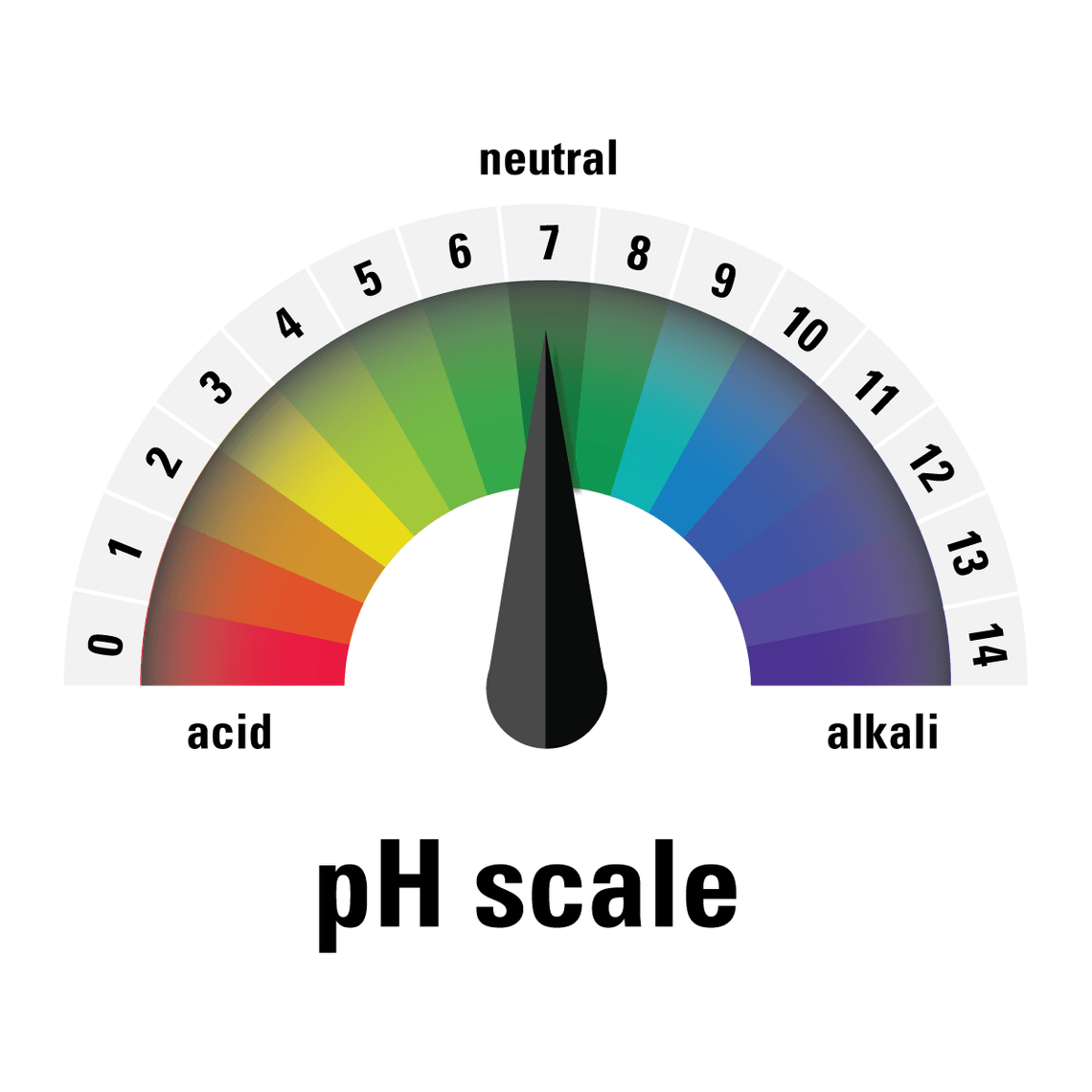
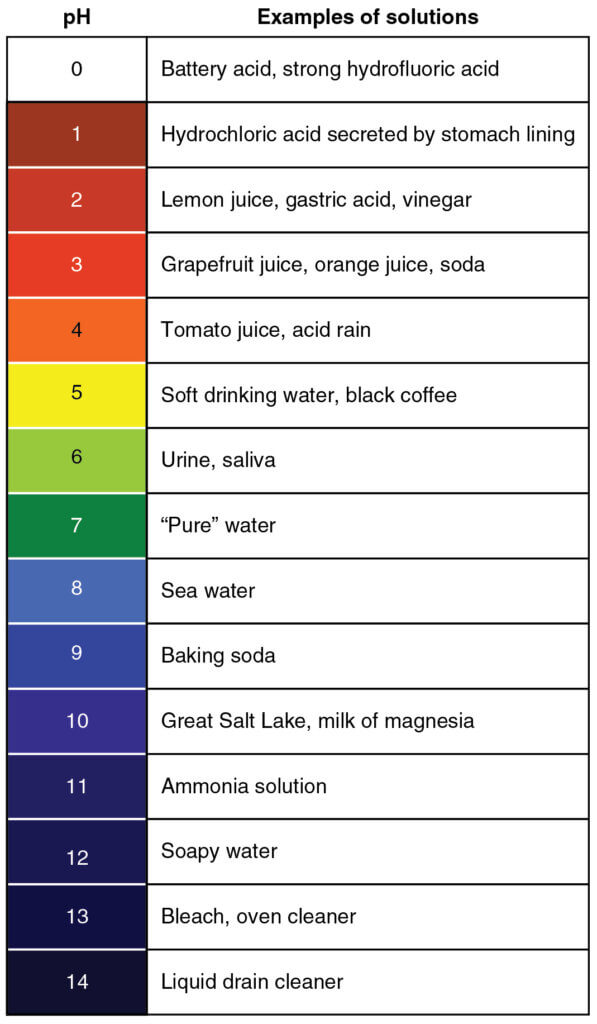
    The pH of a liquid is represented on a scale of 0 to 14, and it describes how acidic or alkaline it is, respectively. A neutral pH is about 7 whereas a pH of 2 is very acidic and a pH of 14 is very alkaline. It is important to remember that the pH scale is logarithmic, not linear. This means that a value of 6 is 10x more acidic than a pH of 7, while a pH of 8 is 10x more alkaline than 7 and 100x more alkaline than 6.

    The following table gives the pH of common materials to give a sense of perspective.

    pHSubstance
    14Sodium hydroxide (caustic soda)
    12.6Sodium hypochlorite (bleach)
    11.5Ammonia
    10.2Magnesium hydroxide (antacids)
    9.3Sodium borate (borax)
    8.4Sodium bicarbonate (baking soda)
    8.1Sea water
    7.4Human blood
    7.0De-ionised water
    6.8Tea
    6.7Milk
    6.0Rain water
    4.5Tomatoes
    4.2Orange juice
    4.0Wine & Beer
    2.8Vinegar
    2.2Lemon juice
    2.0Stomach acid
    1.0Battery acid
    0.0Hydrochloric acid

    Excessive Alkalinity

    Most recognize that a pH above 8 will reduce the effective life of certain pesticides, such as organophosphate insecticides (if you’re still allowed to spray them where you are). In certain situations, water above pH 8 can change herbicide solubility (poor mixing), reduce product stability (reduced half-life) and negatively affect droplet interaction with the leaf surface. However, the effect of high pH on herbicides is largely overstated.

    Excessive Acidity

    Glyphosate has been found to work slightly better in moderately-acidic solutions. This effect is from the precipitation of calcium compounds in the tank, preventing the formation of calcium glyphosate on the leaf surface. Excessively acidic water (pH < 5) can affect the stability of mixes (see the following image) and leads to gelling of salt-based products. It has also been found to increase the volatility of herbicides such as dicamba (this is discussed later in the article).

    This grower was told to drop the pH of his spray. He added citric acid and added another three products. Source: R. Buttimor

    Do I need to adjust the pH of my water?

    There are many half-truths in the marketplace about the effect of pH on pesticides. But generally:

    If the pH of the water in the spray tank is between pH 6 and 8, it’s is suitable for spraying.

    Something that is rarely discussed is that the addition of the pesticide will modify the pH of the solution. Therefore, each pesticide user needs to test the water before the addition of pesticides and then check the pH after the addition of the pesticide. They will be very different.

    The addition of glyphosate to the spray solution will drop the pH of the spray mix from 8 to less than 5. In the following figure the test strip on the right is town water which normally has a pH of about 8.5, compared with the test strip to the left which is from a 1% glyphosate (450 g/L) solution using town water, which is below a pH of 4.

    Adding glyphosate will drop the pH of the tank mix two or three units, depending on initial pH, the formulation and the rate of glyphosate. The pH following the addition of 1% glyphosate (450 g/L) is less than 4 (the yellow test strip). Town water (the blue test strip) is shown on the right.

    Research in the United States has found drift damage from dicamba continued to be a problem despite the mandating of using XC and UC spray quality. They found one cause was the addition of glyphosate to the mix, which reduced the pH of the spray solution (Table 2). Volatilization of dicamba increases with decreasing pH. Different formulations of dicamba were found to drop the spray solution pH from 7.8 to between 6.5 and 6.9, however the addition of different formulations of glyphosate dropped the spray solution to 5 or lower.

    Table 2 Effect of different formulations of dicamba and glyphosate on spray solution pH. Source: Larry Steckel

    Starting pH (water)Dicamba added (3 formulations)Glyphosate added (3 formulations)
    7.86.94.8
    7.86.54.8
    7.86.75.0

    Currently, in Australia, the recommendation for dicamba is to not add glyphosate to the mix. This will minimize pH drop and therefore reduce the volatilization of dicamba and potential off-target damage.

    There’s even more about adjusting the pH of carrier water here.

    Adjusting pH using Ammonium sulphate (AMS), Ammonium thiosulphate (ATS) and adjuvants

    The degree of bicarbonate, or alkalinity, depends on the presence of calcium and sodium, which can inhibit herbicide performance. Readings higher than 500 ppm inhibit 2,4-D-amine and MCPA-amine. Adding AMS can be effective at countering bicarb. According to Jim Reiss (former Vice President, Ag Chemistry with Precision Labs in Illinois), the following formula can be used to calculate how many pounds of AMS are required to raise the alkalinity. It involves soil testing levels of sodium, calcium, magnesium and iron, along with potassium:

    0.002 x K ppm + 0.005 x Na ppm + 0.009 x Ca ppm + 0.014 x Mg ppm + 0.042 x Fe = lbs of AMS/US gallon.

    Generally, AMS has no negative impact on mixing in a water-based carrier when added at any stage, but always follow the label if it specifies a mixing order. Especially if mixing in a fertilizer carrier instead of water. Read more about AMS here, under the “Water Conditioners” heading.

    Ammonium thiosulphate (ATS) is another option, but must be used with care. Research from Purdue University (2019) concluded that using ATS with a burndown herbicide program that relies on glyphosate or glyphosate plus 2,4-D could lower the control of weeds (e.g. barnyard grass, velvetleaf or lamb’s quarters), or cover crops.

    Adding UAN can also help neutralize the effects of bicarbonates, but be aware that adding UAN (or any sulfur) to a carrier could cause physical incompatibilities – especially when adding to a fertilizer carrier. Follow mixing order directions on the pesticide label and read more, here.

    Alternately, you might consider a mixing aid or water conditioning adjuvant to deal with bicarbonate. The following table describes the difference between using AMS and a pH adjuster (based on information from Winfield United). If you’re in doubt, speak to your crop consultant and/or pesticide dealer about the best pH adjustment method for your situation.

    AMSpH Adjuster Adjuvant
    How it worksSulfate binds to cations in water and on leaf surfacesLowers pH to prevent glyphosate binding to cations.
    pH of solutionRemains neutral (pH 5.5-7.0)Lowers pH to 5.0 or less
    Tank compatibilityCompatible with pesticides and micronutrientsOnly compatible with glyphosate and weak acid herbicides
    HerbicidesCompatible with wide range (often used with Groups 1, 9, 10 and 27)Helps glyphosate and weak acids (e.g. 2,4-D amine). Antagonizes many others (e.g. Groups 2, 27)
    FungicidesGenerally compatibleNot recommended
    Insecticides
    Generally compatible
    Not recommended

    Final Thoughts

    While we share some general best practices in this article, the standards defining the suitability of carrier water can often be region-specific. Be sure to have your water tested and interpret it within the context of local best practices before making adjustments. If an adjustment is warranted, be sure to follow the pesticide label and the water treatment product label, exactly.

    Additional Resources

    In 2024, Ontario held a sprayer event (Spray Smart) where sprayer operators were asked to bring in their water for testing. This article discusses some of the observations made that day, and a graph of the fill water survey is presented below. Assuming no adjustments are needed for a hardness < 600 ppm, a TDS < 325 ppm and and alkalinity (esp. bicarbonate) <500 mg/L, the averaged results of the sampling indicated no adjustments were required. However, there were a few outliers that are lost in the averaging.

    For more information on how water affects spraying, consult Purdue Extension’s “Adjuvants and the Power of the Spray Droplet – PPP-107”. You can also consult Purdue’s “The Effect of Water Quality on Pesticide Performance – PPP 86”.