Category: Tables & Apps

Calculators, tables and applications

  • Evaluating the return on investment of optical sprayers for horticulture

    Evaluating the return on investment of optical sprayers for horticulture

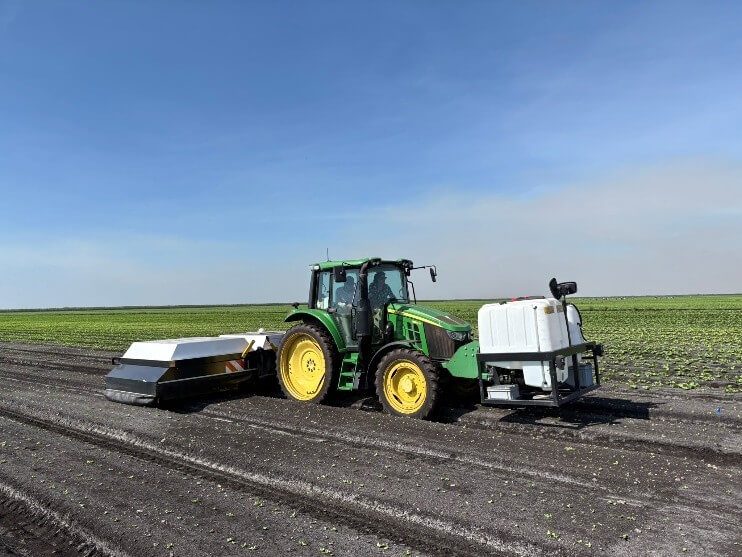
    Investing in an optical sprayer for horticulture is not a straightforward financial decision. Compared with a conventional boom sprayer, the upfront capital cost is substantially higher, often by an order of magnitude, and most commercial systems require an annual software or service subscription to operate. Despite these barriers, adoption is accelerating, and many growers who have made the investment report very positive outcomes.

    To help clarify when and where this technology makes financial sense, I developed a calculator to estimate the return on investment (ROI) of optical sprayers under a range of production scenarios. The goal of this tool is not to promote the technology, but to provide growers and advisors with a structured way to evaluate whether it fits their specific operation.

    Note: This calculator was designed for onion and carrot production in Ontario, Canada. Model parameters can easily be adjusted reflect other production systems. However, if you need assistance making these changes you can contact me by email.

    New versions may be uploaded as the calculator evolves through experience and based on user feedback, so check back. You can download Version 1.1 (April, 2026), HERE.

    How to use the calculator

    At first glance, the calculator may appear overwhelming because it requires a fair amount of information to be entered. This is the minimum data required to reflect real-world conditions while avoiding an oversimplification that could lead to misleading conclusions. Cells shaded in yellow are meant for user input. All other values are calculated automatically based on those inputs.

    For convenience, the calculator is pre-filled with generic values derived from grower discussions and informal benchmarks. These default numbers are meant only as placeholders and to provide general reference. They are not sufficiently accurate on their own to support financial decisions.

    Users should replace all default values with operation-specific data whenever possible. As with any economic model, the quality of the output depends entirely on the quality of the inputs.

    The calculator is organized into three spreadsheets (see tabs at bottom).

    1. Introduction

    This tab provides general instructions and contact information. No data entry is required.

    2. Sections Explained

    This is a reference tab that explains each section of the calculator in detail. It is intended to help users understand how different inputs affect the results and the intention of each section (small table) withing the sheet. No values should be entered here.

    3. Calculation Sheet

    This is the main working tab. All data entry occurs here. To prevent accidental changes that could break formulas, the sheet is protected. For most input fields, a brief explanation is provided immediately to the right of the cell. In the results section, short interpretations are often included, such as: “Decrease of 36% ($101,250/year) in hand-weeding cost with optical sprayer.” Within this tab, scenario tables are also provided. These tables are designed to illustrate how different acreages of the two crops analyzed affect each of the calculated financial indicators.

    Insights from scenario testing

    Even using rough approximations, several consistent patterns emerge from adjusting the calculator inputs:

    Herbicide savings alone rarely justify the investment

    In high-value horticultural crops, herbicide costs are often a relatively small portion of total production costs compared with labor, equipment, and the overall value of the crop. In many cases, any reduction in herbicide expenditure is largely offset by increased tractor hours resulting from slower operating speeds and narrower effective spray widths typical of optical sprayers.

    Labor savings can be decisive

    When the technology results in meaningful reductions in hand-weeding, the financial impact can be substantial. This is especially true in crops such as onions, where hand-weeding is both costly and difficult to source reliably. In these situations, labour savings alone can drive a favorable ROI.

    Yield protection may outweigh cost savings

    Several growers report stand losses and weakening associated with herbicide phytotoxicity as a major production risk. By limiting spray exposure to crop plants, optical sprayers can significantly reduce or even eliminate this issue. In high-value systems, relatively small yield gains resulting from improved crop safety can translate into revenue increases large enough to justify the technology, even if other savings are modest.

    Scale matters

    When evaluating advanced sprayer technologies, scale becomes a decisive factor. The high capital investment and ongoing service fees may be difficult to justify for small, and in some cases, even medium-sized operations.

    What about herbicide resistance?

    The long-term implications of optical sprayers for herbicide resistance management are still uncertain. Recent research from the University of Arkansas has raised concerns in field crop systems, suggesting that poorly optimized optical spraying can result in short term gains, but these can be outweighed over time by higher weed escape rates compared with broadcast applications. If these escapes are allowed to grow and set seed, rapid seedbank replenishment and accelerated resistance development may occur.

    This highlights an important limitation of short-term ROI calculations. A single-year economic benefit may look attractive, but if the system allows even a small number of weeds to consistently escape and reproduce, the long-term consequences can be severe.

    On the other hand, optical sprayers may eventually enable new resistance-management strategies. It is possible that new active ingredients, higher labelled rates, or novel use patterns could be registered specifically for targeted spraying in horticultural crops that would not be feasible with broadcast applications. Such developments could significantly improve resistance management tools. As always, it is essential to remember that the label is the law: only registered products and rates may be used, regardless of perceived crop safety.

    ROI implications beyond herbicide spraying

    Optical sprayers can deliver value beyond herbicide applications, even though weed control is their primary use. These additional uses may improve overall ROI. However, because their economic impact is still difficult to quantify, they have not been included in the calculator.

    Depending on the model, additional value-generating capabilities can include:

    • Creation of weed maps: Some systems can generate weed maps automatically while spraying, at no additional operational cost. These maps can support future management decisions.
    • Application of fertilizers and other pesticides: Although optimized for herbicides, optical sprayers may also be used to apply other inputs, such as fertilizers or non-herbicide pesticides.
    • Crop thinning: Certain manufacturers have developed algorithms for automated crop thinning, particularly in crops like lettuce.

    Conclusion

    Even using approximate inputs, it is clear why optical sprayer adoption is expanding rapidly in Canada.

    • For medium to large-scale operations, the ROI can be highly attractive, and the range of potential benefits continues to grow.
    • As the technology matures, more equipment options are emerging to serve a wider diversity of crops and farm sizes.
    • Manufacturers are introducing wider and more flexible platforms, and Ontario-based companies are actively developing alternative machines and service-based business models that may better suit smaller operations.

    It is difficult to argue that optical spraying is a passing trend. While it’s not a universal solution and must be implemented carefully, the technology is clearly here to stay. It will reshape weed management and production economics over the long term.


  • Airblast Productivity and Work Rate Calculator

    Airblast Productivity and Work Rate Calculator

    There are many factors that affect the work rate of an airblast application. If an operator can improve their work rate, without compromising spray efficacy or safety, they improve operational efficiency and save money.

    But how does each variable factor in? Is it worth the cost of a tender truck and operator to fill more efficiently? Should you upgrade to a multi-row sprayer? Should your next planting have longer rows? We have a simple calculator that can help you make these decisions. You can build and compare multiple scenarios to explore the relative impact of small changes to your typical spray program. We recommend making only one change for each scenario so you can better understand the results. Print the comparison page for your records.

    Whether you’re a sprayer operator, or a manager of sprayer operators, this exercise will help you see your spray program in a whole new light. Download a copy of the Airblast Budget and Work Rate Calculator and explore your productivity. You must have Excel to run the spreadsheet, and you must permit the use of macros (you’ll be prompted to accept).

    Spoiler: It’s amazing how changes to travel speed have only a marginal impact on work rate. Often less than 60% of the total spray job is spent actually spraying!

    If you’d like to see just how productive you can be, check out this rare (possibly unique) sprayer from Ed Oxley Farms in Michigan. Built on an OXBO 7550, this sprayer is the fourth iteration of a concept developed over the last 20 years by Ed Oxley Farms and ag engineers from Michigan State University.

    Capable of spraying five rows at a time, this self-propelled beast is a hybrid wrap-around and targeting-tower system that uses CurTec spray heads equipped with tangential fans and wire-mesh basket rotary atomizers.

    That’s not dribbling – that’s purging the boom prior to spraying.

    It sprays a mere 150 L/ha (~ 15 gallons/acre) at a ripping 13 km/h (~8 mph), as seen on the Ag Leader monitor below.

    When row spacing and turn time are accounted for, that means it’s capable of covering almost 15 hectares (~40 acres) per hour.

    And, when not spraying grapes, the boom can be swapped to make it a high-clearance corn sprayer. It doesn’t get much more efficient than this.

    The following videos will show the view from inside and outside the cab. Note that the row that’s straddled is sprayed from an overhead spray head mounted to the centre rack behind the sprayer. The two adjacent rows are covered from one side from vertical spray heads mounted on the chassis. Finally, the boom holds two more overhead spray heads for the outer-most rows.

    Ideally, the boom-mounted spray heads would be suspended vertically inside the row, but it makes for such a wide turn radius that it would take too long to turn… assuming there was enough headland to allow it. They’re also swept-back to minimize the turn radius and reduce the amount of airborne spray that deposits on the sprayer itself.

    A clever design that makes a few compromises to ideal coverage in order to improve productivity. The balance works for them and this sprayer might be a sign of things to come in horticultural crop production systems. Want to see how your sprayer stacks up? Download the calculator and see where you might be able to make improvements.

  • Mode of Action and Spray Quality

    Mode of Action and Spray Quality

    The decision on which application method is best for herbicides boils down to two main factors: (a) target type and (b) mode of action. In general, it’s easier for sprays to stick to broadleaf plants on account of their comparatively larger leaf size and better wettability compared to grassy plants. There are exceptions, of course – at the cotyledon stage, broadleaf plants can be very small and a finer spray with tighter droplet spacing may be needed. Water sensitive paper is a very useful tool to make that assessment. Imagine if a tiny cotyledon could fit between deposits – that could be a miss!

    Some weeds are also more difficult to wet, and those may also need a finer spray or a better surfactant for proper leaf contact. An easy test is to apply plain water to the leaf with a spray bottle. If the water beads off or the droplets remain perched on top in discrete spheres, the surface is considered hard to wet. Most grassy weeds are hard to wet, while most broadleaf weeds are easy to wet.

    Grassy weeds are an especially difficult target because they have smaller, more vertically oriented leaves, and almost without exception are more difficult to wet than broadleaf species. All these factors call for finer sprays for effective targeting and spray retention.

    Broadleaf weeds usually have more horizontally oriented leaves which also happen to be larger. As a result, they can intercept larger droplets quite efficiently.

    There are about thirty mode of action (MOA) groups among the herbicides with about ten accounting for the majority in Canadian prairie agriculture. It’s probably an over-simplification to categorize them into just two groups – systemic and contact.  But that grouping goes a long way to making an application decision.

    Contact products (MOA Group 5, 6, 10, 14, 22, 27) must form a deposit that provides good coverage. Good coverage is an ambiguous term that basically means that droplets need to be closely spaced and cover a significant proportion of the surface area because their physiological effects occur under the droplet, and don’t spread far from there. One way to generate more droplets is to reduce droplet diameter, another is to add more water. A reasonable combination of both is ideal because simply making droplets smaller creates issues with evaporation and drift.

    Systemic products (MOA Group 1, 2, 4, 9) will translocate within the plant to their site of action after uptake. As a result, coverage is less important as long as sufficient dose is presented to the plant. In practice, this means coarser sprays and/or less water may be acceptable.

    When two factors are combined, either in a tank mix or a weed spectrum, the more limiting factor rules. Application of a tank mix or product that is active on both broadleaf and grass plants will be governed by the limitation placed on grass targets. A tank mix comprised of both systemic and contact products is governed by the limitations placed on contact products.

    A factor we should also consider is soil activity and the presence of residue. Studies have shown that soil-active products are relatively insensitive to droplet size. But if they have to travel through a layer of trash to get to the soil surface, more application volume is the best tool.

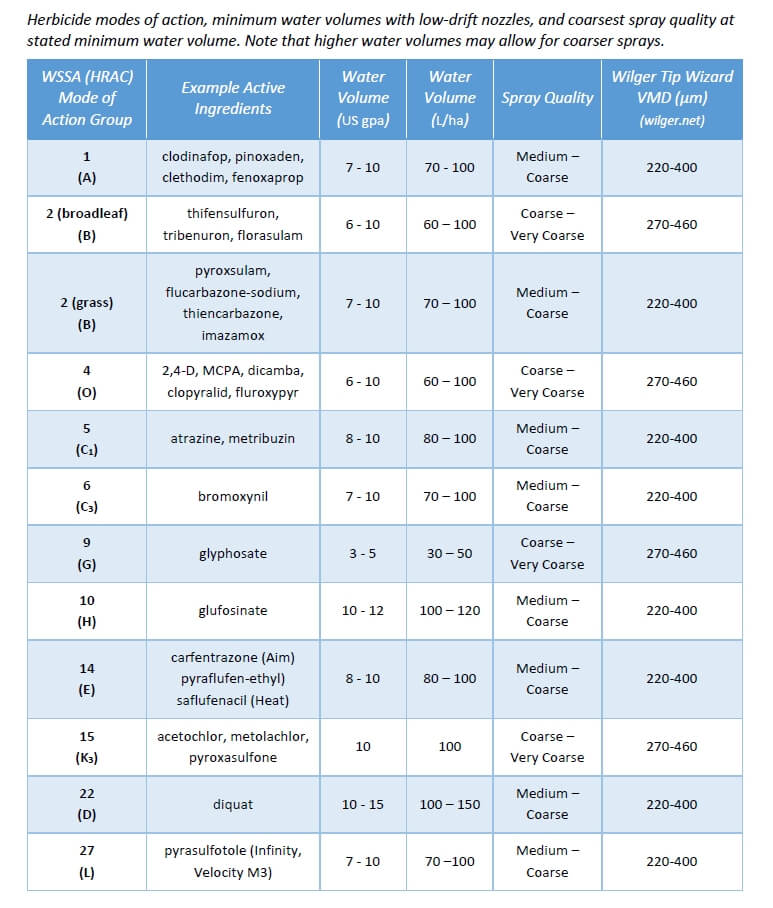
    Below are some recommended spray qualities and water volumes for use in Canada. The spray qualities listed in the table can be matched to a specific nozzle by referring to nozzle manufacturer catalogues, websites, or apps. Note that Wilger also offers traditional VMD measurements on their site, allowing users to be a bit more specific if necessary.

    Click here to download PDF

  • OrchardMAX

    OrchardMAX

    2016_Orchard_Max_Logo

    OrchardMAX won the 2016 Canadian Agri-Marketing Association’s “Certificate of Merit” in the Mobile Apps Category.

    2022 Update

    OrchardMAX was developed in 2016. iOS and Android have moved on since then, so the links to the app no longer function. Maintaining this app for new operating systems requires a capitol expense which, presently, we have not explored. If you have some interest in exploring the model, reach out to jason@sprayers101.com and we’ll send you a copy that will work on Excel.

    What is OrchardMAX?

    OrchardMAX is a free app developed by the Ontario Ministry of Agriculture, Food and Rural Affairs to improve sprayer efficiency and effectiveness in apple orchards. The app is based on the Crop-Adapted Spraying (CAS) model, which was tested in semi-dwarf and high-density apple orchards in Ontario and Nova Scotia from 2013 to present day. The primary goal of the app is to help the sprayer operator achieve consistent coverage, no matter the architecture of the orchard block, throughout the season. Research has demonstrated that following the process improves coverage while reducing wasted spray by an average of 20% over the season.

    OrchardMAX will:

    • Accept Metric or US Imperial units
    • Create an inventory of your orchard airblast sprayers
    • Create an inventory of your orchard blocks
    • Determine optimal sprayer settings based on the average size, shape and density of the trees in the block
    • Propose a pesticide dose for each block, including ideal nozzle rates, water volume and product(s) per tank
    • Develop a permanent spray record that can be emailed to the user for archival
    • Calculate work rates and estimate productivity

    OrchardMAX won’t:

    • Exceed label rates
    • Calibrate your sprayer
    • Confirm spray coverage
    • Account for environmental conditions such as wind, humidity or temperature
    • Advise a volume below 400 L/ha (about 42.5 US g/ac)
    • Advise a dose that is less than 1/2 the label rate (that may seem low, but consider a first-year planting)

    Recognizing that this app can only approximate ideal sprayer settings based on data entered by the user, sprayer adjustments are still required on the part of the sprayer operator. Specifically, the sprayer operator must still calibrate and adjust the sprayer air to match the tree and the environmental conditions and confirm coverage using water-sensitive paper.

    Why you should try it

    Financial savings: The app will help you match your sprayer settings to the crop you’re trying to protect. That means you will find out if you are over- or under-spraying the tree canopy and by how much. This information, combined with feedback from water-sensitive paper, will improve canopy coverage and very probably improve the quality of the apple crop. Additionally, the app may lead to reduced pesticide volumes, which reduces environmental contamination and saves money.

    Explore different spraying scenarios: Perhaps you’re considering a new planting and you would like to know how many tanks it would take to spray an orchard block for a given speed, or row spacing. Perhaps you are considering a sprayer with a larger tank to reduce the number of refills, or a smaller tank to prevent rutting and you want to see how that affects your spray efficiency. Maybe you’re considering decreasing your fill time by using a tender or nurse truck. Enter the parameters and see how it affects your spray day BEFORE you invest.

    Create permanent spray records: The app will create a library of spray records that are emailed directly to you.

    How it works

    Enter Farmer/Owner information
    Enter Farmer/Owner information

    Like any new practice, you have to put in a little time and effort to realize the full benefit of the app. Try it on a few blocks in the first year, make the changes to your spray program and review the results. As you get used to this new method for spraying, and see the improvement, you can continue to expand its use to the entire operation.

    First you have to enter information about your operation. This only has to be done once.

    1. Enter your profile information
    2. Complete the Inventory
    3. Information for each sprayer in your operation
    4. Information about each sprayer operator
    5. Information about each physiologically different orchard block (e.g. Trellised Gala on 10′ rows is quite different from mature semi-dwarf Empires)

    Now you are ready to calculate rates for a spray day.

    1. Choose the Sprayer, Operator and Block from your Inventory
    2. Decide if you want to use label-rate, or an optimized rate based on tree size
    3. Determine if you will spray every row, or alternate rows (You cannot choose to optimize your rate AND spray alternate rows)
    Select sprayer, operator and block from inventory, then enter spray-day data to calculate rate and sprayer settings.
    Select sprayer, operator and block from inventory, then enter spray-day data to calculate rate and sprayer settings.

    Enter information about the tree shape and density (This accounts for pruning and time-of-season). This is mostly visual, where the user chooses from a series of pictures

    • Enter label rate and preferred rate for each pesticide in the spray mix

    The software then lets you know how much carrier and/or pesticide can be saved if you nozzle your sprayer according to it’s prescription.

    • From a nozzle catalog, enter the nozzle rates for each position within 5% of OrchardMax’s prescription

    The software then assembles a simple spray record, including all the rate adjustments and sprayer settings, which is emailed to you for your permanent records.

    Where can I get it?

    Select your operating system (images below) and you will be taken to the respective store and begin downloading. Please rate the app so we know it’s being used and can work to improve it. Please opt in to provide us with usage information so we can see how it’s being used – this is entirely private, and we will not contact you.

    NOTE: These links may no longer function. Contact jason@sprayers101.com if you’d like to learn more about the model or to try the Excel version.

    The OrchardMAX app was developed by AgNition Inc. with funding from Growing Forward 2.

  • Simple Statistics for Growers

    Simple Statistics for Growers

    In North America, winter is agriculture conference and lecture season. Growers are inundated with graphs and charts and left to make sense of what they’re seeing. It might be an agrichemical rep promoting a new pesticide or a seed dealer comparing yields. Maybe an equipment dealer is illustrating return on investment. Even university researchers and government extension specialists have been known to flash the occasional graph from time to time.

    Without a basic understanding of how data can be abused, we are at the mercy of those presenting the data. So, in 2012, I was asked to develop a talk that would give growers a basic grounding in descriptive statistics. More to the point, it would empower a grower to raise their hand and ask questions if they felt a presenter was talking out of their… *ahem*.

    • Did the researcher do their stats correctly?
    • Is the data clear and easy to understand?
    • Is the presenter skewing something to make us see what they want?

    Since writing it, I’ve been asked to deliver this talk to several grower groups, which is surprising because very few people love statistics. Now that we’re all webinar-savvy, I took the opportunity to update the presentation and record it.

    The video is only 15 minutes. When you’re done I hope you’ll appreciate that it’s OK to be skeptical of data. Ask questions and dig deeper.