There are many factors that affect the work rate of an airblast application. If an operator can improve their work rate, without compromising spray efficacy or safety, they improve operational efficiency and save money.
But how does each variable factor in? Is it worth the cost of a tender truck and operator to fill more efficiently? Should you upgrade to a multi-row sprayer? Should your next planting have longer rows? We have a simple calculator that can help you make these decisions. You can build and compare multiple scenarios to explore the relative impact of small changes to your typical spray program. We recommend making only one change for each scenario so you can better understand the results. Print the comparison page for your records.
Whether you’re a sprayer operator, or a manager of sprayer operators, this exercise will help you see your spray program in a whole new light. Download a copy of the Airblast Budget and Work Rate Calculator and explore your productivity. You must have Excel to run the spreadsheet, and you must permit the use of macros (you’ll be prompted to accept).
Spoiler: It’s amazing how changes to travel speed have only a marginal impact on work rate. Often less than 60% of the total spray job is spent actually spraying!
If you’d like to see just how productive you can be, check out this rare (possibly unique) sprayer from Ed Oxley Farms in Michigan. Built on an OXBO 7550, this sprayer is the fourth iteration of a concept developed over the last 20 years by Ed Oxley Farms and ag engineers from Michigan State University.
Capable of spraying five rows at a time, this self-propelled beast is a hybrid wrap-around and targeting-tower system that uses CurTec spray heads equipped with tangential fans and wire-mesh basket rotary atomizers.
That’s not dribbling – that’s purging the boom prior to spraying.
It sprays a mere 150 L/ha (~ 15 gallons/acre) at a ripping 13 km/h (~8 mph), as seen on the Ag Leader monitor below.
When row spacing and turn time are accounted for, that means it’s capable of covering almost 15 hectares (~40 acres) per hour.
And, when not spraying grapes, the boom can be swapped to make it a high-clearance corn sprayer. It doesn’t get much more efficient than this.
The following videos will show the view from inside and outside the cab. Note that the row that’s straddled is sprayed from an overhead spray head mounted to the centre rack behind the sprayer. The two adjacent rows are covered from one side from vertical spray heads mounted on the chassis. Finally, the boom holds two more overhead spray heads for the outer-most rows.
Ideally, the boom-mounted spray heads would be suspended vertically inside the row, but it makes for such a wide turn radius that it would take too long to turn… assuming there was enough headland to allow it. They’re also swept-back to minimize the turn radius and reduce the amount of airborne spray that deposits on the sprayer itself.
A clever design that makes a few compromises to ideal coverage in order to improve productivity. The balance works for them and this sprayer might be a sign of things to come in horticultural crop production systems. Want to see how your sprayer stacks up? Download the calculator and see where you might be able to make improvements.
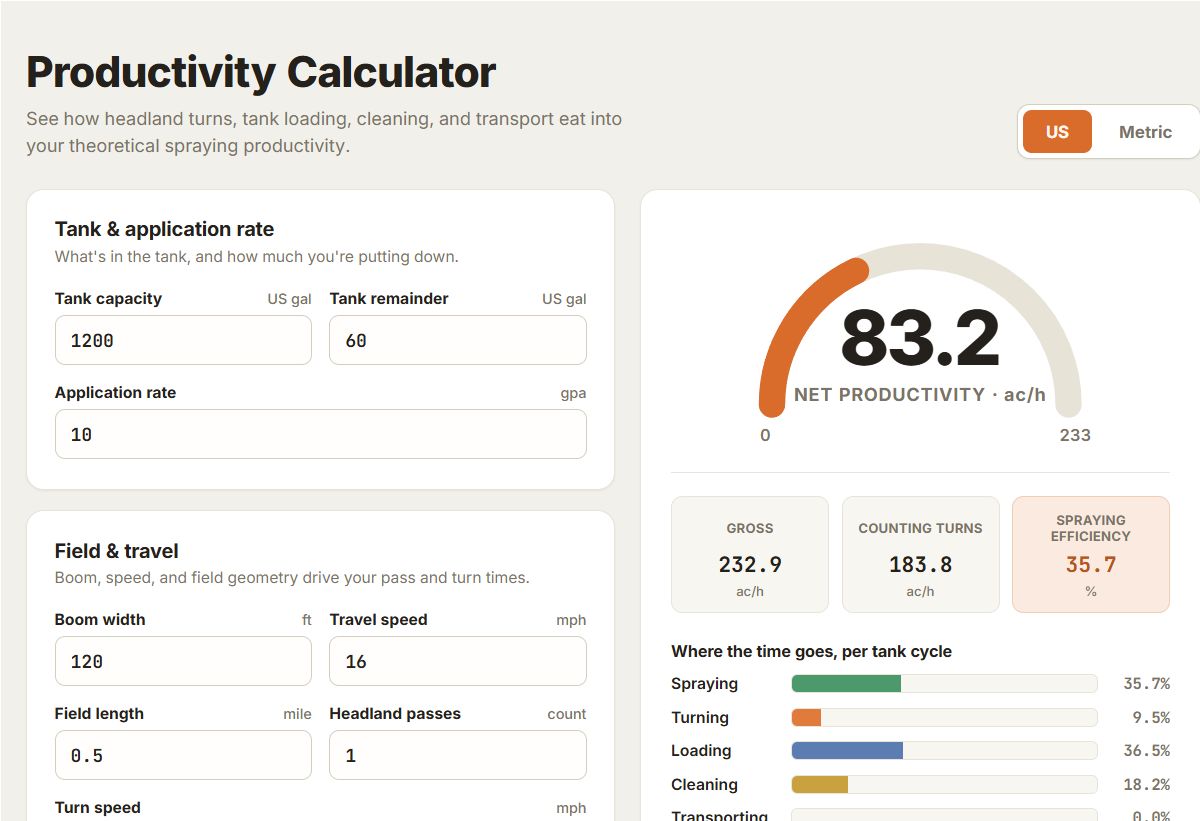
Want to figure out how your sprayer configuration affects your productivity? Try out this little that tells you acres per hour, the amount of productivity lost to turning and filling, and the benefit of longer booms.
You might be surprised how productive you can be without driving faster.
In almost all agronomic practices, timing is key. There are certain, and often small, windows of opportunity for getting a task done without losing yield potential or product quality. Weed specialists talk about early weed removal, pathologists talk about symptom monitoring, and entomologists remind us of economic thresholds. Acting at the right time is fundamental.
Sometimes I’m asked about comparing two different methods of
spray application. I usually dodge these questions by advising to choose the
one that gets the job done on time. “An average application at the right time
is much better than an excellent application at the wrong time” is how I put
it. Sure, I’m dodging, but I really believe that. It’s mostly in the timing.
Everything we do carries with it some time inefficiencies.
Some are rooted in technology, others in habits. It’s the habits that are
easier and cheaper to address. That’s why, when evaluating how to improve a
spraying operation, I advise to start with a stopwatch and notepad, not a
sprayer brochure.
A stopwatch and notepad provides your path to greater productivity.
Remember, if you want to improve a system, you first need to understand it. And to understand it, you need to measure it.
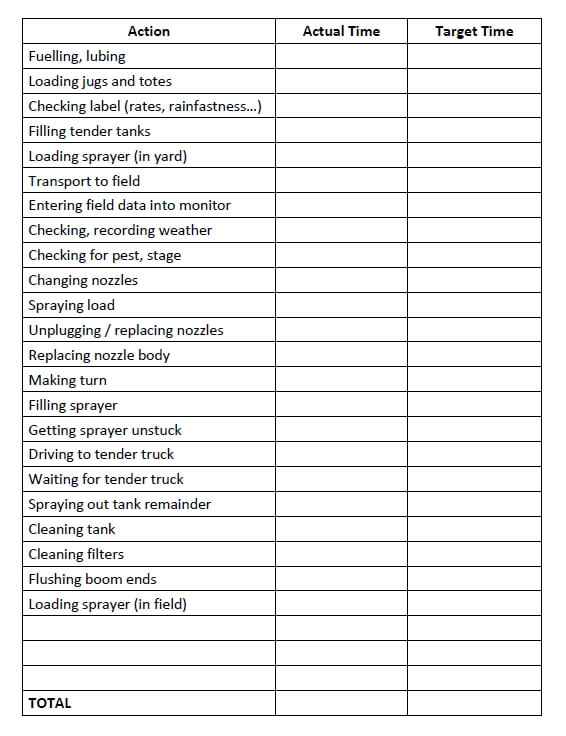
So, do a time accounting. You need to know how your time is used on a spray day. Note the time spent preparing for the job (loading supplies, double checking label instructions, transporting, etc.). The big users of time are sprayer transporting, filling and cleaning, but there are very many small time users and those can add up. This time is doubly important because these tasks occur during the spray day, when the weather is good and you should be maximizing spray time.
Make your own time accounting sheet, including every detail or possibility.
Even within any one operation, time can be subdivided. How
much time is spent on a turn? Since a 120’ sprayer will make about 22 of these
per half mile, that can add up. Even a spray monitor can play a productivity role
if it quickly and consistently locks onto its swath. Needing to stop and back
up while it searches for a signal can be costly.
On our farm, we sometimes used custom operators to get the cereals off. I recall how aggravating it was to watch the 8820 inch ahead of my N6. Surely it must be throwing a lot over, I thought (it was). But I usually caught it at the truck, where my unloading speed was over 1 minute faster. Redemption, briefly.
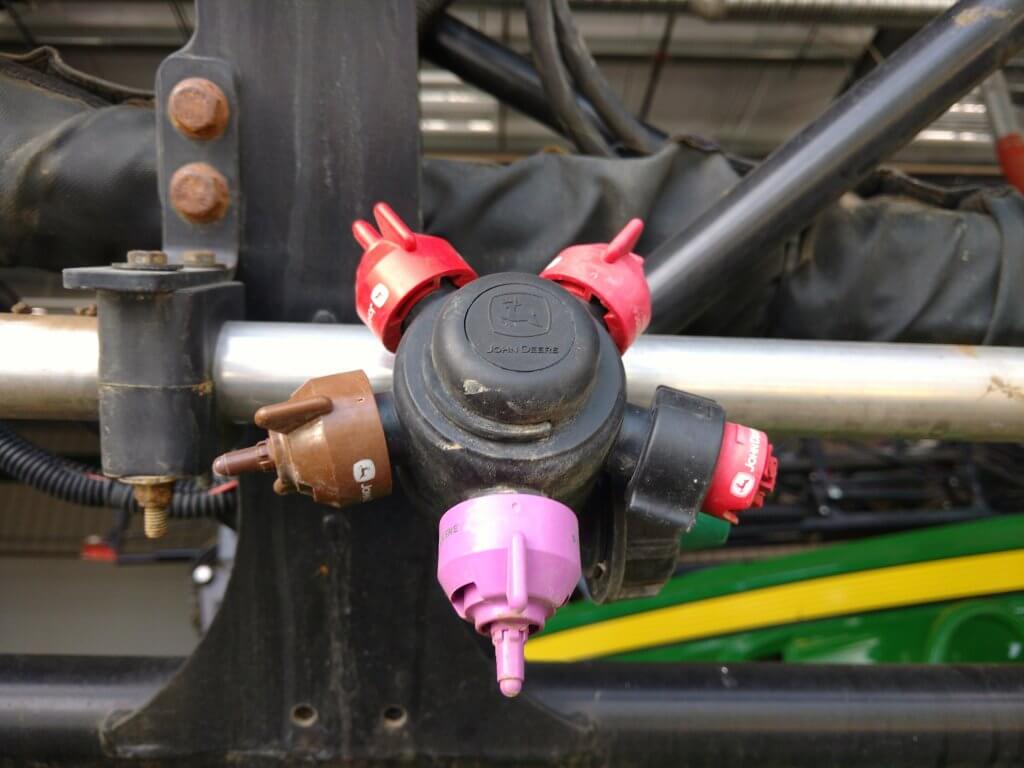
That same principle applies to these small efficiencies. A well-designed tender truck can speed loading and more than make up for lower spray productivity of a smaller sprayer. A lighter sprayer load and flotation tires can save a ton of time if it means the difference between getting stuck or cruising through that spot. A set of extra-coarse nozzles that can be rotated into place in just two minutes can help finish a field if the weather changes, or allow a margin to be sprayed, saving a return trip.
Extra nozzles to allow spraying in higher wind speeds without increasing drift are a productivity tool.
A custom operator shared some very useful tips with me a few
years back. He optimized the small things, such as re-locating the switch to
deflate his suspension airbags after driving onto the trailer, to the platform
beside the cab. He’d deflate while descending the steps, and by the time the tie-down
straps were thrown across, the unit was ready to be cinched down. No waiting.
He also opted for a slightly wider aftermarket boom so he had an even number of
spray passes per quarter, saving another 2 minutes or so per field.
The same operator made me aware of the importance of knowing
exactly how much spray is in the tank at any one time. The majority of spray
monitors are simply not accurate enough. A factory sprayer can count down from
a full tank using its flow meter, but that requires two things to be accurate,
the filled amount (entered by the operator, usually from a sight gauge) and the
flow meter itself. Point is, when we fill the last load of a field, we don’t
want too much left over, but we’d still rather not run out. By using the
AccuVolume from Simon Innovations, he was able to fill accurately and he was
also able to exactly monitor his liquid usage. If he had two passes left, and
knew he needed exactly 150 gallons (also considering when his pump drew air),
he could monitor that and make small adjustments to the application rate, if
necessary, to get there. It’s a big deal because contending with a larger
remainder is wasteful and takes time to deal with. The AccuVolume also helps
make multiple small volume batch cleaning more accurate, and therefore easier.
The AccuVolume measures your tank contents, to the nearest gallon, regardless of slope position. It’s a time saver.
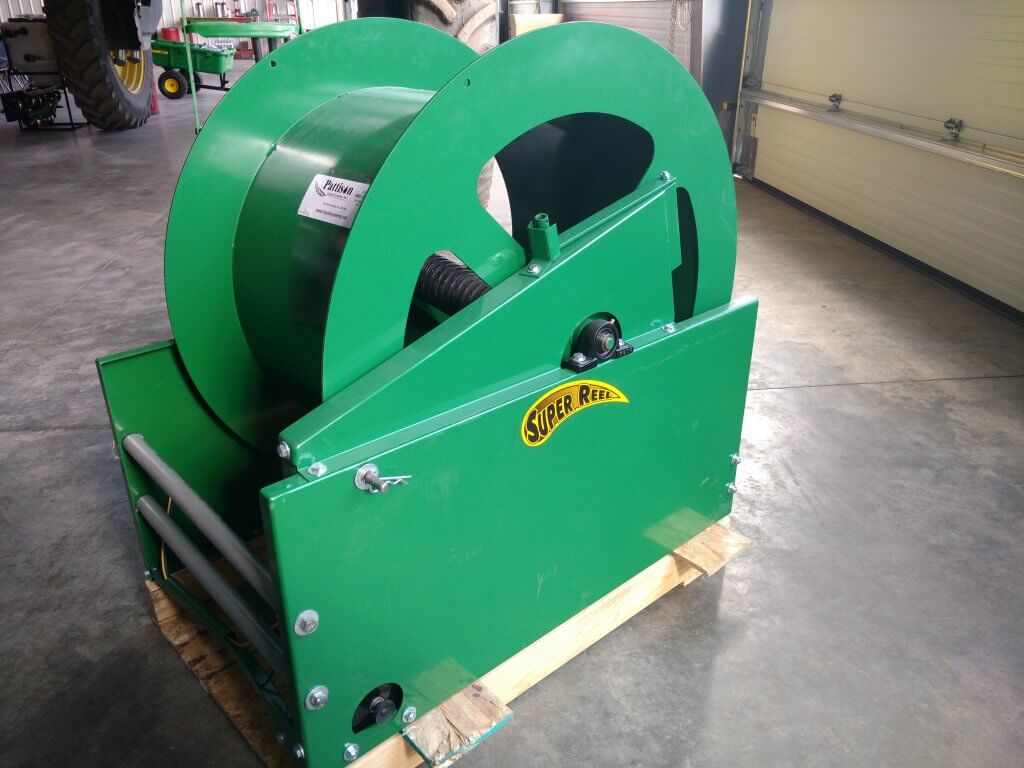
A small addition to the tender truck such as an electric
hose reel or a swing arm that carries, say 20’ of hose, helps deal with the
weight of a full 3” line. Or an air-line at the pump end can be used to blow
the remaining water into the tank. Time, and mess, are saved. Still pumping
product? Induction using a venturi is much faster.
An electric hose reel makes handling 3″ plumbing manageable.
Preventing problems is probably a better use of time than
dealing with them. Take tank mixes, for example. With more products in the
tank, and adjuvants such as conditioners, fertilizers, or low-drift products
making their way in, anticipating mixing problems may require a jar test. Get
the tools, and learn how to do them. It’s important to use the actual tended
water in these tests, at the temperature it will be, because that, and water
quality such as hardness and bicarbonates, can affect mixing. And don’t
over-agitate, as that can create its own problems, especially as the tank runs
down.
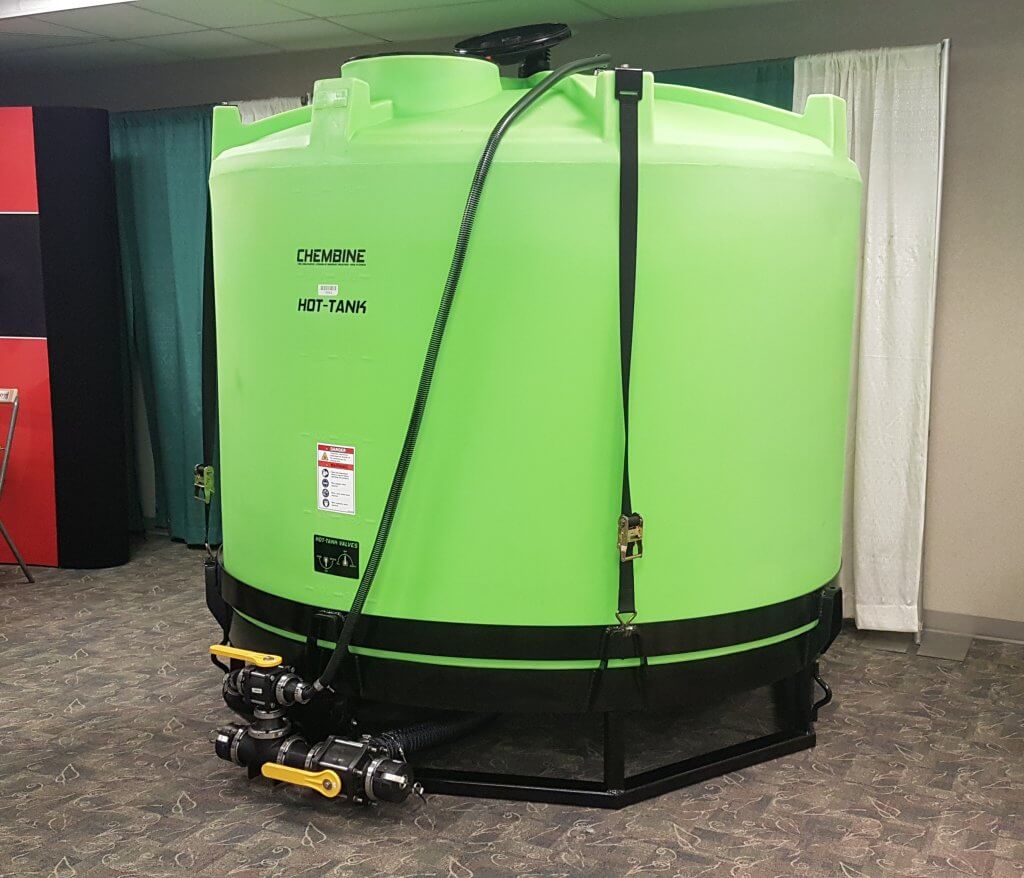
Consider a hot tank. If extra labour is available, it removes a lot of time pressure for mixing dry, or multiple products. At filling time, simply pump it over and go.
A hot tank gives you more time to mix properly, and makes transfers faster. (Some additional labour required).
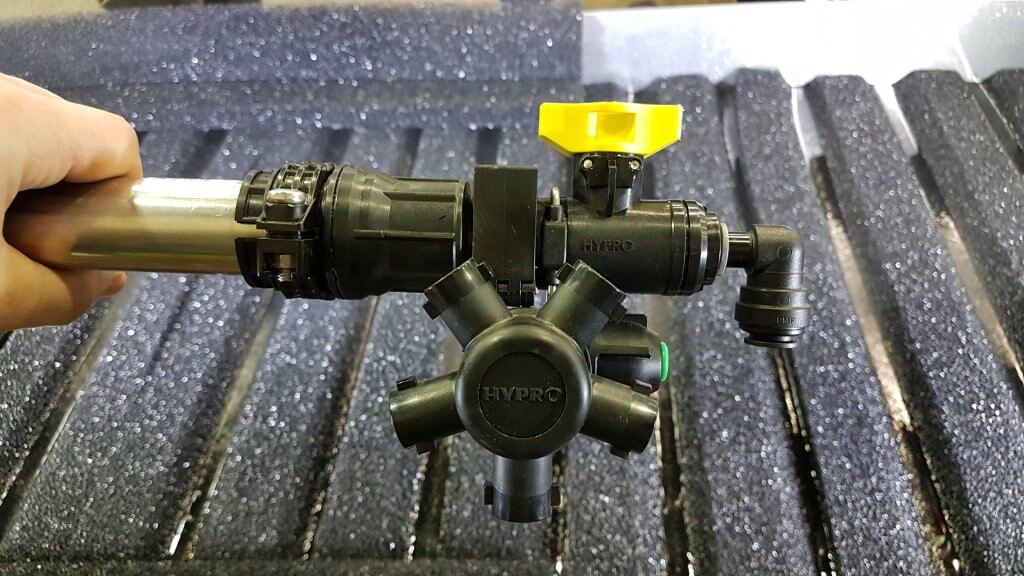
Consider improvements in the plumbing to save time. The new Hypro Express End Cap features a ball valve for flushing (existing Express End Caps can be retrofitted), and this valve can soon be fitted with the ProStop E (electric) valve. Flushing can then be done from the cab, saving time and mess. It’s a small change, but it brings joy.
A new valve addition is available for the Express End Cap. Manual (shown) or electric available.
The importance of time on a spray day can also be viewed economically. Let’s say a large area needs to be sprayed today, and the weather forecast calls for rain overnight. The rain will stop spraying for 5 days. What is the yield potential lost in those five days if weed or disease pressure is high? If 100 acres don’t get treated, what is the lost revenue? (for example, if 3 bpa is lost, at $6/b, that’s $18/acre or $1,800.) That’s what that hour is worth. Tell your boss.
Getting more done means getting more done on time. Evaluate your habits and technologies on that basis.
Timing trumps most things in crop protection. A great spray applied at the wrong time isn’t nearly as valuable as a mediocre spray at the right time. So how do we improve our ability to get things done at the right time?
Often, we try to win races by driving faster. In our last article, we looked at driving speed and concluded that faster speeds can lead to more drift and less uniform deposition. Driving slower can be viewed as a sort of insurance policy: You may not notice the benefits right away, but on days when that extra bit of performance is required, you’re covered.
So how do you get the job done quickly if you can’t drive faster? To answer, we have to look to other opportunities for boosting productivity.
Recently, we built a model to capture all the elements of a normal spray operation that affect timeliness. These were:
travel speed
boom width
tank size
water volume
field length
number of headlands
turning speed
fill time
First, we identified a reasonable base condition. For the sprayer, that was a travel speed of 14 mph, a 90’ boom, an 800 gal tank, a 10 gpa water volume, and a 20 minute fill time. Then, we set up a typical field situation, which was spraying a half-mile run on a quarter with two sprayed headlands and a turning speed of 8 mph. Finally, we changed one factor at a time to determine its relative importance.
Before we discuss the results, let’s make it clear that just because changing some of these factors improves productivity doesn’t mean we’re recommending them! For example, adequate water volume remains an important input that improves coverage and permits the use of low-drift sprays. Larger tanks increase compaction and take more power, and so forth.
Here’s what we found:
All productivity values were expressed as acres per engine hour. For this reason, our numbers will be lower than what a typical sprayer monitor reports, most of which calculate acres per spraying hour.
For the base condition, the sprayer spent 15% of its driving time turning, and 37% of its on-field time stationary (i.e. filling). For every hour spent on the field, less than half the time (48%) was spent spraying. This resulted in an average productivity of 82 acres/h.
Increasing the spray speed to 18 mph increased average productivity to 93 acres/h, but it also increased the proportion of time spent turning and loading, resulting in just 40% of the field time spent spraying.
Decreasing the loading time from 20 to 10 minutes reduced the proportion of field time spent stationary to 23%, covering 100 acres/h at 14 mph. Surprisingly, this was the productivity-winner, resuling in 62% of on-field time spraying.
We discovered other powerful productivity factors, and chief among them was boom width. A 33% increase in boom width from 90’ to 120’ gave a productivity boost to 94 acres/h, close to the same result as increasing the travel speed to 18 mph earlier. Similar side effects occurred: more time turning, and a greater proportion of time filling, as we saw with faster travel speeds.
Boom width seems to have some room for growth. Many smaller European counties use wider booms than we do in North America, for example. With gps guidance and large fields, we have excellent conditions for their implementation.
Two other factors that had similar effects to fill time were water volume and tank size. Less water and larger tanks increased productivity by decreasing the fill frequency, with effects similar in magnitude to speeding up the fill time. Decreasing the water volume from 10 to 5 gpa increased productivity to 100 acres/h by decreasing the proportion of time the sprayer was stopped from 37% to 23%. Increasing from an 800 to a 1,200 gallon tank increased productivity to 94 acres/h, again by decreasing the proportion of time spent filling to 28%.
Taken together, a sprayer with a 120’ boom, a 1,200 gal tank, applying 10 gpa and filling in 10 min had an average productivity of 132 acres/h. And this was achieved without driving faster than 14 mph. If you can string two quarters together and drive a whole mile before turning, that number rises to 145 acres/h, a surprisingly large 13 acres/h gain.
The perspective of minimizing downtime extends to other tasks, too:
Be more prepared for the job by reviewing the product label in advance, noting the correct mixing order.
Keep extra nozzles, clamps, and nozzle bodies in the cab.
Don’t clean plugged nozzles, replace them.
Use low-drift nozzles so a small increase in wind doesn’t shut you down.
Ensure all the products needed are on the tender truck (e.g. pesticide, adjuvant, tank cleaner, anti-foamer, etc.).
Consider switching to 3” plumbing (pump rates of 300 – 400 gpm are possible).
Make sure your inductor won’t be the limiting factor. For example, product pumps can be awfully slow when the product is cold. It might be worthwhile to explore a venturi system.
Speeding up the fill process is a good idea, but be careful with certain products. Dry materials such as the sulfonyl ureas (e.g. Refine, Express SG, etc.) and some fungicides (e.g. Astound, etc.) require time to hydrate in water so they mix properly. Some operators pre-hydrate these in a smaller tank, while others get an extra tank to pre-mix whole loads and simply transfer them over.
Also think about the time spent cleaning the sprayer. Thoroughness is important, but perhaps there are efficiencies to be gained there as well, like never letting a sprayer sit after spraying. We’ve written about continuous rinsing, for example, to improve cleaning speed and effectiveness.
So, the quicker we can spray, while ensuring a quality job, the more effective our crop protection practices will be. We encourage you to use our to determine your best configuration.
Got a productivity tips to share? Let us know! And remember: In spraying, the race is won in the pits.