Category: Directed & Air-Assist

Articles about horizontal booms with air-assist or directed nozzles.

  • Air-Assisted Boom Sprayers

    Air-Assisted Boom Sprayers

    Air-assisted boom sprayers have been around since the 70s. More common in Europe than North America, they have demonstrated value in mitigating drift and improving canopy penetration. The majority of air-assist systems are found on three-point-hitch or trailed sprayers, which is fine (and perhaps even preferable) as long as clearance, travel speed and acreage aren’t limiting factors. In North America, trailed air-assist sprayers are used by some vegetable and strawberry growers, but air-assist in general is rare among field croppers. There are a few possible reasons for this:

    • North American field croppers are predominantly concerned with work rate and prefer the larger, faster, self-propelled option.
    • Air-assist is not ideal for herbicide applications to bare soil because unless it’s perfectly adjusted, it tends to bounce spray off the ground. A canopy is preferred to capture the spray and exhaust the air energy. This reduces the overall utility of air-assist.
    • The air-assist feature is expensive and growers are either unaware or unconvinced of its value.
    • There are few, if any, after-market air-assist upgrade kits available. This is because installations are bespoke; The apparatus is heavy, adds load to existing electrical and hydraulic systems and can interfere with boom folding. So, getting air-assist means purchasing a new (and perhaps unfamiliar) brand of self-propelled sprayer… and there aren’t many on offer.
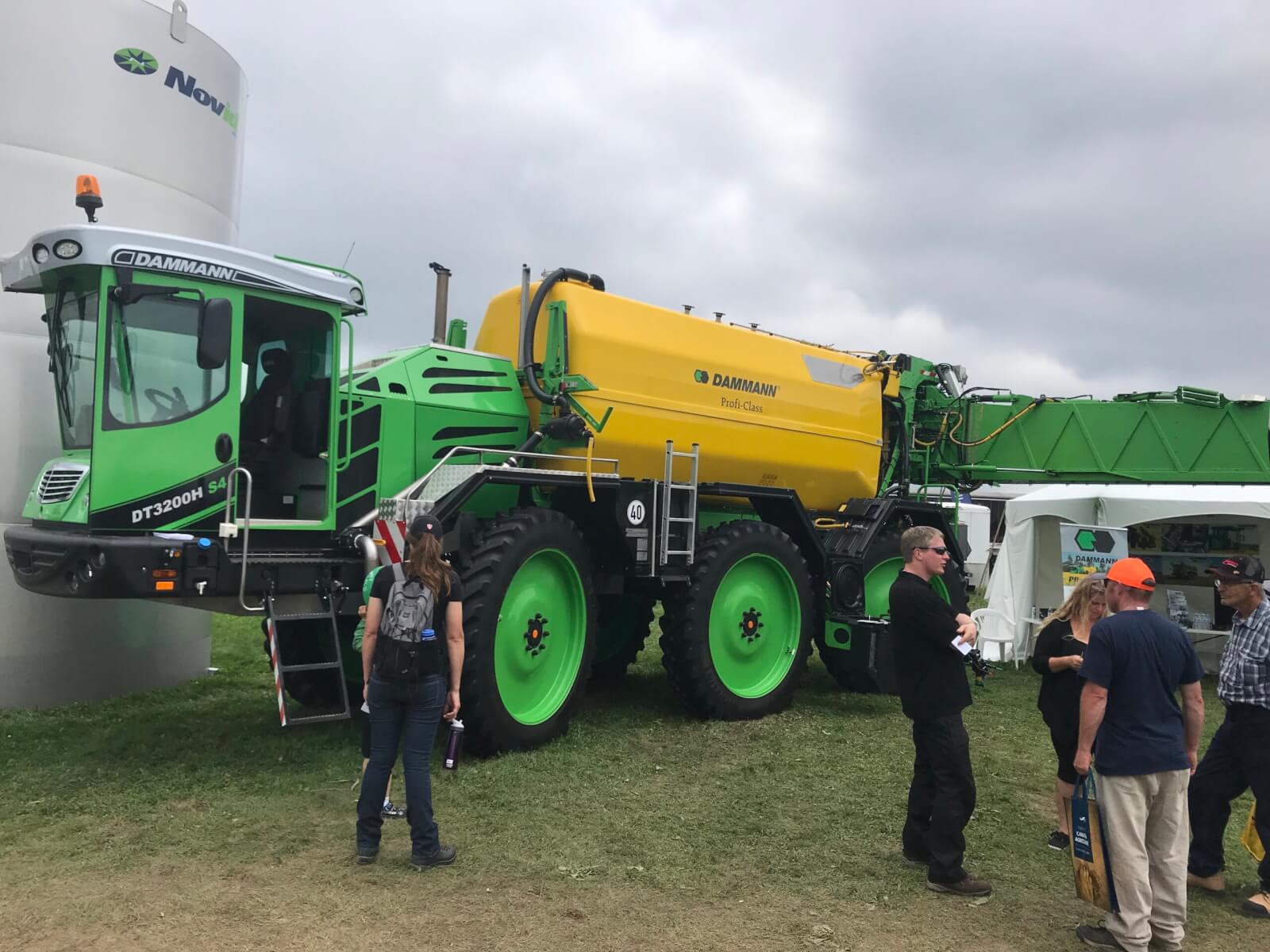
    Figure 1 – Dammann’s massive three-axel DT3200H S4 self-propelled air-assist sprayer at Canada’s Outdoor Farm Show in 2018.
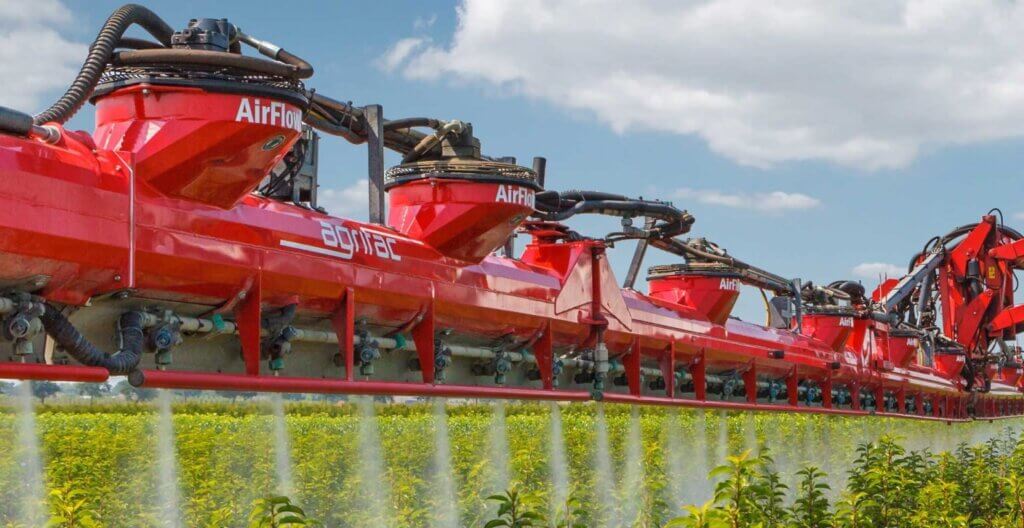
    Figure 2 – Agrifac’s AirFlowPlus (Image from Agrifac website)
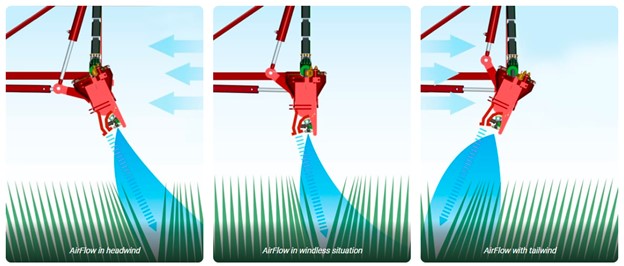
    Figure 3 – Agrifac’s AirFlowPlus depicting adjustable angle (Image from Agrifac website)
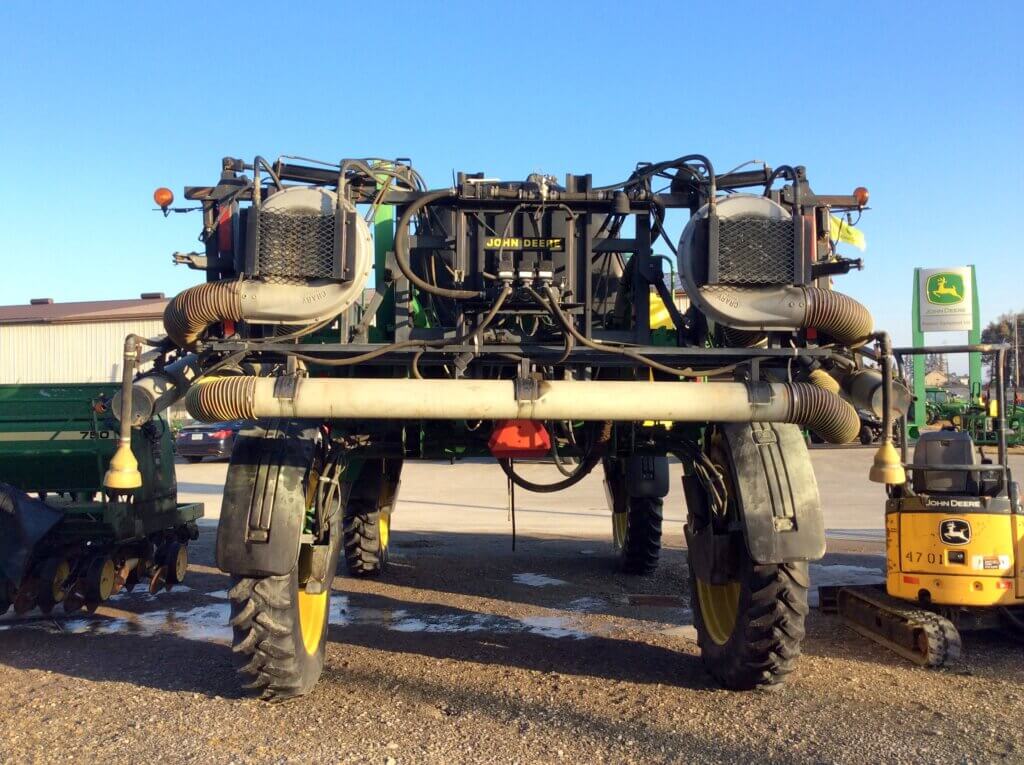
    Figure 4 – This photo of a John Deere with air-assist was taken at a dealer’s lot in Southwestern Ontario in 2014. We have no idea what the history is, or who added the air-assist feature (it looks similar to a Miller Spray-Air with two blowers).

    Air assist booms came to Western Canada in the early 1980s in the form of the “Spray-Foil” sprayer, later renamed Spray-Air. This sprayer was developed and manufactured in Carseland, Alberta. It used a shear-atomizer nozzle, a “foil”, that required a strong airblast to properly atomize a liquid feed that was introduced on the foil’s leading edge. As a result, it created a powerful airblast and a very fine spray. It was marketed as a way to reduce herbicide rates, an attractive feature during the times of drought, high interest rates, low commodity prices, and general economic malaise of farming on the prairies during the 1980s. Neighbours of Spray-Foils didn’t like the drift potential of the machines, and chemical companies objected to the claims of reduced water volumes (2 gpa) and lower product rates which contravened label directions. An unflattering test report of the sprayer by PAMI in Lethbridge resulted in a protracted lawsuit which helped cast the fate of the company. A Danish company licensed the design and sold it in Europe under the name Danfoil, where it continues to exist and @Nozzle_Guy saw it in person during the 2019 Agritechnica.

    Figure 5 – A Spray-Air Trident pull-type made in Carseland, Alberta, for sale.

    Eventually, Spray-Air rose from litigation and developed an improved nozzle with the assistance of the National Research Council (the “Shear Guard”) and introduced the Trident boom which gave users the option of atomizing spray with a conventional boom with or without air assistance, in addition the the native choice of shear-atomization. The sprayer chassis itself also continued to improve with a better overall design. Nonetheless, it was sold to Miller in the 2000s after a period of sales stagnation.
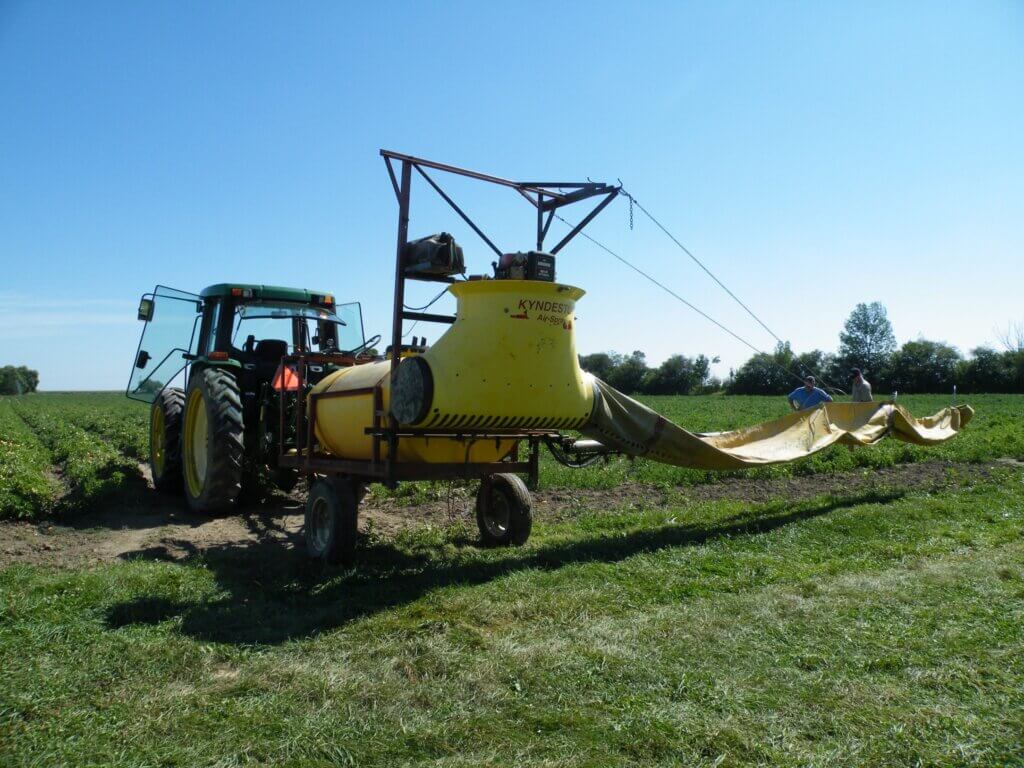
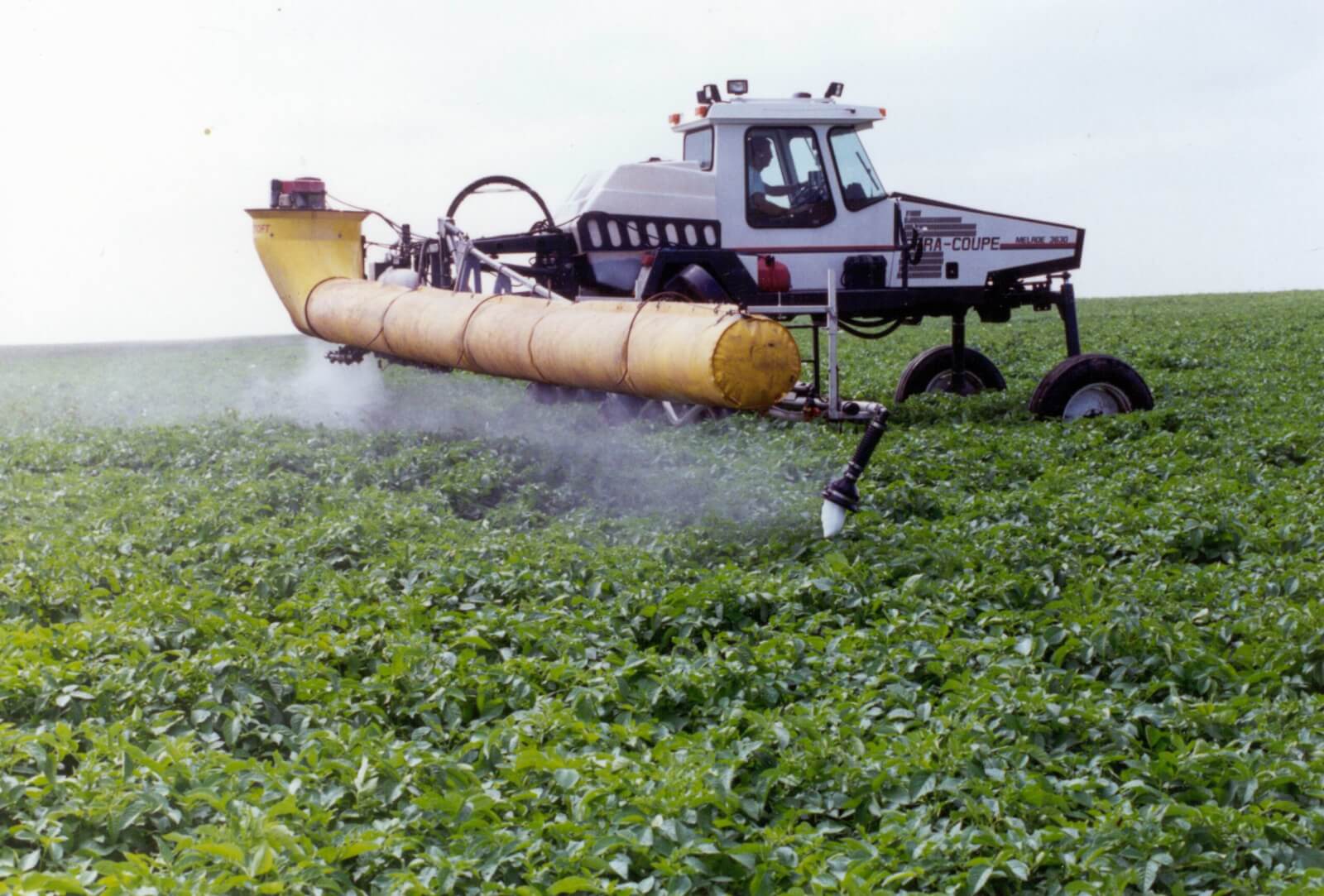
    Figure 6 – A trailed one-sided Kyndestoft Air-Sprayer in Ontario field tomatoes (c. 2010)
    Figure 7 – Everyone’s favourite sprayer, the Spra-Coupe, sporting a Kyndestoft Air-Spray system (1996, PAMI)
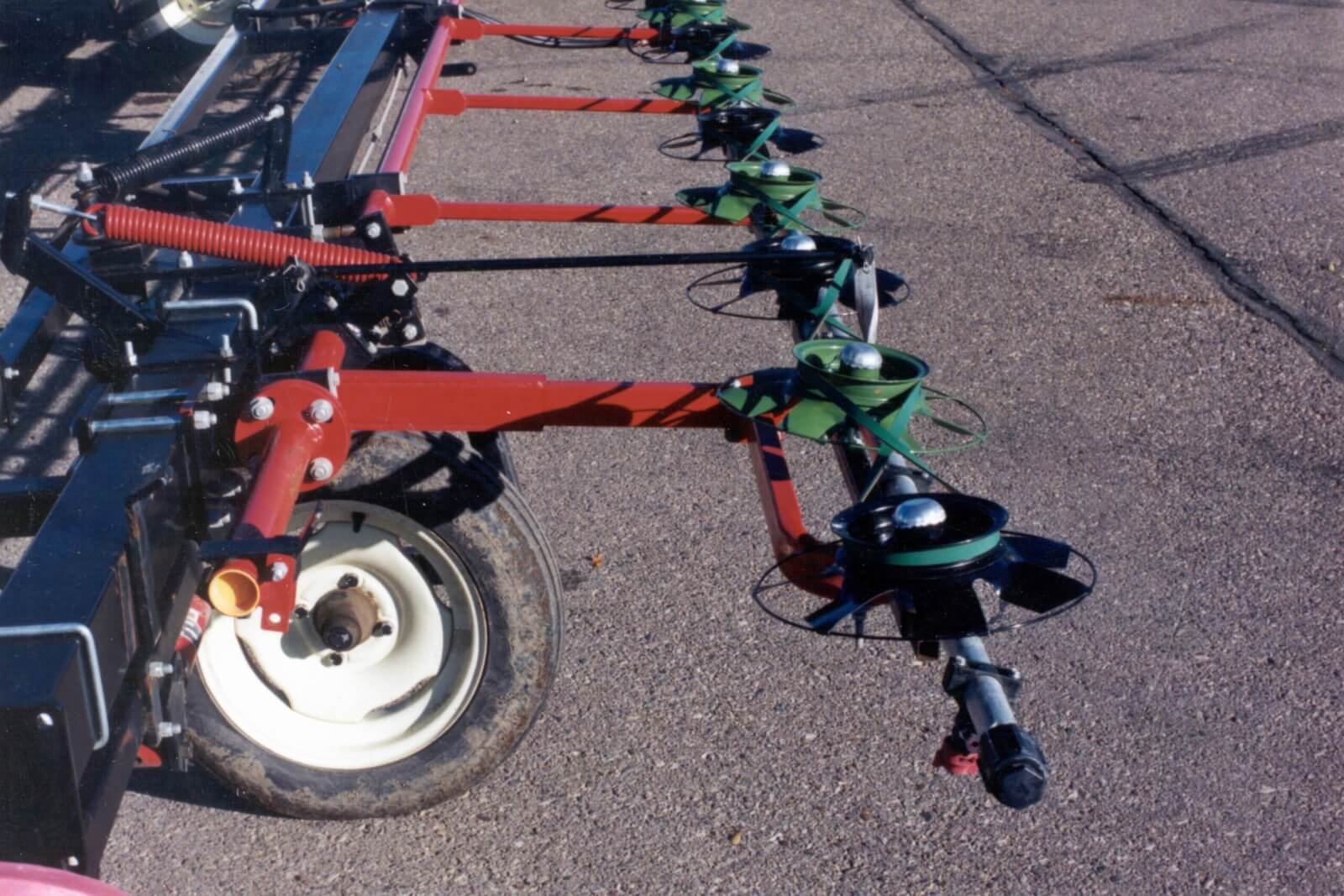
    Figure 8 – An innovative prototype out of Alberta, the “Kaletsch fan sprayer” used pulleys to power the fans (1996, PAMI)

    A fundamental problem with shear-atomization on sprayers like the Spray-Air is the requirement for significant air velocity for the atomization to occur properly. When the canopy cannot absorb that energy, air rebounds and creates drift. And if the operator cannot reduce the airblast strength without adversely affecting atomization, it leads to problems.

    This photo (Figure 9) was submitted by Mr. L. Jones, a cash-cropper in ND, USA. It’s his JD4710 (circa 2004), which has 100′ booms and an 800 gallon tank. What’s interesting is that it has a Miller’s Spray-Air. This air-assist system is available on Miller’s Nitro and Condor line as well as New Holland sprayers (which are built by Miller). @spray_guy did some work with it on a Condor in field corn. It comes with their dual-flow nozzle system (Shear Guard™ PLUS Air Nozzles plus Dial-A-Drop™) for fungicides (applied at low volume) but you can also use conventional tips for coarser herbicide work.
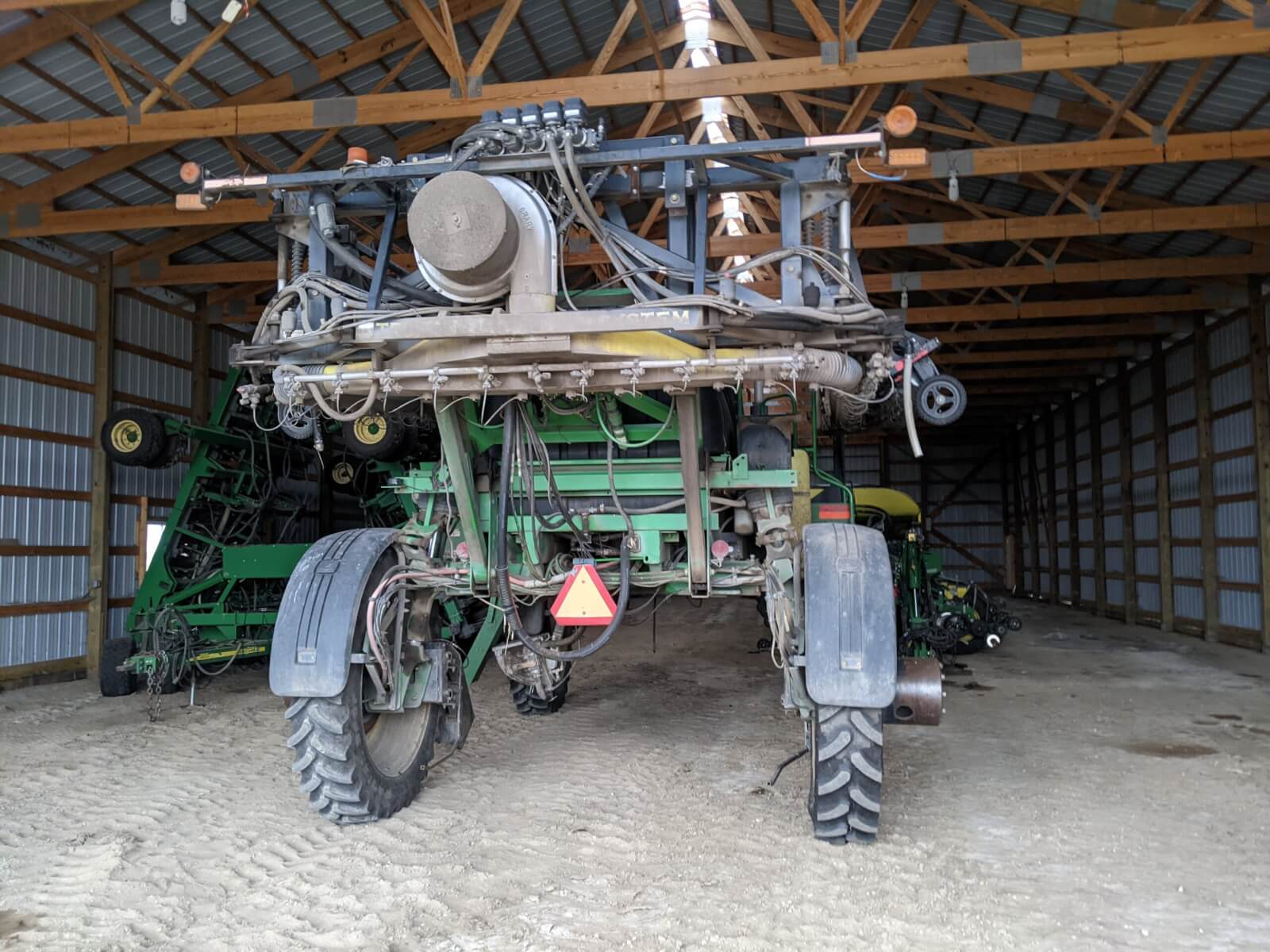
    Figure 9 – A JD4710 with Miller’s Spray-Air and conventional nozzles.

    Mr. Jones says they use the flat fans when spraying a soil-applied herbicide. If it’s moderately windy, they engage the air to reduce drift. When they apply fungicide on wheat they use only enough air to move the heads as they pass over. Bystanders can see the spray enter the canopy and a portion rebounds, which they suggest (and hope) provides some underside coverage. That’s possible, but it’s generally better to keep all the spray in the canopy. This can be achieved by further reducing air speed, increasing travel speed, and/or aiming the air slightly backwards to increase the cross-sectional distance the spray has to travel and slow the spray velocity relative to the sprayer speed.

    Generally, we’re proponents of using air when spraying. It opens the crop canopy, exposes otherwise-hidden surfaces, entrains and carries droplets to the target (reducing drift and improving coverage) and it extends the spray window by out-competing moderate winds. We have no proof, but wonder if it might also help alleviate the negative impact of tire and chassis turbulence on coverage uniformity under the boom. And, before you feel we’ve ignored a big benefit, we’d would be very cautious about using air-assist as a means for reducing carrier volume. The debate about finer sprays at less volume giving greater efficacy continues. While true at times, any benefit needs to be balanced with the downsides of potentially more drift and evaporation.

    Here’s some 2018 footage from an assessment of canopy penetration in field pea using a Miller Nitro with Spray-Air. We see coverage extends deeply into the canopy, the degree of which shares an inverse relationship with depth (fairly classic). Note the heterogeneous mix of smaller and larger deposits from the air-shear nozzles. While some heterogeneity is good, this extreme span represents waste. The product tied up in the largest droplets could have been more gainfully employed as several smaller droplets. This pattern may be the result of using insufficient air energy, preventing the air-shear nozzle from fully atomizing the spray liquid.

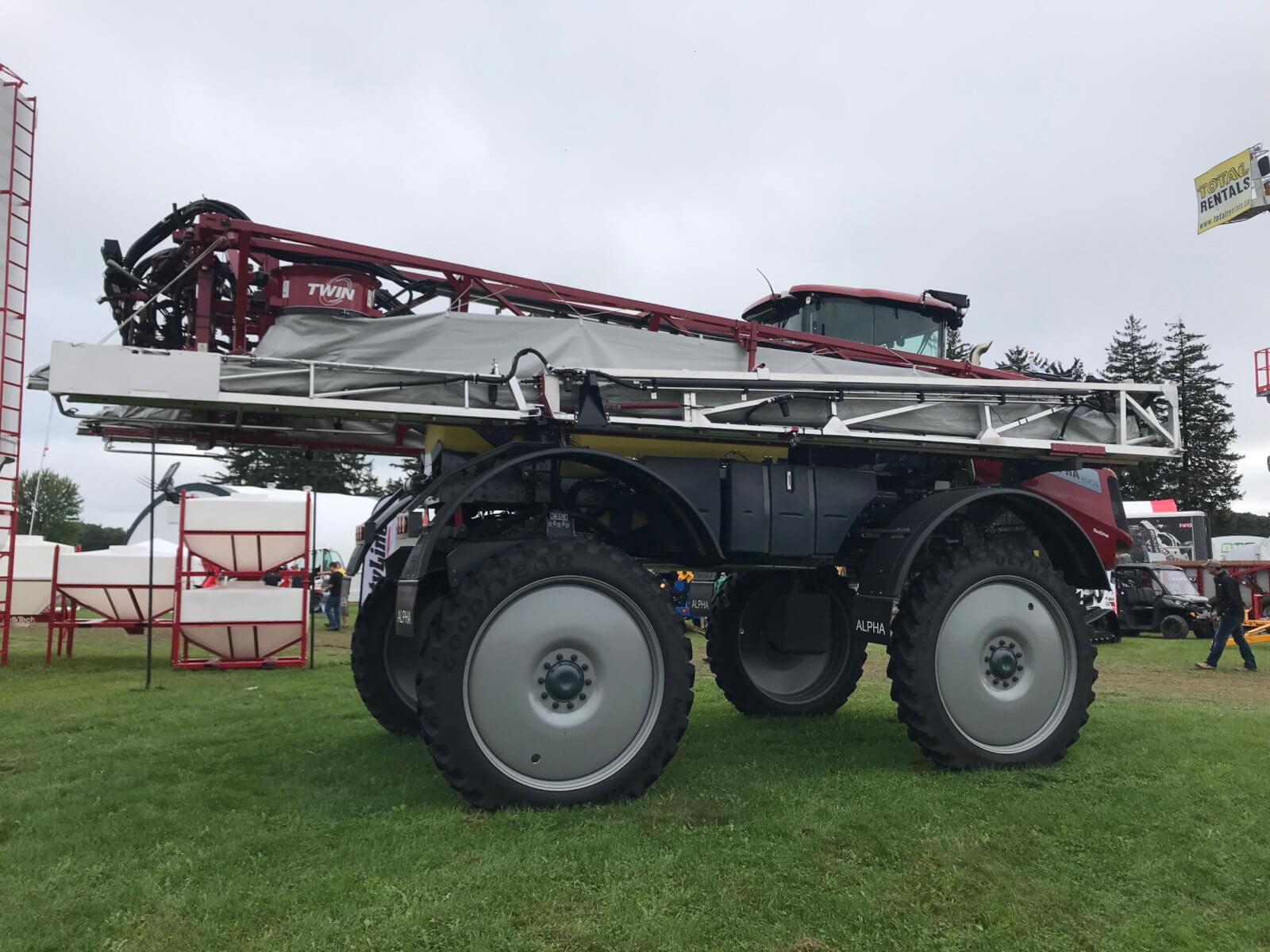
    In 2015 we felt air-assist needed some exposure, so we held a demonstration at Canada’s Outdoor Farm Show. Over three days we used water-sensitive paper to evaluate coverage in a soybean canopy (moderately dense, planted on seven inch centres) from a Hardi Commander (Figure 10) with and without air-assistance. We originally wanted to get our hands on a self-propelled Hardi Alpha Evo (Figure 11), but there were only two in North America at the time and neither were available. By the way, the Alpha Evo is now on the third iteration, but still uses the Twin Force air-assist system which allows the operator to change the angle of the air and the air speed. Each blower can be steplessly adjusted to a maximum output of 2,000 m³/h per m of boom and a maximum (and we’d wager, often excessive) air speed of 35 m/sec. You can watch a video explaining how to dial-in a Twin Force sprayer here.
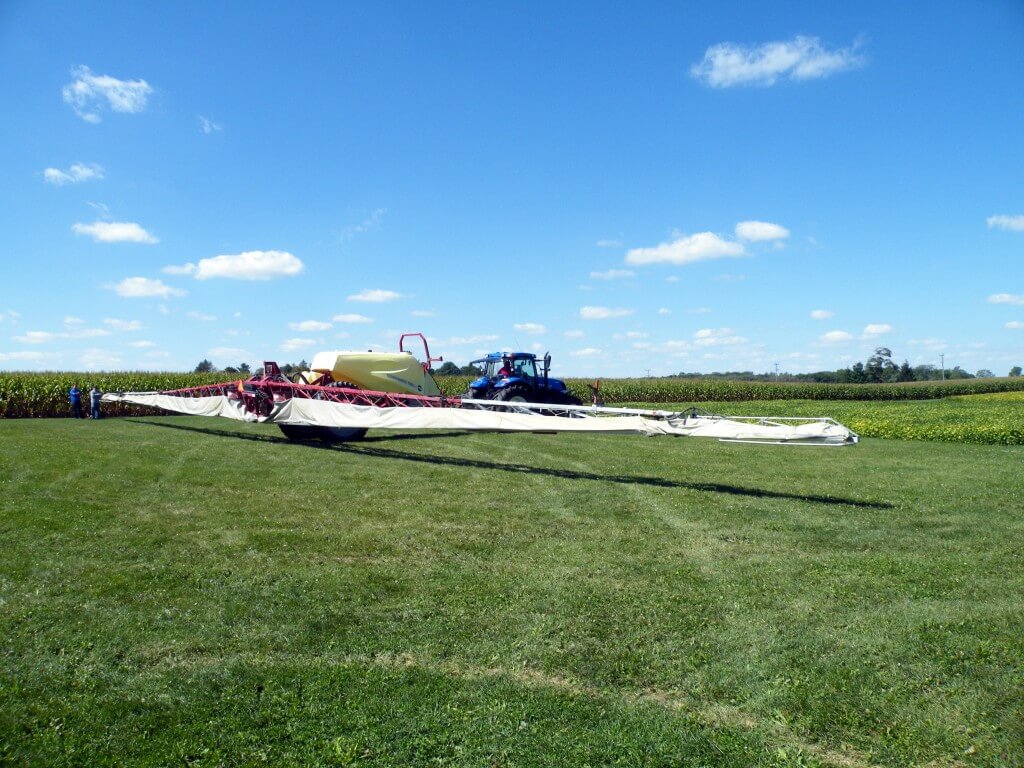
    Hardi Commander (118 foot boom) with TWIN air-assist
    Figure 10 – The Hardi Commander (118 foot boom) with Twin Force air-assist used in a spray demo at Canada’s Outdoor Farm Show.
    Figure 11 – Hardi’s Alpha Evo self-propelled sprayer employs their their Twin Force air-assist system.
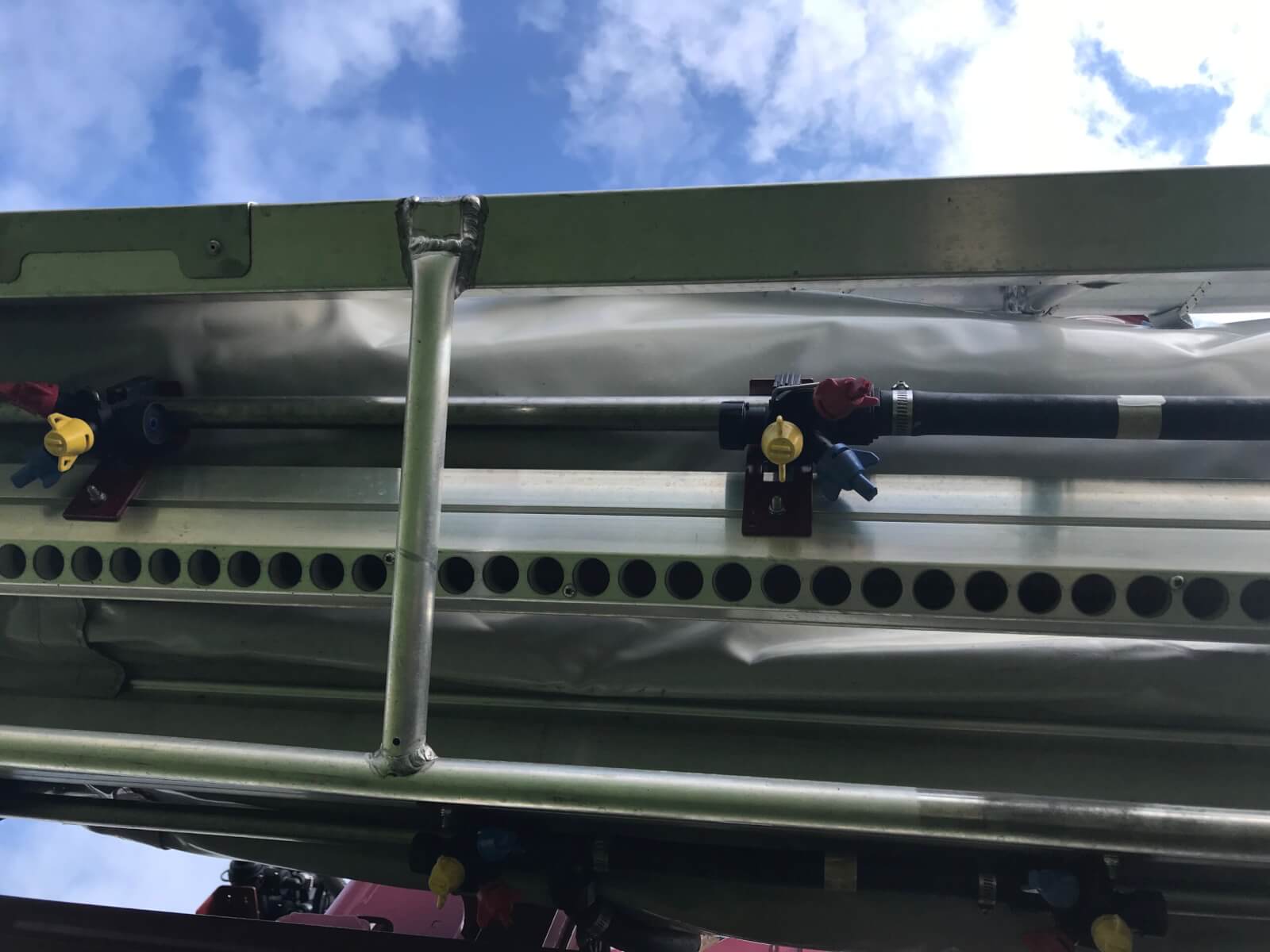
    Figure 12 – Looking up from under the Hardi Alpha Evo boom. Air angle and speed can be adjusted.

    The demo treatments

    The sprayer was calibrated for 93.5 L/ha (10 gpa) at 2.75 bar (40 psi) at 9.7 km/h (6 mph). The boom was suspended 50 cm (20 inches) above the top of the canopy. On one side of the boom, we ran yellow mini drift nozzles (MD 11002’s) to create a Coarse spray quality, and on the other side we ran conventional yellow flat fans (F 11002’s) to produce a Fine spray quality.

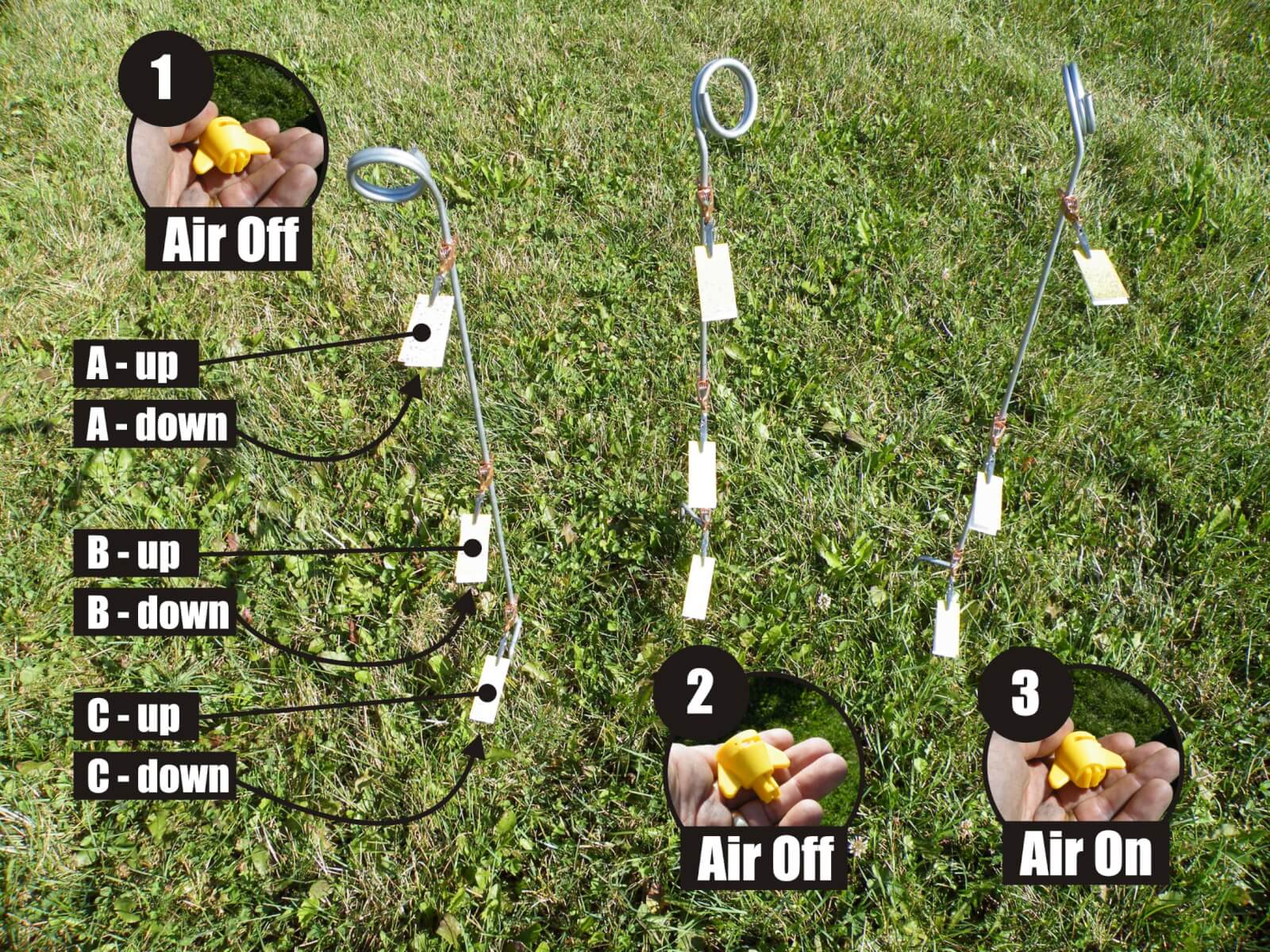
    Water-sensitive paper was attached to rods at three canopy depths: at the top, midway down and at the bottom of the canopy. Papers were oriented both face-up and face-down (Figure 13). Following each application, papers were collected for digital analysis using “DepositScan” which calculates the percent surface coverage and the deposit density. Both of these factors contribute to overall coverage.

    We collected papers from three treatments:

    1. Fine spray quality, No air assist
    2. Coarse spray quality, No air assist
    3. Fine spray quality, Air assist
    Figure 2 - Water-sensitive papers were placed at three levels in a dense soybean canopy, facing up and down, for three conditions. Condition 1 - Air off, conventional 11002’s (medium-fine spray quality). Condition 2 - Air off, mini drift AI11002’s (very coarse spray quality). Condition 3 - Air on, conventional 11002’s (medium-fine spray quality).
    Figure 13 – Water-sensitive papers were placed at three levels in a dense soybean canopy, facing up and down, for three treatments. Treatment 1 (Fine spray quality, No air assist). Treatment 2 (Coarse spray quality, No air assist). Treatment 3 (Fine spray quality, Air assist).

    We held two demos per day at noon and 3:00 pm for three days, giving us six sets of papers to analyze for each treatment. The weather ranged from 25-29°C, 30-58% relative humidity and winds of variable direction from 3-11 km/h.

    This was a simple randomized complete block design, but it was not a rigorous experiment. We simply took the opportunity to gather numbers from the demonstration. A more fulsome experiment would require many, many more passes under more stable conditions. For example, we set the angle of the air and nozzles to about 30° forward and the air speed at maximum, which wasn’t necessarily correct. Ideally, these settings should have been fine-tuned to match the forward speed of the sprayer, the density of the crop and the weather conditions. There was a lot of boom sway (watch the video below).

    And so, caveats aside, the following graph illustrates the mean percent coverage and mean deposit density for papers in each treatment, for papers that were facing up (Figure 14). Standard error of the mean is presented alongside the average (x% ± y).

    Results
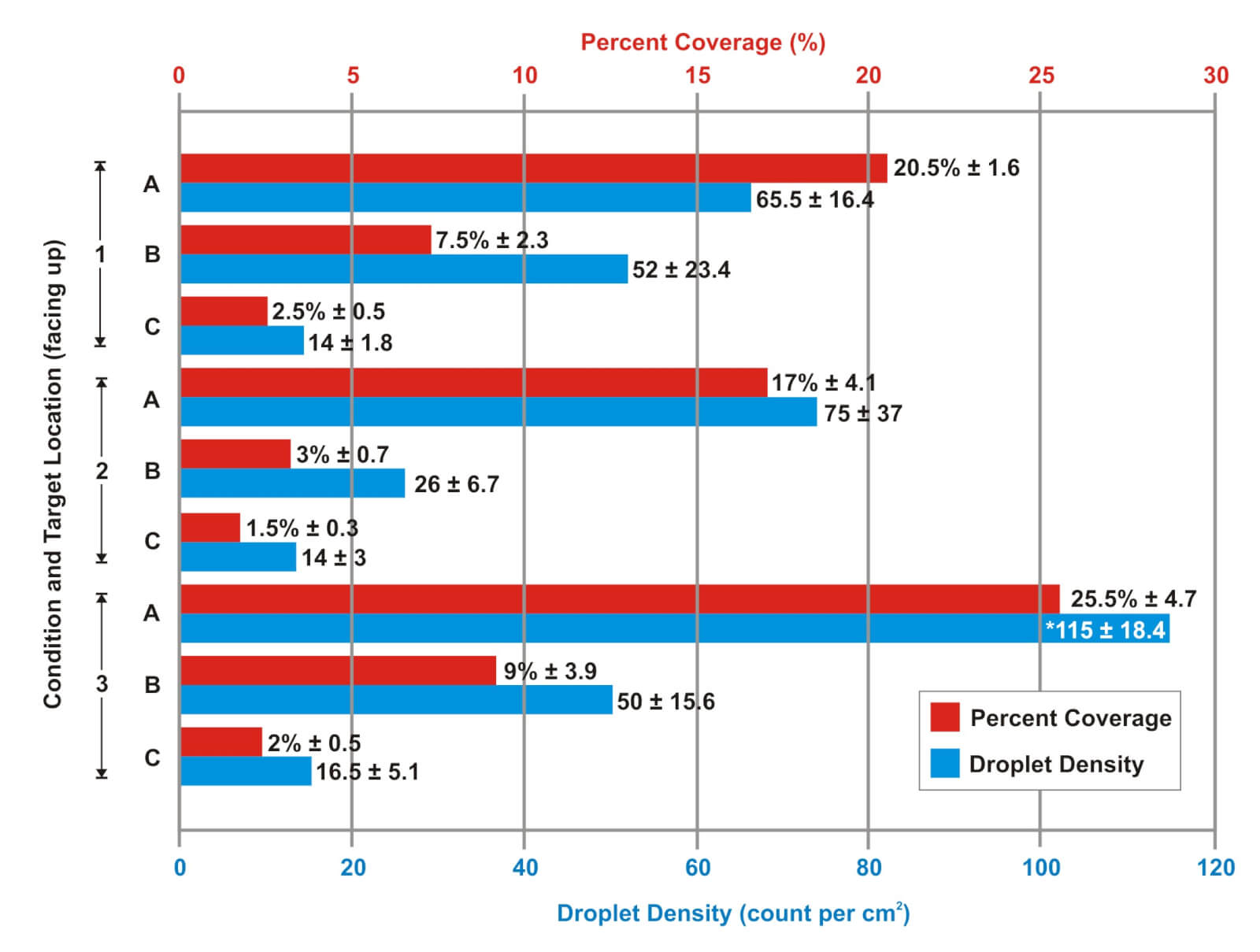
    Figure 3 – Average percent coverage (red) and droplet density (blue) for upward-facing water-sensitive papers in three canopy depths for each of three conditions. Averages rounded to the nearest 0.5 and Standard Error is indicated. * indicates significance with 95% confidence.
    Figure 14 – Average percent coverage (red) and deposit density (blue) for upward-facing water-sensitive papers in three canopy depths for each of three treatments. Averages rounded to the nearest 0.5 +/- standard error. “*” indicates significance with 95% confidence. Condition 1: Fine, No Air. Condition 2: Coarse, No Air. Condition 3: Fine, Air Assist.

    Treatment 1 (Fine, No Air) reflects a typical coverage pattern for a dense canopy. Coverage declines as a function of canopy depth because spray droplets are intercepted by plant material before they reach the ground. This is particularly evident with broadleaf canopies that create shading. The coverage data doesn’t show it, but there was an obvious (and unacceptable) plume of spray drift during these applications (see Figure 15).
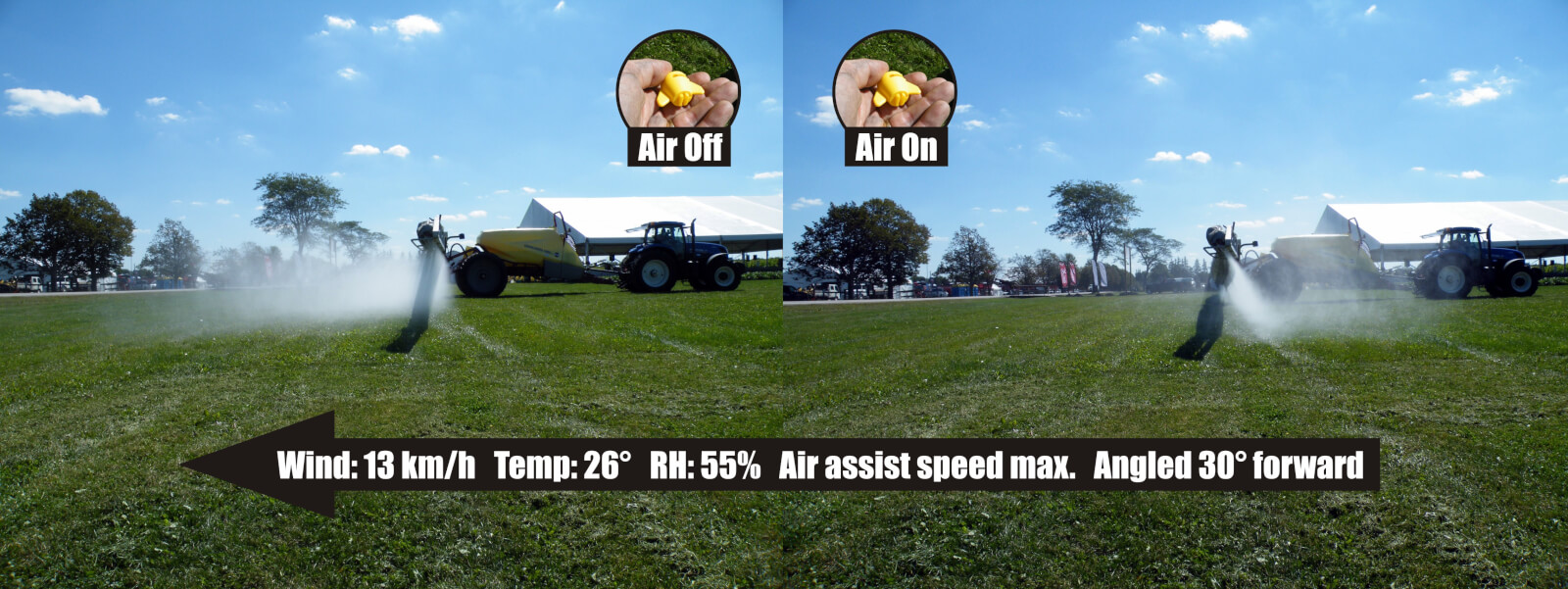
    Figure 4 – The effect of air-assist on downwind drift from a medium-fine spray quality. Note that the nozzles and air are directed 30° forward. When sprayed over bare ground, the air-assist bounces spray back up, as pictured here. However, when sprayed into a canopy with the correct air settings, bounce (and drift) is virtually eliminated.
    Figure 15 – The effect of air-assist on downwind drift from a Medium-Fine spray quality. Note that the nozzles and air are directed 30° forward. When sprayed over relatively bare ground, the air-assist bounces spray back up, as pictured here. However, when sprayed into a canopy with the correct air settings, bounce is virtually eliminated.

    Treatment 2 (Coarse, No Air) follows the same coverage trend as Treatment 1. This treatment represents much larger, and fewer, droplets than Treatment 1, and yet the only obvious difference is reduced coverage in the middle of the canopy. There was little or no plume of spray drift during these applications.

    Treatment 3 (Fine, Air) also followed the trend of reduced coverage as a function of canopy depth. Mean coverage was higher at the top of the canopy compared to the other two treatments. In fact, according to an ANOVA, deposit density was significantly higher in this canopy position than the other treatments, with 95% confidence. While mean coverage in the middle of the canopy was more than 2x that of Treatment 2, it was not statistically significant. There was no apparent difference at the bottom of the canopy. It is important to note that unlike Treatment 1, there was little or no spray drift plume during these applications.
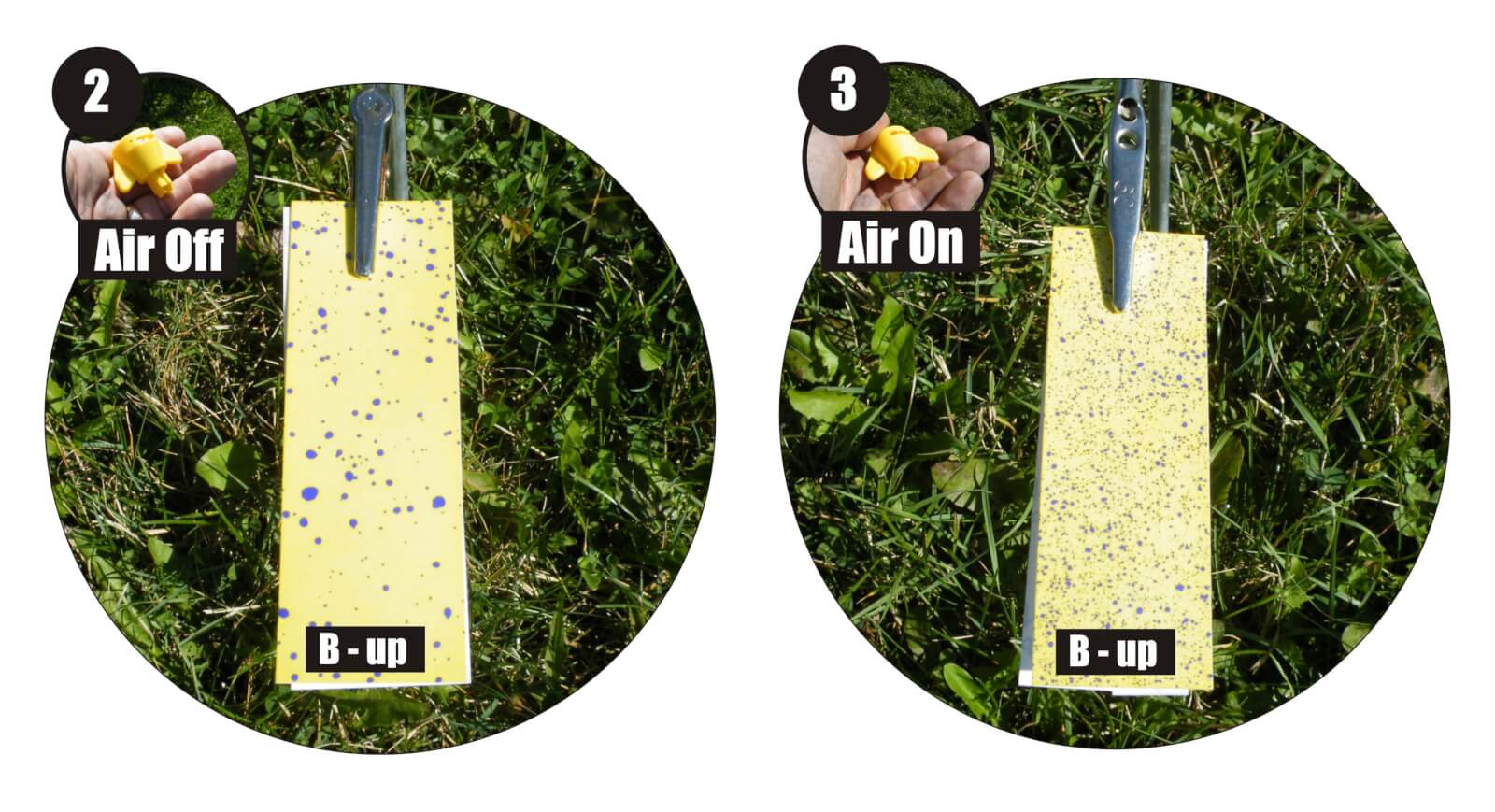
    Figure 5 – Upward-facing water-sensitive paper from mid-way into the canopy (position B) for condition 2 (very coarse droplets, air off) and condition 3 (medium-fine droplets, air on). The difference in coverage is obvious.
    Figure 16 – Upward-facing water-sensitive paper from mid-way into the canopy (position B) for Treatment 2 (Coarse spray quality, no air assist) and Treatment 3 (fine spray quality, Air assist). The difference in coverage is obvious.

    DepositScan was unable to detect coverage on any of the downward-facing papers. However, close visual inspection did reveal differences. Unsurprisingly, Treatment 2 (Coarse, No air)  did not produce any underside coverage; Large droplets do not change direction mid-flight unless acted upon by some other force. Droplets can bounce and shatter, but that did not occur here. The Medium-Fine droplets created in Treatment 1 (Fine, No Air) and Treatment 3 (Fine, Air) did leave trace coverage on the downward-facing surfaces. Generally no more than 10-30 deposits on the entire 1 x 3″ surface, representing less than 1% total surface coverage. It could not be determined if the air used in Treatment 3 improved underside coverage over that of Treatment 1.

    Did air-assist make a difference?

    Let’s start with the literature. Many experiments in peer-reviewed journals show that it does. A perfunctory literature review reveals improved coverage in the middle and lower portions of cotton, potato, soybean and wheat canopies. Some of these experiments were based on coverage using fluorescent dyes, and some with water-sensitive paper. Others were based on efficacy and report improved crop protection. The actual implementation was highly variable with some authors recommending angling the air and nozzles forward 20-25°. Others proposed 30° backwards. Most agreed (as do I) that the air speed should be set relative to the canopy density where higher speeds improved coverage deeper in the canopy, but did so at the expense of coverage in the higher canopy. Picture a bell curve on it’s side where the Y axis is canopy depth and the X axis is coverage; More air shifts the peak of the curve down the Y axis, into the canopy.

    As for our demonstration, some interpretation is required. If an operator is spraying a contact product with limited or no translocative properties, then coverage becomes especially important. In order to improve coverage, higher volumes and finer droplets combined with slower travel speeds are often advised. This may be impractical, as most operators prefer to use less water and drive faster.

    When we used Medium-Fine droplets with no air assist, coverage was good (Figure 14) and better than coverage obtained using Very Coarse droplets. However, spray drift was unacceptable (Figure 15). When air-assist was engaged, we reaped the coverage advantage of smaller droplets and drift reduction as good or better than what we saw with coarser droplets. Unexpectedly, we did not see an obvious improvement in coverage from the air assist. This begs the question “If the spray didn’t drift, where did it go?” This demo was a far cry from a formal mass accounting exercise, but my guess is it wasn’t effectively captured by our collectors and that a hefty fraction ended up on the ground. We would expect more uniform coverage under the boom, and some improvement in canopy penetration, but our ad hoc experiment wasn’t sophisticated enough to reveal it.

    In the end, we feel there are advantages to the air-assist mechanism. The ability to employ a finer spray quality when required, while greatly reducing spray drift and combating inclement weather to extend the spray window are appealing features. Research has clearly demonstrated that deep-canopy spray coverage and overall efficacy are improved when this system is properly adjusted to match spray conditions. We’re not comfortable with suggesting it warrants lower carrier volumes (i.e. not dose) because of the expertise required to adjust the system. However, to be fair, experienced operators have accomplished it

    We hope to see more air-assist options on boom sprayers.

  • Drop Hoses Improve Coverage in Field Peppers

    Drop Hoses Improve Coverage in Field Peppers

    In early July 2016, a farm supplier contacted us on behalf of a client with a history of disease control issues in his field pepper operation. He wanted us to calibrate their sprayer and diagnose spray coverage to see if there was room for improvement. Improved coverage doesn’t necessarily mean improved efficacy, but generally it’s a reliable indicator. When we arrived at the field the winds were gusting over 15 km/h, which had the potential to create a massive drift issue. We were only spraying water, so it was decided that if we managed decent coverage in those conditions, there would be no need to worry on an acceptable spray day.

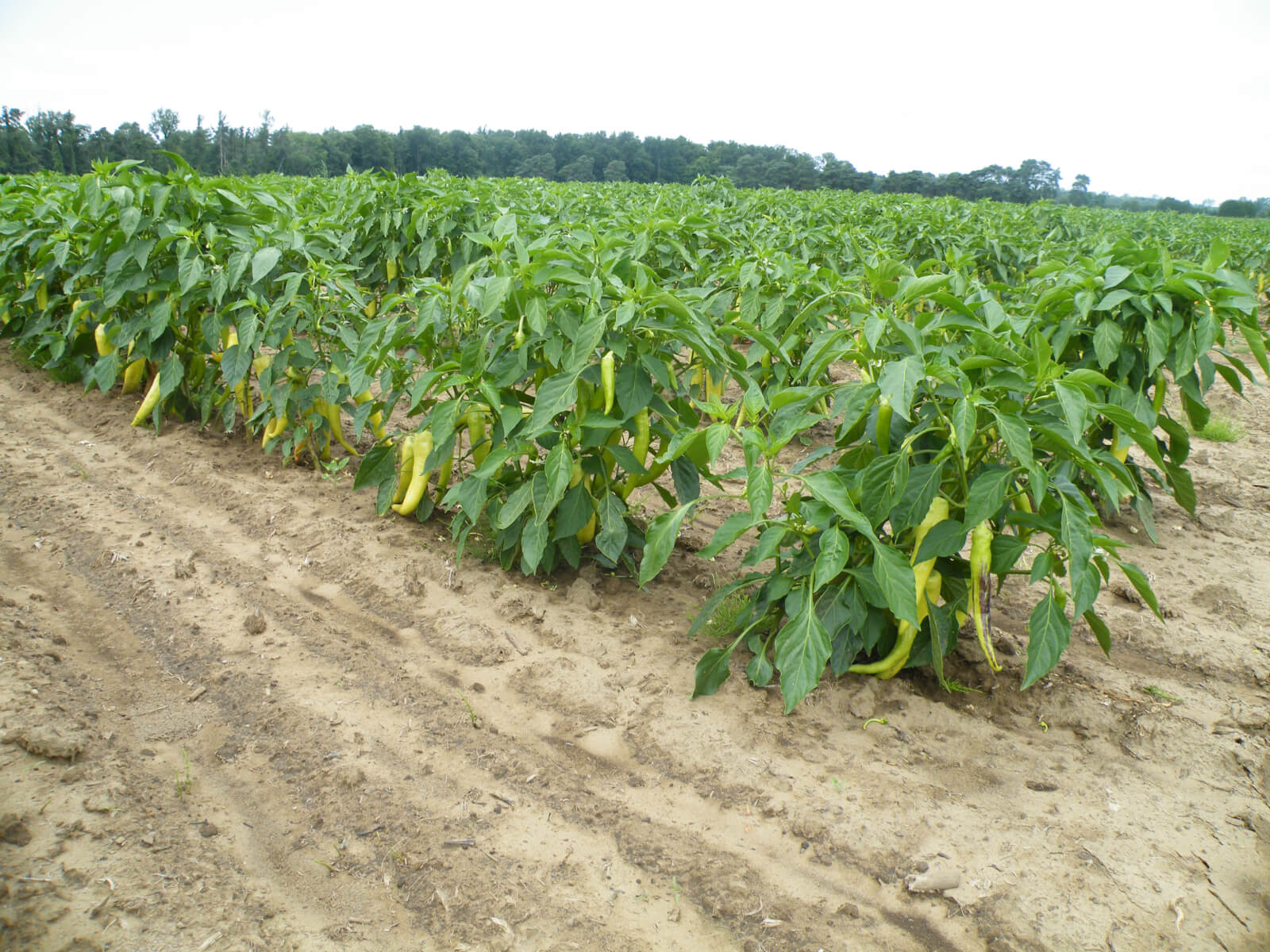
    Field pepper in Southern Ontario in mid-July
    Field pepper in Southern Ontario in mid-July

    The grower traditionally ran two different settings on his sprayer. They were relatively low volumes for a vegetable operation, but the crop was still small at this stage, so we did not propose raising the volume:

    1. TeeJet AITX 11008’s on 50 cm (20″) centres at 11.25 kmh (7 mph) and 3.44 bar (50 psi). That’s 3.35 L/min (0.89 gpm) per nozzle for a total rate of 350 L/ha (37.5 gpa).
    2. TeeJet ConeJet TXVK18’s on 50 cm (20″) centres at 7 kmh (4.5 mph) and 3.44 bar (80 psi). That’s 1.6 L/min (0.42 gpm) per nozzle for a total rate of 275 L/ha (29.5 gpa).

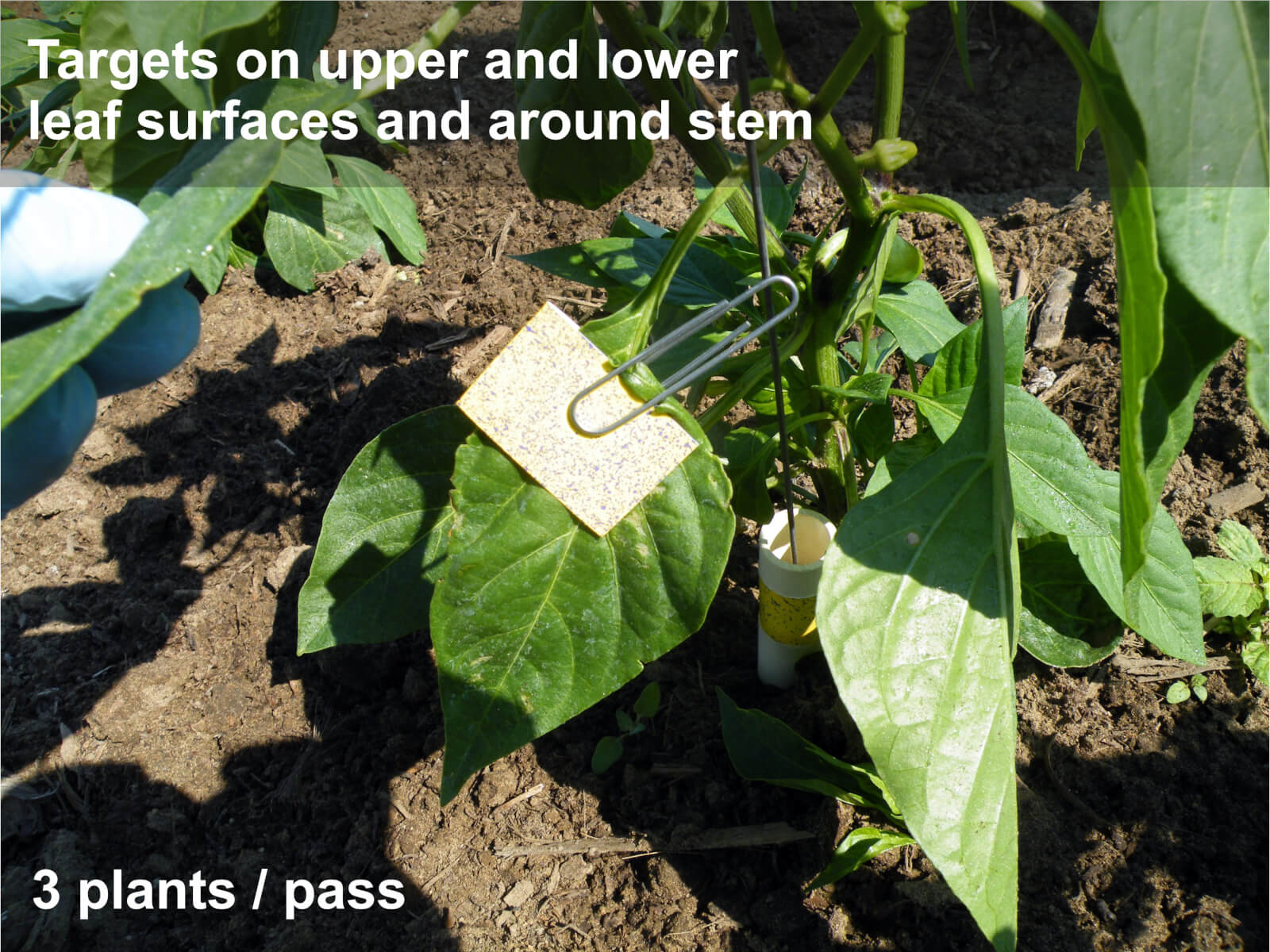
    To test the coverage with these settings, we folded a piece of water-sensitive paper over a leaf to cover both surfaces, and wrapped one around a hollow tube to mimic a plant stem (see figure). Three plants were papered for each sprayer pass. Papers were collected, digitized and analysed for percent-coverage and droplet density. When diagnosing coverage for a horticultural crop, a distribution of 85 medium deposits/cm2 and 10-15% coverage is a reasonable standard for most applications.

    Location of water-sensitive papers in situ.
    Location of water-sensitive papers in situ.

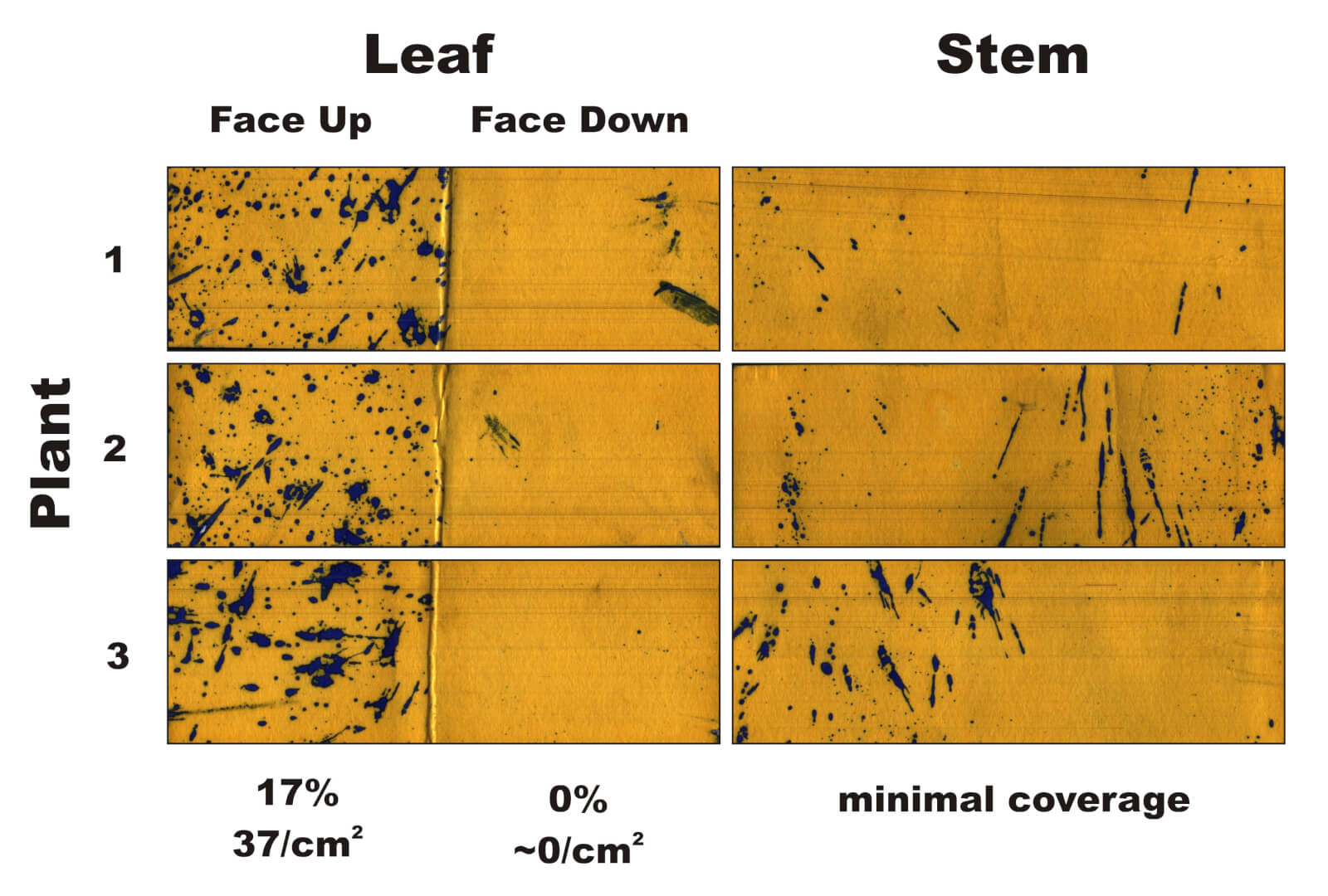
    The first condition (the AITX tips) averaged 17% coverage on upper leaf surfaces (37 deposits/cm2). These were coarser droplets at relatively low volume, so it was no surprise that we didn’t achieve 85 deposit/cm2 target. When using such large droplets, it is more important to achieve an even distribution and the 10-15% surface coverage (we achieved 17%). There were no deposits on the underside of the leaves (See figure 1), but that was also expected as coarser droplets tend to follow a downward vector that is not conductive to under-leaf coverage.

    Figure 1 - Water-sensitive papers from three plants sprayed in Condition 1. Percent coverage and droplet density are calculated for the leaves, and a visual inspection is made of the stems.
    Figure 1 – Water-sensitive papers from three plants sprayed in Condition 1. Percent coverage and droplet density are calculated for the leaves, and a visual inspection is made of the stems.

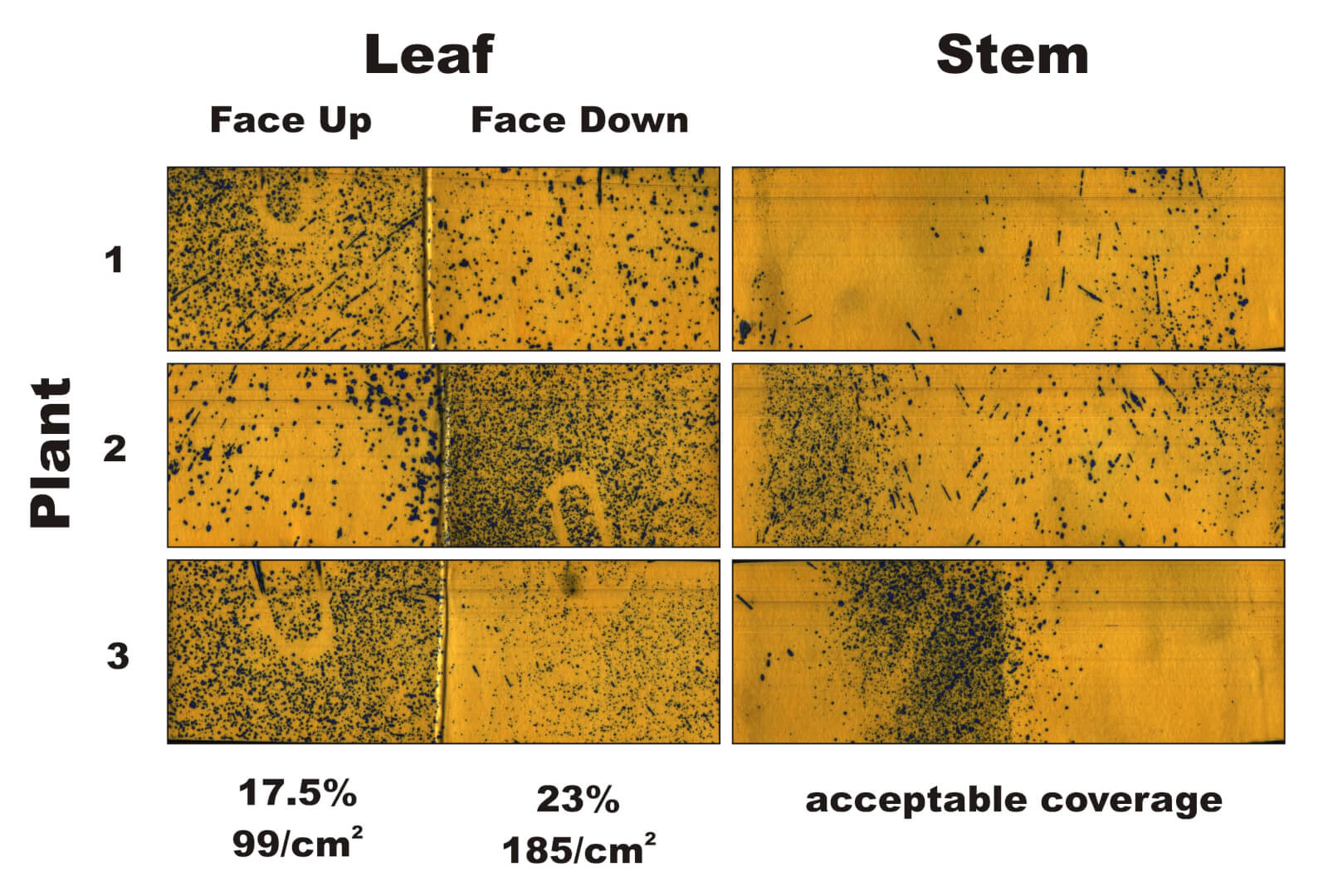
    The second condition (the ConeJets) provided better coverage. The fine droplets produced covered an average 17.5% coverage with a distribution of 99 deposits/cm2 on upper surfaces, and 23% coverage with a distribution of 185 deposits/cm2 on lower surfaces. Panoramic stem coverage was improved as well (see figure 2). This is excellent coverage, but the finer droplets were highly prone to drift (see below). With no form of drift control, this set up is undesirable.

    Figure 2 - Water-sensitive papers from three plants sprayed in Condition 2. Percent coverage and droplet density are calculated for the leaves, and a visual inspection is made of the stems.
    Figure 2 – Water-sensitive papers from three plants sprayed in Condition 2. Percent coverage and droplet density are calculated for the leaves, and a visual inspection is made of the stems.
    With no form of drift control, the fine droplets produced by hollow cones create unacceptable spray drift, even in moderate wind conditions.
    With no form of drift control, the finer droplets produced by hollow cones create unacceptable spray drift, even in moderate wind conditions.

    This led us to propose a more directed boom arrangement: We set up a hollow cone over the row (the grower’s original ConeJet) and a drop hose suspended in each alley with two TeeJet XR 8004 flat fans positioned on an angle (i.e. not vertical or horizontal to ground). This gave sufficient height to span the canopy with as little direct waste on the ground as possible. As the crop grows, the nozzles would need to be twisted into a more vertical alignment.

    ConeJet TXVK18’s alternating with drops with TeeJet XR 8004’s.
    ConeJet TXVK18’s alternating with drop hoses with TeeJet XR 8004’s.

    We did not use an air induction fan to avoid the Very Coarse spray quality and we used 80° instead of 110° to ensure the spray did not overshoot or undershoot the plant. Here are the details of the third set up:

    3. TeeJet ConeJet TXVK-18’s on 100 cm (40″) centres at 7 kmh (4.5 mph) and 3.44 bar (80 psi). That’s 1.6 L/min (0.42 gpm) per nozzle. Also, two TeeJet XR 8004’s per drop on 100 cm (40″) centres at 7 kmh (4.5 mph) and 3.44 bar (80 psi). That’s ~4.5 L/min (1.2 gpm) per drop hose. Together, set of nozzle for a total rate of 523 L/ha (56 gpa).

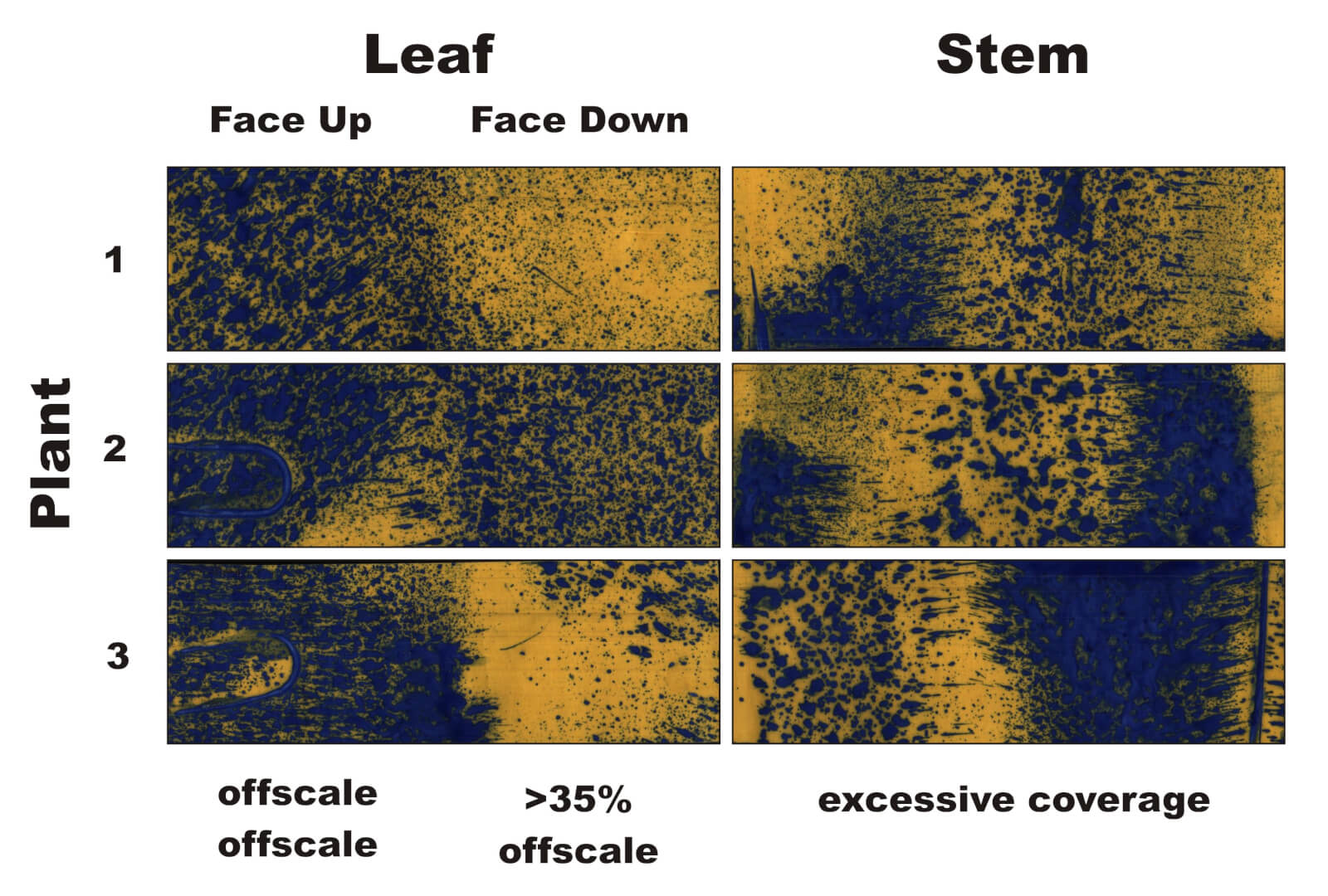
    This set up raised the volume considerably and aimed spray directly at the sides of the plant. Coverage was excessive and in a few cases exceeded what the diagnostic software could reliably resolve (see figure 3). Since the plants were still small at this stage, it was decided we would let them “grow into the volume” and come back to check coverage once they were at full size.

    Figure 3 - Water-sensitive papers from three plants sprayed in Condition 3. Percent coverage and droplet density are calculated for the leaves, and a visual inspection is made of the stems.
    Figure 3 – Water-sensitive papers from three plants sprayed in Condition 3. Percent coverage and droplet density are calculated for the leaves, and a visual inspection is made of the stems.

    When we returned in mid-August the plants had reached full maturity. In this final coverage trial, we added a second water-sensitive paper to each plant to span the height of the crop canopy, which had grown considerably.

    The same pepper plants ~5 weeks later had more than doubled in size.
    The same pepper plants ~5 weeks later had more than doubled in size.

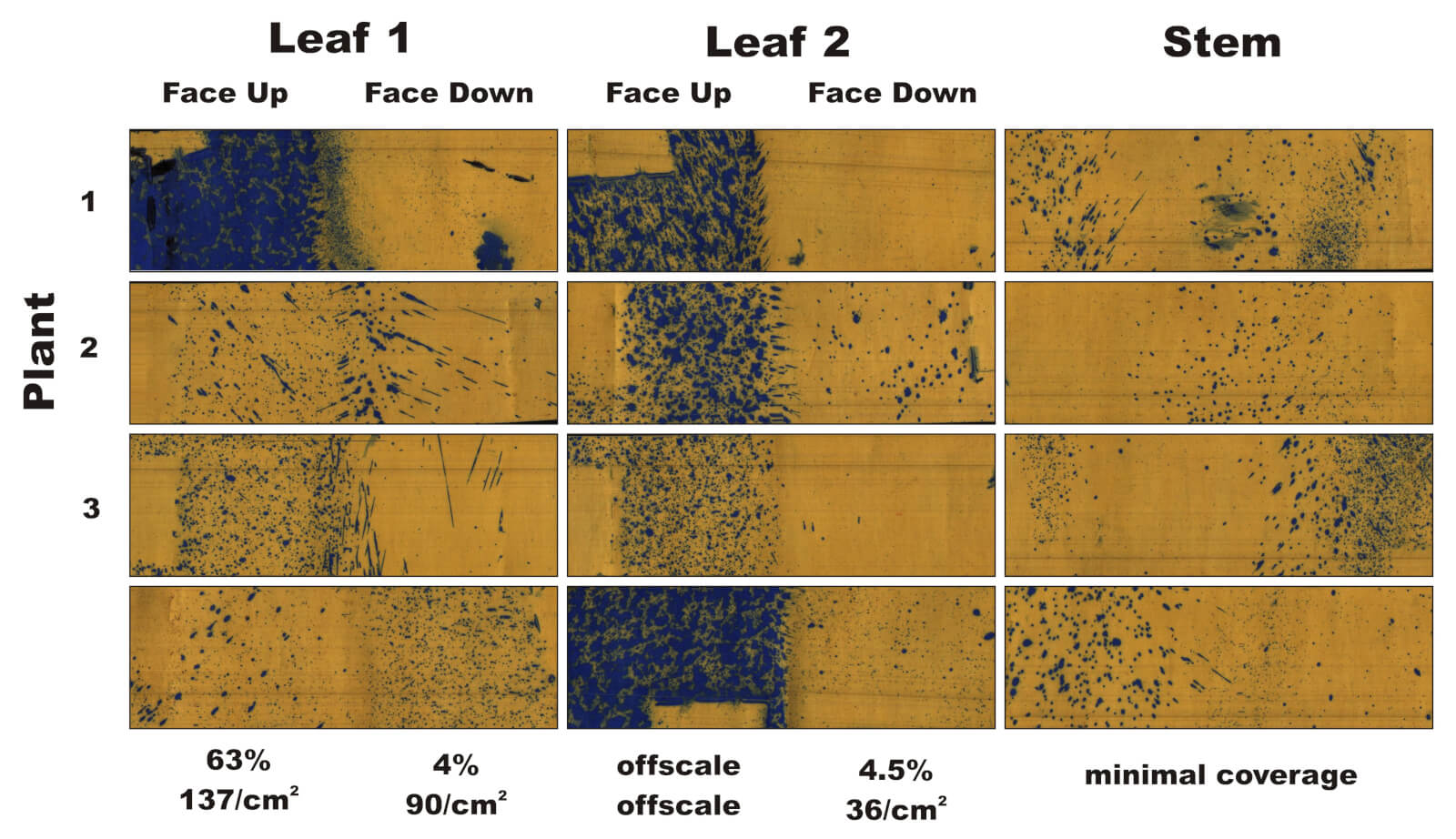
    Coverage was reduced compared to how we left things in July, but appeared to be sufficient on key surfaces (see figure 4). The papers showed upper leaf-surface coverage of 63%-to-offscale and deposit distribution of 137 deposits/cm2-to-offscale. Coverage on the lower leaf surfaces was greatly reduced to 4-4.5% and 36-90 deposits/cm2. Panoramic stem coverage was present, but minimal. Applying higher volumes would likely have improved matters.

    Figure 4 - Water-sensitive papers from three plants sprayed in Condition 3, ~5 weeks later. Percent coverage and droplet density are calculated for the leaves, and a visual inspection is made of the stems.
    Figure 4 – Water-sensitive papers from three plants sprayed in Condition 3, ~5 weeks later. Percent coverage and deposit density are calculated for the leaves, and a visual inspection is made of the stems.

    When asked about the drop hoses, the grower reported “They are a bit of a nuisance because they take extra time to put on, and they get caught in the bush at the back of the field. But if they increase our coverage, then they’re worth the extra effort.”

    Final thoughts

    Adding drop hoses to a vegetable sprayer may be unconventional, but if fungicide coverage is a concern, and the drops will fit between rows, they might be worth a try. Carefully consider the volumes you use because they should reflect the size of the plant canopy you are trying to protect. Finally, water-sensitive paper provides excellent feedback to help you decide if your field volume, nozzle rates and nozzle positions are providing acceptable coverage.

  • How Spot Spraying will Affect Sprayer Design

    How Spot Spraying will Affect Sprayer Design

    Some years ago, a friend recommended that I read The Tipping Point by Malcolm Gladwell. In this book, Gladwell tries to understand why some things catch on, and others don’t. It’s a compelling read full of Gladwell’s trademark stories and his knack to deftly interpret scientific studies. He talks of connectors, mavens, and salesmen, as well as the “stickiness factor”, a measure of how memorable something is, as keys to success of products and ideas. I think of the book often as I ponder the many good ideas in agriculture, many of which never see widespread adoption.

    One of these good ideas is spot spraying. Green-on-brown detection was first introduced in the early 1990s. Anyone remember the Concord DetectSpray? It was great but had bad timing, as resistance wasn’t a big issue and glyphosate prices were about to slide. Green-on-brown grew to the NTech (later Trimble) WeedSeeker a few years later. Rometron’s WEEDit built on Trimble’s success and found widespread adoption in Australia in the past ten years. Spot spraying did not gain any traction in North America during this time.

    Australia is unique in many ways, not the least of which is their summer spraying practice. Summer is the hot, dry season where land is typically fallow and weeds are kept in check with herbicide sprays (aaaah, the serenity). Making several passes over a field, combined with the need to control some larger and hardy plants, is expensive, and a spot spray saves much of the cost. The savings can be put to use with more effective herbicide tank mixes that delay the onset of herbicide resistance. Spot sprays pay for themselves in short order Down Under.

    It’s more of a challenge in the northern plains of North America, where the fallow season involves snow cover and burnoff occurs in a short window before seeding and sometimes after harvest. But nonetheless, spot sprays have a fit for many of the same reasons.

    WEEDit is the first system to make serious inroads in North America, with several dozen systems having been retrofitted to high-clearance sprayers. High detection accuracy and hardware reliability is proven in three seasons.

    On March 2, 2021, John Deere entered the Green-on-brown spot spray area with See & Spray Select. This not to be mistaken as competition. Instead, the entry of a major brand provides validation of the concept like only a large manufacturer can. Yes, we’ve reached a tipping point.

    While the first Green-on-brown units are becoming established, Green-on-green, the ability to detect weeds within a crop, continues to be developed around the world. French startup Bilberry has made enough gains in Australia to bring its product to market with Agrifac, where it’s called AIC Plus. In farmer field trials, they have achieved 90 per cent detection accuracy of wild radish in Western Australia, and claim that they are ready for broadleaf weed identification in wheat, barley and oats. Bilberry’s technology will also be seen on Australia’s Goldacres and France’s Berthoud. Other startups, notably Israel’s Greeneye Technology, plan to introduce a Green-on-green system in the U.S. in the near future. Amazone, the German farm equipment giant, partnering with Xarvio and Bosch, announced plans at Agritechnica to have a commercial unit for sale by 2021.

    This technology will have significant impact on sprayer design philosophy. At present, productivity is synonymous with capacity, and large tanks with commensurate heavy and powerful tractor units dominate. Spot spraying savings will depend on weed density and hardware resolution, but 50 per cent to 90 per cent reductions in spray volume can be expected. A 1,600-gallon tank would no longer be necessary. The savings in frame weight and horsepower would be significant, as would the time savings from less intense tendering demands. These savings would offset the lower driving speeds that accompany sensing technologies, and, overall, provide a lower bar for autonomous operation. We may see lighter specialty spot sprayers.

    The savings in brute size will be countered by increased sophistication. Better boom height management is essential for spot spraying, not just for the sensor to properly see the target and estimate the time needed for the boom to reach that spot, but also for the spot spray itself to deliver the right dose. In any fan spray, band width at ground level changes with height, and that, of course, is related to dose. Trailed booms can address this issue easily.

    But not everyone wants a specialty spot sprayer that would require an extra pass over the field. With growing utility of soil residual herbicides, dual tank sprayers—small tank for the spot spray, large tank for the broadcast residual—make sense. Large sprayer frames can accommodate an additional smaller tank, second pump, and plumbed boom easily.

    Plant detection and identification bring other opportunities. Adjusting dose for plant size is one of the first, or for harder to control weed species.

    Spot sprays rely on fast, precise response of the nozzle, and this provided by fast-reacting solenoids that are part of pulse-width modulation (PWM) systems. On a broadcast sprayer, these solenoids can change the emitted dose instantly, within a certain envelope, by altering the duty cycle of the pulse. This, however, works best in the context of a boom with overlapping spray patterns. A single band spray would not change dose with duty cycle as easily.

    Higher dosing would be an opportunity for multiple nozzle bodies that are able to spray one, two or more nozzles in the same spot simultaneously. These are already widely available and popular in Europe.

    This also brings direct injection into play. Current systems introduce the active ingredient into the boom upstream of the nozzles, affording it time to mix into the water. For true spot spray utility, though, direct injection ought to be at the nozzle. Only then can custom mixes and rates be applied on a spot basis. It’s been done before, if only to show how difficult it would be to deliver uniform doses to a spot spray machine.

    Spot spray sensors have agronomic benefits. By recording the location sprayed, weed patches can be mapped. As plant identification becomes possible, it’s conceivable to obtain plant species and stage distribution maps from the spray pass That would turn the sprayer into a high-resolution crop scouting tool. As machine learning and sensor sophistication grows, other plant and soil parameters can be mapped. The agronomic value of such maps, especially if created over the course of the growing season, is immense. Of course, data density, handling, storage, and analysis will constrain this.

    If the past has taught us anything, it’s that there seems to be a appetite for investment in farm equipment. Sprayers have been the most-used implement on the farm for some time, and their popularity continues despite sharp price increases. These new capabilities will only add value to these implements. Prepare for sticker shock, followed by acceptance and adoption.

    What will a future spot sprayer look like? Although it will have tanks and booms, the level of electronic sophistication will make it so much more versatile we can’t yet imagine all the ways in which it might be used. But it seems to me the situation has tipped and we’re already accelerating toward that future.

  • Air Orientation for Wrap-Around Sprayers

    Air Orientation for Wrap-Around Sprayers

    One of the pleasures of working in agricultural extension is when you’re able to help a grower solve a problem. This was one of those happy occasions. An orchardist purchased a Lipco multi-row recycling sprayer and wanted help evaluating their spray coverage.

    We worked in 3.7 m (12 foot), mature, high-density Royal Gala trees. The sprayer was driving at 5.0 km/h (3.1 mph), operating at 11 bar (160 psi) using orange Albuz 80 degree air-induction flat fans. This resulted in about 350 L/ha (~37 gpa).

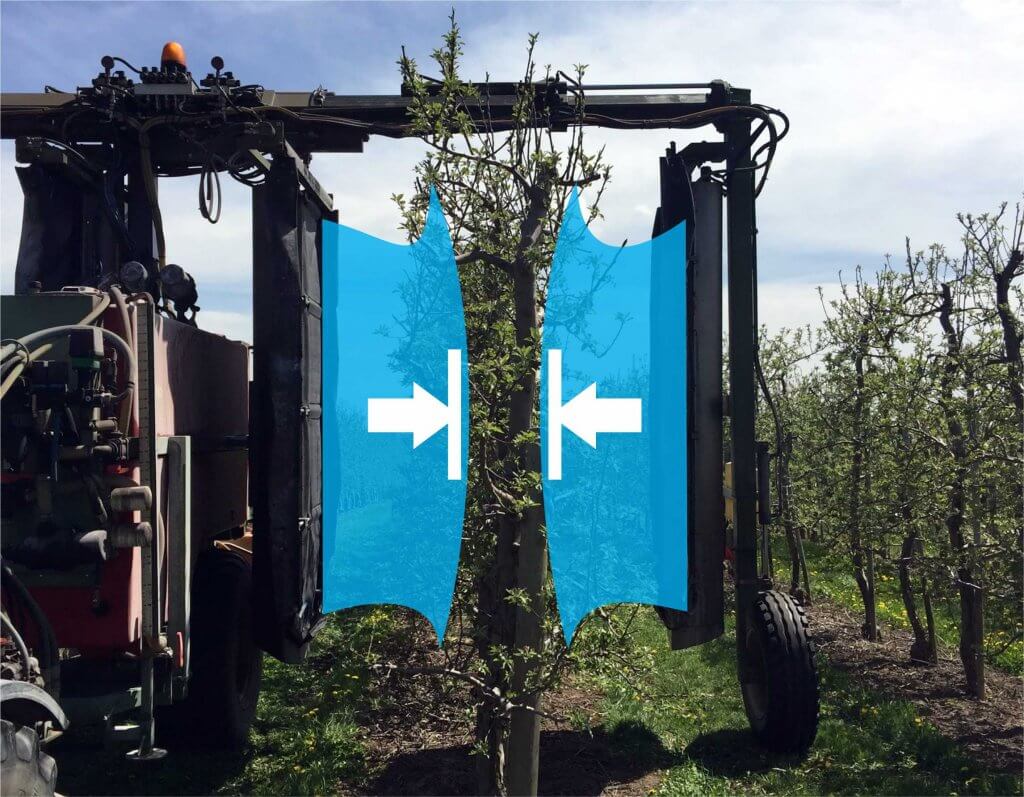
    This grower wisely invested in the air-assist option, which produces a vertical plane of somewhat laminar air to entrain the spray and carry it into the centre of the target canopy. Whatever spray blows through the tree should impact the opposing shroud and get recycled back to the tank. All in all, how could you miss?

    …we managed to.

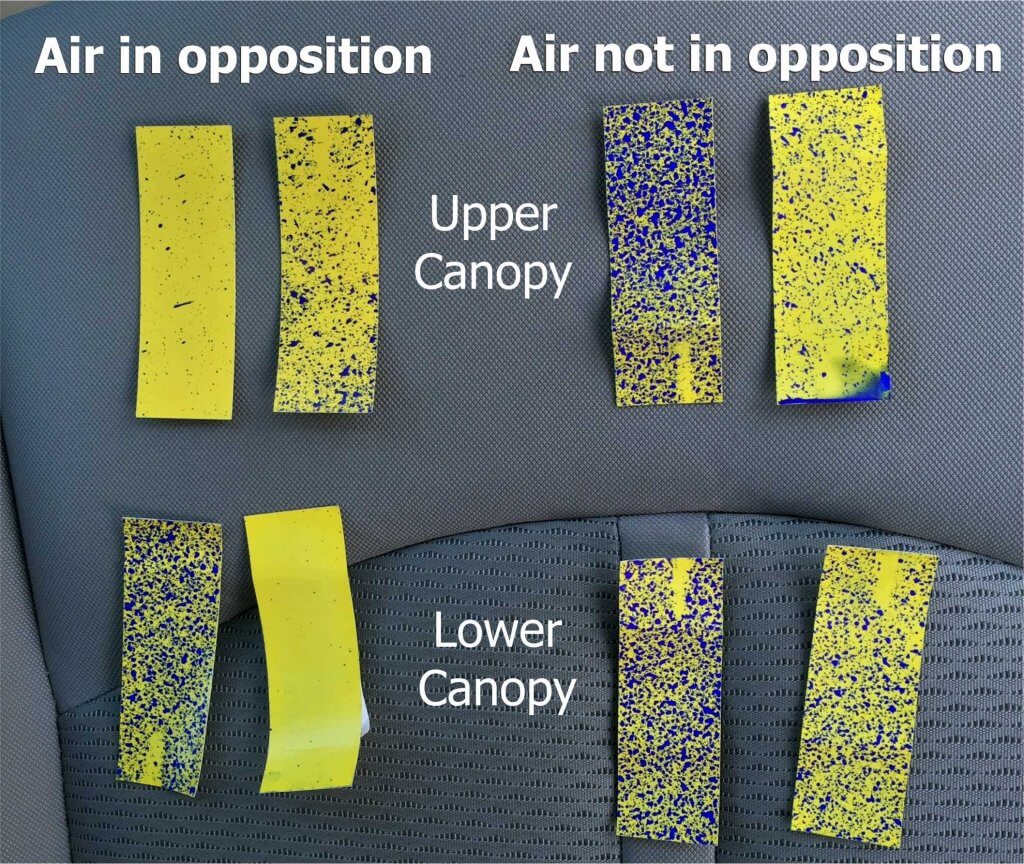
    Water sensitive papers were placed back-to-back facing each alley (in other words, facing the spray booms). Despite our best efforts, each pass resulted in inconsistent coverage. Papers were replaced in the same location and orientation for each pass and no settings were changed. Nevertheless, sometimes a paper got spray and sometimes it didn’t. What was going on? It was as if the two air streams were interfering with one another – almost cancelling each other out.

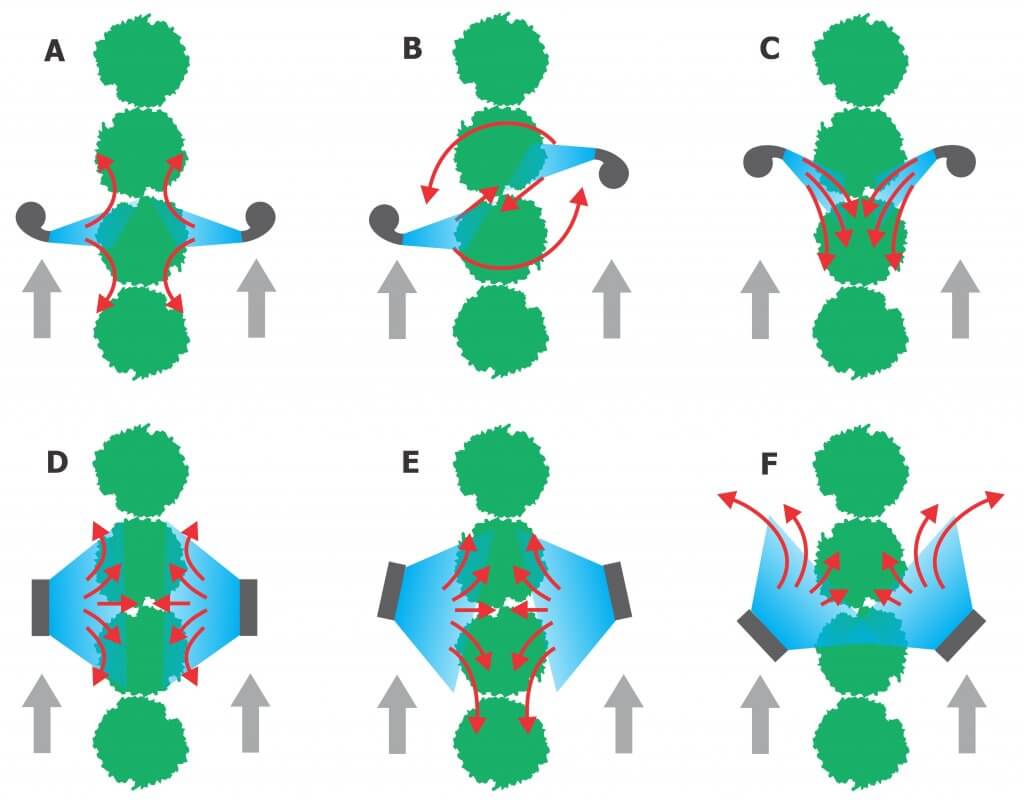
    Air from tangential (cross-flow) fans oriented perpendicular to the canopy in direct opposition will cancel out. This reduces canopy penetration.

    Where possible, do not position laminar air outlets in direct opposition. The convergence creates a high-pressure zone that reduces spray penetration. Some sprayers are designed to avoid this by staggering air outlets one ahead of the other. Laminar flows will deflect unpredictably around this pressurized area and carry droplets back out of the canopy. Unless the canopy is particularly narrow and sparse, turbulent air handling systems do not typically create this problem. In both cases, canopy penetration is improved when fans are staggered and/or are angled slightly forward or backward.

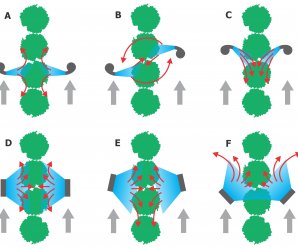
    Grey arrows indicate direction of travel. The air outlets of wrap-around sprayers should be symmetrical when viewed from behind. A. Tangential fans in direct opposition: Poor coverage. B. Tangential fans angled forward/backward: Possible vortices and good coverage. C. Tangential fans angled backward: Good coverage, but if the angle is too steep, air will not penetrate the canopy. D. Straight-through axial fans in direct opposition: Good coverage in denser canopies. E. Straight-through axial fans angled slightly backward: Good coverage but limit the angle to prevent the trailing edge of the air wash from missing the canopy entirely. F. Straight-through axial fans angled forward: Slight angles are acceptable, but too much in this image. Wind created by travel speed subtracts from air energy. This creates a risk of reduced coverage and increased operator exposure.

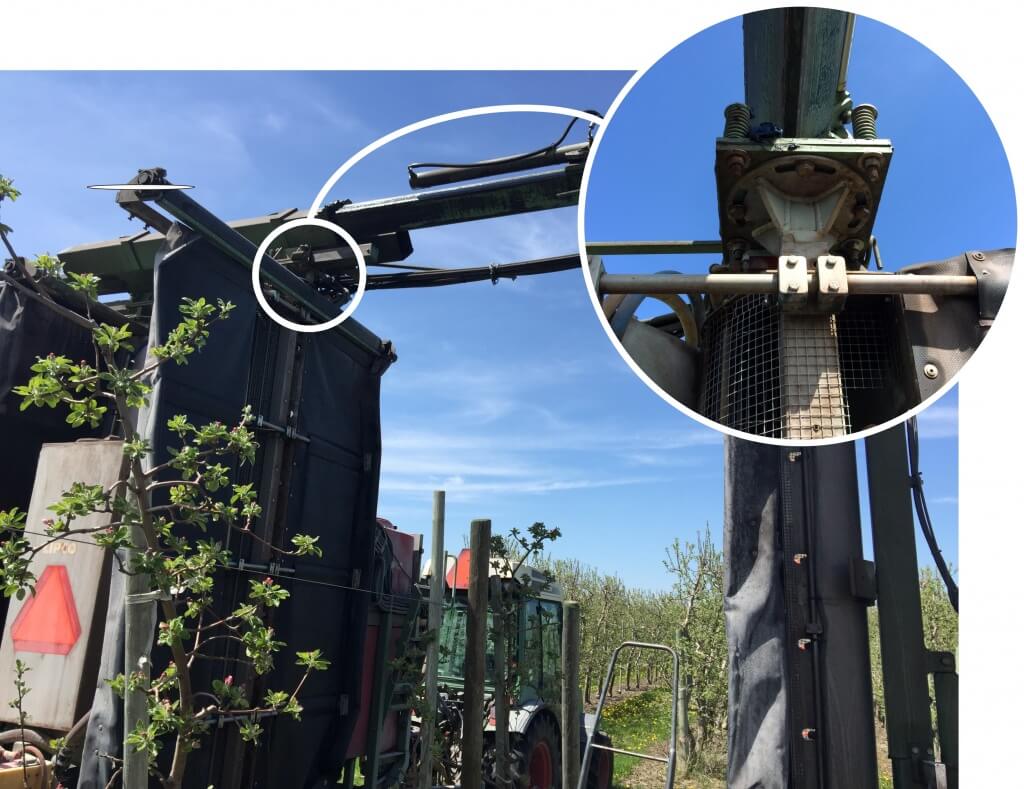
    We decided to turn the outer boom/shroud/fan assemblies 10˚ backward by loosening the four bolts at the top of the gantry (see below). This minor change in configuration improved spray coverage significantly. Increasing the angle beyond 10° might have caused the air wash to trail along the canopy face and would have made sprayer turns difficult at the row ends.

    Figure 3. Four bolts to adjust the assembly angle.
    We loosened the four clamping screws to adjust the fan angle on the outer boom of this Lipco Recycling Tunnel sprayer.

    We replaced the water sensitive papers and ran another pass. The operator later told me he could see the leaves and branches rustling in the row where we made the adjustment, but not in the unadjusted row. The result on water-sensitive paper was dramatic.

    Since experiencing this in 2013, I have been told that the Lipco instruction manual advises against air in direct opposition. It was a poorly translated and somewhat obscure sentence buried in the manual, but I concede that it was there. Determine whether your sprayer produces more laminar or more turbulent air, and explore how their relative orientation impacts canopy penetration.

    Cross The Streams!!!
    Sometimes, you just have to cross the streams!
  • New Use for Bourgault 1460 Field Sprayer

    New Use for Bourgault 1460 Field Sprayer

    This week I spoke with Gerry Bell, a producer from near Gravelbourg in southern Saskatchewan (a beautiful town with a historic downtown, church and school, also, home of the Gravelbourger at the local diner). He told me about a project he recently completed, converting his older pull-type sprayer to a granular spreader. It’s a great project, worth sharing.

    The concept was first popularized by Manitoba farmer Kyle Holman in 2012, who uses the #SprayMar hashtag on Twitter to promote it.

    Gerry wrote his project up for us and I’ve posted his description below.

    Bourgault 1460 Field Sprayer

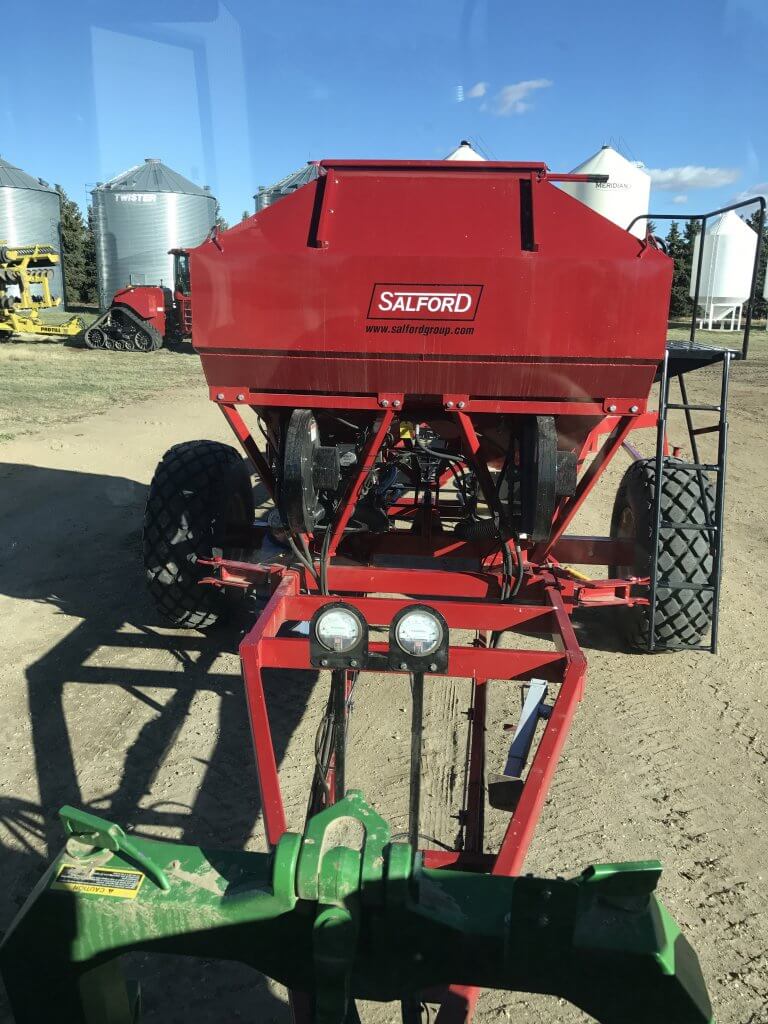
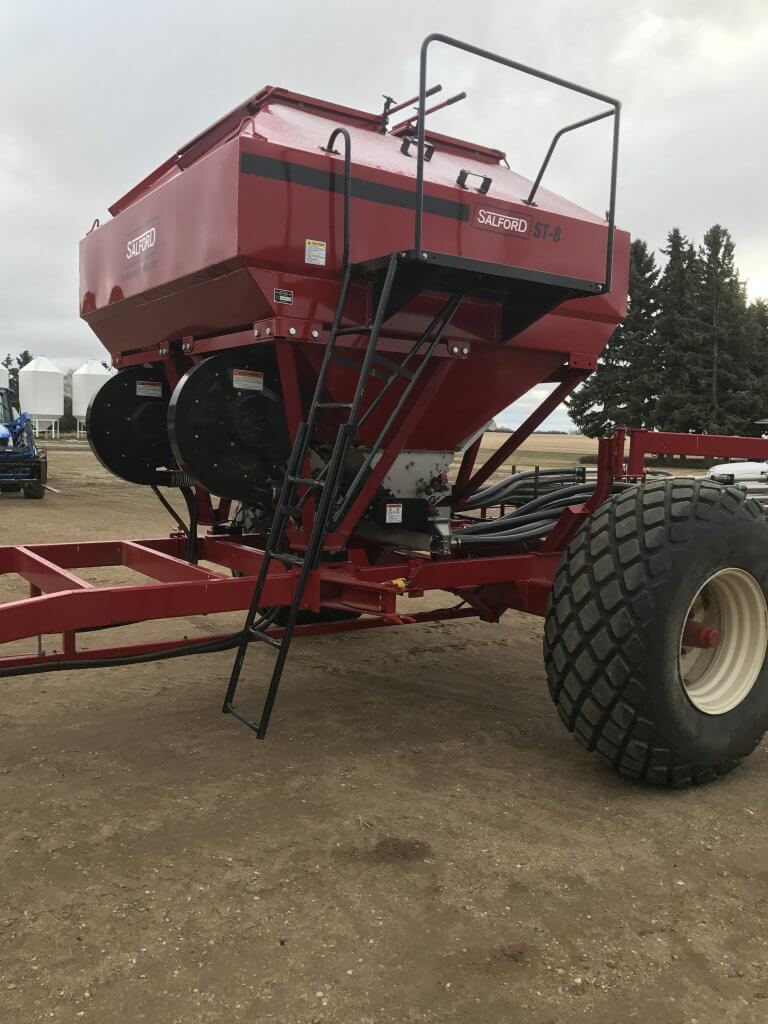
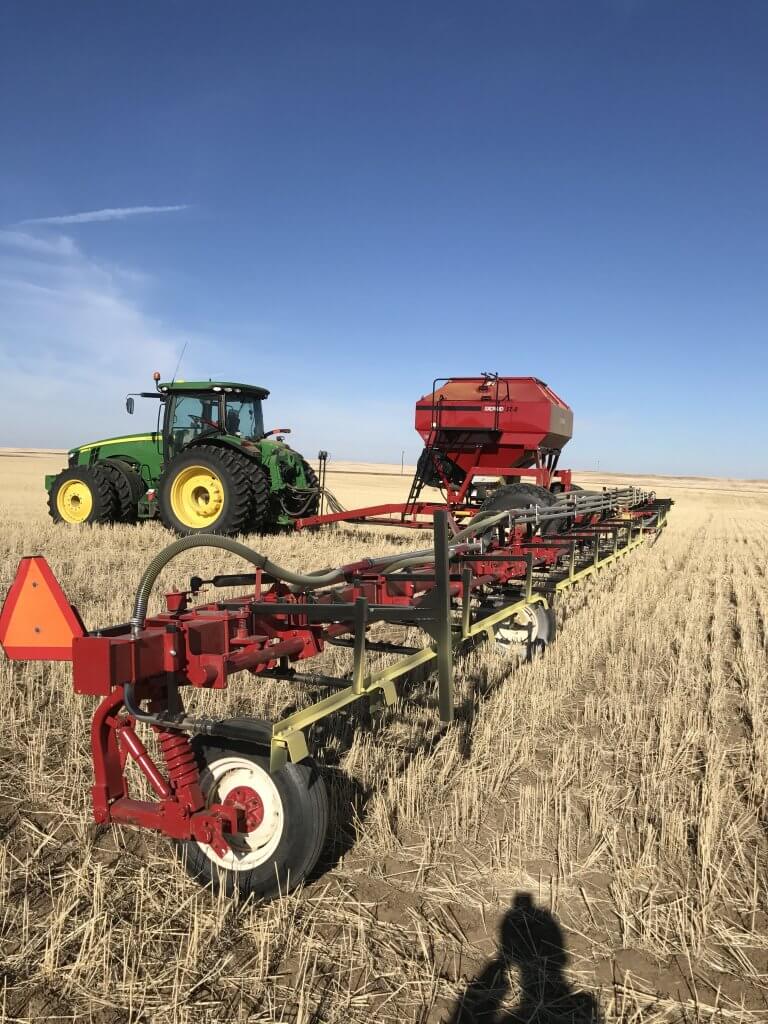
    The sprayer sat in a machine shed from 2011 when we purchased a Patriot 4420 sprayer. For many years we wondered if we couldn’t find a use for the sprayer as Bourgault had build a very rugged unit. So, in 2017 we decided to mount a Valmar tank (now owned by Salford) on the sprayer frame to be used for granular herbicides and granular fertilizer applications.

    Bourgault 1460 (Source: Bourgault.com)

    The liquid tank and plumbing were removed as well as the secondary boom with the wet boom. A few modifications to frame were made but for the most part the frame was left as is. The unit was painted with the Salford colours. (Case IH red)

    The Valmar/Salford unit is a ST8 which is used lots in Eastern Canada and the States for strip tilling for applying granular products. We purchased the tank, hoses, splitters and deflectors from Salford.

     The unit as purchased had the following features:

    • 8 imperial tons (16,000 lbs)
    • Stainless steel tank and duct systems
    • Mueller Hydraulic metering system with two sets of rollers – one pair for granular herbicides and one pair for granular fertilizers
    • Two hydraulic driven air fans – usually just one fan but we chose two fans – one for each boom
    • Weight scales for tank
    • ISOBus system with mapping, auto on off, sectional control (one for each boom)
    • 18 outlets – 9 outlets on each side of tank

    We designed unit in consultation with Salford engineers:

    • Each of the 18 outlets has a 2” flexible hose from the tank going to 2” stainless steel tubing stacked on the boom frame
    • Just prior to the deflectors each 2’ tubing is split into two 1-1/4 streams with special splitters supplied by Salford (according to Salford these are commonly used and have an accuracy of less than 2-3 % variation if mounted properly). Need to be horizontal.
    • The deflectors are mounted every 30” along the length of the boom (36 deflectors)
    • The sprayer boom was cut down from 110’ to 90’ to give the correct spacing

    Comments on use of the unit

    • Functionality seems to work very well as designed
    • Weigh scales, GPS, mapping, auto on/off, sectional control a real plus compared to original field sprayer with none of these features
    • Accuracy of product metering seems very good
    • Distribution across length of unit seems very good
    • Travel speeds of 10 mph
    • Product takes 2.5 seconds from time meter starts turning until product reaches far end of boom

    There is a difference of about thirty feet in travel distance with start and stop of product on the ground between inner side of boom and outer end of boom. Therefore, we have set look ahead time at 3.3 seconds and shut of time at 0.3 seconds.

    • Load products with a belt conveyor in yard
    • Apply 100 lbs of elemental sulphur (0-0-90) on 25% of the crop land each year

    (Tank does 160 acres)

    • Applied Avadex at 12.5 lbs per acre last fall on some acres prior to snow.
    • Apply Edge at 20 lbs per acre each fall just prior to snowfall  (for pulses)

    Tanks holds 10 minibulk bags – 12,000 lbs, and does 600 acres. On a long day have put out 1200 acres of Edge.

    We did extend the axles and also put on new hubs and new tires which were a bigger size. A Bourgault 1850 with 1600 gallons would have worked better but it is hard to find them. Plus they would probably have needed new tires anyways.

    It took a lot more time than we had imagined to build but that is true of most building projects. But I would say that we are very happy with the results. It is a pleasure to operate and appears to serve our needs very well.

    Thank you, Gerry, for sharing this with us!