OrchardMAX won the 2016 Canadian Agri-Marketing Association’s “Certificate of Merit” in the Mobile Apps Category.
OrchardMAX is a free decision-support tool that helps apple growers match airblast sprayer output to the size, shape, and density of an orchard canopy.
Rather than applying the same volume and pesticide dose to every block throughout the season, OrchardMAX uses the principles of Crop-Adapted Spraying to estimate settings appropriate for each orchard block. The objective is more consistent spray coverage with less avoidable waste. Ontario and Nova Scotia orchard trials demonstrated seasonal spray-volume savings of approximately 20 to 35%, without significant differences in pest activity and reported or fruit quality.
What OrchardMAX does
Using information supplied by the operator, OrchardMAX can:
Account for changes in canopy size, shape, and density
Estimate an appropriate carrier volume and pesticide dose
Suggest nozzle flow rates and sprayer settings
Calculate the amount of formulated product required per tank
Estimate work rate, tank requirements, and potential savings
What OrchardMAX does not do
OrchardMAX is a decision-support tool, not a substitute for calibration, operator judgement, or the pesticide label. It will not:
Recommend a rate above the pesticide label
Calibrate the sprayer
Confirm that adequate spray coverage was achieved
Account fully for wind, temperature, or relative humidity
Recommend less than 400 L/ha, approximately 42.5 US gal/ac
Recommend less than half the labelled pesticide rate
The results are only as reliable as the information entered. Operators must still maintain and calibrate the sprayer, match air settings to the canopy, work in reasonable weather conditions and confirm coverage using water-sensitive paper.
How to use it
For each spray scenario:
Select or enter the sprayer and orchard block.
Describe the current canopy size, shape, and density.
Enter the labelled pesticide rate and planned spray mixture.
Review the proposed carrier volume, pesticide dose, nozzle rates, and number of tanks.
Configure and calibrate the sprayer.
Confirm the resulting coverage in the orchard and adjust where necessary.
Start with a few representative blocks. Compare OrchardMAX recommendations with your current program, evaluate coverage, and make incremental changes as you gain confidence.
History
The original app was an excel-based tool created in 2010 and later developed into an app for iOS and Android systems by AgNition Inc. with funding from Growing Forward 2 in 2016. Compatibility with iOS and Android ended in 2020. We have now rebuilt the same functionality into this online version of the app.
Spray coverage describes the degree of contact between spray droplets and the target surface area. This metric can be used to predict the success of an application. One of the easiest methods for visualizing coverage is to use water sensitive paper (WSP), which is a passive, artificial collector that turns from yellow to blue when contacted by water.
WSP is often used to evaluate iterative changes to a spray program. Placed strategically throughout a target canopy, or directly on the ground, achieving uniform, threshold coverage translates into improved efficacy, reduced waste, reduced off-target contamination and reduced risk of pesticide resistance development. WSP were also used to develop a system that measures the area covered by the effective radial distance in an attempt to relate the area covered by a stain to a larger area where sufficient pesticide activity is taking place.
WSP tends to underestimate the spreading effect that can occur on plant surfaces (especially when surfactants are used), but they are effective as a relative index.
A brief history of WSP
In 1970, a journal article described a new method for sampling and assessing spray droplets. Photographic paper treated with bromoethyl blue created a yellow surface that changed colour when it encountered moisture. The pH-based reaction was fast and irreversible, leaving a distinct blue stain to mark the deposition.
Ciba-Geigy Ltd. made water sensitive paper commercially available in 1985 (later as Novartis in 1996 and as Syngenta since 2000). It is produced in several formats, but aluminum foil packages of 50, 76 x 22 mm (1 x 3 in.) papers are the most popular. Odds are if you’ve ever used water sensitive paper, it originated from Syngenta in Switzerland. In 2023 I noticed that the papers now say “made in Germany.”
Change of manufacturing location?
In recent years, two new options have been made commercially available: Innoquest’s SpotOn Paper (United States) and WSPaper (Brazil). At the time of writing, there has been no impartial comparative evaluation of these three products.
Once dry, the blue stains on WSP are irreversible and papers can be stored for long periods of time. However unstained portions will continue to react to moisture from humidity, dew, or fingerprints, so care must be taken in their handling and storage.
Comparing WSP brands
The three commercially-available brands of WSP were subjected to a series of comparisons. The intention was not to rank these products, but to determine if they performed in a similar fashion and to alert users to any significant differences.
Packaging and Appearance
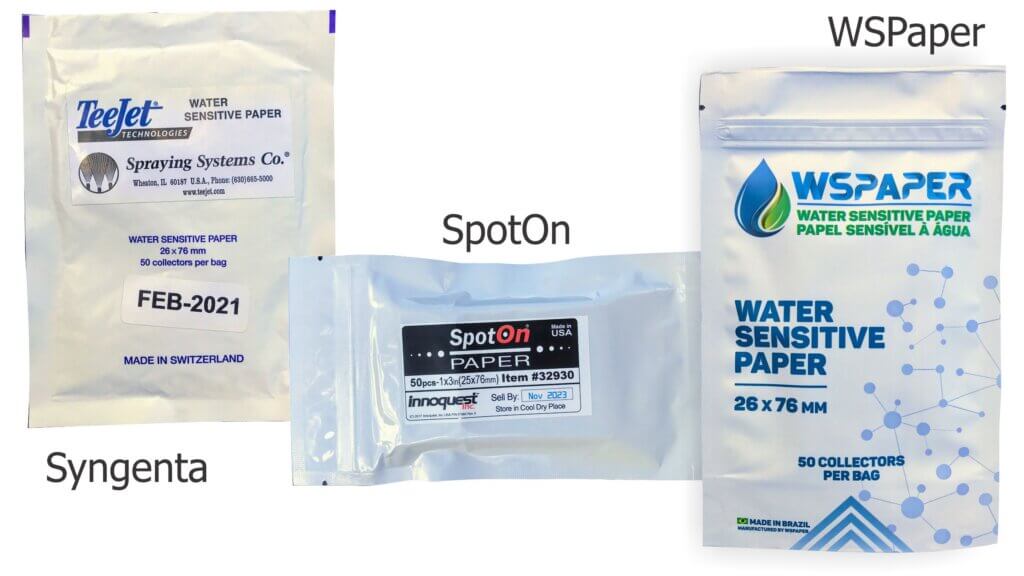
Each package was donated for the study. The SpotOn (SO) papers had a “sell-by” date of November 2023, the Syngenta (SY) papers (provided via Spraying Systems Co.) were dated February 2021 and the WSPaper (WS) was their newest formulation (white package, not silver), received June 2021. The comparison was performed on July 5, 2021.
WSP packages.
Each product was a foil or plasticized bag of 50, 26 x 76 mm papers. SO and WS had a re-sealing feature similar to that of a sandwich bag. SO also included a package of silica gel desiccant to capture moisture and a pair of plastic forceps to facilitate handling.
Users are encouraged to label papers to ensure they know their relative position and sprayer pass for later analysis. It was possible to write in ink on the faces of the SY and SO papers, but not WS. It was possible to write on the back of all brands.
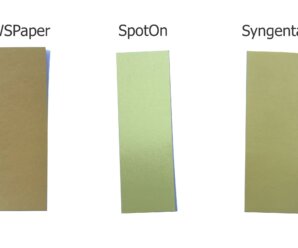
The three papers were different shades of yellow. Further, in the author’s experience, the colour can be visibly different between batches of the same brand. In the case of larger experiments where more than 50 papers are required, it would be prudent to ensure papers are not only from the same manufacturer, but the same production batch. This would not be an issue when subjectively comparing papers, but when using software that employs colour thresholding to identify deposits, it could create artifacts. Presently, only Syngenta has a batch number (found on a sticker on the back of the bag).
Bleed-through
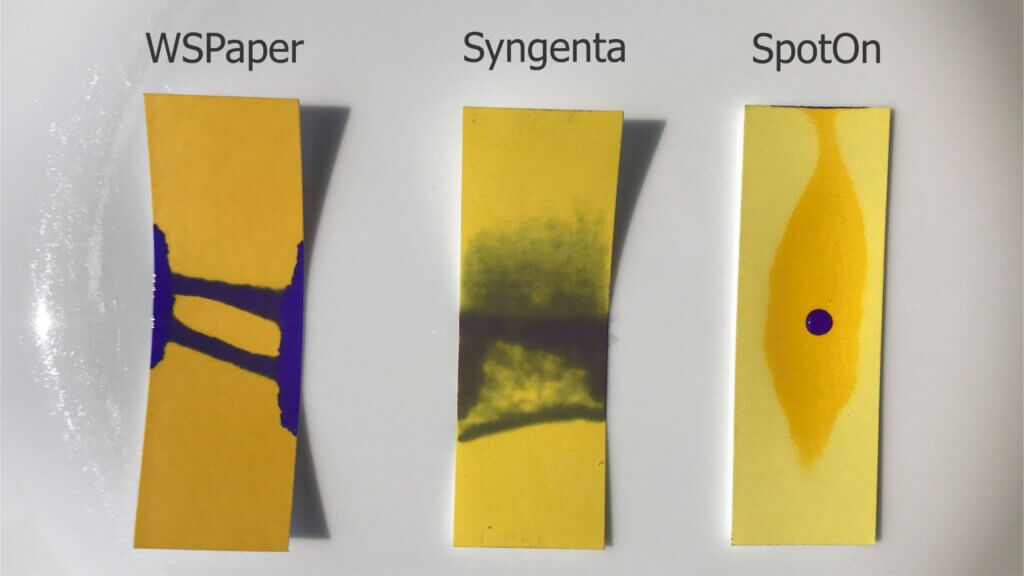
WSP is often placed in foliar canopies which are subject to dew and transpiration that can cause the papers to react prematurely. This can be particularly limiting when moisture soaks through the backs of papers. Each brand of paper was placed face-up on a drop of water to see if the water would bleed through.
Three brands were placed on a single drop of water. Within five minutes, WSPaper and Syngenta brands wicked the water through, causing a colour reaction. SpotOn did not, although the yellow surface darkened. When a drop of water was applied to the face, the SpotOn paper still produced a blue stain.
WS quickly curled as the water wicked in from the edges. Within five minutes the water soaked through from the back as well. Within five minutes SY also curled, but the colour reaction was entirely due to water soaking through and not wicking along the edges of the paper. SO did not curl and there was no colour reaction save a minor wicking reaction at one edge. It did however produce a dark yellow patch. In order to see if a colour reaction was still possible, a single drop of water was placed on the face and the colour reaction was distinct and instantaneous.
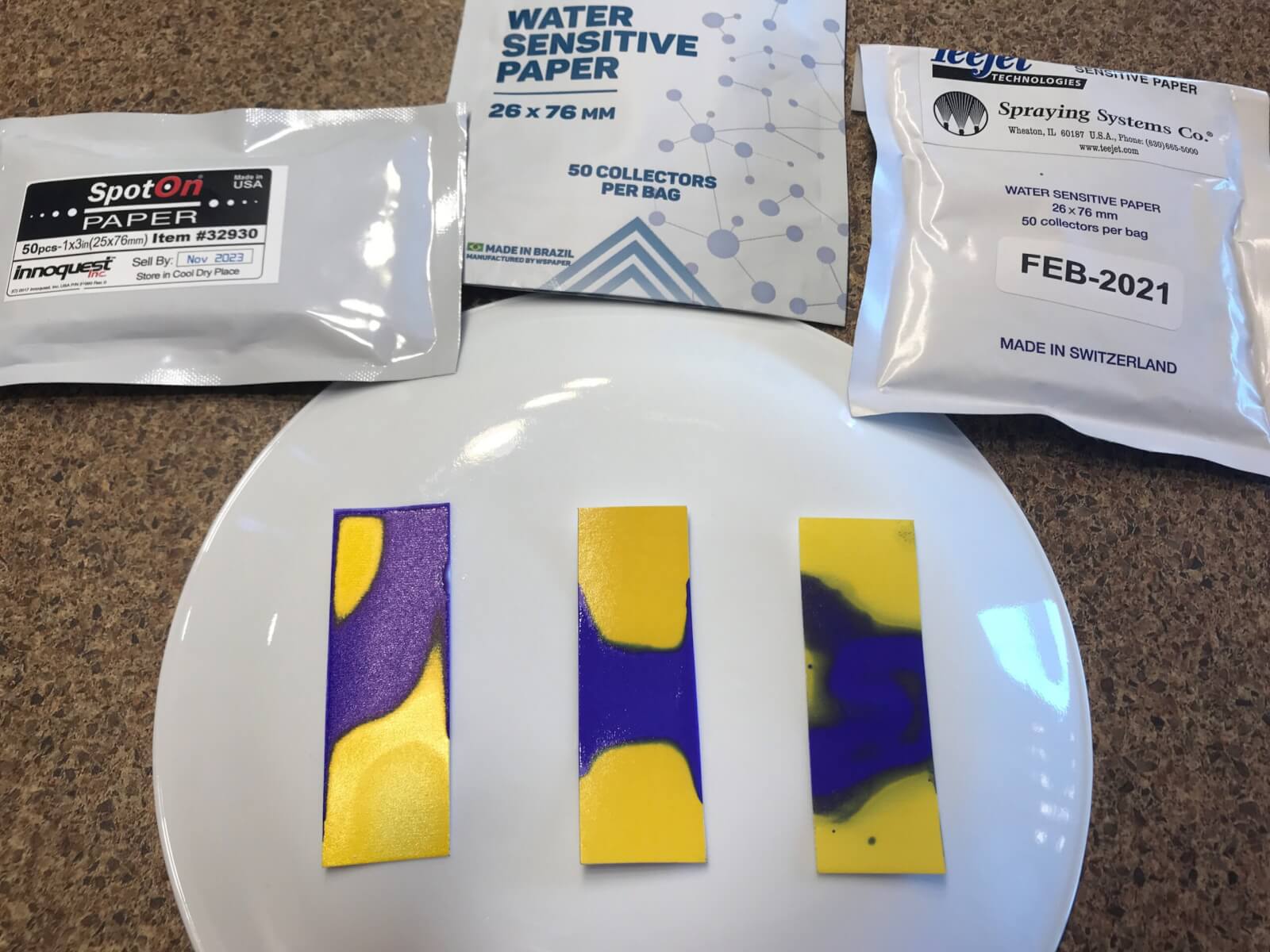
Note: Others have since replicated this experiment and reported that the response depends on the amount of water used and how long you leave it. We repeated our experiment with higher volumes and longer wait times (see image below). Ultimately, no brand of WSP is water proof from the back. Nevertheless, with small volumes of water (such as from dew) the original assessment of each brand is still valid.
A replication of the bleed-through experiment with the same batch of papers was performed with higher water volumes and a longer duration. Eventually, all three brands bled through. (SpotOn left, WSPaper middle, Syngenta right).
Deformation and drying time
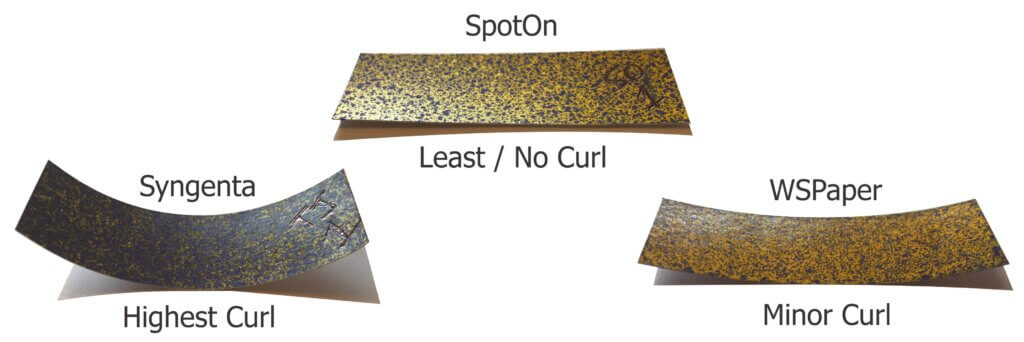
Users of water sensitive paper may be familiar with its occasional tendency to curl when one side is sprayed. In extreme cases, this movement could create smears if the paper contacted other wetted surfaces in dense foliage. The degree of curling was significantly different by brand, with SY becoming convex when wet and then flexing back into a concave form once dry. WS deformed as well, but only to a minor degree. SO did not appear to deform at all. Syngenta has noted that the degree to which their papers curl depends on the batch. Their manufacturing process has changed over the years in response to regulatory requirements and minor adjustments are still occasionally made.
Once dry, each brand of WSP tended to curl to different degrees. Syngenta curled the most and SpotOn the least if at all.
There was no appreciable difference in the time it took for any brand to dry. This is based on attempts to smear papers every 30 seconds. All were dry in under five minutes.
Experimental design
While there is considerable variability inherent to spraying, every effort was made to maintain consistent conditions. Papers were sprayed in a closed room with no appreciable air currents (21.5 °C and 64% RH). Papers were paired randomly, side-by-side on a plastic sled. The sled was pulled at 2.5 kmh (~1.5 mph) through the centre of a spray swath produced by a TeeJet XR80015 positioned 50 cm (20 in.) above the targets. The nozzle operated at 2.75 bar (40 psi) to produce ~270 L/ha (~29 gpa) with Fine spray quality. Six passes were made, producing four sprayed papers for each brand.
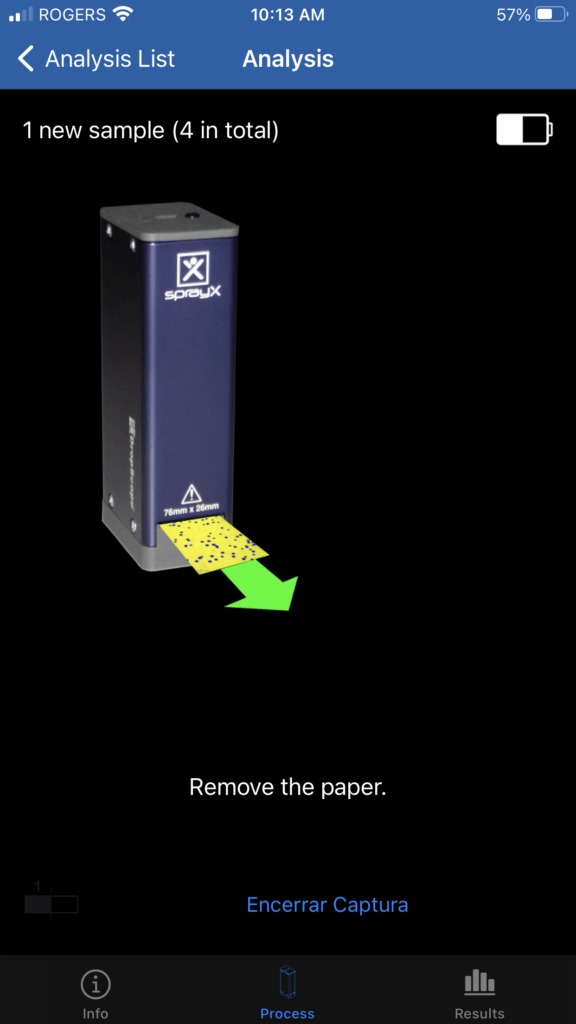
All papers were dry to the touch after two minutes. They were removed to a cooler, low humidity space and were digitized and analyzed using the SprayX DropScope (v.2.3.0) within an hour of spraying. We noted that while WS and SO fit easily into the DropScope port, the SY papers were sometimes slightly wider and had to be forced. Learn more about how to digitize and analyze WSP in this series of articles.
Screen capture from DropScope’s smartphone app.
The “ground” option was selected, and each brand of paper was processed using its specific spread factor. DropScope has a detection threshold of 35 µm. This is appropriate as the smallest droplet diameter that can be resolved by any brand of WSP is ~30 µm (Syngenta, Innoquest, SprayX – Personal Communication).
Percent surface covered
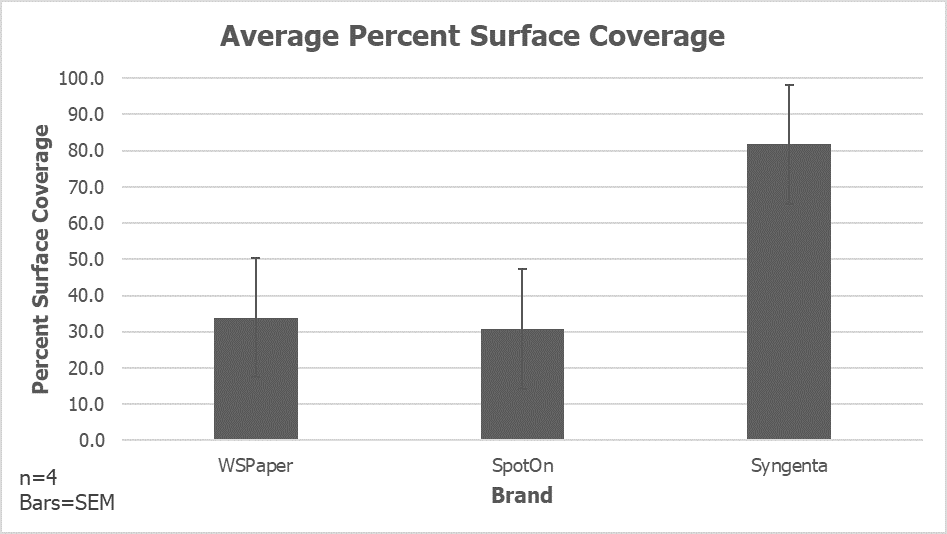
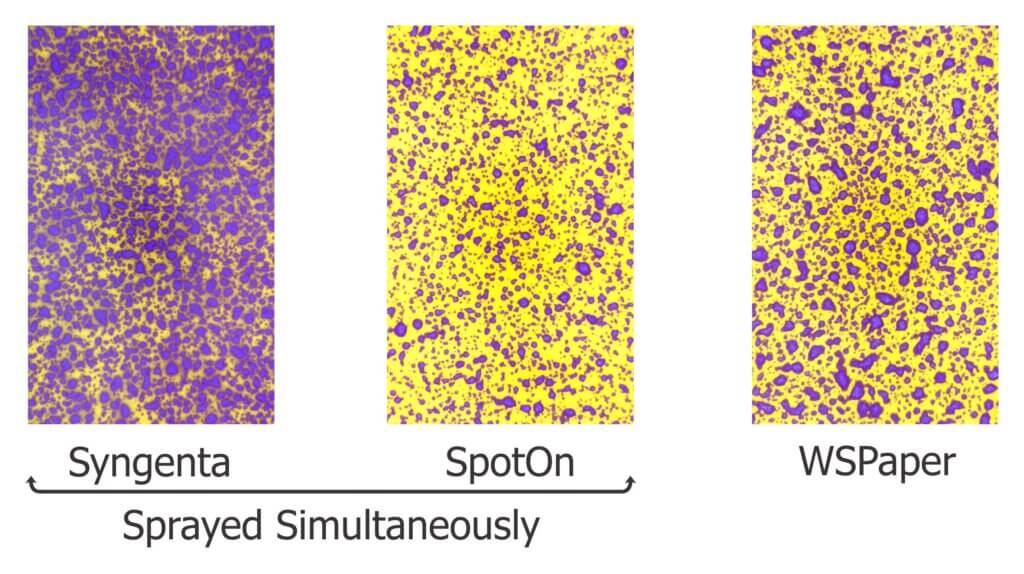
The average percent surface covered was calculated with standard error of the mean for each paper. WS and SO produced similar values between 30 and 35%. While all three brands exhibited similar variability, SY approached saturation at approximately 80% coverage. Therefore, WSPaper exhibited a slightly higher degree of spread than SpotOn, while the Syngenta paper exhibited a significantly higher degree of spread.
For reference, it can be difficult to determine if a stain represents a single deposit or is the result of multiple overlapping deposits. This becomes a problem when the surface of the WSP exceeds 20% total coverage. Further, it becomes increasingly difficult to distinguish a stain from the background, unstained surface when papers exceed 50% total coverage.
Average percent surface coverage by brand.DropScope-digitized images of three brands of WSP. The Syngenta and SpotOn papers were sprayed simultaneously while the WSPaper was sprayed in a subsequent pass. WSPaper exhibited a slightly higher degree of spread than SpotOn, while the Syngenta paper exhibited a significantly higher degree of spread.
Deposit density
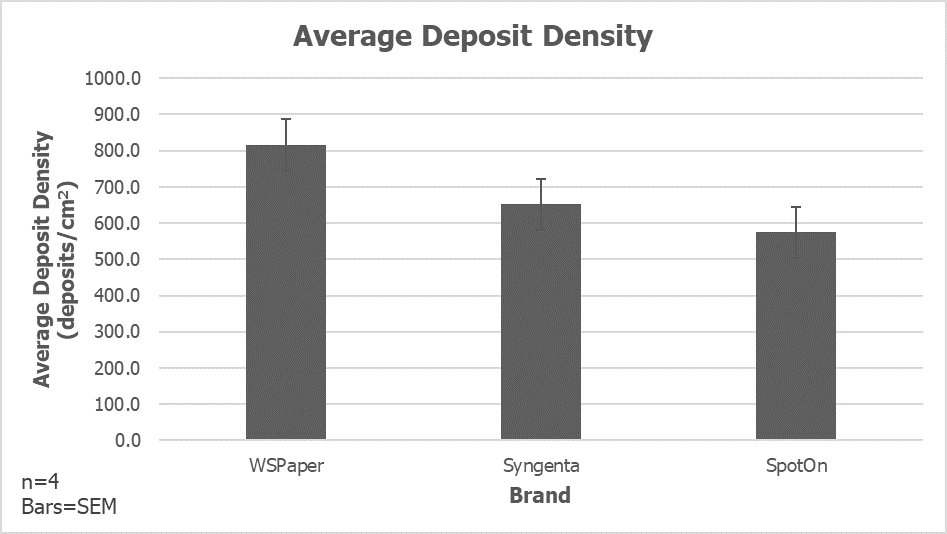
The average deposit density is a count of discrete objects (i.e. stains) per cm2. WS appeared to resolve the highest count, followed by SY and then SO. The process for determining what is a discrete object, and not the result of anomalies such as overlapping deposits, elliptical deposits or imperfections in the paper itself is complicated and computationally heavy. The algorithms employed by DropScope treated each paper consistently. So, while some differences are attributed to variations in spraying, they also reflect the paper’s innate ability to resolve individual deposits.
Average deposit density was highest for WSPaper, then Syngenta, then SpotOn. Variability was similar in all cases.
Droplet diameter
It is not the intent of this article to determine if WSP should be used to extrapolate the original droplet size. The many assumptions and inconsistencies inherent to this process are well known. Nevertheless, some researchers do use WSP in this manner, so a comparison was warranted.
DropScope bins deposit diameters by size to produce histograms of deposit size by count. These stain diameters are used to extrapolate DV0.1, DV0.5 (VMD), DV0.9 and NMD, which describe the population of droplets that produced the stains. DV0.5 is the Volume Median Diameter, or the droplet diameter where half the volume is composed of finer droplets and the other half by coarser droplets. Number Median Diameter (NMD) is the droplet diameter where half the total droplets are finer, and half the total droplets are coarser.
Each brand of WSP will permit a certain degree of spread when a droplet of water contacts the surface. This spread factor is specific to the brand of paper. Further, the spread factor is not constant for all droplet sizes; Finer droplets will spread less than coarser droplets.
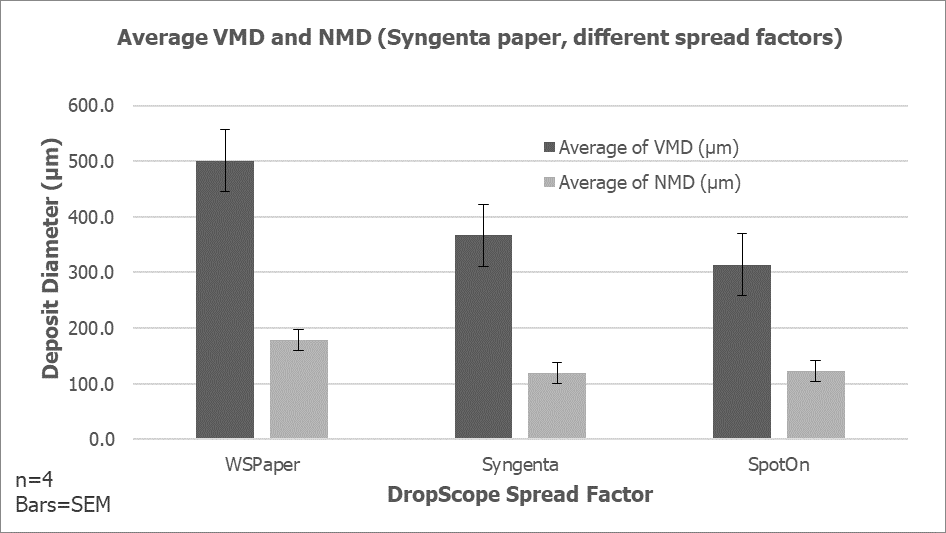
When processing data using DropScope, selecting the appropriate spread factor makes a significant difference to the output. For example, here are the same four SY papers processed using the Syngenta-specific spread factor as well as the spread factors intended for SpotOn and WSPaper.
The same four Syngenta papers were processed by DropScope using the Syngenta-specific spread factor as well as the SpotOn and WSPaper spread factors. The resulting VMD and NMD were very different.
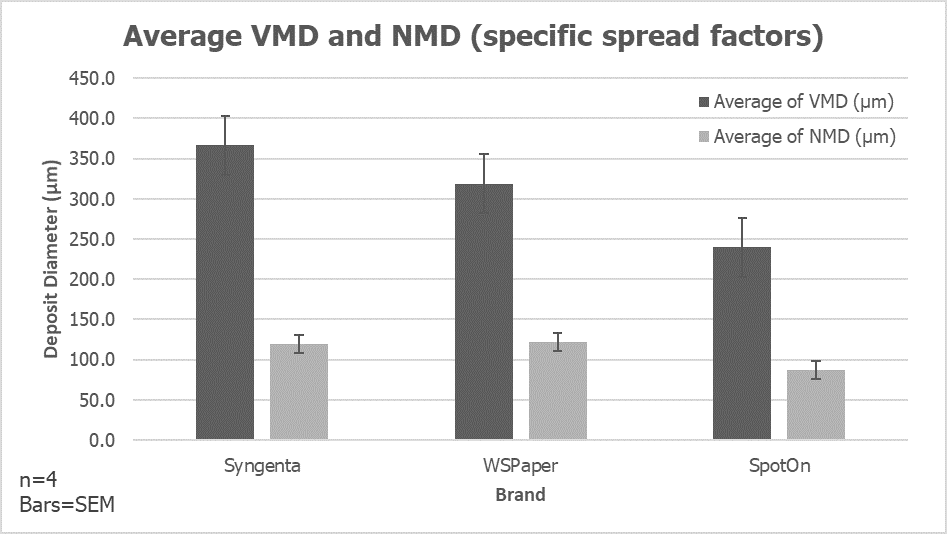
Therefore, each brand of water sensitive paper was analyzed using its brand-specific spread factor (according to DropScope), to produce the following graph.
Three brands of WSP processed by DropScope using their specific spread factors. VMD differed by as much as 30%.
SY produced a VMD higher than that of WS, and both were higher than SO. There was less variability in the NMD, but this was expected given the high droplet count on the finer side of a hydraulic nozzle’s droplet size spectrum.
Conclusion
Water sensitive paper has immeasurable value in agricultural spraying. It is far more important to encourage its use than to quibble over brands. However, when these tools are used for more rigorous evaluations of spray coverage, brand-specific variability must be addressed.
The differences in how each brand responds to moisture (i.e. discolouration and deformation) may factor into which brand is most appropriate for a given situation. Further, there appear to be significant differences in how each brand resolves coverage. Once again, this may be irrelevant for those spray operators who occasionally use WSP to inform their spraying practices, but for consultants and researchers it is suggested that they use a single brand for an experiment, with papers produced in the same batch run.
If there’s one thing that stays the same, it’s that nothing stays the same. Formulations and manufacturing processes change. According to SprayX, manufacturers of the DropScope, all three of the papers described in this article (written in 2021) have changed in recent years. Some have improved and others can create potential errors in digitizing coverage. The following points may require a deeper understanding of how WSP is digitized and analyzed. Refer to this series of three articles.
Be aware of the following best practices when using WSP:
Be aware of package expiration dates. Expired paper will work differently from new paper, creating an artifact in analysis.
Papers with bright, reflective surfaces can cause an underestimation of deposit counts (specifically the smallest deposits).
Best results are obtained when using water for testing. Adjuvants and pesticide co-formulants have minor impacts on spread, but can also change the how the paper changes colour, making thresholding difficult.
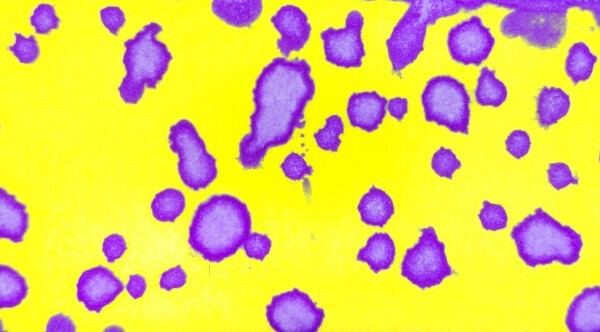
Beware papers that create stains with bright borders and faint (hollow) centres (see image below). This can lead to an underestimation of volume median diameter. If your camera or scanner permits, examine the coverage in binary (e.g. black and white) for more accurate results.
Do not sample the edge of the WSP (leave at least a mm) to avoid edge effects such as wicking and partial impacts. Some scanners have a setting, or you can select the area manually.
Note the physical shape of the paper itself. Inconsistencies in the length and width (cutting errors) can make papers difficult to use in certain scanners, and curled papers cause changes in perspective and focal distance that can lead to errors.
When not using a sealed camera or scanner (e.g. DropScope or flatbed), changes in the camera angle, shadows, lighting conditions, and make/model of cellphone camera will affect the results. Be consistent.
Stains with faint centers may not register correctly with some software. This could be due to adjuvants in the liquid, or issues with the coating itself. Other issues might include inconsistent coatings that are either too thick or to thin affecting the reaction to water.
North American product labels may or may not include carrier volume recommendations. When they do, it could be based on a two-dimensional value like the planted area, or perhaps on row length which is more appropriate for trellised crops that form contiguous hedge-like canopy walls. Volume may also be tied to product concentration, which sets minimum and maximum volumes based on product rates. Or, more commonly, volume recommendations take the form of vague guidelines such as “Spray to drip” or “Use enough volume to achieve good coverage”.
In all cases, spray efficacy and efficiency can be greatly improved by dialing-in the carrier volume to optimize coverage uniformity and reduce off-target spraying. This is easier said than done because the optimal spray volume is case-specific. It depends on a complicated relationship between:
Weather conditions (E.g. temperature, humidity, wind speed and direction)
Sprayer design (E.g. air handling, droplet size and flow distribution over the boom)
Traffic pattern (E.g. every row or alternate row)
Product chemistry (E.g. mode of action and formulation).
It is the final variable, the nature of the target, which is the focus of this article. To learn more about the other variables, grab a copy of Airblast101.
The plant canopy and planting architecture dictate volume
Quite often, the target in airblast applications is the plant canopy. The plant canopy is the collective structure containing all plant surfaces. This could be the foliar portion of a single pecan tree, a panel of grapes, or a bay of container crops. The planting architecture describes how those canopies are arranged on the planted area. If we consider the canopy and architecture geometrically, we can make relative statements about the volume required when all other variables are equal.
Six geometric characteristics of the plant canopy and planting architecture.
Geometric Characteristic
Relationship to Carrier Volume(per unit planted area)
Row Spacing
The greater the row spacing, the less volume needed.
Plant Spacing
The greater the plant spacing, the less volume needed. This assumes gaps between the canopies (I.e. not a contiguous hedgerow).
*Canopy Depth
The greater the canopy depth, the more volume needed.
*Canopy Width
The greater the canopy width, the more volume needed.
*Canopy Height
The higher the canopy, the more volume needed.
Canopy Density
The denser the canopy, the more volume needed.
*The product of average canopy depth, width and height is the canopy volume. This value forms the basis for many dose expression models and historic carrier volume calculators such as Tree Row Volume.
Canopy density
Let’s focus on a single plant canopy. Research has demonstrated that with the possible exception of canopy height, canopy density has the greatest influence on optimal sprayer settings.
Density describes the amount of matter inside a canopy relative to the volume of space it occupies. The denser the canopy, the more surface area there is to cover and the more difficult it is for spray to penetrate.
While air handling plays a significant role in improving coverage, a denser canopy will almost always require a greater carrier volume.
When two morphologically-diverse blocks share an alley, a two-sided, every-row sprayer should employ settings suitable for the larger of the two. It’s more important to ensure good coverage on the big block than to save on the smaller. Once the hybrid row is sprayed, settings should be modified to suit the block.
For most perennial crops, canopy density changes over the growing season. The influence of age and staging on canopy size and density will depend on the crop variety, plant health and canopy management practices. The practical implication is that as the canopy grows and fills it typically warrants an increase in spray volume.
As illustrated in the figure below, the volume used should reflect the current stage of canopy development. If a volume suitable for the densest and largest stage of development is used all season, it will create a great deal of waste early in the season. However, if volume is increased incrementally to reflect canopy growth, a better fit between coverage and volume will minimize waste.
Note that volume is increased around petal fall, but the fit could be improved with more increments. Caution is advised to ensure the volume is raised (if required) prior to immediate need, particularly during key developmental stages like bud break or bloom where fungicide coverage is critical.
The curved line represents the leaf area in a canopy (Y-axis, right) increasing over the growing season (X-axis). The volume of the spray (Y-axis, left) providing effective coverage is indicated in green. Spraying the same volume throughout the season means a lot of over-spray (red) early in the season. The target simply isn’t there yet. Using less volume early season and changing about midway through the season, or as required by canopy development, has the potential to save a lot of spray (blue) without compromising spray coverage. Note that the first volume should give sufficient coverage to reach mid-season, and the second volume should be sufficient to reach the end of the spraying season. Always err on the side of excessive coverage to buffer against the impact of unanticipated variables.
There are exceptions to this rule. Many nursery crops and mature evergreens often do not require changes to volume. High density apple orchards may or may not require an increase in volume. Early in the season, sparse canopies have low profiles that result in very low catch efficiencies. In other words, a great deal of spray misses the target.
The amount of waste is a function of the application equipment design and the weather conditions. Most low-profile axial airblast systems envelop the target in spray with limited means of reducing air energy sufficiently, or to turn off the spray between trees.
Further, sparse canopies do not restrict wind, which means ambient wind speed tends to be higher early in the season compared to when the trees become wind breaks. This creates a drift-prone situation and higher volumes are often used to compensate for the loss. The collective result is that excess spray volume is inevitable early season.
As the canopies fill, the wind is reduced and catch efficiency increases, so trees intercept more spray without having to raise volumes. This balance eventually tips, however, and an increase in volume may be advisable.
Watch the following video to see the impact of using excessive spray volume (and poor air adjustment settings) in a young cherry orchard. The waste becomes particularly apparent at ~43 seconds when the sprayer passes in front of the woods and the plume can be seen with higher contrast.
While some loss is inevitable in such a sparse canopy wall, this situation could be improved by using less carrier volume, larger droplets, the correct air settings, canopy-sensing optics and/or a tower or wrap-around sprayer design.
Adjusting spray volume sprayer settings to reflect the canopy can save money and reduce environmental impact during early-season applications and in young plantings. Mix the tank as you normally would to maintain the pesticide concentration on the label, but adjust the sprayer output to match the plant size.
Performed correctly, you will be able to go further on a tank without compromising efficacy. This crop-adapted spraying method and the relationship between spray volume, concentration and dose are described further in this article and this article.
Estimating volume from canopy geometry
It is challenging to decide on an appropriate spray volume. Many operators resort to historical or regional practices and do not make adjustments to reflect their specific situation. Others refer to models such as Tree Row Volume (a.k.a. Canopy Row Volume) which relates canopy volume per planted area to spray volume.
In this case, catch efficacy is expressed as a coverage factor, which is determined through experimentation specific to the crop, environment and sprayer.
In New Zealand, coverage factors for dilute applications to deciduous canopies range from 0.07 to 0.1 L/m3 (0.00052 to 0.00075 US gal/ft3) or 71 to 100 ml/m3 (0.067 to 0.096 US oz/ft3). The range captures variation in canopy density and any product-specific coverage requirements. Oil sprays, for example, require more surface coverage than most products. While closer to “the truth”, the Tree Row Volume method is still only an estimate.
If the operator has no prior experience with the crop or the sprayer and wants a sanity-check on their estimated spray volume, we propose the following guidelines for full canopy dilute application to mature crops using every-row traffic patterns. The volumes may seem high, but recognize we have selected a very challenging scenario.
Small canopies (E.g. bush, vine, cane, high-density fruiting wall): 500 L/ha (55 US gal./ac.) to 1,000 L/ha (110 US gal./ac.).
Medium canopies (E.g. tender fruit, pome): 750 L/ha (80 US gal./ac.) to 1,250 L/ha (135 US gal./ac.).
Large canopies (E.g. tree nut, citrus): >2,000 L/ha (214 gal./ac.) and up tp 7,000 L/ha (748 US gal./ac.).
For sprayer operators that think in 100 m row lengths, consider 20 L volume per 100 m row length per 1 m canopy height.
Further Resources
No matter the approach to determining spray volume, it is imperative that coverage is assessed. It is amazing what we ask of airblast sprayers. Read this short article for some perspective on the coverage we hope to achieve from a given spray volume.
We propose the use of water-sensitive paper to assess spray coverage. We describe its use and evaluation in detail in this article, this article and in this article.
Dialing-in an optimal spray volume is an iterative process that requires careful observation and keeping records on what works and what doesn’t for your specific operation.
Jon Clements (University of Massachusetts) has noted special considerations when it comes to establishing effective volumes for plant growth regulators that go beyond this article. You can explore the concepts in this 2021 factsheet (Spray Mixing Instructions – Considering Tree Row Volume) by Terence Robinson and Poliana Francescatto (Cornell University) and Win Cowgill (Professor Emeritus, Rutgers University).
Finally, if you really want to get lost the weeds, check out this video recorded in 2021. I had an opportunity to learn from pros like Dr. Terence Bradshaw (University of Vermont) and participants from the Great Lakes region. They’ll tell you all you ever wanted to know about Tree Row Volume. Settle in!
Thanks to Mark Ledebuhr of Application Insight LLC for his contributions to this article.
“If you can’t measure it, you can’t improve it”. While the source is nebulous (Peter Drucker, Lord Kelvin, or Antoine-Augustin Cournot), the sentiment is clear.
The status quo
In the world of crop protection, considerable resources are expended to distribute a pesticide over a target. And yet, sprayer operational settings and spray coverage are rarely assessed. As a result, too much time elapses between the application and observing the biological results to evaluate and correct equipment performance. The damage (be it waste or an inconsistent and sub-lethal dose) is done. All sprayer operators know this to be true, so why do precious few perform these assessments?
Perhaps, dear reader, you have personal experience assessing coverage and already know the answer. Perhaps you’ve performed the iterative dance that is placing, spraying, retrieving, assessing and re-placing water sensitive paper (WSP). Perhaps you’ve sprayed fluorescent tracers and hunted for faint glows at twilight using UV lights. Perhaps you’ve looked for residue from diatomaceous earth or fungicides. Or, perhaps, you’ve trusted in the falsely-comforting “shoulder check” and assumed dripping must mean you’ve hit the target.
Existing methods are complicated, subjective, messy and time-consuming. We need an alternative.
The alternative
Consider a permanent, solar-powered sensor that supplies real-time spray coverage data to your smartphone via a cellular connection. The output could be visualised in a simple and intuitive way, and immediately available to both sprayer operators and farm managers. If the sensor was relatively inexpensive, sufficiently hardy, and easy to deploy, its utility would only be limited by your imagination:
Stakeholders could confirm the correct functioning of their equipment before committing to the application. Decisions could be made to change operational settings, repair equipment, or delay until conditions improved.
The sensors would provide coverage data specific to their location and orientation. Units could be installed in difficult-to-spray regions such as treetops, or canopy-centres, or fruiting zones. Sensors could be placed where pest/disease pressure has been historically high, or where wind is a known issue.
Large operations could install them in a test-row, where sprayer operators would perform a gauntlet-style calibration run prior to a day of spraying.
Spray records could inform compliance audits, supplement insurance or CanadaGAP traceability requirements, or be used in agronomic assessments.
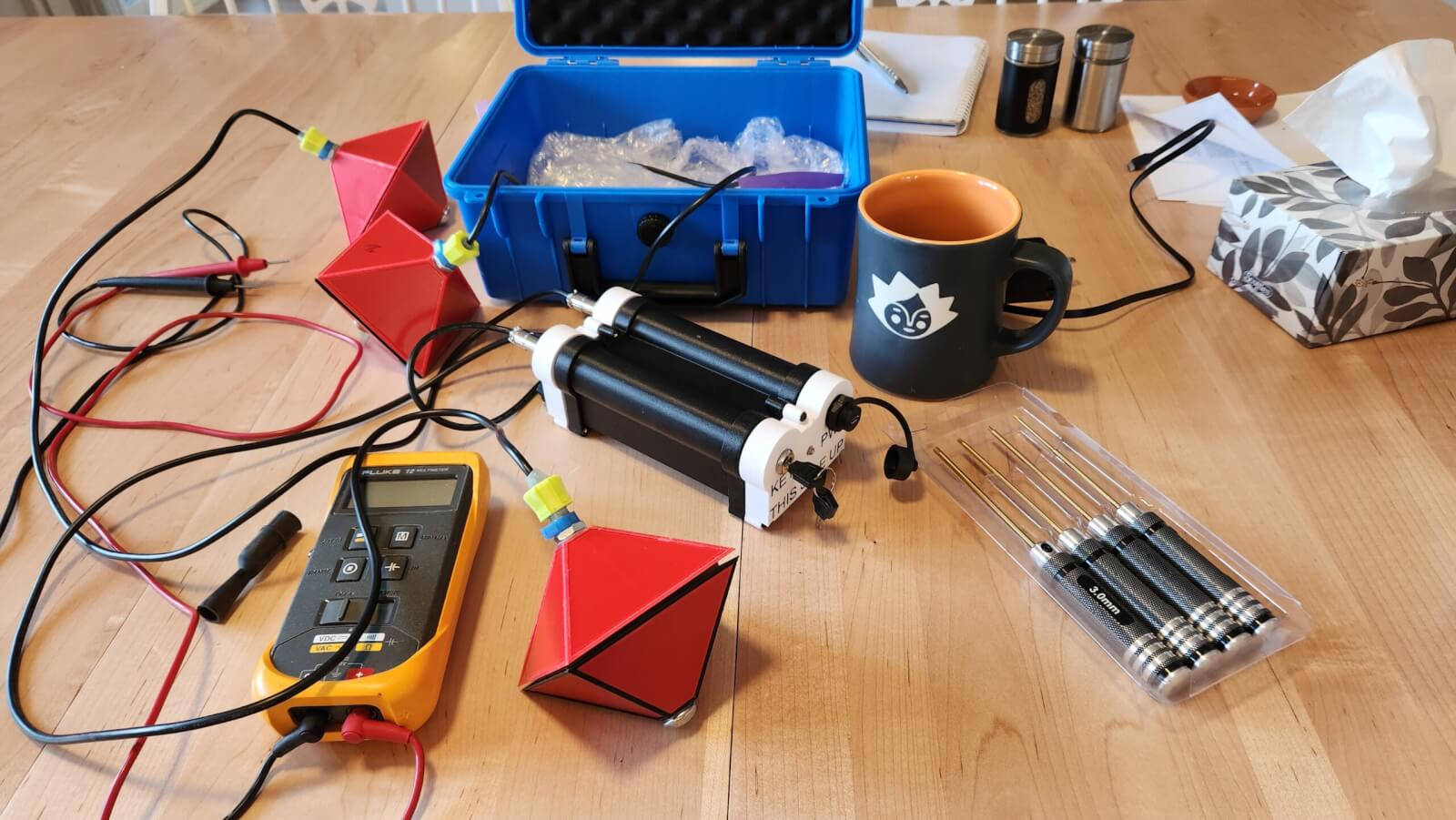
In 2025 I was approached by an Australian developer who claimed he had a device that did all of this. And, if that weren’t enough, it could also monitor certain meteorological factors such as pre-spray moisture levels and temperature and report post-spray evaporation rates. I could barely contain my excitement. A prototype was in my hands a few weeks later.
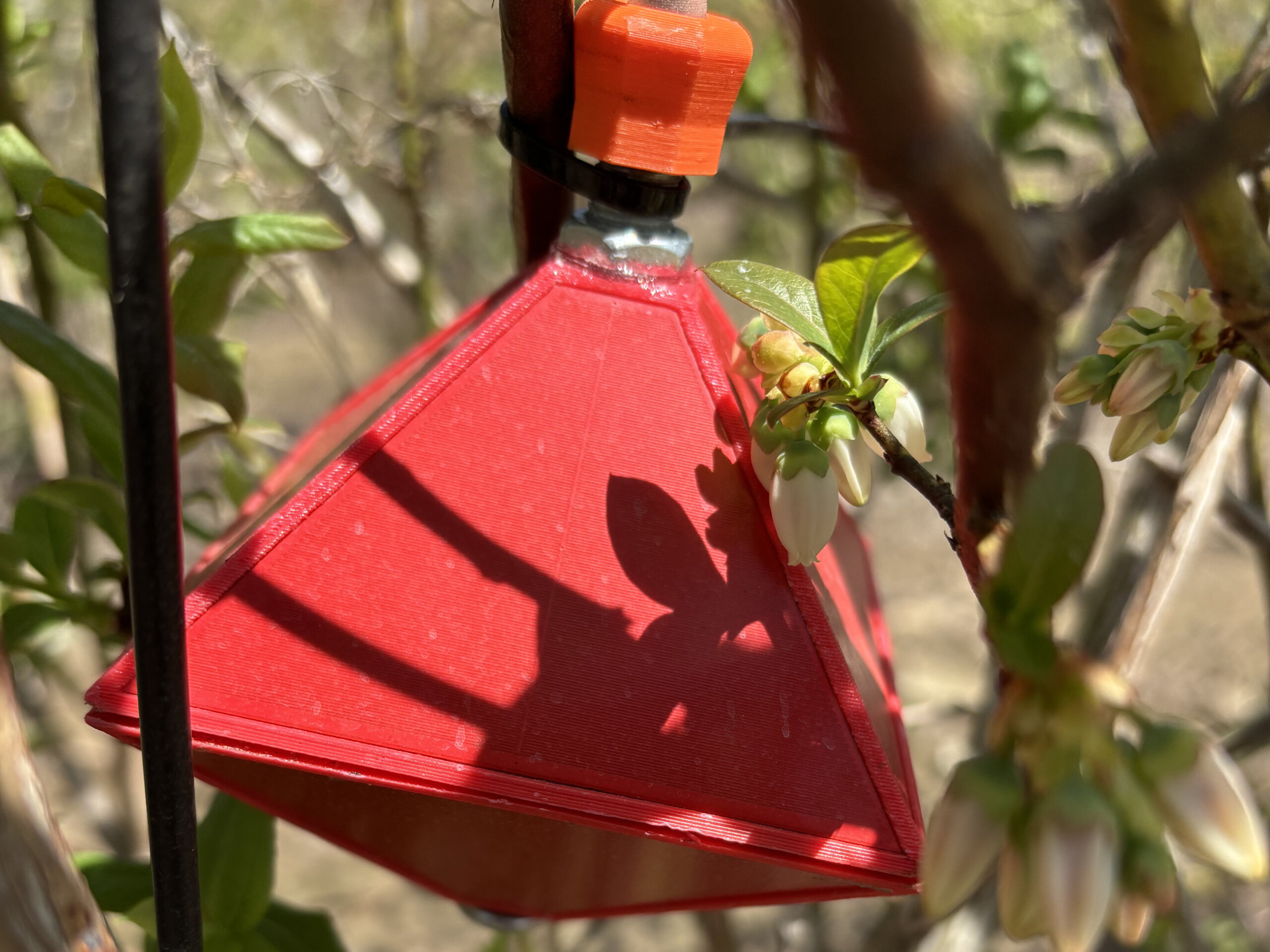
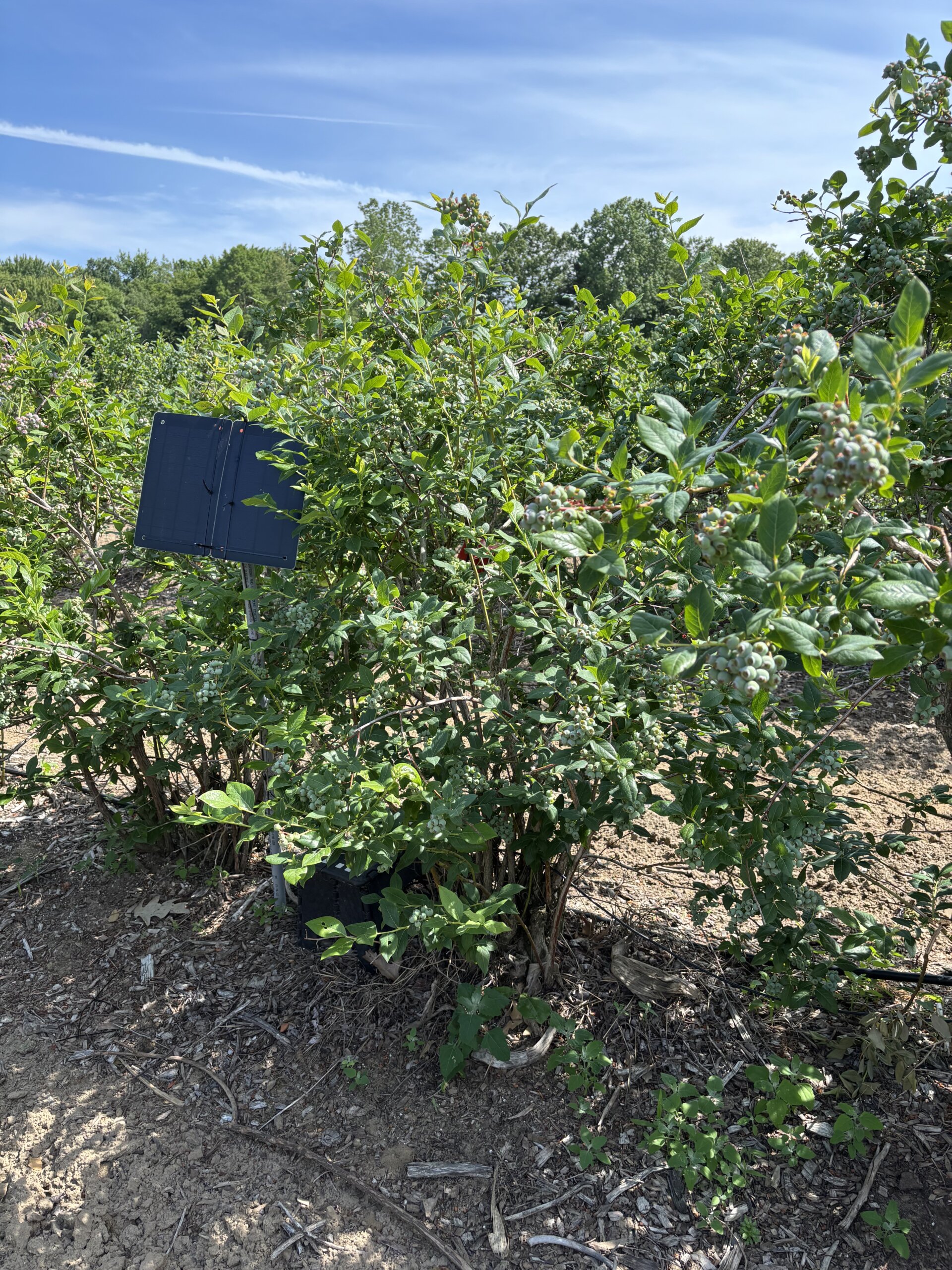
Prototype, 8-sided sensor located in a blueberry bush.Solar panel powering three, 8-sided prototype sensors spanning 10 meters of highbush blueberry.
Benchmarking the sensor
The Spray Doctor (working name for the prototype) started its life as a leaf wetness sensor, evolving into a spray coverage sensor piloted in 2023/24 in Australian and New Zealand grape production. The history of earlier iterations and company schisms is convoluted, and fortunately immaterial to our purposes. All I needed to know was that we weren’t starting from scratch. Several of the questions regarding how accurately the surface could detect spray deposition were already addressed by independent research.
The sensing surface is impregnated with an array of capacitive wetness sensors. The sensor responds to the surface area covered and not deposit density. Researchers reported a reliable response range between ~10% and 50% surface coverage. Given the arguable “ideal” coverage standard of 10-15% surface area, this includes the range of interest for most sprays.
Benchmarking against WSP was part of the foundational assessment. A droplet of water deposited on WSP produces a high angle of contact and very little spread, while the same droplet deposited on plant tissue tends to produce a lower angle of contact and more spread. This means the stain produced on WSP is smaller than would be produced on plant tissue, depending on how smooth, vertical or waxy the tissue surface was.
It was therefore surprising that WSP were found to report a higher degree of spray coverage during water-only sprays than the sensor. It seemed droplets more easily coalesced and ran off the sensor surface. This was ultimately interpreted as an advantage, because the sensor would better emulate how a leaf surface would respond to the influence of surfactants and spray quality.
Adding a surfactant to a spray solution improves droplet adherence, and/or reduces surface tension, improving the degree of contact on plant surfaces. Likewise, it was found that surfactants increased the degree of coverage reported by the sensor, and when actual chemistry was sprayed (e.g. sulphur powder or copper sulfate) there was an effect on the degree of coverage reported. This is unlike WSP, where adjuvants and chemistry do little to increase the spread.
And so, like every method for assessing spray coverage, the sensor has limitations and caveats. If you have some doubt as to the sensor’s accuracy, do not get distracted by the fine detail. Remember, most operators currently have no feedback whatsoever; even a binary response (e.g. hit or miss) would be welcome. The sensor is sufficiently sensitive and consistent to resolve coverage in a range relevant to most sprays, and therefore worth field testing.
The experiment
My role in this story was to work with a grower to evaluate the sensor’s ability to report coverage information in a clear and actionable way. There were three questions:
Does data from the sensor influence a sprayer operator’s behaviour?
Does that change in behaviour lead to improved spray coverage (implying more efficient and effective crop protection).
Could we “dial in” the hardware and the interface based on the grower’s feedback?
In part two, we share our experience installing and using the Spray Doctor, as well as supply answers to these questions. Stay tuned.
Thanks to Brandon Falcon (Falcon Blueberries) for volunteering his time and farm for this evaluation, and the developer for the in kind donation of the prototype Spray Doctor.
This case study is taking place on a 15 acre highbush blueberry operation in southern Ontario. In 2016, considerable pressure from spotted-wing drosophila (SWD) prompted the growers to make changes to their crop management practices and their spray program. They employed a three-pronged approach to improving crop protection:
Significant changes to canopy management and picking / culling practices
Investing in a new sprayer
Adopting the Crop-Adapted Spraying (CAS) method of dose expression
We have been tracking pesticide use, water use and yield compared to historic values. We also monitored spotted-wing drosophila catches both in crop and in wild hosts along the border of the operation for three years.
Canopy Management
In 2016 the operation made the following changes to their canopy management practices:
They performed their first-ever heavy pruning and planned to to maintain an ideal crop density by removing ~30% plant material annually. This more-or-less took place.
They regularly collected and buried culled and dropped berries.
They picked cleanly and more frequently.
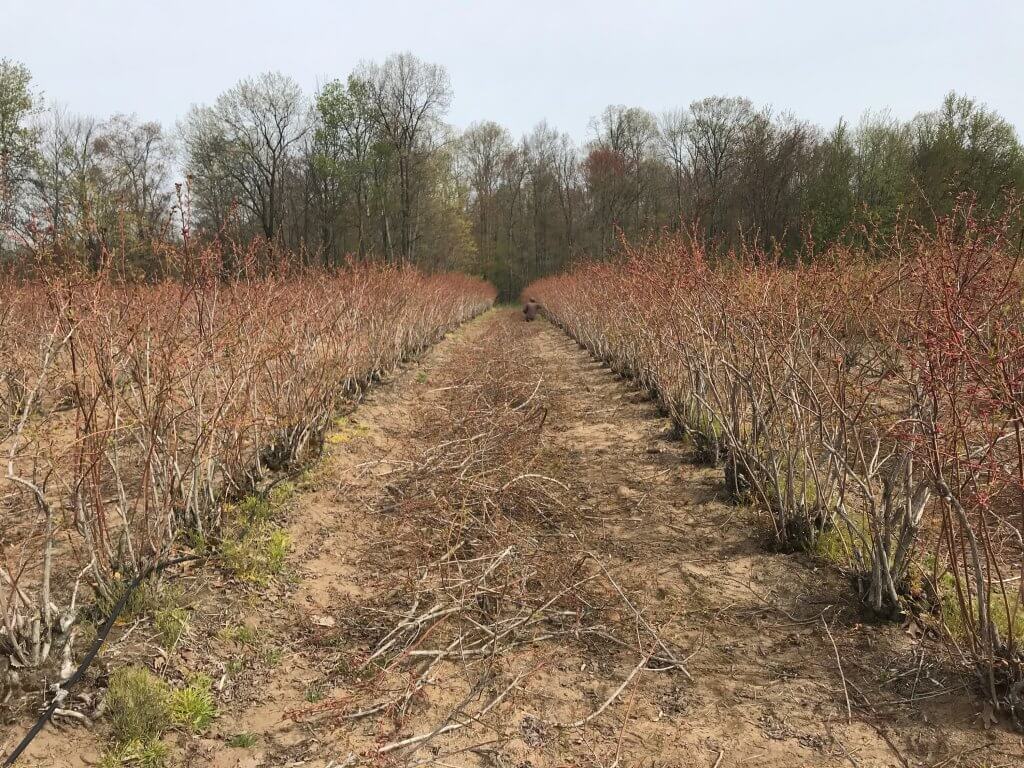
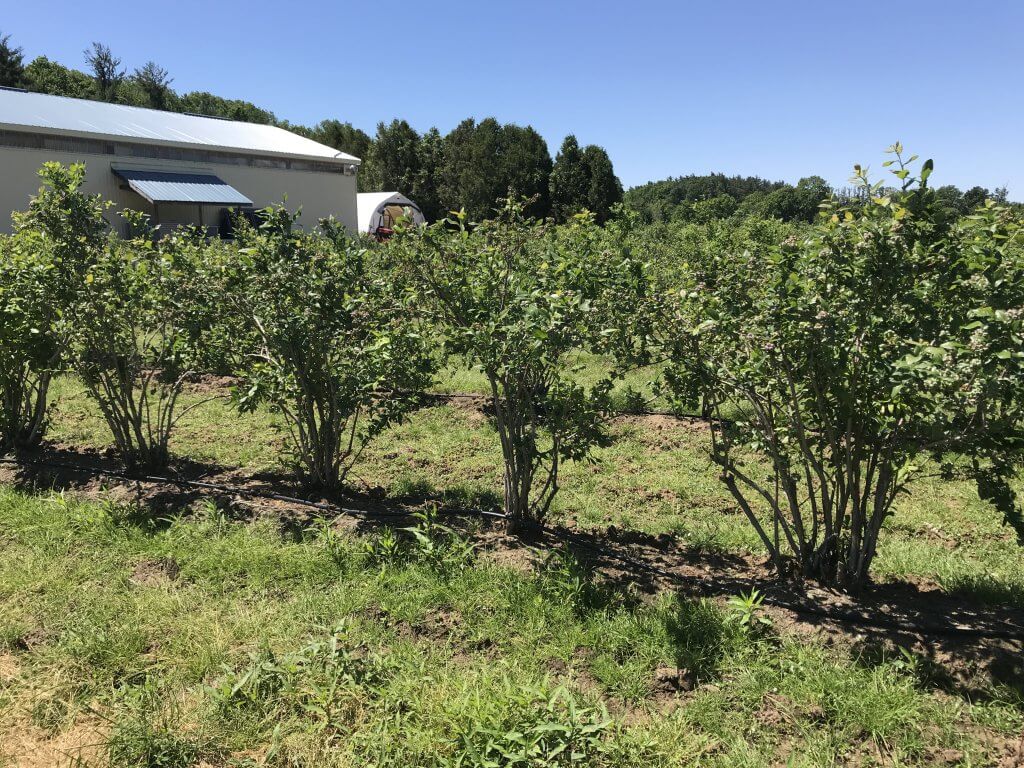
Heavy pruning in 2016.Most years, bushes were pruned ~30% to maintain an ideal size and shape.Pickers were educated in how to pick cleanly and dropped / culled fruit was collected and buried.
There were initial concerns that such dramatic pruning would reduce production per acre and require trellising to prevent berries weighing down the smaller bushes. However, in 2017 (and thereafter) they found that the quality of the berries was greatly improved and noted fewer hours spent culling berries during packing. Financially, the growers felt they came out ahead.
Application Technology
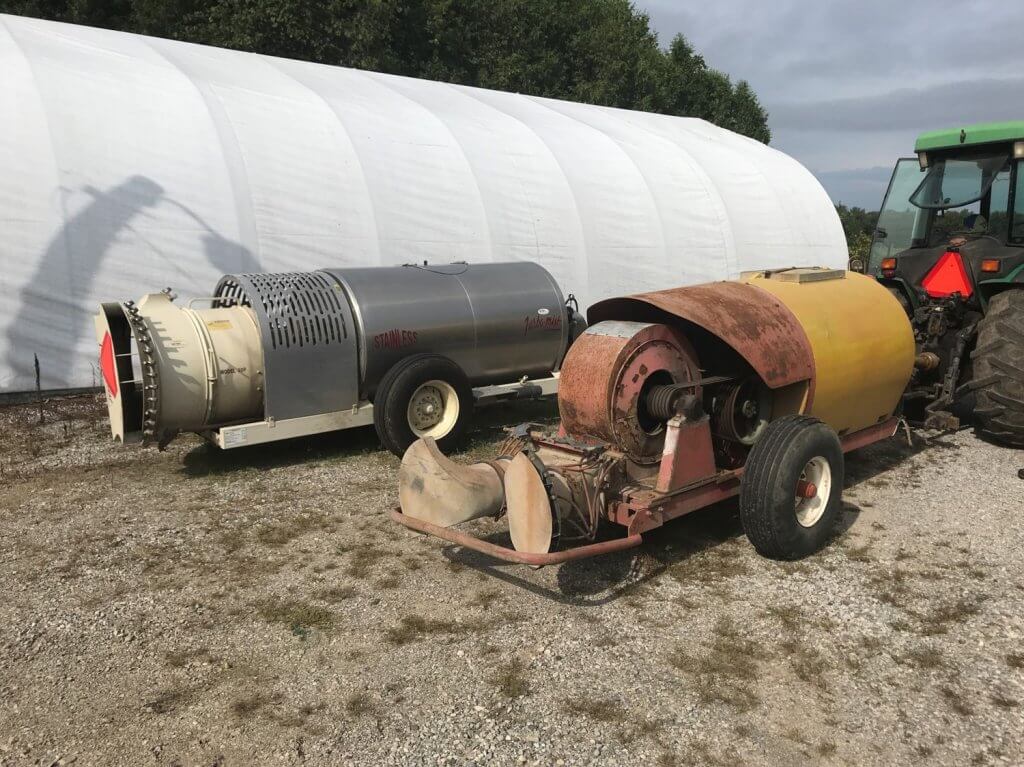
In 2018 they replaced their old, inefficient KWH sprayer with a low profile axial with conventional hydraulic nozzles to permit greater control of the spray. The KWH design was intended for standard fruit trees. It produced >100 mph air and an Extremely Fine spray quality and was therefore a bad fit with the planting architecture and canopy morphology of highbush blueberry.
They considered a cannon-style sprayer hoping to spray multiple rows in a single pass but given the desire for improved coverage and reduced waste, they elected to drive every row using a low-profile axial.
Fore: An old KWH air shear sprayer. Rear: Low profile axial sprayer with conventional hydraulic nozzles.
The new sprayer was more reliable, quieter, and more fuel efficient. Further, the old sprayer leaked and the air-shear nozzles did not respond when shut down at the end of rows. Eliminating these sources of waste represented a savings of ~20% of the spray volume traditionally used per acre.
Crop-Adapted Spraying
The redundancy inherent to product label rates for three-dimensional perennial crops has long been recognized. In response, rate adjustment (or dose expression) methods have been developed to improve the fit between rate and canopy coverage (e.g. Tree-Row Volume, PACE+, DOSAVIÑA). Each has value, but their adoption has been slow because they are region- or crop-specific and they can sometimes be quite complicated.
CAS lends structure and repeatably to the informal rate adjustment methods already used to spray three-dimensional perennial crops (e.g. Making pro rata changes by engaging/disengaging nozzles in response to canopy height or altering travel speed in response to canopy density).
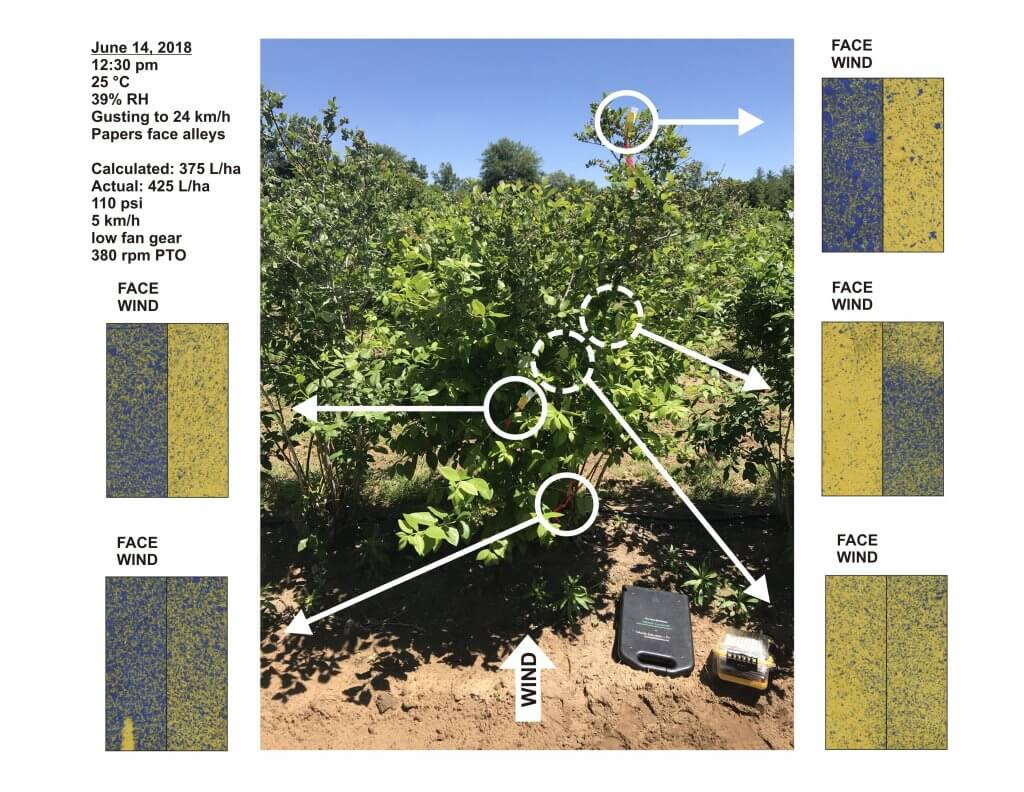
The CAS method relies on the use of water sensitive paper to confirm a minimal coverage threshold of 85 deposits per cm2 as well as 10-15% area covered throughout a minimum of 80% of the canopy. Using this protocol, we calibrated air energy and direction, travel speed and liquid flow distribution. This process is covered in detail here and in the new edition of Airblast101. In that first year we reassessed coverage every few weeks between April and June using water-sensitive paper.
Spray volume / Pesticide
By matching the sprayer calibration to a well-managed canopy, the growers were able to go from ~1,000 L/ha to ~400 L/ha of spray mix. The ratio of formulated product-to-carrier remained the same, but less spray was warranted per acre. Stated differently, the grower mixed the spray tanks per usual, but drove further on a tank.
This also saved an estimated 15 hours of filling/spraying time per year, which translates to reduced operator fatigue and exposure as well as reduced manhours and equipment hours.
The decision of what and when to apply was at the growers’ discretion. Chemistry was rotated and applications were made according to IPM in early morning (if there were no active pollinators) to avoid potential drift due to thermal inversions. The following image shows what those papers looked like in June of the first year.
Example of water sensitive paper coverage on a windy day (worst case scenario) in June, 2018.
Note how little spray escapes the target rows in the following video. The wind was too high for spraying, but we were only using water and saw it as an opportunity to test a worst-case scenario. Air-induction hollow cones were used in the top nozzle position on each side so droplets were large enough to fall back to ground if they missed the top of the canopies.
SWD monitoring
SWD represents a serious economic threat to blueberry operations. Traps were placed in the operation (three in the crop and one in an unmanaged wild host along a treeline) and monitored weekly. Traps were also placed in surrounding horticultural operations which were employing standard pest control practices. This not only provided regional information about SWD activity but allowed us to compare the level of SWD control from the Crop-Adapted Spraying approach.
In 2018 the comparison included up to 16 other sites that were berry and tender fruit.
In 2019 the comparison included 10-12 sites (depending on the week) and they were berry and tender fruit sites.
In 2020 the comparison included 4 other sites (blueberries, raspberries and cherries).
2020 & 2021 – Covid 19 and Heavy Rain
In agriculture, every year is an adventure, but 2020 and 2021 were exceptionally difficult and the circumstances should be considered when deciphering the results. Covid-19 has had a significant impact on global agriculture.
In 2020, fearing a reduction in the availability of seasonal labour, the operation pruned their bushes heavily. This was done to reduce the yield in order to make harvest manageable.
In 2021, labour was once again secure. Given the heavy pruning the year previously there was no need to prune again, so the crops densified. This coincided with abnormally high levels of precipitation to create significant anthracnose issues. Additional fungicide applications took place that raised costs, but the grower maintained CAS-optimized rates and sprayer settings.
Quantitative Results
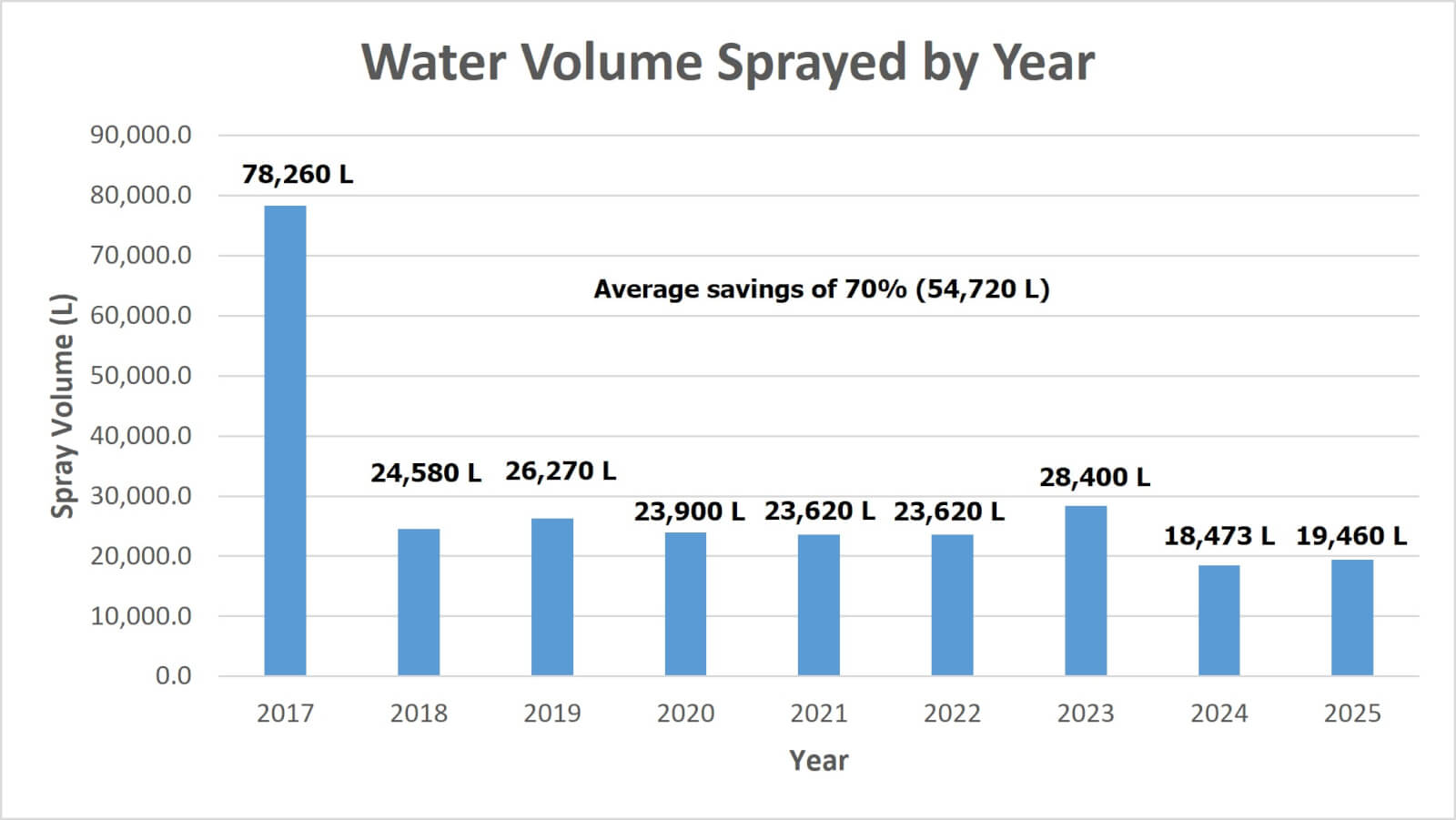
Prior to replacing their sprayer, and adopting CAS, the operation sprayed about 78,260 L/yr. Their average savings in spray volume (water) has been 54,720 L/yr, or 70%.
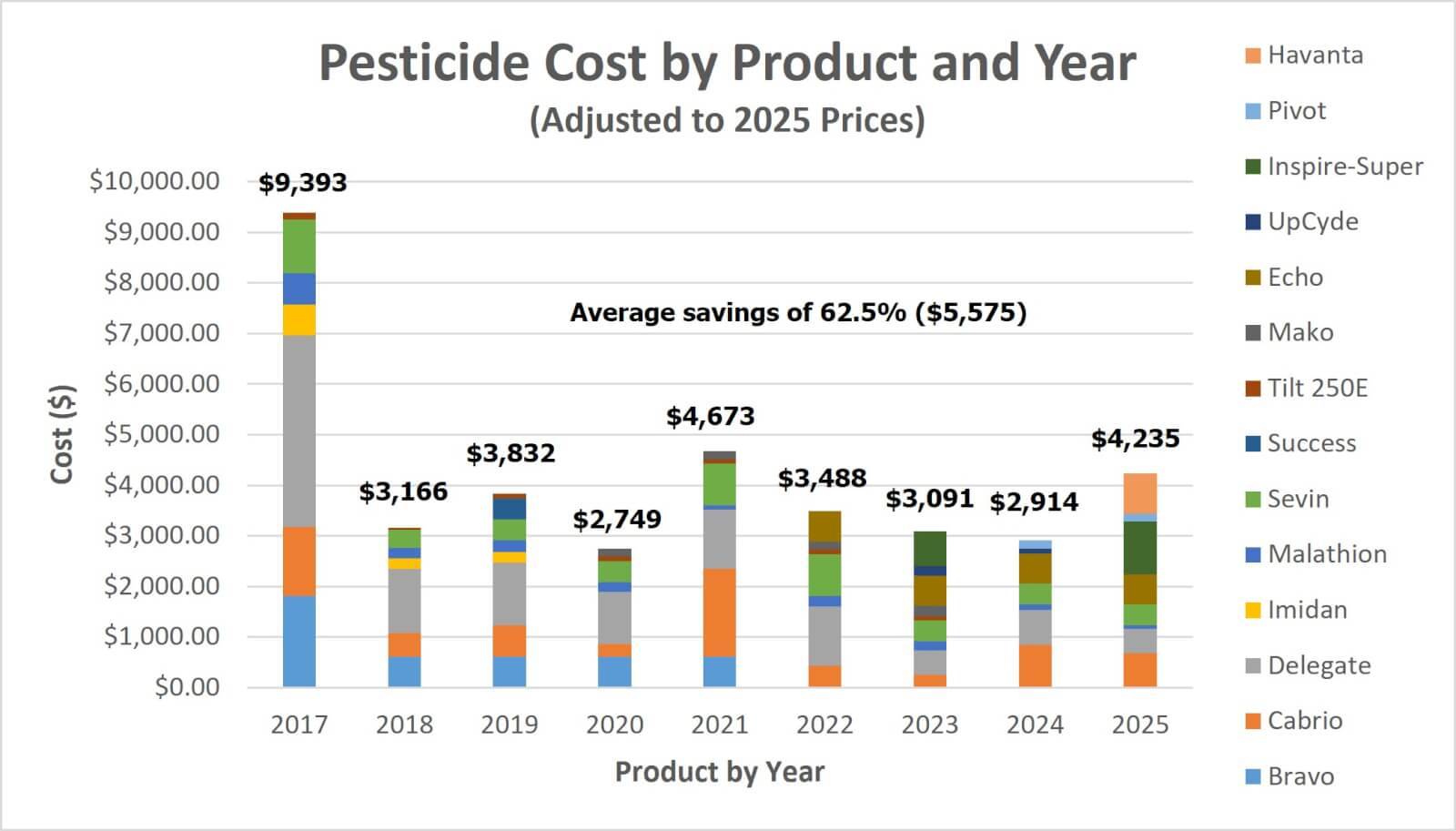
In terms of pesticide savings, we compare each year to the 2017 baseline. In order to make for a fair comparison, we update pesticide prices each year using current costs. Therefore, the 2017 total has increased by about $2,600.00 (wow). Their average savings represents $5,575.00 CAD/yr or 62.5%.
Yield is more difficult to interpret due to mitigating circumstances in 2019 and 2020:
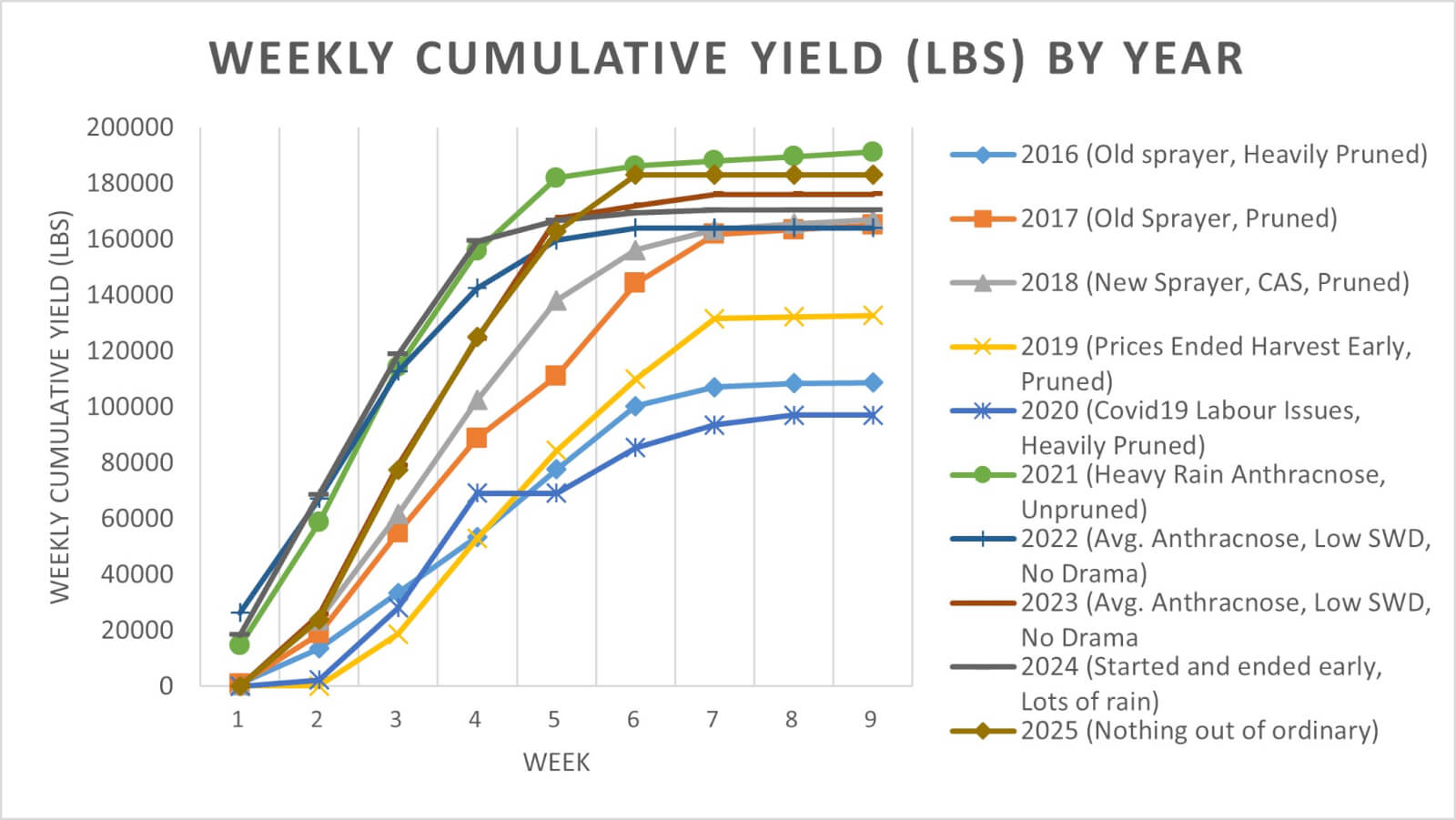
In 2016, prior to any changes, they harvested 12,076 flats (about 9lb of fruit each).
In 2017, following the canopy management changes, harvest increased to 18,335 flats (~50% increase).
In 2018, using CAS, harvest was essentially unchanged compared to 2017, which was excellent.
In 2019, harvest started a month late compared to previous years. Further, blueberry prices were low, and the operation elected to stop harvesting a month early. However, when those issues are factored in, the harvest was comparable.
2020 was particularly challenging for agriculture and with the possibility of reduced labour due to the pandemic, the operation elected to prune heavily and reduce their yield.
2021 saw unpruned bushes (following the heavy pruning in 2020) and abnormally high levels or precipitation which created anthracnose issues. As a result, more applications were made than any other year on record, but maintained the CAS-optimized rates and sprayer settings.
2022 was (thankfully) fairly typical. Low SWD, average anthracnose and no drama.
2023 was very much like 2022 with low SWD, average anthracnose and no drama.
2024 saw a LOT of rain. The season started and ended early, but yields were par. “Pivot” replaced “Tilt”.
2025 was pretty average all things considered. No drama whatsoever. “Inspire-Super” was added to product list.
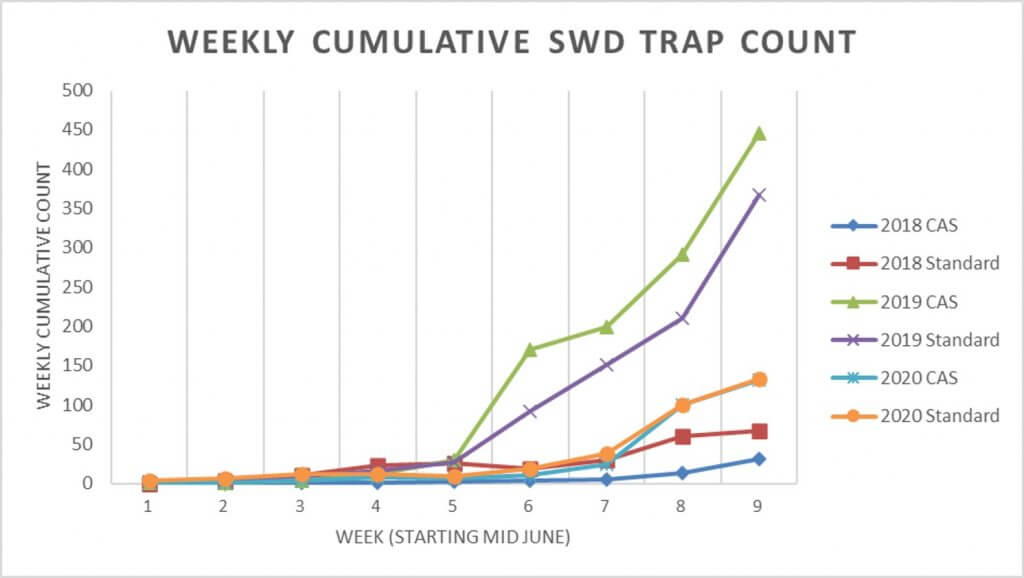
Trap counts for SWD were only performed during three years of the CAS study, so we are only able to present 2018-2020 data. It should also be noted that while the presence of SWD in an operation represents an impact on yield, there is not necessarily a correlation between the number of SWD captured the amount of damage.
In 2018 and 2020, average counts were higher in the surrounding operations employing standard practices (STD) compared to the CAS trial. In 2019, average counts were higher in the CAS trial. When total average counts are compared, the difference is negligible. Berries were tested regularly by the growers and the damage due to SWD was within acceptable limits. It should also be noted growers monitored and reported satisfactory disease control throughout the study.
We have not applied any statistical rigor, but the trend suggests that the level of control provided by the CAS method was comparable to conventional methods. This conforms with our previous results in Ontario apple orchards and similar evaluations of optimized application methods world wide.
Qualitative results
Beyond the quantifiable results, the growers reported qualitative benefits:
Customers of the U-pick portion of the operation regularly enquire about pesticides. The operation’s reduction in pesticide use became a positive speaking point and aligned with the grower’s philosophy about reduced environmental pesticide loads.
While many blueberry growers experienced a market shortage of certain fungicides in 2018, this operation returned unused product to the distributor.
Growers reported less early-season disease damage, which saved considerable time on the packing line because there was less fruit to cull. Disease levels rose to typical levels later in the season, but there was still a net savings in labour.
Conclusion
The success enjoyed in this berry operation was a result of several canopy management and crop protection changes. This is a situation where the whole equaled more than the sum of its parts – it could only be achieved by making holistic changes to the operation. At the end of three years the growers themselves stated:
“Based on my experience losing multiple crops to SWD, I can say with absolute certainty it works. <The results are> superior to what I expected. What we are doing is successful.”
Here’s a narrated PowerPoint presentation of this study (includes data up to 2020):
The monitoring portion of this project was funded by Niagara Peninsula Fruit and Vegetable Growers Association, Ontario Grape and Wine Research and Ontario Tender Fruit Growers in collaboration with private consultants.