Sprayer math can be intimidating, but the effort gives solid value. When combined with a calibrated sprayer you reap the following benefits:
Determine how much spray mix is required to apply the intended rate.
Estimate how much crop protection product must be ordered for the season.
Populate spray records which allow you to review practices, respond to enquiries and satisfy traceability requirements.
There are many ways to perform sprayer math, and you need only look to local pesticide safety courses, industrial catalogues, and extension resource centres for examples. If you’re already comfortable with your current method, don’t mix and match with others. Sprayer math is a series of related calculations that employ constants to keep the units straight. It’s all or none.
Walkthrough
Let’s start with the classic, US Imperial formula for calculating the sprayer output. We’ll weave in Metric, later. This base formula can be adjusted to allow you to solve for any factor, as long as you’re only missing one piece of information. Turns out your high school teacher was right – you DO need algebra.
GPM = [GPA x MPH x W] ÷ 5,940
In this case, you can determine an output rate (GPM – gallons per minute). You’ll need to know your target volume (GPA – gallons per acre), your average travel speed (MPH – miles per hour) and your nozzle spacing (W – which is width in inches). The number “5,940” is a constant that handles all the unit conversions. If you divide the GPM by the number of nozzles on your sprayer (assuming they are all the same rate), you can hone in on the ideal nozzle size.
But, as we noted earlier, you can do a lot more with sprayer math than just pick the ideal nozzle size. The rest of this article includes examples of both Metric and US Imperial formulae, but watch out for unit conversions. If at any time you don’t see the units you’re looking for, you can consult our unit conversion tool.
Grab your calculator – it’s math time!
Don’t be intimidated. With a little practice, sprayer math gets easier and it’s always worthwhile. The real trick is navigating unit conversions.
Step 1 – How large is the area you need to spray?
Multiply the length of the area you plan to spray times the width. If you are using metres, then divide the product by 10,000, which is the number of m2 in a hectare (ha). For feet and acres, divide by 43,560 which is the number of ft2 in an acre (ac):
Step 2 – How much product is needed to spray the area?
Consult the rate(s) shown on the label. In Canada, rates are often based on planted area (E.g. hectares). In Australia and New Zealand, they may be based on row length (not covered in this article). If you measure your area in acres, you’ll have to convert the rate by multiplying by a constant: 0.4.
Now multiply the area you want to spray (step 1) by the rate (step 2).
Step 3 – How far can you go on a full tank?
You know your sprayer output (determined through calibration) so you divide that into your tank size. Watch your units:
Step 4 – How much pesticide per tank?
Multiply the area that can be sprayed per tank (Step 3) by the pesticide rate (Step 2). Again, watch your units:
Step 5 – How much area is left to spray?
Just subtract what you’ve already sprayed from the total area.
Step 6 – How much pesticide in the last, partially-full tank?
Multiply the area you have left to spray (Step 5) by the pesticide rate (Step 2). Yes, watch your units:
Step 7 – How much spray mix will I need for the partial tank to finish spraying the total area?
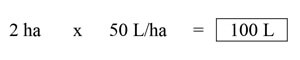
Multiply the area you have left to spray (Step 5) by the sprayer output (determined through calibration). Guess what? Watch your units:
Sample problems
Time to test your knowledge. Let’s suppose you want to apply a product rate of 3 L/ha to your blueberries. You calibrate your sprayer and determine your output to be 50 L/ha. Your tank holds 400 L of spray mix. Your planting is 500 m long and 200 m wide.
Q1 – How large is the area you need to spray?
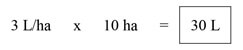
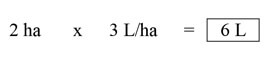
Q2 – How much product is needed to spray the area?
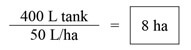
Q3- How much area can be sprayed on one tank?
Q4 – How much product should be added to a full tank?
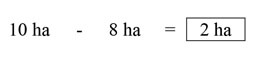
Q5 – After the tank is empty, how much area is left to spray?
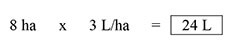
Q6 – How much product to add to the last, partially full tank?
Q7 – How much spray mix will be needed to finish spraying?
Tank mix calculator
You might feel we buried the lead by adding this calculator to the end of the article. It’s important for a sprayer operator to understand the math required to interpret labels and calculate tank mixes, so hopefully you read and understood the process before you got here. And now that you have, this is a very helpful tool. Try it online, or download a standalone version.
Notable exceptions
Certain situations aren’t covered in this article. If you are spraying a greenhouse, the math is different. If you are performing a banded application, the math is different. And, if you’re an airblast operator trying to reconcile why a pesticide label uses planted area rather than canopy volume for its rates, you’re in for some additional reading.
Crop spraying is one of the most important and highly skilled jobs undertaken on any arable farm, but it is facing increased public scrutiny. This is why it is vital that the kit you use as a means to apply pesticide to crops is in prime working order and is set up correctly to deliver the product safely and accurately to its target. Optimum sprayer set up will help to maximize the efficacy of applied products, reduce spray drift and keep machinery in good condition.
For this best practice guide to sprayer set up, Farmers Weekly teamed up with former Farm Sprayer Operator of the Year Iain Robertson. Mr. Robertson is assistant arable farm manager at David Foot Ltd, a 2,200ha mixed farm south of Dorchester in Dorset, growing wheat, barley, beans, oilseed rape and maize as forage for the farm’s three dairy herds. The machine used for this guide is a Bateman RB26 self-propelled sprayer and while most of these checks and tests are universally applicable to all sprayers, it is also important to refer to the handbook of the manufacturer of your specific machine.
Watch the video tutorial with Mr. Robertson and then see the step-by-step guide below for more detail.
Pre Start Checks
Before firing up the engine, the first thing to do is your pre-start checks – that means checking your machine’s vital fluids like fuel, hydraulic oil, hydrostatic oil, engine oil and coolant levels. If yours is a self-propelled sprayer, chances are you’ll need to get up on to the back of the machine to check some of these.
“While I’m up on the back of the sprayer I also have a quick look in the top of the tank to make sure that it is nice and clean and the tank rinse nozzles have worked properly – cleanliness is next to godliness,” says Mr. Robertson. Next, move on to the tires. Use a pressure gauge to check all tires are at the correct pressure and refer to the manufacturer’s guidelines. If you’ve got a trailed sprayer, don’t forget to check the tractor tire pressures as well.
Aim for tires to be run at the lowest pressure recommended for the load to be carried. This will help with boom height and stability and also helps tires act like a shock absorber to ride out bumps. If using a trailed sprayer, use a spirit level to ensure that the drawbar is level. Mr. Robertson says he tries to work around the machine in a methodical, clockwise manner to ensure that he doesn’t miss anything.
Coming to the pumps, check that they have got enough oil, check that any tool boxes have enough spare parts and any equipment needed and make sure you are carrying a spill kit with absorbent granules and a spade in case the worst happens and there is a spillage. Make sure all parts are lubricated daily and that any grease nipples are cleaned before and after use to avoid them collecting dirt and blocking.
Check all hydraulic hoses, spray lines and air lines for any signs of wear that could result in problems while operating.
It’s best to run the sprayer at a minimum of 5 bar to check for leaks. Also check the spray tank is fixed down securely, all straps and bolts are tight.
Boom checks
Once opened out, check the boom has good movement in the x- and y-axis. All machines are different so check with your manufacturer as to how the boom is set up. Mr Robertson’s Bateman has tie rods and stock bots that can be adjusted to set the boom up to ride well.
Check the tie rod nearest the back of the machine is slightly loose when moving and that the front rod is tight. Next, check for up and down movement by gently pushing the boom down by about 50cm and letting go. The boom should return to the central position without too much bouncing around.
“We want a little bit of movement but not excessive so that you can ride over the bumps as you go along without over- and under-dosing the crop,” says Mr. Robertson. Boom height is one of the most critical factors when spraying and the ideal height is 50cm above the crop. One of the easiest ways to work this out is by using a cable tie that is cut off at the correct length to use a visual aid from the sprayer cab.
Don’t forget to measure from the tip of the nozzle to the crop, not the spray line.
Good sprayer cleanliness is important, so make sure the system is rinsed through at the end of each day with clean water to make sure there’s no residue left in the boom. If your machine’s boom doesn’t have recirculation, remember to take the end caps off occasionally and flush out the whole boom.
Nozzle checks
Check that the nozzles are aligned both vertically and horizontally, according to the NSTS guidelines. Loosen clamps to adjust any nozzles that need realignment.
Check the nozzle output at least twice a year by running the sprayer with clean water at 3 bar pressure. Time the output of each nozzle for 30 seconds. If nozzles have been used previously, it’s best to check their output against that of a new pair. Mr Robertson advises using a measuring cylinder rather than a jug to measure the flow rate as a jug is less accurate “because you get a bigger variation over the wider surface area”.
With an 03 nozzle running for one minute at 3 bar pressure, the output should be 1.2 litres/minute as a rule of thumb but refer to the nozzle manufacturer’s output chart for the expected flow rate. “An easy way to remember this is: at 3 bar your nozzle size multiplied by four will give you your target litres/minute output. It works for all nozzle sizes.” If the output varies more than 4% of the average, or if the spray pattern visually doesn’t look correct, you need to change the nozzle set.
After checking the output, cross-reference this figure with the rate controller – you may need to adjust the flow figures to ensure that the two correlate. If a nozzle becomes blocked while spraying, Mr. Robertson says he will swap it for a new one and then clean it later using a toothbrush or airline. Never blow through a nozzle with your mouth.
Nozzle choice
The choice of nozzle is highly dependent on the sort of job you’re doing. “Timing is crucial but using the right nozzle at the right time will make the job so much easier, cut drift and mean that you’re getting more of the product where you want it to go. If you aim at it you will hit it,” says Mr. Robertson.
His nozzle of choice is an 03 size and he prefers to use the Defy 3D nozzle alternated forwards and backwards across the boom for pre-emergence work and T0 applications as well as the T3 ear spray. “In less than optimum conditions I may prefer to use the Amistar/Guardian Air, a fine induction nozzle. I would use this at T1 and T2 and also in sub-optimum conditions.” This nozzle has a 3-star Local Environmental Risk Assessment for Pesticides (LERAP) rating and is 75% drift reducing.
A water volume of 100 litres/ha is a good rate for spring fungicide application. It provides enough coverage for good disease control and allows maximum efficiency from the sprayer.
Forward speed
The third and final part of reducing spray drift is forward speed. Depending on nozzle size and water volume, aim to travel at 12kph.
Mr Robertson says he finds that this speed gives a good overall output and means you don’t get shadowing or turbulence behind the machine.
Tips and tricks
One of the biggest risk of contamination is at fill up. “A fantastic, cheap trick that I learned through Farm Sprayer Operator of the Year is to take a 200 litre plastic drum and cut it in half to create two drip trays to catch any spillages under the induction hopper and the tank overfill.” This eliminates point source contamination, he says.
“Finally, there’s a plethora of information out there on the internet, loads of good apps to download. The technology is there to help us do the best job possible and make our job as safe as possible.”
Spot sprays are becoming mainstream. As of 2024, John Deere’s See & Spray Select, their Green-on-Brown technology, is selling well in western Canada but it’s creating some confusion about how to outfit and run the system.
Quick Overview:
See & Spray Select is available on 120’ booms with either 15” or 20” spacing. It can be operated at up to 12 mph with conventional vertically oriented nozzles, or up to 16 mph with backwards oriented nozzles using a 40º adaptor available from John Deere. Optimal boom height is between 26” and 47”
Operating speed for See & Spray Select is measured at the boom. That means if an operator drives at the 12 mph limit and the boom yaws forward under normal driving or in a turn, the boom speed will exceed 12 mph and it will enter “fallback” mode. Fallback mode is intended to provide weed control when camera vision is compromised due to dust, height, or speed, and typically it means that all the nozzles in the affected boom region are turned on. To avoid unnecessary waste, an operator will want to minimize fallback mode and therefore will want to drive slower than the maximum allowed boom speed.
An operator has a choice of selecting a single-nozzle or overlapping-nozzle activation. In single nozzle mode, only the nozzle in the weed’s lane is turned on. In overlapping mode, one adjacent nozzle on each side is also turned on, for security. Overlapping mode is available on most spot spray systems to compensate for spray displacement in a side-wind, for example.
Research at the University of Wisconsin has shown that the overlapping mode resulted in more consistent weed control in a side-wind.
Nozzle Selection
Overlapping mode makes nozzle selection easier because the fan angle is not as critical. Nozzles are allowed to overlap as they’re supposed to on a broadcast boom, and the spray dosage is a function of nozzle size, spacing, and travel speed. It’s also easier because boom height movement doesn’t affect the dose, so long as the required overlap remains. But nozzle fan angles should still not be too wide.
Single nozzle activation can save more product. But in this mode, nozzle fan angle is critical because it determines the band width. Unfortunately, current nozzle selection is poor – most manufacturers aren’t offering any narrow-enough fan angle nozzles yet. For this reason, John Deere’s nozzle recommendations are intended primarily for overlapping mode.
With single nozzle activation, the nozzle pattern (band) width needs to be fairly close to the nozzle spacing, but still have some overlap when adjacent nozzles are activated in a weed patch. The more the pattern width exceeds the nozzle spacing, the greater the underdosing in single nozzle activation compared to overlapping sprays. This conundrum is unavoidable. The closer these two values (pattern width and nozzle spacing) are to each other the better. But for this to work, boom height has to be consistent. Too low a boom creates gaps between adjacent narrow patterns. Too high and the pattern width widens, reducing the single nozzle dose. There is simply not much room for error.
Broadcasting Background Dose
With See & Spray Select, the A solenoid (front nozzle in ExactApply) can be used to apply a PWM broadcast spray simultaneous to the spot spray. This feature is useful with early season application because of just-emerged weeds that may be missed by the sensor. We might choose about 1/3 of the full rate applied this way, a dose which is sufficient to control these small weeds. With a tank mix for 10 gpa, one would spray 3 gpa with the front boom and 7 gpa with the B solenoid, the spot spray. This way the entire field receives the 3 gpa dose, while larger weeds that trigger the spot spray receive the 10 gpa dose.
The problem is again with nozzle availability. For example, 3 gpa with 15” spacing at 11 mph with PWM (broadcast mode) requires a small nozzle such as an 01 (orange) or 015 (green). These are hard to find in a low-drift version. Increasing the broadcast water volume to 5 gpa would allow an 02 (yellow) nozzle to be used. A 20” spacing would allow even larger nozzles to be used, for 3 gpa an 025 (lilac) is a possibility and this greatly improves the available choice. At 5 gpa, an 03 size is suitable, and now the John Deere LDM nozzle is an option (it is not manufactured in sizes smaller than 03).
Let’s assume a user selects 5 gpa for the broadcast based on nozzle availability. The next decision is whether to adjust the total applied volume upwards. If sticking with a 10 gpa tank mix, the spot spray would also be 5 gpa, making the broadcast 50% of the dose.
Alternatively, one could increase the spot spray volume to 10 gpa, mixing the tank for 15 gpa. This returns one to 1/3 of the total dose as broadcast, and 2/3 as a spot spray. A reason for doing this is to make nozzle size selection easier and also improving the product savings of the system.
The spot spray from the B solenoid is not PWM, which allows for a more straightforward nozzle sizing, as well as the use of air-induced tips which are available in a large number of sizes.
A summary of some possible nozzle combinations for two nozzle spacings and travel speeds is listed in Table 1.
Table 1: Possible nozzle sizes for overlapping mode in John Deere See & Spray Select Note that the travel speed is lower than the maximum allowed, to accommodate boom yaw.
If the operator chooses single nozzle activation, the fan angle of the nozzle becomes important. To recap, one would want to have a nozzle that can do two things:
Cover a band that is close to the same width as the nozzle spacing when a single weed activates a single nozzle, and
Provide sufficient overlap when multiple adjacent nozzles are activated in a larger weed patch.
It’s not possible to have a band width as narrow as the nozzle spacing and still get an overlapping pattern when it’s needed. This means the dose for a single nozzle pattern will unavoidably be spread out wider, resulting in a lower dose for any weed it encounters compared to the overlapping activation. But the wider the fan angle, the wider the band and the lower the dose, resulting in possibly reduced control for single nozzle activations.
On the other hand, a narrower band limits the boom height at which an acceptable overlap can be achieved. Let’s say an overlapping nozzle needs to have 30% overlap to get an acceptable spray distribution. At a 20” spacing, the band would need to be 26” wide (a 24% under-dose on a single nozzle compared to an overlapping section). Band width will change with boom height, but it depends on the fan angle. For a 60 degree fan angle, the band changes by about one inch for every inch of boom height. That means even with a modest 10” vertical movement of the boom, the dosage might change by 30%, a fair amount.
Actual changes depend on the nozzle spacing and the fan angle, but the point remains that this is a significant dosage change that could affect weed control. And this change in dose is because of boom sway.
Recommendations
What should a spot spray user do? One thing is clear, compromises will be necessary.
The most consistent application will be achieved with overlapping mode, but at the cost of forfeited savings. These lost savings may be recovered due to fewer weed control failures, or less need to re-spray.
On the other hand, the greatest savings will be achieved with single nozzle activation. But fan angle will need to be carefully selected and boom height consistency will be critical.
Availability of narrow fan angles is limited. Only Wilger (20, 40, and 60 degree DX), Greenleaf (40 degree Spot Fan), Arag (CFLD-CX 40 degree) and Magnojet (30 and 60 degree) offer spot spray-specific low-drift nozzles off the shelf. TeeJet has issued DriftGuard (DG) versions of 65 degree nozzles for the Australian spot spray market, with the DG65055 a special nozzle that conforms to the VC spray quality requirement needed for 2,4-D products.
John Deere has recently (Spring 2025) released an 80 degree spot spray tip called the TSL. It ships with the angled adaptor for faster spray speed. However, 80 degrees is still not narow enough to permit single nozzle activation without some significant rate compromises between single and overlapping mode.
The availability will need to increase, not only in terms of fan angles, but also in flow rates and spray qualities. With spot sprays remaining a relatively small market this will take time. But the success of spot sprays also depends on it.
One question that only experience will answer is the relative frequency of single vs multiple nozzle activation for any given farm. If the majority of the activations are multiple nozzles, then setting up the nozzles for that situation (i.e., opting for wider fan angles that create more overlap) makes most sense.
But regardless of the choice made by the user, the need for stable booms remains paramount. This feature will be the basis on which any progress in spot spray adoption will be built. Call your dealer. Tell them how important boom stability is.
Green-on-green sprayer competes with Blue River and Bilberry
One distinguishing feature of the new agriculture is the rapid development of new technologies. Ideas move from concept to implementation at record pace, helped by an influx of talent and capital into this profitable sector.
Greeneye Technology is an example of this pace. Founded by entrepreneurs who met in the Israeli armed forces, they developed a software platform that identified crops, weeds, and other objects in agricultural fields from drone imagery. They recognized the opportunity to transition their software to a sprayer platform, and in 2017 decided to join the race, most notably competing with Blue River, Bilberry, Carbon Bee, and Xarvio, to create a green-on green spot sprayer.
Greeneye, in an amazing display of efficiency and speed, has been a commercial product for approximately one year in the US and has sold several units in Nebraska, Minnesota and Oklahoma, and next year will expand to North and South Dakota, Iowa, Illinois, Kansas and Texas. Having consulted for the company in its early years, I paid a visit to Peterson Farms Seed near Fargo, ND in early July 2023 to see the sprayer first hand at a field demo. By the way, kudos to PFS for bringing this technology to their customers to see. Have to love a business so committed to the cutting edge.
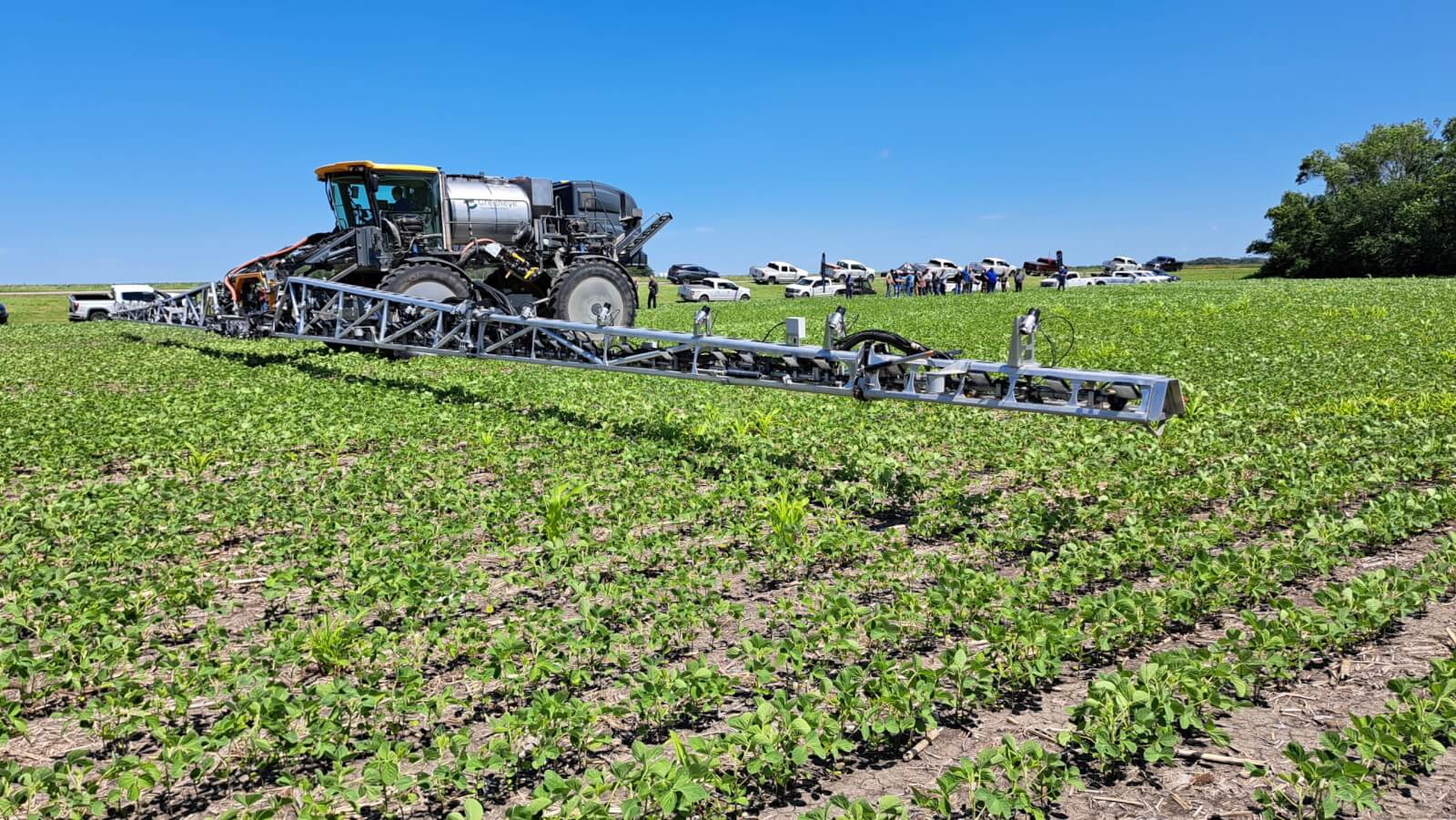
Figure 1: The Greeneye system was mounted on a Hagie STS 12 sprayer.
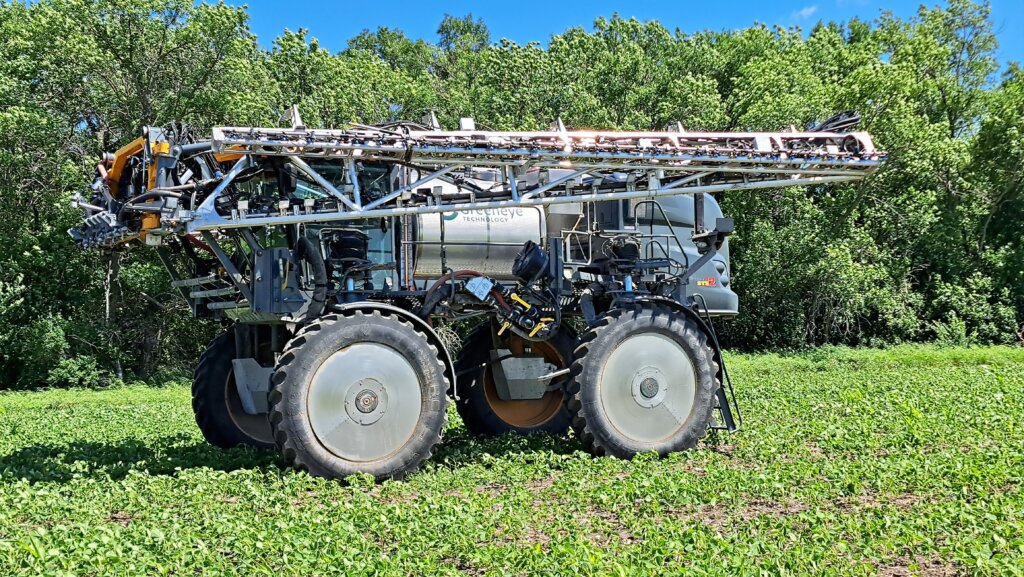
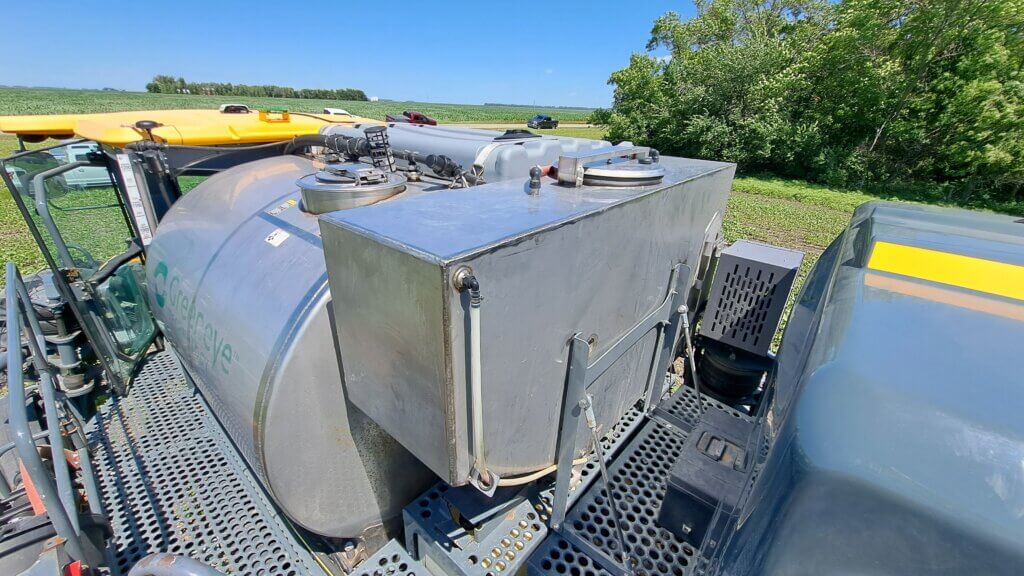
The Greeneye system was mounted on a Hagie STS 12 sprayer (1200 US gallon tank) with a custom 120’ boom manufactured for Greeneye by Millenium. Recognizing the agronomic need to broadcast pre-emergence herbicides along with a post-emergent spray, they company retained the existing plumbing system (tank, pump, wet boom) for this purpose. They added a smaller spot spray tank (240 gallons) with its own pump and wet boom for spot spraying.
Figure 2: A smaller spot spray tank was added to the Hagie. If necessary, spray mix can be pumped from the larger tank to this smaller tank.
This approach permits the flexibility of broadcasting a pre-emergent herbicide during burnoff alongside a post spot spray on emerged weeds. The agronomist in me likes this a lot. Broadcast pre-emergent herbicides are an important part of resistance management, particularly in the US.
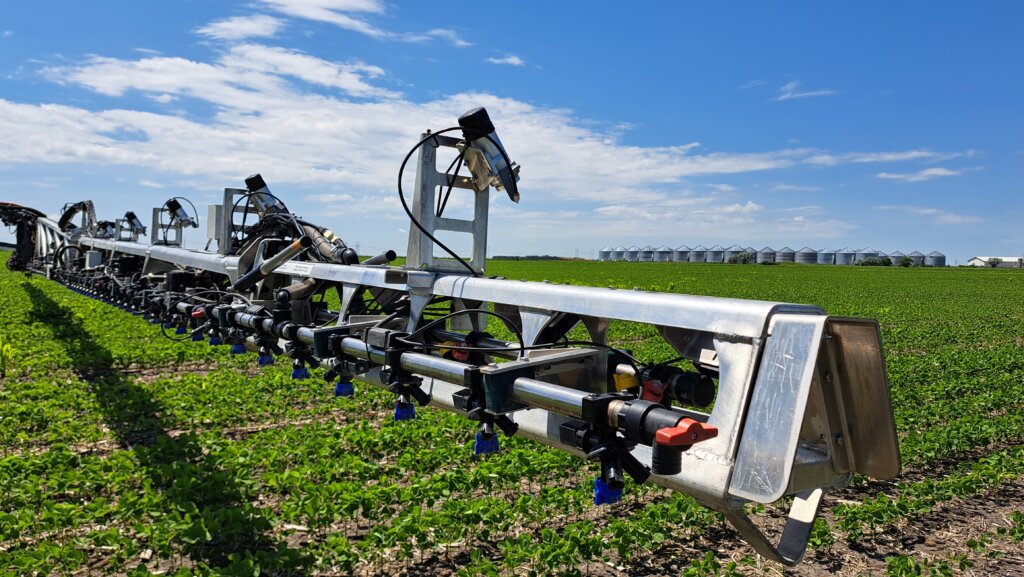
Figure 3: The second (spot spray) boom is mounted behind the factory wet boom.
The new wet boom has a nozzle spacing of 10”, is fitted with three-nozzle-turret TeeJet bodies. The 10″ spacing allows for higher resolution of the spot spray, increasing potential savings compared to a 20″ spacing.
Figure 4: The spot spray nozzles are mounted at 10″ (25 cm) spacing.
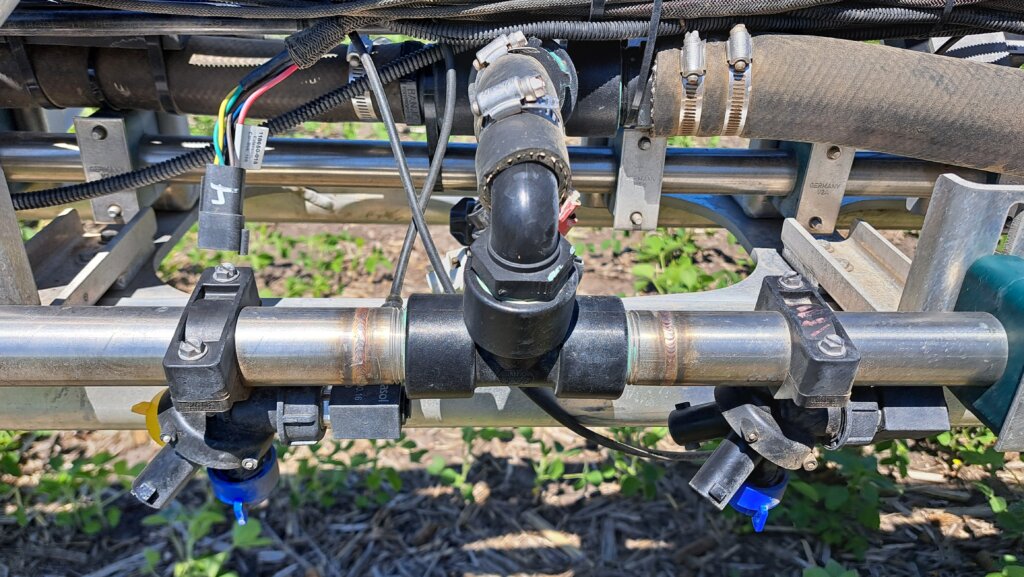
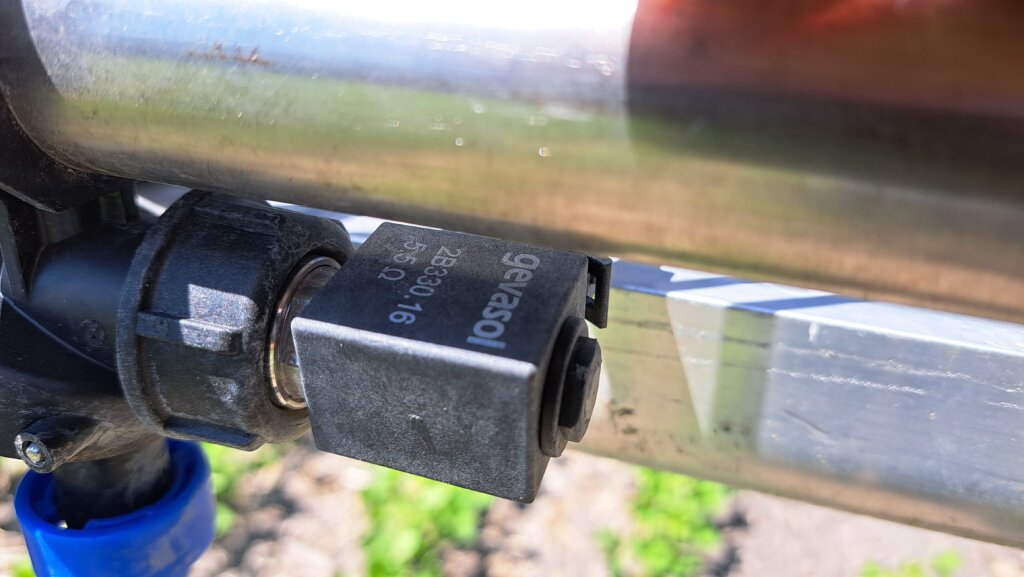
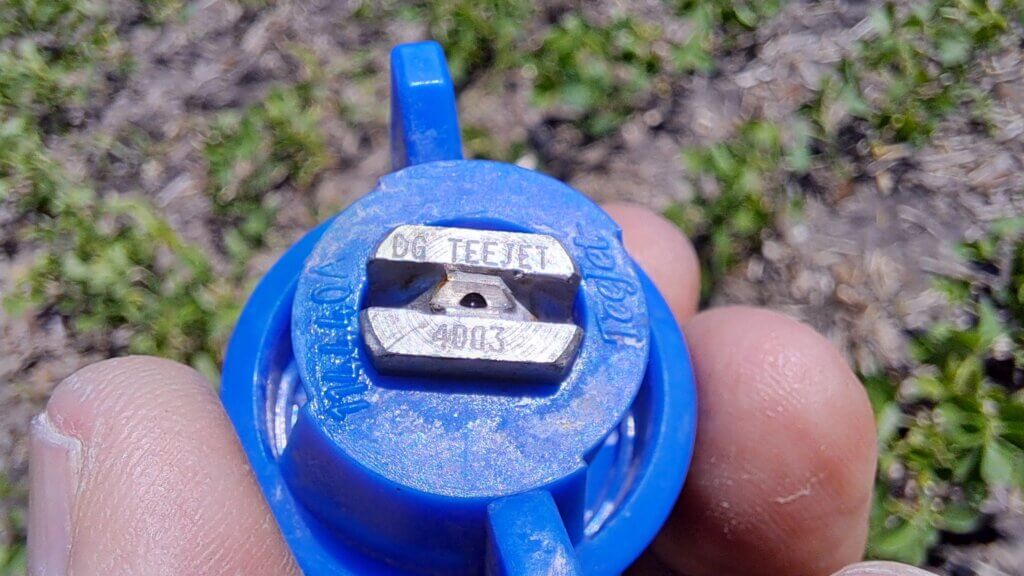
The spray was metered through custom-made TeeJet DG4003 tips using Gevasol solenoids running at a speed-dependent frequency, maximally 100 Hz, with turn compensation.
Figure 5: Solenoids activate the spray when a weed is detected in that nozzle’s lane.
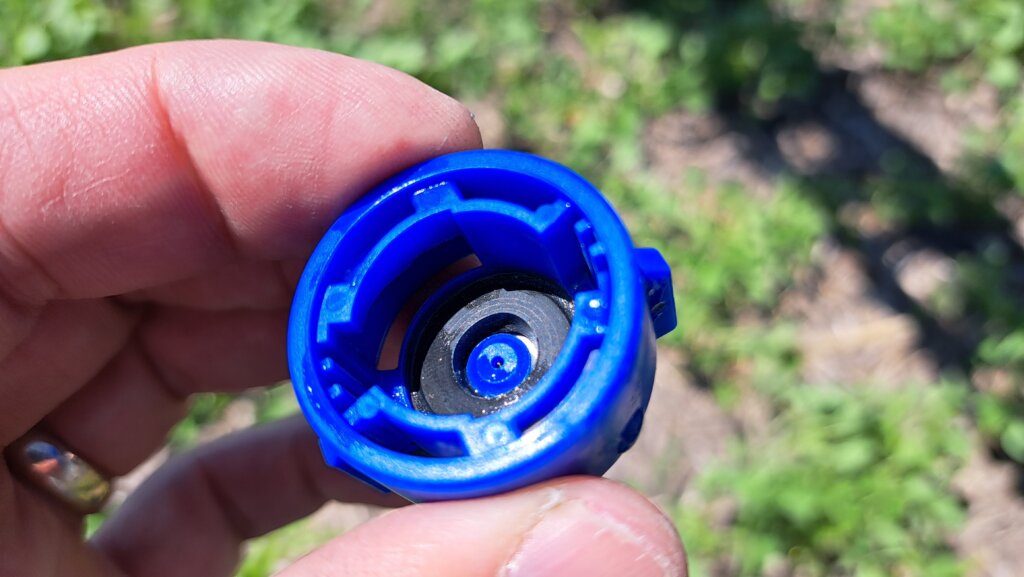
DG Nozzles use a pre-orifice to meter the flow at the rated amount, with an exit orifice slightly larger. This creates a pressure drop, resulting in a lower drift spray.
Figure 6: These Drift Guard nozzles are custom-made for Greeneye by TeeJet.
Figure 7: The blue DG pre-orifice meters the flow at 0.3 US gpm at 40 psi.
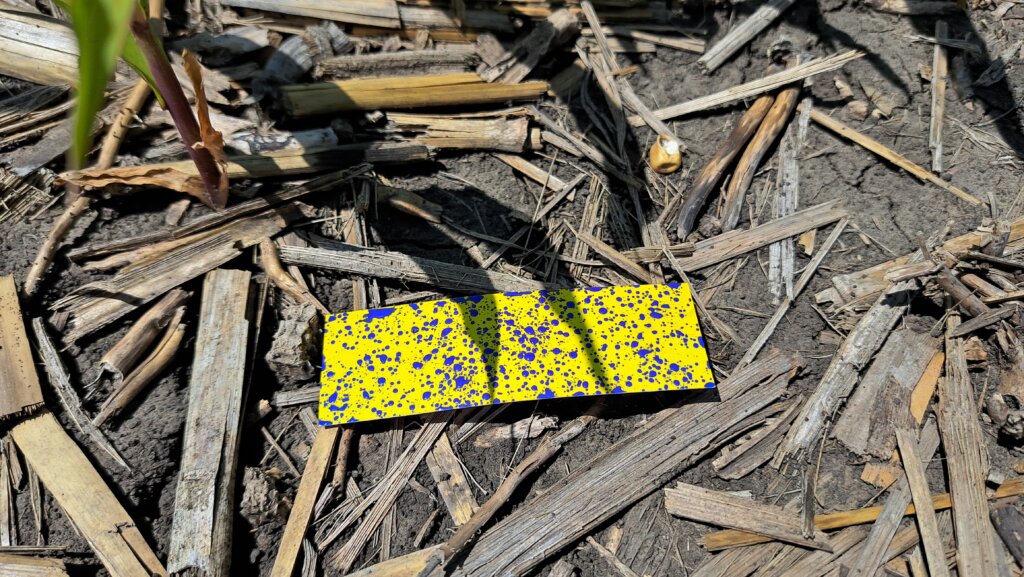
Looking at the spray quality and coverage on water-sensitive paper I thought the deposit looked just right. Spot sprays shouldn’t be too fine for risk of displacement from their intended band. We’re not seeing bundled nozzles with other spot spray systems, who leave nozzle selection to the operator. That can pose difficulties and possibly forfeit either weed control or savings.
Figure 8: The spray deposit shows adequate coverage and a good droplet size distribution for good placement accuracy.
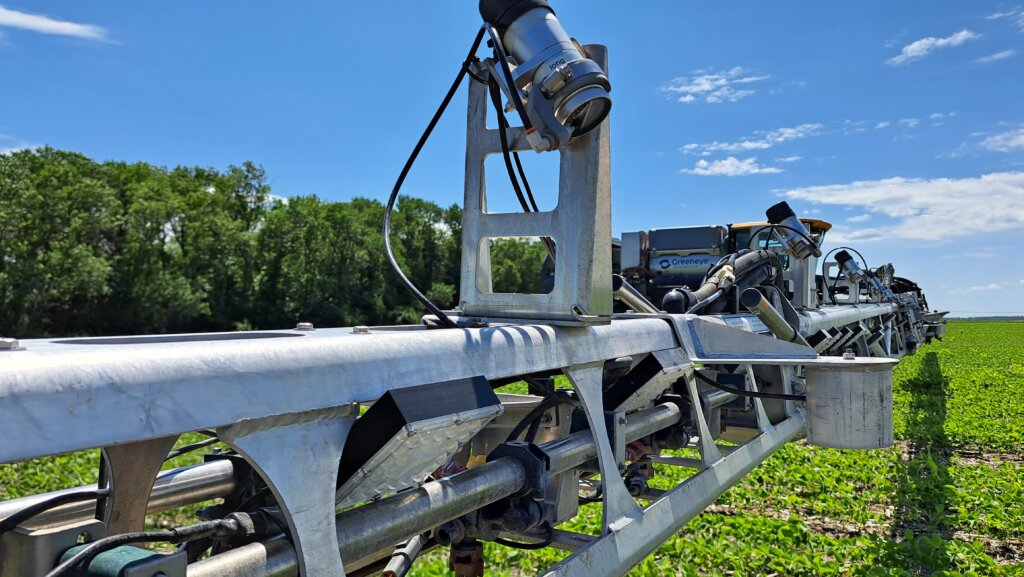
Sectional control retains the plumbed resolution at this time, although nozzle-by nozzle resolution is in the pipeline. Cameras are mounted at 1.5 m intervals and can run up to 50 fps. Camera resolution is proprietary, but the company claims that weeds as small as ¼” diameter can be detected. In its current configuration, weed diameters of 1” are detected, leaving smaller weeds for the pre-emergent products. LED lights flash to illuminate the camera field of view, improving image consistency and permitting the system to run at night. The Greeneye system analyzes a captured image just once to make a spray decision, and does not use segmentation in its algorithm.
Figure 9: The camera and lights look ahead to provide the necessary time for the on-board computer to make the required calculations that determines the plant’s identity. Note the aspirated lens cleaner.
Like its competitors, the user can select from individual nozzle activation or, in “windy mode”, the addition of the adjacent two nozzles to create a three nozzle broadcast. The length of the band is automatically selected by the software, with no user input available. Sensitivity adjustments are currently by request to the factory, but will be available for operator control in 2024.
Greeneye provides its own cab monitor that works with the sprayer monitor on sectional control. The Greeneye monitor keeps track of the spray volume usage and provides an ongoing report to the operator.
The software is able to report back whether a detection was a grassy or broadleaf weed, a powerful piece of information for keeping track of weed patches and monitoring for emerging problems. Weed maps are already being produced as a proprietary tool, and will be generally available in 2024.
New Greeneye customers have their sprayer picked up at the yard and transported to Greeneye facility where the new boom, tank, and digital components are installed. The customer receives the converted sprayer, calibrated and ready to go.
In my judgement, the install was clean and tidy. Camera mounts are welded on, and an air jet can be used to keep the lenses dust free. Brackets for the GPU and other control boxes are unobtrusive, although the wiring does get a bit crowded in places. Everything is accessible.
Cost is $239,000 US at time of printing (July 2023). This gets the customer a Greeneye system for a 120 foot boom, a brand new aluminum boom, retrofit of the sprayer to dual tank, installation and warranty. Return on Investment (ROI) for a spot sprayer will depend on farm size and herbicide use. Based on observed savings to date, Greeneye estimates that for a farm larger than 3,000 acres the ROI would typically be less than 2 years.
Greeneye does not charge subscription fees for its algorithms. This last aspect is interesting as John Deere and Bilberry both charge for use of their algorithms on a per acre basis. John Deere, for example, charges $3/acre US for corn, and $4/acre for soybeans and cotton, each time you make a spot spray pass with See & Spray Ultimate.
Available Greeneye algorithms are for Green-on-Brown, and Green-on-Green in corn and soybeans as of July 2023. Cotton and milo will be available in 2024, and Greeneye is working on canola and wheat as well. Like Bilberry, they capture images from the cameras for use in algorithm learning, and accuracy and hit rate should be improving with time. Travel speeds of 15 mph are working well according to Greeneye.
As for performance, the proof will be in the pudding. The company in its wisdom did commission an independent evaluation at the University of Nebraska, Lincoln, and has made a summary of the university report available on its website. According to UNL, broadleaf weed control in corn with the spot sprayer was equivalent to the broadcast treatment, and grassy weed control was slightly less effective. UNL researchers noted herbicide crop injury (“Status”, dicamba + diflufenzopyr) was reduced with the spot spray. Of course, savings will be a function of weed density and the detection threshold chosen by the operator, but the addition of reduced crop injury resulting in greater yields could also be very valuable.
A recent investor and business partner is Farmers Business Network (FBN). FBN sees the opportunity for a spot sprayer to act as a scouting platform that helps evaluate the success of new pest management strategies.
Support on the ground is in the form of US staff with backgrounds in the spraying industry. Software development and digital troubleshooting remains in Israel.
Although I no longer have business links to Greeneye, I was happy to see this sprayer operating as well as it did. I remain convinced that spot sprays will be an essential part of our spraying future, for sustainability and resistance reasons. It is heartening to see these early successes and it will be interesting to see them continue to evolve.
It’s the rite of passage of many agricultural summer students across the world: applying experimental treatments to field plots using a research sprayer. The results of these experiments may be the basis of new product use registrations, or provide clues into future scientific studies. Needless to say, the application method needs to be bullet proof to ensure the results are reliable. Here are a few guidelines, starting with some tips:
Pro Tips:
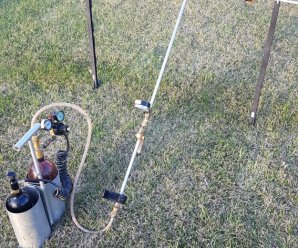
When assembling a hand-held boom, ensure the threads are properly sealed using Teflon tape. More or less tape can be used to create a snug fit at the right part of the thread rotation.
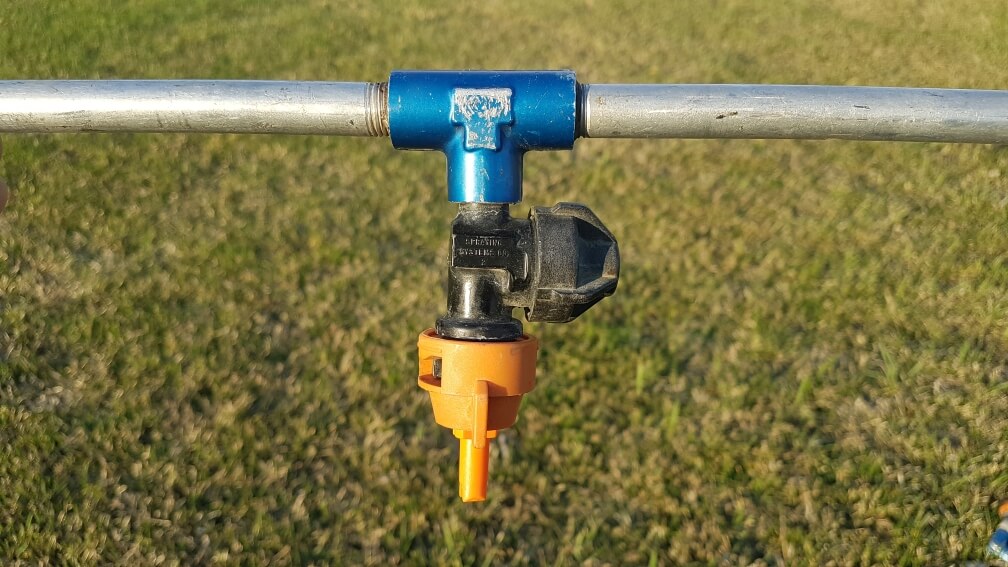
2. Choose nozzle bodies with diaphragm shutoff valves. These valves stop flow below 10 psi and prevent dripping of the nozzles after shutoff, without pressure drop during operation.
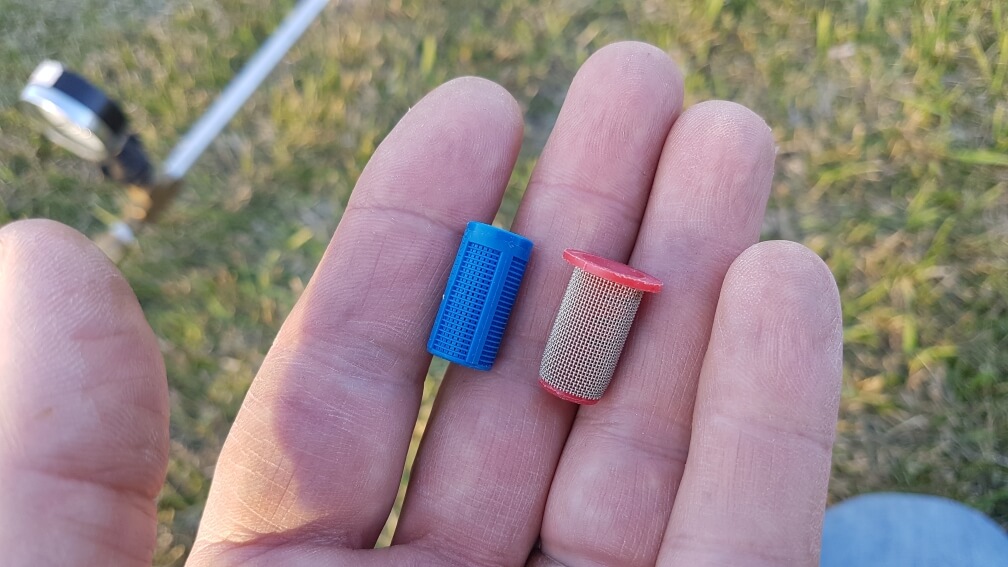
3. Avoid the use of older style “check-valve strainers”. Although these also prevent drips, they create a pressure loss of about 5 psi which creates uncertainty around the actual spray pressure.
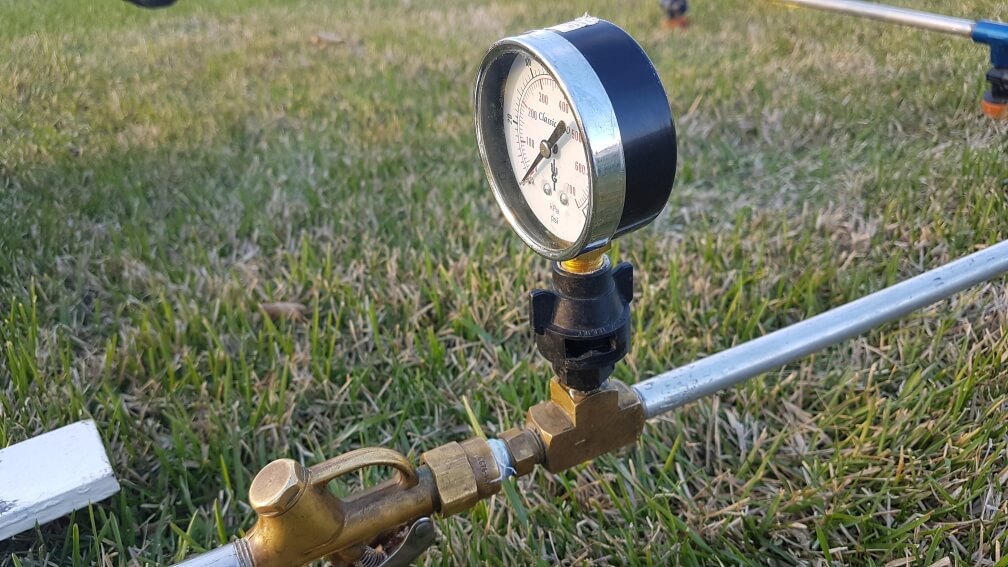
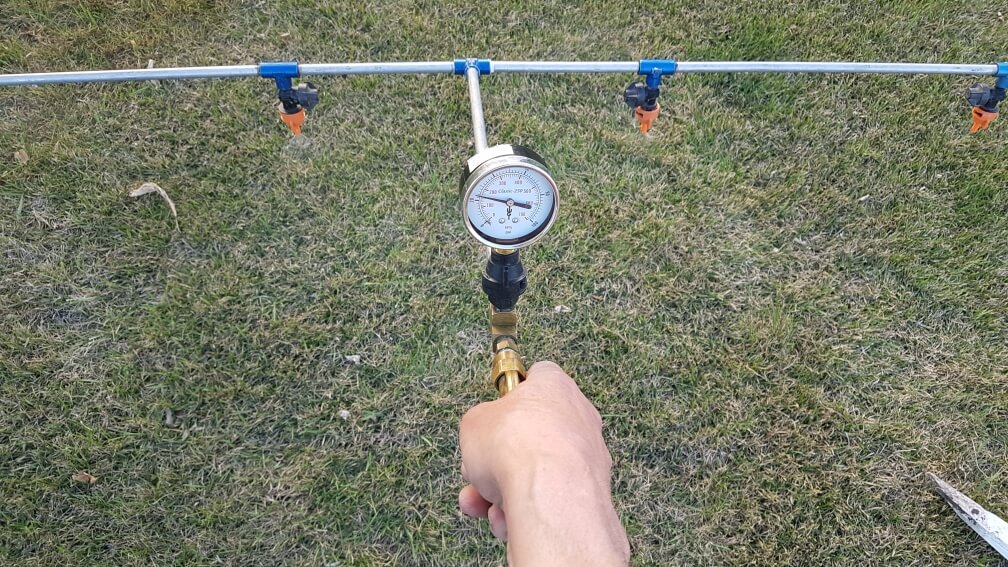
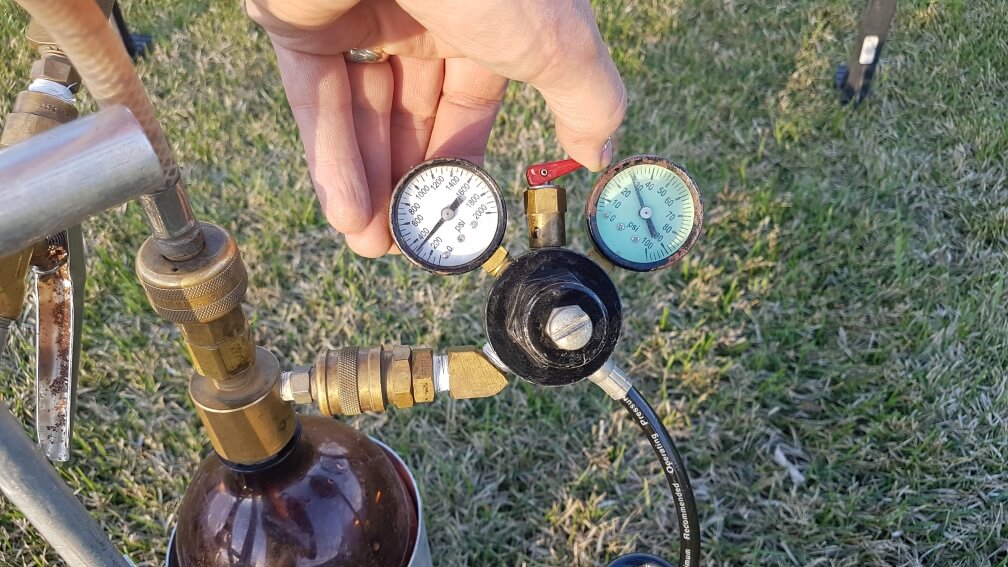
4. Install a trusted pressure gauge on the handle of the sprayer in clear view for the operator. This provides important information. Don’t believe the gauge on the regulator. Ours, for example, is stuck at 30 psi.
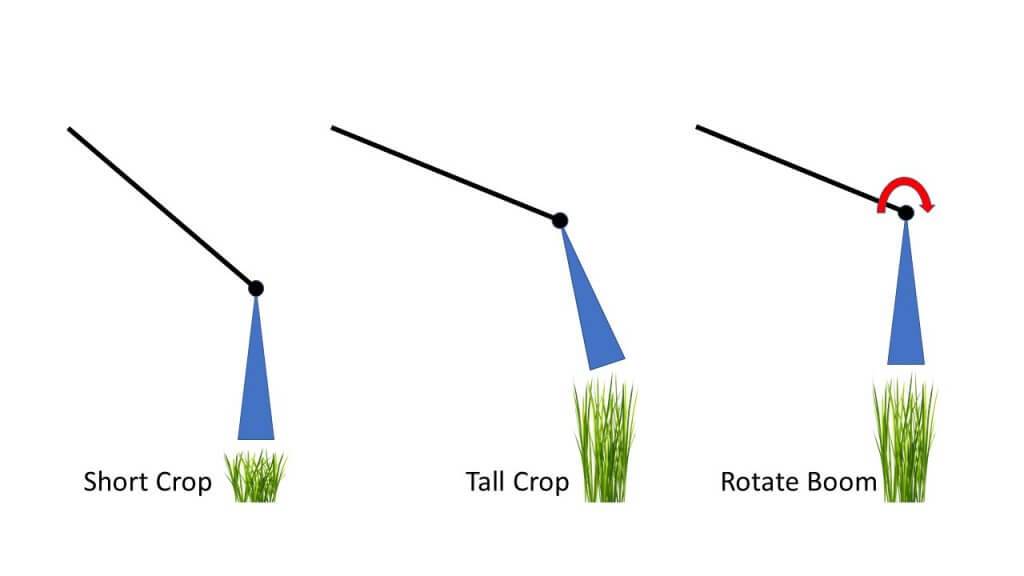
5. For hand-held booms, rotate the booms so that the nozzles point down, for each application. Different size people or height of crops will change this angle and make accuracy more difficult.
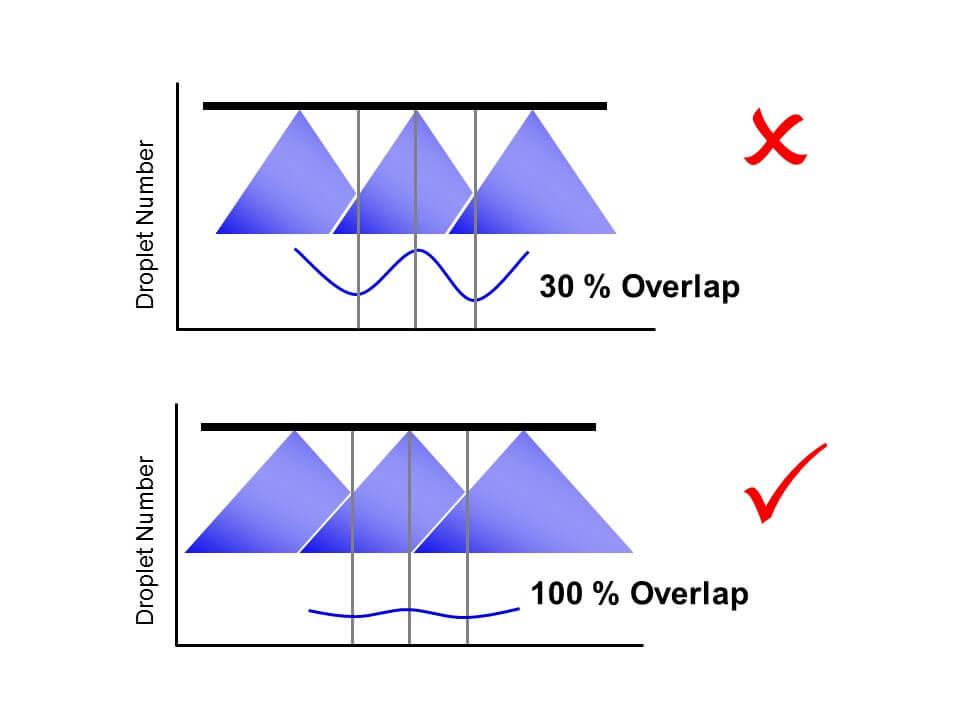
6. Set the boom height so that you achieve 100% pattern overlap. This means that a nozzle’s pattern width should be twice the boom’s nozzle spacing. Boom height will be close to 50 to 55 cm above target, depending on fan. Too low, and the pattern may cause striping. Your supervisor will see that all year long and think of you.
7. You can test the spray pattern by applying water to a concrete pad. At the right boom height, the entire boom width should dry at a similar rate.
8. Install a visual guide for boom height. For example, place a wire flag at the end of the plot, at the correct height. This will provide a handy reference of boom height as your arms get weary. Or hang a wire, zip tie, or chain from a spot that doesn’t interfere with your spray pattern (thanks ACC).
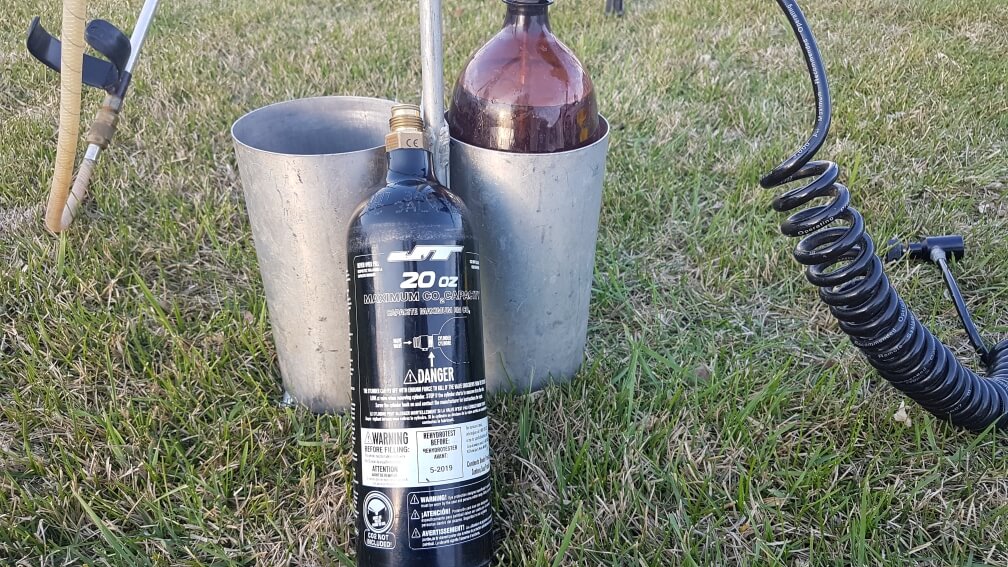
9. Minimize weight by using smaller bottles of CO2. We use 20 oz paintball bottles, they are much lighter, last long enough, and can be legally refilled with liquid CO2 or topped up with gas from a nurse tank in the field.
10. Spray out leftover mix in a designated part of the plot area. Do not pour any mix on the ground. Please. Consider a biobed on your research farm.
11. When completing a treatment, spray the boom completely empty so air comes out of each nozzle. This provides certainty that the next liquid at the nozzles is from the next bottle, be it water or another treatment.
12. When spraying dose responses of the same product, always start with the lowest dose. Again, spray out in a designated place until the boom produces air, no need to flush.
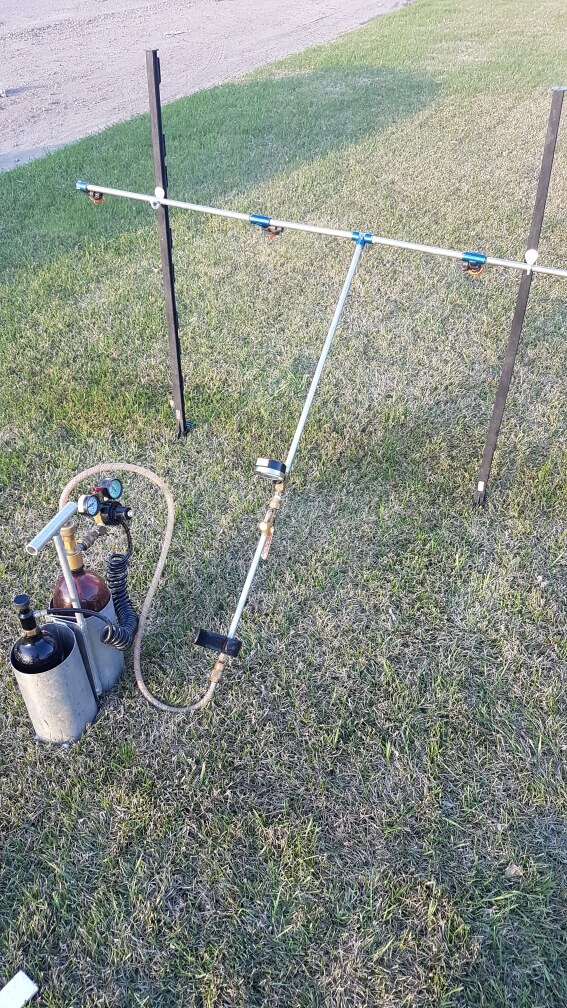
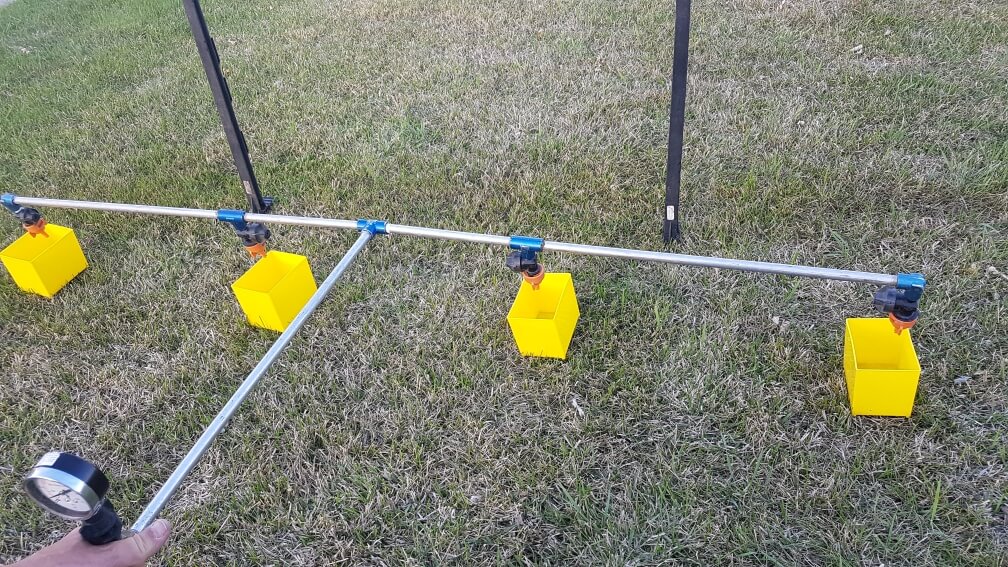
13. Construct a boom hanger from electric fence posts and coat hangers. Nozzles face down and can be serviced. The boom should never lie on the ground.
14. Use nozzle screens to prevent time delays due to plugging. Usually 50 (blue) or 80 (yellow) mesh is sufficient. Any finer mesh may interfere with some dry formulations. Note: Beware old screens – ISO mesh colours have changed. Learn more here.
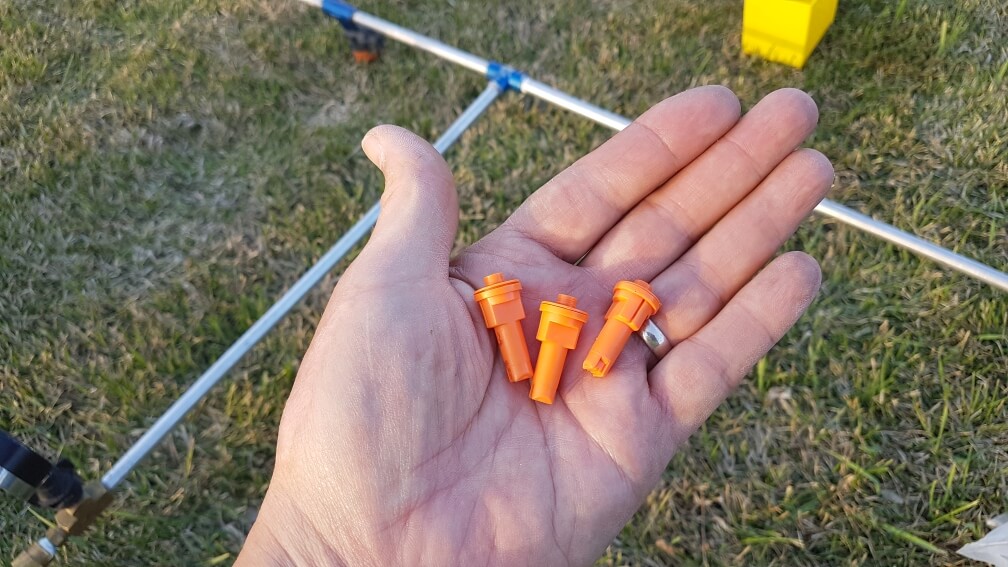
15. It’s very useful to apply research sprays with low-drift nozzles. Air-induction tips are most effective. These reduce drift, and are also closer to the commercial spray quality used by producers.
16. 01 size (orange) air-induced nozzles are available from Albuz (AVI Twin and AVI), Arag (CFA, CFAU, AFC), Billericay (Air Bubble Jet), Greenleaf (AirMix and TurboDrop XL), Lechler (ID3 and IDK). No other major manufacturer produces this small size of tips in air-induction.
17. 015 size tips (green) and larger are produced by the above, as well as Albuz (CVI Twin and CVI), Hypro (GuardianAIR or ULD) and TeeJet (AIXR, AI, and TTI), within both manufacturers listed in order of increasing coarseness.
18. Always carry several other nozzles of the same size and type already on the boom. Should a nozzle plug, replace it, don’t clean it. Clean it later.
19. If a nozzle plugs and there is no extra nozzle, use compressed air to clean it. Compressed air electronics cleaners are available in most electronic stores.
20. If a plugged nozzle can’t be cleaned, simply place it at the end of the boom and continue. Plot ratings and yields are usually taken from the centre. Remind your supervisor of this.
21. Always de-pressurize a sprayer before disconnecting any liquid hoses. You can’t rely on check valves. If two people work together, make sure you practice and communicate this with each other.
Calibration:
Assemble the sprayer and run water through it to ensure it’s free from silt or residue. Repair leaks.
2. Install nozzles and ensure none are plugged and the pattern looks good.
3. While spraying water, set pressure to what you intend to spray with. (Note: boom pressure will be lower than regulator (attached to CO2 canister) by a few psi, hence the separate pressure gauge on the boom. Also note that the set pressure will always be higher when the system is at rest.)
4. Obtain four containers of similar size that can hold about 500 mL, and place on ground at nozzle spacing. Using stopwatch, emit spray directly into all four for a set time, say 30 s.
5. Expected spray volume at 40 psi: 01 tip, 380 mL/min; 015 tip, 570 mL/min; 02 tip, 760 mL/min. In other words, from a 2 L bottle you’ll not get much more than 30 s spray time from 4 tips.
6. Measure collected volume from four tips using the same graduated cylinder.
7. Repeat, for total of three times.
8. Average three reps for each nozzle and convert to mL/min. Make sure all nozzles are within 5% of the average flow. Replace those that aren’t or place worst offender on outside edge of boom.
9. Advance to “Calculations”, but be prepared to conduct another calibration
Now for the fun part.
Calculations
There are three options for applying the correct amount. We’ll be using metric in these examples:
Use the average nozzle flow from the calibration (mL/min) and the target application volume (L/ha) to calculate the necessary walking speed (km/h);
or
Use the flow from the calibration and a set walking speed to arrive at an application volume;
or
Use a set walking speed and a set application volume to calculate a required calibrated flow.
Option 1:
Walking Speed = (60*flow)/(Volume*nozzle spacing)
If your nozzle flow was 330 mL/min and you wanted to apply 100 L/ha using a sprayer with 50 cm nozzle spacing, your required walking speed is 60*330/100/50 = 3.96 km/h
Option 2:
Application Volume = (60*flow)/(Speed*spacing)
If your nozzle flow was 330 mL/min and you wanted to walk 5 km/h using a sprayer with 50 cm nozzle spacing, your application volume is 60*330/5/50 = 79 L/ha
Option 3:
Required flow = (Speed *Volume*spacing)/60
If your speed is 5 km/h and you wanted to apply 100 L/ha using a sprayer with 50 cm nozzle spacing, your required flow is 5*100*50/60 = 417 mL/min
If you selected Option 3, you now need to return to your sprayer and find a nozzle, or a pressure, that delivers an average of 417 mL/min. You can use math to get into the ballpark with the nozzle you already have:
New Pressure = (required flow/calibrated flow)2*calibrated pressure
If your required flow is 417 mL/min and the calibrated flow is 330 mL/min, and you calibrated at 30 psi, then you should be close to your required flow at (417/330)2*30 = 48 psi
Now, return to your sprayer, set the pressure to 48 psi, and confirm this estimate.
We use Option 3 when comparing nozzles of the same size but from different manufacturers. It’s not uncommon for these to have slightly different outputs. Rather than adjusting our walking speed slightly, which is very difficult to do accurately, we change pressure slightly so all nozzles produce the same flow. This is also useful when comparing water volumes by switching to a larger nozzle.
Travel Speed:
The last step is to confirm travel speed. Say you want to walk at 5 km/h. The best way to calibrate walking speed is to measure a known distance (m) in the field you’ll spray. Wearing the gear and carrying the sprayer you will use to spray, walk this distance. Use a wire flag to mark the start and end points; when the boom hits the flags, start and stop the timer. Repeat until comfortable.
Time needed to walk distance:
Time (s) = Distance *3.6/required speed
Say your walking distance is 10 m, and you need to walk 5 km/h.
10*3.6/5 = 7.2 s
A simple spreadsheet that can be used for the calculations can be found here.
Congratulations! You’re done. Happy spraying! Remember to not worry too much about a 5% deviation from your expected application. That’s definitely an acceptable error, as long as you don’t allow too many of those to add up.
Low Volume Research (Aerial)
Some product uses are by air, and the label volumes for those are often 30 to 50 L/ha. Registrants need to provide efficacy data at those volumes. Ground application can be accepted as a surrogate for aerial as long as the volumes are correct.
Since the spray nozzles aren’t typically available below the 01 (orange) size and if they are, they usually plug so easily and make such a fine spray that they’re frustrating to use. The alternative, to travel faster, is also problematic on research plots.
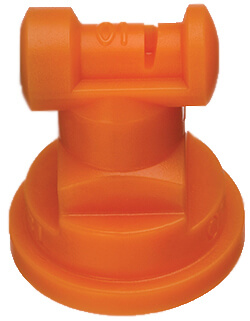
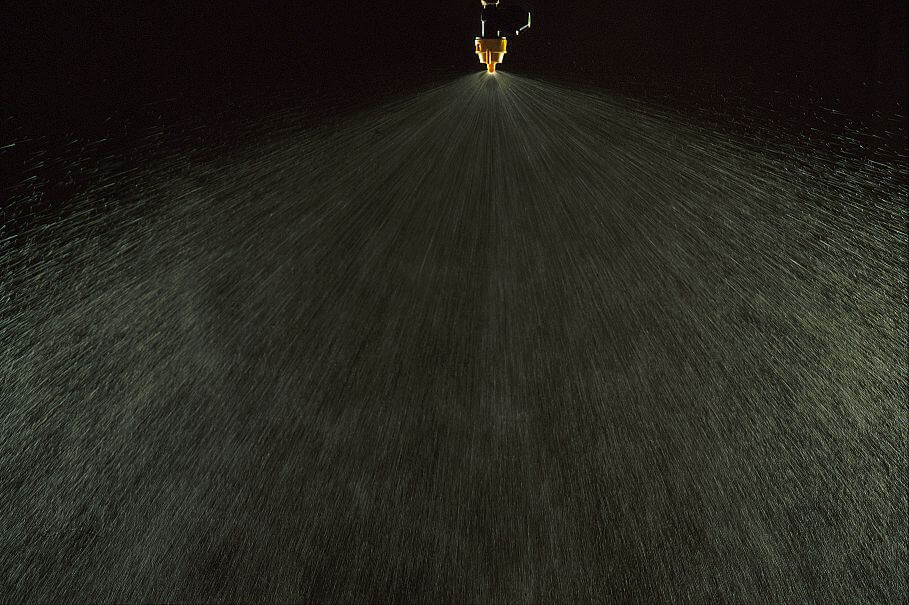
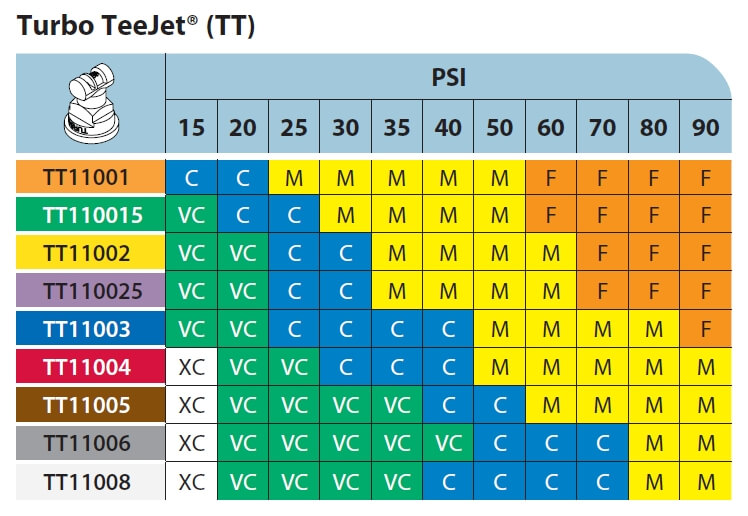
We recommend that Turbo TeeJet nozzles be used for this purpose. They produce such a wide fan angle that a 100 cm spacing is justifiable. Simply cap off every second nozzle body. Booms need to be elevated to ensure overlap, for uniformity. The value of the small nozzles and wider spacings is the low total application volume that is now possible.
The TT tips can also be used at fairly low spray pressures (say 20 psi) further reducing their output.
Spray Quality of TeeJet Turbo TeeJet (ASABE S572.1). This tip is available in smaller sizes and, due to its wide fan angle, can be used at 40″ (100 cm) spacing, therefoe applying low water volumes.