In 2025 I ran a comparison between five florescent dyes and three UV lamps to determine which combination worked best for tracing spray deposition. If you haven’t read part 1, go do so and come back.
In early 2026 my colleague and I used the winning combination to evaluate spot sprayer deposition in an onion field, and it worked “OK”. Only “OK”. In fact, I think many of the growers attending that twilight meeting were being polite when they said they could clearly discern the coverage. The fundamental problem was that we required almost complete darkness for the dye to be visible, and even then, you had to hold the lights just right. Photography was nearly impossible.
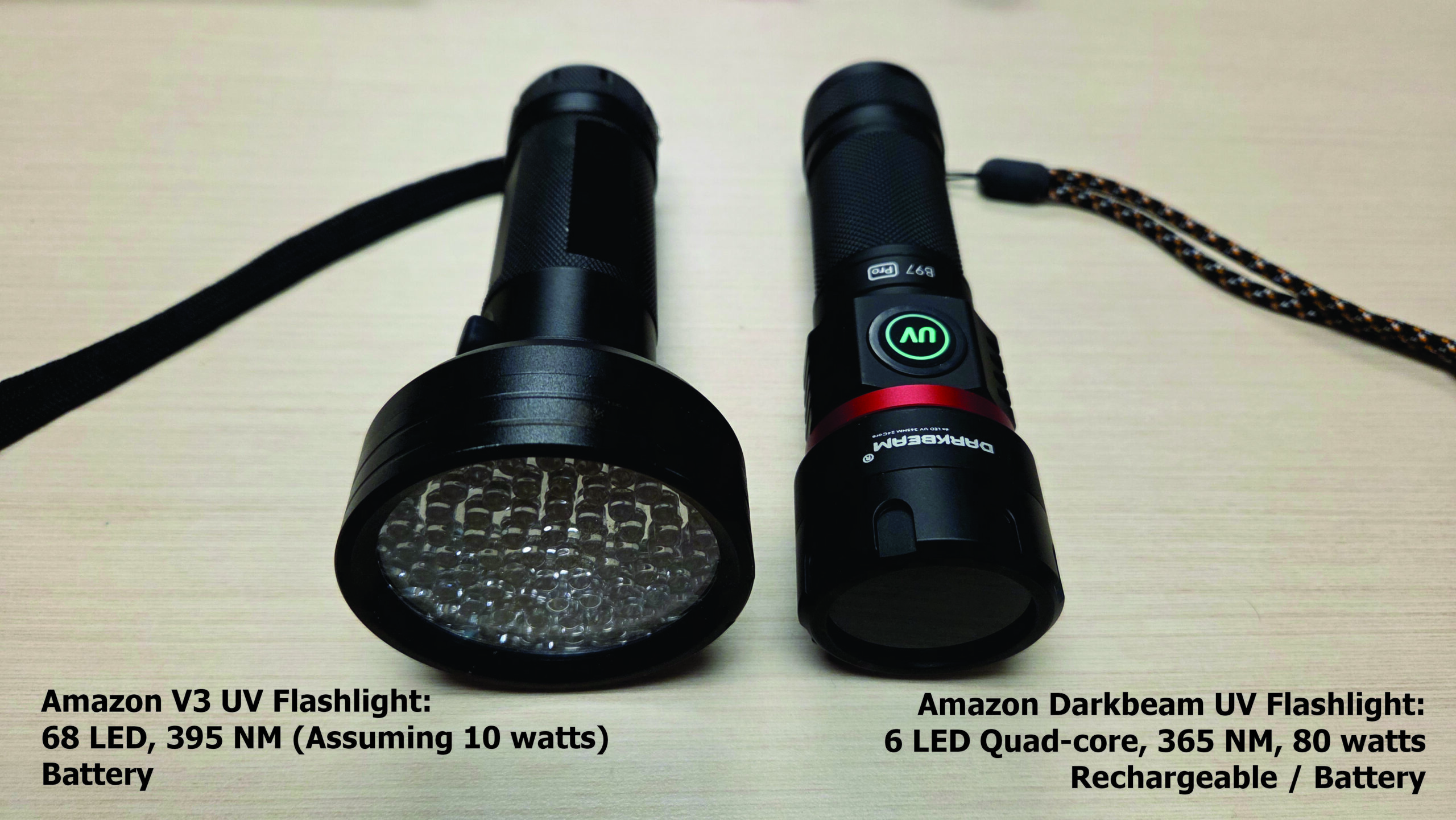
That’s when my colleague showed me that I’d brought a knife to a gunfight when he illuminated the scene with a new UV lamp. It was a veritable lightsaber! The high wattage and different wavelength changed everything. I knew immediately that we would have to redo the dye comparison in “light” of this new development.
The Old (left) and the New (right).UV dyes are more easily discerned at twilight or darker. Note that this image was taken while it was still light outside using the new UV lamp. A game changer.
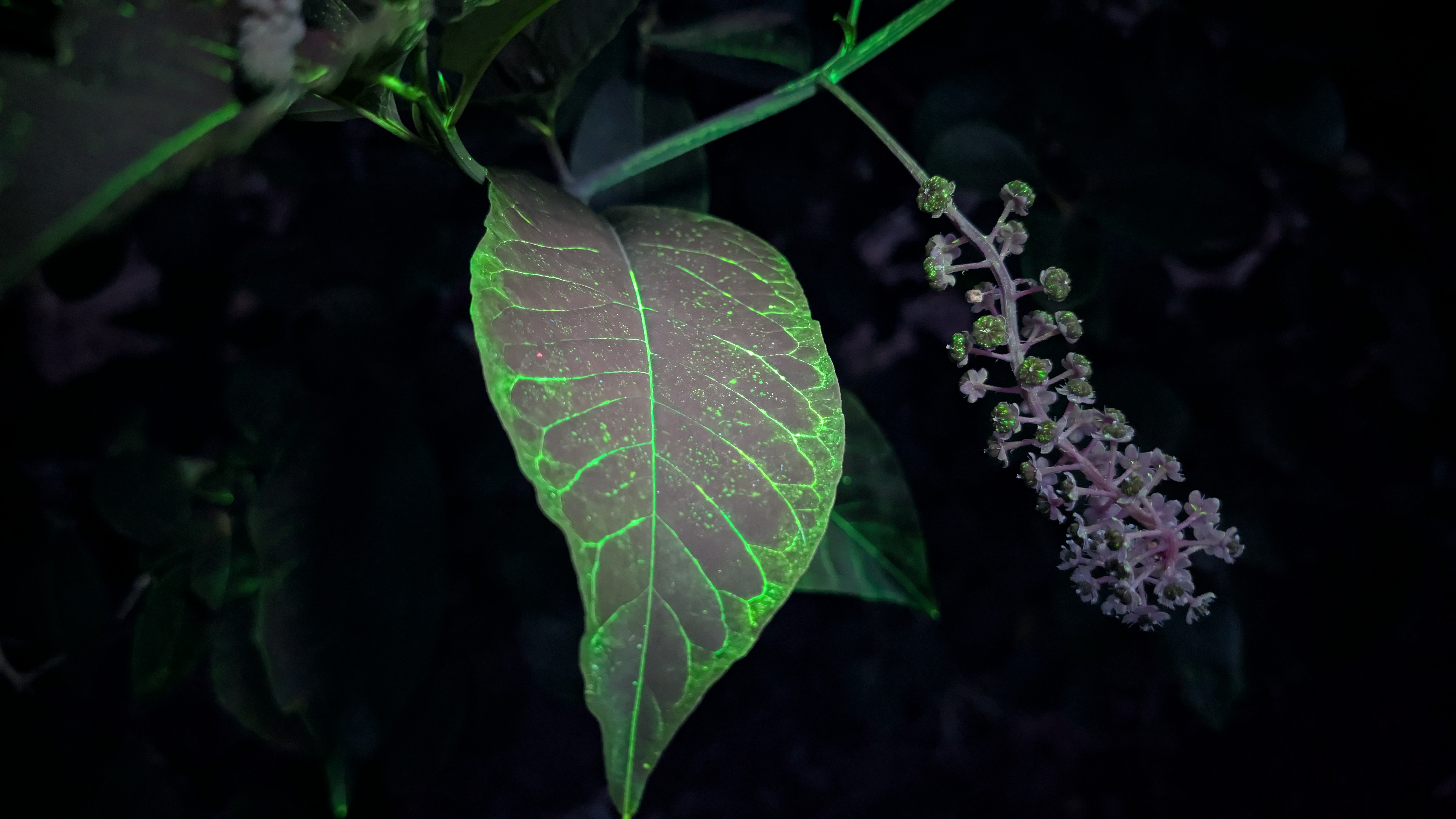
In September, 2026 we returned to Falcon Blueberries to paint the town red (well, green, orange and yellow). The images, which were taken with a cellphone, are stunning and yet they really don’t capture what we were able to see in person.
Dyes Used
We used the same dyes, mixed in the same ratios with NIS as in the previous study:
Risk Reactor IFWB-C81PT
Risk Reactor UVTRACER-G1PT
Eco Pigment Blaze Orange SPL15JX
Tri Art Fluorescent Yellow Tempura Paint
We omitted the Phosphor Powder (Zinc Orthosilicate: Manganese CAS#11-47-2) used in the last study because the SDS really didn’t qualify it as non-toxic, and it’s not within reach of most people. Also, you won’t see any photos of the Tempura paint, because there was nothing to see. Historically, I’ve held out hope that it was a viable option, but it’s really only ever worked when super-concentrated and applied by a hand sprayer. So, if you’re doing that, go ahead, but I’ll never use it in a commercial sprayer again.
Application
We used the same Turbomist airblast sprayer, and the operational settings aren’t really relevant, here. Suffice it to say we made a single pass with their conventional settings, and left 8 rows between blocks (that is, a buffer of four rows on each side of the pass) to ensure we didn’t cross contaminate the dyes. Then we waited for dark.
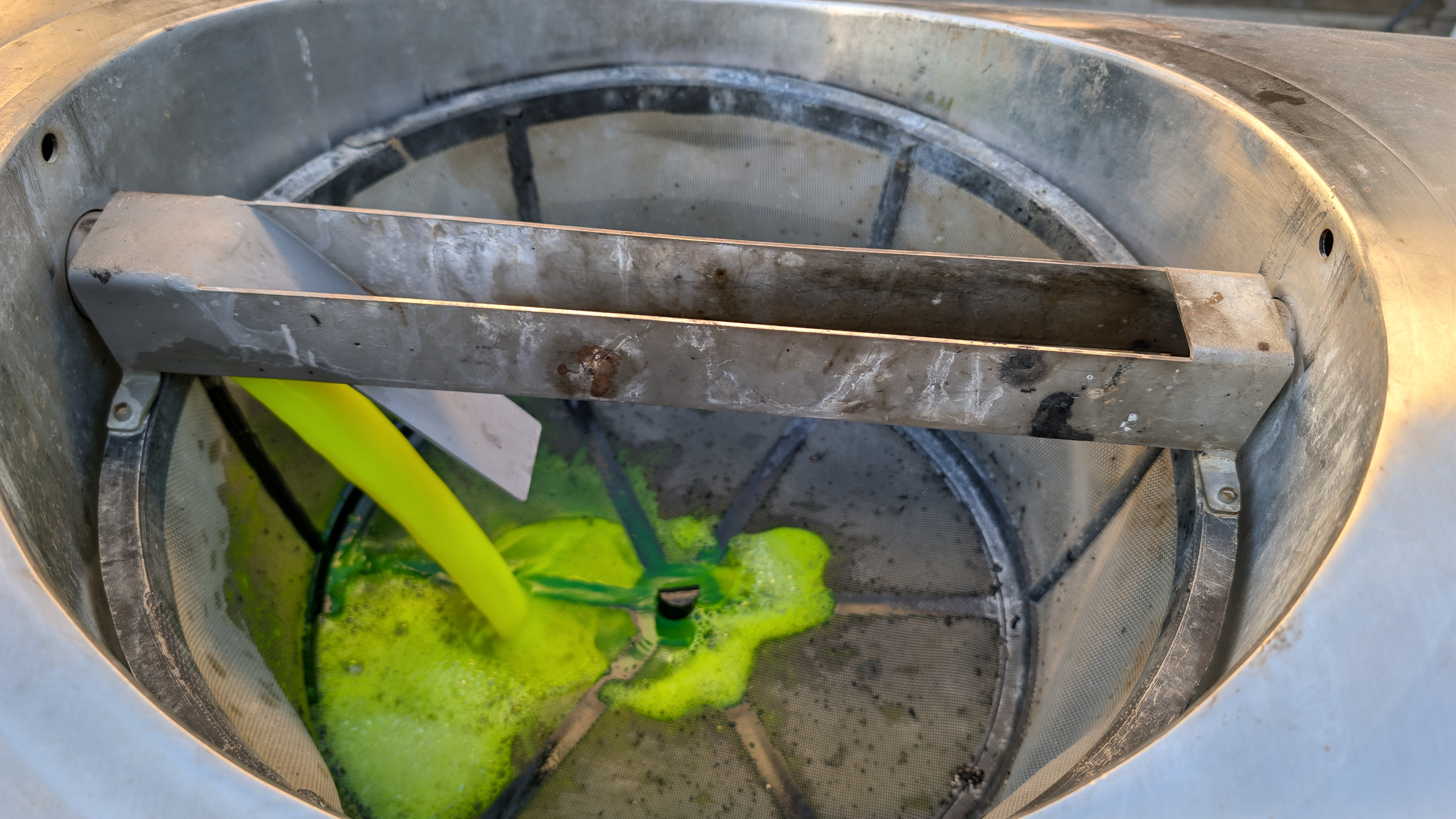
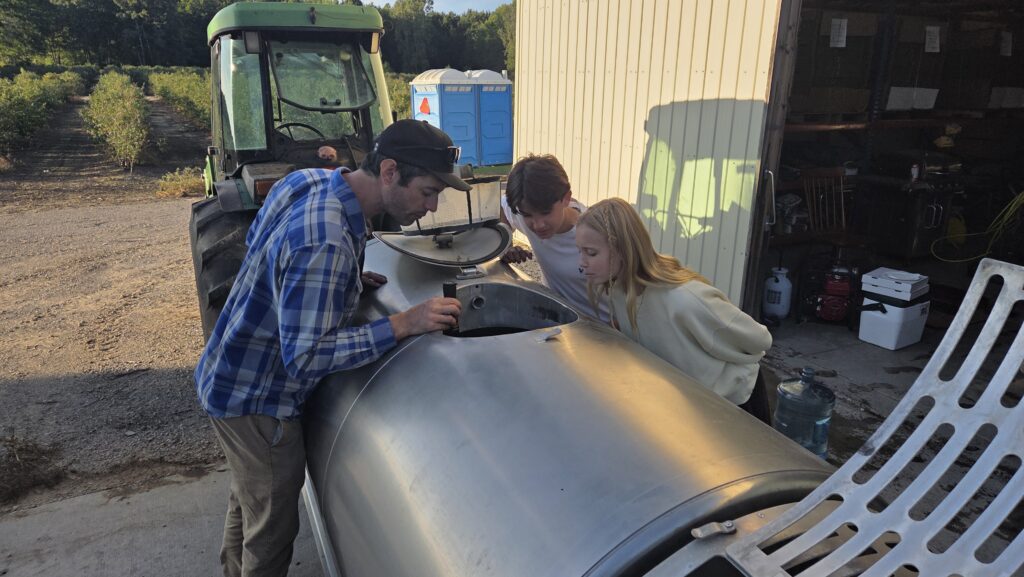
Even in daylight, dye helps visualize spray. Those top nozzles should have been off, but this was a post-harvest mock-up. When the bushes were larger and fuller there would have been better interception at the top.Adding colourful, non-toxic dye to a completely clean sprayer proved very interesting to the next generation of Falcon Blueberries.
Risk Reactor IFWB-C81PT
This dye was pretty spectacular, which it absolutely was not when we tried last year using the weaker UV lamps.
IFWB-C81PT – Immediate row (sprayed directly).IFWB-C81PT – Next row over (sprayed indirectly).
Risk Reactor UVTRACER-G1PT
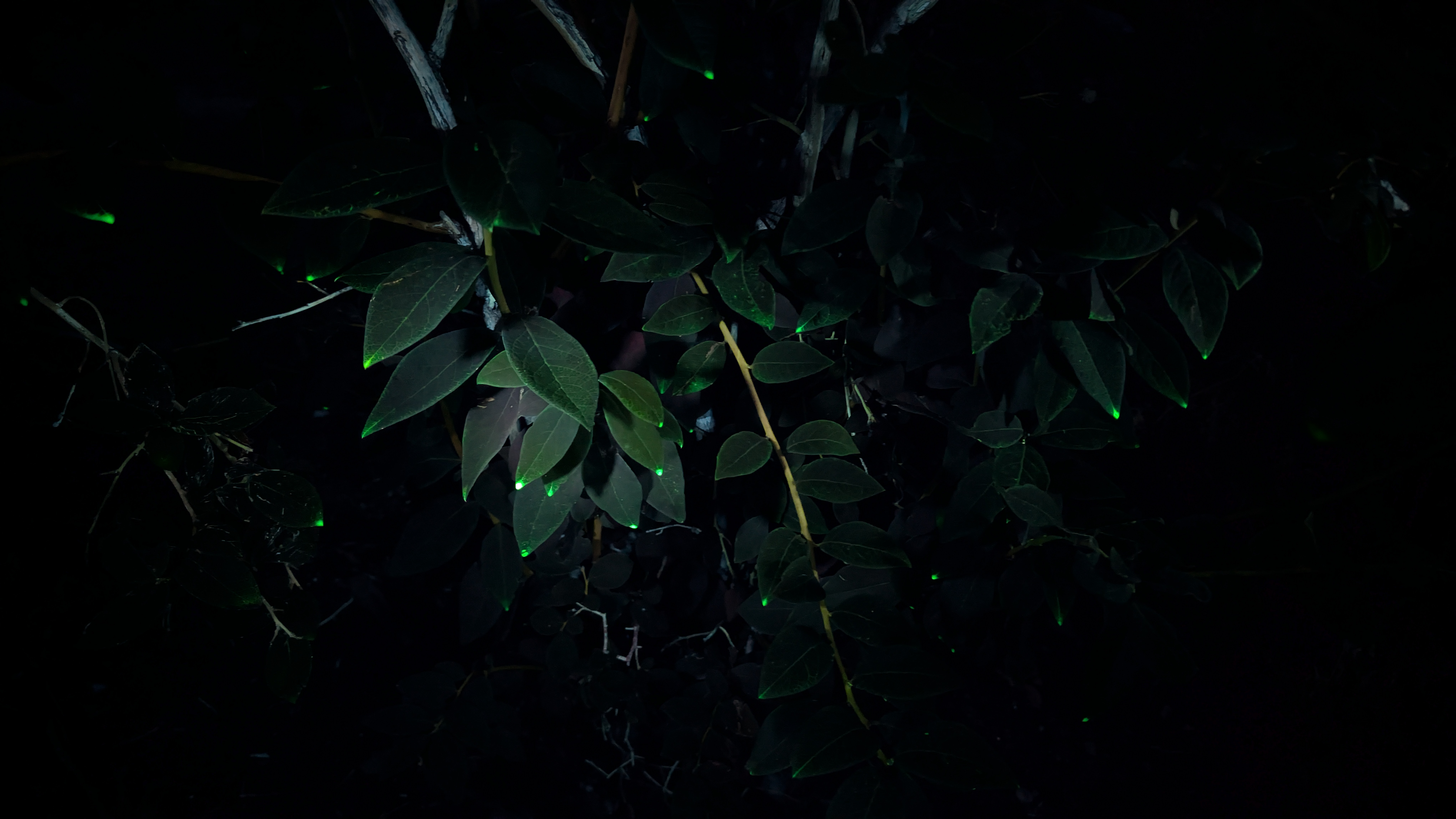
This dye didn’t perform well. It didn’t seem to leave any residue other than accumulated runoff (drip points) at the tips of the leaves. It wasn’t the volume or adjuvant, because while there was some runoff with the other dyes, they were nothing like this. We speculated it was a function of the dye’s formulation. On the up side, we did capture a few good photos of bad coverage when applying a foliar product.
Risk Reactor UVTRACER-G1PT. Incurred run-off on the immediate row (sprayed directly) and was not visible beyond this row.
Eco Pigment Blaze Orange SPL15JX
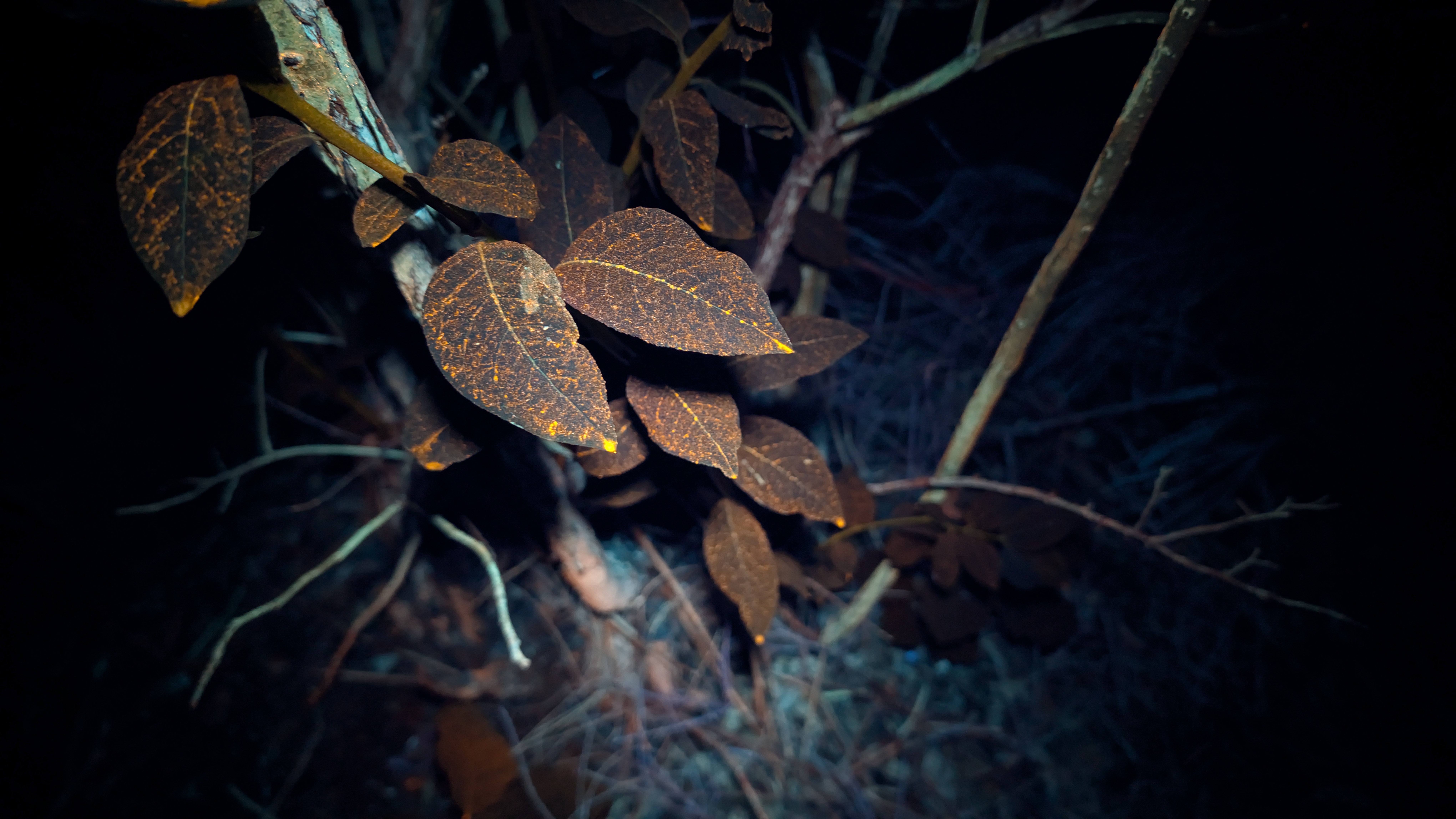
Once again, this pigment put on a quite a show. Whole not unique to this dye, we noted particular accumulation along the veins of the leaves where we suspect the pigments (which are not water soluble) collected. It was also visible on the petioles, under-leaf surfaces and the stems, branches and trunks.
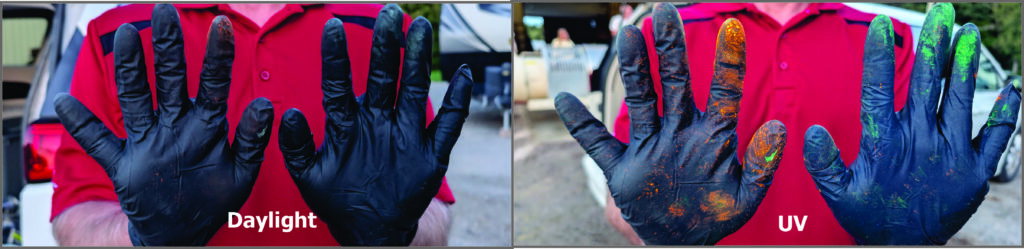
Not only did we see it three rows out, but it was all over the ground, the hood of the tractor, the operator’s boots and pretty much everywhere the sprayer went.
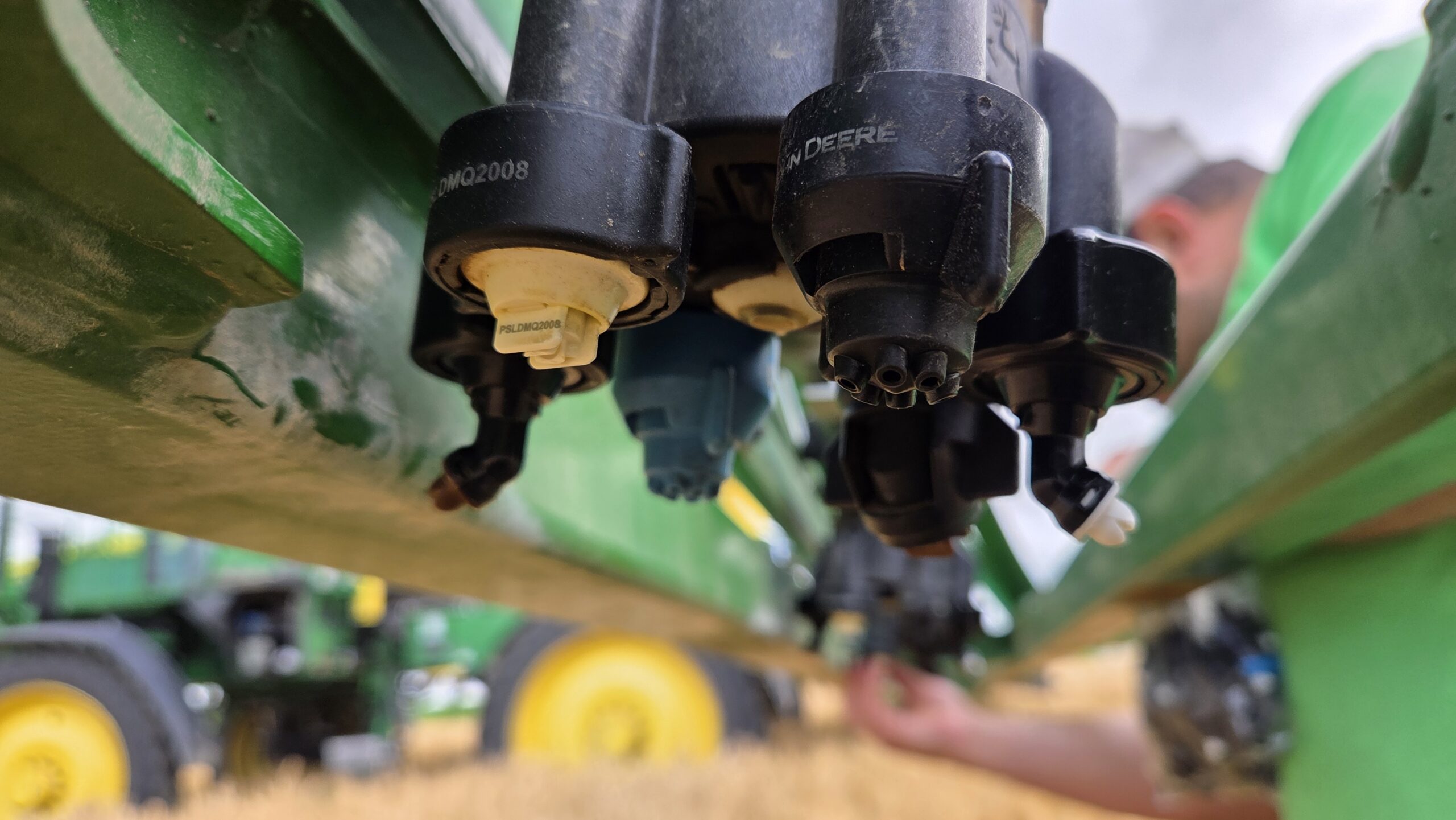
The last few shots are a public service announcement. The TOPPS water protection project in Europe once performed a study on a variety of airblast sprayers to determine where pesticide residue accumulated. They concluded that the header was the worst offender (that is, the booms, air ducts and fan at the rear of the unit).
While we saw evidence of dye deposition all over the sprayer, and on the tractor’s radiator grille (air inlet), the sprayer header was by far the most contaminated region. Always assume an unwashed sprayer has residue – wear your PPE.
Four dyes, one pass each, and no wind left the sprayer header completely covered. We would expect far more accumulation following an actual spray day. Do not touch contaminated application equipment, even if it appears clean, without PPE.
Thanks to Cesar Cappa, OMAFA Horticultural Weed Specialist for introducing the new UV lamp, for the photography, and for not complaining every time I blinded him with the light. Thanks to Falcon Blueberries for their time and collaboration.
We’ve been here before, haven’t we? I could rehash the explanation of why wheat head coverage is important, and define the variables involved, but perhaps you’re already in-the-know. Instead, new readers (and those requiring a refresh) can go give this article and this article a quick read and then come back. I’ll wait.
Why perform another wheat head nozzle assessment? Primarily we do it so you don’t have to, but in this case there’s a specific problem we’re trying to solve and a “new” nozzle to explore.
The problem (and some history)
Let’s digress a little and use the historical experience shared by Clean Field Services (CFS) in Drayton, Ontario (cooperators in this study), to explain the problem and our objective.
As broadacre sprayers evolve, nozzle technology has been lagging. Consider a basic field sprayer equipped with a centrifugal pump. Its performance curve exhibits a direct relationship between flow rate and pressure. In this case, the operator relies on a rate controller to bypass flow to maintain a target application rate across a range of travel speeds.
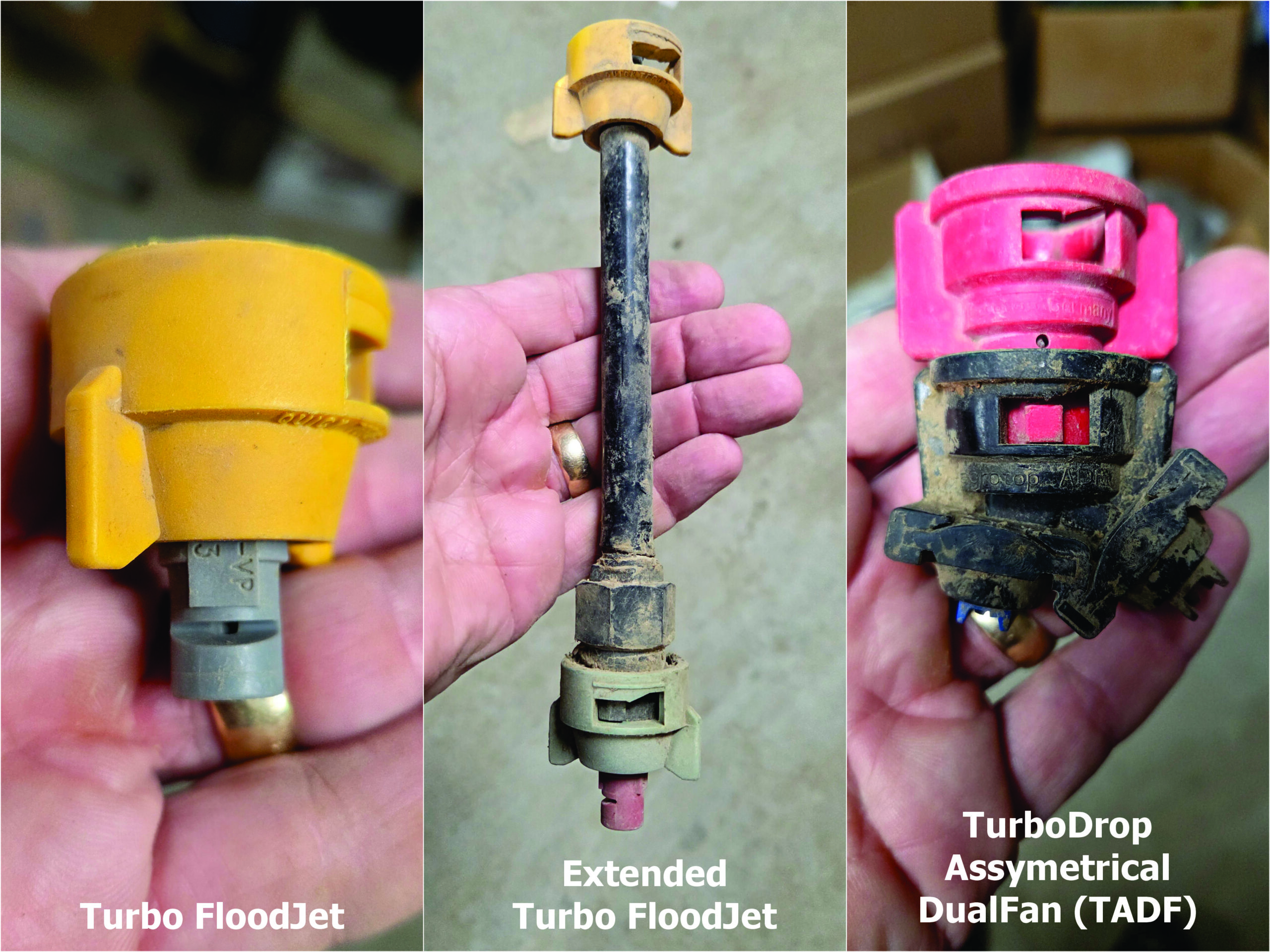
However, bypassing changes system pressure, which inadvertently changes the average droplet size. Basically, increasing travel speed reduces droplet size and vice versa. This was the manner of sprayer used in Ontario more than 20 years ago when researchers demonstrated that TeeJet Turbo FloodJets, alternated front-to-back, provided excellent coverage of wheat heads at the T3 timing. This is what Clean Field Services used.
However, some booms have obstructions that interfere with the aggressive spray angles produced by wide-pattern nozzles such as the Turbo FloodJet. CFS experienced this when they got a RoGator in 2012 and later an R-series Deere in 2017. At one point they tried using extensions to clear the obstruction, but this proved to be a nuisance and interfered with folding. They settled on GreenLeaf Technologies’ TurboDrop Asymmetric DualFan (TADF), which worked great, until the sprayer changed again.
A visual history of wheat nozzles at Clean Field Services.
Pulse Width Modulation
Sprayer plumbing and control systems have evolved. The introduction of pulse width modulation (PWM) technology changed the way rate control is achieved. Rather than regulating flow by altering pressure, PWM intermittently interrupts flow at the nozzle. This decouples flow rate from pressure, preserving droplet size across a range of travel speeds. Most air induction (AI) nozzles, such as the TADF are not approved for use with PWM systems.
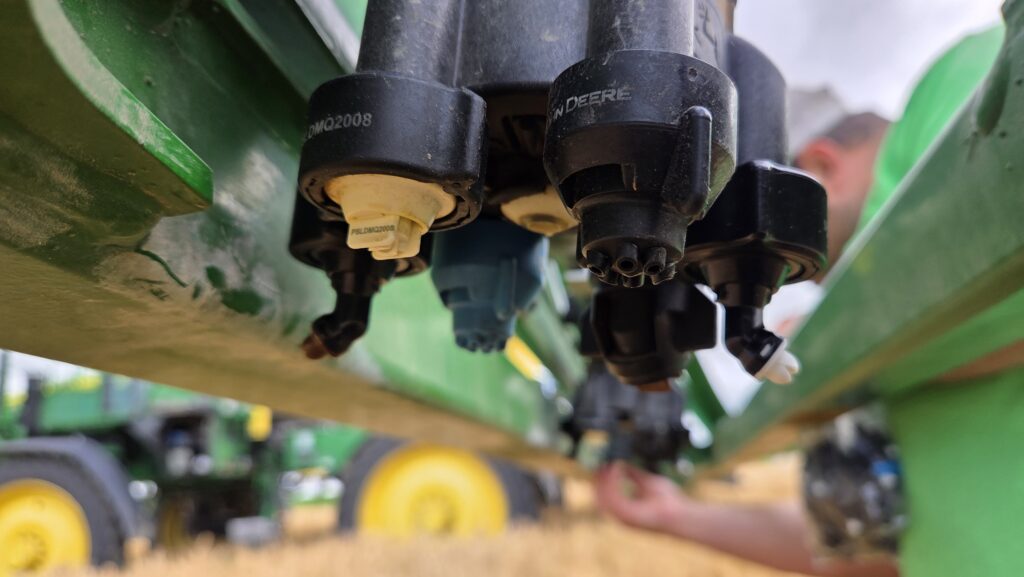
John Deere’s ExactApply PWM system became available in 2017, and CFS got one in 2018. Operators could mount two nozzles in each position, creating opportunities for interesting new configurations. One of the recommended nozzles was the Defy 3D, which features a 38° angle and was developed by Hypro in collaboration with Syngenta to help control blackgrass in the UK. It performed well in drift-reduction studies relative to conventional flat-fan nozzles.
Welcome to Canada
CFS mounted a single Defy 3D ’08 in each nozzle body, and had problems. Canadian sprayer operators, on average, drive faster than their UK cousins. Even with PWM, the largest Defy 3D tip (the ’08) required a flow rate that increased system pressure, which in turn led to a drifty experience. Bad in itself, but also not ideal for angled applications, because finer spray deposits with the wind rather than ballistically.
They tried throttling back, slowing down and/or adjusting water volumes, but felt they never really dialed it in. They settled on a Defy 3D ’08 in the B (rear) position, and an ’05 in the A (front) position at 21 km/h (13 mph) to apply 156 L/ha (16.67 gpa).
Exploring a solution
Wouldn’t it be nice to have your cake and eat it too? Drive faster, apply higher volumes and still mitigate drift? Enter the 3D Ninety, with claims of good fungicide utility while producing a significantly coarser droplet than the Defy. They came out in 2021, and yet they are still difficult to find in North America. This study establishes baseline panoramic coverage from the Defy 3D, then benchmarks it against the 3D Ninety and a hybrid configuration at a faster travel speed.
Experimental design
The trial took place in a mature wheat field in Drayton, Ontario on July 22, 2026. Temperature was 15°C, and while generally windy, we operated in an area protected by a windbreak, reducing windspeed from an ambient 18 km/h to an average 8 km/h at boom height.
Sprayer settings
A John Deere See and Spray Premium (410R) was used in the study. For each condition, we isolated a section of seven nozzles in the middle of the left and right booms (as far as possible from boom tip and chassis). Nozzles were on 50 cm (20″) spacing, so this spanned 2.7 m. The sprayer was set to a 70% D.C., and the boom was 50 cm (20″) above the wheat heads. The treatment conditions were as follows:
Treatment
Forward Nozzle
Rear Nozzle
Pressure (psi)
Travel speed (mph)
1
’05 Defy 3D
’08 Defy 3D
25
13
2
’05 3D Ninety
’08 3D Ninety
40
16
3
’05 Defy 3D
’08 3D Ninety
40
16
Operational settings and nozzles for each treatment.
In all treatments the ’05 faced forward and the ’08 faced back.
Samplers
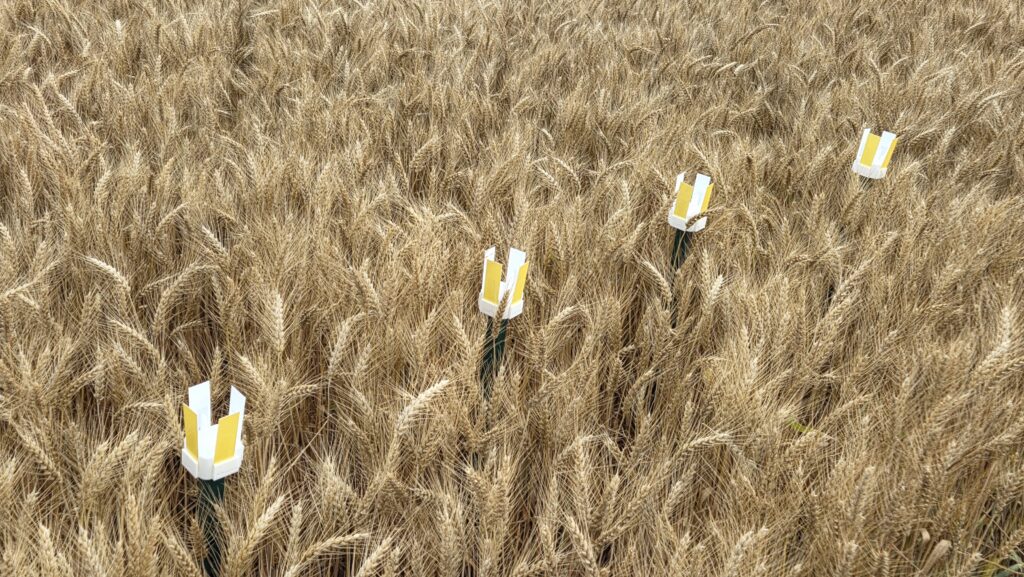
A series of four posts were positioned in the wheat, spaced 0.5 m apart and centred on the corresponding section of nozzles. The samplers were SpotOn water sensitive papers (WSP) mounted in custom holders to orient four papers at 90° to the sprayer: Advance (facing the sprayer), Left, Retreat (facing away from the sprayer) and Right.
A series of samplers positioned at wheat head height, 50 cm apart, centred on the swath produced by the section of seven trial nozzles.
A parallel tramline approximately 1 m from the samplers provided access. The sprayer began spraying 15 m (50 feet) before the samplers and continued spraying the same distance beyond them. Once the spray settled, the samplers were retrieved. A single pass represented a repetition and there were three passes per treatment.
Papers were digitized using a DropScope (SprayX) and the analysis was performed in R (v. 4.6.0), leveraging the rpy2 library for integration with Python within the Colab environment.
What we saw
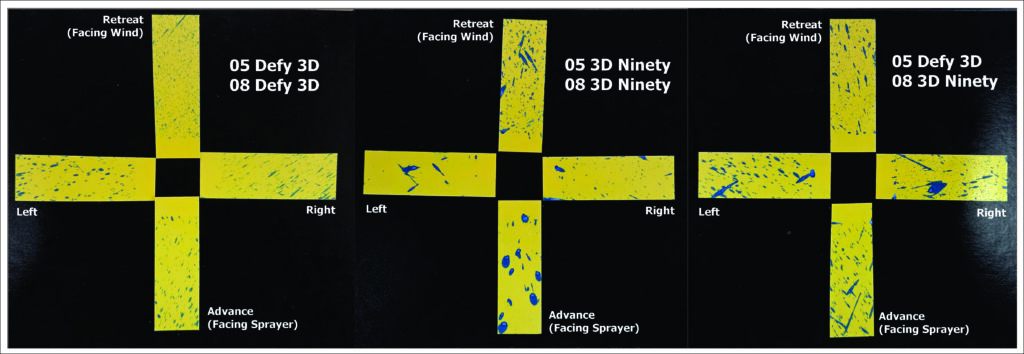
The following image shows a typical coverage pattern for each treatment. While WSP is not able to determine droplet size accurately, it can certainly reveal relative differences. It was clear that the Defy 3D produced smaller droplets than the 3D Ninety, and that there were far more of them. The hybrid condition shows a more heterogeneous coverage pattern, which would be expected given it represents a greater span of droplet sizes than either nozzle design used alone.
Typical coverage pattern from each treament.
Defy 3D
3D Ninety
Hybrid Defy 3D and 3D Ninety
Continuing with general observations, we can average the coverage measured on each plane, on each sampler, for each treatment. When spoiled samplers were removed from the study (it happens), coverage can be described as either the area covered, or the number of deposits per area. With no exploration of variability, we see that the Defy 3D resulted in the greatest average coverage as represented by either metric.
Treatment
n
Mean Area Covered (%)
Mean Deposits/cm²
Defy 3D
46
3.73
126.35
3D Combo
44
3.22
87.64
3D Ninety
47
3.02
93.77
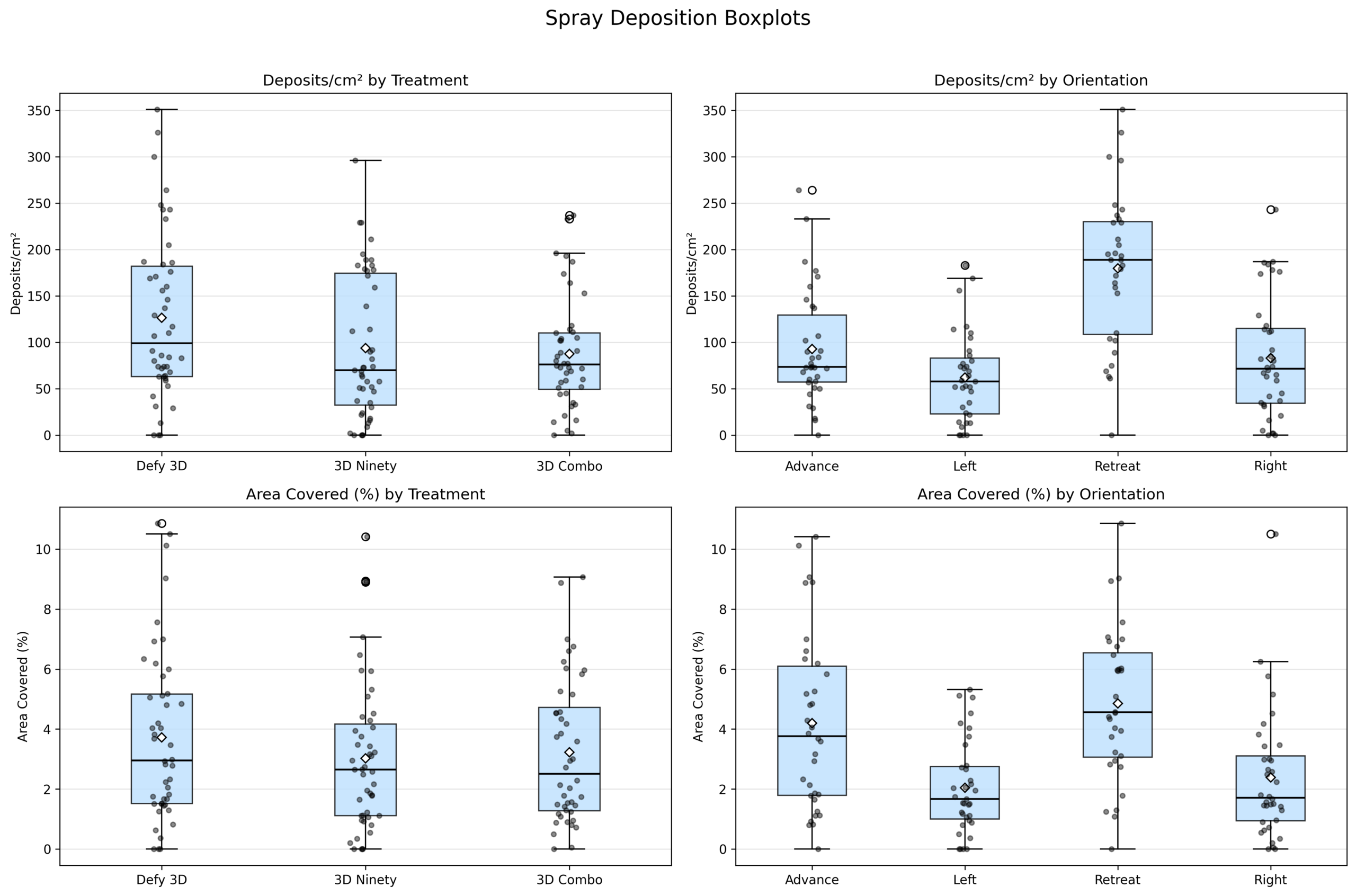
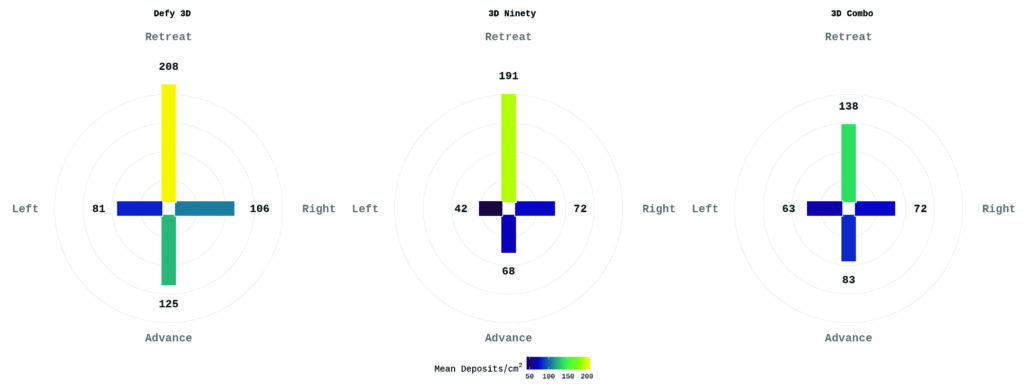
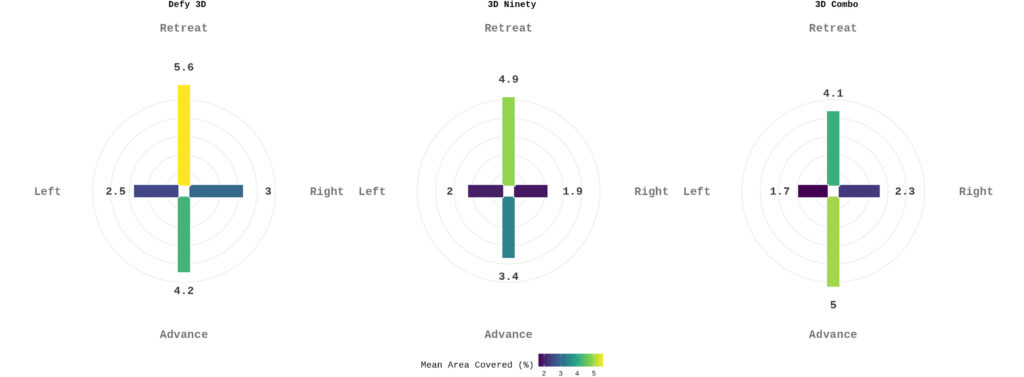
We can drill down and explore coverage by WSP orientation as well, this time including some measure of variability (standard deviation). As a matter of housekeeping, there was no evidence that repetition or post position had any meaningful bearing on coverage results (Pearson p of 0.422 and 0.455 and Spearman p of 0.267 and 0.217). We see the highest average number of deposits on the retreat side (facing the wind) in all treatments. Similarly, and excepting the combination treatment, we see the greatest average area covered on the same plane.
Treatment
Orientation
n
Mean Deposits/cm²
SD
Mean Area Covered (%)
SD
3D Combo
Advance
11
83.00
53.58
4.98
2.80
3D Combo
Left
11
63.36
38.07
1.67
1.24
3D Combo
Retreat
10
138.20
58.38
4.12
1.93
3D Combo
Right
12
72.00
63.84
2.29
1.93
3D Ninety
Advance
11
67.82
52.92
3.41
3.38
3D Ninety
Left
12
42.25
49.83
1.96
1.61
3D Ninety
Retreat
12
191.17
54.20
4.89
2.07
3D Ninety
Right
12
71.67
50.30
1.87
1.46
Defy 3D
Advance
12
124.92
65.48
4.19
2.64
Defy 3D
Left
12
80.75
49.75
2.48
1.74
Defy 3D
Retreat
10
207.70
115.84
5.55
3.45
Defy 3D
Right
12
105.58
75.92
2.98
2.83
We can illustrate this using box and whisker plots, which show all the data as well as the relative span of each treatment. This makes it easier to compare the treatments and determine if any differences in average coverage were significant or not.
We can illustrate coverage in an even more intuitive manner using a rosette-style graph. Here we see the average deposit density or the percent area covered for each treatment on each plane. Note that the discrepancy between the Advance (shadowed by wind) and Retreat (wind-facing) side is far greater when the coverage is represented by droplet counts rather than area covered.
Average coverage on each plane for each treatment, as represented by deposit density.Average coverage on each plane for each treatment, as represented by percent area.
Interpretation and discussion
Deposits/cm² and percent area covered were strongly positively associated (r = 0.75), indicating that higher deposit counts generally corresponded to greater percent coverage. The relationship wasn’t perfect, suggesting that other factors also influenced coverage and leaving room for interpretation.
The Defy 3D produced the highest overall coverage, as reflected in total deposit counts. This is consistent with the fact that it emits a higher proportion of finer droplets relative to the 3D Ninety. While finer droplets can improve coverage, they are also more prone to drift and tend to deposit on the downwind face of vertical targets. We have evidence of this in all treatments, which showed more deposits on the Retreat (windward) face than on the Advance face, which was sheltered from the wind.
This deposition pattern is likely influenced by the rear-facing nozzle configuration (an ‘08), which delivers a higher application rate than the forward-facing nozzle (an ‘05). With higher boom heights or stronger wind conditions, this configuration may be less effective, as reported in previous studies. In this comparison, the Defy 3D also exhibited the greatest variability, suggesting greater sensitivity to such conditions.
The 3D Ninety and hybrid treatments were difficult to separate based on overall coverage. There was no significant difference in the magnitude of coverage between them, although the hybrid condition showed a more balanced distribution of deposits between the Advance and Retreat faces. In contrast, the 3D Ninety would be expected to produce a coarser spray that is less susceptible to deflection, assuming boom height is sufficiently low to maintain droplet trajectory. Despite this, it recorded more deposits on the Retreat face than the hybrid condition. We have no explanation.
The hybrid configuration was designed to improve deposition balance by combining complementary spray characteristics. The forward-facing nozzle produced finer droplets, which can be carried along by the sprayer’s forward momentum to enhance forward deposition. The rear-facing nozzle produced coarser droplets at a higher application rate, compensating for lower droplet numbers while counteracting forward momentum to improve retreat-side coverage.
Although the hybrid treatment appeared to provide a more even distribution of deposits between the Advance and Retreat faces, it is uncertain whether this would translate into improved biological efficacy. Further trials would be needed to evaluate whether this deposition balance leads to measurable yield gains.
It is also important to note that both the 3D Ninety and hybrid treatments were applied at 25.7 km/h (16 mph), nearly 20% faster than the Defy 3D treatments. This indicates potential for higher productivity. Given the relatively balanced deposition observed, a combination of a forward-facing Defy 3D nozzle and a rear 3D Ninety nozzle may offer improved resilience to changes in boom height and wind speed while maintaining adequate coverage at higher travel speeds.
Thanks to Clean Field Services for their participation in this study, thanks to Agflow Canada (Hypro / Shurflo) for donating the 3D Ninety’s, and thanks to Cesar Cappa, OMAFA weed specialist in horticulture for patiently explaining how to use R more effectively.
Spray coverage describes the degree of contact between spray droplets and the target surface area. This metric can be used to predict the success of an application. One of the easiest methods for visualizing coverage is to use water sensitive paper (WSP), which is a passive, artificial collector that turns from yellow to blue when contacted by water.
WSP is often used to evaluate iterative changes to a spray program. Placed strategically throughout a target canopy, or directly on the ground, achieving uniform, threshold coverage translates into improved efficacy, reduced waste, reduced off-target contamination and reduced risk of pesticide resistance development. WSP were also used to develop a system that measures the area covered by the effective radial distance in an attempt to relate the area covered by a stain to a larger area where sufficient pesticide activity is taking place.
WSP tends to underestimate the spreading effect that can occur on plant surfaces (especially when surfactants are used), but they are effective as a relative index.
A brief history of WSP
In 1970, a journal article described a new method for sampling and assessing spray droplets. Photographic paper treated with bromoethyl blue created a yellow surface that changed colour when it encountered moisture. The pH-based reaction was fast and irreversible, leaving a distinct blue stain to mark the deposition.
Ciba-Geigy Ltd. made water sensitive paper commercially available in 1985 (later as Novartis in 1996 and as Syngenta since 2000). It is produced in several formats, but aluminum foil packages of 50, 76 x 22 mm (1 x 3 in.) papers are the most popular. Odds are if you’ve ever used water sensitive paper, it originated from Syngenta in Switzerland. In 2023 I noticed that the papers now say “made in Germany.”
Change of manufacturing location?
In recent years, two new options have been made commercially available: Innoquest’s SpotOn Paper (United States) and WSPaper (Brazil). At the time of writing, there has been no impartial comparative evaluation of these three products.
Once dry, the blue stains on WSP are irreversible and papers can be stored for long periods of time. However unstained portions will continue to react to moisture from humidity, dew, or fingerprints, so care must be taken in their handling and storage.
Comparing WSP brands
The three commercially-available brands of WSP were subjected to a series of comparisons. The intention was not to rank these products, but to determine if they performed in a similar fashion and to alert users to any significant differences.
Packaging and Appearance
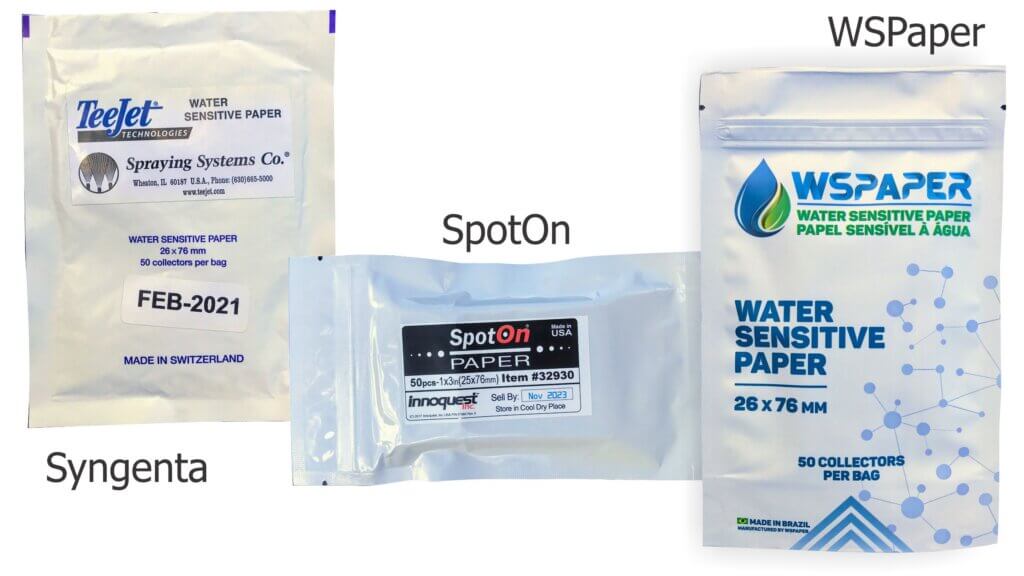
Each package was donated for the study. The SpotOn (SO) papers had a “sell-by” date of November 2023, the Syngenta (SY) papers (provided via Spraying Systems Co.) were dated February 2021 and the WSPaper (WS) was their newest formulation (white package, not silver), received June 2021. The comparison was performed on July 5, 2021.
WSP packages.
Each product was a foil or plasticized bag of 50, 26 x 76 mm papers. SO and WS had a re-sealing feature similar to that of a sandwich bag. SO also included a package of silica gel desiccant to capture moisture and a pair of plastic forceps to facilitate handling.
Users are encouraged to label papers to ensure they know their relative position and sprayer pass for later analysis. It was possible to write in ink on the faces of the SY and SO papers, but not WS. It was possible to write on the back of all brands.
The three papers were different shades of yellow. Further, in the author’s experience, the colour can be visibly different between batches of the same brand. In the case of larger experiments where more than 50 papers are required, it would be prudent to ensure papers are not only from the same manufacturer, but the same production batch. This would not be an issue when subjectively comparing papers, but when using software that employs colour thresholding to identify deposits, it could create artifacts. Presently, only Syngenta has a batch number (found on a sticker on the back of the bag).
Bleed-through
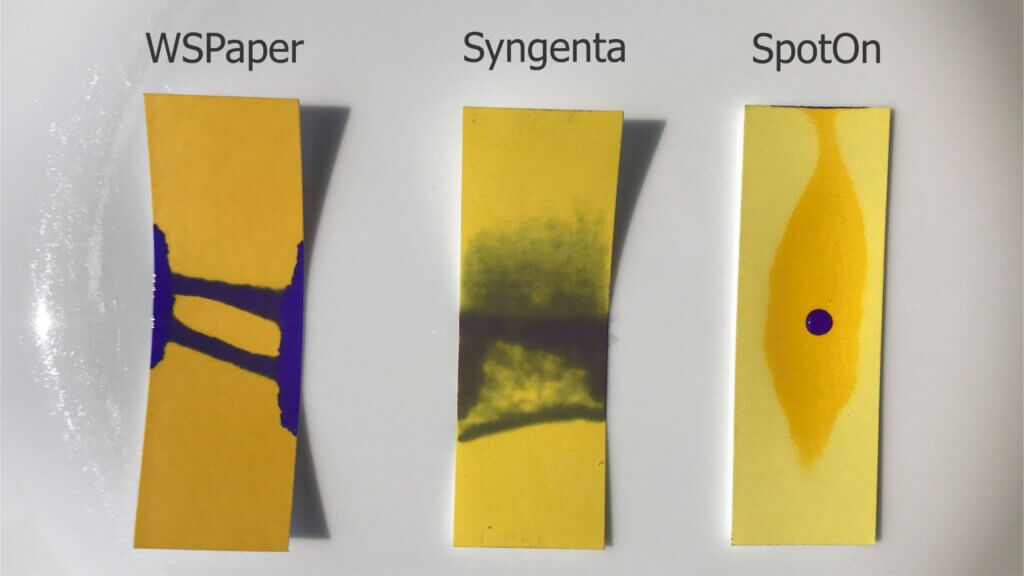
WSP is often placed in foliar canopies which are subject to dew and transpiration that can cause the papers to react prematurely. This can be particularly limiting when moisture soaks through the backs of papers. Each brand of paper was placed face-up on a drop of water to see if the water would bleed through.
Three brands were placed on a single drop of water. Within five minutes, WSPaper and Syngenta brands wicked the water through, causing a colour reaction. SpotOn did not, although the yellow surface darkened. When a drop of water was applied to the face, the SpotOn paper still produced a blue stain.
WS quickly curled as the water wicked in from the edges. Within five minutes the water soaked through from the back as well. Within five minutes SY also curled, but the colour reaction was entirely due to water soaking through and not wicking along the edges of the paper. SO did not curl and there was no colour reaction save a minor wicking reaction at one edge. It did however produce a dark yellow patch. In order to see if a colour reaction was still possible, a single drop of water was placed on the face and the colour reaction was distinct and instantaneous.
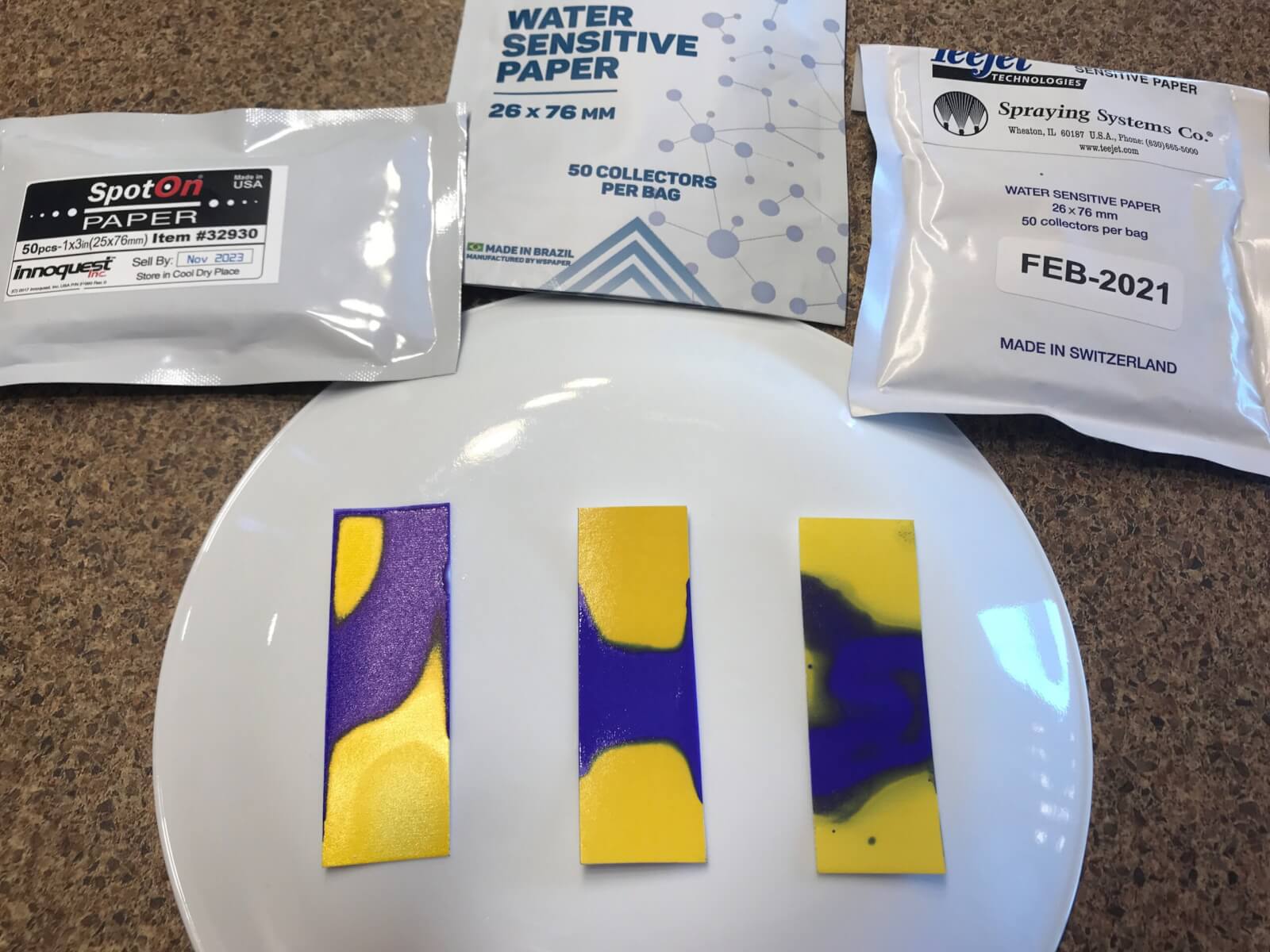
Note: Others have since replicated this experiment and reported that the response depends on the amount of water used and how long you leave it. We repeated our experiment with higher volumes and longer wait times (see image below). Ultimately, no brand of WSP is water proof from the back. Nevertheless, with small volumes of water (such as from dew) the original assessment of each brand is still valid.
A replication of the bleed-through experiment with the same batch of papers was performed with higher water volumes and a longer duration. Eventually, all three brands bled through. (SpotOn left, WSPaper middle, Syngenta right).
Deformation and drying time
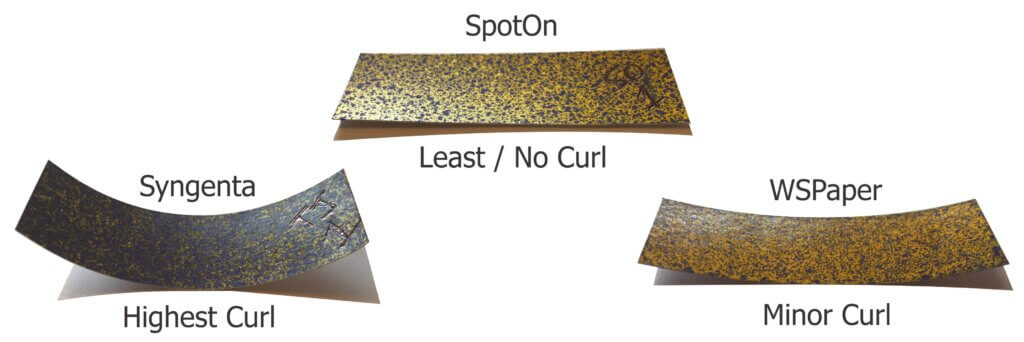
Users of water sensitive paper may be familiar with its occasional tendency to curl when one side is sprayed. In extreme cases, this movement could create smears if the paper contacted other wetted surfaces in dense foliage. The degree of curling was significantly different by brand, with SY becoming convex when wet and then flexing back into a concave form once dry. WS deformed as well, but only to a minor degree. SO did not appear to deform at all. Syngenta has noted that the degree to which their papers curl depends on the batch. Their manufacturing process has changed over the years in response to regulatory requirements and minor adjustments are still occasionally made.
Once dry, each brand of WSP tended to curl to different degrees. Syngenta curled the most and SpotOn the least if at all.
There was no appreciable difference in the time it took for any brand to dry. This is based on attempts to smear papers every 30 seconds. All were dry in under five minutes.
Experimental design
While there is considerable variability inherent to spraying, every effort was made to maintain consistent conditions. Papers were sprayed in a closed room with no appreciable air currents (21.5 °C and 64% RH). Papers were paired randomly, side-by-side on a plastic sled. The sled was pulled at 2.5 kmh (~1.5 mph) through the centre of a spray swath produced by a TeeJet XR80015 positioned 50 cm (20 in.) above the targets. The nozzle operated at 2.75 bar (40 psi) to produce ~270 L/ha (~29 gpa) with Fine spray quality. Six passes were made, producing four sprayed papers for each brand.
All papers were dry to the touch after two minutes. They were removed to a cooler, low humidity space and were digitized and analyzed using the SprayX DropScope (v.2.3.0) within an hour of spraying. We noted that while WS and SO fit easily into the DropScope port, the SY papers were sometimes slightly wider and had to be forced. Learn more about how to digitize and analyze WSP in this series of articles.
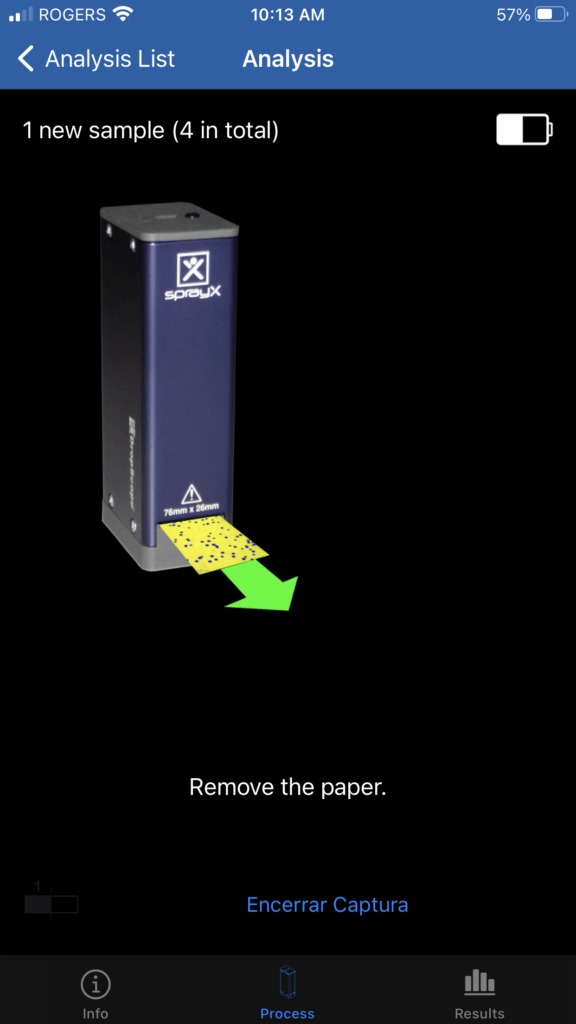
Screen capture from DropScope’s smartphone app.
The “ground” option was selected, and each brand of paper was processed using its specific spread factor. DropScope has a detection threshold of 35 µm. This is appropriate as the smallest droplet diameter that can be resolved by any brand of WSP is ~30 µm (Syngenta, Innoquest, SprayX – Personal Communication).
Percent surface covered
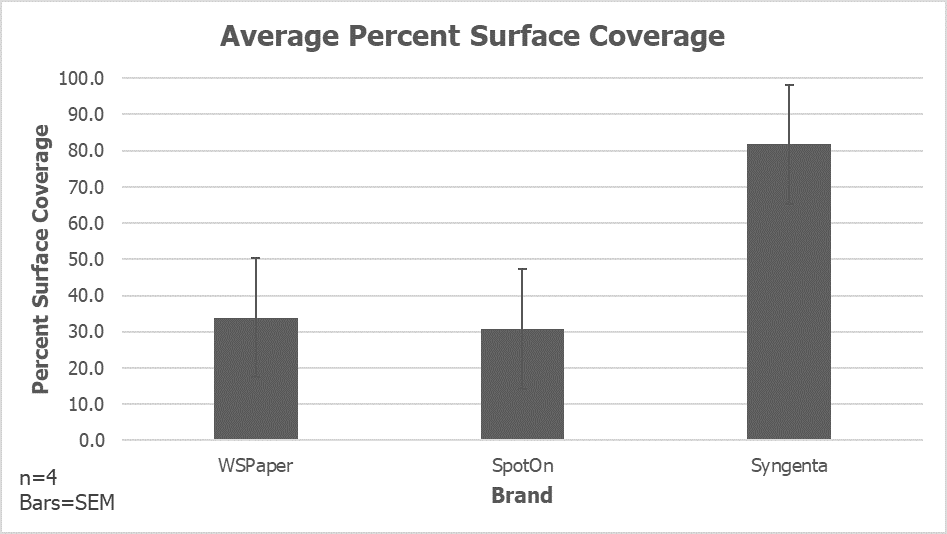
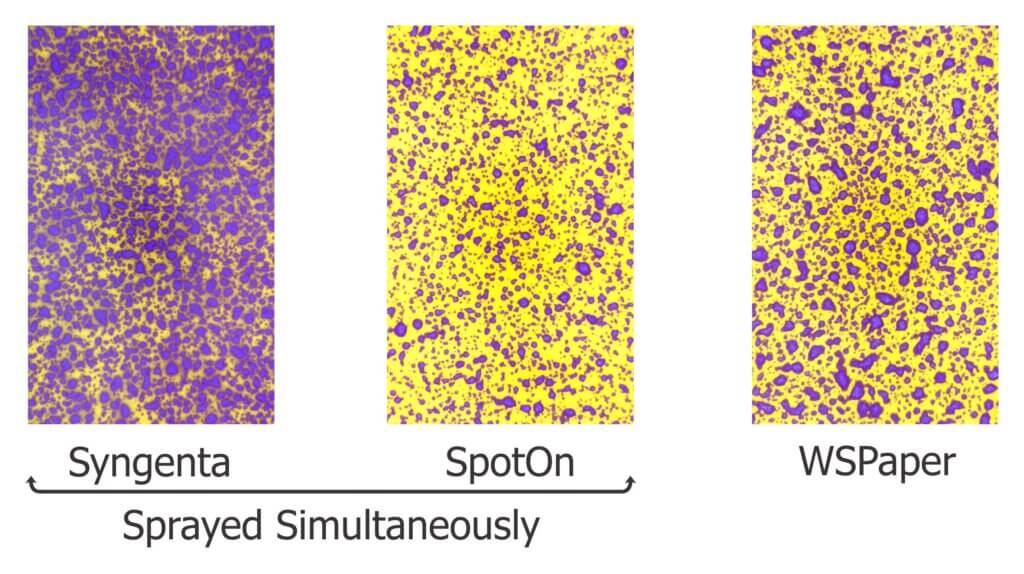
The average percent surface covered was calculated with standard error of the mean for each paper. WS and SO produced similar values between 30 and 35%. While all three brands exhibited similar variability, SY approached saturation at approximately 80% coverage. Therefore, WSPaper exhibited a slightly higher degree of spread than SpotOn, while the Syngenta paper exhibited a significantly higher degree of spread.
For reference, it can be difficult to determine if a stain represents a single deposit or is the result of multiple overlapping deposits. This becomes a problem when the surface of the WSP exceeds 20% total coverage. Further, it becomes increasingly difficult to distinguish a stain from the background, unstained surface when papers exceed 50% total coverage.
Average percent surface coverage by brand.DropScope-digitized images of three brands of WSP. The Syngenta and SpotOn papers were sprayed simultaneously while the WSPaper was sprayed in a subsequent pass. WSPaper exhibited a slightly higher degree of spread than SpotOn, while the Syngenta paper exhibited a significantly higher degree of spread.
Deposit density
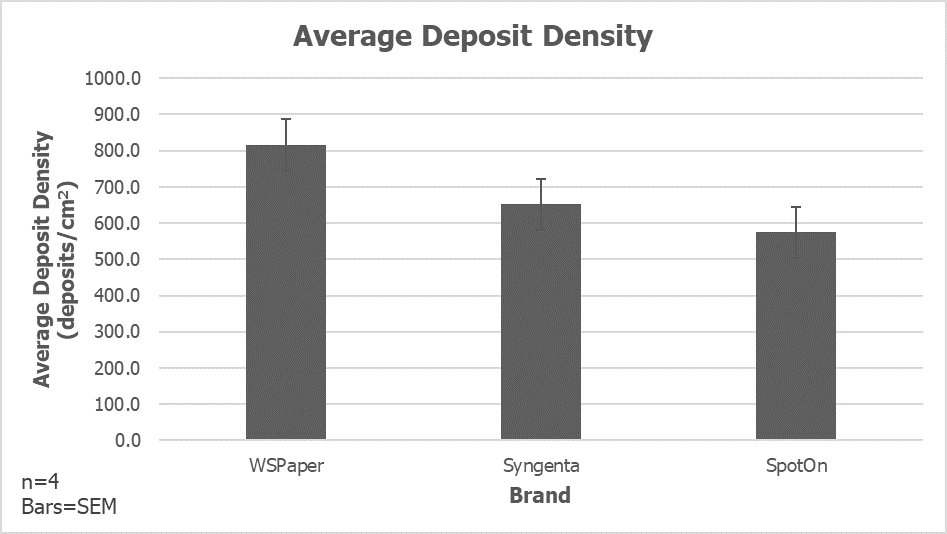
The average deposit density is a count of discrete objects (i.e. stains) per cm2. WS appeared to resolve the highest count, followed by SY and then SO. The process for determining what is a discrete object, and not the result of anomalies such as overlapping deposits, elliptical deposits or imperfections in the paper itself is complicated and computationally heavy. The algorithms employed by DropScope treated each paper consistently. So, while some differences are attributed to variations in spraying, they also reflect the paper’s innate ability to resolve individual deposits.
Average deposit density was highest for WSPaper, then Syngenta, then SpotOn. Variability was similar in all cases.
Droplet diameter
It is not the intent of this article to determine if WSP should be used to extrapolate the original droplet size. The many assumptions and inconsistencies inherent to this process are well known. Nevertheless, some researchers do use WSP in this manner, so a comparison was warranted.
DropScope bins deposit diameters by size to produce histograms of deposit size by count. These stain diameters are used to extrapolate DV0.1, DV0.5 (VMD), DV0.9 and NMD, which describe the population of droplets that produced the stains. DV0.5 is the Volume Median Diameter, or the droplet diameter where half the volume is composed of finer droplets and the other half by coarser droplets. Number Median Diameter (NMD) is the droplet diameter where half the total droplets are finer, and half the total droplets are coarser.
Each brand of WSP will permit a certain degree of spread when a droplet of water contacts the surface. This spread factor is specific to the brand of paper. Further, the spread factor is not constant for all droplet sizes; Finer droplets will spread less than coarser droplets.
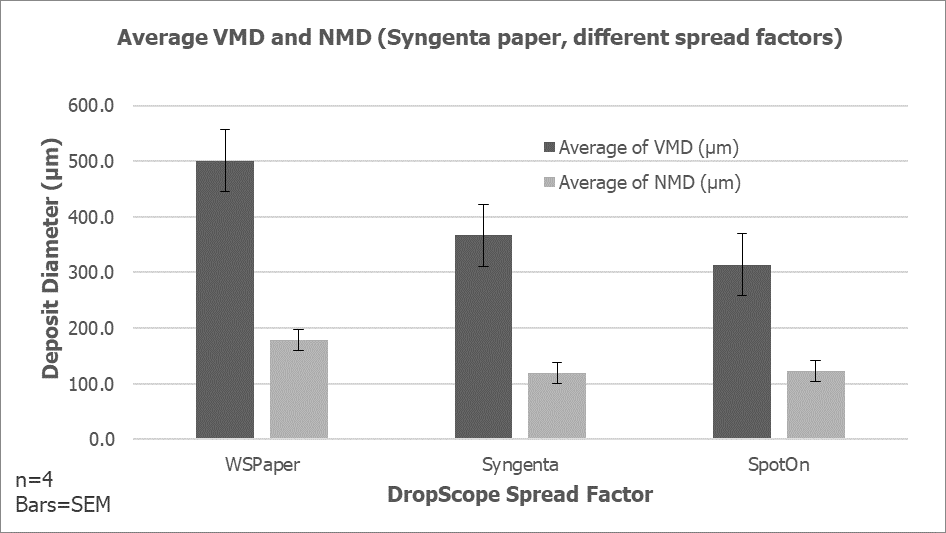
When processing data using DropScope, selecting the appropriate spread factor makes a significant difference to the output. For example, here are the same four SY papers processed using the Syngenta-specific spread factor as well as the spread factors intended for SpotOn and WSPaper.
The same four Syngenta papers were processed by DropScope using the Syngenta-specific spread factor as well as the SpotOn and WSPaper spread factors. The resulting VMD and NMD were very different.
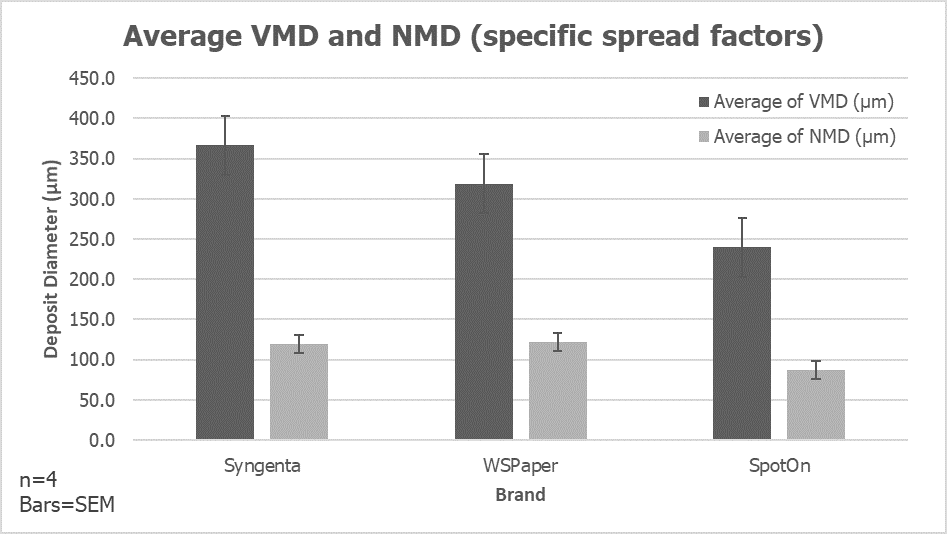
Therefore, each brand of water sensitive paper was analyzed using its brand-specific spread factor (according to DropScope), to produce the following graph.
Three brands of WSP processed by DropScope using their specific spread factors. VMD differed by as much as 30%.
SY produced a VMD higher than that of WS, and both were higher than SO. There was less variability in the NMD, but this was expected given the high droplet count on the finer side of a hydraulic nozzle’s droplet size spectrum.
Conclusion
Water sensitive paper has immeasurable value in agricultural spraying. It is far more important to encourage its use than to quibble over brands. However, when these tools are used for more rigorous evaluations of spray coverage, brand-specific variability must be addressed.
The differences in how each brand responds to moisture (i.e. discolouration and deformation) may factor into which brand is most appropriate for a given situation. Further, there appear to be significant differences in how each brand resolves coverage. Once again, this may be irrelevant for those spray operators who occasionally use WSP to inform their spraying practices, but for consultants and researchers it is suggested that they use a single brand for an experiment, with papers produced in the same batch run.
If there’s one thing that stays the same, it’s that nothing stays the same. Formulations and manufacturing processes change. According to SprayX, manufacturers of the DropScope, all three of the papers described in this article (written in 2021) have changed in recent years. Some have improved and others can create potential errors in digitizing coverage. The following points may require a deeper understanding of how WSP is digitized and analyzed. Refer to this series of three articles.
Be aware of the following best practices when using WSP:
Be aware of package expiration dates. Expired paper will work differently from new paper, creating an artifact in analysis.
Papers with bright, reflective surfaces can cause an underestimation of deposit counts (specifically the smallest deposits).
Best results are obtained when using water for testing. Adjuvants and pesticide co-formulants have minor impacts on spread, but can also change the how the paper changes colour, making thresholding difficult.
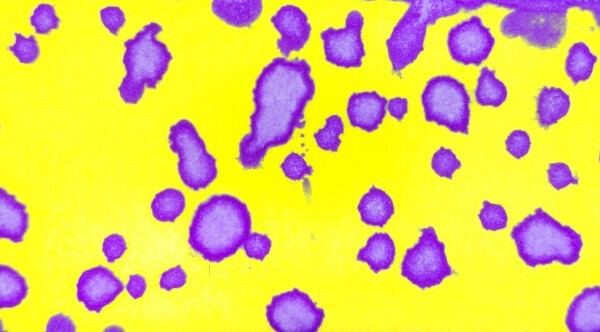
Beware papers that create stains with bright borders and faint (hollow) centres (see image below). This can lead to an underestimation of volume median diameter. If your camera or scanner permits, examine the coverage in binary (e.g. black and white) for more accurate results.
Do not sample the edge of the WSP (leave at least a mm) to avoid edge effects such as wicking and partial impacts. Some scanners have a setting, or you can select the area manually.
Note the physical shape of the paper itself. Inconsistencies in the length and width (cutting errors) can make papers difficult to use in certain scanners, and curled papers cause changes in perspective and focal distance that can lead to errors.
When not using a sealed camera or scanner (e.g. DropScope or flatbed), changes in the camera angle, shadows, lighting conditions, and make/model of cellphone camera will affect the results. Be consistent.
Stains with faint centers may not register correctly with some software. This could be due to adjuvants in the liquid, or issues with the coating itself. Other issues might include inconsistent coatings that are either too thick or to thin affecting the reaction to water.
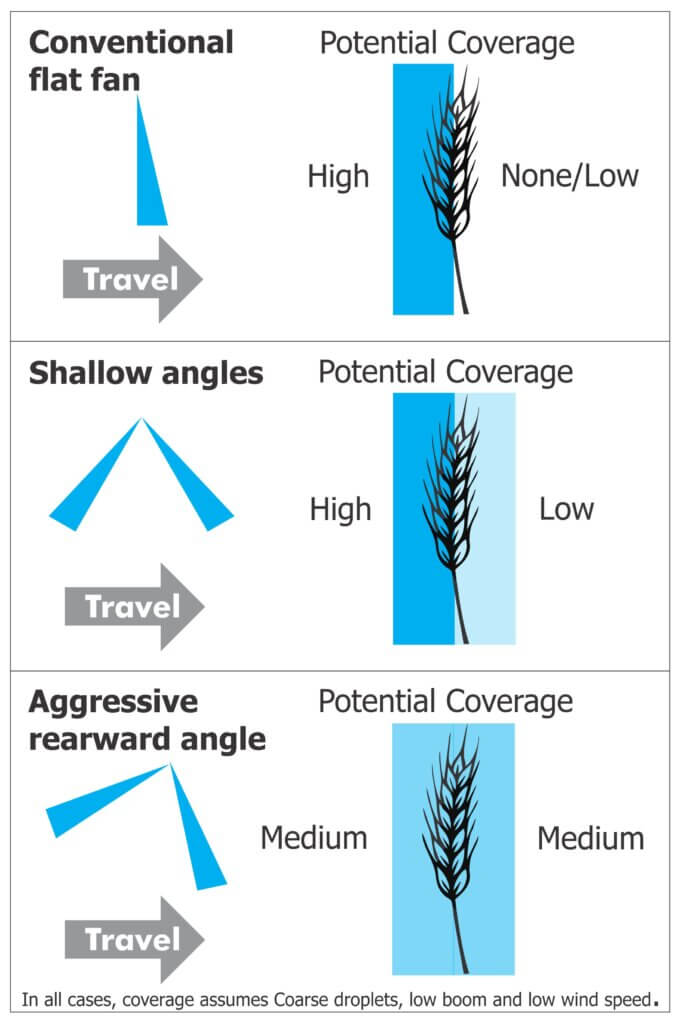
When T3 wheat rears its head, the first rainy day brings questions about spray angles. Let’s begin with a graphic that illustrates how angled sprays cover a vertical target like a wheat head. Assuming moderate wind and sufficiently large droplets, this is a simplified depiction of what we would expect to see.
But is this how the nozzles actually perform? Are dual angles really better than a single fan with an aggressive angle? We hoped to answer these questions when we demonstrated a selection of dual fan nozzles at Canada’s Outdoor Farm Show in 2013. But it was a very windy few days and what we saw was that regardless of the nozzle, most of the spray tended to deposit with the wind.
A 10 km/h wind will easily deflect Medium-and-smaller droplets and at 20 km/h all but the coarsest spray is deflected. This leads to non-uniform deposits and unacceptable levels of drift (yes, even through it’s a fungicide and you have lots of acreage.) To learn more, we turned to the literature to review studies performed in Ontario and Saskatchewan.
Wolf and Caldwell
In 2002, Dr. Tom Wolf and Brian Caldwell experimented with fan angles. They evaluated the impact of nozzle angle, travel speed, and droplet size on the “front” (facing the sprayer’s advance) and “back” (sprayer’s retreat) of vertical targets. They ran three laboratory experiments: spray configuration (single vs. double fan), travel speed (7.6 and 15.2 km/h) and spray quality (conventional versus air-induced droplets) using TeeJet XR’s and Billericay air bubbles at a rate of 175 L/ha. Here’s what they observed:
Larger, air-induced droplets produced higher average deposits than smaller, conventional droplets.
Twin fans improved overall average deposit compared to single fans.
Building on the first two points, twin air-induction fans improved overall average deposit versus conventional twin fans, and also improved deposit uniformity (i.e. coverage on the front versus the back of the vertical targets).
Higher travel speeds improved overall average deposit, but at the cost of reduced uniformity as the rear-facing target received reduced coverage (particularly in the case of conventional droplets).
Spray angle did not impact coverage from conventional tips, but increasing from 30 to 60 degrees improved coverage for AI tips.
While the coverage data was compelling, growers were not reporting improved efficacy with the improved coverage. The authors felt there were confounding variables like crop susceptibility, disease pressure and product effectiveness. Their conclusion was that applicators should strive for improved coverage, but only after integrated pest management (IPM) criteria such as product choice, crop staging and application timing are satisfied.
Hooker and Spieser
In 2004, Dr. David Hooker (University of Guelph) and Helmut Spieser (OMAFRA) started exploring nozzle configuration and sprayer set-ups to optimize Folicur applications in wheat. For several years they ran field trials exploring panoramic wheat head coverage. That is, not only the front and back of the wheat head, but the sides as well. Ten different nozzle configurations were used:
TurboTeeJets mounted in dual swivel bodies (backwards and forwards)
AirMix air induction nozzles mounted in dual swivel bodies
Air induced Turbo TeeJets mounted in dual swivel bodies
Single Turbo TeeJets angled forward or angled backwards
Single Turbo FloodJets angled forward or angled backwards
TwinJets
Single Hollow cones
Turbo TeeJet’s mounted in Twincaps
Turbo TeeJet Duos
Single Turbo FloodJets alternating forward and backwards
They explored boom height (0.5 m and 0.8 m above the crop), travel speed (10 km/h and 20 km/h) and application volume (93.5 L/ha and 187 L/ha). Here is a summary of their findings:
Travel speed did not appear to impact overall coverage.
Spraying higher volumes improved coverage.
Lowering the boom improved coverage.
Coverage from conventional flat fans and TwinJets gave ~15-18% coverage and 22-26 mg of copper was deposited per m2, but alternating Turbo FloodJets gave ~29% coverage and deposited ~37 mg copper per m2.
The highest percent coverage was obtained using Turbo TeeJets or the AirMix tips mounted in dual swivels (~26% coverage), or single Turbo Floodjets alternating forward and backwards (34% coverage) as long as the spray was not obstructed by the boom structure itself.
Hooker and Schaafsma
A few years later, Dr. Hooker and Dr. Art Schaafsma worked with OMAFRA to explore efficacy. DON is a mycotoxin that may be produced in wheat infected by Fusarium Head Blight (FHB) or scab. There is an indirect relationship between wheat head coverage of fungicide and the reduction of FHB and DON: The higher and more uniform the coverage (with the right timing) the lower FHB and DON.
In two field experiments they performed in 2008, DON values in the untreated checks were around four parts per million. DON was reduced by an average of 22.5% using a single flat fan, 23.0% using a TwinJet and 41.5% using alternating Turbo FloodJets when averaged across two fields, two fungicides and four reps (n=16). They all reduced DON significantly. There was no statistical difference between singles and twins, but control from the alternating Turbo FloodJets was significantly better.
The Return of Wolf and Caldwell
Then, in 2012, Tom and Brian evaluated the new asymmetrical twin fan nozzles from TeeJet. The marketing claimed they could improve overall coverage at higher travel speeds because they decrease the contribution of the front-facing fan and increased the angle of the back. Tom and Brian’s lab-based experiments determined that:
Asymmetricals increased overall deposit amounts and uniformity versus single fan and symmetrical twin fans.
Nozzle orientation (alternating or not) seemed unimportant.
As suggested earlier, boom height was a big factor in coverage. Nozzle angle didn’t improve coverage when the boom was too high, but spray deposit increased significantly when the boom was lowered.
Coarser spray droplets have more momentum, so they can travel greater distances on their original vector. A coarser spray quality is the best choice for any angled fan.
Water volumes and FHB
Let’s address the notion that high water volumes might increase Fusarium Head Blight (FHB). This is a hypothesis that seems to have resonated with growers. Dr. David Hooker ran trials where he tried to favour FHB by spraying 40-50 gpa of water multiple times per day (even up to 100 gpa). There was no pathological impact (personal communication).
Consider that 1″ of rain is the equivalent of 2,715 gpa of water. Raising your carrier volume from 15 gpa to 20 gpa is the equivalent of 0.000184″ of rain. Admittedly, it’s all aimed at the wheat head, but it’s still a tremendously small volume. While studies have shown a diminishing return in coverage at 30 or 40 gpa, spraying with 20 gpa appears to be a safe way to improve coverage significantly.
Learn more about early morning spraying here, and a more in depth discussion of spraying when there is dew here.
PWM
What if you’re running a PWM system? Sizing for PWM requires the tip be sized about 20-40% more than if you were running a conventional sprayer. In other words, at expected travel speeds, the pulsing duty cycle should be approximately 60-80%. Nozzles that are permitted on PWM sprayers are limited and the angled fan selection for PWM is, at the time of writing, more so. It requires some experimenting. The following list uses the JD Exact Apply as an example system, and it is not exhaustive. We’re always looking for new ideas.
3D90 (the original 3D is arguably too misty) in the A or B positions, alternating front and back <or> in both A and B positions. This tip may not be readily available in North America.
LDT (Low Drift Twin) which is two LD tips installed in a Twincap (twin 30° angles) in position A or B.
LDM (Low Drift Max) which is two LDM installed in a Twincap in position A or B. This tip only goes down to an 03.
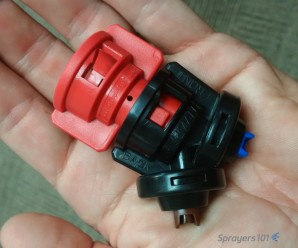
The Deere 40 degree angled adaptor (developed for See and Spray) can be used to convert any PWM-compatible nozzle into an angled spray.
GAT (GuardianAir Twin) is an air-induced tip, running in conventional “A” mode or in Auto Mode but sized for “B”. Avoid operating in A and B to prevent pattern interference.
Wilger Wye Adaptor with SR nozzles. This does cause tips to drop below the boom frame but is a versatile option.
Wilger Dual Angle Max. More compact than the wye adaptor, this asymmetrical assembly (30° fore and 50° aft) prioritizes Coarse spray.
TeeJet Accupulse TwinJet.
Greenleaf Blended Pulse Dual Fan Assembly.
Summary
So here’s what we can say based on all this research:
Higher volumes improve coverage (significantly up to ~200 L/ha or 20 gpa). Can you go to 30 gpa? Yes, and it will likely improve coverage, but it’s a diminishing return and at some point you will incur run-off.
When using angled sprays, coarser droplets improve vertical coverage. Compared to finer droplets, they move faster, survive longer (i.e. resist evaporation) and are less likely to be deflected by wind.
Maintaining the lowest operable boom height improves coverage from angled sprays. We want 100% overlap at target height, and with angled sprays that means getting pretty close. Aim for the highest wheat heads and not the tillers. If you’re 2′ away, you’re likely too high.
Symmetrical fans with shallow angles (e.g. 30°) improve coverage uniformity on vertical targets versus single fans, and a steeper backward-facing angle (e.g. 70°) improves coverage even more on the sprayer-retreat side.
Travel speed may or may not affect coverage, but slower speeds do facilitate lower booms, which do improve coverage.
Timing, weather and product choice are likely the most critical factors.
Angled sprays may offer some advantage in other situations, but they are primarily intended for panoramic coverage of vertical targets.
“If you can’t measure it, you can’t improve it”. While the source is nebulous (Peter Drucker, Lord Kelvin, or Antoine-Augustin Cournot), the sentiment is clear.
The status quo
In the world of crop protection, considerable resources are expended to distribute a pesticide over a target. And yet, sprayer operational settings and spray coverage are rarely assessed. As a result, too much time elapses between the application and observing the biological results to evaluate and correct equipment performance. The damage (be it waste or an inconsistent and sub-lethal dose) is done. All sprayer operators know this to be true, so why do precious few perform these assessments?
Perhaps, dear reader, you have personal experience assessing coverage and already know the answer. Perhaps you’ve performed the iterative dance that is placing, spraying, retrieving, assessing and re-placing water sensitive paper (WSP). Perhaps you’ve sprayed fluorescent tracers and hunted for faint glows at twilight using UV lights. Perhaps you’ve looked for residue from diatomaceous earth or fungicides. Or, perhaps, you’ve trusted in the falsely-comforting “shoulder check” and assumed dripping must mean you’ve hit the target.
Existing methods are complicated, subjective, messy and time-consuming. We need an alternative.
The alternative
Consider a permanent, solar-powered sensor that supplies real-time spray coverage data to your smartphone via a cellular connection. The output could be visualised in a simple and intuitive way, and immediately available to both sprayer operators and farm managers. If the sensor was relatively inexpensive, sufficiently hardy, and easy to deploy, its utility would only be limited by your imagination:
Stakeholders could confirm the correct functioning of their equipment before committing to the application. Decisions could be made to change operational settings, repair equipment, or delay until conditions improved.
The sensors would provide coverage data specific to their location and orientation. Units could be installed in difficult-to-spray regions such as treetops, or canopy-centres, or fruiting zones. Sensors could be placed where pest/disease pressure has been historically high, or where wind is a known issue.
Large operations could install them in a test-row, where sprayer operators would perform a gauntlet-style calibration run prior to a day of spraying.
Spray records could inform compliance audits, supplement insurance or CanadaGAP traceability requirements, or be used in agronomic assessments.
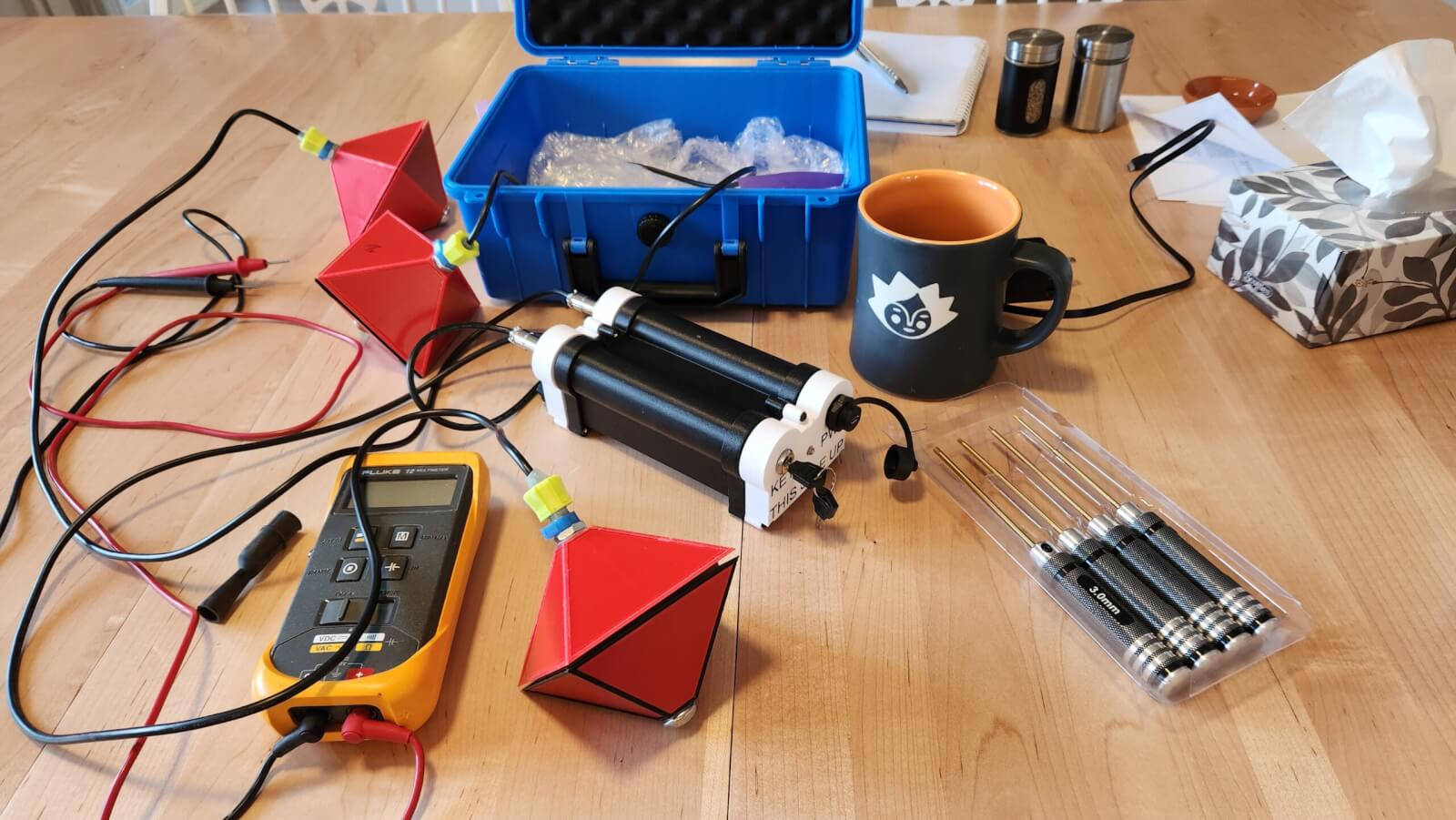
In 2025 I was approached by an Australian developer who claimed he had a device that did all of this. And, if that weren’t enough, it could also monitor certain meteorological factors such as pre-spray moisture levels and temperature and report post-spray evaporation rates. I could barely contain my excitement. A prototype was in my hands a few weeks later.
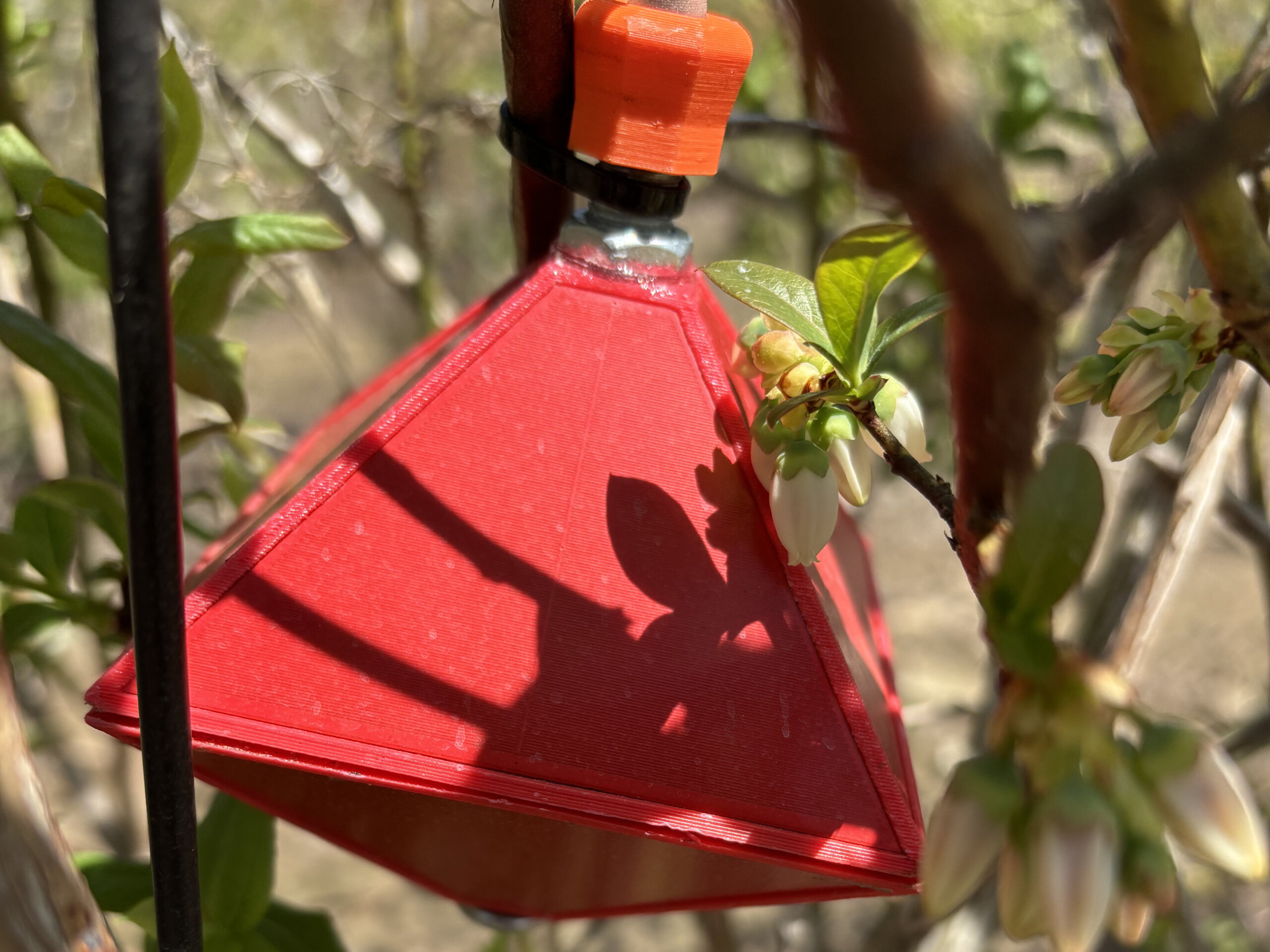
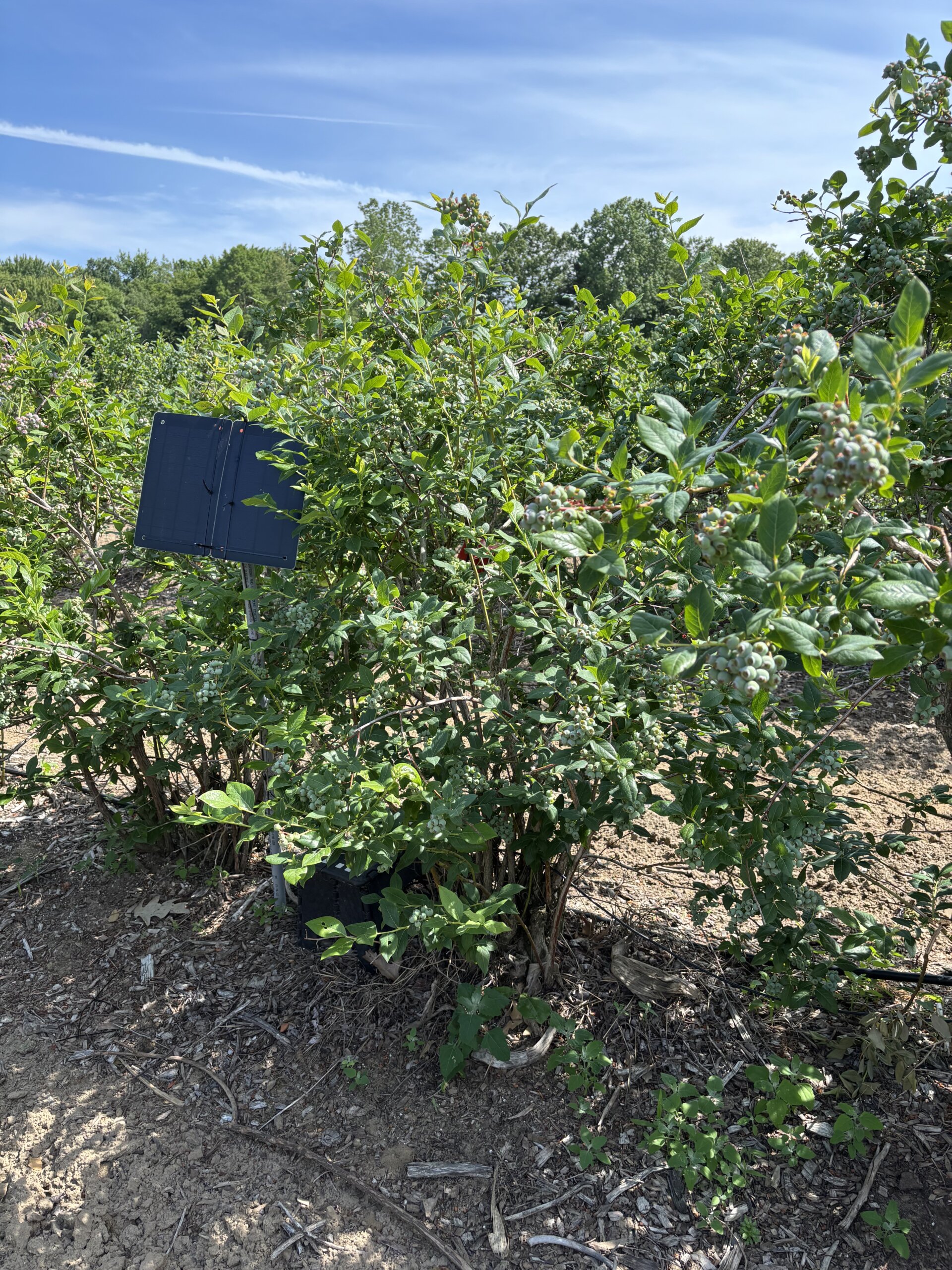
Prototype, 8-sided sensor located in a blueberry bush.Solar panel powering three, 8-sided prototype sensors spanning 10 meters of highbush blueberry.
Benchmarking the sensor
The Spray Doctor (working name for the prototype) started its life as a leaf wetness sensor, evolving into a spray coverage sensor piloted in 2023/24 in Australian and New Zealand grape production. The history of earlier iterations and company schisms is convoluted, and fortunately immaterial to our purposes. All I needed to know was that we weren’t starting from scratch. Several of the questions regarding how accurately the surface could detect spray deposition were already addressed by independent research.
The sensing surface is impregnated with an array of capacitive wetness sensors. The sensor responds to the surface area covered and not deposit density. Researchers reported a reliable response range between ~10% and 50% surface coverage. Given the arguable “ideal” coverage standard of 10-15% surface area, this includes the range of interest for most sprays.
Benchmarking against WSP was part of the foundational assessment. A droplet of water deposited on WSP produces a high angle of contact and very little spread, while the same droplet deposited on plant tissue tends to produce a lower angle of contact and more spread. This means the stain produced on WSP is smaller than would be produced on plant tissue, depending on how smooth, vertical or waxy the tissue surface was.
It was therefore surprising that WSP were found to report a higher degree of spray coverage during water-only sprays than the sensor. It seemed droplets more easily coalesced and ran off the sensor surface. This was ultimately interpreted as an advantage, because the sensor would better emulate how a leaf surface would respond to the influence of surfactants and spray quality.
Adding a surfactant to a spray solution improves droplet adherence, and/or reduces surface tension, improving the degree of contact on plant surfaces. Likewise, it was found that surfactants increased the degree of coverage reported by the sensor, and when actual chemistry was sprayed (e.g. sulphur powder or copper sulfate) there was an effect on the degree of coverage reported. This is unlike WSP, where adjuvants and chemistry do little to increase the spread.
And so, like every method for assessing spray coverage, the sensor has limitations and caveats. If you have some doubt as to the sensor’s accuracy, do not get distracted by the fine detail. Remember, most operators currently have no feedback whatsoever; even a binary response (e.g. hit or miss) would be welcome. The sensor is sufficiently sensitive and consistent to resolve coverage in a range relevant to most sprays, and therefore worth field testing.
The experiment
My role in this story was to work with a grower to evaluate the sensor’s ability to report coverage information in a clear and actionable way. There were three questions:
Does data from the sensor influence a sprayer operator’s behaviour?
Does that change in behaviour lead to improved spray coverage (implying more efficient and effective crop protection).
Could we “dial in” the hardware and the interface based on the grower’s feedback?
In part two, we share our experience installing and using the Spray Doctor, as well as supply answers to these questions. Stay tuned.
Thanks to Brandon Falcon (Falcon Blueberries) for volunteering his time and farm for this evaluation, and the developer for the in kind donation of the prototype Spray Doctor.