Tag: ginseng

  • How to Spray Ginseng

    How to Spray Ginseng

    This article was co-written with Dr. Sean Westerveld, Ontario Ginseng and Herb Specialist.

    An effective ginseng protection program begins with observing the Integrated Pest Management (IPM) process:

    • diagnose the problem,
    • monitor the problem,
    • control the problem, and
    • monitor the results.

    When spraying is warranted, the operator should understand the basics of application technology. This not only includes the equipment, but the effects of changing spraying parameters (such as pressure or carrier volume), the impact of weather conditions (such as wind and relative humidity) and the product being applied (such as correct timing and safety requirements). The operator should also understand how to properly maintain, calibrate and orient the sprayer according to the nature of the target. Finally, monitoring the results requires the operator to respond to changes in the environment and target during application and to consider these factors when evaluating the outcome.

    The ginseng garden

    This is a four-year old garden, which represents one of the largest, densest ginseng canopies an applicator can spray. The six-foot wide beds in this particular garden are higher than most beds, making sprayer/tractor clearance an issue. It also means the distance-to-target from boom to canopy is less in the middle of the bed than it is nearer the alleys, making it difficult to ensure consistent coverage. Sprayer operators typically drive in the same direction over each bed, “training” the plants to bend in the same direction each time the tractor passes over the surface. This practice, combined with fenders on the tractor wheels, helps to minimize physical damage as the sprayer passes.
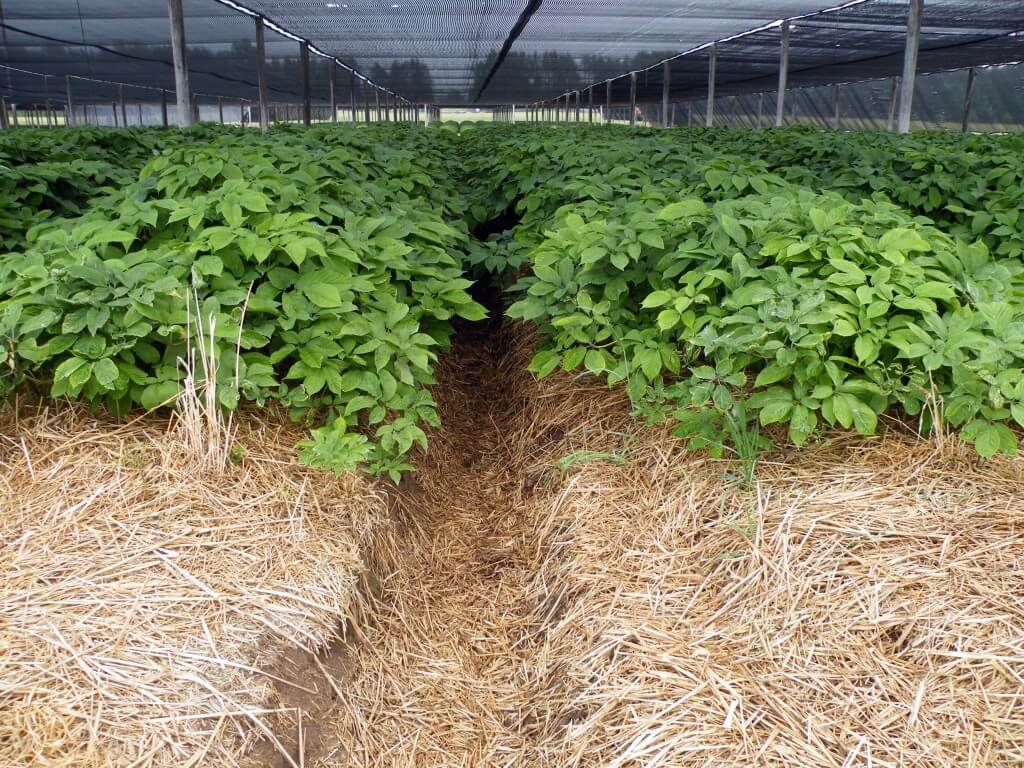
    Ginseng gardens have high beds.
    Ginseng gardens have high beds.
    In a four year old ginseng garden. Clearance is an issue.
    Clearance is an issue in a four year old ginseng garden.

    The sprayer

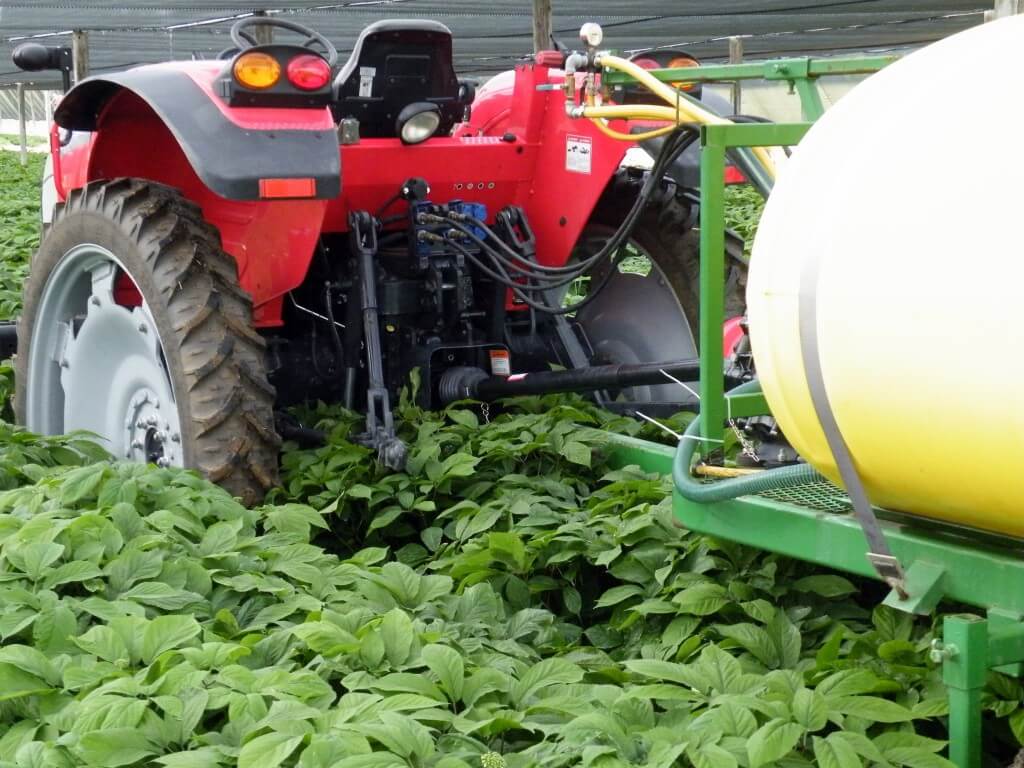
    This custom-built sprayer is a fairly standard design for most ginseng operations: Eight nozzles on each wing and nine on the centre boom. Spacing varies but this sprayer is on 11 inch centres, with the outermost nozzles on five inch centres and aimed outward towards the adjacent beds. Given the limited boom height, all nozzles are aimed back about 45 degrees to increase the distance to target and allow for overlap. The angle is critical to prevent gaps in the spray swath, but given the recommended practice of limited overlap for hollow cone nozzles, the 11 inch spacing may be a little shorter than required.
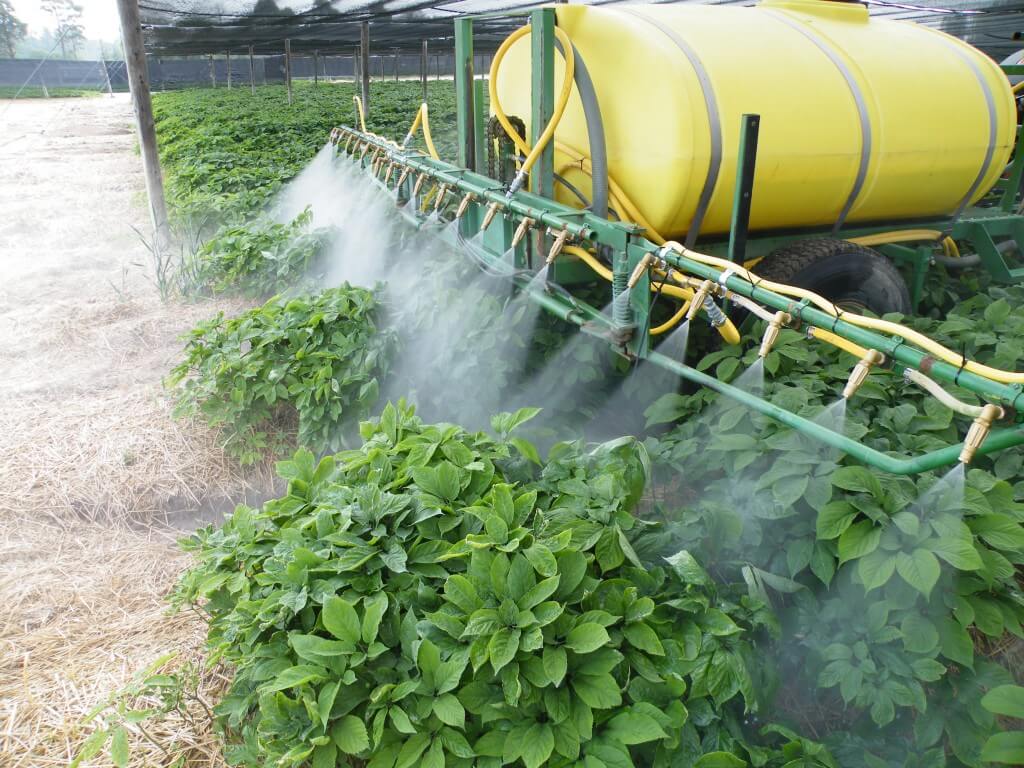
    Custom-made ginseng sprayer. A standard design.
    Custom-made ginseng sprayer. A standard design in Ontario.

    Spray coverage

    There is no hard and fast rule for spraying ginseng. The crop can receive 30 or more applications a year, most of which are fungicide applications. Tip: Monitoring the small plants inside the canopy is a good indicator of overall garden health.

    The following lists products available for use in Ontario at the time this article was published. The application target varies for each product, depending on the pest or disease the applicator wishes to control. As such, the application volume should reflect the location of the intended target. For example, a foliar-and-stem application should achieve consistent coverage of all leaf surfaces without incurring run-off. An application intended to reach the crown through the straw will require some run-off down the plant stem and should require a higher volume than a foliar-and-stem application. Many products will become immobilized if they dry onto the straw. Applications are best done to wet straw, followed by irrigation or rainfall to wash the product into the root zone. Applications for diseases like Rhizoctonia generally take place early in the season before the canopy closes, and higher volumes may not be required to achieve root coverage. In order to know how much is required for optimal coverage, read on.

    Table 1 – Spray target and relative volume by pest

    PestApplication Target – Specific ProductGarden AgeRelative Volume
    Alternaria and/or BotrytisFoliar and Stem – all productsSeedling – 2nd yearLow
    3rd – 4th yearModerate
    Phytophthora Leaf BlightFoliar and Stem – most productsSeedlingLow
    2nd-4th yearModerate
    Foliar – Aiette and PhostrolAllLow
    Phytophthora Root RotRoot – xylem-mobile root rot productsAllHigh
    Foliar – Aiette and PhostrolAllLow
    Phytophthora Leaf and RootRoot – xylem-mobile root rot productsAllHigh
    Foliar – Aiette and PhostrolAllHigh
    CylindrocarponRoot – all productsAllHigh
    RhizoctoniaRoot – most productsAllHigh
    Root – QuadrisSeedlingHigh
    PythiumRoot – all productsAllHigh
    AphidsFoliar and Stem/Berries – all productsAllModerate
    CutwormsStem – all productsAllLow
    Four-Lined Plant BugFoliar – all productsAllModerate
    LeafrollersFoliar and Stem – all productsAllModerate
    Root Lesion NematodesRoot – all productsAllHigh

    History of the ginseng boom in Ontario

    Historically, ginseng sprayer operators used brass hollow cone nozzles to spray ginseng. For reasons that are unclear, many then adopted the Casotti-style sprayer, which used higher volumes and an oscillating nozzle assembly to create a larger swath. This was determined to be overkill for ginseng, and it produced inconsistent coverage.

    Many growers (sadly, not all) switched back to horizontal booms and began using the Arag microjet assembly. Drop nozzles (aka drop arms, drop booms, drop legs, etc.) were positioned with disc-core hollow cone nozzles behind the wheels to direct spray into the canopy from below.

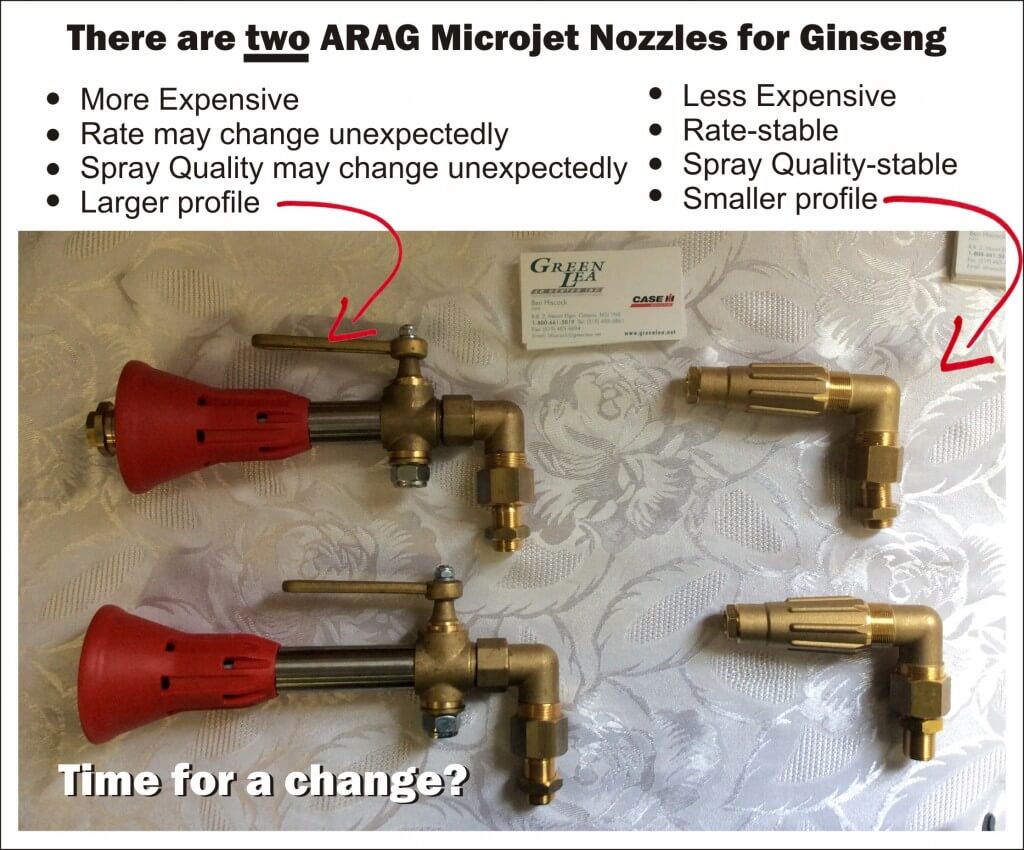
    Later, we demonstrated that the microjet mixing valve was difficult to set accurately, creating outputs +/- 50% the optimal rate. In response, a new variation on the Arag microjet was introduced, with a more reliable rate adjustment and a lower price tag (they are imported from Italy by a single North American distributor). The drop nozzles are absolutely critical for under canopy coverage, and growers have begun suspending them in each alley – not just behind the sprayer wheels. I predict the future boom arrangement will return to hollow cone nozzles, but in the form of molded poly nozzles with ceramic handling and drop nozzles with full cone disc-core assemblies. Air assist would be even better.

    Sprayer settings

    Most operators employ a ground speed of about 5 km/h (3.1 mph), operate at about 13.8 bar (200 psi) with nozzles spaced 25-30.5 cm (10-12”) spraying anywhere from 1,000 L/ha (107 gal./ac.) to 1,686 L/ha (180 gal./ac.). The application volume should reflect the stage of crop growth, the age of the garden and the target in question (see Table 1). Applicators should also consider droplet size (Table 2). This is difficult to control given that the majority use Arag microjets with the 1.5 mm orifice disc. In which case, pressure choice will affect median droplet size, with lower pressures increasing median droplet diameter and vice versa.

    Table 2 The Impact of Droplet Size

    Droplet SizeDrops per areaRetentionCanopy PenetrationDrift Potential
    FineHighHighLowHigh
    MediumModerateModerateModerateModerate
    CoarseLowLowHighLow
    Two versions of the ARAG Microjet.
    Two versions of the ARAG Microjet.

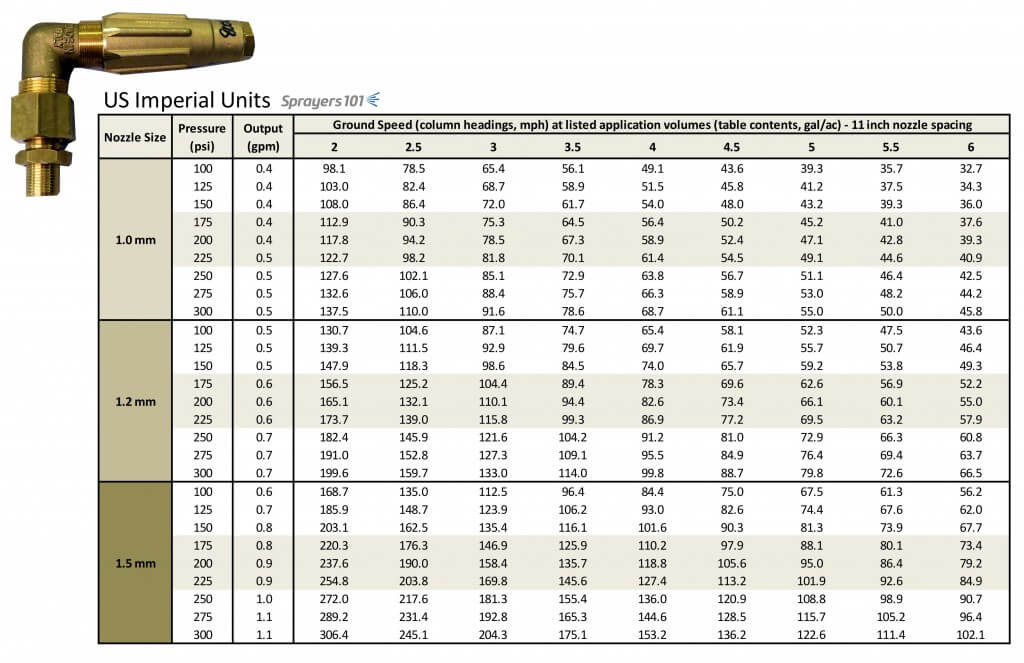
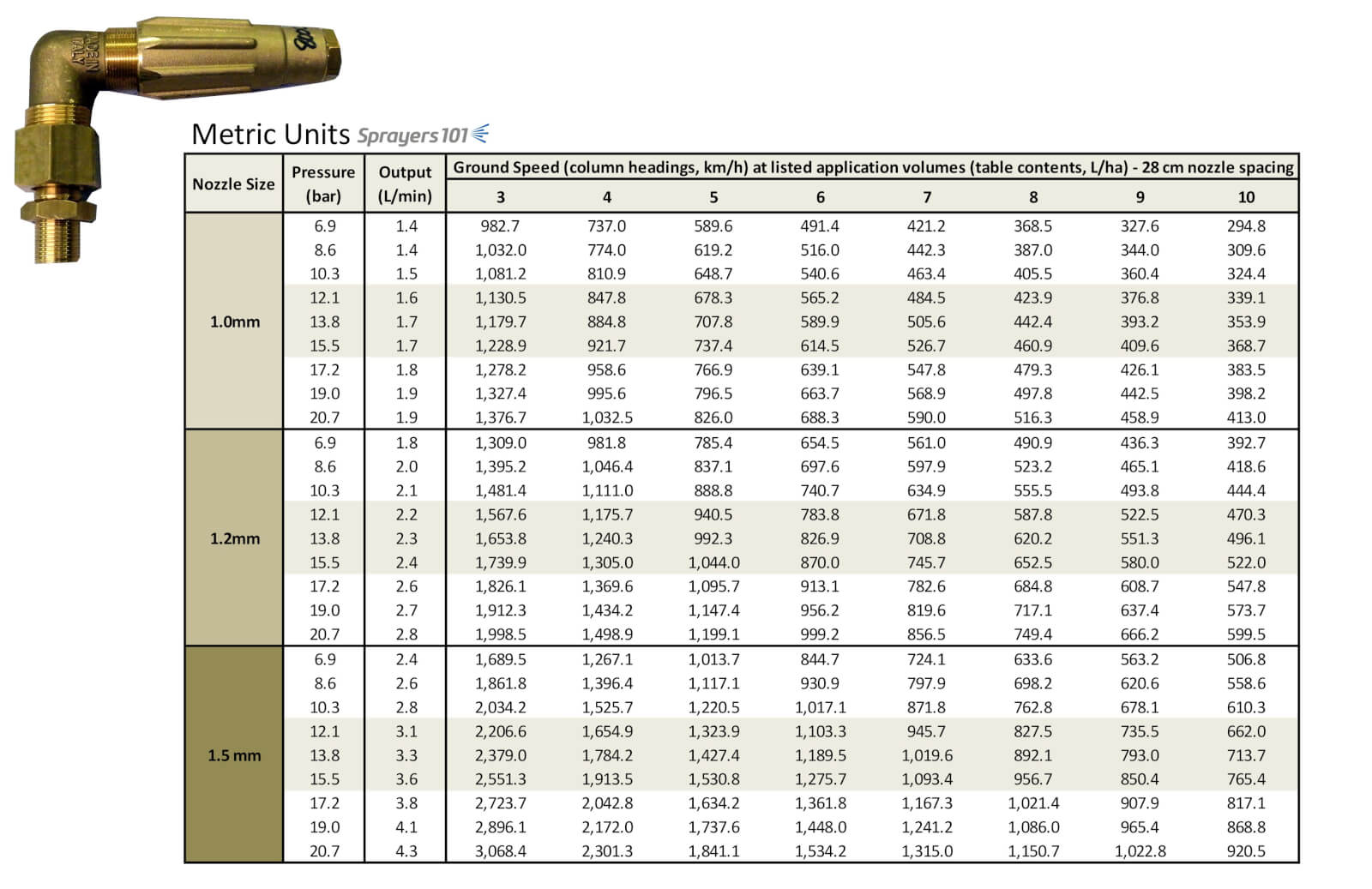
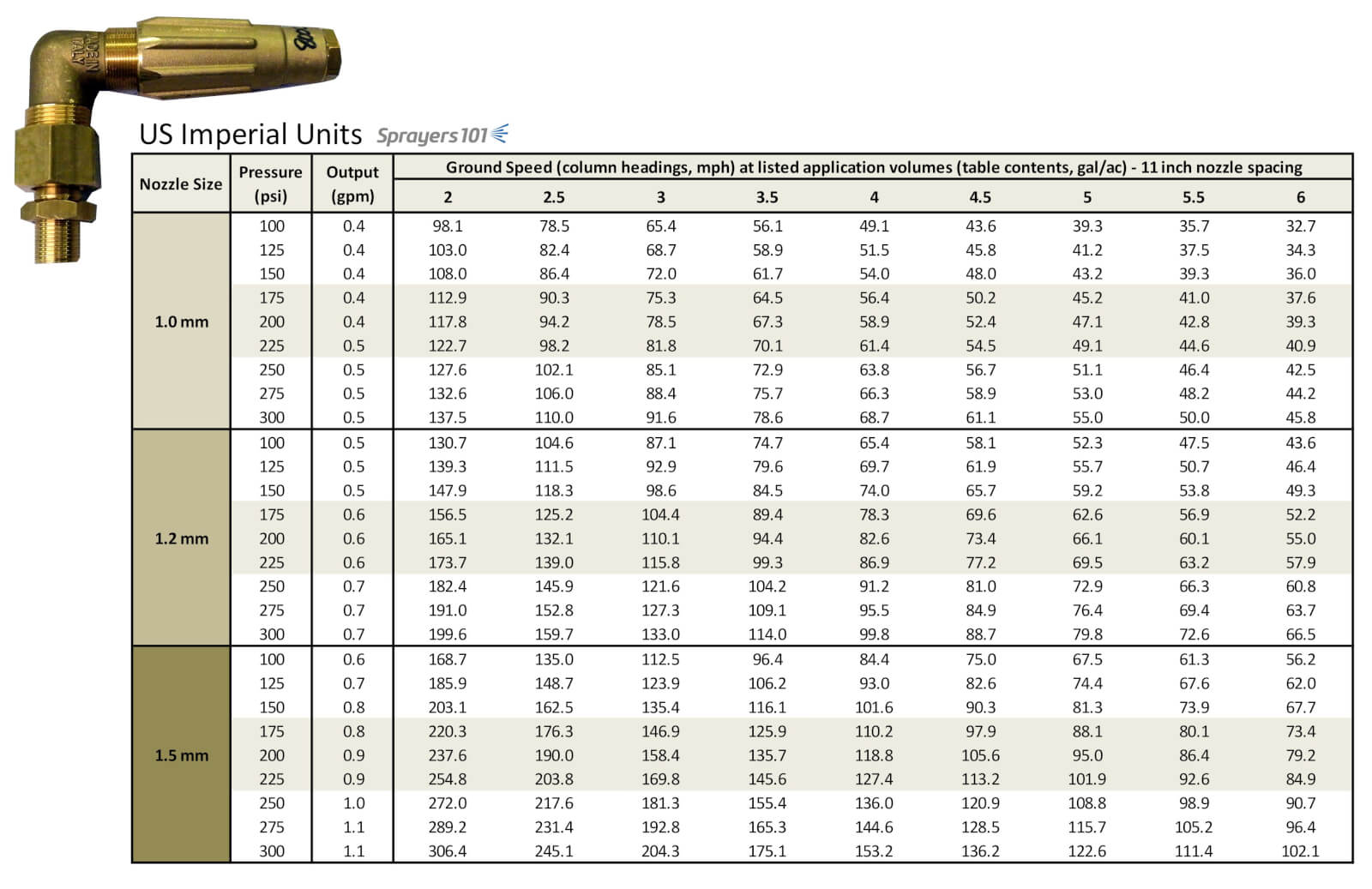
    The older style Arag microjets with 1.5 mm diameter discs have highly variable outputs. We developed tables listing their rates with the mixing valve handle set in two positions. They can be found here. We have also developed tables for the newer Arag nozzles for the 1.0, 1.2 and 1.5 mm discs based on 28 cm (11”) spacing. They are listed in Metric and U.S. Imperial.

    Download the tables here: Metric (or) U.S. Imperial
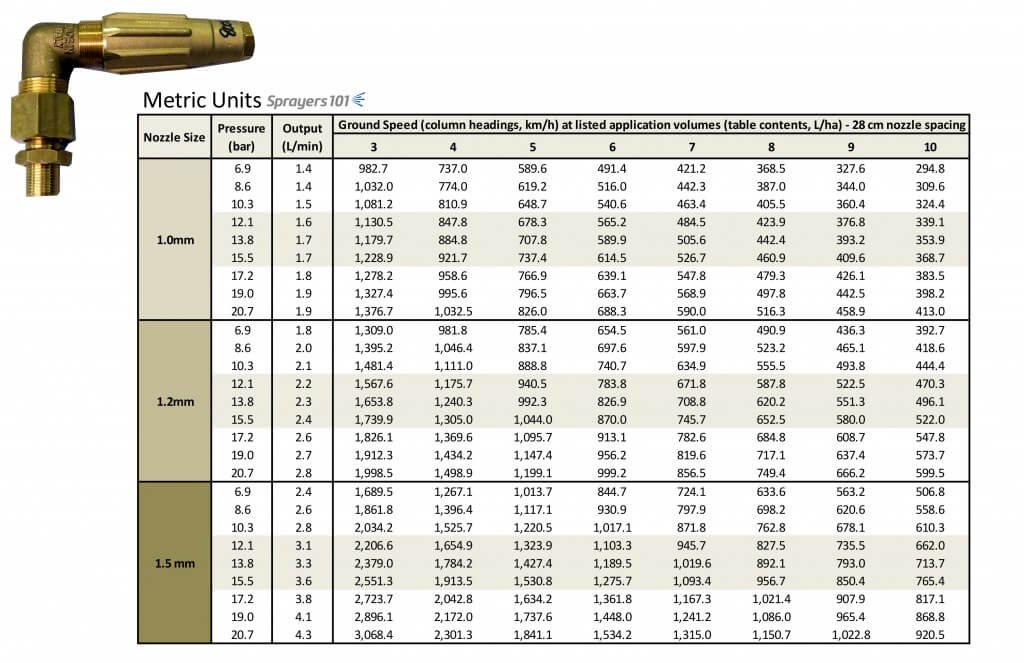
    ARAG Microjet rates (Metric)
    ARAG Microjet rates (Metric)
    ARAG Microjet rates (U.S. Imperial)
    ARAG Microjet rates (U.S. Imperial)

    Timed output test

    Park the clean sprayer and get the pressure up to the desired level. Using a calibration vessel, perform a timed output test to determine each nozzle rate. I prefer the SpotOn SC-4 and a length of 1” braided line to direct the spray into the vessel. You will get wet, so ensure the water is clean and/or wear appropriate PPE.
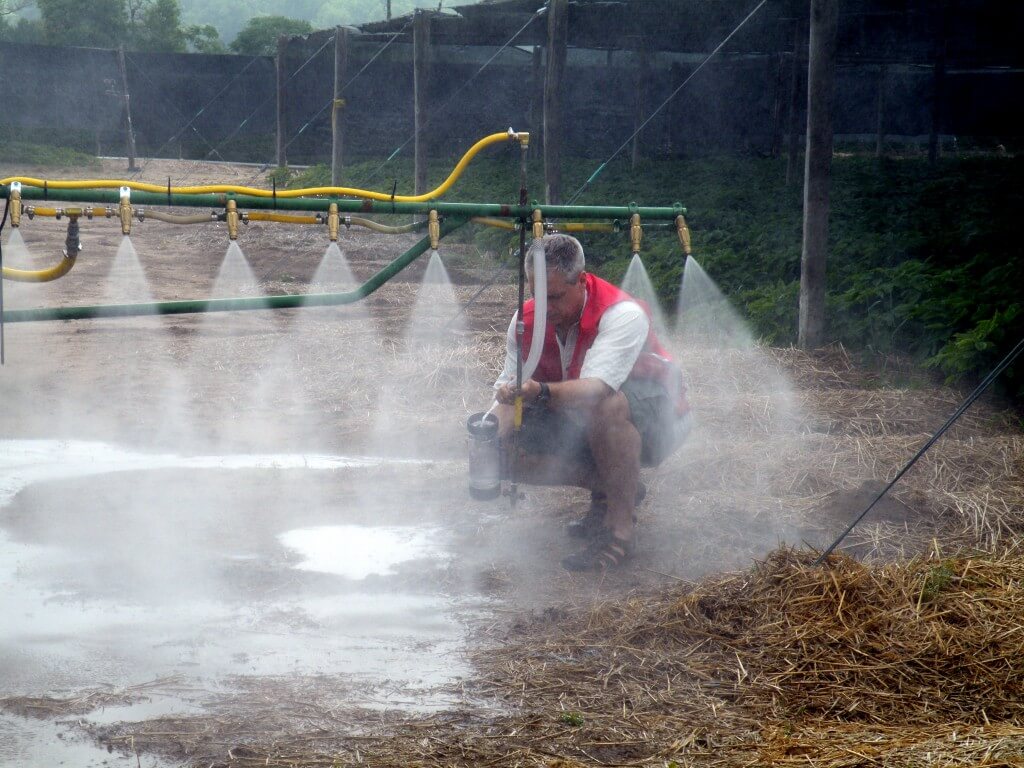
    Timed output test. Prepare to get very wet. Sprayer must be clean and PPE is a must.
    Timed output test. Prepare to get very wet. Unless sprayer is sparkling clean, like this one, PPE is a must.

    At 200 psi, we took readings from each microjet and found that while they were more consistent than the older model, there was still a lot of variation from tip to tip. This required us to turn the valve on the nozzle to get a more consistent output, then take another reading, and repeat until we liked what we saw. It became tricky to adjust the rate without reducing the hollow cone pattern to a solid stream because only a slight turn of the nozzle was required. Once we had it, we tightened the lock nut and moved to the next nozzle. Table 3 is a record of the procedure.

    While calibrating, we noticed some of the nozzles would suddenly appear plugged, or dense lines could be seen in the spray cone indicating something was wrong. We cleaned them to discover bits of plastic from the poly tank. I asked about strainers, but they are not available for the microjets. I asked about in-line filters, but they aren’t rated for 200 psi. Filling the tank with clean water is very important, but even more so with these nozzles.

    Table 3 – Calibrating the new Arag microjets

    Nozzle PositionRates in gpm (bold represents final rate)Nozzle PositionRates in gpm (bold represents final rate)
    10.97, 0.96, 0.93140.77, 0.92
    21.07, 1.07, 1.26, 0.9150.76, 0.8, 0.95
    31.1, 1.1, 1.1, 0.93160.97, 0.95
    40.73, 0.92170.73, 1.0, 1.07, 1.0, 0.98
    50.92, 0.92180.83, 0.94
    60.94190.77, 1.0, 0.99, 1.1, 1.24, 10.8, 0.93
    70.88200.77, 0.88
    80.92210.71, 0.95
    90.95220.77, 1.07, 1.04, 1.1, 1.27, 1.0
    100.90231.06, 0.97
    110.86240.77, 0.97
    120.76, 0.83, 1.0, 1.0, 1.2, 0.92250.68, 0.95
    130.77, 0.92
    Average output: 0.93 gpm, standard deviation of 0.03 gpm.

    Ground speed

    Once the nozzles were adjusted, we filled the tank ½ full and measured out 25 m in the bed. We would normally do 50 m, but the row was too short. The sprayer operator drove the course and we measured the time it took to travel the 25 m distance. Pass one took 18.5 seconds and pass two took 18.3 seconds. That’s an average of 18.4, which we then double so it works in the formula = 36.8 s.

    ( 50 × 3.6 ) ÷ 36.8 s = 4.9 km/h

    Adjusting the drop leg nozzles

    This sprayer had drops behind the wheels and two more to hang in the adjacent alleys. This is excellent because research has shown considerably improved coverage with directed spray from drop arms. In my mind, these are not optional – they are mandatory!
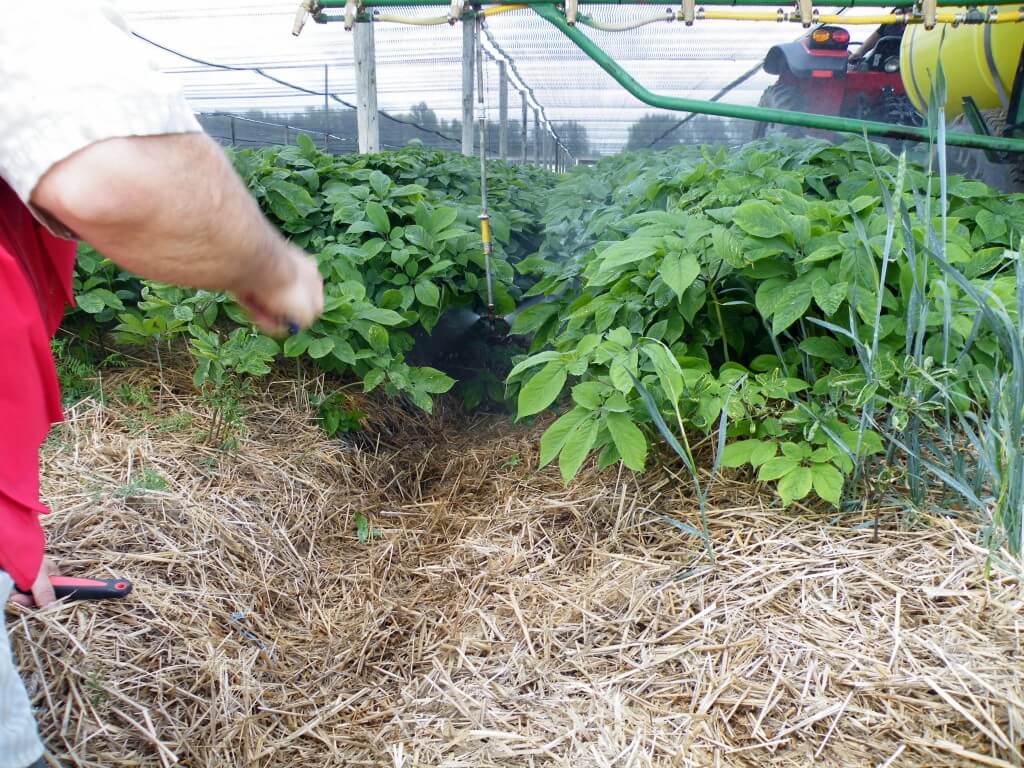
    Drop nozzles in the alleys.
    Drop nozzles in the alleys.

    We swapped out the hollow cones we found in those positions for full cone disc and core (D5-DC35). Full cones increase the number of droplets that will clear the raised bed and enter the canopy. When adjusting them, be sure to minimize the portion intercepting the bed, while minimizing the spray escaping up through the canopy. It’s a fine line.
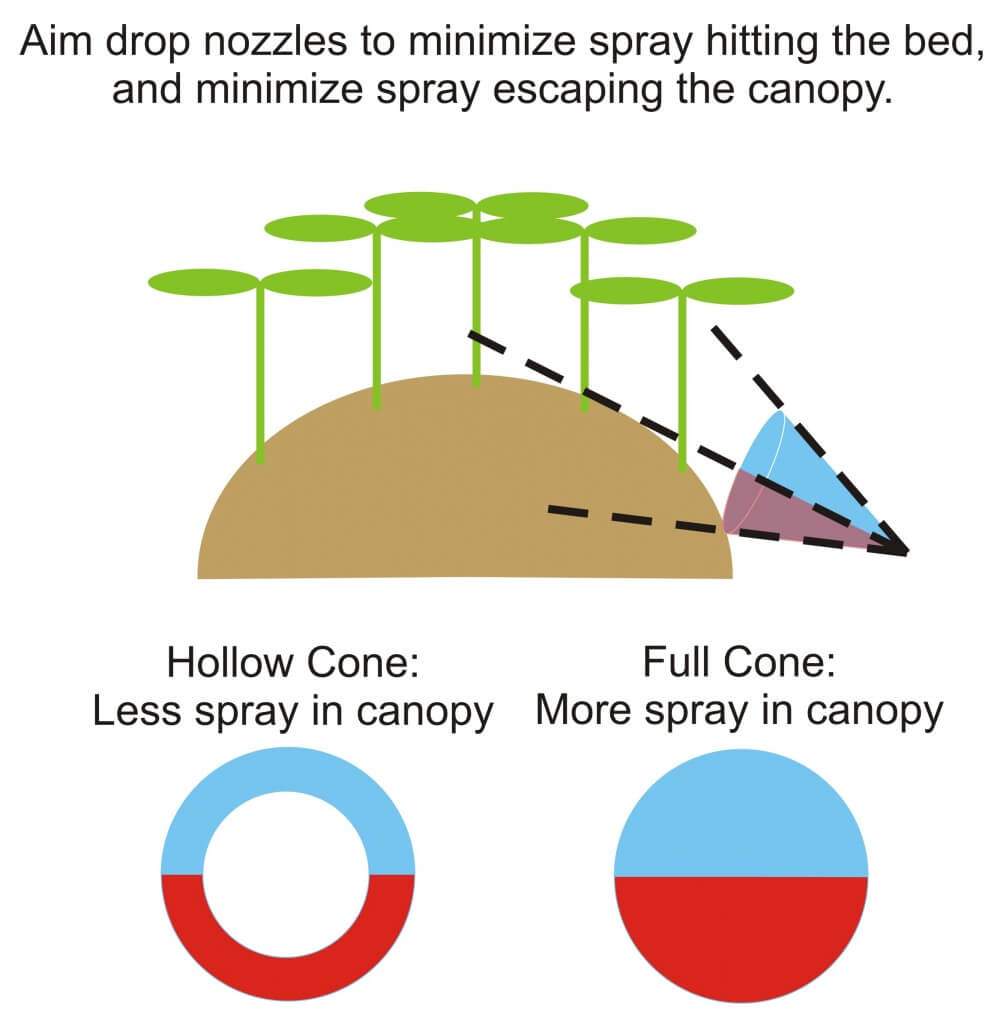
    Aiming drop arms in a ginseng garden.
    Aiming drop arms in a ginseng garden.

    Calculating sprayer output

    25 microjets at 200 psi = average of 0.93 gpm = 23.25 gpm
    8 × D5-DC35 at 200 psi = 1.4 gpm × 8 = 11.2 gpm
    That’s ~34.5 gpm for the boom.
    Ground speed was 4.9 k/hr or ~ 3mph.

    GPA = (GPM × 5,940) ÷ (mph ÷ nozzle spacing in inches)
    GPA = (34.5 gpm x 5,940) ÷ (3.0 mph × 11 inches)
    GPA = 204,940 ÷ 33
    62.1 GPA or about 580 L/ha.

    Diagnosing coverage

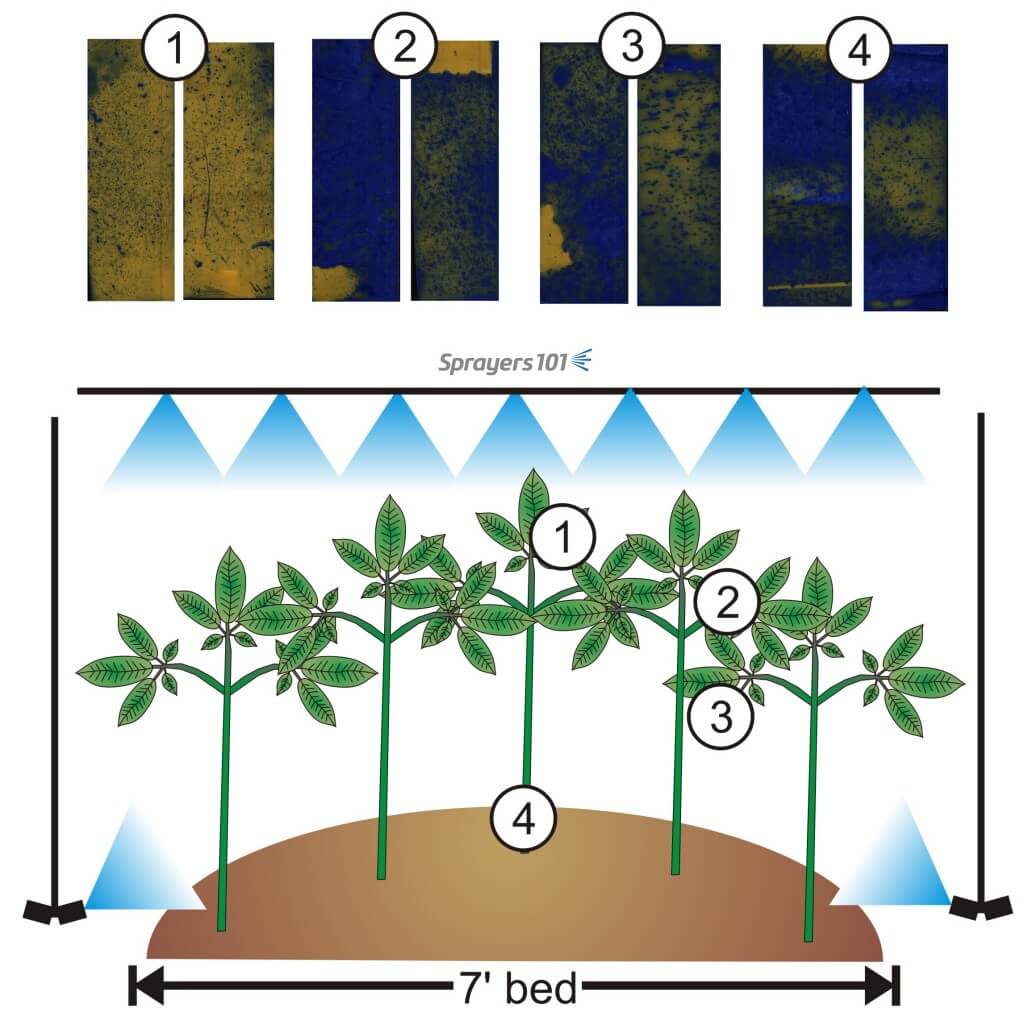
    Water sensitive paper, which turns from yellow to blue when contacted by moisture, was placed in the ginseng canopy. Two sets of papers were set out, with four papers in each set. The canopy was still wet with rain, which made placement difficult as the papers would accidentally contact water on the leaves and change colour prematurely.
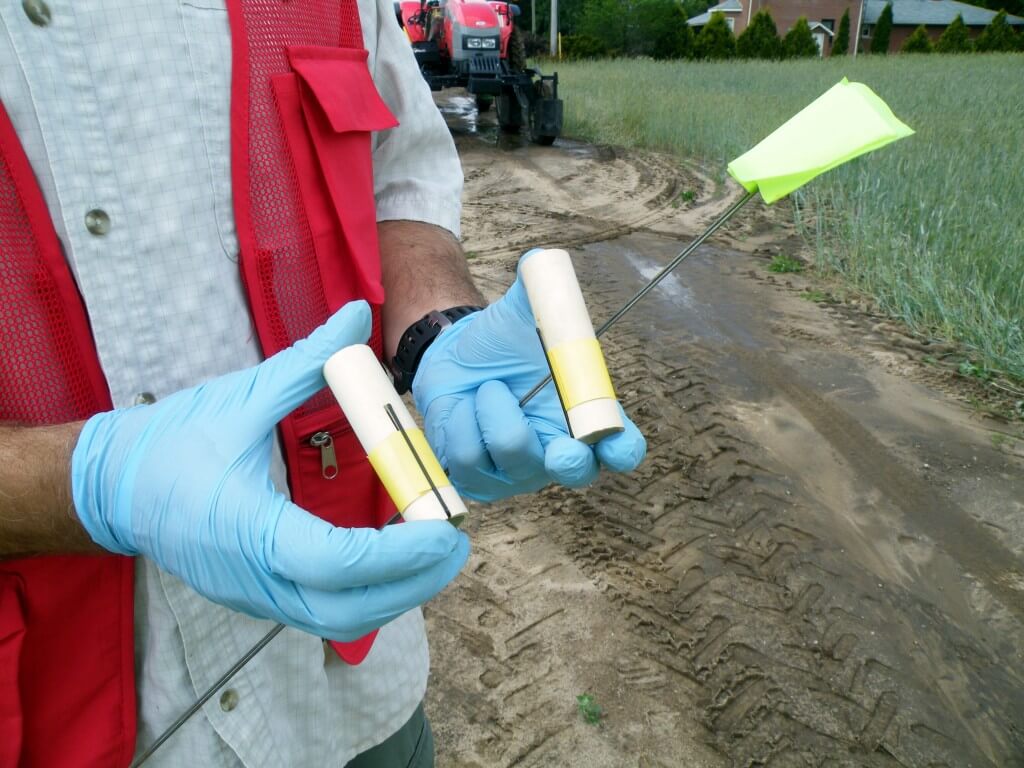
    Water-sensitive paper wrapped around tubes for panoramic coverage.
    Water-sensitive paper wrapped around tubes for panoramic coverage.
    Position#1Clipped face-down on the underside of leaves at the top of the canopy.
    Position#2Clipped face-up on the upper side of leaves in the middle of the canopy.
    Position#3Clipped face-down on the underside of leaves in the middle of the canopy.
    Position#4Wrapped around a plastic tube and threaded over a wire flag, located at the foot of the plant to give panoramic coverage at the root.

    The sprayer passed over the canopy spraying water, and papers were carefully retrieved, allowed to dry and scanned.
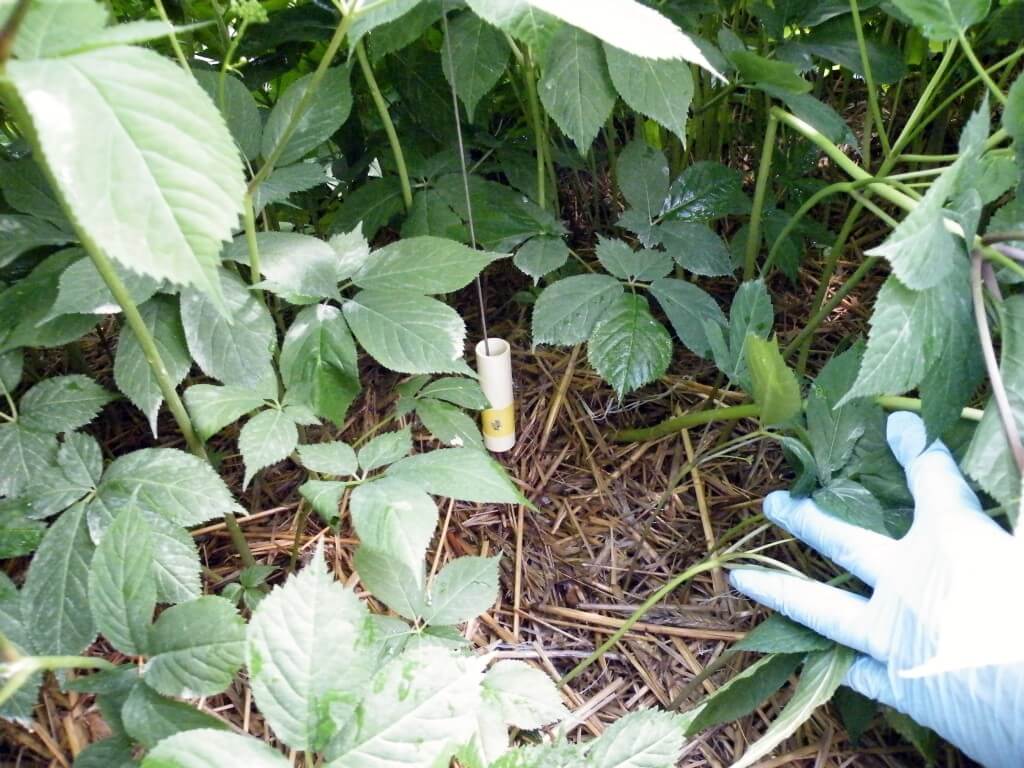
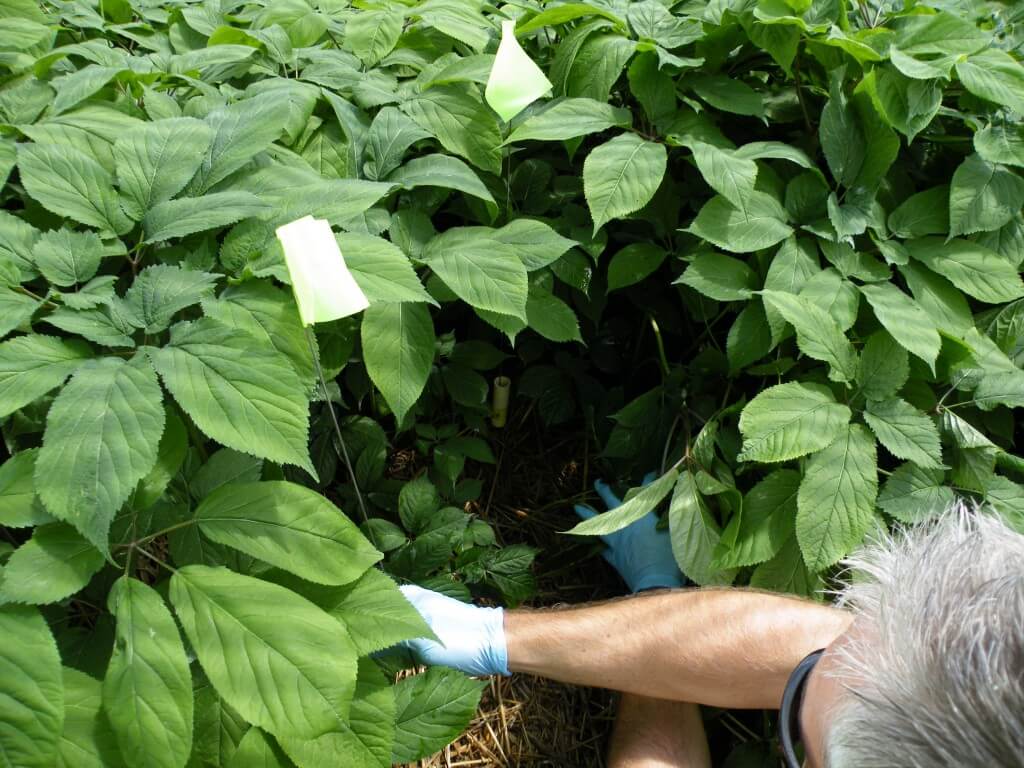
    Panoramic papers in situ.
    Panoramic papers in situ.
    Flags mark the locations of papers.
    Flags mark the locations of papers.

    Generally, there were no “misses” whatsoever. Position 1 showed excellent coverage, with no indication of run-off and a high droplet count with even distribution. This is ideal for foliar applications, and under-leaf coverage is notoriously difficult to achieve. Positions 2 through 4 showed excessive coverage, with the exception of one of the position 3 papers, which was still adequate.
    Example of coverage and paper locations in canopy.
    Example of coverage and paper locations in canopy.

    Next steps

    Ideally, the operator would drop the pressure by 20 psi increments, reducing output until coverage failed. It is important to note that the operating pressure must never approach the lower end of the nozzle’s recommended pressure range, or the spray quality will be compromised and so will coverage.

    Once the coverage is considered a failure, the operator would return to the lowest output that did a good job, and the sprayer is calibrated for that crop (at that stage of growth).

    Note that the calibration must be performed for each significantly different crop. With the exception of an early-season drench intended to contact the entire root, an emerging one year old garden would need a very different prescription than a four year old garden with a fully-developed canopy. Plus, the weather conditions will affect coverage, so do not calibrate in conditions you would not normally spray in. Hot and dry and windy conditions produce very different coverage compared to cool, humid and still conditions.

    Once the operator knows what each garden requires, they will be able to mix their tanks using the same concentration of carrier to formulated product as they normally use, but likely go further on the tank. It will take some practice before the operator knows how much spray mix is required to finish the job.
  • Spraying Ginseng with Arag Microjets

    Spraying Ginseng with Arag Microjets

    In June 2013 we ran a ginseng spraying workshop and we learned as much as the growers did. Ginseng is notoriously difficult to spray:

    • It is highly susceptible to pathogens given the high humidity and still conditions generally found under the shade structure.
    • It forms a solid ceiling of leaves that resist spray penetrating to the stem and crown below and makes under-leaf coverage very difficult to achieve.

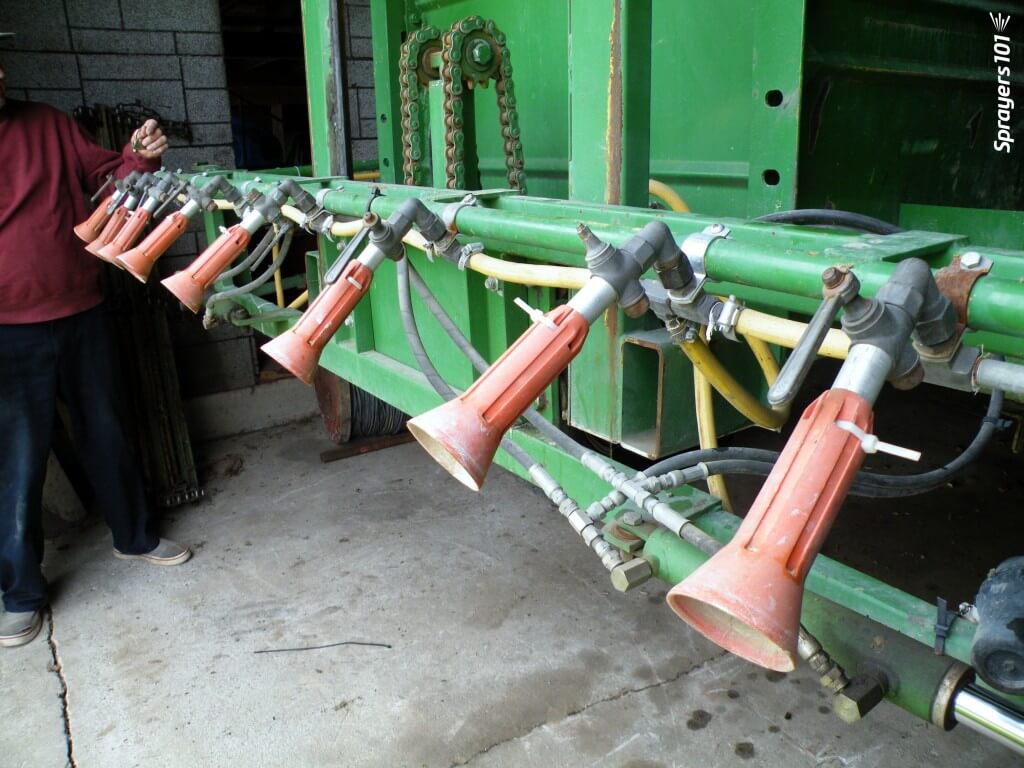
    Many growers have (wisely) walked away from the old Casotti sprayers, which have been shown to give erratic coverage at best. They have adopted the Arag Microjet system with it’s characteristic orange shields. The >$80.00 CAD price tag for each nozzle is due to the brass mixing valve and swivel joint, as well as import costs from Italy. Contrary to popular belief, it does not use air-assist, or air-induction – it is strictly hydraulic. It does tend to create a ‘wake’ of air movement at high pressure. This phenomenon is called air entrainment and it is caused by large droplets travelling at high speed.

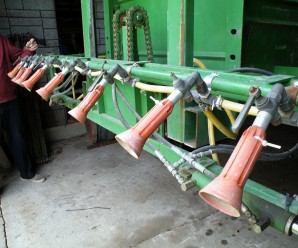
    Classic Arag microjet nozzles.
    Classic Arag microjet nozzles.

    This nozzle is essentially the business-end of a spray gun. The way it is used in ginseng it works more-or-less like a hollow cone disc-core assembly. This begs the question “Why not use the cheaper and more readily available ceramic disc-core?” We set out to compare the two options using water sensitive paper set within the canopy. These yellow, paper targets turn blue when sprayed, clearly showing spray coverage.

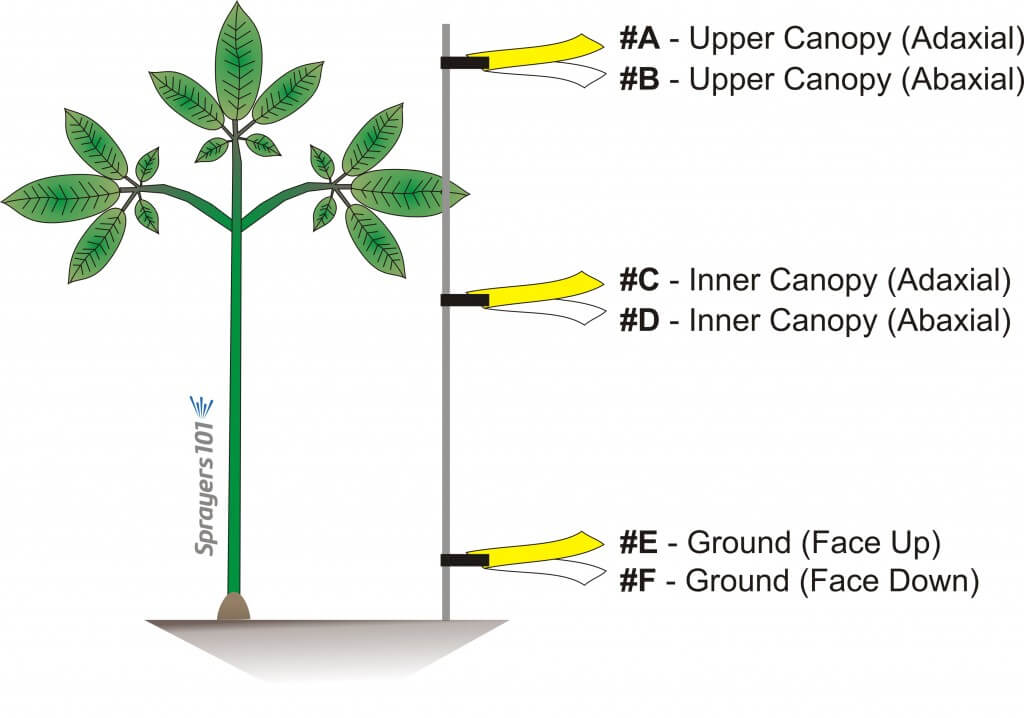
    Location of water-sensitive papers in the ginseng canopy.
    Location of water sensitive papers in the ginseng canopy.

    Determining rates

    The first step was to determine the output rate for each nozzle. Generally, nozzle manufacturers provide rate tables showing how much volume a nozzle emits by time (e.g. US gallons per minute) at a given pressure. Finding these tables for the 1.5 millimetre Arag Microjet proved difficult. When we finally found one, it was discovered the rates were established for 200 to 850 pounds per square inch. This is excessively high pressure for a typical boom sprayer, so tables had to be developed for lower pressures.

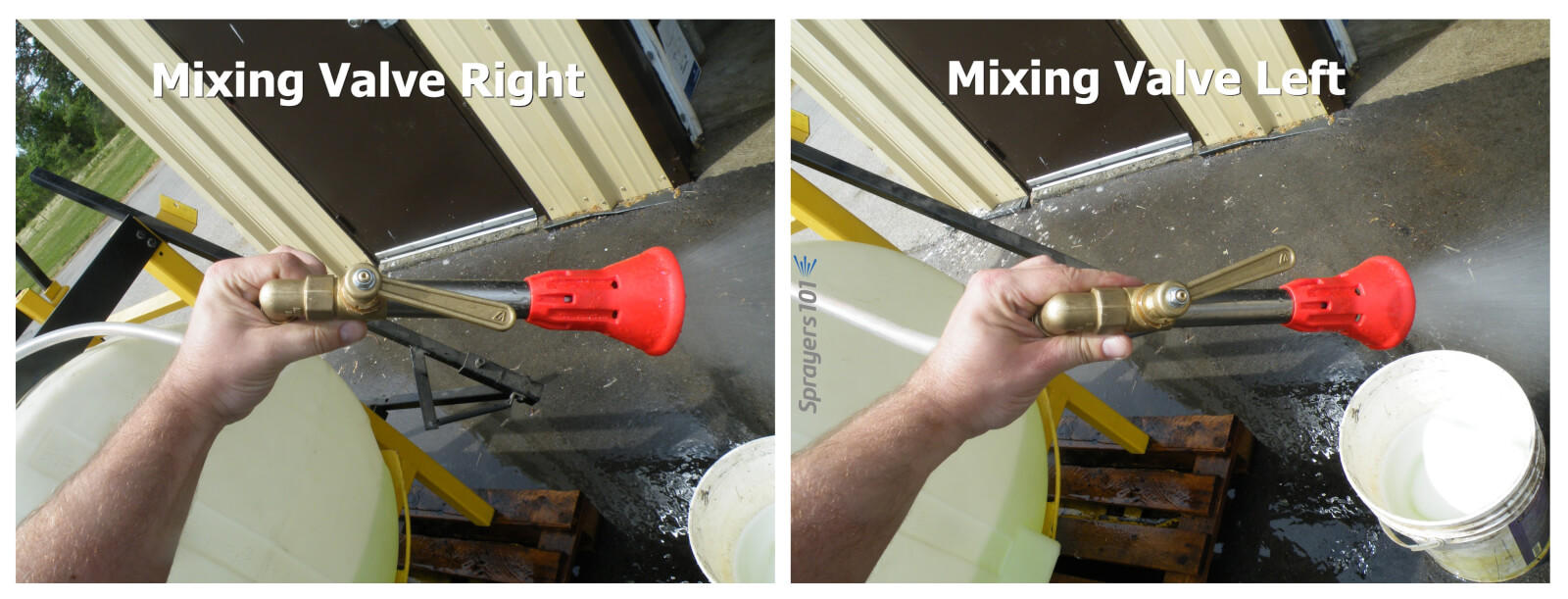
    Classic Arag microjets have a mixing valve that opens the spray up into a hollow cone, or collapses it into a tight stream. This also changes the rate. It can never be shut off completely, and it's hard to adjust consistently.
    Classic Arag microjets have a mixing valve that opens the spray up into a hollow cone (valve handle left or right), or collapses it into a tight stream (valve handle middle). The valve position also changes the rate. It can never be shut off completely, and it’s hard to adjust consistently.
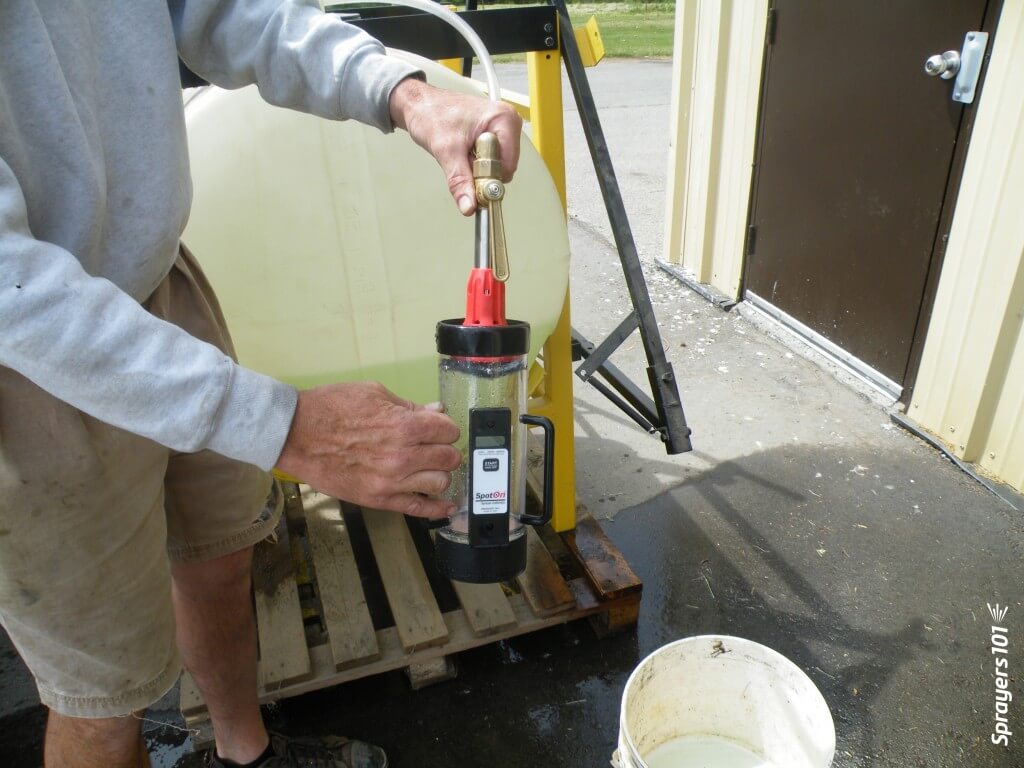
    Determining nozzle rate using the Innoquest Spot-On SC-4.
    Determining nozzle rate using the Innoquest Spot-On SC-4.

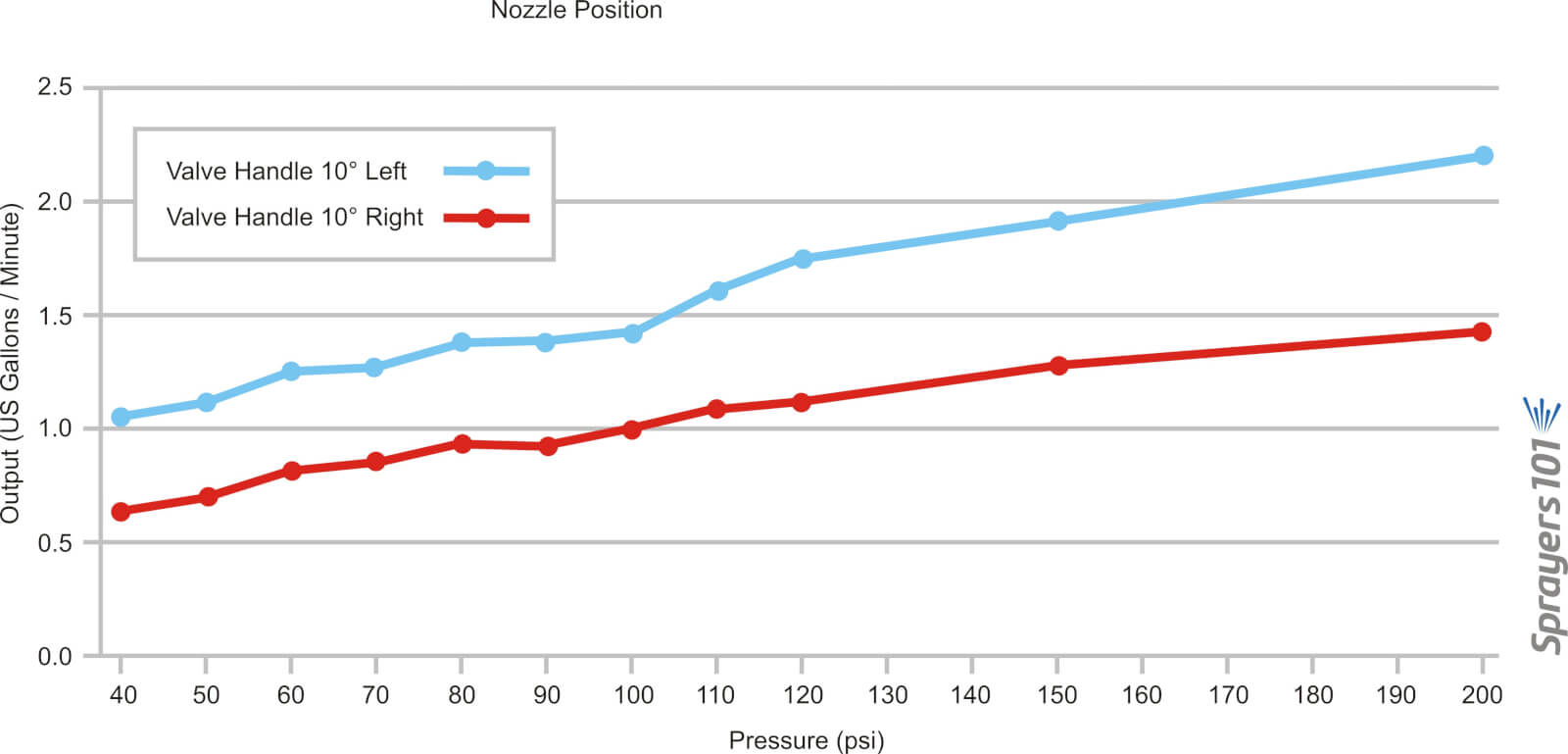
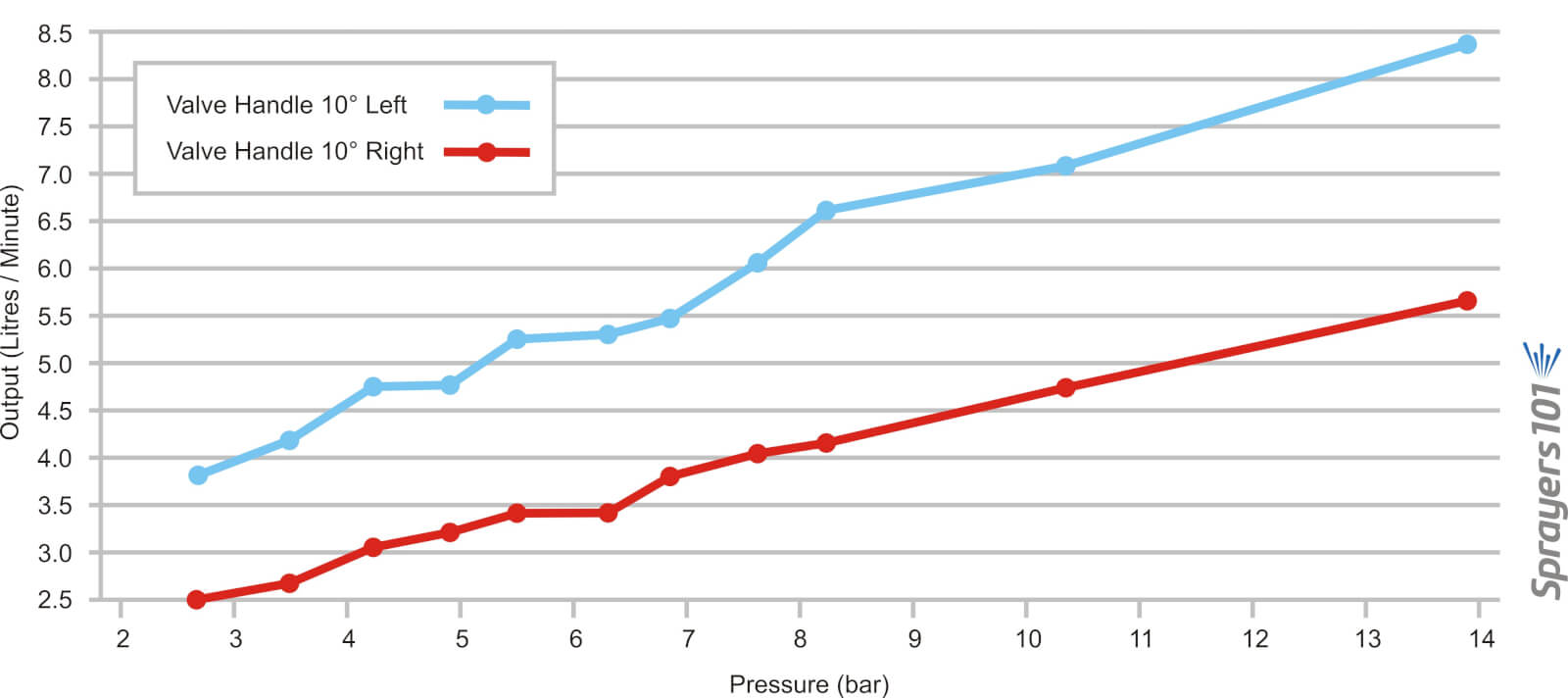
    Further, given the odd design of the mixing valve, it was determined that moving the handle ~10 degrees left of centre, or ~10 degrees right of centre, gave a difference of as much as 60%. The table below  shows the outputs for a 1.5 millimetre nozzle with the handle in both positions and the two graphs show the results… well… graphically. Outputs were determined using the Innoquest Spot-On SC-4, but the frothing effect created by the nozzles may have created minor errors. Each rate is the average of a minimum of three samples.

    Valve SettingPressure (psi)Avg Output (gpm)Pressure (bar)Avg Output (L/min)
    10 degrees left401.022.763.86
    10 degrees left501.13.454.16
    10 degrees left601.254.144.73
    10 degrees left701.254.834.73
    10 degrees left801.385.525.22
    10 degrees left901.46.215.3
    10 degrees left1001.456.895.49
    10 degrees left1101.67.586.06
    10 degrees left1201.758.276.62
    10 degrees left1501.8710.347.08
    10 degrees left2002.213.798.33
    10 degrees right400.652.762.46
    10 degrees right500.73.452.65
    10 degrees right600.84.143.03
    10 degrees right700.854.833.22
    10 degrees right800.95.523.41
    10 degrees right900.96.213.41
    10 degrees right10016.893.79
    10 degrees right1101.077.584.05
    10 degrees right1201.18.274.16
    10 degrees right1501.2510.344.73
    10 degrees right2001.3713.795.19
    Average 1.5 mm ARAG Microjet output at a range of pressures and two valve settings in US Imperial units.
    Average 1.5 mm ARAG Microjet output at a range of pressures and two valve settings in US Imperial units.
    Average 1.5 mm ARAG Microjet output at a range of pressures and two valve settings in Metric units.
    Average 1.5 mm ARAG Microjet output at a range of pressures and two valve settings in Metric units.

    Comparing nozzles

    Using the grower’s typical ground speed of 5 km/h (~3 mph) and operating pressure of 6.9 bar (100 psi), we found four TeeJet disc-core combinations that emitted a hollow cone pattern and approximately the same output as the Arag Microjets. The five nozzles sets tested were:

    1. ARAG Microjet® 1.5 mm = ~0.95 US g/min avg at 100 psi
    2. TeeJet® D8-DC25= 0.97 US g/min at 100 psi= ~97° cone
    3. TeeJet®D7-DC45= 0.97 US g/min at 100 psi= ~81° cone
    4. TeeJet®D4-DC46= 0.88 US g/min at 100 psi= ~33° cone
    5. TeeJet®D6-DC45= 0.93 US g/min at 100 psi= ~81° cone

    We did not use nozzle drop hoses (aka drop arms or hose drops) because it has already been firmly established that they are absolutely required to achieve under leaf coverage See OMAFRA factsheet 10-079 and this article.

    Observations

    While there were some complications with setting up the papers for the demo, we observed the following:

    1. The output of each Microjet nozzle can be as much as 50% more or less than expected without being visually detectable and output for each nozzle must be confirmed before spraying. Therefore, outputs should be confirmed before every application.
    2. Microjets at 100 psi emitting ~890 L/ha (~95 US gallons per acre) gave satisfactory coverage on all upward facing targets, but unsatisfactory under-leaf coverage. This has been demonstrated many times before.
    3. The TeeJet D7-DC45 combination emitting a similar rate gave satisfactory coverage on all upward facing targets, but unsatisfactory under-leaf coverage. They may be a viable alternative to the Microjets.
    4. Nozzle drops are advised to achieve under-leaf coverage.

    The demo also raised some questions:

    1. Did the TeeJet disc-core push the canopy apart as much as the Microjet? The audience noticed there was some leaf-shadowing where the cards did not get complete coverage using disc-core. This might have been coincidence, or it may not have. This question will be addressed in a research trial next season, but for now, the D7-DC45 appeared to give similar coverage to the Microjet.
    2. Can nozzle drops be avoided if pressure is raised to 27.5 bar (400 psi)? Thanks to one grower trying this experiment in his garden after the demo, we saw some under-leaf coverage is possible at such high pressures, but this occurred at the cost of a lot of noise, diesel fuel and considerable wear on the ceramic Microjet discs. The grower tested these tips and discovered they needed replacement after only two years of use. Nozzle drops are cheaper, easier and result in considerably more spray in the under leaf positions.
    3. We saw what minimal and excessive foliar coverage looked like, and determined how much variability there was from one nozzle to another. A significant question was “How much spray can be saved when using a more accurate application?” and the answer is yet to be determined, but could be well in excess of 10% of the typical spray volume. Given that this crop can be sprayed more than 100 times over it’s 3 or four years before harvest, this represents significant savings in pesticides and refill time.

    Additional – Newer ARAG Microjet Design

    Since this work was performed, growers have been exploring a newer option from ARAG.

    They are an improvement over the older version insofar as they are more easily calibrated and held at a given rate thanks to a lock nut. They still employ a 1.5 mm diameter ceramic disc, but this can be changed for a 1.0 or 1.2 quite easily. They are still somewhat finicky when trying to set a consistent spray quality and rate from nozzle to nozzle, but are better than the mixing-valve option.

    Learn more in this article.

    Custom-made ginseng sprayer. A standard design.
    Custom-made ginseng sprayer. A standard design with newer, cheaper and easier-to-use ARAG microjets.

    Special thanks to Syngenta Canada for providing lunch, to C&R Atkinson Farms Ltd. for hosting, to TeeJet for supplying the disc-cores and water-sensitive papers, and to Dr. Sean Westerveld, Dr. Melanie Filotas and OMAFRA summer student Megan Leedham for contributing to the workshop.

  • Novel Ginseng Boom Design

    Novel Ginseng Boom Design

    In 2013 we ran a sprayer coverage demonstration in a ginseng garden in Norfolk County, Ontario. The goal was to encourage growers to reconsider their spray operation with an eye to coverage. We performed a down-and-dirty comparison between simple disc-core nozzles and the considerably more expensive Arag Microjets. Opinions were mixed, but we were confident the humble disc-core could do the job.

    One grower took the day to heart.

    Having experienced Alternaria infection (likely due to frost damage) in the outer rows, he decided to buy a few packages of water sensitive paper and put his spray boom to the test. Multiple ground speeds, nozzle choices, pressures, spray volumes and even nozzle orientations were tested. This led him to what we will call “ideal coverage” from what may be the perfect ginseng boom.

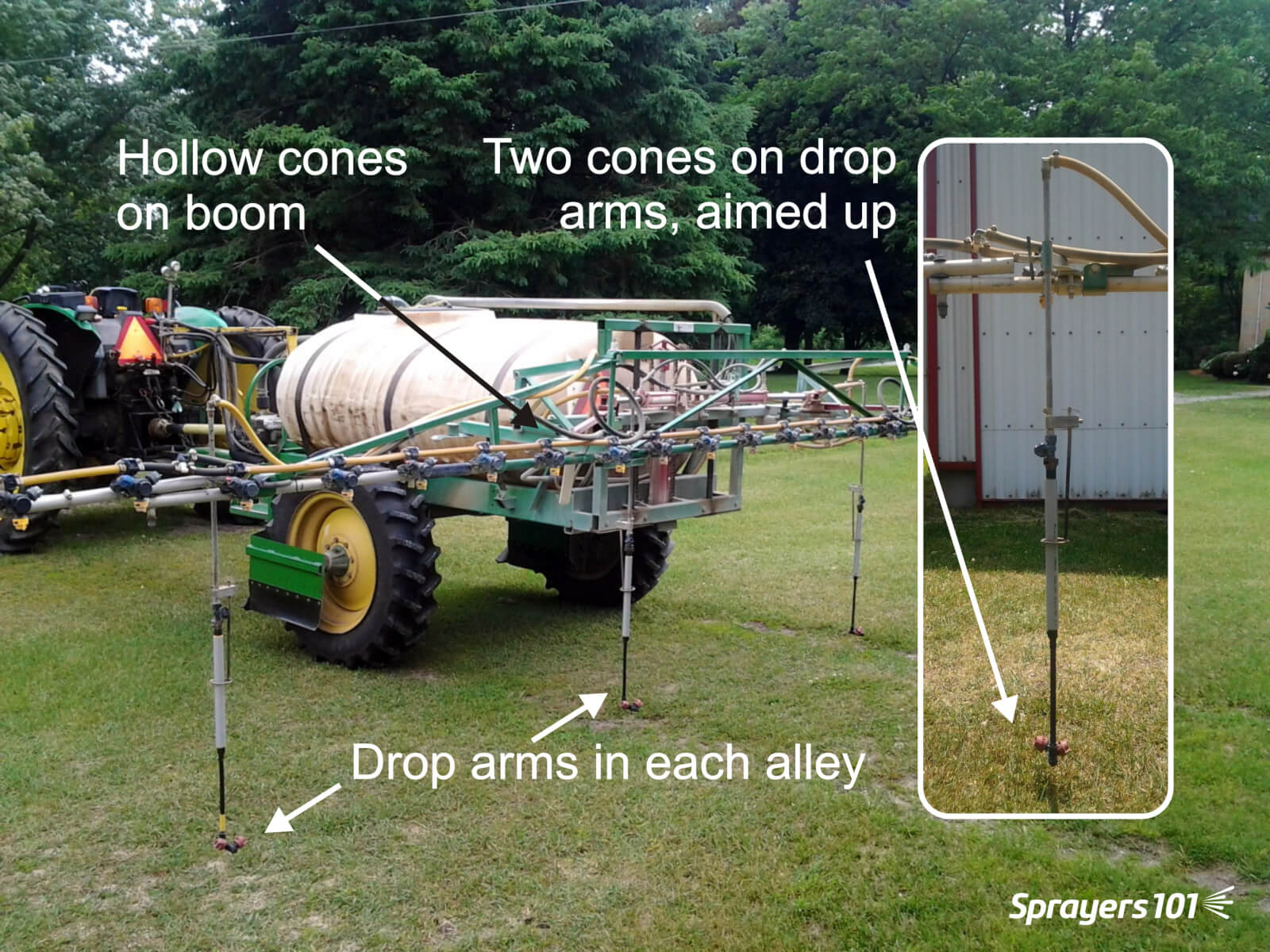
    Possibly the “perfect” ginseng spray boom. 25 hollow cones and four drop arms sporting 2 full cones apiece.
    Possibly the “perfect” ginseng spray boom. 25 hollow cones and four drop arms sporting 2 full cones apiece.

    On June 15th, the temperature was about 22 °C, winds were light and humidity was about 40%. The nozzle arrangement was 24 D4-45’s (hollow cones) on the horizontal booms, spaced every 50 cm (20 inches). The grower built four drop arms, hung over each alley (not just behind the wheels) with twin bodies that each held two D5-35’s (full cones), for a total of eight dropped nozzles.

    His output was ~1,000 L/ha (115 US gallons per acre) and he sprayed at ~14 bars (200 psi) and he was travelling at ~7.2 kilometers per hour (4.5 miles per hour).

    Compared to traditional methods, that’s low pressure and low volume for ginseng. The ground speed was reasonable given the art of negotiating a sprayer under a shade structure. Collectively, this is a savings in fuel, water and pesticide.

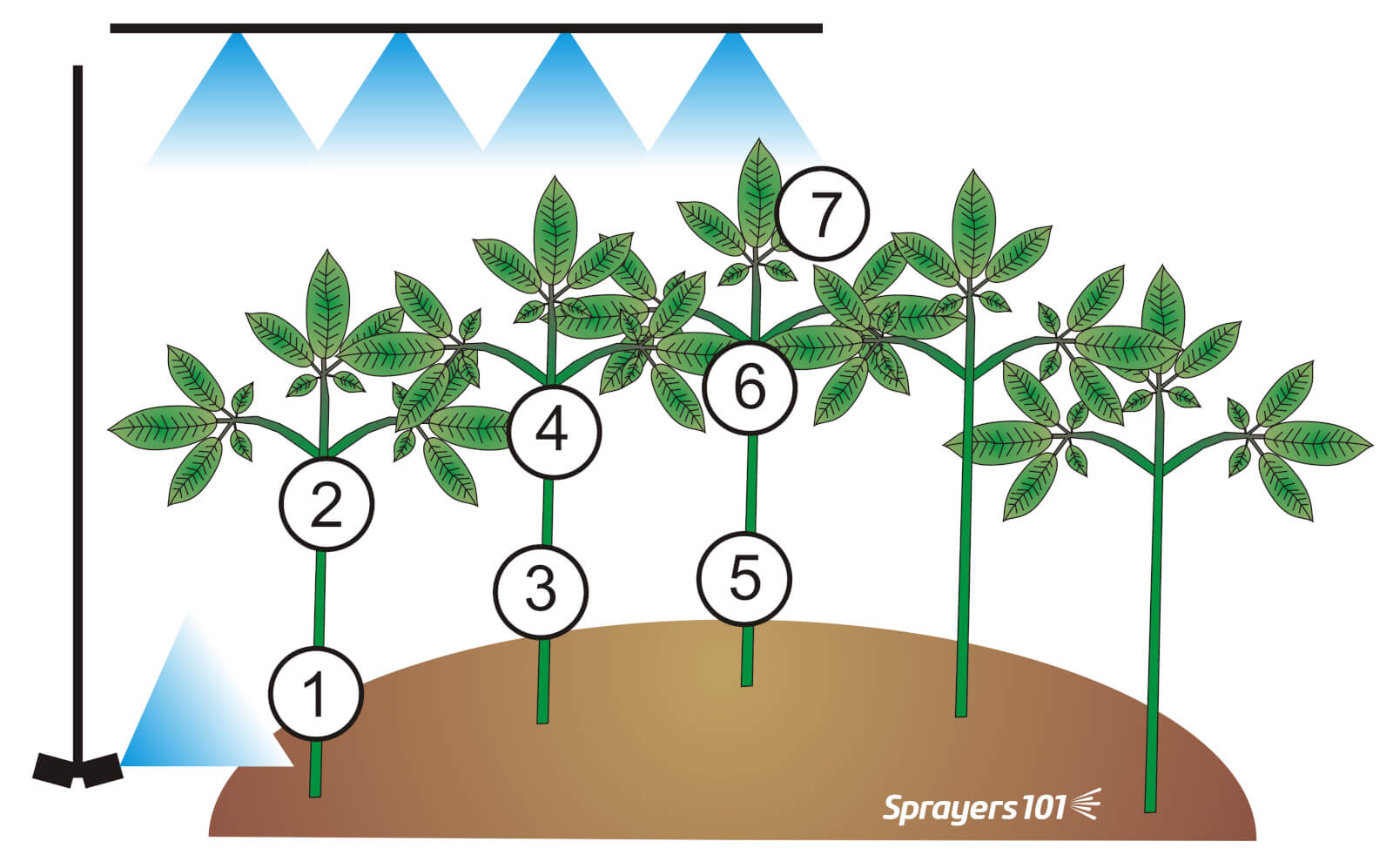
    Positions for water-sensitive papers.
    Positions for water sensitive papers.

    Water sensitive papers were placed in seven positions (see image below) in a three-year old garden. In each position, the papers were folded so the paper wrapped around the stems and could show coverage facing each alley. They were placed on the stems just above the ground and just below the canopy on three plants. The seventh card was folded over the uppermost leaf, to show coverage on the adaxial (top), and abaxial (underside) of the leaf.

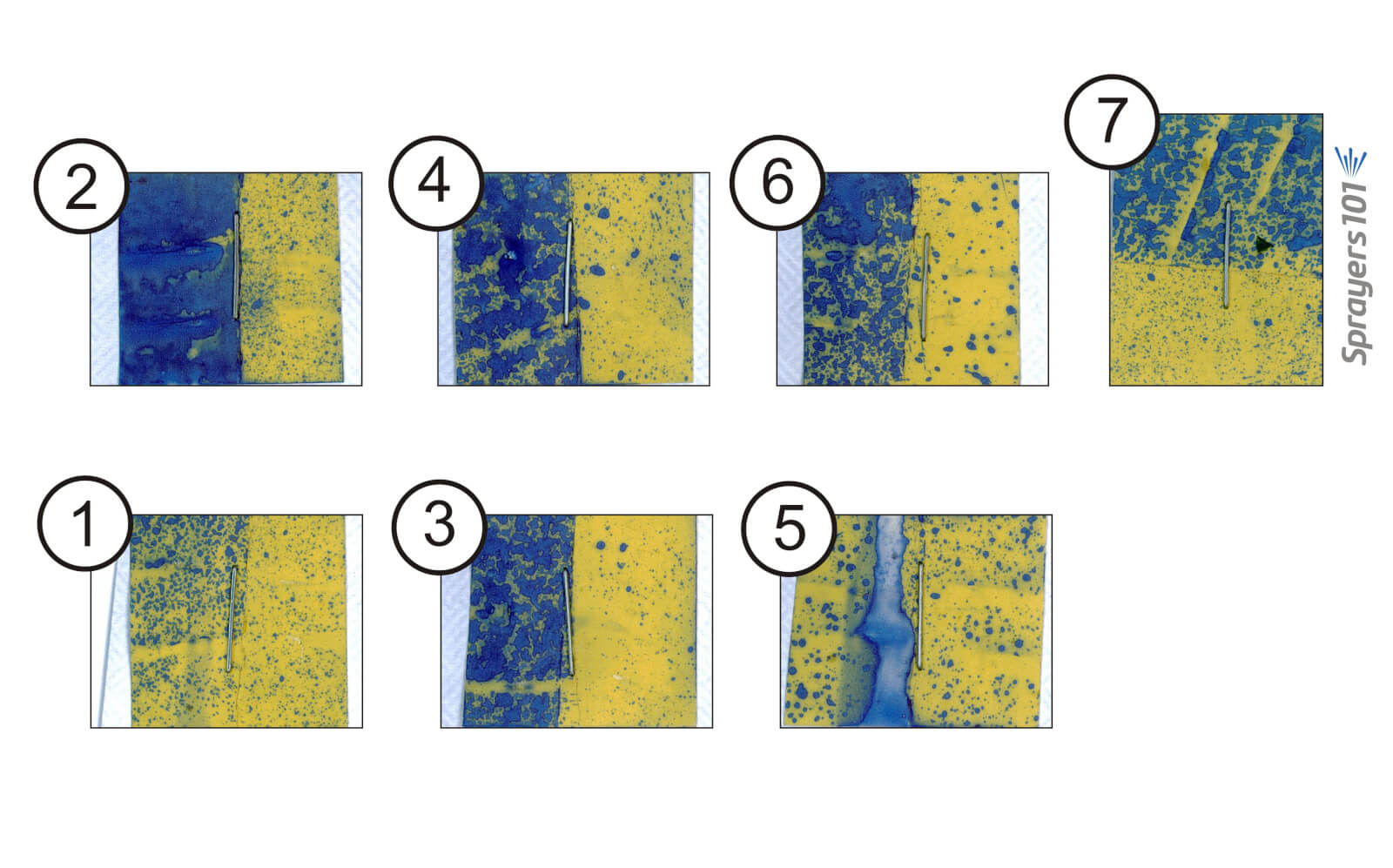
    Water-sensitive papers corresponding to positions in Figure 2. Cards were folded around the stems to face each alley (Cards 1-6) and around the top leaf for surface and underleaf coverage (Card 7). There are some drenches, but no misses.
    Water sensitive papers corresponding to the numbered positions in the earlier illustration. Cards were folded around the stems to face each alley (Cards 1-6) and around the top leaf for surface and under-leaf coverage (Card 7). There are some drenches, but no misses.

    The coverage was excellent. A completely blue card represents a drench, which isn’t necessary but can be difficult to avoid when trying to spray all surfaces in a dense canopy. The rest of the papers show a high droplet density which tends to lead to an effective application. Ideally, hope to see 10-15% coverage and >85 droplets per cm2. This is a difficult or even impossible prospect for abaxial coverage, but we achieved it (note the lower half of card 7).

    The trick, you ask? The full cones on the drop arms are aimed so the bottom of the cone is parallel with the ground (essentially, aimed up about 30°). That creates a cloud of spray moving under the canopy, improving the odds of contact on all surfaces. It is important to not spray the cone into the ground or the raised mound, and to spray in from both sides.

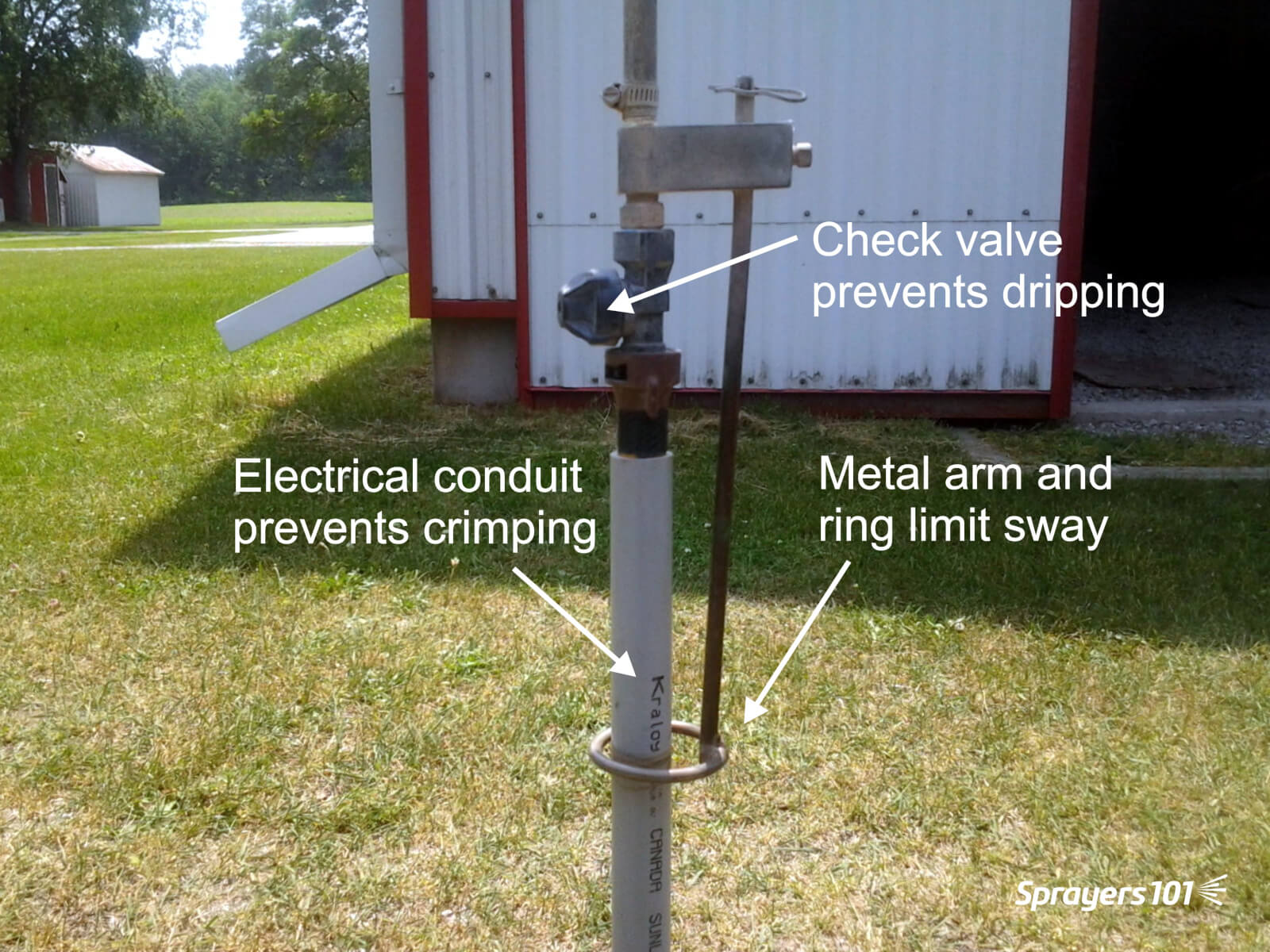
    The improved drop arm
    The improved drop arm

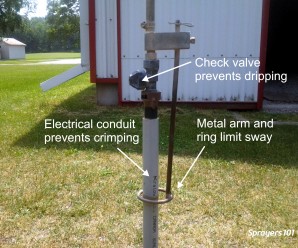
    The drops themselves have been modified so they are flexible enough to move through an overgrown 3rd or 4th year garden (yes, there will be some leaf damage), but are also stiff enough not to sway. This was accomplished by sliding a sheath of electrical conduit over the drop arm and using a metal stabilizing arm that terminates in a ring around the conduit.

    With the right timing and product choice this method of spraying will be hard to beat. And it’s cheap! It’s going to save fuel and wear because of lower pressures, and save spray mix because he can go a lot farther on a tank spraying only 1,000 L/ha.

    For more information, check out the OMAFA research article describing the original research that set us on the path of drop leg technology.

    Special thanks to Richard Klosler of Michael Klosler Farms Ltd. for sharing his great boom design.