Tag: pesticide

  • Mode of Action and Spray Quality

    Mode of Action and Spray Quality

    The decision on which application method is best for herbicides boils down to two main factors: (a) target type and (b) mode of action. In general, it’s easier for sprays to stick to broadleaf plants on account of their comparatively larger leaf size and better wettability compared to grassy plants. There are exceptions, of course – at the cotyledon stage, broadleaf plants can be very small and a finer spray with tighter droplet spacing may be needed. Water sensitive paper is a very useful tool to make that assessment. Imagine if a tiny cotyledon could fit between deposits – that could be a miss!

    Some weeds are also more difficult to wet, and those may also need a finer spray or a better surfactant for proper leaf contact. An easy test is to apply plain water to the leaf with a spray bottle. If the water beads off or the droplets remain perched on top in discrete spheres, the surface is considered hard to wet. Most grassy weeds are hard to wet, while most broadleaf weeds are easy to wet.

    Grassy weeds are an especially difficult target because they have smaller, more vertically oriented leaves, and almost without exception are more difficult to wet than broadleaf species. All these factors call for finer sprays for effective targeting and spray retention.

    Broadleaf weeds usually have more horizontally oriented leaves which also happen to be larger. As a result, they can intercept larger droplets quite efficiently.

    There are about thirty mode of action (MOA) groups among the herbicides with about ten accounting for the majority in Canadian prairie agriculture. It’s probably an over-simplification to categorize them into just two groups – systemic and contact.  But that grouping goes a long way to making an application decision.

    Contact products (MOA Group 5, 6, 10, 14, 22, 27) must form a deposit that provides good coverage. Good coverage is an ambiguous term that basically means that droplets need to be closely spaced and cover a significant proportion of the surface area because their physiological effects occur under the droplet, and don’t spread far from there. One way to generate more droplets is to reduce droplet diameter, another is to add more water. A reasonable combination of both is ideal because simply making droplets smaller creates issues with evaporation and drift.

    Systemic products (MOA Group 1, 2, 4, 9) will translocate within the plant to their site of action after uptake. As a result, coverage is less important as long as sufficient dose is presented to the plant. In practice, this means coarser sprays and/or less water may be acceptable.

    When two factors are combined, either in a tank mix or a weed spectrum, the more limiting factor rules. Application of a tank mix or product that is active on both broadleaf and grass plants will be governed by the limitation placed on grass targets. A tank mix comprised of both systemic and contact products is governed by the limitations placed on contact products.

    A factor we should also consider is soil activity and the presence of residue. Studies have shown that soil-active products are relatively insensitive to droplet size. But if they have to travel through a layer of trash to get to the soil surface, more application volume is the best tool.

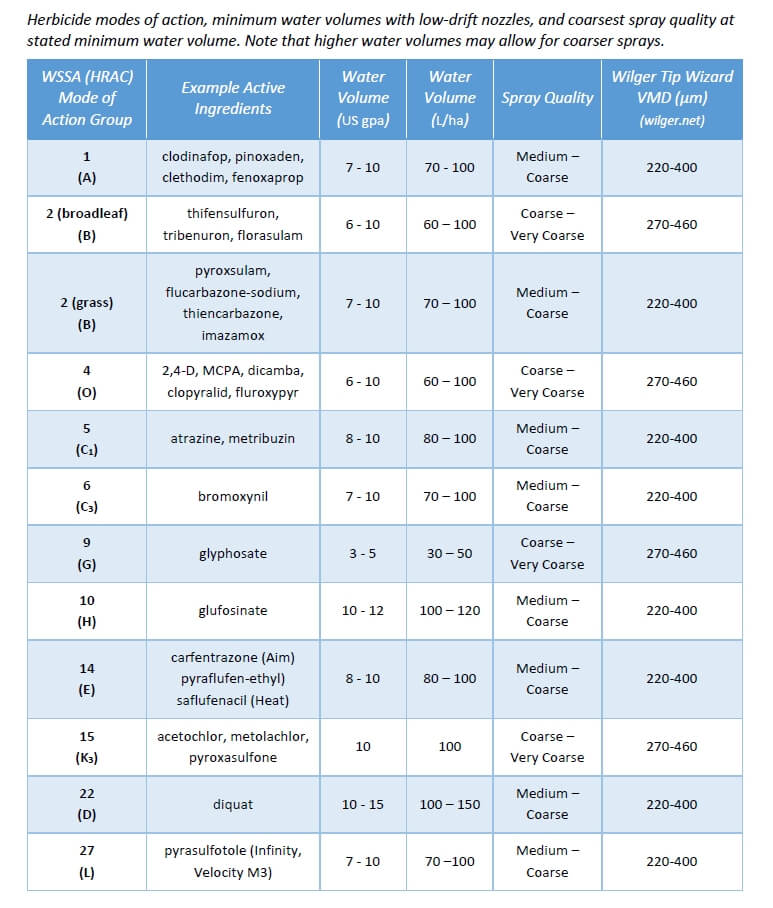
    Below are some recommended spray qualities and water volumes for use in Canada. The spray qualities listed in the table can be matched to a specific nozzle by referring to nozzle manufacturer catalogues, websites, or apps. Note that Wilger also offers traditional VMD measurements on their site, allowing users to be a bit more specific if necessary.

    Click here to download PDF

  • Spray Drift Basics

    Spray Drift Basics

    This article is intended as a basic overview of what pesticide spray drift is and how to avoid it. If you want a more in-depth study of the physics of drift, head over here.

    Defining Drift

    Pesticide spray drift is the aerial movement, and unintentional deposit, of pesticide outside the target area. Aside from being illegal, there are a lot of compelling reasons for avoiding it. Drift can be measured in financial loss associated with wasted pesticide, wasted time and reduced crop quality/quantity. Plus, if an application is unsuccessful, the operator may have to re-apply, incurring further cost. Pesticide drift increases any risk of damage to human health, susceptible plants (e.g. adjacent crops), non-target organisms (e.g. wild and domestic animals, pollinating insects, etc.), the environment, and property.

    We’ll limit our definitions to two forms of pesticide spray drift: Particle Drift and Vapour Drift.

    Physical Drift is the initial off-target movement of pesticide droplets. This occurs at the time of application, and it is generally on a scale of tens-of-metres. There is a secondary component to physical drift wherein particularly small droplets (or the evaporated remains of droplets) stay aloft for longer periods of time, during which they can move laterally with wind or vertically with thermals and turbulence.

    Vapour Drift is the off-target movement of pesticide vapours. This is a function of product chemistry (vapour pressure) and surface temperature. Rainfall (rewetting) can also affect vapour loss. If vapour gets caught up in a light breeze, moves downhill during a thermal inversion, or is redistributed in precipitation, movement is can be on a scale of kilometres.

    Managing Drift

    Drift cannot be entirely eliminated, but sprayer operators can greatly reduce the degree and impact. Much of what follows relates predominantly to particle drift from horizontal boom sprayers, but it’s never wrong to follow these best practices. Research and modeling have shown that the three biggest factors under the operator’s control are:

    • Apparent wind speed (i.e. the sum of wind speed and travel speed)
    • Boom height (i.e. release height)
    • Droplet size (i.e. nozzle spray quality)

    Therefore, the degree and impact of drift can be greatly reduced by following these guidelines:

    • Reduce the distance between nozzle and target. For a herbicide application, that means lowering the boom to the lowest practicable height. There are exceptions, but a good rule of thumb is that the boom height should be approximately the same as the nozzle spacing.
    • Use the coarsest effective droplet size, generally achieved through the use of drift reducing nozzles such as air induction.
    • Work with the weather.  Labels will specify appropriate weather conditions for spraying. Change sprayer settings to account for hot, dry and windy conditions or halt the job until conditions improve. Generally, avoid spraying when the weather is against you.
    • Identify any vulnerable nearby crop, landscape or environmental area. Choose a spray day when winds are blowing away from these sites. Explore voluntary watchdog sites like DriftWatch to see if there are registered sensitive crops nearby. Planting windbreaks or utilizing riparian areas can also help manage wind and provide localized downwind protection.
    • Observe labelled buffer zones and recommended sprayer settings. In Canada, using optimal sprayer settings in the right environmental conditions may reward the sprayer operator with buffer-zone reductions.
    • Work with your neighbours.  Let them know your intentions. For example, greenhouse growers need to be notified to close vents during morning spray times to avoid any possibility of drift.
    • Understand the potential damage off-target herbicides can cause and make this part of your planning when selecting a herbicide. Where possible, choose herbicides with a low risk of volatility. Avoid products like dicamba near susceptible crops (grapes, tomatoes, peppers, sweet potato, tobacco, IP soybeans, etc.) or greenhouses. While not necessarily volatile, other synthetic auxins such as 2,4-D are extremely damaging to horticultural crops at very, very low doses.
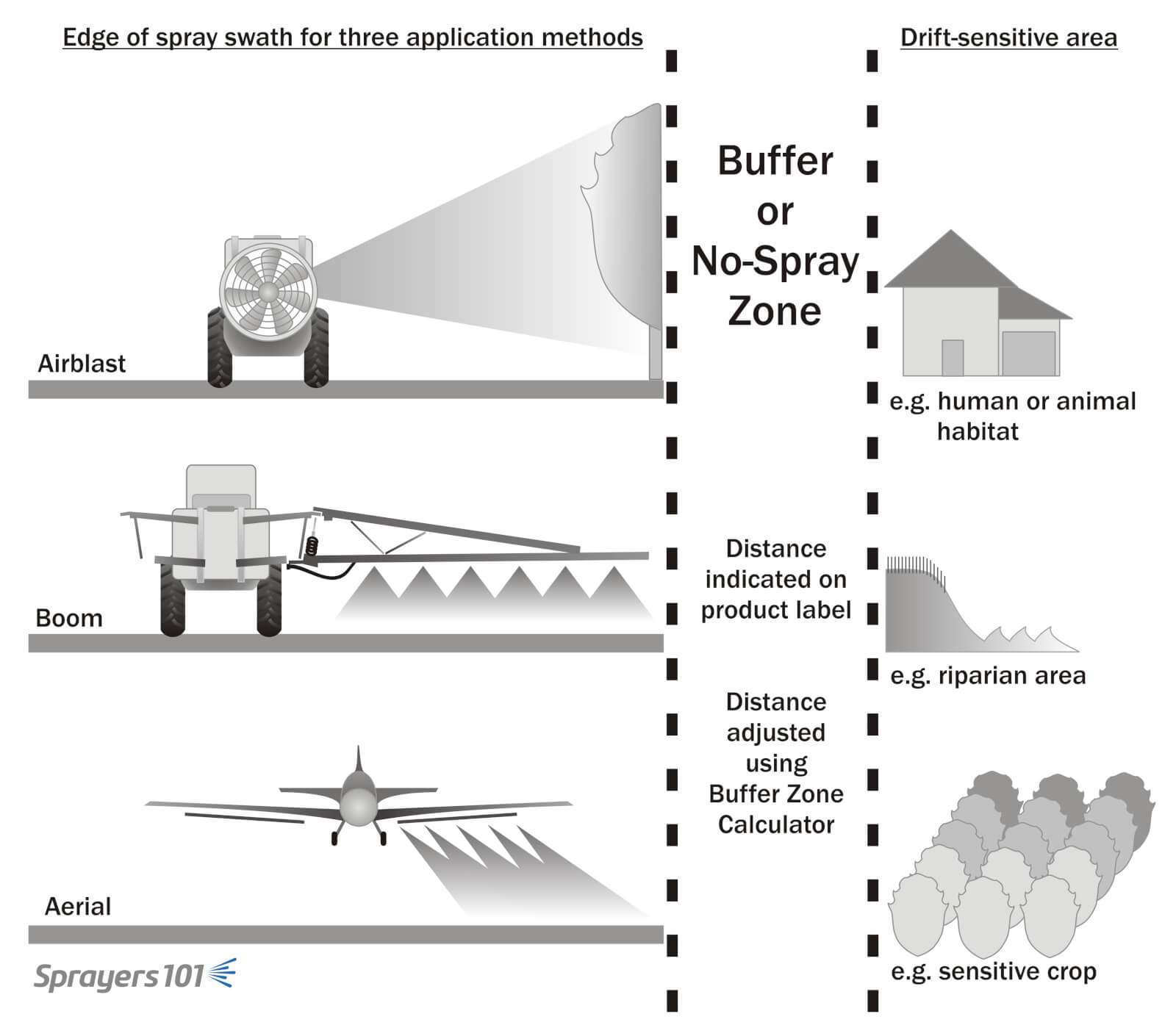
    Buffer zones or No-Spray zones physically separate the end of the spray swath for the nearest downwind sensitive area.
    Buffer zones or No-Spray zones physically separate the end of the spray swath for the nearest downwind sensitive area.
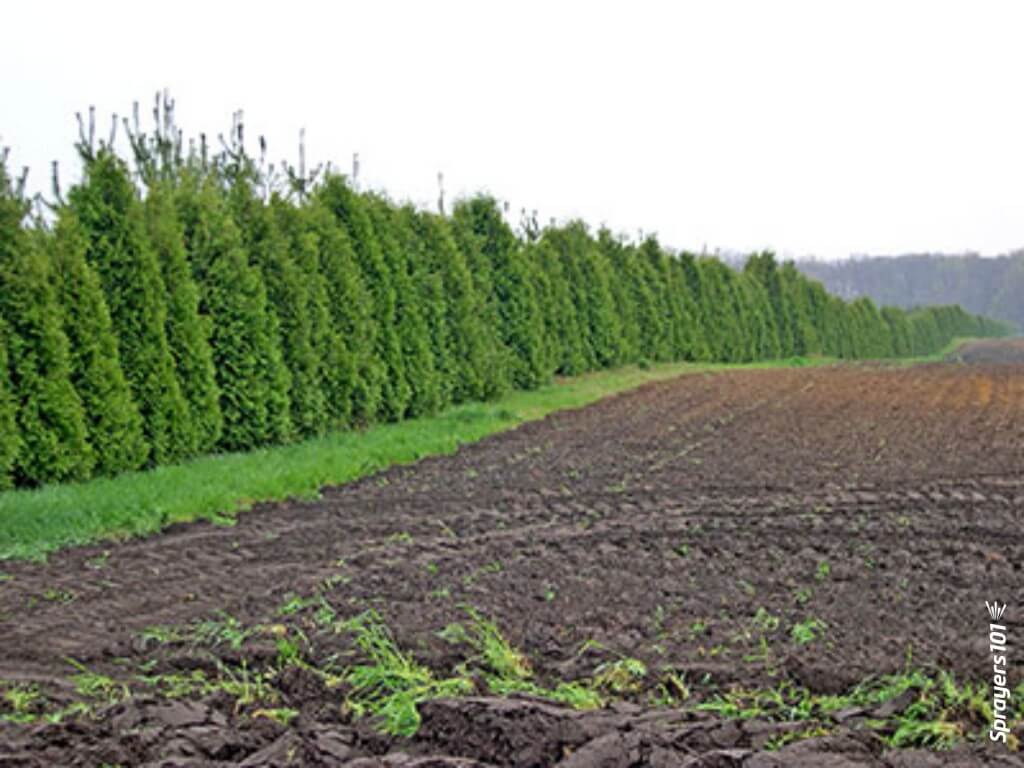
    Consider planting windbreaks between your operation and sensitive downwind areas. Be aware that the windbreak should filter pesticide-laden air, not block it completely (~50 % porosity). Also be aware that there are potential impacts to nearby crop rows, such as creating shade as well as cool, still air conditions. Contact your local Nature Conservancy to discuss the right plants and management plan for you.
    Consider planting windbreaks between your operation and sensitive downwind areas. Be aware that the windbreak should slow and filter pesticide-laden air, not block it completely (~50 % porosity). Also be aware that there are potential impacts to nearby crop rows, such as creating shade as well as cool, still air conditions. Contact your local Nature Conservancy to discuss the right plants and management plan for you.

    Running an Airblast Sprayer?

    For airblast sprayer operators, the environmental factors that affect drift are the same, but the rules for optimizing sprayer settings are slightly different. Droplet size is less of an issue, and in some cases droplet size cannot be controlled. Air settings are the primary tool for reducing drift potential.

    • Adjust fan settings to produce the minimal effective air speed throughout the season.
    • Use deflectors to channel air into, not over or under, the target.
    • If possible, increase droplet size by using air induction nozzles or disc & core (or disc & whirl) nozzles that produce a coarser droplet size. Depending on canopy size, you could use them in every nozzle position, or only in highest nozzle positions.
    • Any sprayer design the brings nozzles closer to the crop (e.g. tower or wrap-around designs) will reduce drift.
    • Canopy sensors that turn boom sections on and off to match the size and shape of the canopy will reduce drift.
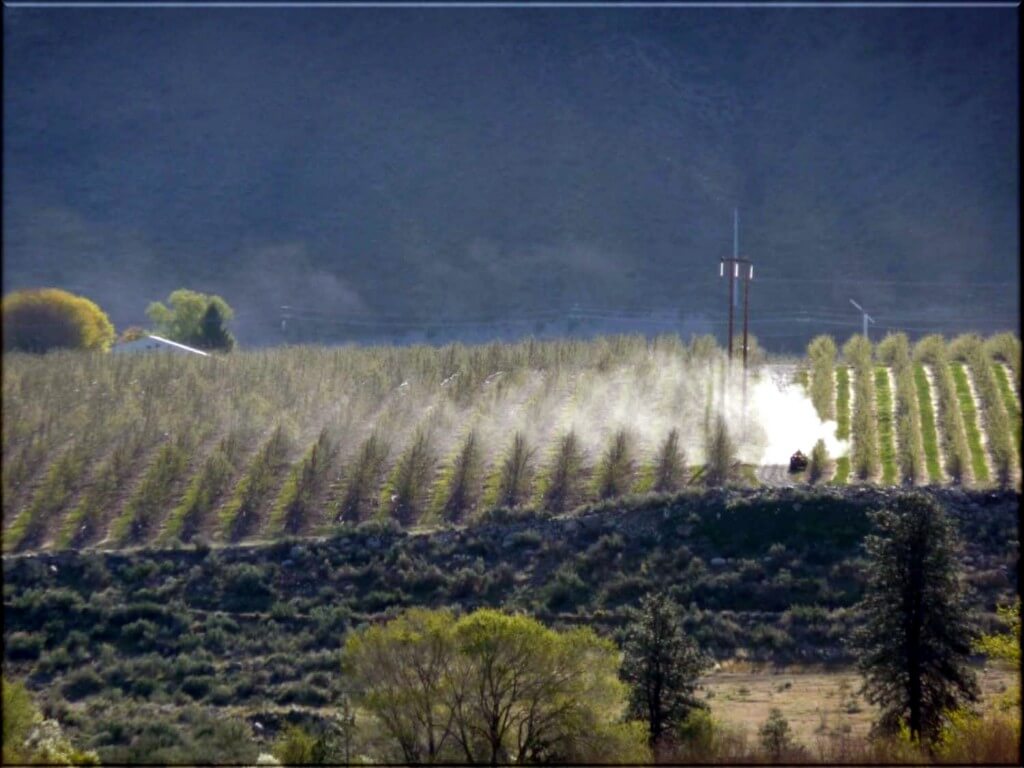
    It’s not only field sprayers that drift. Photo Credit – G. Amos and D. Zamora, Washington State.
    It’s not only field sprayers that drift. Photo Credit – G. Amos and D. Zamora, Washington State.
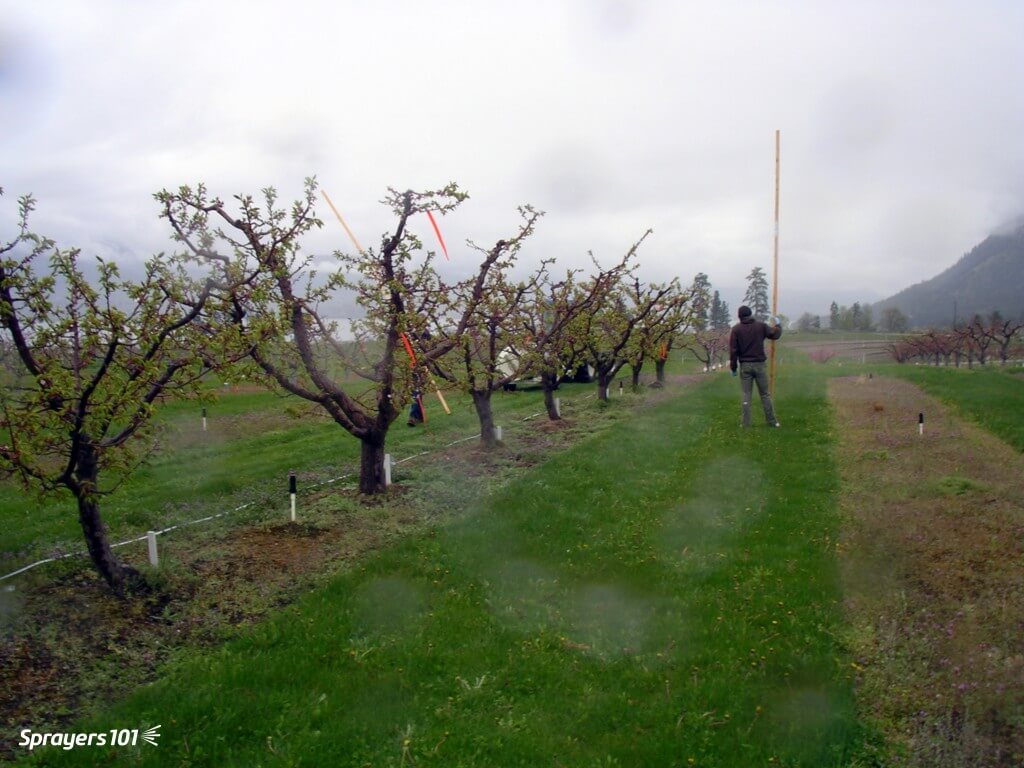
    Monitoring airblast drift using a tall pole with water-sensitive papers stapled along the length. This trial was run using only water so as not to expose the person holding the pole. Photo Credit – M. Waring, British Columbia.
    Monitoring airblast drift with ribbons and a tall pole with water-sensitive papers stapled along the length. This trial was run using only water so as not to expose the person holding the pole. Photo Credit – M. Waring, British Columbia.

    If You Suspect Drift

    If you suspect your crops or property have been damaged by pesticide drift, follow these steps (The contact info is specific to Ontario, so substitute your local authorities). The following information is based on this article in ONFruit which focuses on herbicide drift. Drift onto an organic operation would not necessarily cause visual injury, but steps are similar.

    1. Diagnose the problem

    • Is there evidence of a spray application (agricultural or vegetative management such as roadside spraying)?  Look for wheel tracks, weed symptoms, boom patterns and overlap on the headlands. Look for spray evidence in neighbouring fields, lawns, ditches, etc.
    • Familiarize yourself with the symptoms of drift injury on your crops.
    • Eliminate other possible causes. Disease, insects, nutrient deficiency, herbicide carryover, improper sprayer cleanout, and environmental stress can resemble drift injury.
    • Are there damage patterns? In the case of physical drift, damage is more pronounced on the upwind side of the damaged area, tapering away with distance from the source. In the case of vapour drift, damage can be uniform throughout damaged area and not necessarily downwind from the source. Pesticides can also move in cold air drainage and in surface run-off from rain events. If damage is patchy, it may be something else, such as soil pH or carryover (look where sprayer starts and stops).

    2. Contact the appropriate people

    • Talk to your neighbour or the sprayer operator. Ask what was sprayed, when it was applied and who performed the application.
    • Contact the Ministry of the Environment, Conservation and Parks District Office or Spills Action Center (SAC): 1-866-663-8477. The SAC is available 24/7 and they will then contact the appropriate Environmental Officer and pesticide specialist in your region. Local MECP offices can be found here.
      • It is extremely important to report as soon as possible because the concentration of herbicide drops quickly within the plant.  Do NOT wait until there are symptoms. Do NOT hesitate to call, even if you are unsure if it’s pesticide drift.
    • MECP officers can do a site visit, take samples of tissue and soil, and have them analyzed for suspect pesticides. Where appropriate, the offending applicator may face charges under Ontario’s Pesticides Act. Charges will be pursued only if off label use is identified from the information gathered.
      • Because of the wording of some of the labels and the difficulty of tracking down all the information needed, this has always been a very difficult thing to pursue in grower-to-grower drift incidents. 
      • The results from the MECP lab are available for the grower and, if enough information is collected, the grower is encouraged to pursue civil court if insurance and/or cooperation with the applicator does not work. According to the label of most pest control products, the applicator is liable for any damage caused by the misapplication of a pesticide.
    • Contact your (crop) insurance adjustor and advise the applicator to contact theirs. However, do not rely on your crop insurance; Insurance companies may not provide coverage for drift incidents. It is prudent to determine if you are covered before you need to file a claim.
    • Report the incident to the PMRA Voluntary incident reporting system
    • Report the incident to the manufacturer of the pesticide product. See the label for the toll-free number. Labels can be found on the PMRA label search.

    3. Document all details of the problem and consider lab analysis

    • Collect spray records. This includes yours (to ensure it was not your application), and the potential offending applicators’.
    • Collect weather records (temperatures, possible temperature inversions, wind speed, wind direction, rainfall) for the date of application).
    • Take timestamped, geolocated photos (most smartphones include this information automatically, but check your settings). Repeat photos several times through the season.
    • Document yield loss from the damaged area and an undamaged area. Choose a similar planting (same age, cultivar, rootstock, etc.). For perennial crops (e.g. vineyards, orchards, asparagus, berries) herbicides such as Group 4’s may necessitate documenting the effects for several years after the damage occurred.
    • Laboratory analyses of herbicide levels in plant tissue are often necessary to confirm the presence of herbicides, although symptoms may be helpful in diagnosing which herbicides caused the problem.
      • Research laboratories that will analyze crop samples for herbicide residues. Their requirements regarding sample size, labeling, storage, and shipping will vary, as will the list of pesticides they provide testing for and their minimal detection levels. Given the time-sensitive nature of pesticide detection, it would be prudent to know this information before need the service.

    Applicator Liability

    Anyone using pesticides is responsible for their safe application. For example, the Ontario Pesticides Act requires that licensed spray applicators carry a specialized liability insurance policy that provides appropriate coverage for their business. Operators who work on a “for hire” basis (e.g. a licensed spray applicator) or away from their own farm operation will need additional coverage. Where drift damages adjacent crops, insurance adjustors generally ask the following questions:

    • Was the damage to the applicator’s own crop? If so, it is unlikely that there will be coverage under any insurance policy.
    • Was the damage to a neighbour’s property? If so, the applicator’s liability policy may respond.
    • Was the product being applied according to label directions?

    Other Resources

    Managing spray drift is everyone’s responsibility. Extremely low, and often invisible, amounts of spray drift can be very damaging; even long after the application. For more information about drift mitigation, watch the following videos and download a copy of this Factsheet

    What is Pesticide Drift?- Ontario Ministry of Agriculture and Food and Ministry of Rural Affairs (2011)

    Equipment and Methods to Reduce Pesticide Drift- Ontario Ministry of Agriculture and Food and Ministry of Rural Affairs (2011)

    Preventing Pesticide Spray Drift- University of Missouri Extension (2013)

    Three simple ways to reduce drift. Thanks to Real Agriculture for filming and editing! (2014)

    Three simple ways to reduce drift. Thanks to Real Agriculture for filming and editing! (2014)

  • How Canadian Crop Protection Products are Assessed for Safety

    How Canadian Crop Protection Products are Assessed for Safety

    As originally published by The Grower, August 2020.

    Pests such as insects, diseases, and weeds can affect our quality of life in many different ways. Pests can represent a threat to public health and the environment as well as create substantial negative impacts to the economy if they are not sufficiently managed.

    Crop protection products or pesticides play an important role in agriculture and other sectors in managing pests. These products can be very broad in scope; they include, as defined by the federal government:

    “A product, an organism or a substance, including a product, an organism or a substance derived through biotechnology, that consists of its active ingredient, formulants and contaminants, and that is manufactured, represented, distributed or used as a means for directly or indirectly controlling, destroying, attracting or repelling a pest or for mitigating or preventing its injurious, noxious or troublesome effects.”

    While dealing with pests is an important aspect of society, crop protection products can also represent a hazard. If not properly managed, their use has the potential to pose risks to the health and well-being of Canadians and to our environment. As such, crop protection products are highly regulated. So how do we ensure the safety of these products in Canada?

    The federal government has the responsibility of reviewing and registering pest management products before they can be sold or used in Canada. This is covered by the Pest Control Products Act (PCPA). The primary objective of the PCPA is the prevention of unacceptable risks to human health and the environment resulting from the use of these products. The PCPA also recognizes that pest management is an important factor to both the economy and quality of life in Canada; however, these are considered secondary objectives to health and the environment.

    It is the mission of the Pest Management Regulatory Agency (PMRA) based in Ottawa to execute the implementation of the PCPA and its objectives. Of the 450 employees at PMRA, 73% are scientists, including biologists, toxicologists, epidemiologists, and chemists. Evaluations of products by PMRA are extensive and use a weight of evidence approach that considers the nature and quality of scientific sources in their decision making.

    Before the PMRA approves any product for use, regardless of origin, it must undergo a thorough science-based risk assessment and meet strict health and environmental standards. If the proposed use of a product poses unacceptable risks to human health or the environment, it is not registered for use in Canada. It is the responsibility of the company or individual seeking registration to prove their product does not pose unacceptable risks through scientific studies.

    During evaluation or re-evaluation of a product, PMRA considers a comprehensive toxicology database to assess potential health effects. Both shorter term and longer-term effects are considered. These include, but are not limited to, studies to characterize acute and chronic toxicity, carcinogenic potential, reproductive and developmental toxicity, immunotoxicity, neurotoxicity, genotoxicity, and endocrine disruption potential. The PMRA assessments are also informed by epidemiological evidence, general scientific knowledge, and published scientific information.

    In exposure assessments, sensitive populations and life stages are specifically addressed, including infants, children, and women of child-bearing age. Consideration is given to different activities, dietary habits, food intake, and body weight of children versus adults. A product will only be registered if this estimated exposure raises no concerns. Once this is determined, the PMRA will ensure the label directions indicate the appropriate use instructions to best minimize exposure.

    Exposure to a product may occur through different routes (oral, dermal, and inhalation) and pathways (dietary, drinking water, and non-commercial uses). In order to fully assess potential risks, the PMRA conducts aggregate assessments which consider these different pathways and routes. Where it has been demonstrated that a group of pesticides share a common mechanism of toxicity, they are subject to a cumulative risk assessment in which the combined aggregate risks are assessed. In occupational settings such as agriculture and forestry, exposure may occur while handling or applying pesticides. As well, workers re-entering treated areas may be exposed to pesticide residues. These occupational risks are also assessed during the PMRA review.

    The PMRA also sets science-based maximum residue limits (MRLs) on food commodities to ensure the food Canadians eat is safe. These limits are enforced by the Canadian Food Inspection Agency. The MRLs established for each crop are set at levels well below the amount that could pose a health concern.

    Environmental risk assessment integrates the environmental exposure and ecotoxicity information to evaluate the potential for adverse effects on non-target species. This integration is achieved by comparing estimated environmental concentrations (EECs) with concentrations at which adverse effects may occur. The EECs are concentrations of product in various environments, such as in food, water, soil, and air. The EECs can be estimated using standard models, which take into consideration the application rate(s), chemical properties, and environmental fate properties, including the dissipation of the product between applications. In re-evaluations of registered products, EECs can be taken from empirical data.

    Ecotoxicity information includes acute and chronic toxicity data for various organisms or groups of organisms from both terrestrial and aquatic habitats including invertebrates, vertebrates, and plants. Toxicity endpoints used in risk assessments may be adjusted to account for potential differences in species sensitivity as well as varying protection goals such as protection at the community, population, or individual level.

    A vast amount of scientific data is reviewed when evaluating the safety of crop protection products in Canada. These extensive reviews are posted publicly and include consultations where any stakeholders are invited to submit comments. There is good reason to have high confidence that crop protection products are safe for Canadians and the environment under the conditions of registration.

    For those who want a more in depth read, check out the PMRA’s guidance document overview.

  • Ten Tips for Spraying in the Wind

    Ten Tips for Spraying in the Wind

    Choosing the right time to spray can be tricky. Our gut tells us that spraying when it’s windy is wrong.  The experts tell us that spraying when it’s calm is wrong. So when can you actually spray?

    I’ve always advised my clients to spray in some wind, because it has a few advantages. The main one is that wind helps disperse the spray upward and downward, diluting the spray cloud fairly rapidly. Another advantage is that winds tend to be reasonably steady in their direction and velocity (or at least that can be forecast), so downwind areas can be identified and potential impacts are known or predictable. It helps if it’s sunny, because that improves the dispersion of the cloud even more.

    First, let’s define “windy”. The classic wind scale is the Beaufort Scale, intended for the sea, but also used on land. The upper limit for spraying is probably Force 3 or Force 4, with upper limits of 20 – 25 km/h or so.  The Beaufort Scale calls these “Gentle or Moderate Breezes” (they had to save the alarming words for hurricanes), and the scale provides good visual clues such as what wind does to flags, leaves, or dust.

    Beaufort Scale-1

    Spraying under breezy conditions can be done fairly safely if you follow specific steps. The idea is to understand what the risks are and to manage them.

    The cornerstone is to use a low-drift spray and match it to a pesticide that will work well with larger droplets. But there are other important aspects to consider. Below are the top ten to think about:

    • Choose a herbicide that can handle large droplets. Glyphosate products are well suited to coarse droplets. But glyphosate commonly has contact actives in the mix, members of Group 6, 14, and 15, and these are less likely to perform well with big droplets than those that contain Group 2 and 4 mixes. Actives with soil activity also have more tolerance for larger droplets.
    • Use a low-drift nozzle and operate it so it produces a Coarse (C) to Very Coarse (VC) spray quality, as described by the manufacturer. Dicamba labels call for Extremely Coarse (XC) to Ultra-Coarse (UC) sprays, and Enlist requires at least Coarse. To achieve these you may need to purchase new nozzles. Low-pressure air-induced nozzles operated at about 50 – 60 psi will generally be very low-drift, but lower drift models are available. If you need a finer spray, produce it either by increasing the pressure or moving to a finer tip. Do this when the weather improves, for contact modes of action.
    The name, symbol and range of droplet sizes used to describe the median droplet diameter produced by nozzles according to ASABE S572.3
    • Keep your boom low. Lowering the boom ranks as the second-most effective way to reduce drift, after coarser sprays. But there’s a limit. For low-drift sprays, you need at least 100% overlap (more for PWM), which is for the edge of one nozzle pattern to spray into the centre of the adjacent pattern. In other words, the spray pattern should be twice as wide as your nozzle spacing at target height.  For most nozzles, a boom height of close to 20 inches is enough to achieve this overlap. That’s pretty low by current standards from suspended booms on self-propelled sprayers, so being too low for a good pattern will only happen due to boom sway.
    • Maintain reasonably slow travel speeds. These reduce the amount of fine droplets that hang behind the spray boom, reduce turbulence from sprayer wheels, and they also make low booms more practical. An added bonus is less dust generation.
    • Know what’s downwind and what harms it. Survey the fields on all sides of the parcel you’re treating. When you have a choice, avoid spraying fields that have sensitive areas downwind such as water, shelterbelts, pastures, people, etc. If you can’t avoid being upwind of these areas, make sure you check and obey the buffer zone restrictions on the label. These will also give you an idea if the product can cause harm in water or on land, or both.
    • Consider a dicamba tip for special situations, even if you don’t use dicamba. If you’re in a situation where quitting and waiting is a poor option, these tips allow you to finish the job with minimal drift risk and with only slight reductions in product performance due to poor coverage.
    • Use a low-drift adjuvant. Specific products such as Interlock or Valid have been shown to reduce driftable fines (<150 microns) by between 40 – 60%, without adding significant volume in coarser droplets. The response will depend on the nozzle and the tank mix, but can be very noticeable.
    • Study drift and how it forms and moves. It’s about more than wind speed and droplet size. Knowledge in this area can help you work out the best strategies.
    • Invest in productivity. You may not need it every day, but on occasions when you have a small window to avoid bad weather, it pays dividends.
    • If you feel that drift is unavoidable and someone might be impacted by it, talk to those people first. It’s one of the most important things you can do.

    Keeping pesticide sprays on target continues to be one of our top responsibilities.

  • Pesticide Safety for Student Workers

    Pesticide Safety for Student Workers

    This article is based on a presentation by Dr. Melanie Filotas, who delivered it as part of the 2019 agriculture summer student orientation day.

    Most crops are sprayed with organic or synthetic pesticides at some point during the growing season. Use caution before entering any area where crops are grown (e.g. corn field, nursery, greenhouse, orchard etc.). Always confirm that it is safe to enter.

    Most crops receive some form of chemical input during growth. Be aware of what has been applied.
    Even organic operations apply controlled products that may make it unsafe to enter for a period of time.

    You can be exposed to pesticides if you enter a treated area before pesticide residues break down and vapours dissipate. The minimal time that must elapse before being permitted to enter is called the Restricted Entry or Re-entry Interval (REI).

    REIs are data-driven and established by the federal government. They are defined as: “The period of time that agricultural workers, or anyone else, must not do hand labour in treated areas after a pesticide has been applied.” Hand labour can be any task involving substantial contact with treated plants, plant parts or soil, including planting, harvesting, pruning, and scouting.

    Things you should know about REIs:

    • REIs can range from one hour to several days
    • If a pesticide label does not indicate a REI, the default is 12 hours
    • REIs can vary with the product, crop and type of activity (e.g., scouting, harvesting, etc.)
    • REIs can change over time so always refer to the most recent label
    • If a tank mix (multiple products) was applied, observe the most restrictive REI

    Before visiting an operation to work in the field:

    • Tell your supervisor where you will be that day
    • Ask the grower or spray applicator what was sprayed. Records may be posted, but verbal confirmation is preferred
    • Look up the REI for the product on the crop you will be entering
    • Check with your supervisor on any products with special instructions beyond the REI

    Do not enter the field until the REI has ended. Pesticide REIs can be found in local production guides, or on pesticide labels.

    Local production guides summarize REIs.
    Local production guides list REIs by crop, by product applied, and by activity.

    If local production guides are not available, registered pesticide labels can be found using Health Canada’s Pesticide Label Search service online. In the United States, most labels can be found on the EPA’s Pesticide Product and Label System website.

    Health Canada’s online pesticide label search.

    Miscommunication can sometimes happen. Learn to recognize the signs of spraying. When in doubt, leave the planted area and call the grower to confirm or call your supervisor.

    • In some cases you can look for fresh tracks in the operation, but be aware they may not have been made by a sprayer
    • Some products have a distinctive odour
    • It can be difficult to see a sprayer operating, particularly in orchards, but they can be heard. Do not wear earbuds or headsets while in a production area
    • Look for foliar residue. This is an indicator, but does not always mean it is unsafe to enter
    Fresh wheel tracks may indicate recent spraying.
    Some products have a distinctive odour.
    It may be difficult to see a sprayer operating in the vicinity, such as in this orchard. However, they can often be heard. Do not wear a headset or earbuds in a production area.
    Residue on leaves may indicate a recent application, as in the left photo. However, it could also be unrelated. On the right is calcium magnesium precipitation from irrigation water. (Photo credit [right]: Jennifer Llewellyn)

    There are many potential symptoms of pesticide exposure: headache, fatigue, irritation of the skin, eyes, nose or throat, loss of appetite, dizziness, nausea or vomiting, diarrhea, decreased muscle coordination, and blurred vision. Each product has a Material Safety Data Sheet (MSDS) that will provide details on exposure symptoms and treatments.

    While sometimes confused with symptoms arising from sun stroke or dehydration, if you suspect pesticide exposure it is always best to be prudent and get medical help immediately. Contact your local poison centre or 911.

    Summer work in crop production can be rewarding and enjoyable, but always use caution and be safe.