Tag: coverage

  • Measuring Spray Coverage – Tips with Tom #8

    Measuring Spray Coverage – Tips with Tom #8

    The importance of good spray coverage is emphasized in all kinds of agricultural publications, including product labels. But, according to Tom Wolf, “the labels are remarkably silent on what good coverage actually is and how you can actually measure it.”

    Tom goes on to explain that spray coverage can be defined using three main criteria: droplet density, area covered and dose administered. In order to measure and assess spray coverage, we recommend using water sensitive paper, a rigid, specially-coated, yellow paper which is stained dark blue/purple by aqueous solutions. The paper can be positioned at the targeted levels of the crop canopy with a paper clip or other handy instrument and the coverage received in the field then compared to recommended levels produced in the lab to give an indication of whether or not coverage needs to be adjusted through increasing water volumes or altering droplet size.

    Learn to integrate spray coverage evaluation into your spray operation, and how doing so can help you fine-tune applications.

  • Spray Coverage in Potato

    Spray Coverage in Potato

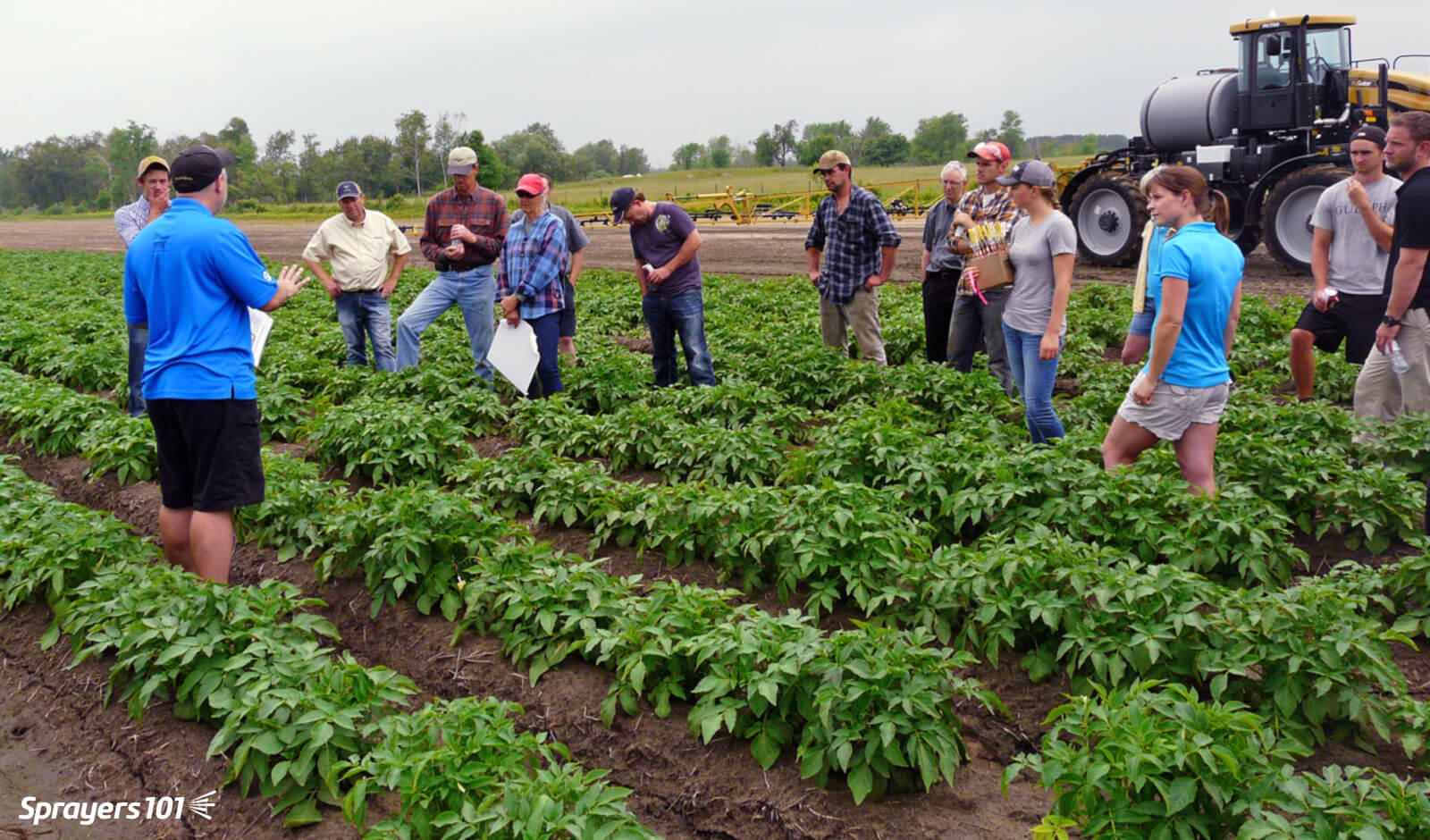
    In June, 2014, 30 growers attended a spray coverage demonstration in a potato field in Alliston, Ontario. Our goal was to explore three questions:

    1. What is the effect of droplet size on coverage?
    2. What is the effect of volume on coverage?
    3. What is the effect of spray angle on coverage?

    This certainly wasn’t a scientific experiment. Spray demos are a great foil for discussing droplet behaviour and teaching operators how to diagnose spray coverage. Take the “results” with a grain of salt.

    Discussing spray coverage in Alliston, Ontario (2014).
    Discussing spray coverage in Alliston, Ontario (2014).

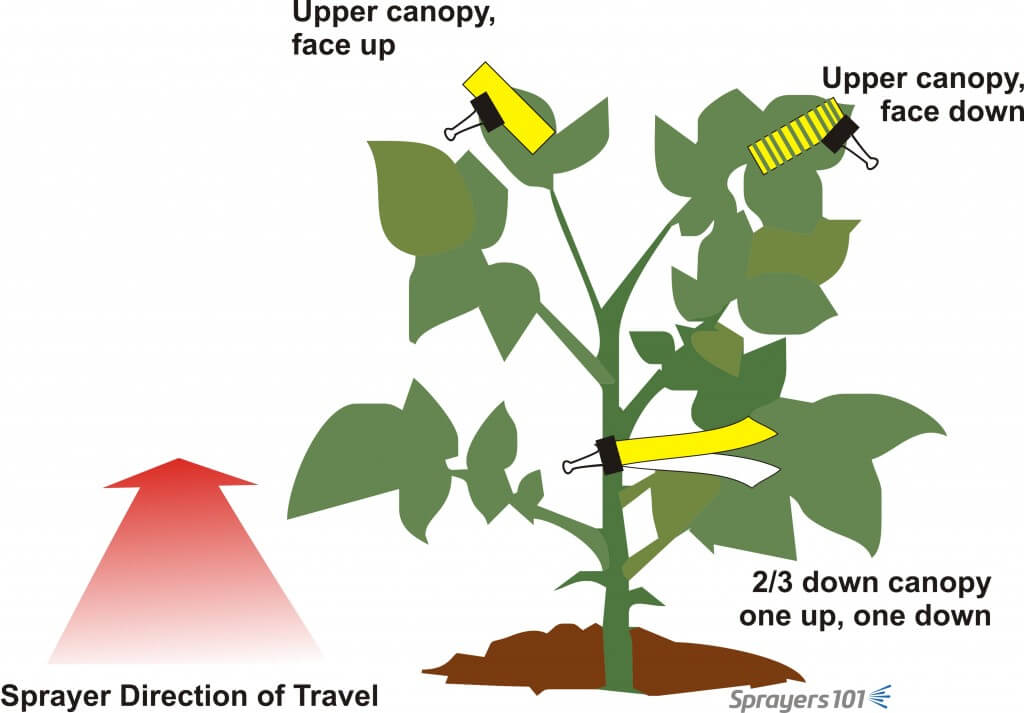
    In order to see spray coverage, we placed water sensitive paper in the potato canopy (see below). Water sensitive paper turns from yellow to blue when it is contacted by water. Normally, we use a digital scanner to quantify spray coverage. However, it was a very humid day and this made it difficult for the scanner to discern spray from background. We decided to assign a qualitative value to the papers based on coverage. Low (or no) coverage got a score of zero. Moderate coverage (enough to offer good control) received a score of one. Papers with excessive coverage (anything more than moderate) received a score of two. Did I mention this wasn’t a scientific experiment?

    The location of water-sensitive papers in the potato plant canopy. Two plants were papered for each nozzle.
    The location of water-sensitive papers in the potato plant canopy. Two plants were papered for each nozzle.

    Droplet Size

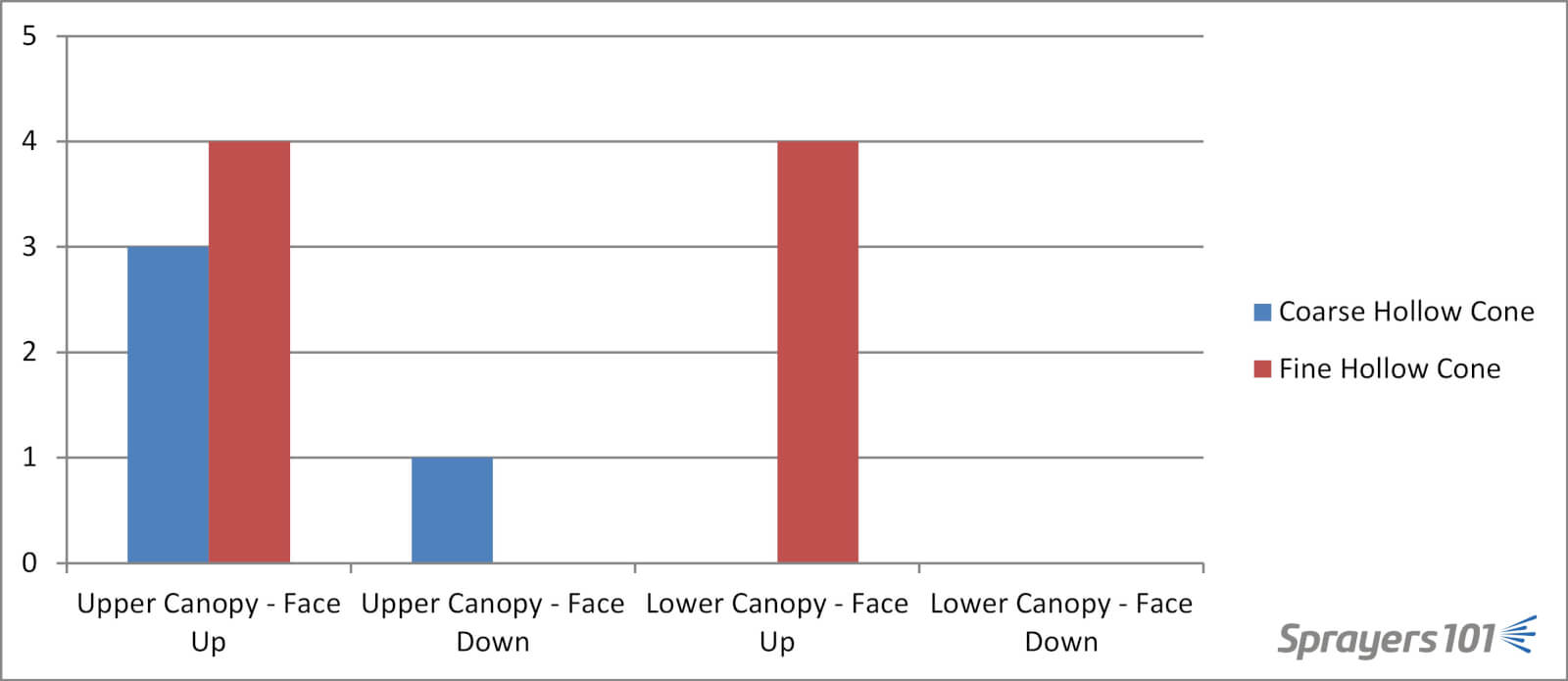
    To answer the first question, we compared coverage from two hollow cone nozzles. The TeeJet TXR80028, which creates a fine/medium droplet size, and the TeeJet AITX8002VK, which is air-induced and creates a Coarse/Very Coarse droplet size. In both cases the boom was approximately 50 cm (20 in) above the top of the crop, travelling at 10 km/h (6.2 mph) and spraying about 110 L/ha (~11.5 gpa).

    Generally, Coarse droplets tend to move in a straight line, and are not as easily deflected by moderate wind or travel speed. Conversely, Fine droplets slow very quickly and move erratically depending on the forces acting on them.

    Droplet size comparison. Cumulative spray coverage achieved in four positions, on two plants per nozzle. Low-to-no coverage = 0. Moderate coverage = 1. High-to-excessive coverage = 2.
    Graph 1 – Droplet size comparison. Cumulative spray coverage achieved in four positions, on two plants per nozzle. Low-to-no coverage = 0. Moderate coverage = 1. High-to-excessive coverage = 2.

    Graph 1 shows the coverage results in each position. We see that finer droplets appear to penetrate the canopy more than the coarser droplets. We also see that under-leaf coverage was difficult to achieve overall. It’s possible the small amount of coverage achieved on the under-side of the top scaffold of leaves is the result of Coarse droplets bouncing… but if that’s the case, why wasn’t there any coverage on the upward-facing leaves inside the canopy? Write me – I’m open to ideas. In any case, redistribution is erratic and should not be relied on.

    This graph may appear to favour smaller droplets, but be aware that Fine droplets are prone to drift and evaporation and should not be used without making every effort to prevent off-target movement. Shrouds, low ambient wind, and slower ground speed can help. To my mind, the best drift-mitigating option that still allows the use of finer droplets is an air-assist option on the boom, which would also improve under-leaf coverage. I’ve seen it in field tomato, soybean and even field corn. It’s disappointing that there aren’t more self-propelled sprayers in Ontario that offer this feature.

    Volume

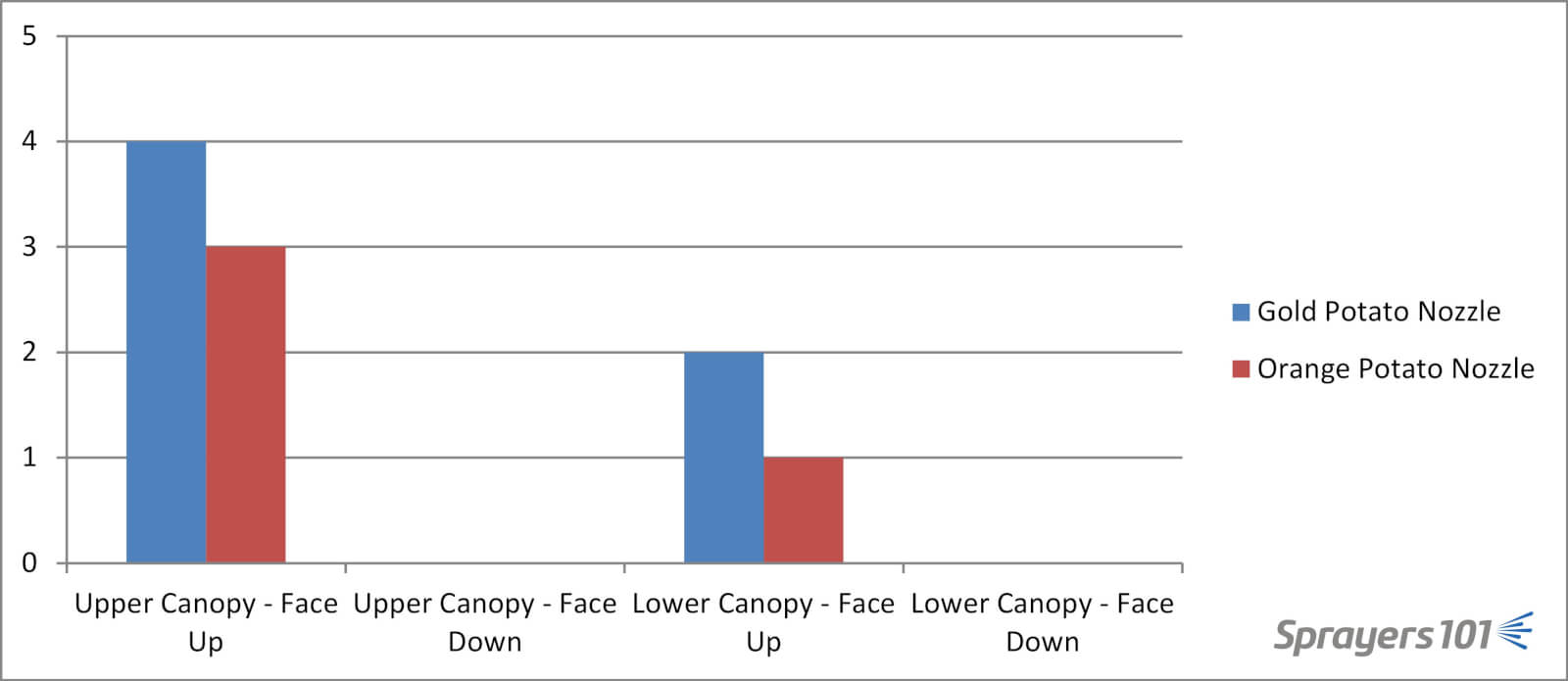
    To answer this question, we compared coverage from Syngenta’s potato nozzles. They aren’t generally available in North America, but we got a few for the sake of the demo. The VP04 (gold) was operated at 1.5 bar (22 psi) and sprayed 135 L/ha (~14.4 gpa). The VP05 (Orange) sprayed 180 L/ha (~19.2 gpa) at the same pressure. The boom travelled at 10 km/h (6.2 mph) at approximately 50 cm (20 in) above the top of the crop.

    Generally, raising the volume-per-hectare translates to improves coverage, but at some point there is a diminishing return. Imagine comparing coverage between 1 L/ha and 100 L/ha – there would be a big difference. Now imagine comparing 500 L/ha to 1,000 L/ha – probably not much difference, because drenched is drenched.

    Spray volume comparison. Cumulative spray coverage achieved in four positions, on two plants per nozzle. Low-to-no coverage = 0. Moderate coverage = 1. High-to-excessive coverage = 2.
    Graph 2 – Spray volume comparison. Cumulative spray coverage achieved in four positions, on two plants per nozzle. Low-to-no coverage = 0. Moderate coverage = 1. High-to-excessive coverage = 2.

    According to Graph 2, the higher volume did not improve coverage. In fact, the lower volume appears to have superior coverage, but it’s likely not significant. Remember, there are no error bars here because there’s no statistical analysis – it’s not a scientific study. It’s possible that at this stage of growth, our 150 L/ha was close to the threshold of diminishing return.

    Once again, note the absence of under-leaf coverage. Truly, the more I spray vegetable and row crops with conventional nozzles on a horizontal boom, the more I think under-leaf coverage can only be achieved by Bigfoot riding the Loch Ness Monster while wielding Harry’s wand. Without directed sprays from drops (aka pendant nozzles, drop hoses, etc.) or some means of redistribution (e.g. air assist or even maybe electrostatics) droplets will not reliably change direction.

    Spray Angle

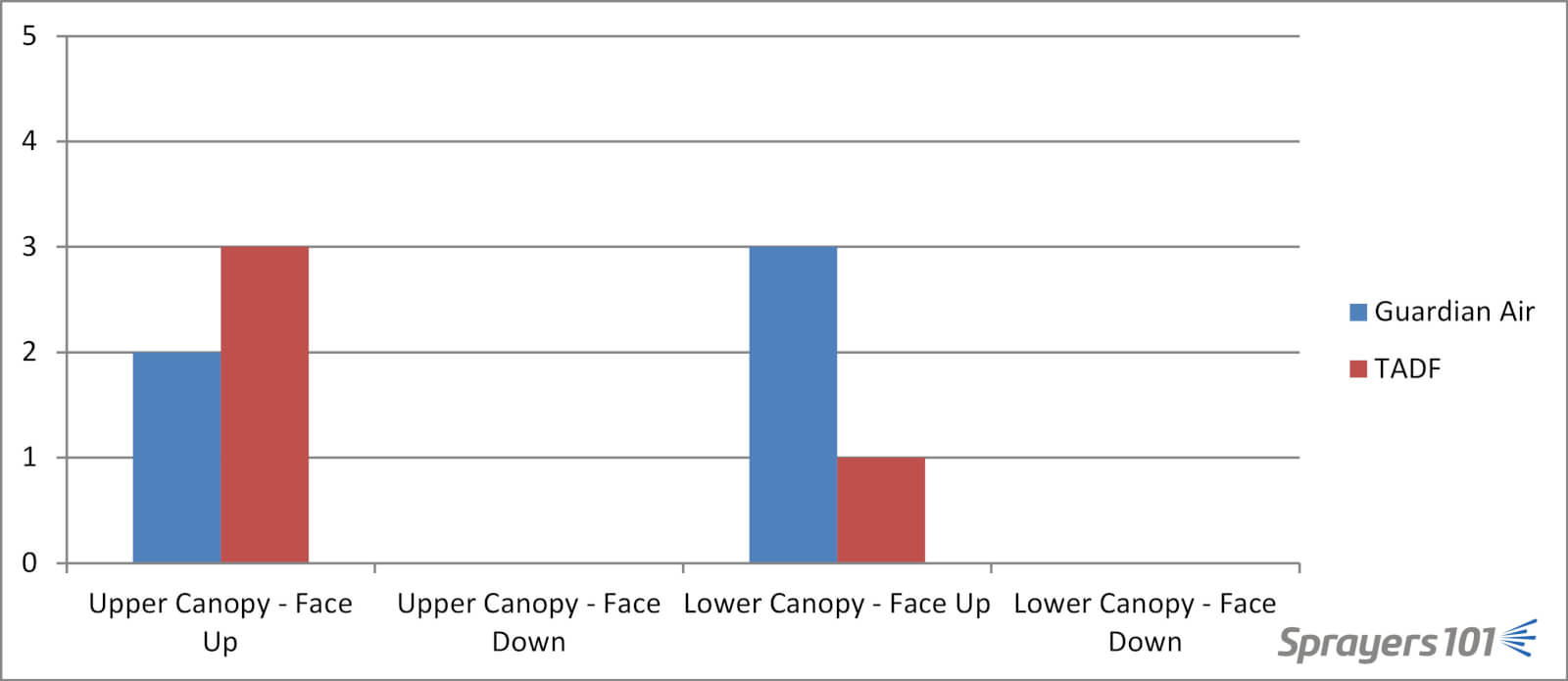
    To answer this question, we used Hypro’s Guardian Air nozzle (GA11003), which is a 110° wedge-shaped flat fan that we alternated between 15° forward and 15° backward on the boom. We compared it to Greenleaf’s TADF nozzle (a blue and yellow 02), which is an asymmetrical, 110° twin-fan tip, where one fan is at 50° and has a higher flow compared to the second fan at 10°. We also alternated these nozzles on the boom to take advantage of what became four different angles of attack. Both tips sprayed 100 L/ha (10.9 g/ac) from a boom travelling 10 km/h (6.2 mph) and about 35 cm (~14 in) from the top of the canopy.

    Spray angle comparison. Cumulative spray coverage achieved in four positions on two plants per nozzle. Low-to-no coverage = 0. Moderate coverage = 1. High-to-excessive coverage = 2.
    Graph 3 – Spray angle comparison. Cumulative spray coverage achieved in four positions on two plants per nozzle. Low-to-no coverage = 0. Moderate coverage = 1. High-to-excessive coverage = 2.

    Graph 3 shows a lot of spray impacting on the surface of the canopy, with moderate penetration to the upward-facing leaves in the inner canopy. The angled spray may have helped a little, but no more than the finer droplets from hollow cones. While others like it, my personal experience in soybean, field tomato and ginseng has shown that the spray angle does not have much bearing on crop penetration in a broadleaf canopy. Perhaps if the canopy is sparse… but not in dense canopies. This shouldn’t be a surprise because angled sprays are best suited to vertical targets, such as wheat heads. Graph 3 seems to bear this out.

    Now, since I ran this last demo, I’ve learned that I really didn’t use the twin fan nozzles optimally. In order to keep the outputs comparable, the rate controller operated the TADF’s at about 30 psi. That pressure is fine for something like glyphosate, but for contact products 60 psi to 120 psi is preferable to put the droplets in the medium range and keep them moving at the right angle.

    A lot of people like the asymmetrical nozzles in broad leaf crops, so if they’re working for you that’s great. Carry on! As for me, I’m hoping to run a more stringent experiment in the future to satisfy myself.

    Take Home

    So, as I’ve pointed out a few times, this comparison of nozzles and spray variables isn’t definitive. It was only a subjective demonstration. Further, coverage doesn’t necessarily imply efficacy: Just because you have more coverage doesn’t mean you didn’t already have enough to do the job.

    Caveats aside, however, there are a few points to be made:

    • Smaller droplets penetrate dense canopies better than larger droplets, as long as they survive to arrive.
    • Under-leaf coverage is difficult to achieve without some form of mechanical assistance – e.g. directed application from drops, air-assist, electrostatics, etc.
    • Higher volumes result in improved coverage, but only to a certain point. Volume should reflect the stage of growth.
    • At the moment, I’m unconvinced that spray angles impact (dense) broad leaf canopy penetration. There are, of course, many other learned and experienced opinions for spraying vegetables.
  • 50 Ways to Get Good Coverage – Parody

    50 Ways to Get Good Coverage – Parody

    50 Ways To Get Good Coverage

    Sung to the tune of “50 Ways to Leave Your Lover” by Paul Simon.

    The problem is all inside your barley canopy

    The answer’s easy if you find it empirically

    I’d like to help in your quest for efficacy

    There must be fifty ways to get good coverage

    She said it’s really not my habit to intrude

    Furthermore, I hope my application won’t be lost or misconstrued

    But I’ll repeat myself at the risk of being crude

    There must be fifty ways to get good coverage

    Fifty ways to get good coverage

    Lower the boom, June

    Get a new fan, Stan

    You don’t need to drive slow, Bo

    Just get yourself drops

    Jack up the press, Bess

    You don’t need to discuss much

    Just get a new tip, Skip

    And get yourself drops

    She said it grieves me so to see you in such pain

    I wish there was something I could do to give you pest control again

    I said I appreciate that and would you please explain

    About the fifty ways

    She said why don’t we both just spray a bit tonight

    And watch inversion drift in the morning light

    And then she kissed me and I realized she probably was right

    There must be fifty ways to get good coverage

    Fifty ways to get good coverage

    Buy Agrifac, Jack

    Get a good gauge, Paige

    You might need to drive slow, Joe

    Just get yourself drops

    Do calibrate, Nate

    You don’t need to discuss much

    Just do a good job, Bob

    And get yourself drops

  • Fungicide Application Basics

    Fungicide Application Basics

    Fungicide use appears to be the fastest growing segment of North American crop protection.  Here is some advice on how to get the best bang for the buck.

    • Timing is the most important part of fungicide application. Diseases can develop and spread quickly.  Most fungicides cannot cure a disease infection, they can only protect against it.  If an application misses the window, yield is lost.  Remember your priorities – become familiar with disease symptoms, the susceptibility of your crop and key growth stages.  Make sure your sprayer is ready – your nozzles are installed, calibrated, and you can achieve the necessary boom height.  Hire an agronomist to help scout and make recommendations. Make the right decision about whether to spray or not.
    • Water volume is the most important application parameter for fungicide application. In years of study, increasing water volume had a greater effect on fungicide performance than changes in droplet size or spray pressure.  More water is needed for fungicides than herbicides because of the greater amount of plant material present.  Getting coverage on leaf areas deeper into the canopy requires more water.  Although finer sprays can also help with coverage, this practice is riskier due to drift potential and higher evaporation rates.
    • Double nozzles, in particular the asymmetric types, are becoming more popular with fungicides. Double nozzles are proven effective and recommended primarily for fusarium head blight, or any other disease where an exposed vertical part of the plant canopy is the primary spray target.  Double nozzles are also useful for preventing the spray quality from getting too coarse as higher flow-rate nozzles (which tend to have larger droplets) are used.
    • Travel speed is important with fungicides. Canopy penetration sometimes improves with slower travel speeds, and this can be used as an advantage by eliminating the need for a special fungicide nozzle.  For example, assume a nozzle was used to apply 8 gpa of herbicide at 15 mph at 70 psi (this pressure assumes air-induced tips).  For fungicides, this same nozzle and pressure will deliver 12 gpa simply by slowing down to 10 mph.

    Boom height and spray quality are both important for single angled sprays or double nozzles. The angle at which a spray leaves a nozzle diminishes quickly as air resistance and gravity exert their influence.  If the boom is too high, the initial forward  angle will be lost and the spray droplets will actually deposit with gravity and wind.  But if the spray is a bit coarser and the boom is low enough, the angle of attack is retained for long enough to make a difference in spray deposition.

    Despite these suggestions for making the spray more effective, there is no substitute for an informed decision regarding fungicide use.  It’s possible that spraying is unnecessary for a number of reasons, and it’s best to have professional advice help make that call.  If you decide to go ahead, ensure that your sprayer is set up to deliver the fungicide to the part of the canopy that needs protection.

  • How Fast Should I Drive My Sprayer?

    How Fast Should I Drive My Sprayer?

    It seems simple: The faster you drive the sprayer, the more area you cover. This makes higher travel speeds a seductive method for improving productivity. Sprayer manufacturers knew this 25 years ago when pull-type sprayers first received bigger, suspended outrigger wheels. Since then they’ve delivered more powerful engines, better hydraulic motors, smoother suspension and cruise control.

    Each of these innovations still required the operator to consider the relationship between travel speed, pressure, nozzle choice and the desired output per acre. But now we have rate controllers, and we don’t have to think about such mundane things anymore… do we? Do we still do a good job if we go faster? What exactly happens when we speed up?

    Before considering the role of the rate controller, you have to decide on an overall target-speed range. Charts, apps, or online tools can help you select nozzles sized to deliver your application volume at a given speed and pressure. This initial travel-speed decision requires an understanding of how spray gets delivered to the target. Let’s start with the spray boom.

    As the boom moves through air, the oncoming air does three things to the spray:

    • It shears the spray, making it a bit finer.
    • It scrubs the smallest droplets from the pattern, leaving them in the wake of the boom.
    • Finally, negative pressure behind the pattern sucks even more fine spray into the sprayer wake.

    Collectively, these create the dreaded “spray plume” that hangs behind the spray boom… and we’ve lost control over it. The faster we move, the greater the proportion of the spray that ends up in the plume. This can be anywhere from one to 15% of the spray. Once formed, that plume moves with the prevailing winds.

    Today’s sprayers have wide booms, and faster speeds often require us to keep these booms higher than we have in the past to prevent impacts. But higher booms reduce our control over the spray’s direction. For example, when spraying vertical targets (e.g. wheat heads) we have begun to employ angled sprays. But droplets lose momentum quickly. The further they are from the target, the more likely they are to slow or even fall vertically before they reach the target. That means that higher booms often negate the benefit of angled sprays.

    Still not convinced of the perils of high speeds? Well, think about the aerodynamics of the sprayer itself. As travel speed increases, the sprayer, the boom, and even the spray pattern itself disrupt the air around it.  Visualize a sprayer in a wind tunnel with smoke tracer lines. The nice pattern created by the boom gets really messy in a turbulent environment. This can cause a loss of deposit uniformity, resulting in a reduction of overall effectiveness.

    So far, we’ve talked about average speeds – choosing to travel eight, 12 or 16 mph overall, and then choosing the nozzle that will suit. Now let’s talk about changes in your travel speed within your target-speed range.

    Operators know that even small travel speed changes can result in large pressure changes.  That’s because travel speed and pressure enjoy a “square-root relationship”. If you double travel speed, your rate controller needs to quadruple the spray pressure to meet the new flow need!

    Even minor changes in speed (to adapt to field conditions) can lead to big fluctuations in pressure, changing average droplet size, and affecting coverage and drift potential. Severe pressure fluctuations are more likely with a faster average travel speed. That’s perhaps why pulse-width modulation, which decouples spray pressure from travel speed and replaces it with a solenoid duty cycle, has a growing role in fast self-propelled sprayers.

    To minimize pressure fluctuations, use the pressure gauge as your speedometer. Have the boom pressure displayed prominently in your sprayer cab, and try to operate at speeds that result in a pressure which is optimal for the job you’re trying to do.

    So, let’s summarize the effects of fast travel speeds.

    Pros:

    • More area covered per hour
    • Better contact with vertical targets (if the booms are kept low)

    Cons:

    • More drift
    • Less uniform deposition
    • Wider pressure fluctuations

    So, how fast is too fast? We won’t draw a line in the sand, but we will emphasize how important it is to consider as much information as you can before deciding on a travel speed. Don’t rely on the rate-controller to think for you – it doesn’t have all the information.