Tag: coverage

  • Dual Fan Nozzles in Broadleaf Crops

    Dual Fan Nozzles in Broadleaf Crops

    Wondering which (if any) dual fan nozzle to buy?

    • Symmetrical?
    • Alternating floods?
    • Asymmetrical?

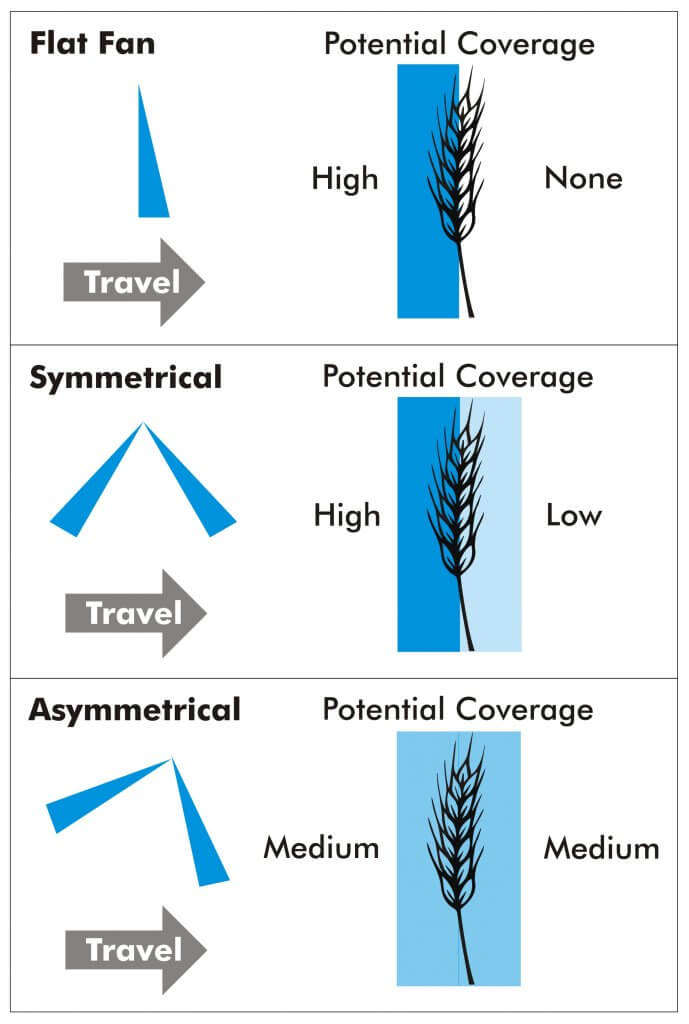
    Well, first, understand they are intended for vertical targets, like wheat heads. Here’s a diagram of how they are (ideally) supposed to work:

    Here’s is the ideal coverage from fan nozzles on a vertical target. Note that high booms, smaller droplet sizes, high travel speeds, high or changeable wind conditions and uneven emergence can negatively affect coverage.

    Here’s our very own Dr. Tom Wolf to tell you all about them.

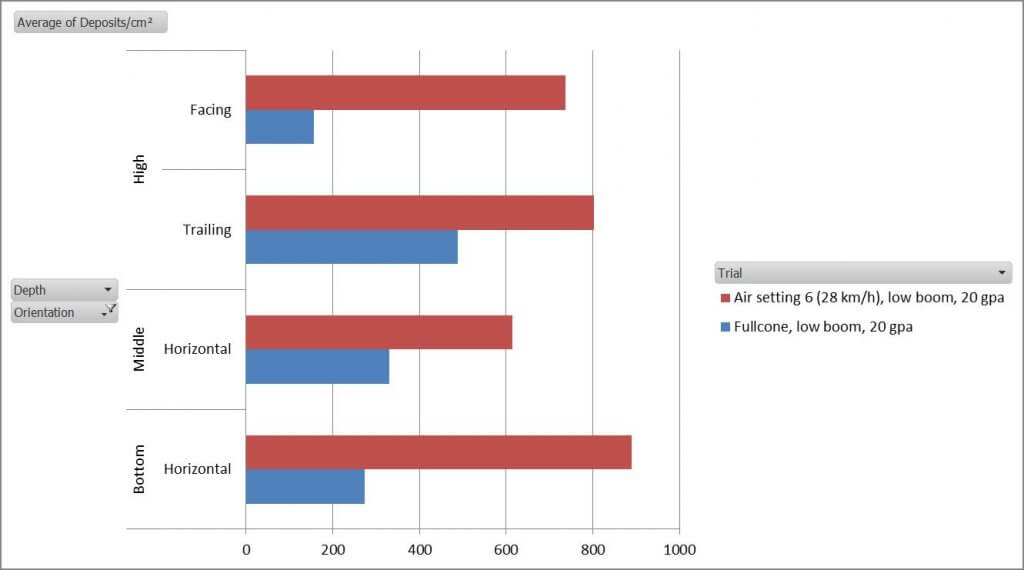
    Now understand they don’t seem improve matters (at conventional pressures) in broad leaf crops. We compared spray coverage from several nozzles in soybean. The lack of any clear cut winner was disheartening, but even messy results can lead to valuable conclusions! Read more about the experiment here and watch the video below:

    And finally, understand that choosing a brand or variation of a dual fan nozzle arrangement is likely the least important factor. It falls, in our opinion, last in this sequence of factors:

    1. Spray timing (i.e. crop stage, pest stage)
    2. Product choice
    3. Boom height (Keep ’em low)
    4. Droplet size (Keep ’em Coarse or larger)
    5. Spray volume (Go with more gallons per acre, not less)
    6. Style/brand of dual fan nozzle
  • Spray Coverage in Carrot, Onion and Potato

    Spray Coverage in Carrot, Onion and Potato

    This research was performed with Dennis Van Dyk (@Dennis_VanDyk), vegetable specialist with the Ontario Ministry of Agriculture, Food and Rural Affairs.

    Prior to 2017, Syngenta introduced the UK to the Defy 3D nozzle, which is a 100° flat fan, designed to run alternating 38° forward or backward along the boom. They prescribed a boom height of 50 to 75 cm, 30-40 psi, and travel speeds of 10 to 14 km/h in cereals and vegetables. Compared to a conventional flat fan, they claimed that the angle and Medium-Coarse droplets promise less drift and improved coverage.

    In 2017, Hypro and John Deere began distributing the Defy 3D in North America. Our goal was to explore coverage from the 3D in vegetable crops. We compared the nozzle’s performance to common grower practices in onion, potato and carrot in the Holland Marsh area of Ontario.

    Experiment

    We used a technique called fluorimetry. A fluorescent dye (Rhodamine WT) was sprayed at 2 mL / L from a calibrated sprayer based on protocols generously provided by Dr. Tom Wolf.

    Tissue samples from the top, middle and bottom of the canopy were collected from random plants.

    The samples were rinsed with a volume of dH2O and this rinsate was then tested to determine how much dye was recovered.

    The tissues collected were dried and weighed to normalize the samples to µL of dye per gram dry weight to allow for comparison.

    In addition, we used water-sensitive paper as a check in key locations in the canopy to provide laminar and panoramic coverage. Papers were digitized and coverage determined as a percentage of the surface covered.

    In carrot and onion, we compared a hollowcone, an air-induction flatfan, and alternating 03 3D’s at 500 L/ha (~40 cm boom height, ~3 km/h travel speed, ~27ºC, 3-9 km/h crosswind, ~65% RH).

    In potato we compared the alternating 05 3D’s to a hollowcone at 200 L/ha (~55 cm boom height, ~10.5 km/h travel speed, ~22ºC, 6-8 km/h crosswind, ~65% RH).

    Water-sensitive papers were originally intended as a coverage check, and not as a source of analysis, but their use revealed interesting information. The following images are the papers recovered a single pass in each crop.

    Carrot

    Onion

    Potato

    Results

    The following table represents the percent coverage of these paper targets. Papers were digitized using a WordCard Pro business card scanner and analysis made using DepositScan software. This table is small, but you can zoom in for a quick comparison. The following three histograms show the same data graphically for carrot, onion and potato, respectively. Remember, this only represents a single pass, so don’t draw any conclusions about coverage yet.

    Carrot

    Onion

    Potato

    It was interesting to note differences in coverage observed on the papers versus the results of the fluorimetric analysis. It was anticipated that while water-sensitive paper serves for rough approximation of deposition, fluorimetry would be far more accurate. This is because of the droplet spread on the paper, and the evaporation and concentration of a spray droplet en route to the target. Again, here is a small table, and again, the next three histograms show the same data graphically for carrot, onion and potato, respectively.

    Carrot

    Onion

    Potato

    Observations

    While water-sensitive paper is an excellent diagnostic tool for coverage, fluorimetry allows for greater resolution. The high variability in coverage meant little or no statistical significance, however the means suggested the following:

    • In carrot, the 3D deposited more spray at the top of the canopy.
    • In onion, the hollowcone spray had a higher average deposit, and penetrated more deeply into the canopy.
    • In potato, the hollowcone deposited more spray at the top, with little or no difference mid-canopy.

    Each nozzle performed well at the top of the canopy, which is quite easy to hit. Certainly they exceeded any threshold for pest control. With the possible exception of hollowcone in onion, nozzle choice had only minor impact on mid-bottom canopy coverage. And so, if coverage is not a factor for distinguishing between these nozzles, we should consider drift potential. Due to the comparably smaller droplet spray quality, the hollowcone is far more prone to off target movement. This leads us to select the AI flat fan or the 3D as the more drift-conscious alternatives.

    Future analysis would benefit from a larger sample size to reduce variability, and the inclusion of an air-assist boom to better direct spray into the canopy.

    Applitech Canada (Hypro / SHURflo) is gratefully acknowledged for the 3D nozzles. Thanks to Kevin D Vander Kooi (U of G Muck Crops Station) and Paul Lynch (Producer). Assistance from Will Short, Brittany Lacasse and Laura Riches is gratefully acknowledged. Research made possible through funding from Horticultural Crops Ontario.

  • Deciding on the Right Way to Spray

    Deciding on the Right Way to Spray

    “What is the right way to apply this pesticide?” It’s one of the classic questions. Applicators know that spray method determines the efficacy of the application as well as its environmental impact. And it has to use time and water resources efficiently to make sense.

    To answer the question properly, we need to take things one step at a time.

    1. Canopy: To start, we need to look at the canopy that our application will go into. If it’s an early season spray into a seedling crop, then the canopy won’t be much of a barrier. Lower water volumes can be possible. Droplet size will only depend on the target type and the pesticide mode of action.
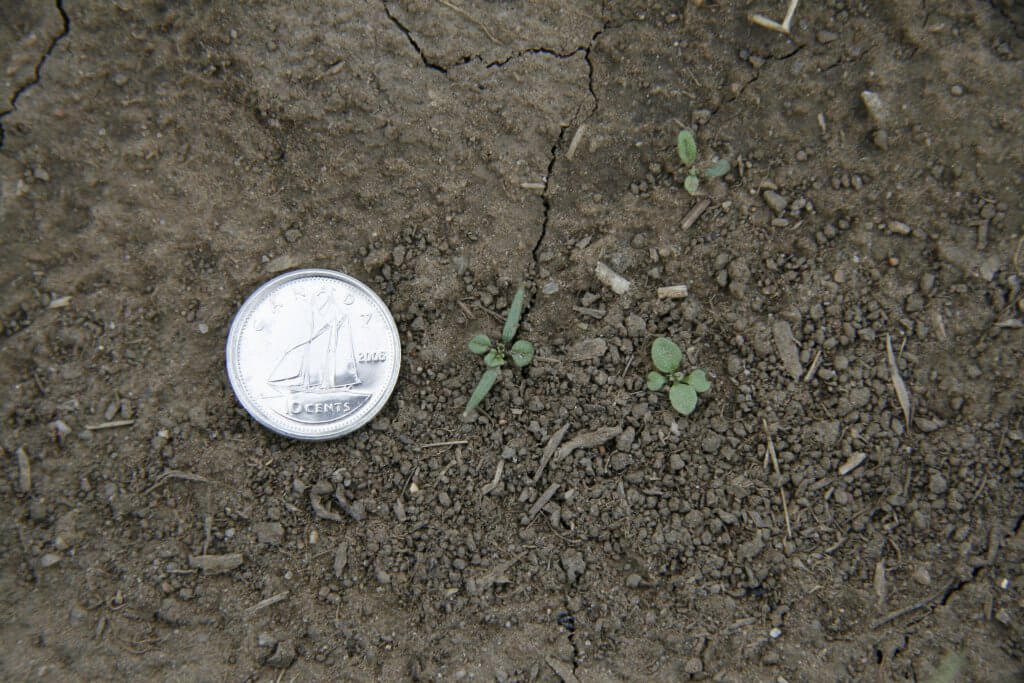
    Small weeds require more smaller droplets to secure effective targetting

    If it’s a later application into the bottom of a maturing canopy, the foliage may intercept the spray before it reaches the target area. More water will likely be needed, and droplet size may become more critical for getting the spray to its destination. Dense canopies are a real challenge and lower-canopy deposition usually benefits from finer sprays because the small droplets can turn corners better.

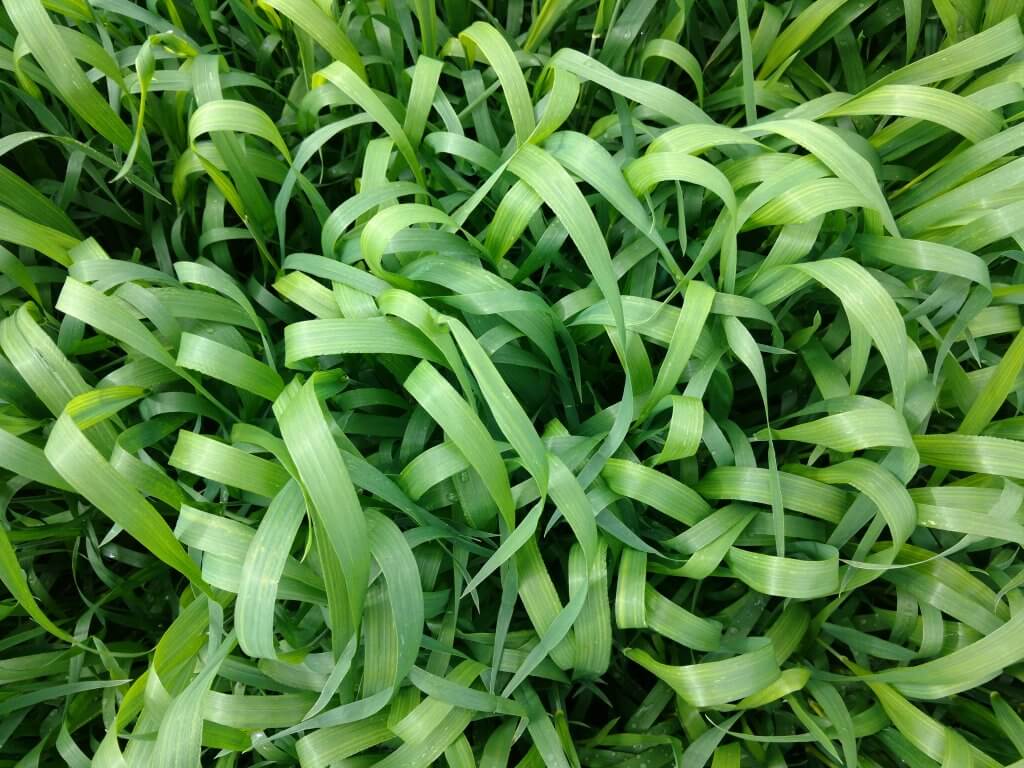
    Dense canopies are very difficult for a spray to penetrate. Higher water volumes and smaller droplets are the key tools that help.

    2. Water Volume: Regardless of canopy, the range of application possibilities will depend on the water volume and spray quality combination. It’s math: assuming some constant amount of coverage on each leaf, more layers of foliage will require more water. Using less water volume will make it necessary to use finer sprays to keep droplet numbers constant. More water will allow coarser sprays. This decision has implications for drift, and by extension, affects the number of hours we can spray in a day. More drift tolerance means better application timing and overall productivity.

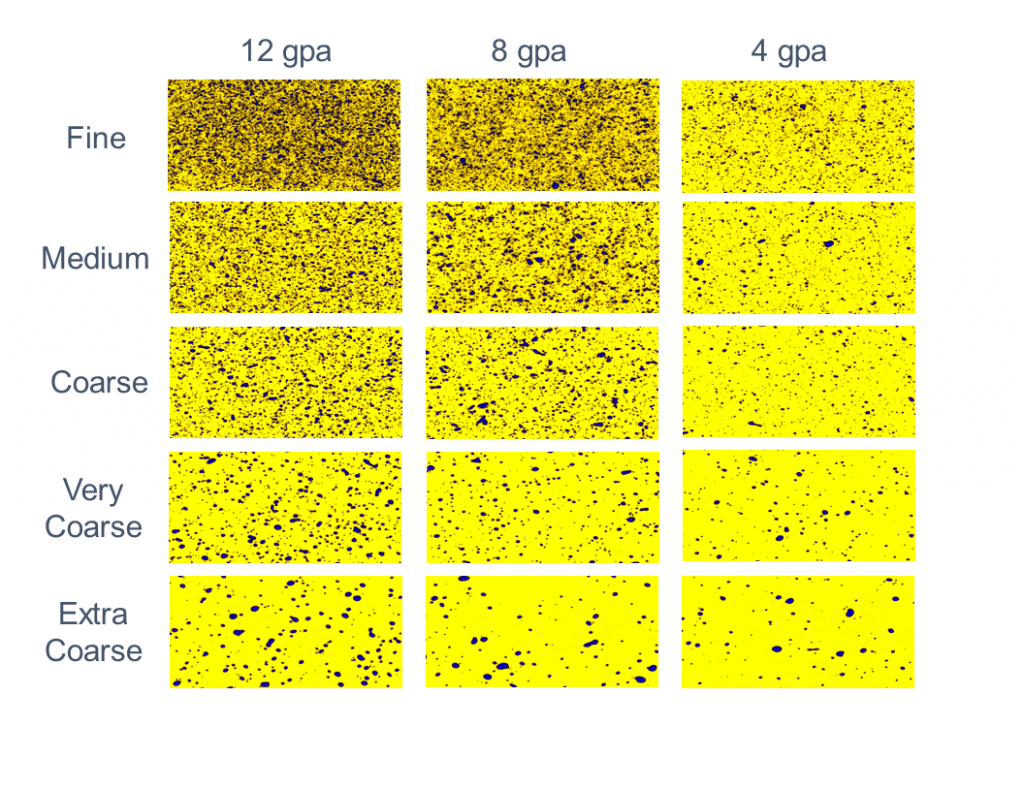
    The tradeoffs between water volumes and droplet sizes are seen in this figure. Once a certain threshold of coverage has been reached, a further increase in coverage may not provide any additional control.

    3. Target Type and Droplet Behaviour: Whatever spray we use, the target plant or insect needs to intercept, collect, and retain the spray droplet. This is where the fun begins. Target leaves may be vertical or horizontal, large or small. Their waxy surface may be easy-to-wet or difficult-to-wet. The general rules of thumb are that larger, more horizontal and easy-to-wet surfaces are better suited for coarser sprays – these are intercepted more efficiently and stick readily. That is a reason why most broadleaf weeds and crops are very compatible with low-drift sprays.

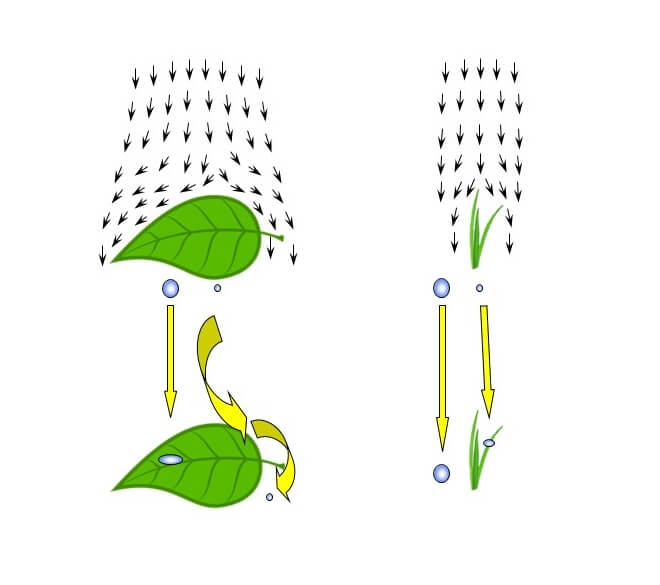
    Large targets (left) are most efficient at intercepting larger droplets (provided droplet bounce is not a problem) because smaller droplets may evade capture. Smaller targets are usually missed by larger droplets but are very capable of capturing smaller droplets.

    On the other hand, smaller, vertically oriented and difficult-to-wet plants require finer sprays for effective targetting. Larger drops tend to miss these targets or bounce off them. Most grassy, and some broadleaf weeds (especially at early growth stages) fall into this category.

    4. Mode of Action: There are nearly 30 modes of action on the herbicide world, and another ten modes for insecticides and fifteen for fungicides. The effect of droplet size and water volume on their uptake and translocation varies, and it’s probably not correct to generalize too much. There is one notable product, glyphosate. For this product, research has consistently shown that large droplets and more concentrated mixtures provide better uptake. But we’ve also seen problems when this is over-done, causing localized toxicity and limiting translocation.

    With many products, we’ve sometimes seen better performance with finer sprays due to improved coverage, yet at other times less performance due to rapid evaporation. On the whole, it’s probably still fair to say that contact modes of action require finer sprays and higher water volumes, even if there is the occasional exception. And systemic products can typically handle coarser sprays. We’ve always been surprised just how coarse we seem to be able to push the system before any loss of efficacy.

    What does it all mean? In spraying, we need to accommodate a lot of diversity. The average application is broad-spectrum, targeting large and small broadleaf and grassy plants. Many sprays are tank mixes of several modes of action. It’s impossible to prescribe a specific spray for each situation. We need a little bit of everything. And the spray should not be drift-prone. It’s easy to see that we need to aim for the middle to accommodate everything.

    The traditional flat fan nozzle, either in its conventional or low-drift form, generates a wide range of droplet sizes that can range from 5 µm to about 2000 µm. If we need fine droplets, they’re there. If we need larger droplets, they’re also there. The proportion of the total spray volume in each specific size fraction depends on the nozzle choice and size, the spray pressure, and the adjuvant mix in the tank. Overall, the system is very robust, and although it requires some tweaking, a well chosen average spray can achieve most tasks well enough.

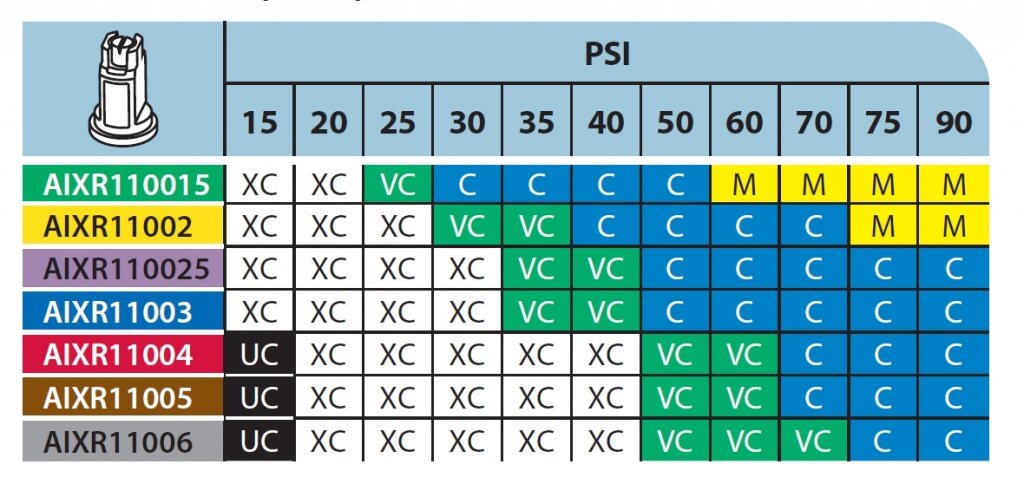
    A typical spray quality chart shows the expected spray quality for a range of nozzle sizes and pressures. Spray quality measurements follow standards set by the ISO and ASABE, these change from time to time and therefore charts tend to become outdated.

    Our research has repeatedly shown that a Coarse spray is a good starting point that does most things well. It is acceptable to move into a Very Coarse or coarser category provided water volumes are also raised, and provided the target types and modes of action are suited for this change.

    It is rarely necessary to spray finer than Coarse, and when this is done, we recommend against spraying finer than a Medium spray. There is simply no advantage from product performance, and drift risk becomes unacceptable.

    Tweaking the System. In order to maximize the performance of your spray, and the efficiency of your overall spray program, here is some advice:

    1. Know the spray quality of your nozzles, and their response to spray pressure. Manufacturers publish this information in their catalogues and on-line. Make this your homework assignment.
    2. Use the coarsest spray that you can afford to. This will make the application safer, it will widen the weather window, and it will simply let you get more done in a day or a season. Coarse sprays work.
    3. Use spray pressure and water volume to fine tune the application for a specific purpose. If using a contact product, you can keep the same nozzle you used for a systemic product. Apply more water or use more spray pressure to generate more droplets.
    4. Do not skimp on water. Higher water volumes tend to make an application more uniform, robust, and crop-safe. Spray coverage improves. Canopy penetration improves. Coarser sprays are possible. The only exception to this rule is glyphosate, which works better in lower water volumes. But with higher glyphosate rates and more tank mixing, even that exception is disappearing.
    5. Learn as much as you can about how your pesticides work and where they need to be in your canopy. Apply your knowledge to select optimal water volumes and spray qualities.
    6. Be wary of people who advise very low water volumes in conjunction with fine sprays. They want to appeal to your need for efficiency, but do so at the cost of consistency and environmental stewardship. Plus these types of applications are illegal for many of our products.
  • How to evaluate airblast coverage

    How to evaluate airblast coverage

    Note: While there’s nothing wrong with this article, a more recent article on this subject can be found here.

    It’s nearing the end of a long morning of spraying and you just want to get it done. As the tank empties and you watch the last of the spray cloud waft through the row, you’re thinking about rinsing out and moving on… but did the spray land where you wanted?

    How do you really know if you hit the target?

    Maybe you’re content with the occasional “shoulder checks” you made from the cab while spraying. Perhaps you stop at the end of the row and get out of the tractor to look for wet foliage during.
    Maybe you plan to return once the product is dry and look for white residue.

    Taken with the sprayer operator’s smart phone, here’s the over-the-shoulder view of an early-morning spray application from the cab. You can’t see coverage, but gaps in the spray will show if nozzles are plugged. You can also check to see if you are overshooting or blowing through the target. Photo Credit – C. Hedges, ON.
    This early morning “shoulder check” was photographed by the operator using his smartphone.  You can’t see coverage, but gaps in the spray will show if nozzles are plugged. You can also check to see if you are overshooting or blowing through the target. Photo Credit – C. Hedges, ON.

    These are all good feedback practices, but a more accurate method is the use of water-sensitive paper, which turns from yellow to blue wherever spray touches it. You can easily see the distribution of the spray and the overall area covered, and it can be quantified so you can compare one sprayer set-up to another, or see the impact of weather, or even the effects of nozzle choice, pressure and  water volume.

    Water- (and oil-) sensitive paper: Cheap, simple and available on-line or in person from your favourite sprayer equipment store.
    Water- (and oil-) sensitive paper: Cheap, simple and available on-line or in person from your favourite sprayer equipment store.

    Draw a map

    Begin by creating a simple drawing of the tree, cane, bush,vine, etc. you wish to spray. Label the drawing with unique numbers that correspond to where you are going to place the papers. Write the numbers on the back of each paper so you can see where they came from after they are collected. You should also note the pass number, so you can differentiate between each sprayer setup and corresponding pass. You might make a change and want to see how it affects coverage, and it’s very easy to mix up the papers if you haven’t record everything clearly. Plan to do this for at least two plants upwind from the sprayer to ensure you will get an accurate representation of average coverage. Be sure to wear disposable gloves and avoid dew so the papers don’t react prematurely.

    Create a simple drawing of the target. Number positions on the drawing that correspond to where you plan to place the papers.
    Create a simple drawing of the target. Number positions on the drawing that correspond to where you plan to place the papers.

    Distribute the papers

    It is critical to distribute the papers evenly throughout each target canopy. They should be placed in key locations where pest damage has been an issue in the past (e.g. scab at the top of a tree, or spotted-wing drosophila at the bottom-centre of highbush blueberry), or anywhere coverage is notoriously difficult. Our preference is to place them at the top, centre and bottom of a tree canopy as well as laterally from the outer edge of the canopy beside the sprayer moving in towards the trunk.

    Number positions on the drawing that correspond to where you plan to place the papers. Label the papers as well so you know where they came from. Consider writing the pass number and the position (e.g. 1-1 would be Pass 1, Position 1) so you can evaluate the changes to the sprayer settings from pass to pass. (Figure 60) Later, all the information from the calibration can be entered into your spray records, like in this example.
    Number positions on the drawing that correspond to where you plan to place the papers. Label the papers as well so you know where they came from. Consider writing the pass number and the position (e.g. 1-1 would be Pass 1, Position 1) so you can evaluate the changes to the sprayer settings from pass to pass. Later, all the information from the calibration can be entered into your spray records, like in this mock-up.

    We use spring-back paper clips attached to alligator clips at 90 degrees to attach the papers to small branches. You can also staple them to the upper or lower face of the leaves (as long as they don’t cause leaf to droop). You can wrap them around stems for panoramic coverage or to monitor drenches. They can be stapled the trunk to show if spray is aimed into the canopy or being wasted. You can even skewer to the ground using wire flags to to illustrate poor lower-nozzle positioning and/or canopy run-off. Put them wherever you want to know about spray coverage!

    This home-made double-ended alligator clip holds papers at right angles. One end for the paper, the other end to a twig or wire flag.
    This home-made double-ended alligator clip holds papers at right angles. One end for the paper, the other end to a twig or wire flag.

    We typically orient them facing the alleys so their sensitive faces are square to the sprayer as it passes. We often use two in each location, oriented back-to-back facing each alley so you can resolve coverage from both sides. The important part is to ensure you are consistent. Mark the location in the canopy with some colourful flagging tape so you can find the papers after you spray, and if you wish to replace them with fresh papers to evaluate another pass, orient them the same way to make the comparison fair.

    Water-sensitive papers located in five positions in an Empire apple tree. Two papers were pinned back-to-back in each position, distributed evenly throughout the canopy, facing the alleys. One paper was located at the lowest branch to determine if the lowest nozzle position needed to be on. Another paper was pinned to the ground face-up under the tree to show any excessive waste. Be creative, but be consistent from pass to pass.
    Water-sensitive papers located in five positions in an Empire apple tree. Two papers were pinned back-to-back in each position, distributed evenly throughout the canopy, facing the alleys. One paper was located at the lowest branch to determine if the lowest nozzle position needed to be on. Another paper was pinned to the ground face-up under the tree to show any excessive waste. Be consistent from pass to pass.

    Spray, check and spray again

    Once the papers are in place, pass by on one side with both booms open (as you would normally spray). Be sure to start spraying well before passing the target, and keep spraying afterwards to ensure the resultant coverage represents an actual application. It is very informative to get out of the cab and examine the papers before passing by on the other side. You can learn a lot about how the wind is affecting the spay.

    Once papers are in place, pass by spraying with both booms open to emulate a typical spray day. Be sure to start spraying well before passing the target, and keep spraying afterwards to ensure the resultant coverage represents an actual application. It can be very informative to examine coverage at this point to see how wind is affecting the spray. Then, pass by on the other side to complete the application.
    Once papers are in place, pass by spraying with both booms open to emulate a typical spray day. Be sure to start spraying well before passing the target, and keep spraying afterwards to ensure the resultant coverage represents an actual application. It can be very informative to examine coverage at this point to see how wind is affecting the spray. Then, pass by on the other side to complete the application.
    An example of the coverage obtained on water-sensitive papers placed throughout an apple tree canopy, and on the ground beneath it.
    An example of the coverage obtained on water-sensitive papers placed throughout an apple tree canopy, and on the ground beneath it.

    Interpret the patterns

    You might notice the outer portions of larger canopies receive more spray than the inside. This is hardly surprising given that spray must pass through the outside to get to the inside. As a result, inner papers often receive proportionally less spray and should be the basis for determining if you have sufficient spray coverage. This is also why the label recommendation of “spraying to the point of runoff” is unhelpful: the outer portion of wide, dense canopies often begin to drip before the inner portion receives sufficient coverage. Further, how do you spray to the point of runoff? How do you know when to stop before it’s too late? Label language can be frustrating…

    When water-sensitive paper is sprayed to the point of run-off, the blue dye will drip. This is fine for a drench (dilute) application, but excessive for a typical concentrated application like foliar fungicides and insecticides.
    When water-sensitive paper is sprayed to the point of run-off, the blue dye will drip. This is fine for a drench (dilute) application, but excessive for a typical concentrated application like foliar fungicides and insecticides.

    When assessing coverage, don’t follow the droplet counts in the small guide that comes with the paper sensitive paper kit – they haven’t been updated for a very long time and are more appropriate for field crop applications – not airblast applications. Research and experience suggest that 85 discrete fine/medium-sized droplets per square centimetre and a total coverage of 10-15% should be sufficient for most foliar insecticides and fungicides. Remember, this is only a suggested threshold and in the case of coarser sprays, focus more on even distribution and the 10-15% coverage.

    It’s debatable, but 85 fine/medium-sized drops per square centimetre and about 10-15% total surface covered represents adequate airblast spray coverage for most foliar applications. It is less applicable for applications made with very coarse droplets, because there are fewer of them and they generally cover more area. In this case, focus more on the even distribution of spray and the 10-15% coverage. The extreme example of this is a drench (dilute) application of oil where total saturation is the goal.
    It’s debatable, but 85 Fine/Medium-sized drops per square centimetre and about 15% total surface covered on a minimum 80% of all papers represents adequate airblast spray coverage for most foliar applications. It is less applicable for applications made with Coarse/Very Coarse droplets, because there are fewer of them and they generally cover more area. In this case, focus more on the even distribution of spray and the 15% coverage. An extreme example of this is a drench (dilute) application of oil where total saturation is the goal. Conversely, ultra-low volume applications employ Very Fine droplets and a better metric is uniform, high droplet density rather than area covered.

    Make a change and try again

    There’s no easy way to define a threshold between sufficient and insufficient spray coverage. When you retrieve and examine the papers, think about how the product is intended to work: “Is it a contact, trans-laminar or locally systemic pesticide? What are the odds that an insect or spore will come in contact with residue? Will I be spraying again soon (e.g. fungicide) and will the spray already on the leaves have residual activity?” Regarding that last thought, protectant fungicide applications are often layered, so what one spray misses, the next will catch. Quite often, “sufficient coverage” is less than most sprayer operators think.

    If you are content with the coverage, record your sprayer settings to use them again in that block (in similar weather, and assuming the crop canopy doesn’t change significantly before the next spray day). If you are not content, make a change to the sprayer to improve matters, reset the papers, and go again. It can take time and some effort to get it right, but improved coverage and reduced waste are ample financial reward for your efforts.

    Other methods of evaluating coverage

    It should be noted that while water-sensitive paper is versatile, cheap and easy to use, it has its shortcomings. Placement and orientation of the paper is very important; it’s easy to hit papers on the outside of the canopy with the sensitive-side facing the sprayer. It’s considerably harder when they are at the very centre of the canopy, or hiding behind fruit. When the thin edge of the paper is oriented to the spray (i.e. oriented facing the ground), it presents very little surface and can be difficult to hit.

    Use enough air to only just ruffle the leaves. This exposes all surfaces, however briefly, to the spray. Too much air will align leaves with the spray, exposing only their thin edge and making coverage difficult. Too much air may also cause leaves to shingle (overlap), and create shadows like on the grape leaves shown here.
    Use enough air to only just ruffle the leaves. This exposes all surfaces, however briefly, to the spray. Too much air will align leaves with the spray, exposing only their thin edge and making coverage difficult. Too much air may also cause leaves to shingle (overlap), and create shadows like on the grape leaves shown here.

    Further, the papers won’t show the finest droplets (<50 µm), so there may be spray even though you can’t see it. Taken collectively with the product’s mode of action (i.e. contact or locally systemic), and any possible re-distribution by rain or dew, spray coverage becomes a good indicator for protection, but it isn’t definitive. While coverage is a good indicator, improved coverage does not always mean improved efficacy.

    Some sprayer operators use other methods to confirm their coverage. Kaolin clay is an inert compound that leaves white residue when dry. Red, yellow or green water-soluble, food-grade dyes will also indicate coverage. Even fluorescent dyes such as phosphorus can be sprayed at night and illuminated under black lights.

    Kaolin clay and fluorescent dies sprayed into fruit canopies give a lot of information about sprayer coverage, but are relatively inconvenient compared to water-sensitive paper.
    Kaolin clay and fluorescent dies sprayed into fruit canopies give a lot of information about sprayer coverage, but are relatively inconvenient compared to water-sensitive paper.
    Red food-grade dye sprayed from a horizontal boom to demonstrate downwind drift onto a white target. This was a messy experiment and my hands, and the sprayer, were pink for a long time afterwards. Photo Credit – J. McDougall, Ontario.
    Red food-grade dye sprayed from a horizontal boom to demonstrate downwind drift onto a white target. This was a messy experiment and my hands, and the sprayer, were pink for a long time afterwards. Photo Credit – J. McDougall, Ontario.

    Take home

    These methods give the sprayer operator a lot of information because they land on the actual target, not a piece of paper hung in the canopy. But, they require a lot of time and effort and are typically out of reach for most operators. Further, they do not allow multiple applications on the same canopy to compare the effect of sprayer settings on coverage – once the target is sprayed, it’s sprayed.

    No matter which method you choose to use, understanding how changes to you sprayer, or the impact of weather, affect coverage is a critical piece of information. Operators should make an effort to evaluate spray coverage. Here are a few videos describing the process:

    Using water-sensitive paper for airblast coverage diagnostics – thanks to Penn State, Univ. New Hampshire and Chazzbo Media (2014).

    Checking water-sensitive paper in an orchard. Tower is spraying only water during a calibration run (2013).

  • How to Assess Spray Coverage in Vegetable Crops

    How to Assess Spray Coverage in Vegetable Crops

    Sprayer operators recognize the importance of matching their sprayer settings to the crop to optimize efficacy. For example, spraying a protective fungicide in field tomato should require a different approach from spraying a locally systemic insecticide in staked peppers. Knowing this, many operators make ad hoc changes and then wait to “see if it worked”. A process is required that empowers the operator to make systematic changes to their program and assess coverage immediately.

    Such a process would require some fundamental understanding of how droplets behave, the location of the target, and the physical structure of the crop. This would be tempered by broader concerns such as weather (e.g. wind, rain and inversions as they affect coverage and spray drift), pest staging, and sprayer capacity (i.e. the sprayer’s ability to cover the crop in the window of time available). Finally, there has to be a mechanism for the operator to make a single change, then assess the impact in a quick, convenient, and yet quantitative manner.

    There are always exceptions to a rule, but an operator looking to assess spray coverage might consider the following process:

    • Understand how the pesticide works. Not only do certain tank mixes and weather conditions affect pesticide efficacy, but the mode of action plays a big role. A contact product must hit the target, while a locally systemic offers more latitude and can withstand less coverage.
    • Use IPM to determine where the pest is, whether it’s at a stage of development where it is susceptible to the spray, and where the spray needs to be to affect it. For example, if the pest is deep in the canopy, or under a leaf, or in the flower, this is where spray coverage should be targeted and assessed.
    • Understand droplet behaviour.
      • Coarser droplets move in straight lines and are prone to runoff (especially on waxy and vertical targets). They rarely provide acceptable canopy penetration in dense, broadleaf canopies and do not give under-leaf or panoramic stem coverage. The Coarser the droplet, the fewer the sprayer produces, reducing droplet density. However, they are not prone to drift and can tolerate higher winds.
      • Finer droplets slow quickly and tend to move in random directions without some form of entrainment (e.g. air-assist). While they are not prone to runoff, they can get caught up on trichomes (leaf hairs) and may not reach the leaf surface. They provide improved canopy penetration and some under-leaf and panoramic stem coverage, but their lack of momentum leads some operators to use higher pressures to “fog them in”. Higher pressures are generally not advisable because they increase the potential for drift and often result in less spray available to the crop.
      • Consider the droplets’ point of view. Look along the droplets potential path from nozzle to target. If there’s something in the way, consider re-orienting the nozzle using drop-arms, or a nozzle body that can be adjusted to change the spray direction.
    • Understand the impact of water volume and travel speed. Higher volumes improve spray coverage by increasing the number of droplets. Slower speeds give more opportunity for spray to penetrate the canopy and reduce the potential for drift, leaving more spray available to cover the crop.
    • Use water-and-oil sensitive paper to assess spray coverage. The operator should pin or clip papers in the crop, in locations and orientations representing the desired target. Wire flags and flagging tape mark their locations:
      • Spray using water to establish baseline coverage.
      • Retrieve the papers and replace them with a new set in the same locations and orientation.
      • Make one change to the sprayer set-up and determine whether or not coverage was improved.
      • Continue to tweak the sprayer until coverage is improved. Sometimes, improving spray efficiency means maintaining coverage while using less spray.
      • Understand how much is enough. Knowing whether to drench the target, or be satisfied with a low droplet density depends on how the pesticide works and whether or not the pest is mobile. As a general rule for foliar insecticides and fungicides, 85 drops per square centimeter and 10-15% surface coverage on 80% of all targets should be sufficient.

    Now, a few caveats: Know that under-leaf coverage is VERY difficult to achieve and that improved coverage does not necessarily mean improve efficacy. Further, know that a systematic approach requires time and effort, and should only be performed in weather conditions the operator would spray in.

    Read about how a similar process was used to assess coverage in field tomato and in staked pepper. It may take time out of an already busy schedule, but performing this assessment is always worth it.