
Should you really get up before the birds to spray? There are a lot of good reasons for early morning and night spraying, but if you’re in a strong inversion, you might be in a world of hurt. Here’s episode 5 in our series of short, educational and irreverent videos made with Real Agriculture.
Category: Multimedia
Videos, Books, Presentations, Songs and ePubs

Lessons Learned from the Top 5 Field Sprayer Articles of 2015
When Jason and I launched the Sprayers101 website in June, I wasn’t sure what to expect. Seven short months and 150 posts later, we’re stoked to have had such a great response. About 70,000 page views. 17,000 users. Of the over 100 countries that have visited, Canada, the US, Russia, Australia, and the UK are the top 5. Jason provided some great background to the venture in his recap of the top horticulture posts. I owe him a debt of gratitude for leading this effort.
It was a pleasant surprise that a very specific subject matter such as agricultural spraying could generate this level of response. Without a single mention of the Kardashians!
Here are the top five posts on field spraying for 2015:
- Agrifac Condor: A Wake-up Call for North American Sprayer Manufacturers? 3078 views. Prior to writing this article, I’d been watching this relatively new (to me) Dutch company for about one year. I noticed that they thought big, and featured technologies that had benefits for applicators, like air-assist or twin-fluid nozzles, wide booms, and clever plumbing. On seeing the sprayer first-hand at Canada’s Outdoor Farm Show in Woodstock, I knew it was just what the industry needed. A wake up call.
- Exploding Sprayer Myths Episode IV: Speed Spraying. 2211 views. What is life without a bit of fun? Writing and filming these episodes had us in stitches. With generous support of Shaun Haney and the gang at RealAgriculture.com, we’re producing these in our spare time and with gifted resources. A big thanks to Bern Tobin for being the videographer, director, and rough cut editor, and Jason Stroeve for the final editing, special effects, voice-overs and all those other things that go into it. We hope to do more of these, resources permitting.
- A New Way to Purchase Sprayers. 1058 views. A friend recently reminded me that I used to urge producers to spend more money on sprayers. Well, the industry responded by making sprayers more expensive (you’re welcome), without actually improving our control over deposition uniformity, coverage, or drift. So yes, people are spending more, but not the way I intended. In the meantime, the innovations that matter, those on the spray boom – width, aerodynamics, recirculation, better sectional controls, droplet size and rate management – are still considered special options that are probably too expensive. We’re still looking for the right balance here.
- Sprayer Tank Cleanout. 968 views. Cleaning a sprayer remains one of the top concerns of an applicator, actually the whole industry, and we’ve written about it several times. But it wasn’t until we had a guest contributor, Katelyn Duncan, offer her views that we had any real success. Katelyn is a Regina area farmer with her own blog and an interest in machinery. She approached the issue from a practitioner’s perspective and this really resonated and generated a lot of discussion.
- Calculators and Tables. While no single table or calculator broke into our top 5, collectively they did and this is worth mentioning. Much of spraying is mathematical, from rate calculations, to calibrations and nozzle size selection, travel speed ranges and so forth. Despite living in an age of connectivity and touch screens, a laminated table in the sprayer cab is often worth its weight in gold.
So what are the lessons?
For one, we showed that a dedicated website for just one aspect of a farming operation seems to be in demand. That should encourage those specializing in seeding or harvesting techniques, commodities, fertility. Where are those sites?
People seem to want alternative, independent views, sometimes voiced as controversial opinions. Much of our media is controlled by corporate interests with soft-sell implications. Yes, it’s interesting and valuable information. But a reality check, whether it comes from an independent researcher or a new entry from the corporate world, is still needed.
Alternative formats for information are important. Not everyone learns by reading articles or deciphering charts. By offering a bit of entertainment, we can reach new clients or demographics that we’d otherwise leave behind. Plus, for Jason and I, the opportunity to be creative is probably the single most important thing about Sprayers101 that keeps us going.
Lastly, we are so pleased to have guest contributors on our site. Anyone can contribute – just drop us a note. I think it’s important to hear different viewpoints, and learn from each other. That’s one of the great things about agriculture – the willingness to share information. Any applicators out there who want to describe an aspect of their operation, from innovations in how they fill faster, to their experience with boom lights or cameras, to their thoughts on boom height controllers or PWM, we’d love to hear from you.
Thanks everyone for supporting Sprayers101.com!
My Sprayer Santa Wish List
Dear Sprayer Santa,
“I tried to be good this year. It was hard, though. Yes, I know that fast driving causes drift and lots of other problems. But I couldn’t help it – the 375 horses under the hood needed the exercise. I honestly didn’t mean it. I’d have stopped had the air-ride not cushioned all the impacts so well. I had no idea, really. The cab was so quiet. I’m sure that plume of spray and dust behind my sprayer didn’t cause any damage. I mean, nobody called me, anyways. I had no choice, after spending 2 hours cleaning out the tank and having to do another three quarters before the forecast rain. So please, Santa, can I have a bigger sprayer? Please? I think I need it…to, errr…to…to feed the world. Yeah, that’s right, Santa Baby. I need it to grow food for others. So how about it?”
I wake up in a cold sweat. Well, if there was a Sprayer Santa, he’d hear lots of excuses about these sorts of things from applicators afraid of getting a lump of coal on Christmas Day, a black nozzle so to speak.
So why don’t we stop making excuses and solve the problem by making sprayers that focus on the right things?
Here’s my “no more excuses” wish list:
- Increase transport speeds, reduce field speeds. Let’s establish gear ranges which save time getting to the field, and ensure a better quality job once we get there. Let’s focus on productivity without resorting to the easy, but bad option. Speed comes at a cost. More horsepower. More fuel. More structural stength. More weight. None of it cheap. Or good.
- Increase boom width. This one’s a productivity powerhouse. It’s every bit as good as travel speed, on a percent gain basis, and much cheaper. Where else in the world is there a better opportunity for wider booms? The earth’s temperate plains are almost without exception wide, and more or less flat. With the help of autosteer and automatic boom height, why should 120 ft be the limit? Many aftermarket manufacturers offer booms at 150 ft. But why stop there? Sure, we’ll need some engineering to make it work. But the fact is that wide booms, coupled to slower speeds that require less horsepower, can have the same productivity. Not a bad tradeoff.
- Explore lighter materials. Sure, Ford was ridiculed by GM for offering aluminim trucks. But when weight is important, alternate materials can make the impossible possible. Booms that weigh many thousands of pounds require so much strength just to carry their own weight, there are diminishing returns. And the result is that we are stuck with narrow booms. Let’s get inventive with alloys and composites.
- Focus on time saving features. On any given day, we are given maybe 6 hours of good spraying conditions, some in the morning, some in the evening, and perhaps a few in between. This can be interspersed with several days of bad conditions. What a waste to spend this precious time not actually spraying, but rather filling, cleaning, transporting, getting un-stuck, figuring. In a business where timing is so important, and where a late application can have serious yield implications, we should be spending a greater proportion of time spraying. We need help to minimize downtime.
- Dedicated clean water pumps and small sumps. Want to clean out the tank faster? Rather than relying on batch mode, reducing concentration by serial dilution, consider adding a dedicated pump to your clean water saddle tank. Introducing clean water through the wash-down nozzles while at the same time spraying out the sump dramatically increases dilution power with less water. And of course, the smaller the sump and recirculating reservoir, the faster the job will get done.
- Recirculating booms. I initially wrote these off as a bad idea when they offered a single pressure entry point (on one end) followed by an exit on the other. Over 120 ft, you’d surely see pressure drops of 10 psi – unacceptable. But with modern designs offering up to four pressure entry points (both ends and middle) these issues appear to have been eliminated. And with clever plumbing, the boom can act as an extension of the tank, making priming and cleaning faster and easier. Sectional control is now governed by individual shutoff valves, offering customizable, fast, positive shutoff.
- Better flow and droplet size control. 2016 promises to be one of the most exciting years for new atomizers, with new entries in the twin fluid, pulse-width modulation, and multiple nozzle markets. But there’s still lots of room for improvement. To the young engineers reading this, give us a nozzle that provides a 10-fold range of flow rates, each at the same pattern angle and droplet size. Let this nozzle offer easy control of droplet size from Medium to Ultra Coarse at each flow rate. How hard can this be? Make it affordable and reliable, with consistent flow rates and a long wear life. I think we’re ready to pay for this.
- Easy cleaning materials. Every year, it’s a guessing game. Are all the Group 2 residues removed from the tank and booms before you spray your LibertyLink canola? How can you be sure? Well, by checking your canola two weeks later, of course! In the meantime, all we can do is offer hope with ever more rigorous cleaning protocols, one-upping last year’s efforts to ensure that nothing got left behind. How about tank, fitting, hose, boom, and nozzle body designs engineered to eliminate these problems? How about a guarantee to that effect by the sprayer manufacturer? It’s going to take more than the occasional stainless steel component. If we have enough knowledge in fluid dynamics to send an F1 sports car into a turn at 250 km/h, then surely we can design a hydraulic system that self-cleans!
- Better aerodynamics. Let’s face it, we can’t control drift just by making sprays coarser. Eventually we’ll reduce coverage too much and this will hurt our important contact products the most. Instead, we need sprayer and boom designs that facilitate the transport of droplets towards their target, avoiding drift. Maybe the shape of our tractor units and boom components will play a role here, maybe the nozzle pattern needs a re-evaluation. Maybe shrouds will return. One thing’s for sure – we can’t simply drive faster and expect coarser sprays to solve the problem.
So that’s my list. I’m sure it’s just a beginning.
What’s on your list?
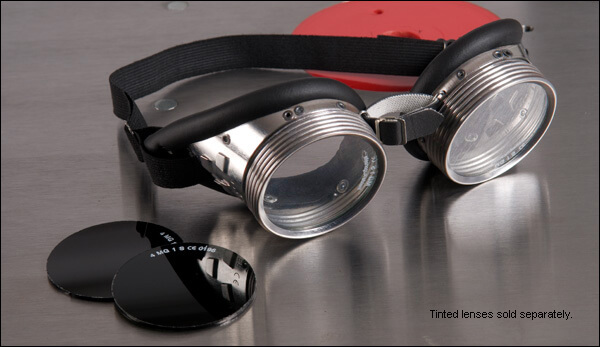
*I have a confession to make. I’m secretly hoping for those Lee Valley German Safety Goggles for Christmas. Protecting your eyes has never been cooler.
Exploding Sprayer Myths (ep.3): Nozzle Pressure
Here’s the third in our series of short, educational and irreverent videos made with Real Agriculture.
We wanted to explain where pressure readings are taken on a sprayer and why it’s so important to know what pressure your nozzle is experiencing, rather than what the screens in your cab are telling you. Not only does pressure affect your application rate, but it affects your spray quality, which can be critical if your rate controller allows the pressure to drop below 30 psi.IT’S MY TURN TO DRIVE!

Exploding Sprayer Myths (ep.2): Canopy Penetration
This is the second of a series of short, educational and irreverent videos made with Real Agriculture to bring a little levity to sprayer education. Let’s face it – ironically, nozzles can be pretty dry.
Here we enjoy an early morning soy bean scout and a light breakfast of toast as we demonstrate how pressure, droplet size and canopy penetration interact.