Category: Mixing

All hort articles about water quality, agitation, tank mixing and adjuvants.

  • Biopesticides: Holy Grail or Giant Pain?

    Biopesticides: Holy Grail or Giant Pain?

    Biopesticides are a rapidly growing segment in horticultural pest control. While they are often billed as green “miracle cures”, applicators should be aware that they require unique considerations. Issues with lifespan, target specificity, and application technology can all impact their efficacy. However, like any pesticide application, careful planning can minimize wasted time and money.

    Typically defined as pesticides derived from “natural” sources, biopesticides contain active ingredients extracted from plants, microorganisms, animals, and/or certain minerals. Given their origin, and the fact that many biopesticides are living organisms (as is the case with most of the microbial-based pesticides), they are often photo-sensitive and quickly break down. This generally means that they need to be re-applied often.

    Mixing and handling
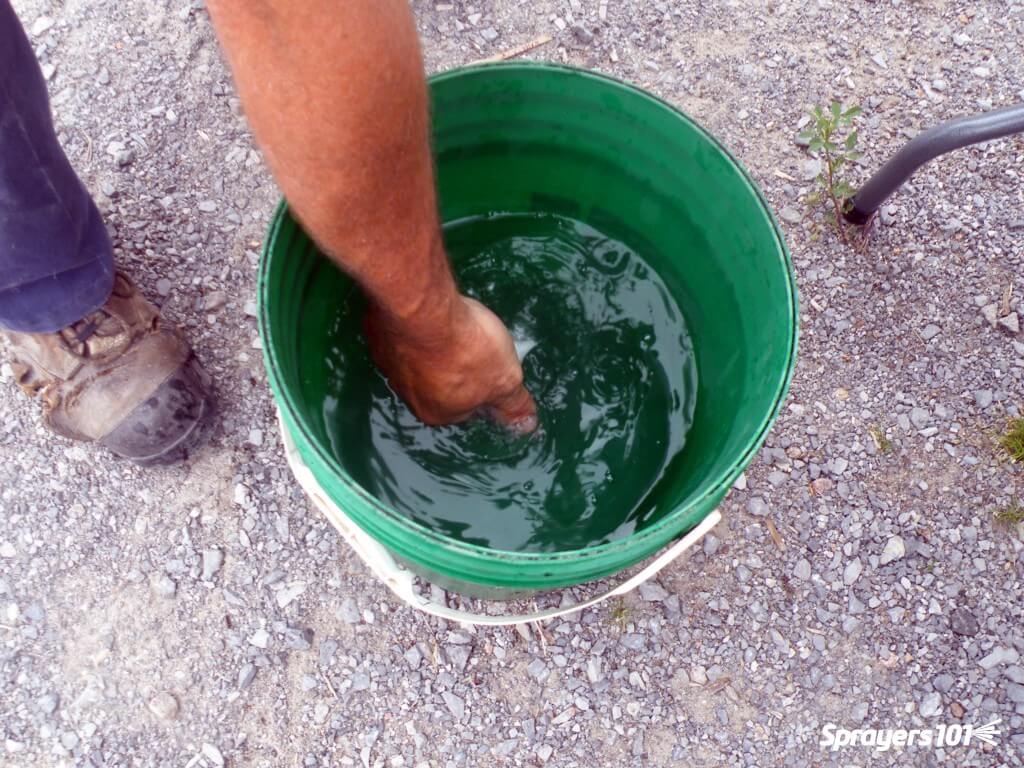
    Pre-suspending nematodes before inoculating the spray tank.
    Pre-suspending nematodes before inoculating the spray tank.

    Consideration should also be given to the lifespan of these products during the application. Many have an optimum pH for both the carrier water and the soil, and a limited temperature range outside of which they may not be active. As already mentioned, direct sunlight can quickly degrade many biopesticides, which means they should be applied either early or late in the day. Timeliness is also a factor: efficacy can be greatly reduced if the product is not used quickly – many biopesticide organisms begin to break down as soon as they are tank mixed. Also, be aware that it can be difficult (or impossible) to find suitable tank-mix partners. For example, a fungal biopesticide obviously shouldn’t be mixed with a fungicide. That also leads the applicator to consider their spray program carefully and clean their sprayers thoroughly between applications.

    Efficacy

    Applicators should understand how each biopesticide is supposed to control (or more likely, supress) pests. Many biopesticides have to be ingested or physically contact the pest. As such, they often need high application volumes to ensure sufficient coverage of all target surfaces. Many are slow to control the pest, so the applicator may mistakenly think the product is not working, and reapply unnecessarily.

    Application equipment
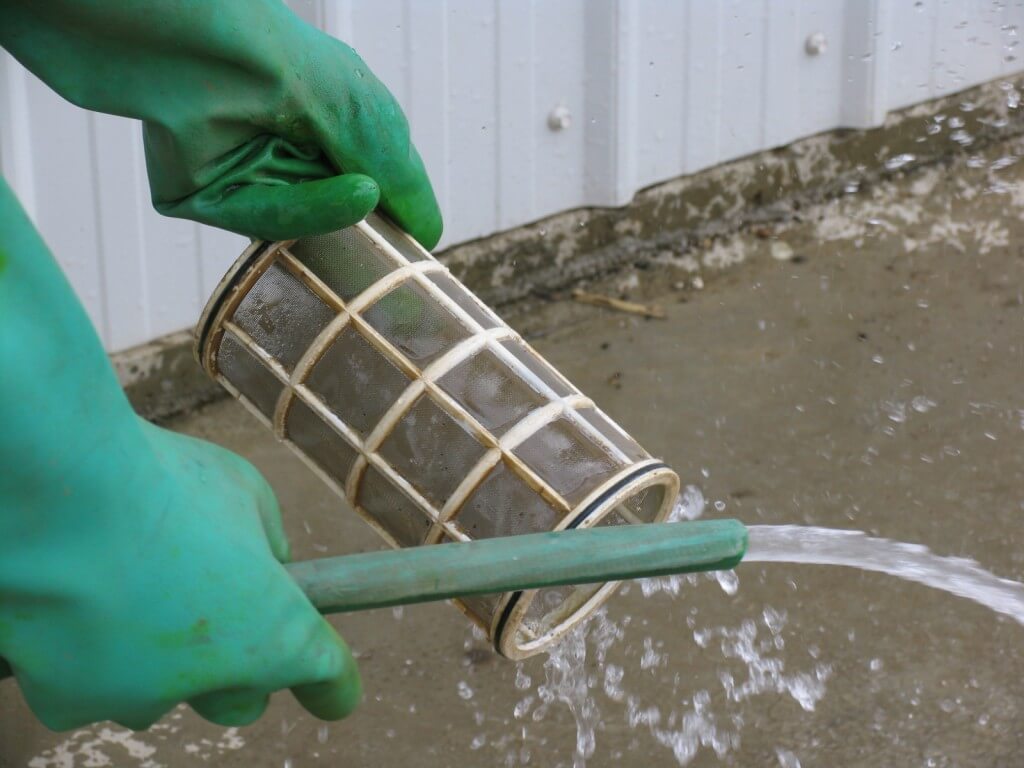
    Cleaning a strainer - image courtesy of M. Lanthier.
    Cleaning a strainer – image courtesy of M. Lanthier.

    Applicators may need to reconsider their current equipment when using biopesticides. If the product has to contact the pest, high droplet density is preferred. This can be accomplished with high volumes, but also with higher droplet counts, and that means smaller droplets. Drift issues aside, many biopesticides are actually living organisms (e.g. nematodes) which might be negatively affected by the small nozzle orifice.

    The “Spray Guy”, Dr. Jason Deveau, (Application Technology Specialist with the Ontario Ministry of Agriculture, Food and Rural Affairs) suggests using a nozzle with a larger exit orifice and no pre-orifice to minimize clogging or any potential damage to the microorganisms. Clogging can be further reduced by using a minimum of three levels of filtration on a sprayer. With proper agitation, a tank basket, suction filter at the pump and slotted strainers behind each tip should catch any “chunks”. In-line filters at the boom are also potentially helpful. Each filter, from tank to nozzle, should be filter smaller particles than the last. Cleaning screens diligently and inspecting the effectiveness of the agitation system, should be part of every spray day.

    Applicators can account for many of these issues by understanding what the biopesticide is and how it is intended to work. Consider these questions:

    • When is the pest active/vulnerable?
    • Under what conditions does the product need to be used to be most effective?
    • Are there special handling or mixing considerations?
    • What do I need to have in place to minimize the time between mixing and applying the product?

    Ultimately, an effective application of biopesticides relies on integrated pest management (IPM). Biopesticides can work as advertised when used thoughtfully and appropriately. Understanding the products benefits and limitations will ensure applicators reap the full benefits of these new and evolving methods of control.
  • Off-Label Spraying: A Lose-Lose Situation

    Off-Label Spraying: A Lose-Lose Situation

    Submitted while Dustin was the Commercial Horticulture Specialist with Alberta Agriculture and Forestry.

    Horticultural chemicals and pesticides often have the dubious distinction of being more expensive than their field crop cousins. In order to reduce costs, growers may sometimes buy and use chemicals which have the same active ingredient, but are not registered for the crop they’re being used on. This practice of “off-label” spraying is not only illegal and can result in severe fines, but can also be incredibly dangerous for your clients, your livelihood, and the environment.

    Health Canada’s Pest Management Regulatory Agency (PMRA) is the sector of the federal government that is responsible for overseeing the registration and regulation of pesticides in Canada. This includes products that producers are more familiar with such as herbicides and fungicides, as well as less thought about products such as animal repellents, rodenticides, and disinfectants. These products are all rigorously tested to compile data on residue, efficacy and long term effects, all of which is reviewed by Health Canada prior to registration. Furthermore, the PMRA is the body in charge of monitoring and enforcing appropriate use of these chemicals to ensure public safety.

    When reviewed by Health Canada, all chemicals have specified rates, target pests, and the crops on which they can be applied. ‘Off-label’ spraying can include spraying above the appropriate rate, or spraying the chemical for a pest that it is not registered for or on a crop not on the chemical’s label.

    Throughout the year, the PMRA randomly selects growers for pesticide use inspections in order to ensure compliance. These inspections could be random ones, arising from increased incorrect spraying because of a label change, the need to update information or a neighbour’s complaint. The purpose of inspections is twofold in that they serve as a deterrent to off-label spraying but also as an educational tool to encourage growers to follow labels.

    In an inspection, samples of vegetative material or soil are collected and sent away for testing. Should these come back showing incorrect use of chemicals, growers may be subject to increased monitoring, financial penalty or even prosecution under the Pest Control Products Act. If somebody producing food is found to be non-compliant, it could even result in the Canadian Food Inspection Agency (CFIA) becoming involved and product being recalled or destroyed.

    No grower wants to purposefully put themselves, their clients or the environment at risk, so how to avoid the temptation of spraying off-label? When possible, avoid the need to altogether! Good scouting and appropriate record keeping allows growers to track outbreaks over time and better plan for them in their operating cycle. Furthermore, a good chemical inventory will give producers a better idea of how much they have of needed chemicals and whether they have enough to deal with problems when they come up. Adopting biological controls in their operation may also allow growers to nip some problems in the bud before they become full blown issues.

    As with all chemicals, proper storage, labelling and disposal are all part and parcel in running a safe, effective operation. By being aware of the process and how best to handle these chemicals, growers can ensure they grow a safe healthy crop without running afoul of the law.

  • Water Quality and Spray Application

    Water Quality and Spray Application

    Water is one of the main inputs into a spray operation. The amount of water applied per acre is closely related to spray coverage and pesticide performance. But water quality – a term encompassing its cleanliness and chemical composition – is also critical to the performance of pesticides. Ensuring good performance means testing water and understanding the results.

    There are four main water quality indicators related to pesticide performance:

    1. Water Hardness. Water hardness is caused by positively charged minerals, primarily calcium and magnesium, but also sodium and iron. These cations can bind to some herbicides (glyphosate is the best-known example, also 2,4-D amine), reducing its performance. Hardness is usually named “Total Hardness (calculated)”, based on the concentration of calcium and magnesium in the sample, and is expressed in ppm or mg/L of CaCO3 equivalent. Some tests refer to the older unit “Grains”, which is ppm divided by 17.  Bayer suggests that total water hardness should be below 350 ppm (20 grains) for the low rate (1/2 L/acre equivalent) of glyphosate, and below 700 ppm for the higher rates.
    2. Bicarbonate.  Sometimes referred to as alkalinity, the bicarbonate ion can inhibit herbicide activity, and also make some herbicides more difficult to mix. The most commonly affected herbicides are members of the Group 1 modes of action, products like clethodim, sethoxydim, and others, as well as MCPA amine and 2,4-D amine. Definite guidelines are hard to find because the antagonistic effect of the bicarbonate ion depends on the presence of other ions such as sodium and calcium.
    3. pH. This is a complex parameter because it is related to pesticide solubility, hard water antagonism, and pesticide degradation. In most cases, pH values between 4 and 7 are considered acceptable. But some herbicides, notably those in the Group 2 modes of action, have specific pH needs to dissolve properly. For example, the sulfonylureas (FMC products such as Refine, Express), triazolopyrimidines (Corteval products such as Frontline, Simplicity), Triazolones (Bayer products such as Varro, Velocity M3) and Sulfonylaminocarbonyltriazolinone (UPL products such as Everest) dissolve better at higher pH, whereas the imidazolinones (Odyssey, Pursuit, Ares) tend to require lower pH. Some Group 14 products such as saflufenacil (BASF products Heat, Eragon) also prefer higher pH values for solubility. Label directions are important, sometimes calling for specific adjuvants to adjust the pH prior to adding the pesticide. Some pesticides, particularly insecticides, can break down rapidly in higher pH water. The rate of breakdown is usually not of importance on a spray day but may matter if a mixed tank needs to be stored for many hours or days.
    4. Cleanliness / turbidity. Water may contain suspended solids such as clay. Glyphosate and diquat (Reglone) are sensitive to this, as these chemicals are readily adsorbed to soil particles, and turbid water can reduce their effectiveness. This is also why dust generated by the sprayer can reduce these herbicides’ performance.

    Ensuring good performance

    Select clean water sources and conduct a water test to identify possible problems. Well water is more likely to be hard than surface water. If a laboratory water test is not available, then some quick home testing can provide the necessary guidance. First, use a conductivity meter to test the electrical conductivity (EC) of the spray water. Although this test does not identify the ions present, it shows if a potential problem exists. EC values less than 500 µS/cm are considered safe. For values above 500, a hardness test is necessary to confirm the presence of antagonizing cations. Paper test strips compared to a colour scale are a quick way to determine hardness.

    If you have done a water test and want to know what all the numbers mean, have a look here.

    If the water is hard, a generally accepted solution is to add ammonium sulphate (AMS) fertilizer at rates between 1 – 3% w/v of 21-0-0-24 to the spray tank, preferably before adding the herbicide. Spray grade liquid concentrate AMS product is available from Bayer CropScience, Winfield United, and some other suppliers.  The sulphate anions tie up the hard water cations, preventing them from antagonizing the herbicide. Liquid urea-ammonium nitrate (UAN, 28-0-0) has also been shown to improve herbicide activity for some products, but because it does not contain the sulphate ion, it is not as effective as AMS.

    Certain weak organic acids can also function as water conditioners. For example, citric acid can chelate hard water ions so long as the pH is not too low, that is, the necessary dissociable groups are ionic. If the pH is very low, these groups will be protonated and the chelating action is suppressed.

    Be careful when lowering pH. It does affect the solubility of many herbicides and possibly the function of some formulations. The outcome may be an unusable tank mix.

    Caution is also advised when adding foliar fertilizer specialty products. Adding a blend of fertilizer salts, combined with associated changes in pH, can result in unpredictable interactions with pesticides and water, resulting in sticky precipitates that may be very difficult to clean out of tanks and plumbing. Ask for compatibility data, and always conduct a jar test to be sure that the planned mixture mixes as expected. A recent study shows the effects of adding herbicides to UAN and ammonium thio-sulphate (ATS) plus nitrate stabilizers, where mixing order is critical.

    Turbidity is a problem with surface waters, especially in areas of clay soils and after surface runoff. If spray water is taken from a pond, its turbidity can be reduced by adding aluminum sulphate at rates between 10 to 60 mg/L of pond water. Thorough agitation is required, and 80 to 95% removal of turbidity is achieved within 24 to 48 h (technical information here).

    Pesticide manufacturers are usually aware of potential problems when their products are used in poor quality water. Consult with your local rep to learn of know issues and solutions before spraying.

    Check out this 2022 Real Agriculture interview with Tom and Greg Dahl of Winfield United. Pan ahead to the 16 minute mark for a discussion on water quality.