Spray adjuvants are tank mix additives that either physically or chemically influence the efficacy, consistency or safety of pesticides. For example, adjuvants can improve the handling characteristics of a spray solution (e.g. water conditioners, de-foamers, emulsifiers). They can improve uptake into a target plant and/or improve the amount of contact between spray droplet and target surface (e.g. non-ionic spreaders). They can also modify droplets to reduce the potential for wastage from drift or run-off (e.g. anti-drift additives, stickers).
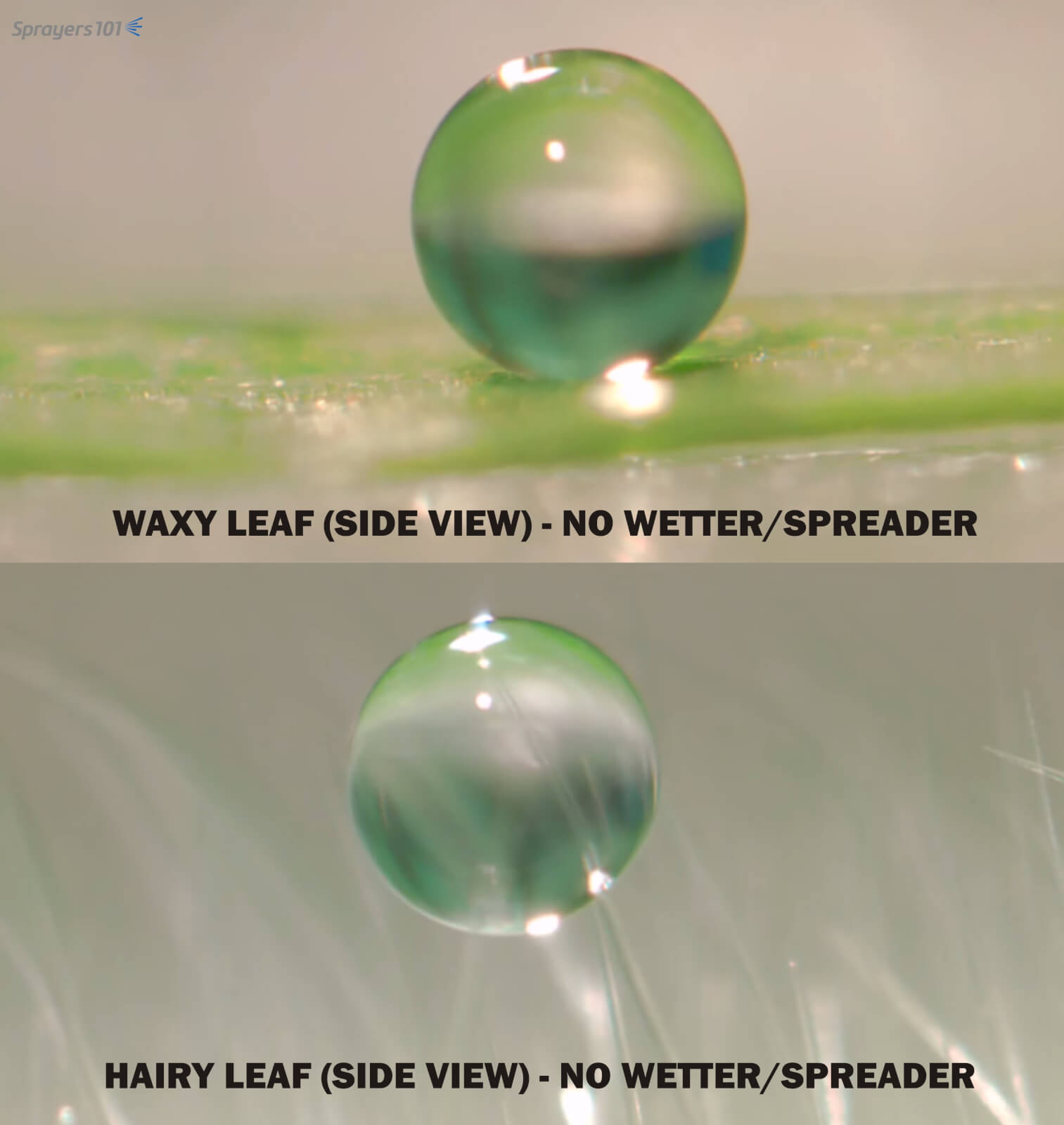
Note how little of the droplet contacts a waxy leaf (above). This hydrophobic reaction between water and wax can be overcome using a non-ionic spreader. Similarly, note how the droplet gets hung up on the trichomes (hairs) on a leaf before it reaches the leaf surface (below). Again, a non-ionic spreader would reduce droplet surface tension allowing it to splash onto the leaf. Photo Credit – Dr. H. Zhu, Ohio.
Some pesticide labels require the use of adjuvants in the tank mix for the pesticide to work correctly. They are not formulated with the product because of expense, bulk, or product stability, and must be added during loading. In order for a pesticide to work as advertised, it is important to include any adjuvants required by the label. In some cases, we are encouraged to use adjuvants to improve an application, even though they are not on the label.
There are potential benefits to introducing some unlabelled adjuvants, but there are also potential problems. The difficulty is that unless someone tests a specific tank mix combination for a specific crop, the results cannot easily be predicted. For example, when a tank mix is incompatible, an adjuvant could cause phytotoxicity, create more drift when used with the wrong nozzle, deactivate or enhance a tank partner, and/or potentially reduce spray coverage.
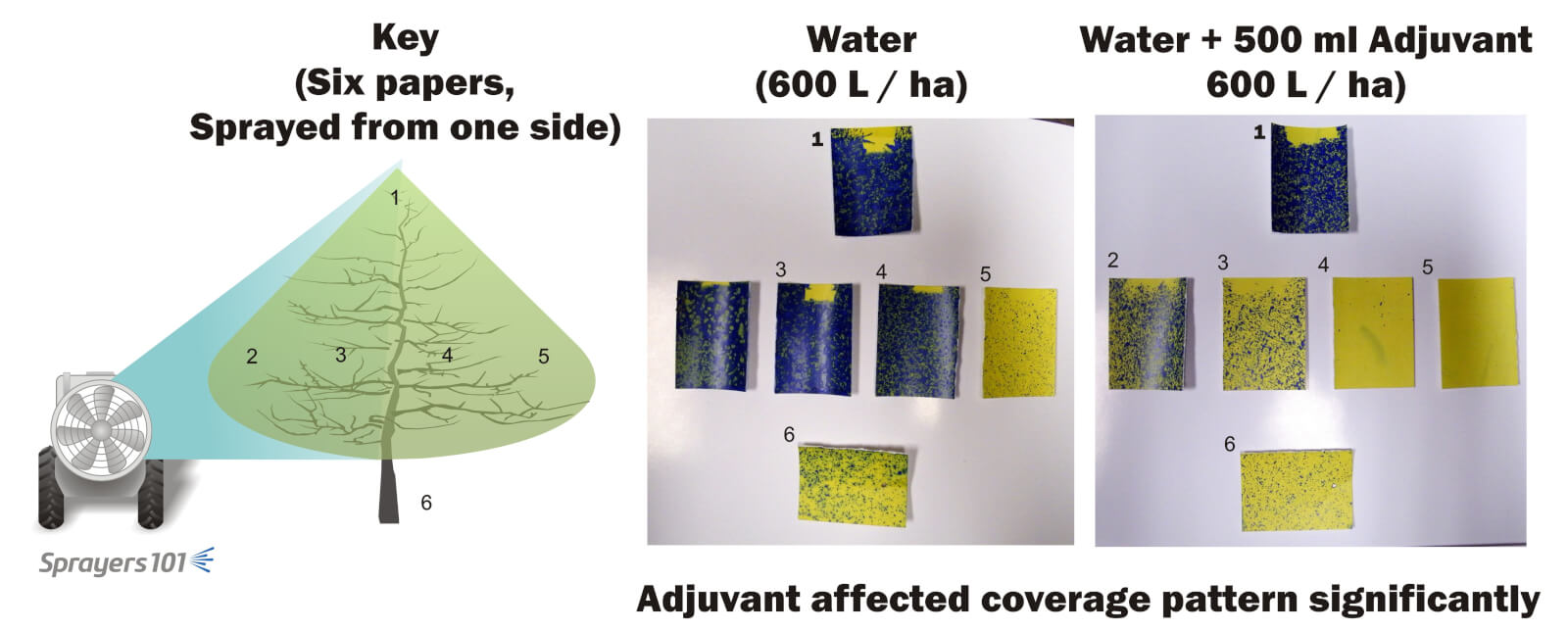
We once conducted a trial to test a deposition utility modifier intended to reduce run-off and drift. Water-sensitive papers were placed in the canopies of a 40 year old McIntosh orchard, which was then sprayed from one side in late May. The papers in the left panel (dilute control) were sprayed with 600L/ha (~60 g/ac.) of water. Those in the right panel (adjuvant) were also sprayed with 600L/ha but included the label rate of 500 ml of adjuvant. The water-plus-adjuvant reduced drift and runoff, as advertised, but did not penetrate as deeply into the canopy or spread on the papers, which is a concern if the operator was performing alternate-row middle spraying or needed better coverage (e.g. for mites). It was an unexpected side effect.
For better or worse, even small amounts of adjuvants can have a significant effect on spray coverage. Always test spray coverage when using a new adjuvant in a tank mix.
We also investigated the use of an anti-drift adjuvant in airblast sprayers, which you can read about here.
There is no simple answer regarding unlabelled adjuvants; there are too many possible product/adjuvant/plant combinations. If you intend to experiment with an adjuvant, perform a jar test to test for physical incompatibility. Then spray a small volume of the tank mix on a few trial plants to ensure there are no unexpected chemical issues (e.g. phytotoxicity or inactivating tank mix partners) or coverage issues.
It is highly recommended that every sprayer operator have a copy of Purdue Extensions’ 2015 “Adjuvants and the Power of the Spray Droplet – PPP-107”. This comprehensive handbook describes of how water quality and adjuvants affect the performance of pesticide applications. I consult it regularly.
Here are two videos from Dr. H. Zhu, USDA-ARS Ohio, showing how adjuvants that affect surface tension can help improve the level of contact between spray droplet and target surface.
Sprayers101 recently received a couple of seemingly unrelated questions about airblast sprayers:
What are the advantages and disadvantages of mechanical versus hydraulic agitation? Why would someone want a stainless tank versus the cheaper poly or fiberglass options?
Recognizing that each manufacturer has their own reasons for the features and materials used in their sprayers, we posed these questions to Mr. Kim Blagborne (formerly of Slimline Manufacturing). The following article was written from Kim’s response, and it turns out these two questions are very much related. Kim writes:
This is a great debate among customers and manufacturers, and it’s difficult to stay neutral. Let’s consider the following:
Hydraulic Agitation
The flow required for hydraulic agitation requires about 30% of the pumps total capacity. This is very important because many sprayers cannot achieve, or maintain, this minimum requirement whilst spraying. This may be why it’s rare for a sales person to demonstrate agitation while the sprayer is spraying; quite often, the agitation slows or even stops. And, of course, because everyone gets wet.
Let’s say an airblast sprayer has a pump with a manufacturer-listed capacity of 26 gallons per minute (gpm) (Click to download the spec sheet for the pump). The figure in that output chart is determined on a bench at 540 rpm and at 50 psi. However, when an operator uses that pump in the field, they run it at ~150 psi, and that brings the pump capacity down a bit to 25.5 gpm.
Now we build in the line pressure drop associated with the sprayer’s plumbing. Effectively, another 8-10% of the pump’s output is lost to plumbing (a figure easily measured by collecting the total output capacity of the pump). Let’s say we are now down to a practical capacity of 23 gpm.
If the operator’s crops are on 14 foot rows, it would be reasonable to spray 200 gpa at a travel speed of 3 mph at 150 psi. With both booms spraying that’s a required flow of 16.8 gpm.
Remember, our hypothetical 26 gpm pump can only provide 23 gpm in the field. When we subtract the 16.8 gpm required for spraying, we’re left with 6.3 gpm excess capacity for agitation. But, we said we needed 30% of the pump’s 26 gpm capacity, and that comes out to 7.8 gpm. We’re short by 1.5 gpm, or stated differently, we’re about 20% short of what we need.
Why don’t we see that deficit? Because the flow to the booms is prioritized, and therefore the sprayer output matches the calibration, so everything seems OK. But no one sees the reduced return flow through the regulator, and certainly no one peeks into the tank while spraying to see that the hydraulic agitation is greatly reduced.
And so, while everything looked great during loading, the spray mix (especially SC and WDG formulations) may not stay suspended correctly during spraying. In extreme cases, that could lead to burning a crop (high concentration) at the start of a spray job, and reduced efficacy (low concentration) at the end. We’re quick to blame the chemical, but no one ever thinks to question hydraulic agitation.
Let’s consider it from another angle: TeeJet suggests a model number 62905c-5 jet agitator for a sprayer with a 250 US gallon tank. To correctly agitate the contents of this tank, we will need 30 psi and 7.6 gpm (see the chart below).
Unfortunately, there is no simple way for an operator to measure the agitation pressure or the flow, so it goes unchecked. The only way to determine if the flow demand is satisfied is to apply the generic rule of 30% of pump capacity and make an estimate. That’s pretty loose math since we’ve already established that the listed capacity may not reflect reality.
Still another angle: Many operators now employ the Gear Up, Throttle Down (GUTD) approach to match their sprayer air settings to the crop canopy. However, when we reduce PTO input speed we also reduce pump capacity. Remember our piston diaphragm pump with the 26 gpm capacity at 540 rpm? We still need 16.8 gpm to spray, but reducing the rpm’s by 100, per GUTD, drops our pump output to only 23.16 gpm.
23.16 minus 16.8 equals 6.36, and we needed 7.8 gpm to maintain sufficient hydraulic agitation. Oops.
Mechanical Agitation and Tank Material
There are definite advantages to mechanical agitation. It is not affected by the PTO speed because it is already excessive at 540 rpm. This means there is no pump capacity issue and it allows the operator to take advantage of GUTD.
There are also a few disadvantages. Unlike a hydraulic system, mechanical agitation requires maintenance, such as regular (daily?) greasing. The packing where the the system inserts into the spray tank also requires occasional inspection and adjustment to prevent leaks.
And of course there’s sticker shock. Many European manufacturers offer hydraulic agitation because it is ~$500.00 CAD less expensive. Further, mechanical agitation creates vibrational stress on tanks walls, which fiberglass or plastic tanks can’t handle for long. The solution is stainless tanks, which is a more expensive material. Further, stainless cannot be moulded around pumps and rotating parts, so more steel is required, adding to expense and weight.
In my opinion, there is sufficient benefit to stainless to easily recover the investment. Beyond permitting mechanical agitation, there’s durability. We have stainless tanks built in 1948 that are still operating today, and we’ve never found a plastic or fiberglass tank that can claim that. There’s also sprayer sanitation. It has long been know that stainless cleans more easily and more reliably that plastic or fiberglass, especially as the tanks begin to age.
Closing
The decision to buy a sprayer with hydraulic agitation or mechanical agitation lies, ultimately, with the consumer. But be sure to look past the price tag, and under the hood. Ensure that you have sufficient agitation to properly suspend your tank mix, and give you the flexibility to Gear Up and Throttle Down to improve your spray coverage and efficacy.
Some of our biggest struggles in spraying involve the start and end of each spray day.
When starting a new field after the sprayer is cleaned, we need to prime the boom. If it’s full of water, that water has to be purged and the question is always for how long and where to do this (pro tip at bottom of article).
At the end of the day, we should ideally clean the sprayer. During that process, we may struggle with waste disposal, including large rinsate amounts, and course, the uncertainty of whether the job is actually done (since clean water looks exactly the same as contaminated water).
If not cleaning the entire sprayer plumbing, we should at least rinse the boom, even if we’re returning to the same product the following day. It can prevent future problems.
These tasks are complicated by the increasingly convoluted plumbing featured on modern sprayers. Ask someone to explain their sprayer’s plumbing system to you one day. It’s a long story! A bright spot is the well-engineered, compact, and accessible Agrifac system.
Fortunately, virtually any sprayer can be modified to suit your needs. Let’s talk about a few ideas for a winter project:
Boom flush. It’s good practice to flush clean water through your boom at the end of spraying even if the main tank remains full of product. Some sprayers have an air purge system to eliminate liquid from the plumbing and that is a great feature. A water flush should follow that purge so that any residual pesticide is diluted and removed before it can dry on and become hard to remove later. First you’ll need a clean water tank on the sprayer (150 gal is enough). Second, plumb a feed so that this clean tank can be the sole source of the water supplied to the solution pump. Select this source, shut return lines down or off, and pump clean water through boom. Sprayers that have an auto-rinse cycle will likely be able to draw clean water, but may not be able to push it to the boom, directing it to the wash-down nozzles instead. Check to see what’s possible, and make the changes you need.
Clean water pump. Installing a second pump dedicated to the clean water tank has several advantages. We’ve talked about continuous rinsing before, here, and here, as a way to dilute the tank remainder faster. It requires installation of a second pump dedicated to clean water. Additionally, give this pump the option to deliver water to the boom, not just the wash-down nozzles. Now it can be used to rinse water through the boom. The main challenge is to obtain a pump capacity that can match the needs of the boom and/or the wash-down nozzles.
Boom ends. We’ve mentioned this part of the boom many times. Boom ends must be flushed regularly to get rid of product and possibly debris that gets stuck there. A simple way to achieve this is to use the Express Nozzle Body End Caps from Hypro. These bleed air continuously, and also prevent accumulation of dead-end contamination. They do need to be flushed, and this can be done by pulling a plug or rotating the turret to an open (no nozzle ) position.
Recirculating boom. This is a significant change, but worth considering. Conventional plumbed booms are separated into five to 13 sections. Each has two ends at which the spray stops and where air and contamination can accumulate (see point #3). Each section feed has a shutoff valve. Once the spray mixture leaves the pump and bypass valve, it is committed to leaving the sprayer. In a recirculating boom, the boom becomes a part of the tank and the liquid can return to the tank if desired. Spray is pressurized at one or both ends, and valve positions determine its flow. Sectional control is achieved with individual nozzle shutoff, air or electric.
Three advantages: (a) the boom can be primed with new product without spraying. The surplus goes back to the tank. (b) the boom can be flushed with water without spraying while material is still in tank, and without spilling anything on the ground. Again, the surplus goes back to the tank. (c) high resolution sectional control with individual nozzle shutoff is a byproduct of this design. Fast response, high res, saves money.
Steel lines. Steel cleans easier than plastic, and this material makes a lot of sense for booms. But it also makes sense for the boom feeds, currently handled by black rubber hose. This hose is a literal black box. We can’t see inside it, and we don’t know if and where potential contamination resides. It has considerable surface area. Consider replacing portions of your feed lines with steel. The boom is the obvious candidate. Aside from easier cleanout, it also helps with faster nozzle shutoff because it doesn’t expand with pressure.
A word about dumping the tank on the ground. It’s a bad practice for many reasons. Let’s examine just one of those. When you spray a product at 10 gpa, you actually cover each square meter with about 10 mL, or 1/3 oz, of spray mix. When you flush your boom ends on the ground, you’re probably dropping 2 or 3 gallons in the same area. That’s 1000 times the label rate at each boom end, 10 to 26 times per boom. If you dump your tank remainder and all the hoses, say 20 or 30 gallons, that’s 10,000 times the label rate if it covers 1 sq meter. That’s leaching, runoff, residual potential, and not a good story.
Many of the changes we outlined above help prevent that from being necessary.
Pro Tip: To find out how much water your plumbing (from the pump to the boom ends) holds, do this: After cleaning with water and before spraying an EC formulation (white milky appearance in tank, some crop oils are ECs) reset your sprayed gallons on your rate controller. Start spraying and watch for the last nozzle on your furthest and longest section to spray white. Stop spraying and check your sprayed gallons. That’s your volume. No matter the size of nozzle or application volume, it stays constant. To be sure the boom is primed with a new mix, spray until those gallons are reached and you’re set.
Not being able to finish a tank due to weather or any other reason happens to just about everyone. Is it OK to simply leave the sprayer as is, and resume spraying later after some agitation?
In many cases, the answer is yes. Most pesticide mixtures are stable in short term storage. On resuming spraying, an agitation could be all that’s needed to get back to where you started a day or so earlier.
But there are three important exceptions.
When the active ingredient is formulated as a suspension. Suspensions are typically wettable powders and flowables, and rely on a clay carrier to distribute the active in the tank. Because clay is denser than water, these formulations settle out quickly after agitation stops. Sure, they can be brought back into suspension with vigorous agitation. But in lines and booms, boom ends and screens, dislodging a settled clay carrier is much more difficult. It’s also hard to tell if the cleaning has been successful because the problem spots are hidden.
The best solution is to flush the spray boom with water before materials can settle and lodge. A visual inspection where access is possible, such as strainer bowls and boom ends, is part of the process to ensure the formulated product has been removed.
Learn to identify which formulations are suspensions. There’s lots of jargon out there. Look for terms such as DC, DF, DG, DS, F, Gr, SP. Even EC formulations are suspensions (oil in water) and require agitation.
When the active ingredient is chemically unstable. Some pesticides can degrade in the tank, usually due to alkaline (high pH) hydrolysis. The effect is very pesticide specific, but in general, insecticides (particularly organophosphates and carbamates) are more susceptible than other pesticides. This fact sheet by Michigan State University describes the impact of pH on a the half-life of a large number of pesticides.
Note that in the examples in the MSU fact sheets, pesticide half lives are typically days and weeks, and only rarely hours. Also note that while high pH is most often problematic, low pH can lead to faster breakdown in a small number of products.
Ensuring tank mix stability requires a pH meter or paper, and possibly a pH modifier such as citric acid. But do your research first! Here’s an article on pH and water quality.
When the tank previously contained a product known to harm the current crop. This situation is most common and most difficult to address. Some examples from western Canada are Group 2 modes of action sprayed prior to a canola crop. Why are Group 2 products implicated? Many are formulated as dry products on a clay base, and these can settle in boom ends, adhere to tank walls, or get stuck on screens. Their solubility is pH dependent, as we explain in this article.
Canola is particularly sensitive to this mode of action, and the most common canola herbicides, Liberty and glyphosate, are formulated with strong detergents that act as tank cleaners.
Even when applicators think that their tank is clean, they can’t actually be sure and can’t do much about it at that stage. The stripping of tiny amounts of residue off the tank walls, filter screens, or plumbing, can happen during a mid-day stop or an overnight break. Applicators eventually find out that this happened, usually about two weeks after spraying.
Our advice is:
After spraying a herbicide to which a subsequent crop may be sensitive, with the classic case being a Group 2 and moving to canola, be extra diligent with cleaning and pay attention to the tank walls, all screens, and boom ends.
The best way to solve issues is to avoid them in the first place. If the weather looks unsettled and may interrupt your spray operation, consider mixing smaller batches that can be sprayed out completely even if conditions change quickly. This allows you to rinse the tank and spray water through the boom, thus avoiding a contamination problem developing overnight.
If that’s not possible, at least do not let a tank mix sit in the boom overnight. Instead, use your clean water tank to push water through the boom prior to storage and double check the screens. The following day, prime the boom with your tank mix as usual and resume spraying the crop.
If you’re not sure that your sprayer can draw from the clean water tank and push through the booms (the wash-down nozzles are, after all, the intended destination for that water), decipher your system and add the necessary valves that make this possible.
A useful design that helps flush and prime a boom quickly is the recirculating boom offered by some aftermarket boom manufacturers. These booms are also more common on European sprayers. A nice feature of such designs is that the tank contents can be pumped through the entire boom assembly without actually spraying. This ensures that the boom is primed without any soil contamination. It also dilutes whatever residue there may be in the boom plumbing with the entire tank, likely reducing its concentration enough to be of little concern.
An additional feature of recirculating booms is that many offer stainless steel tubing throughout most of their feed and return length, minimizing the black rubber hose products that often adsorb, and later release, herbicide contamination.
Even if a wholesale boom or sprayer change is impractical, consider switching to steel boom lines and tanks tank to minimize residue carryover.
As is often the case in the spraying business, prevention is easier and less costly than solving a big problem later. Spray mix storage is one of those examples where a small amount of extra effort at the beginning can pay big dividends later.
Most pesticides are either pre-formulated with the required adjuvants, or the label specifies their addition. However, compelling claims by manufacturers create interest in tank mixing additional adjuvants to improve some aspect of pesticide performance. In a previous article we advised caution when using adjuvants in airblast sprayers (see here). Specifically, we stated that unless an adjuvant has been tested with airblast equipment, do not assume it will perform as it does in a boom sprayer. In the last year, we’ve received a lot of questions about anti-drift adjuvants, so we decided to test one of the more popular products.
The Adjuvant
According to the manufacturer, InterLock is a vegetable oil-based adjuvant intended to improve deposition, canopy penetration and drift reduction from both aerial and ground applications. Independent research has validated its ability to reduce the population of Finer droplets produced by a nozzle without shifting the entire droplet spectrum into a Coarser category. As such, InterLock is used extensively in aerial and field sprayer applications, but we wanted to explore its fit in airblast applications.
There are fundamental differences in how an airblast sprayer functions compared to a field sprayer. An airblast sprayer operates at pressures considerably higher than field sprayers, and many use paddle agitation to churn tank mixes. Further, droplets are entrained by air and can be carried several meters before reaching their target. So, does the collective impact of paddle agitation, droplet shear and the increased opportunity for evaporation affect the adjuvants performance?
The Trials
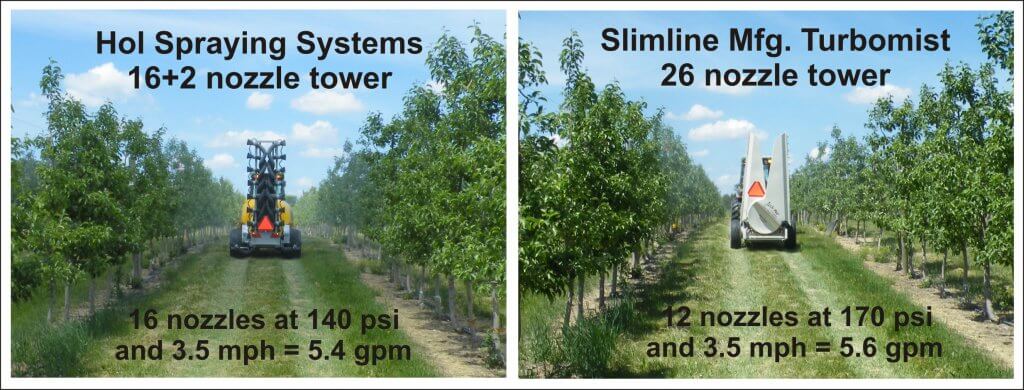
Water sensitive cards were distributed throughout target trees in an apple orchard. We elected to use two models of airblast sprayer to eliminate the chance of sprayer-specific results. Both models applied either water or water-and-adjuvant. So, the four treatments were:
Hol Sprayer: Water Hol Sprayer: Water-and-Adjuvant Turbomist: Water Turbomist: Water-and-Adjuvant
Weather Conditions
On the afternoon of May 30, 2016, the crosswind was 6-11 kmh (3.7-6.8 mph), the temperature was 27 ˚C (80.5 ˚F), and the relative humidity was ~50%. While warm, conditions were reasonable for spraying.
Orchard and Targets
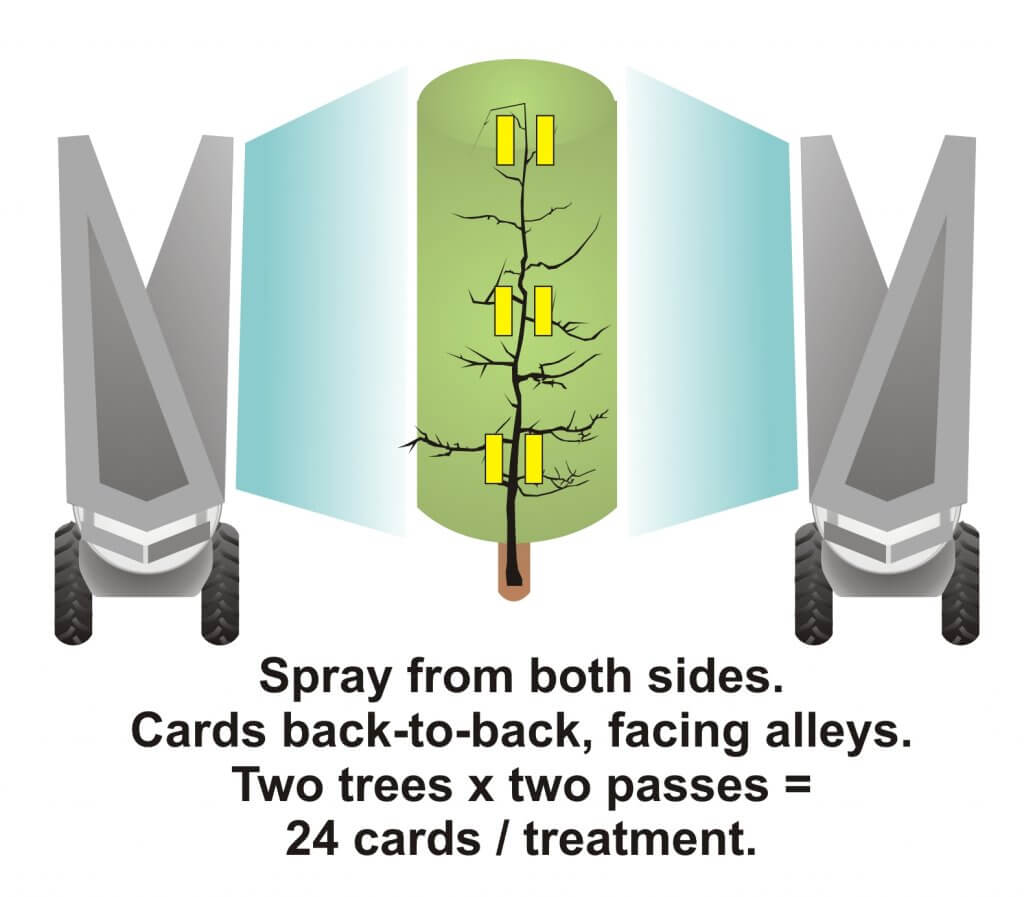
We worked in high-density Honeycrisp apples planted in 2008 on M.26 rootstock. Row spacing was 5 m (16’), average canopy width was 1.2 m (4’) and average height was 3.3 m (11’). Water sensitive cards were located at the top, middle and bottom of each target tree, close to trunk. In each location, the cards were placed back-to-back with sensitive sides facing the alleys.
We placed cards in two trees in the same row, and the sprayer passed down both sides to complete the application. We performed this twice per treatment. That’s four trees per treatment representing a total of 24 cards (comprised of eight per position).
Sprayers
As previously mentioned, we used two models of airblast sprayer. In both designs, nozzle bodies are outside the airstream, causing additional shear as nozzles spray into the air on an angle.
A Hol sprayer with tower operated at 9.6 bar (140 psi) and driven at 5.6 kmh (3.5 mph). The sprayer was calibrated and spray was distributed to match the canopy. Nozzles were TeeJet AITX 8004s and TXR 80015’s spraying 10.2 l/min. (2.7 gpm) per side for a total rate of approximately 500 l/ha (53.5 gpa).
A Turbomist with tower was operated at 11.7 bar (170 psi) and driven at 5.6 kmh (3.5 mph). The sprayer was calibrated and spray was distributed to match the canopy. Nozzles were TeeJet AITX 8004s and TXR 8002’s spraying 10.6 l/min. (2.8 gpm) per side for a total rate of approximately 500 l/ha (53.5 gpa).
Spray mix
Sprayers were filled with water for the control trials, and then dosed with the equivalent of 250 ml per 500 L (8.5 oz in 132 US gal.) of spray mix, per manufacturer’s recommendation. We ensured lines were primed and sprayer was up to speed before spraying.
Analysis
Water sensitive cards were scanned and digitized to compare coverage and median droplet size using DepositScan software (created by Dr. Heping Zhu, USDA ARS, Ohio). Water sensitive cards have a limitation when quantifying average droplet size: once a card exceeds about 30% coverage, too many droplets overlap and their combined profile is wrongly counted as a single droplet. This can skew droplet size analysis.
For the sake of an accurate comparison, we selected subsets of the overall data; we analyzed only those cards with 40% coverage or less, then refined our comparison to those cards with 30% or less, and finally cards with 20% or less. In each subset, the data remained fairly robust because they included at least one card from each canopy position (i.e. top, middle, low) and three from each treatment.
In the following tables, the range of droplet sizes is represented by DV0.1, DV0.5 and DV0.9 in µm. Basically, this is the span of droplet diameters from the smallest 10%, to the median to largest 10% in microns. The standard error of the mean and the number of papers are also indicated.
Data subset 1: Cards with 40% coverage or less
Avg. DV0.1 (µm) ±SEM
Avg. DV0.5 (µm) ±SEM
Avg. DV0.9 (µm) ±SEM
Hol
Adjuvant: 255±33 (n=8) Water: 254±24 (n=12)
Adjuvant: 664±137 (n=8) Water: 736±114 (n=12)
Adjuvant: 1,175±223 (n=8) Water: 1,391±204 (n=12)
Turbomist
Adjuvant: 252±38 (n=8) Water: 258±31 (n=9)
Adjuvant: 545±86 (n=8) Water: 697±141 (n=9)
Adjuvant: 964±168 (n=8) Water: 1,175±237 (n=9)
Data subset 2: Cards with 30% coverage or less
Avg. DV0.1 (µm) ±SEM
Avg. DV0.5 (µm) ±SEM
Avg. DV0.9 (µm) ±SEM
Hol
Adjuvant: 221±30 (n=6) Water: 189±22 (n=6)
Adjuvant: 553±127 (n=6) Water: 495±118 (n=6)
Adjuvant: 1,007±245 (n=6) Water: 969±235 (n=6)
Turbomist
Adjuvant: 240±42 (n=7) Water: 192±22 (n=5)
Adjuvant: 502±86 (n=7) Water: 433±89 (n=5)
Adjuvant: 912±184 (n=7) Water: 759±187 (n=5)
Data subset 3: Cards with 20% coverage or less
Avg. DV0.1 (µm) ±SEM
Avg. DV0.5 (µm) ±SEM
Avg. DV0.9 (µm) ±SEM
Hol
Adjuvant: 163±19 (n=3) Water: 172±28 (n=4)
Adjuvant: 371±107 (n=3) Water: 472±176 (n=4)
Adjuvant: 617±137 (n=3) Water: 904±315 (n=4)
Turbomist
Adjuvant: 240±78 (n=4) Water: 192±22 (n=5
Adjuvant: 439±140 (n=4) Water: 433±89 (n=5)
Adjuvant: 691±189 (n=4) Water: 759±187 (n=5)
Conclusions
In the first subset (i.e. 40% coverage or less) there was no trend to suggest the sprayer model made any difference in coverage. Nor did there appear to be any change in the droplet spectra produced by water or water-plus-adjuvant. In particular, there was no apparent increase in the DV0.1 when adjuvant was used, which we would expect to see if the Finest droplets produced by the nozzle were made Coarser. We hoped that by further subdividing the data to cards with 30% coverage or less, and then 20% coverage or less might resolve some trend, but there were no significant differences to speak of.
These trials are not drift studies, so we cannot say that the adjuvant has or doesn’t have an effect on particle drift. However, according to the water sensitive cards, there is no apparent impact on droplet size or deposition. This suggests that some property of airblast application has reduced or negated the benefit of using the adjuvant. As such, the use of InterLock in an airblast sprayer cannot be recommended. It supports our position that unless an adjuvant has been tested with airblast equipment, you should not assume it will perform as it does in a boom sprayer.
Thanks to Winfield for the educational donation of InterLock, to TeeJet for the nozzles and to Provide Agro for use of the Hol sprayer. Special thanks to Donald Murdoch of the University of Guelph for operating the sprayers.