Author: Tom Wolf

  • We Need Better Drift Control Technologies

    We Need Better Drift Control Technologies

    Sprayer manufacturers have all but offloaded the entire responsibility for drift management to the sprayer nozzle. It’s asking too much.

    Sprayers have changed a lot over the past 25 years. They have become larger, with more tank capacity, boom width, and, if self-propelled, horsepower.  They are more comfortable and ergonomic, with more sophisticated swath control and guidance systems. But every year, a very important deficiency in their design becomes obvious. Drift control.

    The changes described above are intended to improve productivity and fight operator fatigue.  Today’s sprayer can cover more ground than ever before. But the demand to cover ground, through a combination of growth in farm size and frequency of treatment, has outpaced machine productivity. As a result, operators find themselves ever further in a time deficit, with acres on the to do list and no time to get the work done.

    Spray drift remains the single most limiting factor to the safe application of pesticides. Spraying cannot happen when it’s too windy or during inversions because all agricultural nozzles produce fine droplets whose movement in the atmosphere cannot be controlled . This has been an issue since spraying began.

    Simply put, pesticides belong in one place only, and that is on the treated swath.  Applicators have some tools to make this happen, such as using coarser sprays, lowering the booms, choosing very specific weather conditions, and the like. But when winds are incessant, and crops and pests are quickly growing out of the treatable stages, what is an applicator to do?  There is only one thing they can do: lower their standards. Either miss the treatment and suffer the yield loss, or spray in the wind and hope nothing bad happens.

    Neither of these options are acceptable.

    There isn’t an easy fix. Spraying is a game of tight margins. The spray liquid in the tank must be atomized in droplets that can make their way to the target and provide adequate coverage when they get there. The total liquid volume to achieve that task must also be practical. The global ag industry has determined, over the past 100 years, that about 100 to 200 L/ha, 10 to 20 gallons per acre, is the ballpark amount that allows reasonable work rates with sprays that are just coarse enough to resist displacement in modest winds.  If it gets windier and we need even coarser sprays, we need to add more water to maintain an acceptable droplet density on the targets. And of course, the droplets need to stick to those targets, so there is a limit how coarse we can spray.

    Over the past 20 years, we’ve been asking the low-drift nozzle to do the heavy lifting in drift management, and it has served us well. But with a return to more contact modes of action for resistance management, there’s a need to retain good coverage for product performance.

    What ag needs is a drift-reducing technology that is better than the low-drift nozzle. We need a technology that maintains a practical water volume limit and combines this with intermediate spray qualities that generate good pesticide efficacy without allowing drift under windy conditions.

    These technologies need to do just one of three things: (a) Protect the driftable droplets from exposure to moving air with a physical barrier, (b) make driftable droplets less drift-prone by increasing their velocity, or (c) eliminate the driftable droplets altogether.

    Let’s have a look at some options, and explore the pros and cons.

    • Shields and Cones.  A shroud surrounding the boom was first proposed and built in the 1950s in the UK by Dr. Walter Ripper. Although never commercial, his “Nodrif” boom inspired an entire industry that took hold in western Canada in the 1980s and 1990s. Shrouding worked. In studies conducted at Ag Canada, shrouds produced by Flexi-Coil, Rogers Engineering, AgShield, and Brandt reduced drift by up to 80%. But shrouds disappeared in the 90s, partly because of the advent of tight-folding suspended booms where they posed a problem, but also because of crop contamination from the shrouds and poor nozzle visibility in case of plugs.

      The advent of the air-induced low-drift nozzle offered an alternative, but coarseness has been taken to its practical limit.  What about a newly engineered version of shrouds that addresses its shortcomings? Willmar Fabrication has created the Redball Buffer Sprayer, for example. We see hooded sprayers in row crops. But there may be other ideas. The simple device called the PatternMaster introduced by KB Industries a few years back was also a step in that direction. Let’s keep working on this.
    Figure 1: Shrouded booms, once common on the prairies and proven effective (Brandt cones, top), are still used on research sprayers (bottom).
    • Air Assist. Small drops don’t drift just because they’re small. They drift because they have very little kinetic energy, and they get blown off course easily. Speed them up, and that problem is solved. Introducing an air stream at the nozzle can do just that. Furthermore, air assist also enhances canopy penetration, a problem that we currently attempt to address with the addition of more water. Again, this idea is not new. Hardi, once the world’s largest sprayer manufacturer, has had the TwinForce boom available for decades. An inflatable bag is positioned over the boom. Openings along the bottom direct the air down. The operator turns a knob in the cab to control fan speed, and another for forward or backward angle, until the combination is suited to the canopy and the travel speed. The SprayAir, out of Carseland, AB (purchased by Miller and still available) was a less elegant version because they chose an air-shear atomizer that sometimes required more air than was prudent. Too much air rebounds off the ground, increasing the drift issue. Their Trident boom, allowing a hydraulic nozzle to be used with air assist, continues to have potential.  Air bag type air assist systems were also available from other manufacturers, but none were ever commercially successful.
    Figure 2: Air assisted booms such as this Hardi TwinForce accelerate small droplets, reducing their drift-potential and improving canopy penetration (Source: Hardi Sprayers)
    • Low Booms.  How low can booms go? It depends on the nozzle spacing and fan angle. Horsch claims that with a good boom package, this is an option. They are offering 10” spacing, and with wide fan angles, booms as low as 15” would still provide good overlap. Hands up who will try this at 18 mph. Wingssprayer has an interesting design where the boom rests on backswept plastic sheets, providing a physical barrier and a low height.
    Figure 3: Low booms can significantly reduce drift, but their success depends on superior stability and height control (Top, Source: Horsch Sprayers; Bottom, Source: Wingssprayer)
    • Twin Fluid Atomizer. In this atomizer type, both air and liquid are forced out through the same nozzle. The ratio of air and liquid determines the liquid flow rate and the degree of atomization. First introduced by Cleanacres in the UK as the Airtec, improved by Harry Combellack in Australia over many years, and making a re-appearance with the Dutch manufacturer Agrifac, it’s been one of my favourite atomizers, mostly in theory.  The small amount of air moving through each nozzle is not enough for serious air-assist, but the idea is good and perhaps it can be improved.
    • Electrostatics. Forget about it for drift control. The attractive force is so weak that it only works for very small droplets over short distances. It needs air-assist to work properly. See point #2.
    • Rotary Atomizer. These are all the rage on aircraft these days, offering a more consistent droplet size range that eliminates the largest, water-wasting droplets, and curtails many of the smallest droplets produced by hydraulic atomizers. These attributes are powerful and address the fundamental problem: If the small droplets drift, then let’s not produce them. In reality, rotary atomizers are used mainly to produce smaller droplets to save water in the aerial business, not really solving the drift problem. In the 1970s and 80s, the concept was advanced by Micron Corporation, led by Ed Bals and later by his son Tom. Although very successful in forestry and hand-held applications in arid regions where water posed a serious limitation, the transition to boom spraying never happened.
    Figure 4: Rotary atomizers can eliminate larger droplets and sharply reduced the smallest ones, leaving a more uniform sized distribution (insert). They are used on aircraft to save water, but have not been adopted on ground equipment to control drift.
    • A new Atomizer. This is my Hail Mary. All hydraulic nozzles produce a wide variety of droplet sizes, and that is a problem. Even the venerable dicamba nozzles that create Extremely Coarse and Ultra Coarse sprays produce some fines that drift in inversions. The idea put forth by Ed Bals, to eliminate the problematic size ranges, is sound. But the rotary atomizer is hard to implement on a boom sprayer. Can there be an innovation that maintains a simple overall design, produces a narrow, but low-drift droplet size range, and mates it to a bit of air assist to get the spray where it belongs? Absolutely.
    Figure 5: Current hydraulic atomizers tend to produce a wide range of droplet sizes. The distribution on the left results in significant drift (droplets <150 µm). The one on the right wastes the larger droplets (droplets >600 µm. The narrower span in the centre distribution avoids these problem areas and delivers the spray in an efficacious portion.

    To create value for farmers you first need to understand farmers’ priorities and problems. Getting the spraying job completed on time often means squeezing the work into ever narrower time frame, between rains, between winds in the afternoons and inversions that same evening, between too much dew and too dry, between too early and too late. I am looking forward to the day when engineering resources are allocated to address these issues better, protecting both the environment and the stress levels on the farm.

  • What’s the Relationship Between Vapour Drift and Inversions?

    What’s the Relationship Between Vapour Drift and Inversions?

    Drift symptoms can take a few weeks to be discovered, and to figure out the cause, people need to reconstruct the conditions during the application in question. Wind direction is the easiest. But when we consider factors like inversions, volatility, calm conditions, and others used to explain the movement of pesticides, it can quickly become quite confusing.

    Let’s review how and why pesticides move.

    There are about six main ways that pesticides can move off-target.

    1. Droplet drift at the time of application;
    2. Vapour drift at or after the time of application;
    3. Pesticide movement in water (precipitation or runoff) after application;
    4. Dislodgeable residues from plant surfaces after application;
    5. Pesticide-containing soil movement after application;
    6. Pesticide residue in sprayers applied to another site.

    Whenever we find pesticides in a place where they do not belong, usually first indicated by plant symptoms specific to that herbicide, we need to find out the possible reasons and take steps to prevent that from happening again. We’ll focus on the first two items from the above list because those two are the most common.

    Droplet Drift: Sprayer nozzles produce droplet sizes ranging from 5 to 1000 µm, some up to 2500 µm. All nozzles, even the venerable low-drift tips recommended for dicamba application, will have a fraction of their volume in driftable droplets, say, less than 150 to 200 µm. For the low-drift sprays, that fraction is indeed very low, only a few percent of the total spray volume. For conventional nozzles, the driftable fraction may be 10 to 20% or more if high pressures are used.

    Tiny droplets have no energy of their own and move with the air mass they’re released into. If it’s windy, they move downwind. If the air is turbulent, they move up and down. If the atmosphere is stable, the buoyant fraction stays aloft and concentrated. So in order to understand their movement, we need to understand the atmosphere.

    Vapour Drift: Some chemicals are inherently volatile. This means they convert from the liquid or solid phase to a vapour phase on their own in accordance with temperature. Water is a great example, it is highly volatile. It is also able to sublimate, which means it can convert from a solid directly to a vapour without going through the liquid phase. An example of that is freezer burn, in which ice cubes shrink due to water escaping as a vapour.

    Volatile pesticides can also sublimate. On landing on a leaf or soil, a significant portion of a droplet is absorbed or adsorbed. Some fraction may dry on the leaf surface. This remaining solid can volatilize (form a vapour) for hours or days after application. The rate of evaporation is driven by two factors, (a) the background vapour pressure of the substance in the atmosphere, and (b) the surface temperature of the object the chemical is resting on. For water, the atmospheric vapour pressure can be expressed as relative humidity. Droplets evaporate slower when the atmosphere is already full of water.

    Pesticide evaporation is driven primarily by surface temperature. The background concentration of pesticide in the air is much lower than saturation, and has no effect. Pesticide evaporation is not directly affected by relative humidity because vapour pressures are independent of each other. In other words, most active ingredients will evaporate at the same rate whether the RH is 30% or 100% (it’s actually a bit more complicated than that. See the Note on Evaporation at the bottom of this article). This will be on the test, kids.

    Vapour losses can be minimized by choosing low-volatile pesticides and also by making the application on cooler days. We also need to watch the forecast and avoid spraying when tomorrow or the day after is forecast to be hot.

    Sometimes a rainfall can affect vapour losses, prompting a release of pesticide into the atmosphere. This behaviour can be predicted by the Henry’s Law Constant of a chemical.

    Inversions:  There are two types of turbulence, mechanical and thermal. Mechanical turbulence results from air encountering friction as it moves across a landscape. Taller objects and stronger winds result in greater mechanical turbulence. This turbulence creates small eddies that allow different layers of the atmosphere to communicate with each other and transfer momentum and contents up and down. More mechanical turbulence means more mixing and more sedimentation and dilution of a contaminant. In other words, the downwind impact of drift particles is reduced with greater mechanical turbulence. Mechanical turbulence happens whenever it’s windy, day or night, and it tends to counteract thermal turbulence.

    Thermal turbulence is more powerful than mechanical turbulence for dispersion of pollutants. Driven by the solar heating of the earth’s surface, that causes the lower atmosphere to be much warmer than the air higher up. The atmosphere normally cools the higher you go (at about 1°C/100 m, called the dry adiabatic lapse rate), but when it’s sunny, the gradient is greater. In other words, it cools faster because the air at the ground is warmer.

    Thermal effects move large parcels of air up and down, and we call this an unstable  or a turbulent atmosphere. When parcels of air rise and fall great distances, we get a powerful diluting effect which is usually associated with a breeze but can also happen under calm conditions. An unstable atmosphere is great at dispersing drift, minimizing its downwind impact. This can only happen during the daytime, is most powerful when it’s sunny, and almost never happens at night.

    By the way, a neutral atmosphere occurs when the rate of air cooling with height equals the adiabatic lapse rate described above. A neutral atmosphere can occur on cloudy days just before a rain, or on windy nights. There are no thermal effects in a neutral atmosphere, and the only dispersion occurs due to mechanical turbulence (windy conditions).

    A stable atmosphere (inversion) happens when there is no solar heating of the soil. In other words, it can only happen when the sun is low in the sky or at night. In this case, soil cools off and the cold soil cools air near it. As a result, the air temperature rises with elevation. Since it’s normal for air to cool with elevation (at the dry adiabatic laps rate mentioned earlier), the temperature profile is now…inverted. Hence the name “inversion”. To be clear (write this down kids, it’s on the test), an inversion describes an atmospheric condition in which (potential) temperature rises with elevation. That’s it. It rarely happens during the day, but is common on clear calm nights. (btw, “potential temperature is the temperature adjusted by its normal rate of cooling with height. To have thermal effects, the rate of cooling needs to be different from this rate.)

    The atmosphere is called stable because there is no thermal mixing. Air parcels stay put. Suspended particles such as tiny droplets stay put. Drift clouds stay concentrated, potent. If you make a fire, smoke hangs around. Cool, dense air is near the ground, and moves laterally very slowly, and might run downhill, like water, in a sloped setting. This situation is dangerous because it can move pesticide particles or vapours great distances without them becoming diluted or dispersed. An additional danger is that relative humidity is higher at night, delaying evaporation of water from the droplets. They stay potent.

    In Summary: Pesticides move in the atmosphere and are rapidly diluted by mechanical, and especially thermal, turbulence. That is why we like to see spray applications on sunny days with a nice breeze, which moves the product in a predictable direction and dilutes any drift rapidly along the way. We minimize particle drift through the usual measures such as the use of low booms, protective shields, slow travel speeds, and coarser sprays. We avoid spray application of volatile pesticides on or preceding hot days to minimize the risk of vapour drift. We do not apply pesticides when the atmosphere is stable (inversion), which usually means from just before sunset to just after dawn on a clear night.

    OK, that’s the basics. Now let’s explore some common questions.

    1. Can all pesticides move as particles and vapours? All pesticides that are atomized through a nozzle can move as particles. Only pesticides that are considered “volatile” can form significant amounts of vapour and move in that form. Dicamba is volatile. New dicamba formulations such as Xtendimax, FeXapan, and Engenia are much less volatile than older formulations, but they’re still capable of moving as vapours. Glyphosate and many other pesticides are not considered volatile and are not known to cause vapour drift.
    2. Are inversions only a problem for dicamba? Inversions affect droplet drift from all pesticides equally. The key difference is the amount of harm that any given droplet or vapour cloud can impart. Dicamba can harm conventional soybeans, many vegetable crops, and many trees and shrubs at extremely low doses. That means that even a weak inversion or a small amount of drift can cause great harm for long distances. In comparison, most other products are not as harmful to most of our crops in such small doses (I’m generalizing, forgive me). Tiny amounts may never be noticed, but they are there. Dicamba lets us notice these tiny amounts.
    3. Does vapour drift move only by inversions? No, although its movement is more damaging under inversions. Vapour drift clouds form above a recently sprayed canopy on hot days when leaf or soil surfaces contain a volatile product. On a sunny day (no inversion), this vapour will likely disperse rapidly downwind, causing diminishing damage with increased distance in relation to the sensitivity of the non-target plant. But towards evening, the dispersion (caused by thermal turbulence) ends as the sun sets and the atmosphere becomes stable. Now, the residual vapour cloud above the crop is no longer diluted, and may move in an unpredictable direction based on the slope of the land or a very gentle evening breeze. This movement may be significant, extending for miles in some cases, and potentially causing harm along the way.
    4. How long after application can vapour drift occur? Under most conditions, vapour losses diminish rapidly and will likely be gone within a few days as the pesticide is taken up by plants, metabolized, converted to a non-volatile form, etc. For some products, a light rainfall event can release a new wave of vapour drift because these products would rather be vapours than be dissolved in water, in accordance with their Henry’s Law Constant.
    5. Do some products drift further than others? Yes and no, but mostly no. Spray drift is a physical process governed by the behaviour of droplets in the atmosphere. Droplet diameter determines its mass and this mass controls the time it takes the droplet to sediment to the ground. The substance dissolved or suspended in that droplet has no bearing on this behaviour. But there are two key exceptions to consider. First, we know that some formulations generate more fine droplets than others even when atomized through the same nozzles. The greater abundance of small droplets will create more drift damage at any given distance, and also extend further downwind. And secondly, some formulations change the rate of water evaporation from the droplets. As a result, droplets moving downwind may shrink faster, in effect making them more drift prone and causing them to move further downwind. The same droplet size drifts the same distance, but droplet size changes. Question for the final: If you spray dicamba and glyphosate on the same day using the same nozzle, and the formulation has no impact on droplet size or evaporation, which one drifts further over a soybean crop? The answer is at the bottom of this article.
    6. Do calm conditions indicate an inversion? Inversions are defined as a temperature profile, not a wind condition. But the two are associated. An inversion is most pronounced and persists the longest under calm conditions, and because it suppresses atmospheric mixing, an inversion does prevent a windier upper atmosphere from reaching the ground. But it can be calm in the middle of the day with an unstable atmosphere. The calm condition eliminates mechanical turbulence, and therefore reduces the dispersion of the spray cloud. Calm conditions are also undesirable because the winds that follow a calm period are often unpredictable in direction, force, or duration. So it’s not a great idea to spray when it’s completely calm, even on a sunny day.
    7. Can inversions occur during the day? Yes, but it’s rare. Sometimes a large cold air mass moves into an area, say from a cool body of water, pushing warm air above it. So technically the air at the ground is cooler than the air above it, suppressing dispersion through that cap. Another situation is an inversion layer that forms at the top of a transpiring plant canopy. The air at ground level is warm, and cools suddenly where the crop evaporates water from its leaves. Air temperature rises with elevation above this transpiring layer, then cools again in accordance with an expected profile. So we have a thin layer in which vertical mixing is suppressed. This is most common in dense, thick canopies with adequate soil moisture on hot days.
    8. Is there an inversion every night? No. Cloud cover suppresses the rapid cooling of the soil, and the air at soil level stays warmer longer. Wind mixes the cold air layer into a warmer air layer, returning a more neutral condition. Inversions are most likely on clear nights with little wind. Recent data in inversion frequency from Missouri and North Dakota shows that inversions occur on the majority of nights, but the frequency depends on the location.
    9. Can drift be eliminated? Yes, we can eliminate spray drift by atomizing the spray in droplets (or, for dry soil-active products on carrier particles) large enough to resist movement in wind. We would need to be sure that absolutely no fine droplets or particles are produced, and that they don’t dislodge after application. That will require different atomizers and significantly more water volume and possibly new adjuvants. Some will argue that drift can also be eliminated by protecting the fine droplets with shields or air assist, but again, the protection would need to be 100%. Drift control has not been a high enough priority for these technologies to be developed and made available to applicators. Vapour drift can be eliminated by not applying volatile products.

    Pesticide movement in the atmosphere is complicated. But pesticides don’t just move as a result of vapour or droplet drift. Consider all the options when investigating an affected field. And let’s all work together to better understand pesticide movement and to prevent it.

    Answer: Both drift equally. But assuming the beans are susceptible to both herbicides, the dicamba damage will appear further downwind due to the greater sensitivity of the beans to this herbicide. This does not mean it drifted further.

    Note on Evaporation: There is some discussion about the role of relative humidity on vapour loss. Although we stated that RH plays no direct role in pesticide volatility, we need to qualify that.

    (a) Many pesticides dissolve in water. More water moves to plant or soil surfaces during periods of low RH, and this can carry dissolved pesticide with it. The supply of pesticide that can evaporate is thereby replenished.

    (b) Evaporation is driven by temperature and the concentration gradient between the source and the atmosphere. In still air, the air layers closest to the evaporating surface are most concentrated with evaporated pesticide, slowing further evaporation. Air movement will remove these layers, increasing the rate of evaporation.

    (c) co-distillation may occur for some pesticides. This means that the pesticide dissolved in water may evaporate with water, liberating it into the atmosphere. When co-distillation occurs, low RH would increase pesticide losses as well.

    We still have much to learn about these phenomena, especially as it affects new formulations.

  • Ground vs Aerial Application of Fungicide in Chickpeas

    Ground vs Aerial Application of Fungicide in Chickpeas

    This article was originally published in the Proceedings of the Soils and Crops Workshop, 2005.

    Authors

    Tom Wolf (AAFC), Brian Caldwell (AAFC), Cheryl Cho (CDC), Sabine Banniza (CDC), Yantai Gan (AAFC)

    Background:

    Fungicide application is an important disease management strategy for ascochyta blight (caused by Ascochyta rabiei) in chickpea due to the poor host resistance in available cultivars.   Ascochyta blight, left untreated, can cause yield losses in excess of 90% in Saskatchewan, and appropriate timing and frequency of fungicide spray application is critical.  Producers wishing to apply fungicide are sometimes unsure which application method to use – aerial or ground.  Both offer potential advantages and disadvantages:  ground sprayers utilize greater water volumes, but leave tracks which can lower yield and spread disease.  Aircraft use lower water volumes but do not damage the crop and can cover more area in a timely fashion.  The relative importance of these characteristics is unknown. 

    Objectives:

    Objectives of this study were to compare aerial and ground fungicide application on chickpea disease and seed yield. 

    Materials and Methods:

    Chickpeas (certified CDC Xena, a unifoliate kabuli rated as having very poor ascochyta resistance) were seeded on May 15 (2003) and May 27 (2004) on 35-acre sites near Saskatoon which had been chem-fallow wheat stubble (2003) and spring wheat (2004) the previous year.  Seed was treated with Crown and Apron and seeded at 170 lbs/acre (35 seeds/m2) to a depth of 6.5 cm using a Flexi-Coil airseeder with 9” row spacing.  The field was harrowed and rolled after seeding.  Pursuit (70 mL/ha) and Post Ultra (0.32 L/ha) were applied for weed control in both years.  The crop established evenly and weed populations (primarily prostrate pigweed and stinkweed) were low in 2003.  In 2004, sow thistle was the predominant weed.

    In 2003, the crop was scouted at 5-day intervals for the presence of disease.  Initial disease levels through June were very low and disease did not become visible until after the first major rainfall event on July 6.  Headline (pyraclostrobin) was applied on July 11 and 21 at 0.4 L/ha, followed by Lance (boscalid) on August 1 and 13-14 at 0.42 kg/ha.  Aerial and ground applications were conducted at dusk with calm conditions.  Both were conducted within 1 h of each other except for the last application of Lance where the ground application followed the next morning. 

    In 2004, the crop was slow to establish, but disease became prevalent early in its development, especially on the side of the field which bordered the 2003 trials.  Headline was applied on July 12 and July 23, Lance was applied on August 2.  A second application of Lance was not warranted due to cool conditions which jeopardized the maturity of the crop. 

    In both years, aerial applications were done by Cessna Ag Truck applying 4 US gpa (37 L/ha) through 24 CP-03 nozzles with the 0.125 flow orifice and 90º deflection, at a pressure of 34 psi and 120 mph airspeed.  At these settings, the spray had a volume median diameter (VMD) of 271 µm according to USDA atomization models.  Swath width was 50’ and boom height was 10 to 15’ above ground. 

    Aerial application of fungicide to chickpeas, 2003.

    Ground applications were done using a Melroe SpraCoupe 220 travelling 8 mph with a 43’ boom, using XR8003 nozzles operated at 40 psi and a boom height of about 75 cm.  At these settings, the application volume was 100 L/ha, and the spray had a VMD of 246 µm. 

    Ground application of fungicide to chickpeas, 2003.

    Disease ratings were conducted on approximately the same dates as spraying.  Disease ratings were conducting using the 0-11 Horsfall-Barratt scale, converted to % infection.  Single plants were rated at 64 (2003) and 60 (2004) locations in each treatment within each rep, for a total number of 128 or 120 plants rated per treatment per rating date (except for the first rating, where only 24 plants per treatment were rated).  Ratings from the outside two passes of the aircraft in each replicate were deleted since proper spray patterns were not expected at these edges. 

    In 2003, the crop matured in mid-August and Reglone was applied by ground sprayer travelling perpendicular to the treatments, on August 22.  In 2004, the crop failed to mature and was sprayed with Roundup on September 20. 

    The 2003 crop was harvested on September 3 using a Case 1688 combine with a 30’ flex header.  After removal of headlands, two 275 m long swaths were taken from each treatment, and the seed from each swath was weighed and sub-sampled for seed quality.  In the aerial plots, the central two spray swaths of each rep were sampled.  In the ground plots, two swaths were taken with wheel tracks, and two without wheel tracks in each rep.  Wheel tracks were then adjusted to a 90’ boom width for yield calculations.

    In 2004, harvest was impractical with the large combine due to the low seed yield and quality which prevented accurate yield measurements.  On November 10, a Hege combine was used to harvest a single pass along the length of each sprayer swath for all treatments.  The grain was bagged, dried , and weighed. 

    All data were analyzed using analysis of variance (ANOVA) as a randomized complete block design with two replicates.  Treatment effects were considered significant at p=0.05. 

    Results and Discussion:

    Ascochyta was prevalent in both 2003 and 2004.  In 2003, disease severity in the untreated chickpea progressed from about 5% to about 66% from July 9 to July 31.  Disease severity in sprayed plots was significantly less, about 18 and 21% for the ground and aerial treatments, respectively on July 31.  A late flush of disease on new growth increased levels to 87% in the untreated plots, and 28 to 41% in the ground and aerial plots, respectively, on August 14.

    Ascochyta blight severity on chickpeas throughout growing season, 2003

    In 2004, disease in the untreated plots steadily increased from 3% infection on July 14 to 99% on Sept 14.  During this time, the treated aerial and ground plots increased from 4 to 18-20%, similar for both application methods.

    Ascochyta blight severity on chickpeas throughout growing season, 2004

    Application methods generated visually different spray deposits on water sensitive cards.  The ground application had greater overall coverage of the cards primarily due to the greater water volume used (100 L/ha vs. 37 L/ha)  Cards indicated that overall uniformity of the spray deposit along the width of the boom was greater for the ground sprayer (data not shown).  However, water sensitive cards provide an artificial collection surface that does not accurately simulate the complexity of a leaf surface or a multi-dimensional plant canopy.  These cards therefore do not provide an assessment of leaf coverage, but are limited to a visual indication of the type of spray quality emitted by the application. 

    Spray deposit on water-sensitive paper for ground application at 100 L/ha
    Spray deposit on water-sensitive paper for aerial application at 37 L/ha

    Fungicide application significantly increased seed yield in both years.  In 2003, yield averaged 13 bu/acre for the unsprayed treatments, and 33 bu/acre where fungicide had been applied.  Aerial treatments yielded 32.7 bu/acre, whereas ground treatments (track damage adjusted for 90’ boom width) yielded 34.4 bu/acre.  This difference was not statistically significant (Table 1).  Ground-sprayed areas without wheel tracks yielded 36.0 bu/acre, therefore yield loss due to tracks was 1.6 bu/acre.

    Chickpea seed yield in plots treated with fungicide applied by air and ground, 2003.

    Table 1:  Analysis of Variance (ANOVA) for chickpea seed yield from aerial and ground applications (ground with tracks adjusted for 90′ boom), 2003

    Effectdf
    Effect
    MS Effectdf ErrorMS ErrorF-valuep-level
    Trt15.8911.414.180.290
    Rep112.1011.418.580.209

    Sprayer tracks reduced yield due to crop destruction, but they did not appear to spread disease within the crop.  It is possible that application during evening hours before dew wetted the foliage helped prevent disease spread.  The role of sprayer tracks requires further investigation. 

    Seed yield and quality were very poor in 2004 due to cool growing conditions and an early frost.  In spite of this, results mirrored those from 2003:  fungicide significantly increased yield, from 0.3 bu/acre in the untreated plots to 4.7 and 4.9 bu/acre in the ground and aerial treatments, respectively.  Yield differences arising from application method were not statistically significant. 

    Chickpea seed yield in plots treated with fungicide applied by air and ground, 2004

    Seed quality analysis demonstrated no difference in chickpea grade of either ground or aerially applied fungicide.  Aschochyta rabiei was not detected on seed from any treatment. 

    These results showed that both ground and aerial application of fungicide provided effective control of Ascochyta rabiei on chickpeas.  Results from 2004 were compromised by a poor growing season, therefore further work may be necessary to confirm this outcome.  Nonetheless, the consitency of conclusions support recommending both methods to producers wishing to apply fungicide. 

    Acknowledgements:

    We thank Roland Jenson (Cloud 9 Airspray) for conducting the aerial applications, Mark Kuchuran and Dan Caldwell (BASF) for providing fungicide, herbicide, and overall support, Jim Kelley (Redhead Equipment) for providing harvesting equipment, Al Baraniuk (AAFC) for assisting with seeding and harvesting operations, and Curtis Sieben and Chris Gilchrist for implementing this trial.  Financial assistance was provided by the Saskatchewan Pulse Growers (2003) and AAFC through the IFSP Initiative (2004). 

  • Don’t try this tempting shortcut

    Don’t try this tempting shortcut

    There’s a call that I’ve been getting for 20 years now. It came again this week. Someone has a twincap with two small air-induced tips, and they’re applying herbicides and fungicides with low water volumes, often 5 gpa, sometimes less. They call because they want to know how much wind they can spray in. Is 30 km/h OK? They want my blessing.

    I don’t need to hear much more. Some nozzles are sold entirely on the premise that they provide superior coverage – more droplets per square inch – and that this improved coverage permits the reduction of water volumes. Furthermore, the claim goes, when water is reduced, the spray concentration increases and the whole darn package just works a lot faster and better.

    This line of thinking is as old as spraying itself. Applicators seek pesticide performance as well as productivity, and this approach gives them both. The proponents are well aware of their customers’ desires, and sell into it. “Use these tips and cut back on water. Any more than this just runs off anyways. You’ll get better coverage and better performance, get more spraying done.” It’s a convincing argument. Get an edge on your neighbour, the person who’s not in on the secret and is wasting time and water.

    Why don’t I embrace it? There are a few reasons.

    First, it doesn’t tell the whole story. Invariably it involves a twin nozzle setup. Use two nozzles, get more droplets, right? If that were true, believe me, I’d be advocating for quintuples.

    Fact is that the only factors that change droplet numbers are droplet size (spray quality) and water volume. Want more droplets at the same water volume? Make the spray finer. Want to keep spray quality and add droplets? Add water (not nozzles).

    The easiest way to improve coverage at the same volume is to use a finer nozzle, or to increase spray pressure. Depending on how far you go, you could make the spray finer and cut water, and still have more droplets per square inch.

    The hardest way to improve coverage is to purchase a twincap and buy two nozzles, each of them half the size. True, within any given nozzle type, smaller sized tips usually generate finer sprays. But why bother with two tips? They’re more expensive and plug more.

    If someone asks me how to improve coverage without changing water volume, I usually tell them to speed up a few mph. The rate controller will increase pressure and the spray gets finer. If speeding up is not possible, get one size smaller nozzle and run at higher pressure, same speed. Or keep nozzle and speed, and add some gpa, pressure will go up. It’s that easy. No twins necessary.

    Second, the twin nozzle/low volume approach exaggerates the value of the twin nozzle for herbicides. With small plants and relatively open canopies in the early season, plus our high booms and travel speeds, the twin tips are not adding a lot, if anything at all, to coverage. It remains a sum of droplet size and water volume, the angle is not important at this stage. Deposit is by turbulence and wind, most of the time.

    Third, low volume believers ignore a few potential problems. Drift is a big one. Low volume, fine spray operators are surrounded by nervous neighbours. They have fewer hours per day during which drift is acceptably low. And they definitely should not be on the field when wind is at 30 km/h. Basically, they’re a bit uncomfortable (at least they should be) and get less done per day.

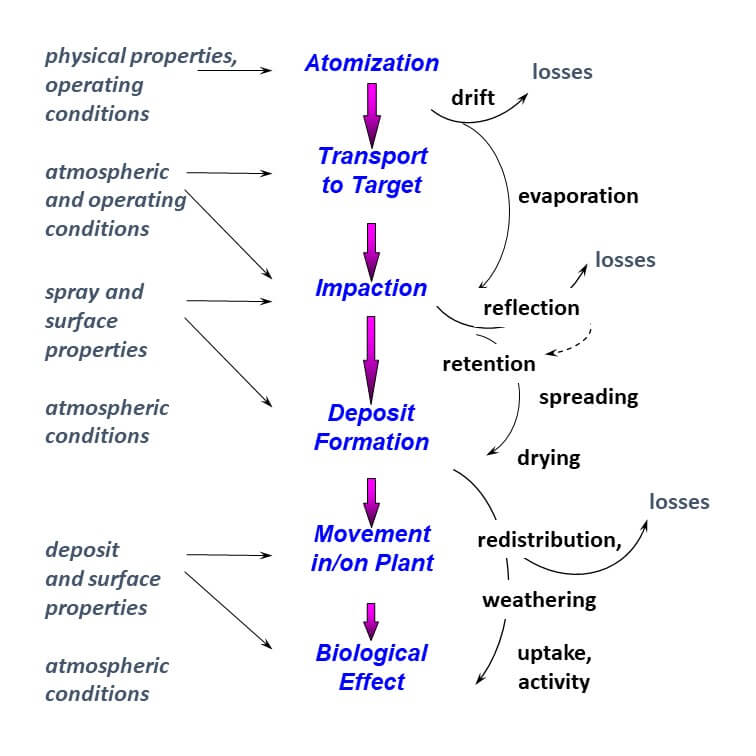
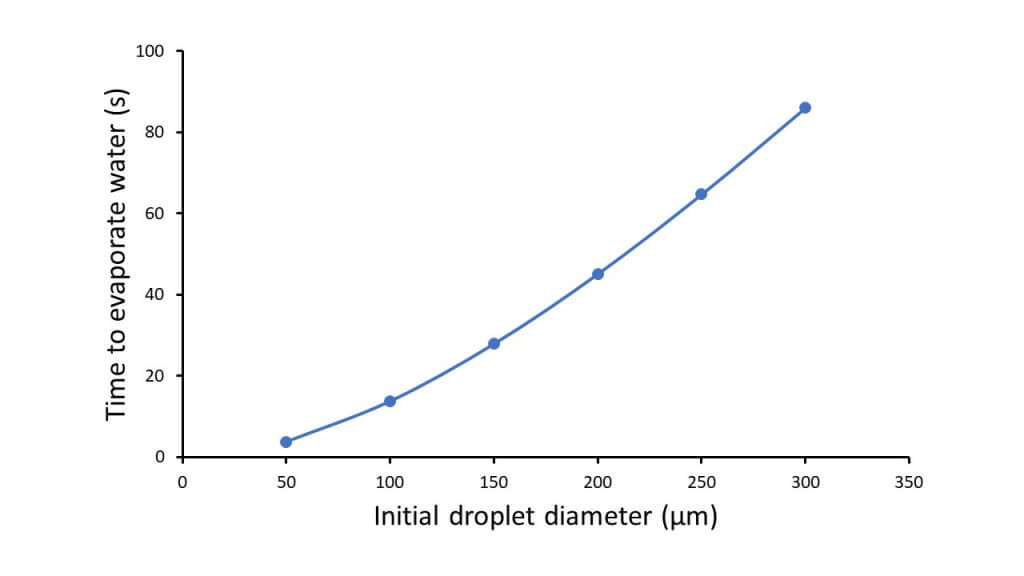
    Another potential problem is evaporation. Most sprays, even when applied at lower volumes, are still 90% or more water. The same volume of water evaporates much quicker when atomized into smaller droplets. This has two main downsides: On their way to the canopy, small droplets evaporate and become even more drift prone, and may not impact at all. Those that impact evaporate shortly thereafter. Research has shown that pesticide uptake is better from wet than dry deposits.

    When Delta T (dry bulb minus wet bulb temperature) is high, evaporation can be so strong that it reduces pesticide performance or causes solvent burn. Fine sprays make it worse.

    I also hear about the use of oily adjuvants to control evaporation from small droplets. This could be even more dangerous. Small droplets drift, and evaporation to dryness is actually helpful in reducing the impact of that drift. How? It makes the small droplets disappear, with their remnants dispersing into the turbulent atmosphere. With oily adjuvants, the small droplets stick around and stay potent and their drift damage is much worse.

    Lastly, the practice is possibly off label. Water volume and spray quality label statements are designed to offer good performance and acceptable drift risk. While that part of the label is often a bit dated, it does provide better support from the manufacturer should something go wrong.

    If you’re spraying under hot, dry and windy conditions, the low volume, fine spray approach is irresponsible. Use sufficient water (7 to 12 gpa) to allow low-drift sprays, at least Coarse to Very Coarse, in some case, even coarser.

    Agronomists provide the best possible information for their clients, based on scientific evidence and experience and in accordance with their professional code of ethics. Sometimes the news we deliver aren’t what the customer wants to hear. But we have to represent the interests of all of us, collectively. I find that pretty important.

  • What Nozzle is This? (Field Sprayers)

    What Nozzle is This? (Field Sprayers)

    Us this handy visual guide to identify a mystery nozzle you may find on a field sprayer. We’ve included the most common low-drift nozzles found on North American, European, and Australian sprayers. The list does not contain any conventional flat fan nozzles.

    It’s in alphabetical order by manufacturer.

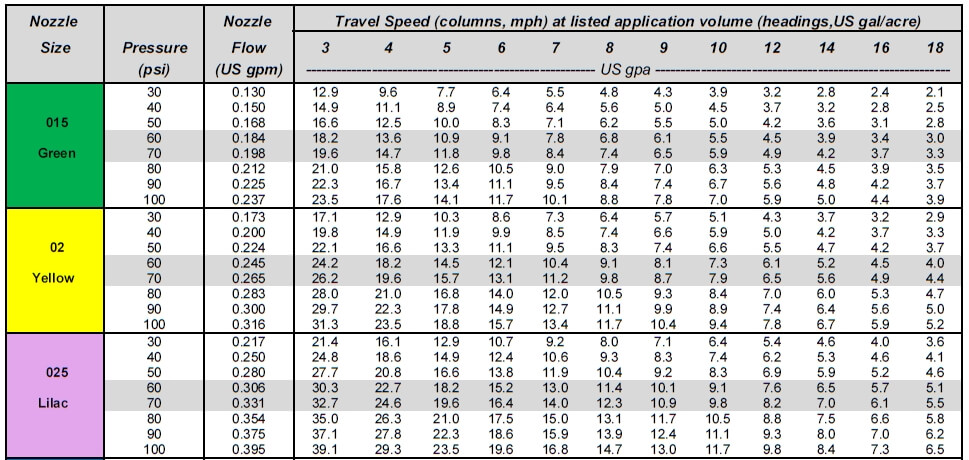
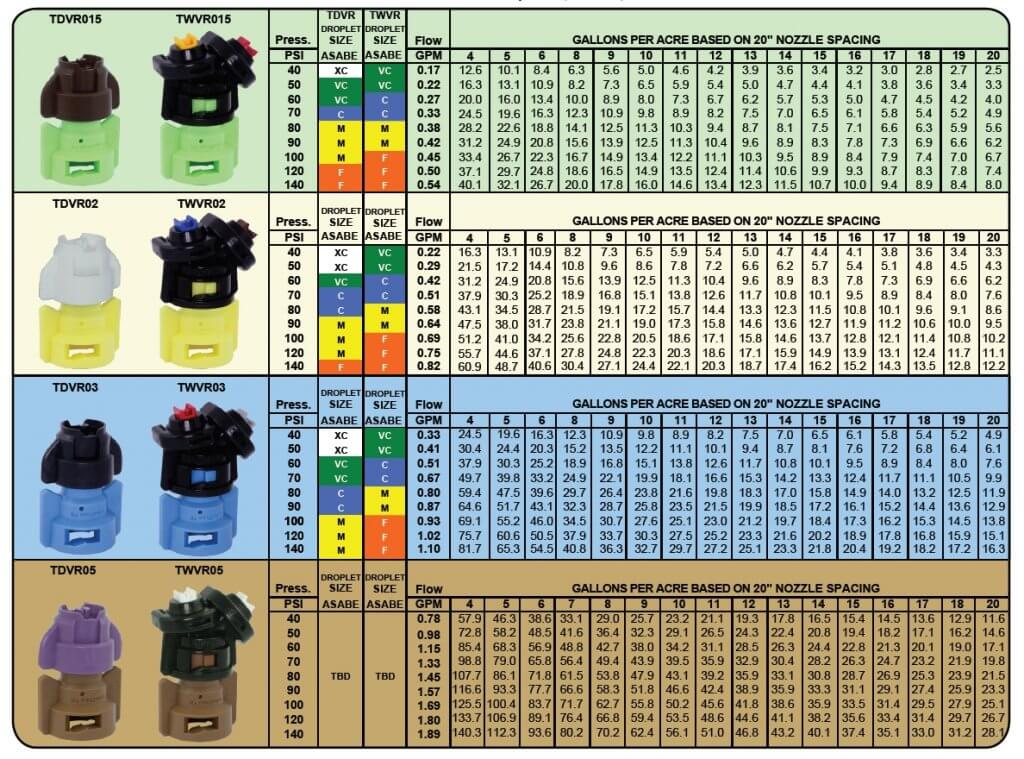
    First, a reminder of the ISO colour coding of nozzles by nominal flow rate, and their approximate output at normal speeds and nozzle spacings.

    ISO Flow rate colour coding and benchmark application volumes for US and metric units

    Also recall that most nozzles have markings that identify their fan angle (usually 30, 40, 65, 80, 90, 110, 120, 130, or 150 degrees, with 80 and 110 being most common) or flow rate (in US gpm, as shown in figure above).

    Albuz (manufactured in France)


    Albuz AVI (also John Deere ULAC)
    Type: Air-Induced
    Average Pressure: 60 psi
    Average Spray quality: VC
    Sizes Available: 01 – 10

    Albuz AVI Twin
    Type: Air-Induced Twin
    Average Pressure: 60 psi
    Average Spray quality: VC
    Sizes Available: 01 – 06

    Arag (manufactured in Italy)

    Arag Compact Fan Air (CFA)
    Type: Air-Induced
    Average Pressure: 60 psi
    Average Spray quality: C
    Sizes Available: 01 – 04
    Arag Compact Fan Air Ultra (CFA-U)
    Type: Air-Induced
    Average Pressure: 60 psi
    Average Spray quality: C-VC
    (intended for 2,4-D label compliance in Australia, available in 01 – 03 sizes only)
    Arag Twin Fan Low Drift (TFLD)
    Type: Pre-Orifice, suitable for PWM
    Average Pressure: 60 psi
    Average Spray Quality: VC – XC
    Sizes Available: 02 – 05

    Billericay Farm Systems (manufactured in UK)

    Billericay Farm Systems Air Bubble Jet (ABJ)
    Type: Air-Induced
    Average Pressure: 60 psi
    Average Spray Quality: M-C
    Sizes Available: 01 – 06
    Billericay Farm Systems EasyJet (known as Pulzar in UK)
    Type: Pre-Orifice, suitable for PWM
    Average Pressure: 60 psi
    Average Spray Quality: M-C
    Sizes Available: 01 – 08

    Greenleaf / Agrotop (manufactured in Germany)

    Greenleaf AirMix (made by Agrotop)
    Type: Air-Induced
    Average Pressure: 60 psi
    Average Spray Quality: C
    Sizes Available: 01 – 06
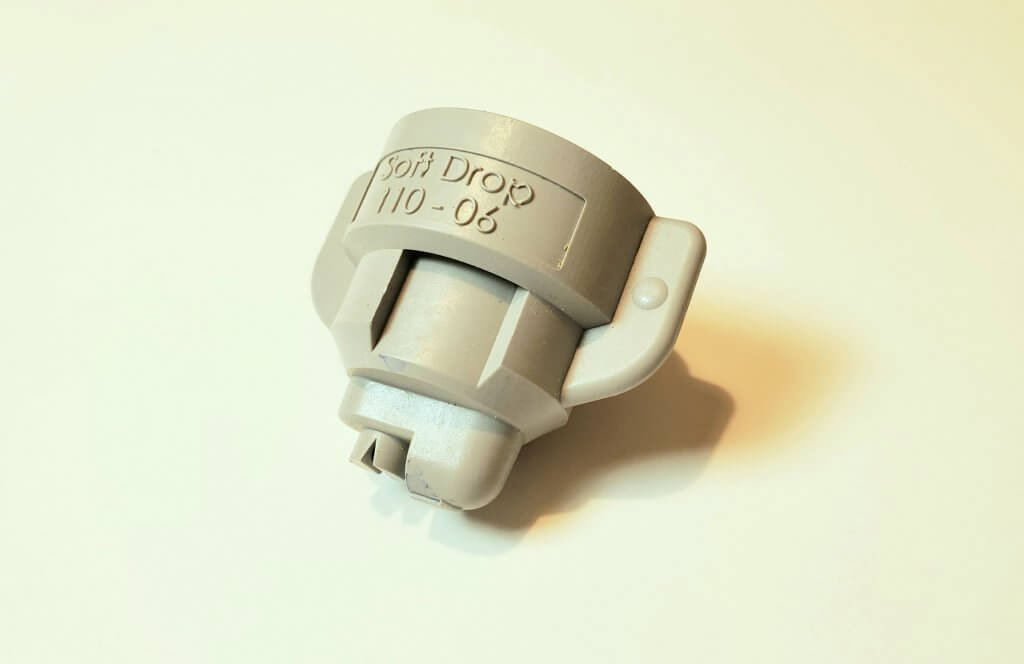
    Greenleaf SoftDrop (made by Agrotop)
    Type: Pre-orifice, suitable for PWM
    Average Pressure: 60 psi
    Average Spray Quality: XC – UC
    Sizes Available: 04 – 10
    Greenleaf TurboDrop-XL (TDXL, made by Agrotop). TDXL-D appears same, but has larger exit size and produces coarser sprays for dicamba
    Type: Air-Induced
    Average Pressure: 60 psi
    Average Spray Quality: TDXL, C-VC, TDXL-D, XC-UC
    Sizes Available: 01 – 15 (08 for -D)
    Greenleaf TADF (made by Agrotop). TADF-D appears same, but has larger exit size and produces coarser sprays for dicamba
    Type: Air-Induced Asymmetric Twin
    Average Pressure: 60 psi
    Average Spray Quality: TADF, C-VC, TADF-D, XC-UC
    Sizes Available: 01 – 15
    Greenleaf Dual Fan (DF, made by Agrotop), asymmetric twin.
    Similar to Hypro TwinCap, assembly can house two nozzles to produce a twin spray.
    Greenleaf Low Drift Dual Fan for PWM (BPDF)
    Uses AirMix nozzles with air portion removed.
    Spray Quality M – XC
    Sizes Available: 06 – 12

    Hypro Pentair / John Deere (manufactured in UK and USA)

    Hypro Guardian (Also John Deere LDX)
    Type: Pre-orifice, suitable for PWM
    Average Pressure: 40 psi
    Average Spray Quality: M
    Sizes Available: 015 – 08

    Hypro GuardianAIR (GA, also John Deere Low-Drift Air, LDA)
    Type: Air-Induced
    Average Pressure: 60 psi
    Average Spray Quality: C
    Sizes Available: 015 – 05
    Hypro Ultra Low-Drift (ULD, also John Deere ULD)
    Type: Air-Induced
    Average Pressure: 60 psi
    Average Spray Quality: C – VC
    Sizes Available: 015 – 08
    Hypro Ultra Low-Drift Max (ULDM)
    Type: Air-Induced, approved for PWM by Hypro
    Average Pressure: 60 psi
    Average Spray Quality: UC
    Sizes Available: 04 – 08
    Hypro GuardianAIR Twin (GAT, also John Deere GAT)
    Type: Air-Induced Twin
    Average Pressure: 60 psi
    Average Spray Quality: M-C
    Sizes Available: 02 – 08

    Hypro 3D (also John Deere 3D)
    Type: Pre-Orifice, suitable for PWM
    Average Pressure: 40 psi
    Average Spray Quality: M
    Sizes Available: 015 – 08
    Hypro TwinCap. Assembly can house two nozzles to produce a twin spray.

    John Deere LDM
    Type: Pre-Orifice, suitable for PWM
    Average Pressure: 60 psi
    Average Spray Quality: C – VC
    Sizes Available: 03 – 10
    John Deere LDM showing characteristic twin pre-orifice

    Lechler (manufactured in Germany)


    Lechler ID
    Type: Air-Induced
    Average Pressure: 60 psi
    Average Spray Quality: C – VC
    Sizes Available: 01 – 10

    Lechler ID3
    Type: Air-Induced
    Average Pressure: 60 psi
    Average Spray Quality: C – VC
    Sizes Available: 01 – 10

    Lechler IDTA
    Type: Air-Induced Asymmetric Twin
    Average Pressure: 60 psi
    Average Spray Quality: C
    Sizes Available: 02 – 08

    Lechler IDK (Also Hardi MiniDrift)
    Type: Air-Induced
    Average Pressure: 60 psi
    Average Spray Quality: C
    Sizes Available: 01 – 10

    Lechler IDKT (Also Hardi MiniDrift Duo)
    Type: Air-Induced Twin
    Average Pressure: 60 psi
    Average Spray Quality: C
    Sizes Available: 015 – 06

    MagnoJet (manufactured in Brazil)

    Magnojet MUG
    Approved by EPA for Dicamba in US
    Type: Air-Induced
    Average Pressure: 70 psi
    Average Spray Quality: UC
    Sizes Available: 015 – 05

    TeeJet (manufactured in USA)

    TeeJet AIXR
    Type: Air-Induced
    Average Pressure: 60 psi
    Average Spray Quality: C
    Sizes Available: 015 – 10
    TeeJet AI
    Type: Air-Induced
    Average Pressure: 60 psi
    Average Spray Quality: VC
    Sizes Available: 015 – 15
    TeeJet TurboTeeJet (TT)
    Type: Pre-orifice, suitable for PWM
    Average Pressure: 40 psi
    Average Spray Quality: M-C
    Sizes Available: 01 – 12

    TeeJet TurboTwinJet (TTJ60)
    Type: Pre-orifice Twin, suitable for PWM
    Average Pressure: 40 psi
    Average Spray Quality: M-C
    Sizes Available: 02 – 10

    TeeJet Air-Induced TurboTwinJet (AITTJ60)
    Type: Air-Induced Twin (approved for PWM by TeeJet)
    Average Pressure: 60 psi
    Average Spray Quality: C-VC
    Sizes Available: 02 – 15
    TeeJet TurboTeeJet Induction (TTI)
    Type: Air-Induced (approved for PWM by TeeJet)
    Average Pressure: 60 psi
    Average Spray Quality: XC-UC
    Sizes Available: 015 – 15

    TeeJet Twin TurboTeeJet Induction (TTI60)
    Type: Air-Induced Twin (approved for PWM by TeeJet)
    Average Pressure: 60 psi
    Average Spray Quality: XC-UC
    Sizes Available: 02 – 08
    TeeJet AI3070
    Type: Air-Induced Twin
    Average Pressure: 60 psi
    Average Spray Quality: C-VC
    Sizes Available: 015 – 05
    TeeJet AccuPulse TwinJet (APTJ)
    Type: Pre-orifice Twin, suitable for PWM
    Average Pressure: 60 psi
    Average Spray Quality: XC- UC
    Sizes Available: 015 – 08

    Wilger ComboJet (manufactured in US and Canada)


    Wilger ComboJet
    Available as ER,SR, MR, DR, and UR models. Appear similar, requires inscription to differentiate
    Type: Pre-orifice, suitable for PWM
    Average Pressure: 50 psi
    Average Spray Quality:
    ER: M
    SR: C
    MR: VC
    DR: XC
    UR: UC
    Sizes Available: 01 – 25
    Adaptor for Combojet tips on TeeJet connector