It was Saturday morning in April, 2016 when I received an email from Steven Bierlink, an orchardist in Washington State. He was curious about the impact of air induction nozzles on lime-sulphur applications (intended to thin apple blossoms). Work-life balance notwithstanding, I happily grabbed a hot cup of coffee and we got on the phone. It was a great conversation.
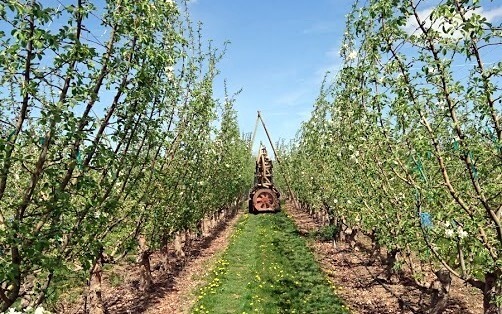
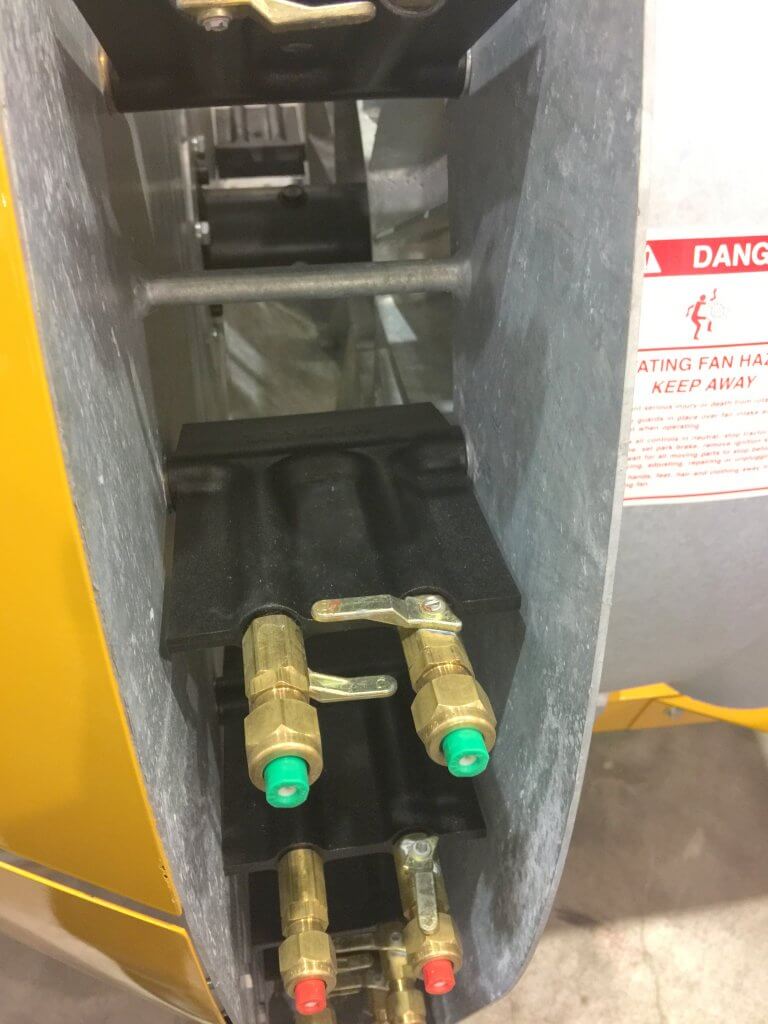
The top two nozzles are capped in this orchard (targeting 10′ and below). It’s very evident that the top two nozzles are not in use.
It turned out Steve, like many growers, also had a knack for metal working. Displeased with his Rears sprayer’s performance, he told me he’d replaced his classic radial air outlet and curved boom with a ducted tower assembly, very much like the H.S.S. sprayer had just been introduced to North America.
I asked if he would share his story and a few photos of how he did it and he didn’t disappoint! What follows is a photo journal of how he designed and built his new sprayer. He wrote:
“Sorry it’s taken me so long to get back to you. Spring is like a tornado and there’s just no time to get things done! Here’s a quick/not so quick rundown of the process:“
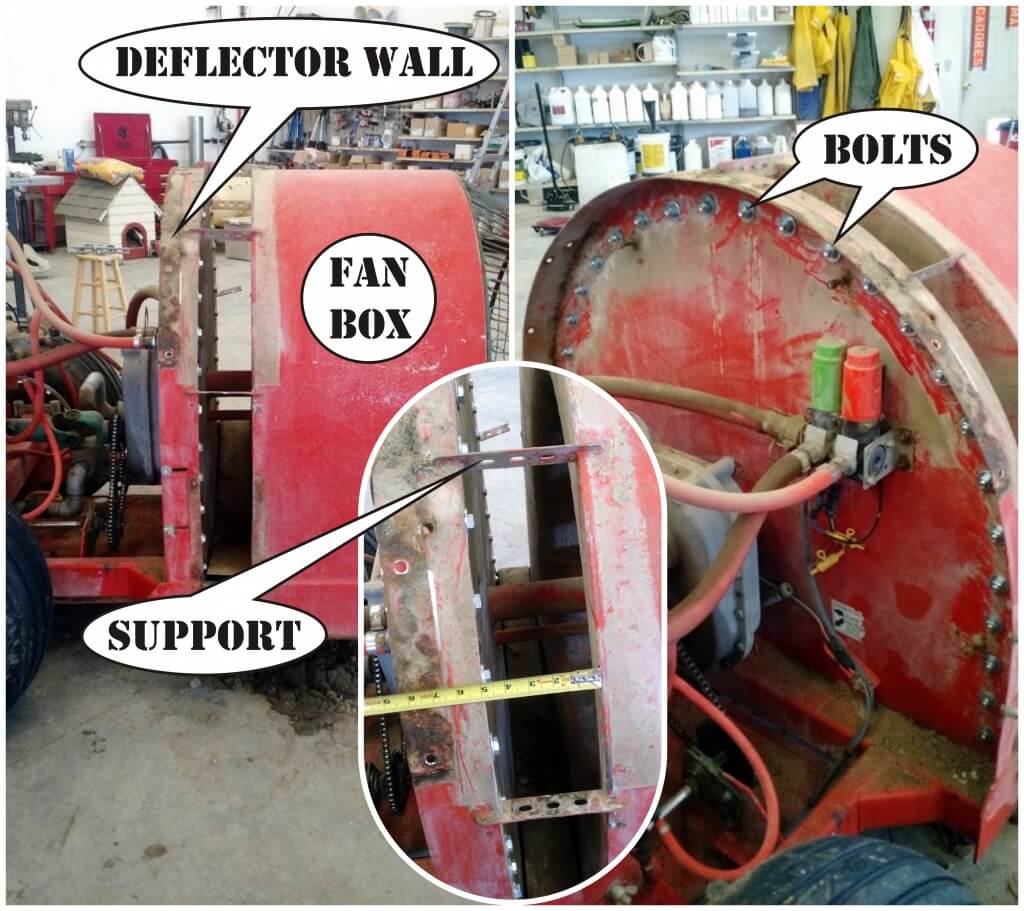
1 – I started by cutting the horizontal supports that attach the fan box to the front deflector wall. I plugged all the old holes with nuts and bolts to keep the air going where I wanted it.
Fan box cut away from deflector wall. Holes filled with bolts.
2- I then got a 10″ wide sheet of 16 ga cold-rolled steel from a local HVAC guy. I marked out where I wanted to attach it, drilled and tapped the holes, and attached using only stainless hardware. I marked out for a total of 8 holes per side evenly spaced, and drilled them out with a 4” hole saw. I then cut 3″ long sections of 4″ diameter thin-wall pipe (about 0.125” thick) and welded them flush with the inside.
Welded pipe outlets for air.
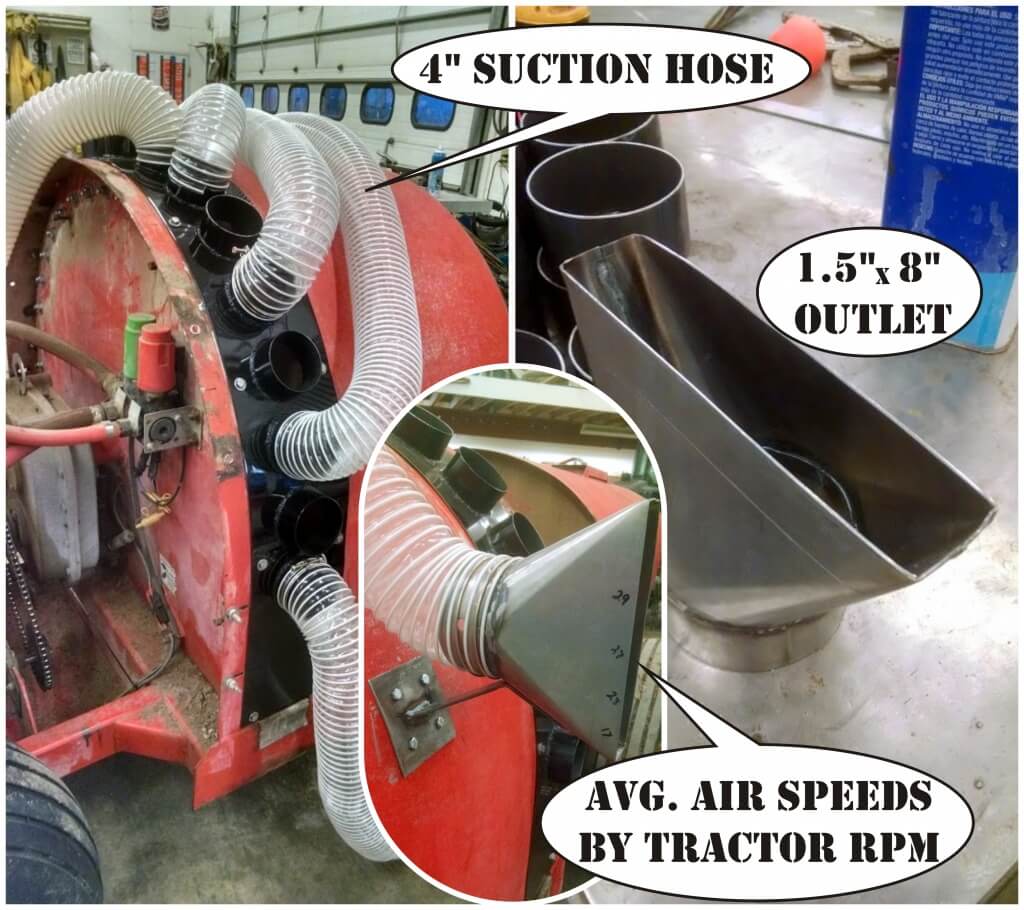
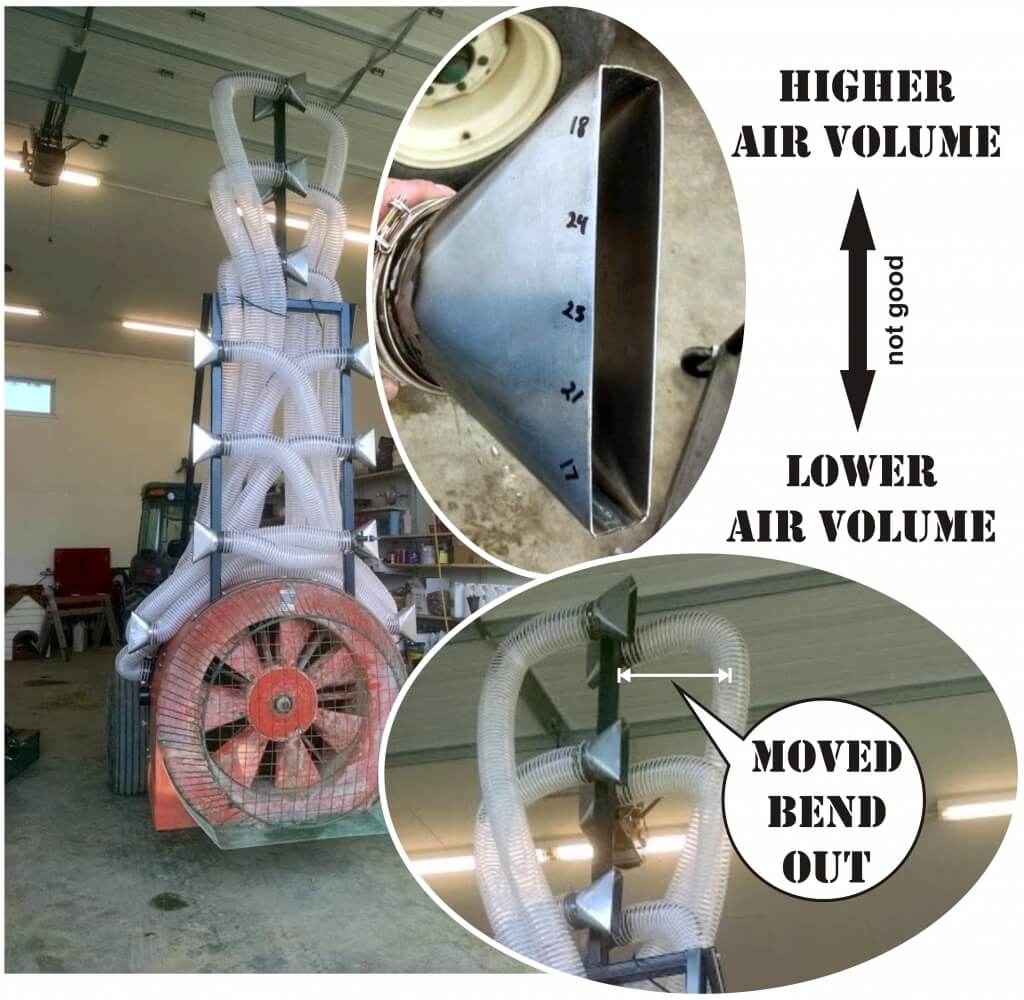
3 – I had several conversations with the local HVAC guy about turning vanes, nozzles, cubic feet/min. and wind speeds. The reason I decided to use hose after all these conversations is because there are no 90° angle turns. Those turns during testing severely decreased wind speeds because of the turbulence it caused. The hose is standard 4″ suction hose for woodworking chip/dust collection. Together, we came up with a 1.5” x 8” outlet to use. The numbers written on the outlet are average wind speed with 10 feet of hose attached at the desired tractor rpm’s.
Commercial woodshop hose and air outlets.
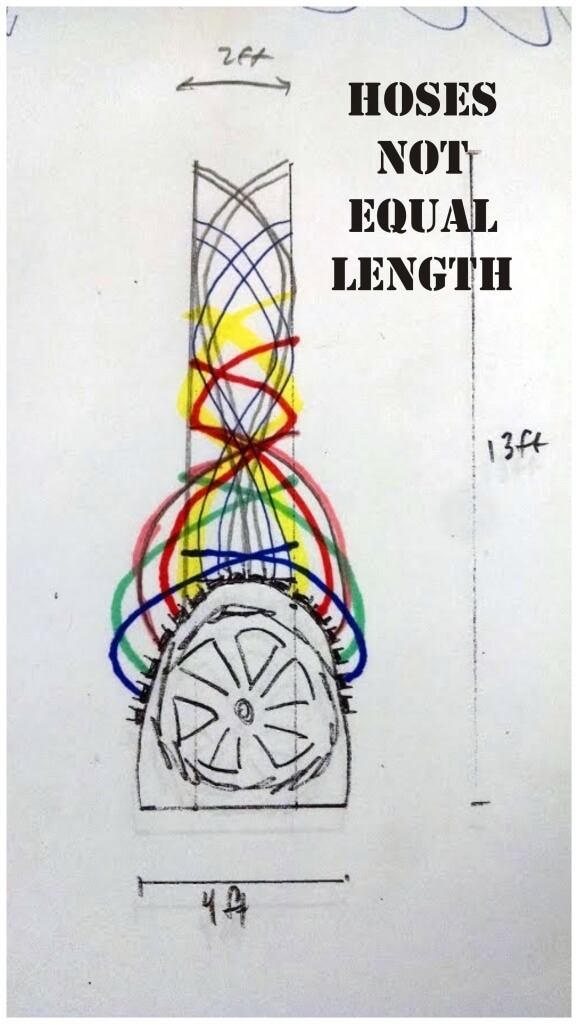
4 – Initially I was set on having the same distance of hose for each outlet, like headers for an internal combustion engine. I let that go since volume matters so much more in this situation and there is no “real” back pressure pressure to be concerned about. This was the initial drawing:
Early sketch of equal hose lengths and positions.
5 – My measured dimensions showed the rectangular tower frame would fit through my tightest V-trellis, but only if I drove 0.5 mph and who is going to do that!? So, I needed to rethink it, break it down, and redo it. I decided on a partial, center-mast design.
Original tower frame would not clear the V-trellis. A center-mast solved the issue.The top of the mast can be removed and the hoses disconnected and just left to hang. This allows me to hit 12′ tall V-trellis easily, as well as 14′ vertical trees all the way to the top.
6 – After putting everything together I realized the air volume wasn’t always balanced across the each outlet. This was because the bend in the hose was too sharp and too close to the outlet. This REALLY MATTERS because if the air volume is too “heavy” on one side of the outlet, it doesn’t capture and carry the spray consistently. I corrected it by attaching support rods to increase distance between bends and outlets to about 18”.
Gradual angles on hose prevented uneven air from the outlets.
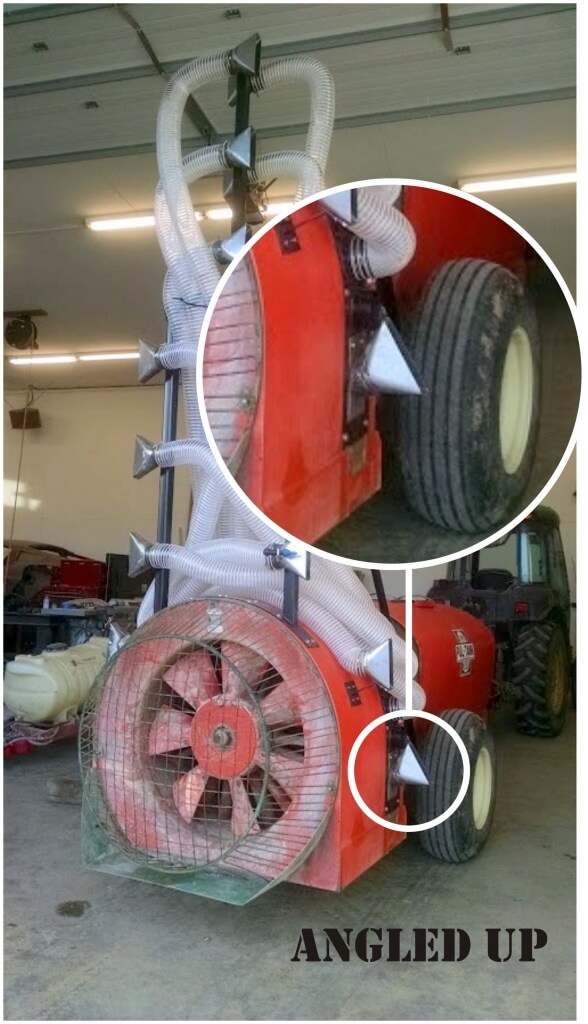
7 – On the painted, final design, you might notice lowest nozzle is angled. This is because I’ve noticed that foliar applications don’t often hit the lowest branches. I angled one outlet upwards to correct this. I notice in your article on the H.S.S. sprayer that the Woolly Apple Aphid nozzle does the same thing. I feel like I need to meet these people; we have incredibly similar ideas!
Lowest nozzle and air outlet angled up to better hit lowest branches.
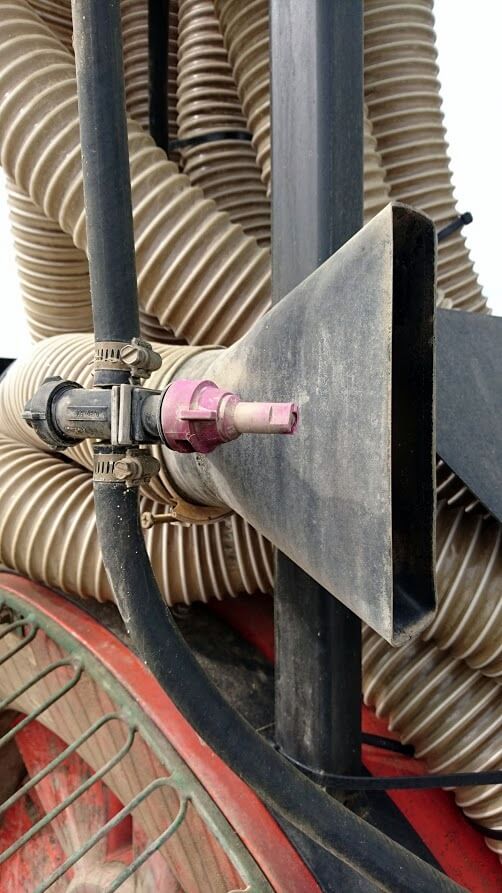
8 – I used TeeJet’s ¼ turn AIC air-induction flat fan nozzles. They’re molded into the cap, so they are always oriented the right way. I set the nozzle bodies outside the air outlets to reduce turbulence in the airflow. It also makes servicing cleaner and easier. I also ended up adding some shielding around the lower nozzles just in case someone loses focus and runs into something.
Shields prevent physical impacts to AIC (air induction) nozzles. Coverage map was created for 55 gpa in a 6’x14′ vertical planting.Close up of nozzle location versus air outlet.
I asked Steve to stay in touch and let me know how his spraying season goes with the new sprayer. I’ll add to this article as he checks in and lets us know how the sprayer holds up and what changes, if any, he wants to make in the future.
July 2016 Update
As promised, I checked in with Steve to see how the sprayer was holding up. Here’s what he had to say:
“It’s awesome. Works fantastic. Very effective in windy weather without having to worry about drift. Also, it works perfectly for sunburn protectants because of how directed the application can be. It has held up well considering how many acres its gone through this year.”
Of course, there are always a few hiccups. I’ll interject here to suggest that what Steve is about to note about thinning is not a reflection of his design. I believe many orchardists experience the same difficulties with their conventional towers, too. Steve continued:
“A few downsides I’ve noticed throughout the season: For blossom thinning (lime sulfur), gallonage is critical to get the stamen of the flower burned sufficiently to prevent fertilization. Even when spraying ~100 gallons per acre with this sprayer, it wasn’t enough to effectively blossom-thin the fruit. Part of this may be because I’m now distributing the spray evenly through the entire canopy, rather than spraying up through the canopy below. Another downside is the droplets’ tendency to accumulate in the lower portions of the tree (since every droplet doesn’t hit foliage), and over-apply in those areas. My Sevin/NAA application this year definitely prove this theory as my lower branches were over-thinned.”
So, what’s the final word on this cool sprayer mod?
“Overall, it’s great, and with a few tweaks this winter will be even better.“
One of my main activities in the winter is public speaking. Attending producer meetings gives me the privilege of meeting many farmers, learning about their operations, and sharing my research results.
I enjoy providing practical solutions to problems. But there are three issues that always come up to which I wish I had better answers. Here they are:
The Correct Spray. We’re stuck with compromises in this area. We need small droplets for coverage. We need large droplets for drift control. We need to keep application volumes moderate for productivity. We’ve basically asked the nozzle to shoulder the entire burden of our application needs, seeking a spray that hits all the right notes. Not too fine. Not too coarse. Able to work with fast and variable travel speeds and high, variable boom heights.
Based on our research in field crops such as wheat, canola, corn, lentils, etc., we can be confident that Coarse, even Very Coarse sprays, coupled with a reasonable water volume, are appropriate for most modes of actions and target situations. These sprays contain enough small droplets for good coverage, and their larger droplets work surprisingly well in most cases. Sure, a finer spray could save some water. And a coarser spray would reduce drift even more. But we need a compromise spray, combined with some lucky weather, to get the job done.
And yet we usually make spray quality recommendations with caveats, because droplet size alone isn’t enough. Drift is always a possibility, no matter how coarse we go. Coverage is not guaranteed, especially if the canopy is dense. Finer sprays will get deeper into a broadleaf canopy, but then we may have drift or evaporation to deal with. The nozzle size, volume, and travel speed relationship has to be just right so the spray pressure is in the correct range. And on it goes.
I’d like to give the overworked nozzle some help. We used to use shrouds to protect fine sprays from drift. Now it’s time to let air assist take over that task.
Air assist booms can accelerate (i.e., add kinetic energy to) small droplets so they’re less prone to off-target movement. Properly adjusted, air assist can carry these droplets deeper into the canopy and enhance their deposition.
A good air-assist system allows the user to select the strength and direction of the airblast to match canopy, boom height, and travel speed conditions.
Air assist is the workhorse of most fruit-tree and vineyard spraying. It has to be done right to provide all the benefits I mentioned, and certain approaches should be rejected. For example, there are some companies using air assist to promote very fine sprays with very low volumes. That’s the wrong use of the technology, and invites a backlash.
Instead, we need systems that work with existing spray practice to address some of its classic shortcomings, such as drift management, deposit uniformity, and canopy penetration.
Let’s see some products. It’s time to bring air-assist to the mainstream of agricultural spraying.
Boom Height, Level, Sway and Yaw Control. Boom height is so fundamental it’s almost boring. We’ve long said that it’s important to set the boom at the right height for proper nozzle overlap and drift control. It was easy with wheeled booms. But over the last 15 years, suspended booms coupled with fast speeds have caused booms to rise again (RISE OF THE BOOMS!).
Fact is that there are some tasks we’re asking of nozzles that they simply can’t achieve without level, low booms. Drift control is one such thing. Low booms are surprisingly effective at reducing drift, not only because winds are lower closer to the canopy, but also because droplet velocities are faster closer to the nozzle.
Angled sprays for fusarium headlight control are another thing that is more effective with low booms.
Spray droplets released from an angled spray soon slow down and get swept back by air resistance and begin to fall vertically, or move with wind currents, reducing their intended benefit. Low booms can prevent that.
Uniform and low booms also keep deposit variability more manageable. They can save energy needed for air-assist systems. The shorter the path to the target, the less air-velocity will be needed to get it there.
So how about it? Can we have boom linkages and suspension systems, coupled with sensors and hydraulics, that are stable and maintain 20” above canopy at 16 mph on uneven ground? Can we have systems that do this reliably enough that we’re prepared to invest in, say, expensive nozzle bodies? It’s possible.
Sprayer Cleanout. One of my favourite questions about cleanout is: “When do you know that you’re finished cleaning the sprayer tank and booms?” Inevitably, someone from the back yells: “In two weeks!” And we laugh, knowingly.
We have a terrible system of sprayer decontamination. It’s a process that is awkward, imperfect, and time consuming, often leading to poor practice. I’ll ask a group of producers what they do with their pesticide waste. The response is silence. I don’t blame them for not telling me that they dump the remainder on the ground somewhere, but I’d rather they didn’t. Sprayer designs don’t help.
What we need is a system that guarantees results. To start, a tank gauge that is reliably accurate to the nearest gallon would remove some of the filling guesswork and help minimize leftovers.
We need a remainder volume (volume left in the non-boom plumbing after the pump sucks air) that is known and small, because that remainder can’t be expelled and needs to be diluted. The smaller it is, the easier it is to dilute.
We need a wash system that requires little volume and works quickly, like continuous rinsing.
We need plumbing that is easy to understand and whose inside surfaces do not absorb pesticide, or hide it in corners and dead ends. Perhaps it’s a recirculating system. Perhaps it hasn’t been invented yet.
We need pesticide formulations that clean up easily. We need an easier way to inspect and clean filters. And we need a safe place to put any waste that can’t be sprayed out in a field.
I’d like to see a sprayer that can be decontaminated in 10 minutes without the operator leaving the cab, and without any spillage of spray mixture. Clean enough to spray conventional soybeans after a tank of dicamba. Clean enough to spray canola after a tank of tribenuron. I know it’s possible.
I also know what many of our European readers are thinking right now. Much of what I’ve discussed exists in the EU in some form or another. Why does the North American, and to a lesser extent the Australian market, not have these features?
Part of the reason is federal standards and regulations. Some European countries test and approve products for remaining tank volume, boom stability, and spray drift, for example. Others have sprayer performance criteria that must be met to be eligible for sale in that country. An increasing number have mandatory sprayer inspection.
These requirements serve to protect the producer and the environment. They’re an example of useful government actions. Despite, or perhaps because of, stricter rules, the entire EU marketplace is very competitive, with about 75 sprayer manufacturers. Bottom line: producers benefit.
We need leadership, preferably from a combination of government, industry, and producers, to achieve better sprayer designs. Our market has room for products that make it easier to prevent drift, protect water, and protect yields.
As they say, a rising tide lifts all boats. And it will certainly make my job easier.
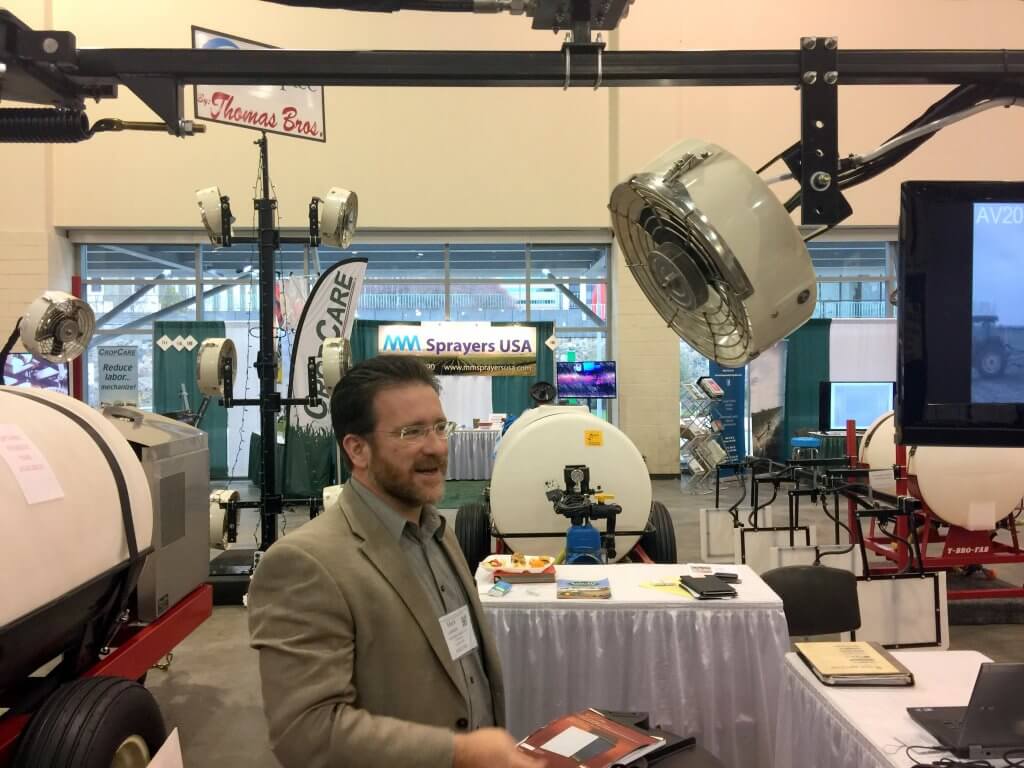
Michigan’s Great Lakes EXPO is a massive horticultural convention that draws international speakers and more than 4,000 attendees to Grand Rapids every December. Like any large agricultural conference, it can be challenging to run back and forth between lecture rooms to hear key presentations. And, of course, there is always disappointment when you have to choose between two talks in concurrent sessions. When your head is full and your posterior is numb, you move onto the trade show floor.
I think the trade show might be my favourite part; Who doesn’t like filling a bag with swag? Candies, foam vegetables, pens, DVD’s, colourful brochures and all manner of gimmicks designed to get your attention in a sea of vendors that vie for “just a minute of your time”. But for me, I only have eyes for the sprayers. And wow, were there a lot of sprayers at GLEXPO.
This article is a photo journal of those sprayers (or features) that caught my eye. For some readers, these features might be old news, but for me they were insight into a different way of spraying. For example, Europe’s tolerance for spray drift is practically nil, and sprayer manufacturers have had to develop equipment that comply with that reality. Many such sprayers were present, so I had a chance to see, and ask questions, about their claims of less than 5% drift. At the other end of the spectrum, there were sprayers that proudly boasted being able to cover multiple rows in a single pass by boiling the spray over great distances… which while appealing to producers looking to save time, still makes me wince. But then, I’ve never tried to spray almonds in California, or citrus in Florida. Then there were sprayers claiming to cover multitple rows and reduce drift, which would be quite a trick. I reserve the right to be a skeptic.
So, I’m not promoting or condoning any of the equipment or claims described here. I’m just sharing what I found interesting and I’m giving the reader a peek onto a trade show floor they might not otherwise have seen.
Shrouded Herbicide Application
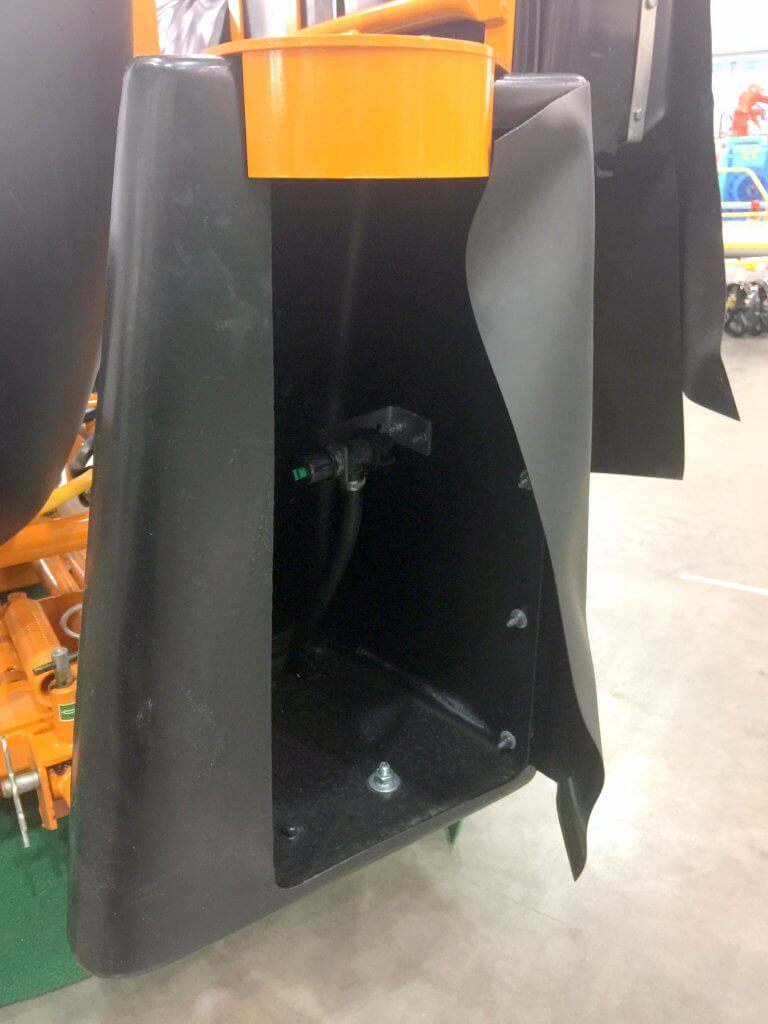
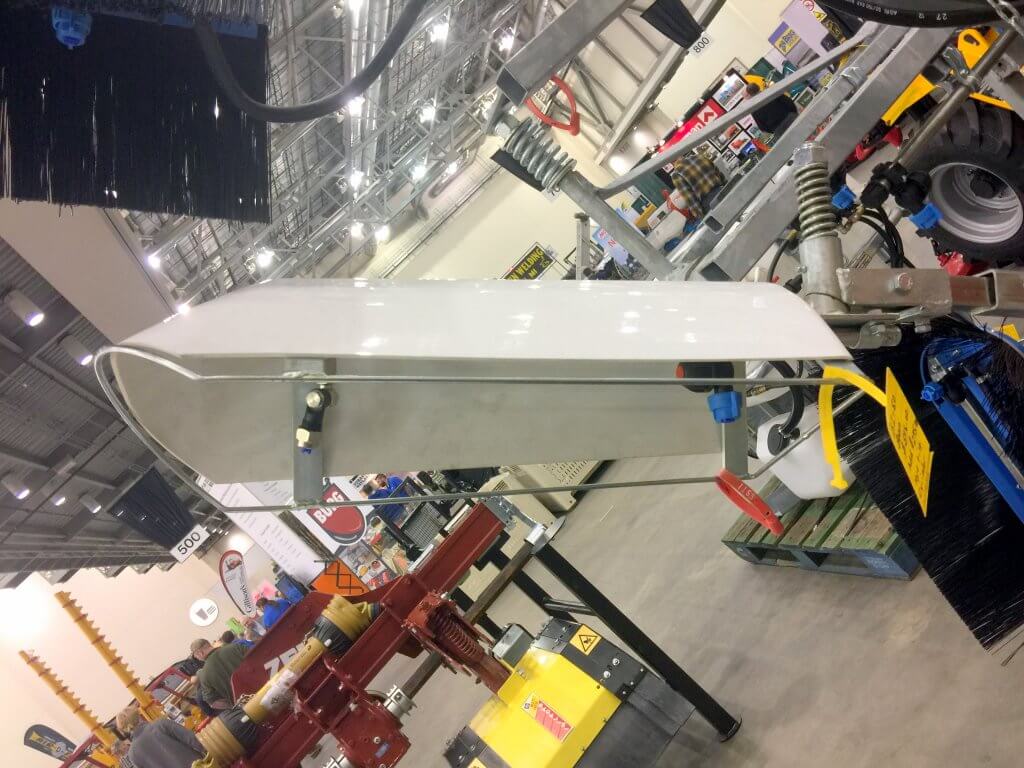
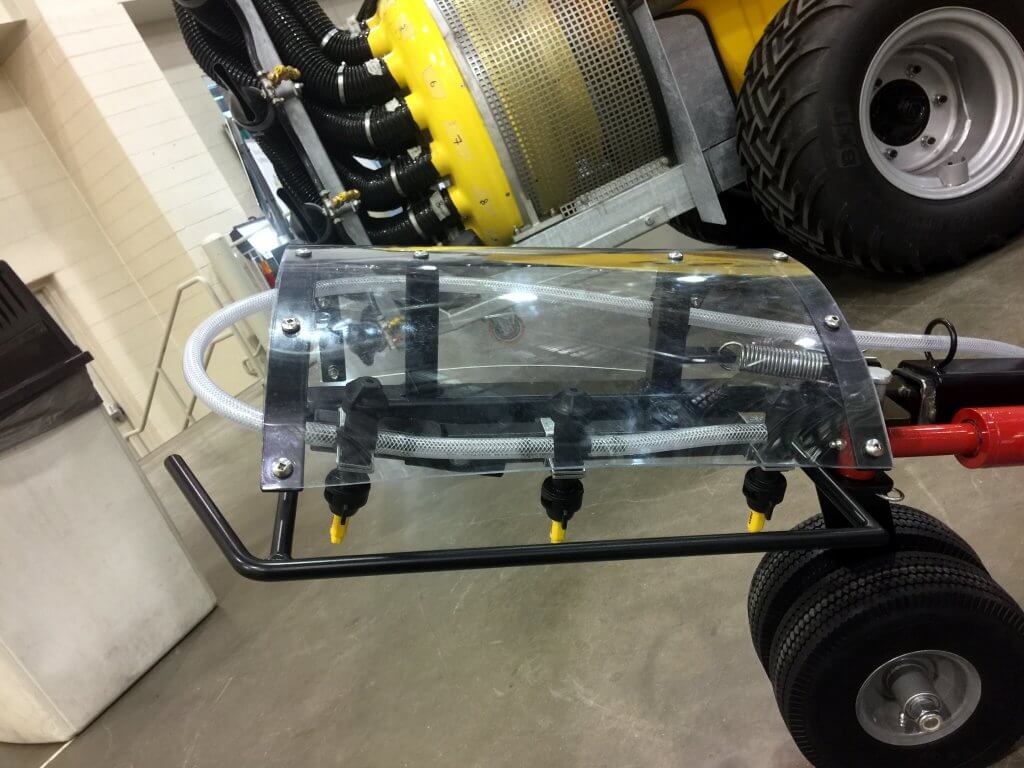
There are lots of approaches to making in-row or under-row herbicide applications. The concept is simple enough: You want to get the product on the ground either under or between rows without hitting the crop itself. If you don’t care about hitting a mature orchard trunk, the boomless nozzle is a good choice with it’s massive droplets and variable swath. But if you want to avoid off-target movement as much as possible, you need shrouds.
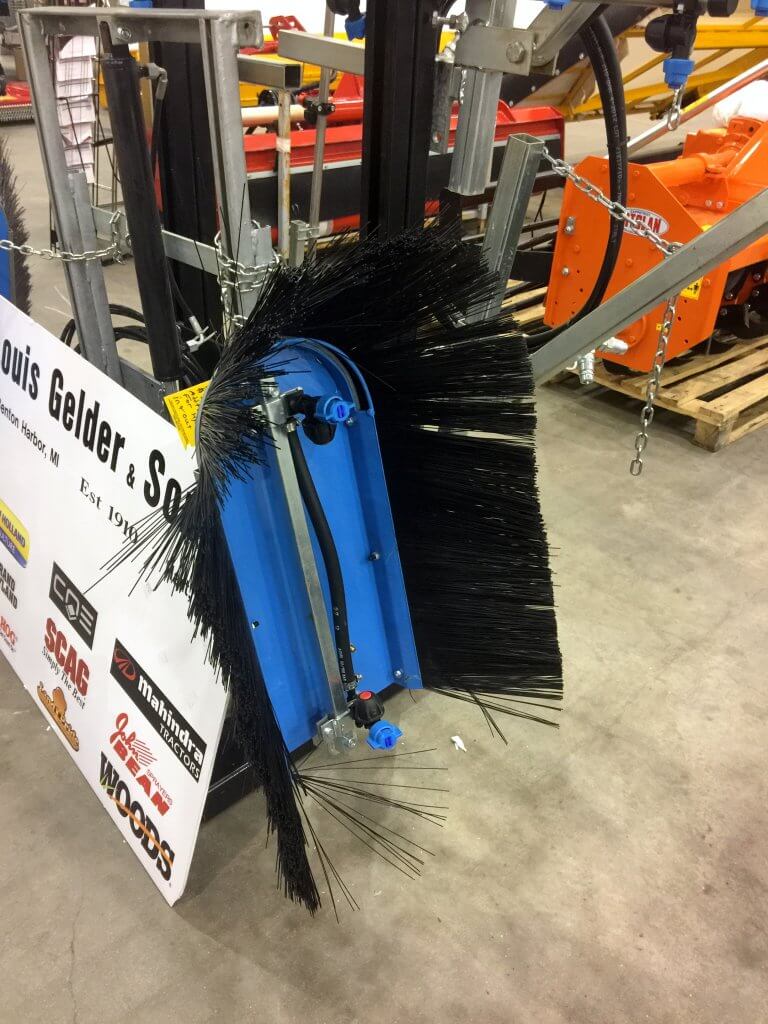
I’ve seen brushes used to great effect in asparagus because they match the contour of moderately uneven ground by dragging over it. Gaps may open in the shroud as the bristles part, but that issue may be offset by the possible advantage of physical redistribution of herbicide as it rubs over the target weeds like a weed-wicker.
Then there’s the classic flexible curtain. Similar to the brushes, it’s intended to “just” touch the ground and should maintain a reasonable seal even if said ground is moderately uneven. I often wonder how difficult it is to clean all the surfaces on these systems, but since they are only ever used with herbicide, I won’t speculate how often operators actually decontaminate (or even rinse) them.
Other variations include a hard carapace with no contouring lip. They should only be used with Coarse spray qualities or larger. Note the hefty spring on the boom for those inattentive moments where the operator might whack a trunk or fence post. The wing flexes away from the impact and snaps back into position, giving the operator time to put down the cell phone and tweak the steering wheel. The adjustable nozzle body on the far end is a nice feature for adjusting the swath without changing nozzle spacing, but beware to maintain proper overlap.
And, if you want the heartiness of a solid carapace, wouldn’t it be nice to be able to see through it so you can spot a plugged nozzle before it becomes a problem? This variation with its heavy impact bar, tight nozzle spacing (to reduce the potential for misses) and guide wheel (to maintain correct boom height) looks ready to handle anything.
Airblast – Multi-Row, Ducted Systems
In the never-ending quest to do more in less time, multi-row airblast systems are very appealing. Delivering air to the vertical booms in each row can be challenging. I’ve seen suspended axial fans (e.g. Gregoire, not pictured) but they’ve always struck me as overkill because of the volume and speed of the air they deliver, and because they need fairly wide rows to be accommodated. Their weight is also a concern, requiring scaffolding that must be strong and still somewhat flexible to handle the inevitable pitch and yaw translated from uneven ground to the boom.
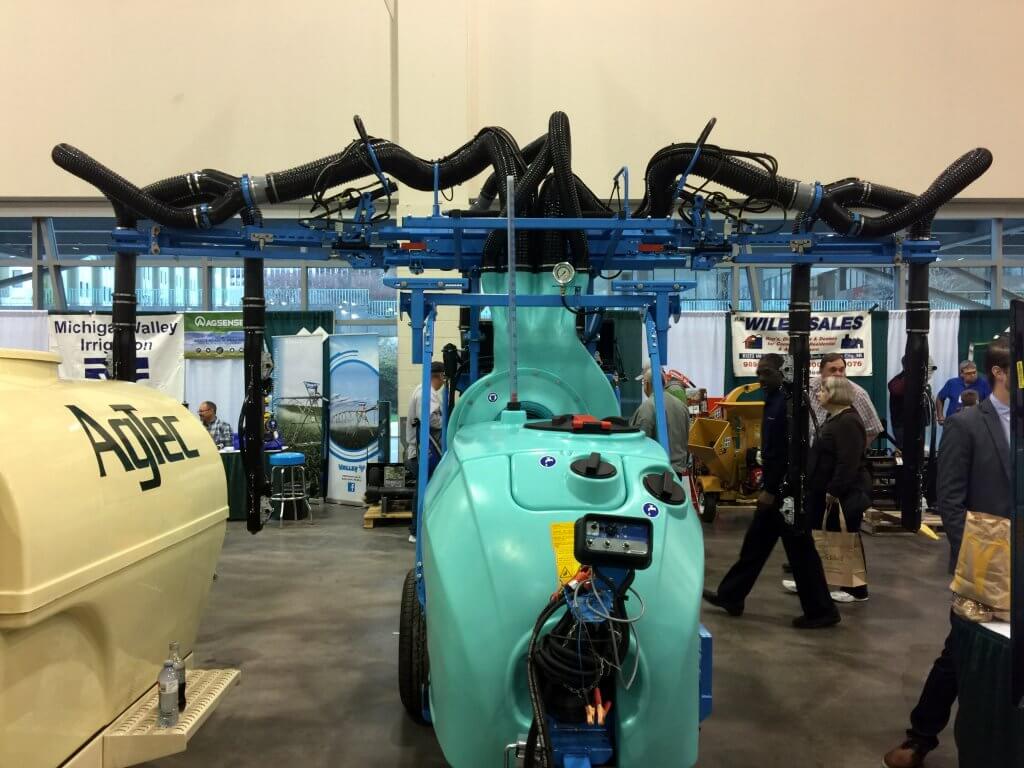
Lightweight conduits that channel air through ducts (like the Berthoud sprayer below) are a popular solution. They can be suspended to any length and telescope to any row width. Head pressure, and friction from sharp bends in the ducts can influence the air delivered, so the shorter the ducts and the less bends, the better. It was a surprise to discover the ducts in this sprayer are corrugated inside as well as out, but apparently it’s not enough to disrupt air flow significantly.
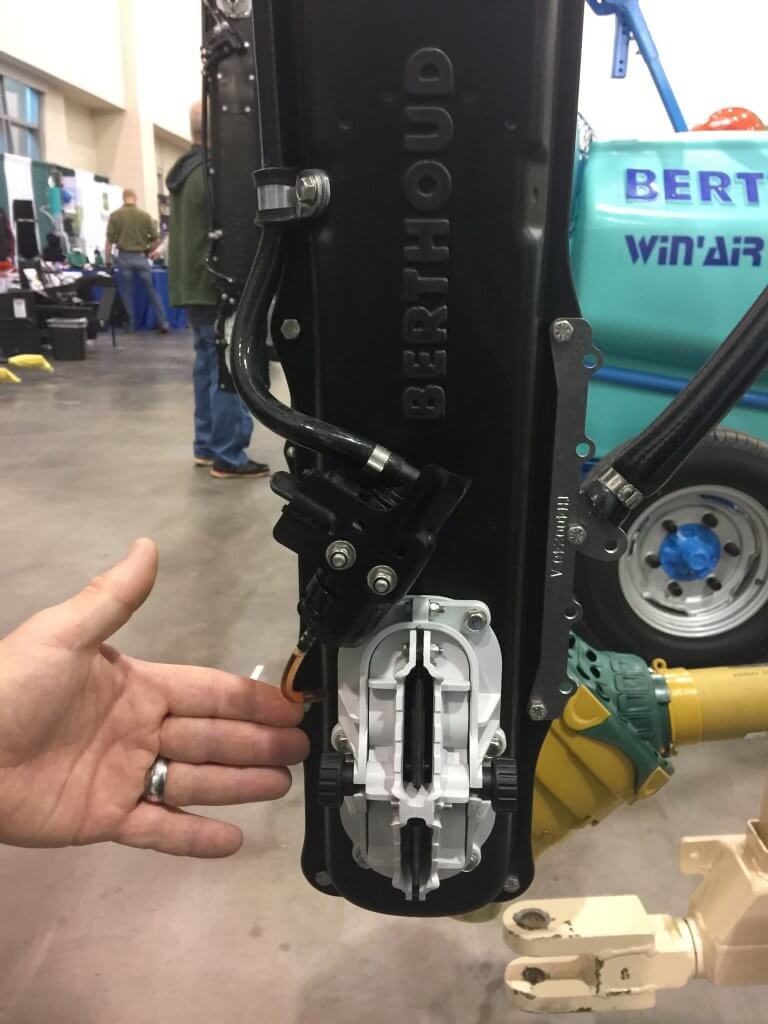
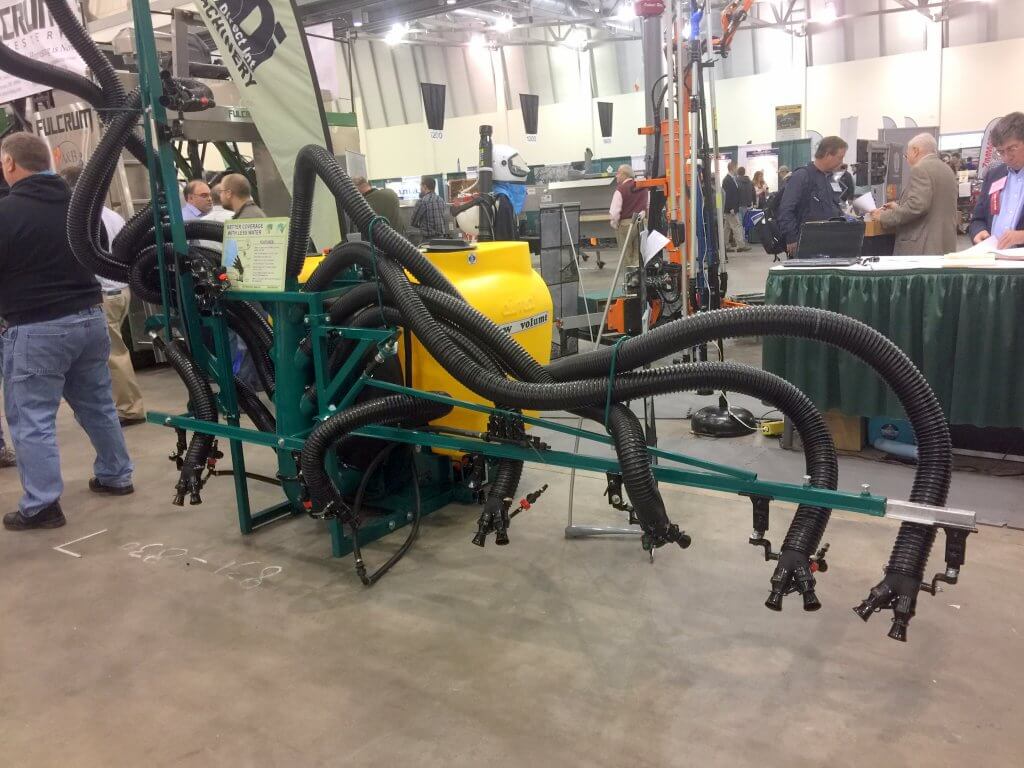
This Berthoud sprayer offers many of the optional features I’ve seen on the Hol sprayer (not pictured) such as tandem axles, a hand wash tank, low residual volume tank, and built-in boom and tank rinse systems. What’s interesting is the light weight “Drop Legs” (i.e. the vertical booms) with dual-angled “airmist diffusers” (i.e. the air shear nozzles) for multi-row vineyard applications. The close-up below uses my hand for reference. There are options for two to four diffusers on each drop leg, and they can be single or double sided, giving a lot of flexibility to match the crop.
How do you control flow? With a digital flow regulator. What if you want a different rate at each diffuser? Well, if I understand this correctly, instead of using a typical flow-metering disk placed in-line to restrict flow, you slot a conventional moulded hollowcone inline and use the nozzle manufacturer’s flow tables. And what if you are concerned about using a misting air-shear style nozzle? It appears they also offer an option to swap out the diffusers for air assisted swirl nozzles where the air flow is behind the nozzle to entrain the spray and limit dispersion. They look similar to the diffusers, except they have a nozzle cap between the slotted air outlets (not pictured).
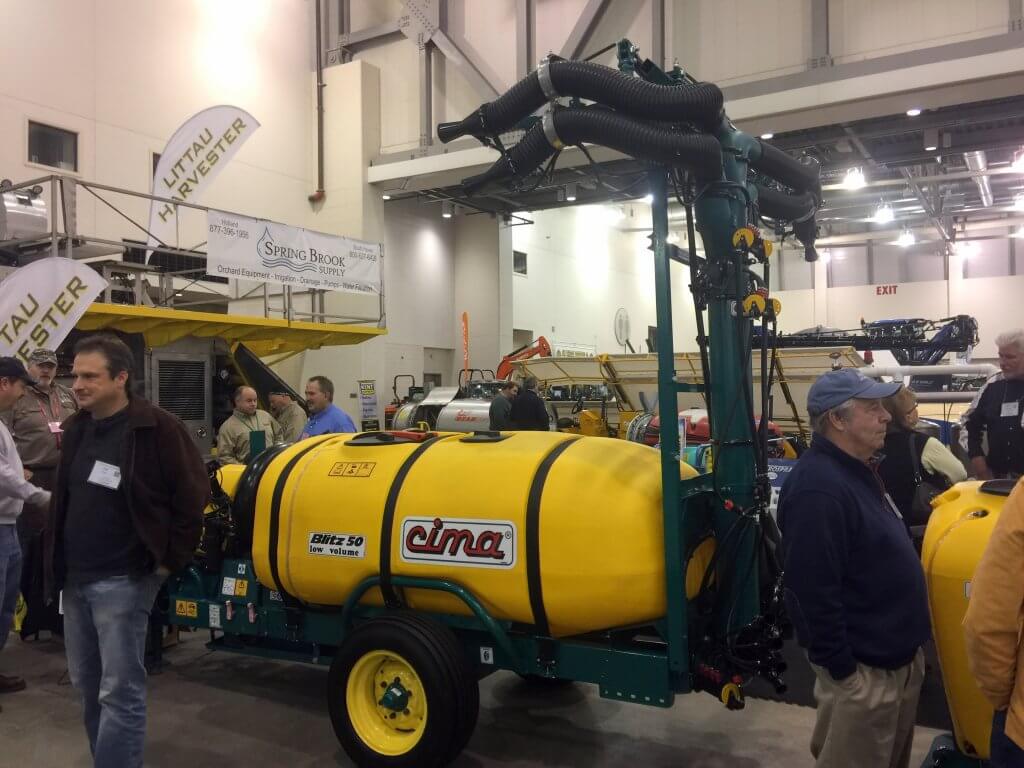
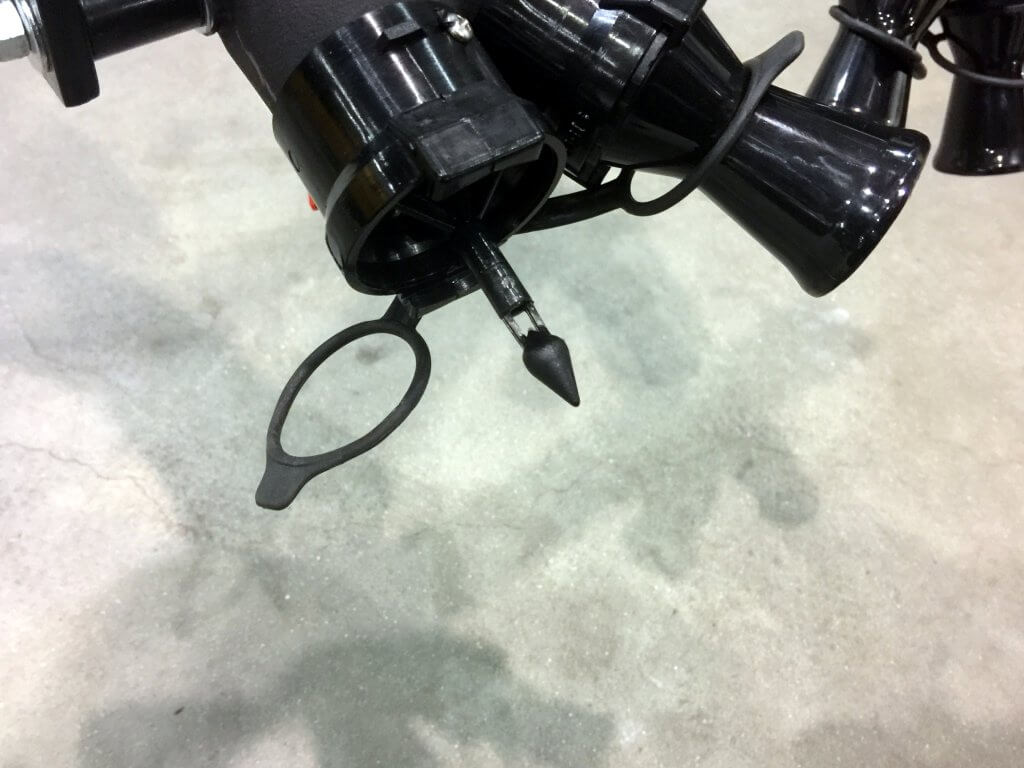
Ducted air handling comes in many shapes and sizes. Rather than terminating in a blade-shaped diffuser, Cima has hourglass shaped distribution heads that use the venturi principle to deliver airspeeds up to 180 mph at the nozzle. That’s fast, and while it would help entrain spray as it travels longer distances, I wonder what it does to crops close-up?
In the centre of each head is the teardrop-shaped atomizer-style nozzle that produces a Very Fine spray quality between 100 and 150 µm in diameter. It was explained that the teardrop employs Bernoulli’s principle… and for the lay reader (like me), think of the teardrop the way you think of an airplane wing. Air moves over the contour at different rates, making a low pressure area at the tip. The upshot is that it creates lots of very small droplets that (according to the manufacturer) permit you to use much lower volumes that you would with an airblast sprayer using conventional hydraulic nozzles. As always, I suggest you let coverage be your guide to spray volume.
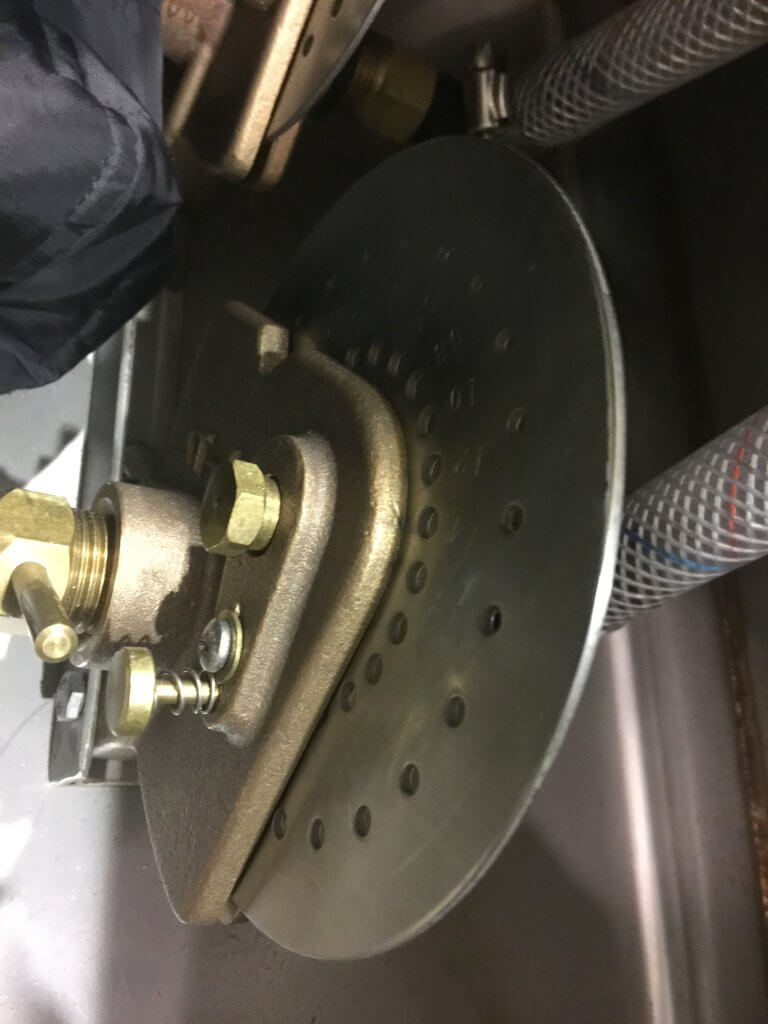
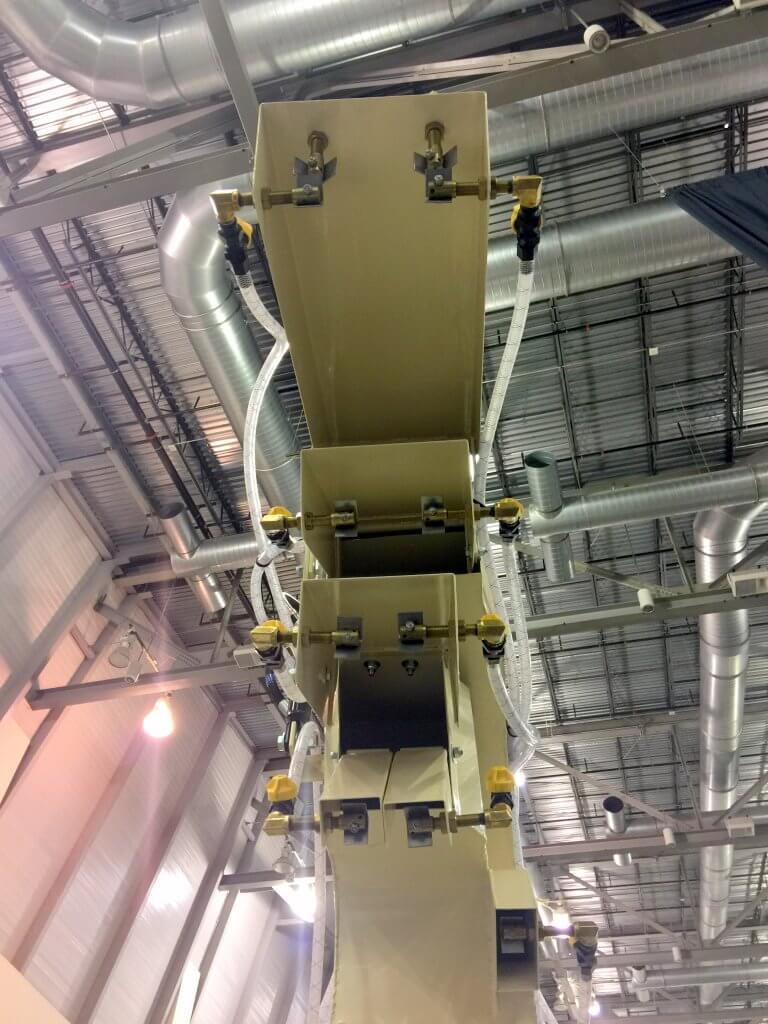
Flow is controlled by an inline disc that allow the user to select from a series of flow-restricting orifices. Look back two photos and you’ll see them as yellow circles on the tower. The photo below is a stainless steel version from an AgTec.
Air-Assist Horizontal Booms
A ducted, vertical airblast sprayer is an air-assisted horizontal boom sprayer just waiting to happen. For vegetable and berry growers, air assisted spraying is an appealing prospect. Many still use axial airblast or cannon sprayers to spray row crops, but I don’t like that. It’s my opinion that while it may be effective, it’s not efficient because it’s not possible to consistently control drift or coverage. I prefer getting the air and nozzle closer to the crop, but sprayers that can do this are few and far between.
There have been no after-market options I’m aware of for converting a horizontal boom to an air-assisted boom. That leaves only a few manufacturers of trailed boom sprayers to fill the need (e.g. the trailed Hardi Commander with Twinforce air or their new self-propelled Alpha evo). But this tradeshow opened other possibilities, as demonstrated by the Cima below. It uses all the same principles described above… it just aims down.
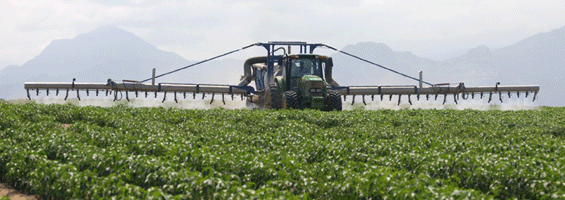
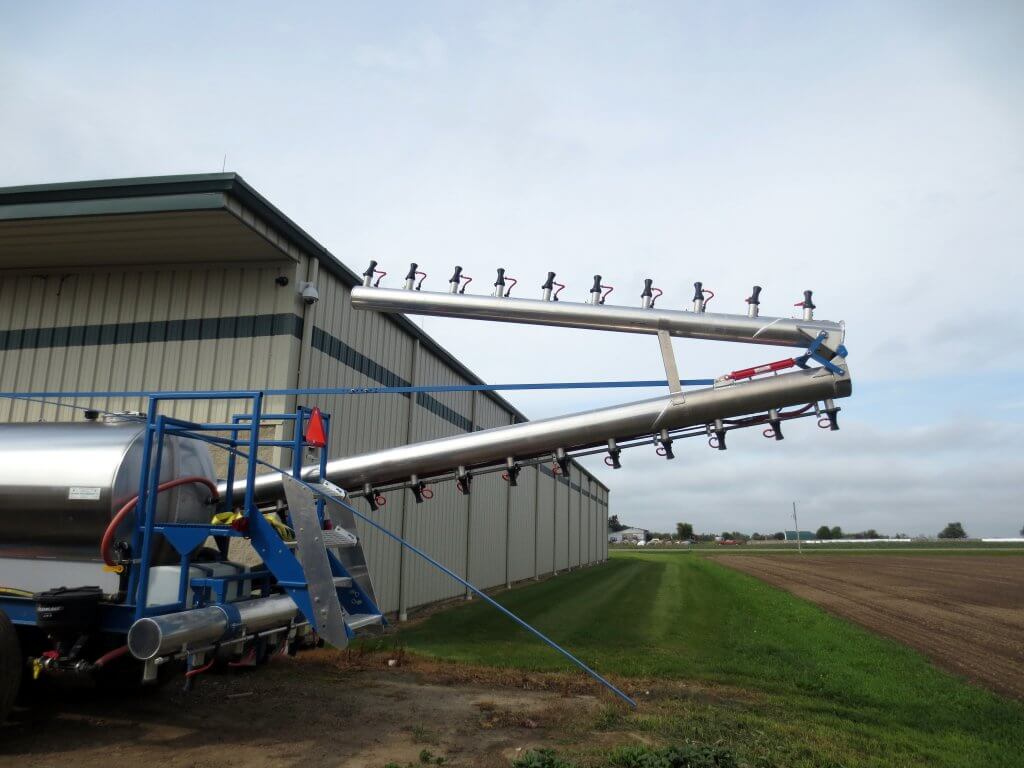
Not interested in ducted air delivery on a three-point hitch system from France or Italy? No problem. How about a Florida company called Airtec that offers trailed air-assist booms up to 120 ft. I wasn’t able to photograph the sprayer at the show, so here’s a picture of one in the field (from their website), as well as several I took at a spinach operation in Ontario.
Airtec offers a single axle, or a walking beam tandem axle reminiscent of the Argifac Condor. Note that the boom itself is the air conduit, which should open crop canopies, expose underleaf surfaces, entrain smaller droplets to reduce drift, and extend the spray window by allowing the operator to work in slightly windier conditions. I can’t speak to the manufacturer’s claims of reducing spray volumes (and by extension, chemicals), but you can read it on their glossy brochure.
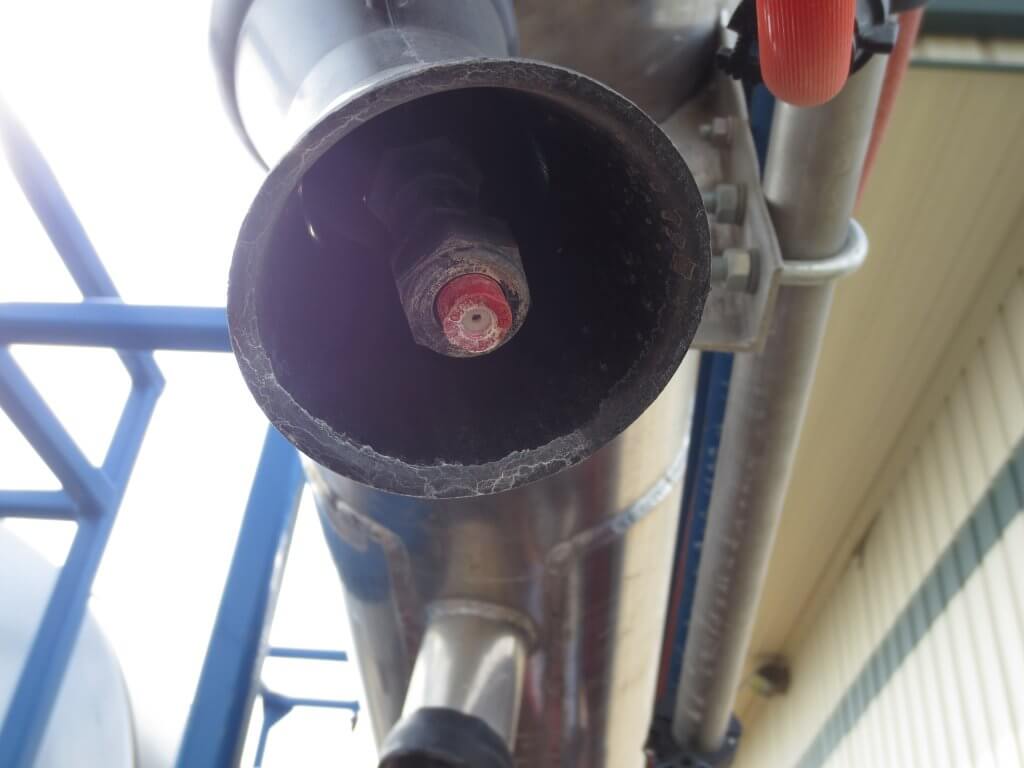
Each air outlet terminates in an hourglass-shaped duct, similar to the Cima and ostensibly creating the same advantage, as they also claim 180 mph windspeed at the nozzle. Again, I wonder if that can be dialed back, or adjusted to match the density of the crop canopy? Unlike the Cima teardrop shear nozzle, conventional hollowcone nozzles are used (see below). They can also be suspended to match the contour of the row (look back at the first photo) improving coverage in a manner similar to using drop arms or row kits.
Airblast – Unconventional Fans
Have you seen this man? Mark Ledebuhr is the co-author of the 2nd edition of Airblast101. He looks happy here… little did he know I’d one day lasso him into writing the new edition with me.
Let’s get back to airblast sprayers. The majority do not use ducts to convey air to the target – they point and blow. Pictured below is the generous Mark Ledebuhr with a Proptec rotary atomizer. I call him generous because for several hours Mark led me through the tradeshow and introduced me to many of the vendors. Perhaps more importantly, he helped me interpret what they were explaining after we left each display. Developed with his father, the Proptec system suspends individual fans with rotary atomizers so each can be aimed and operated independently, offering a lot of targeting flexibility. The fans can be electrically or hydraulically driven. Some might be reminded of a Sardi fan (not pictured) but unlike that system which uses several conventional nozzles around the circumference of the fan, Proptec employs a rotary atomizer in the centre. Rotary atomizers can produce very, very small droplets and until GLEXPO I was only familiar with their use in aerial applications.
I admit to a bias when it comes to airblast sprayers. In my mind, the further away the source of air and spray are from the target, the more opportunity there is to drift. Particularly when such small droplets are involved. I couldn’t find the Proptec video I saw looping at the tradeshow, but what I saw looked like tight columns of cycling spray, reminiscent of a tornado, firing into each row of a vineyard. I was told it was during a 15 mph wind, yet I didn’t see a lot of off target movement. A notable advantage to spraying down into the ground rather than sideways or up into the air. Here’s a good video I found of one operating in highbush blueberry (below). It seems I have a lot more to learn about this system.
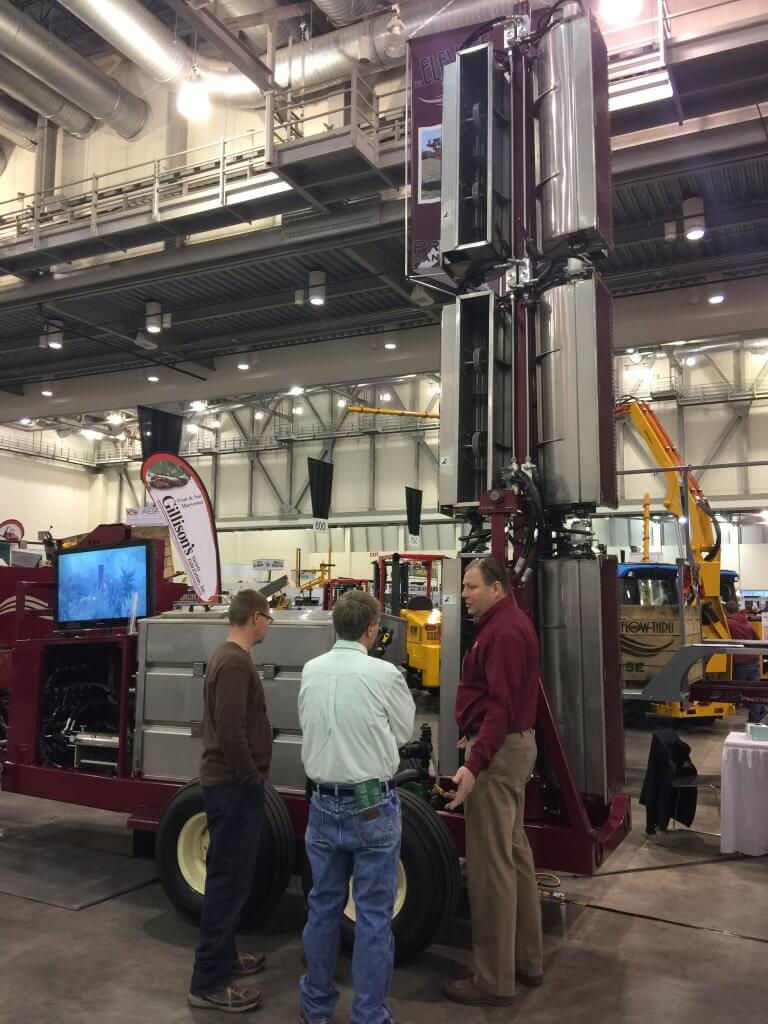
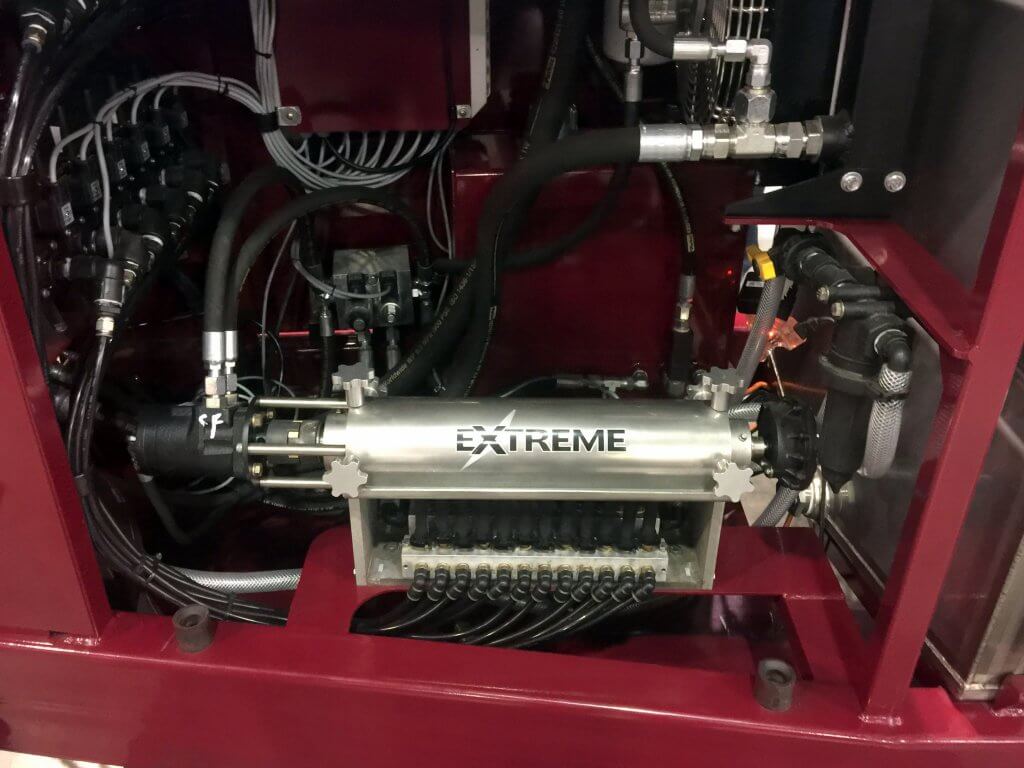
Then Mark and I went over to see Michigan-based Precise Manufacturing’s EX III cross-flow rotary atomizing tower system. I was reminded of the Curtec tangential fan towers that, like this sprayer, employ rotary atomizers and a peristaltic pump. For Curtec, it’s the AccuStaltic pump. For Precise, it’s the Extreme pump. More on that shortly.
Here’s a video of the EX III operating (sourced from the Precise Mfg. website). Obviously, we’re not talking grapes, berries or high-density orchards, here. This is for big, dense targets like standard cherry, nut trees and citrus. The rotary atomizers throw spray in a circle, but the air from the tangential fans capture it and blow it all out towards the target in very laminar (i.e. not turbulent) air that carries it over long distances to the target.
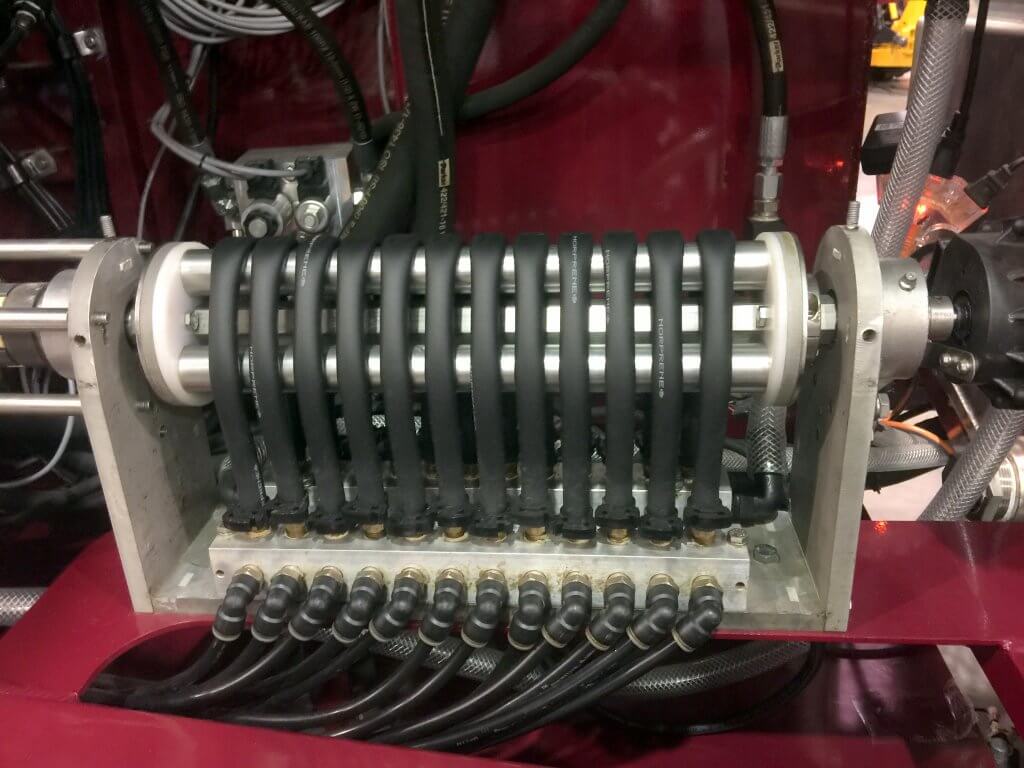
Back to the peristaltic pump. It can run dry, is self-priming, is anti-backflow, low maintenance and can handle pretty much any manner of spray mix (i.e. viscosity and corrosion are non-issues). Each atomizer has its own flow channel, and by changing the diameter of each tube you change the relative flow rate to each atomizer. Certainly not something you’d do every day, but it does allow you to match flow to the canopy density.
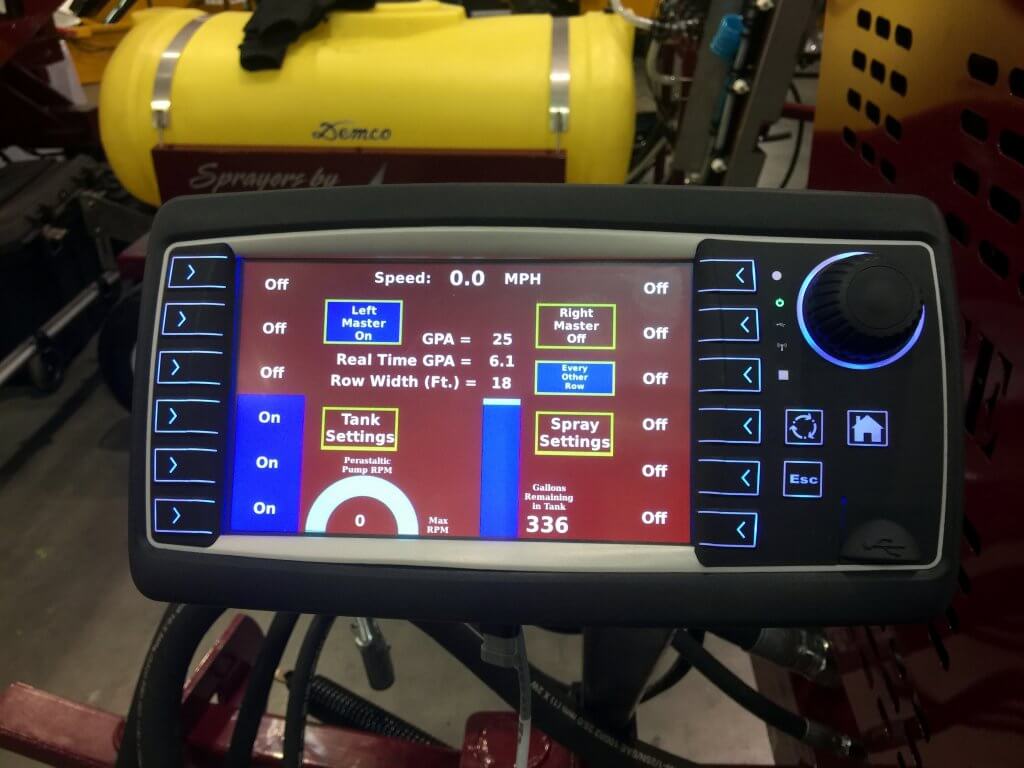
The Precise Touch Screen Controller is very intuitive and I liked how much control the operator has. Fan speed can be adjusted quite easily (although it would require a very knowledgeable operator to ensure the correct speed is selected). It tracks GPS position and logs where the sprayer empties and the rates used per acre. It also calculates a kind of tree-row volume by determining savings when the operator turns off nozzles that would otherwise blow over the tops of targets, or when overall flow is reduced by slowing the rpms of the pump.
Airblast – Cannons
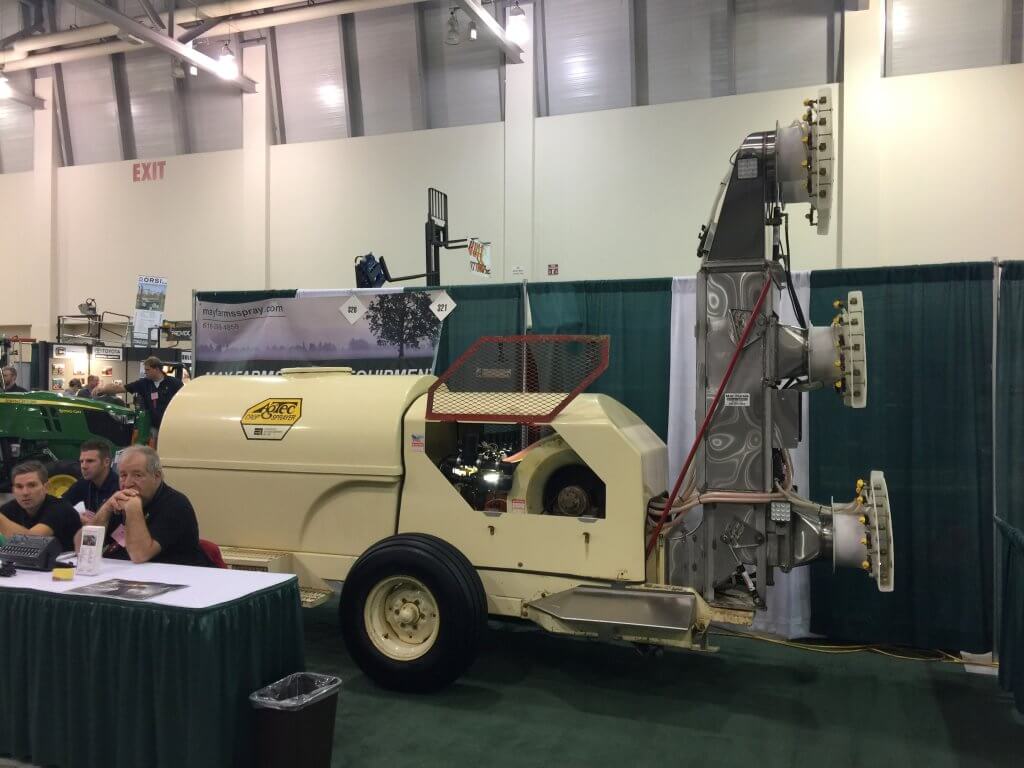
Well, there were lots of cannon sprayers. Most airblast manufacturers have one in their lineup. Squirrel-cage style fans feed air into a tower that allows spray to come out laterally, and on a downward angle from the top of the sprayer. AgTec, pictured below, has long sold such a sprayer.
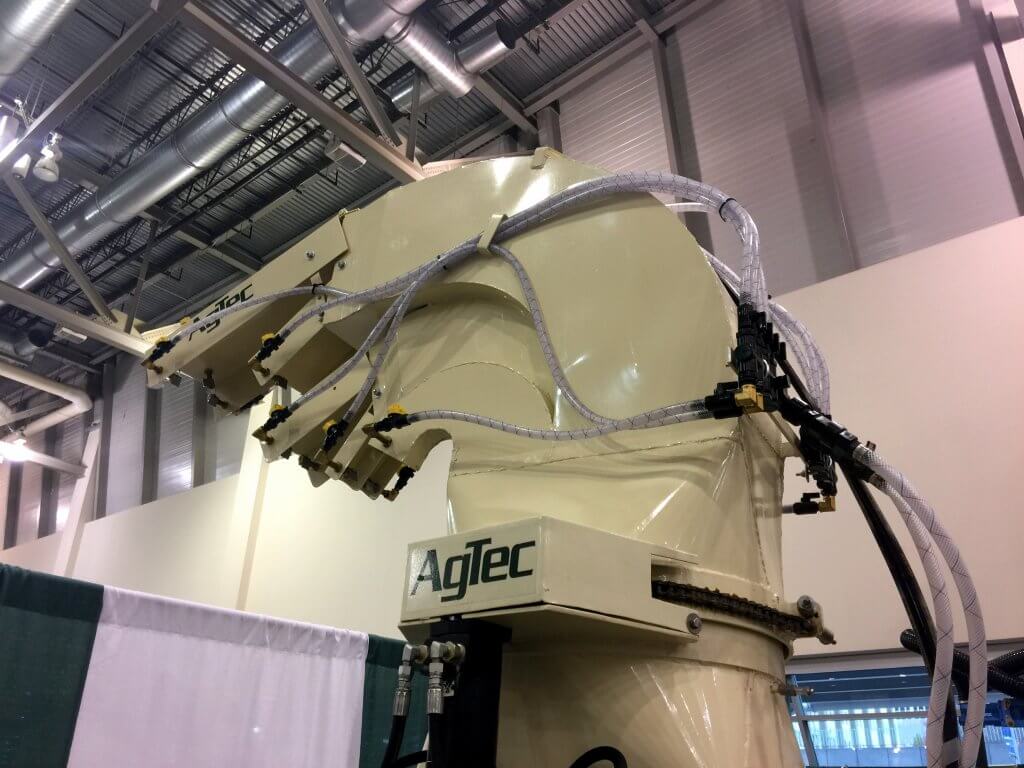
The nozzles are air-shear style, relying on fast-moving air to shear the spray into finer droplets.
They usually only have nozzles on one side and the cannon can be turned via a chain-driven gear, and aimed up or down from the cab. They are intended to spray larger areas to save the grower traveling every row, and to prevent physical damage to the crop as the sprayer passes (I’m thinking about knocking berries off, mostly).
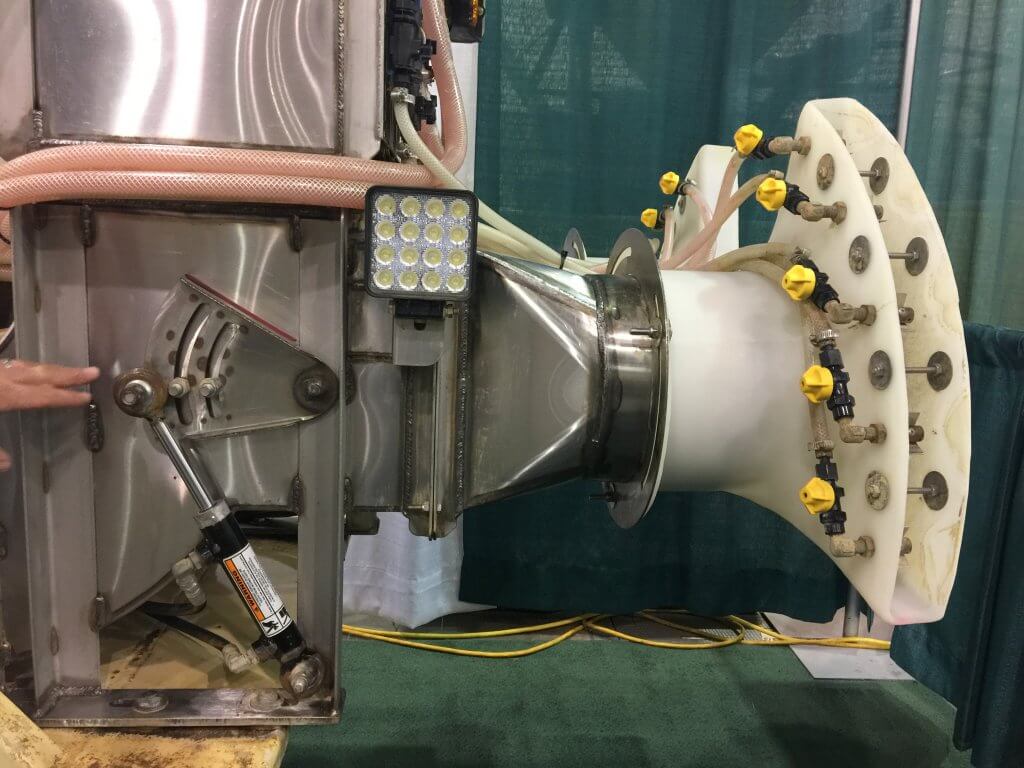
Nurseries use cannon sprayers quite often because they spray whips (i.e. young trees), shrubs, container crops, and all manner of crops in dense plantings and they try to spray them all with a single sprayer. Generally, there’s a lot of drift potential and erratic coverage from cannon sprayers – especially when operators try to cover too much ground in a single pass. I’m always skeptical when I can’t adjust air settings without impacting spray quality, and considering the bad practice of trying to apply too wide a swath, I have a hard time with cannon sprayers. I will note that the AgTec now has baffles that allow the operator to distribute air over the height of the tower (see the hand near the hydraulic piston in the image below). However, I don’t know what that does to spray quality in each section of the tower.
Airblast – Classic Axial Fans
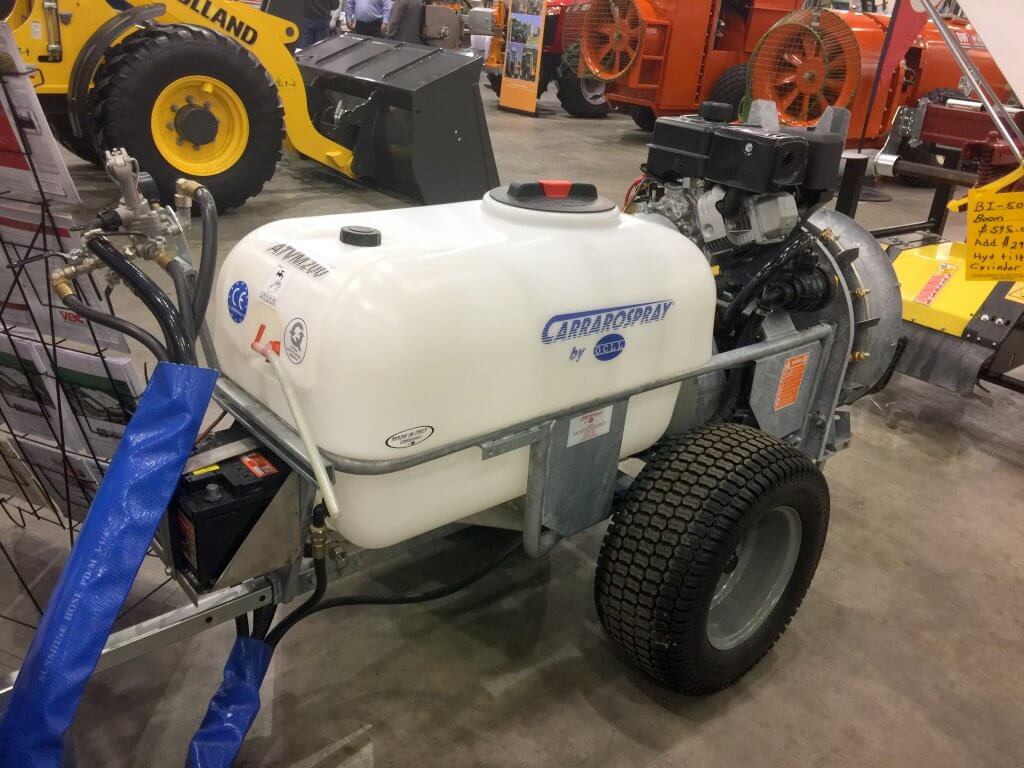
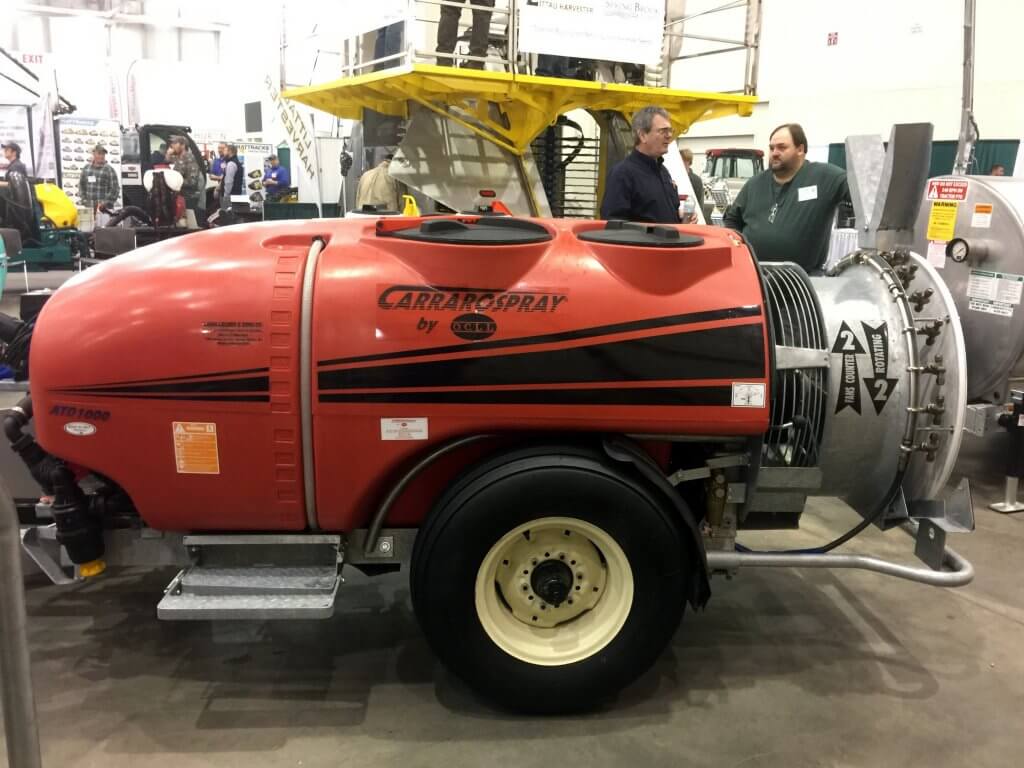
And, of course, there were many classic axial airblast sprayers. Even then, however, there were features to set them apart from one another. British Columbia’s Slimline TurboMist was there, featuring their turbine fans and adjustable air outlets (not pictured). Italy’s Carrarospray was there, and I’ve written about them in the past because they make a tiny sprayer that I like in cane fruit and highbush blueberry. You can hitch it to a mower and mow while you blow.
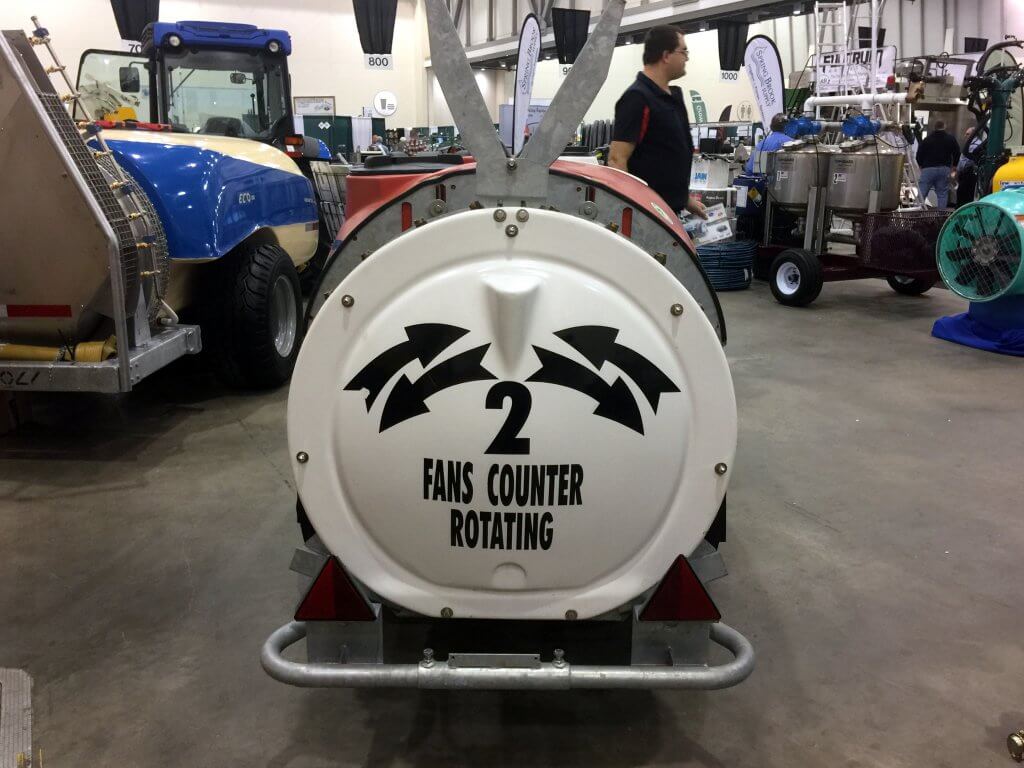
More interesting to me was their sprayer boasting two axial fans that run counter to one another. Carrarospray claims this counter-rotation creates more uniform air than a single fan… but I have no idea how.
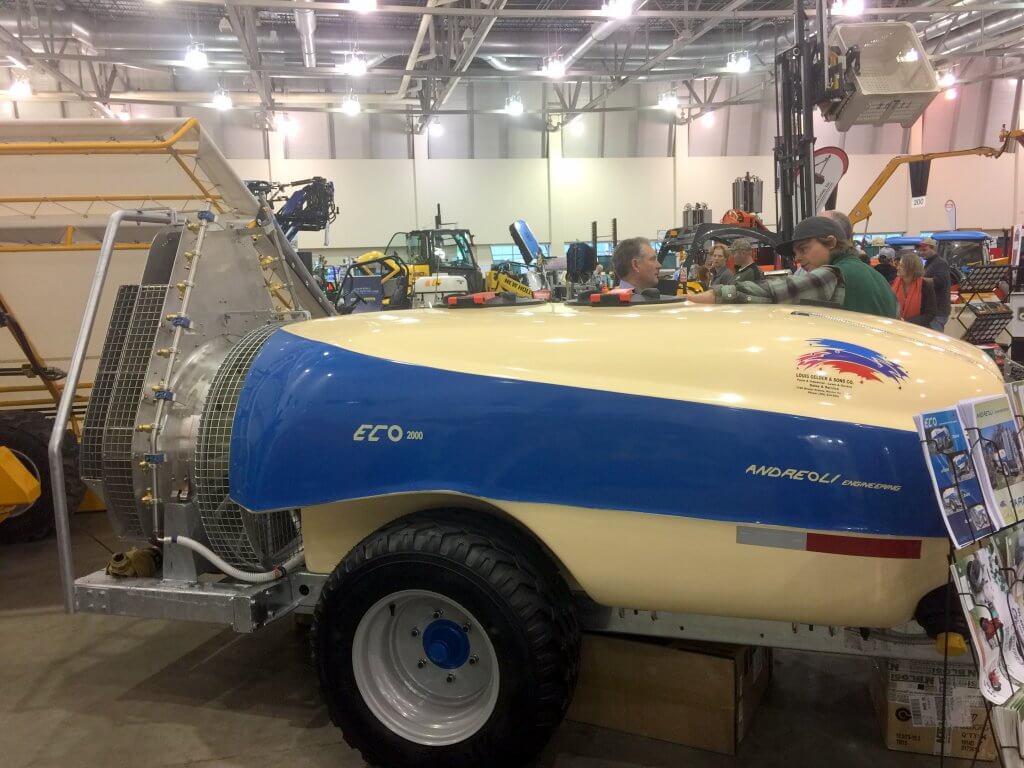
Then there was the Andreoli Eco with it’s stainless steel high-efficiency vane system. Reminding me of the Turbomist, the suction is in the front, so the sprayer is a little less likely to draw spray into the fan when one side is shut down for border spraying and when turning at the end of a row. Louvers covering the outlets would be better, but still, this is an improvement. They also claim to have a symmetrical airflow pattern, unlike older axial fans that move air up on one side and down on the other.
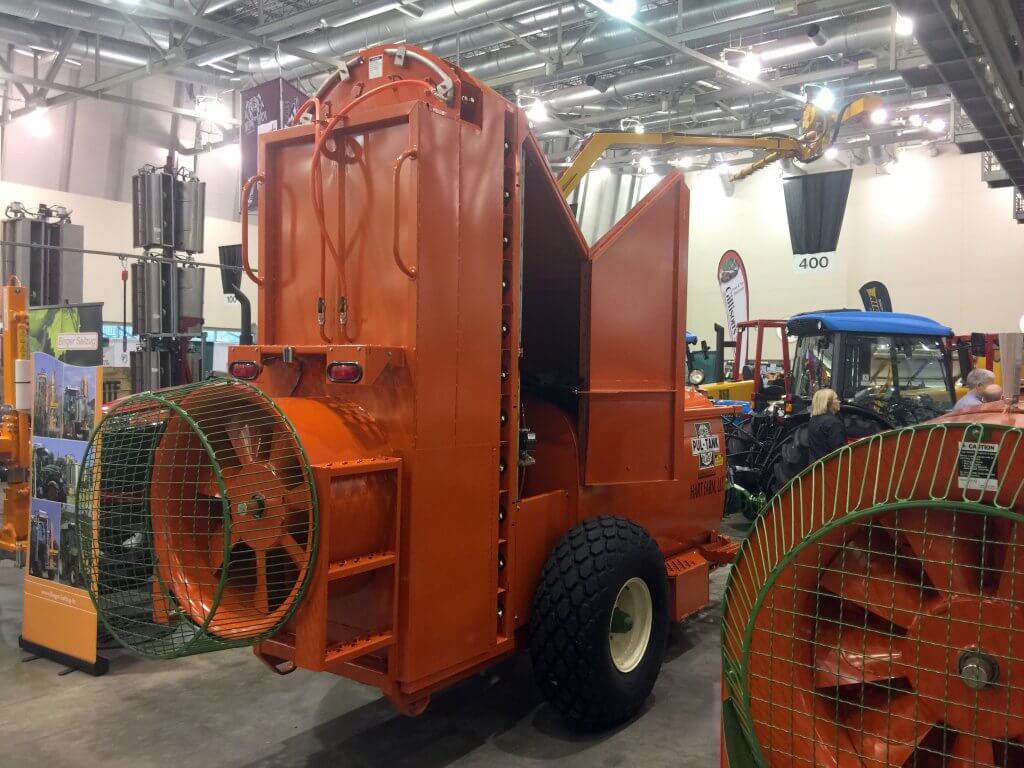
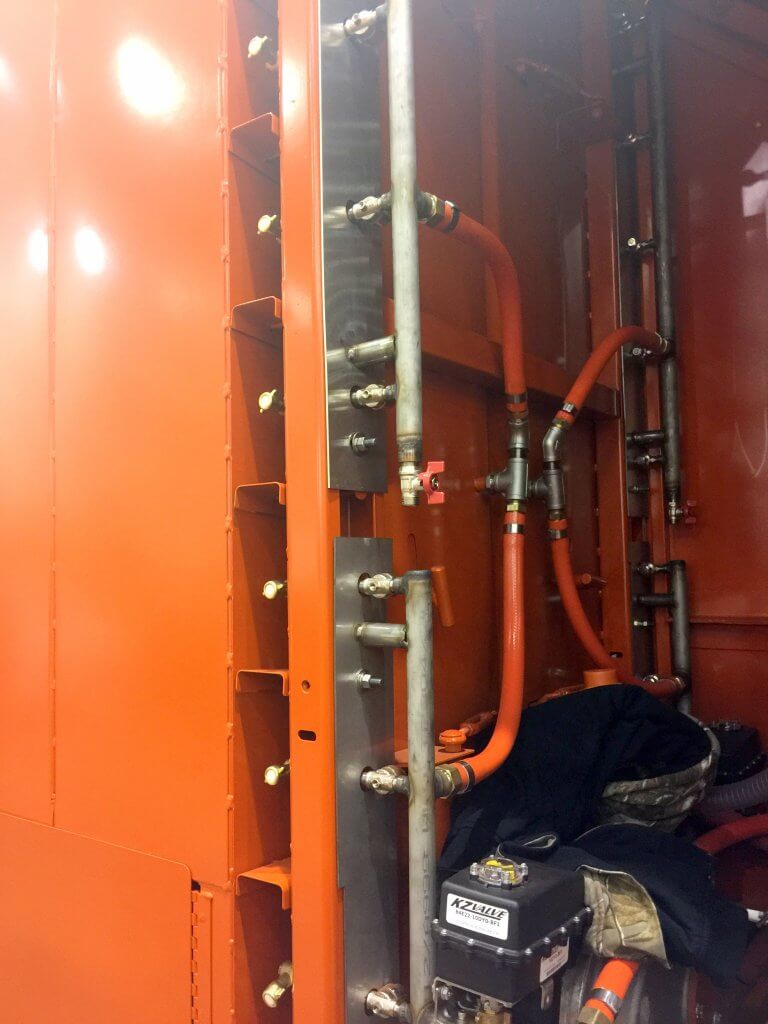
The Rears Pul-Tank reminded me of just that – a tank! Heavy-duty, stainless construction and intended (with care) to last a long, long time. No special features to boast of. It would seem this sprayer adheres to old-school ideas about airblast spraying. Certainly, simple and strong are two appealing features to those operators that don’t want to be bothered with complications.
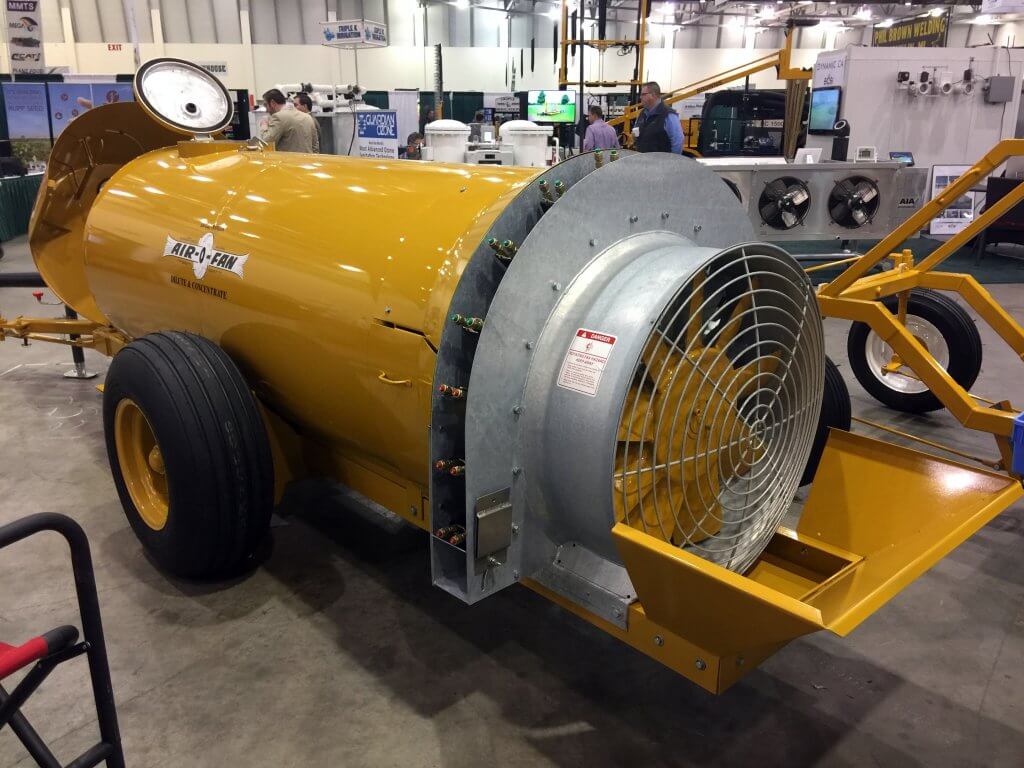
And, lastly (not leastly), was the Air-O-Fan sprayer. Another solidly-built sprayer with a few interesting features. Not shown is the reverse-style propeller which like the Andreoli Eco, claims to draw from clean air, and not spray-laden air. This is undoubtedly the biggest trash guard I’ve ever seen to protect the fan blades from drawing in dirt and leaves (see below). Looks like a CAT steam shovel.
Something that struck me was the air deflector blades inside the fan housing. In my experience, the nozzle bodies and blades are two separate components. But not here, and it makes so much sense! I’ve always taught operators to adjust the air speed/volume and direction first, then adjust nozzle direction and rates second. With this system, you aim the nozzles right along with the air. Expanded systems (e.g. for tree nut, citrus) can have as many as three nozzles per deflector blade.
There was one other very exciting feature coming to this sprayer that I promised I wouldn’t reveal until they were ready, but I’ll just write “HVES” so you will remember you heard it here, first!
Closing
So, this was a massive, sprawling article. Congratulations for getting to the end and I hope it opens your mind to the possibilities for horticultural spray application. The GLEXPO tradeshow was a great experience and I’ll try to get back there in the future. Until then, I look forward to bringing some of this equipment to Ontario to try it out in our horticulture operations. There’s always more to learn.
The first modern airblast sprayer was developed in the mid 1900’s, but competed with existing equipment before it was adopted by the majority. As you can see below, we’ve come a long way. As application technology continues to evolve and grow, so does the array of choices facing growers.
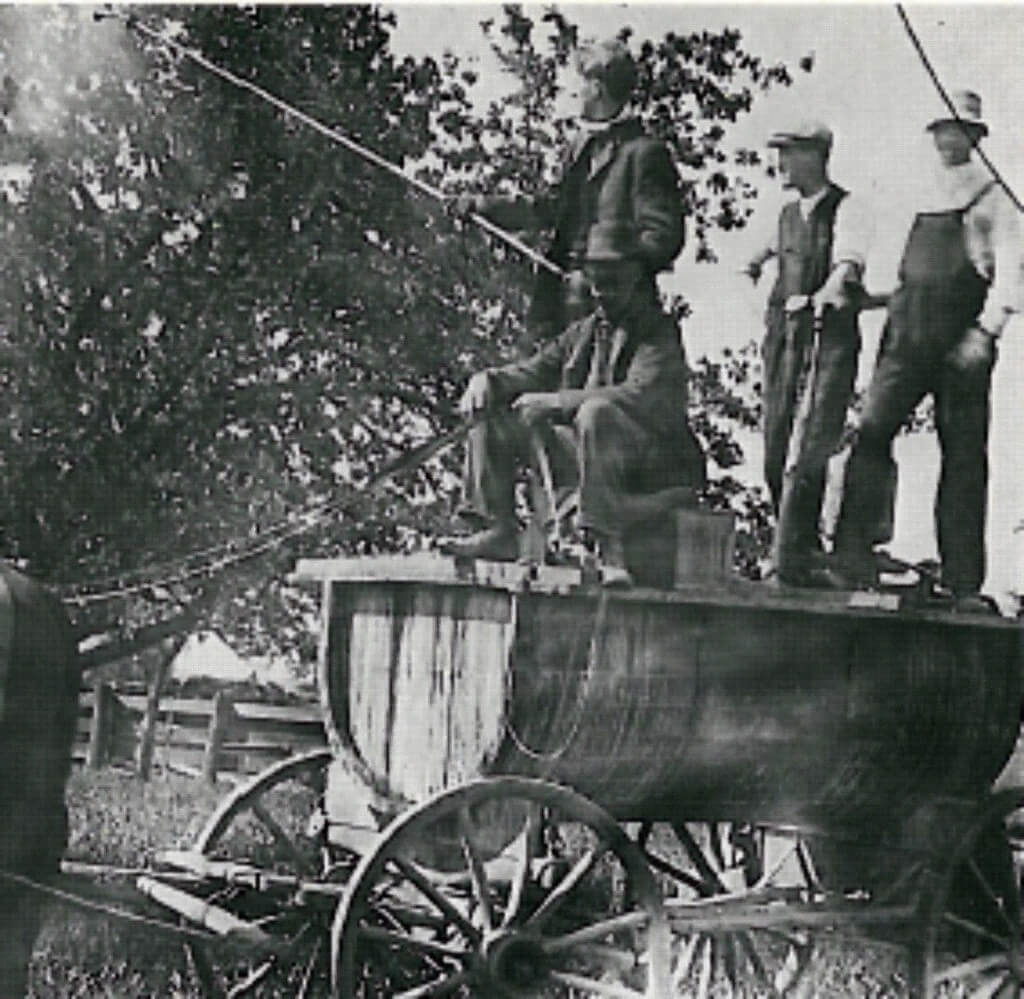
An Ontario orchard spray crew c.1910. Pump pressure was maintained by the two operators at the right. The spraying rate by the above method could cover 1.2 to 1.6 hectares (3 to 4 acres) per hour. Image from www.farms.com
Provide Agro (a subsidiary of N. M. Bartlett Inc.) had been considering introducing a new airblast sprayer to Canada for more than ten years. After deciding not to get into the manufacturing game, they explored importing sprayers from Europe and Australia. In late 2014 they recently invited me to see their choice: the H.S.S. CF airblast sprayer built by Holland-based “Hol Spraying Systems”.
It’s not often I get to see a “new” airblast sprayer design. To be fair, H.S.S. has been building similar sprayers in Holland for more than 20 years, so technically it was new-to-me.
We met at a local apple orchard in Simcoe, where we ran the sprayer through a series of light duties. The first thing we did was explore the sprayer’s features, both optional and standard. As the ambassador to Canada, this particular model had all the bells and whistles. Here is a list of features and observations I feel are worth relating. It’s important to note that this list is in no way an endorsement, nor are any omissions intended to be a condemnation.
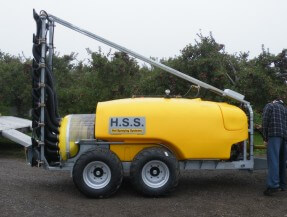
The H.S.S. CF sprayer. Outwardly this PTO-driven sprayer appears very different from Ontario’s typical fleet of airblast sprayers. Notably the flexible ducts and gantry comprising the tower, and the double axle. However, it operates using the same principles as our more familiar sprayers and following a brief inspection of welds and fastens (and given its more than 20 year history in Europe) it appears to be very durable.
Each duct is paired to a nozzle body, and that means each air outlet can be adjusted individually. The tower structure can be customized to match everything from vines to high-density orchards and even has an optional woolly aphid attachment for directing air and spray up-and-into the canopy. For taller crops like hops and semi-dwarf trees, a second fan can extend the tower to 5.5 m.
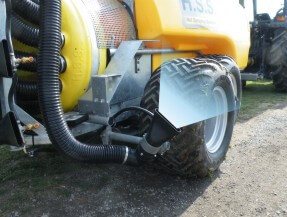
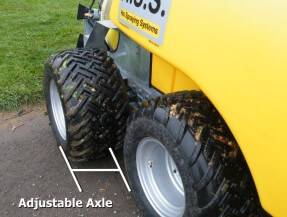
Anyone that’s been stuck in wet weather can appreciate the value in this adjustable double axle. Weight is distributed to reduce compaction and hopefully, the creation of ruts. This feature is standard, but you have the option to upgrade to hydraulic adjustment. I’m not sure how often an operator would want to adjust the axle length, but there it is.
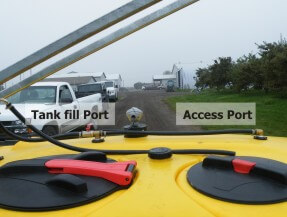
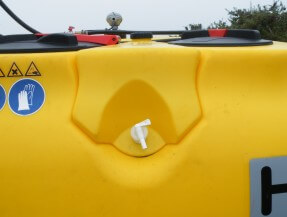
The H.S.S. CF has a lot of features that promote operator safety by reducing the potential for exposure. One convenient feature is the access port separate from the tank fill port. No need to remove the basket to examine/clean the interior, and no need to remove the basket and come in contact with (potentially) concentrated pesticide residue.
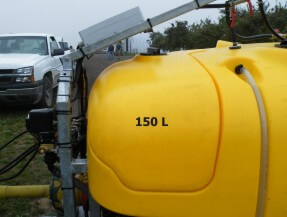
Many large field sprayers feature tank rinse nozzles to facilitate sprayer cleanout following an application. Finally, airblast can boast this feature as well. The 150 L clean water tank supplies enough water to the tank rinse nozzles for a triple, low-volume rinse in the field with no need for a pressure washer or a nurse tank. This prevents residue buildup and reduces operator exposure – and it’s standard!
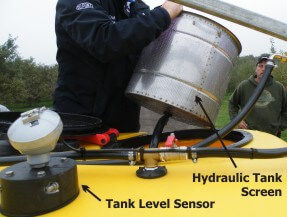
An optional feature is the tank level sensor, which can be tied to the agitation. If you are using a foamy tank mix, agitation won’t turn on until a preset tank level. I’m not certain about this option because proper tank suspension requires agitation from the beginning – just use a defoamer. Note the tank basket has a hose attached to the bottom… read on.
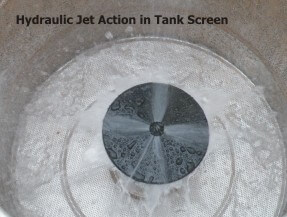
There’s a standard hydraulic jet at the bottom of the tank basket to assist in proper mixing. I don’t know if it precludes mixing a slurry, or if it will improve pesticide bag dissolution, but I have to assume it helps. I trust there’s a safety feature to prevent this nozzle from operating while the hatch is open, but I’m not certain.
This final standard feature may seem small, but it further reduces the potential for operator exposure. The onboard clean water source is separate from the spray tank and the tank-rinse supply and provides a convenient hand-wash station.
Other features include solenoid shut-offs for boom sections, a rate controller and a small-radius draw bar.
An important function of any airblast sprayer is air handling. Too often, tower sprayers have inconsistent air speeds (and presumably air volumes) over the length of the air outlet. Sometimes this can be compensated for using the small deflectors in the tower, or in extreme cases, replacing conventional hollow cone nozzles in “dead spots” with air induction hollow cones that produce coarser droplets and tend to fly farther under pressure. Using a Pitot meter, we examined the airspeed from each air outlet. The PTO was set to 400 rpm and the fan gear was in low.
Nozzle:
Ground
2
3
4
5
6
7
Top
Left
70 mph
85 mph
90 mph
85 mph
80 mph
85 mph
80 mph
85 mph
Right
75 mph
90 mph
90 mph
90 mph
80 mph
90 mph
85 mph
85 mph
There were no obvious dead spots, and the left and right sides of the tower seemed about equal. The bottom two positions were notably slower than the rest, but given the distance to the target in that position, and the fact that ambient wind is slower at the ground, it’s interesting, but not necessarily a concern.
We arranged a set of water-sensitive targets in the canopies of semi dwarf apple trees to get a sense of the sprayer coverage. Admittedly, it was very humid and there was little wind that day, so coverage is much easier to achieve because so little spray evaporated or was blown off course before reaching the target. We ran different combinations of PTO speed and fan gear. These images are from 540 rpm and low fan gear using red Albuz nozzles (1.5 L/nozzle/minute @ 6 bar) spraying about 400 L/ha at about 5 kph. On a drier and windier day, higher volumes would be needed.
There were no obvious misses, even when papers were oriented parallel with the ground (exposing their narrow edge to the sprayer, such as in the paper on the right). This isn’t conclusive, but it does show that the sprayer had no trouble penetrating the canopy, and with further tweaking should be able to provide suitable coverage throughout the canopy. Personally, given the upward orientation, I would use the woolly aphid nozzle for all applications, particularly for drenches. More on that later.
One notable quality was the “quiet” operation of the sprayer. Applicators are familiar with the loud whine created by most airblast sprayers; at lower rpm’s and in low fan gear, the tractor seemed as loud (or even louder) than the sprayer operation. You can watch a video of one of the spray passes at the bottom of this article.
So the big question: “How much?”. You’ll have to contact the dealers to find out more, but I will say that stripped down to standard features, it’s comparable to some of the more expensive sprayers in Ontario. Don’t be dissuaded because I believe the expense is warranted given the features, with particular note of the on-board tank rinse system and adjustable air ducts.
So is this the sprayer for you? Well, if you’re in the market for a new sprayer, always start by prioritizing your goals. Perhaps work-rate is a priority, so look to sprayer capacity to reduce the number of refills and consider over-the-row technology (where possible) to reduce the number of passes. Perhaps the crop is adjacent to sensitive areas or residential homes and drift control is a priority; consider adjustable air direction and adjustable air speed.
When compiling a prioritized list, reflect on the positives and negatives of your current sprayer and talk to fellow growers about their experiences. It may come down to personal preference, but consider the following points. These points are in no particular order; they come from many articles I’ve read on the subject of considering new equipment purchases and from talking to dealers, mechanics and sprayer owners:
Necessity – Is a new sprayer really needed? Manufacturers have a number of retrofit kits available to upgrade and improve sprayers. If poor pesticide performance has led to the decision to purchase a new sprayer, be sure it’s related to the technology, and not to an operating error.
Crop Type and Acreage – Consider the size of the operation and the size, shape and density of the crop(s). Can the sprayer adapt to provide adequate coverage throughout the growing season and in the long-term? How flexible is the sprayer when spraying different products onto different targets? • Sprayer Capacity and Filling – Fewer refills means a higher work rate, but increased capacity also means more weight, so consider the effects on navigation, turning radius and soil compaction. Is the tank easy to fill?
Cleaning, Calibrating and Maintenance – Moving between crops sometimes requires complete cleaning and decontamination of the tank, lines, nozzles and any shrouds or ducts. Clean water reservoirs, tank-rinsing nozzles and overall accessibility should be considered. Review the steps required to winterize and to calibrate the sprayer. Is it easy to access parts? Is operator exposure minimized
Horsepower – This is an important consideration for airblast sprayers because fans move a lot of air and liquid. Tank agitators require power, too. Consider selecting from the higher range of manufacturer-recommended horsepower to improve longevity. Remember, however, that fans typically don’t have to operate at the maximum rated rpm’s, particularly early in the season.
Nozzle Technology and Operating Pressure – Consider the range of nozzle-types intended for use and ensure the sprayer can provide sufficient pressure. While more expensive, diaphragm and piston pumps have fewer moving parts in contact with the spray solution, reducing cleaning time and operator exposure.
Spraying Conditions – A sprayer has to be reliable, even in adverse conditions, so consider the operating environment. Night spraying, uneven terrain, high winds, dry conditions – many environmental factors can impact sprayer performance and may warrant special consideration. Investigate deflectors, shrouds and the structural framework and durability of the sprayer.
Since its introduction in late 2014, growers have been slowly adopting this sprayer in Ontario and the northern US. Some high-density operations have purchased the optional over-the-row boom system that allows them to spray multiple rows at once. Here at at the Simcoe Resource Station, we’re hoping to run the HOL sprayer in apples for the 2016 season to see if the optional woolly apple aphid (WAA) nozzle has any impact on scale, mites and of course, WAA control. Moreover, we plan to run that nozzle all season long to see if its upward angle improves underleaf coverage and canopy penetration.
You’ve got an older sprayer. Your neighbours have newer sprayers. For various reasons, you’ve decided against a trade. How can you still get the benefits that newer sprayers deliver? Let’s explore how to improve your sprayer performance and productivity with strategic component upgrades.
Most of the biggest gains will relate to the plumbing, especially filling and cleaning. Here is a list to think about:
Nozzles. This one’s a no-brainer. Nozzles remain the cheapest and most important part of any sprayer, affecting coverage, drift, and accuracy. Although durable, nozzles do wear or get damaged over time. But perhaps more important is the changing use patterns of our pesticides. We are moving into a time of greater reliance on tank mixes that blend systemic and contact products, and also higher water volumes into mature canopies. For example, fungicides for Fusarium Head Blight benefit from twin fan nozzles. We’re also seeing new herbicide registrations with greater spray quality (droplet size) restrictions, requiring coarser sprays or higher water volumes to maintain acceptable drift amounts. Are your nozzles able to meet those needs?
Nozzle bodies or turrets. As we move towards more specialty applications, perhaps we need a greater selection of nozzles at our disposal at any given time. Bodies with 5-nozzle turrets are standard on newer sprayers, and these make sense. Burnoff, in-crop, fungicide, and fertilizer nozzles are four that most users will need just from flow-rate needs alone. But some finer or coarser options of each may also be justified, and easy access saves time in the field. New bodies also provide new seals, and the newest offer higher flow rates and exchangeable parts.
Boom end cleanout. Removing residue or air from booms is an important part of good practice. Many sprayers already have manual valves that allow this to happen relatively easily, but it’s still a process that an operator has to make time for. And on top of that, flushing boom sections results in massive doses of pesticide on the soil. One of the most innovative inventions in recent times is Hypro’s Express Nozzle Body End Cap. A DIY or dealer installation of these units allows your boom to bleed introduced air on the go. The ENBEC also forms a dead end exactly at the last nozzle position, eliminating the dead spots that introduce contamination after a pesticide switch. Cleanout and shutoff response also improves. A fast boom flush is straightforward by moving the turret to an open position. TeeJet offers a Rapid Stop extended inlet tube that evacuates trapped air from the wet boom, can be retrofitted on most bodies. Wilger Combojet bodies offer a similar design called Kwikstop. Both can be expected to improve shutoff response, but do not address boom end contamination.
Wet boom. Are your wet booms made of plastic? If so, they can warp over time and are also harder to clean. Replacement wet booms are available from several suppliers, including Hypro and Wilger. These are made of thin-walled stainless steel for excellent durability and ease of cleaning. Wilger units are very thin and light and come with their own Quick-Nut fittings and feature swept elbows and Ts. Hypro’s Express Booms come with nozzle bodies and Express Nozzle Body End Caps. Flange fittings are used in the Hypro upgrade.
New boom. Some people are recognizing the value of boom width in sprayer productivity and are considering a wholesale boom replacement from a third party. These booms come in wider sizes, lighter materials such as aluminum or even carbon fibre, and innovative plumbing options such as recirculating designs or telescoping for adjustable widths from 80’ to 150’. Perhaps a better suspension system or automatic boom levelling system is part of such a purchase.
Individual nozzle shutoff. Most sprayers have sectional control of at least 5 sections. But some of the outer wings (the part of the boom that is most often involved in sectional control) can still contain significant lengths tied to a section, creating waste. With individual shutoff valves, a boom can be converted to either many smaller sections or even nozzle-by-nozzle sections, depending on the capabilities of the rate controller. Not only do these offer excellent resolution, they also feature instant shutoff and turn-on response at the spray pressure. Because this type of installation can demonstrate product savings, it has a calculable ROI.
Rate controller. Some older sprayers struggle with responsiveness. An operator changes speed, and has to wait a long time for the rate controller to catch up. A newer controller can improve the responsiveness significantly, offer a new larger cab screen, work better with a navigation system, or even include ISO-BUS capabilities for future upgrades. Improving the user experience with a better interface can be valuable, giving an old sprayer a new capabilities and feel.
Variable rate technology. We are seeing several options that can offer better control over nozzle flow rate to suit either a greater range of travel speeds (on hilly or otherwise uneven land) or a better range of rates for prescription map application. Pulse-Width Modulation systems from Capstan (Sharpshooter) and Case (AIM Command), Raven (Hawkeye), or TeeJet (DynaJet) all offer these types of features. A new nozzle body, Hypro Duo React, achieves similar results with multiple nozzles that can switch back and forth according to flow rate needs.
Boom lights. Whether spraying at night or wishing to see spray patterns better in the day, boom lights can help. Versions are available from ATI or SprayTest. Caution is advised when spraying between evening and morning hours, as temperature inversions are common during that time.
3″ plumbing. One of the biggest productivity tools is decreasing the time required to load a sprayer. Wide booms applying large water volumes at fast travel speeds can empty even a large tank in 30 minutes or less. If the fill also takes 30 minutes, then 50% of the spray day is spent idle just for filling. Increasing the fill speed with a new load system using 3” plumbing and a high capacity pump can reduce that to 10 minutes, adding acres per hour. Make sure, though that dry products are properly hydrated so they mix well and stay out of screens. Also consider the rate of chemical induction, as that can be a bottleneck.
Tank wash down nozzles. These nozzles, installed at the top of the tank, direct a clean water source (containing a cleaning adjuvant if needed) to the tank wall, rinsing the pesticide off. Successive batches of cleaning improve the tank wall decontamination as the solution becomes more dilute. By making the wash down easier, tank cleaning can occur in the field immediately after spraying and the rinsate can be sprayed out in the field. This saves time and prevents point-source contamination.
Self-cleaning line strainers. Consider this a productivity tool. Mounted on the pressure-side of the pump, these strainers use excess pump capacity to bypass particles back to the tank. A tapered design creates a rapid flow of liquid past the screen face generating continuous wash-down of particles. Regular inspection is still recommended, but the chance of a problem is significantly reduced. Because debris is returned to the tank, proper tank sump cleaning becomes more important.
Pump. Some call it the heart of the sprayer. The pump pressurizes the spray mixture so it can be distributed evenly and atomized. To do this, it needs to produce high enough flow for our ever increasing water volumes, travel speeds, and boom widths, while maintaining enough reserve for agitation. Some use the system pump to draw water into the tank, which can present a bottleneck. Clearly, capacity and pressure are important. Pump impellers can wear and seals can leak, reducing performance. New or re-built pumps are available in long-lasting stainless steel, and the best new models have flange fittings and seals with either enhanced dry-run survivability, or dry-run capability. An upgrade definitely worth considering.
Clean water tank with dedicated clean water pump. This is another productivity tool. Cleaning the tank in the field without stopping the sprayer becomes an option with this design. Rather than use the product pump to draw clean water into the tank, mix it up, spray it out, and repeat, this design allows continuous cleaning. When the product tank is empty (signalled by a loss of pressure), the clean water pump turns on and delivers clean water through the wash-down nozzles. The pump must have enough capacity to obtain a good cleaning spray from the wash-down nozzles. As the sump fills again, the product pump delivers it to the boom and also cleans the return lines. The end result is prompt cleaning of the tank and thorough, efficient dilution of the remainder.
Boom remote control. Whether it’s for cleaning out boom ends or simply verifying proper nozzle operation, a remote boom section shutoff makes those jobs easier, safer, and more environmentally friendly. Boom remote controls let you turn on just the boom section you need to inspect. It’s also useful for nozzle calibration.
Tires. Ask yourself: what equipment do I spend more time in than any other, makes more passes over each field than any other, makes deeper ruts than any other, and gets stuck more often than any other? A new set of tires, or even tracks, might be worth considering. Low-pressure sprayer-specific tires with VF (Very High Flexion) technology are available from major suppliers. These offer sprayer-specific lug designs, they increase the footprint for increased floatation and less compaction, and they can also improve ride quality. Tracks, though considerably more expensive, are becoming available for sprayers and can make sense in some situations.
Some of these retrofits can be costly. But they can introduce new life and utility into an aging chassis, resulting in higher productivity, higher quality work, or simply a better operator experience. All of these are important and are worth investing in.
Here’s a Real Agriculture video of Tom and Jason talking sprayer retrofits at the end of Edmonton’s 2016 FarmTech. Note the snazzy “Sprayers101” team shirts!