Tag: productivity

  • Don’t try this tempting shortcut

    Don’t try this tempting shortcut

    There’s a call that I’ve been getting for 20 years now. It came again this week. Someone has a twincap with two small air-induced tips, and they’re applying herbicides and fungicides with low water volumes, often 5 gpa, sometimes less. They call because they want to know how much wind they can spray in. Is 30 km/h OK? They want my blessing.

    I don’t need to hear much more. Some nozzles are sold entirely on the premise that they provide superior coverage – more droplets per square inch – and that this improved coverage permits the reduction of water volumes. Furthermore, the claim goes, when water is reduced, the spray concentration increases and the whole darn package just works a lot faster and better.

    This line of thinking is as old as spraying itself. Applicators seek pesticide performance as well as productivity, and this approach gives them both. The proponents are well aware of their customers’ desires, and sell into it. “Use these tips and cut back on water. Any more than this just runs off anyways. You’ll get better coverage and better performance, get more spraying done.” It’s a convincing argument. Get an edge on your neighbour, the person who’s not in on the secret and is wasting time and water.

    Why don’t I embrace it? There are a few reasons.

    First, it doesn’t tell the whole story. Invariably it involves a twin nozzle setup. Use two nozzles, get more droplets, right? If that were true, believe me, I’d be advocating for quintuples.

    Fact is that the only factors that change droplet numbers are droplet size (spray quality) and water volume. Want more droplets at the same water volume? Make the spray finer. Want to keep spray quality and add droplets? Add water (not nozzles).

    The easiest way to improve coverage at the same volume is to use a finer nozzle, or to increase spray pressure. Depending on how far you go, you could make the spray finer and cut water, and still have more droplets per square inch.

    The hardest way to improve coverage is to purchase a twincap and buy two nozzles, each of them half the size. True, within any given nozzle type, smaller sized tips usually generate finer sprays. But why bother with two tips? They’re more expensive and plug more.

    If someone asks me how to improve coverage without changing water volume, I usually tell them to speed up a few mph. The rate controller will increase pressure and the spray gets finer. If speeding up is not possible, get one size smaller nozzle and run at higher pressure, same speed. Or keep nozzle and speed, and add some gpa, pressure will go up. It’s that easy. No twins necessary.

    Second, the twin nozzle/low volume approach exaggerates the value of the twin nozzle for herbicides. With small plants and relatively open canopies in the early season, plus our high booms and travel speeds, the twin tips are not adding a lot, if anything at all, to coverage. It remains a sum of droplet size and water volume, the angle is not important at this stage. Deposit is by turbulence and wind, most of the time.

    Third, low volume believers ignore a few potential problems. Drift is a big one. Low volume, fine spray operators are surrounded by nervous neighbours. They have fewer hours per day during which drift is acceptably low. And they definitely should not be on the field when wind is at 30 km/h. Basically, they’re a bit uncomfortable (at least they should be) and get less done per day.

    Another potential problem is evaporation. Most sprays, even when applied at lower volumes, are still 90% or more water. The same volume of water evaporates much quicker when atomized into smaller droplets. This has two main downsides: On their way to the canopy, small droplets evaporate and become even more drift prone, and may not impact at all. Those that impact evaporate shortly thereafter. Research has shown that pesticide uptake is better from wet than dry deposits.

    When Delta T (dry bulb minus wet bulb temperature) is high, evaporation can be so strong that it reduces pesticide performance or causes solvent burn. Fine sprays make it worse.

    I also hear about the use of oily adjuvants to control evaporation from small droplets. This could be even more dangerous. Small droplets drift, and evaporation to dryness is actually helpful in reducing the impact of that drift. How? It makes the small droplets disappear, with their remnants dispersing into the turbulent atmosphere. With oily adjuvants, the small droplets stick around and stay potent and their drift damage is much worse.

    Lastly, the practice is possibly off label. Water volume and spray quality label statements are designed to offer good performance and acceptable drift risk. While that part of the label is often a bit dated, it does provide better support from the manufacturer should something go wrong.

    If you’re spraying under hot, dry and windy conditions, the low volume, fine spray approach is irresponsible. Use sufficient water (7 to 12 gpa) to allow low-drift sprays, at least Coarse to Very Coarse, in some case, even coarser.

    Agronomists provide the best possible information for their clients, based on scientific evidence and experience and in accordance with their professional code of ethics. Sometimes the news we deliver aren’t what the customer wants to hear. But we have to represent the interests of all of us, collectively. I find that pretty important.

  • Productivity Calculator

    Productivity Calculator

    Want to figure out how your sprayer configuration affects your productivity?  Try out this little that tells you acres per hour, the amount of productivity lost to turning and filling, and the benefit of longer booms.

    You might be surprised how productive you can be without driving faster.

    To see other apps, .

  • Recirculating Booms – Introduction to the Concept

    Recirculating Booms – Introduction to the Concept

    Listen to the audio version of this article here

    A lot of people are intimidated by sprayer plumbing. One look at the spaghetti bowl of spray mix and hydraulic hoses and valves, and they walk away. It hasn’t helped that much of it is concealed under the frame and all of it is in the same black colour, so figuring it out on your own is almost impossible.

    Belly of a typical sprayer, showing black hydraulic and spray hoses.

    Let’s quickly review the basics. In all sprayers, the liquid in the tank is drawn out from the bottom and pressurized by a pump. The pressurized liquid is split into two main paths. One goes to the spray boom to hydraulic atomizers (nozzles). The other goes back to the tank to agitate the liquid and act as a pressure bypass when the booms are off. Bypass throttling changes pressure. That’s it.

    Sprayer plumbing diagram (Source: TeeJet).

    By the way, has anyone ever thought of some colour-coding or labelling the hoses and valves on a sprayer? We’d definitely appreciate that.

    Conventional boom sections

    Most North-American sprayers feed the pressurized liquid to the boom, where the flow is subdivided into physical sections that define the various portions of the boom that can spray at any one time. Older sprayers might only have two sections, the left and the right boom. Wide booms now have anywhere from 5 to 13 sections, each about two to four metres wide. Each section has a pressure feed to its middle, and each section terminates at two dead ends, at which we place caps or valves for flushing.

    A conventional plumbed boom with two sections. Each section has two terminal ends that require cleaning. Boom can only be flushed or primed by spraying or by opening boom end caps.

    Sprayer with nine sections, each controlled by its own valve and each running a dedicated feed hose.

    Two partial boom sections, each showing a central feed line and a capped boom end.

    Sectional boom end showing 10 cm of capped pipe beyond last nozzle body.

    Boom end with valve to facilitate draining and flushing.

    Any liquid that enters this type of boom must exit at the nozzle or the boom end. It must be sprayed out or drained. This poses three distinct problems.

    • If the boom contains water or a previous spray mix, the boom needs to be primed with the new product before spraying. We need to spray or drain the existing product out.
    • If we want to clean the boom or flush it with water, again we need to push the existing liquid out.
    • If we have dead spots in the boom section, such as a boom end, we need to take special care to flush those out as well.

    These characteristics complicate cleaning, create waste or contamination, and take time.

    Recirculating booms

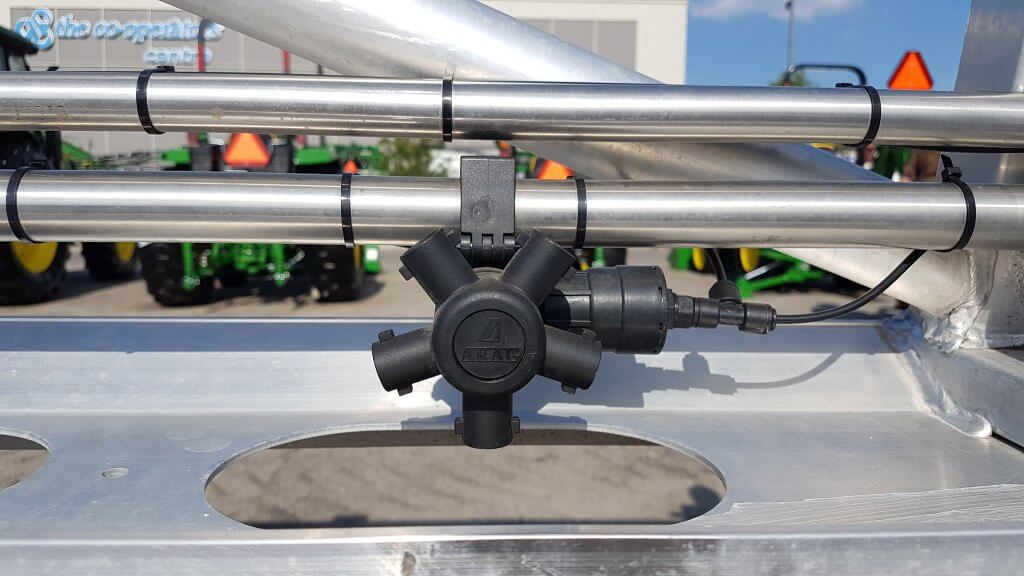
    In a recirculating boom, the spray mixture enters the boom at one end and exits at the other, returning to the spray tank. In most cases, the left and right wing each has its own feed and return. Sectional control is achieved via individual valves (air or electric) placed on the nozzle bodies.

    There are two main types of recirculating booms on the market.

    The first system routes the pressurized mixture into the boom and shuts off the return line during spraying. When the nozzles are shut off for a turn, the return line opens automatically and the boom flow is pushed past the nozzles back to the tank. When the nozzles spray again, the return line closes to pressurize the boom. 

    Recirculating boom system offered by Pommier. One end of boom is pressurized, the other end is return. Return flows when boom spraying is shut off. Boom can be primed or flushed without spraying.

    This is the system used by Pommier, the French aluminum boom manufacturer who first introduced recirculating booms to North America.

    Pommier recirculating boom.

    Pommier boom showing stainless steel supply and return lines, as well as air-activated shutoff valve on nozzle body.

    The second type of system contains a 3-way valve, connected to the return line and the pressure side of the pump. This valve provides the option of either allowing the return line to go back to the tank, as above, or to also allow pumped flow to the return side so that the boom is pressurized at both ends.

    Recirculating boom that allows return line to be either pressurized by pump, or return to tank.

    Top view of D.O.T. Connect sprayer recirculating boom setup. Lower line is pressurized by pump. Upper line is return. Three-way valve allows return line to either go back to tank, or be pressurized by pump.

    Tidy setup of pressure and return lines on D.O.T. Connect system.

    This feature may be useful with long booms along which pressure drop is more likely to occur, or when very high flows are required, and was introduced to North America by the Dutch manufacturer Agrifac, about which we wrote here and reprinted Mick Robert’s article from Pro Operator here. A similar system is available from Rogator (starting in 2018) via their C-Series featuring LiquidLogic. It has also been used on the Connect sprayer, developed by Pattison Liquid Systems, for the D.O.T. autonomous platform.

    The main advantages of this design are that it provides the option of additional pressure to the spray boom to avoid pressure drop, and to allow any spray mix in the return line to be pushed and sprayed out to the boom for rinsing in the field. This lowers the remaining volume that needs to be diluted.

    Agrifac recirculating boom showing return loop at boom end.

    Boom end on Rogator Liquid Logic system. Note Hypro Pro-Stop E shutoff valve.

    Features

    Recirculating booms offer advantages in terms of preventing soil and water contamination and also in terms of simplifying the boom cleaning process. The design provides an opportunity to graduate to a better resolved sectional control as well due to the requirement for individual nozzle shutoff valves. 

    Due to shorter and less complex lengths of plumbing needed, stainless steel can be used for the return lines which decreases the potential for pesticide residue being adsorbed.

    To rinse a boom with product mix still in the tank, simply draw water from the on-board clean water tank and push it to the boom without activating any nozzle bodies. The mix in the boom is returned to the tank and replaced with water, nothing is sprayed or drained. The tank contents may become slightly diluted depending on the duration of the rinse.

    To rinse the tank as part of the sprayer cleanout, first spray the tank empty. Then introduce clean water into the product tank via the wash-down nozzles and spray that out. As always, either use several batches of  small clean water volumes, or a continuous rinse system, to dilute the remainder most effectively. There may be additional volume to dilute from the return lines compared to a conventional system, depending on the type of recirculating system is used. However, boom ends no longer exist and this saves effort and ensures a more thorough rinsing.

    To prime a boom that contains water, simply open the return lines back to the tank and allow the new mix to flow through the boom. Again, some dilution of the tank will occur due to the water in the boom.

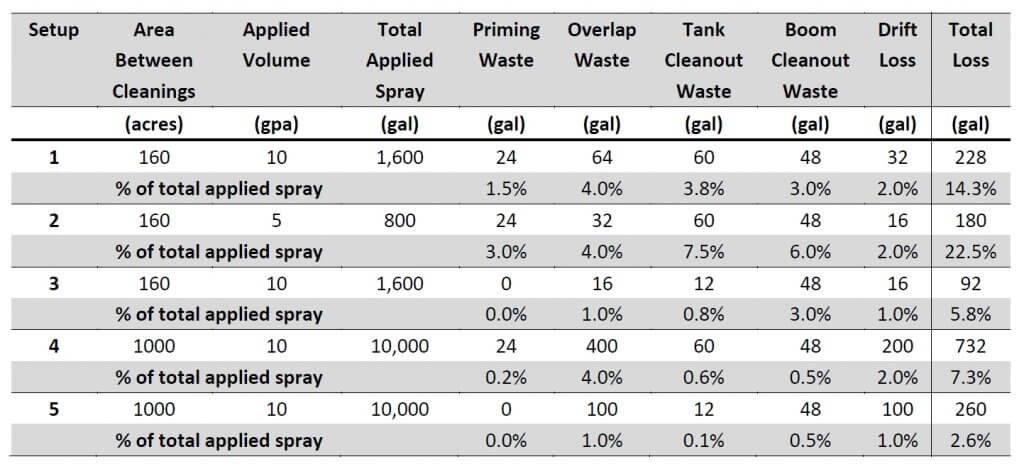
    The value of spray-free rinsing and priming adds up. Each prime, for example, consumes about 30 US gallons before the spray reaches the last nozzle of the longest section. Much of that product ends up on the ground, probably while the sprayer is stationary, and probably in a similar place on the field year after year.

    Since a recirculating boom requires a powered individual nozzle shutoff, this adds some cost. However, the opportunity of improved sectional control via virtual sections is significant (most monitors offer 16 virtual sections that can be configured). Well-configured virtual sections can save several percent from overlaps.

    Recirculating booms remove many of the contamination problems associated with conventional plumbed sections. They save time, money, and reduce environmental impact. We think they should be offered on sprayers.

    Here’s a link to a nice article on recirculating booms written by Spencer Myers for the Manitoba Co-operator. A video that goes with the article can be found here.

  • Techniques to Improve Spray Productivity

    Techniques to Improve Spray Productivity

    Click here for an audio version of this article

    In almost all agronomic practices, timing is key. There are certain, and often small, windows of opportunity for getting a task done without losing yield potential or product quality. Weed specialists talk about early weed removal, pathologists talk about symptom monitoring, and entomologists remind us of economic thresholds. Acting at the right time is fundamental.

    Sometimes I’m asked about comparing two different methods of spray application. I usually dodge these questions by advising to choose the one that gets the job done on time. “An average application at the right time is much better than an excellent application at the wrong time” is how I put it. Sure, I’m dodging, but I really believe that. It’s mostly in the timing.

    Everything we do carries with it some time inefficiencies. Some are rooted in technology, others in habits. It’s the habits that are easier and cheaper to address. That’s why, when evaluating how to improve a spraying operation, I advise to start with a stopwatch and notepad, not a sprayer brochure.

    A stopwatch and notepad provides your path to greater productivity.

    Remember, if you want to improve a system, you first need to understand it. And to understand it, you need to measure it.

    So, do a time accounting.  You need to know how your time is used on a spray day. Note the time spent preparing for the job (loading supplies, double checking label instructions, transporting, etc.). The big users of time are sprayer transporting, filling and cleaning, but there are very many small time users and those can add up. This time is doubly important because these tasks occur during the spray day, when the weather is good and you should be maximizing spray time.

    Make your own time accounting sheet, including every detail or possibility.

    Even within any one operation, time can be subdivided. How much time is spent on a turn? Since a 120’ sprayer will make about 22 of these per half mile, that can add up. Even a spray monitor can play a productivity role if it quickly and consistently locks onto its swath. Needing to stop and back up while it searches for a signal can be costly.

    On our farm, we sometimes used custom operators to get the cereals off. I recall how aggravating it was to watch the 8820 inch ahead of my N6. Surely it must be throwing a lot over, I thought (it was). But I usually caught it at the truck, where my unloading speed was over 1 minute faster. Redemption, briefly.

    That same principle applies to these small efficiencies. A well-designed tender truck can speed loading and more than make up for lower spray productivity of a smaller sprayer.  A lighter sprayer load and flotation tires can save a ton of time if it means the difference between getting stuck or cruising through that spot. A set of extra-coarse nozzles that can be rotated into place in just two minutes can help finish a field if the weather changes, or allow a margin to be sprayed, saving a return trip.

    Extra nozzles to allow spraying in higher wind speeds without increasing drift are a productivity tool.

    A custom operator shared some very useful tips with me a few years back. He optimized the small things, such as re-locating the switch to deflate his suspension airbags after driving onto the trailer, to the platform beside the cab. He’d deflate while descending the steps, and by the time the tie-down straps were thrown across, the unit was ready to be cinched down. No waiting. He also opted for a slightly wider aftermarket boom so he had an even number of spray passes per quarter, saving another 2 minutes or so per field.

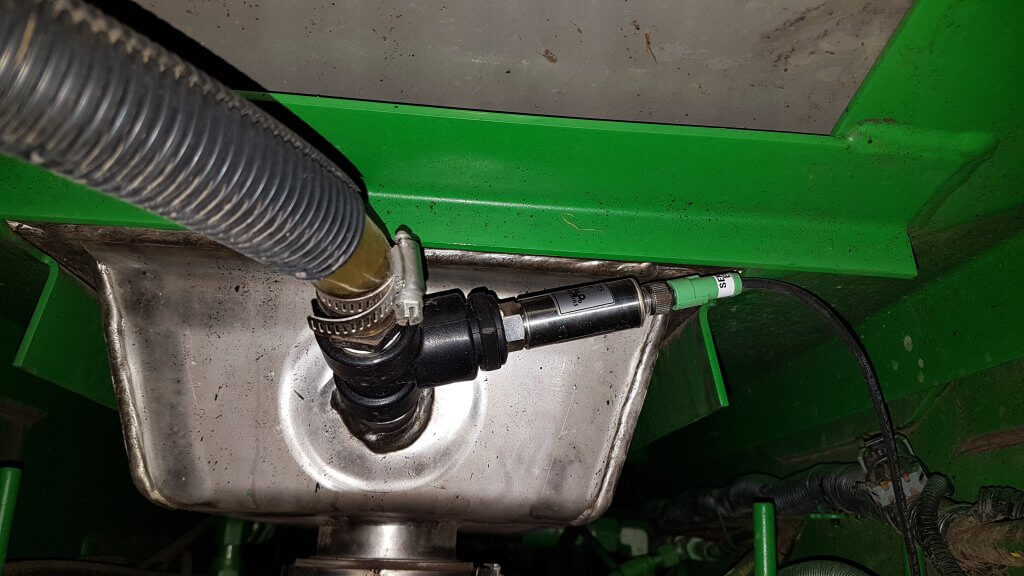
    The same operator made me aware of the importance of knowing exactly how much spray is in the tank at any one time. The majority of spray monitors are simply not accurate enough. A factory sprayer can count down from a full tank using its flow meter, but that requires two things to be accurate, the filled amount (entered by the operator, usually from a sight gauge) and the flow meter itself. Point is, when we fill the last load of a field, we don’t want too much left over, but we’d still rather not run out. By using the AccuVolume from Simon Innovations, he was able to fill accurately and he was also able to exactly monitor his liquid usage. If he had two passes left, and knew he needed exactly 150 gallons (also considering when his pump drew air), he could monitor that and make small adjustments to the application rate, if necessary, to get there. It’s a big deal because contending with a larger remainder is wasteful and takes time to deal with. The AccuVolume also helps make multiple small volume batch cleaning more accurate, and therefore easier.

    The AccuVolume measures your tank contents, to the nearest gallon, regardless of slope position. It’s a time saver.

    A small addition to the tender truck such as an electric hose reel or a swing arm that carries, say 20’ of hose, helps deal with the weight of a full 3” line. Or an air-line at the pump end can be used to blow the remaining water into the tank. Time, and mess, are saved. Still pumping product? Induction using a venturi is much faster.

    An electric hose reel makes handling 3″ plumbing manageable.

    Preventing problems is probably a better use of time than dealing with them. Take tank mixes, for example. With more products in the tank, and adjuvants such as conditioners, fertilizers, or low-drift products making their way in, anticipating mixing problems may require a jar test. Get the tools, and learn how to do them. It’s important to use the actual tended water in these tests, at the temperature it will be, because that, and water quality such as hardness and bicarbonates, can affect mixing. And don’t over-agitate, as that can create its own problems, especially as the tank runs down.

    Consider a hot tank. If extra labour is available, it removes a lot of time pressure for mixing dry, or multiple products. At filling time, simply pump it over and go.

    A hot tank gives you more time to mix properly, and makes transfers faster. (Some additional labour required).

    Consider improvements in the plumbing to save time. The new Hypro Express End Cap features a ball valve for flushing (existing Express End Caps can be retrofitted), and this valve can soon be fitted with the ProStop E (electric) valve. Flushing can then be done from the cab, saving time and mess. It’s a small change, but it brings joy.

    A new valve addition is available for the Express End Cap. Manual (shown) or electric available.

    The importance of time on a spray day can also be viewed economically. Let’s say a large area needs to be sprayed today, and the weather forecast calls for rain overnight. The rain will stop spraying for 5 days. What is the yield potential lost in those five days if weed or disease pressure is high? If 100 acres don’t get treated, what is the lost revenue? (for example, if 3 bpa is lost, at $6/b, that’s $18/acre or $1,800.) That’s what that hour is worth. Tell your boss.

    Getting more done means getting more done on time. Evaluate your habits and technologies on that basis.

    Click here for our app

  • Plumbing Projects That Make Spraying Easier and Safer

    Plumbing Projects That Make Spraying Easier and Safer

    Some of our biggest struggles in spraying involve the start and end of each spray day.

    When starting a new field after the sprayer is cleaned, we need to prime the boom. If it’s full of water, that water has to be purged and the question is always for how long and where to do this (pro tip at bottom of article).

    At the end of the day, we should ideally clean the sprayer. During that process, we may struggle with waste disposal, including large rinsate amounts, and course, the uncertainty of whether the job is actually done (since clean water looks exactly the same as contaminated water).

    If not cleaning the entire sprayer plumbing, we should at least rinse the boom, even if we’re returning to the same product the following day. It can prevent future problems.

    These tasks are complicated by the increasingly convoluted plumbing featured on modern sprayers. Ask someone to explain their sprayer’s plumbing system to you one day. It’s a long story! A bright spot is the well-engineered, compact, and accessible Agrifac system.

    Fortunately, virtually any sprayer can be modified to suit your needs. Let’s talk about a few ideas for a winter project:

    1. Boom flush. It’s good practice to flush clean water through your boom at the end of spraying even if the main tank remains full of product. Some sprayers have an air purge system to eliminate liquid from the plumbing and that is a great feature. A water flush should follow that purge so that any residual pesticide is diluted and removed before it can dry on and become hard to remove later.  First you’ll need a clean water tank on the sprayer (150 gal is enough). Second, plumb a feed so that this clean tank can be the sole source of the water supplied to the solution pump. Select this source, shut return lines down or off, and pump clean water through boom.  Sprayers that have an auto-rinse cycle will likely be able to draw clean water, but may not be able to push it to the boom, directing it to the wash-down nozzles instead. Check to see what’s possible, and make the changes you need.
    2. Clean water pump. Installing a second pump dedicated to the clean water tank has several advantages. We’ve talked about continuous rinsing before, here, and here, as a way to dilute the tank remainder faster. It requires installation of a second pump dedicated to clean water. Additionally, give this pump the option to deliver water to the boom, not just the wash-down nozzles. Now it can be used to rinse water through the boom. The main challenge is to obtain a pump capacity that can match the needs of the boom and/or the wash-down nozzles.
    3. Boom ends. We’ve mentioned this part of the boom many times. Boom ends must be flushed regularly to get rid of product and possibly debris that gets stuck there. A simple way to achieve this is to use the Express Nozzle Body End Caps from Hypro. These bleed air continuously, and also prevent accumulation of dead-end contamination. They do need to be flushed, and this can be done by pulling a plug or rotating the turret to an open (no nozzle ) position.
    1. Recirculating boom. This is a significant change, but worth considering. Conventional plumbed booms are separated into five to 13 sections. Each has two ends at which the spray stops and where air and contamination can accumulate (see point #3). Each section feed has a shutoff valve.  Once the spray mixture leaves the pump and bypass valve, it is committed to leaving the sprayer.  In a recirculating boom, the boom becomes a part of the tank and the liquid can return to the tank if desired. Spray is pressurized at one or both ends, and valve positions determine its flow. Sectional control is achieved with individual nozzle shutoff, air or electric.
      1. Three advantages:
        (a) the boom can be primed with new product without spraying. The surplus goes back to the tank.
        (b) the boom can be flushed with water without spraying while material is still in tank, and without spilling anything on the ground. Again, the surplus goes back to the tank.
        (c)  high resolution sectional control with individual nozzle shutoff is a byproduct of this design. Fast response, high res, saves money.
    2. Steel lines. Steel cleans easier than plastic, and this material makes a lot of sense for booms. But it also makes sense for the boom feeds, currently handled by black rubber hose.  This hose is a literal black box. We can’t see inside it, and we don’t know if and where potential contamination resides. It has considerable surface area. Consider replacing portions of your feed lines with steel. The boom is the obvious candidate. Aside from easier cleanout, it also helps with faster nozzle shutoff because it doesn’t expand with pressure.

    A word about dumping the tank on the ground. It’s a bad practice for many reasons. Let’s examine just one of those. When you spray a product at 10 gpa, you actually cover each square meter with about 10 mL, or 1/3 oz, of spray mix. When you flush your boom ends on the ground, you’re probably dropping 2 or 3 gallons in the same area. That’s 1000 times the label rate at each boom end, 10 to 26 times per boom. If you dump your tank remainder and all the hoses, say 20 or 30 gallons, that’s 10,000 times the label rate if it covers 1 sq meter. That’s leaching, runoff, residual potential, and not a good story.

    Many of the changes we outlined above help prevent that from being necessary.

    Pro Tip: To find out how much water your plumbing (from the pump to the boom ends) holds, do this: After cleaning with water and before spraying an EC formulation (white milky appearance in tank, some crop oils are ECs) reset your sprayed gallons on your rate controller. Start spraying and watch for the last nozzle on your furthest and longest section to spray white. Stop spraying and check your sprayed gallons. That’s your volume. No matter the size of nozzle or application volume, it stays constant. To be sure the boom is primed with a new mix, spray until those gallons are reached and you’re set.