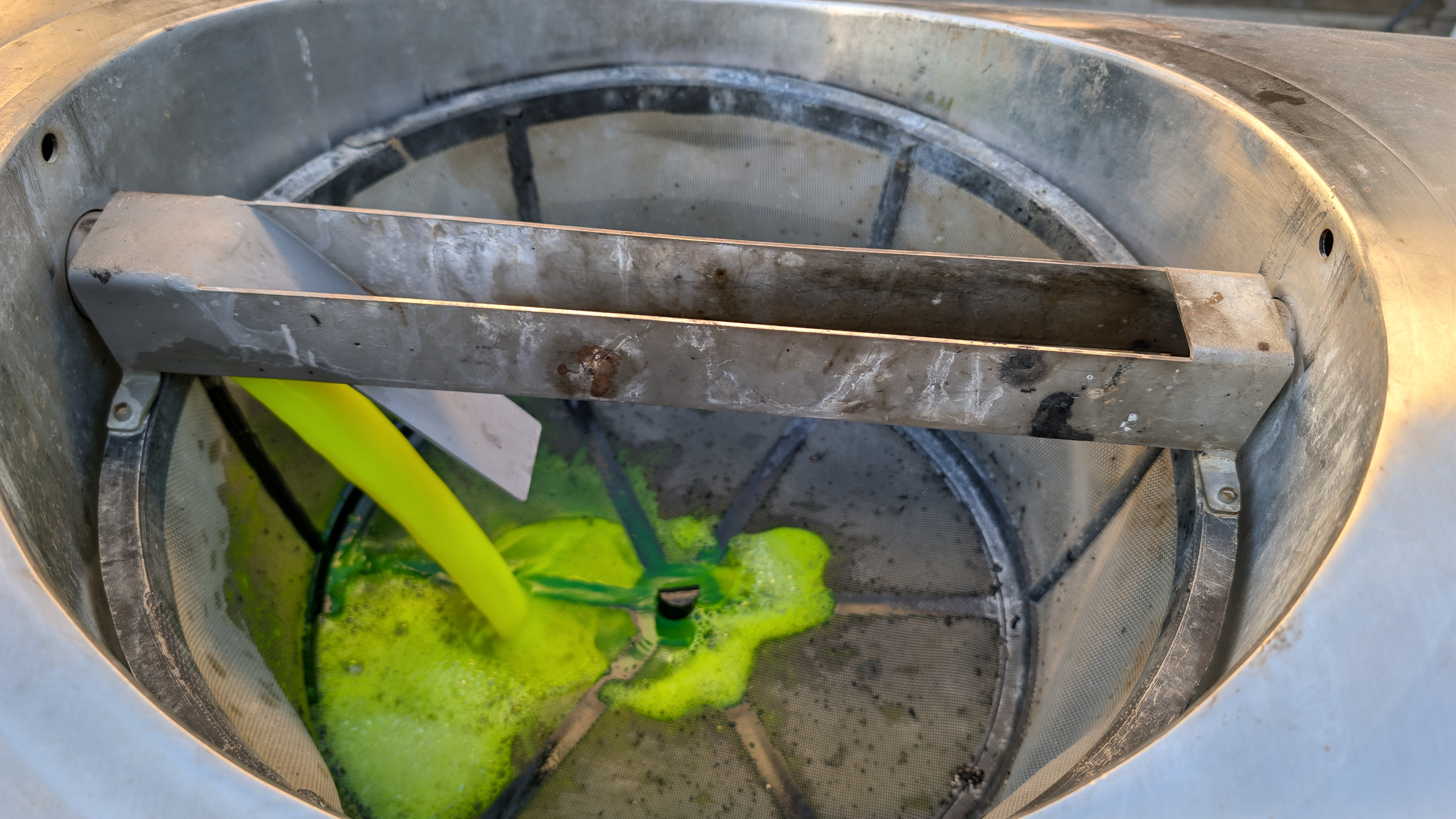
- New high-wattage UV lamp was a game changer; dyes visible before dark, photography finally possible.
- Some dyes stellar, some useless: IFWB-C81PT and Blaze Orange spectacular.
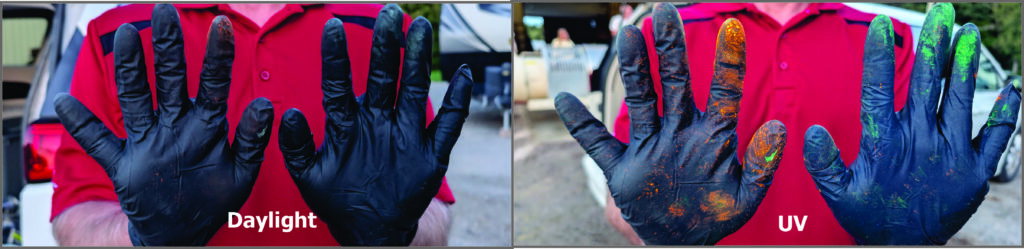
- Dyes showed spray drift and heavy contamination on sprayer header and tractor; PPE recommended for anyone handling equipment.
This text was generated by OpenAI GPT 5 Mini
In 2025 I ran a comparison between five florescent dyes and three UV lamps to determine which combination worked best for tracing spray deposition. If you haven’t read part 1, go do so and come back.
In early 2026 my colleague and I used the winning combination to evaluate spot sprayer deposition in an onion field, and it worked “OK”. Only “OK”. In fact, I think many of the growers attending that twilight meeting were being polite when they said they could clearly discern the coverage. The fundamental problem was that we required almost complete darkness for the dye to be visible, and even then, you had to hold the lights just right. Photography was nearly impossible.
That’s when my colleague showed me that I’d brought a knife to a gunfight when he illuminated the scene with a new UV lamp. It was a veritable lightsaber! The high wattage changed everything. I knew immediately that we would have to redo the dye comparison in “light” of this new development.
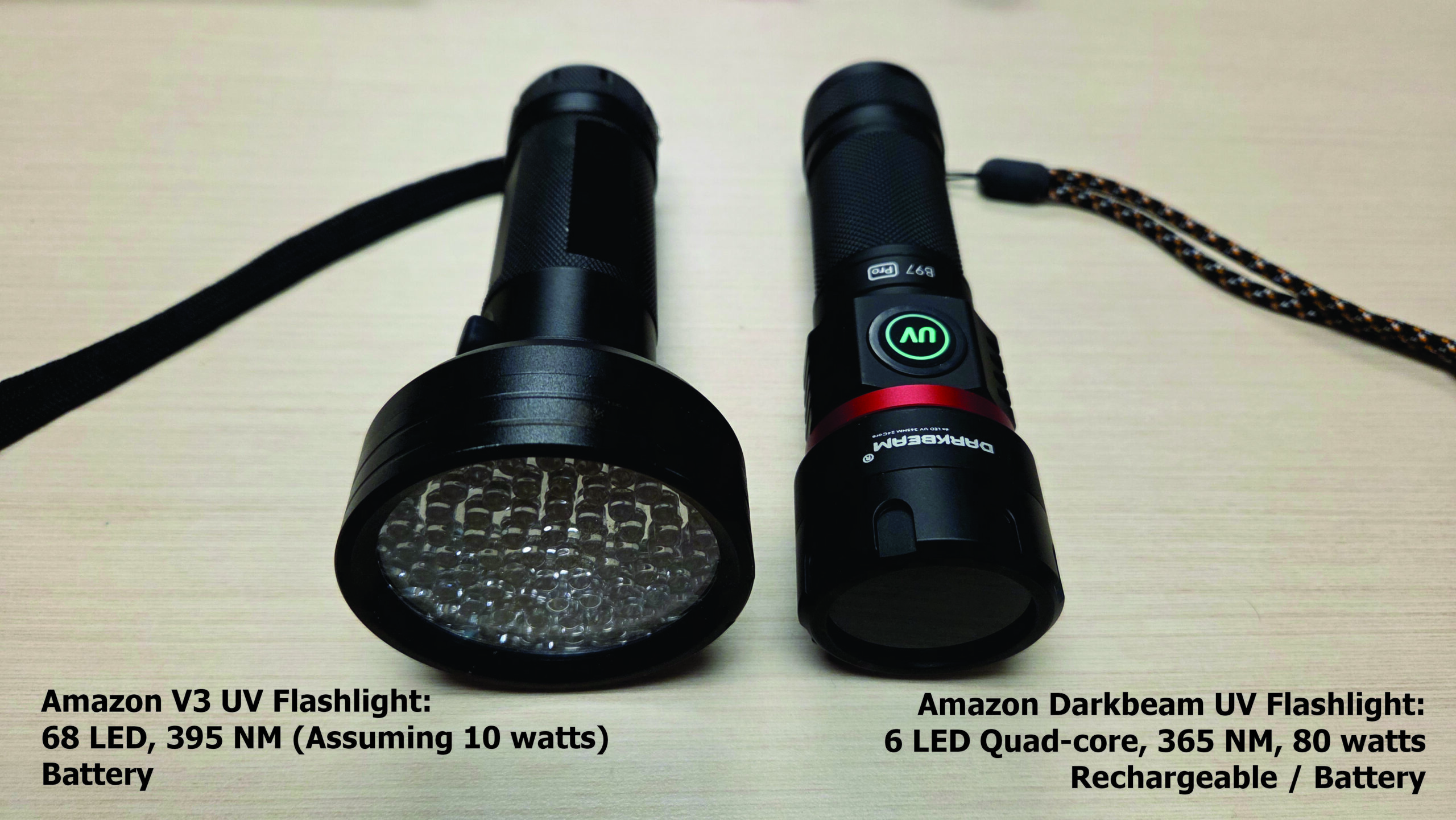
A game changer.
In September, 2026 we returned to Falcon Blueberries to paint the town red (well, green, orange and yellow). The images, which were taken with a cellphone, are stunning and yet they really don’t capture what we were able to see in person.
Dyes Used
We used the same dyes, mixed in the same ratios with NIS as in the previous study:
- Risk Reactor IFWB-C81PT
- Risk Reactor UVTRACER-G1PT
- Eco Pigment Blaze Orange SPL15JX
- Tri Art Fluorescent Yellow Tempura Paint
We omitted the Phosphor Powder (Zinc Orthosilicate: Manganese CAS#11-47-2) used in the last study because the SDS really didn’t qualify it as non-toxic, and it’s not within reach of most people. Also, you won’t see any photos of the Tempura paint, because there was nothing to see. Historically, I’ve held out hope that it was a viable option, but it’s really only ever worked when super-concentrated and applied by a hand sprayer. So, if you’re doing that, go ahead, but I’ll never use it in a commercial sprayer again.
Application
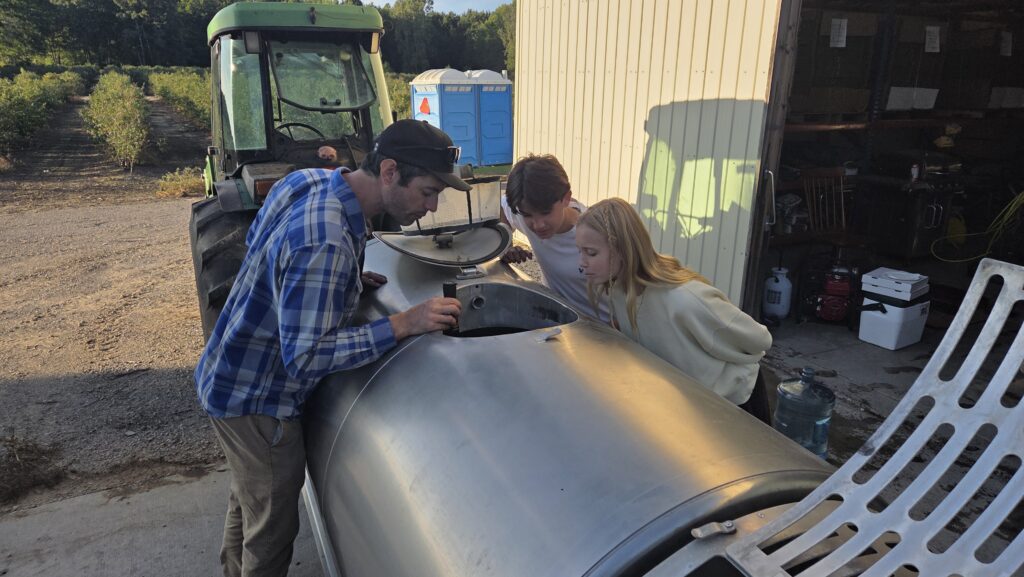
We used the same Turbomist airblast sprayer, and the operational settings aren’t really relevant, here. Suffice it to say we made a single pass with their conventional settings, and left 8 rows between blocks (that is, a buffer of four rows on each side of the pass) to ensure we didn’t cross contaminate the dyes. Then we waited for dark.

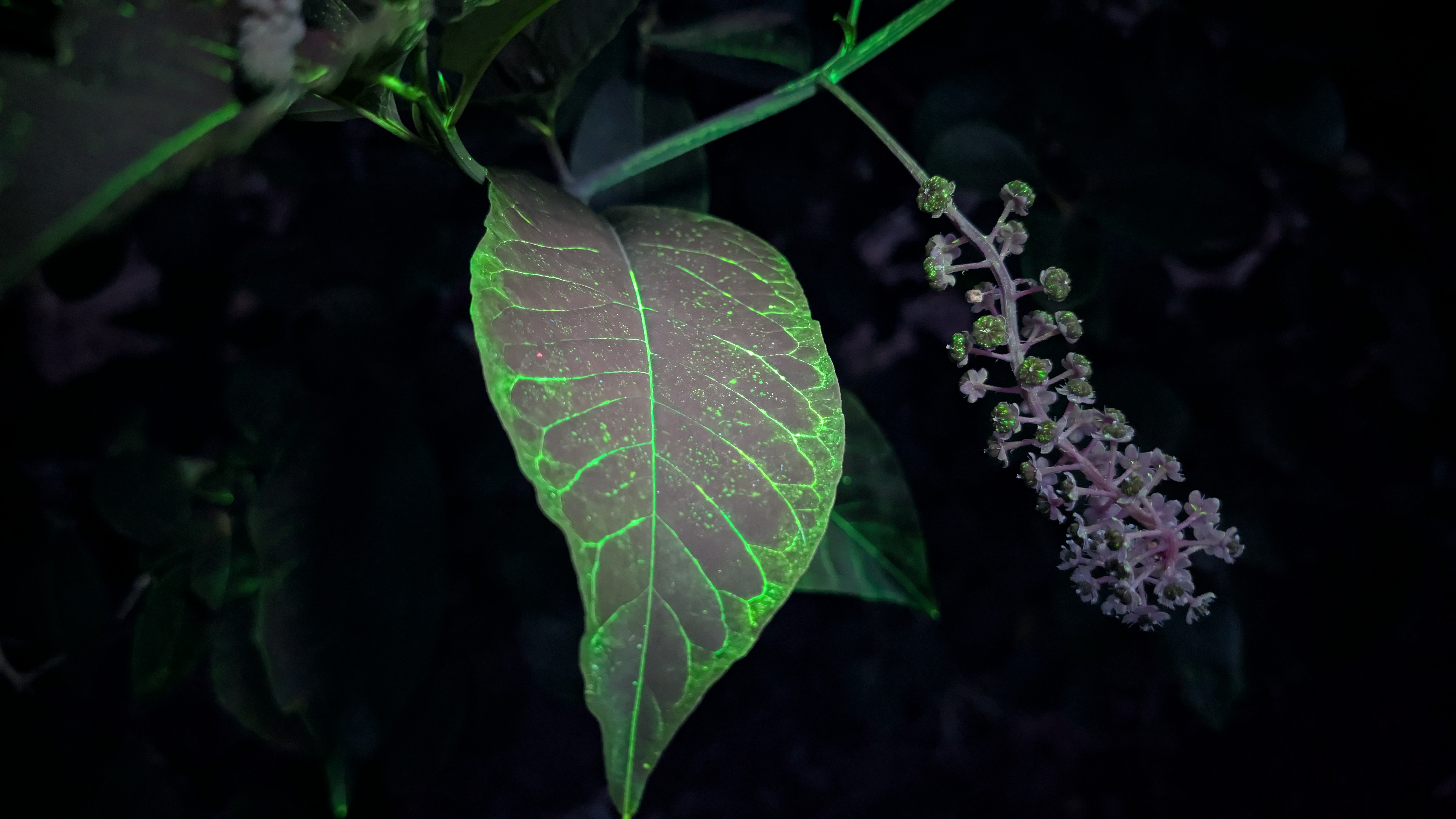
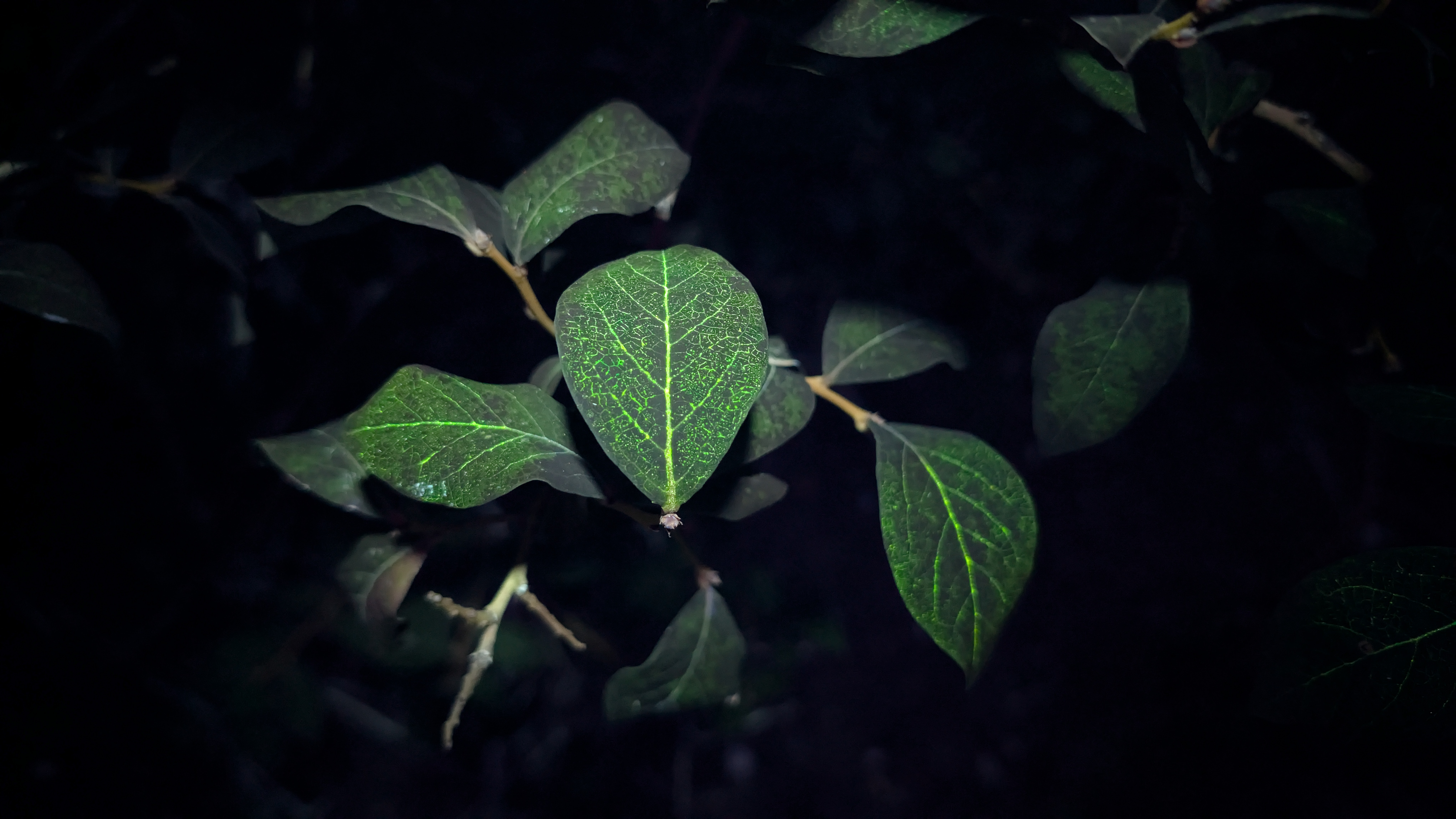
Risk Reactor IFWB-C81PT
This dye was pretty spectacular, which it absolutely was not last year using the weaker UV lamps.
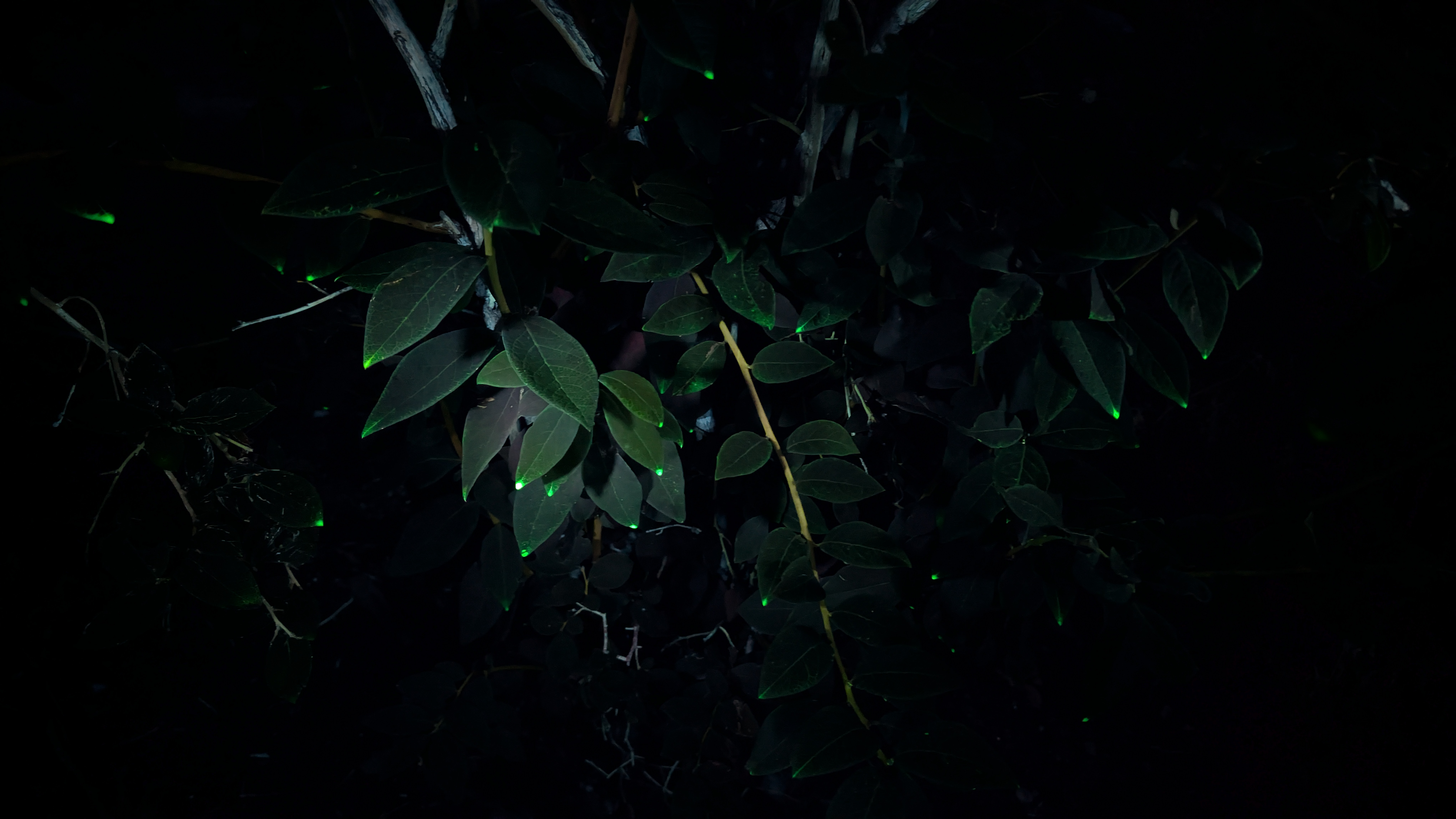
Risk Reactor UVTRACER-G1PT
This dye was not as spectacular. In fact, it didn’t deposit well at all. Note the runoff (drip points) on the tips of the leaves. This could be an issue with the NIS, or excessive volumes, but we didn’t see that with the first dye and it was mixed and applied in the same manner. It could be something related to how this dye is was formulated. Whatever the cause, it’s not a good candidate. On the up side, we captured a good example of bad coverage when applying a foliar product.
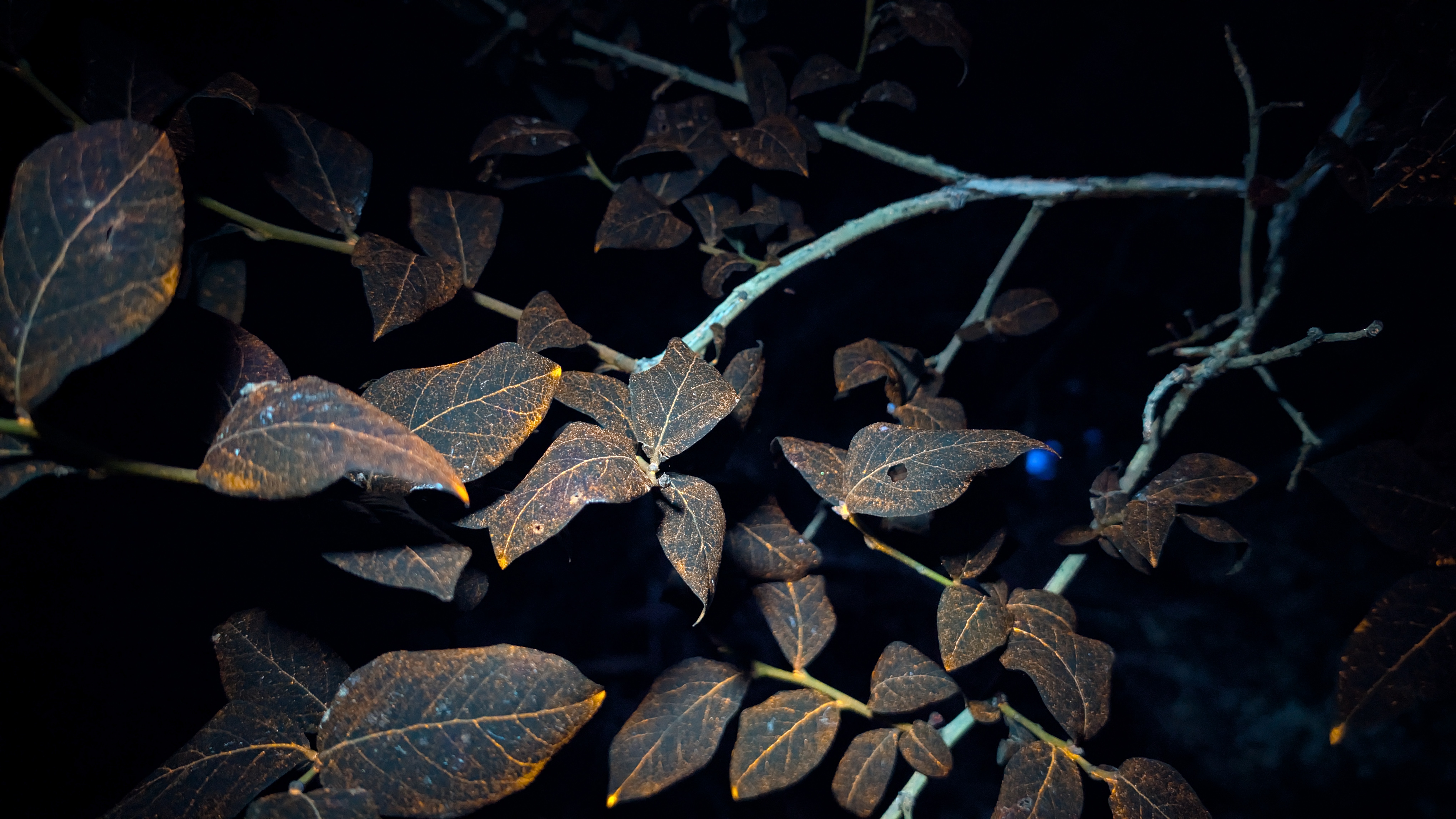
Eco Pigment Blaze Orange SPL15JX
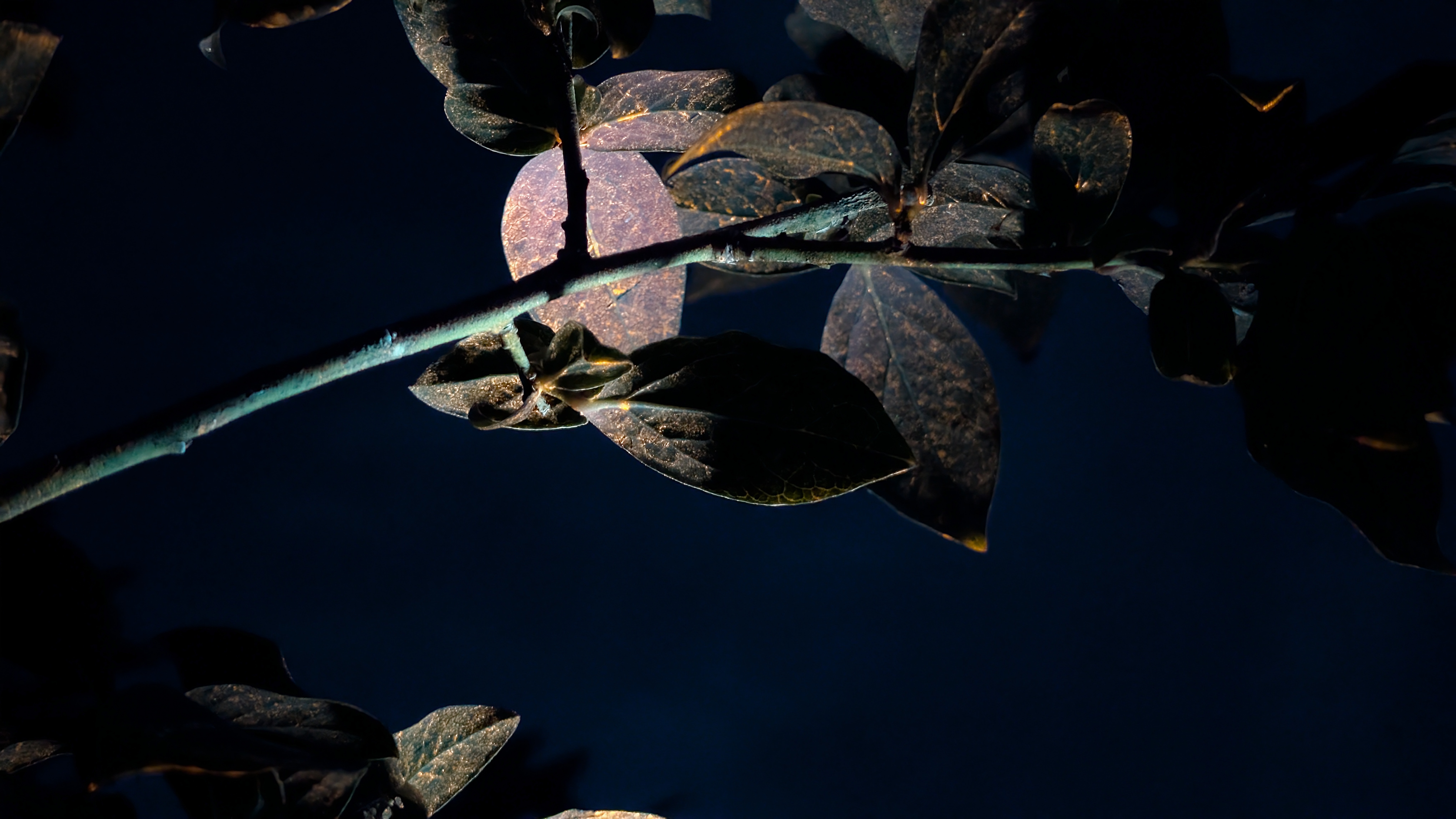
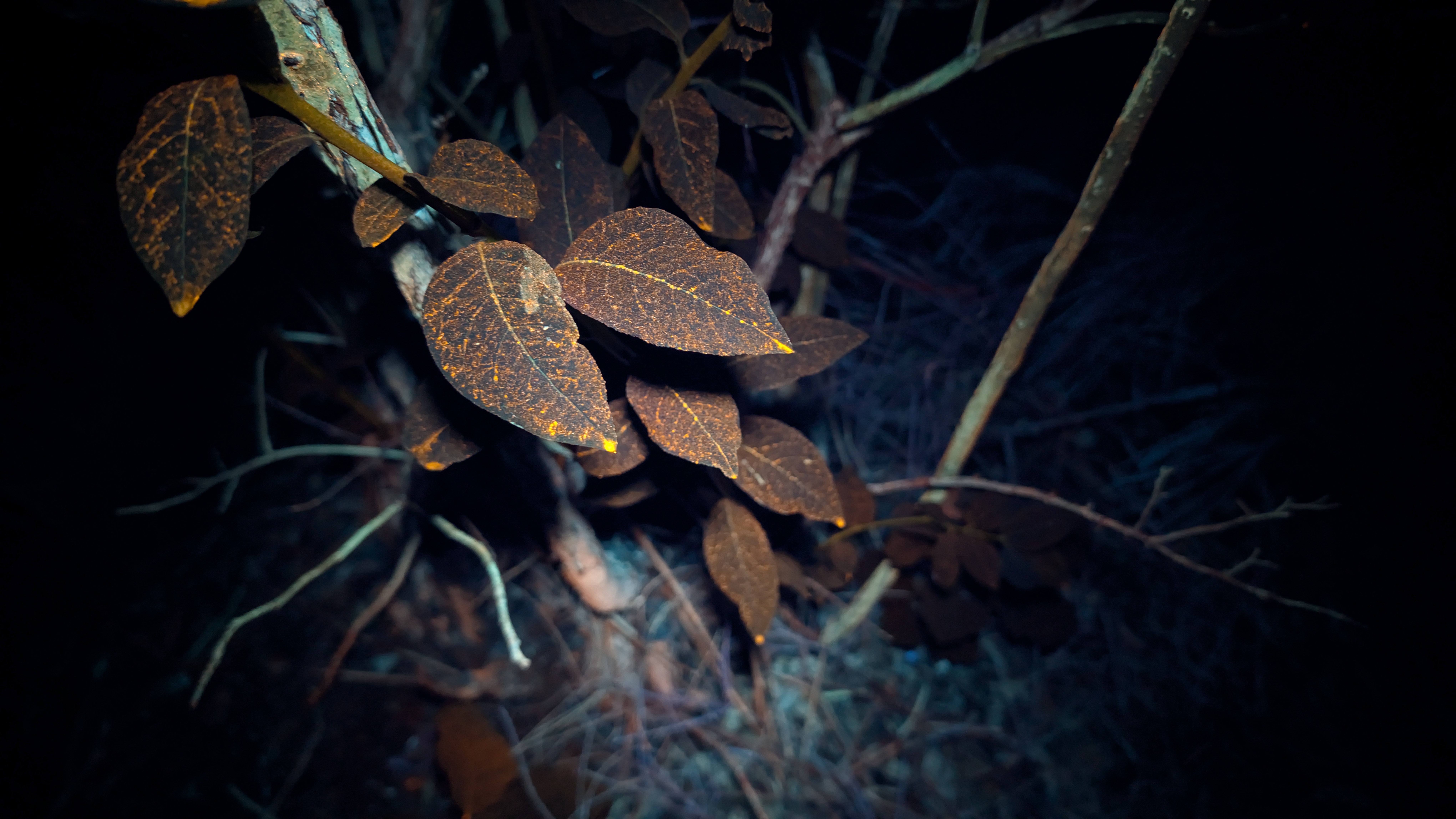
Once again, this pigment puts on a quite a show. We noted particular accumulation along the veins of the leaves where we suspect the pigments (which are not water soluble) collected. It was also visible on the petioles, under-leaf surfaces and the stems, branches and trunks. Not only did we see it three rows out, but it was all over the ground, the hood of the tractor, the operator’s boots and pretty much everywhere the sprayer went.
PPE
The last few shots are really a public service announcement. TOPPS in Europe once performed a study on a variety of airblast sprayers to determine where pesticide residue accumulated. They concluded that the header was the worst offender (that is, the air outlet and fan at the rear of the unit). While we saw evidence all over the sprayer, and at the radiator (air inlet) on the tractor, the sprayer header was by far the most contaminated region. Always assume an unwashed sprayer has residue – wear PPE.

Thanks to Cesar Cappa, OMAFA Horticultural Weed Specialist for introducing the new UV lamp, for the photography, and for not complaining every time I blinded him with the light. Thanks to Falcon Blueberries for their time and collaboration.
