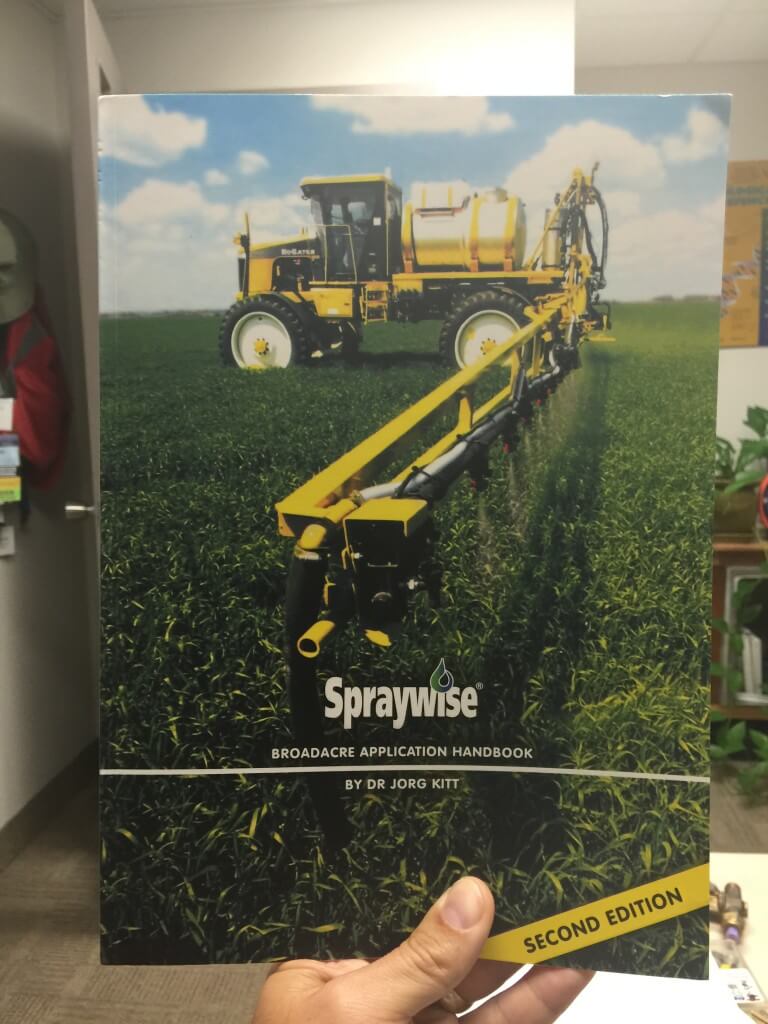
I haven’t written a book-report since high school, but I was recently sent a copy of Dr. Jorg Kitt’s “Spraywise – Broadacre Application Handbook” and I was compelled to share. It’s published by Nufarm and is based out of Australia. What a fantastic, easy-to-read book full of excellent spraying know-how.
Am I overselling this?
I am not.
The chapters include:
- Droplet Size
- Chemical Target Interaction
- Nozzle Types
- Nozzle Selection
- Nozzle Spacing & Boom Height
- Drift
- Weather
- Adjuvants
- Formulation & Mixing Order
- Cleaning Procedure
- Calibration
- Record Keeping
At risk of copyright infringement, let me share a little of Dr. Kitt’s advice on chemical and target interaction.
“Many chemicals used in agriculture show only limited movement in or on the plant. For surface active fungicides such as mancozeb coverage is critical because the active does not move – it settles where the droplet dries with only limited redistribution properties.”
This is why we suggest coverage is king when applying products that don’t translocate. You can slow down, raise water volume, or as a last resort reduce spray quality (minding the drift and evaporation issues that arise from this choice). But he goes on:
“Many cereal fungicides such as DMIs move only in the xylem (water transport bundles) and therefore can only travel in one direction – upwards towards the tip of the leaf (acropetal).”
So, I admit that as I continue to transition from horticultural spray applications to broadacre work, I have a lot to learn. Something that bothered me when I started looking at fungicide applications in corn was the appalling coverage on water sensitive paper. If any of my vegetable or orchard applicators had such poor coverage, their crops would be riddled with disease… so why was such poor coverage working so well in field crops?
According to this new-to-me information, perhaps the >Coarse droplets were penetrating the canopy, reaching down to impinge on the base of the plant (or splatter up from the soil) where they could re-distribute by moving up through the xylem. It certainly makes more sense to me why such coarse droplets and relatively low volumes can still be efficacious for certain fungicides in field crops. I’ll reiterate – this may be old hat to some readers, but I still have a lot to learn on this topic.
Dr. Kitt shares many digestible, easily-implemented little factoids that make this handbook a must-have for your spray library. Applied herbicide advice, for example:
“…if 50% of the ground is covered with stubble only half the spray volume will hit the soil directly; the other half will strike stubble. To optimise applications in this situation it is important to produce droplets with sufficient velocity to increase bounce and splatter. The applicator should use higher water volumes (70-100 L/ha) and a coarse to very coarse spray quality. In a clean bed spray quality and water volume have little effect. A coarse spray quality and water volumes above 50 L should be sufficient to achieve efficacy.
These volumes are low for North America (Australia uses nerve-rackingly low volumes) but otherwise this is solid gold.
I was fortunate to have someone send me a copy of this handbook. I’ve poked around on-line to try to find a Nufarm-based website where anyone could order a copy, but I was unsuccessful. However, if you Google “Spraywise Broadacre Application Handbook 2nd ed.” you will find a number of dealers that will happily sell and mail you a copy. I won’t share those links here to avoid a bias, but they’re easily found.
So, to summarize, I wanted to make the sprayers101 readership aware of this Handbook. Given the affiliation with an agrichemical company, it’s a bit adjuvant-rich, but it’s chock full of great information and well worth the cost and effort to have a copy mailed to you.
Now I’m going to go back to reading mine.