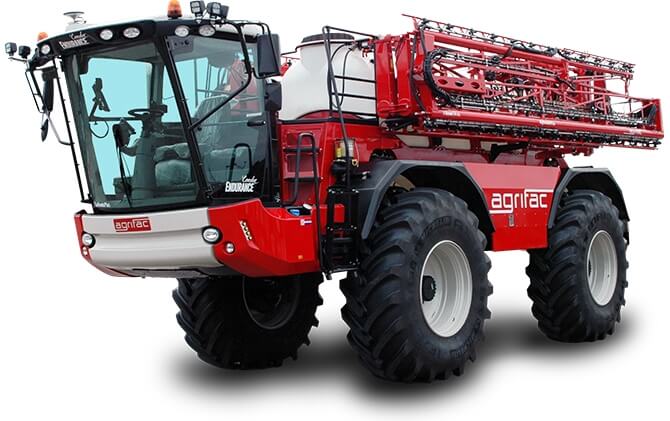
I like good ideas. And at Canada’s Outdoor Farm Show in Woodstock this fall, I saw a sprayer that puts a lot of them in one place. I’m talking about the Agrifac Condor Endurance. I’ve seen European sprayers before, even operated a few. And although they are all well-engineered machines, the Netherlands-based Condor might be the first one to gain traction in North America. Why this one? Let me explain.
Size: If you thought European machines are too small for North American conditions, this one breaks the mold. Sporting an 8000 L (2100 US gal) tank, track widths up to 4.6 m (15 ft), a 320 hp Tier 4 engine, and booms up to 55 m (180 ft) wide, it’s a monster. The smaller Condor offers tank sizes of 1050 or 1300 US gal and is a smaller machine overall.
The tank sump design ensures minimal remainders.
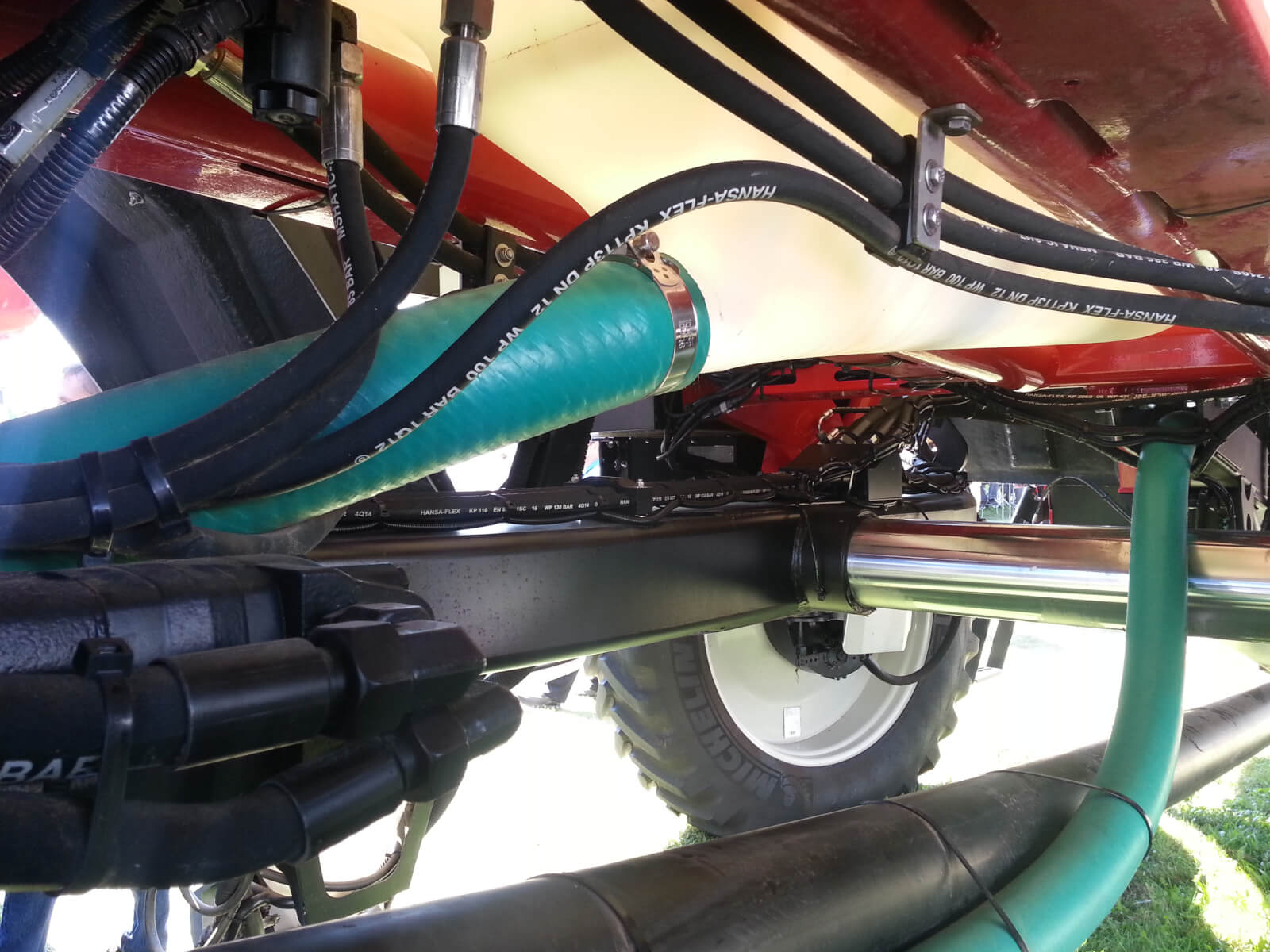
Tank and Pump: The large tank has a molded funnel sump that feeds directly into the pump. Net result is a design that empties the tank completely, leaving a tiny remainder amount, less than 2 gallons according to Rob Blijdorp, with Agrifac North America. Because most of us clean tank remainders by diluting them with clean water, this small remainder needs less water to dilute residues to safe levels, saving time when switching products. The machine is equipped with a Hypro centrifugal pump as standard equipment in North America. A diaphragm pump is optional. This pump type is unusual for North America, but it is self-priming, can run dry, and can produce very high pressures.
Wide booms with recirculating plumbing boost productivity and minimize waste (Source: Agrifac)
Boom: The boom widths available on the Condor are astounding, and there’s no easier place to use them than the North American Great Plains. Wider booms are one of the most effective efficiency boosts in spraying, and allow slower travel speeds while creating fewer tracks. The Condor boom has a recirculating design with a pressure feed from both ends, eliminating boom ends and increasing cleanout speed. Since it uses the boom as part of its circulation system, the boom primes at filling so the new product is at the nozzles right away. Sectional control is flexible, with nozzle-by-nozzle control available.
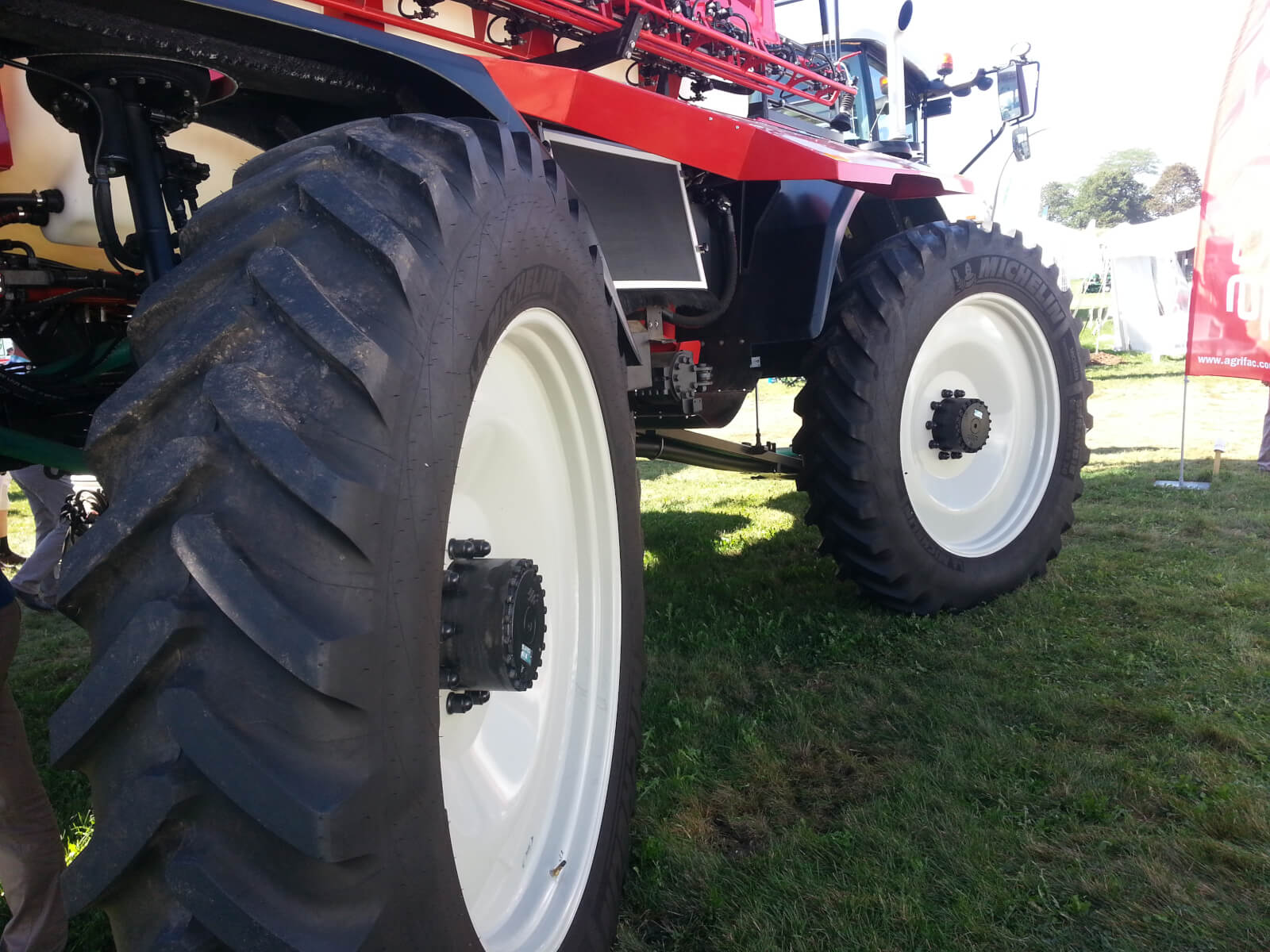
Four wheel steer on a walking beam chassis
Chassis: The frame and suspension system looks like a walking-beam setup, and is claimed to give a smoother ride with less transfer of bumps to the boom. The system has four-wheel steer capability for less tracking in turns, and a tight turning radius. The weight of the smaller Condor machine equipped with a 120’ boom is 24,500 lbs, the Condor Endurance with the same boom is 31,000 lbs.
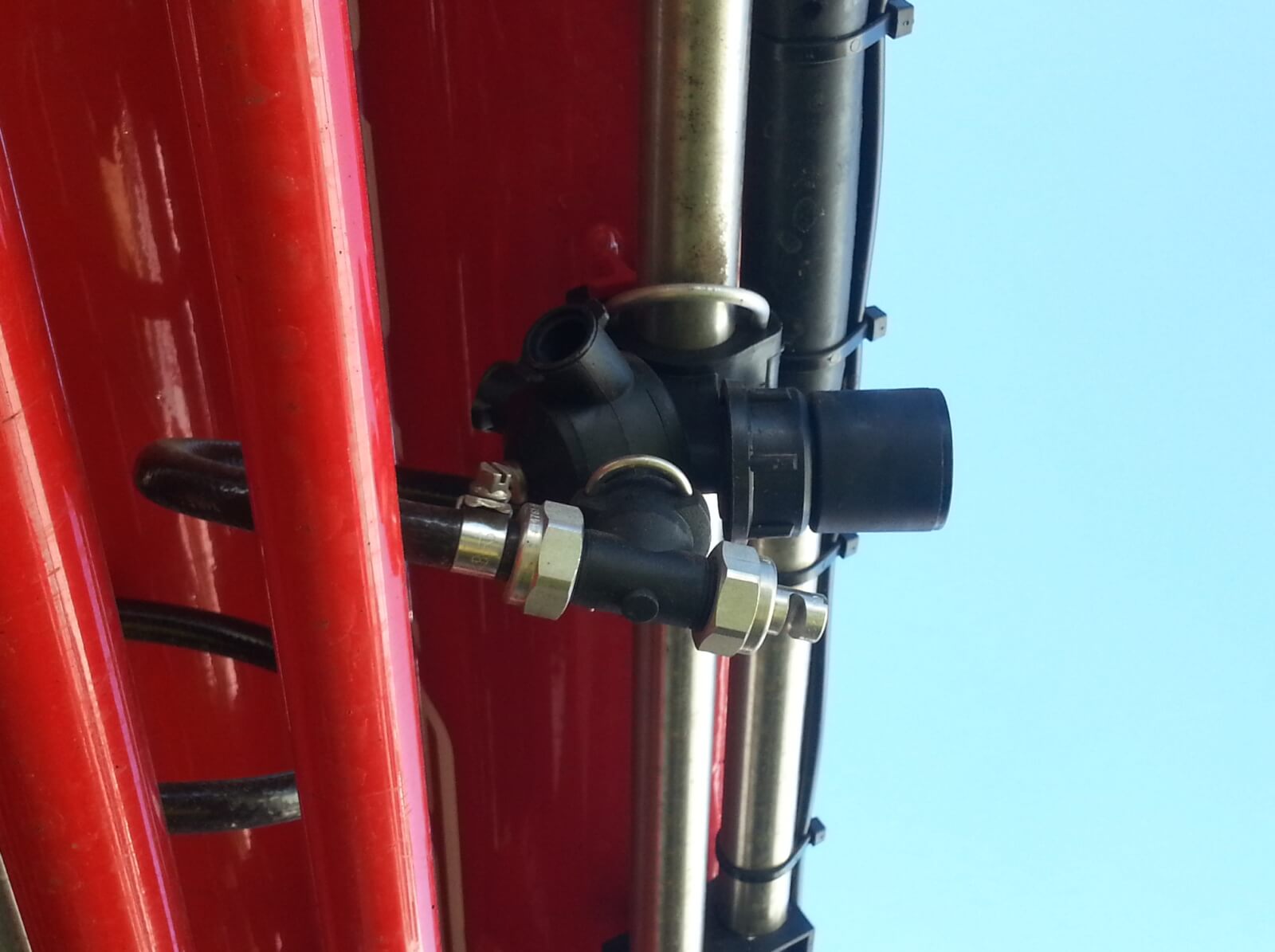
The HighTechAirPlus atomizer is a twin fluid design that uses air to control flow and atomization.
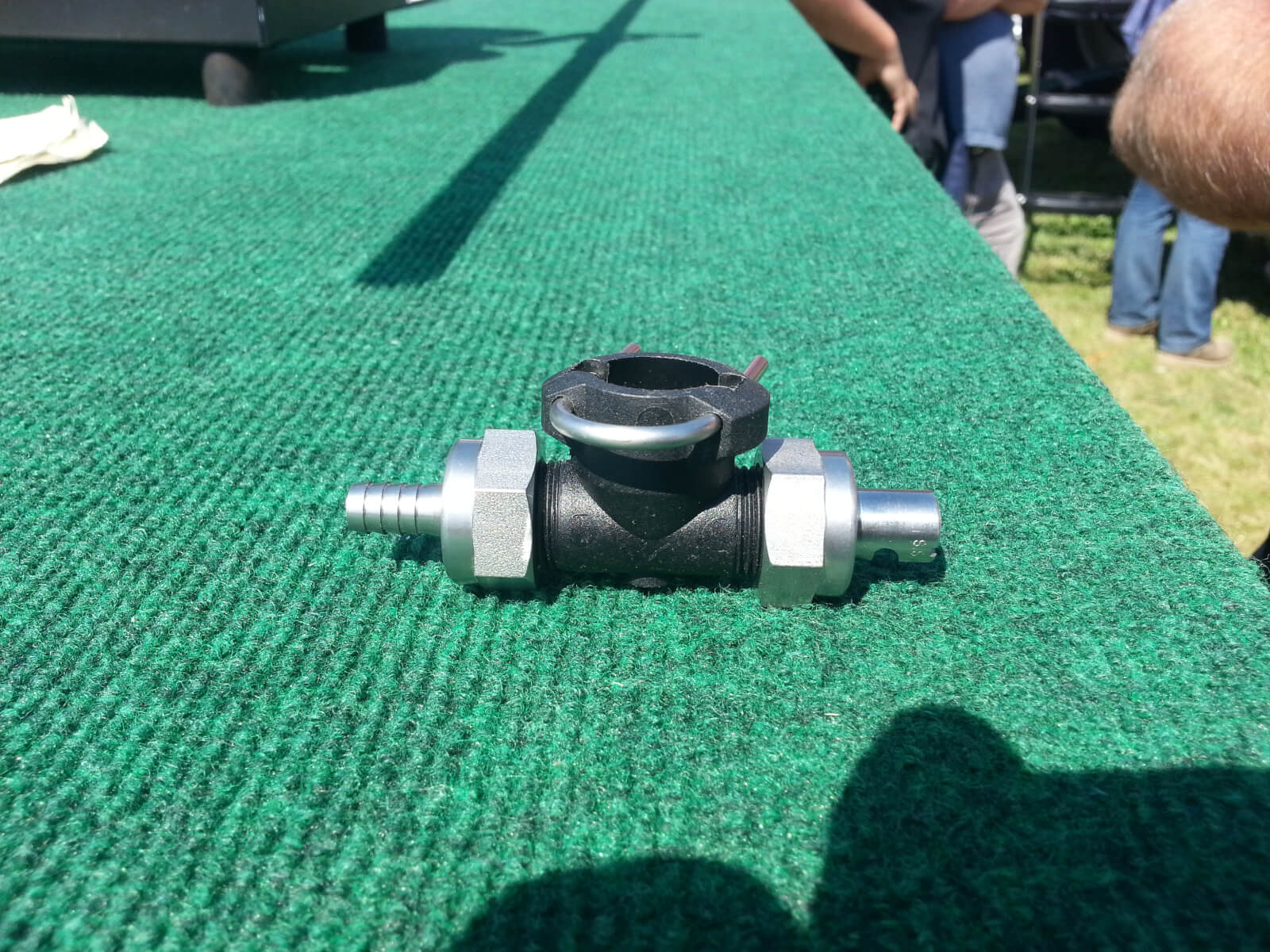
Nozzles: I saved the best for last. Since 1989 (yes, I remember the year!), I’ve been a fan of “twin fluid” nozzles, but have not seen them take hold anywhere. The HighTechAirPlus nozzles are Agrifac’s version. Here’s how they work: Liquid is delivered to the nozzle in the usual way, by pressure. But air is also delivered, created by a dedicated air pump that has modest volume and pressure requirements. Both air and liquid make their way through the same nozzle (a deflector style, similar to the TeeJet FloodJet).
HighTechAirPlus installed. Note the air supply and the air-activated shutoff for individual nozzle sectional control.
The advantage? Liquid flow and droplet size can be adjusted independently, with air and liquid pressure. More air results in lower liquid flow. It also reduces droplet size. More liquid pressure increases flow, and also reduces droplet size. Clever combinations of both can keep droplet size fairly constant over a wide flow rate range. Alternatively, the nozzles can change droplet size while keeping the same flow rate, depending on the drift or coverage needs at the time. The travel speed range achievable is similar to that with PWM.
Verdict. The jury’s out. As a newcomer to North America, the Agrifac faces a few challenges. Many say it needs a dealer network, inventory and parts. It needs to prove its reliability. It needs to be able to service its machines, especially if parts are non-standard. It needs field cred out here.
But I’m a bit tired of our North American sprayers adding horsepower, speed, and weight to their sprayers each year, and little else. They leave applicators to struggle alone with equally important productivity factors such as quick and thorough cleanout, drift management, nozzle selection and others.
The things that strike me with this new sprayer are Agrifac’s innovative design, and its emphasis on issues that matter to applicators: productivity and excellent control over application rate and droplet size. The company has the right priorities in my books.
A local strawberry producer was just beginning his harvest when the entire field was suddenly stricken with anthracnose. He would have done almost anything to save it, but he could only watch in frustration as the disease quickly devastated his crop. While he was telling me this story, he was wringing his hands; I’m sure he didn’t realize he was doing it. It had been more than a month since the crop was lost and he was obviously still very upset. Let’s put on our deerstalker hats and consider what might have caused the trouble.
Strawberry anthracnose. Photo by Pam Fisher, former berry specialist with OMAFRA.
Most of the fungicides we apply in horticulture are protectants, not curatives. What that means is that the fungicide has to be in place before disease has a chance to take hold. Once it establishes a beachhead, you can typically only hold it at bay, not eradicate it. So, if you’re guilty of waiting too long between fungicide applications, the problems may have already begun. This is exacerbated when you don’t achieve the necessary spray coverage. Put the two together and mix in rainy and warm conditions and diseases like anthracnose can spread at alarming speed.
Method
I focus on the sprayer part of disease management, so I have to assume that inoculum is being controlled as much as possible (e.g. culling infected plants, drip irrigation, etc.). I asked the grower about his sprayer and his spraying schedule. He admitted to pushing the limits between fungicide applications, and being uncertain about the spray coverage he was achieving with his conventional flat fan nozzles.
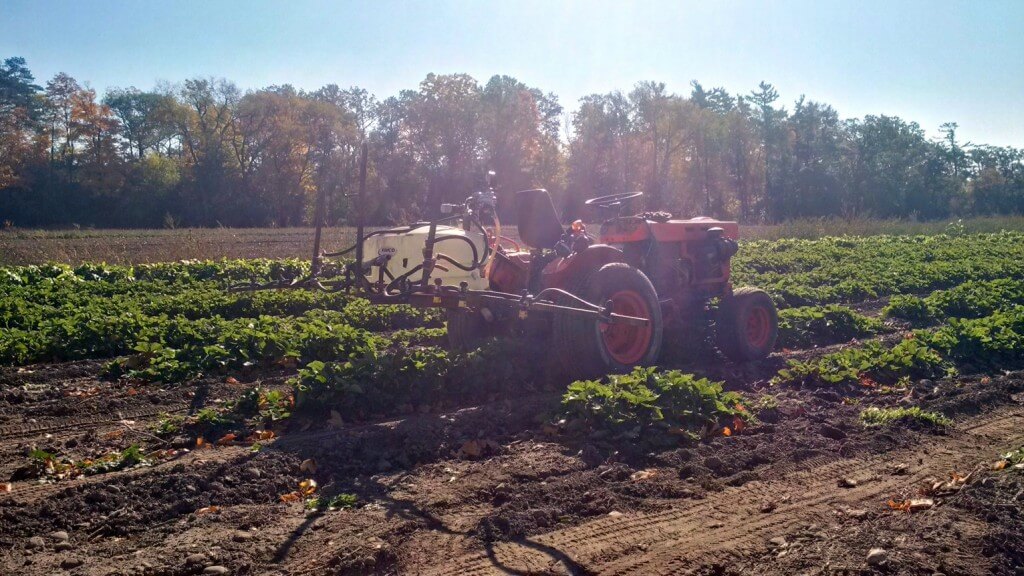
Strawberry Sprayer
In cases like this I try to find gentle ways of introducing the idea of using more water, increasing the frequency of applications, or buying new nozzles, because there is time and expense involved and many growers don’t want to hear that. However, when I started my soft sell routine, he looked me straight in the eye and said he’d lost tens of thousands of dollars in revenue so a few nozzles or a couple more applications were not a pressing concern. There’s a point in any endeavour when you’ve committed so much time and money that you’ll do pretty much anything to see it come to fruition (pun intended). He was willing to do whatever it took. This was my kind of guy.
So, in preparation for next year, we diagnosed spray coverage from five different sprayer set ups. Let me point out, as I always do, that spray coverage analysis does not necessarily extend to control. They correlate well, but if you aren’t using the right product or your timing is off, even the best coverage won’t help you. Caveats aside, here’s what we tested:
Setup1:
Broadcast application using a horizontal boom with TeeJet Twinjet 8006’s at 8.3 bar (120 psi) on 50 cm (20 in) centres. We calculated a nozzle rate of 3.9 L/min (1.03 gpm), so at 5.0 km/h (3.1 mph) that’s 923 L/ha (98.7 g/ac).
Setup 2:
Banded application on a horizontal boom equipped with a row kits suspending three TeeJet XR 8002’s at 8.3 bar (120 psi). We angled the two side nozzles so the fans were not perpendicular or parallel with ground. This kept more spray on the raised row and out of the alleys. The swath covered 50 cm (18 in) and we calculated a nozzle rate of 1.29 L/min (0.34 gpm), so at 5.0 km/h (3.1 mph) that’s 1,016 L/ha (108.6 g/ac).
Setup 3:
Banded application on a horizontal boom equipped with a row kits suspending three TeeJet XR 8002’s at 6.2 bar (90 psi). We angled the two side nozzles so the fans were not perpendicular or parallel with ground. This kept more spray on the raised row and out of the alleys. The swath covered 50 cm (18 in) and we calculated a nozzle rate of 1.14 L/min (0.3 gpm), so at 5.0 km/h (3.1 mph) that’s 896 L/ha (95.8 g/ac).
Setup 4:
Broadcast application using a horizontal boom with TeeJet Twinjet 8004’s at 6.2 bar (90 psi) on 38 cm (15 in) centres. We calculated a nozzle rate of 2.27 L/min (0.6 gpm) so at 5.0 km/h (3.1 mph) that’s 717 L/ha (76.5 g/ac).
Set up 5:
Broadcast application using a horizontal boom with TeeJet Twinjet 8006’s at 6.2 bar (90 psi) on 38 cm (15 in) centres. We calculated a nozzle rate of 3.4 L/min (0.9 gpm) so at 5.0 km/h (3.1 mph) that’s 1,076 L/ha (115 g/ac).
Protocol and Conditions
It was late September, so the weather was a cool 8 °C, humidity was low and winds averaged 5 to 15 km/h. We timed our passes to correspond with lighter wind wherever possible. Three sets of water-sensitive paper were placed in a single row, but only one pass was made per sprayer setup. One paper was placed at the top of the canopy which is always very easy to hit, so we oriented it sensitive-face-down. The second paper was placed midway down the canopy, oriented facing up. The final paper was also oriented facing up, but placed at the very bottom of the canopy, more or less on the ground. Collectively, we spanned the depth of the canopy.
Following each application, papers were collected for digital analysis using “DepositScan” which determines the percent of the paper covered with spray, and the droplet density. Both of these factors contribute to overall coverage. This wasn’t intended to be a rigorous experiment, so the means are presented here with standard error for the sake of comparison. There was no statistical analysis. In the case of papers located face-down, when only trace amounts of spray were discernible they were assigned a percent coverage of 1% and droplet density of 25 droplets/cm2.
Results
A few observations before we get to the results. Research has demonstrated that row kits and higher volumes improve spray coverage, and that’s why we tried banding the applications using row kits in Setups 2 and 3. However, this grower didn’t use GPS to plant his rows, and while they weren’t too crooked, they made it challenging to apply in a band. Further, there is some concern that a banded application would miss any inoculum in the alleys. These are important points to factor in when considering methods to control disease.
The keen reader might notice we sprayed using pressures that exceed the manufacturer’s recommendations. In fact, none of these tips were rated over 60 psi and I used a formula to calculate their output at our high pressures. I have been heard to say (many times) never to exceed the manufacturer’s rates because it makes a mess out of the spray quality: droplets get much finer and pressure does not cause finer drops to penetrate a dense canopy. Better to switch to larger nozzles and stay within the pressures indicated on the manufacturer’s rate tables. I maintain that assertion. However, the grower was assured by fellow growers and custom applicators that this was the way to go and he wanted to try it. So, that’s where Setups 1, 4 and 5 came from.
Be aware that a small sprayer like the one in this study needs considerable pump capacity to support such high pressure and flow to the boom and maintain effective agitation. For more information on pumps, check out this article.
The following table expresses the coverage obtained by setup:
Set up
Paper Position
Mean % Coverage (±SE)
Mean Deposits/cm2 (±SE)
Setup 1 – Broadcast XR 8006’s on 20” centres at 120 psi for 98.7 gpa
Top
1.0 ± 0
25.0 ± 0
Middle
23.6 ± 4.5
253.5 ± 72.9
Bottom
15.2 ± 2.1
423.2 ± 35.3
Setup 2 – Three banded XR 8002’s at 120 psi for 108.6 gpa
Top
2.1 ± 1.1
78.9 ± 53.9
Middle
54.8 ± 12.1
275.2 ± 145.3
Bottom
29.1 ± 2.7
544.5 ± 70.4
Setup 3 – Three banded XR 8002’s at 90 psi for 95.8 gpa
Top
7.4 ± 5.9
134.4 ± 52.2
Middle
31.6 ± 15.9
203.6 ± 108.5
Bottom
8.1 ± 3.9
224.4 ± 102.3
Setup 4 – Broadcast Twinjet 8004’s on 15” centres at 90 psi for 76.5 gpa
Top
1.0 ± 0
25.0 ± 0
Middle
33.3 ± 5.0
240.7 ± 70.9
Bottom
12.9 ± 6.0
263.9 ± 95.2
Setup 5 – Broadcast Twinjet 8006’s on 15” centres at 90 psi for 115 gpa
Top
2.3 ± 1.3
105.6 ± 80.6
Middle
48.9 ± 5.5
194.3 ± 25.6
Bottom
19.5 ± 10.3
246.8 ± 40.4
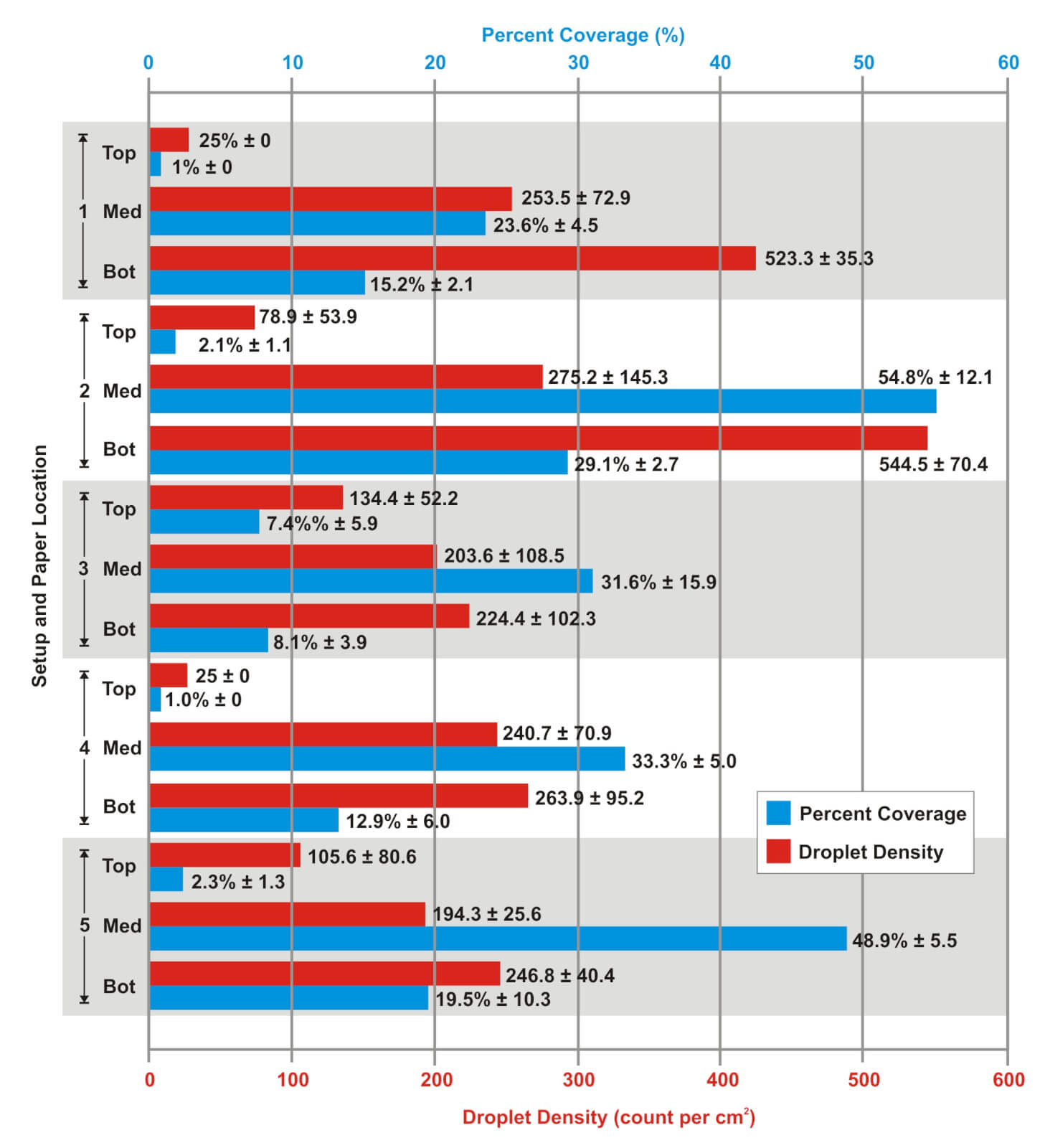
The results may be easier to compare and contrast in the following graph.
Strawberry coverage results for all five setups.
Observations
According to the results, Setup 2 appeared to provide the best overall coverage. This is no surprise given that it was the second highest volume and employed a row kit. This corresponds with findings that have been published elsewhere. However, the excessively high pressure did create a lot of drift and the row kit didn’t always line up with the planted row. Further still, there’s the potential for missing anything that might harbour inoculum in the alleys, like runners. This setup wasn’t appropriate for this particular situation.
The second-best overall coverage was obtained from Setup 5. This represented the highest volume, and a preferably lower pressure on twinjets, which may have allowed the spray to penetrate the canopy from multiple angles. This broadcast application is more reliable for hitting meandering rows and covers the alleys as well. So, the grower plans to employ this setup for the 2016 season, spraying at shorter intervals and confirming his coverage with water-sensitive paper. Let’s hope it works out.
End-of-Season Update
The grower that volunteered his time to this study has reported that his strawberries at the end of the 2016 season were absolutely beautiful. Granted, it is always difficult to draw a direct correlation between sprayer calibration and control. For example, 2016 was a very dry growing season and disease pressure was lower than in 2015. Nevertheless, spray coverage plays an important role in crop protection and our work to improve sprayer performance definitely played it’s part. His success is great news!
So it’s been a long spraying season and as you perform your annual maintenance you grudgingly admit that the hoses have given their all. Before you run out to get more of the same, give some thought to the hydraulic fittings (i.e. hose adaptors and couplers). Many feel that stainless steel (SS) is the best choice for hydraulic fittings: It must be, because it’s certainly the shiniest and most expensive choice! But before you opt for stainless, here are a few things you should know.
SS requires surface oxidization to resist corrosion. Oxidation forms a protective barrier called a “passivation layer”, but it’s susceptible to mechanical damage. It can be penetrated as abrasive powders flow past. The layer will reform when it dries, only to be sanded off again during the next spray. The wear is on-going. If the newly-exposed SS remains submerged in a liquid, the passivation layer will not reform. Without it, SS surfaces corrode at a high rate, and in extreme cases SS will even corrode inside of itself and become a hollow shell.
When two pieces of stainless steel are forced together, the passivation layer gets scraped off, allowing parts to gall (or ‘weld’). In fact, any similar metals in physical contact will naturally gall to each other, but stainless steel is especially susceptible. When disassembled, the ‘welded’ material must be torn apart. This destructive galling can be reduced with lubrication during assembly and avoided altogether by mating dissimilar materials (e.g. bronze and stainless steel). Technically, mating different types of stainless steels (e.g. martensitic against austenitic) could work, but it is possible that two different alloys electrically connected in a humid environment may act as a voltaic pile and corrode even faster. This is probably a moot point because many do not have access to different SS alloys when choosing fittings.
Sometimes we see black or galvanized pipe fittings on sprayers, but I don’t recommend either. Galvanizing is only slightly better than black pipe and since the threads are cut after being galvanized the threads are essentially black pipe, anyway.
So what about plated steel fittings? They’re available with swivels and can seal on faces and seats (rather than on the thread – which is much easier to assemble and disassemble). They can be crimped onto the hoses, eliminating the need for hose clamps that fail or snag and cut the operator. (As a related aside, hydraulic hose is not really compatible with most spray products – the steel wire inside the rubber begins to corrode and unexpected failure is common. Even when spraying above 200 psi there are better high pressure-rated choices than hydraulic hose.) Mechanically, these fittings are a great option, but unfortunately the plating is designed for oil, not pesticide. Within a year they rust internally and seize up. To add insult to injury, the flaking rust is notorious for plugging nozzles.
A better choice is brass (or even bronze) fittings (e.g. pipe, SAE 45° and hose barb). Just like the crimped plated steel fittings, brass SAE 45° fittings can swivel and seal on seats and they are easily assembled and disassembled over many seasons. Brass fittings are more costly than black or galvanized pipe but cost less than hydraulic or SS fittings. Conveniently, they’re available at most hardware stores.
While brass may be the best metal material for the sprayer fittings, I feel that plastic is the most economical and in many applications is superior to metal. But, that’s a topic for a follow-up article. So, before you spring for SS hydraulic fittings, consider cheaper and more effective alternatives like brass or plastic. And, if only for the sake of your mechanic, please don’t over tighten fittings. It is unnecessary and causes endless damage and frustration.
Here’s the third in our series of short, educational and irreverent videos made with Real Agriculture. We wanted to explain where pressure readings are taken on a sprayer and why it’s so important to know what pressure your nozzle is experiencing, rather than what the screens in your cab are telling you. Not only does pressure affect your application rate, but it affects your spray quality, which can be critical if your rate controller allows the pressure to drop below 30 psi.
This is the second of a series of short, educational and irreverent videos made with Real Agriculture to bring a little levity to sprayer education. Let’s face it – ironically, nozzles can be pretty dry.
Here we enjoy an early morning soy bean scout and a light breakfast of toast as we demonstrate how pressure, droplet size and canopy penetration interact.