NOTE: This article has proved very popular, and subsequently we received emails with additional information. The article has now been expanded to include work performed by Dr. Bob Wolf et al.
Part 1:
Boomless nozzles are used for vegetative management activities where it’s not practical, or sometimes even impossible, to use a horizontal boom. Consider highway easements and ditches, railways, and infrastructure like buildings, powerline poles or fence posts. In these cases, the booms would hit uneven ground, trees and other obstacles. Enter the boomless nozzle.
Unlike a typical flat fan nozzle, these nozzles direct spray laterally in one or two directions, creating a very wide spray pattern. Some field sprayers use a smaller version such as an off-centre or uneven fan to either extend the booms’ coverage (e.g. to get around fence posts) or give the pattern a discrete edge and not spray beyond the booms length.
There are many varieties of boomless nozzle available, but they don’t give the same performance.
Using a spray pattern table, Helmut Spieser and I compared coverage patterns from three popular tips:
The Boom X Tender
The Boom Buster
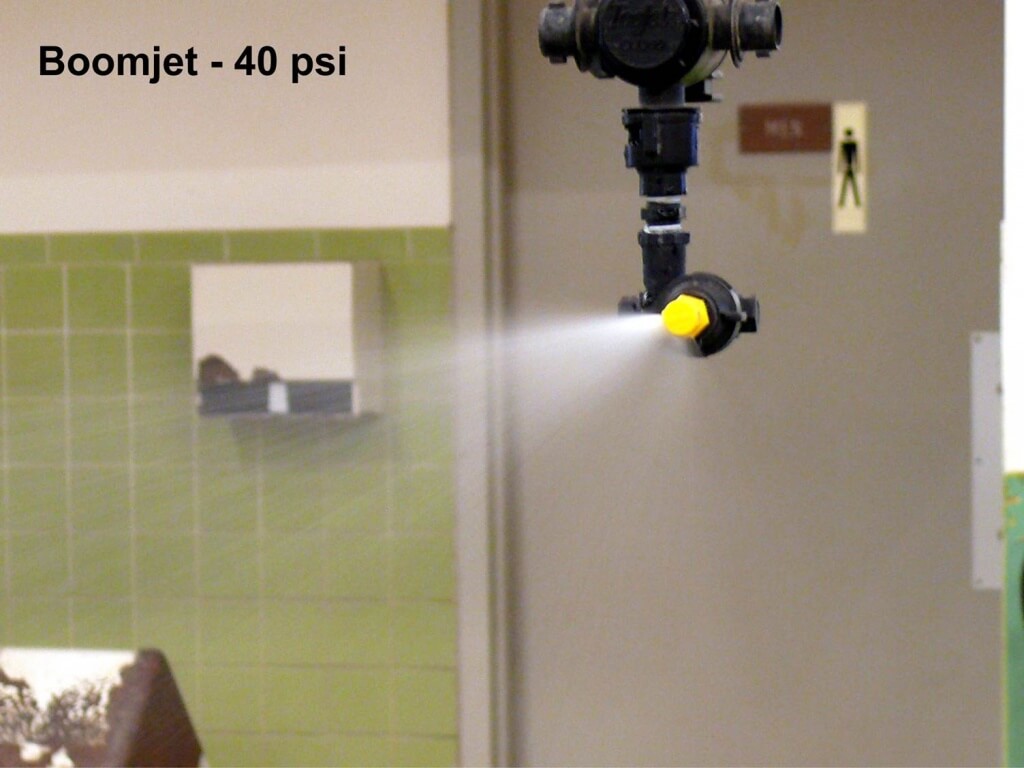
XP BoomJet
The Boom X Tender
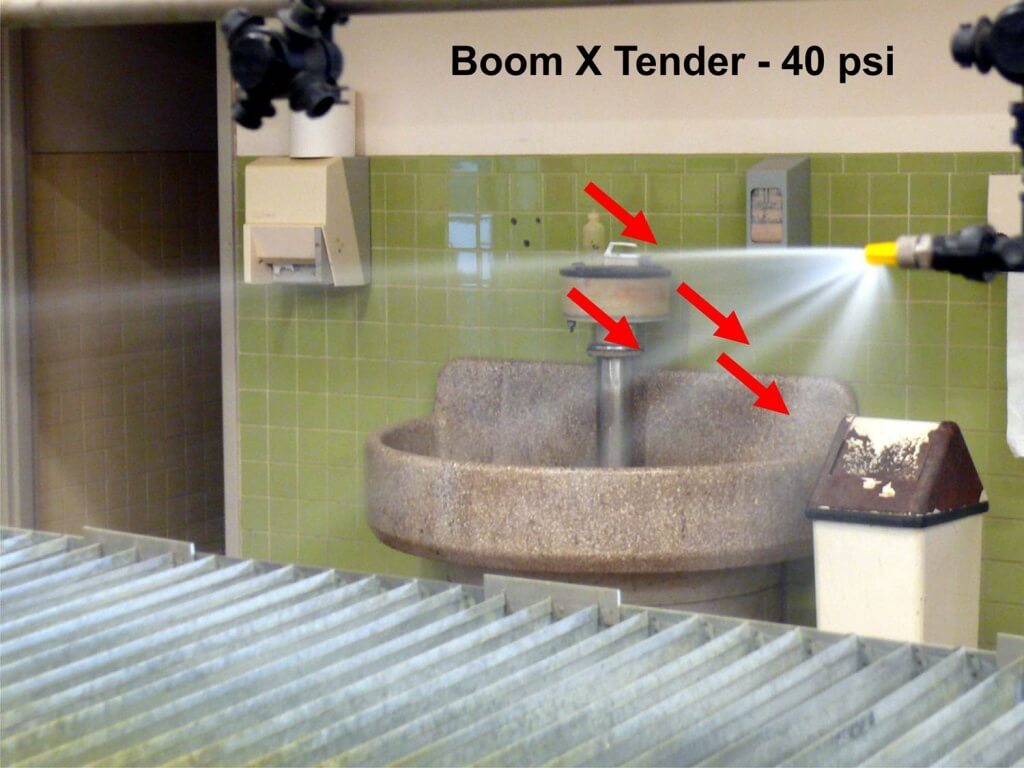
With seven rates to choose from, this nozzle claims up to 13′ throw from tip to the edge of the swath. When we ran the tip at 40 psi we noticed a lot of inconsistency in the pattern, where it clearly had variation in flow along the swath. Note the red arrows in the image.
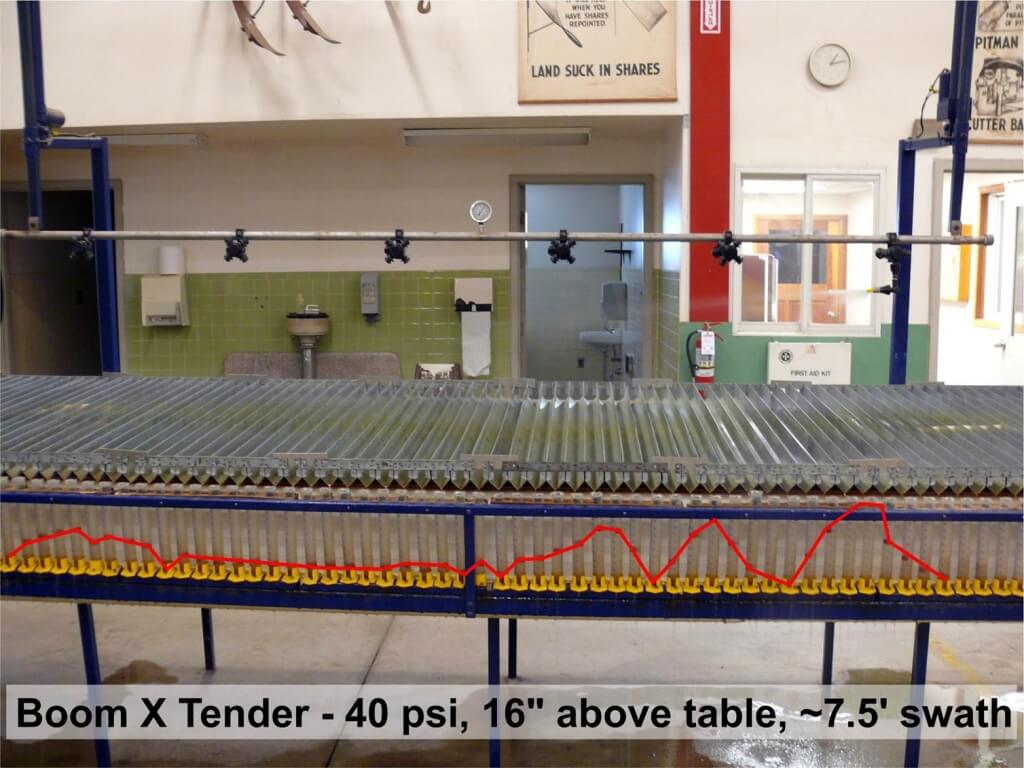
These inconsistencies made themselves known when we observed the pattern produced on the spray table. We achieved a 7.5′ swath at 40 psi, 16″ above the table with the XT024 (yellow) tip. The coverage wasn’t very even.
The Boom Buster
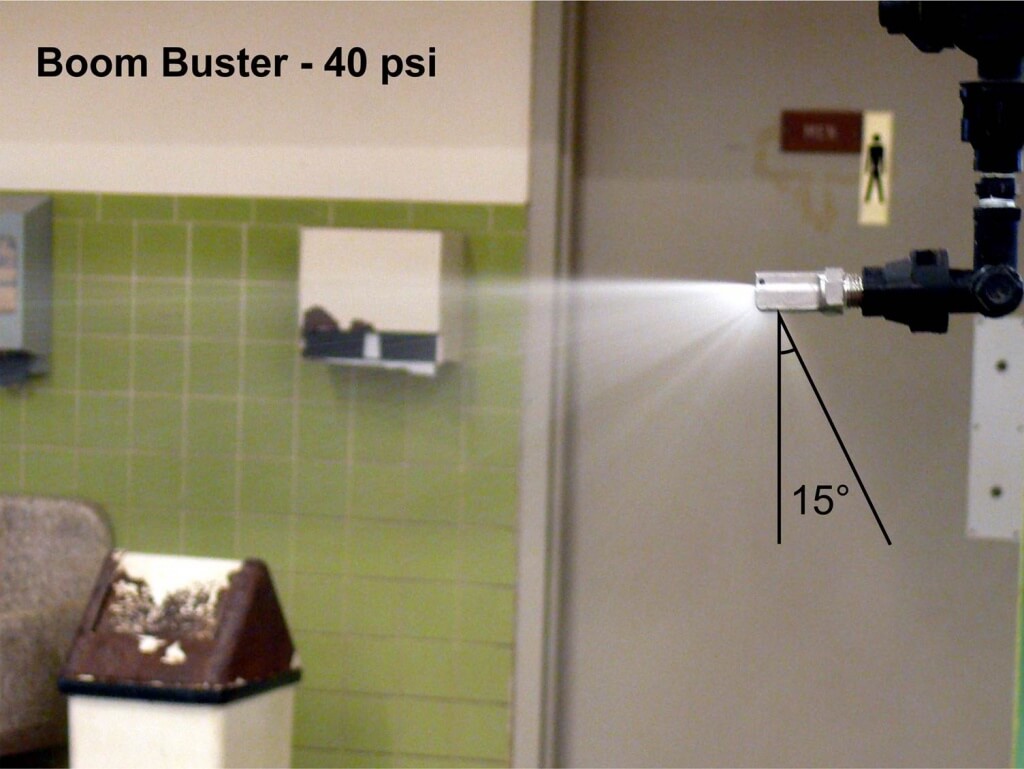
There are fourteen nozzles to choose from, each delivering different flows and according to the manufacturer, spanning up to 31′ from the tip to the edge of the swath. An interesting feature when we ran this nozzle was that the fan extended back ~15°, which might eliminate the need for a centre nozzle if two were operated at the same time with sufficient overlap.
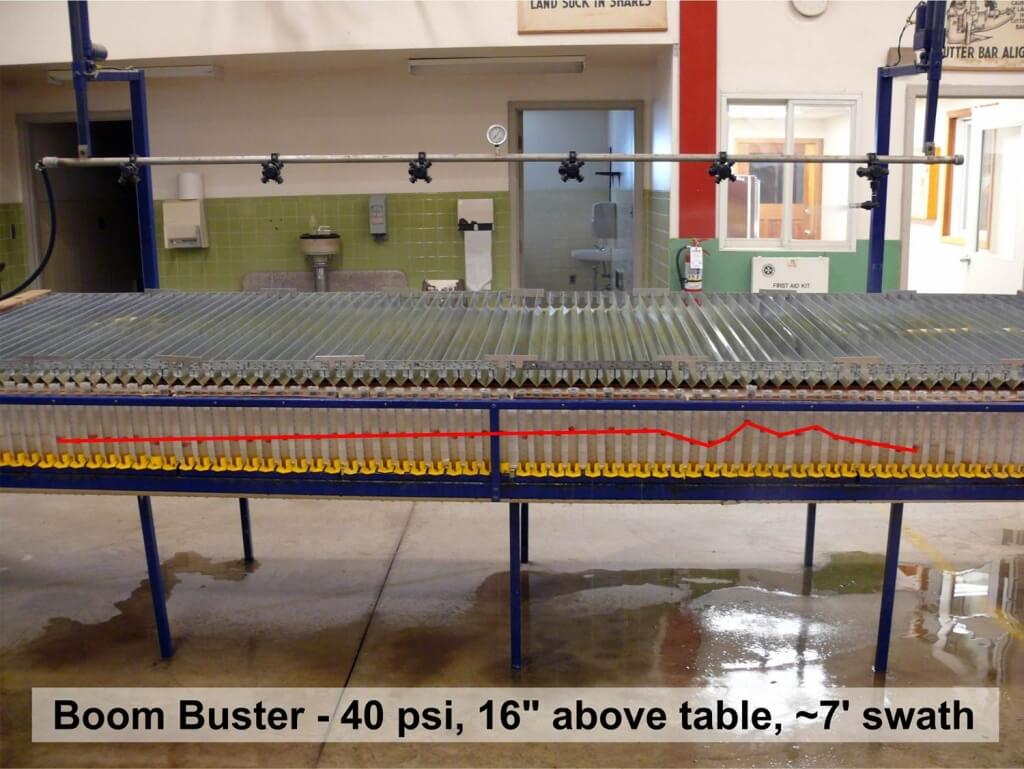
We achieved a 7′ swath at 40 psi, 16″ above the table and the coverage described a fairly consistent curve. It did taper at the far end, but did a respectable job. It was obvious some overlap at the 15° end would help level out the response, and when paired with a second tip facing the opposite direction, this would work well.
The XP BoomJet
The BoomJet mounts 90º to the swath, and with five rates to choose from claims a swath up to 18.5′ from tip to edge.
We mounted the (B) 1/4XP20L (You have to specify left or right) 16″ above the table and at 40 psi we achieved a 6′ swath. There was an odd dip in the coverage pattern not far from the tip. We suspected it might be an artifact, but after multiple attempts it persisted. Other than that dip, the pattern was quite consistent. Had we adjusted the angle to reach a 7′ swath, it may have tapered as much as the Boom Buster.
Observations
Given the range of possible rates and swath distances, the overall consistency of the swath, the conventional nozzle mount, and the 15º overlap, Helmut and I chose the Boom Buster. The BoomJet was a close second, with a consistent pattern save the odd dip, but the 90º mount while making it possible to elongate or shorten the swath was a bit finicky and could pose a snagging risk. The Boom X Tender ranked third because of the inconsistent coverage.
Part 2:
Nozzle mounted on the front bumper of a County Highway Spray Truck used to spray ditches in Kansas.
Boomless nozzles are often used on all-terrain vehicles (ATV’s) equipped with small-capacity spray tanks and they’re popular for for eliminating weeds in pastures and rangelands as well as along roadsides. In 2009, Kansas State University published a factsheet evaluating the efficacy of boomless spray nozzles and describing how they can best be used. What follows is a summary of the findings from their field trials.
Considerations for using boomless nozzles
Pick a nozzle that best fits the mode of action of the herbicide being used.
Select spray width to achieve uniform distribution.
Both the height of the vegetation, and the prevailing wind, will interfere with the width of the spray swath.
As with any hydraulic nozzle, pressure should be optimized to achieve the desired droplet size and swath width while reducing drift potential.
Field Trials
Applications were tested on small (growth stage prior to jointing and 4-5 inches tall) and large (growth stage after jointing and 24-30 inches tall) wheat crops planted in 20 foot wide strips. The nozzles tested were the BoomJet (XP) , Boom X Tender (XT) , Boom Buster (BB) and the Combo-Jet (WCJ). Glyphosate and paraquat were applied a typical ATV-mounted set-up. The treatments were replicated three times and water sensitive paper was used to analyze droplet size.
The Combo-Jet nozzle group.
Results
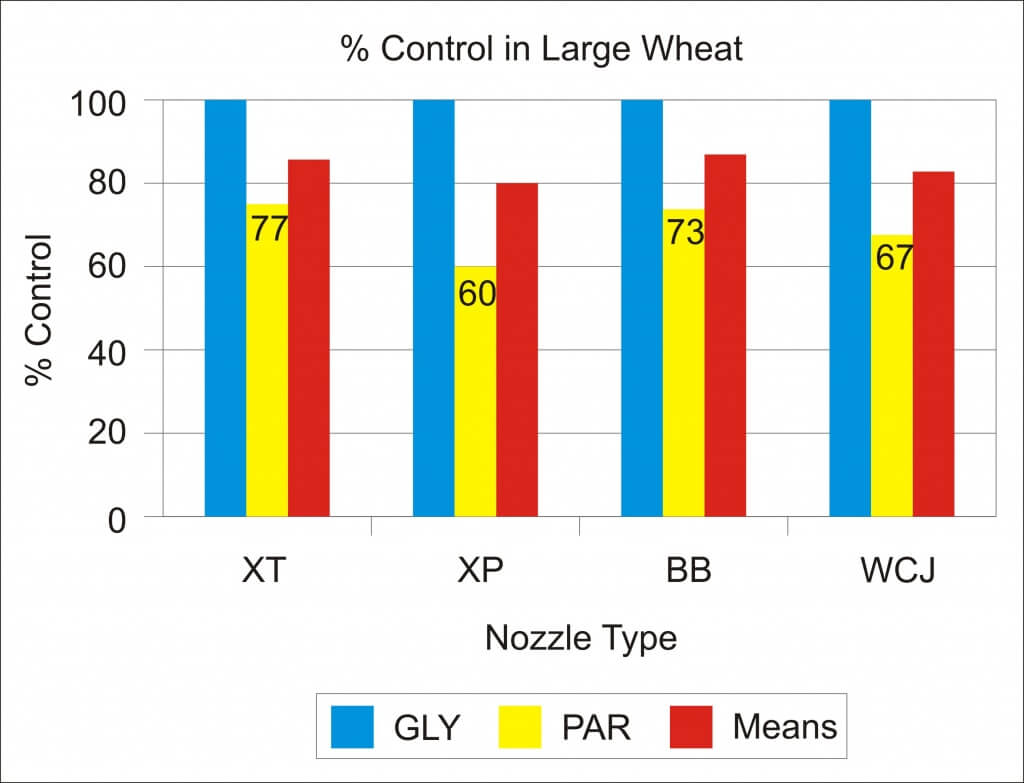
The mode of action, coverage and droplet size affected the results in both short and tall wheat. As expected, glyphosate served as the 100% control and paraquat efficacy ranged depending on the nozzle (see Graph 1). The XT gave the best performance with paraquat.
Graph 1 – Percent Control in Large Wheat
Spray (control) uniformity was about equal with glyphosate, but with paraquat, on a scale of 1-10 with 10 being the highest level of control, the XT and BB tied for best (Graph 2).
Graph 2 – Spray Uniformity in Large Wheat
Swath width was considerably less than manufacturers claimed in the tall wheat (Graph 3). Based on width of control, the WCJ had the widest swath.
Graph 3 – Swath Width in Large Wheat
Swath width was somewhat less than manufacturers claimed in the short wheat (Graph 4). Based on width of control, the XT had the widest swath.
Graph 4 – Swath Width in Small Wheat
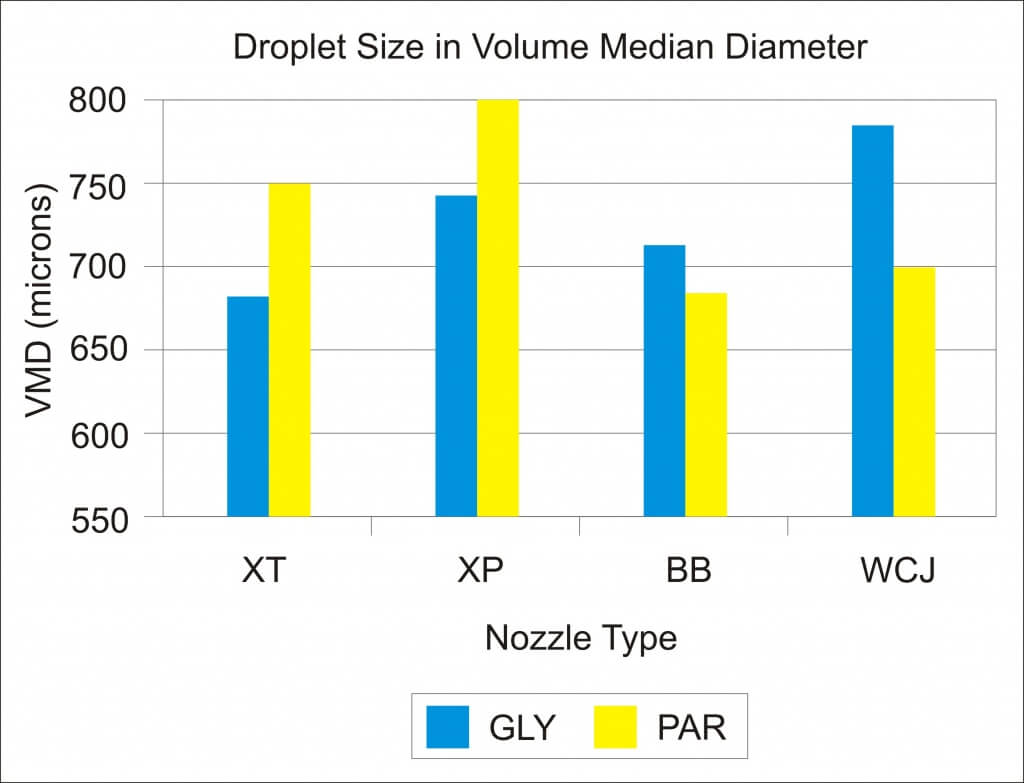
Median droplet size ranged from 684 to 799 microns (Graph 5). If we assume the preferred range for coverage/weed control is 300-500 microns, all nozzles were on the high end. It should be noted that this does reduce drift potential.
Graph 5 – Droplet Size as VMD (microns)
Percent coverage ranged from 37.5 to 27.0 for paraquat and 28 to 21.3 for glyphostate (Graph 6).
Graph 6 – Percent Coverage
Observations
The wind direction and height of the spray stream likely affected the results. To achieve the manufacturer-rated swath width, nozzles would have to be mounted higher on the ATV than is practical, and this would lead to increased drift potential. It was noted that the large orifices common to boomless nozzles made it difficult to pressurize with pumps typically used on ATV’s and a more powerful pump (e.g. a roller pump) might provide better swath width.
While there are many parameters to consider, and counter to the lab trials performed in Part 1, the results from Part 2 suggest the Boom X Tender and Boom Buster gave better overall performance.
Checking the Boom Buster spray pattern.
Overall Conclusions from Part 1 and Part 2
It can be frustrating testing nozzles. What works wonderfully one day might not be worth the materials they’re made of the next. Obviously there was no clear “winner” at the end of this article, but that’s just as well, because perhaps that’s the wrong take home message.
Instead, remember that any nozzle can be used incorrectly. Mind the pressure, swath width and environmental conditions to get the most out of whichever nozzle you choose to use. Take time to confirm that everything is working optimally, and go back to ground-proof the results so you know what worked and what didn’t.
We like to keep things simple ’round here and this poka-yoke from Arkansas is both simple and effective. What’s a poka-yoke?
“Poka-Yoke”: a Japanese term that means “mistake-proofing”. It’s a mechanism that helps an equipment operator avoid (yokeru) mistakes (poka) by preventing, correcting, or drawing attention to human errors as they occur. Thanks, Wikipedia.
The problem
An aerial applicator has to spray a lot of fields. They consult their work orders, the plane is loaded, they spray and repeat. However, depending on which herbicide trait was introduced to which crop, accidents can happen. Imagine the mess when you spray a crop with glyphosate… and it isn’t a glyphosate-tolerant crop? This problem promises to become more of an issue as we introduce glyphosate+2,4-D and glyphosate+dicamba-tolerant crops. It may look like the right soybean plant, but you DO NOT want to mess up by spraying the wrong chemistry on the wrong genetics! You think a bit of residue in the lines can cause trouble…
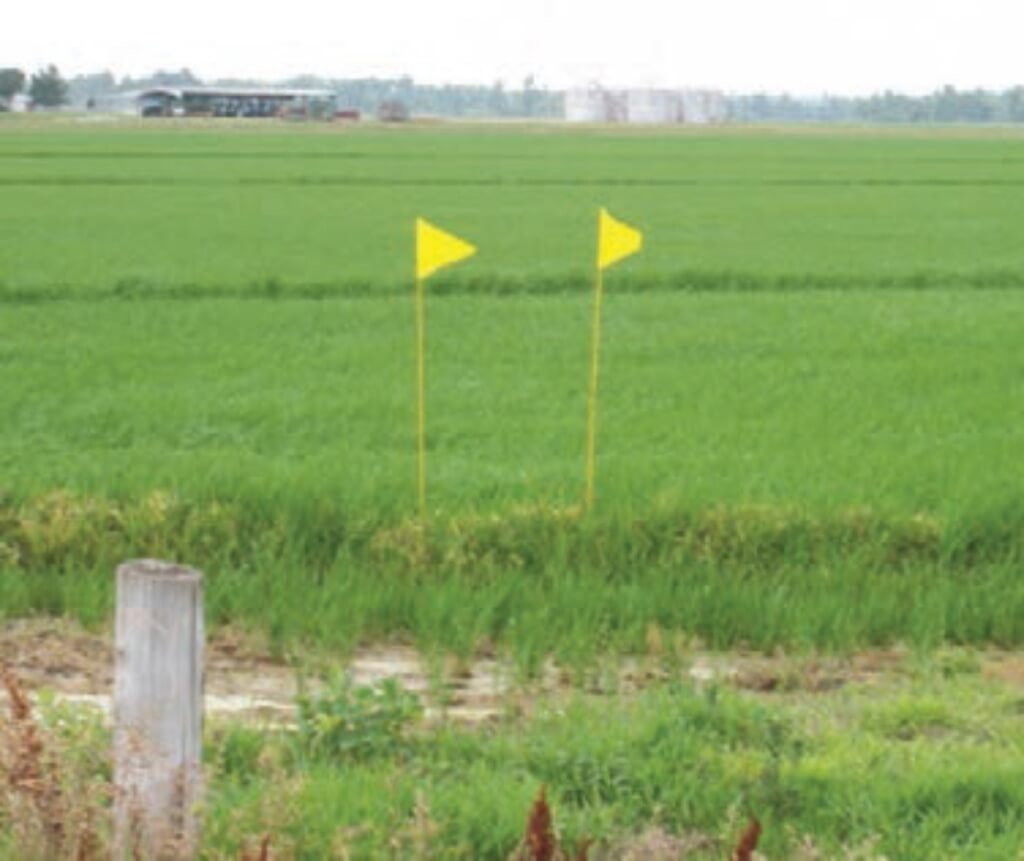
Yellow flags designate this field as a Clearfield rice field (Photo from UofA FSA2162)
The solution
In 2011 the University of Arkansas came up with a “quick and inexpensive” way to prevent this from happening. They used six-foot, colour-coded bicycle flags. Each colour or pattern represented a specific herbicide tolerance, as shown here. Aerial operators were given a copy of this visual key and the growers placed a couple of appropriate flags at the edge of the field on the approach vector at planting.
The result
Aerial applicators got one final check before they started to spray… just in case. In 2014 the innovative people behind this concept reported that it prevented countless acres of accidentally-damaged crops. Several (honest) aerial operators admitted to pulling up just before they started to spray because they realized there was a mismatch between what was in their tank and what the field was supposed to receive.
Corn field with glyphosate (white) and glufosinate (bright green) stacked technology. (Photo from UofA FSA2162)
The challenge
This is the kind of elegant, simple tool that we all should be using for ground rigs as well as aerial sprayers as we begin to plant more crops with stacked traits. Canada, the US, Australia, anyone using these genetics, could benefit. We should consider adopting this method, complying with Arkansas’ existing colour scheme and adding to it as required. Seed companies and agrichemical companies should find a way to bundle the flags with the chemicals and seeds for the buyer.
One of our recent posts highlighted some great producer designed tender systems for the sprayer. We posted four submissions, and are continuing the series with new submissions in this post.
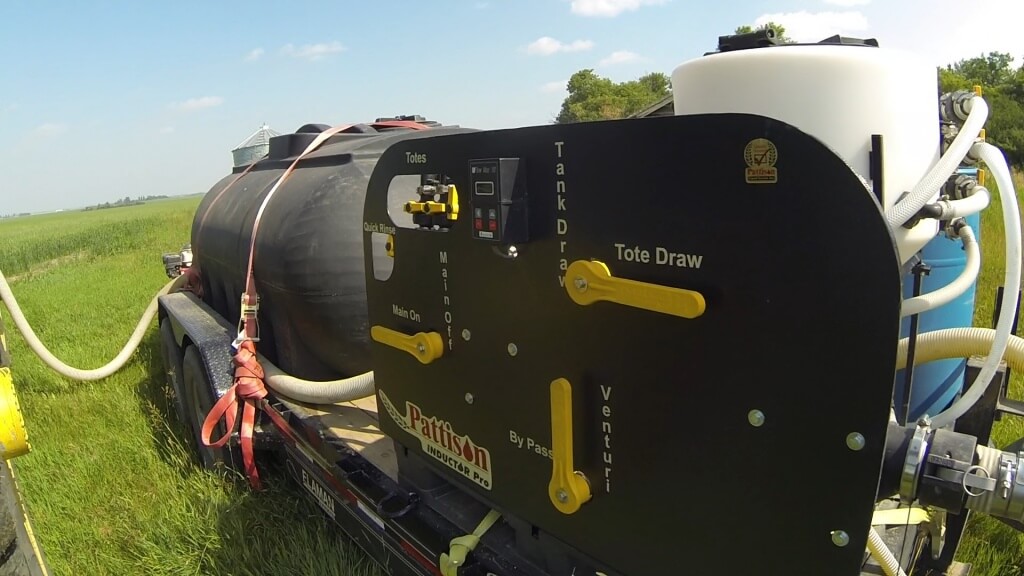
Our fifth submission comes from the folks at Pattison Liquid Systems of Lemberg, Saskatchewan
I recently saw Phil Lingelbach of Pattison at a sprayer clinic. Pattison has been designing and building transfer systems for years, and have valuable experience to share.
I asked Phil and John Young these questions about transfer system designs:
Why is filling faster important? How does it reduce your operating cost?
“Idle time costs money. Consider that trade in cost of an average high-clearance sprayer is approximately $185/hr on the meter. So 100 hours of idle time per year is costing nearly $20,000 in reduced trade-in value.
We also need to maximize “best spray condition” time. We know that application timing is critical to success, and need to take advantage of good weather conditions. Spraying under marginal conditions reduces the chance of good pesticide performance.
Efficient filling can also reduce labour costs, this is a “snowball number”. Every unnecessary hour spent spraying could be used to do something more productive, in essence a wasted hour costs you two.”
When designing a transfer system, what are the key considerations that separate a good from a bad system?
“Make sure that the water pumps pushes water to the inductor system. Do not use a water pump to pump chemical. Contamination is a huge issue with this.
Keep your transfer system away from the rear of an open deck to minimize dust exposure.
A good transfer system will be easy to clean and very user friendly, valves separated and clearly marked.
Get the biggest, fastest pump available. Loading water after the chemical is in is key.
Make it simple to operate, there is lots of hired help on the farm.
Design it to keep operator from being exposed to chemical. Keep trip hazards to a minimum.
Include fast product induction. There is no point filling water quickly and having to wait on a slow product pump.”
You mentioned the speed of filling product. What flow meters are most accurate and reliable?
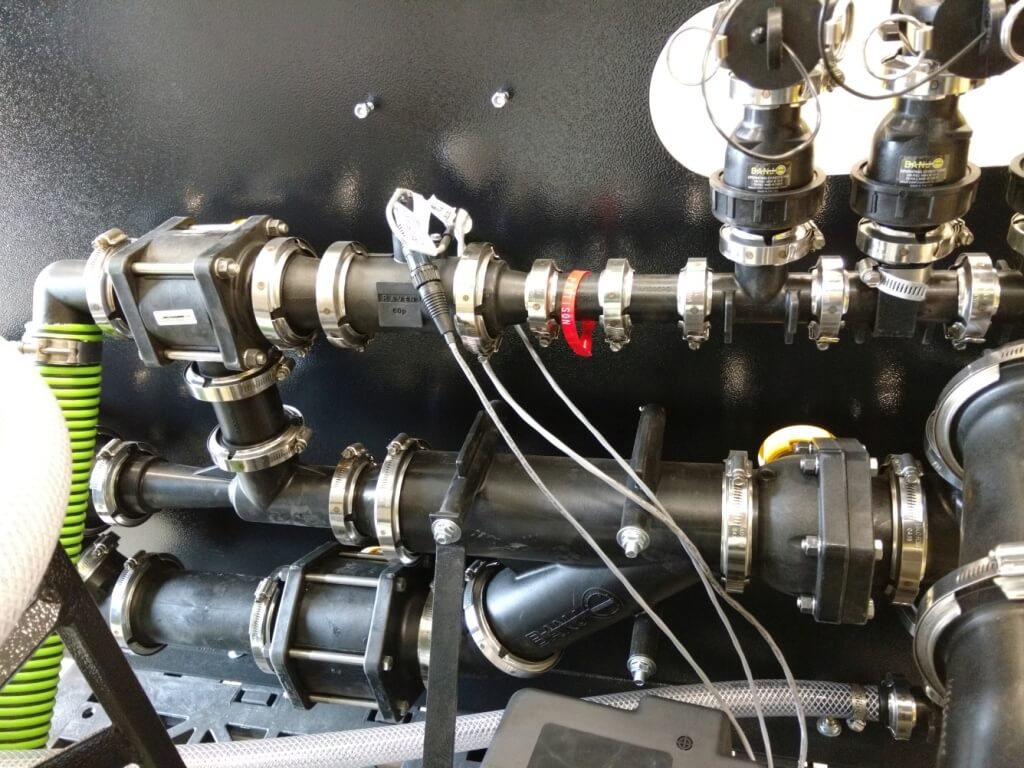
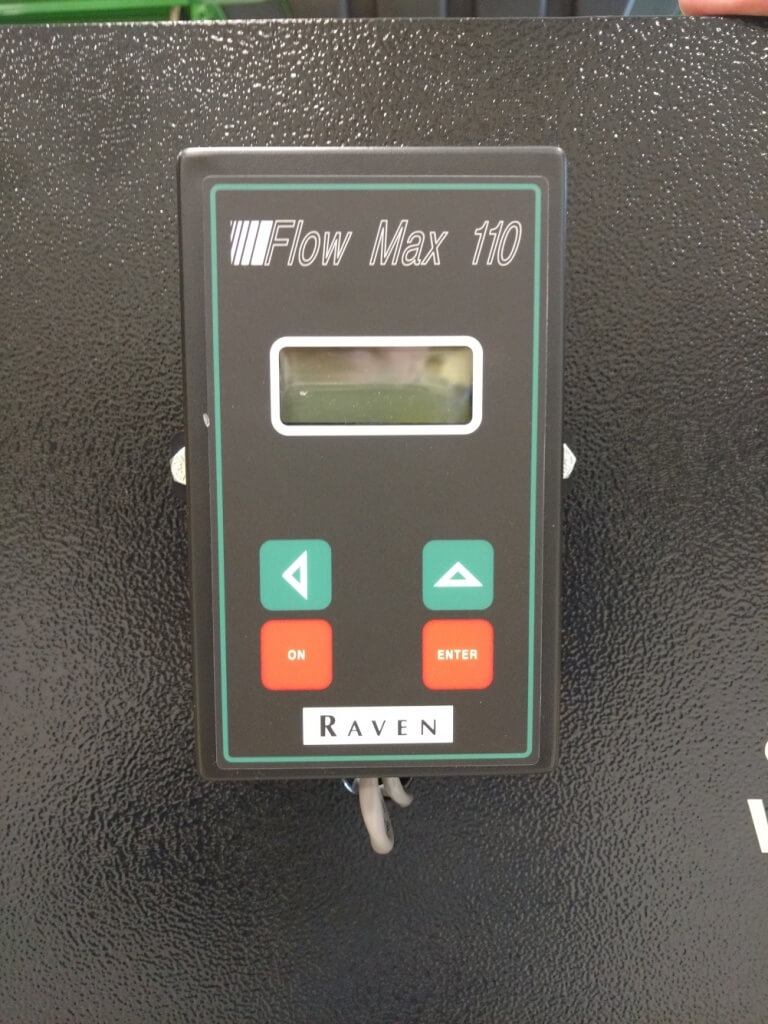
“The Banjo Mag meters and the Raven FloMax 110 (combined with the 60P) and 221 are the most accurate that we have available, the Banjo is limited to non-petroleum based products though.
Both the Raven 60P and Flomax 221 are turbine style meters, to be used with all ag chemicals, – 2” models.
Banjo Mag meters should only be used with water based products – this meter is the best for measuring water when filling, comes in a 3” model.”
What are the best ways to clean a transfer system?
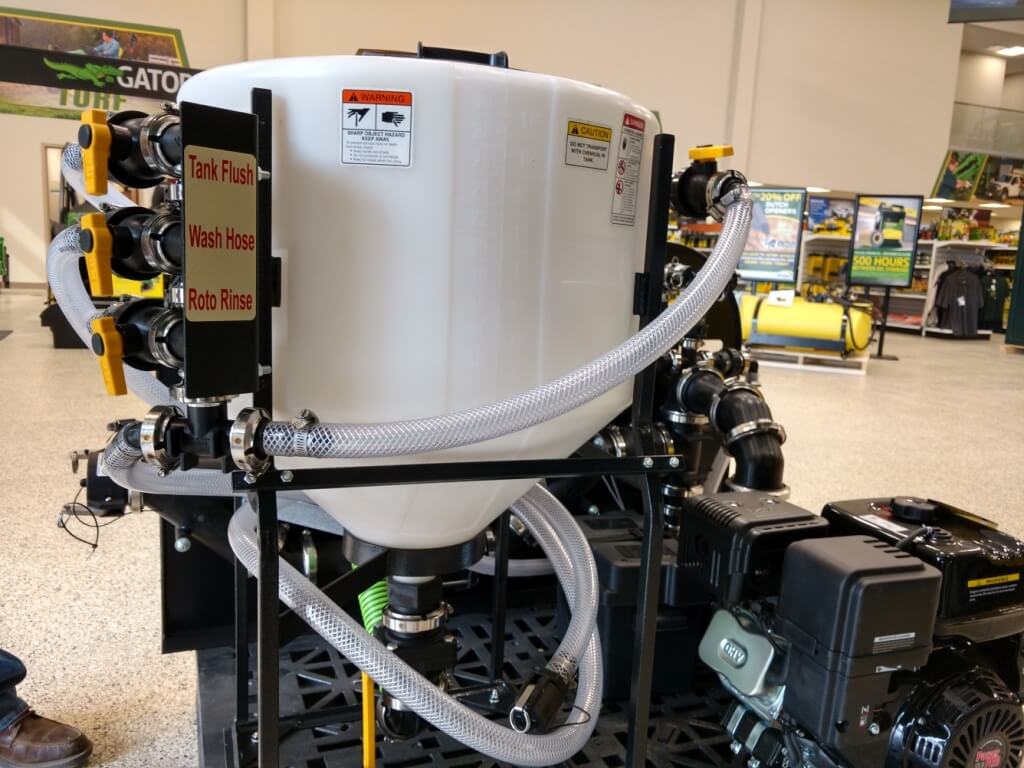
“The best way to clean your jug rinse tank is THOROUGHLY!! There is no such thing as overkill when it comes to cleaning this tank, we use a tank that has no bulkhead (total drain, no bulkhead for product to get hung up on) in the drain, a rinser designed for an 800 gallon tank, and very minimal fittings for chemical to get hung up on.
Use lots of water, when you think it’s clean, rinse it one more time!!
All our inductor systems come with a quick attach clean water rinse system, that allows the operator to flush the complete metering/inductor system.”
What is usually the limiting factor when trying to fill a sprayer faster?
“Hose size, pump size, venturi efficiency, and planning are most critical. Consider your needs – a system should be designed specifically to the needs of the operator.”
Do you need more than one inductor to handle multiple products in time?
“Usually one will be sufficient so long as the suction line is of sufficient size and length.
Our inductor systems are configured to handle more than one bulk product at one time. With just the turn of a valve you can switch from metering one product to another, or quickly change from metering a bulk product to handling jugs.”
We’ve recently been talking about how to save time while cleaning a sprayer. Although it’s very important to be thorough while cleaning, and to take the necessary time to do the job properly, there is always an opportunity to fine tune and spend less time. This is especially true when diluting the tank remainder down and pushing clean water to the booms. A method promoted in Europe, and coming to us via Joachim Herfort of Agrotop, is called “Continuous Rinsing”.
Continuous Rinsing requires a dedicated pump that delivers the clean water (which may contain a cleaning adjuvant) to the tank via wash-down nozzles. It works like this:
The operator, having carefully measured the pesticide mixture, has only a small remainder in the tank when spraying is complete.
This remainder is sprayed out in the field, either on a set-aside area, or over the already sprayed field at a reduced rate, product permitting (the operator would pay attention to crop tolerance and carryover issues)
As soon as the tank is empty, indicated by the boom spray pressure dropping, the operator switches on the clean water pump which delivers the clean water via the wash-down nozzles.
Soon, the main product pump starts delivering the wash-down liquid to the boom and the return lines.
Because the clean water pump will deliver less than the boom flow, the cleaning mixture is delivered somewhat intermittently. We are told that this helps with the cleaning action of the lines. Be cautious that the main pump does not run dry long enough to damage its seals.
Once the clean water tank is empty, the pressure drops again for the final time and the tank rinsate is now very dilute.
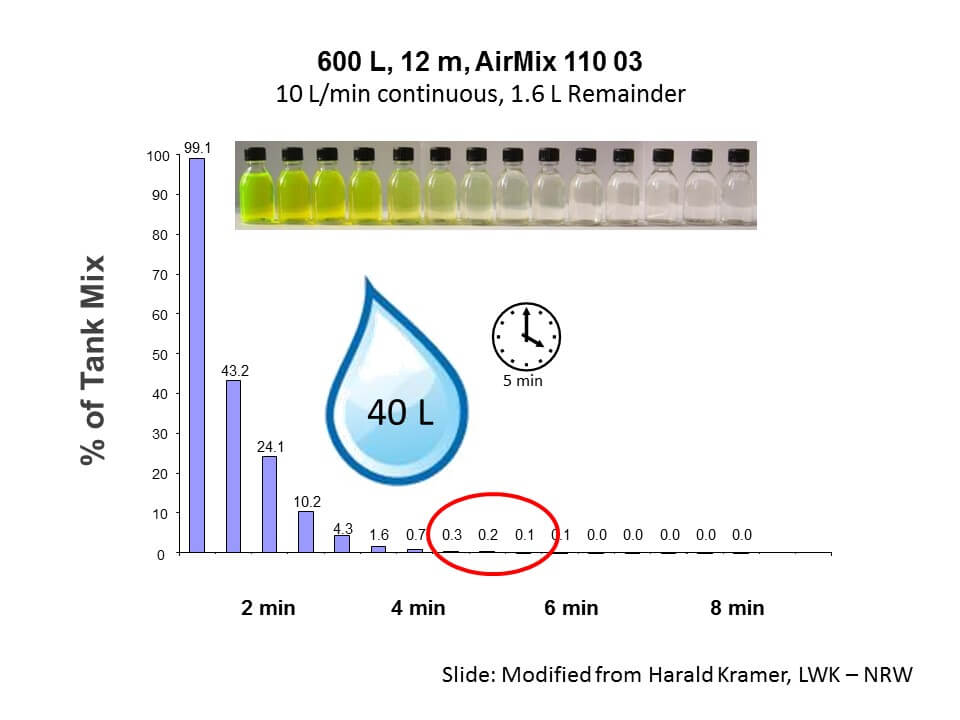
Testing in Europe has shown that the whole process takes only about half as long as batch mode. One key time-saving feature is that the sprayer never has to stop, and the operator never dismounts. These data also show that a significantly lower water volume is required to achieve a greater dilution of the remainder than a batch mode would have achieved.
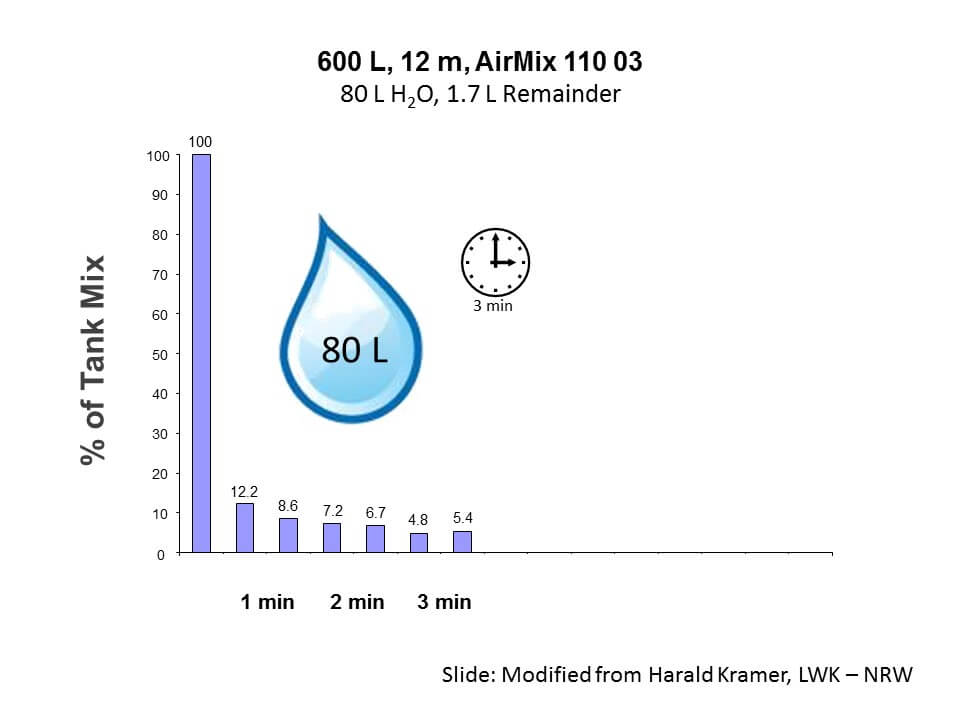
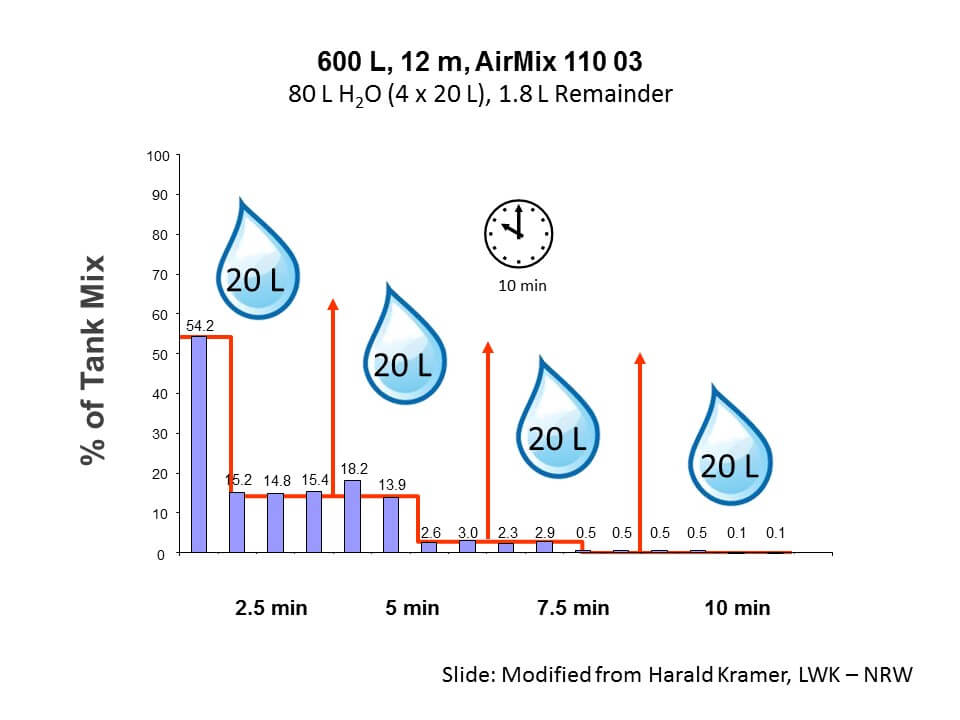
For example, the European tests (we believe these were done by the Landwirtschaftskammer of Nordrhein-Westfalen, a German regional government) used a single rinse of 80 L, as well as four batch rinses of 20 L each. As expected, the four-batch process was superior to the single rinse, but took a lot of time. They then tested a continuous rinse with 40 L. The continuous rinse resulted in greater dilution than the 4 x 20 L rinse, in less time. In this case, the quality went up, and the time went down.
Our challenge in North America is to roughly match the clean water pump, wash-down nozzles, and main sprayer pump capacities so the system works. Our larger sprayers easily deliver 30 gpm, and some adjustments may be necessary.
Dilution of the tank remainder is only one aspect of sprayer cleaning. The other aspect, decontamination of surfaces and components, is also important and the process depends on the active ingredients and formulations in the tank.
An animation developed in Germany and shared via Agrotop is availablehere.
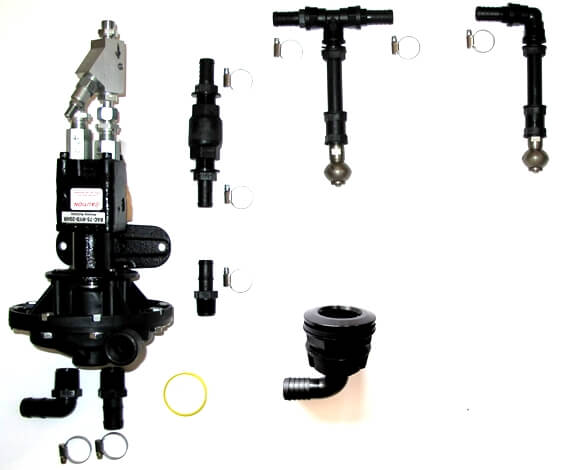
Note that Agrotop has suggested components to convert a sprayer to a continuous rinse system here.
We’ve recently been talking about how we can increase sprayer productivity by decreasing downtime. The main productivity robbers are time spent filling and cleaning. Using our productivity calculator, we’re able to show a 30% increase in acres per hour with some relatively simple changes to how we fill the sprayer. It’s important to actually measure the time spent filling, not estimate it.
A few days ago, Jeff Calder of Letellier, Manitoba (@jcalder1983) tweeted a water truck project he’s been working on, and it generated a lot of interest. We decided to follow a suggestion made by Ron Krahn (@RonKrahn) last fall to show various designs so that everyone can learn from each other.
This post will grow over the next few weeks as we gather more submissions. The first four submissions are below, the fifth and subsequent submissions will be here.
Please use our e-mail link on the site to send us your picture and descriptions, and we’ll post them as they arrive.
The first submission came from Landon Friesen (@landon707) who farms near Crystal City, Manitoba.
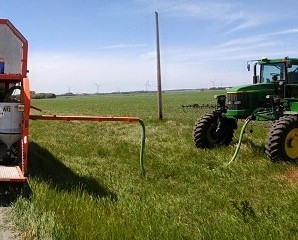
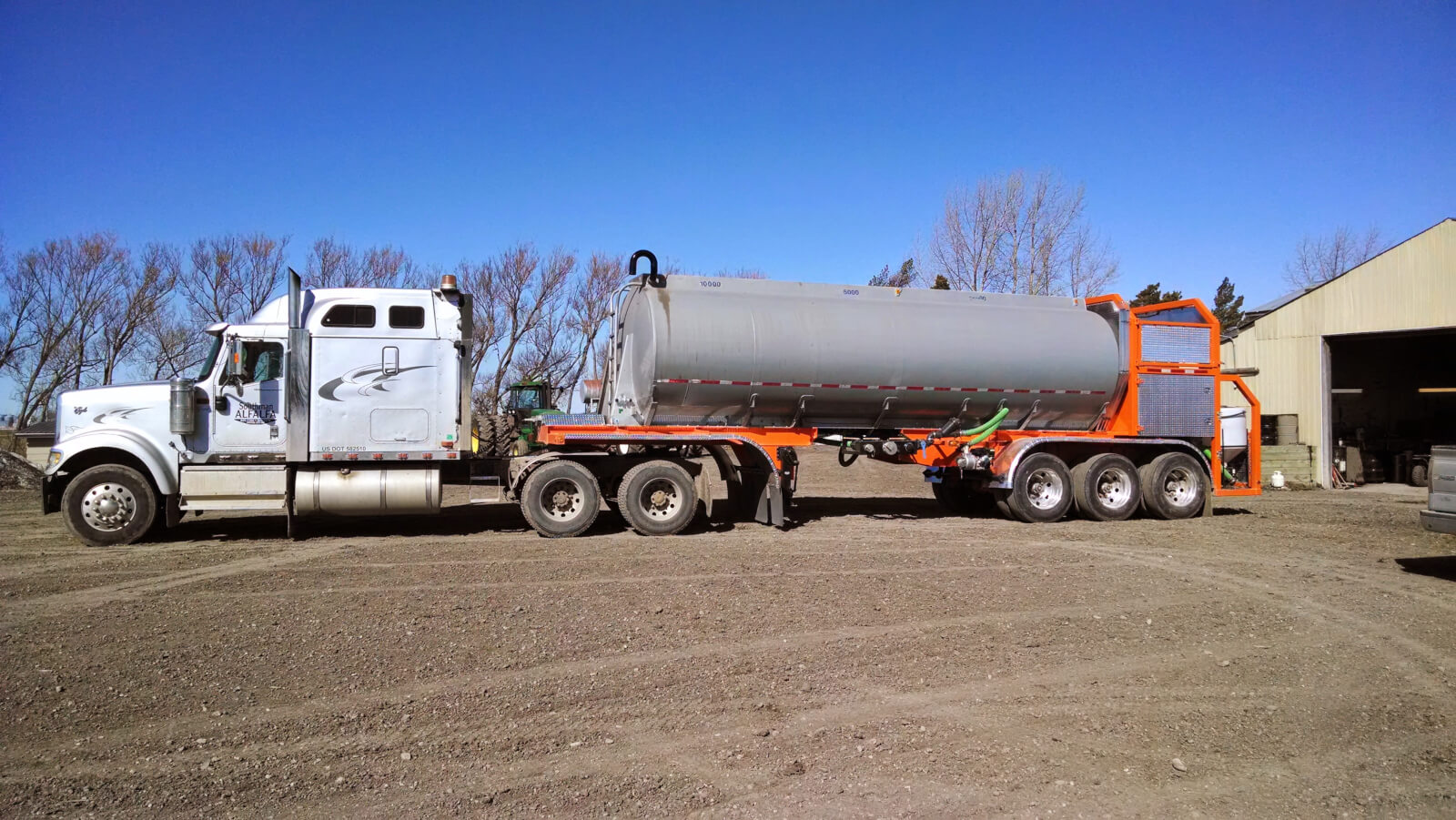
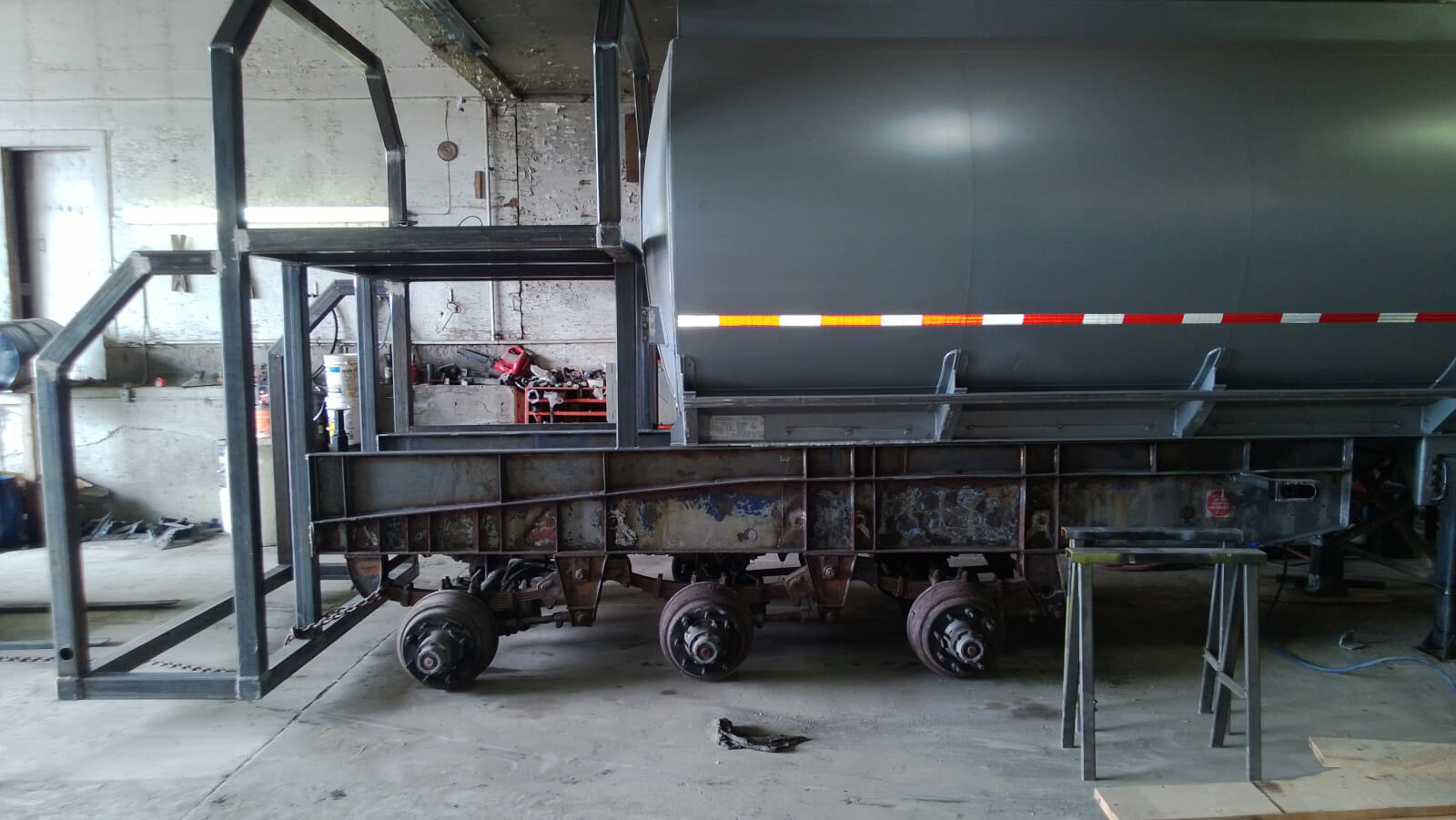
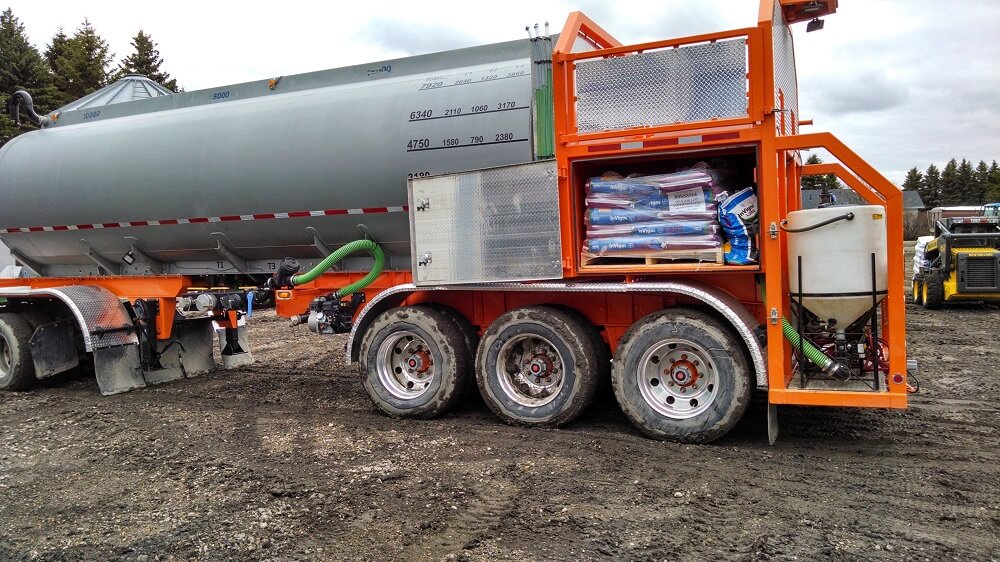
“We bought the front half of a old fuel tanker, stripped it right down to nothing, flipped tank end for end for better weight distribution, and extended the kingpin for bridge length. It’s just shy of 9000 gal to the lids (far from legal). Built the back frame/box etc.
Mix Tanks on rear platform, bulk totes up top, small boxes in the middle. Blast and paint are next. #westcndag
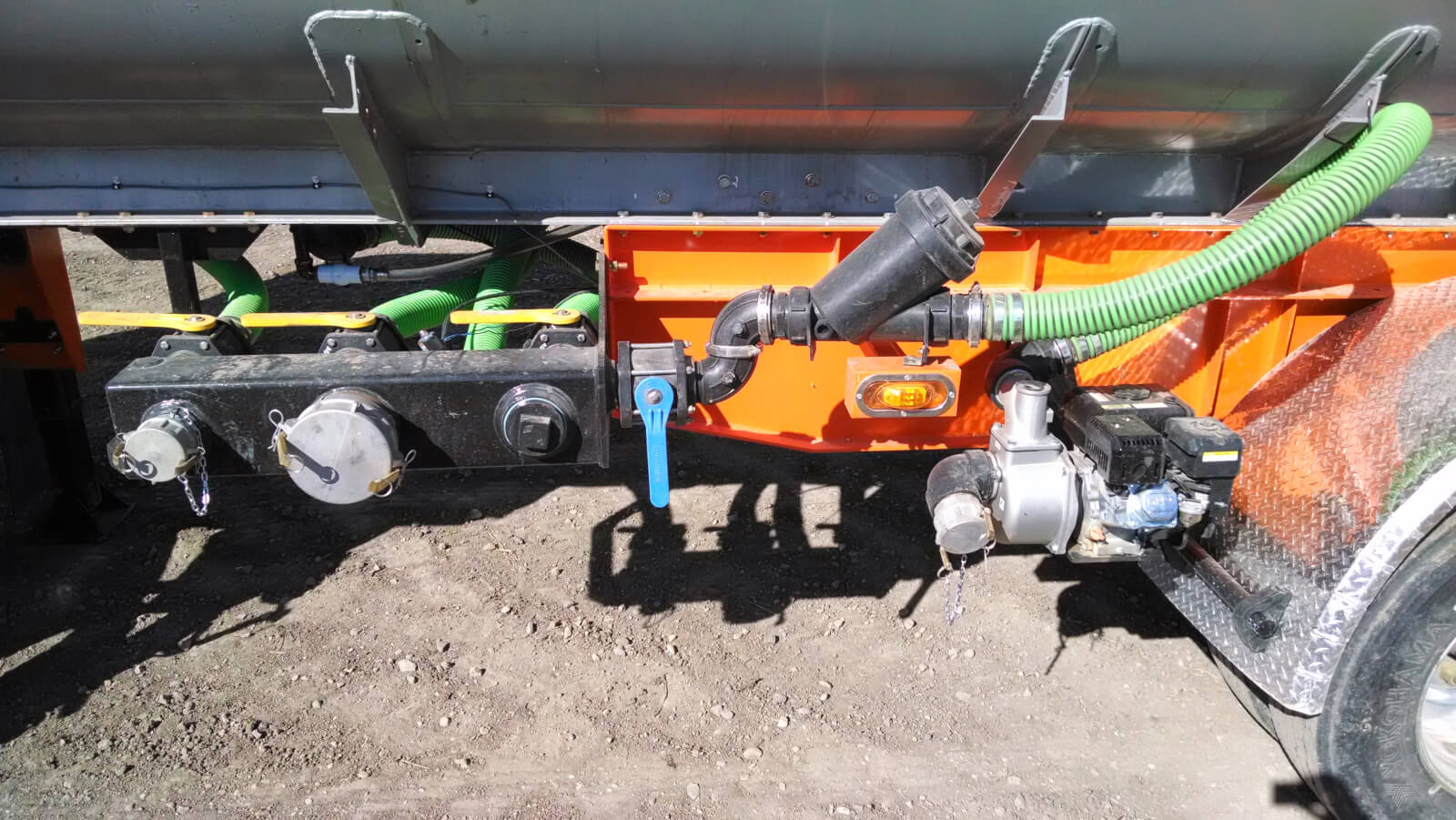
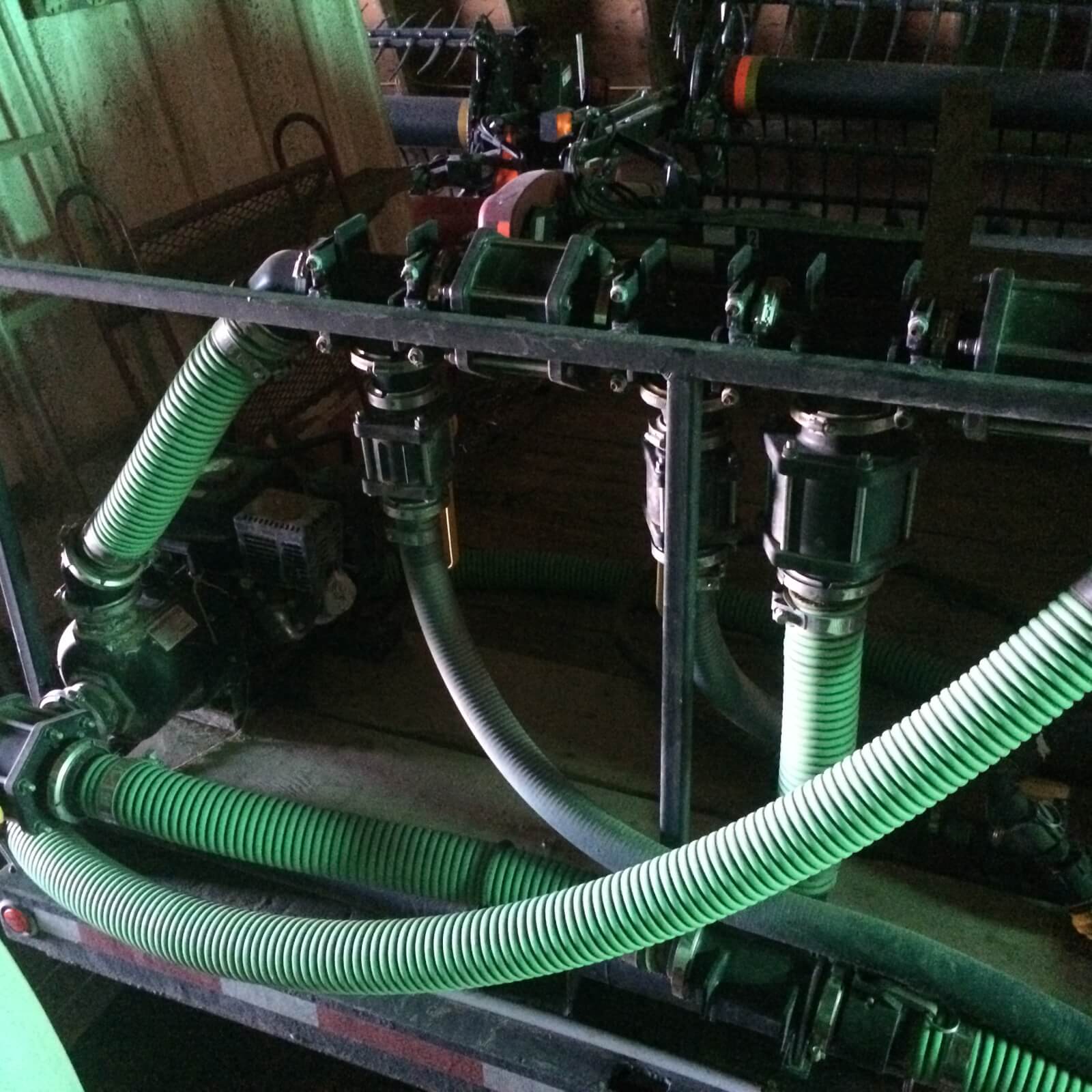
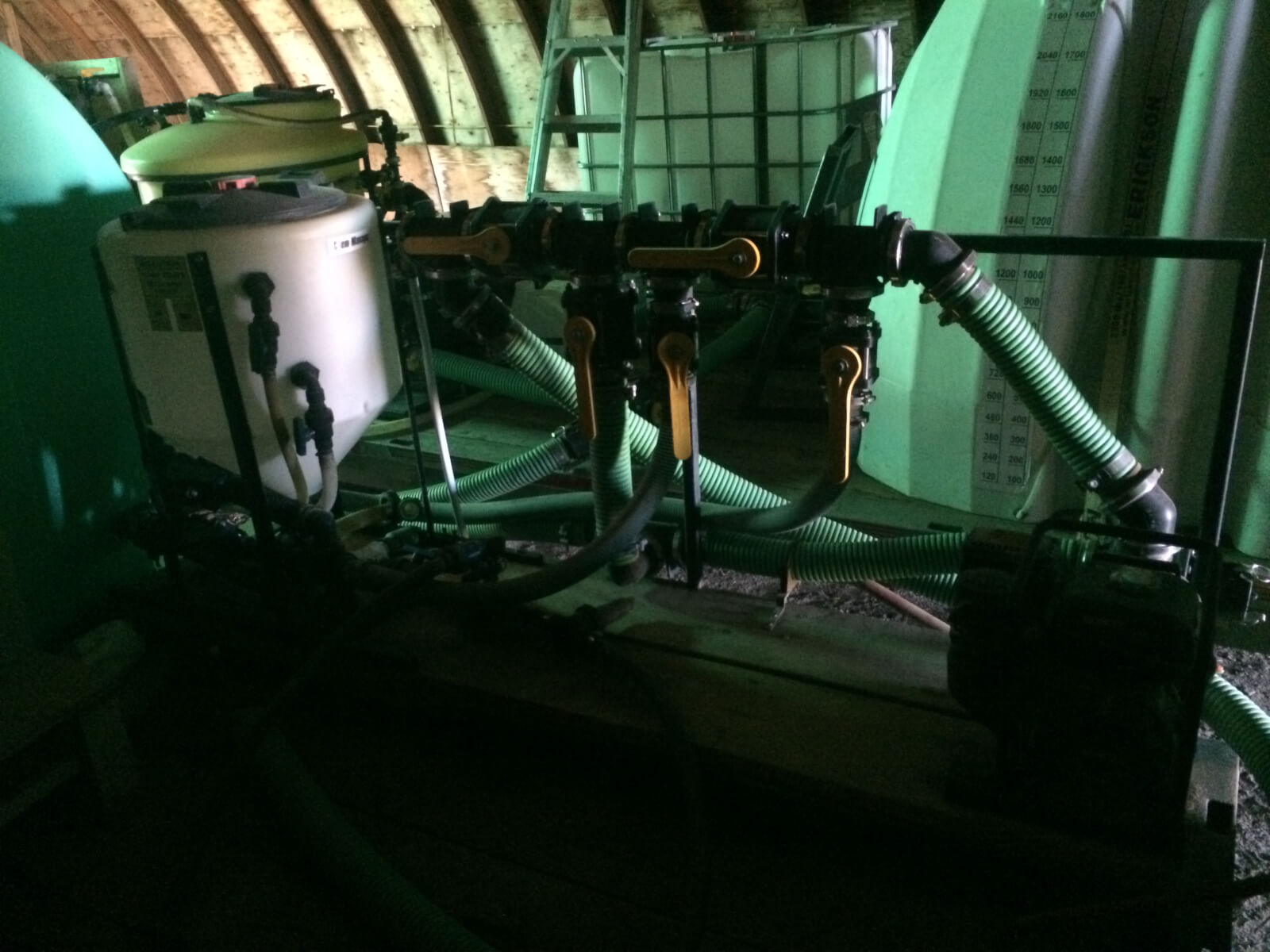
“Starting at the drivers side, all three internal tanks come together in a manifold, you can select which tank you’re drawing from or filling from. You can fill with a 3, 4, and 6 inch pump, connected to the manifold is a stationary pump for only filling ditches or water sources without pumps with a filter on it.
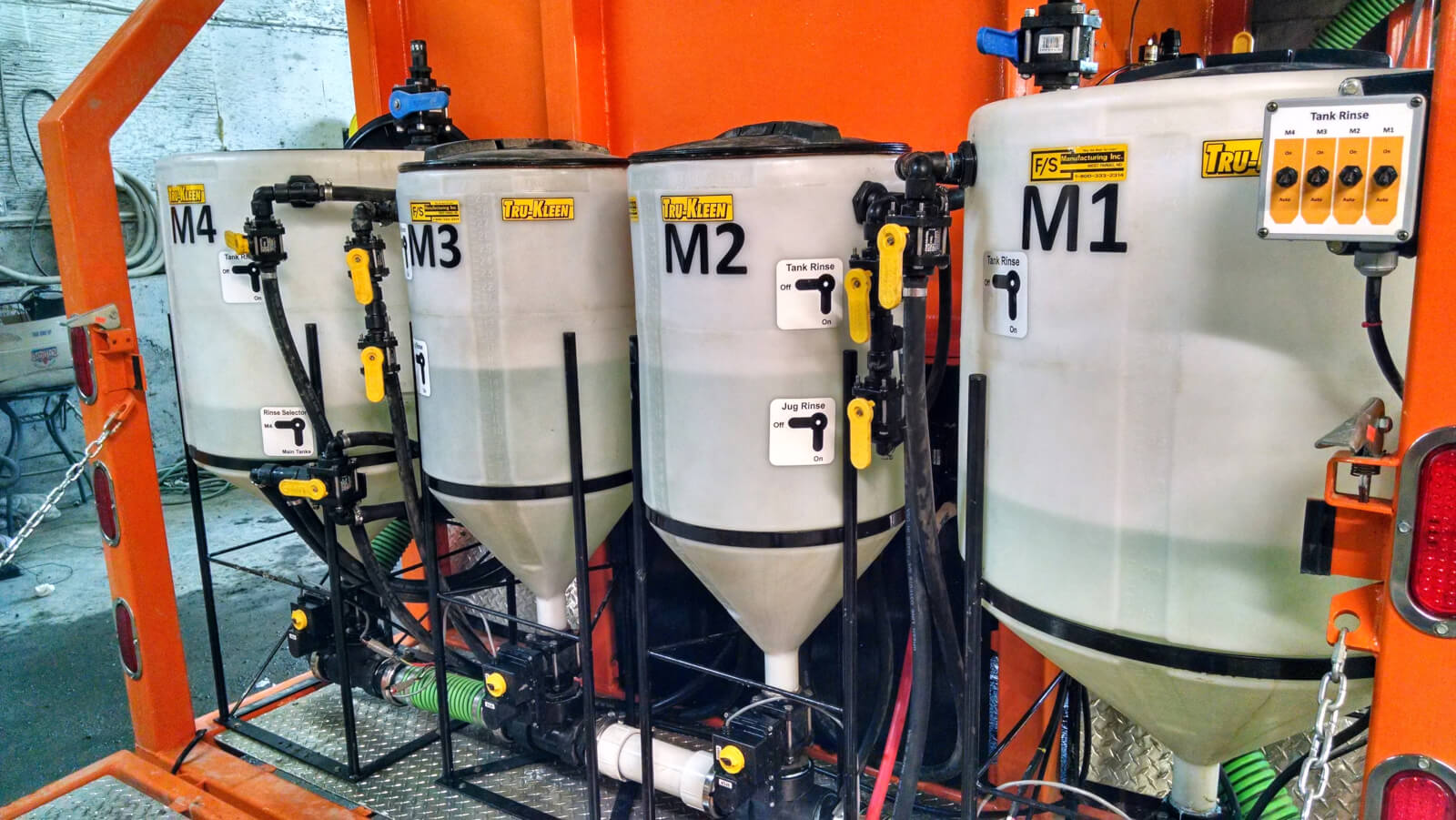
“Water then travels around the backside of the trailer under the 4 induction tanks, a check valve keeps any product from flowing back into the tanks to prevent contamination. Each induction tank has a 1.5 inch electric ball valve that feeds the three inch line.
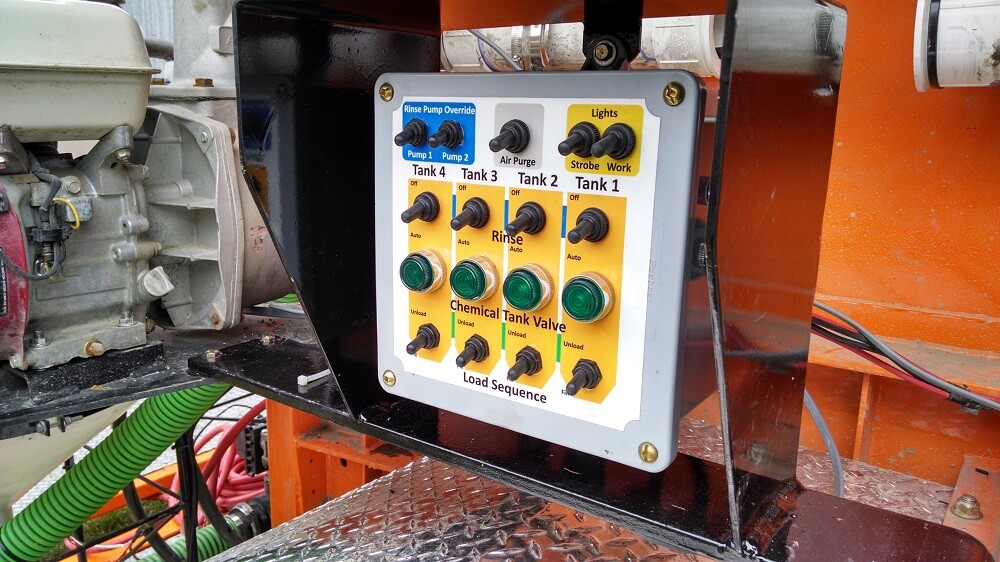
“Each inductor has a tank rinse and a jug rinse. Tank rinse and jug rinse are powered by 2 12 V water pumps drawing from manifold on the drivers side of tank. All electric solenoids control which induction tank gets rinsed.
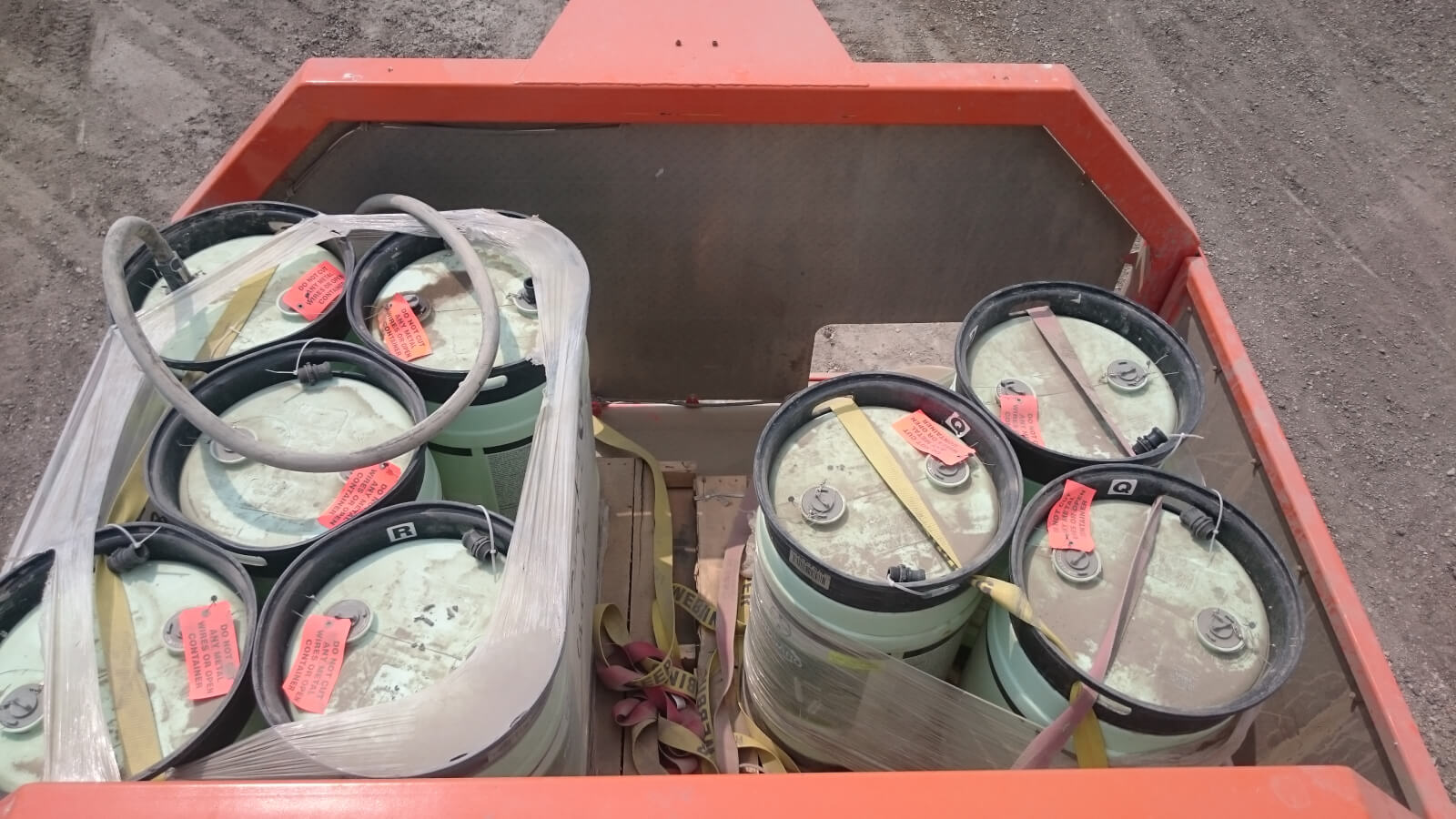
“Jugs are stored inside the large box under the bulk deck, keeps them dry and close by the the rear deck. Bulk containers go on the top deck, 900 L totes are gravity fed into the inductors, accurate measurements on the inductors let us know when to shut off the gravity valve, if barrels are used a chem pump is on the back now too.
“Inductors are handy because it keeps all products “preloaded” and separate for chem safety until you need them.
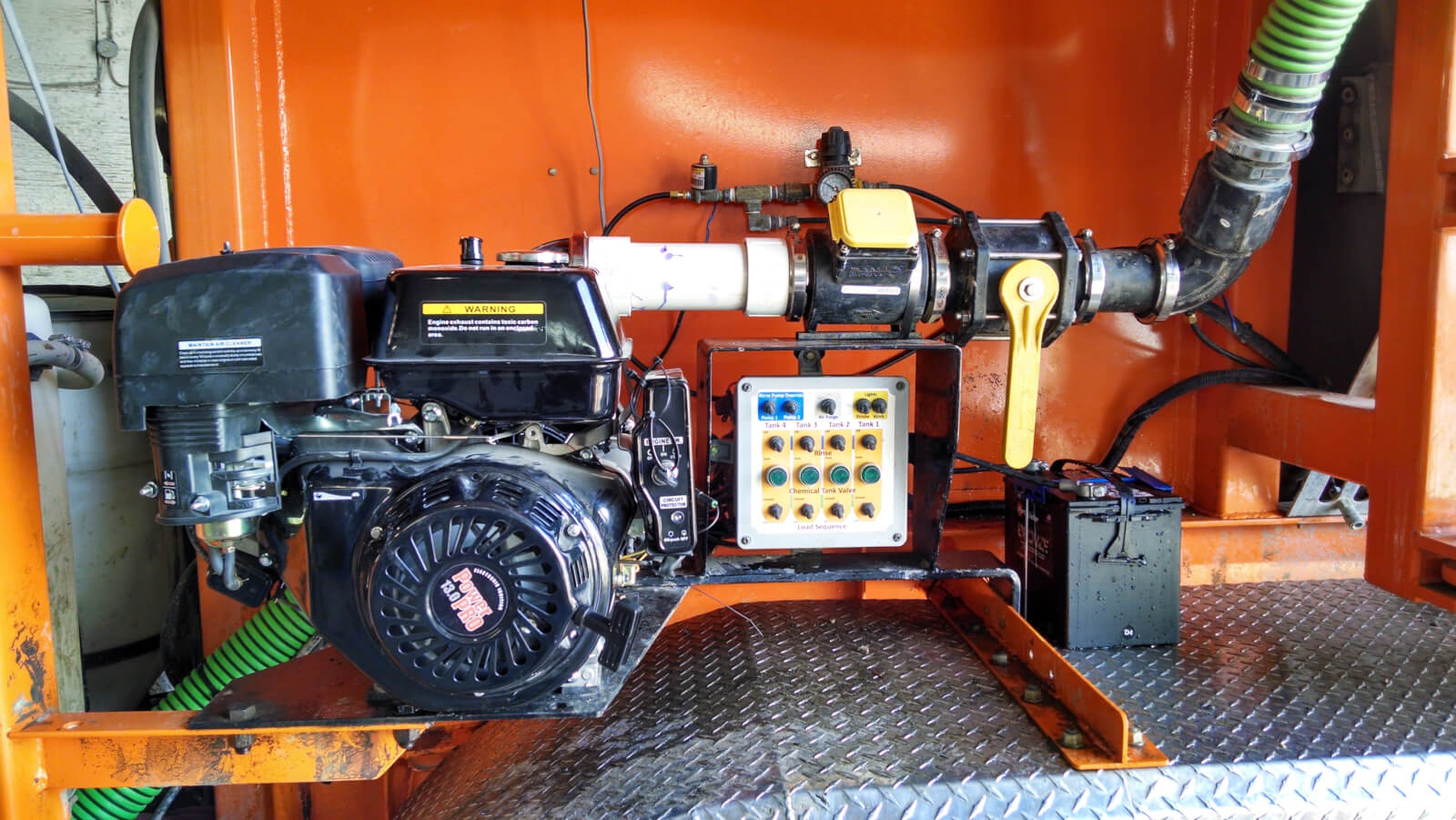
“After the inductors the hose travels to the suction side of the pump, was a 6.5 hp Honda and now replaced by a 13 hp Hypro pump, water or fertilizer then passes through a flow meter and out the 12 ft boom with hose doubled up for 24 ft reach across the ditch.
“Our goal was to have the tanker operator stand by the pump and control panel the whole time, no valves to turn, when you engage the “unloading” of a induction tank on the control panel the auto rinse is activated for that inductor, keeping it cleaned out for the next batch.
“We can fill a 1200gal sprayer with all chem in just under 5 min with all chem included, that’s from hose connection to disconnect. Gained many acres/day b/c of this trailer. Took us 2 years to build and I’d do another in a heartbeat!
“We use it for seeding in spring to bring liquid fertilizer to the drill, can keep a skid of seed out of the rain and blend N, S, and liquid P with the flow meter. Next to the sprayer it’s the most widely used piece of equipment on the farm!
The second submission was made by Jay Schultz (@WheatlanderJay) of Rosebud, Alberta
“Spray tender setup is near and dear to my heart and have set up 2-3 systems in the last few years with the help of my BIL Craig. I have the vision he has the know how. I scoured the internet for a few years for ideas and there is lots of great setups on various forums.
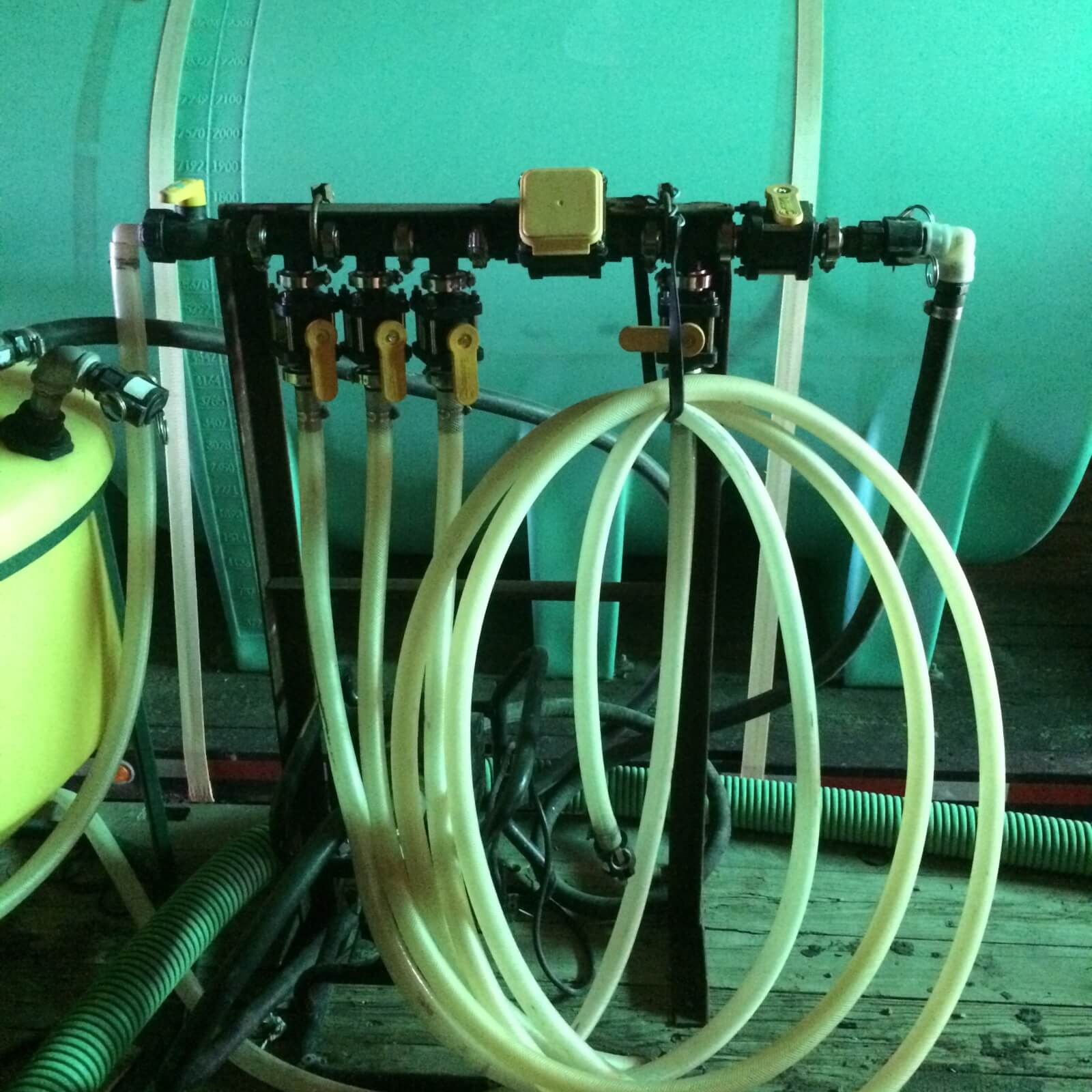
” My bulk chemical hose setup can suck out of three totes or barrels. It can dump into the chem handler using a 1 inch chemp pump or I can use the venturi to suck depending on what we want to do. This system is also plumbed with a fresh water line to be flushed. It also has a banjo flow meter. Banjo last a long time, other brands do not. BUT it measures EC not flow which does not work for all chemicals. Back up is measuring in the chem handler.
“When we use jugs we throw them in an old ICB tote so they don’t blow out down the road.
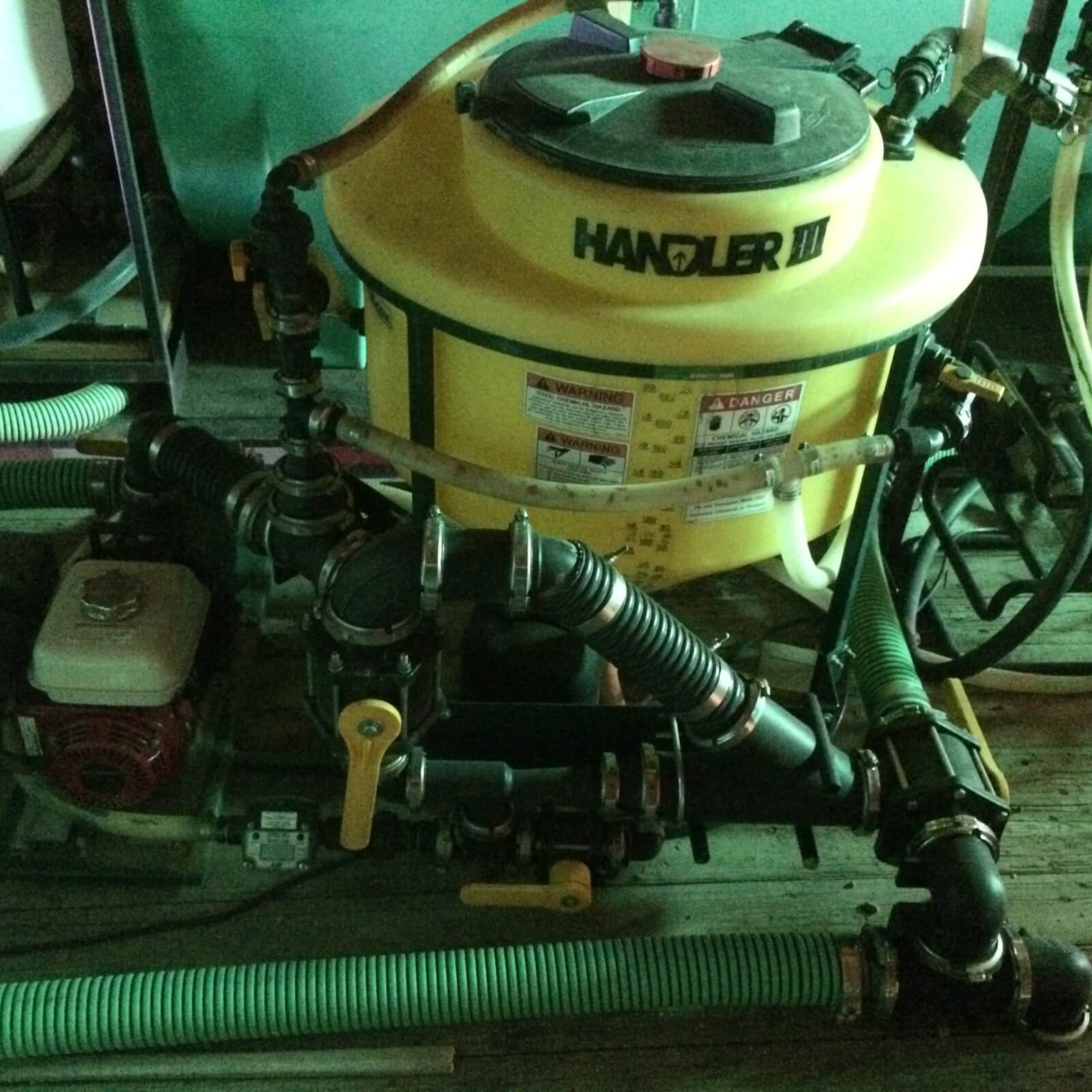
“We are using a chem handler 3 with all three inch hoses.
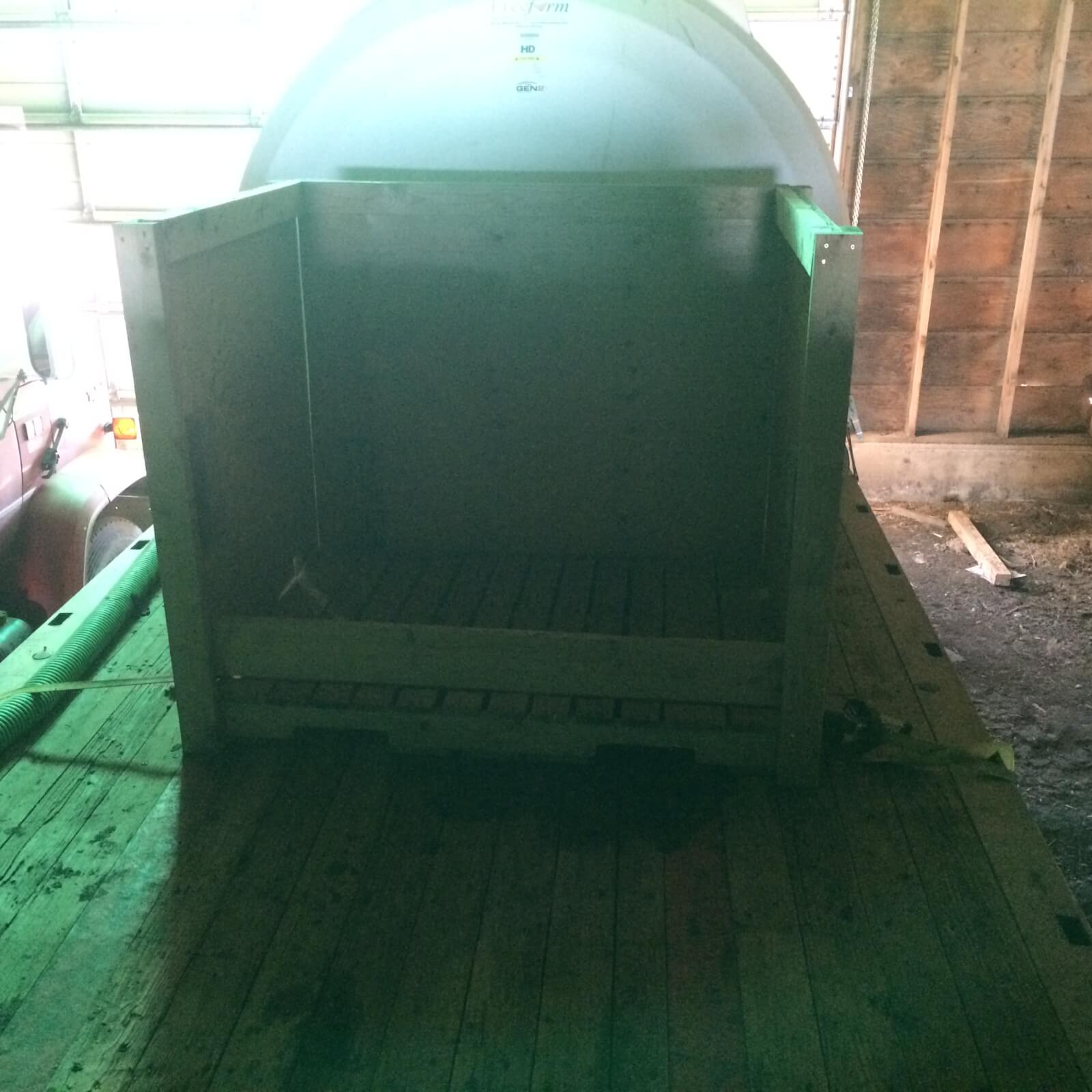
“When we have barrels and or jugs we have a pallet they we built sides for that also has a shelf. We can remove it with one strap and reload or use 4 totes.
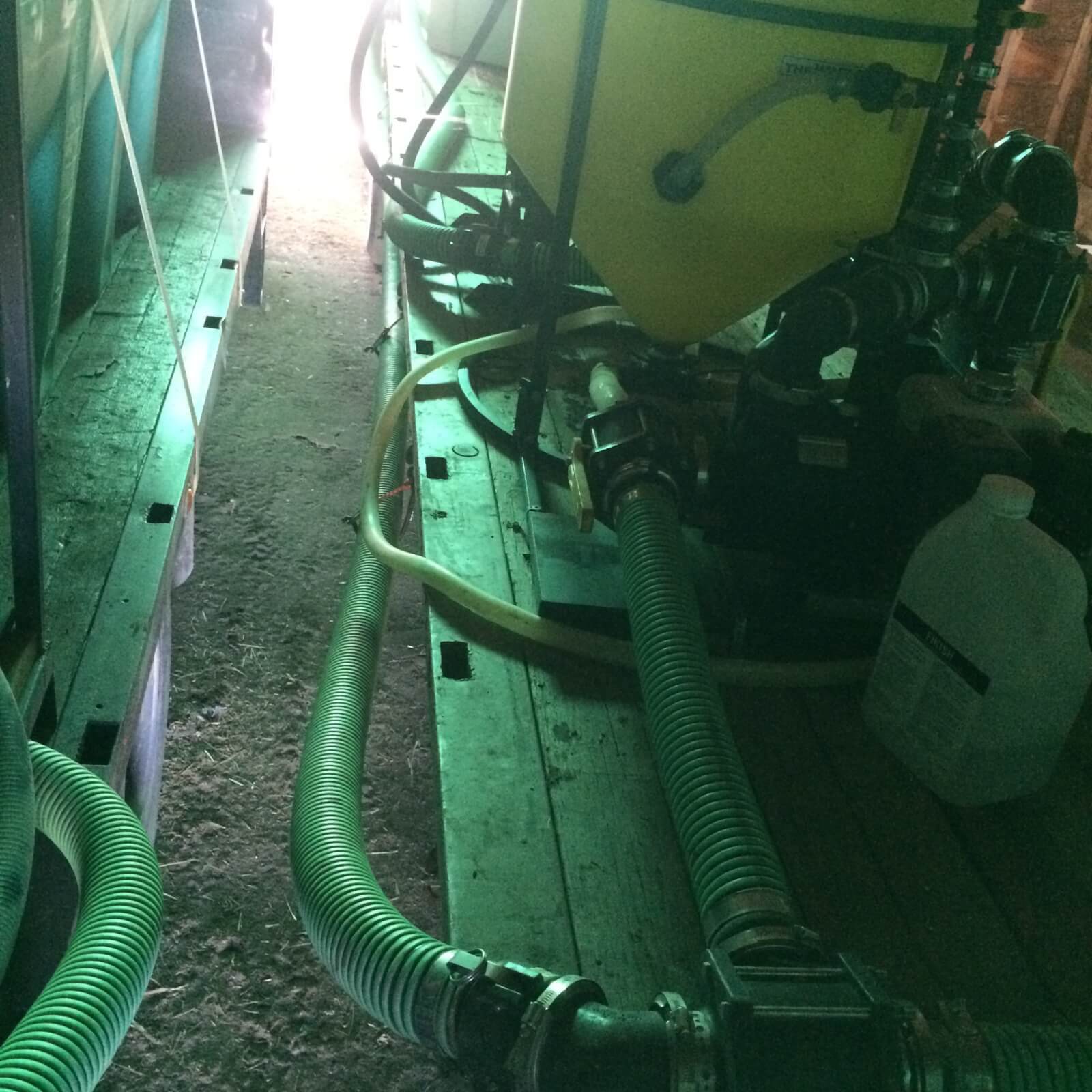
“We have a long hose for filling that has hooks and bungy straps to hold it up. We empty the hose every time because its very heavy when full. To drain the water we just open a valve on the handler to let air in the hose. We installed an air assists clean-out on the sprayer side so we can push the hose back into the chem handler if we need. The water is always murky so there must be some chemical in the hose. This is also where we fill the tanks on the truck with a three way valve on the suck side of our pump and a three way valve on the pressure side. We have free form tanks, tank 1 is 2350 gal and tank 2 is 3100 gal I think.
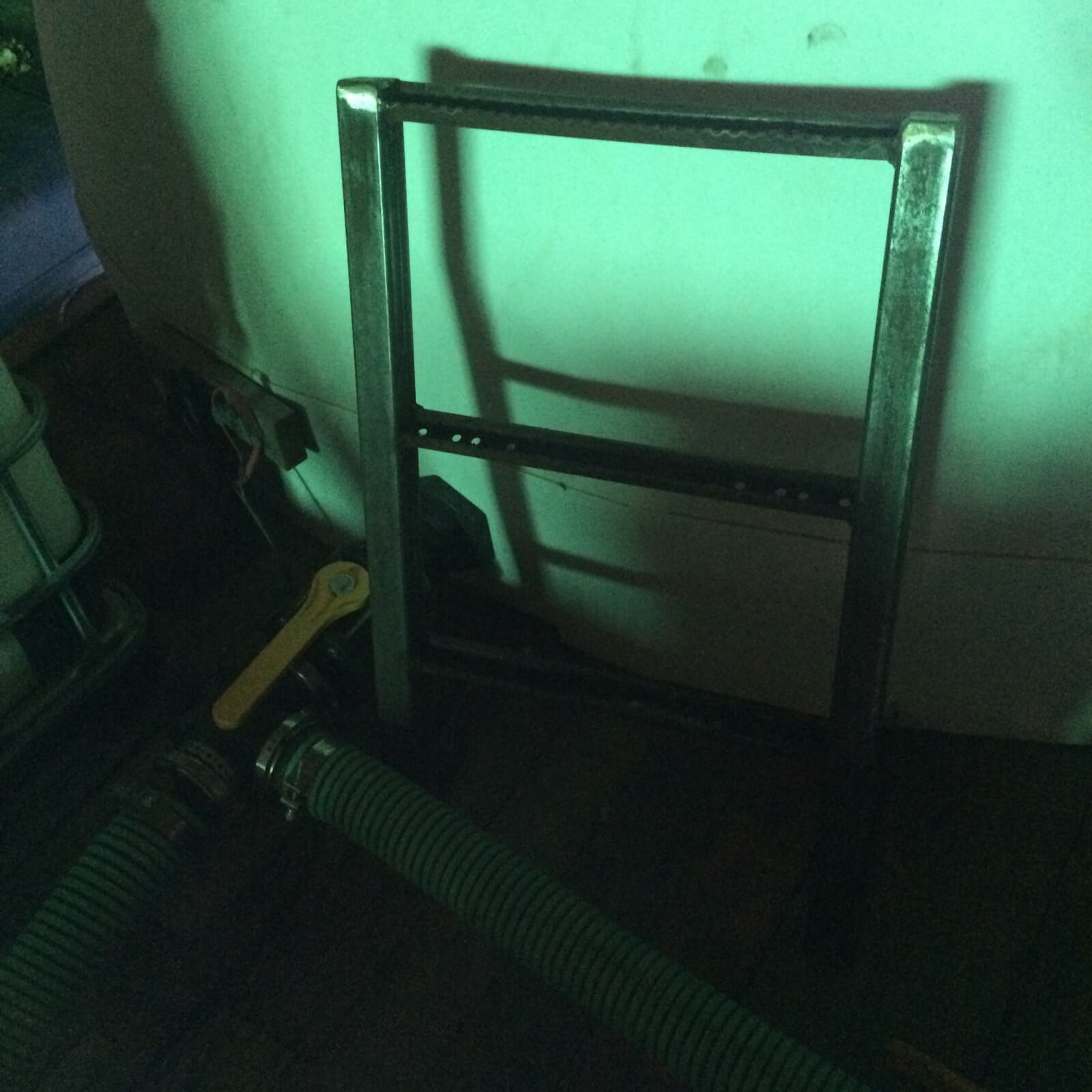
“If you have broken feeder chains lying around, the slats make excellent ladder rungs.
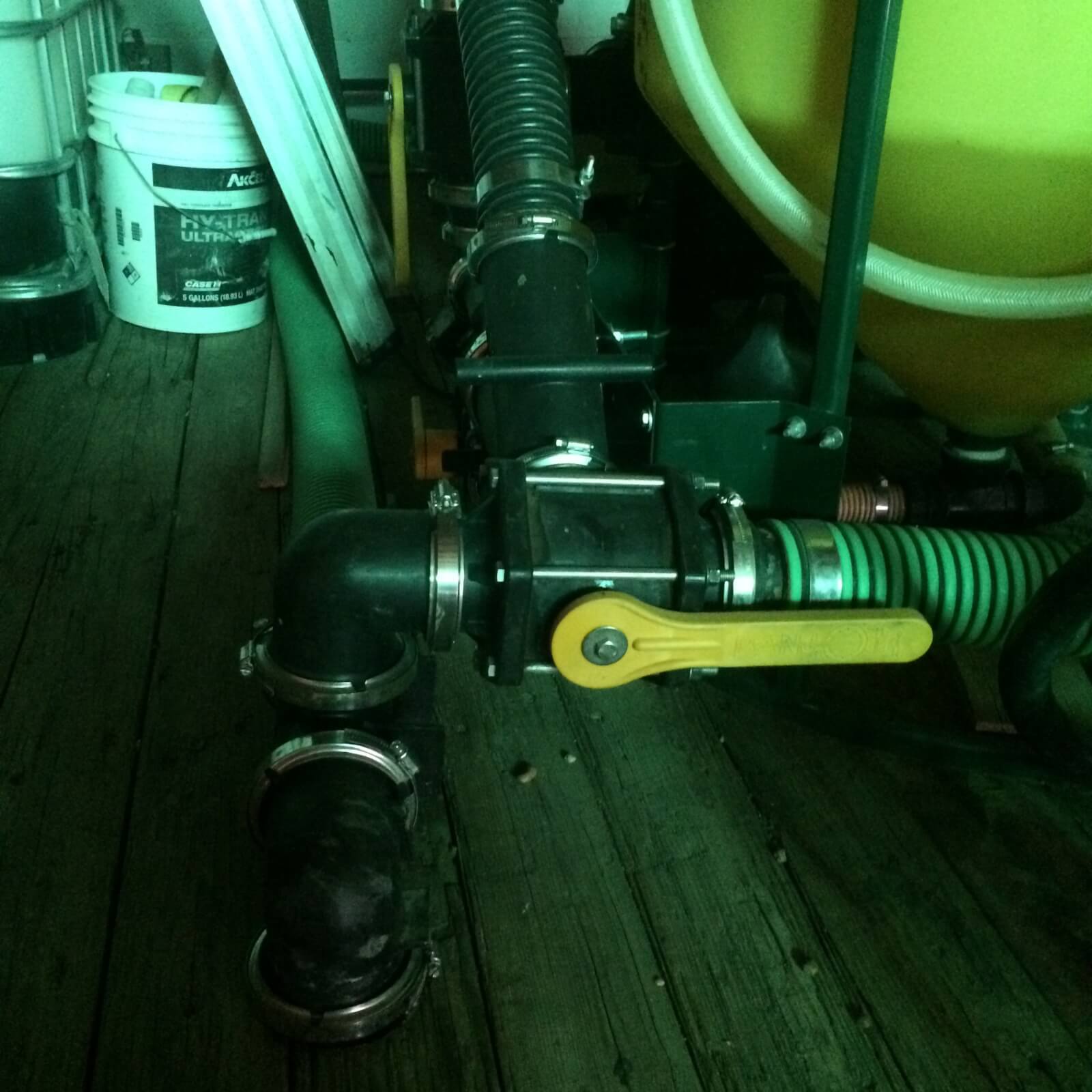
“Showing the 3 way valve on the pressure side. Its positioned to fill the sprayer in the picture.
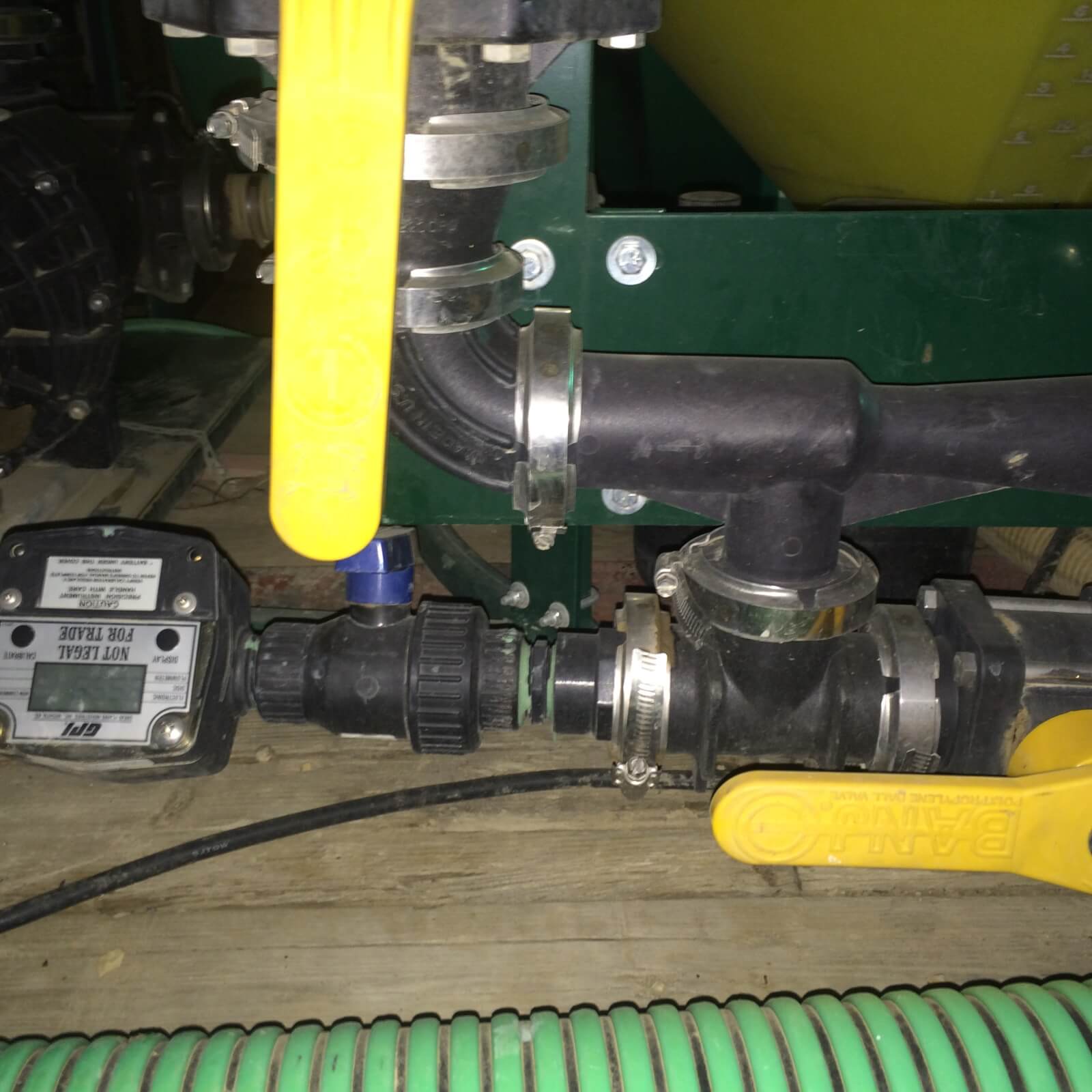
“They have since modified the chem handlers for this purpose but I teed into the venturi to use this for chem totes. I also had an old flow meter I added. I don’t trust it though.
“Our trailer is 48 ft which we bought used for about $8000. Its a bit on the long side for getting into fields. If we could slide the wheels forward it would help but this trailer we cannot. We can fill in about 20 min and our sprayer is 1135 gal. Some advice, when you buy a Rogator the tank size does not match the number on the machine. We though our rate was out but it was because the tank is 1135 gal not 1100 gal. We can spray 4 tanks out and have room for a sprayer clean. We fill the tender at home with a free form 9000 gal trailer tank that we also use for 10-34 during seeding. We fill with a garden hose but are setting up a 1 inch pump to pump out of our overflow spring water system.
“We also have a tandem flat bed truck with a 2500 gal tank. We use this for 10-34 during seeding and fall desiccation instead of our trailer. Craig and I were much happier with the setup on this unit. We also used an old chem handler we had sitting around. I teed into the Venturi as well so I could suck out of totes. We also put an air clean out that was plumbed from the truck air supply. When we load 10-34 the hose is messy and heavy. We just blow the last of it into the drill and no mess and easy storage.”
The third submission was made by Tyler Burns (@windypopfarm) of Wynyard, Saskatchewan
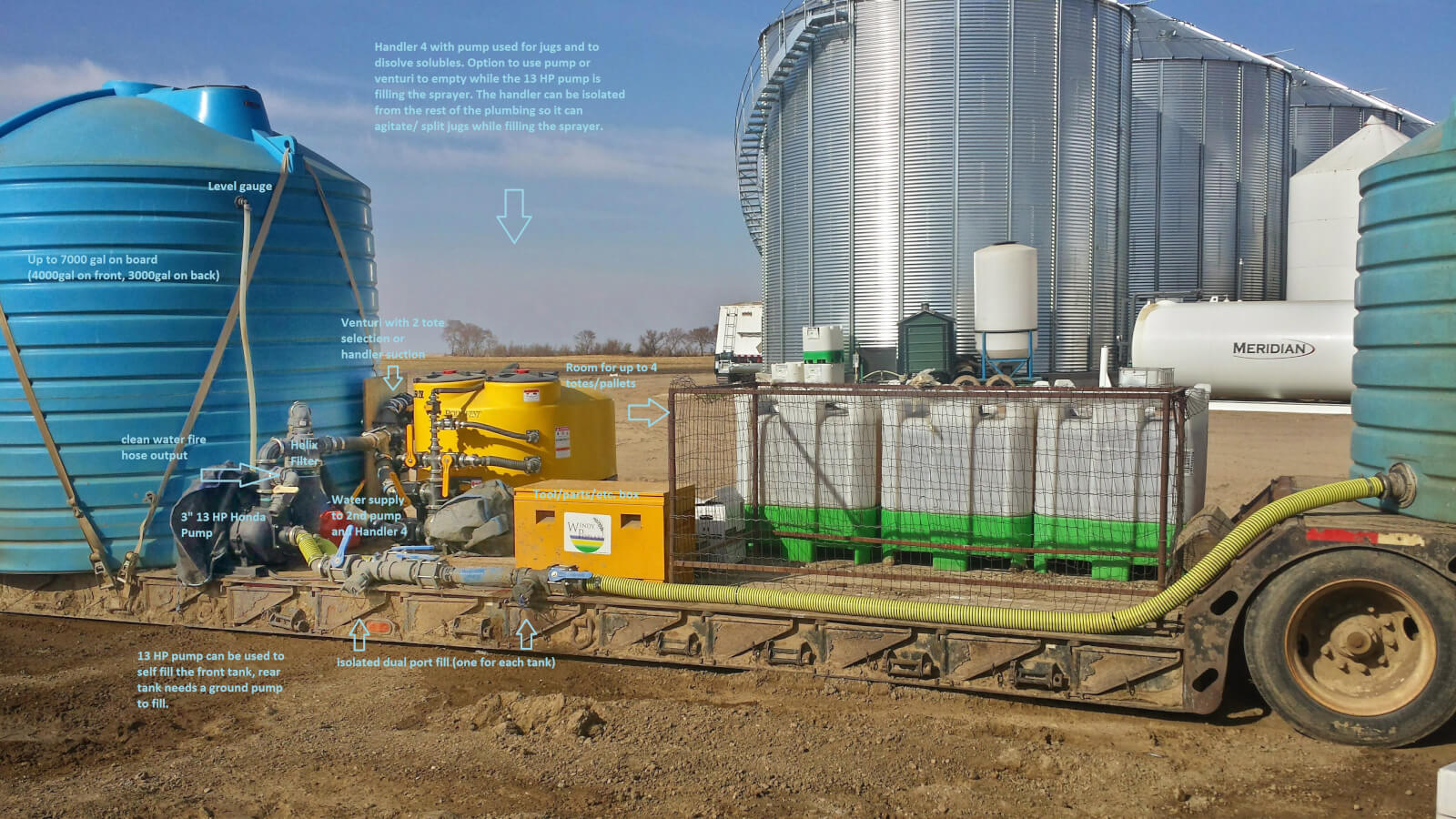
Dual 3” fill ports: ability to isolate the two tanks in order to fill each tank with it’s own port, front tank can be filled with on board 3” 13HP pump, back tank requires a ground pump to fill.
Main Pump: Banjo 333 Series Cast Iron Self-Priming Pumpwith 13 hp Honda electric start and pull rope capable of filling a 1200 gal sprayer in under 5 min if you’re only filling water and the filter is clean. Real time fill will range from 8 to 15 min dependant on what chem mix is being used. A future desired upgrade would be a 1200 gal SS tank on the empty upper front deck to pre-mix a complete tank so that every fill would be down to 5 min. This would require a knowledgeable person at the fill site though.
Auxiliary outlet: 2” clean water outlet often used for washing equipment, grain bag slip n slides or fire control.
Filter:3” Helix filter with extra filter elements if you need to swap in the field. Two outlet ports off of the filter. One going straight to the venturi assembly/sprayer fill line, the other going to the Handler 4 or tank #1.
Tank #1: The front 4000 gal tank placed just after the upper deck.
Tank #2: The back 3000 gal tank placed on the upper rear deck over the tridem axles.
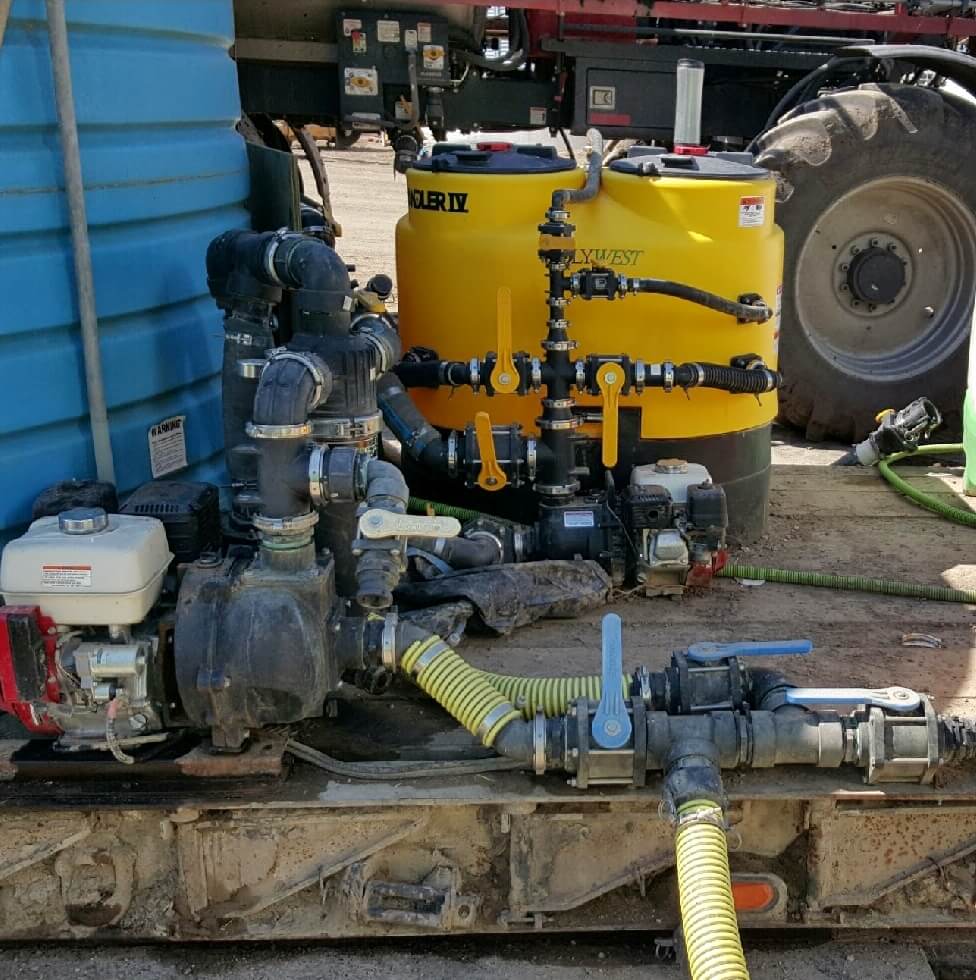
Chem Handler: A Handler IV with attached Honda pump. The secondary pump allows for the ability to agitate a chemical mix or dissolve a dry component. The pump can also quickly empty the handler in stream with the clean water while the 13 hp pump is filling if you don’t want to use the slower venturi option to suction out the product. The secondary pump does not need to be running to get pressure to the Handler rise ports as you can open the valve on the outlet side of it to get a supply of water from the primary pumps flow.
Venturi assembly: full 3” venturi and bypass. Venturi can suction either 2 different chemical barrels or totes and 2” suction of the Handler IV. The chemical induction ports are all dry poppet couplers and the lines 1” induction lines can be swapped if you change products. There’s also a clean dry poppet port to connect to easily flush any of the induction lines.
Flow Meter: There’s a 1” Banjo flow meter to measure the volume of chemical induced. One issue with this meter is that it doesn’t work with all chemicals but I switched to this make because it doesn’t restrict the flow. As nice as it is to use a venturi to transfer chemical is it does significantly increase fill times. (5 min vs 8 to 15 min.)
Level gauge: the level gauge on the front tank helped to minimize overflows and to more accurately fill the tanks to the desired level.
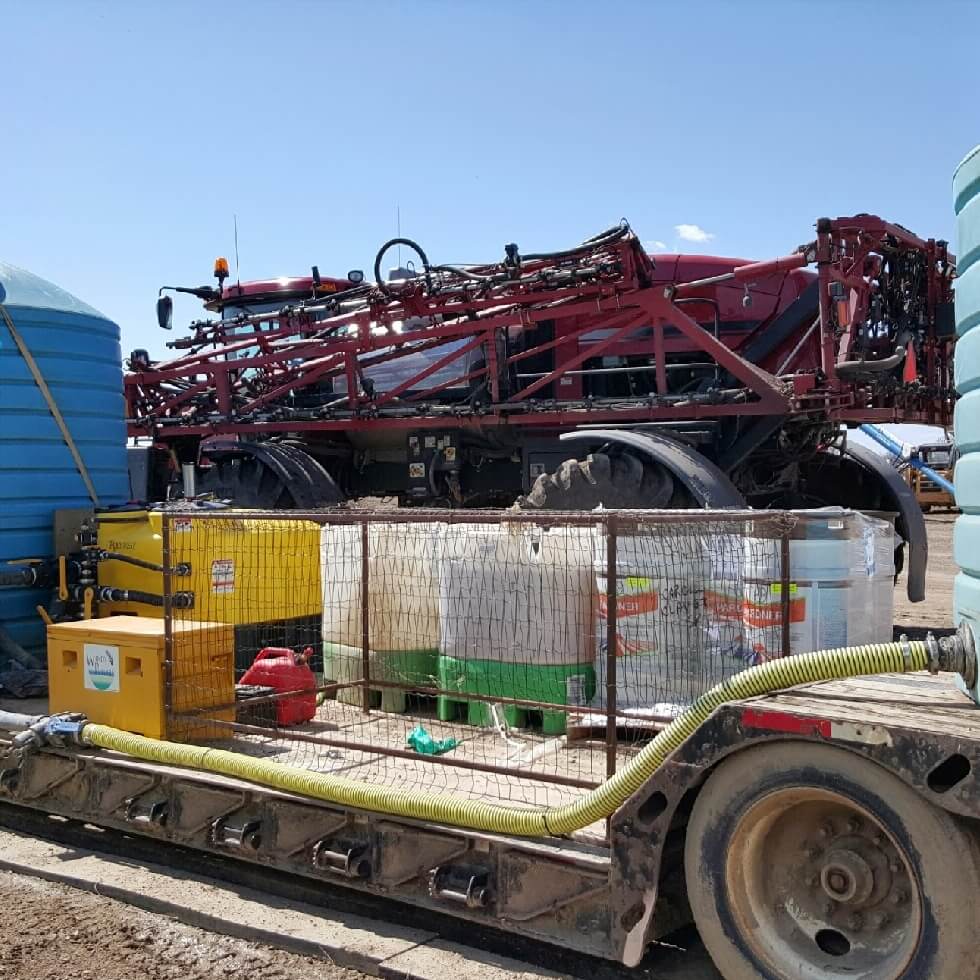
Chemical Payload: Room to fit up to 4 pallets of jugs or 4 450L totes.
Cage: Empty jug and box cage.
Our fourth submission was made by Kelly Baillargeon (@k_baillargeon) of Edam, Saskatchewan
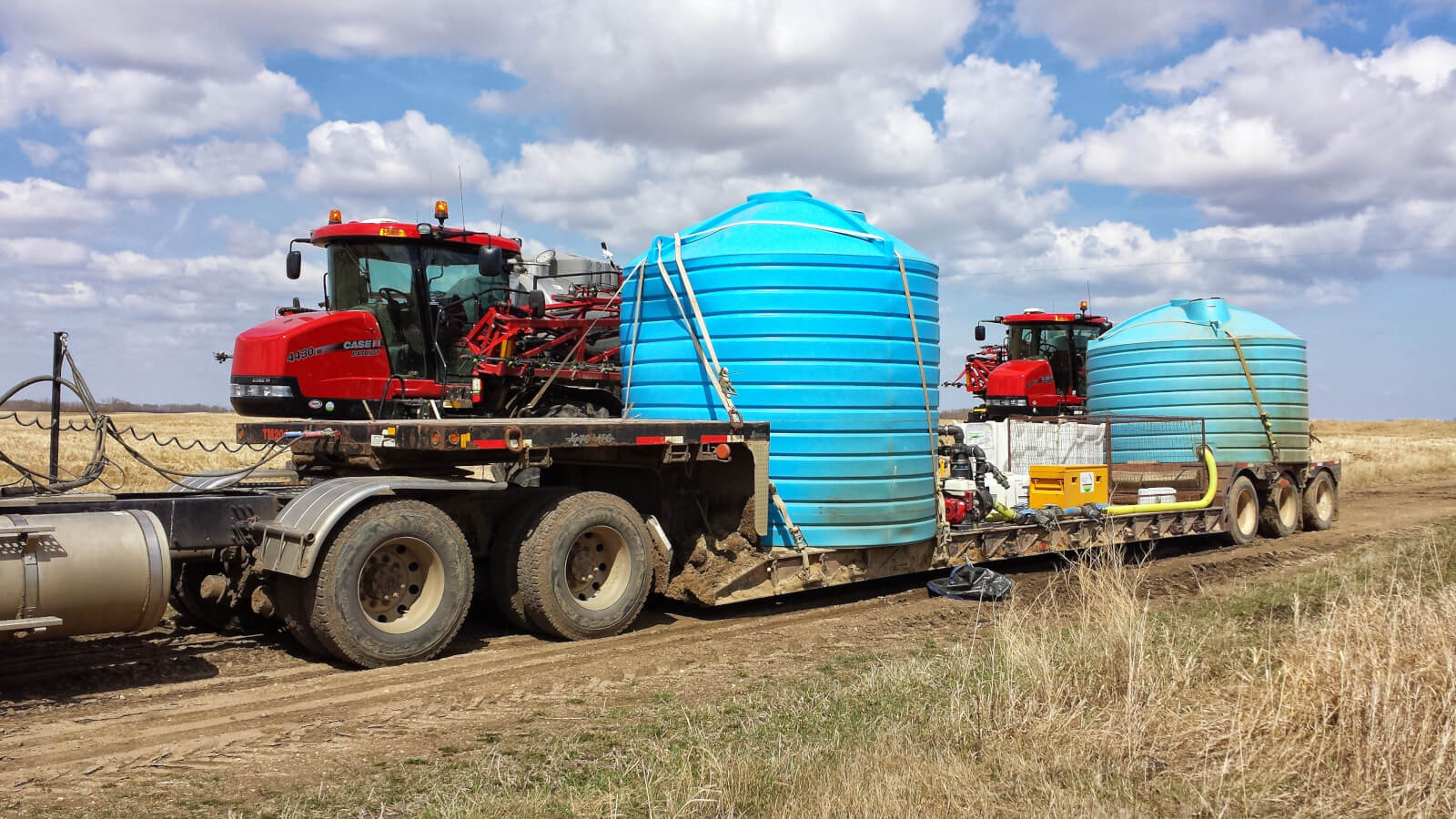
“We have set up many spray trailers the last few years, each design has had its improvements. We run two sprayers between our farm and custom spraying business. It is very important to our operation to carry the sprayers, it allows the sprayer operator to be able to head out in the morning full of chemical and fuel and spray the entire day by himself. Our trailers have a 3200 US gallon tank on them which will give us three full fills on our 1000 gallon 4830 John Deere sprayers.
“We purchased a triaxle water tanker trailer from SGI salvage two years ago (sorry no picture right now as it is tucked away in a shed) that can haul 8000 US gallons per load that keeps our spray trailers full of water and allows my brother and I to spray all day. We built a large cage underneath the tanker out of iron and expanded metal (8′ x 8′ x 2′) that allows us to throw all of our empty chemical boxes and jugs in it when the spray trailer is getting filled with water.
“We used to buy older flat deck trailers and build sprayer cradles for them. But two years ago we decided to buy two of these spray trailers from Flamans in Saskatoon.
“The trailers are built for hauling a sprayer with the cradle being able to be folded up while not in use, which makes it nice for putting into storage or if needing to use the flat deck to haul anything else. These trailers should last a very long time for us.
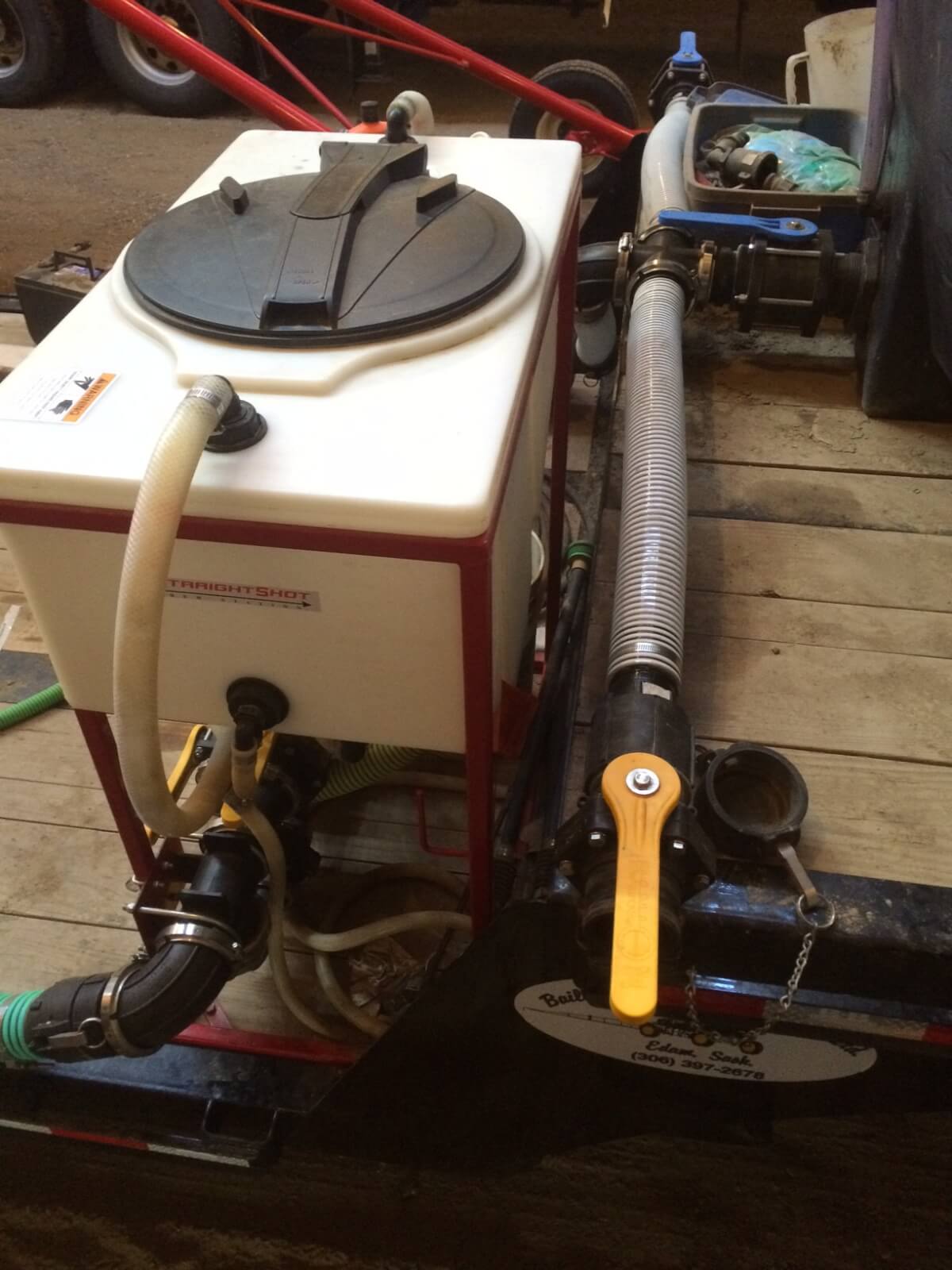
“We mounted one 3200 gallon tank on the nose of the trailer. This conserves valuable deck space, we used to use 2 smaller tanks, but this really compromised deck space on our trailer that can be used to haul lots of chemical. It is also much safer to have lots of room while mixing and filling the sprayer. We aren’t crowded or tripping over lots of hoses while working on the deck. There is a ladder stored on the side of the tank to be used if we are parked at a water source that we are able to throw a hose in the top of the tank to fill while we are out spraying.
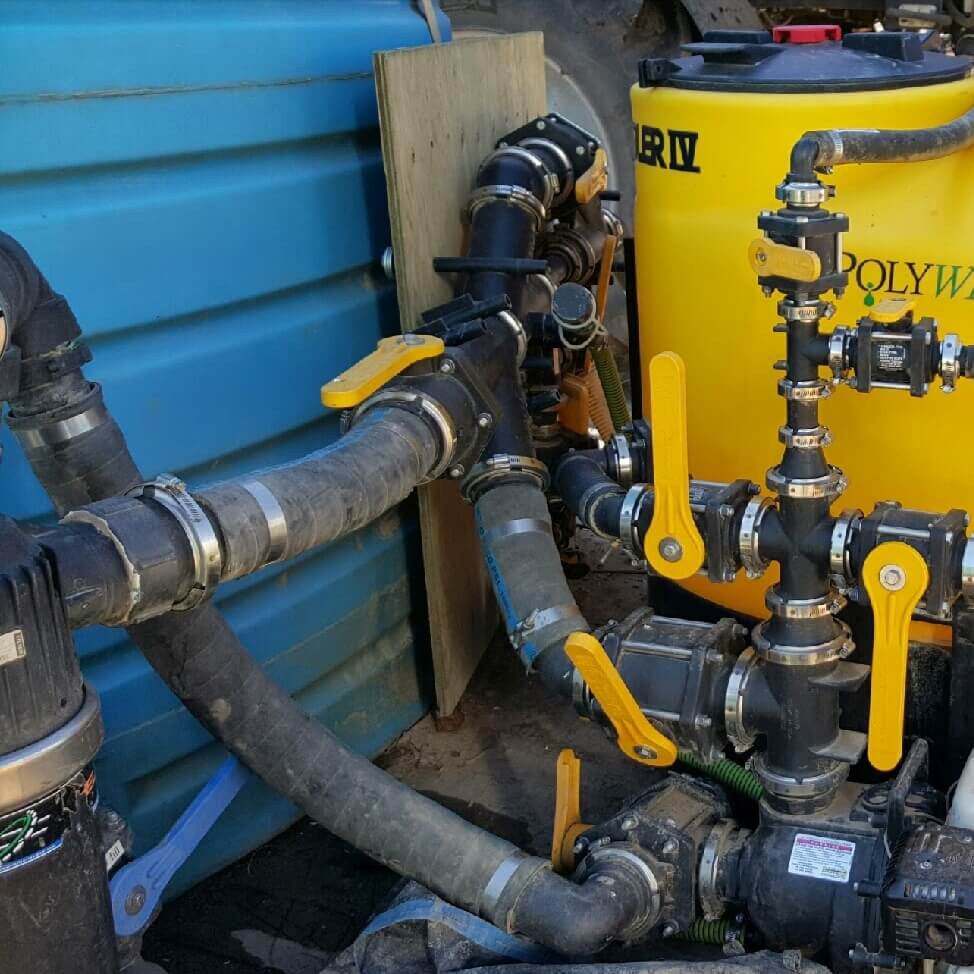
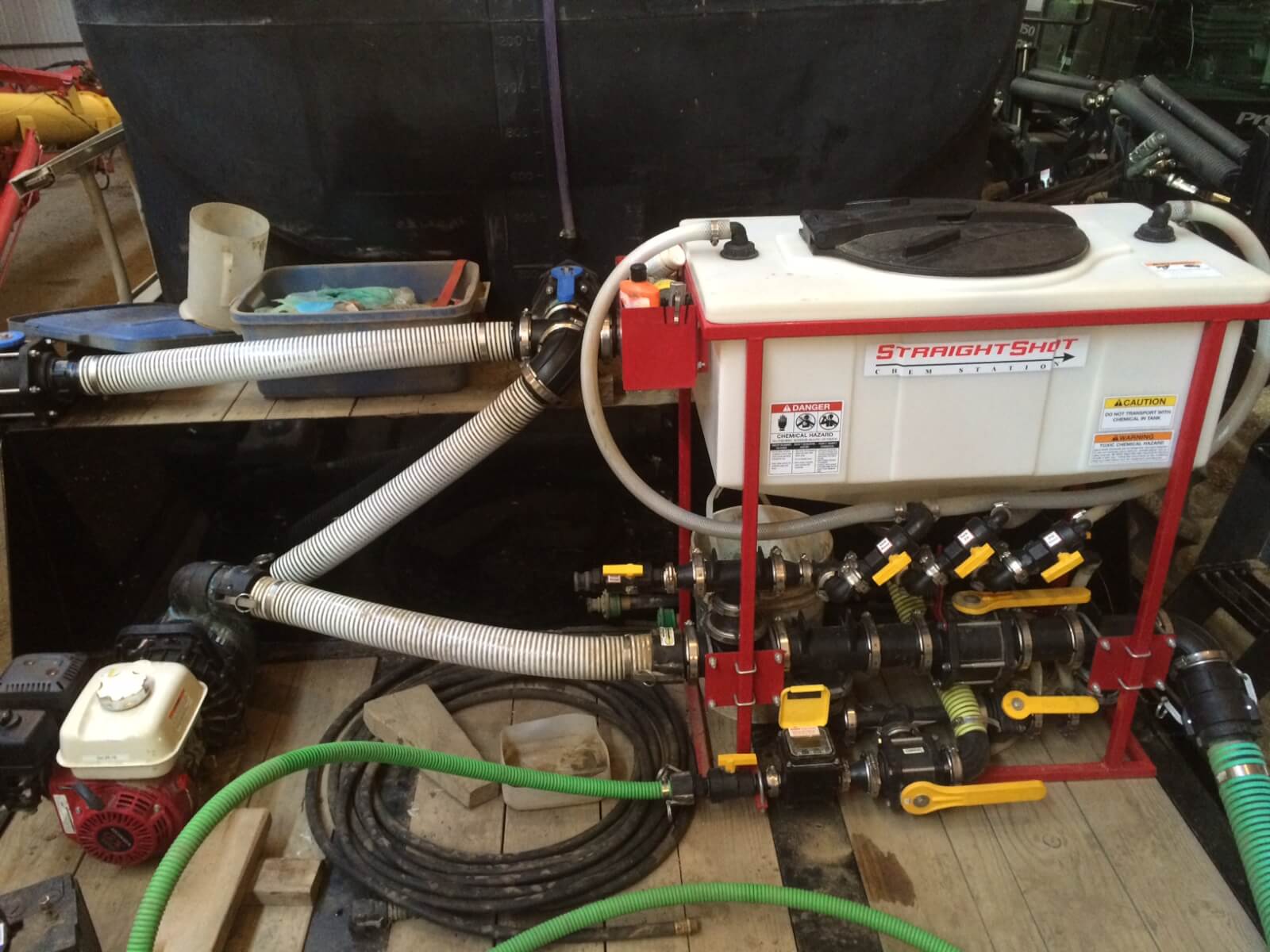
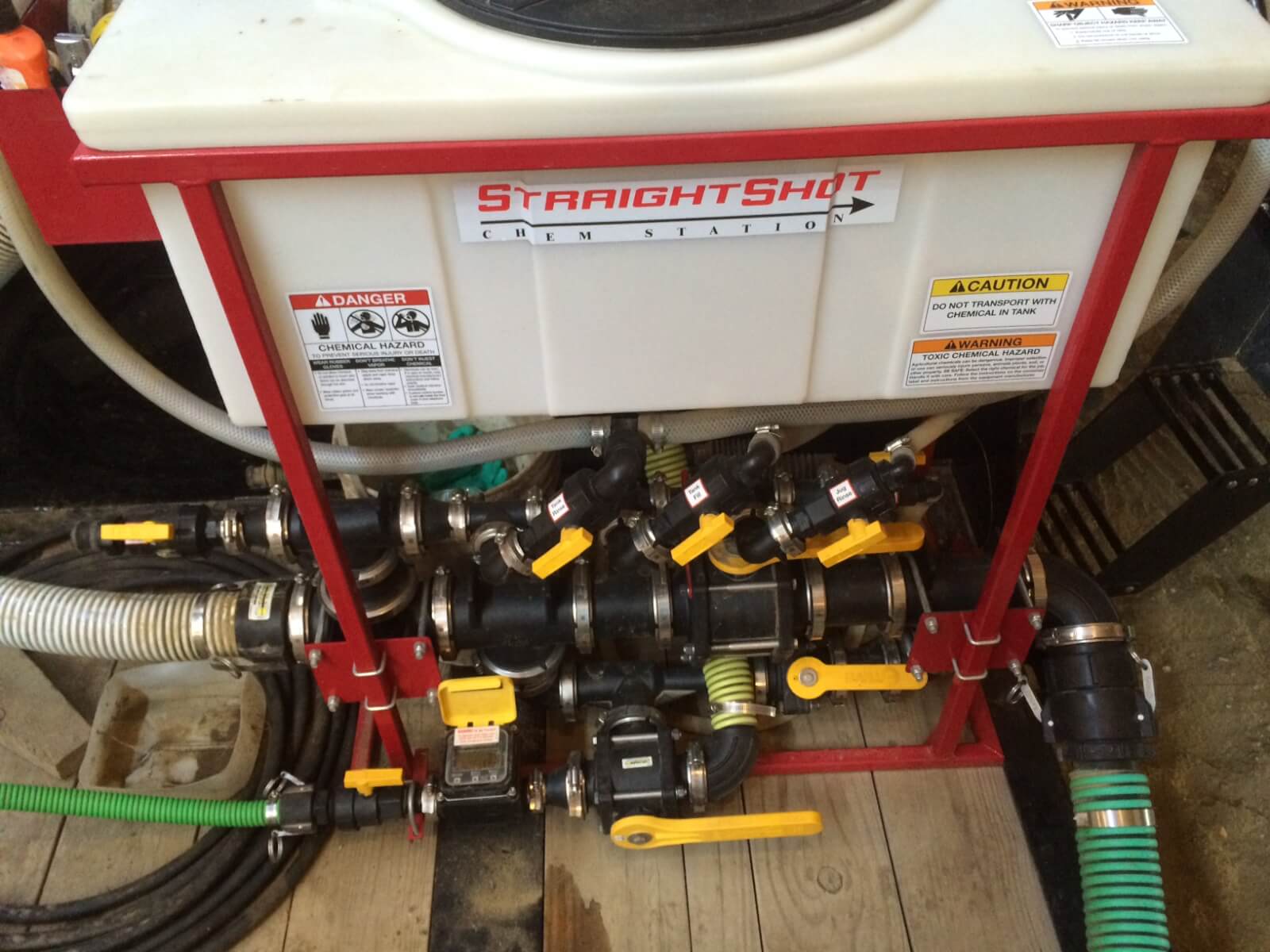
“Each time we have built a spray trailer we try to make the design more simple. In my opinion the less total plumbing I have on the trailer, the better. This makes it easier to teach someone how to use it as well as less chances of making a mistake. I installed a Straight Shot chem station this time, we always used Chemhandlers before and didn’t have any issues. But I really liked the simple straight forward design of this chem station. It is built very compact, saving on more deck space. Everything is very clearly labelled. It has 3” plumbing and when bypassing the handler to fill the sprayer with water, there are no bends or restrictions in the water stream, everything goes straight through. I find that it fills quicker than our Chemhandler did because of this simple plumbing.
“We use a 3″ Honda pump. I replaced the Soterra flowmeter that came with the handler (I had lots of issues with them in a very short amount of time) with a 1” Banjo meter. This meter has no restrictions inside of it, but will not meter products that are not electrically conductive. I have a backup spinning wheel style meter that I attach to the hose when using these types of products. The venturi on this Straightshot chemstation sucks extremely fast. I am able to suck glyphosate out of totes at 78 litres/minute while filling sprayer with water at the same time. Liberty is much slower, about 45 litres/minute. Seat to seat fill times on my 1000 gallon sprayer is 5-8 minutes depending how many products are being used.
“A rubbermaid tub with measuring jug, fittings, gloves and other safety equipment is located right beside work station. The large tank also includes a sight tube on it to prevent overflowing when filling.
“I used “sweep” 90 degree fittings everywhere the direction of water flow changes, these fittings are “wide open” and do not restrict flow. Another lesson I have learned is to use the flange style fittings everywhere possible, threaded fittings work ok, but a few years down the road when you have leaks showing up, you need to take apart most of your plumbing in order to repair them. Flange fittings don’t leak as much, most repairs involve tightening up the clamp and if you do need to take it apart, you won’t have to take apart any other fittings to change the seal.
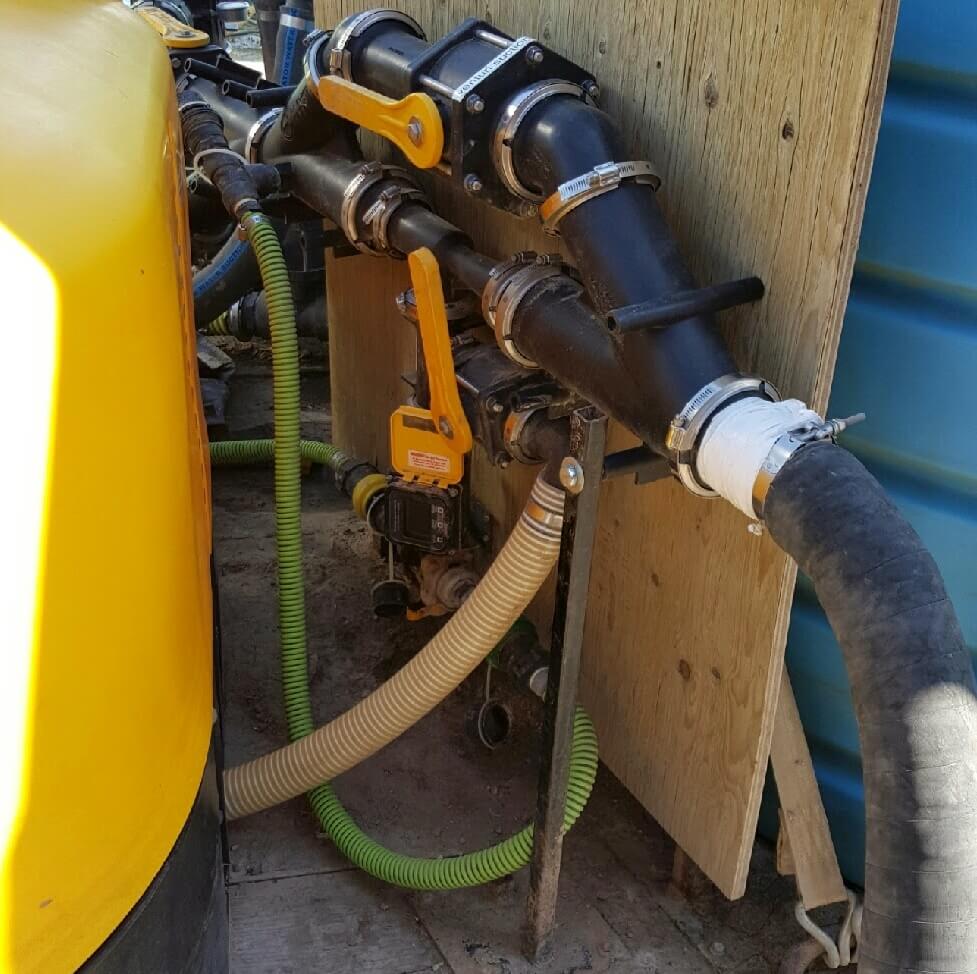
“A close up of the chemstation:
“There is a connection on the left side that is used to flush out the chem induction hose. The tank on the chem station rinses really well as it has two spinning rinse nozzles inside the top of the tank. There is also a fresh water hose on it to help with rinsing tank or washing your hands.
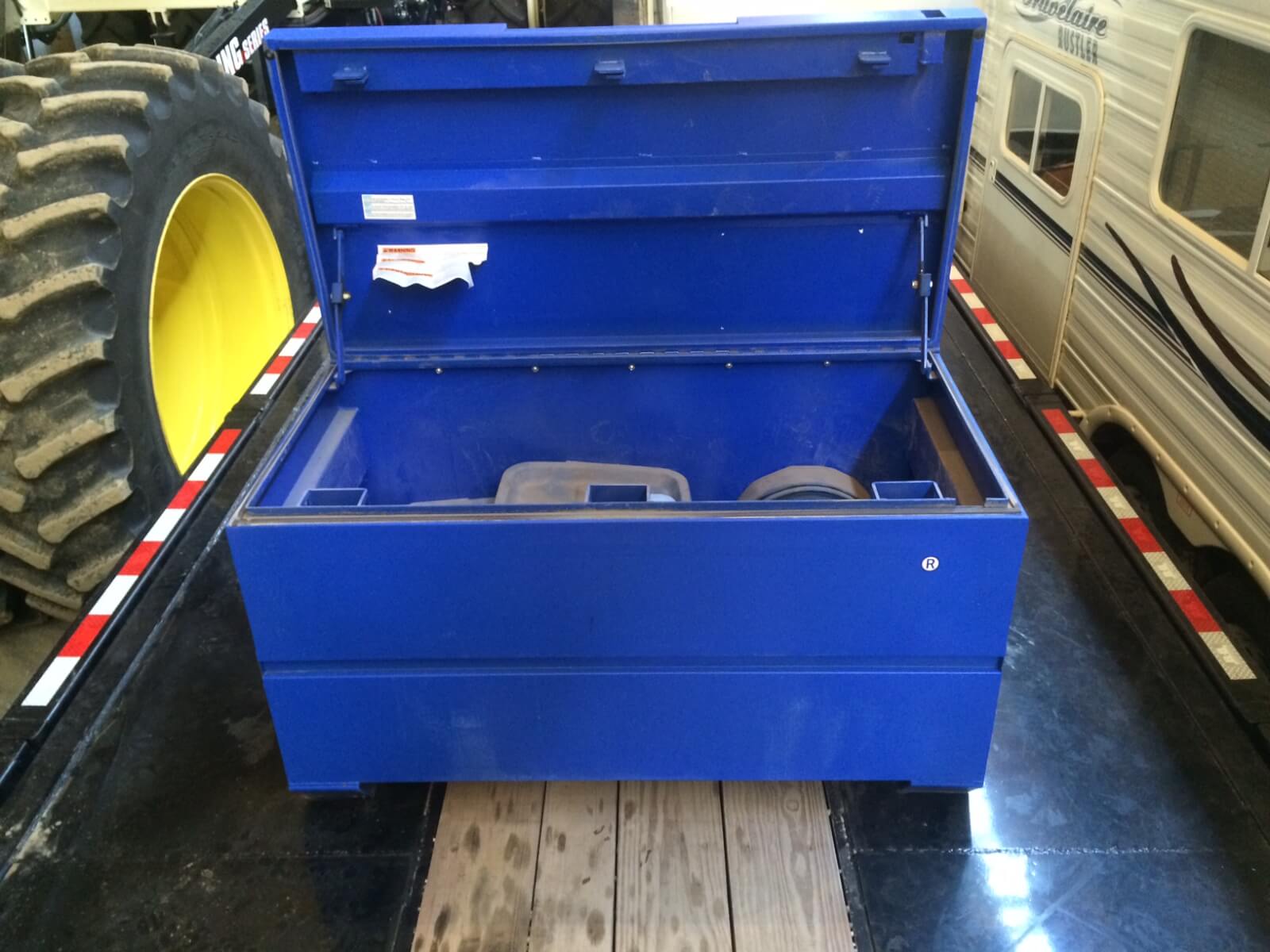
“Located at the back of the trailer, underneath the sprayer, is a large toolbox. I keep extra parts, safety equipment, small jugs of chemical, a firehose for fighting fires and ratchet straps for tying down chemical on the sprayer deck.
“The water tank is able to be filled from either side of the trailer from the ground by the nurse truck, depending how we are parked at the field.
“Long 3” flexible hose for attaching to sprayer:
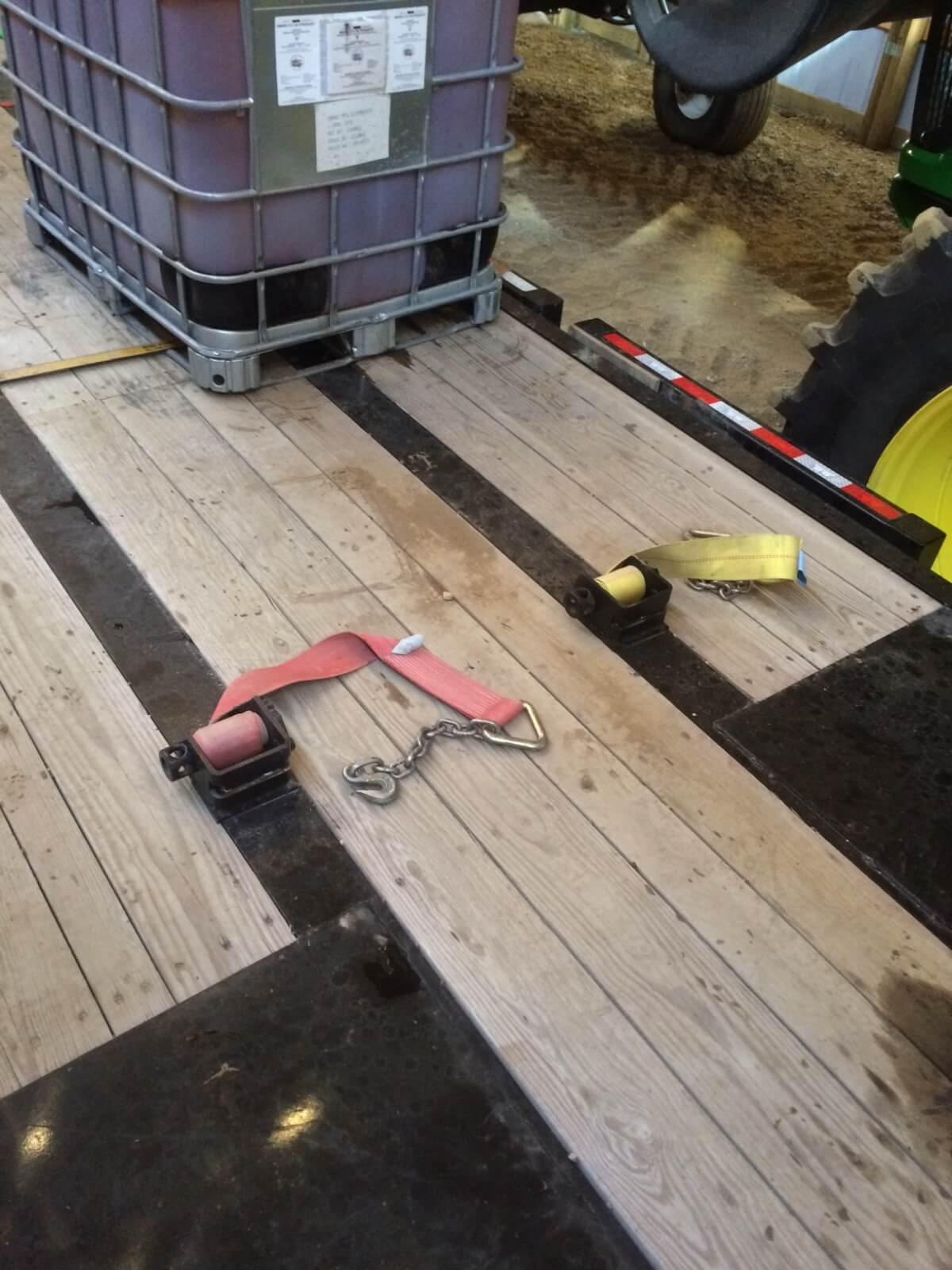
“I bolted 4 large ratchets (2 at the front and 2 at the back) to the trailer deck for tying the sprayer down when in transport. I find straps are much quicker and easier to handle than using chains to tie down the sprayer. I didn’t want to weld the ratchets to the deck because then I would not be able to remove them if we needed to use the trailer for something else.
“When I have the sprayer loaded on the trailer, I have lots of available deck space to carry chemical. I have had as many as 4 1000 L shuttles on the trailer at one time with plenty of room to walk around and work safely.