We’ve recently been talking about how to save time while cleaning a sprayer. Although it’s very important to be thorough while cleaning, and to take the necessary time to do the job properly, there is always an opportunity to fine tune and spend less time. This is especially true when diluting the tank remainder down and pushing clean water to the booms. A method promoted in Europe, and coming to us via Joachim Herfort of Agrotop, is called “Continuous Rinsing”.
Continuous Rinsing requires a dedicated pump that delivers the clean water (which may contain a cleaning adjuvant) to the tank via wash-down nozzles. It works like this:
The operator, having carefully measured the pesticide mixture, has only a small remainder in the tank when spraying is complete.
This remainder is sprayed out in the field, either on a set-aside area, or over the already sprayed field at a reduced rate, product permitting (the operator would pay attention to crop tolerance and carryover issues)
As soon as the tank is empty, indicated by the boom spray pressure dropping, the operator switches on the clean water pump which delivers the clean water via the wash-down nozzles.
Soon, the main product pump starts delivering the wash-down liquid to the boom and the return lines.
Because the clean water pump will deliver less than the boom flow, the cleaning mixture is delivered somewhat intermittently. We are told that this helps with the cleaning action of the lines. Be cautious that the main pump does not run dry long enough to damage its seals.
Once the clean water tank is empty, the pressure drops again for the final time and the tank rinsate is now very dilute.
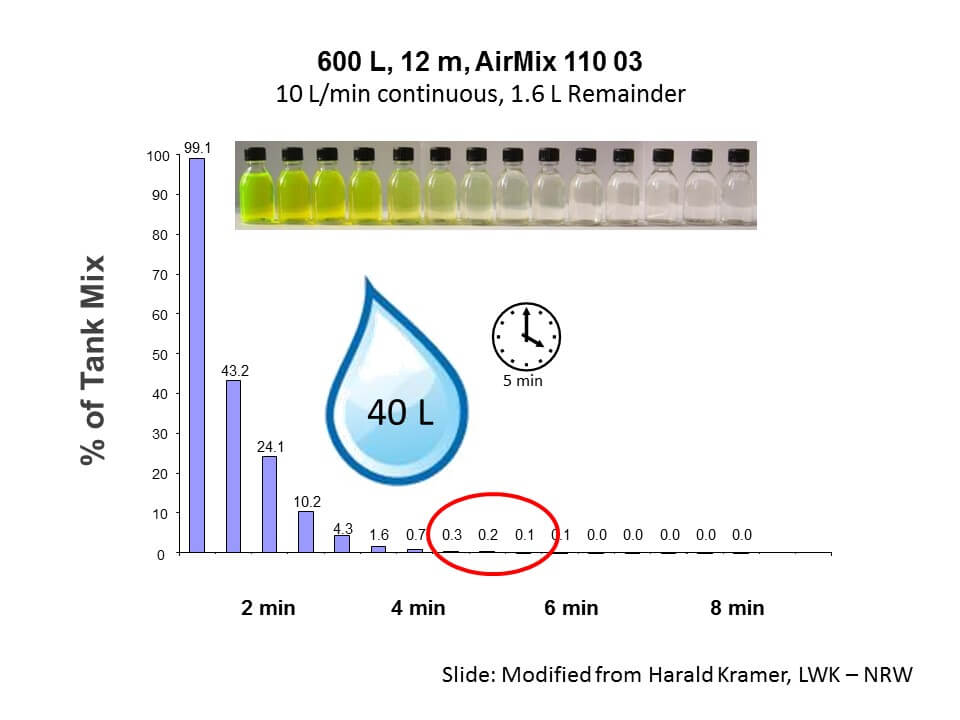
Testing in Europe has shown that the whole process takes only about half as long as batch mode. One key time-saving feature is that the sprayer never has to stop, and the operator never dismounts. These data also show that a significantly lower water volume is required to achieve a greater dilution of the remainder than a batch mode would have achieved.
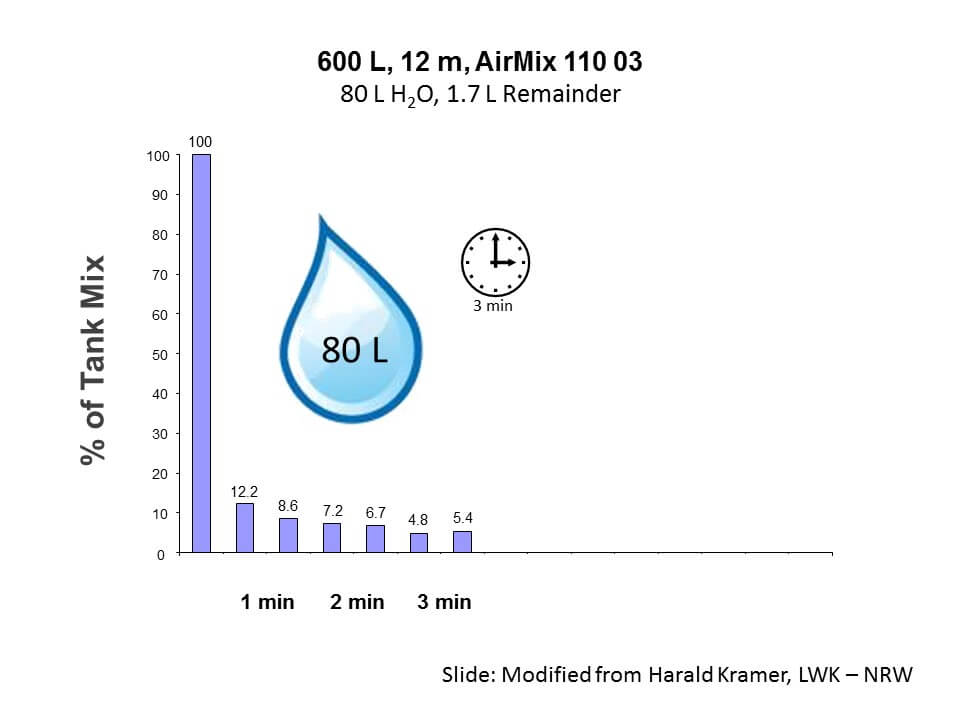
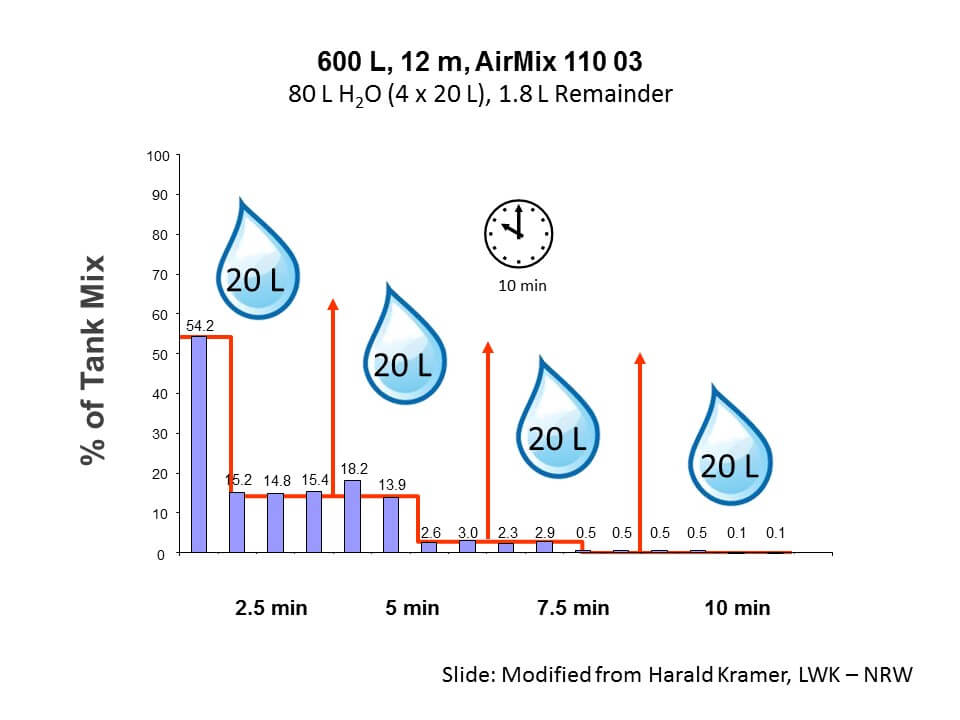
For example, the European tests (we believe these were done by the Landwirtschaftskammer of Nordrhein-Westfalen, a German regional government) used a single rinse of 80 L, as well as four batch rinses of 20 L each. As expected, the four-batch process was superior to the single rinse, but took a lot of time. They then tested a continuous rinse with 40 L. The continuous rinse resulted in greater dilution than the 4 x 20 L rinse, in less time. In this case, the quality went up, and the time went down.
Our challenge in North America is to roughly match the clean water pump, wash-down nozzles, and main sprayer pump capacities so the system works. Our larger sprayers easily deliver 30 gpm, and some adjustments may be necessary.
Dilution of the tank remainder is only one aspect of sprayer cleaning. The other aspect, decontamination of surfaces and components, is also important and the process depends on the active ingredients and formulations in the tank.
An animation developed in Germany and shared via Agrotop is availablehere.
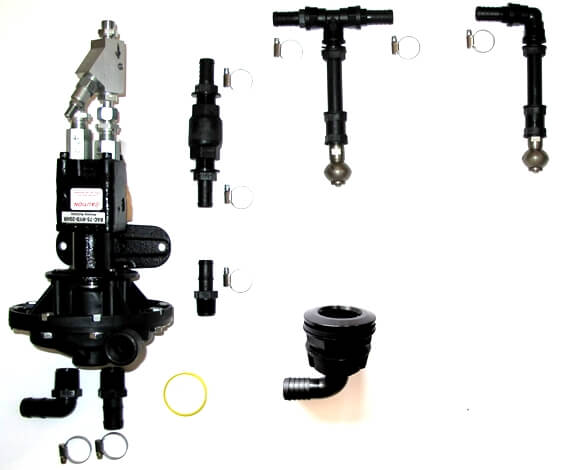
Note that Agrotop has suggested components to convert a sprayer to a continuous rinse system here.
The first question during the spray season is likely, “what kills this weed spectrum? The second might just be, “How do I clean our my sprayer properly without risking crop injury next go-round?”
Tom Wolf, spray application specialist and @Nozzle_Guy, answers not just that question, but also a few more —
“Can you neutralize chemical?”
“Is there a tried and true mixing order?”
“What does ammonia actually do in the cleanout process?”
From the importance of being thorough, to top tips on minimizing issues with specific Group 2 problems, to a handy method for getting a much more effective tank rinse, Wolf will walk you through his top 7 tips for effective sprayer cleanout.
If you have a limited amount of clean water to rinse your sprayer, this can help you decide how to make the best use of it. Simple enter two values – the amount of pesticide remaining in your tank sump (including the suction line to the pump and the return line to the tank), and the amount of clean water you want to add. The units (gal, L) are not important as long as they are the same for both entries.
The app allows you to calculate the dilution power of up to 5 sequential rinses.
Farming can be divided into pleasant and unpleasant tasks. Seeding is pleasant. Hauling oats or barley not so much. Sprayer cleaning is…not. And yet it’s the unpleasant tasks that are often the most important. How can we make them better?
We all know the need for a properly cleaned sprayer. Herbicide residue can harm a sprayed crop, and the damage might not show up for over a week. When it does, it usually takes a while to identify the symptoms and damage patterns to be sure. And then we wait for the inevitable yield loss.
It wasn’t long after the introduction of the Group 2 Mode of Action that producers started noticing how even small residues of these products in sprayer tanks could damage crop yields, most noticeably canola, but also other broadleaf species.
Thirty years later, the problems persist. Let’s look at ways of preventing them.
Cleaning a sprayer is a lot like doing the dishes. Using the right detergent, soaking the hard stuff, being thorough, and rinsing properly – they all matter.
It all starts, though, with preventing the problem.
The main culprits that cause sprayer contamination have the following properties:
They are typically dry formulations,
they typically have poor water-solubility, and
they are potent in low doses.
Many products in herbicide Group 2 MOA fit that bill. The ones that rise to the top of the list have an additional characteristic:
As a subgroup within the Group 2 MOA, the sulfonyl ureas are a top concern, with products like Refine, Express, and Ally on the most-wanted list. Another problem subgroup is the triazolopyrimidines, containing products like Frontline and Simplicity, which, like the SUs, have very pH-dependent solubilities (better solubility at higher pH). Other Group 2s have fewer issues. Everest and Varro have good overall water solubility, for example. The solubility of imidazolinones like Odyssey, Pursuit, Raptor increases with low pH. We tend to see fewer problems with these products.
Instances that add to the problem involve tank mixing with weak acid herbicides, including glyphosate, but especially those that are formulated as emulsifiable concentrates (oils, EC), appearing milky when mixed with water. Most of our herbicides are weak acids.
Two problems occur with these:
The weak-acid herbicide lowers the pH of the spray mix, possibly reducing the solubility of the problematic Group 2s.
Then, oily formulation can adhere the herbicide to plastic and rubber sprayer parts such as tanks, connectors, and hoses.
The best advice on preventing a cleanout problem, is, therefore, to make sure the product is fully dissolved or suspended. Proper mixing technique and time are the key components. Some products, like Simplicity, can benefit from a pH increase (adding ammonia) prior to mixing the product.
Once properly mixed, we can still have problems at the screens. Dry formulations require a screen mesh of 50 or coarser according to their labels. But many sprayers contain 80 mesh screens, some even have 100 mesh. All screens should be inspected both before, during, and after spraying these products. Screen residues cause longer-term contamination, and their cleaning is an important part of this whole process.
After spraying, the cleaning process relies on three main things:
We need to remove as much of the problem mixture as possible.
We need to dilute the remainder as much as possible and use it to clean the boom plumbing.
Ensure anything that came in contact with spray mix has been cleaned.
Removing the mixture
The best way to remove the remainder is to spray it out in the field you’ve just treated. You can overspray some products again, or if you have any land set aside it can be used for this purpose. It’s never a good idea to drain the tank on any land. Obviously, some experience and math is helpful to make sure the last tank empties nicely on the field.
Diluting the remainder
The next step is to dilute the remainder, using tank cleaning adjuvants like ammonia (this raises the pH and helps remove those products whose solubility benefits from this) and detergent (this removes the oily layer formed by EC formulations). Commercial cleaners like All Clear or Cleanout combine these properties in one jug.
Diluting is most effective when done in multiple smaller batches, as long as we can ensure the tank walls are reached. Wash-down nozzles installed in the tank can do this for us.
Let’s assume the sprayer has a 150 gallon clean water reservoir. It’s tempting to empty the whole thing into the tank. We can calculate the diluting power of this: if we had a 10 gallon remainder in the tank and added 150 gallons water, the remainder would be diluted by a factor of 16. After spraying this out, we’d then have to re-fill the rinse tank if we wanted to do more.
If we rinsed in two 75 gallon batches (add 75 gallons, agitate via wash-down nozzle, spray out, repeat), we would dilute by a factor of 72. If we did three rinses of 50 gallons each, our final dilution factor would be 216. That’s the same dilution as adding about 2150 gallons to the first 10 gal spray tank remainder, and is about 14 times better than dumping the whole 150 gallons in at the beginning!
An improvement in diluting power can be achieved by adding a separate clean water pump. Introducing clean water to the tank as rinsate is sprayed out the boom reduces water use even further.
Cleaning all spray mix contact points
The last step is to pay attention to the things you can’t see: Screens, boom lines and boom ends. The total interior surface area of black rubber boom hoses on a 100 ft sprayer with 7 sections can be as much as several square metres, and this surface can bind residues. Seven sections, each with boom ends, can hold several gallons, as well as accumulated debris. Scrubbing screens, soaking boom lines, and flushing boom ends is the necessary detail that this job requires.
A few final pointers:
Adding a surfactant or a commercial cleaner can generate a lot of foam. Have de-foamer handy, it will save a lot of frustration.
A bucket helps collect and clean screens and nozzles.
Consider upgrading to more steel components on your next sprayer – tanks and booms. Stainless steel cleans faster than plastic.
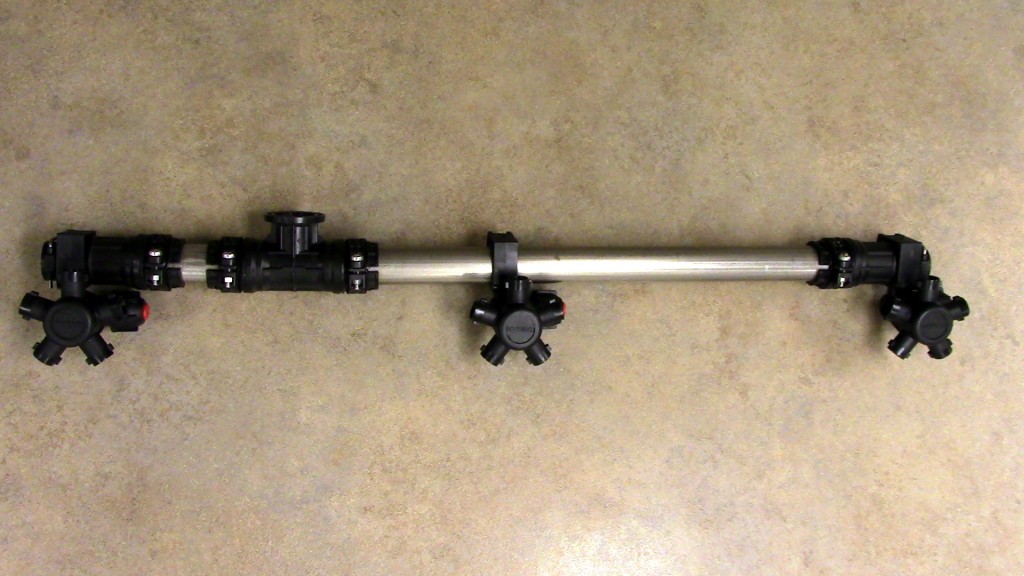
Install a way to flush your boom ends. Traditional ball valves do the job, but Hypro’s Express Nozzle Body End Caps do it automatically. These inexpensive units eliminate the dead space in boom ends and as a bonus, bleed air from the lines on the go.
Hypro’s Express Nozzle Body End Caps on a short length of stainless boom.
Done well, sprayer cleaning doesn’t have to be unpleasant. And it certainly results in a better night’s sleep.