
Should you really get up before the birds to spray? There are a lot of good reasons for early morning and night spraying, but if you’re in a strong inversion, you might be in a world of hurt. Here’s episode 5 in our series of short, educational and irreverent videos made with Real Agriculture.
Tag: drift
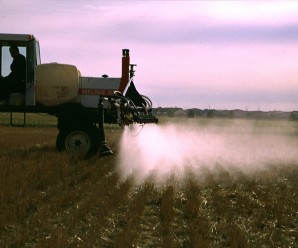
Drift in the Wind – Parody
Sung to the tune of “Dust in the Wind” by Kansas
I close my eyes, only for a moment, and the spray is gone
All my drops pass before my eyes, oh no – a drift complaint
Drift in the wind
All it is is drift in the wind
Same old spray, just a tank of product in an endless field
2,4-D tumbles in the air though we refuse to see
Drift in the wind
All we do is drift in the wind
Oh, ho, ho
Now, don’t hang on, drops don’t last forever, they evaporate
They slip away, and all your money too, in drifter court
Drift in the wind
All we cause is drift in the wind
All we do is drift in the wind
Drift in the wind
Everything is drift in the wind
Everything is drift in the wind
The wind

OMAFA Spray Drift Videos
CropLife Canada and the Ontario Ministry of Agriculture, Food and Rural Affairs partnered in 2012 to develop two educational videos on pesticide application best management practices in an effort to educate, and hopefully to reduce the incidents of spray drift.
The first video, ‘What is Spray Drift?’, highlights the various causes of spray drift. The second video, ‘Equipment and Methods to Reduce Spray Drift’, focuses on how applicators can modify equipment to reduce spray drift. We have them in English and en Français.
Watch drift happening during night spraying under high powered lights, see air induction nozzles prevent drift on a boom sprayer and learn about how spray particles behave from unique computer-animated segments. Also, enjoy the “rock-and-roll” soundtrack. You can’t image how difficult it was to get permission to use rock music in a gov’t-produced video!

Is it OK to Spray in the Early Morning? – Tips with Tom #2
It’s early morning on a bright, clear day. The sun is just starting to climb. There’s a heavy dew on the crop. Should you still head out to spray? Well, the dew is one thing, but there’s a much larger factor at play here that should factor in your decision. Whether or not you should spray with a heavy dew on the plant is this week’s Question of the Day, and then it’s time to head into the meat of this — inversions.
The concept of an atmospheric inversion isn’t the most simple thing to wrap your head around, but in this episode of Spray Tips, Tom Wolf explains it, draws it and describes how to manage for it. What more could you ask for? Well, for one, you could start asking the weather forecasters to include more information in the morning run-down to help you identify an inversion… but that’s a discussion for another day.

Debunking Sprayer Myths
Reproduced from an article written by Angela Lovell for Grainews, 2014
“The fundamental challenge of spraying is that it’s a compromise game,” said Tom Wolf of Agrimetrix Research and Training. “As operators and advisors we need to always balance the opposite needs of coverage, efficacy and drift.”
Wolf, in a presentation at the recent Manitoba Agronomists Conference in Winnipeg, sees a trend towards more fungicide use on farms across western Canada and technology that purports to make application more efficient. These trends include wider booms, faster speed capability, complex monitors, auto boom heights and bigger tanks.
As much as technology is a great thing, it’s still the operator that is the single most important part of any spray operation, so it’s important to make sure that he or she isn’t going out to the field with any conventional beliefs that simply aren’t correct.
The challenge with spraying is to control pests without harming you neighbour’s crops or the environment and over the years Tom Wolf has developed some pretty good ideas about how to do that and has had to dispel more than one popular myth about spraying.
Myth # 1: More pressure forces the spray into the canopy.
“There’s an element of truth to this but it’s forcing spray downward is the least thing that pressure does,” says Wolf. Spray pressure is primarily used to change spray flow rate. If you increase the pressure you will need to travel faster to allow the carrier volume to stay constant, and faster travel speed actually works against canopy penetration. Another important change is that spray quality will become finer with higher pressure. Finally, droplet velocity will initially increase, but even at higher pressure, small droplets still move slowly by the time they reach the canopy. “If you want to force a fine spray into the canopy, the best way to do that is to lower your boom, slow down, and increase the carrier volume,” says Wolf.
Myth # 2: Higher water volumes lead to run off.
There are two things that govern run off; droplet size and surface morphology of the leaf surface. “Anyone who says that anything more than 3 gallons/acre runs off the leaf surface is not telling you the whole picture,” says Wolf. “We’ve been unable to induce runoff from up to 200 US gpa in our tests, even using hard-to-wet grasses like green foxtail. Don’t be afraid of water. It’s a very good way of covering the canopies. Water gives you flexibility to use coarser sprays and that allows you to spray when it’s windier.”
Myth # 3: Spray drift is no issue for fungicides and insecticides
Aquatic organisms are extremely sensitive to most fungicides and insecticides. We might not see this effect, but it has a definite impact on our environment. It’s important to observe the buffer zones shown on product labels, which can vary depending on the product, the application method and the specific environment.
Myth # 4: Faster travel speeds save time and boost productivity
Wolf suggests evaluating this on a field by field basis. At faster speeds you lose control of the spray cloud and the finest droplets will go wherever the wind goes. Other problems with higher speeds are canopy penetration, pattern uniformity and pressure management. If you have an 800 gallon tank with an 80 ft boom and you are going 12 mph at 10 gallons/ac and your fill rate is 50 gallons per minute you are going to do about 84 acres/hour not including turns. If you go faster – 18 mph – you can do 110 acres/hour. But if you increase your fill speed, thereby decreasing the time spent filling you can increase productivity just as much. If you also increase your boom width you also increase productivity. “All I am asking is you don’t just look at travel speed to improve your productivity,” says Wolf.
Myth # 5: Double nozzles produce more droplets and improve coverage
“It’s the droplet size and water volume that drives the droplet numbers produced. It doesn’t matter how many nozzles produce this size,” says Wolf. Although some double nozzles produce finer droplets and therefore improve coverage, others actually produce coarse sprays which may decrease coverage. Pay attention to droplet size first – nozzle manufacturers publish spray qualities from their products. You can increase coverage from a single nozzle simply by increasing the spray pressure so yo produce a finer spray.
Myth # 6: Calm early mornings have the lowest drift risk
This is one of the biggest myths out there, says Wolf, and it’s all because of a condition called an inversion, which usually occur during clear nights, and which linger into the early morning hours. Under normal sunny daytime conditions, air currents rise, fall and disperse spray clouds rapidly but under inversion conditions they don’t. This can lead to severe drift issues, even significant distances away from the treated field.
Under sunny daytime conditions, air temperature cools with height and that allows for thermal turbulence to disperse the spray cloud. On clear nights, the temperature increases with height (the opposite temperature profile, therefore called an “inversion”), and this prevents air from mixing. As a result, the spray cloud will not disperse.
Assume that the atmosphere is inverted on clear summer nights, extending into a few hours after sunrise. Producers should never spray when an inversion is present, and a good indication might be if fog or smoke hangs in the air and not dispersing.
Myth # 7: A rate controller calibrates the sprayer
“Even with a $400,000 sprayer, the rate controller still relies on a single flow meter that sits at the back of the sprayer and measures the total flow to the boom. The operator has no idea where that total flow is going,” says Wolf. As a result, there is still no substitute for individual nozzle calibration. There are various new tools on the market to assist with that but they still need to be done individually.
Myth # 8: If I mess up agronomic decisions, I can correct that with a good spray application
A spray application has to be on time to be truly effective, says Wolf. In efficacy studies where yeield was measured, spraying herbicides “on time” (=early) produced a yield advantage over spraying just one week later, even with a spray quality that was so coarse that it resulted in relatively poor weed control. “If it’s breezy, use a low drift nozzle. This allows you the opportunity to spray on time,” he adds.
Myth # 9: Ammonia is a good general purpose tank cleaner
Ammonia raises pH and some chemicals like sulfonylurea products dissolve better at a higher pH. But if you have an oily emulsifiable concentrate (EC) formulation, either as a product or adjuvant, a soapy cleanout product will be needed. “Liberty exposes poor tank cleanout because the adjuvant in Liberty is such an excellent cleaner,” says Wolf. After use of an oily product, the use of a wetting agent such as AgSurf will assist in removing oily residue and many soap-based commercial cleaners are available.
Myth # 10: There is an optimal nozzle that does it all
“Right now a sprayer costs approximately 100,000 times more than the nozzle and the nozzle is still the part that makes you happy or sad,” says Wolf. “If we inverted the investment trend and said ‘let’s build a better atomizer’ there would be an optimal nozzle right now. But although we’ve made progress with low-drift nozzles recently, the industry still looks for inexpensive, simple ways to atmozie sprays.”
Spray quality is the language that is used when selecting nozzles. All manufacturers publish spray quality charts for their nozzles that also give recommended pressures to produce different spray qualities using a particular nozzle type. Spray qualities are colour coded and generally speaking the hotter (redder) the colour code the more drift-prone (finer) the spray. There are many nozzle choices and designs and typically grassy targets and contact products require nozzles that will produce Medium to Coarse spray quality. For broadleaf targets and systemic products a Coarse to Very Coarse spray quality can be used successfully. Selecting the right nozzle to produce the quality of spray required is important, says Wolf who recommends Coarse as a general purpose spray quality.