Category: Calibration

Horizontal boom sprayer calibration

  • The Pressure Gauge Shows More Than Pressure

    The Pressure Gauge Shows More Than Pressure

    Kim Blagborne (formally with Slimline Manufacturing) has long said that the pressure gauge on an airblast sprayer indicates more than just pressure. It can be used to diagnose a number of pump and plumbing issues… if you know what to look for. Here’s Kim’s troubleshooting guide to reading into what your gauge is REALLY telling you:

    Scenario One

    “As the tank empties, the pressure drops”

    First, try adjusting the pressure regulator (assuming a positive displacement pump). If you can maintain the pressure up until the tank empties, your intake line may be loose and it’s sucking the bottom of the tank. Check the fitting between the suction filter and the pump. Apply a light coating of grease to the O-rings on the elbows and filter to ensure a complete seal.

    Second, try stopping mid-tank (that is, turn off the tractor PTO and let the sprayer sit for a few minutes). Does the pressure gauge return to the original set pressure? If so, then the intake line inside sprayer has likely come loose entirely. Open the lid, and using a straightened-out coat hanger, hook the intake line and give a few gentle tugs – it should not be able to move. If it does, you’ll have to re-fasten the intake line so it’s not sucking the bottom of the tank.
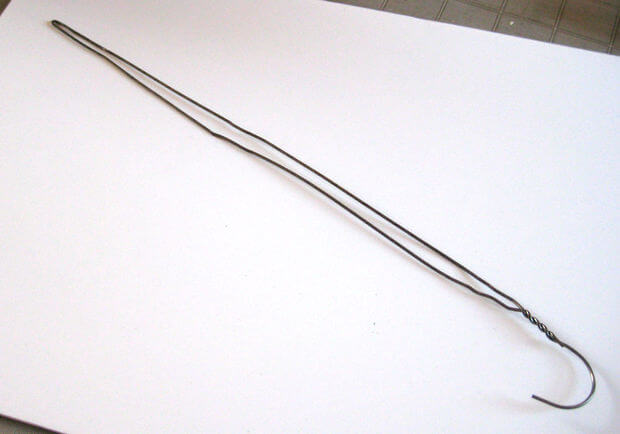
    The humble coat hanger. It opens our cars and now fixes our sprayers. Remarkable!
    The humble coat hanger. It opens our cars and now fixes our sprayers. Remarkable!

    Scenario Two

    “When I first start the sprayer, the pressure drops or fails to maintain constant pressure as the tank empties”

    This might indicate improper mixing practices because the filter is probably plugging with product. Alternately, your PTO speed may be too slow to drive sufficient mechanical agitation. Check the suction filter as soon as the problem occurs (don’t finish spraying). If you wait to check when the tank is empty, the evidence of a plugged filter could be washed away before you can confirm it. This problem often happens when spraying nutrients, or when products aren’t compatible.

    If that’s not it, it could be a collapsed suction valve. The pump will sound like it’s “missing” (like an misfiring engine). The suction valve might need to be replaced.

    Or, perhaps you notice that you can compensate for the pressure drop by adjusting the regulator on the first tank. But it has to be dropped back down again for the second tank. In this case, the regulator might be sticking or jamming. Disassemble it and look for grit in the barrel of the regulator, then lubricate the parts.

    Scenario Three

    “I lose pressure when I turn my boom(s) on or off”

    In this scenario, the pressure is fine as you approach the end of the row. You turn off the outside boom (or both) and finish the turn. But, when you re-engage both booms, the pressure drops. Even when you adjust the pressure regulator to compensate (assuming a positive displacement pump), the unit only gains the lost pressure slowly. In this case, the regulator might be sticking or jamming. Disassemble it and look for grit in the barrel of the regulator, then lubricate the parts.

    Scenario Four

    “The pressure gauge spikes when I turn off the boom(s)”

    If you run a Turbomist, it could be the bypass balance. To solve this issue, head over to this article and pan down to see the step-by-step. If it isn’t the balance, then it’s likely the regulator. The issue of a spiking gauge and how to correct for it is covered thoroughly in this article by Ag mechanic extraordinaire Murray Thiessen.

    Scenario Five (a positive displacement pump issue)

    “My gauge pulses”

    Is it more than a 20 psi range? Have you noticed that the deviation gets less as the PTO speed increases? Well, the pump pressure check-valve may have collapsed. Check the pressure check valves in the pump for broken springs on the suction valve plate.

    Does the needle move rapidly through a 5 to 10 psi range? The accumulator pressure might be low. Try adjusting system pressure via the regulator and if that changes how the needle is responding, then set an air compressor to 90 psi (or manufacturer’s recommended pressure) and charge the accumulator.

    Perhaps the needle movement is not affected by system pressure changes or the PTO speed. In this case the accumulator may have failed entirely and the diaphragm will need replacement.

    Scenario Six

    “My calibration is going farther than expected”

    Sure, that sounds pretty good at first, but it may be that the gauge is stuck. With the PTO off and the spray boom on, the gauge must read “ZERO”. If it doesn’t, pony up the $50.00 and get a new one.

  • Lessons Learned from the Top 5 Field Sprayer Articles of 2015

    Lessons Learned from the Top 5 Field Sprayer Articles of 2015

    When Jason and I launched the Sprayers101 website in June, I wasn’t sure what to expect. Seven short months and 150 posts later, we’re stoked to have had such a great response.  About 70,000 page views.  17,000 users.  Of the over 100 countries that have visited, Canada, the US, Russia, Australia, and the UK are the top 5.  Jason provided some great background to the venture in his recap of the top horticulture posts.  I owe him a debt of gratitude for leading this effort.

    It was a pleasant surprise that a very specific subject matter such as agricultural spraying could generate this level of response.  Without a single mention of the Kardashians!

    Here are the top five posts on field spraying for 2015:

    1. Agrifac Condor: A Wake-up Call for North American Sprayer Manufacturers? 3078 views. Prior to writing this article, I’d been watching this relatively new (to me) Dutch company for about one year.  I noticed that they thought big, and featured technologies that had benefits for applicators, like air-assist or twin-fluid nozzles, wide booms, and clever plumbing. On seeing the sprayer first-hand at Canada’s Outdoor Farm Show in Woodstock, I knew it was just what the industry needed.  A wake up call.
    2. Exploding Sprayer Myths Episode IV: Speed Spraying. 2211 views.  What is life without a bit of fun?  Writing and filming these episodes had us in stitches.  With generous support of Shaun Haney and the gang at RealAgriculture.com, we’re producing these in our spare time and with gifted resources.  A big thanks to Bern Tobin for being the videographer, director, and rough cut editor, and Jason Stroeve for the final editing, special effects, voice-overs and all those other things that go into it.  We hope to do more of these, resources permitting.
    1. A New Way to Purchase Sprayers. 1058 views. A friend recently reminded me that I used to urge producers to spend more money on sprayers. Well, the industry responded by making sprayers more expensive (you’re welcome), without actually improving our control over deposition uniformity, coverage, or drift.  So yes, people are spending more, but not the way I intended.  In the meantime, the innovations that matter, those on the spray boom – width, aerodynamics, recirculation, better sectional controls, droplet size and rate management – are still considered special options that are probably too expensive.  We’re still looking for the right balance here.
    1. Sprayer Tank Cleanout. 968 views. Cleaning a sprayer remains one of the top concerns of an applicator, actually the whole industry, and we’ve written about it several times.  But it wasn’t until we had a guest contributor, Katelyn Duncan, offer her views that we had any real success.  Katelyn is a Regina area farmer with her own blog and an interest in machinery.  She approached the issue from a practitioner’s perspective and this really resonated and generated a lot of discussion.
    1. Calculators and Tables. While no single table or calculator broke into our top 5, collectively they did and this is worth mentioning.  Much of spraying is mathematical, from rate calculations, to calibrations and nozzle size selection, travel speed ranges and so forth.  Despite living in an age of connectivity and touch screens, a laminated table in the sprayer cab is often worth its weight in gold.

    So what are the lessons?

    For one, we showed that a dedicated website for just one aspect of a farming operation seems to be in demand.  That should encourage those specializing in seeding or harvesting techniques, commodities, fertility.  Where are those sites?

    People seem to want alternative, independent views, sometimes voiced as controversial opinions. Much of our media is controlled by corporate interests with soft-sell implications.  Yes, it’s interesting and valuable information.  But a reality check, whether it comes from an independent researcher or a new entry from the corporate world, is still needed.

    Alternative formats for information are important.  Not everyone learns by reading articles or deciphering charts. By offering a bit of entertainment, we can reach new clients or demographics that we’d otherwise leave behind.  Plus, for Jason and I, the opportunity to be creative is probably the single most important thing about Sprayers101 that keeps us going.

    Lastly, we are so pleased to have guest contributors on our site.  Anyone can contribute – just drop us a note.  I think it’s important to hear different viewpoints, and learn from each other.  That’s one of the great things about agriculture – the willingness to share information.  Any applicators out there who want to describe an aspect of their operation, from innovations in how they fill faster, to their experience with boom lights or cameras, to their thoughts on boom height controllers or PWM, we’d love to hear from you.

    Thanks everyone for supporting Sprayers101.com!

  • Exploding Sprayer Myths (ep.1): Rate Controllers

    Exploding Sprayer Myths (ep.1): Rate Controllers

    This is the first of a series of short, educational and irreverent videos made with Real Agriculture to bring a little levity to sprayer education. Let’s face it – ironically, nozzles can be pretty dry.

    This first video discusses what a rate controller can be expected to do, and what it cannot do. Plus, we got to blow up a sprayer in the intro… so there’s that.

  • Capstan Calibration Chart (with Pressure Drop)

    Capstan Calibration Chart (with Pressure Drop)

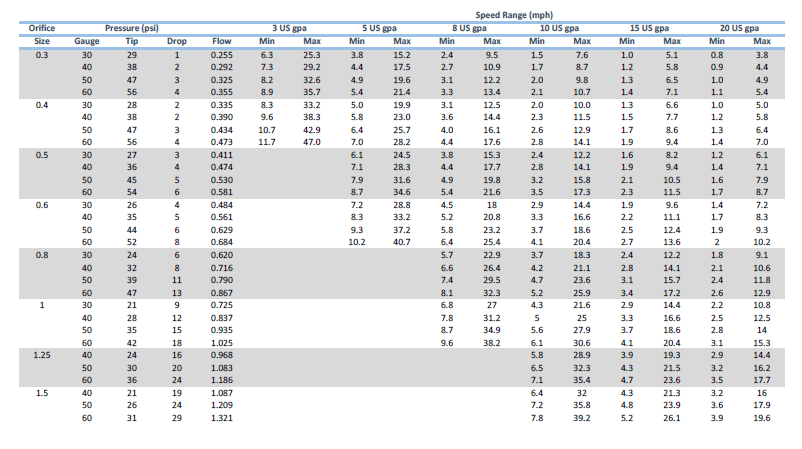
    Pulse-width Modulated flow control allows you to change travel speed by a factor of about five without a change in spray pressure.  This chart shows which nozzle flow rates to use. Note the significant pressure drop across the Capstan solenoid.  This value must be added to the cab spray pressure, as explained here.

    Capstan Tip Chart (with Pressure Drop).pdf

  • Measuring Pressure Drop

    Measuring Pressure Drop

    All sprayers experience a drop in pressure as the solution moves further away from the pump.  Here’s why that’s important, and how to measure it.

    Optimal nozzle operation in terms of spray quality and fan angle is closely tied to spray pressure.  As we try to maximize travel speed range with a modern sprayer, we often push spray pressure to its limits on the low and high side. For many air-induced nozzles, spray quality and fan angle become critical at about 30 psi.  We need to be sure about the exact nozzle spray pressure to prevent problems.

    Pressure drop is caused by the friction that the spray solution experiences as it moves from the pump to the spray nozzles.  It’s caused by a number of factors, including length of tubing, elbows, valves, screens, and other flow obstructions.

    Plumbing components add friction to liquid flow. If the pressure gauge is installed before these components, the nozzle pressure is unknown but will be lower than the gauge reading.

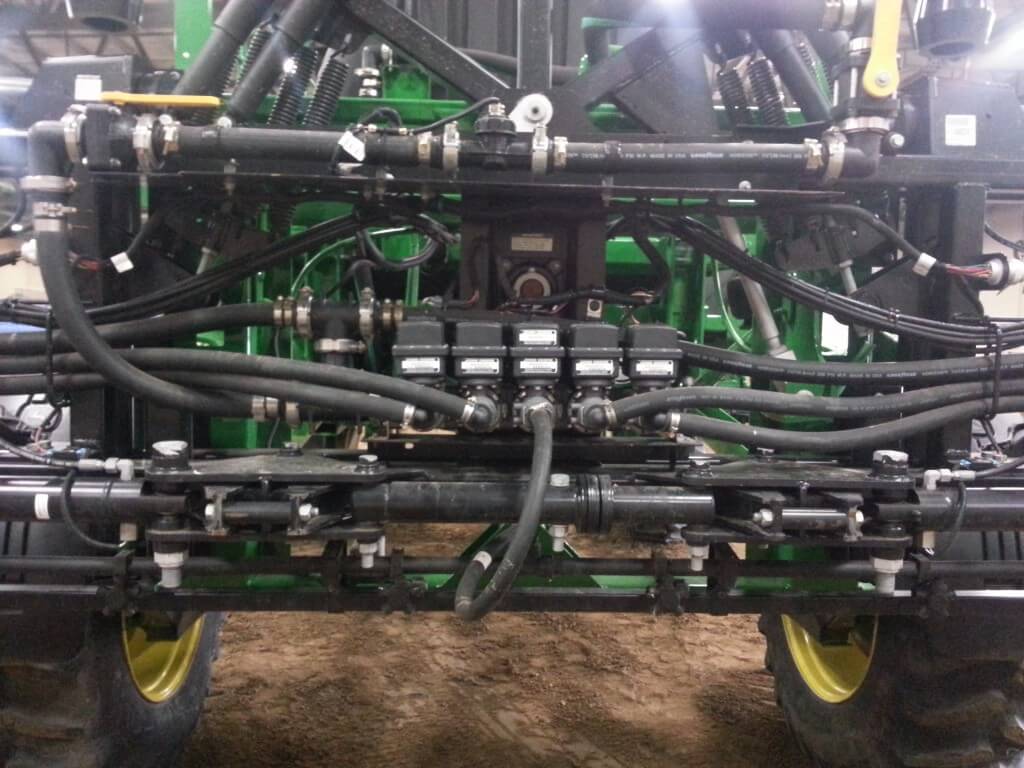
    The pressure transducer that reports pressure to the cab is usually located between the pump and the manifold that divides the spray into the various boom sections.  At this point, the spray liquid hasn’t experienced any significant flow restrictions.  The transducer basically reports pump pressure.

    Once the spray mixture starts moving through boom sections towards the nozzles, it encounters those restrictions, and pressure at the nozzle will therefore be lower than the cab reading indicates.  The higher the liquid flow, the greater the friction, and therefore, pressure loss.

    Even older sprayers with only two boom sections (left and right) and few elbows and reducers, will see pressure losses due to the narrow and long boom pipe that feeds up to 60′ on each side.

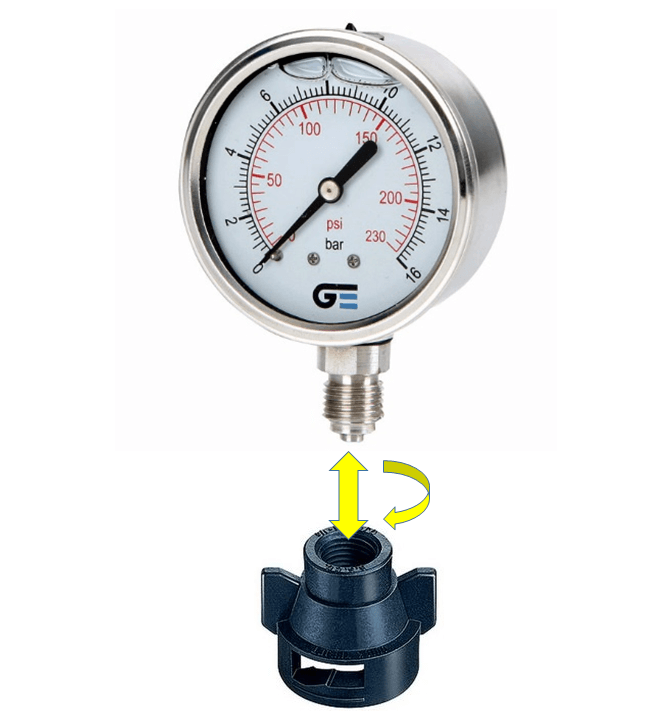
    The nozzle pressure can be measured with a gauge placed on a nozzle body.  Simply purchase a quality gauge and a threaded nozzle cap, combine the two and install in place of a nozzle.

    A pressure gauge threaded into a nozzle cap can measure boom pressure.

    Operate the sprayer at your expected spray pressure (say, 60 psi) with all boom sections on.  Install the portable pressure gauge on an open turret position and turn into place, noting its reading.  If both gauges are accurate, the boom pressure will likely be below 60 psi.

    The difference between the cab gauge pressure and the boom gauge pressure two is the pressure drop.  Repeat the measurement for each boom section.  Also repeat at your lowest, as well as your highest expected flow rates.  Higher flow rates cause greater pressure drops.

    Now, use this information to adjust your interpretation of the cab pressure reading.  For example, if you want to spray at 60 psi and your pressure drop is 10 psi, then the cab pressure should read 70 psi.

    If your boom pressure is higher than your cab pressure, and you’ve checked the accuracy of your new boom gauge, then don’t be too mystified.  Your pressure transducer is malfunctioning.

    This exercise is important if you’re trying to compare your nozzle flow to the expected nominal flow of the nozzle – perhaps you’re trying to determine nozzle wear.  The nominal flow of agricultural nozzles is determined at 40 psi, so it will be important to measure the flow at exactly that pressure.

    By measuring pressure drop on all your boom sections, you also get a good sense of the variability in pressure across your boom.  Your measurements might reveal an obstruction or a hose kink somewhere along the line.

    To see how low pressures can affect coverage, watch this video.

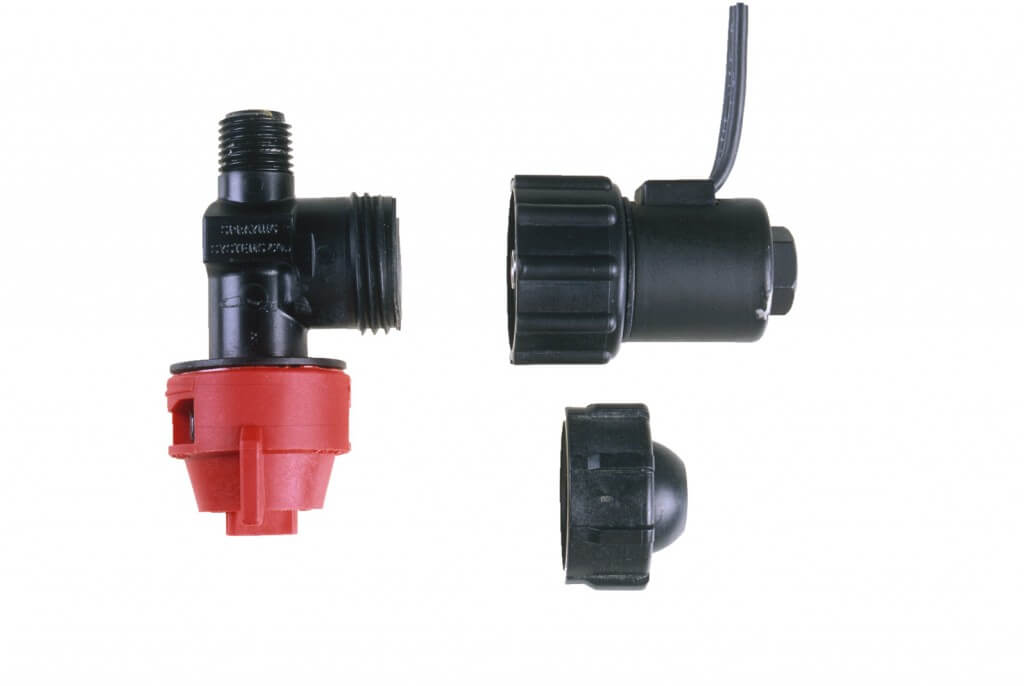
    Note that the pulse-width modulated systems offered by Capstan, Case, and Raven use a solenoid at each valve.  This solenoid adds a known, and significant, pressure drop to the spray system as can be seen here.

    Pulse-Width-Modulation (PWM) solenoids typically have internal flow restrictions that can contribute to pressure drop.

    Here’s a fun video filmed by the Ontario Pest Education Program during a break at Ontario’s Southwest Crop Diagnostic Days: