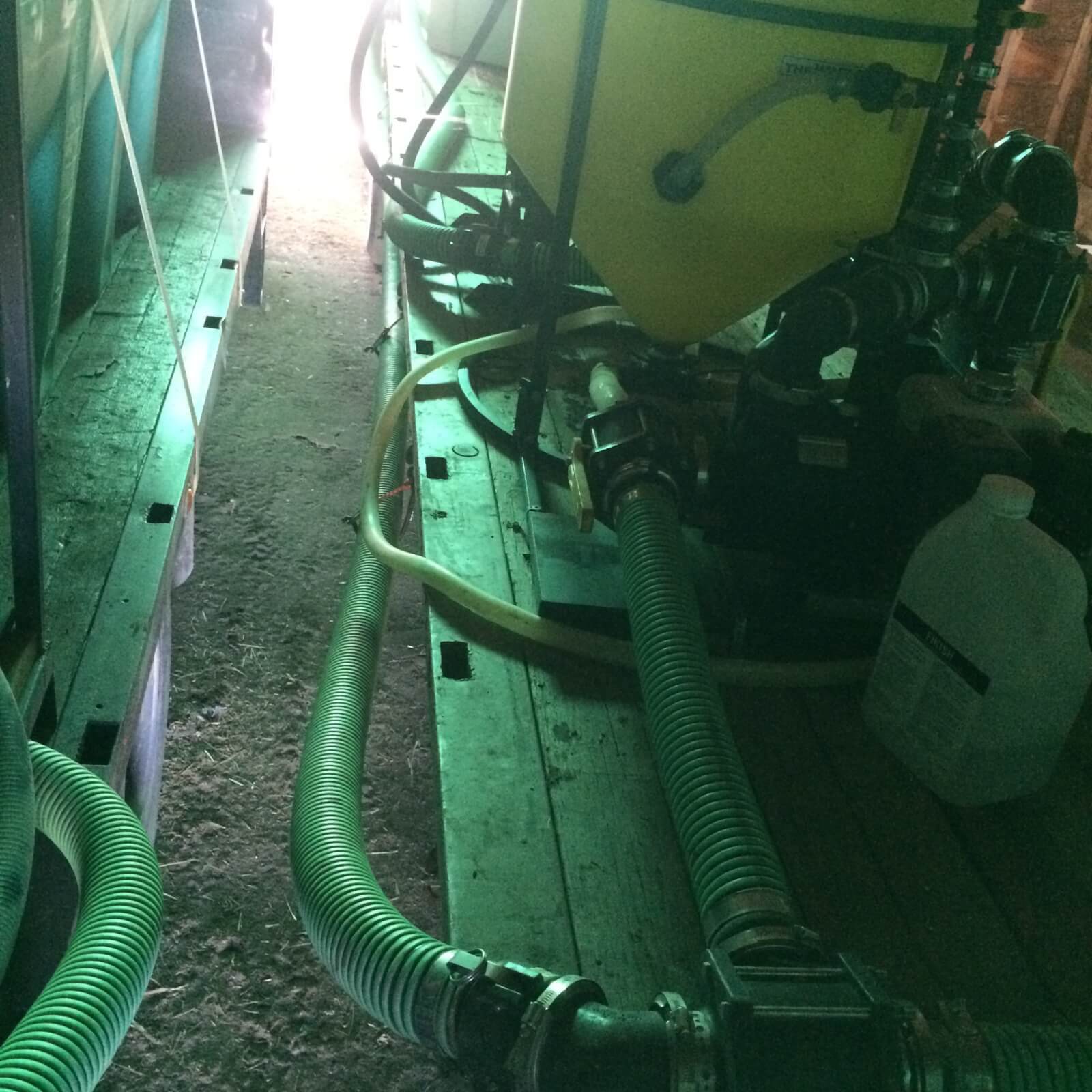
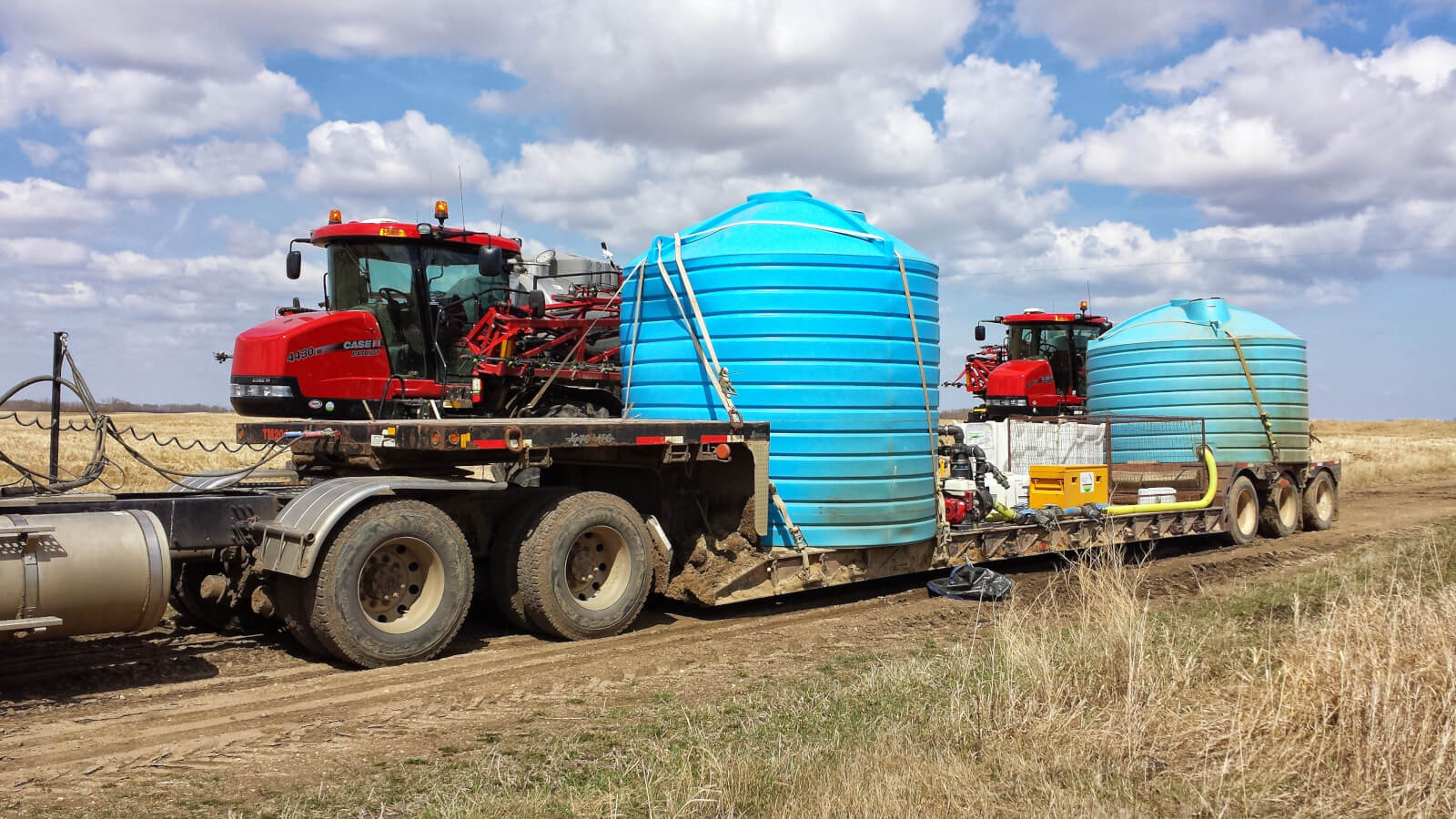
One of our recent posts highlighted some great producer designed tender systems for the sprayer. We posted four submissions, and are continuing the series with new submissions in this post.
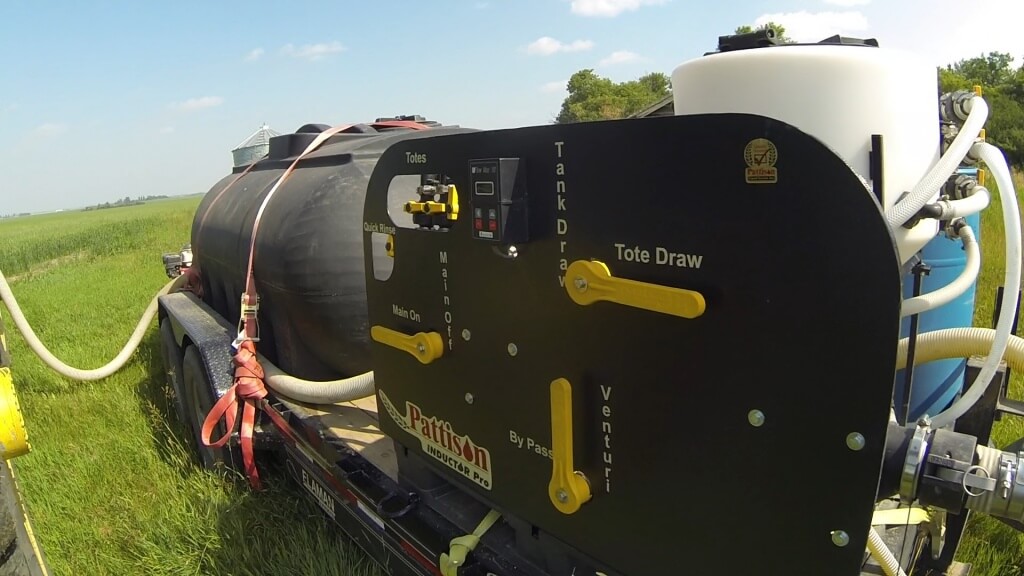
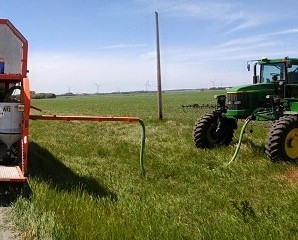
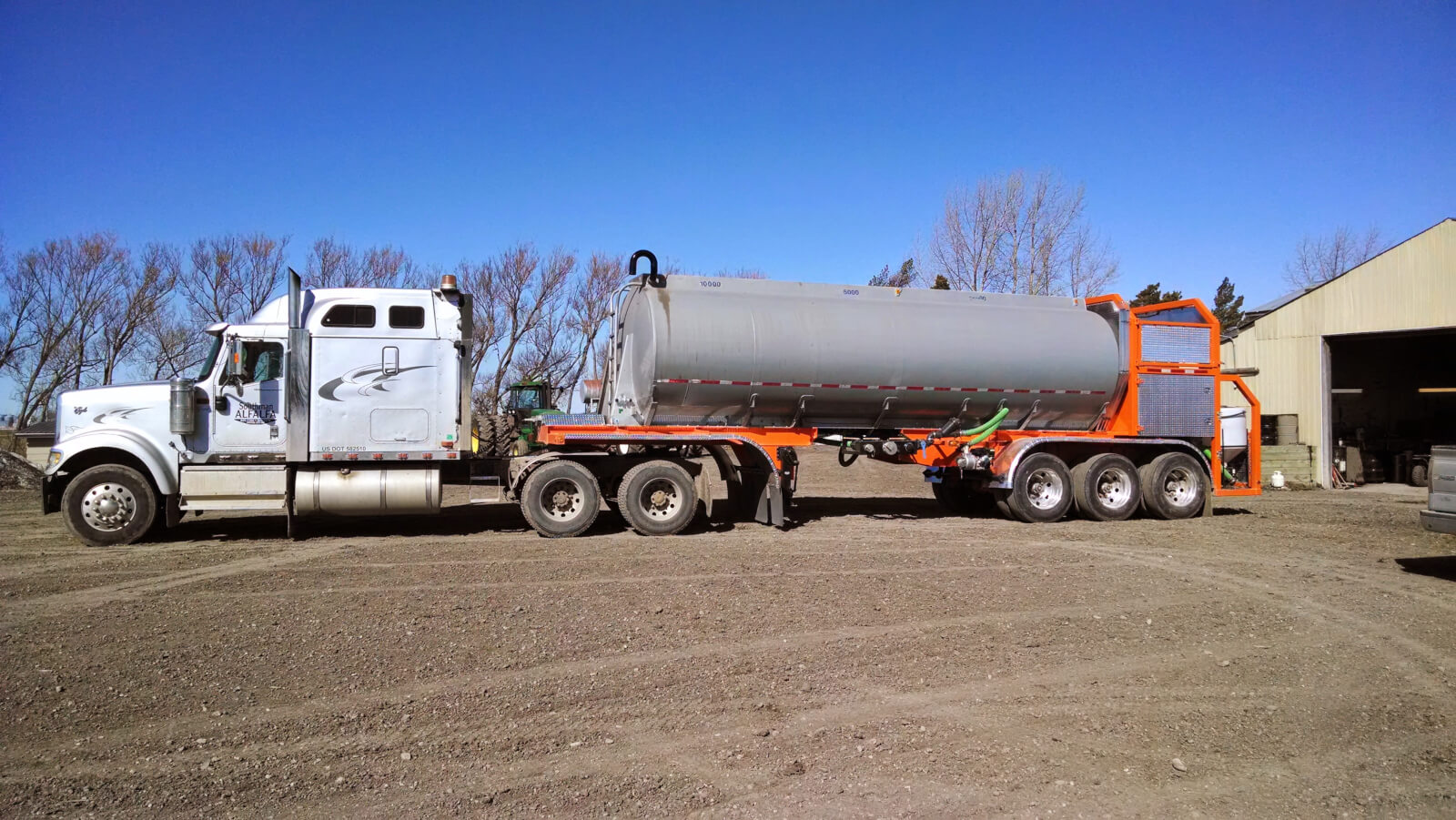
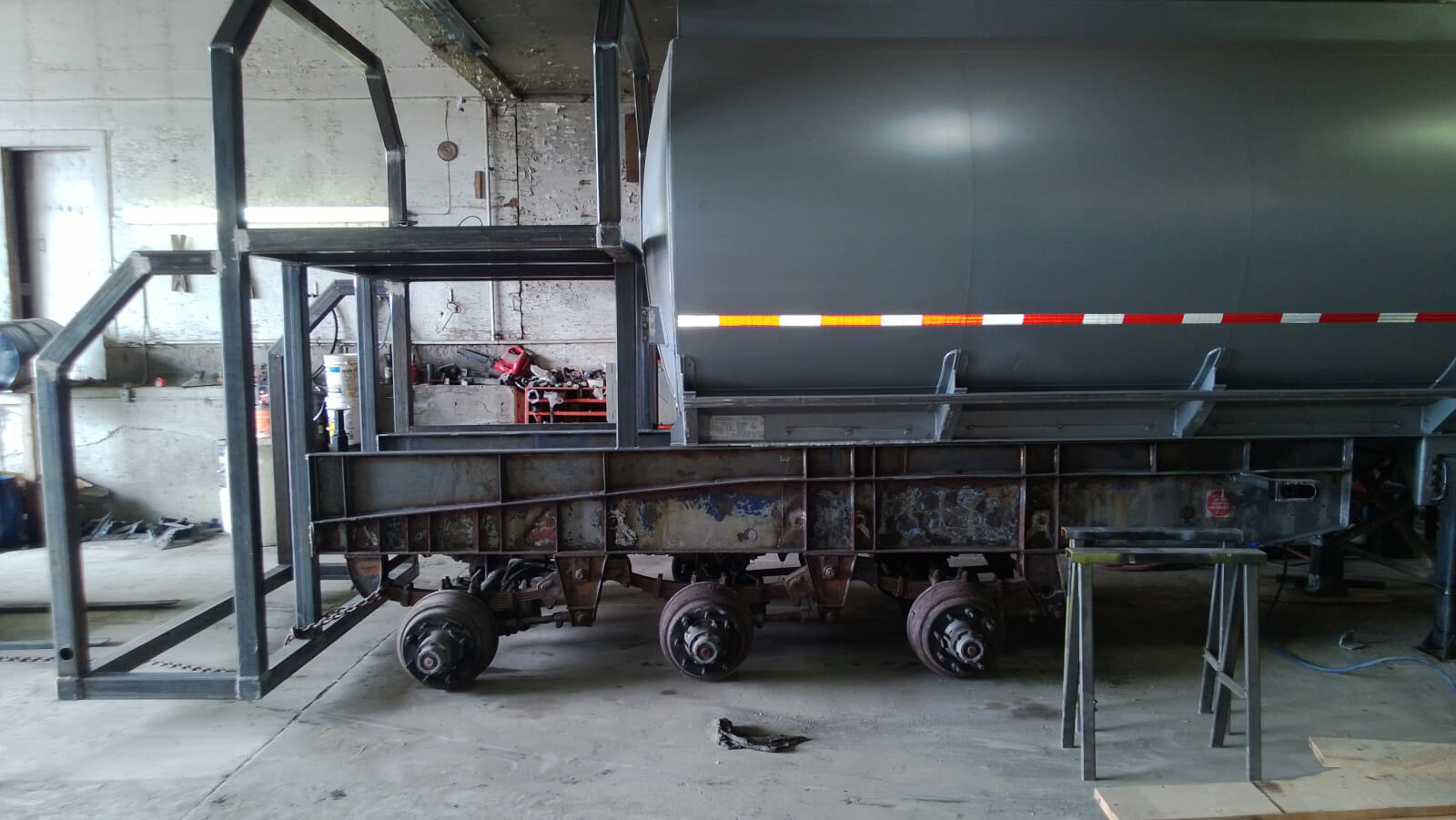
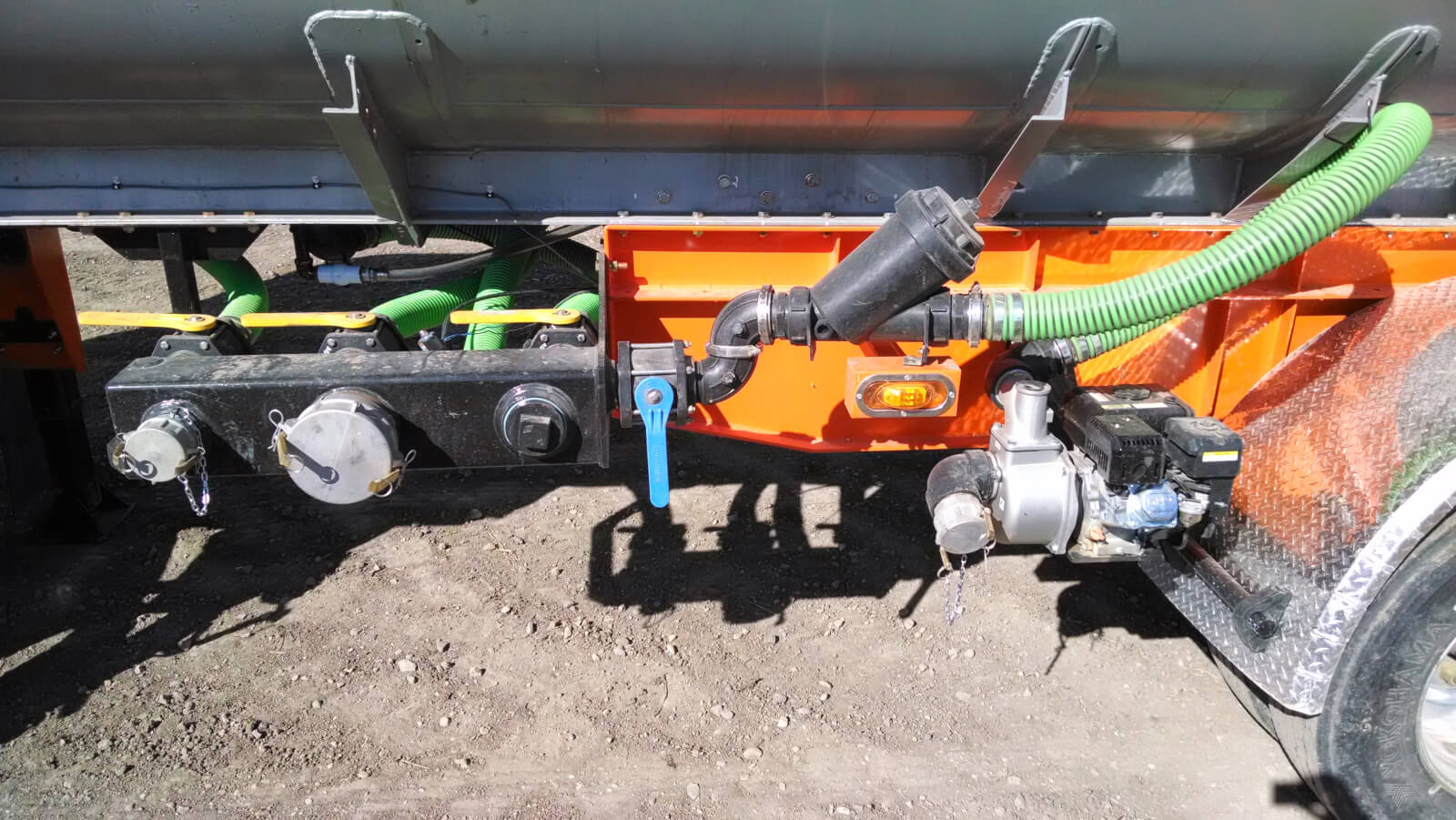
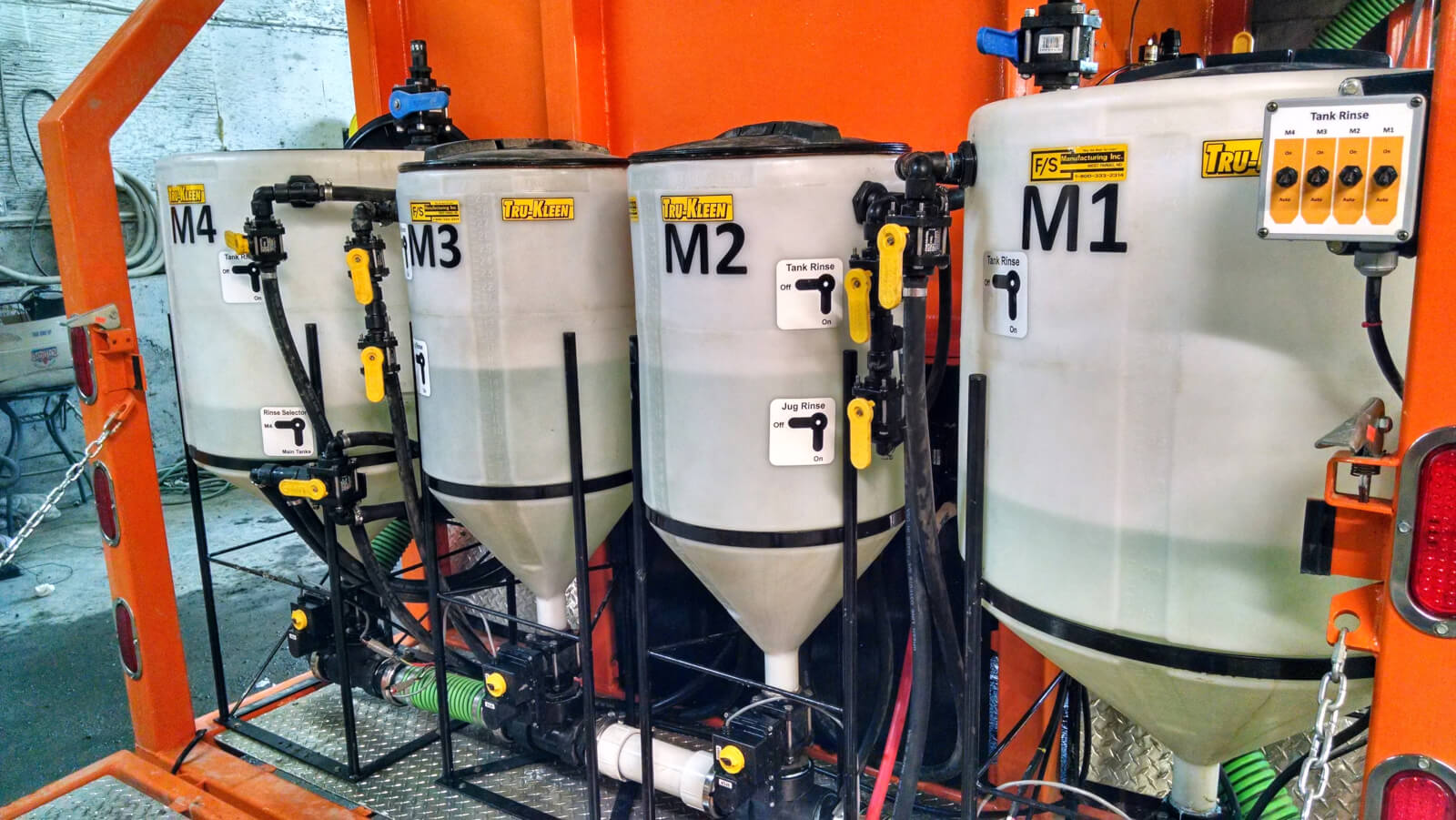
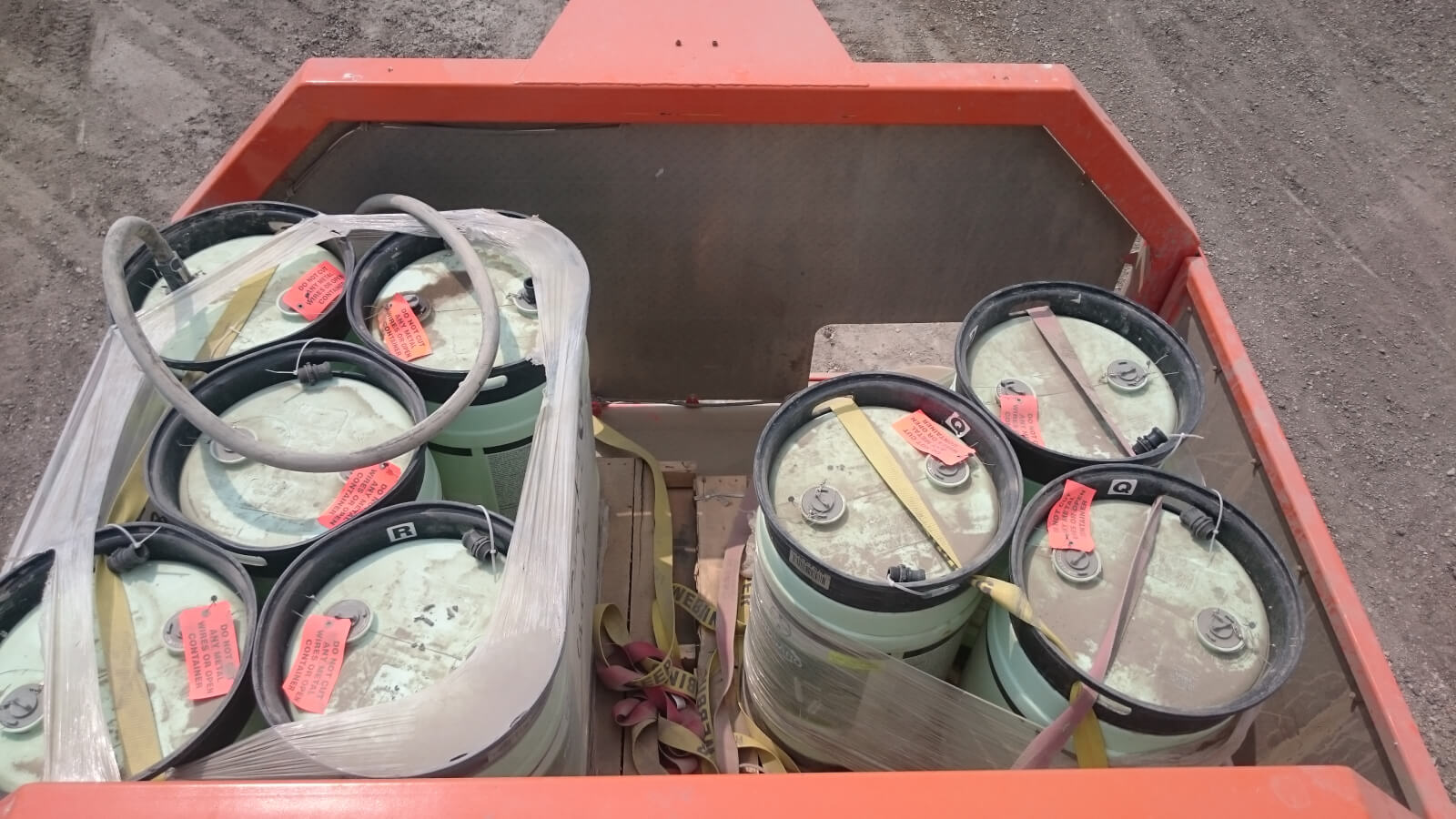
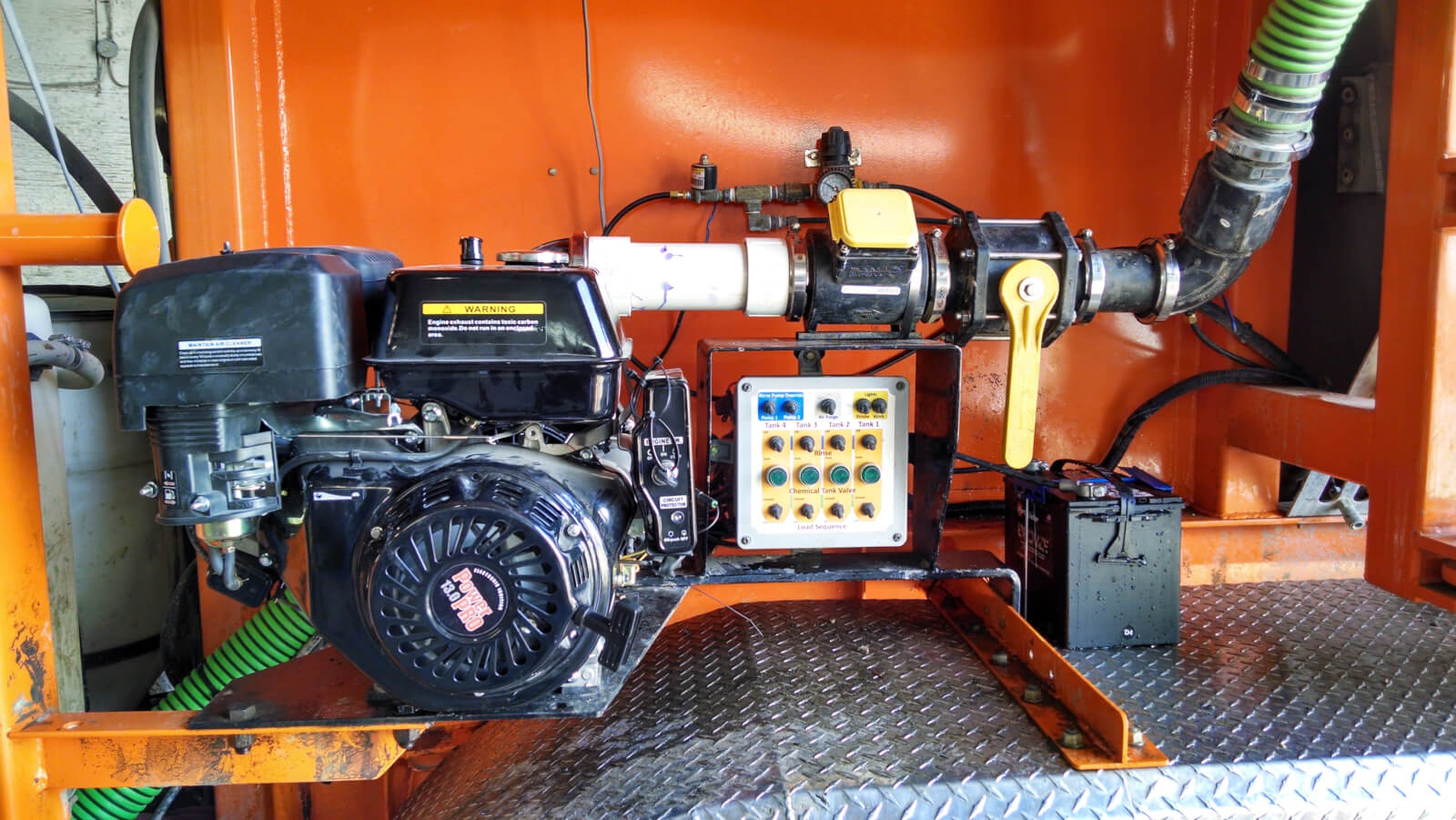
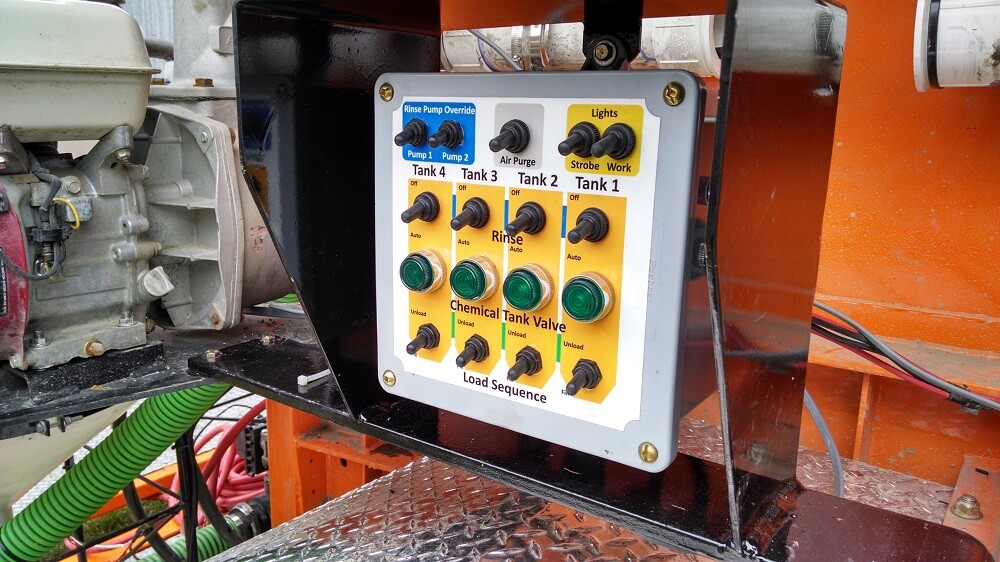
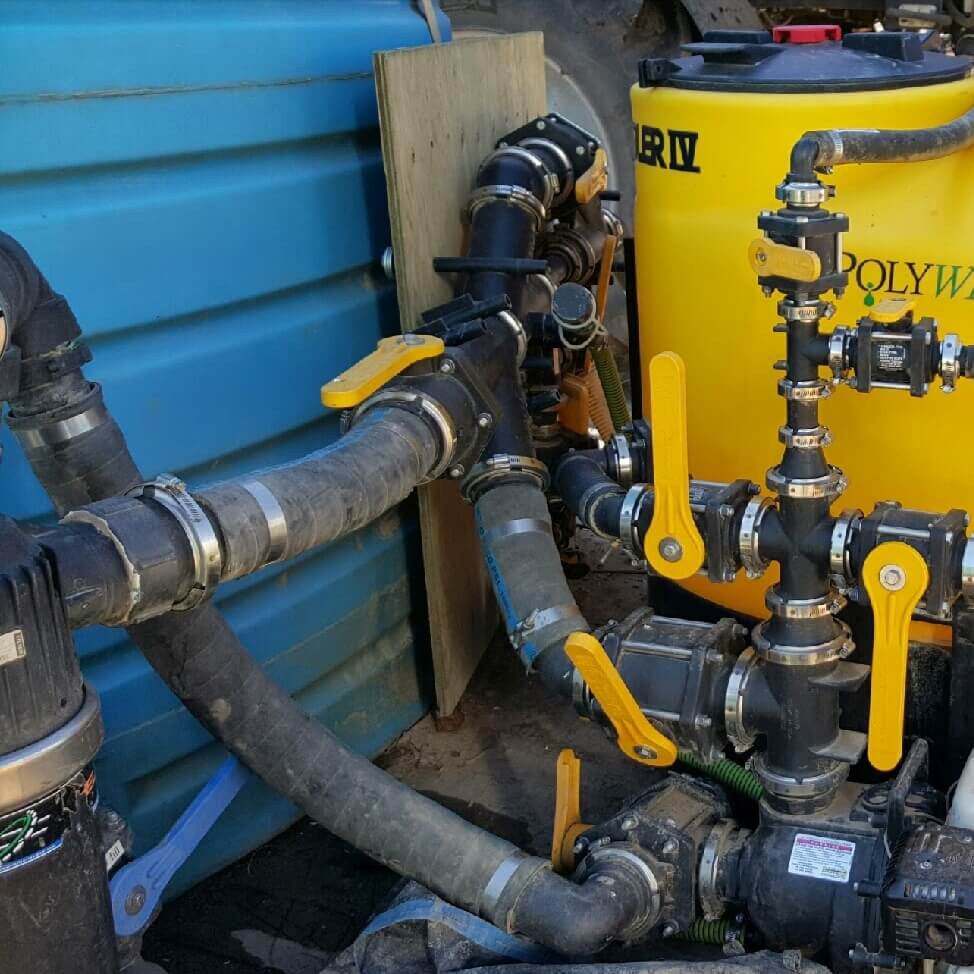
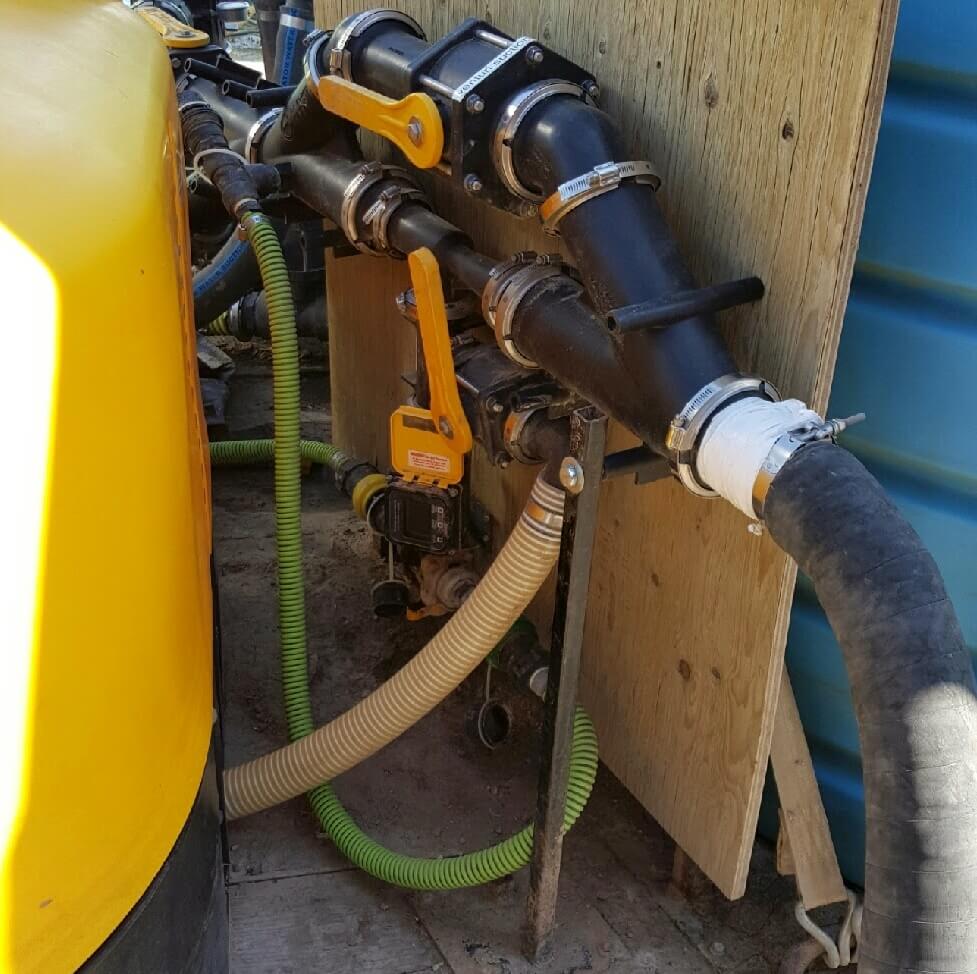
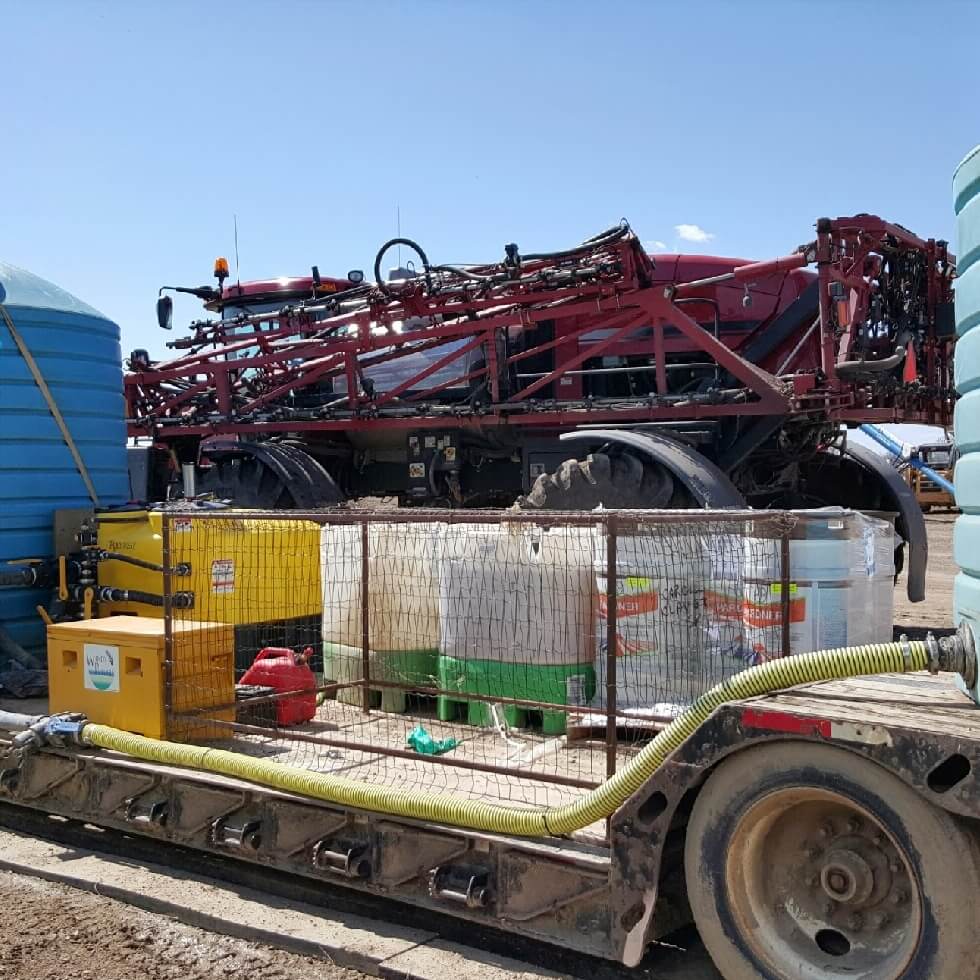
Our fifth submission comes from the folks at Pattison Liquid Systems of Lemberg, Saskatchewan
I recently saw Phil Lingelbach of Pattison at a sprayer clinic. Pattison has been designing and building transfer systems for years, and have valuable experience to share.
I asked Phil and John Young these questions about transfer system designs:
Why is filling faster important? How does it reduce your operating cost?
“Idle time costs money. Consider that trade in cost of an average high-clearance sprayer is approximately $185/hr on the meter. So 100 hours of idle time per year is costing nearly $20,000 in reduced trade-in value.
We also need to maximize “best spray condition” time. We know that application timing is critical to success, and need to take advantage of good weather conditions. Spraying under marginal conditions reduces the chance of good pesticide performance.
Efficient filling can also reduce labour costs, this is a “snowball number”. Every unnecessary hour spent spraying could be used to do something more productive, in essence a wasted hour costs you two.”
When designing a transfer system, what are the key considerations that separate a good from a bad system?
“Make sure that the water pumps pushes water to the inductor system. Do not use a water pump to pump chemical. Contamination is a huge issue with this.
Keep your transfer system away from the rear of an open deck to minimize dust exposure.
A good transfer system will be easy to clean and very user friendly, valves separated and clearly marked.
Get the biggest, fastest pump available. Loading water after the chemical is in is key.
Make it simple to operate, there is lots of hired help on the farm.
Design it to keep operator from being exposed to chemical. Keep trip hazards to a minimum.
Include fast product induction. There is no point filling water quickly and having to wait on a slow product pump.”
You mentioned the speed of filling product. What flow meters are most accurate and reliable?
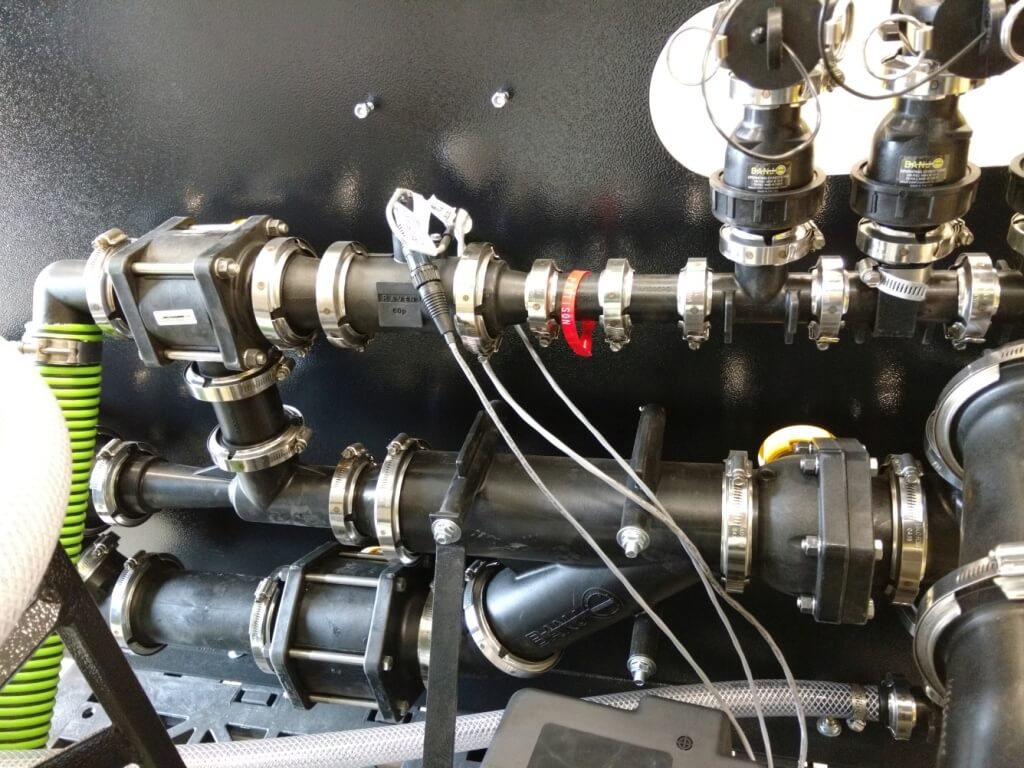
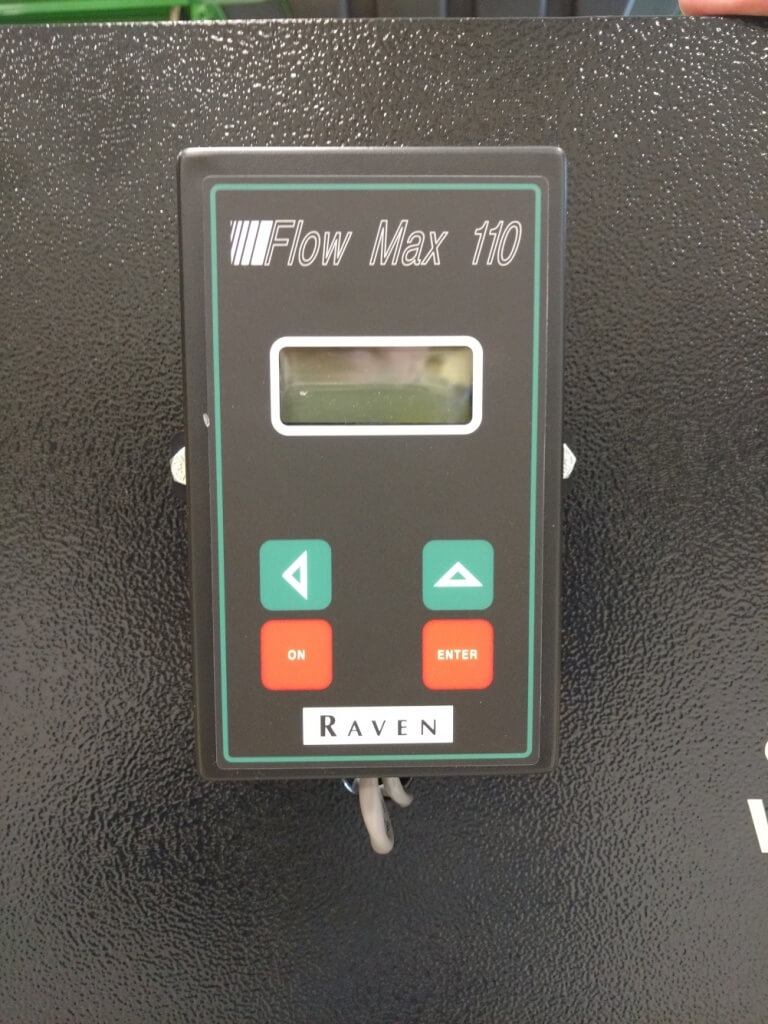
“The Banjo Mag meters and the Raven FloMax 110 (combined with the 60P) and 221 are the most accurate that we have available, the Banjo is limited to non-petroleum based products though.
Both the Raven 60P and Flomax 221 are turbine style meters, to be used with all ag chemicals, – 2” models.
Banjo Mag meters should only be used with water based products – this meter is the best for measuring water when filling, comes in a 3” model.”
What are the best ways to clean a transfer system?
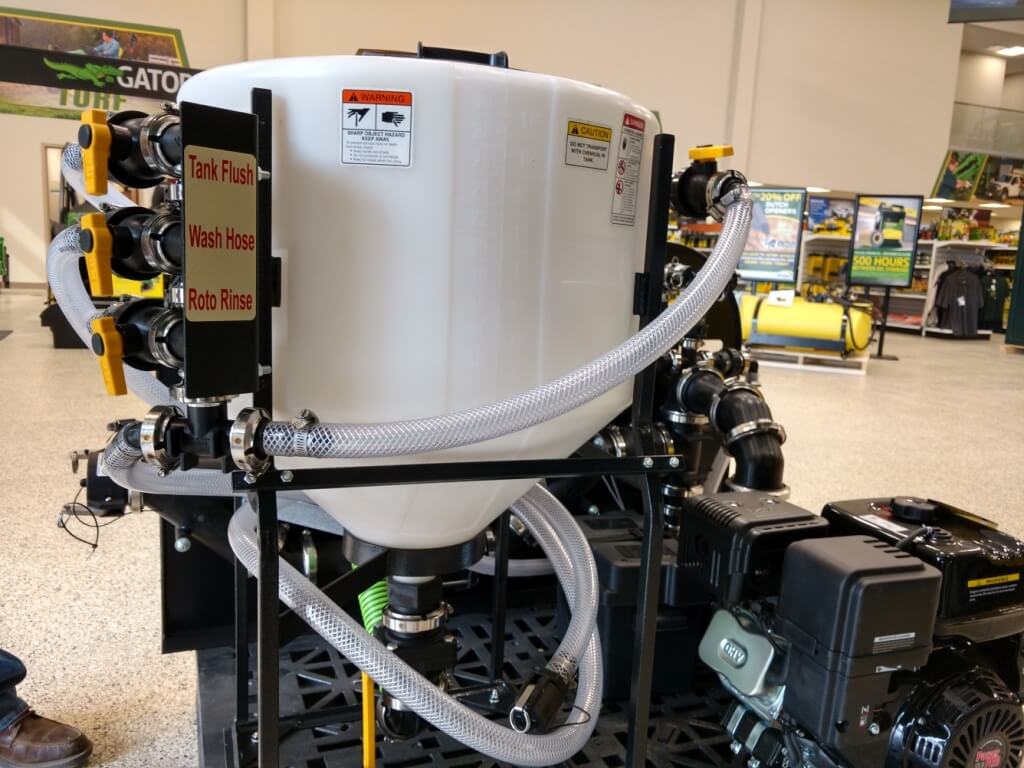
“The best way to clean your jug rinse tank is THOROUGHLY!! There is no such thing as overkill when it comes to cleaning this tank, we use a tank that has no bulkhead (total drain, no bulkhead for product to get hung up on) in the drain, a rinser designed for an 800 gallon tank, and very minimal fittings for chemical to get hung up on.
Use lots of water, when you think it’s clean, rinse it one more time!!
All our inductor systems come with a quick attach clean water rinse system, that allows the operator to flush the complete metering/inductor system.”
What is usually the limiting factor when trying to fill a sprayer faster?
“Hose size, pump size, venturi efficiency, and planning are most critical. Consider your needs – a system should be designed specifically to the needs of the operator.”
Do you need more than one inductor to handle multiple products in time?
“Usually one will be sufficient so long as the suction line is of sufficient size and length.
Our inductor systems are configured to handle more than one bulk product at one time. With just the turn of a valve you can switch from metering one product to another, or quickly change from metering a bulk product to handling jugs.”
We’ve recently been talking about how we can increase sprayer productivity by decreasing downtime. The main productivity robbers are time spent filling and cleaning. Using our productivity calculator, we’re able to show a 30% increase in acres per hour with some relatively simple changes to how we fill the sprayer. It’s important to actually measure the time spent filling, not estimate it.
A few days ago, Jeff Calder of Letellier, Manitoba (@jcalder1983) tweeted a water truck project he’s been working on, and it generated a lot of interest. We decided to follow a suggestion made by Ron Krahn (@RonKrahn) last fall to show various designs so that everyone can learn from each other.
This post will grow over the next few weeks as we gather more submissions. The first four submissions are below, the fifth and subsequent submissions will be here.
Please use our e-mail link on the site to send us your picture and descriptions, and we’ll post them as they arrive.
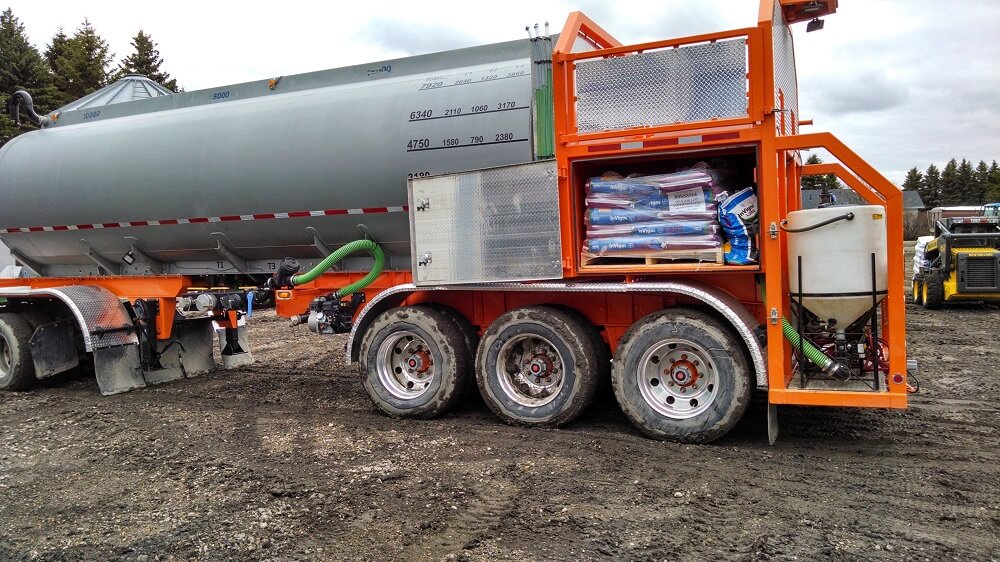
The first submission came from Landon Friesen (@landon707) who farms near Crystal City, Manitoba.
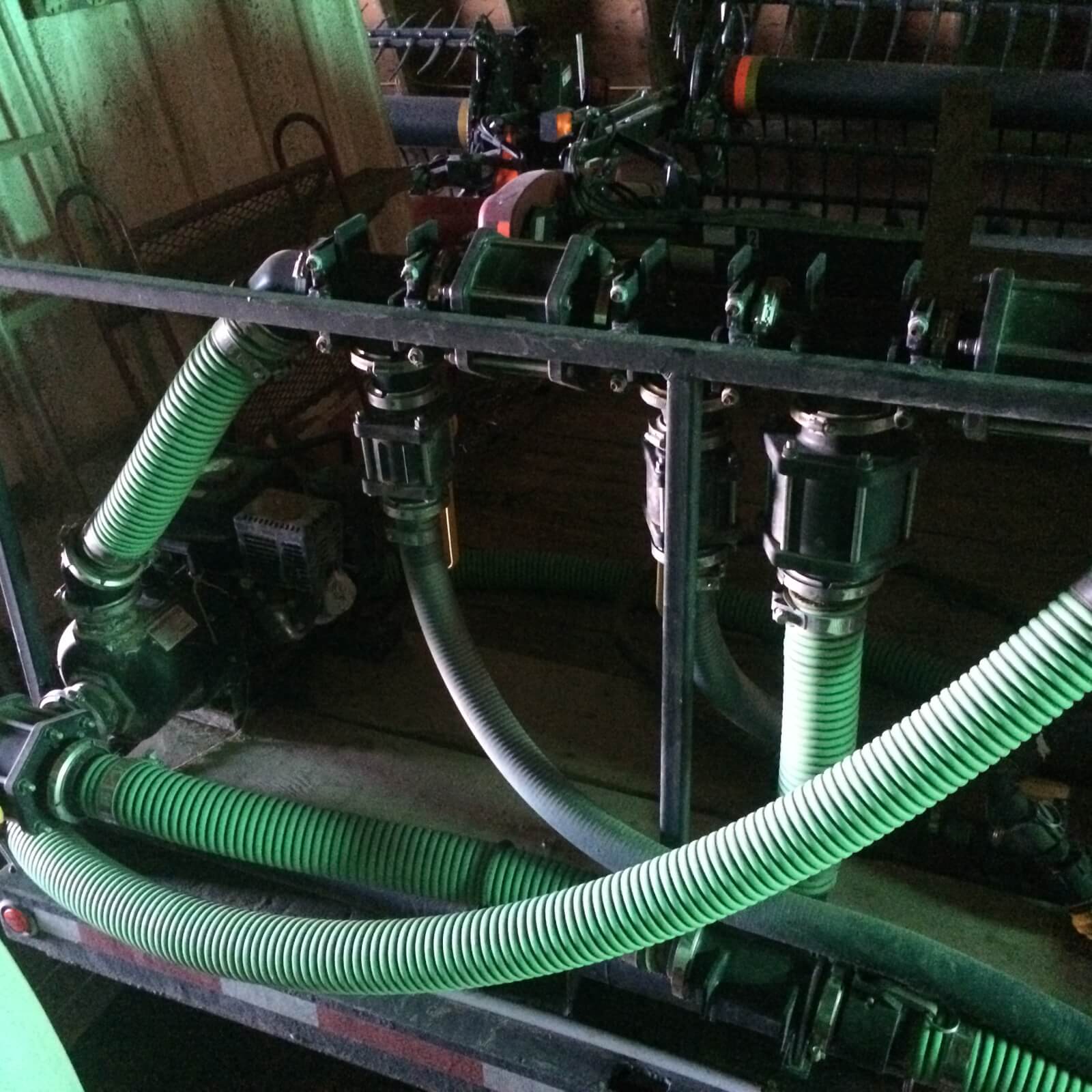
“We bought the front half of a old fuel tanker, stripped it right down to nothing, flipped tank end for end for better weight distribution, and extended the kingpin for bridge length. It’s just shy of 9000 gal to the lids (far from legal). Built the back frame/box etc.
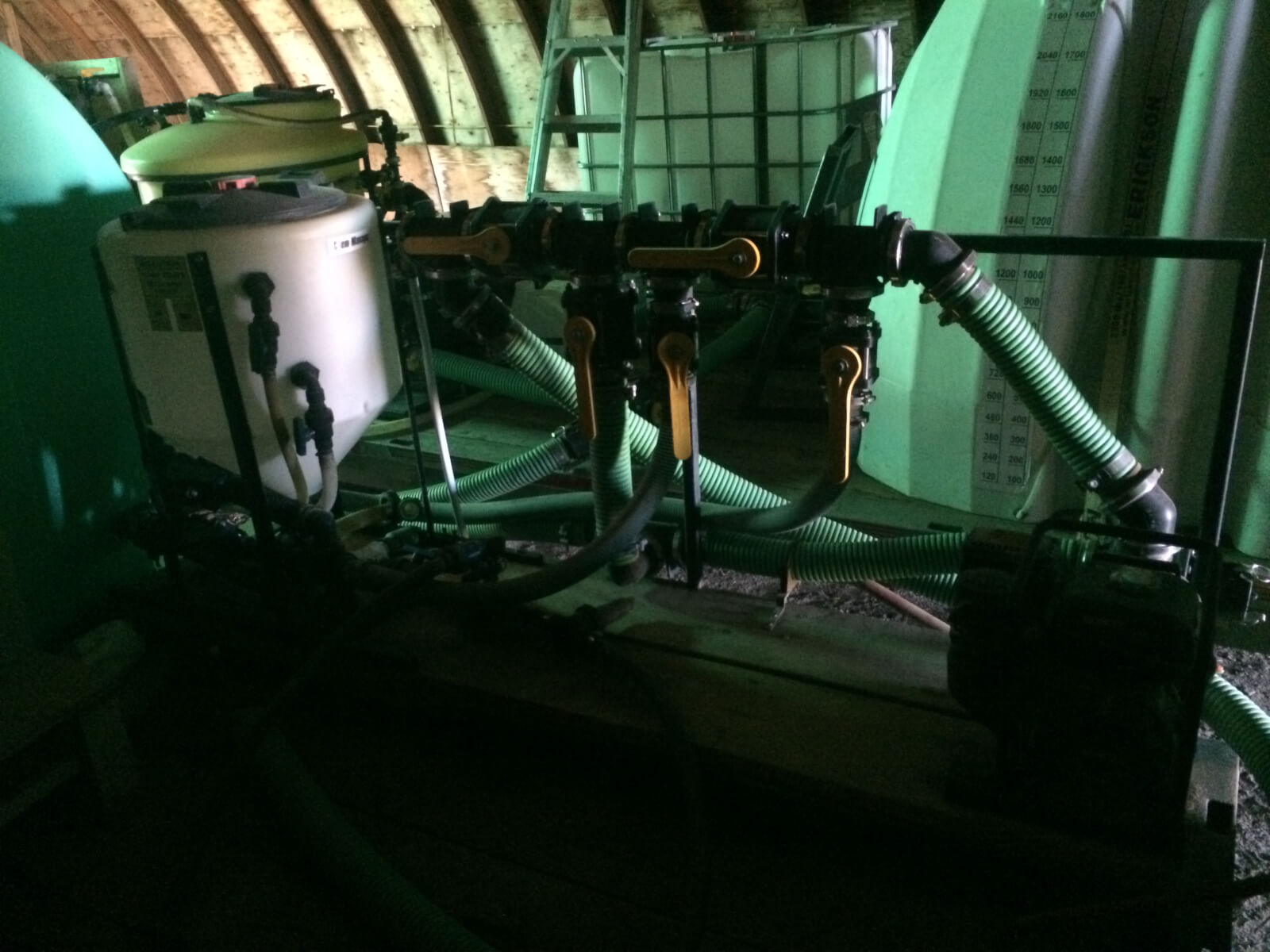
Mix Tanks on rear platform, bulk totes up top, small boxes in the middle. Blast and paint are next. #westcndag
“Starting at the drivers side, all three internal tanks come together in a manifold, you can select which tank you’re drawing from or filling from. You can fill with a 3, 4, and 6 inch pump, connected to the manifold is a stationary pump for only filling ditches or water sources without pumps with a filter on it.
“Water then travels around the backside of the trailer under the 4 induction tanks, a check valve keeps any product from flowing back into the tanks to prevent contamination. Each induction tank has a 1.5 inch electric ball valve that feeds the three inch line.
“Each inductor has a tank rinse and a jug rinse. Tank rinse and jug rinse are powered by 2 12 V water pumps drawing from manifold on the drivers side of tank. All electric solenoids control which induction tank gets rinsed.
“Jugs are stored inside the large box under the bulk deck, keeps them dry and close by the the rear deck. Bulk containers go on the top deck, 900 L totes are gravity fed into the inductors, accurate measurements on the inductors let us know when to shut off the gravity valve, if barrels are used a chem pump is on the back now too.
“Inductors are handy because it keeps all products “preloaded” and separate for chem safety until you need them.
“After the inductors the hose travels to the suction side of the pump, was a 6.5 hp Honda and now replaced by a 13 hp Hypro pump, water or fertilizer then passes through a flow meter and out the 12 ft boom with hose doubled up for 24 ft reach across the ditch.
“Our goal was to have the tanker operator stand by the pump and control panel the whole time, no valves to turn, when you engage the “unloading” of a induction tank on the control panel the auto rinse is activated for that inductor, keeping it cleaned out for the next batch.
“We can fill a 1200gal sprayer with all chem in just under 5 min with all chem included, that’s from hose connection to disconnect. Gained many acres/day b/c of this trailer. Took us 2 years to build and I’d do another in a heartbeat!
“We use it for seeding in spring to bring liquid fertilizer to the drill, can keep a skid of seed out of the rain and blend N, S, and liquid P with the flow meter. Next to the sprayer it’s the most widely used piece of equipment on the farm!
The second submission was made by Jay Schultz (@WheatlanderJay) of Rosebud, Alberta
“Spray tender setup is near and dear to my heart and have set up 2-3 systems in the last few years with the help of my BIL Craig. I have the vision he has the know how. I scoured the internet for a few years for ideas and there is lots of great setups on various forums.
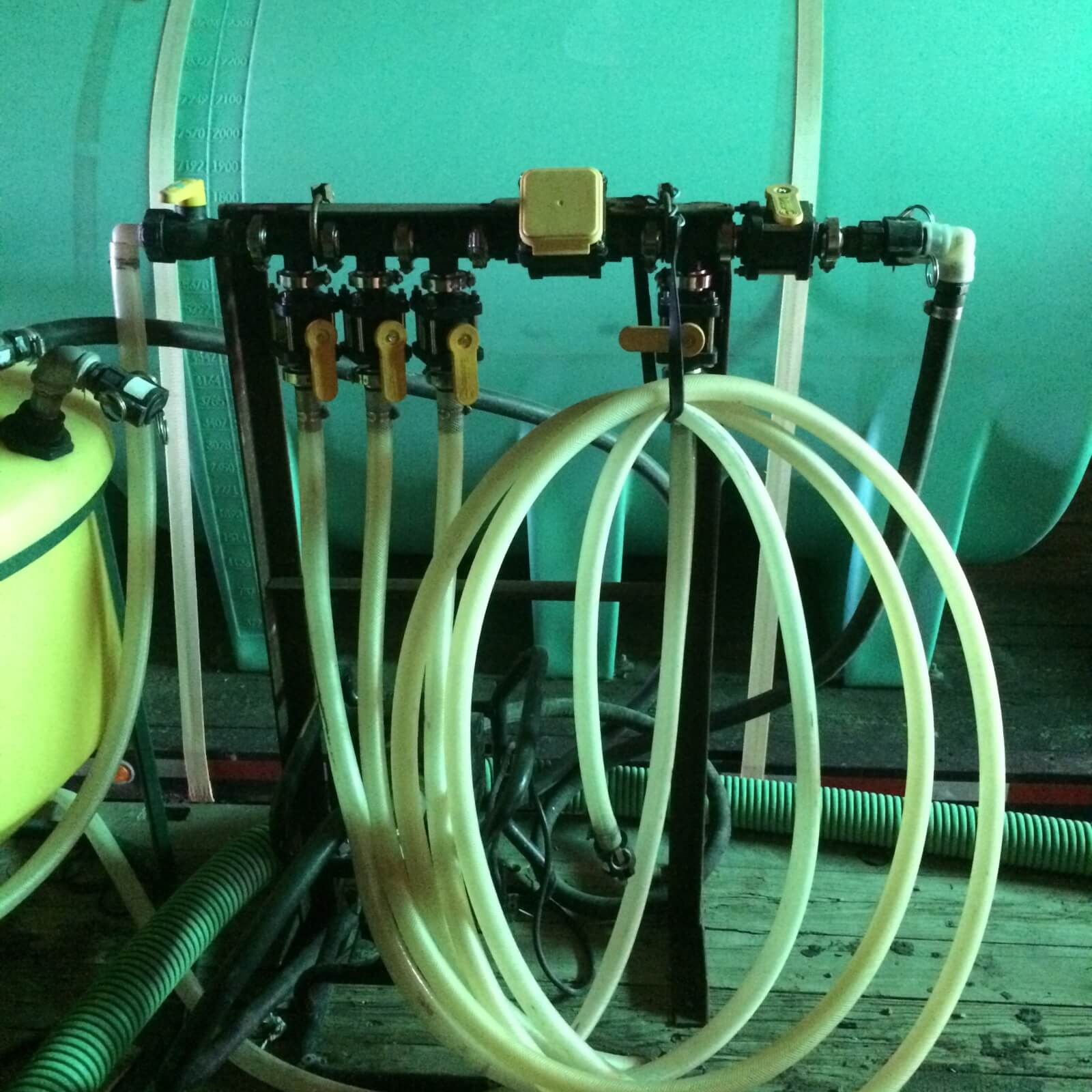
” My bulk chemical hose setup can suck out of three totes or barrels. It can dump into the chem handler using a 1 inch chemp pump or I can use the venturi to suck depending on what we want to do. This system is also plumbed with a fresh water line to be flushed. It also has a banjo flow meter. Banjo last a long time, other brands do not. BUT it measures EC not flow which does not work for all chemicals. Back up is measuring in the chem handler.
“When we use jugs we throw them in an old ICB tote so they don’t blow out down the road.
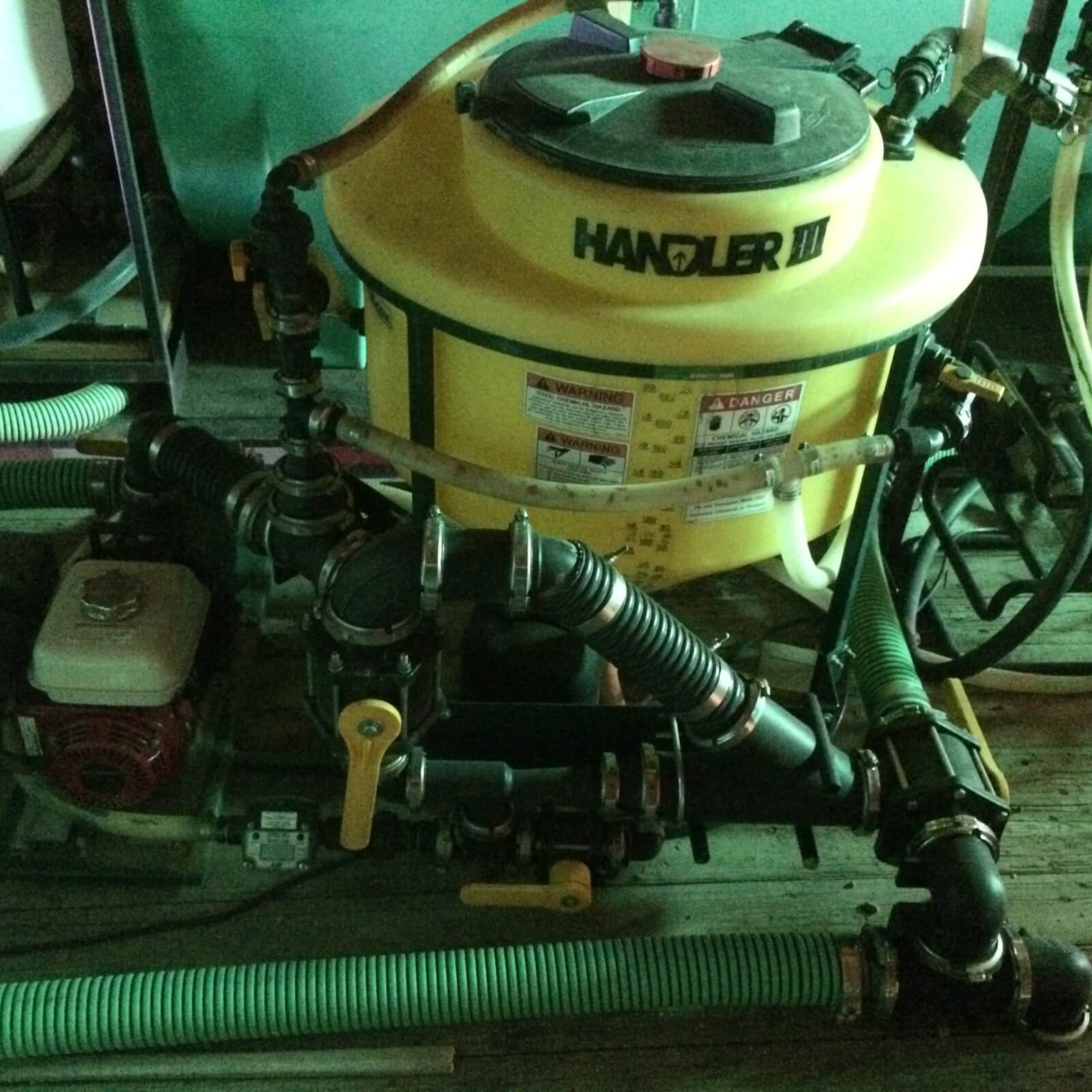
“We are using a chem handler 3 with all three inch hoses.
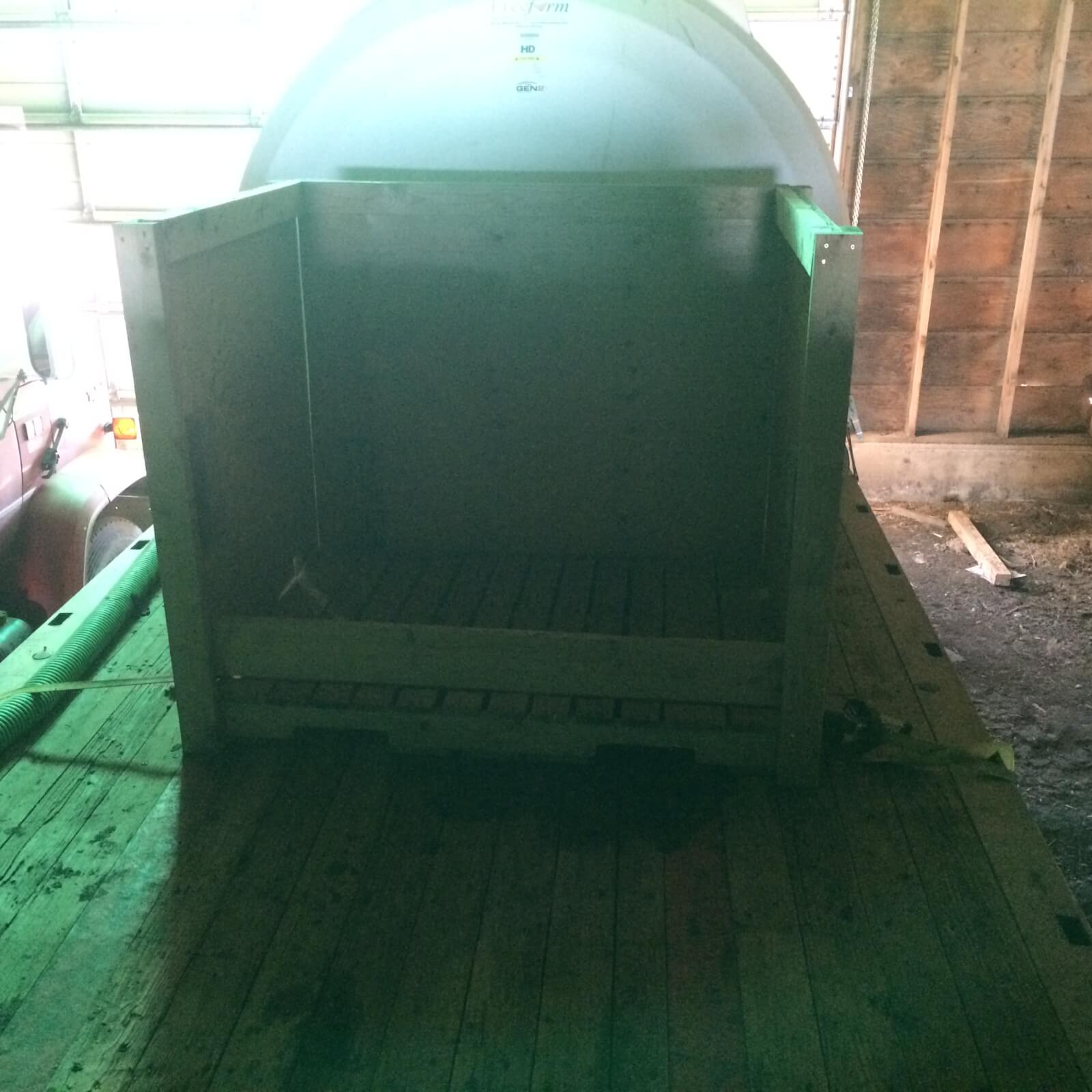
“When we have barrels and or jugs we have a pallet they we built sides for that also has a shelf. We can remove it with one strap and reload or use 4 totes.
“We have a long hose for filling that has hooks and bungy straps to hold it up. We empty the hose every time because its very heavy when full. To drain the water we just open a valve on the handler to let air in the hose. We installed an air assists clean-out on the sprayer side so we can push the hose back into the chem handler if we need. The water is always murky so there must be some chemical in the hose. This is also where we fill the tanks on the truck with a three way valve on the suck side of our pump and a three way valve on the pressure side. We have free form tanks, tank 1 is 2350 gal and tank 2 is 3100 gal I think.
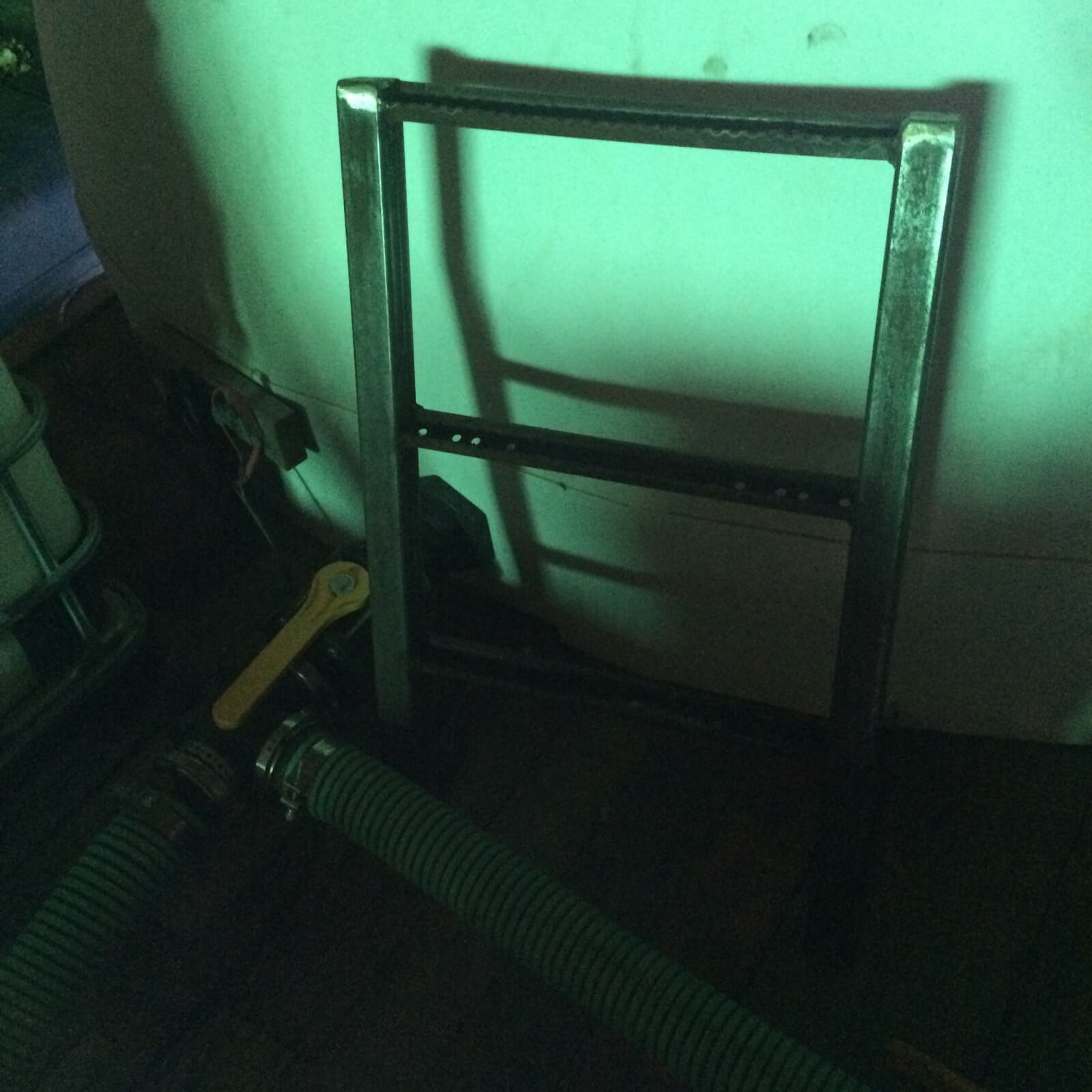
“If you have broken feeder chains lying around, the slats make excellent ladder rungs.
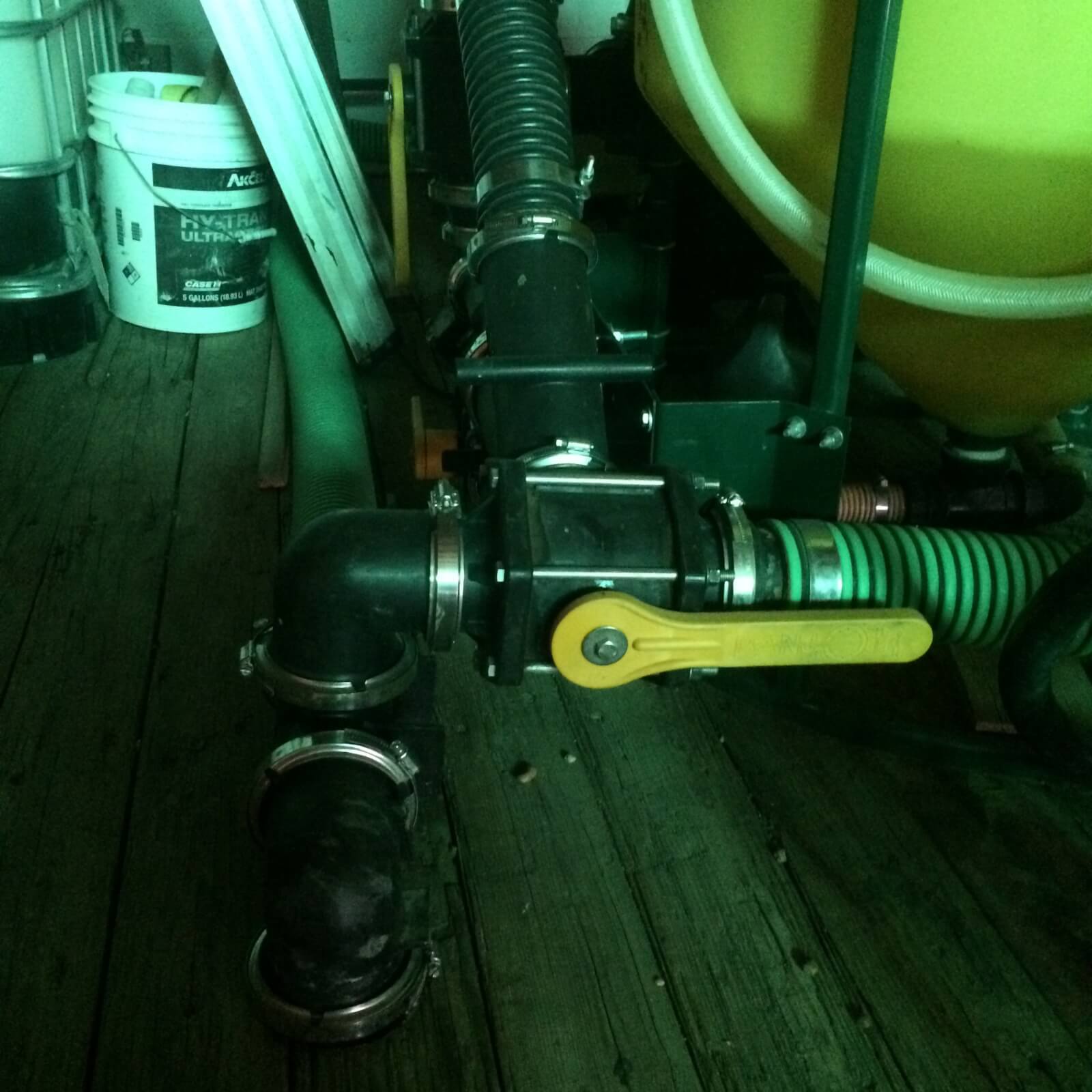
“Showing the 3 way valve on the pressure side. Its positioned to fill the sprayer in the picture.
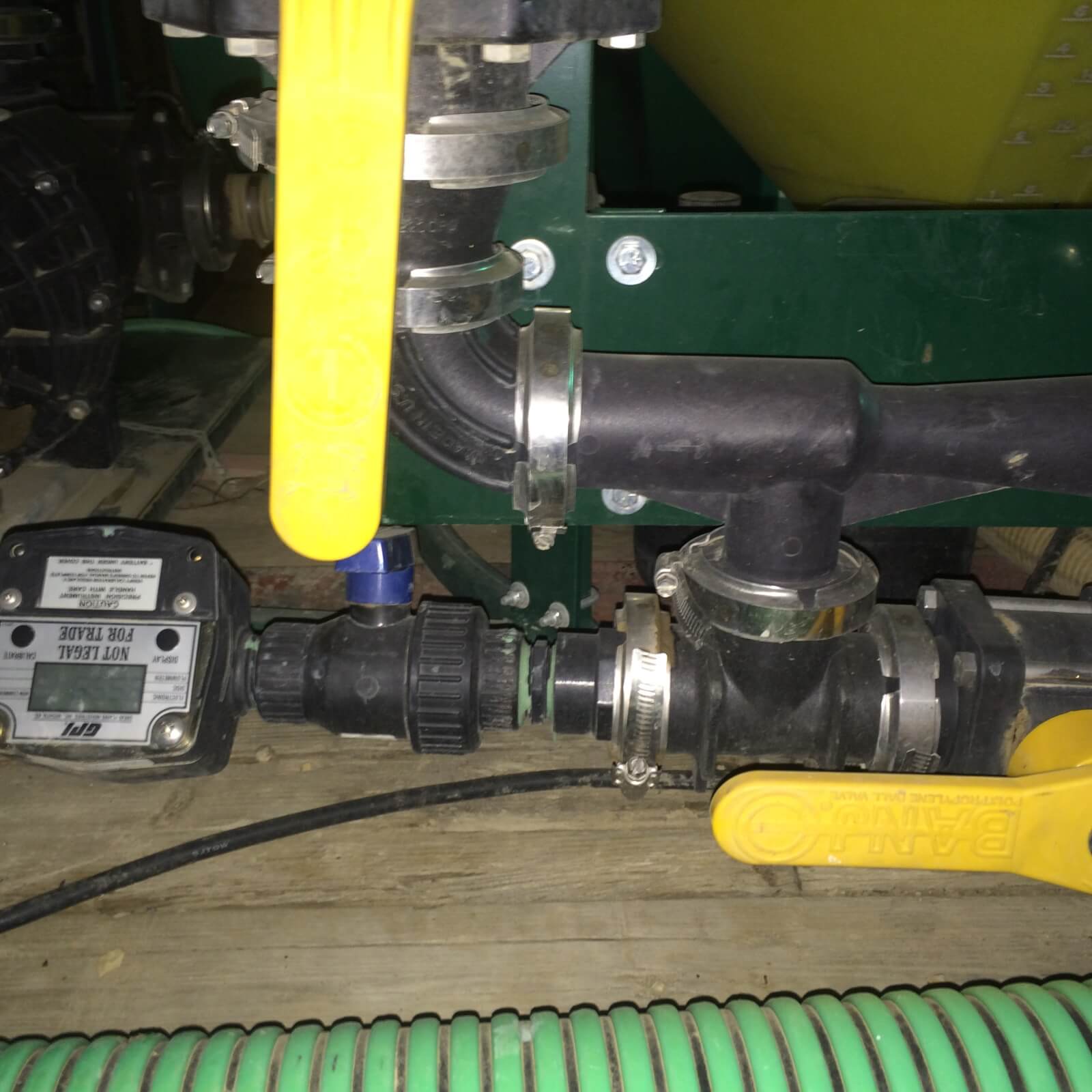
“They have since modified the chem handlers for this purpose but I teed into the venturi to use this for chem totes. I also had an old flow meter I added. I don’t trust it though.
“Our trailer is 48 ft which we bought used for about $8000. Its a bit on the long side for getting into fields. If we could slide the wheels forward it would help but this trailer we cannot. We can fill in about 20 min and our sprayer is 1135 gal. Some advice, when you buy a Rogator the tank size does not match the number on the machine. We though our rate was out but it was because the tank is 1135 gal not 1100 gal. We can spray 4 tanks out and have room for a sprayer clean. We fill the tender at home with a free form 9000 gal trailer tank that we also use for 10-34 during seeding. We fill with a garden hose but are setting up a 1 inch pump to pump out of our overflow spring water system.
“We also have a tandem flat bed truck with a 2500 gal tank. We use this for 10-34 during seeding and fall desiccation instead of our trailer. Craig and I were much happier with the setup on this unit. We also used an old chem handler we had sitting around. I teed into the Venturi as well so I could suck out of totes. We also put an air clean out that was plumbed from the truck air supply. When we load 10-34 the hose is messy and heavy. We just blow the last of it into the drill and no mess and easy storage.”
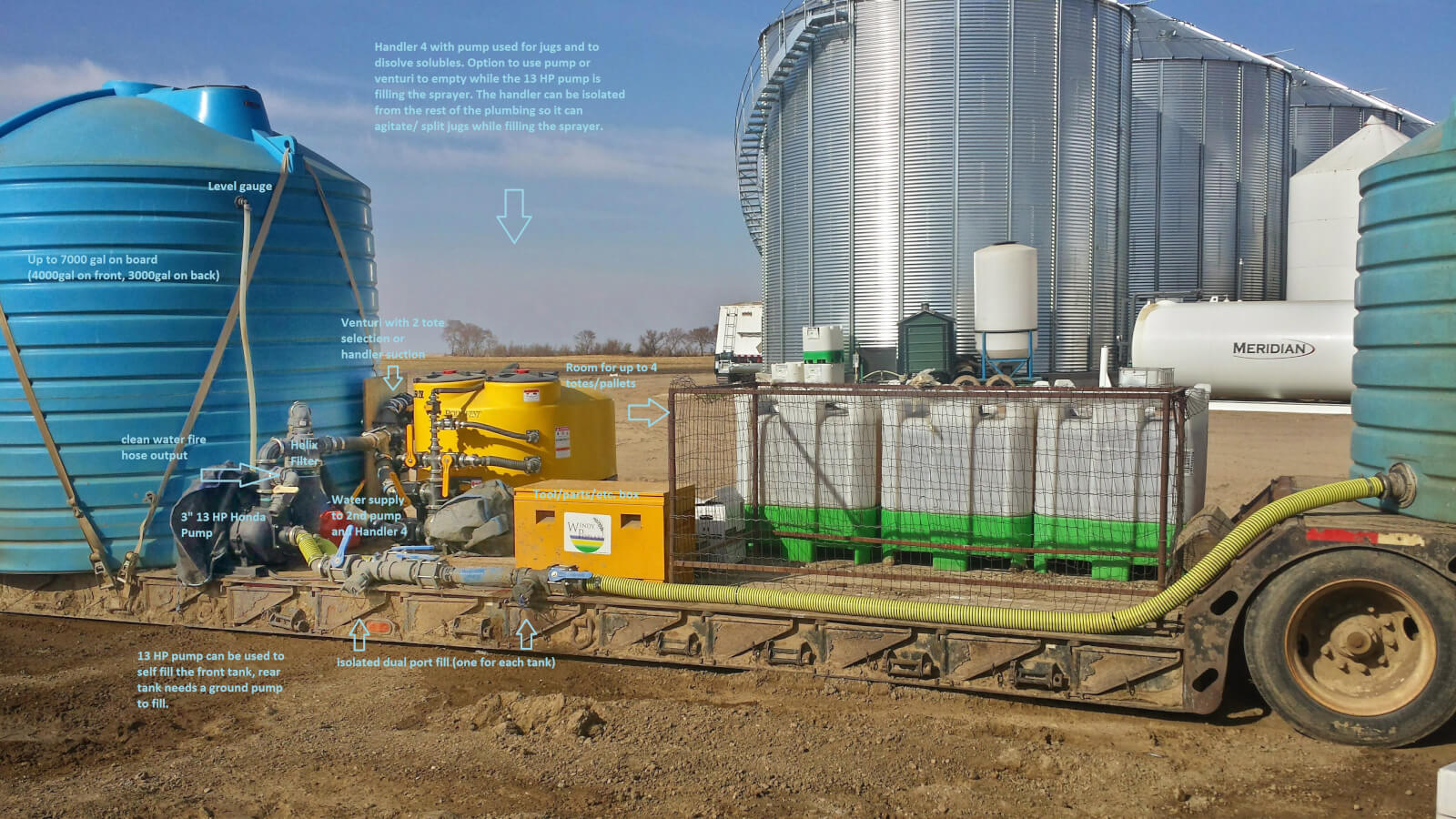
The third submission was made by Tyler Burns (@windypopfarm) of Wynyard, Saskatchewan
Dual 3” fill ports: ability to isolate the two tanks in order to fill each tank with it’s own port, front tank can be filled with on board 3” 13HP pump, back tank requires a ground pump to fill.
Main Pump: Banjo 333 Series Cast Iron Self-Priming Pumpwith 13 hp Honda electric start and pull rope capable of filling a 1200 gal sprayer in under 5 min if you’re only filling water and the filter is clean. Real time fill will range from 8 to 15 min dependant on what chem mix is being used. A future desired upgrade would be a 1200 gal SS tank on the empty upper front deck to pre-mix a complete tank so that every fill would be down to 5 min. This would require a knowledgeable person at the fill site though.
Auxiliary outlet: 2” clean water outlet often used for washing equipment, grain bag slip n slides or fire control.
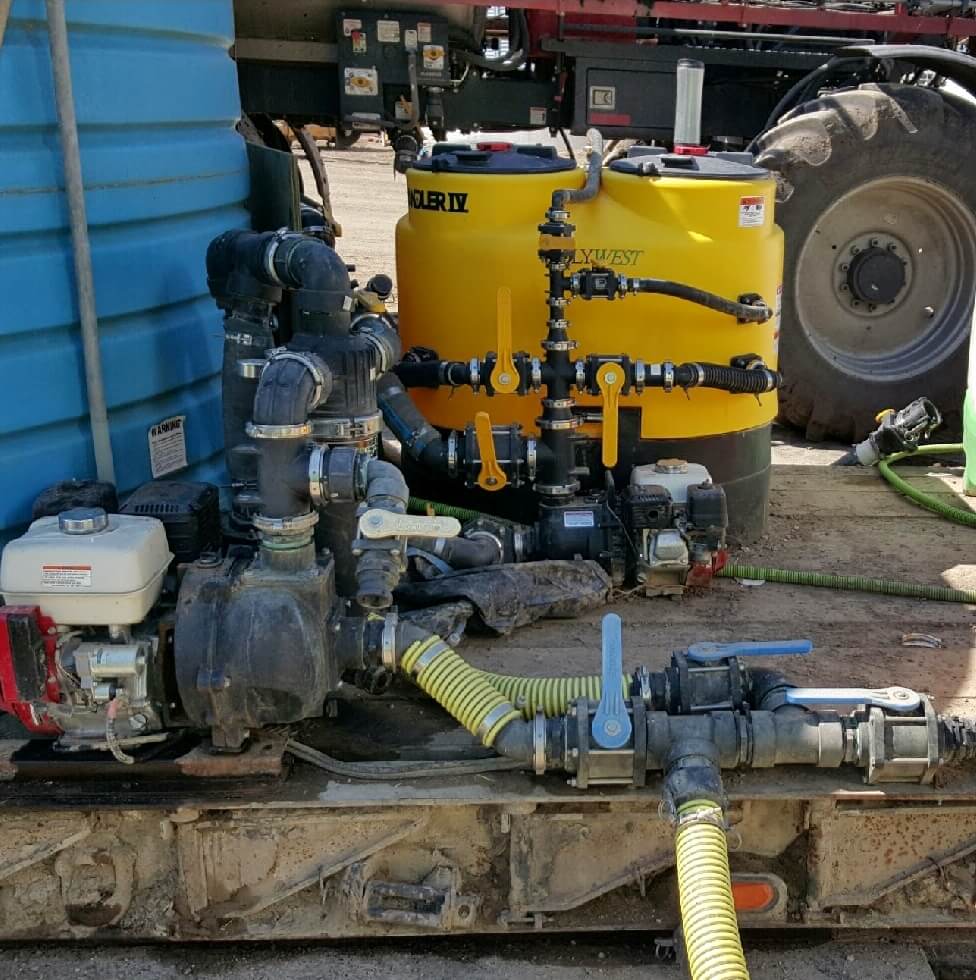
Filter:3” Helix filter with extra filter elements if you need to swap in the field. Two outlet ports off of the filter. One going straight to the venturi assembly/sprayer fill line, the other going to the Handler 4 or tank #1.
Tank #1: The front 4000 gal tank placed just after the upper deck.
Tank #2: The back 3000 gal tank placed on the upper rear deck over the tridem axles.
Chem Handler: A Handler IV with attached Honda pump. The secondary pump allows for the ability to agitate a chemical mix or dissolve a dry component. The pump can also quickly empty the handler in stream with the clean water while the 13 hp pump is filling if you don’t want to use the slower venturi option to suction out the product. The secondary pump does not need to be running to get pressure to the Handler rise ports as you can open the valve on the outlet side of it to get a supply of water from the primary pumps flow.
Venturi assembly: full 3” venturi and bypass. Venturi can suction either 2 different chemical barrels or totes and 2” suction of the Handler IV. The chemical induction ports are all dry poppet couplers and the lines 1” induction lines can be swapped if you change products. There’s also a clean dry poppet port to connect to easily flush any of the induction lines.
Flow Meter: There’s a 1” Banjo flow meter to measure the volume of chemical induced. One issue with this meter is that it doesn’t work with all chemicals but I switched to this make because it doesn’t restrict the flow. As nice as it is to use a venturi to transfer chemical is it does significantly increase fill times. (5 min vs 8 to 15 min.)
Level gauge: the level gauge on the front tank helped to minimize overflows and to more accurately fill the tanks to the desired level.
Chemical Payload: Room to fit up to 4 pallets of jugs or 4 450L totes.
Cage: Empty jug and box cage.
Our fourth submission was made by Kelly Baillargeon (@k_baillargeon) of Edam, Saskatchewan
“We have set up many spray trailers the last few years, each design has had its improvements. We run two sprayers between our farm and custom spraying business. It is very important to our operation to carry the sprayers, it allows the sprayer operator to be able to head out in the morning full of chemical and fuel and spray the entire day by himself. Our trailers have a 3200 US gallon tank on them which will give us three full fills on our 1000 gallon 4830 John Deere sprayers.
“We purchased a triaxle water tanker trailer from SGI salvage two years ago (sorry no picture right now as it is tucked away in a shed) that can haul 8000 US gallons per load that keeps our spray trailers full of water and allows my brother and I to spray all day. We built a large cage underneath the tanker out of iron and expanded metal (8′ x 8′ x 2′) that allows us to throw all of our empty chemical boxes and jugs in it when the spray trailer is getting filled with water.
“We used to buy older flat deck trailers and build sprayer cradles for them. But two years ago we decided to buy two of these spray trailers from Flamans in Saskatoon.
“The trailers are built for hauling a sprayer with the cradle being able to be folded up while not in use, which makes it nice for putting into storage or if needing to use the flat deck to haul anything else. These trailers should last a very long time for us.
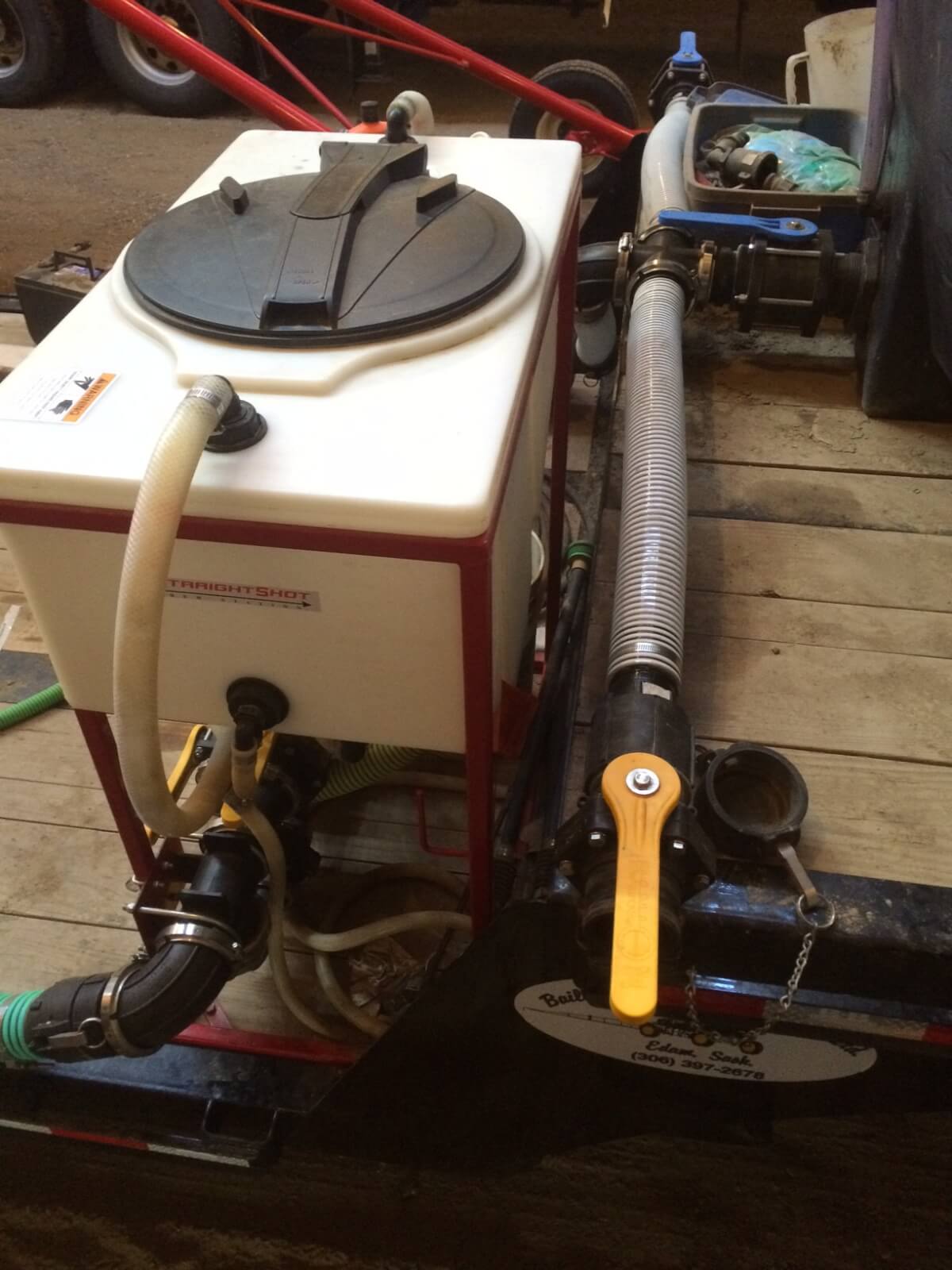
“We mounted one 3200 gallon tank on the nose of the trailer. This conserves valuable deck space, we used to use 2 smaller tanks, but this really compromised deck space on our trailer that can be used to haul lots of chemical. It is also much safer to have lots of room while mixing and filling the sprayer. We aren’t crowded or tripping over lots of hoses while working on the deck. There is a ladder stored on the side of the tank to be used if we are parked at a water source that we are able to throw a hose in the top of the tank to fill while we are out spraying.
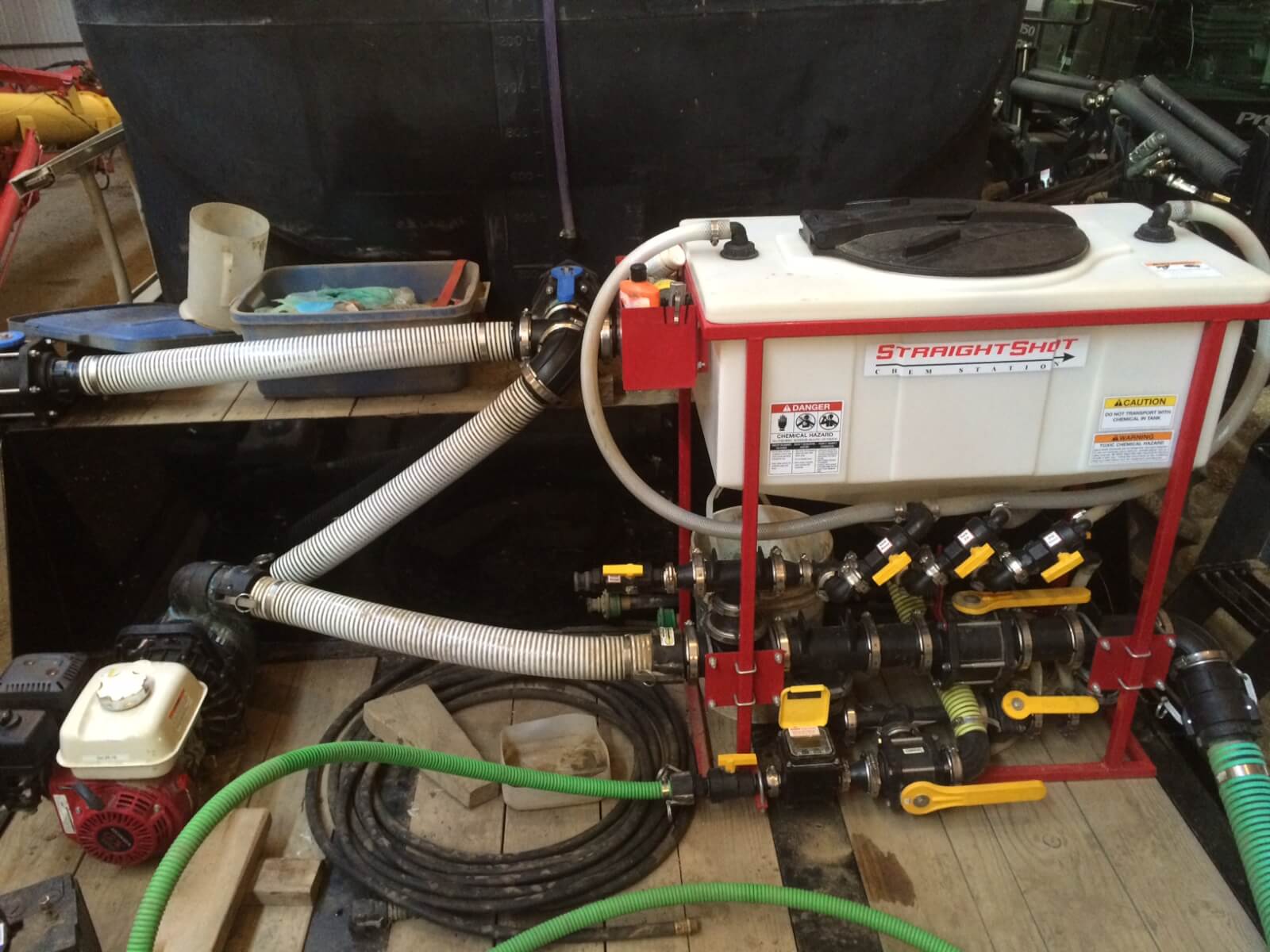
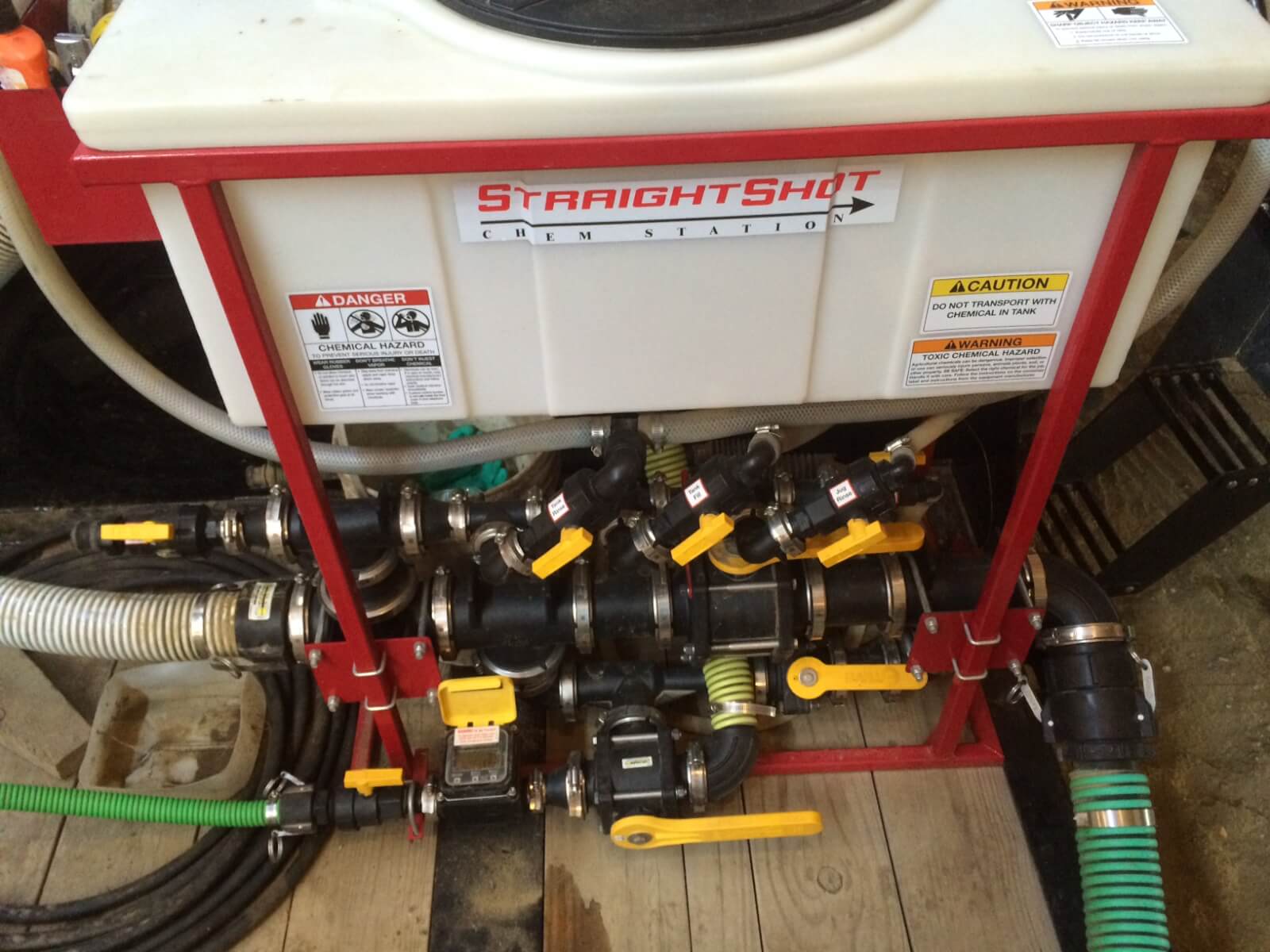
“Each time we have built a spray trailer we try to make the design more simple. In my opinion the less total plumbing I have on the trailer, the better. This makes it easier to teach someone how to use it as well as less chances of making a mistake. I installed a Straight Shot chem station this time, we always used Chemhandlers before and didn’t have any issues. But I really liked the simple straight forward design of this chem station. It is built very compact, saving on more deck space. Everything is very clearly labelled. It has 3” plumbing and when bypassing the handler to fill the sprayer with water, there are no bends or restrictions in the water stream, everything goes straight through. I find that it fills quicker than our Chemhandler did because of this simple plumbing.
“We use a 3″ Honda pump. I replaced the Soterra flowmeter that came with the handler (I had lots of issues with them in a very short amount of time) with a 1” Banjo meter. This meter has no restrictions inside of it, but will not meter products that are not electrically conductive. I have a backup spinning wheel style meter that I attach to the hose when using these types of products. The venturi on this Straightshot chemstation sucks extremely fast. I am able to suck glyphosate out of totes at 78 litres/minute while filling sprayer with water at the same time. Liberty is much slower, about 45 litres/minute. Seat to seat fill times on my 1000 gallon sprayer is 5-8 minutes depending how many products are being used.
“A rubbermaid tub with measuring jug, fittings, gloves and other safety equipment is located right beside work station. The large tank also includes a sight tube on it to prevent overflowing when filling.
“I used “sweep” 90 degree fittings everywhere the direction of water flow changes, these fittings are “wide open” and do not restrict flow. Another lesson I have learned is to use the flange style fittings everywhere possible, threaded fittings work ok, but a few years down the road when you have leaks showing up, you need to take apart most of your plumbing in order to repair them. Flange fittings don’t leak as much, most repairs involve tightening up the clamp and if you do need to take it apart, you won’t have to take apart any other fittings to change the seal.
“A close up of the chemstation:
“There is a connection on the left side that is used to flush out the chem induction hose. The tank on the chem station rinses really well as it has two spinning rinse nozzles inside the top of the tank. There is also a fresh water hose on it to help with rinsing tank or washing your hands.
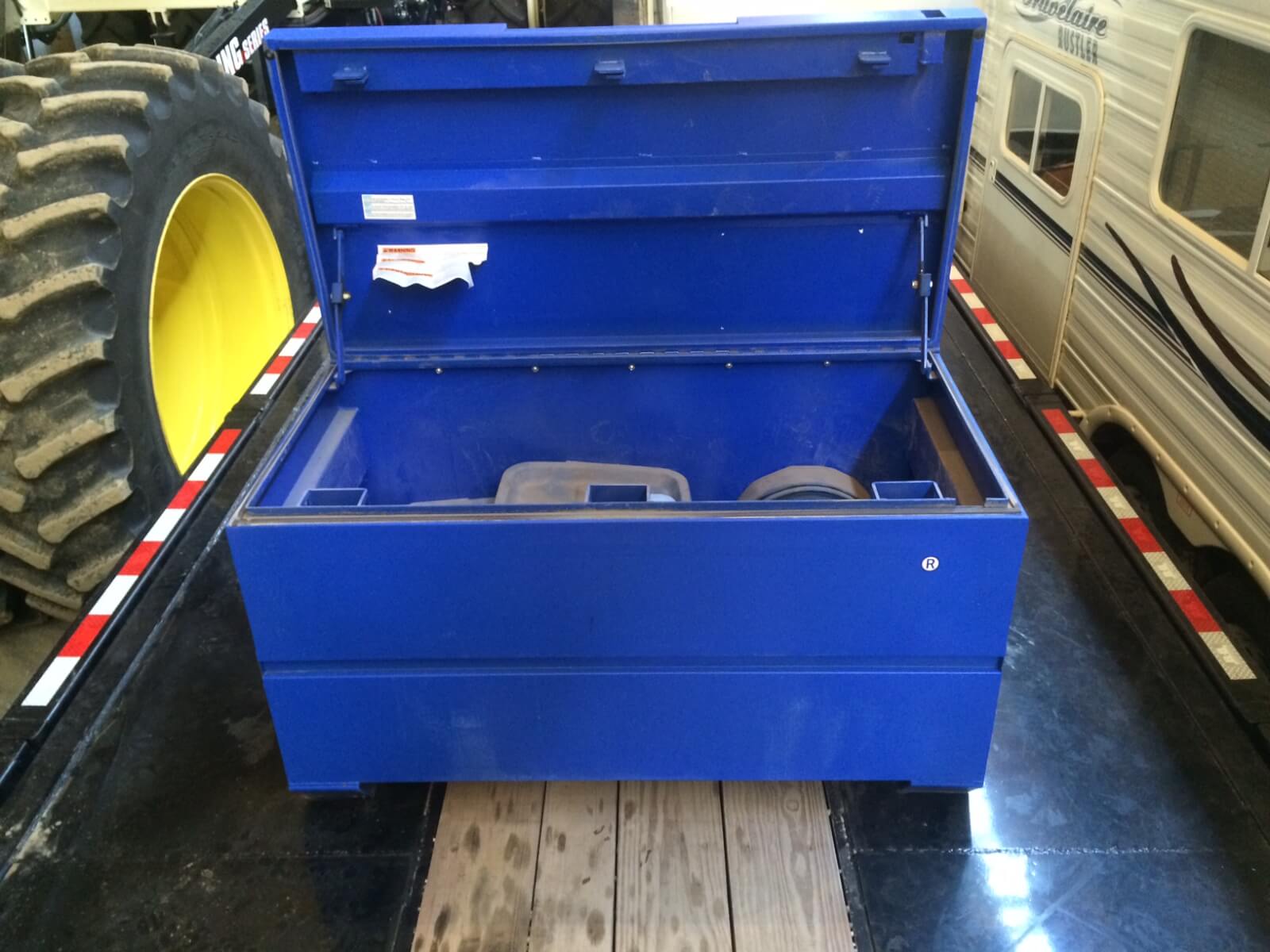
“Located at the back of the trailer, underneath the sprayer, is a large toolbox. I keep extra parts, safety equipment, small jugs of chemical, a firehose for fighting fires and ratchet straps for tying down chemical on the sprayer deck.
“The water tank is able to be filled from either side of the trailer from the ground by the nurse truck, depending how we are parked at the field.
“Long 3” flexible hose for attaching to sprayer:
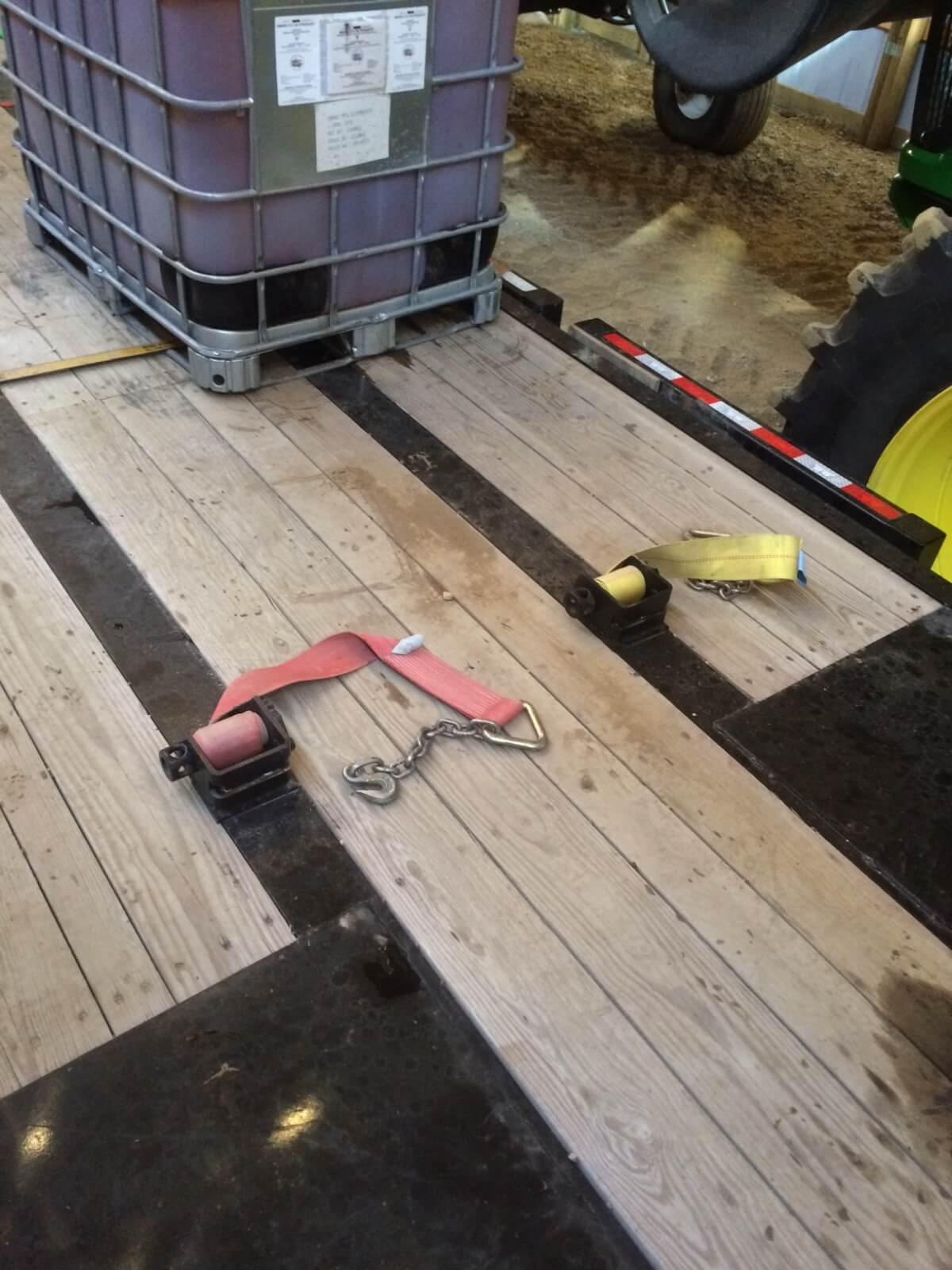
“I bolted 4 large ratchets (2 at the front and 2 at the back) to the trailer deck for tying the sprayer down when in transport. I find straps are much quicker and easier to handle than using chains to tie down the sprayer. I didn’t want to weld the ratchets to the deck because then I would not be able to remove them if we needed to use the trailer for something else.
“When I have the sprayer loaded on the trailer, I have lots of available deck space to carry chemical. I have had as many as 4 1000 L shuttles on the trailer at one time with plenty of room to walk around and work safely.
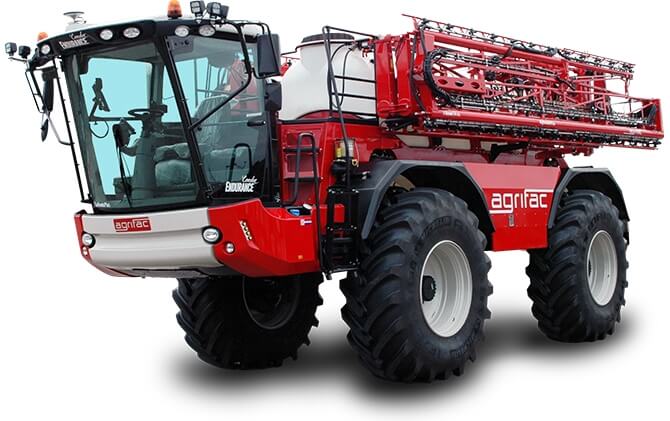
I like good ideas. And at Canada’s Outdoor Farm Show in Woodstock this fall, I saw a sprayer that puts a lot of them in one place. I’m talking about the Agrifac Condor Endurance. I’ve seen European sprayers before, even operated a few. And although they are all well-engineered machines, the Netherlands-based Condor might be the first one to gain traction in North America. Why this one? Let me explain.
Size: If you thought European machines are too small for North American conditions, this one breaks the mold. Sporting an 8000 L (2100 US gal) tank, track widths up to 4.6 m (15 ft), a 320 hp Tier 4 engine, and booms up to 55 m (180 ft) wide, it’s a monster. The smaller Condor offers tank sizes of 1050 or 1300 US gal and is a smaller machine overall.
The tank sump design ensures minimal remainders.
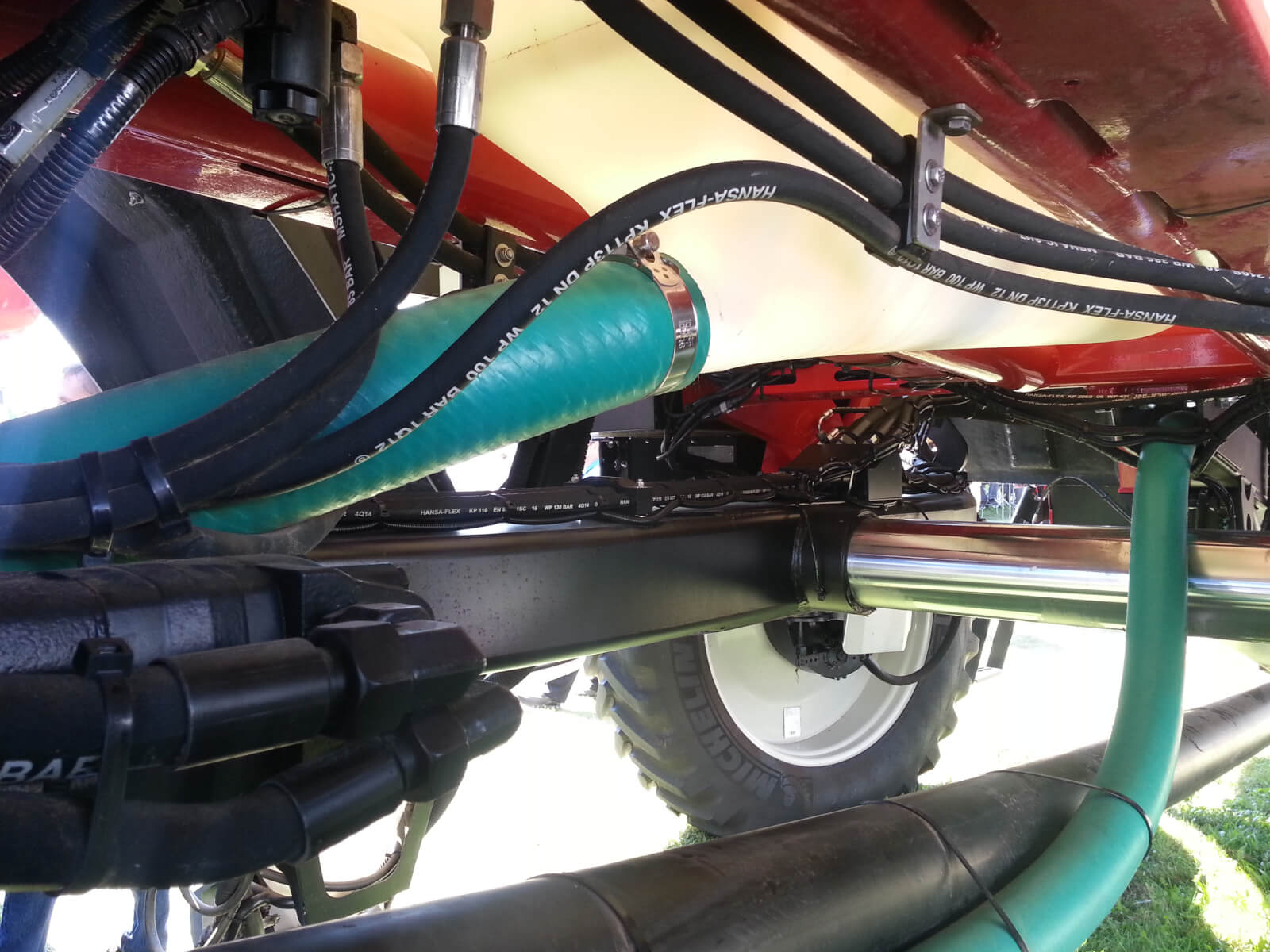
Tank and Pump: The large tank has a molded funnel sump that feeds directly into the pump. Net result is a design that empties the tank completely, leaving a tiny remainder amount, less than 2 gallons according to Rob Blijdorp, with Agrifac North America. Because most of us clean tank remainders by diluting them with clean water, this small remainder needs less water to dilute residues to safe levels, saving time when switching products. The machine is equipped with a Hypro centrifugal pump as standard equipment in North America. A diaphragm pump is optional. This pump type is unusual for North America, but it is self-priming, can run dry, and can produce very high pressures.
Wide booms with recirculating plumbing boost productivity and minimize waste (Source: Agrifac)
Boom: The boom widths available on the Condor are astounding, and there’s no easier place to use them than the North American Great Plains. Wider booms are one of the most effective efficiency boosts in spraying, and allow slower travel speeds while creating fewer tracks. The Condor boom has a recirculating design with a pressure feed from both ends, eliminating boom ends and increasing cleanout speed. Since it uses the boom as part of its circulation system, the boom primes at filling so the new product is at the nozzles right away. Sectional control is flexible, with nozzle-by-nozzle control available.
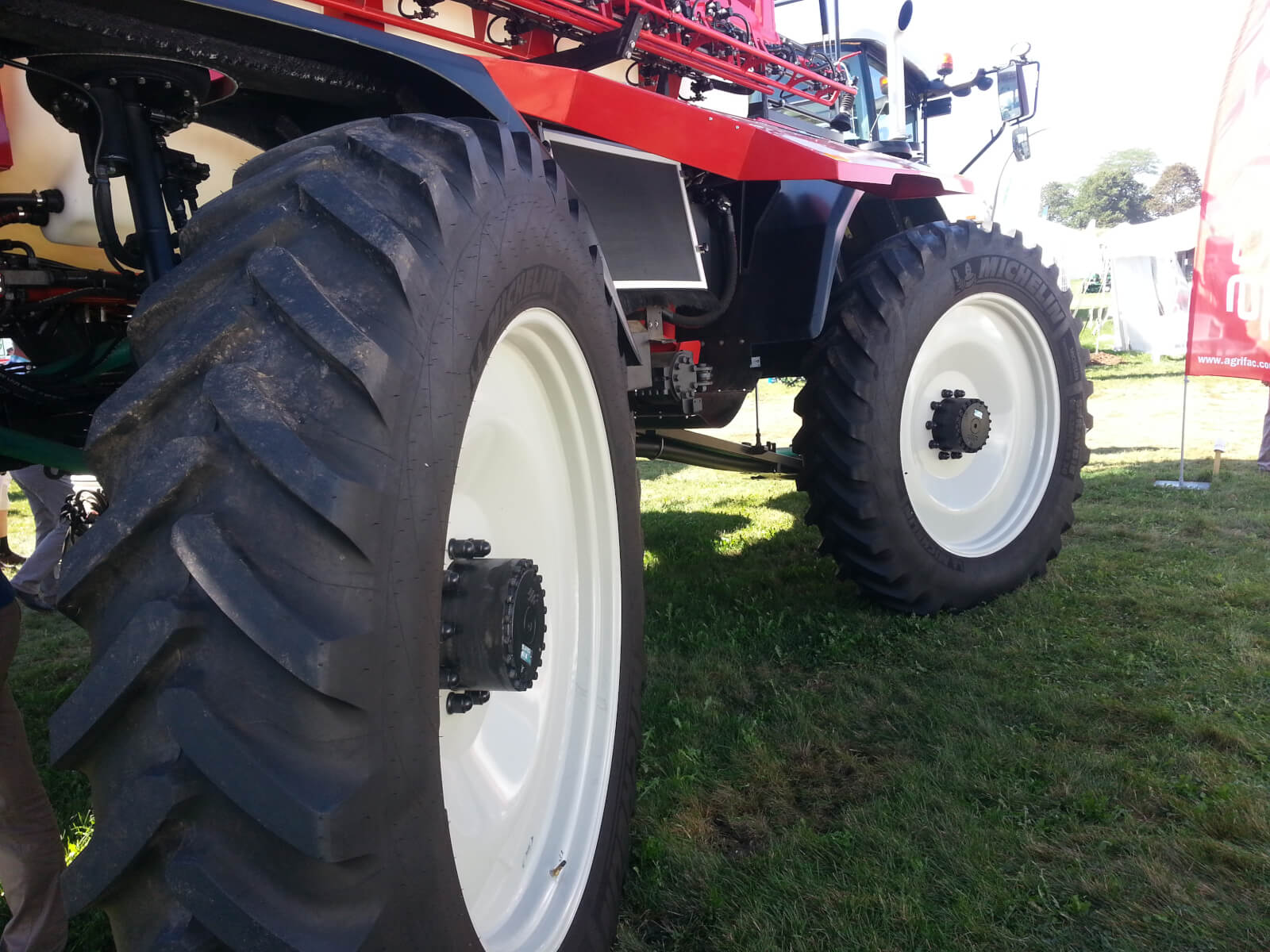
Four wheel steer on a walking beam chassis
Chassis: The frame and suspension system looks like a walking-beam setup, and is claimed to give a smoother ride with less transfer of bumps to the boom. The system has four-wheel steer capability for less tracking in turns, and a tight turning radius. The weight of the smaller Condor machine equipped with a 120’ boom is 24,500 lbs, the Condor Endurance with the same boom is 31,000 lbs.
The HighTechAirPlus atomizer is a twin fluid design that uses air to control flow and atomization.
Nozzles: I saved the best for last. Since 1989 (yes, I remember the year!), I’ve been a fan of “twin fluid” nozzles, but have not seen them take hold anywhere. The HighTechAirPlus nozzles are Agrifac’s version. Here’s how they work: Liquid is delivered to the nozzle in the usual way, by pressure. But air is also delivered, created by a dedicated air pump that has modest volume and pressure requirements. Both air and liquid make their way through the same nozzle (a deflector style, similar to the TeeJet FloodJet).
HighTechAirPlus installed. Note the air supply and the air-activated shutoff for individual nozzle sectional control.
The advantage? Liquid flow and droplet size can be adjusted independently, with air and liquid pressure. More air results in lower liquid flow. It also reduces droplet size. More liquid pressure increases flow, and also reduces droplet size. Clever combinations of both can keep droplet size fairly constant over a wide flow rate range. Alternatively, the nozzles can change droplet size while keeping the same flow rate, depending on the drift or coverage needs at the time. The travel speed range achievable is similar to that with PWM.
Verdict. The jury’s out. As a newcomer to North America, the Agrifac faces a few challenges. Many say it needs a dealer network, inventory and parts. It needs to prove its reliability. It needs to be able to service its machines, especially if parts are non-standard. It needs field cred out here.
But I’m a bit tired of our North American sprayers adding horsepower, speed, and weight to their sprayers each year, and little else. They leave applicators to struggle alone with equally important productivity factors such as quick and thorough cleanout, drift management, nozzle selection and others.
The things that strike me with this new sprayer are Agrifac’s innovative design, and its emphasis on issues that matter to applicators: productivity and excellent control over application rate and droplet size. The company has the right priorities in my books.
Biopesticides are a rapidly growing segment in horticultural pest control. While they are often billed as green “miracle cures”, applicators should be aware that they require unique considerations. Issues with lifespan, target specificity, and application technology can all impact their efficacy. However, like any pesticide application, careful planning can minimize wasted time and money.
Typically defined as pesticides derived from “natural” sources, biopesticides contain active ingredients extracted from plants, microorganisms, animals, and/or certain minerals. Given their origin, and the fact that many biopesticides are living organisms (as is the case with most of the microbial-based pesticides), they are often photo-sensitive and quickly break down. This generally means that they need to be re-applied often.
Mixing and handling
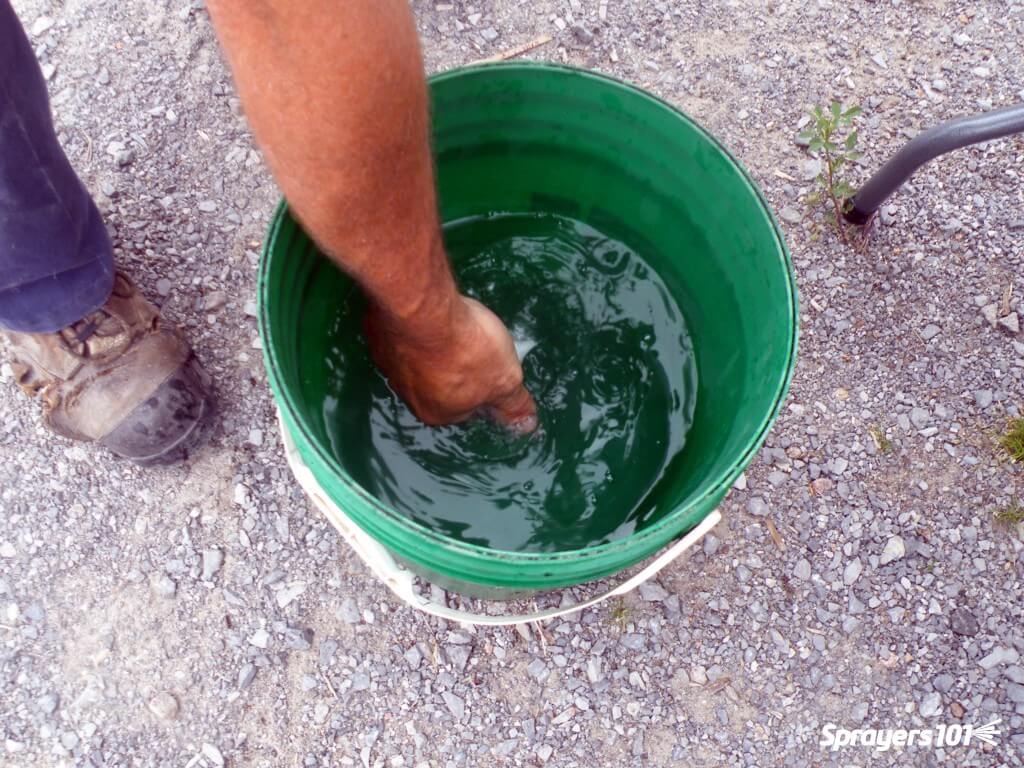
Pre-suspending nematodes before inoculating the spray tank.
Consideration should also be given to the lifespan of these products during the application. Many have an optimum pH for both the carrier water and the soil, and a limited temperature range outside of which they may not be active. As already mentioned, direct sunlight can quickly degrade many biopesticides, which means they should be applied either early or late in the day. Timeliness is also a factor: efficacy can be greatly reduced if the product is not used quickly – many biopesticide organisms begin to break down as soon as they are tank mixed. Also, be aware that it can be difficult (or impossible) to find suitable tank-mix partners. For example, a fungal biopesticide obviously shouldn’t be mixed with a fungicide. That also leads the applicator to consider their spray program carefully and clean their sprayers thoroughly between applications.
Efficacy
Applicators should understand how each biopesticide is supposed to control (or more likely, supress) pests. Many biopesticides have to be ingested or physically contact the pest. As such, they often need high application volumes to ensure sufficient coverage of all target surfaces. Many are slow to control the pest, so the applicator may mistakenly think the product is not working, and reapply unnecessarily.
Application equipment
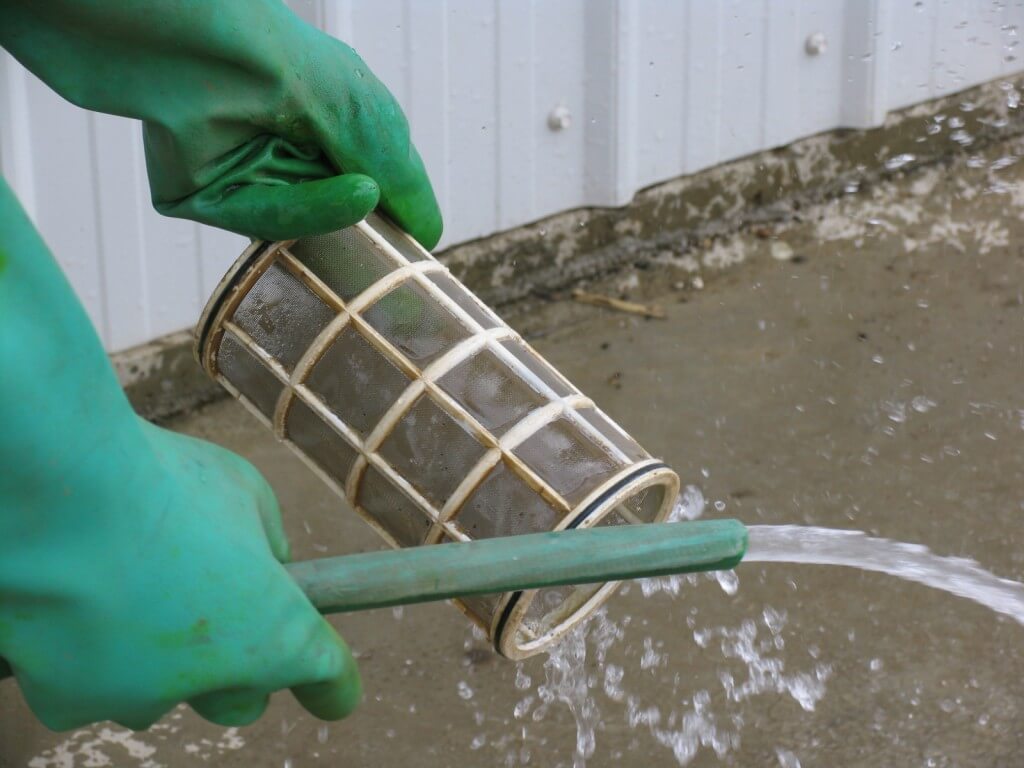
Cleaning a strainer – image courtesy of M. Lanthier.
Applicators may need to reconsider their current equipment when using biopesticides. If the product has to contact the pest, high droplet density is preferred. This can be accomplished with high volumes, but also with higher droplet counts, and that means smaller droplets. Drift issues aside, many biopesticides are actually living organisms (e.g. nematodes) which might be negatively affected by the small nozzle orifice.
The “Spray Guy”, Dr. Jason Deveau, (Application Technology Specialist with the Ontario Ministry of Agriculture, Food and Rural Affairs) suggests using a nozzle with a larger exit orifice and no pre-orifice to minimize clogging or any potential damage to the microorganisms. Clogging can be further reduced by using a minimum of three levels of filtration on a sprayer. With proper agitation, a tank basket, suction filter at the pump and slotted strainers behind each tip should catch any “chunks”. In-line filters at the boom are also potentially helpful. Each filter, from tank to nozzle, should be filter smaller particles than the last. Cleaning screens diligently and inspecting the effectiveness of the agitation system, should be part of every spray day.
Applicators can account for many of these issues by understanding what the biopesticide is and how it is intended to work. Consider these questions:
When is the pest active/vulnerable?
Under what conditions does the product need to be used to be most effective?
Are there special handling or mixing considerations?
What do I need to have in place to minimize the time between mixing and applying the product?
Ultimately, an effective application of biopesticides relies on integrated pest management (IPM). Biopesticides can work as advertised when used thoughtfully and appropriately. Understanding the products benefits and limitations will ensure applicators reap the full benefits of these new and evolving methods of control.
How often do you test spray-water quality and what do you do if you’ve got hard water?
If you’re looking to replace your spray tank, is stainless still the way to go?
What about double nozzles — are they really the bee’s knees?
The questions surrounding these aspects of spraying come up very often.
Tom Wolf recaps some key aspects of water volume and water quality you may not have considered, plus we get that answer on when a stainless steel tank might be the right choice.
Moving on to nozzles and overall spray operation tweaks, Wolf summarizes the reasons for moving to double (or twin-fan) nozzles in some scenarios, plus offers some insight into where your time may be best spent on improving your fill transfer set up.