What’s the most underused active ingredient when creating a proper tank mixture in a sprayer?
Patience.
Spray season is never long enough. The days which are most conducive to spraying are hard to come by. Therefore, the ingredient we need the most when spraying as well as tankmixing is patience. Without it, we are setting ourselves up for failure.
Successful bakers will tell you that patience mattered when perfecting their most decadent creations. By taking their time, adding ingredients slowly and mixing them carefully, those professionals create stunning masterpieces.
We can achieve a masterpiece as well, if we remember to slow down and apply the same principles.
1. Take your time
Take 7-10 minutes between product additions to a spray mixture (especially dry formulations). Have a mini-vacation after each addition! This time allows each product to dissolve into solution and you can complete your spray records!
Extra time allows pesticides to be fully integrated into the spray solution before another product is added, which could impede either formulation from mixing successfully.
Each ingredient must be uniformly mixed before adding the next component. E.g. A soluble powder must be completely dissolved before adding the next item.
2. Add ingredients slowly
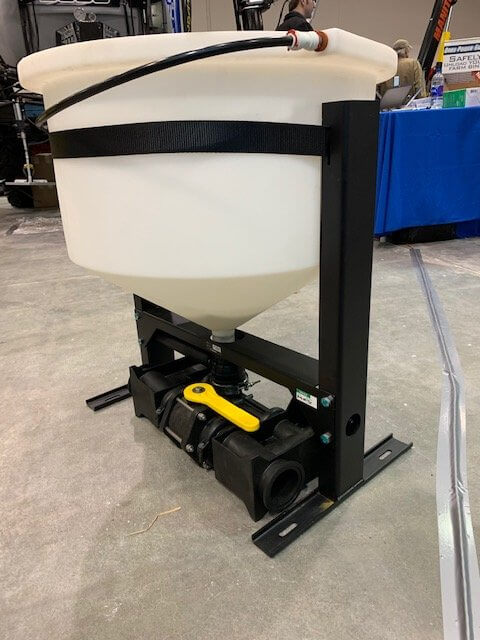
Add products, one at a time, in the mix cone or inductor. If you’re adding product directly via shuttles and dedicated lines, the same principle applies.
Rinse mix cone or inductor and lines with clean water between product additions.
Tank, cone or inductor, mix products one at a time and rinse between additions.Anything resembling cottage cheese in your spray mixture is not a spray masterpiece.
Never “stack” ingredients on top of each other in the mix cone or inductor. Much like oil and water don’t mix, chem-on-chem doesn’t mix either. Active ingredients need water in order transition into solution. It’s vital to not pile products into a mix cone or inductor where they can form cottage cheese instead of a liquid solution.
In my neighborhood, 3″ fill lines are not uncommon. They are a source of time savings when filling but they also bring additional cautions. Be aware of the problems over agitation can bring to what might have been a successful tankmix.
3. Mix carefully
Start with sprayer tank 1/3-1/2 full to allow enough water to create a great solution.
Pre-slurry dry flowables in warm water whenever possible. Yes, it takes additional time and effort but it can prevent having to wash out individual nozzles and strainers later. Or worse, there’s the possibility that the tiny grains of an active ingredient that did not blend into the solution may cause injury to a off target crop.
Mix ingredients in the right order! Typically, crop protection products have a mixing order specified on their labels. Read the label and be familiar with the correct formulations you are currently spraying.
Adjuvants are added in the same sequence as pesticides, e.g., ammonium sulfate is a soluble powder, oil adjuvants are emulsifiable concentrates; and most surfactants are solutions.
Within each group, it is common practice to add the pesticide before the adjuvant, e.g., a soluble-powder pesticide before ammonium sulfate.
Final thoughts
Taking the extra 30 minutes now to load the sprayer carefully will save you the potential of 4 hours of having to clean out an entire tank later!
It happened three times this spring. As is often the case, I was contacted by growers who wanted help with herbicide application. In most of these calls, the discussion revolves around the proper choice of nozzles for a specific task, perhaps some questions on spray pressure, water volume and travel speed.
But these three were different. Instead of being seasoned applicators, all three were new to the business. And more importantly, they had done their homework by looking at product labels before calling.
Labels give us important information on product rates, crop and weed staging, mixing order, sprayer cleaning, and personal and environmental protection. They’re very valuable there. But they also provide application information, and that’s where the problems begin.
Perseverance Required
I have to commend my three clients: they showed great tenacity by actually finding application information on a pesticide label in the first place. This document is so mired in legalese protectionist language at the front that it discourages all but the most persistent.
And often, the application information comes in several parts, interspersed among other information. Mixing instructions. A little later, application. Somewhere nearby, buffer zones. Another paragraph for cleaning. Rainfastness? Keep looking.
It forces the reader to skim through the document, hunting for relevant information.
But once my clients found application instructions, they obviously questioned if they should believe it, or else they wouldn’t have called. The application statements on many labels, simply put, are from long ago, and it’s obvious.
Consider the following two label excerpts, the first from a product initially registered in the mid 1980s and still available, the second from one registered about 30 years later:
1980s:
Application should be made using a minimum of 55-110 litres of water per hectare, at a pressure of 275 kPa, or 310 kPa if using check valves, and at a ground speed of 6-8 kph.
The use of 80° or 110° flat fan nozzles is recommended for optimum spray coverage.
Do not use flood jet nozzles, controlled droplet application equipment or Sprafoil® equipment.
Application of the spray at a 45° angle forward and higher water volumes will result in better spray coverage and penetration of the crop canopy.
Uniform, thorough coverage is important to obtain consistent weed control. Higher water volumes should be used under dense crop and weed canopies to ensure thorough coverage of the target weeds.
2010s:
Apply in a spray volume of 46.8 – 93.5 L/ha unless otherwise specified in tankmix partner section of this label – at 207-345 kPa (30-50 PSI) pressure to ensure proper weed coverage.
Flat fan nozzles of 80° or 110° are recommended for optimum coverage.
Do not use floodjet or controlled droplet application equipment or Sprafoil® equipment.
Nozzles may be oriented 45° forward to enhance crop penetration and to give better weed coverage.
Uniform, thorough coverage is important to obtain consistent weed control. Higher water volumes should be used under dense crop and weed canopies to ensure thorough coverage of the target weeds.
Thirty years apart, but remarkably similar.
Crop protection companies spend about 10 yrs. and $250 million to produce a new pesticide and register it for use. Having made this commitment, it would be most useful to see a small further investment to provide current application information that is relevant to applicators.
After all, these applicators purchase the active ingredient to provide a return on this multi-million dollar investment, to the tune of about 2 billion dollars per year in Canada alone. They deserve good application information.
Imagine this scene:
“Doctor, thank you for this new high tech pharmaceutical engineered to help me with my serious illness. How should I take it?”
“Not sure. Here, read this cough syrup label I found in my drawer. Should be pretty close.”
It’s clearly ridiculous
Let’s dissect these labels to see how they could be improved.
Flat fan nozzles of 80° or 110° are recommended for optimum coverage…
Our sample labels refer to what we assume are conventional flat fan nozzles. While popular in the 80s, these have all but disappeared from sprayers over the course of the past 20 years or so. We haven’t recommended them since then because they drift too much. They’ve been replaced by low-drift nozzles, either pre-orifice, or air-induction.
Nozzle fan angles are now generally 110 degrees or more, and frankly, the difference between 80 and 110 degrees is not that important. What’s important is proper overlap, achievable with a visual assessment followed by boom height and pressure adjustments. Unfortunately the label is silent on that.
Application should be made … at a pressure of 275 kPa, or 310 kPa if using check valves…
A nozzle’s recommended operating pressure depends on the specific nozzle model and on the spray quality (average droplet size) required. With literally many dozens of nozzles now available to each applicator, general pressure suggestions are likely to be wrong, and are more of a liability than a help. And they force label non-compliance when over-ruled by a nozzle manufacturer’s recommendations.
Speaking of spray quality, growers crave to know at what spray quality a product should be applied for best performance and lowest drift. Some labels refer to spray quality (e.g. “apply with a Coarse spray”), but this is with reference to spray drift and buffer zone distances, not efficacy, and that distinction is not made. Knowing the right quality for efficacy would help applicators choose the right nozzle and pressure to meet that criteria.
Higher pressures if using check valves? Nobody has brass screens with check valves anymore. Sprayers have had modern diaphragm check valves for a generation, and those don’t produce pressure losses.
And we all know that six to eight km/h is hardly a common speed these days.
Do not use floodjet or controlled droplet application equipment or Sprafoil® equipment
Sprafoil nozzles have not been produced in Canada for about 25 years, in fact their manufacturer is no longer in business. Controlled droplet atomizers, while becoming more popular again on aircraft, were last seen on ground sprayers in the 1980s. Even then, total installed numbers were probably in the single digits.
As for FloodJet nozzles, those went out of style for herbicides in the late 70s, and were replaced by the very successful TurboTeeJet nozzles shortly after.
Nozzles may be oriented 45° forward…
Nozzles are rarely tilted 45 degrees forward for herbicide application anymore. Maybe that’s because spray booms aren’t built that way today, or because modern booms on self-propelled sprayers are now about 30” (75 cm) above ground, and we travel at about 15 mph (22 km/h). So the forward tilting, though shown to be effective for grassy weeds at 5 mph (8 km/h) and 20” (50 cm) boom heights, as researched in the 1970s, isn’t relevant for herbicides with higher booms.
Uniform, thorough coverage is important to obtain consistent weed control.
Statements advocating for good coverage are nice, but they aren’t useful. Everybody knows we want good coverage. What applicators need to know is how they should measure coverage, and what good coverage actually is. Can we use water-sensitive paper? How much of the target should be covered? How many droplets should be in each square centimetre? How can we measure that in the field, right now? How does it depend on the crop canopy, on weed stage, and on spray quality? The more information an applicator gets, the higher the chance of success.
Apply in a spray volume of 46.8 – 93.5 L/ha…
The only statement that survives our little examination is about water volume. Water volume is important. But even there we have a problem. The volume is in L/ha. This is useful in some parts of Canada, but not in the west, where producers communicate primarily in US gallons per acre. And in the west, provincial guidelines have generated this odd hybrid of L/acre, which few people use for spray volume. But 46.8 to 93.5 L/ha? How is that level of precision justified? (I know that this is a conversion from 5 and 10 US gpa…so why not just say so?)
A Solution
The problem with having outdated or impractical information on labels is that it creates disrespect. Since labels are documents enforceable by federal law, applicators want to comply. At this time, they can’t, and probably shouldn’t, if they want to do the job right.
A vision for a good label should be one that respects the needs of the applicator. Such a label:
places the information that applicators need at the top;
is updated regularly to reflect modern practice and useful advice;
helps a new applicator work out how to apply the product with any equipment;
identifies a spray quality that offers good coverage and low drift;
makes reference to research that supports variations in the application guidelines;
is available electronically, readable on a mobile device, i.e., not pdf.
This label would protect the environment and bystanders, and would foster better pesticide performance.
This label is easy to generate.
This label would be read by applicators.
What’s it going to take?
Additional:
This article created a great deal of discussion. We decided that if we were going to point out issues with the current labelling system, we should also propose a way forward. Read about our Label Summary Sheet proposal.
Some of our biggest struggles in spraying involve the start and end of each spray day.
When starting a new field after the sprayer is cleaned, we need to prime the boom. If it’s full of water, that water has to be purged and the question is always for how long and where to do this (pro tip at bottom of article).
At the end of the day, we should ideally clean the sprayer. During that process, we may struggle with waste disposal, including large rinsate amounts, and course, the uncertainty of whether the job is actually done (since clean water looks exactly the same as contaminated water).
If not cleaning the entire sprayer plumbing, we should at least rinse the boom, even if we’re returning to the same product the following day. It can prevent future problems.
These tasks are complicated by the increasingly convoluted plumbing featured on modern sprayers. Ask someone to explain their sprayer’s plumbing system to you one day. It’s a long story! A bright spot is the well-engineered, compact, and accessible Agrifac system.
Fortunately, virtually any sprayer can be modified to suit your needs. Let’s talk about a few ideas for a winter project:
Boom flush. It’s good practice to flush clean water through your boom at the end of spraying even if the main tank remains full of product. Some sprayers have an air purge system to eliminate liquid from the plumbing and that is a great feature. A water flush should follow that purge so that any residual pesticide is diluted and removed before it can dry on and become hard to remove later. First you’ll need a clean water tank on the sprayer (150 gal is enough). Second, plumb a feed so that this clean tank can be the sole source of the water supplied to the solution pump. Select this source, shut return lines down or off, and pump clean water through boom. Sprayers that have an auto-rinse cycle will likely be able to draw clean water, but may not be able to push it to the boom, directing it to the wash-down nozzles instead. Check to see what’s possible, and make the changes you need.
Clean water pump. Installing a second pump dedicated to the clean water tank has several advantages. We’ve talked about continuous rinsing before, here, and here, as a way to dilute the tank remainder faster. It requires installation of a second pump dedicated to clean water. Additionally, give this pump the option to deliver water to the boom, not just the wash-down nozzles. Now it can be used to rinse water through the boom. The main challenge is to obtain a pump capacity that can match the needs of the boom and/or the wash-down nozzles.
Boom ends. We’ve mentioned this part of the boom many times. Boom ends must be flushed regularly to get rid of product and possibly debris that gets stuck there. A simple way to achieve this is to use the Express Nozzle Body End Caps from Hypro. These bleed air continuously, and also prevent accumulation of dead-end contamination. They do need to be flushed, and this can be done by pulling a plug or rotating the turret to an open (no nozzle ) position.
Recirculating boom. This is a significant change, but worth considering. Conventional plumbed booms are separated into five to 13 sections. Each has two ends at which the spray stops and where air and contamination can accumulate (see point #3). Each section feed has a shutoff valve. Once the spray mixture leaves the pump and bypass valve, it is committed to leaving the sprayer. In a recirculating boom, the boom becomes a part of the tank and the liquid can return to the tank if desired. Spray is pressurized at one or both ends, and valve positions determine its flow. Sectional control is achieved with individual nozzle shutoff, air or electric.
Three advantages: (a) the boom can be primed with new product without spraying. The surplus goes back to the tank. (b) the boom can be flushed with water without spraying while material is still in tank, and without spilling anything on the ground. Again, the surplus goes back to the tank. (c) high resolution sectional control with individual nozzle shutoff is a byproduct of this design. Fast response, high res, saves money.
Steel lines. Steel cleans easier than plastic, and this material makes a lot of sense for booms. But it also makes sense for the boom feeds, currently handled by black rubber hose. This hose is a literal black box. We can’t see inside it, and we don’t know if and where potential contamination resides. It has considerable surface area. Consider replacing portions of your feed lines with steel. The boom is the obvious candidate. Aside from easier cleanout, it also helps with faster nozzle shutoff because it doesn’t expand with pressure.
A word about dumping the tank on the ground. It’s a bad practice for many reasons. Let’s examine just one of those. When you spray a product at 10 gpa, you actually cover each square meter with about 10 mL, or 1/3 oz, of spray mix. When you flush your boom ends on the ground, you’re probably dropping 2 or 3 gallons in the same area. That’s 1000 times the label rate at each boom end, 10 to 26 times per boom. If you dump your tank remainder and all the hoses, say 20 or 30 gallons, that’s 10,000 times the label rate if it covers 1 sq meter. That’s leaching, runoff, residual potential, and not a good story.
Many of the changes we outlined above help prevent that from being necessary.
Pro Tip: To find out how much water your plumbing (from the pump to the boom ends) holds, do this: After cleaning with water and before spraying an EC formulation (white milky appearance in tank, some crop oils are ECs) reset your sprayed gallons on your rate controller. Start spraying and watch for the last nozzle on your furthest and longest section to spray white. Stop spraying and check your sprayed gallons. That’s your volume. No matter the size of nozzle or application volume, it stays constant. To be sure the boom is primed with a new mix, spray until those gallons are reached and you’re set.
Not being able to finish a tank due to weather or any other reason happens to just about everyone. Is it OK to simply leave the sprayer as is, and resume spraying later after some agitation?
In many cases, the answer is yes. Most pesticide mixtures are stable in short term storage. On resuming spraying, an agitation could be all that’s needed to get back to where you started a day or so earlier.
But there are three important exceptions.
When the active ingredient is formulated as a suspension. Suspensions are typically wettable powders and flowables, and rely on a clay carrier to distribute the active in the tank. Because clay is denser than water, these formulations settle out quickly after agitation stops. Sure, they can be brought back into suspension with vigorous agitation. But in lines and booms, boom ends and screens, dislodging a settled clay carrier is much more difficult. It’s also hard to tell if the cleaning has been successful because the problem spots are hidden.
The best solution is to flush the spray boom with water before materials can settle and lodge. A visual inspection where access is possible, such as strainer bowls and boom ends, is part of the process to ensure the formulated product has been removed.
Learn to identify which formulations are suspensions. There’s lots of jargon out there. Look for terms such as DC, DF, DG, DS, F, Gr, SP. Even EC formulations are suspensions (oil in water) and require agitation.
When the active ingredient is chemically unstable. Some pesticides can degrade in the tank, usually due to alkaline (high pH) hydrolysis. The effect is very pesticide specific, but in general, insecticides (particularly organophosphates and carbamates) are more susceptible than other pesticides. This fact sheet by Michigan State University describes the impact of pH on a the half-life of a large number of pesticides.
Note that in the examples in the MSU fact sheets, pesticide half lives are typically days and weeks, and only rarely hours. Also note that while high pH is most often problematic, low pH can lead to faster breakdown in a small number of products.
Ensuring tank mix stability requires a pH meter or paper, and possibly a pH modifier such as citric acid. But do your research first! Here’s an article on pH and water quality.
When the tank previously contained a product known to harm the current crop. This situation is most common and most difficult to address. Some examples from western Canada are Group 2 modes of action sprayed prior to a canola crop. Why are Group 2 products implicated? Many are formulated as dry products on a clay base, and these can settle in boom ends, adhere to tank walls, or get stuck on screens. Their solubility is pH dependent, as we explain in this article.
Canola is particularly sensitive to this mode of action, and the most common canola herbicides, Liberty and glyphosate, are formulated with strong detergents that act as tank cleaners.
Even when applicators think that their tank is clean, they can’t actually be sure and can’t do much about it at that stage. The stripping of tiny amounts of residue off the tank walls, filter screens, or plumbing, can happen during a mid-day stop or an overnight break. Applicators eventually find out that this happened, usually about two weeks after spraying.
Our advice is:
After spraying a herbicide to which a subsequent crop may be sensitive, with the classic case being a Group 2 and moving to canola, be extra diligent with cleaning and pay attention to the tank walls, all screens, and boom ends.
The best way to solve issues is to avoid them in the first place. If the weather looks unsettled and may interrupt your spray operation, consider mixing smaller batches that can be sprayed out completely even if conditions change quickly. This allows you to rinse the tank and spray water through the boom, thus avoiding a contamination problem developing overnight.
If that’s not possible, at least do not let a tank mix sit in the boom overnight. Instead, use your clean water tank to push water through the boom prior to storage and double check the screens. The following day, prime the boom with your tank mix as usual and resume spraying the crop.
If you’re not sure that your sprayer can draw from the clean water tank and push through the booms (the wash-down nozzles are, after all, the intended destination for that water), decipher your system and add the necessary valves that make this possible.
A useful design that helps flush and prime a boom quickly is the recirculating boom offered by some aftermarket boom manufacturers. These booms are also more common on European sprayers. A nice feature of such designs is that the tank contents can be pumped through the entire boom assembly without actually spraying. This ensures that the boom is primed without any soil contamination. It also dilutes whatever residue there may be in the boom plumbing with the entire tank, likely reducing its concentration enough to be of little concern.
An additional feature of recirculating booms is that many offer stainless steel tubing throughout most of their feed and return length, minimizing the black rubber hose products that often adsorb, and later release, herbicide contamination.
Even if a wholesale boom or sprayer change is impractical, consider switching to steel boom lines and tanks tank to minimize residue carryover.
As is often the case in the spraying business, prevention is easier and less costly than solving a big problem later. Spray mix storage is one of those examples where a small amount of extra effort at the beginning can pay big dividends later.
One of my main activities in the winter is public speaking. Attending producer meetings gives me the privilege of meeting many farmers, learning about their operations, and sharing my research results.
I enjoy providing practical solutions to problems. But there are three issues that always come up to which I wish I had better answers. Here they are:
The Correct Spray. We’re stuck with compromises in this area. We need small droplets for coverage. We need large droplets for drift control. We need to keep application volumes moderate for productivity. We’ve basically asked the nozzle to shoulder the entire burden of our application needs, seeking a spray that hits all the right notes. Not too fine. Not too coarse. Able to work with fast and variable travel speeds and high, variable boom heights.
Based on our research in field crops such as wheat, canola, corn, lentils, etc., we can be confident that Coarse, even Very Coarse sprays, coupled with a reasonable water volume, are appropriate for most modes of actions and target situations. These sprays contain enough small droplets for good coverage, and their larger droplets work surprisingly well in most cases. Sure, a finer spray could save some water. And a coarser spray would reduce drift even more. But we need a compromise spray, combined with some lucky weather, to get the job done.
And yet we usually make spray quality recommendations with caveats, because droplet size alone isn’t enough. Drift is always a possibility, no matter how coarse we go. Coverage is not guaranteed, especially if the canopy is dense. Finer sprays will get deeper into a broadleaf canopy, but then we may have drift or evaporation to deal with. The nozzle size, volume, and travel speed relationship has to be just right so the spray pressure is in the correct range. And on it goes.
I’d like to give the overworked nozzle some help. We used to use shrouds to protect fine sprays from drift. Now it’s time to let air assist take over that task.
Air assist booms can accelerate (i.e., add kinetic energy to) small droplets so they’re less prone to off-target movement. Properly adjusted, air assist can carry these droplets deeper into the canopy and enhance their deposition.
A good air-assist system allows the user to select the strength and direction of the airblast to match canopy, boom height, and travel speed conditions.
Air assist is the workhorse of most fruit-tree and vineyard spraying. It has to be done right to provide all the benefits I mentioned, and certain approaches should be rejected. For example, there are some companies using air assist to promote very fine sprays with very low volumes. That’s the wrong use of the technology, and invites a backlash.
Instead, we need systems that work with existing spray practice to address some of its classic shortcomings, such as drift management, deposit uniformity, and canopy penetration.
Let’s see some products. It’s time to bring air-assist to the mainstream of agricultural spraying.
Boom Height, Level, Sway and Yaw Control. Boom height is so fundamental it’s almost boring. We’ve long said that it’s important to set the boom at the right height for proper nozzle overlap and drift control. It was easy with wheeled booms. But over the last 15 years, suspended booms coupled with fast speeds have caused booms to rise again (RISE OF THE BOOMS!).
Fact is that there are some tasks we’re asking of nozzles that they simply can’t achieve without level, low booms. Drift control is one such thing. Low booms are surprisingly effective at reducing drift, not only because winds are lower closer to the canopy, but also because droplet velocities are faster closer to the nozzle.
Angled sprays for fusarium headlight control are another thing that is more effective with low booms.
Spray droplets released from an angled spray soon slow down and get swept back by air resistance and begin to fall vertically, or move with wind currents, reducing their intended benefit. Low booms can prevent that.
Uniform and low booms also keep deposit variability more manageable. They can save energy needed for air-assist systems. The shorter the path to the target, the less air-velocity will be needed to get it there.
So how about it? Can we have boom linkages and suspension systems, coupled with sensors and hydraulics, that are stable and maintain 20” above canopy at 16 mph on uneven ground? Can we have systems that do this reliably enough that we’re prepared to invest in, say, expensive nozzle bodies? It’s possible.
Sprayer Cleanout. One of my favourite questions about cleanout is: “When do you know that you’re finished cleaning the sprayer tank and booms?” Inevitably, someone from the back yells: “In two weeks!” And we laugh, knowingly.
We have a terrible system of sprayer decontamination. It’s a process that is awkward, imperfect, and time consuming, often leading to poor practice. I’ll ask a group of producers what they do with their pesticide waste. The response is silence. I don’t blame them for not telling me that they dump the remainder on the ground somewhere, but I’d rather they didn’t. Sprayer designs don’t help.
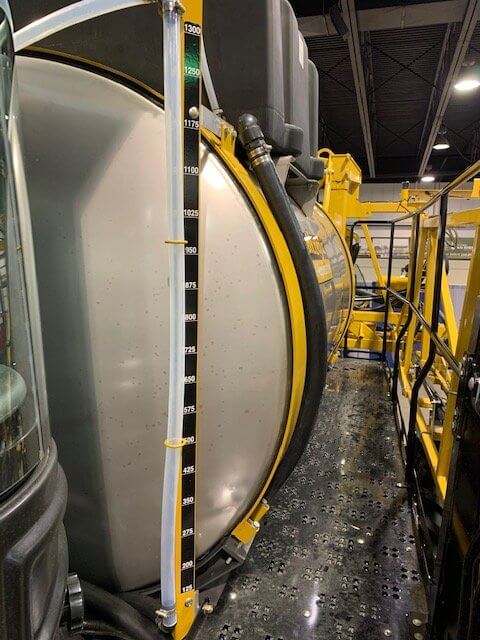
What we need is a system that guarantees results. To start, a tank gauge that is reliably accurate to the nearest gallon would remove some of the filling guesswork and help minimize leftovers.
We need a remainder volume (volume left in the non-boom plumbing after the pump sucks air) that is known and small, because that remainder can’t be expelled and needs to be diluted. The smaller it is, the easier it is to dilute.
We need a wash system that requires little volume and works quickly, like continuous rinsing.
We need plumbing that is easy to understand and whose inside surfaces do not absorb pesticide, or hide it in corners and dead ends. Perhaps it’s a recirculating system. Perhaps it hasn’t been invented yet.
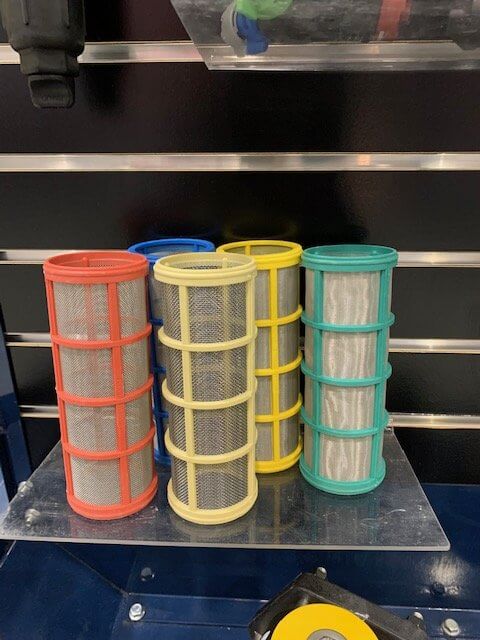
We need pesticide formulations that clean up easily. We need an easier way to inspect and clean filters. And we need a safe place to put any waste that can’t be sprayed out in a field.
I’d like to see a sprayer that can be decontaminated in 10 minutes without the operator leaving the cab, and without any spillage of spray mixture. Clean enough to spray conventional soybeans after a tank of dicamba. Clean enough to spray canola after a tank of tribenuron. I know it’s possible.
I also know what many of our European readers are thinking right now. Much of what I’ve discussed exists in the EU in some form or another. Why does the North American, and to a lesser extent the Australian market, not have these features?
Part of the reason is federal standards and regulations. Some European countries test and approve products for remaining tank volume, boom stability, and spray drift, for example. Others have sprayer performance criteria that must be met to be eligible for sale in that country. An increasing number have mandatory sprayer inspection.
These requirements serve to protect the producer and the environment. They’re an example of useful government actions. Despite, or perhaps because of, stricter rules, the entire EU marketplace is very competitive, with about 75 sprayer manufacturers. Bottom line: producers benefit.
We need leadership, preferably from a combination of government, industry, and producers, to achieve better sprayer designs. Our market has room for products that make it easier to prevent drift, protect water, and protect yields.
As they say, a rising tide lifts all boats. And it will certainly make my job easier.