This video won the Gold 2019 Canadian Farm Writers Federation’s Jack McPherson Award for Electronic Media. This award is for the best video, news story or feature broadcast by a Canadian medium less than 15 minutes in length on an agricultural topic. We’d like to thank Jason Strove, Bern Tobin and the whole team at RealAgriculture for helping to bring Exploding Sprayer Myths to life.
Welcome to season four of Exploding Sprayer Myths, featuring a new opening sequence and a special guest star. Have fun accidentally learning about reducing pesticide drift as we poke fun at Canadian and Australian stereotypes. If you’re unfamiliar with the McKenzie Brothers and the Great-White North, then be sure to educate yourself here before you take off, eh?
Beauty.
Thanks to Mary O’Brien (@SprayDriftGirl) and the Simcoe Research Station.
When it comes to information about mitigating pesticide drift, it’s plentiful and easily accessed. I have an archive of >30 articles written by Ontario Ministry of Agriculture staff spanning 1999 to present day. Many are on this website. In fact, there’s so much good information out there (see BeDriftAware) it feels like there’s nothing left to say. As a connoisseur (and author) of such materials, I’ve noticed they can be grouped into four common themes – see if you recognize any:
The Carrot: These articles describe the benefits of reduced drift, like solid neighbourly relations, reduced environmental impact, saving money in wasted pesticide and improved spray coverage.
The Stick: These articles feature insurance adjusters or regulators providing statistics from case studies on the financial, legal, and insurance impacts of drift. Not to mention the time it takes to deal with these issues.
The Heart: Many articles describe the frustration and emotional impact from the driftee’s perspective. Others chronicle the conflict, irritation and personal insult that come from being accused of drifting.
The Facts: Here we have technical specialists laying out math, such as weather models describing spray behaviour, buffer zones and drift reduction technologies like nozzles, shrouds and sprayer calibration.
Beyond the written word there are also videos, PowerPoint presentations, workshops or demonstrations, government fact sheets, marketing brochures, social media content and smartphone apps. And yet, every May-July, the drift complaints seem to roll in regardless. For those that ask “why?” here are a few possible reasons:
Why drift happens
Maybe the sprayer operator is pressed for time and chooses to ignore best practices in an effort to catch up. Haste can lead to mistakes.
Perhaps the sprayer operator is new and inexperienced, or falls into that small demographic without ready access to educational resources like ag meetings or the internet.
Maybe the operator is a veteran lulled into false security having successfully sprayed so many acres, for so many hours, for so many years. Why be so diligent when nothing bad ever seems to happen? Bad logic, but not uncommon.
Maybe the problem stemmed from poor communication. Perhaps the land is rented by one person, to a farmer that isn’t there, who has their fields sprayed by custom applicators, who don’t know what’s around the field.
Or, perhaps, even the best-intentioned sprayer operator can have bad luck.
Where can drift take place?
Agricultural spray (i.e. field crop or horticulture) has the potential to move between operations, or onto residential areas, or sensitive environmental areas. A single operation can even drift an incompatible chemistry onto itself. There are also residential applications (e.g. lawn care) that can negatively affect neighbours. Industrial applications such as roadside sprays can drift to agricultural or residential. Even organic operations spray products that can move outside the treatment area if conditions allow.
It is important to recognize that every single spray application has the potential for off-target movement. That’s why it’s so important to know what and who is around the treated area.
Communication helps
Communication between neighbours can make a big difference, both in preventing drift damage and resolving matters should an incident occur. Here are two perspectives on the same chemical trespass incident. In the first, the parties do not know, and do not care to know, one another. In the second, the parties have communicated previously. Which scenario will be easier to resolve?
A “field cropper that drives 20 miles per hour in high winds” is contacted by a MECP officer on behalf of a “vegetable grower that’s always complaining about spraying”. Accusations and defensiveness between the two parties escalate until they prevent them from speaking directly. Specialists, adjusters, and the officer find themselves acting as mediators. The process is slow and likely headed for court.
Sarah knocks on Kevin’s door and says there might be something wrong with her crop – can he come have a look? She has (rightfully) contacted the MECP to collect samples just in case, and Kevin has all his spray records so they can figure it out. They call in a crop consultant and she contacts a university specialist to solve the problem and prevent it happening again. They follow the crop to yield to determine the impact and agree on a settlement between them.
Regarding Scenario 1, it’s not my intention to slander field croppers or horticulturalists; I have actually heard parties involved in highly emotional drift disputes describe one another this way. My intent is to point out that you cannot label an entire industry based on the actions of an individual. When parties see each other in this fashion they are unlikely to work together to resolve the problem. No one will be satisfied with the outcome.
Regarding Scenario 2, I have observed that once each party has a face and a name, it’s so much easier to find solutions. It doesn’t mean someone wasn’t at fault or that compensation isn’t required, but the dialogue facilitates a faster, easier and less emotional outcome. Obviously, in the case of repeated or large-scale incidents, communication may not yield satisfactory results. I’m hopeful, but not naive.
Opening a dialogue
Communication can be initiated from either direction: An applicator can inform a residential neighbour or fellow farmer with sensitive crops when and what they intend to spray. Likewise, the neighbour or sensitive crop grower can reach out to the applicator to let them know they are there and that they are concerned.
There’s no need to wait until there’s a problem. Both parties benefit from keeping one another informed about when sprays go on and the state of any sensitive crops. And, if there is an issue, both parties should begin documenting conditions and suspected damage as soon as possible and over time during the resolution.
So, the core of this article isn’t how to prevent drift, or what to do if you suspect it. That’s all been said and I’ve listed a few resources for reference at the end. This article is about being aware of drift potential and about opening lines of communication between those that share borders.
So follow the links below to learn more about what you can do to mitigate drift. Then, go introduce yourself to your neighbours. Bring a pie. Everyone loves pie.
Resources
Article – This link includes four videos and a factsheet about what drift is, how to prevent it and what to do if you suspect it.
Article – This link includes a video and a factsheet about surface inversions and drift.
Website – This is a link to BeDriftAware, a collection of resources and tools to encourage the use of best application practices by farmers and sprayer operators to reduce the possibility of spray drift.
When warm air is cooled, it loses some of its moisture-holding capabilities. This change often occurs at night, when plants (and other objects) cool. Once the temperature of the surface of the leaves, for example, drops below the dewpoint, it causes water to condense, forming the shiny dew that causes so many to question early morning spray applications.
The question is often: will the spray run off the plant or will it get so diluted that it doesn’t work anymore?
In a dew chamber, work has shown that large spray droplets are more likely to run off a plant saturated with dew than their smaller counterparts. However, similar work showed that spray efficacy was not altered by droplet size.
Wolf discusses this work and the potential answer to the seemingly conflicting findings. Wolf also explains how grassy weeds compare to broadleaves, the role of surfactants, and what to consider when making the decision to spray through dew or not.
Here in Episode 10 of Exploding Sprayer Myths we’ve coaxed @Nozzle_Guy back into the orchard. This is part two of a two-part mini series on airblast calibration. In Episode 9 we talked about air settings and travel speed, and now we’re tackling nozzling and coverage.
But here’s the twist: Rather than use spray math to determine the required nozzles to achieve ideal coverage, we do it backwards. This process uses ideal coverage to determine nozzles and finishes with sprayer math.
Confused? Watch the video and this surprisingly simple and versatile approach will become clear. See if you catch the subtle visual joke about “coverage” realize that to pull this off, we had to film it backwards.
Special thanks to the @RealAgriculture team, the Simcoe Research Station and Don Murdoch.
This week I spoke with Gerry Bell, a producer from near Gravelbourg in southern Saskatchewan (a beautiful town with a historic downtown, church and school, also, home of the Gravelbourger at the local diner). He told me about a project he recently completed, converting his older pull-type sprayer to a granular spreader. It’s a great project, worth sharing.
The concept was first popularized by Manitoba farmer Kyle Holman in 2012, who uses the #SprayMar hashtag on Twitter to promote it.
I will say that i do have the original #SprayMar since I did coin that, but I did not build the original pull type device. We saw 1 online after we built it but dad had been thinking of it for yrs. #WhatCouldHaveBeen
Gerry wrote his project up for us and I’ve posted his description below.
Bourgault 1460 Field Sprayer
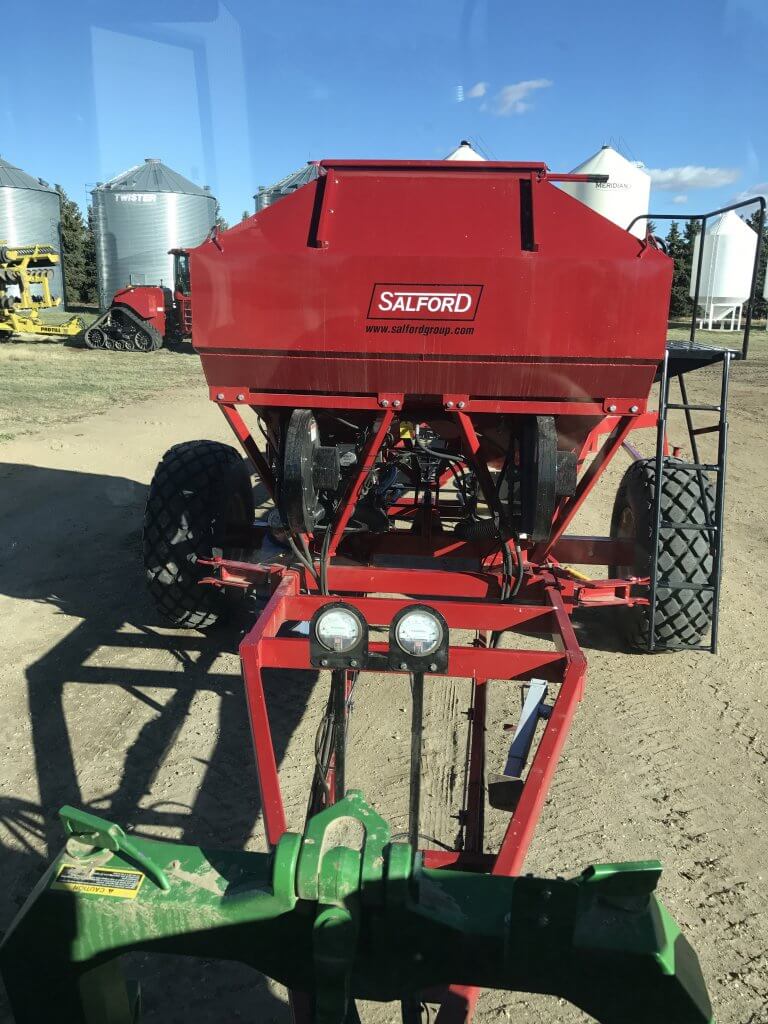
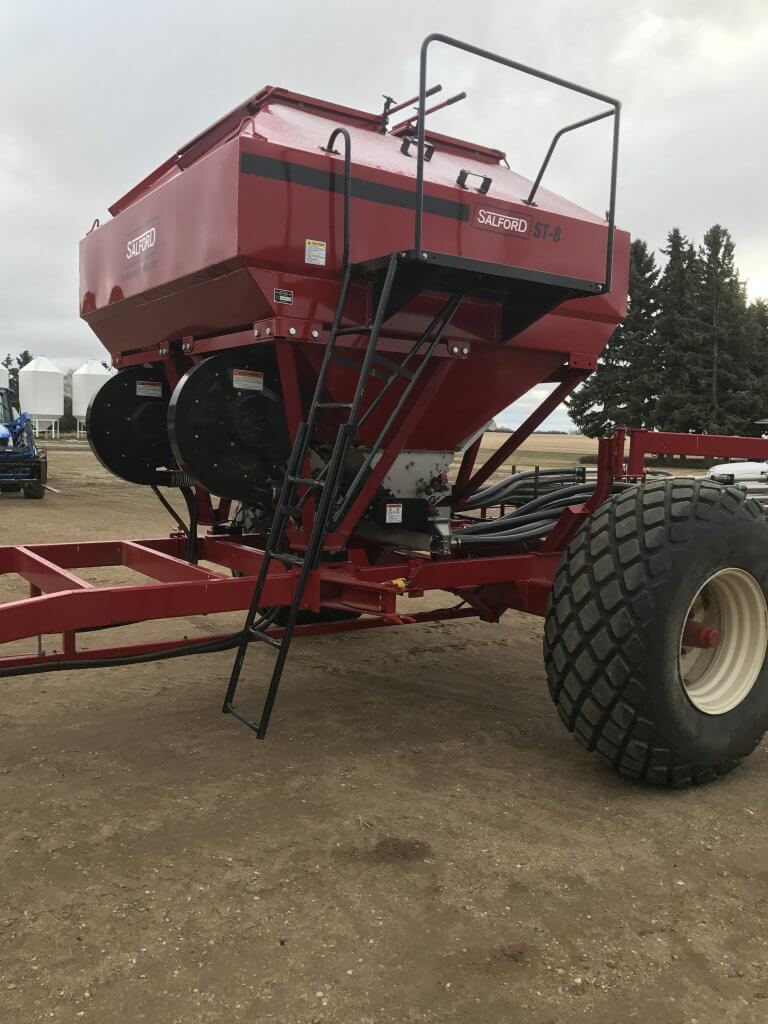
The sprayer sat in a machine shed from 2011 when we purchased a Patriot 4420 sprayer. For many years we wondered if we couldn’t find a use for the sprayer as Bourgault had build a very rugged unit. So, in 2017 we decided to mount a Valmar tank (now owned by Salford) on the sprayer frame to be used for granular herbicides and granular fertilizer applications.
Bourgault 1460 (Source: Bourgault.com)
The liquid tank and plumbing were removed as well as the
secondary boom with the wet boom. A few modifications to frame were made but
for the most part the frame was left as is. The unit was painted with the Salford
colours. (Case IH red)
The Valmar/Salford unit is a ST8 which is used lots in
Eastern Canada and the States for strip tilling for applying granular products.
We purchased the tank, hoses, splitters and deflectors from Salford.
The unit as purchased had the following features:
8 imperial tons (16,000 lbs)
Stainless steel tank and duct systems
Mueller Hydraulic metering system with two sets
of rollers – one pair for granular herbicides and one pair for granular
fertilizers
Two hydraulic driven air fans – usually just one
fan but we chose two fans – one for each boom
Weight scales for tank
ISOBus system with mapping, auto on off,
sectional control (one for each boom)
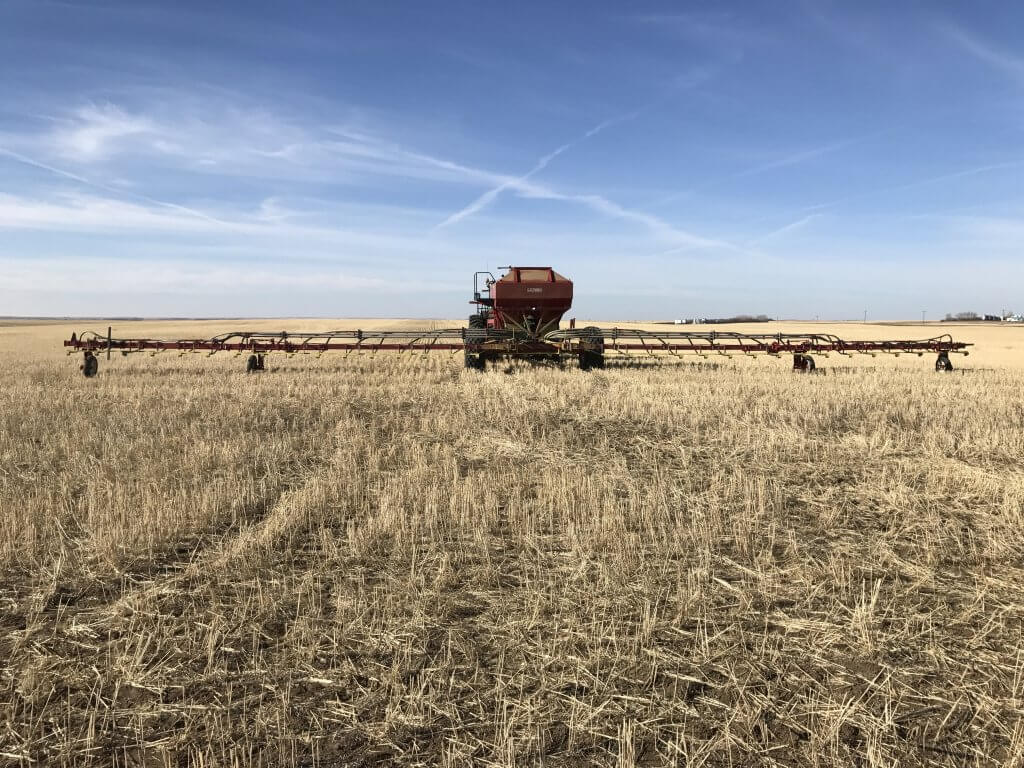
18 outlets – 9 outlets on each side of tank
We designed unit in consultation with Salford engineers:
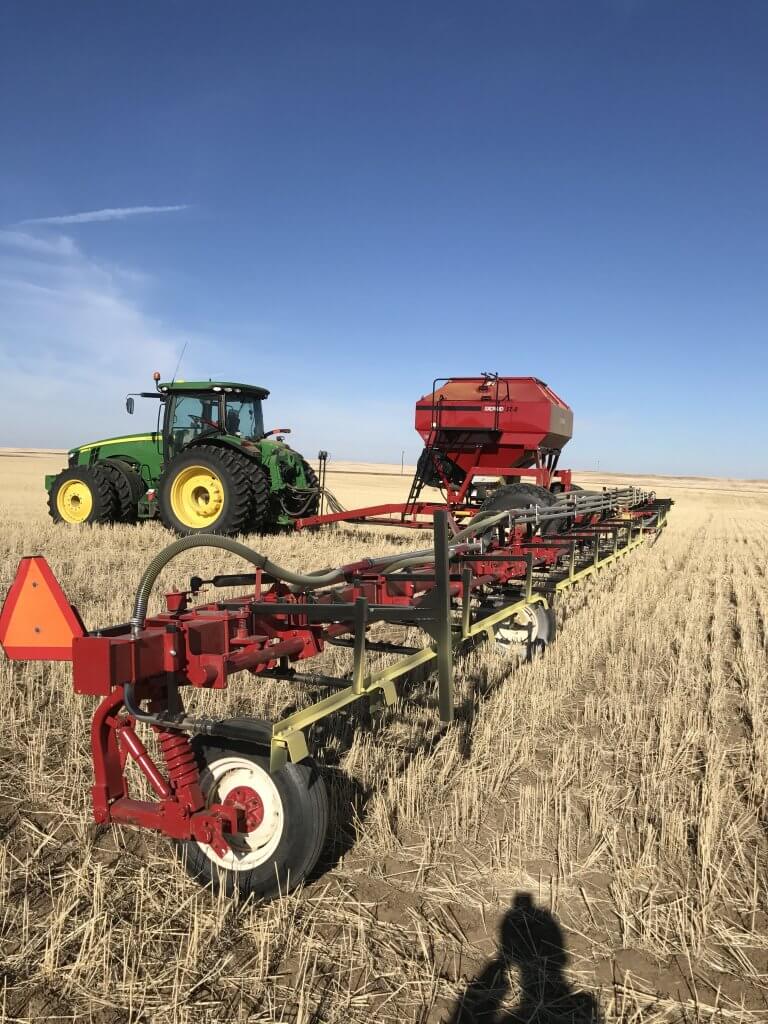
Each of the 18 outlets has a 2” flexible hose from the tank going to 2” stainless steel tubing stacked on the boom frame
Just prior to the deflectors each 2’ tubing is split into two 1-1/4 streams with special splitters supplied by Salford (according to Salford these are commonly used and have an accuracy of less than 2-3 % variation if mounted properly). Need to be horizontal.
The deflectors are mounted every 30” along the length of the boom (36 deflectors)
The sprayer boom was cut down from 110’ to 90’ to give the correct spacing
Comments on use of
the unit
Functionality seems to work very well as designed
Weigh scales, GPS, mapping, auto on/off, sectional control a real plus compared to original field sprayer with none of these features
Accuracy of product metering seems very good
Distribution across length of unit seems very good
Travel speeds of 10 mph
Product takes 2.5 seconds from time meter starts turning until product reaches far end of boom
There is a difference of about thirty feet in travel distance with start and stop of product on the ground between inner side of boom and outer end of boom. Therefore, we have set look ahead time at 3.3 seconds and shut of time at 0.3 seconds.
Load products with a belt conveyor in yard
Apply 100 lbs of elemental sulphur (0-0-90) on
25% of the crop land each year
(Tank does 160 acres)
Applied Avadex at 12.5 lbs per acre last fall on
some acres prior to snow.
Apply Edge at 20 lbs per acre each fall just
prior to snowfall (for pulses)
Tanks holds 10 minibulk bags – 12,000 lbs, and does 600 acres. On a long day have put out 1200 acres of Edge.
We did extend the axles and also put on new hubs and new tires which were a bigger size. A Bourgault 1850 with 1600 gallons would have worked better but it is hard to find them. Plus they would probably have needed new tires anyways.
It took a lot more time than we had imagined to build but that is true of most building projects. But I would say that we are very happy with the results. It is a pleasure to operate and appears to serve our needs very well.