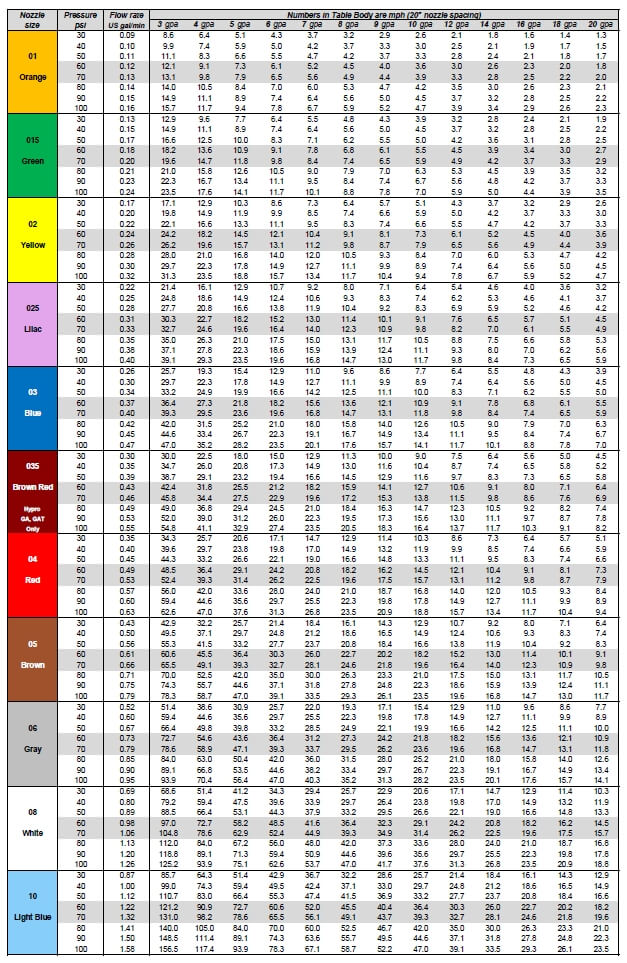
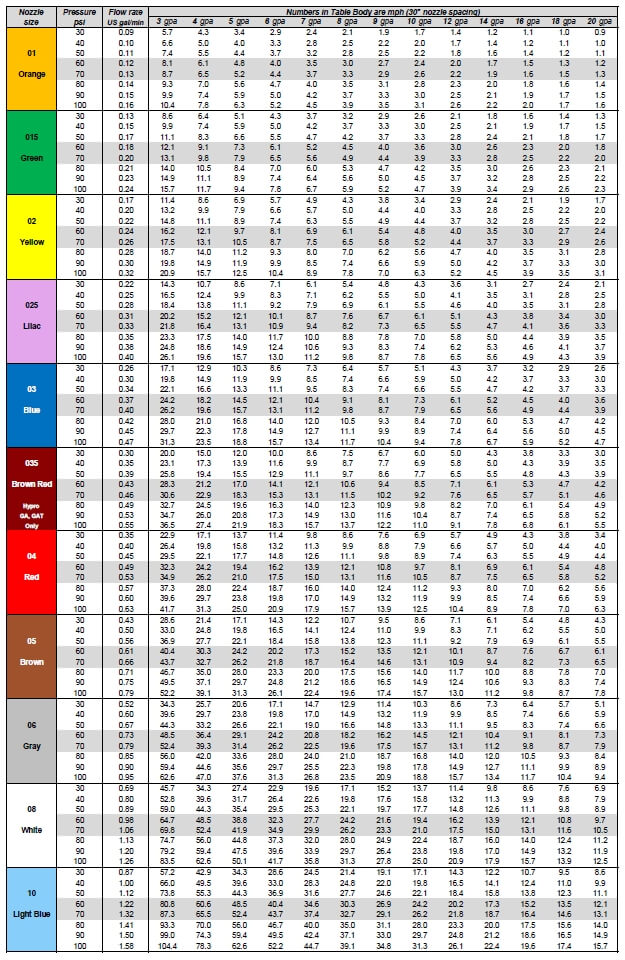
Need to find the right nozzle size for your application? Sometimes a simple chart is the easiest way to figure things out. Print it and place it in your sprayer cab.
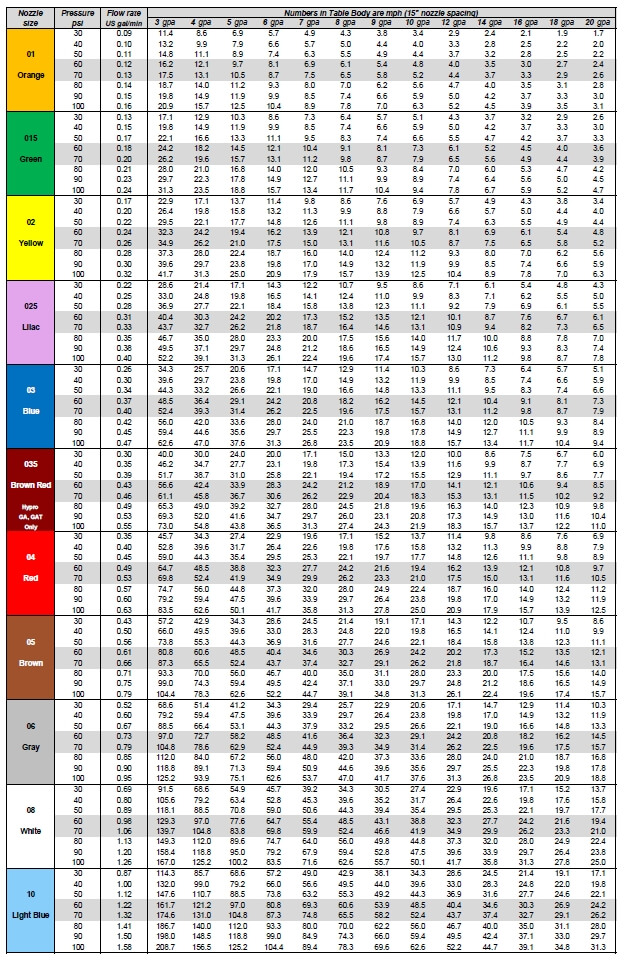
In this chart, identify your water volume along the top row, and follow the column until you encounter the travel speeds you’re interested in.
Once you’ve encountered your travel speed, move along the row to the left to identify the nozzle size and spray pressure.
Make sure that your travel speeds are achieved at a pressure that’s right for the nozzle you’re using. For most air-induced nozzles, this will be about 60 to 70 psi (highlighted).
Once you’ve decided on a nozzle size, the travel speed column for that size becomes the travel speed range at various pressures. Avoid operating a low-drift spray below 30 psi – its pattern will be too narrow and likely its spray quality will be too coarse for good results.
Click on the images or text below to download a high quality pdf version of each chart, starting from the top with US, 15″ spacing, then US, 20″, then US 30″, then metric, 50 cm. Print, laminate, and place them in your sprayer cab.
In this, the season three finale of Exploding Sprayer Myths, we join Jason and the Tom-inator as they “tackle” airblast air settings. There are a whole suite of articles dedicated to this topic, linked below the video. It is, arguably, the most important adjustment you can make to an airblast sprayer.
Will there be more Exploding Spray Myths episodes? In the words of a great man: “We’ll be back.”
Special thanks to Don Murdoch and the Simcoe Research Station.
Crop spraying is one of the most important and highly skilled jobs undertaken on any arable farm, but it is facing increased public scrutiny. This is why it is vital that the kit you use as a means to apply pesticide to crops is in prime working order and is set up correctly to deliver the product safely and accurately to its target. Optimum sprayer set up will help to maximize the efficacy of applied products, reduce spray drift and keep machinery in good condition.
For this best practice guide to sprayer set up, Farmers Weekly teamed up with former Farm Sprayer Operator of the Year Iain Robertson. Mr. Robertson is assistant arable farm manager at David Foot Ltd, a 2,200ha mixed farm south of Dorchester in Dorset, growing wheat, barley, beans, oilseed rape and maize as forage for the farm’s three dairy herds. The machine used for this guide is a Bateman RB26 self-propelled sprayer and while most of these checks and tests are universally applicable to all sprayers, it is also important to refer to the handbook of the manufacturer of your specific machine.
Watch the video tutorial with Mr. Robertson and then see the step-by-step guide below for more detail.
Pre Start Checks
Before firing up the engine, the first thing to do is your pre-start checks – that means checking your machine’s vital fluids like fuel, hydraulic oil, hydrostatic oil, engine oil and coolant levels. If yours is a self-propelled sprayer, chances are you’ll need to get up on to the back of the machine to check some of these.
“While I’m up on the back of the sprayer I also have a quick look in the top of the tank to make sure that it is nice and clean and the tank rinse nozzles have worked properly – cleanliness is next to godliness,” says Mr. Robertson. Next, move on to the tires. Use a pressure gauge to check all tires are at the correct pressure and refer to the manufacturer’s guidelines. If you’ve got a trailed sprayer, don’t forget to check the tractor tire pressures as well.
Aim for tires to be run at the lowest pressure recommended for the load to be carried. This will help with boom height and stability and also helps tires act like a shock absorber to ride out bumps. If using a trailed sprayer, use a spirit level to ensure that the drawbar is level. Mr. Robertson says he tries to work around the machine in a methodical, clockwise manner to ensure that he doesn’t miss anything.
Coming to the pumps, check that they have got enough oil, check that any tool boxes have enough spare parts and any equipment needed and make sure you are carrying a spill kit with absorbent granules and a spade in case the worst happens and there is a spillage. Make sure all parts are lubricated daily and that any grease nipples are cleaned before and after use to avoid them collecting dirt and blocking.
Check all hydraulic hoses, spray lines and air lines for any signs of wear that could result in problems while operating.
It’s best to run the sprayer at a minimum of 5 bar to check for leaks. Also check the spray tank is fixed down securely, all straps and bolts are tight.
Boom checks
Once opened out, check the boom has good movement in the x- and y-axis. All machines are different so check with your manufacturer as to how the boom is set up. Mr Robertson’s Bateman has tie rods and stock bots that can be adjusted to set the boom up to ride well.
Check the tie rod nearest the back of the machine is slightly loose when moving and that the front rod is tight. Next, check for up and down movement by gently pushing the boom down by about 50cm and letting go. The boom should return to the central position without too much bouncing around.
“We want a little bit of movement but not excessive so that you can ride over the bumps as you go along without over- and under-dosing the crop,” says Mr. Robertson. Boom height is one of the most critical factors when spraying and the ideal height is 50cm above the crop. One of the easiest ways to work this out is by using a cable tie that is cut off at the correct length to use a visual aid from the sprayer cab.
Don’t forget to measure from the tip of the nozzle to the crop, not the spray line.
Good sprayer cleanliness is important, so make sure the system is rinsed through at the end of each day with clean water to make sure there’s no residue left in the boom. If your machine’s boom doesn’t have recirculation, remember to take the end caps off occasionally and flush out the whole boom.
Nozzle checks
Check that the nozzles are aligned both vertically and horizontally, according to the NSTS guidelines. Loosen clamps to adjust any nozzles that need realignment.
Check the nozzle output at least twice a year by running the sprayer with clean water at 3 bar pressure. Time the output of each nozzle for 30 seconds. If nozzles have been used previously, it’s best to check their output against that of a new pair. Mr Robertson advises using a measuring cylinder rather than a jug to measure the flow rate as a jug is less accurate “because you get a bigger variation over the wider surface area”.
With an 03 nozzle running for one minute at 3 bar pressure, the output should be 1.2 litres/minute as a rule of thumb but refer to the nozzle manufacturer’s output chart for the expected flow rate. “An easy way to remember this is: at 3 bar your nozzle size multiplied by four will give you your target litres/minute output. It works for all nozzle sizes.” If the output varies more than 4% of the average, or if the spray pattern visually doesn’t look correct, you need to change the nozzle set.
After checking the output, cross-reference this figure with the rate controller – you may need to adjust the flow figures to ensure that the two correlate. If a nozzle becomes blocked while spraying, Mr. Robertson says he will swap it for a new one and then clean it later using a toothbrush or airline. Never blow through a nozzle with your mouth.
Nozzle choice
The choice of nozzle is highly dependent on the sort of job you’re doing. “Timing is crucial but using the right nozzle at the right time will make the job so much easier, cut drift and mean that you’re getting more of the product where you want it to go. If you aim at it you will hit it,” says Mr. Robertson.
His nozzle of choice is an 03 size and he prefers to use the Defy 3D nozzle alternated forwards and backwards across the boom for pre-emergence work and T0 applications as well as the T3 ear spray. “In less than optimum conditions I may prefer to use the Amistar/Guardian Air, a fine induction nozzle. I would use this at T1 and T2 and also in sub-optimum conditions.” This nozzle has a 3-star Local Environmental Risk Assessment for Pesticides (LERAP) rating and is 75% drift reducing.
A water volume of 100 litres/ha is a good rate for spring fungicide application. It provides enough coverage for good disease control and allows maximum efficiency from the sprayer.
Forward speed
The third and final part of reducing spray drift is forward speed. Depending on nozzle size and water volume, aim to travel at 12kph.
Mr Robertson says he finds that this speed gives a good overall output and means you don’t get shadowing or turbulence behind the machine.
Tips and tricks
One of the biggest risk of contamination is at fill up. “A fantastic, cheap trick that I learned through Farm Sprayer Operator of the Year is to take a 200 litre plastic drum and cut it in half to create two drip trays to catch any spillages under the induction hopper and the tank overfill.” This eliminates point source contamination, he says.
“Finally, there’s a plethora of information out there on the internet, loads of good apps to download. The technology is there to help us do the best job possible and make our job as safe as possible.”
Managing the canopy of any perennial crop (e.g. pruning, hedging, leaf stripping, etc.) is an important consideration. The benefits are manifold: It affects the health of the plant, the quantity and the quality of the yield. It allows light and air to circulate and it keeps the crop manageable. From the perspective of an airblast sprayer operator, the reason for canopy management is quite simple:
If you can’t see it, odds are you can’t spray it.
Picture this: It’s late April, and an apple grower and I are calibrating his sprayer. We achieve excellent spray coverage in the target block, shake hands and part ways. In late May I get a phone call from the grower. I assume it’s time to adjust his settings to match the growing canopy, but no… he had called to say he suspected apple scab in one of his blocks. Since I was the last person to adjust his sprayer, the unspoken implication was that I’d better come fix matters.
As I drove back out to his orchard, I considered what the problem might be:
Bad product choice?
Poor application timing?
Spraying in inclement weather?
Cutting rates?
Resistance? (a long shot)
Maybe it was ego, but I couldn’t believe it would be the calibration. We left ample volume to provide sufficient coverage to get the grower to petal fall. We ensured the spray swath was higher than top of the tallest tree, accounting for wind and an uneven alley. We did everything right to match the sprayer to the canopy and leave enough buffer to get to petal fall.
When I arrived, he took me to a block I hadn’t seen before. We didn’t calibrate the sprayer to match this particular group of trees, but he figured since they were about the same height, the sprayer would do its job. It was immediately obvious to me what the problem was, but I knew if I simply told him outright, the lesson might not stick. And so, with respect to that old proverb, I taught him to fish rather than give him one. We spent the next few hours trying to fix our alleged calibration problem by exploring:
Slower ground speed
Higher fan gear
Higher rpms to increase fan speed
Changes to deflector settings
Air induction nozzles in top positions
Higher sprayer output
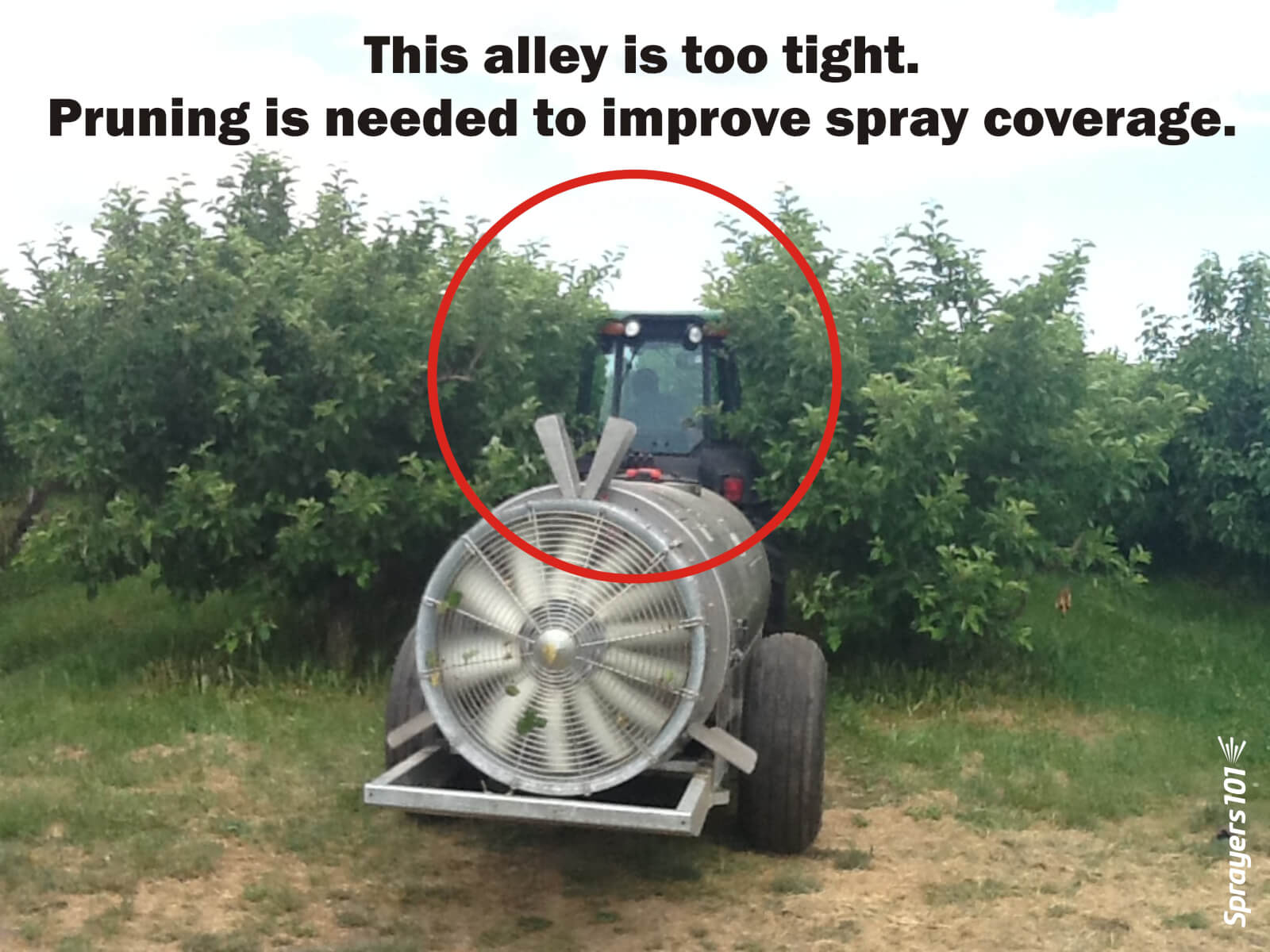
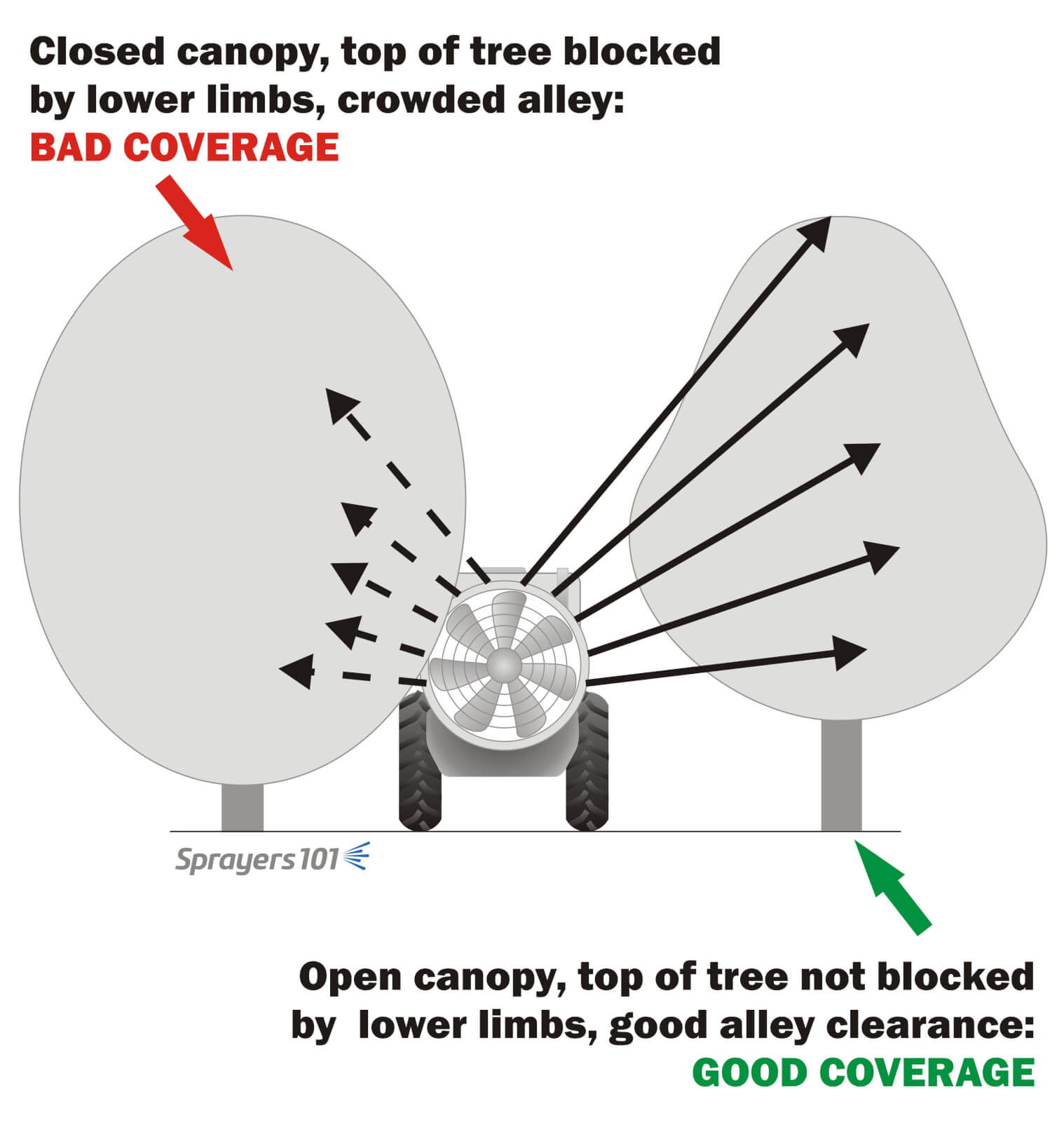
Of course, none of these adjustments had any great impact on coverage because the problem was that the alley had grown so tight that branches were brushing the cab of the tractor (see picture).
If the canopy is brushing against the tractor, it may intercept spray before it expands fully. Essentially, it temporarily blocks nozzles.Closed canopies and tight alleys will almost always compromise spray coverage.
The canopy was so dense you couldn’t see the trunk! I asked the grower to move the sprayer down the row to a tree I saw that was far less dense that the others. We returned the sprayer to our original calibration settings and achieved excellent coverage once again. The only solution was to prune the trees, and once his workers did this, coverage improved considerably. An airblast sprayer can only do so much. Sometimes it comes down to canopy management.
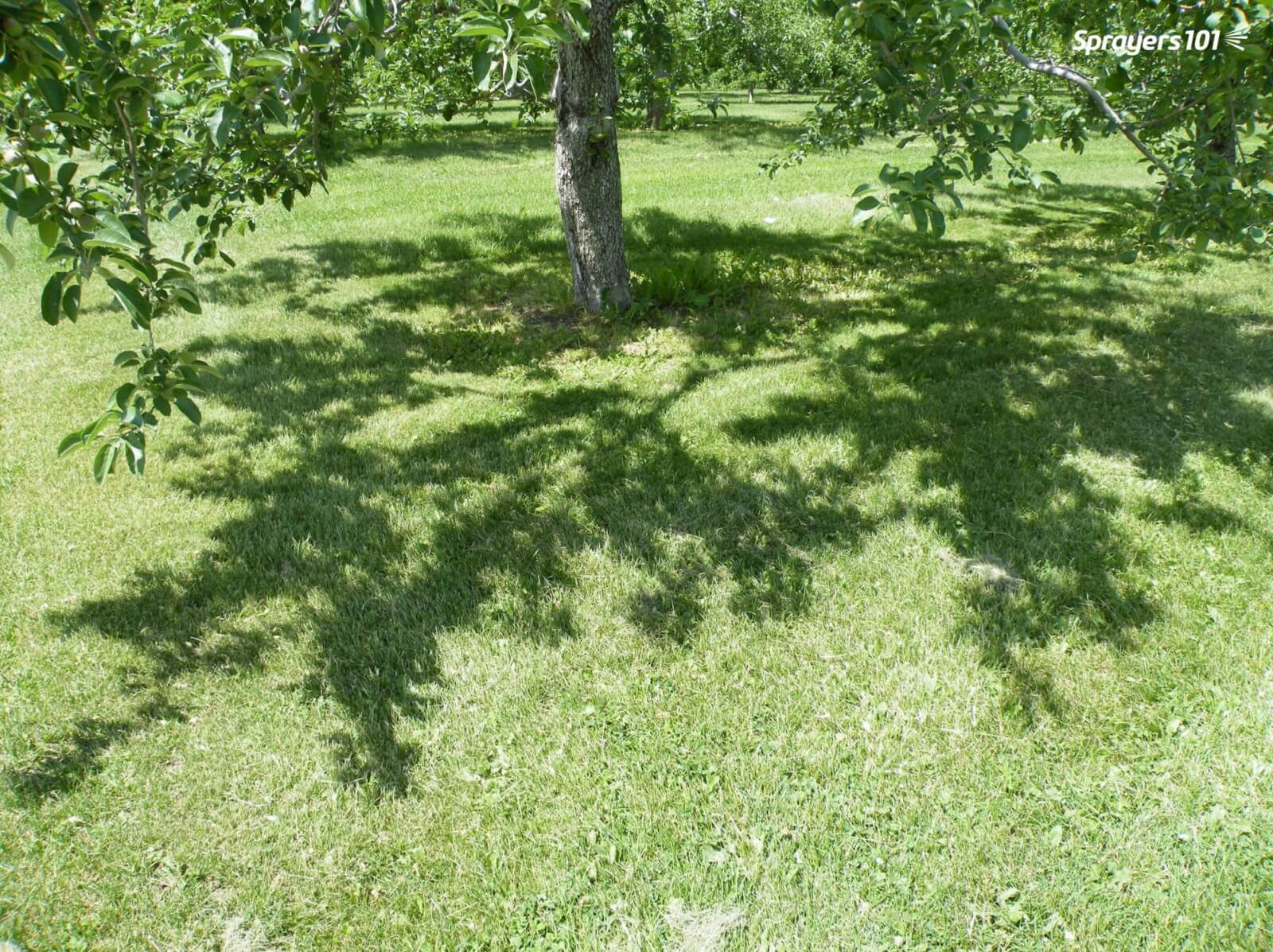
An orchardist taught me this trick: If you want to know if spray will penetrate a canopy, you should be able to see the trunk.An orchardist taught me this trick: If you want to know if spray will penetrate a canopy, you should be able to see sunlight through the shadow at high noon.
Row Spacing in Specialty Crops
Canopy management isn’t just an orchard issue. For high bush blueberry crops, coverage problems may stem from insufficient pruning. How can spray reach the lower, inner portion of a mature bush to control spotted-wing drosophila if the canopy is too thick?
Sometimes it’s not the canopy, but the plant and/or row spacing. Many nurseries arrange container crops, shrubs, whips and cedars as tightly as possible. This may optimize how many plants will fit on a given area, but it compromises sprayer access (due to the reduced number of alleys) and may cause plants to block one another from the spray. Nursery sprayer operators often use cannon sprayers to throw spray over and through all those rows of plants, but cannon sprayers produce excessive coverage at the beginning of the swath and increasingly erratic coverage as a function of distance.
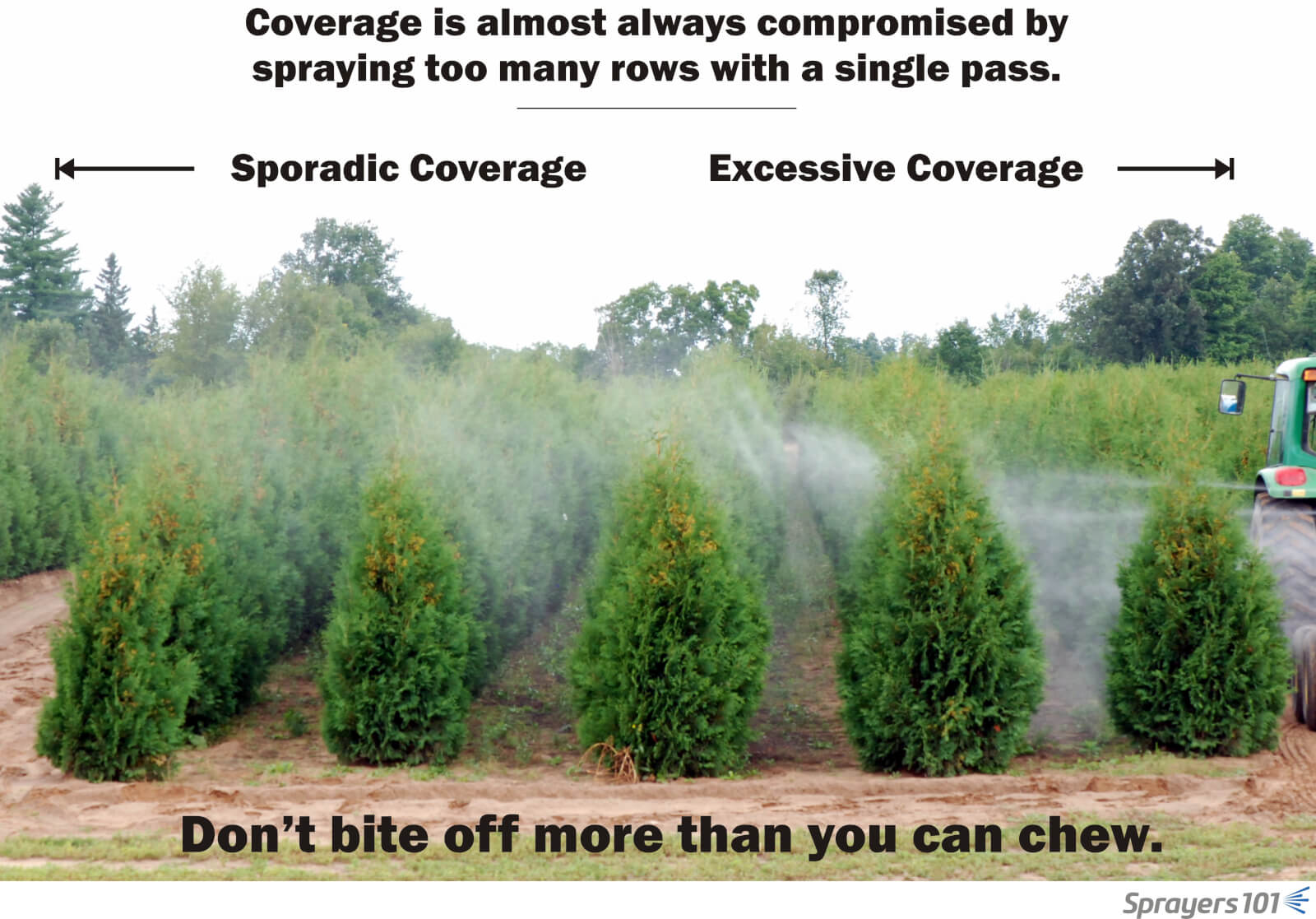
A cannon sprayer attempting five rows of cedars. This sprayer will eventually spray in from the other side, but experience has shown that coverage will be compromised in the centre rows and excessive in the outer rows. Spraying multiple rows may save time, but coverage is almost always erratic.Calibrating a cannon sprayer can greatly improve coverage consistency. Before calibration (above) the sprayer was equipped with full cone nozzles in the upper boom positions and excessive air was employed in an attempt to force spray through the canopy. Although the sprayer would eventually pass down the far side of the five rows, only the water-sensitive papers in the tops of the trees indicated suitable coverage, and a great deal of spray simply blew away. After calibration (below) considerably less air and spray was used, and coverage on water-sensitive papers placed lower in the trees and facing the sprayer was more consistent. Remember, the sprayer would eventually pass down the far side, resulting in similar coverage on the remaining papers. Don’t bite off more than your cannon sprayer can chew – the further spray travels from the sprayer, the harder it is to achieve consistent coverage.
Coverage can be improved by reducing the distance the spray has to travel (i.e. leaving more alleys and reducing the density of planted rows).
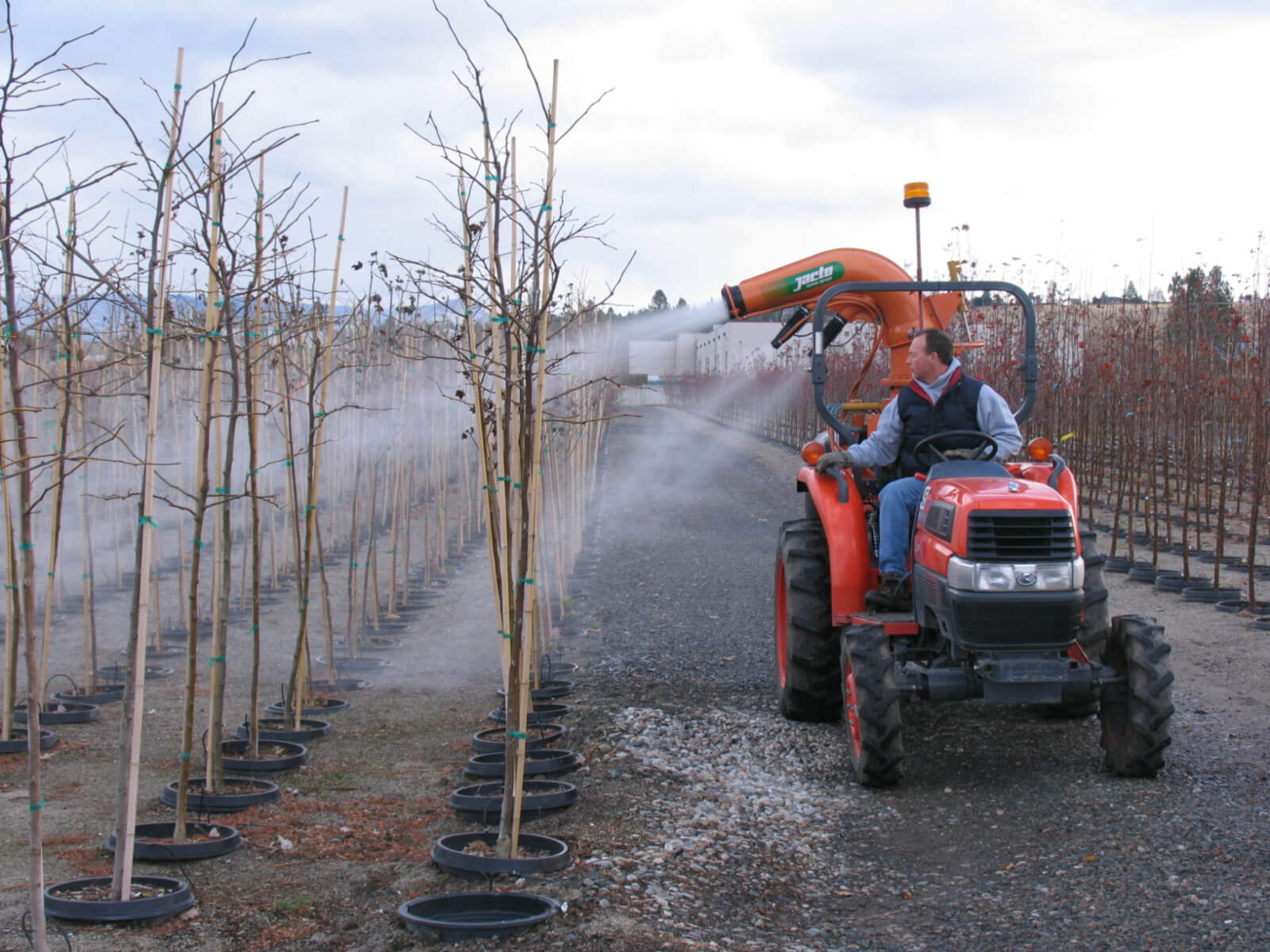
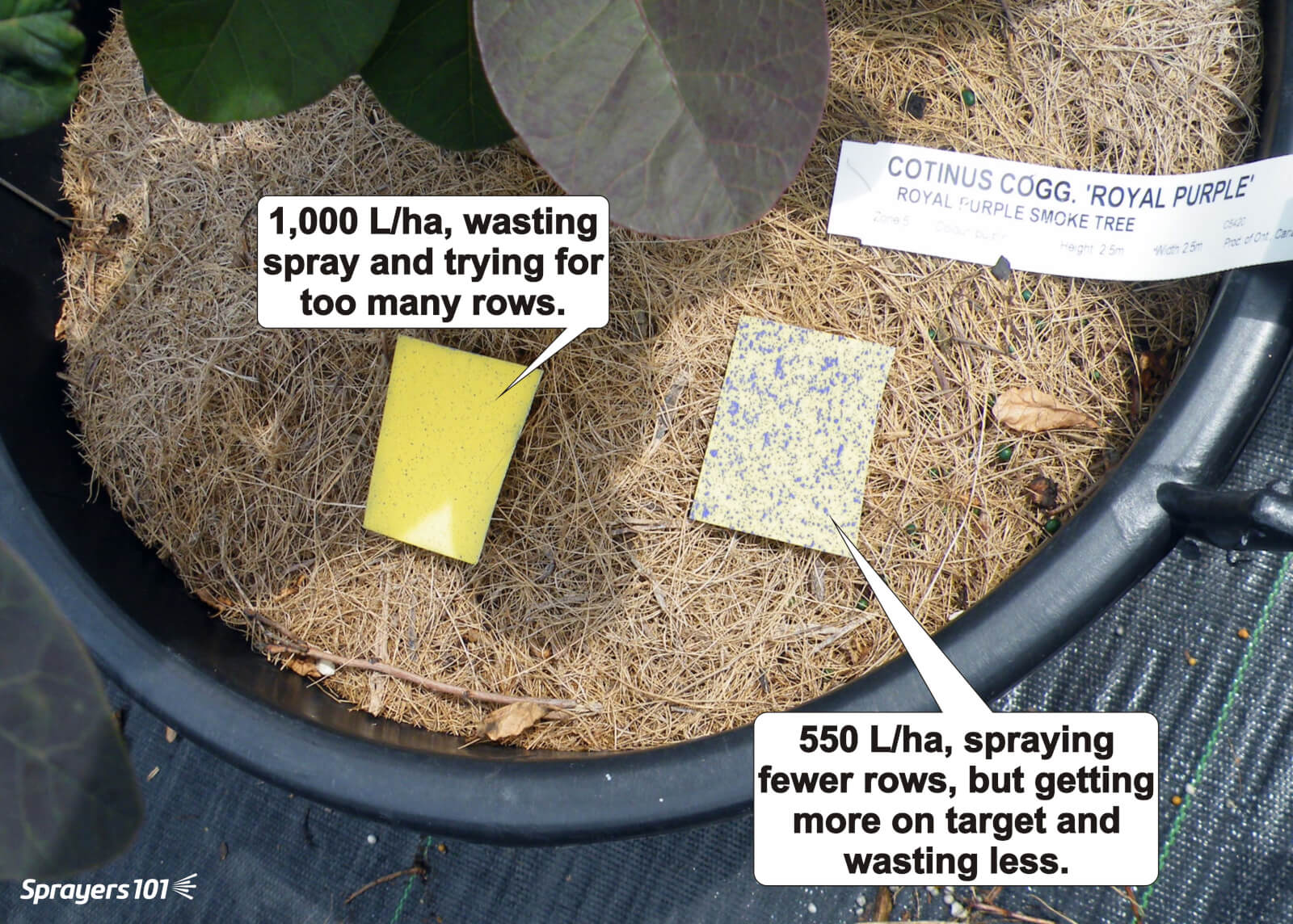
A Jacto cannon sprayer in a nursery. Many nursery and berry operations elect to spray multiple rows in one pass, but be aware that spray coverage suffers the farther away from the sprayer it goes. Independent research has shown that coverage is not reliable at half the distance typically claimed by many cannon sprayer manufacturers. This is a function of canopy density and weather. Always confirm coverage with water-sensitive paper. Photo Credit – M. Lanthier, British Columbia.The results of a cannon sprayer calibration in a container crop nursery. The cannon sprayed 1,000 L/ha and tried to cover too many rows in a pass. The water-sensitive paper showed insufficient and inconsistent coverage. When it was recalibrated to spray 550 L/ha, but drive more rows, the water-sensitive paper showed considerable improvement.
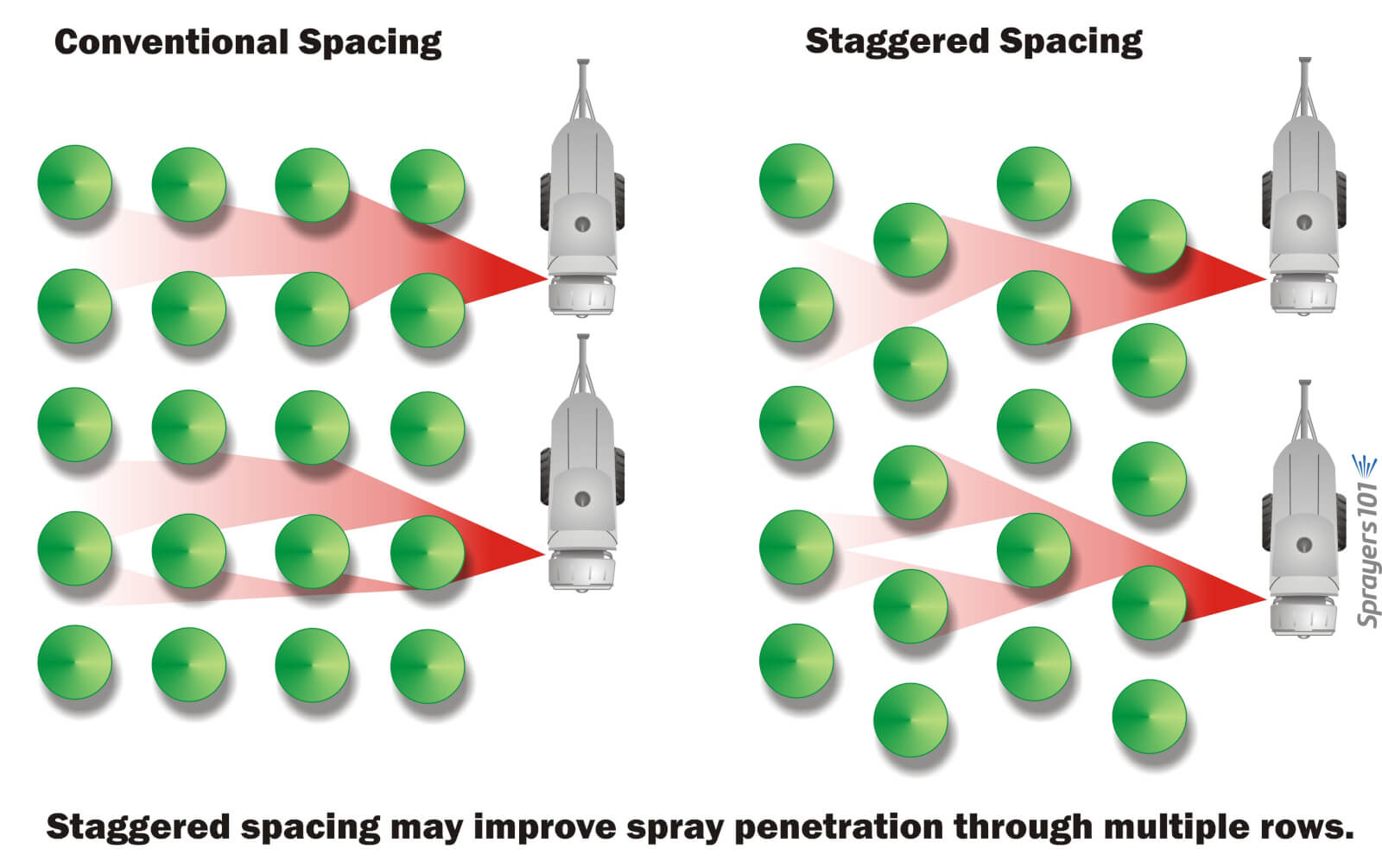
I also suspect that staggering plant spacing from row to row to reduce mutual shading might allow spray to penetrate more easily. As I write this, we’re planning to explore this concept in cedars.
This is speculative, but the when nursery shrubs, trees and container crops are planted in perfect grids, mutual shading probably prevents spray from penetrating deeply into the planting. By staggering the spacing, spray may be able to penetrate more easily between rows. This can be accomplished without reducing the number of plants per hectare significantly.
In the end, try to see the spray target from the droplet’s point of view. If you can easily see where you want the spray to go, you’ll do well. If you can’t see the target, it’s far more challenging.
Kim Blagborne (formally with Slimline Manufacturing) has long said that the pressure gauge on an airblast sprayer indicates more than just pressure. It can be used to diagnose a number of pump and plumbing issues… if you know what to look for. Here’s Kim’s troubleshooting guide to reading into what your gauge is REALLY telling you:
Scenario One
“As the tank empties, the pressure drops”
First, try adjusting the pressure regulator (assuming a positive displacement pump). If you can maintain the pressure up until the tank empties, your intake line may be loose and it’s sucking the bottom of the tank. Check the fitting between the suction filter and the pump. Apply a light coating of grease to the O-rings on the elbows and filter to ensure a complete seal.
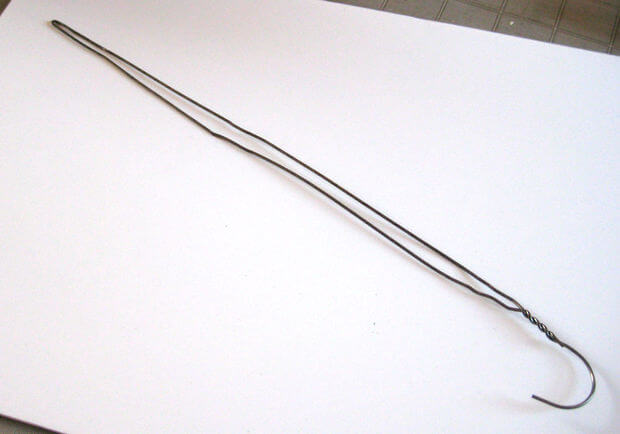
Second, try stopping mid-tank (that is, turn off the tractor PTO and let the sprayer sit for a few minutes). Does the pressure gauge return to the original set pressure? If so, then the intake line inside sprayer has likely come loose entirely. Open the lid, and using a straightened-out coat hanger, hook the intake line and give a few gentle tugs – it should not be able to move. If it does, you’ll have to re-fasten the intake line so it’s not sucking the bottom of the tank.
The humble coat hanger. It opens our cars and now fixes our sprayers. Remarkable!
Scenario Two
“When I first start the sprayer, the pressure drops or fails to maintain constant pressure as the tank empties”
This might indicate improper mixing practices because the filter is probably plugging with product. Alternately, your PTO speed may be too slow to drive sufficient mechanical agitation. Check the suction filter as soon as the problem occurs (don’t finish spraying). If you wait to check when the tank is empty, the evidence of a plugged filter could be washed away before you can confirm it. This problem often happens when spraying nutrients, or when products aren’t compatible.
If that’s not it, it could be a collapsed suction valve. The pump will sound like it’s “missing” (like an misfiring engine). The suction valve might need to be replaced.
Or, perhaps you notice that you can compensate for the pressure drop by adjusting the regulator on the first tank. But it has to be dropped back down again for the second tank. In this case, the regulator might be sticking or jamming. Disassemble it and look for grit in the barrel of the regulator, then lubricate the parts.
Scenario Three
“I lose pressure when I turn my boom(s) on or off”
In this scenario, the pressure is fine as you approach the end of the row. You turn off the outside boom (or both) and finish the turn. But, when you re-engage both booms, the pressure drops. Even when you adjust the pressure regulator to compensate (assuming a positive displacement pump), the unit only gains the lost pressure slowly. In this case, the regulator might be sticking or jamming. Disassemble it and look for grit in the barrel of the regulator, then lubricate the parts.
Scenario Four
“The pressure gauge spikes when I turn off the boom(s)”
If you run a Turbomist, it could be the bypass balance. To solve this issue, head over to this article and pan down to see the step-by-step. If it isn’t the balance, then it’s likely the regulator. The issue of a spiking gauge and how to correct for it is covered thoroughly in this article by Ag mechanic extraordinaire Murray Thiessen.
Scenario Five (a positive displacement pump issue)
“My gauge pulses”
Is it more than a 20 psi range? Have you noticed that the deviation gets less as the PTO speed increases? Well, the pump pressure check-valve may have collapsed. Check the pressure check valves in the pump for broken springs on the suction valve plate.
Does the needle move rapidly through a 5 to 10 psi range? The accumulator pressure might be low. Try adjusting system pressure via the regulator and if that changes how the needle is responding, then set an air compressor to 90 psi (or manufacturer’s recommended pressure) and charge the accumulator.
Perhaps the needle movement is not affected by system pressure changes or the PTO speed. In this case the accumulator may have failed entirely and the diaphragm will need replacement.
Scenario Six
“My calibration is going farther than expected”
Sure, that sounds pretty good at first, but it may be that the gauge is stuck. With the PTO off and the spray boom on, the gauge must read “ZERO”. If it doesn’t, pony up the $50.00 and get a new one.