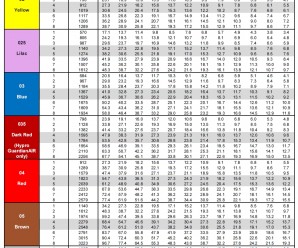
- Identify your water volume along the top row, then follow its column to find the travel speeds.
- Find your travel speed, then move left across the row to determine nozzle size and spray pressure.
- Ensure travel speeds are reached at the correct pressure; most air-induced nozzles use about 60 to 70 psi.
- Avoid operating low-drift nozzles below 30 psi because the pattern narrows and spray quality becomes too coarse.
This text was generated by OpenAI GPT 5 Mini
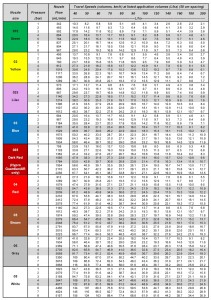
Need to find the right nozzle size for your application? Sometimes a simple chart is the easiest way to figure things out. Print it and place it in your sprayer cab.
In this chart, identify your water volume along the top row, and follow the column until you encounter the travel speeds you’re interested in.
Once you’ve encountered your travel speed, move along the row to the left to identify the nozzle size and spray pressure.
Make sure that your travel speeds are achieved at a pressure that’s right for the nozzle you’re using. For most air-induced nozzles, this will be about 60 to 70 psi (highlighted).
Once you’ve decided on a nozzle size, the travel speed column for that size becomes the travel speed range at various pressures. Avoid operating a low-drift spray below 30 psi – its pattern will be too narrow and likely its spray quality will be too coarse for good results.
Click on the images or text below to download a high quality pdf version of each chart, starting from the top with US, 15″ spacing, then US, 20″, then US 30″, then metric, 50 cm. Print, laminate, and place them in your sprayer cab.
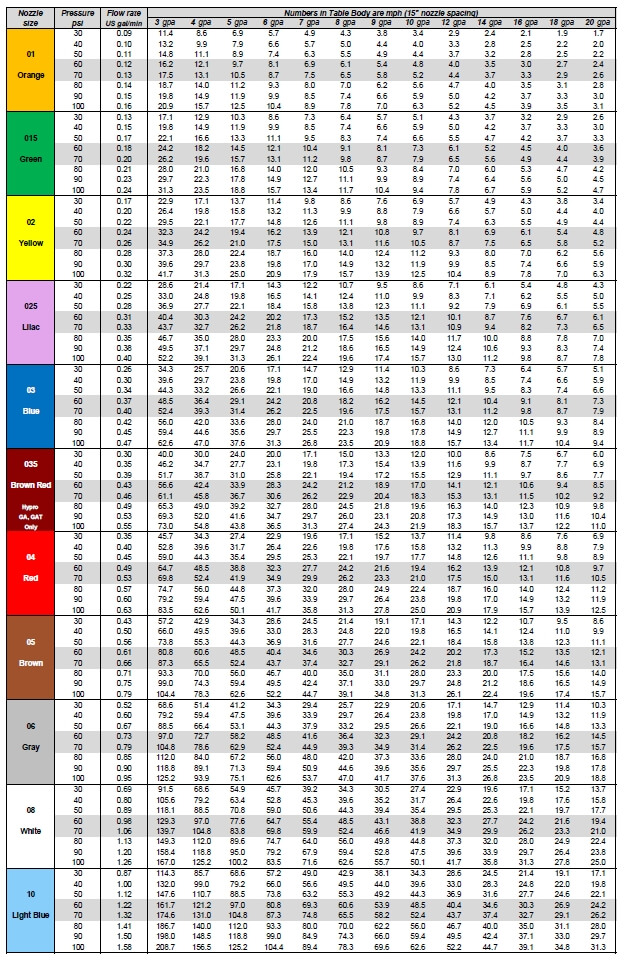
Download Application Chart (US units, 15″ spacing)
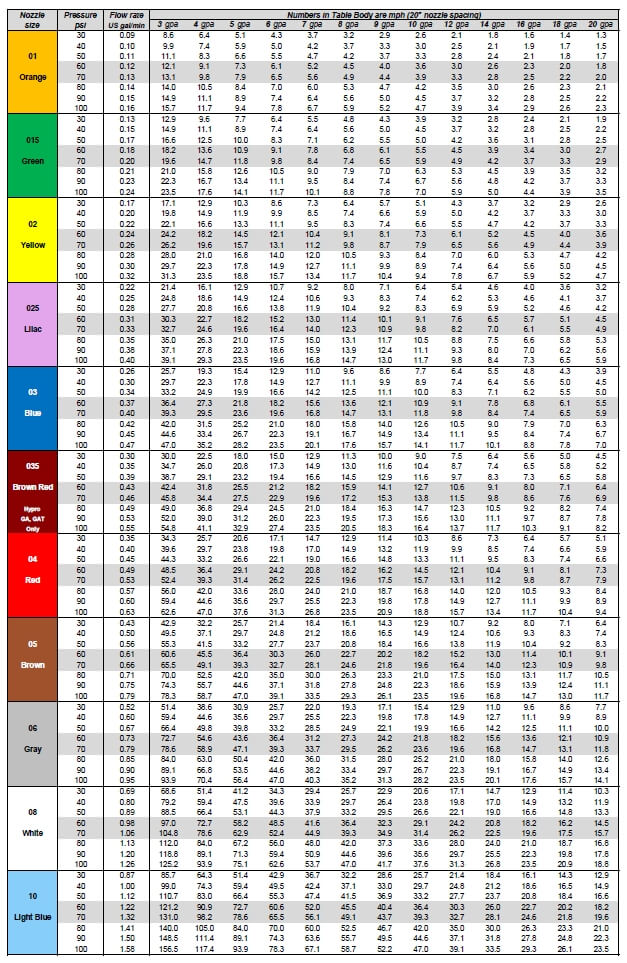
Download Application Chart (US units, 20″ spacing)
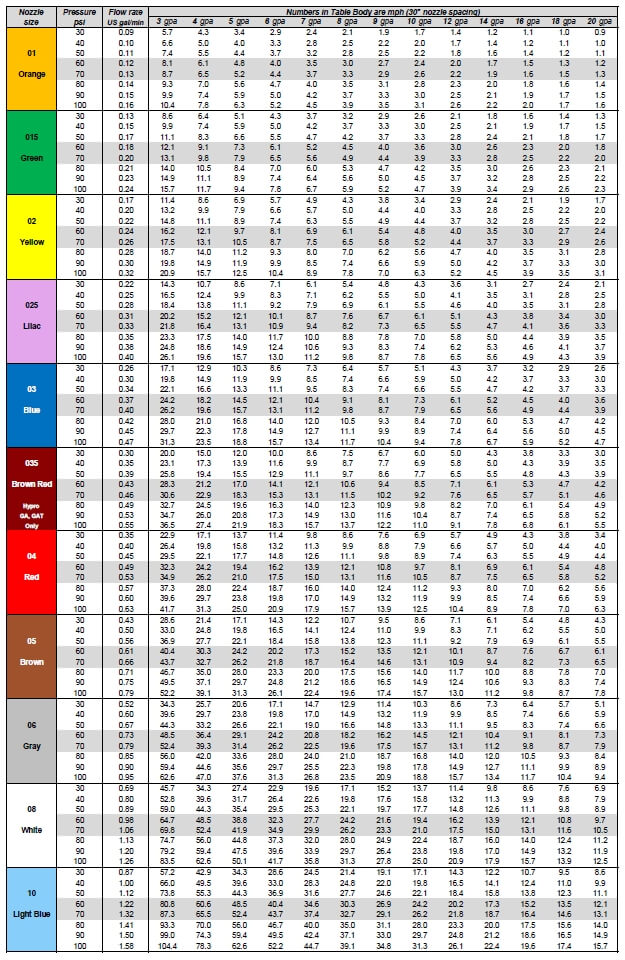
Download Application Chart (US units, 30″ spacing)
Download Application Chart (metric, 50 cm spacing)
Make your own chart using this Excel Template.
