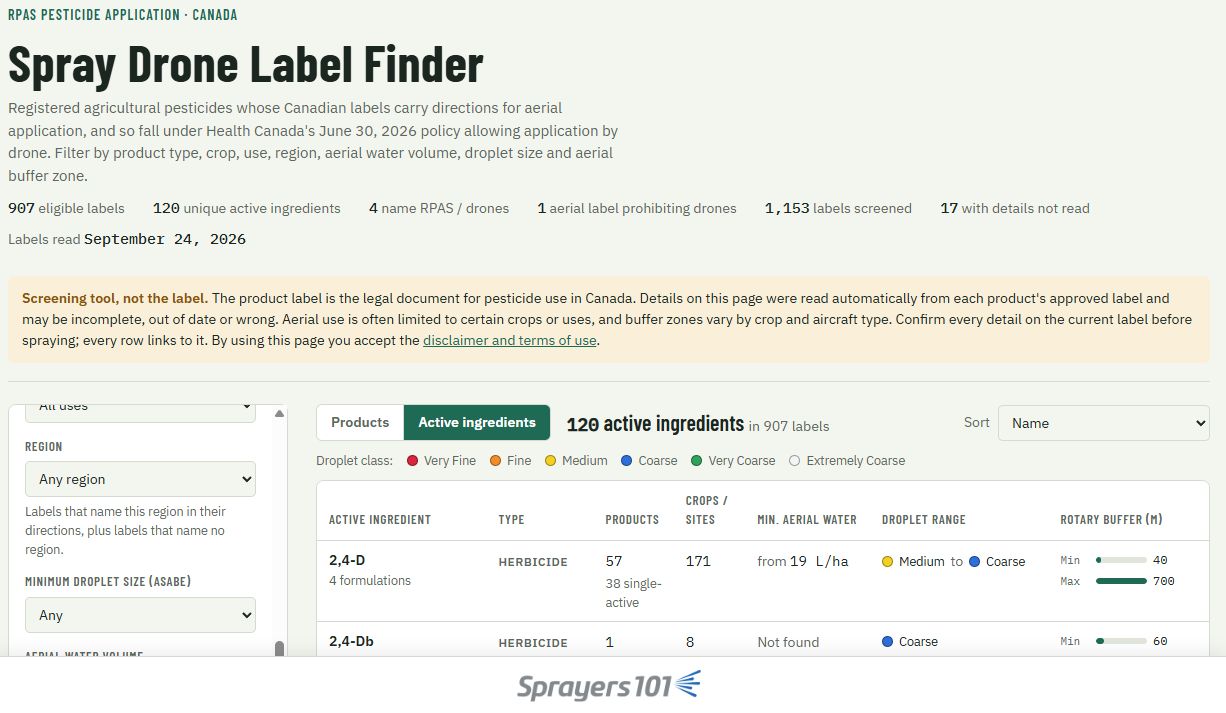
- PRD permitted use of drones for pesticides registered for aerial application in Canada on June 10, 2026.
- We built a searchable database of all products registered for aerial application, filterable by product, ingredient, crop, region, droplet size, and volume.
- Each product row shows key parameters and links to the original label; always read the label to confirm summarized information.
- PRD RPAS rules require separation of mixer/loader and pilot, VLOS with Visual Observer if needed, and strict adherence to label restrictions.
- No new federal RPAS label language; registrants may opt out via PMRA exemption or create RPAS labels; training requirements remain provincial.
This text was generated by OpenAI GPT 5 Mini
On June 10, 2026 the Pesticides Regulatory Directorate (PRD, formerly PMRA) permitted the use of drones for pesticides registered to be applied by air in Canada. Since then, a common question has been which those pesticides are, and what the volume, droplet size, and buffer zone restrictions were.
We’ve built a database that contains all products registered in Canada for aerial application. This database can be searched by product name, or by active ingredient name. The important paramaters are identified in columns. The database can be further filtered by pesticide type, crop, or region, and can also look for specific droplet size or water volume restrictions.
The database is not perfect, and will be updated over time. It is important that the original label be read to confirm the summarized information. To that end, there is a link to the label beside each product.
We’ve tested the database, but not comprehensively. Please let us know what errors you find, or how the database might be improved in the future.
And remember the basics (summarized from here):
Summary of PRD Rules for RPAS Operation in Canada
- There must be a separation of duties of mixer/loaders and pilots. In other words, two people will be required to spray by RPAS, someone who pilots but does not touch pesticide, and another who takes care of the mixing and filling.
- Drones can only be operated within Visual Line of Sight (VLOS). A Visual Observer must assist the pilot if they are unable to maintain VLOS.
- All label product rates, water volumes, droplet size requirements, and buffer zones, as well as PPE required, must be followed.
- Buffer zones for rotary-winged aircraft are to be used for RPAS
- There will be no new label language required. No specific RPAS instructions on flying parameters, calibration requirements, etc.
- Registrants wishing to opt out of an RPAS label would need to file for an exemption with PMRA, and those labels would be revised to state “DO NOT apply by Remotely Piloted Aircraft Systems (RPAS)”
- Registrants may opt to create RPAS specific labels for their products.
- There are no federal RPAS-specific training or certification requirements. Those are at the discretion of the provinces.
