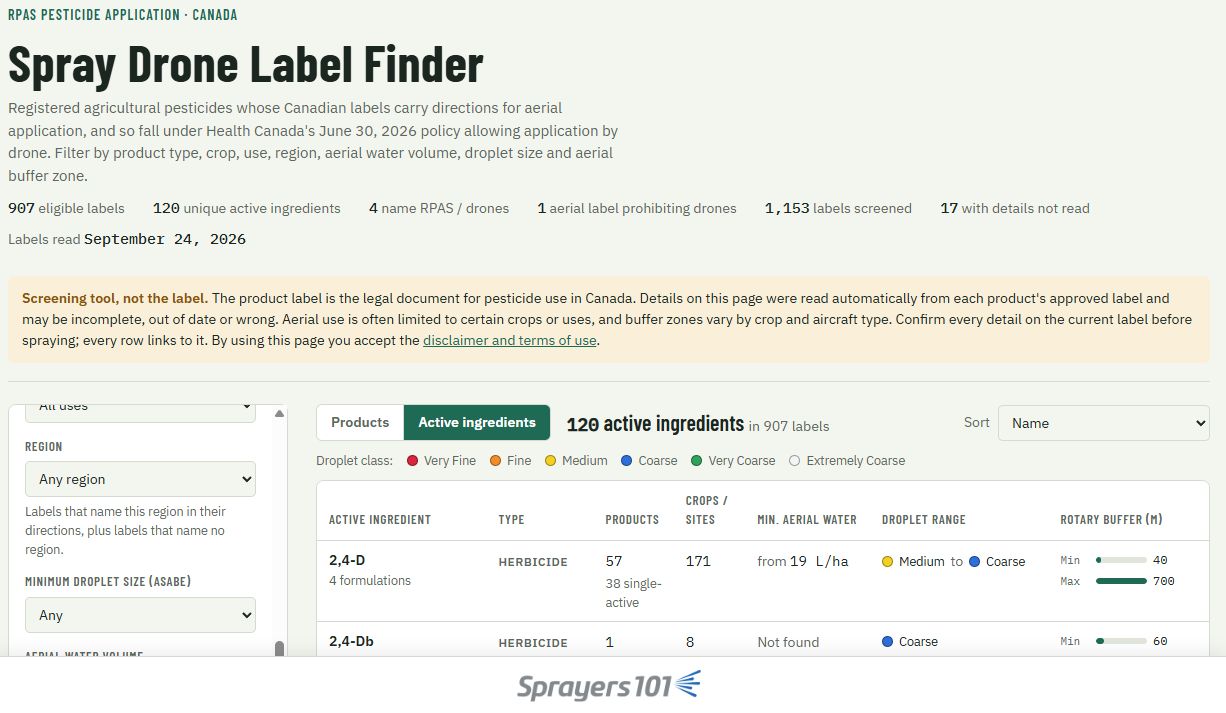
On June 10, 2026 the Pesticides Regulatory Directorate (PRD, formerly PMRA) permitted the use of drones for pesticides registered to be applied by air in Canada. Since then, a common question has been which those pesticides are, and what the volume, droplet size, and buffer zone restrictions were.
We’ve built a database that contains all products registered in Canada for aerial application. This database can be searched by product name, or by active ingredient name. The important paramaters are identified in columns. The database can be further filtered by pesticide type, crop, or region, and can also look for specific droplet size or water volume restrictions.
The database is not perfect, and will be updated over time. It is important that the original label be read to confirm the summarized information. To that end, there is a link to the label beside each product.
We’ve tested the database, but not comprehensively. Please let us know what errors you find, or how the database might be improved in the future.
There must be a separation of duties of mixer/loaders and pilots. In other words, two people will be required to spray by RPAS, someone who pilots but does not touch pesticide, and another who takes care of the mixing and filling.
Drones can only be operated within Visual Line of Sight (VLOS). A Visual Observer must assist the pilot if they are unable to maintain VLOS.
All label product rates, water volumes, droplet size requirements, and buffer zones, as well as PPE required, must be followed.
Buffer zones for rotary-winged aircraft are to be used for RPAS
There will be no new label language required. No specific RPAS instructions on flying parameters, calibration requirements, etc.
Registrants wishing to opt out of an RPAS label would need to file for an exemption with PMRA, and those labels would be revised to state “DO NOT apply by Remotely Piloted Aircraft Systems (RPAS)”
Registrants may opt to create RPAS specific labels for their products.
There are no federal RPAS-specific training or certification requirements. Those are at the discretion of the provinces.
A version of this article was originally written by @nozzle_guy as a guest blog for Farm At Hand, and is reproduced with permission.
One of the smartest decisions a grower could make is to consider a late-season harvest-aid application. Particularly in years with thinner stands, weeds can maintain a foothold. Late season moisture can give new life to late emerging plants or branches. When the crop is ready to cut, this could mean all sorts of cutterbar, pickup reel, feederchain, and sieve headaches.
A desiccant or pre-harvest herbicide application can help avoid those problems. The challenge is to get the spray into, or through, a mature crop canopy. Here are some pointers to do it right.
Evaluate where within the canopy the spray needs to go to do its job. If you’re considering a pre-harvest herbicide, are you looking to control dandelions or buckwheat near the bottom of the canopy, or are you trying to get thistles or quackgrass, whose leaves are near the top? If you’re mostly trying to accelerate drydown with a contact product, where in the canopy are the green stems and leaves that you need to contact?
Take a bird’s eye view of your canopy. That’s how the spray sees it. If you can clearly see your target, the spray application is pretty straightforward because most droplets will make their way there easily. But if the target is obscured by a lot of foliage, or if it’s vertical, the job is much more challenging and will require some combination of more water, slower speeds, angled tips or finer sprays.
To hit plant parts that you can’t see, one of the main tools is finer sprays. The smaller droplets have an easier time changing direction to get around obstacles like leaves, and they are also much more likely to be intercepted by petioles and stems, and to stick to them. This can be both an advantage and disadvantage – for example, the awns in bearded cereals are notoriously effective at capturing the smallest droplets before they can do any good further down. If you don’t want to install a different nozzle to get a finer spray, simply increase the spray pressure of your low-drift nozzle to 80, 90, even 100 psi. This will create enough fine droplets. But don’t expect the higher pressure to push the spray into the canopy. Only air-assist can do that.
To get more spray deeper into the canopy, slow down, add water, and point nozzles backward. The backward orientation helps offset the forward travel speed, giving the droplets a slower net forward velocity that helps their downward movement.
If you’re using contact products like diquat, paraquat, saflufenacil or carfentrazone, use generous amounts of water, and slightly finer sprays. Make sure that spray drift control remains a priority and pay attention to water quality.
Test your water and make sure your water doesn’t have turbidity (suspended clay or other organic matter), for glyphosate and diquat or paraquat, and hardness, for glyphosate. Aluminum sulphate can help get rid of turbidity in a pond, but it takes time (treat turbid water at least 24 to 48 h before you need it). If treating a storage vessel, expect a layer of sediment. Ammonium sulphate (AMS) and other water conditioners can remove antagonizing hard water ions like magnesium and calcium. This is especially important as we increase water volumes with glyphosate to get better coverage. The higher water volumes give a concentration advantage to the hardness minerals.
Diquat and paraquat’s mode of action benefits from being applied in the evening. The absence of the sun allows it to be taken up and slightly moved (by diffusion, not true translocation) within the leaf before morning sunlight activates it. Once activated by the sun, these products exert their activity and movement stops. If you’re not careful, the tighter window of evening-only applications could get you behind. And of course, be aware of the signs of inversions and know when to quit.
Plan ahead and make sure you give yourself enough time, because to do the job right you’ll be using more water and driving a bit slower. Focus on productivity tools like a fast, efficient fill to make up the lost time.
A good job with a pre-harvest herbicide or a harvest-aid can save many harvesting headaches, and can help dry down during less than ideal conditions. It’s another reason why the sprayer may be the most important implement on the farm.
Funny how some issues never go away. For as long as I’ve been in the sprayer business, the question of ideal droplet size for pesticide application has remained a hot topic. At its root are the basic facts that small droplets provide better coverage, making better use of water, but large droplets drift less. So why are we still debating this? Because we need both of these properties to be efficient, effective, and environmentally responsible. Ultimately, the droplet size question is reduced into one of values, where everyone’s individual priorities play a role.
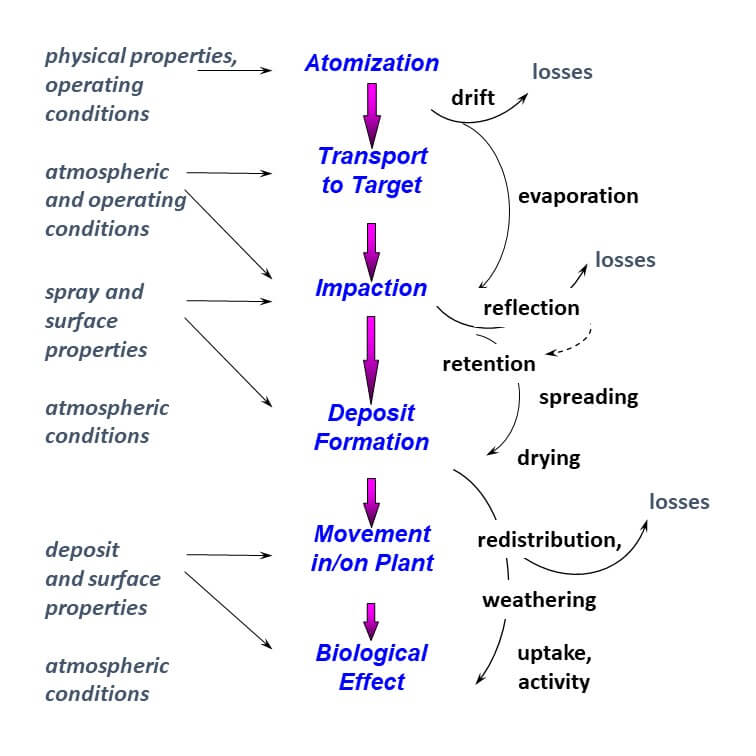
First, let’s talk about basic principles. To be effective, an active ingredient must make its way from the nozzle to the site of action in the target organism. On the way, it encounters several obstacles as summarized by Brian Young in 1986.
Figure 1: The dose transfer process of pesticides (after Young, 1986)
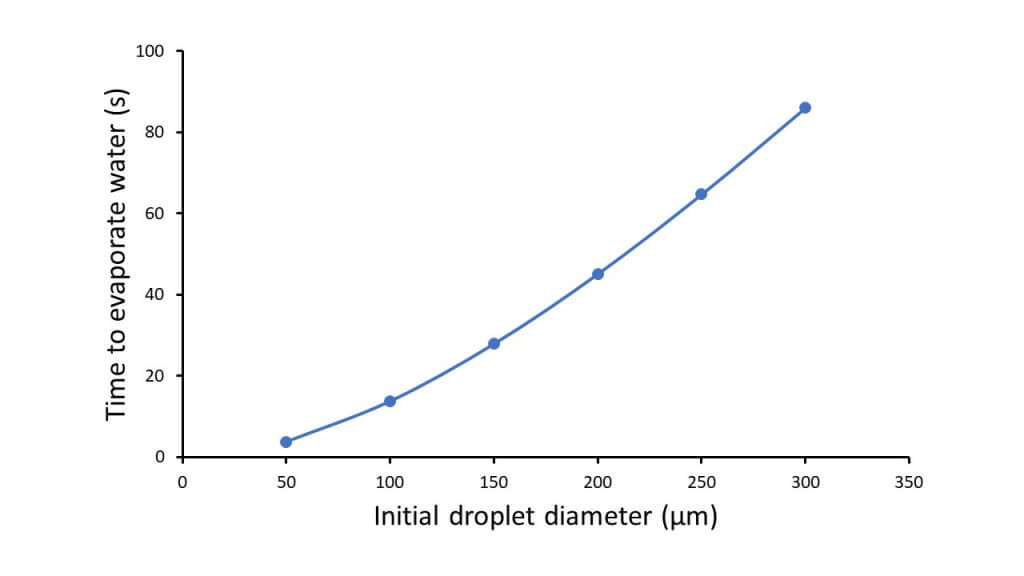
After atomization and before impaction, the spray encounters two main losses, evaporation and drift. Both of these are more severe for smaller droplets. Smaller droplets have a greater ratio of surface area to volume for any given spray volume, and can evaporate to a much smaller size, even to dryness depending on the formulation, in seconds. For water-soluble formulations, one consequence is lower uptake. Oily formulations may maintain efficacy, but neither type can escape the second effect, spray drift.
Figure 2: Time to evaporate all water from droplets of various sizes, based on the “two-fluid” model developed by Wanner (1980). Based on 0.8% v/v non-volatile, non-soluble addition, 20 ºC, and 50% RH. This model suggests that final droplet diameter is 20% of initial diameter. Reproduced from Microclimate and Spray Dispersion by Bache and Johnstone (1992, Ellis Horwood Ltd).
Small droplets are more susceptible to displacement by wind currents due to their small mass. There is no magical size above which drift is no longer possible, but we’ve generally used diameters of 100, 150, or 200 µm as a theoretical cutoff. The proportion of the spray’s volume in droplets smaller than these diameters can be called “drift potential”, and this value is useful to measure the impact of nozzle type, pressure, or formulation on that phenomenon.
But it’s not quite that simple. Even a small droplet may resist drift if its exposure to wind is limited, perhaps through a protective shield shroud, or lower boom height. Or by increasing its speed through air assist. Higher energy droplets resist displacement.
These mitigating strategies aren’t lost on sprayer manufacturers who have used them for decades to build lower drift sprayers.
The next phase of the dose transfer process is interception. The droplet has to encounter its target, but the process is mostly coincidence. Simply put, the target has to be in the way of the droplet’s flight path for the two to meet. Denser canopies are therefore more effectively targeted. A larger number of droplets (smaller droplets or more carrier) also improve the odds. But it’s not that simple. Flight paths can change. That’s where small droplets are more inventive. Because they respond to small air currents, and because such small currents surround most objects, the smaller droplets can weave around objects, following the small eddies generated by air flows. As a result, we’re more likely to find smaller droplets further down in denser, more complex canopies where the eye can’t follow. They simply cascade through.
Larger droplets, on the other hand, resist displacement by air and travel in straighter lines. They tend to hit the objects they encounter. For that reason, larger droplets are intercepted by the first object they reach and only make their way deeper into a canopy if the path is clear. In other words, vertical, sparser objects allow larger droplets to pass by.
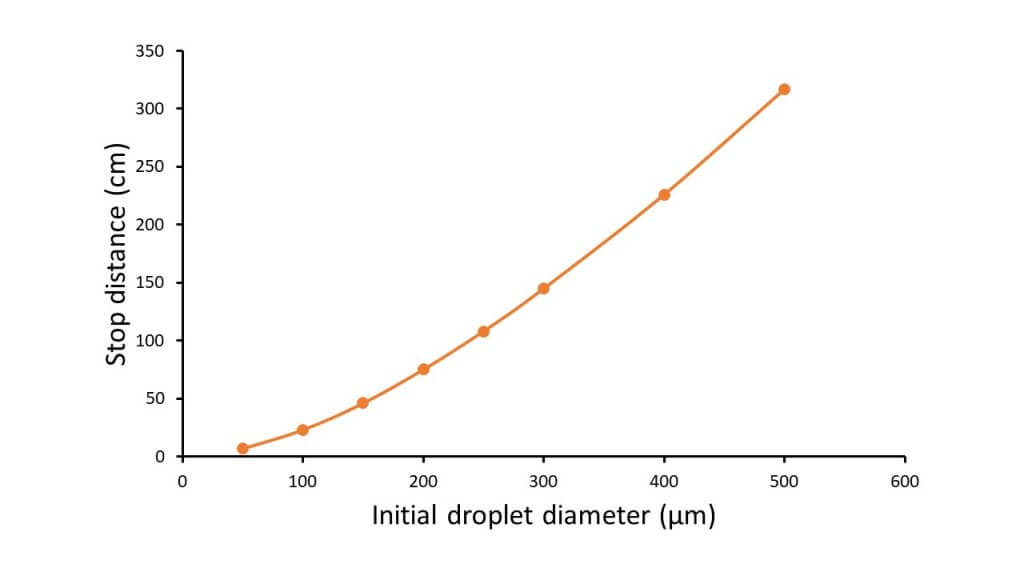
These properties are related to the droplet’s inertia, and are best described by a parameter known as “stop distance”. Assuming an initial velocity, stop distance is the distance required by a droplet to slow to its terminal velocity.
Figure 3: Stop distance as a function of droplet size. Assuming a 20 m/s initial velocity (similar to exit velocity of a hydraulic nozzle) and gravity assistance. Note that smaller droplets without the benefit of air assist lose their initial velocity within a few cm of the nozzle exit. Reproduced from Microclimate and Spray Dispersion by Bache and Johnstone (1992, Ellis Horwood Ltd).
These characteristics, combined with the aerodynamic properties of objects such as tiny insects, cotyledons, leaves, stems, etc. govern the collection efficiency of sprays. Small, slow moving droplets are thus best captured by small objects that don’t create strong enough deflections of airflow to steer the droplets past. Large objects that redirect air around them very effectively are better collectors of the larger or faster droplets whose kinetic energy can guide them through this turbulence. It’s also a matter of probability, as the smaller objects tend to have a lower likelihood of encountering the relatively scarce large droplets of any given spray.
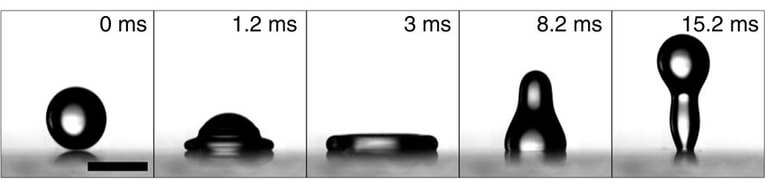
But once again, that’s not the end of the story. Interception is followed by a critical stage, retention. Objects must be able to hold onto the droplets they intercept. Slow motion video has shown that droplets flatten out on contact with an object as the liquid converts impaction velocity into lateral spread. Once at full extension, the flattened droplets will collapse even beyond their original round shape, pushing them away from the surface and possibly causing rebound. A rebounding droplet may eventually land on target, but that would be a matter of fortune. It’s better if the leaf can offer enough adhesion, diminishing the power of the rebound oscillation, allowing droplet to stick the first time.
Figure 4: Droplet deformation during impact (C. Hao, et al. 2015. Superhydrophobic-like tunable droplet bouncing on slippery liquid interfaces. Nature Communications. August 2015).
Small droplets have less mass, and tend to be retained more easily. But more than size is at play here. The morphology and chemistry of the leaf surface is also important, with crystalline or more oily surfaces offering less adhesion for droplets. The physico-chemical properties of the spray mixture becomes important, as characteristics such as dynamic surface tension and visco-elasticity affect spray retention. These properties are optimized through the product formulation effort, and possibly via adjuvants added to the tank.
We sometimes classify targets as “easy to wet” or “difficult to wet” to summarize these properties. Most grassy plants (foxtails, cereals) are difficult to wet (there are exceptions, such as the sedges) and broadleaf plants vary from the easy to wet pigweeds to the difficult to wet lambsquarters and brassicas. Easy to wet species can retain larger droplets than difficult to wet species, and that’s one reason why finer sprays are preferred for grassy weed control (leaf orientation and size are another).
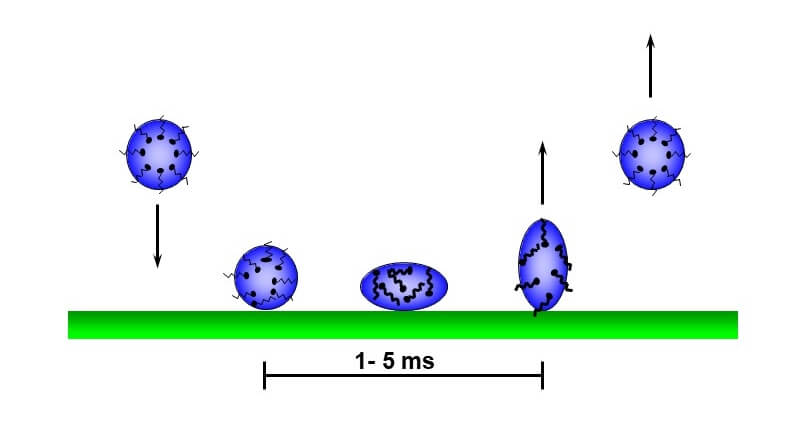
Figure 5: Droplet deformation, and surfactant molecule alignment, during impaction. The inability of surfactants to reach optimal alignment quickly, and for the target surface to absorb these forces, leads to rebound.
A few words about surface tension. Although surfactants reduce surface tension and facilitate spreading, this may not be enough to improve spray retention. To be effective, surfactant molecules need to align themselves with the surface of the droplet so they can be a “bridge” at the interface where the droplet meets the target surface. This takes time. The oscillations that occur during impaction continuously create new surfaces, and if surfactant molecules don’t follow suit immediately, the droplet will behave as if no surfactant is present. Specialists measure “dynamic” surface tension, i.e., the surface tension at young surface ages – a few milliseconds – to better predict spray retention. Very young surface ages have surface tensions of plain water, even with a surfactant present. Only certain surfactants, or higher concentrations of surfactants, can actually improve spray retention.
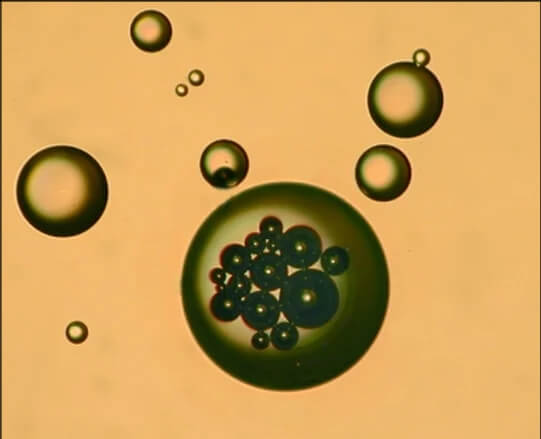
When air-induced nozzles were introduced in the mid 1990s, one of their claims was the improved spray retention due to air inclusions (bubbles) in the individual droplets. These bubbles made the droplets lighter, and also reduced their internal integrity, promoting breakup on impaction. As a result, the coarser sprays they produced actually had some of the same efficacy performance as the finer sprays they replaced. And indeed, research showed that coarser, air-induced sprays did in fact maintain good performance. Interestingly, performance of non-air-induced coarse sprays used with pulse-width modulation also showed similar robustness of performance. Research comparing air-induced to conventional sprays of similar droplet size rarely showed differences, and when they occurred, they were small in magnitude and could be corrected through improved pattern overlap.
Figure 6: Air Bubbles in spray droplets (Source: EI Operator. Believed to originate with Silsoe Research Institute, UK)
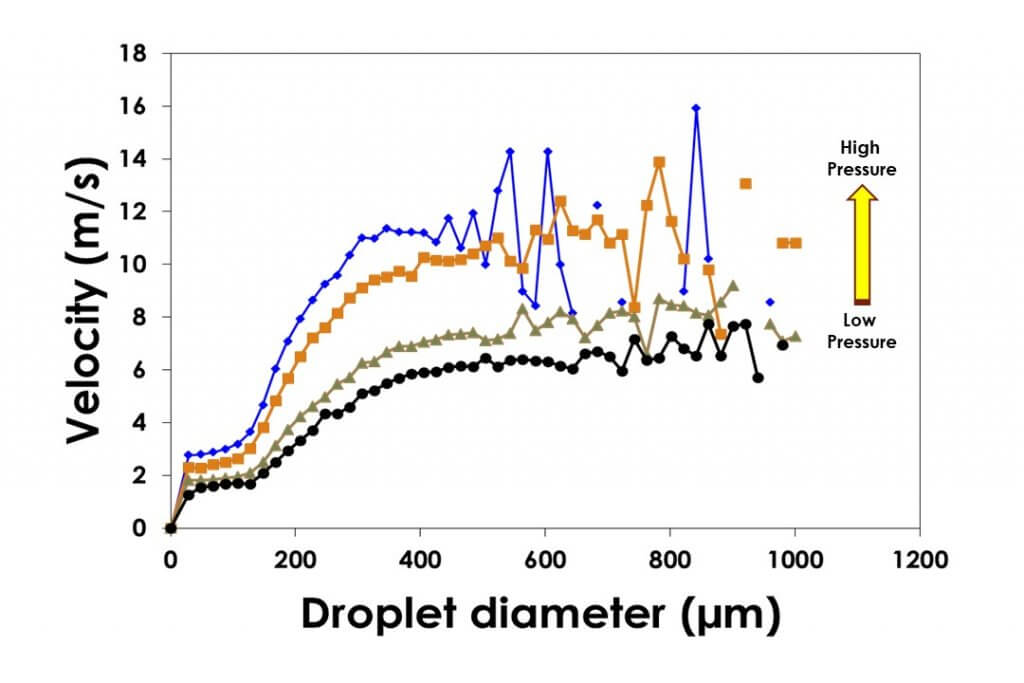
One reason larger droplets still work well is due to the pre-orifice designs of modern low-drift nozzles. This design reduces the internal pressure of the nozzle itself, with the effect being a slower moving large droplet. This reduced velocity takes away some of the force at impaction, reducing rebound.
Figure 7: Droplet velocity of larger droplets is reduced by lower pressures from pre-orifice and air-induced design nozzles. Lower velocities reduce droplet rebound.
Another neat effect of coarser sprays is their ability to entrain air. All sprays move air (simply spray into a bucket to see this), and larger droplets do this better and for longer distances. The entrained air is a form of air assist for the smaller droplets, increasing their average velocity and thus reducing their drift potential while they move in the spray pattern.
The final stage of the dose transfer process is deposit formation and biological effect, and that’s where we once again see differences attributable to droplet size.
Once established on a target surface, the active ingredient usually needs to move to its site of action. In some cases, resting on the surface is sufficient, it depends on the specific product. But for the majority of herbicides, the active ingredient must move across the cuticle into the cytoplasm where it eventually migrates to the enzymes involved in photosynthesis or biosynthesis of fatty- or amino acids. The cuticle is waxy, with only a few water-loving pathways and the uptake process is basically driven by diffusion and concentration gradients. As such, it is more effective when the product is in solution and the longer the droplet can stay wet, the better. That’s one reason why spraying during hot, dry days may reduce performance. Again, it depends on the formulation and the mode of action. Too high a concentration can damage membranes, physiologically isolating the active ingredient and reducing its subsequent translocation. It’s always a balancing act.
If you’ve been keeping track of the score, it’s more or less a tie between large and small droplets. One deposits better and makes more efficient use of lower water volumes, while the other has lower losses from drift and evaporation, helps smaller droplets resist drift, and may improve uptake of some products.
And this draw is why the venerable hydraulic nozzle has been so successful for so many decades. Hydraulic atomization, by its nature, creates a wide diversity of droplet sizes, ranging from 5 to 2000 µm or greater. As Dr. Ralph Brown of the University of Guelph used to say, this nozzle provides a drop for all seasons. Some small ones for coverage and retention in hard to reach places, and some large ones for uptake and drift-reduction. The result is a robust delivery system that provides reliable results on many different targets under many conditions. In recognition of the heterogeneity of sprays, we don’t refer to specific droplet sizes, but rather their composite, grouped into international categories of Spray Quality such as Medium, Coarse, and Very Coarse.
Our challenge is to find the spray quality sweet spot, the ideal blend of these contradictory and yet complementary features of our agricultural sprays. And I believe that task is very achievable. Simply put, broadcast agricultural sprays in field crops work reliably when applied as Coarse and Very Coarse sprays in volumes between 7 and 12 US gpa. There is no need to spray any finer than Coarse for good efficacy, as coverage is already sufficient and any additional coverage has small marginal returns. There is, however, value in adding more water when canopies are denser or when leaf area index grows as the crop matures. To gain coverage, adding water is preferred to reducing droplet size because of the value of environmental protection. It so happens that Coarse to Very Coarse sprays provide or exceed the drift protection required by most agricultural labels.
There is occasional reason for spraying even coarser than what I’ve suggested. It’s certainly required by law for dicamba products on Xtend traited soybeans and cotton, but even then, only in conjunction with higher water volumes to offset losses in droplet numbers. In practice, moving to Extremely Coarse or Ultra Coarse sprays may allow an application to proceed in higher than average wind without adding drift risk. The use of some additional water is a relatively small price to pay for that additional capability.
There will always be opportunities for efficacy improvement in specific cases for those willing to spend the extra time to optimize that situation. That’s one of the reasons I’m excited to see the widespread adoption of pulse width modulation (PWM) in the industry, allowing users to change spray pressure and therefore spray quality with no impact on application rate or travel speed. Or the introduction of nozzle switching from the cab, employing the optimal atomizer for a specific situation. Although it remains difficult to define the ideal spray, selecting a spray quality has never been so easy.
This article was originally published in the Proceedings of the Soils and Crops Workshop, 2005.
Authors
Tom Wolf (AAFC), Brian Caldwell (AAFC), Cheryl Cho (CDC), Sabine Banniza (CDC), Yantai Gan (AAFC)
Background:
Fungicide application is an important disease management strategy for ascochyta blight (caused by Ascochyta rabiei) in chickpea due to the poor host resistance in available cultivars. Ascochyta blight, left untreated, can cause yield losses in excess of 90% in Saskatchewan, and appropriate timing and frequency of fungicide spray application is critical. Producers wishing to apply fungicide are sometimes unsure which application method to use – aerial or ground. Both offer potential advantages and disadvantages: ground sprayers utilize greater water volumes, but leave tracks which can lower yield and spread disease. Aircraft use lower water volumes but do not damage the crop and can cover more area in a timely fashion. The relative importance of these characteristics is unknown.
Objectives:
Objectives of this study were to compare aerial and ground fungicide application on chickpea disease and seed yield.
Materials and Methods:
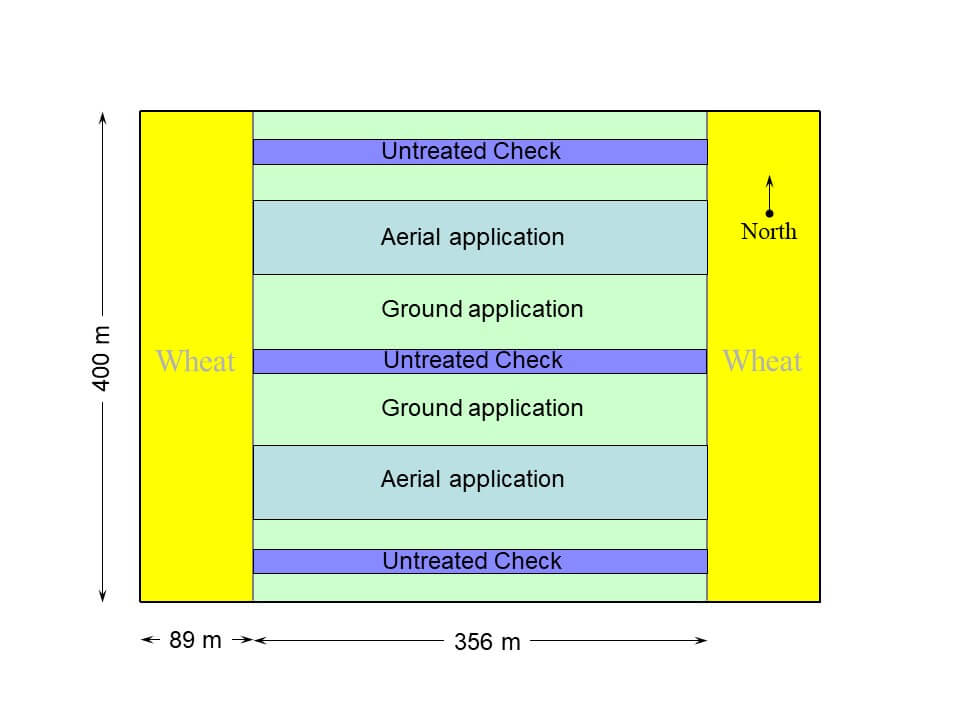
Chickpeas (certified CDC Xena, a unifoliate kabuli rated as having very poor ascochyta resistance) were seeded on May 15 (2003) and May 27 (2004) on 35-acre sites near Saskatoon which had been chem-fallow wheat stubble (2003) and spring wheat (2004) the previous year. Seed was treated with Crown and Apron and seeded at 170 lbs/acre (35 seeds/m2) to a depth of 6.5 cm using a Flexi-Coil airseeder with 9” row spacing. The field was harrowed and rolled after seeding. Pursuit (70 mL/ha) and Post Ultra (0.32 L/ha) were applied for weed control in both years. The crop established evenly and weed populations (primarily prostrate pigweed and stinkweed) were low in 2003. In 2004, sow thistle was the predominant weed.
In 2003, the crop was scouted at 5-day intervals for the presence of disease. Initial disease levels through June were very low and disease did not become visible until after the first major rainfall event on July 6. Headline (pyraclostrobin) was applied on July 11 and 21 at 0.4 L/ha, followed by Lance (boscalid) on August 1 and 13-14 at 0.42 kg/ha. Aerial and ground applications were conducted at dusk with calm conditions. Both were conducted within 1 h of each other except for the last application of Lance where the ground application followed the next morning.
In 2004, the crop was slow to establish, but disease became prevalent early in its development, especially on the side of the field which bordered the 2003 trials. Headline was applied on July 12 and July 23, Lance was applied on August 2. A second application of Lance was not warranted due to cool conditions which jeopardized the maturity of the crop.
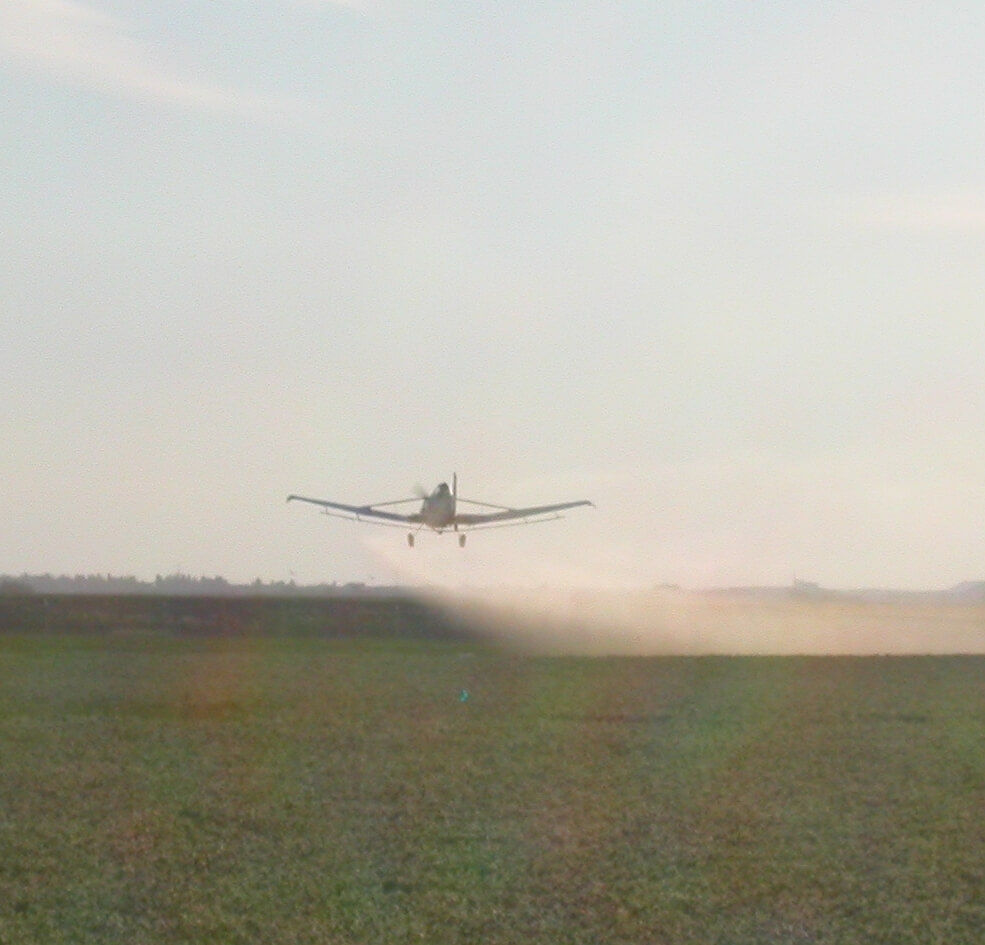
In both years, aerial applications were done by Cessna Ag Truck applying 4 US gpa (37 L/ha) through 24 CP-03 nozzles with the 0.125 flow orifice and 90º deflection, at a pressure of 34 psi and 120 mph airspeed. At these settings, the spray had a volume median diameter (VMD) of 271 µm according to USDA atomization models. Swath width was 50’ and boom height was 10 to 15’ above ground.
Aerial application of fungicide to chickpeas, 2003.
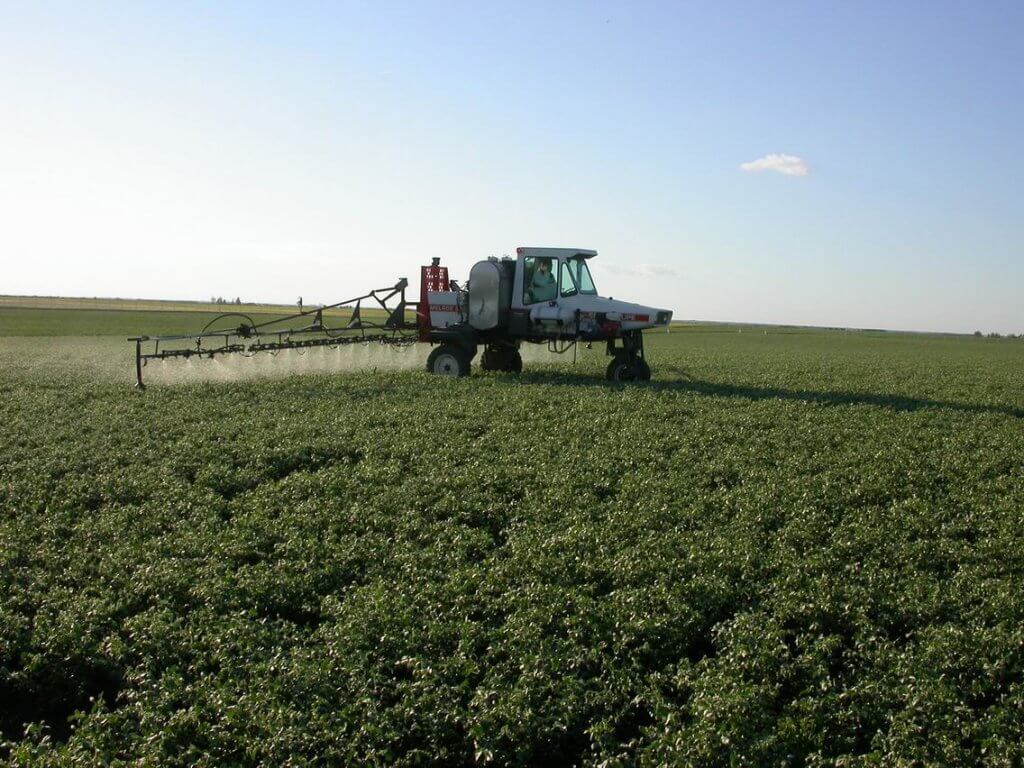
Ground applications were done using a Melroe SpraCoupe 220 travelling 8 mph with a 43’ boom, using XR8003 nozzles operated at 40 psi and a boom height of about 75 cm. At these settings, the application volume was 100 L/ha, and the spray had a VMD of 246 µm.
Ground application of fungicide to chickpeas, 2003.
Disease ratings were conducted on approximately the same dates as spraying. Disease ratings were conducting using the 0-11 Horsfall-Barratt scale, converted to % infection. Single plants were rated at 64 (2003) and 60 (2004) locations in each treatment within each rep, for a total number of 128 or 120 plants rated per treatment per rating date (except for the first rating, where only 24 plants per treatment were rated). Ratings from the outside two passes of the aircraft in each replicate were deleted since proper spray patterns were not expected at these edges.
In 2003, the crop matured in mid-August and Reglone was applied by ground sprayer travelling perpendicular to the treatments, on August 22. In 2004, the crop failed to mature and was sprayed with Roundup on September 20.
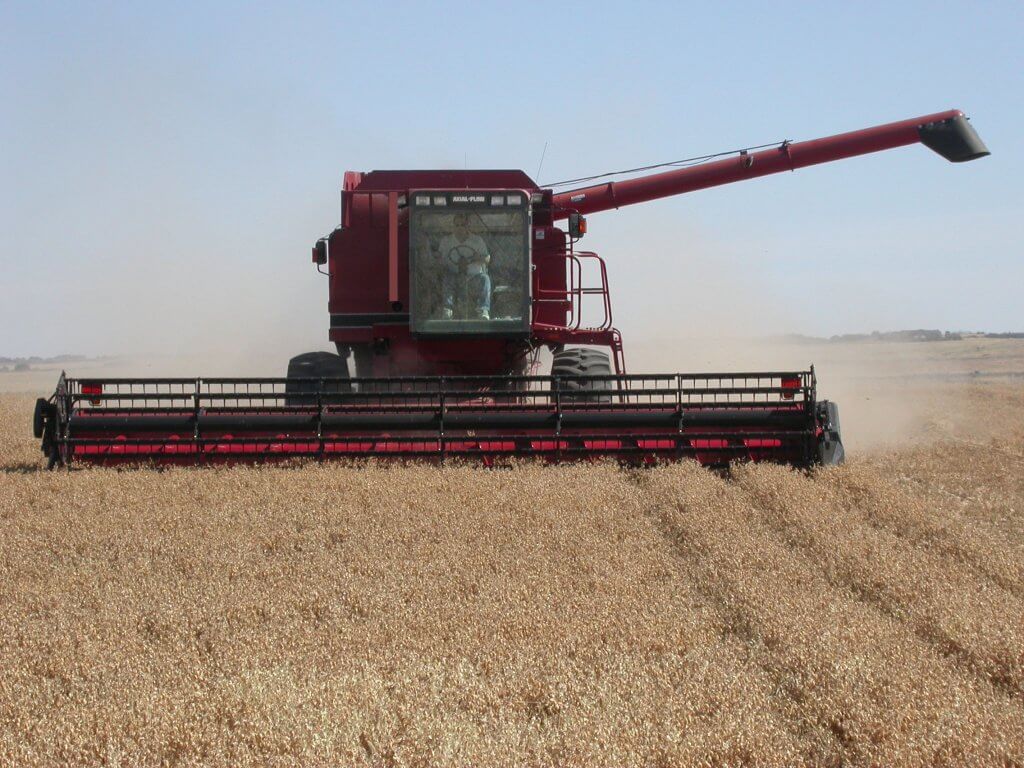
The 2003 crop was harvested on September 3 using a Case 1688 combine with a 30’ flex header. After removal of headlands, two 275 m long swaths were taken from each treatment, and the seed from each swath was weighed and sub-sampled for seed quality. In the aerial plots, the central two spray swaths of each rep were sampled. In the ground plots, two swaths were taken with wheel tracks, and two without wheel tracks in each rep. Wheel tracks were then adjusted to a 90’ boom width for yield calculations.
In 2004, harvest was impractical with the large combine due to the low seed yield and quality which prevented accurate yield measurements. On November 10, a Hege combine was used to harvest a single pass along the length of each sprayer swath for all treatments. The grain was bagged, dried , and weighed.
All data were analyzed using analysis of variance (ANOVA) as a randomized complete block design with two replicates. Treatment effects were considered significant at p=0.05.
Results and Discussion:
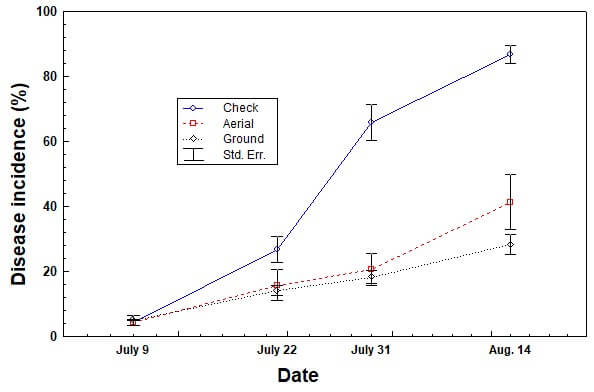
Ascochyta was prevalent in both 2003 and 2004. In 2003, disease severity in the untreated chickpea progressed from about 5% to about 66% from July 9 to July 31. Disease severity in sprayed plots was significantly less, about 18 and 21% for the ground and aerial treatments, respectively on July 31. A late flush of disease on new growth increased levels to 87% in the untreated plots, and 28 to 41% in the ground and aerial plots, respectively, on August 14.
Ascochyta blight severity on chickpeas throughout growing season, 2003
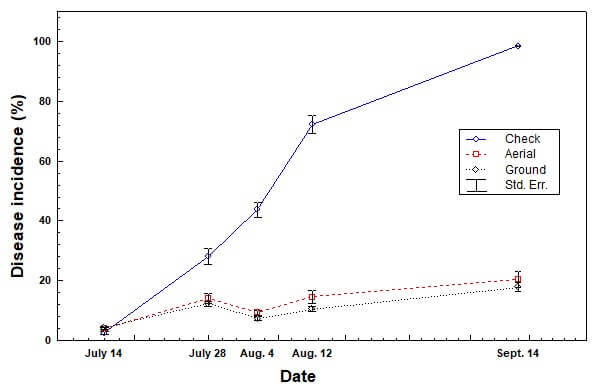
In 2004, disease in the untreated plots steadily increased from 3% infection on July 14 to 99% on Sept 14. During this time, the treated aerial and ground plots increased from 4 to 18-20%, similar for both application methods.
Ascochyta blight severity on chickpeas throughout growing season, 2004
Application methods generated visually different spray deposits on water sensitive cards. The ground application had greater overall coverage of the cards primarily due to the greater water volume used (100 L/ha vs. 37 L/ha) Cards indicated that overall uniformity of the spray deposit along the width of the boom was greater for the ground sprayer (data not shown). However, water sensitive cards provide an artificial collection surface that does not accurately simulate the complexity of a leaf surface or a multi-dimensional plant canopy. These cards therefore do not provide an assessment of leaf coverage, but are limited to a visual indication of the type of spray quality emitted by the application.
Spray deposit on water-sensitive paper for ground application at 100 L/haSpray deposit on water-sensitive paper for aerial application at 37 L/ha
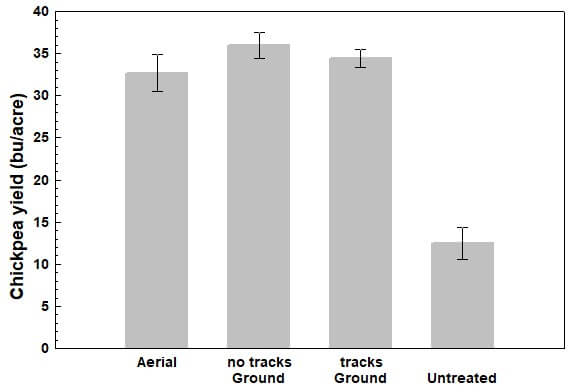
Fungicide application significantly increased seed yield in both years. In 2003, yield averaged 13 bu/acre for the unsprayed treatments, and 33 bu/acre where fungicide had been applied. Aerial treatments yielded 32.7 bu/acre, whereas ground treatments (track damage adjusted for 90’ boom width) yielded 34.4 bu/acre. This difference was not statistically significant (Table 1). Ground-sprayed areas without wheel tracks yielded 36.0 bu/acre, therefore yield loss due to tracks was 1.6 bu/acre.
Chickpea seed yield in plots treated with fungicide applied by air and ground, 2003.
Table 1: Analysis of Variance (ANOVA) for chickpea seed yield from aerial and ground applications (ground with tracks adjusted for 90′ boom), 2003
Effect
df Effect
MS Effect
df Error
MS Error
F-value
p-level
Trt
1
5.89
1
1.41
4.18
0.290
Rep
1
12.10
1
1.41
8.58
0.209
Sprayer tracks reduced yield due to crop destruction, but they did not appear to spread disease within the crop. It is possible that application during evening hours before dew wetted the foliage helped prevent disease spread. The role of sprayer tracks requires further investigation.
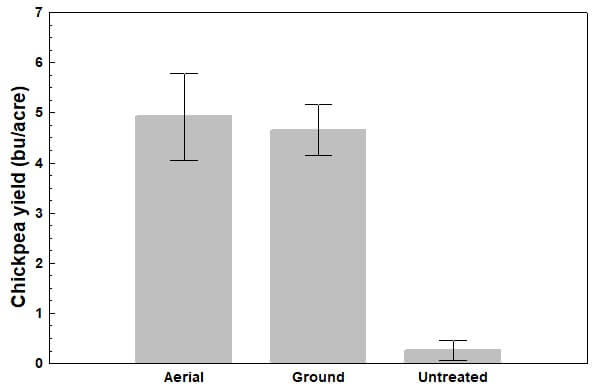
Seed yield and quality were very poor in 2004 due to cool growing conditions and an early frost. In spite of this, results mirrored those from 2003: fungicide significantly increased yield, from 0.3 bu/acre in the untreated plots to 4.7 and 4.9 bu/acre in the ground and aerial treatments, respectively. Yield differences arising from application method were not statistically significant.
Chickpea seed yield in plots treated with fungicide applied by air and ground, 2004
Seed quality analysis demonstrated no difference in chickpea grade of either ground or aerially applied fungicide. Aschochyta rabiei was not detected on seed from any treatment.
These results showed that both ground and aerial application of fungicide provided effective control of Ascochyta rabiei on chickpeas. Results from 2004 were compromised by a poor growing season, therefore further work may be necessary to confirm this outcome. Nonetheless, the consitency of conclusions support recommending both methods to producers wishing to apply fungicide.
Acknowledgements:
We thank Roland Jenson (Cloud 9 Airspray) for conducting the aerial applications, Mark Kuchuran and Dan Caldwell (BASF) for providing fungicide, herbicide, and overall support, Jim Kelley (Redhead Equipment) for providing harvesting equipment, Al Baraniuk (AAFC) for assisting with seeding and harvesting operations, and Curtis Sieben and Chris Gilchrist for implementing this trial. Financial assistance was provided by the Saskatchewan Pulse Growers (2003) and AAFC through the IFSP Initiative (2004).
There’s a call that I’ve been getting for 20 years now. It came again this week. Someone has a twincap with two small air-induced tips, and they’re applying herbicides and fungicides with low water volumes, often 5 gpa, sometimes less. They call because they want to know how much wind they can spray in. Is 30 km/h OK? They want my blessing.
I don’t need to hear much more. Some nozzles are sold entirely on the premise that they provide superior coverage – more droplets per square inch – and that this improved coverage permits the reduction of water volumes. Furthermore, the claim goes, when water is reduced, the spray concentration increases and the whole darn package just works a lot faster and better.
This line of thinking is as old as spraying itself. Applicators seek pesticide performance as well as productivity, and this approach gives them both. The proponents are well aware of their customers’ desires, and sell into it. “Use these tips and cut back on water. Any more than this just runs off anyways. You’ll get better coverage and better performance, get more spraying done.” It’s a convincing argument. Get an edge on your neighbour, the person who’s not in on the secret and is wasting time and water.
Why don’t I embrace it? There are a few reasons.
First, it doesn’t tell the whole story. Invariably it involves a twin nozzle setup. Use two nozzles, get more droplets, right? If that were true, believe me, I’d be advocating for quintuples.
Fact is that the only factors that change droplet numbers are droplet size (spray quality) and water volume. Want more droplets at the same water volume? Make the spray finer. Want to keep spray quality and add droplets? Add water (not nozzles).
The easiest way to improve coverage at the same volume is to use a finer nozzle, or to increase spray pressure. Depending on how far you go, you could make the spray finer and cut water, and still have more droplets per square inch.
The hardest way to improve coverage is to purchase a twincap and buy two nozzles, each of them half the size. True, within any given nozzle type, smaller sized tips usually generate finer sprays. But why bother with two tips? They’re more expensive and plug more.
If someone asks me how to improve coverage without changing water volume, I usually tell them to speed up a few mph. The rate controller will increase pressure and the spray gets finer. If speeding up is not possible, get one size smaller nozzle and run at higher pressure, same speed. Or keep nozzle and speed, and add some gpa, pressure will go up. It’s that easy. No twins necessary.
Second, the twin nozzle/low volume approach exaggerates the value of the twin nozzle for herbicides. With small plants and relatively open canopies in the early season, plus our high booms and travel speeds, the twin tips are not adding a lot, if anything at all, to coverage. It remains a sum of droplet size and water volume, the angle is not important at this stage. Deposit is by turbulence and wind, most of the time.
Third, low volume believers ignore a few potential problems. Drift is a big one. Low volume, fine spray operators are surrounded by nervous neighbours. They have fewer hours per day during which drift is acceptably low. And they definitely should not be on the field when wind is at 30 km/h. Basically, they’re a bit uncomfortable (at least they should be) and get less done per day.
Another potential problem is evaporation. Most sprays, even when applied at lower volumes, are still 90% or more water. The same volume of water evaporates much quicker when atomized into smaller droplets. This has two main downsides: On their way to the canopy, small droplets evaporate and become even more drift prone, and may not impact at all. Those that impact evaporate shortly thereafter. Research has shown that pesticide uptake is better from wet than dry deposits.
When Delta T (dry bulb minus wet bulb temperature) is high, evaporation can be so strong that it reduces pesticide performance or causes solvent burn. Fine sprays make it worse.
I also hear about the use of oily adjuvants to control evaporation from small droplets. This could be even more dangerous. Small droplets drift, and evaporation to dryness is actually helpful in reducing the impact of that drift. How? It makes the small droplets disappear, with their remnants dispersing into the turbulent atmosphere. With oily adjuvants, the small droplets stick around and stay potent and their drift damage is much worse.
Lastly, the practice is possibly off label. Water volume and spray quality label statements are designed to offer good performance and acceptable drift risk. While that part of the label is often a bit dated, it does provide better support from the manufacturer should something go wrong.
If you’re spraying under hot, dry and windy conditions, the low volume, fine spray approach is irresponsible. Use sufficient water (7 to 12 gpa) to allow low-drift sprays, at least Coarse to Very Coarse, in some case, even coarser.
Agronomists provide the best possible information for their clients, based on scientific evidence and experience and in accordance with their professional code of ethics. Sometimes the news we deliver aren’t what the customer wants to hear. But we have to represent the interests of all of us, collectively. I find that pretty important.