Tag: fungicide

  • Fungicides with a Custom Applicator: Drive-Along Diaries #4

    Fungicides with a Custom Applicator: Drive-Along Diaries #4

    In this fourth installment of the Drive-Along Diaries, we’ll shift our focus a little. I’ll continue to share observations about real world spraying practices, but we’ll also dip a toe into the business side of custom application. Every contractor’s situation is different, but perhaps you’ll be able to relate to some of these experiences.

    4:30 am

    Once again, I found myself driving through Ontario in the wee hours, sipping life-giving coffee and marveling at the total absence of traffic. I was headed to Grande Pointe near Chatham to meet with Paul Delanghe, who’d invited me to tag along with him. I was looking forward, but I was also experiencing a little dread as I imagined subjecting my posterior to another day in the buddy seat. When I arrived at 7:00, I found Paul and his staff in the office. Handshakes were shared all around. Then I dove right in by asking how he got started and how his business worked.

    Hello darkness my old friend. I’ve come to sit on you again.

    An evolving business model – fertilizer and/or fungicide?

    Paul’s family has farmed cash crops, including field tomatoes and sugar beets, for four generations. When he left the aviation industry in 2015, he invested in a high clearance sprayer and a set of Y-drops to apply fertilizer on the family farm. It wasn’t long before he was doing neighbouring farms as well. By 2017 he was saw potential in custom fertilizer work and started Acres Unlimited (AU), which incorporated in 2019.

    The original business proposition was straightforward. A split fertilizer application with optimal timing can increase yield while saving fertilizer dollars. For example, perhaps a customer would lay down 150-175 lbs of fertilizer early season, and then call on Paul for another 25-50 lbs using his Y-drops. They might request a single rate, or a variable rate depending on soil type and yield potential (or none if hail or drought wreaked havoc).

    This worked well for a few years, so Paul expanded into fungicides. He observed that many corn growers didn’t want to invest in their own high clearance sprayers and preferred to let a contractor worry about minimizing the trample (~4% of the yield). In the case of wheat, many growers were too busy planting to thoroughly clean their sprayers after herbicide applications and were happy to make that the contractor’s problem.

    Paul found that fertilizer applications weren’t as lucrative as fungicide applications. High volume fertilizer applications meant spraying 300 ac/day instead of the 5-700 typical of herbicide or fungicide applications. That loss in productivity bit deeper when he had to rely on the client to load UAN because it meant chasing refills and waiting on small-capacity pumps.

    Those delays created scheduling conflicts. Typically, as June slips into July, the window for fertilizers closes as the window for fungicides opens. But when there’s a wet spring (like we had this year) it stretches the planting window. Paul would get calls for fertilizer applications in late July, overlapping the fungicide sprays that extended into early August.

    So, was offering custom fertilizer still worth it? Fungicides represent the biggest opportunity for profit and are relatively low risk. UAN is hard on equipment and machine prices and depreciation costs have increased significantly (Paul figures $200.00 CAD/engine hour). He calculated that he would have raise his prices to $25/ac for custom fertilizer applications, and that just wasn’t feasible. So, for all these reasons, he decided to leave custom fertilizer applications behind.

    Staff roles and coordination

    Today, Acres Unlimited consists of Paul, two full time employees (one sprayer operator and one tender truck operator) and one part timer. In addition to working for AU, employees have personal endeavours, such as running their own farms or hauling tomatoes. That means work assignments must be flexible because availability isn’t always a given. Paul sprays from April to November and when he works on his own, he can handle 3 to 500 acres a day. As long as everyone is on board for the peak spraying season in late July / early August it all seems to work.

    Staff coordinate their activities through their phones. They drop pins in Google Maps, use a group chat and call regularly to stay in touch. Each employee is trusted to operate semi independently, using their own judgement to establish the safest, most effective, and most efficient means to get the job done. I was left with the impression that the business functioned almost as a cooperative under the Acres Unlimited banner.

    7:45 am – The yard

    This was great office conversation, and I was so engrossed that I didn’t notice when the staff left for the yard to get ready for the day. We followed behind and Paul showed me their spraying equipment.

    The Sprayers

    Paul has experience with several asset tracking packages (e.g., AgLeader, Raven), but he likes John Deere’s Op Centre the most. When he started spraying, Deere was the most expensive North American option, so he went with Miller and Hagie. However, the cost of sprayers has increased in recent years and closed the price gap sufficiently for him to justify buying a 412R in 2023. AU also runs a 2022 Miller Nitro 7310, and that’s used by their second operator.

    According to Paul, Deere really isn’t interested in producing a high clearance machine for corn (he was encouraged to go buy a Hagie) so he had to add tall tires and a lift kit to climb from the 1.53 m (60”) stock clearance under the frame to 1.82 m (72”). He also protected the hydraulics behind the tires by covering them with canvas bags. Other growers use 5 gallon pails or even car mats to accomplish the same thing.

    Tendering equipment

    AU recently upgraded to a Phiber DASH 4.4 on their 15,900 L (4,200 gallon) tender truck. It caused a little sticker shock but paid for itself very quickly. The sprayer was no longer idling while the operator filled the bowls, saving on engine hours. Plus, the less than eight-minute fill time added to their overall productivity.

    The tender truck itself was designed for the operator to forklift totes onto an overhead platform and gravity feed chemistry into the inductor bowls. Paul likes the bulk format over the jugs and uses it whenever it’s feasible. However, he installed transfer pumps because they’re faster than gravity feed and do a better job emptying the totes completely. Paul prefers to trust the embossed sight gauge on the side of the bowls over a flow meter; Variability in product viscosity makes the flow meter inaccurate, and that adds up over several loads. In fact, when using totes, they’ve seen discrepancies as high as 50 L (13 gallons) at the end of a day.

    There was also a humble 1994 cube truck to service the other sprayers with diesel and chemistry, and a 27,250 L (7,200 gallon) water truck. AU gets their water from municipal stations, and one was conveniently located across the street from the yard. It’s a fast fill, and while there’s rarely a line up, they still make sure to fill each night to ensure an efficient start the next morning.

    Float trailer

    Chatham-Kent and Essex are big counties. When Paul ran the numbers on engine hour depreciation, the operator’s time, fuel, maintenance, and tire wear, floating the sprayer between jobs made sense. So, he uses a 12,100 L (3,200 gallon) float trailer to transport his Deere 412R.

    He chose the two-bowl Phiber DASH 2.4 because they use a lot of jug formats with this sprayer. The left bowl (J) is a push-to-rinse system and on the right (R), a knife. This is handy for co-packs. For example, Veltyma DLX is a co-pack with one larger and one smaller jug. The smaller jug gets upended on the rinser and the larger jug gets spiked on the knife. Spiking is faster, but there’s always a chance of stabbing yourself, so better to spike the larger jugs.

    8:05 – Heading out

    While I waited, Paul circle-checked the float trailer. Then he flipped open the tractor trailer hood and climbed inside to get it to start! He explained that he had to manually operate the fuel pump because the electrical was cranking too slowly. This truck had almost 1,000,000 km on it and fixing the pump was going to be ~$7,000.00, so this little work-around was fine with Paul. Plus, it’s great anti-theft security.

    We drove on narrow county roads which required us to lean on the gravel curbs. Paul noted that it typically kicks up a lot of dust and aggravates the people driving behind him. It can spur them to passing unsafely. But since we’d had so much regular rain this season, there was no dust and people seemed more patient.

    This isn’t actually Paul, but only a few weeks after spending the day with him I ended up driving behind a sprayer. The photo op was too good to miss. and yes, I passed him.

    8:18 am – Loading

    Now at our destination, Paul found a safe and accessible place to park and began untethering the sprayer. That consisted of removing the four chains with turnbuckles that secured the sprayer to the trailer. He always does this first, so he doesn’t forget before backing it off… ask him how he knows. This took about two minutes to complete. Then he hit a switch under the sprayer to send up the airbags and grabbed some gloves to start filling the inductor bowls.

    As Paul was pouring chemistry into the inductor bowls his phone started ringing. He said he never answers when he’s focused on loading. It takes time and attention to ensure it’s done right, and he didn’t want any distractions. Paying a little extra time and attention now means avoiding costly issues later.

    This was a 54 ac job, but Paul was adding enough for 60 acres because he didn’t want to run short. A little leftover fungicide on the next job (soybeans) would be a nice bonus for the client. Each jug was emptied, rinsed immediately, had the cap replaced and was dropped back in its cardboard box. The water truck operator would grab them later when he came with our refill. Removing caps and labels for recycling is a rainy-day job.

    Prepping jugs and cardboard for recycling is rainy day work.

    The loading process

    Perhaps I should have explained sooner, but here’s a short and generic description of the chemical loading system. Product gets added to a conical inductor bowl. This can be via jug (poured or knifed), or from bulk containers via gravity or transfer pump, or dry products get blended with a recirculating agitator. One of several bowls might be filled, each with their own product, or one bowl can be filled and emptied serially. Then the operator starts the carrier pump and begins pushing carrier (usually water) into the sprayer tank. Once enough is loaded, a valve at the bottom of the bowl is opened and the Venturi effect creates suction to draw the chemistry into the carrier stream. Then a second valve is opened to activate a rinse head in the bowl, or this is done manually using a hand-held hose. This process can then be repeated to separate products and control mixing order. Finally, it’s followed up by more carrier to rinse the lines and finish filling.

    Alternately, the suction pump on the sprayer itself can draw in carrier and the induction bowl on the side of the sprayer can be used to add chemistry. In a similar fashion, onboard water is used to rinse the jug and the bowl.

    Paul used a hybrid of these two methods by engaging the pump on the tender system and the pump on the sprayer simultaneously to speed up the process. There are some caveats to doing this. The concern is that some formulations may cause damage to the sprayer pump, but Paul feels there’s so much carrier water following behind the chemistry that it flushes the pump and the entire line. Here’s how he did it.

    Paul backed the sprayer off the trailer and hooked up to the front-fill. He started the pump on the DASH to add about 750 L (200 gallons) of water to the 4,540 L (1,200 gallon) sprayer tank. This was not the ideal “half full”, but unless he’s anticipating a mixing issue, that’s all he uses. In situations when he’s pushing multiple products into the sprayer, he’s found that the tank can fill before he’s done. Ironically, that’s when it’s so important to start with more water, but I’ll get off my high horse now.

    He had already poured or knifed products into the bowls, so he opened the valve under the first, drawing the contents into the water stream before rinsing the bowl down. Then he did the second. Then he walked over to the sprayer and started the sprayer pump to add a “pull” to the “push” and speed up the fill before returning to the DASH to wait.

    Paul said he’d installed an Accu-Volume on his Miller sprayer (and loves it) but saw no need for it on the Deere. He said the float in the tank quickly and accurately responds to the level in the tank. At that point the sprayer registered as “full”, the sprayer pump automatically shut off and the valve closed. You could hear it happen. But the DASH was still pushing and would quickly stretch and damage the hose, and even cause leaks.

    That sound was Paul’s cue to quickly shut off the DASH pump. Then he closed the Banjo quarter turn valves on either side of the connection and disconnected the feed. He said he never pushes UAN through this system. Ag retailers don’t use flow meters with UAN because they can be inaccurate – instead they use weigh scales. However, it was too hard to navigate an oversized tender truck onto a scale, so UAN got loaded directly.

    At 8:32 we were filled and ready to go. That was 14 minutes from the time Paul started untethering to when he started backing the sprayer off the tender truck. And it would have been a lot faster if he hadn’t taken time to explain it to me.

    8:35 am – Job 1

    At the edge of the first corn field, Paul unfolded the boom and set up the monitor. We would be applying 20 gpa at 60 psi and travelling about 12 mph. When spraying corn, Paul tends to travel between 10 and 14 mph. He double checked that the pneumatics he’d switched on earlier had lifted the sprayer high enough to clear the corn.

    One of the chemical companies had given him a set of Low-Drift Air 11005 flat fans (PSLDAQ1005) to try, and this was his first time using them. We immediately saw that they were not all pointing in the same direction (or even alternating). They were just on willy-nilly. We figured it wouldn’t matter since we were only just clearing the tassels, but it tweaked both of our latent OCD personalities and we decided to fix them next chance we got.

    Nozzles tilting at windmills – just not all in the same direction.

    We finished at 8:59 am and found we’d covered 51 of the estimated 55 acres, due in part to a few missed strips and rounded-off corners. Why did we miss them? Read on.

    Fungicides versus herbicides and fertilizers

    I’d tagged along during fertilizer and herbicide applications, so I began to notice that overhead fungicides in corn seemed to follow different rules. Here are some observations I made throughout the day:

    1. It’s not ideal to have to stretch a tank of herbicide, but you can if it’s not too dilute. And you can always go top up if you really must. However, for fungicides, you absolutely do not want to run short because that means increased trample. You can stretch the tank a little, but if it means running over corn, then leaving a few “test strips” and unsprayed corners is the profitable choice. Quote from Paul: “The most important part of fungicide in corn? Don’t run over the corn.”
    2. Paul felt sectional control was more than enough resolution for fungicide applications in small/medium sized fields. The uniformity and product-savings associated with nozzle-level resolution (e.g. PWM with turn compensation) pays with herbicides and expensive fertilizer, but not fungicide.
    3. A low and steady boom is ideal, but not critical for corn fungicides. Increased drift potential and a loss of coverage uniformity are still bad practice, but rather than slow down and drop the boom, we leaned into maintaining our speed and raised the boom ends until they were clear of the tassels. Even then, the centre rack was still deep in the canopy. C’est la vie.

    9:00 am – Job 2

    Job two was the for the same customer, so all we had to do was cross the street to a 60 acre soybean field waiting for an application of Delaro Complete. This time we were full in seven minutes (because I didn’t ask silly questions) and we were starting to run short of water. We called for more.

    I haven’t mentioned it, but the Deere was equipped with Precision Planting’s ReClaim recirculating booms. He was actually one of the prototype testers, having installed it on his old Patriot a few years back and his Miller as well. I’ll discuss the system in more detail later on. So, at 9:10 am we started recirculating the boom to dilute the residual Veltyma DMX and prime the Delaro Complete. Veltyma DMX has some “greening effect” on soybean, so while a full dose wouldn’t hurt anything, it would leave a conspicuous green triangle at the edge of the field that no one wants to see.

    We drove the perimeter manually. The ruts left from such a wet year kept tugging the sprayer, so Paul steered with a light touch, correcting when the wheels pulled. Once we got to the interior, we were applying 20 gpa at 13 mph. Paul relied more on autosteer (although he still fought the ruts a bit) and took the opportunity to text customers and get in touch with staff. Just as when he’s focused while loading, never taking a call, he doesn’t take them when spraying field boundaries. At 9:39 we were empty and done.

    Acquiring and scheduling customers

    I asked how AU found and scheduled customers. Paul said that roughly 40% of their business came from contracts with ag retailers and the remainder was direct. AU works with a few ag retailers, and they don’t all operate the same way. Here’s how it was explained to me.

    Ag retailer 1 acquires a customer and sells them any number of agronomic services, including crop inputs. Then they use their own sprayer, or subcontract someone like AU to spray those crop inputs. AU has the option to decline a job (perhaps it’s too small, too distant, or generally undesirable), but they can’t do that too often. If they accept, they pick up the chemistry and apply it within 24 hours to avoid long-term storage.

    Ag retailer 2 has a different arrangement. In this case Paul refers to a project management app called “Monday.com” which allows him to review and select open jobs. Once again, they pick up the chemistry and apply it within 24 hours.

    AU also takes on customers directly. Weather events and breakdowns are problems for farmers but represent opportunities for contractors. AU is often hired by large farming operations (e.g. >1,000 ac) when they can’t keep up, and this is far better than chasing 10-15 ac fields.

    Juggling all these customers can be challenging. In the winter, the core, repeat customers are penciled into the schedule. However, in the chaos of fungicide season, the ag retail customers get priority because of contractual obligations. And, of course, AU is always open to opportunities and slots in new jobs as best they can. They take advantage of social media while operating because Paul believes it’s important to stay involved in the community, but also because it’s a means of free advertising. People see when they’re in the area and it’s resulted in lots of jobs.

    Duck hunting

    I debated including this in an already epic article, but it was too interesting to leave on the cutting room floor. Paul also described a long-standing niche job working as a land manager for a few private “duck-farm” operations. Nearby Mitchel’s Bay is some of the best duck hunting in the world because of strategically placed duck-farms next to marshes or lakes. They grow corn to attract the ducks, then mow parts down to make pathways for boats, and then flood the fields using dikes and pumps.

    These clubs aren’t necessarily big revenue generators. They’re perks for businesses to offer employees, or locales for casual business meetings, or maybe just status symbols for the wealthy elite. Given that they spend a lot of the year flooded, the ground is tough to spray because it’s always soft. Sprayers can’t go in full, and that tends towards premium fees for crop management.

    Paul sprays for a few of these operations because he finds the whole practice fascinating. And, as a duck hunter himself, he’s permitted access to places most never see. There’s no such thing as free corn, Daffy.

    9:43 am – Water fill

    The water truck arrived and six minutes later we were topped up. Then it left to go support the Miller about 30 minutes away, promising to come back to us right after. Paul appreciated not having to go back to the yard for water – how can you ever be satisfied with coach after you’ve flown first class? We headed off to the next job.

    Paul made this look easy.

    9:51 am – Job 3

    This 50 acre soybean field abutted a tomato field, and after seeing this sort of thing all season I wondered aloud if buffer zones were just a white lie that we tell ourselves. Paul chuckled and said there’s generally no stress when spraying fungicide this close to a sensitive crop, but herbicide would be tense. He changed fields on the monitor, verified that he was applying the right amount and started spraying. He noted there was a soft area in the field where the owner replanted soybeans. We avoided it.

    This was one of the direct customers and not an ag retail client. The customer was a tradesman that left the crop protection choices to Paul. Custom operators can have a lot of influence on their client’s product choices because they spray so many acres with so many chemistries. In order to better guide his clients, Paul makes an effort to get involved in product testing and performance trials. But, as a sprayer operator, he’s not only interested in efficacy and price, but also ease-of-use.

    Running a product comparison trial

    For example, powdered manganese plugs a sprayer horribly while liquid formulations are far more forgiving. Another example, perhaps one product is 1 L/ac while another is 2 L/ac. Handling less is always easier. Or perhaps all this is trumped when a customer is swayed by loyalty points, which are issued by some registrants to reward a customer for using their suite of products.

    We were done at 10:11 and found we’d covered 47.5 of the 50 acres because we skipped that wet, replanted area. That left about five acres worth of spray mix in the tank that we’d have to consider on the next job.

    Recirculating booms

    Paul secured the sprayer to the trailer, and we hit the road. While we drove, he talked about why he felt a recirculation system was necessary. Beyond the savings in chemistry and water, he said it was tricky charging the boom on some of the farms in the county. Severed lots meant more homes and private gardens, and that limits where it’s safe to prime.

    Precision Planting released their aftermarket ReClaim recirculating boom a few years ago. We’ve written about it. Basically, it relies on dropping the pressure below the ~10 psi required to open the check valves in the nozzle bodies. So, no shut-off valves required. However, some Deere pumps won’t operate under 20 psi, which requires a work-around. Despite having that fix in place, we still saw nozzles dribbling while we were recirculating. Obviously not ideal, but Paul said it cost about a seventh of what the factory option would have cost, so he could live with it.

    But there are other points to consider. For example, the sprayer doesn’t know the feature is there. So, when recirculation is engaged the sprayer “thinks” it’s spraying, and as liquid passes the flowmeter, the display shows the volume dropping… but it isn’t. As a result, the operator must know how much liquid circulated and manually adjust the volume prior to spraying.

    And this system isn’t plumbed to flush the lines from the clean water tank. And it increases the length of hose that needs to be rinsed. And while you can recirculate glyphosate and UAN, many operators won’t do it with sticky products like atrazine or dicamba, preferring to just prime normally and keep them out of the recirculation lines.

    While Paul and I were discussing all of this, and you can’t make this stuff up, the second operator called to say they broke an elbow on their recirculation line. To their credit, Precision was out there like a shot and had it mended in an hour (amazing service). But the delay meant we had to redistribute some of the remaining jobs. It was decided that Paul would take on some extra work and then both operators would meet up at the end of the day and split the last job.

    10:50 am – Job 4

    We parked, dismounted from the trailer, loaded and taxied to the headland. Paul said it was another 50 acres of corn, but I saw something was different. He treaded out the tires to a 138″ spacing to align with what I was told was a 23” corn spacing. Until now, we were on a typical 30” planting architecture. I soon learned that I didn’t like 23” corn. Tracking between such tight rows without trampling everything was a nightmare.

    Here are two videos. We’re driving 30″ corn in the first and 23″ in the second.

    I asked if Paul had tried row feelers, but he said they didn’t work on such tight spacing. In any case they got in the way when he used his float trailer. So, I watched as Paul studied the row ahead and referred to the feed from the cameras, micro-adjusting the steering for the entire 47.8 acre field as he fought to stay between the rows. It felt like forever, but we were done at 11:24 and back on the road for tendering a few minutes later.

    11:38 am – Job 5

    As we drove alongside this 45 ac field to get to the entry, we saw rows of sweet corn planted on the perimeter (surprise). Paul said there was a variety trial planted in the centre of the field somewhere as well and that we weren’t supposed to spray it. And it was another 23” row spacing.

    Once again, we found it hard to stay on course. Just for added fun we got pulled by the planter draft and the occasional guess row. We finished at 12:10 pm and planned to meet the water truck. As we left, Paul reset the treads to 120” from 138”. Never good to forget that bit – again, ask Paul how he knows.

    1:07 pm – Job 6

    After a short and uneventful drive to the next client, we parked, loaded, and unfolded at the headland of a 45 ac cornfield. As we sprayed, Paul was on the lookout for a bridge that would give us access to another, smaller field. It turned out to be a substantial land bridge, which disappointed Paul because he was hoping to take me over a rickety little wooden bridge. The buddy seat was rough enough without testing its absorptive qualities as well, so I was good with it.

    There were plenty of obstacles in this field. Paul was well acquainted with “the tree”. They’d had dealings in the past. I asked about wind turbines, which were all over the county, and I was surprised that he liked them. All turbines in the area have associated hard-packed lanes leading through the field. Paul took advantage by parking on them and filling there if needed. Plus, he watched them to monitor wind speed and inversion situations.

    Still on the subject of obstacles, we found a field of peppers hidden in the corn. We left the test strip there. As we made these on the fly decisions, Paul wondered how an autonomous sprayer would handle all these little surprises. A good question.

    I was finding the rows a little hypnotic and said so. Paul said corn was hard to spray day after day. In windy conditions, the tassels sway and it can make an operator dizzy. Some operators slow down to 10 mph or use row feelers to stay on track. We finished at 1:37 and when we got back to the trailer, two new jobs came in over the phone. Paul decided that his other operator could absorb those. We got ready for what might be our last job – rain was forecast

    1:58 pm – Job 7

    Full again, this 74 acre corn field would also get a test strip. Paul reiterated that it’s better to trample a field once, and not go in and out to get more spray mix. So, we filled for 70 acres spraying at 17 gal/ac and 9.6 mph to empty a single tankful as accurately as we could.

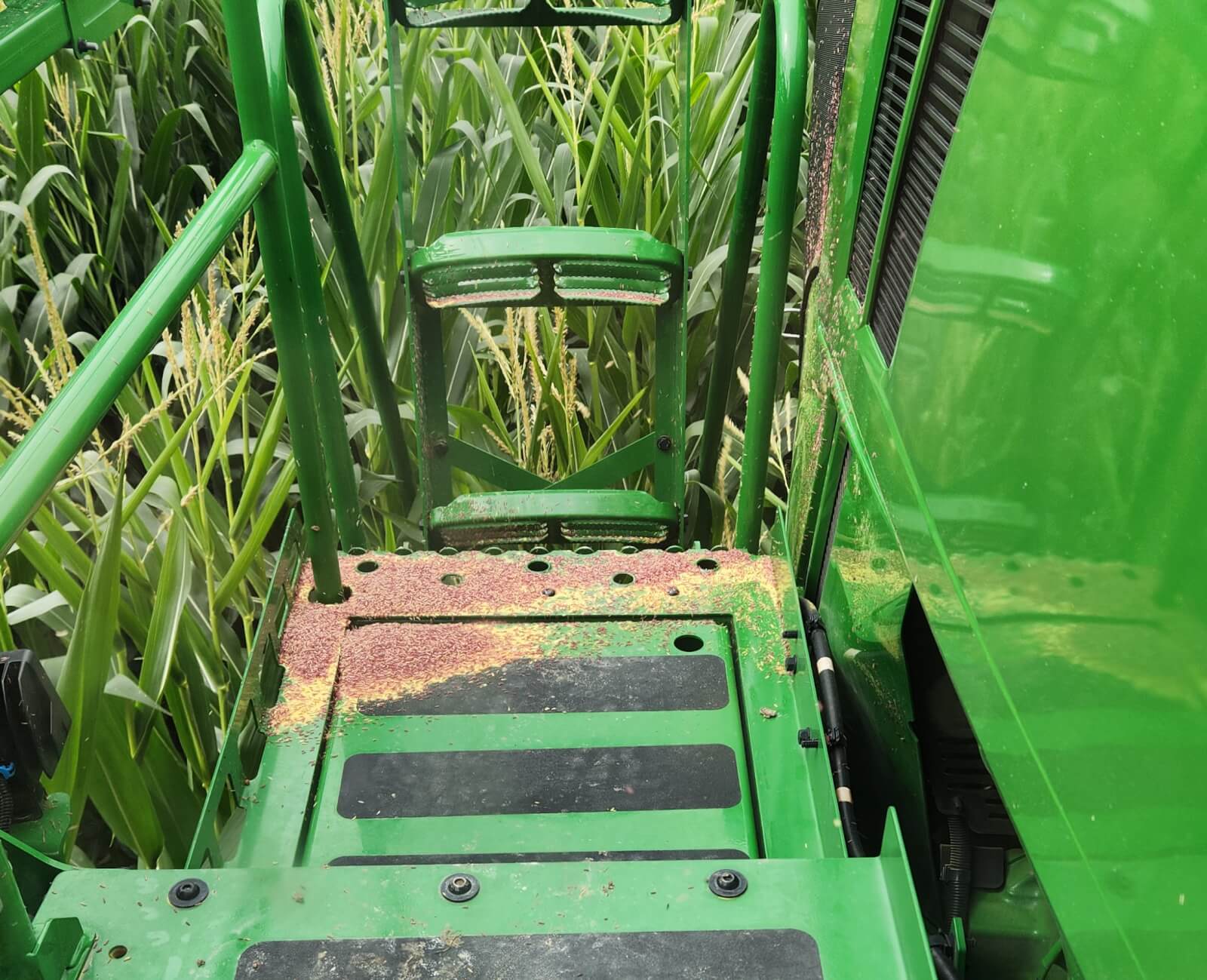
    I watched as the pollen and anthers broke in waves over the hood and onto the steps. The radiator fan periodically reversed to blow it all out, but not as frequently as we needed. Paul occasionally did it manually. The sound of corn scraping and hitting the sprayer was loud. Paul said corn can beat the paint off a sprayer and damage the side induction bowl – wow. Carbon filtered cab or not, my pollen allergy was driving me crazy, and I was glad this was our last job. We were done at 2:37 and back on trailer five minutes later.

    3:30 pm – Back at the yard

    As we pulled into the yard it looked like rain was indeed coming. We weren’t worried about the fungicides we’d applied because they were rainfast in an hour. But it did put a premature end to the spray day. We’d covered more than 365 acres in the Deere, which was a light fungicide day for Paul. Combined with what the Miller did, AU covered 735 acres.

    As I was packing to leave Paul asked if I was interested in seeing his new battery-powered backpack sprayer. I was, but I didn’t realize he’d put me to work spot spraying weeds. So, I suppose we actually covered 736 acres that day: 735 in sprayers, and one manual. Worth it.

  • Ground vs Aerial Application of Fungicide in Chickpeas

    Ground vs Aerial Application of Fungicide in Chickpeas

    This article was originally published in the Proceedings of the Soils and Crops Workshop, 2005.

    Authors

    Tom Wolf (AAFC), Brian Caldwell (AAFC), Cheryl Cho (CDC), Sabine Banniza (CDC), Yantai Gan (AAFC)

    Background:

    Fungicide application is an important disease management strategy for ascochyta blight (caused by Ascochyta rabiei) in chickpea due to the poor host resistance in available cultivars.   Ascochyta blight, left untreated, can cause yield losses in excess of 90% in Saskatchewan, and appropriate timing and frequency of fungicide spray application is critical.  Producers wishing to apply fungicide are sometimes unsure which application method to use – aerial or ground.  Both offer potential advantages and disadvantages:  ground sprayers utilize greater water volumes, but leave tracks which can lower yield and spread disease.  Aircraft use lower water volumes but do not damage the crop and can cover more area in a timely fashion.  The relative importance of these characteristics is unknown. 

    Objectives:

    Objectives of this study were to compare aerial and ground fungicide application on chickpea disease and seed yield. 

    Materials and Methods:

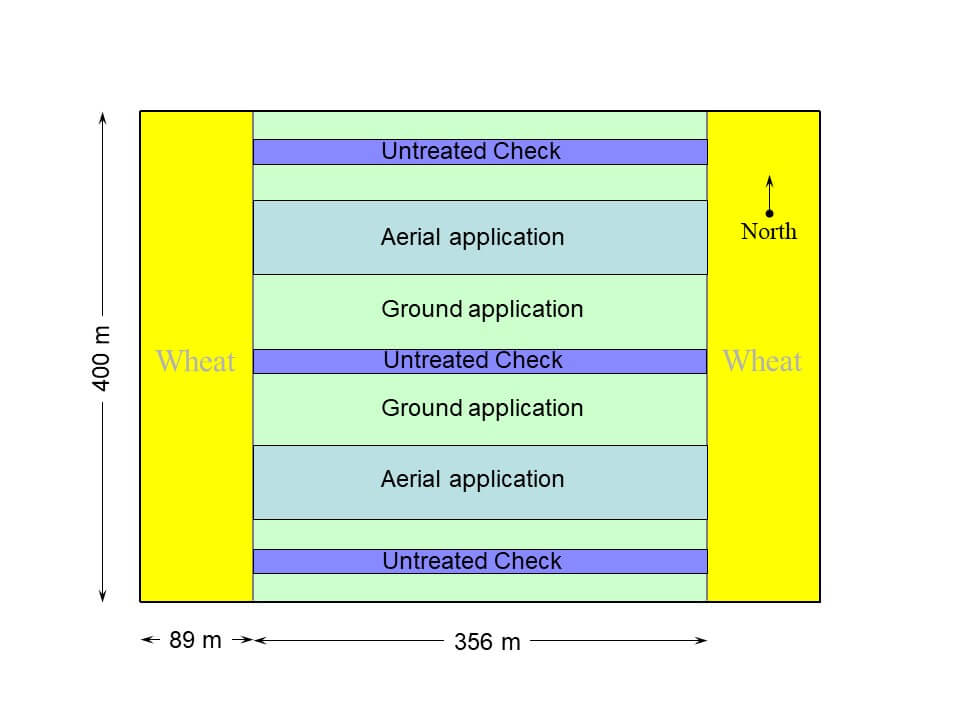
    Chickpeas (certified CDC Xena, a unifoliate kabuli rated as having very poor ascochyta resistance) were seeded on May 15 (2003) and May 27 (2004) on 35-acre sites near Saskatoon which had been chem-fallow wheat stubble (2003) and spring wheat (2004) the previous year.  Seed was treated with Crown and Apron and seeded at 170 lbs/acre (35 seeds/m2) to a depth of 6.5 cm using a Flexi-Coil airseeder with 9” row spacing.  The field was harrowed and rolled after seeding.  Pursuit (70 mL/ha) and Post Ultra (0.32 L/ha) were applied for weed control in both years.  The crop established evenly and weed populations (primarily prostrate pigweed and stinkweed) were low in 2003.  In 2004, sow thistle was the predominant weed.

    In 2003, the crop was scouted at 5-day intervals for the presence of disease.  Initial disease levels through June were very low and disease did not become visible until after the first major rainfall event on July 6.  Headline (pyraclostrobin) was applied on July 11 and 21 at 0.4 L/ha, followed by Lance (boscalid) on August 1 and 13-14 at 0.42 kg/ha.  Aerial and ground applications were conducted at dusk with calm conditions.  Both were conducted within 1 h of each other except for the last application of Lance where the ground application followed the next morning. 

    In 2004, the crop was slow to establish, but disease became prevalent early in its development, especially on the side of the field which bordered the 2003 trials.  Headline was applied on July 12 and July 23, Lance was applied on August 2.  A second application of Lance was not warranted due to cool conditions which jeopardized the maturity of the crop. 

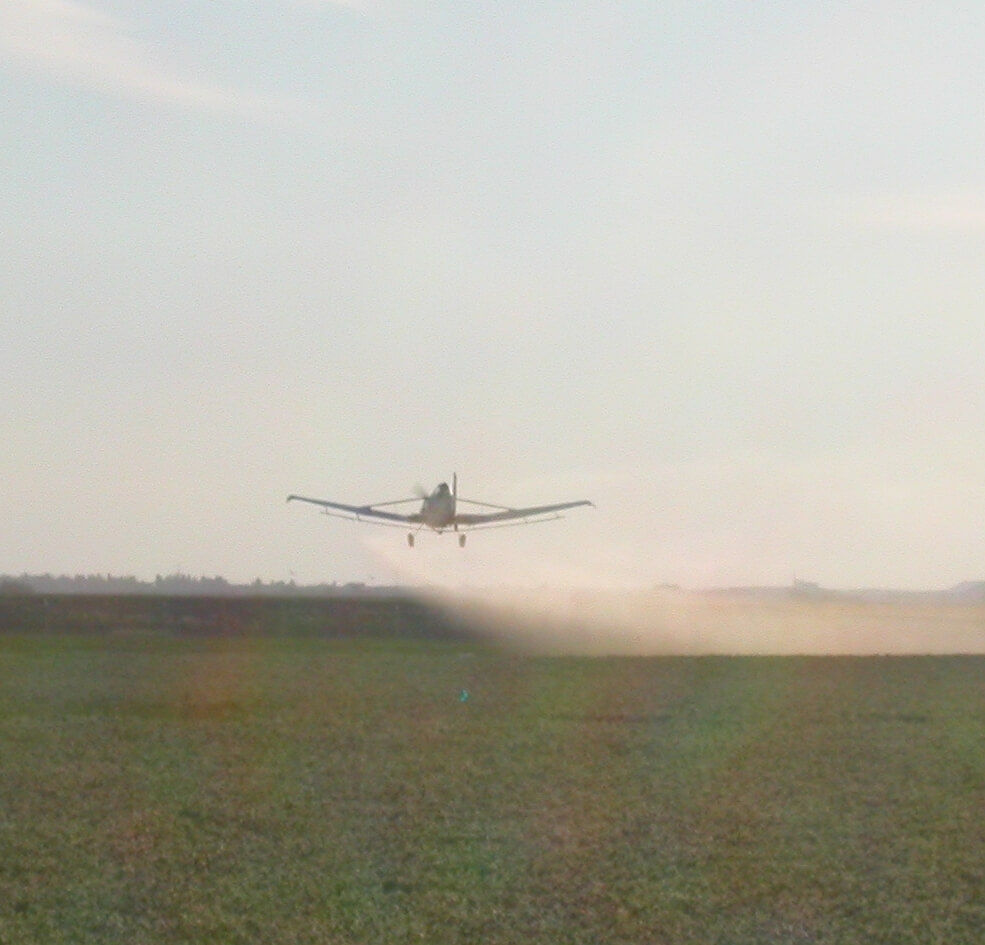
    In both years, aerial applications were done by Cessna Ag Truck applying 4 US gpa (37 L/ha) through 24 CP-03 nozzles with the 0.125 flow orifice and 90º deflection, at a pressure of 34 psi and 120 mph airspeed.  At these settings, the spray had a volume median diameter (VMD) of 271 µm according to USDA atomization models.  Swath width was 50’ and boom height was 10 to 15’ above ground. 

    Aerial application of fungicide to chickpeas, 2003.

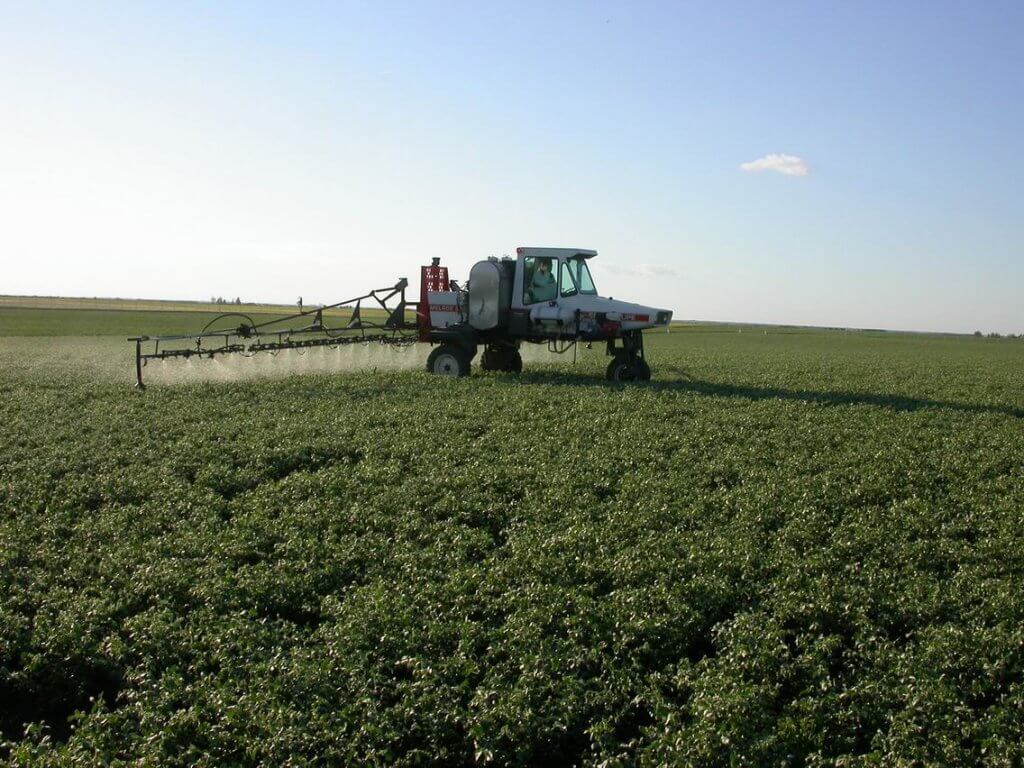
    Ground applications were done using a Melroe SpraCoupe 220 travelling 8 mph with a 43’ boom, using XR8003 nozzles operated at 40 psi and a boom height of about 75 cm.  At these settings, the application volume was 100 L/ha, and the spray had a VMD of 246 µm. 

    Ground application of fungicide to chickpeas, 2003.

    Disease ratings were conducted on approximately the same dates as spraying.  Disease ratings were conducting using the 0-11 Horsfall-Barratt scale, converted to % infection.  Single plants were rated at 64 (2003) and 60 (2004) locations in each treatment within each rep, for a total number of 128 or 120 plants rated per treatment per rating date (except for the first rating, where only 24 plants per treatment were rated).  Ratings from the outside two passes of the aircraft in each replicate were deleted since proper spray patterns were not expected at these edges. 

    In 2003, the crop matured in mid-August and Reglone was applied by ground sprayer travelling perpendicular to the treatments, on August 22.  In 2004, the crop failed to mature and was sprayed with Roundup on September 20. 

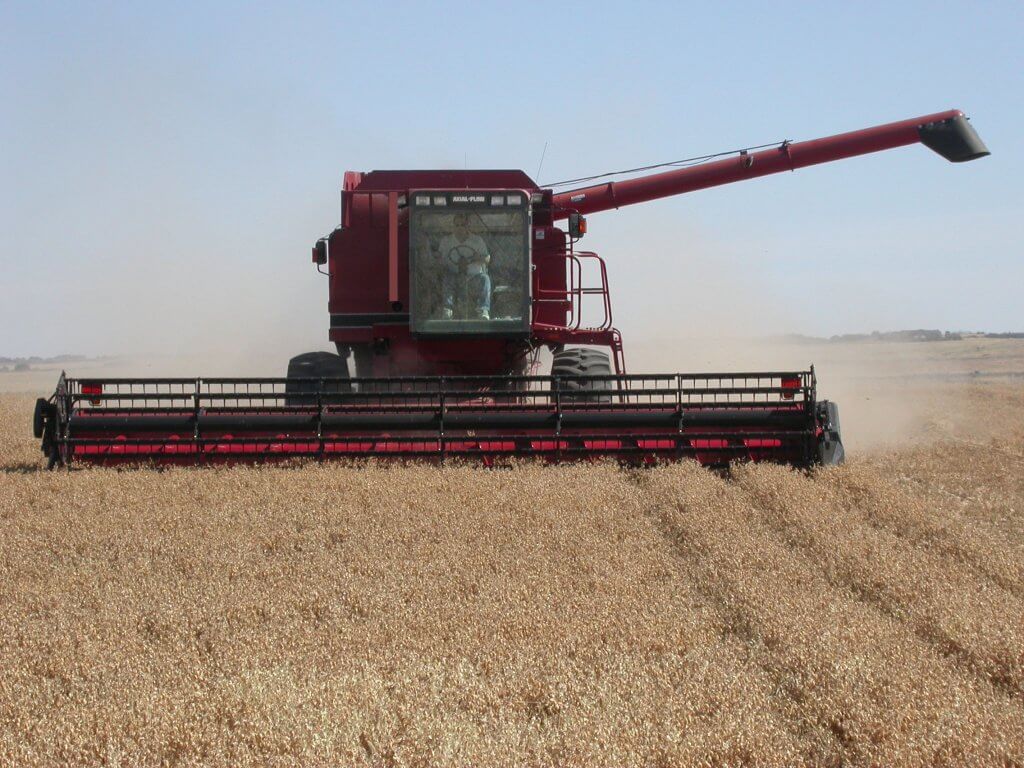
    The 2003 crop was harvested on September 3 using a Case 1688 combine with a 30’ flex header.  After removal of headlands, two 275 m long swaths were taken from each treatment, and the seed from each swath was weighed and sub-sampled for seed quality.  In the aerial plots, the central two spray swaths of each rep were sampled.  In the ground plots, two swaths were taken with wheel tracks, and two without wheel tracks in each rep.  Wheel tracks were then adjusted to a 90’ boom width for yield calculations.

    In 2004, harvest was impractical with the large combine due to the low seed yield and quality which prevented accurate yield measurements.  On November 10, a Hege combine was used to harvest a single pass along the length of each sprayer swath for all treatments.  The grain was bagged, dried , and weighed. 

    All data were analyzed using analysis of variance (ANOVA) as a randomized complete block design with two replicates.  Treatment effects were considered significant at p=0.05. 

    Results and Discussion:

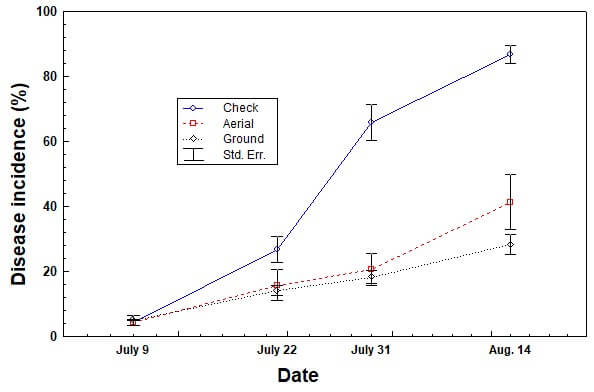
    Ascochyta was prevalent in both 2003 and 2004.  In 2003, disease severity in the untreated chickpea progressed from about 5% to about 66% from July 9 to July 31.  Disease severity in sprayed plots was significantly less, about 18 and 21% for the ground and aerial treatments, respectively on July 31.  A late flush of disease on new growth increased levels to 87% in the untreated plots, and 28 to 41% in the ground and aerial plots, respectively, on August 14.

    Ascochyta blight severity on chickpeas throughout growing season, 2003

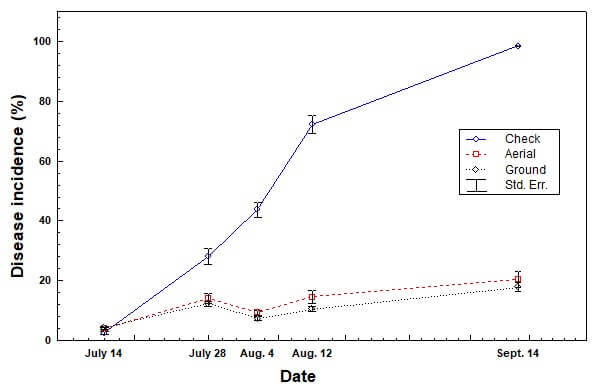
    In 2004, disease in the untreated plots steadily increased from 3% infection on July 14 to 99% on Sept 14.  During this time, the treated aerial and ground plots increased from 4 to 18-20%, similar for both application methods.

    Ascochyta blight severity on chickpeas throughout growing season, 2004

    Application methods generated visually different spray deposits on water sensitive cards.  The ground application had greater overall coverage of the cards primarily due to the greater water volume used (100 L/ha vs. 37 L/ha)  Cards indicated that overall uniformity of the spray deposit along the width of the boom was greater for the ground sprayer (data not shown).  However, water sensitive cards provide an artificial collection surface that does not accurately simulate the complexity of a leaf surface or a multi-dimensional plant canopy.  These cards therefore do not provide an assessment of leaf coverage, but are limited to a visual indication of the type of spray quality emitted by the application. 

    Spray deposit on water-sensitive paper for ground application at 100 L/ha
    Spray deposit on water-sensitive paper for aerial application at 37 L/ha

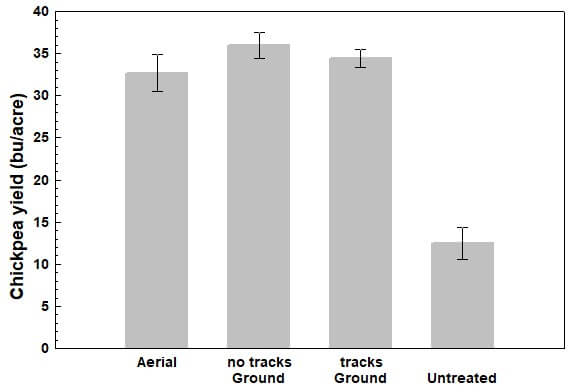
    Fungicide application significantly increased seed yield in both years.  In 2003, yield averaged 13 bu/acre for the unsprayed treatments, and 33 bu/acre where fungicide had been applied.  Aerial treatments yielded 32.7 bu/acre, whereas ground treatments (track damage adjusted for 90’ boom width) yielded 34.4 bu/acre.  This difference was not statistically significant (Table 1).  Ground-sprayed areas without wheel tracks yielded 36.0 bu/acre, therefore yield loss due to tracks was 1.6 bu/acre.

    Chickpea seed yield in plots treated with fungicide applied by air and ground, 2003.

    Table 1:  Analysis of Variance (ANOVA) for chickpea seed yield from aerial and ground applications (ground with tracks adjusted for 90′ boom), 2003

    Effectdf
    Effect
    MS Effectdf ErrorMS ErrorF-valuep-level
    Trt15.8911.414.180.290
    Rep112.1011.418.580.209

    Sprayer tracks reduced yield due to crop destruction, but they did not appear to spread disease within the crop.  It is possible that application during evening hours before dew wetted the foliage helped prevent disease spread.  The role of sprayer tracks requires further investigation. 

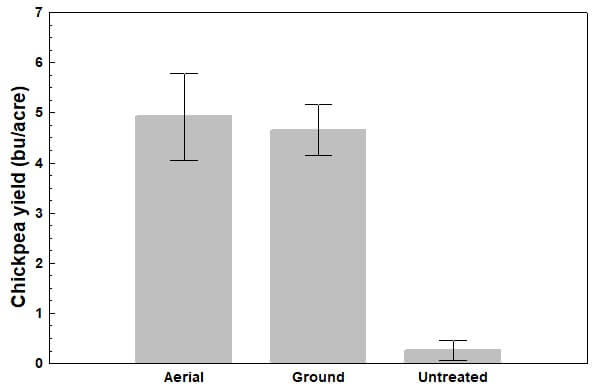
    Seed yield and quality were very poor in 2004 due to cool growing conditions and an early frost.  In spite of this, results mirrored those from 2003:  fungicide significantly increased yield, from 0.3 bu/acre in the untreated plots to 4.7 and 4.9 bu/acre in the ground and aerial treatments, respectively.  Yield differences arising from application method were not statistically significant. 

    Chickpea seed yield in plots treated with fungicide applied by air and ground, 2004

    Seed quality analysis demonstrated no difference in chickpea grade of either ground or aerially applied fungicide.  Aschochyta rabiei was not detected on seed from any treatment. 

    These results showed that both ground and aerial application of fungicide provided effective control of Ascochyta rabiei on chickpeas.  Results from 2004 were compromised by a poor growing season, therefore further work may be necessary to confirm this outcome.  Nonetheless, the consitency of conclusions support recommending both methods to producers wishing to apply fungicide. 

    Acknowledgements:

    We thank Roland Jenson (Cloud 9 Airspray) for conducting the aerial applications, Mark Kuchuran and Dan Caldwell (BASF) for providing fungicide, herbicide, and overall support, Jim Kelley (Redhead Equipment) for providing harvesting equipment, Al Baraniuk (AAFC) for assisting with seeding and harvesting operations, and Curtis Sieben and Chris Gilchrist for implementing this trial.  Financial assistance was provided by the Saskatchewan Pulse Growers (2003) and AAFC through the IFSP Initiative (2004). 

  • Disease Control in Berry Crops

    Disease Control in Berry Crops

    In the spring of 2016, the Ontario Berry Growers Association (OBGA) conducted a survey of its membership to poll how fungicides were being applied. The results were very interesting.

    Fungicide basics

    Generally, fungicides registered for berry crops are contact products, so coverage and timing are very important. The fungicide has to be distributed evenly on the target before disease has a chance to infect the crop. That means the sprayer operator must be aware of the susceptibility of the crop to the level of disease pressure to ensure timing is appropriate. While kickback and post-application distribution of pesticide residue is sometimes possible, sprayer operators should not rely on it. The following table outlines application recommendations for a fungicide commonly used in Ontario. It combines labelled information and provincial recommendations and is representative of most fungicides.

    Summer-fruiting and Fall-bearing Raspberry / Blackberry Highbush Blueberry Day-neutral and June-bearing Strawberry
    Labelled rate 2.5 kg/ha 2.25 kg in 1,000 L/ha2.75-4.25 kg in 1,000 L/ha
    Diseases (Labelled and Ontario provincial recommendations) Anthracnose fruit rot, Spur blight, Leaf spot, Botrytis grey mouldAnthracnose fruit rot, Shoot blight (Mummy berry), Botrytis twig and/or blossom blightCommon leaf spot, Botrytis grey mold
    Crop staging Bloom, Pre-harvest, HarvestFirst bloom, Fruit ripeningFlower bud, First bloom, 7-10 days after bloom, Pre-harvest, Through to fall
    As of 2016

    The spray target

    The applicator reading the recommendations should be considering the best way to get the fungicide to the target. But, what is the target, and what is the best way to apply it? It seems the recommendations raise as many questions as they answer:

    • With the possible exception of blueberry, this fungicide can be applied through much of the growing season (especially when it’s been a wet season). That means the crop staging is highly variable.
    • The primary target is blossoms, but depending on the disease, leaves and stems are also important.
    • The label states a volume of carrier (i.e. 1,000 L/ha) for strawberry and blueberry, but not the cane fruit. It does not specify highbush blueberry versus the sessile, ground cover variety.

    So, this means is the sprayer operator has to spray crops with highly variable physiology (e.g. bush, cane or sessile row crops), onto very different targets (e.g. leaves, canes, stems, flowers) throughout much of the season as the crop canopies grow and fill. This is a very challenging spray application. It would be wrong to suggest a single spray quality, water volume or sprayer set-up to efficiently accomplish all these goals (more on that later). The first consideration is the application equipment itself.

    The application equipment

    Berry growers employ a variety of sprayers to protect berries. Without considering models or optional features, there are three fundamentally different styles: Airblast, backpack and boom. According to the survey, the following table shows which sprayers are used in which berry crop in Ontario. Approximately 60 growers responded, and many grow more than one variety of berry and use more than one style of sprayer.

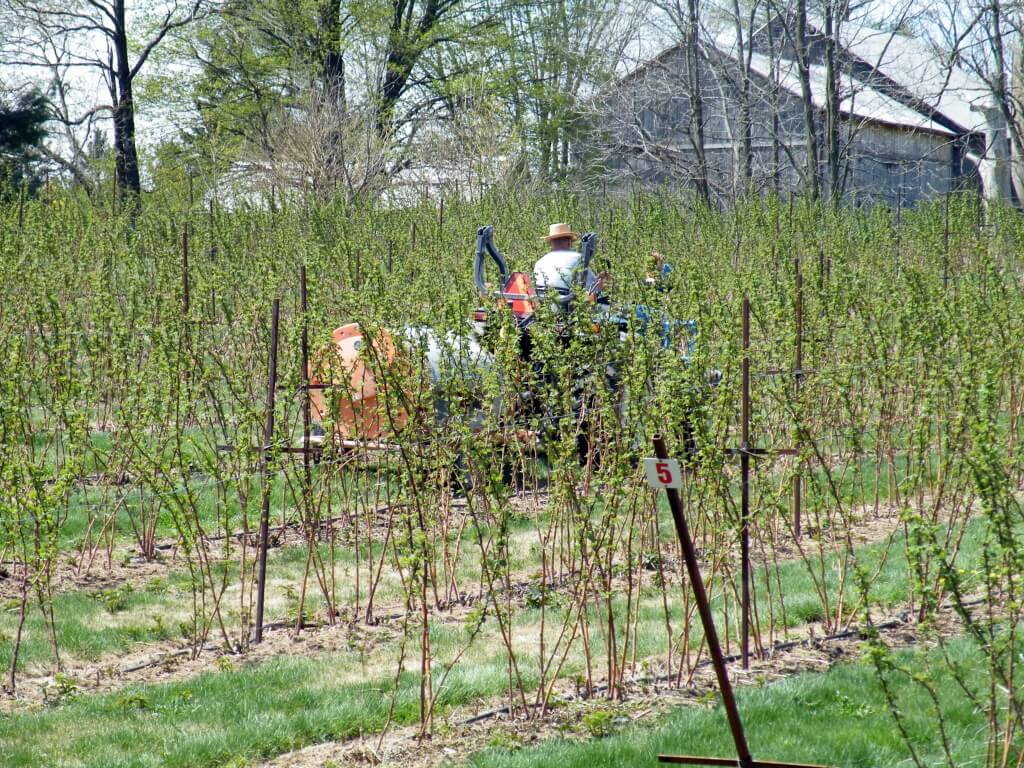
    Jacto airblast in raspberry
    Jacto airblast in raspberry
    Airblast SprayerBackpack or Wand SprayerVert. or Hor. Boom SprayerTotal
    Highbush blueberry 8109
    Day-neutral Strawberry 302124
    June-bearing Strawberry503237
    Raspberries & Blackberries211729
    Total37260

    So, generally, cane and bush berries are sprayed using airblast sprayers and strawberries using horizontal booms. The survey didn’t specify features such as air-assist on booms, or whether or not those booms are trailed or self-propelled. The type of, and features on, any given sprayer dictate the limits of what an operator can adjust to improve coverage.

    Water volume

    Respondents also reported on how much carrier (i.e. water) they used to spray fungicide on their crops. Given Canada’s propensity to report volumes in many different forms, I have converted all values into the most common units: L/ha, US g/ac and the dreaded L/ac:

    nL/ha ± std (max./min.) US g/ac ± std (max./min.) L/ac ± std (max./min.)
    Highbush Blueberries7534.2 ± 340.1 (1,000/150)57.1 ± 36.4  (106.9/16)216.2 ± 138 (404.7/60.7)
    Day-neutral Strawberries22418.5 ± 192.2 (1,000/224.5)44.7 ± 20.6 (106.9/24)169.4 ± 77.8 (404.7/90.8)
    June-bearing Strawberries33403.1 ± 235.1 (1,000/50)43.1 ± 25.1 (106.9/5.3)163.1 ± 95.1 (404.7/20.2)
    Raspberries & Blackberries27450.1 ± 279.4 (1,200/50)48.1 ± 29.9 (128.3/5.3)182.1 ± 113.1 (485.6/20.2)
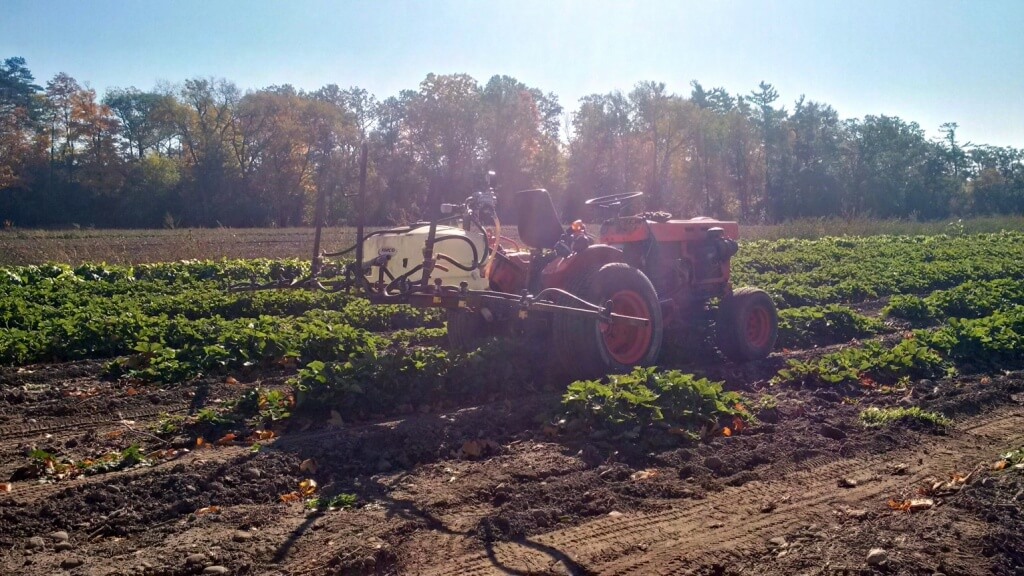
    Trailed horizontal boom in strawberry
    Trailed horizontal boom in strawberry

    There appears to be a lot of variability in the volumes applied, but on the whole, very few are using the 1,000 l/ha indicated in the fungicide recommendations. The ~430 l/ha overall average is no surprise; labelled volumes are quite often higher than what sprayer operators use. In some cases, high label volumes are warranted because the product requires a “drench” application to totally saturate the target, or to penetrate very dense canopies. Conversely, a high label volume might reflect outdated practices if that label hasn’t kept up with current cropping methods or application technology. Sometimes label volumes are suspiciously large, round numbers that suggest they are intended to encompass a worst-case scenario (e.g. a large, unmanaged crop with high disease pressure and a less-than-accurate spray application). In the particular case of crops sprayed with an airblast sprayer, it is very difficult for a label to accurately predict an appropriate volume due to the variability in crop size, density and plant spacing. This has led to methods to interpret labels, such as crop-adapted spraying.

    The disparity between label language and grower practices is not entirely the fault of the label. Most sprayer operators don’t want to carry a lot of water because more refills prolong the spray day. In situations where the crop has reached a critical disease threshold, or bad weather has compressed the spray window, sprayer operators sometimes reduce the volumes in the belief that “getting something on” trumps “good coverage”. Perhaps that’s true, but insufficient volumes greatly reduce coverage. This can be further exacerbated when operators do not account for the increase in crop size and density over the season, or the impact of hot dry weather on droplet evaporation.

    Improving coverage

    So, is there an ideal sprayer set up and volume? As previously alluded, the variability in crop staging, crop morphology, target location and spray equipment make a single recommendation impossible. But that doesn’t mean there aren’t diagnostic tools and a few simple rules to help a sprayer operator determine a volume to suit their particular needs. Much can be accomplished with these three things:

    • Water-sensitive paper
    • A modest selection of nozzles and a nozzle catalogue
    • An open-minded sprayer operator willing to spend a little time and reconsider traditional practices
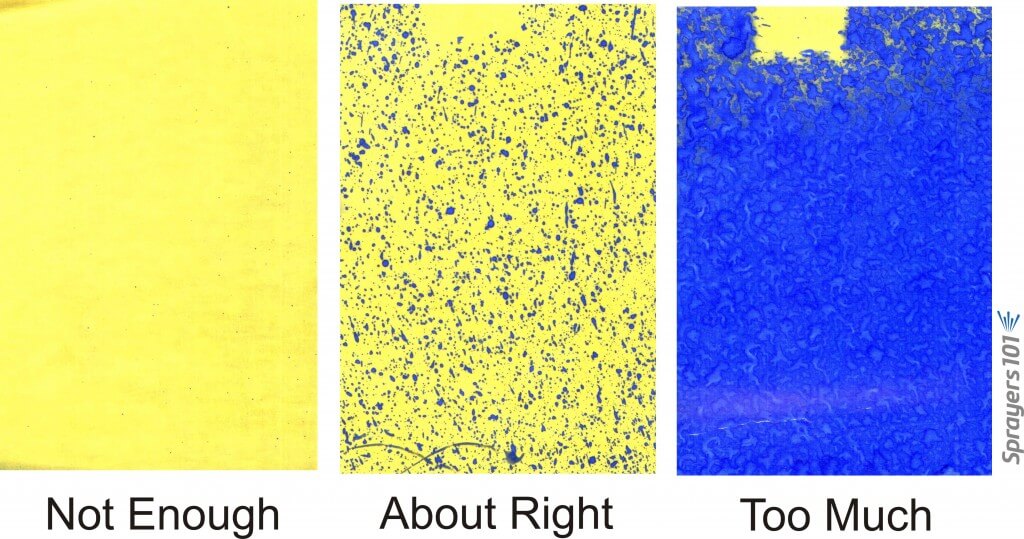
    Rule-of-thumb fungicide coverage on water-sensitive paper.
    Rule-of-thumb fungicide coverage on water-sensitive paper.

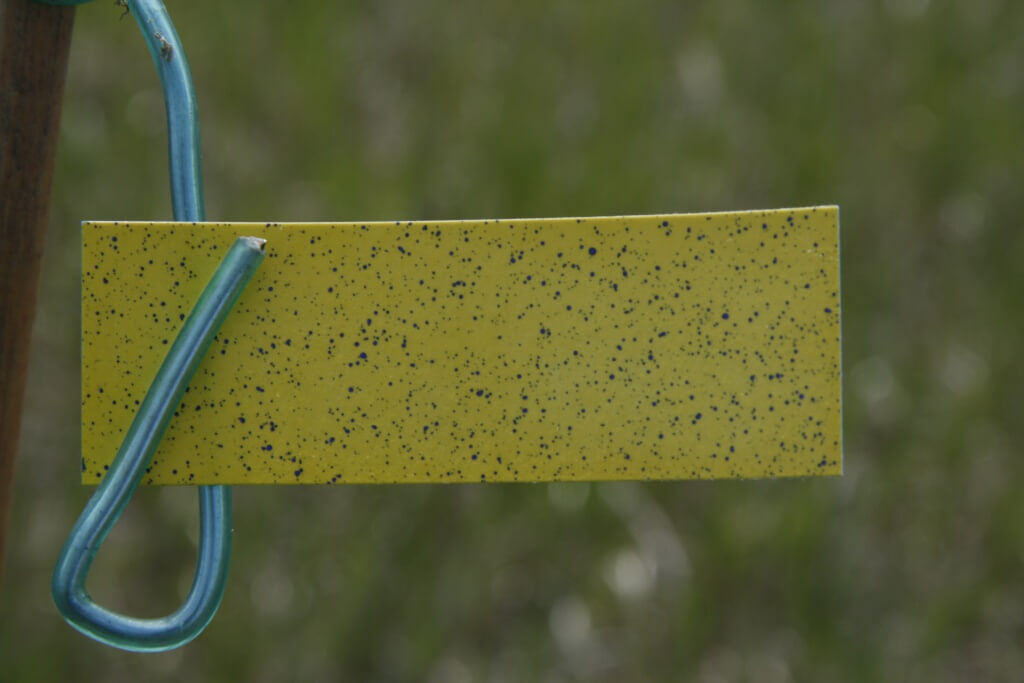
    Water-sensitive paper is placed in the canopy, oriented to represent the target (e.g. leaf, bloom, etc.). It is important to put multiple papers in at least three plants to ensure the coverage reflects a typical application. The paper changes colour when it’s sprayed and this provides valuable and immediate feedback. Did the spray go where it was supposed to go and did it distribute throughout the target? If so, then the operator now knows that they can safely focus on timing rather than targeting. If not, a little diagnosis is required:

    1. Were targets completely drenched? If so, there is too much coverage. Operators can drive faster (if possible, and as long as it doesn’t create drift), reduce operating pressure (if possible, and as long as the nozzle is still operating in the middle of its registered range), or change nozzles to lower rates (as long as spray quality is constant).

    2 .Were targets only partially covered, as if a leaf obstructed part of the target and created a shadow? This mutual-shading is the bane of spraying dense canopies. One possible solution lies in understanding droplet behaviour: Coarser sprays generally mean fewer droplets and they move in straight lines. Therefore, when they hit a target, they might splatter or run-off, but typically their journey is over. If the spray is too Coarse, a slightly Finer spray quality increases droplet counts and may help droplets navigate around obstacles and adhere to more surfaces. Sprays that are too Fine will not penetrate dense canopies without some form of air assist. They slow very quickly and tend to drift and evaporate before they get deep enough into a canopy to do any good. A Medium droplet size is a good compromise because it produces some Fines and some Coarser drops – the best of both worlds.

    Increasing volumes and reconsidering spray quality often helps, but there might be other options. If using air assist, there are tests that can confirm the air volume and direction are appropriate. Another solution might lie in canopy management (where pruning bushes and canes can help spray penetration immensely). Still another might lie in the use of adjuvants to improve droplet spread on the target.

    3. Were targets missed entirely, or coverage is consistent but sparse? The operator is likely not using enough water, and/or the spray quality is too fine. It has been demonstrated time and again that higher volumes improve coverage, but operators can try any of the options listed previously for partially-obstructed coverage. All the reasoning is the same.

    Conclusion

    Spraying fungicides effectively requires an attentive sprayer operator. Timing and product choice are very important, but when it is time to spray the sprayer operator should diagnose coverage with water-sensitive paper, and be willing to make changes to the sprayer set-up to reflect changing conditions. Thanks to the OBGA for sharing the survey data.

  • Fungicide Application in Cereal, Pulse, and Oilseed Crops

    Fungicide Application in Cereal, Pulse, and Oilseed Crops

    Get ready for a busy fungicide season. If your growing conditions have been good, your crop is dense and vigorous, and soil moisture is adequate, you have yield potential to protect.  A bit of moisture and warm temperatures at a critical time, and disease is likely to develop.

    Before we delve into how to apply fungicides, let’s review the basics.

    1. There is no substitute for an informed decision about whether to spray or not. Seek the advice of a professional to make sure you understand your crop’s genetic susceptibility to disease, the conditions conducive to its development, and the parts of the plant canopy that are affected and therefore need protection. How much yield or seed quality is actually at risk? What do the disease forecasts say for your area?
    2. Identify the best fungicide product for your disease situation. Consider inherent efficacy, but also the longevity of the protection and the fungicide’s off-target toxicity (less toxic products can be sprayed in windier conditions without harming susceptible ecosystems). Remember that most fungicides are not curative and must be present on the plant foliage before infection takes place. Also remember that most fungicides are not easily translocated and are at best “locally systemic”. This means that fungicide deposit must cover the plant part that requires protection with an adequate droplet density. If the fungicide is systemic, these deposits must be absorbed through the plant cuticle and will only migrate a small distance within the plant tissue, usually in the transpiration stream, from the point of application.
    3. Make proper timing the priority. Disease control is usually only effective if the fungicide is applied in a narrow time frame in which the crop or disease is at a certain developmental stage. A great application at the wrong time is less valuable than mediocre application at the right time. The use of low-drift nozzles should be considered an agronomic tool that permits the correct staging even under marginal wind conditions.

    Let’s now review the major highlights of fungicide application in the major cereal and oilseed crops.

    Wheat

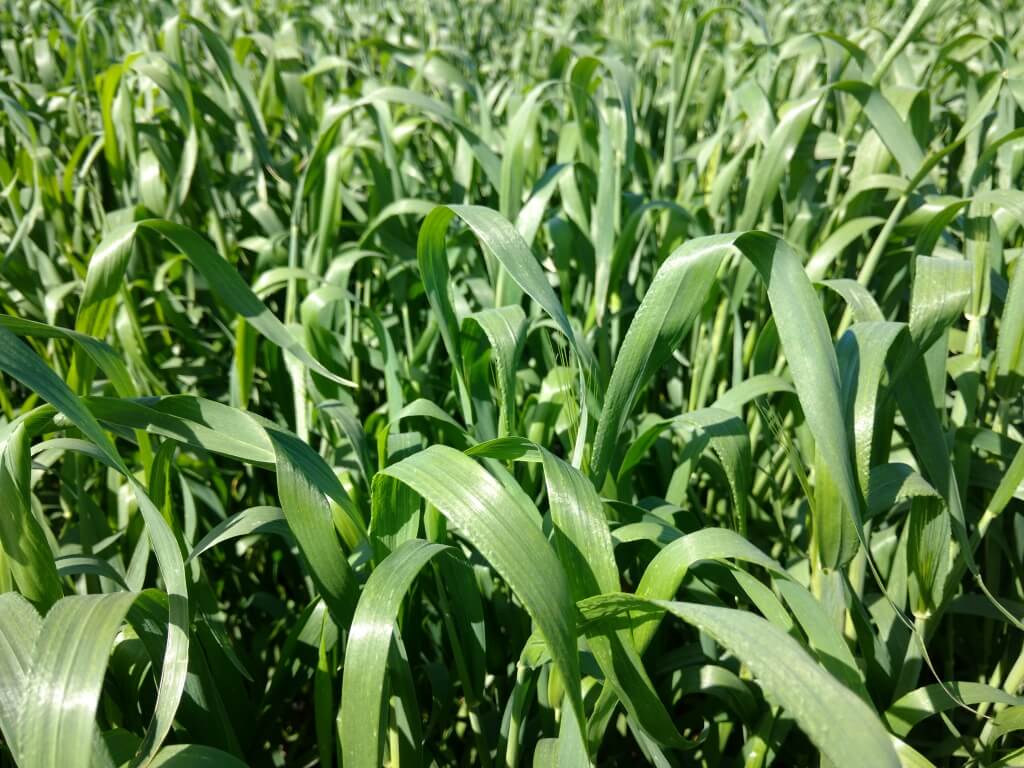
    In wheat, the early growth stagings for foliar fungicides are usually done to protect from leaf spot diseases such as tanspot, septoria nodorum blotch and septoria tritici blotch. Because these diseases are trash-borne, they tend to migrate up from the bottom to the top and good canopy penetration of the spray is important.

    IMG_20160621_170305406

    Better canopy penetration can be achieved the following ways:

    • Higher water volumes. This is probably the most powerful tool in an applicator’s arsenal. More water usually delivers higher doses of active ingredient deeper into the canopy, and whatever dose does get deposited will be present in higher droplet densities. So in short, for any given spray quality (droplet size), more water provides better coverage. We all intuitively know this.
    • Slower travel speeds. Moving slower imparts less of a forward velocity on the spray cloud, particularly in the larger droplets. As a result, these droplets move more vertically.  In the case of a cereal canopy, more of the spray will reach the lower leaves. The finer droplets in the cloud tend to deposit with the wind direction regardless of travel speed.
    • Backward pointed nozzles. If a droplet moves backwards at the same speed as the spray boom moves forwards, then it is basically standing still relative to the crop. It will have a greater chance of moving down towards the lower canopy than a droplet that’s moving forwards. The latter droplet will likely be intercepted by something vertical, like a wheat head or stem.

    A single nozzle oriented back, applying a water volume that is at least 10 to 15 US gpa, will be sufficient to get good canopy coverage for leaf spot and rust protection.

    Fusarium Headblight (FHB), caused by Fusarium graminearum, is a special case. It infects the wheat head at anthesis, and fungicide must be present on the head, at the glumes where the anthers emerge, at the time of infection. So we have a relatively large vertical target that is at the very top of the canopy.  Initial work at North Dakota State University, followed up by work at AAFC in Saskatoon and the University of Guleph at Ridgetown, found the following:

    • Angled sprays are essential. Field and lab studies showed that angled sprays were much more effective at depositing the fungicide on heads than vertical sprays. Backward pointed angled sprays provided additional help at targetting the other side of the wheat head. Twin nozzles are available from most manufacturers.
    IMG_9079
    • Use Coarse sprays when angling.  Angled and twin sprays have their challenges.  The angle at which the spray is released dissipates quickly, particularly for smaller droplets. As a result, more aggressive angles and coarser droplets were found to be more effective. Larger droplets were able to maintain their initial trajectory for a longer distance, increasing the chance that the droplet hit the head from the side rather than passing it by vertically.
    •  Maintain low boom heights. Even coarse sprays are deflected by air resistance and will eventually stop moving in the direction they were first emitted. In fact, this happens within a short distance.  Low booms, less than 25″ if possible, help.
    • Watch wind speed and direction. Field observations show that even a moderate wind can over-ride the application practices described above, resulting in most of the spray deposited on the windward side of a target regardless of its initial release.
    • Awns intercept small droplets. Many of our modern wheat cultivars are awned, and these fine structures are excellent collectors of small droplets. In early studies with durum, we found a large proportion of the spray volume on awns, where it served no useful purpose. The best way to minimize this awn interception is to ensure coarse sprays and sufficient water, no less than 10 gpa.
    wheat with water droplets credit David McClenaghan

    It’s important to maintain realistic expectations with FHB. Fungicide chemistry is improving but still offers only suppression. Crop staging is variable. Excellent application practices place the odds more in favour of disease control, but can’t change these facts.

    Pulse Crops

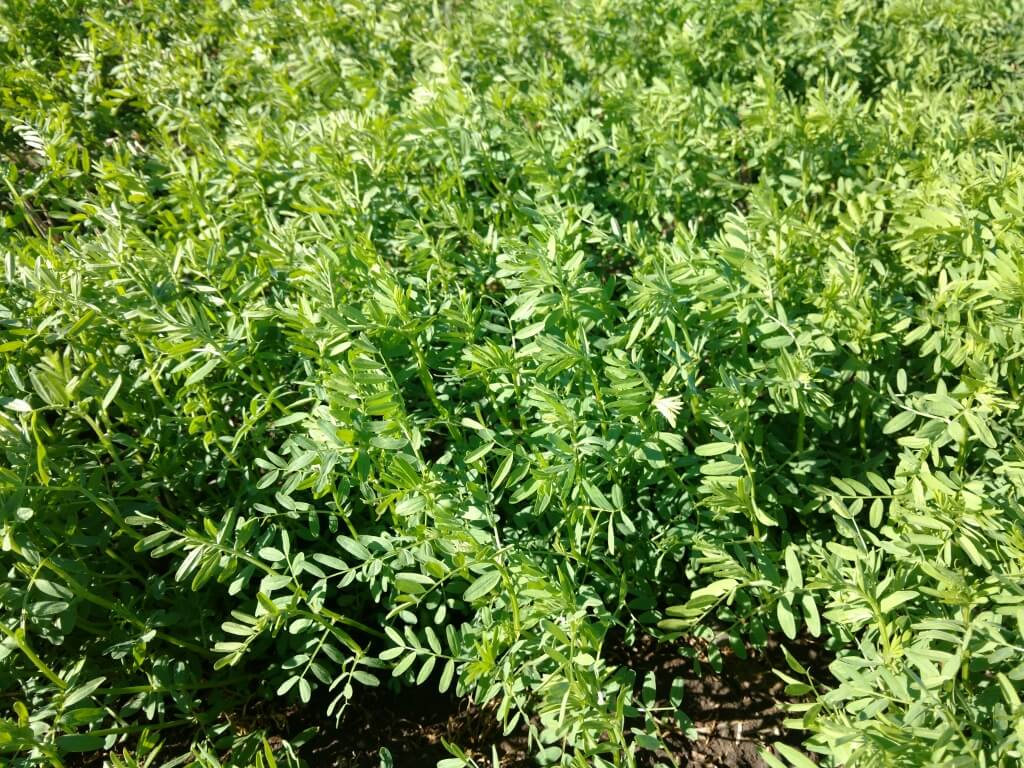
    Lentils and peas are increasingly important crops. They appear spindly in their early stages of development and are poor weed competitors. But under the right conditions, lentils soon form an impressive set of leaflets that creates one of the most impenetrable barriers in our cropping systems.

    Here are some pointers for fungicide application in pulse crops:

    • Understand the disease in your crop. Do you need to protect stems (anthracnose), leaves and stems (ascochyta complex, mycosphaerella), or senescing leaves or flowers (sclerotinia)? This is where the spray needs to go.
    • Understand the time of disease development.
      • Trash-borne diseases like anthracnose and ascochyta will start at the bottom of a lentil canopy, and early treatment before canopy closure will be important to arrest or at least delay disease development as long as possible.
      • Late season diseases like sclerotinia and botrytis push the application timing towards a closing or closed canopy. Success of such sprays is more elusive because of the rapid development of new biomass.
    • Take a bird’s eye view of the canopy.
      • If you can see the target you need to spray, the job is pretty straightforward and conventional water volumes and nozzles will work.
      • If the targets are hidden from view, it will take more water and slower travel speeds to get the required coverage. Consider the higher end of the recommended water volumes (15 gpa in most cases), slower travel speeds (10 mph).
    • IMG_20160620_082718907
      • When a canopy has many layers of cascading leaves, it is very difficult for a spray to get past these “umbrellas”. We’ve observed many times that a leaf is a very effective shield for anything below it.  Large droplets have a hard time changing direction because of their mass and resulting momentum.  But small droplets, especially those below 100 microns, can move with slight changes in air movement and get around these obstacles. Use higher pressures (to generate the finer sprays) or select finer nozzles to improve canopy penetration.
    • Look at the size of the plant part you need to target. Large targets like leaves can capture almost any droplet size, but small targets like petioles or vertical targets such as stems may benefit from finer sprays, especially if they’re hidden in the canopy.

    Generally speaking, dense pulse canopies will require higher water volumes and finer sprays than their cereal counterparts. Although twin fan nozzles have not been shown to provide an advantage in our studies on chickpeas, higher water volumes proved very effective at improving deposition and disease control.

    Canola

    Canola has two main diseases for which foliar sprays are used. A small number of producers choose herbicide timing for control of blackleg. Because the crop canopy is small and the spray targets are exposed, general herbicide application guidelines (Coarse sprays from a venturi nozzle, 7 – 10 US gpa) will provide good targeting and adequate coverage.

    461635974_1bce7d1eaa_z

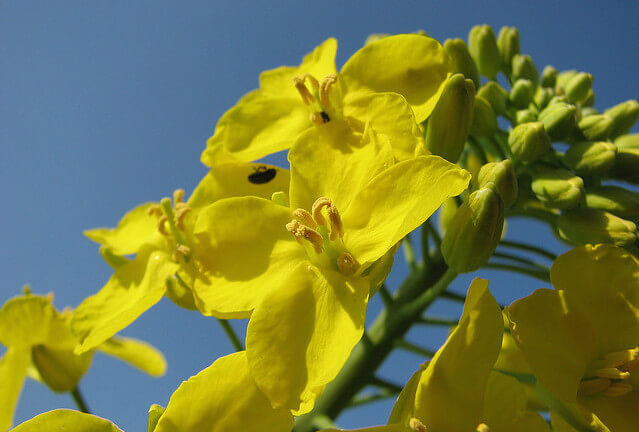
    Sclerotinia control requires that the spray reaches buds and petals of canola that is between 20 and 50% flowering. Work at AAFC in Melfort compared conventional and low-drift sprays at two pressures, and showed that droplet size had no effect on disease control. In fact, the Fine spray produced by hollow cone nozzles at high pressure did not significantly improve sclerotinia control compared to a venturi nozzle at its recommended pressure of about 60 psi.

    Subsequent lab work showed that the proportion of the applied spray that was retained by petals and buds was statistically identical for all tested sprays.

    Water volumes may need to be increased for modern canola hybrids that have significant biomass at flowering. Such cultivars may grow over 1.5 m tall and present a large range of canopy positions in which buds and petals appear. As with the other crops, when a spray needs to cover more area, and especially when this area presents itself in layers, more water volume is appropriate.

    Fine Sprays for Coverage

    Conventional wisdom says that fungicides require finer sprays for coverage and best effect. This is certainly true in some cases, particularly where the leaf area index is high and leaves are arranged in cascading layers. But it’s time to retire this notion as general advice and adhere to research results for guidance. For FHB, the recommended angled sprays benefit from being applied in coarser, not finer sprays. And in pulses and canola, research showed that there was no benefit from finer sprays. In fact, finer sprays can impair proper timing because of their propensity for drift and rapid evaporation under dry conditions.

    Modern coarse sprays produced by air-induced nozzles are less susceptible to these environmental conditions and therefore offer an important advantage: they allow for better timing accuracy. For this reason, I view them not so much as drift control tools, but rather as agronomic tools.

    There is a downside to the coarser sprays – they do require more water. Volumes should always be above 10 US gpa, and many recommendations go to 15 gpa if the canopy is dense.  In some cases, 20 gpa may be beneficial. These higher volumes are a reasonable price to pay to protect a valuable crop, and we certainly have the equipment to make this price bearable.

    Aerial Application

    Aerial application is an important way to apply fungicides.  An aircraft’s chief advantage is to cover large areas with no crop trampling, and can do so even in wet conditions. As a result, they offer the timing advantage we so often mentioned in this article.

    Aerial Rotary atomizer

    A producer hiring an aircraft for spraying ought to have a conversation with the pilot and discuss water volume and droplet size. Aircraft, out of practical necessity, apply less water and distribute it in finer sprays to offer the required coverage. Although this has been shown to be effective, it creates drift and evaporation potential. It is worthwhile to ask for higher water volumes if it means that the spray can be applied somewhat coarser, creating less drift.

    _MG_4778

    The rotary atomizers on many aircraft produce fairly uniform droplet sizes and do a good job of eliminating the larger droplets. This makes even more droplets available for coverage. However, even with this technology spray drift still matters and all steps to prevent it should be taken. This means using larger average droplet sizes and increasing water volumes accordingly to their label recommendations.

  • When is Fungicide Coverage Critical? Always!

    When is Fungicide Coverage Critical? Always!

    Introduction

    A local strawberry producer was just beginning his harvest when the entire field was suddenly stricken with anthracnose. He would have done almost anything to save it, but he could only watch in frustration as the disease quickly devastated his crop. While he was telling me this story, he was wringing his hands; I’m sure he didn’t realize he was doing it. It had been more than a month since the crop was lost and he was obviously still very upset. Let’s put on our deerstalker hats and consider what might have caused the trouble.

    Strawberry anthracnose. Photo by Pam Fisher, OMAFRA.
    Strawberry anthracnose. Photo by Pam Fisher, former berry specialist with OMAFRA.

    Most of the fungicides we apply in horticulture are protectants, not curatives. What that means is that the fungicide has to be in place before disease has a chance to take hold. Once it establishes a beachhead, you can typically only hold it at bay, not eradicate it. So, if you’re guilty of waiting too long between fungicide applications, the problems may have already begun. This is exacerbated when you don’t achieve the necessary spray coverage. Put the two together and mix in rainy and warm conditions and diseases like anthracnose can spread at alarming speed.

    Method

    I focus on the sprayer part of disease management, so I have to assume that inoculum is being controlled as much as possible (e.g. culling infected plants, drip irrigation, etc.). I asked the grower about his sprayer and his spraying schedule. He admitted to pushing the limits between fungicide applications, and being uncertain about the spray coverage he was achieving with his conventional flat fan nozzles.

    Strawberry Sprayer
    Strawberry Sprayer

    In cases like this I try to find gentle ways of introducing the idea of using more water, increasing the frequency of applications, or buying new nozzles, because there is time and expense involved and many growers don’t want to hear that. However, when I started my soft sell routine, he looked me straight in the eye and said he’d lost tens of thousands of dollars in revenue so a few nozzles or a couple more applications were not a pressing concern. There’s a point in any endeavour when you’ve committed so much time and money that you’ll do pretty much anything to see it come to fruition (pun intended). He was willing to do whatever it took. This was my kind of guy.

    So, in preparation for next year, we diagnosed spray coverage from five different sprayer set ups. Let me point out, as I always do, that spray coverage analysis does not necessarily extend to control. They correlate well, but if you aren’t using the right product or your timing is off, even the best coverage won’t help you. Caveats aside, here’s what we tested:

    Setup1:

    Broadcast application using a horizontal boom with TeeJet Twinjet 8006’s at 8.3 bar (120 psi) on 50 cm (20 in) centres. We calculated a nozzle rate of 3.9 L/min (1.03 gpm), so at 5.0 km/h (3.1 mph) that’s 923 L/ha (98.7 g/ac).

    Setup 2:

    Banded application on a horizontal boom equipped with a row kits suspending three TeeJet XR 8002’s at 8.3 bar (120 psi). We angled the two side nozzles so the fans were not perpendicular or parallel with ground. This kept more spray on the raised row and out of the alleys. The swath covered 50 cm (18 in) and we calculated a nozzle rate of 1.29 L/min (0.34 gpm), so at 5.0 km/h (3.1 mph) that’s 1,016 L/ha (108.6 g/ac).

    Setup 3:

    Banded application on a horizontal boom equipped with a row kits suspending three TeeJet XR 8002’s at 6.2 bar (90 psi). We angled the two side nozzles so the fans were not perpendicular or parallel with ground. This kept more spray on the raised row and out of the alleys. The swath covered 50 cm (18 in) and we calculated a nozzle rate of 1.14 L/min (0.3 gpm), so at 5.0 km/h (3.1 mph) that’s 896 L/ha (95.8 g/ac).

    Setup 4:

    Broadcast application using a horizontal boom with TeeJet Twinjet 8004’s at 6.2 bar (90 psi) on 38 cm (15 in) centres. We calculated a nozzle rate of 2.27 L/min (0.6 gpm) so at 5.0 km/h (3.1 mph) that’s 717 L/ha (76.5 g/ac).

    Set up 5:

    Broadcast application using a horizontal boom with TeeJet Twinjet 8006’s at 6.2 bar (90 psi) on 38 cm (15 in) centres. We calculated a nozzle rate of 3.4 L/min (0.9 gpm) so at 5.0 km/h (3.1 mph) that’s 1,076 L/ha (115 g/ac).

    Protocol and Conditions

    It was late September, so the weather was a cool 8 °C, humidity was low and winds averaged 5 to 15 km/h. We timed our passes to correspond with lighter wind wherever possible. Three sets of water-sensitive paper were placed in a single row, but only one pass was made per sprayer setup. One paper was placed at the top of the canopy which is always very easy to hit, so we oriented it sensitive-face-down. The second paper was placed midway down the canopy, oriented facing up. The final paper was also oriented facing up, but placed at the very bottom of the canopy, more or less on the ground. Collectively, we spanned the depth of the canopy.

    Following each application, papers were collected for digital analysis using “DepositScan” which determines the percent of the paper covered with spray, and the droplet density. Both of these factors contribute to overall coverage. This wasn’t intended to be a rigorous experiment, so the means are presented here with standard error for the sake of comparison. There was no statistical analysis. In the case of papers located face-down, when only trace amounts of spray were discernible they were assigned a percent coverage of 1% and droplet density of 25 droplets/cm2.

    Results

    A few observations before we get to the results. Research has demonstrated that row kits and higher volumes improve spray coverage, and that’s why we tried banding the applications using row kits in Setups 2 and 3. However, this grower didn’t use GPS to plant his rows, and while they weren’t too crooked, they made it challenging to apply in a band. Further, there is some concern that a banded application would miss any inoculum in the alleys. These are important points to factor in when considering methods to control disease.

    The keen reader might notice we sprayed using pressures that exceed the manufacturer’s recommendations. In fact, none of these tips were rated over 60 psi and I used a formula to calculate their output at our high pressures. I have been heard to say (many times) never to exceed the manufacturer’s rates because it makes a mess out of the spray quality: droplets get much finer and pressure does not cause finer drops to penetrate a dense canopy. Better to switch to larger nozzles and stay within the pressures indicated on the manufacturer’s rate tables. I maintain that assertion. However, the grower was assured by fellow growers and custom applicators that this was the way to go and he wanted to try it. So, that’s where Setups 1, 4 and 5 came from.

    Be aware that a small sprayer like the one in this study needs considerable pump capacity to support such high pressure and flow to the boom and maintain effective agitation. For more information on pumps, check out this article.

    The following table expresses the coverage obtained by setup:

    Set upPaper PositionMean % Coverage (±SE)Mean Deposits/cm2 (±SE)
    Setup 1 – Broadcast XR 8006’s on 20” centres at 120 psi for 98.7 gpaTop1.0 ± 025.0 ± 0
    Middle23.6 ± 4.5253.5 ± 72.9
    Bottom15.2 ± 2.1423.2 ± 35.3
    Setup 2 – Three banded XR 8002’s at 120 psi for 108.6 gpaTop2.1 ± 1.178.9 ± 53.9
    Middle54.8 ± 12.1275.2 ± 145.3
    Bottom29.1 ± 2.7544.5 ± 70.4
    Setup 3 – Three banded XR 8002’s at 90 psi for 95.8 gpaTop7.4 ± 5.9134.4 ± 52.2
    Middle31.6 ± 15.9203.6 ± 108.5
    Bottom8.1 ± 3.9224.4 ± 102.3
    Setup 4 – Broadcast Twinjet 8004’s on 15” centres at 90 psi for 76.5 gpaTop1.0 ± 025.0 ± 0
    Middle33.3 ± 5.0240.7 ± 70.9
    Bottom12.9 ± 6.0263.9 ± 95.2
    Setup 5 – Broadcast Twinjet 8006’s on 15” centres at 90 psi for 115 gpaTop2.3 ± 1.3105.6 ± 80.6
    Middle48.9 ± 5.5194.3 ± 25.6
    Bottom19.5 ± 10.3246.8 ± 40.4

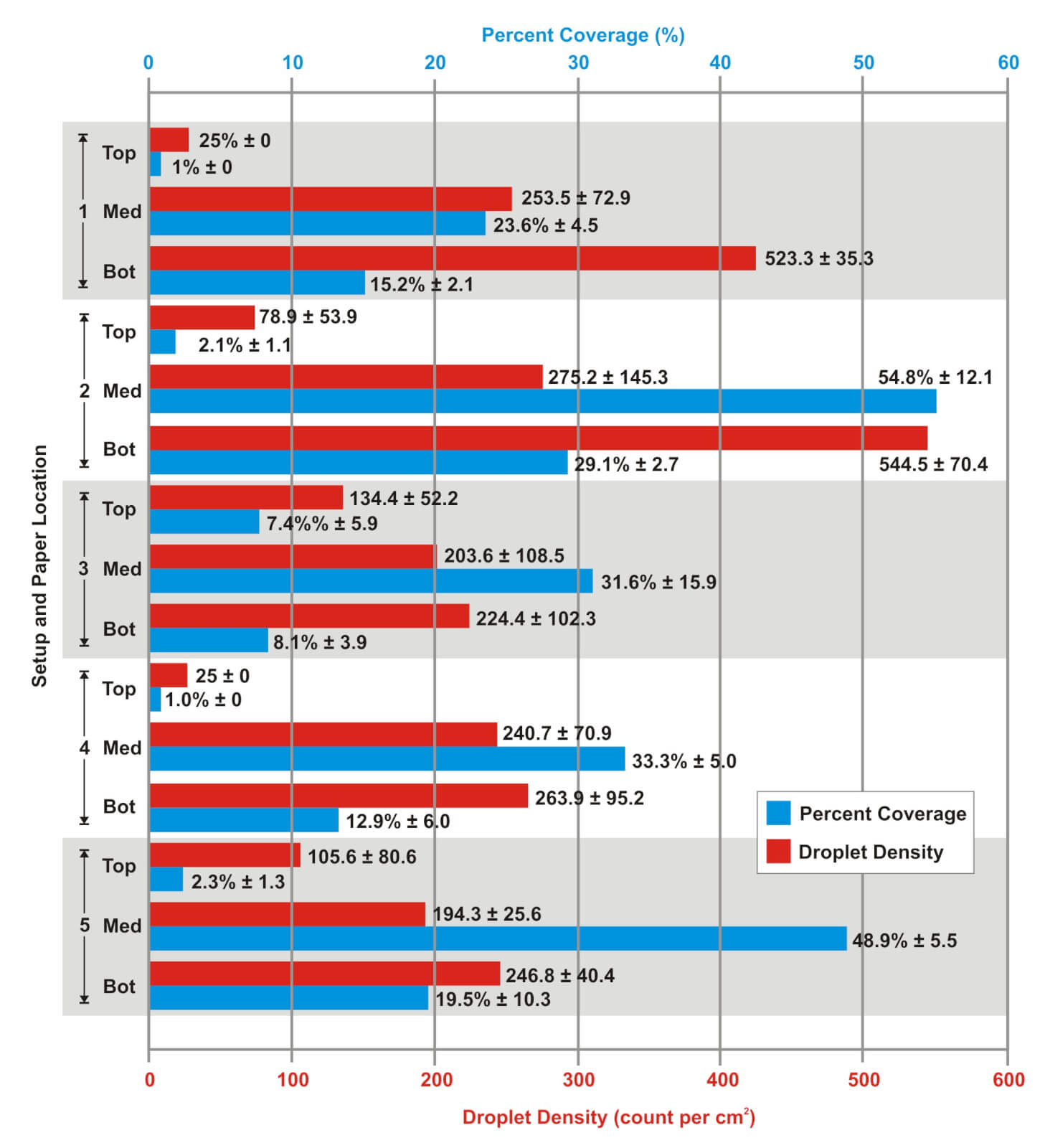
    The results may be easier to compare and contrast in the following graph.

    Strawberry coverage results for all five setups.
    Strawberry coverage results for all five setups.

    Observations

    According to the results, Setup 2 appeared to provide the best overall coverage. This is no surprise given that it was the second highest volume and employed a row kit. This corresponds with findings that have been published elsewhere. However, the excessively high pressure did create a lot of drift and the row kit didn’t always line up with the planted row. Further still, there’s the potential for missing anything that might harbour inoculum in the alleys, like runners. This setup wasn’t appropriate for this particular situation.

    The second-best overall coverage was obtained from Setup 5. This represented the highest volume, and a preferably lower pressure on twinjets, which may have allowed the spray to penetrate the canopy from multiple angles. This broadcast application is more reliable for hitting meandering rows and covers the alleys as well. So, the grower plans to employ this setup for the 2016 season, spraying at shorter intervals and confirming his coverage with water-sensitive paper. Let’s hope it works out.

    End-of-Season Update

    The grower that volunteered his time to this study has reported that his strawberries at the end of the 2016 season were absolutely beautiful. Granted, it is always difficult to draw a direct correlation between sprayer calibration and control. For example, 2016 was a very dry growing season and disease pressure was lower than in 2015. Nevertheless, spray coverage plays an important role in crop protection and our work to improve sprayer performance definitely played it’s part. His success is great news!