Category: Coverage

Articles related to horizontal boom sprayer coverage

  • Rainfastness of Insecticides and Fungicides on Fruit

    Rainfastness of Insecticides and Fungicides on Fruit

    This article was co-authored by Kristy Grigg-McGuffin, OMAFA Horticulture IPM Specialist

    In view of the frequent heavy rains in many regions this season, understanding rainfastness, or the ability of a pesticide to withstand rainfall, is important to ensure proper efficacy. All pesticides require a certain amount of drying time between application and a rain event. Typically, residue loss by wash-off is greatest when rain occurs within 24 hours of spraying. After this point, the rainfastness of a product will depend on formulation, adjuvants and length of time since application.

    Rainfastness of Insecticides

    John Wise, Michigan State University has studied rainfastness of common tree fruit insecticide groups and his findings are summarized below. For the complete article, refer here. Note that some products listed in this article may not be registered for use in Canada. Check with your local supplier or in Ontario, refer to OMAFA Publication 360 for a complete list of registered products.

    According to Wise, the impact of rain on an insecticide’s performance can be influenced by the following:

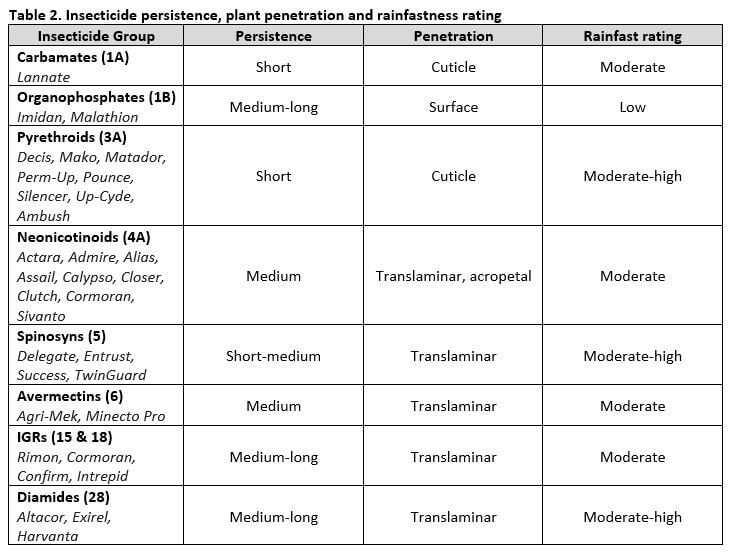
    1- Penetration

    Penetration into plant tissue is generally expected to enhance rainfastness.

    • Organophosphates have limited penetrative
      potential, and thus considered primarily surface materials.
    • Carbamates and pyrethroids penetrate the cuticle,
      providing some resistance to wash-off.
    • Spinosyns, diamides, avermectins and some insect
      growth regulators (IGR) readily penetrate the cuticle and move translaminar (top
      to bottom) in the leaf tissue.
    • Neonicotinoids are considered systemic or
      locally systemic, moving translaminar as
      well as through the vascular system to the growing tips of leaves (acropetal
      movement).
    • For products that are systemic or translaminar,
      portions of the active ingredient move into and within the plant tissue, but
      there is always a portion remaining on the surface or bound to the waxy cuticle
      that is susceptible to wash-off.

    2- Environmental persistence and inherent toxicity

    Environmental persistence and inherent toxicity to the target pest can compensate for wash-off and delay the need for immediate re-application.

    • Organophosphates are highly susceptible to
      wash-off, but are highly toxic to most target pests, which means re-application
      can be delayed.
    • Carbamates and IGRs are moderately susceptible
      to wash-off, and vary widely in toxicity to target pests.
    • Neonicotinoids are moderately susceptible to
      wash-off, with residues that have moved systemically into tissue being highly
      rainfast, and surface residues less so.
    • Spinosyns, diamides, avermectins and pyrethroids
      are moderate to highly rainfast.

    3- Drying time

    Drying time can significantly influence rainfastness, especially when plant penetration is important. For instance, while 2 to 6 hours is sufficient drying time for many insecticides, neonicotinoids require up to 24 hours for optimal penetration prior to a rain event.

    4- Adjuvants

    Spray adjuvants that aid in the retention, penetration or spread will enhance the performance of an insecticide.

    The following tables can serve as a guide for general rainfastness to compliment a comprehensive pest management decision-making process. They are adapted from “Rainfast characteristics of insecticides on fruit” by John Wise, Michigan State University Extension.

    Based on simulated rainfall studies to combine rainfastness with residual performance after field-aging of various insecticides, including carbamates (Lannate), organophosphates (Imidan, Malathion), pyrethroids (Capture), neonicotinoids (Assail, Actara, Admire), IGRs (Rimon, Intrepid), spinosyns (Delegate) and diamides (Altacor), Wise recommends the following re-application decisions for apples. Additional work was done on grapes and blueberries; see Wise’s article for this information. Among the crops, variation in rainfastness of a specific insecticide occurs since the fruit and leaves of each crop have unique attributes that influence the binding affinity and penetrative potential.

    • ½ inch (1.25
      cm) rainfall:
      All products with 1-day old residues could withstand ½ inch
      of rain. However, if the residues have aged 7 days, immediate re-application
      would be needed for all products but Assail, Rimon, Delegate or Altacor on
      apples.
    • 1-inch (2.5
      cm) rainfall:
      In general, most products would need re-application following
      a 1-inch rainfall with 7-day old residues, whereas Delegate and Altacor could
      withstand this amount of rain on apples and would not need to be immediately
      re-applied. Some products such as Imidan on apples could withstand 1 inch of
      rain with 1-day old residues.
    • 2-inch (5
      cm) rainfall
      : For all products, 2 inches of rain will remove enough
      insecticide to make immediate re-application necessary.

    It is important to note, not all products registered for the selected pests were included in this study. Refer to Publication 360 for a complete list of management options.

    Rainfastness of Fungicides

    There is no comparable research on rainfastness of fungicides and few labels provide this kind of information. A general rule of thumb often used is that 1 inch (2.5 cm) of rain removes approximately 50% of protectant fungicide residue and over 2 inches (5 cm) of rain will remove most of the residue. However, many newer formulations or with the addition of spreader-stickers, some products may be more resistant to wash-off. Avoid putting on fungicides within several hours before a rainstorm as much can be lost to wash-off regardless of formulation. As well, there are exceptions to the general rule in regard to truly systemic fungicides such as Aliette and Phostrol.

    The effectiveness of sticker-spreaders with fungicides is variable and product/crop specific. Penetrating agents don’t help strobilurins; in fact, some fungicide/crop combinations have been associated with minor phytotoxicity due to excessive uptake. Captan, which is intended to stay on the surface, is notorious for causing injury when mixed with oils or some penetrating surfactants that cause them to penetrate the waxy cuticle.  Consult labels for minimum drying times for individual products and recommendations for using surfactants. 

    Annemiek Schilder, Michigan State University suggests the following to improve fungicide efficacy during wet weather:

    • During rainy periods, systemic fungicides tend
      to perform better than protectant (or contact) fungicides since they are less prone
      to wash-off.
    • Applying a higher labelled rate can extend the
      residual period.
    • Apply protectant fungicides such as captan
      (Supra Captan, Maestro), mancozeb (Manzate, Dithane, Penncozeb) and metiram
      (Polyram) during sunny, dry conditions to allow for quick drying on the leaves.
      These types of fungicides are better absorbed and become rainfast over several
      days after application.
    • Apply systemic fungicides such as sterol
      inhibitors (Nova, Fullback, Inspire Super), SDHI (Fontelis, Sercadis, Kenja, Aprovia
      Top, Luna Tranquility) and strobilurins (Flint, Sovran, Pristine) under humid,
      cloudy conditions. The leaf cuticle will be swollen, allowing quicker
      absorption. In dry, hot conditions, the cuticle can become flattened and less
      permeable, so product can breakdown in sunlight, heat or microbial activity or
      be washed off by rain.

    Click here to refer to the complete article.

  • What’s with dew? – Tips with Tom #9

    What’s with dew? – Tips with Tom #9

    When warm air is cooled, it loses some of its moisture-holding capabilities. This change often occurs at night, when plants (and other objects) cool. Once the temperature of the surface of the leaves, for example, drops below the dewpoint, it causes water to condense, forming the shiny dew that causes so many to question early morning spray applications.

    The question is often: will the spray run off the plant or will it get so diluted that it doesn’t work anymore?

    In a dew chamber, work has shown that large spray droplets are more likely to run off a plant saturated with dew than their smaller counterparts. However, similar work showed that spray efficacy was not altered by droplet size.

    Wolf discusses this work and the potential answer to the seemingly conflicting findings. Wolf also explains how grassy weeds compare to broadleaves, the role of surfactants, and what to consider when making the decision to spray through dew or not.

  • How Low Can You Go?

    How Low Can You Go?

    Listen to an audio recording of this article by clicking here

    There’s a lot of talk about lowering the boom to reduce drift and make twin fan nozzles more effective. But how low can we actually go with a boom before striping becomes a problem?

    We’ve done some calculating and have come up with answers.

    First, a few guidelines. Tapered flat fan nozzles require overlap to generate a uniform volume distribution under the boom. Traditionally, we’ve recommended 30 to 50% overlap with fine flat fan sprays. The small droplets tended to redistribute to fill in any gaps that might occur.

    Overlap from fine sprays is less critical than from coarser sprays because the small droplets redistribute readily.

    The advent of low-drift nozzles changed that advice. This nozzle type produces fewer droplets overall, and, like all fan-style nozzles, puts the coarser ones towards the outside edges of the fan. These don’t redistribute.

    A typical flat fan spray places the coarser droplets at its periphery, and the smaller ones in the middle. When only the outed edges overlap, that can creates a band of poor coverage.

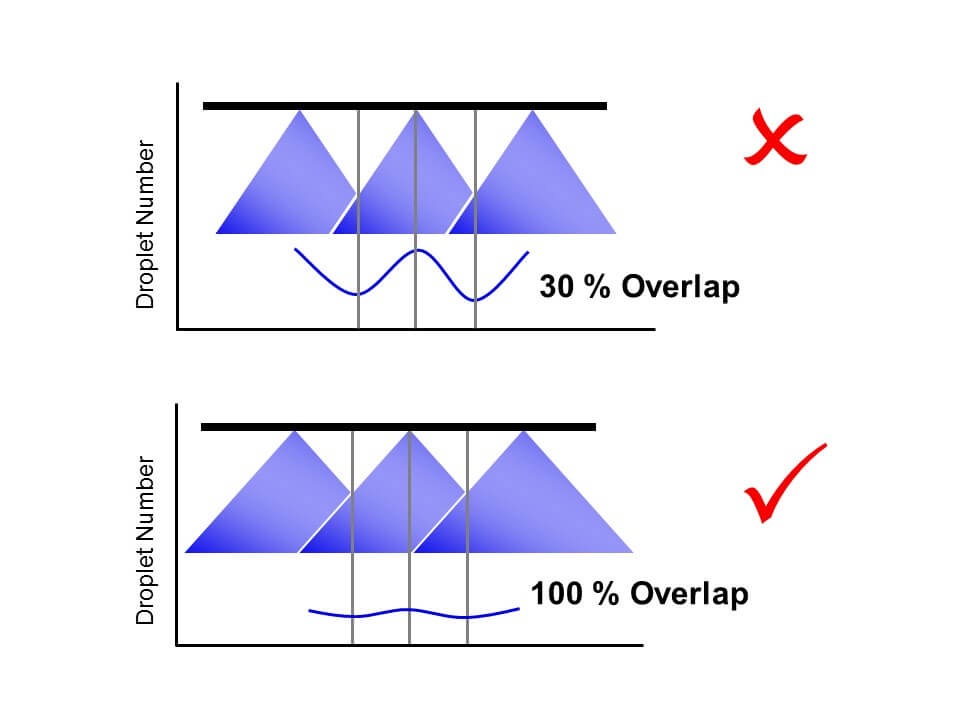
    When we had 30% overlap and these two edges met, a region of relatively few, coarse droplets was formed, and this region contained almost no small droplets. On a patternator, the volume distribution was still good. But when we measured the droplet density, we saw a deficit in coverage at the overlap.

    With low-drift nozzles, we need 100% overlap to distribute both small and large droplets uniformly under the spray swath. Too little overlap and we create bands of relatively few but large droplets that can cause striping.

    Since then, we’ve been recommending 100% overlap for low-drift sprays. This means that the pattern width at the target will be twice the nozzle spacing, and all regions under the boom receive droplets from two adjacent nozzles.

    With this adjustment, small droplets appeared throughout the spray swath, and striping was eliminated.

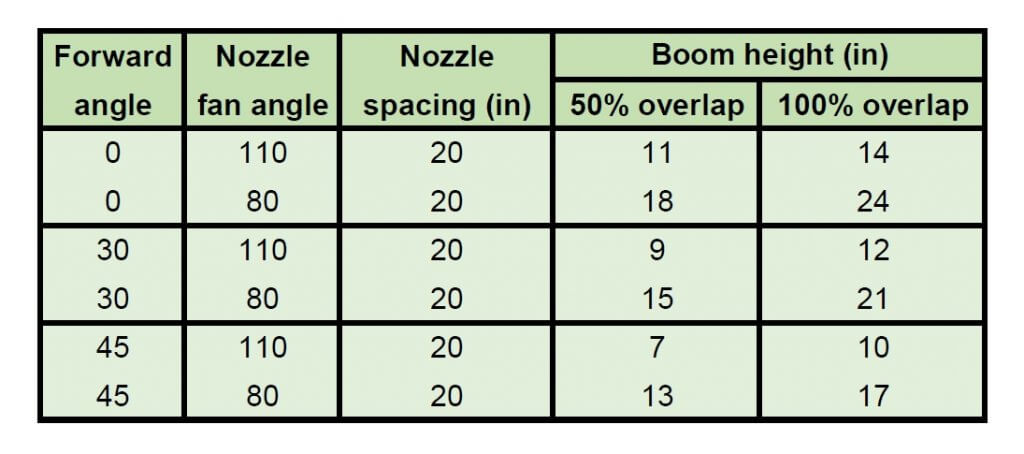
    That leaves the question, just how low can a boom be set without creating this problem? The following tables provide some theoretical numbers.

    Minimum boom heights for achieving 50% and 100% overlap of flat fan spray nozzles (US units)

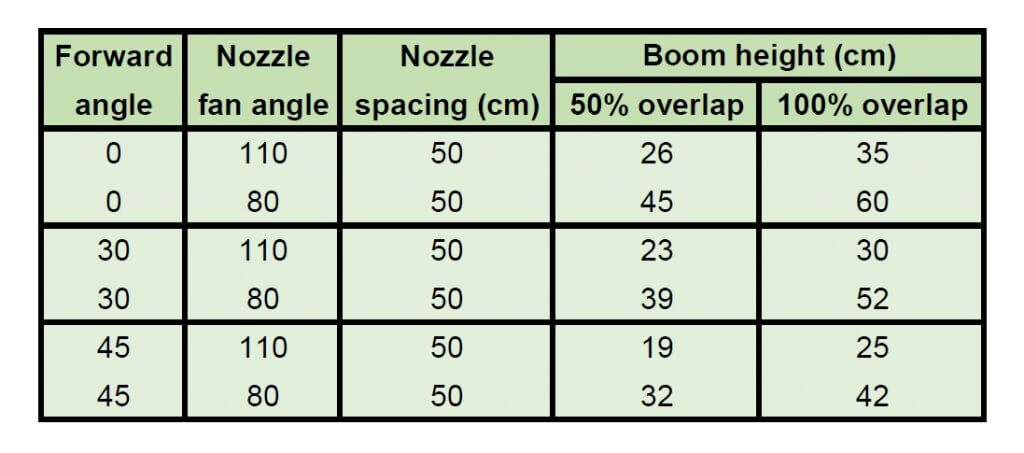
    Minimum boom heights for achieving 50% and 100% overlap of flat fan spray nozzles (metric units)

    A word of caution: The advertised fan angle on a sprayer nozzle often differs in practice. Not only will it be slightly different by design, it also depends on spray pressure and tank mix. As a result, it’s best to do a visual check. Set the spray pressure to the minimum you expect to use. Inspect the spray patterns and set the boom height so that the edge of each nozzle pattern reaches to the middle of the next nozzle. That means your pattern width is twice the spacing and will give 100% overlap. No tape measure required.

    The tables were generated from a spreadsheet which can be downloaded here:

    • The values are theoretical and assume the fan angles are accurate. Some nozzles don’t produce the advertised fan angle. Enter your actual angle in the spreadsheet if you know it.
    • The theory assumes that the droplets at the edge of the fan always move in their projected direction. In fact, after some distance, say 50 to 75 cm, gravity pulls the droplets down and the pattern no longer widens at the same rate. The rate of pattern collapse depends on the droplet sizes.
    • Use the 0% overlap column to help with banding nozzle pattern width. Simply use the nozzle spacing column to enter your desired band width.
    • Note that angling the nozzles forward or backward decreases your minimum boom height, but depending on the deflection of the spray in the wind, this too has limits.
    • Too high a boom obviously increases drift. But patternation from overlap isn’t affected that much, largely because the pattern is now subject to aerodynamics and that becomes more important.

    Pro Tip: Attach a length of plastic hose or a large zip tie to the boom, cut to your minimum boom height. This makes it easier to see what your boom height is, from the cab or the ground.

    The bottom line is that a boom can be quite low and still allow excellent overlap and pattern uniformity from the nozzles. Yet we all know that most sprayer booms can’t reliably operate that low because they don’t control sway well enough. The ball’s in your court, sprayer manufacturers!

  • Boom Heights at Fan Angles Worksheet

    Boom Heights at Fan Angles Worksheet

    Use this spreadsheet to calculate the minimum boom heights needed for various applications.

    Some caution:

    • The values are theoretical and assume the fan angles are accurate. Some nozzles don’t produce the advertised fan angle. Enter your actual angle in the spreadsheet
    • The theory assumes that the droplets at the edge of the fan always move in their projected direction. In fact, after some distance (say 50 to 75 cm, gravity pulls the droplets down and the pattern no longer widens at the same rate. The rate of pattern collapse depends on the droplet sizes.
    • Use the 0% overlap column to help with banding nozzle pattern width. Simply use the nozzle spacing column to enter your desired band width.
    • Note that angling the nozzles forward or backward decreases your minimum boom height, but depending on the deflection of the spray in the wind, this too has limits.
    • Too high a boom obviously increases drift. But patternation from overlap isn’t affected that much, largely because the pattern is now subject to aerodynamics.
  • Air-Assist Improves Coverage in Field Corn

    Air-Assist Improves Coverage in Field Corn

    Why aren’t there more air-assist boom sprayers in Canada? I can understand why field croppers might hesitate to pay for the feature because it’s only been in recent years that fungicide applications have become a regular part of their annual spray program. But, high-value horticultural muck crops like onion and carrot, or field vegetables like tomato and peppers have been a great fit for many years.

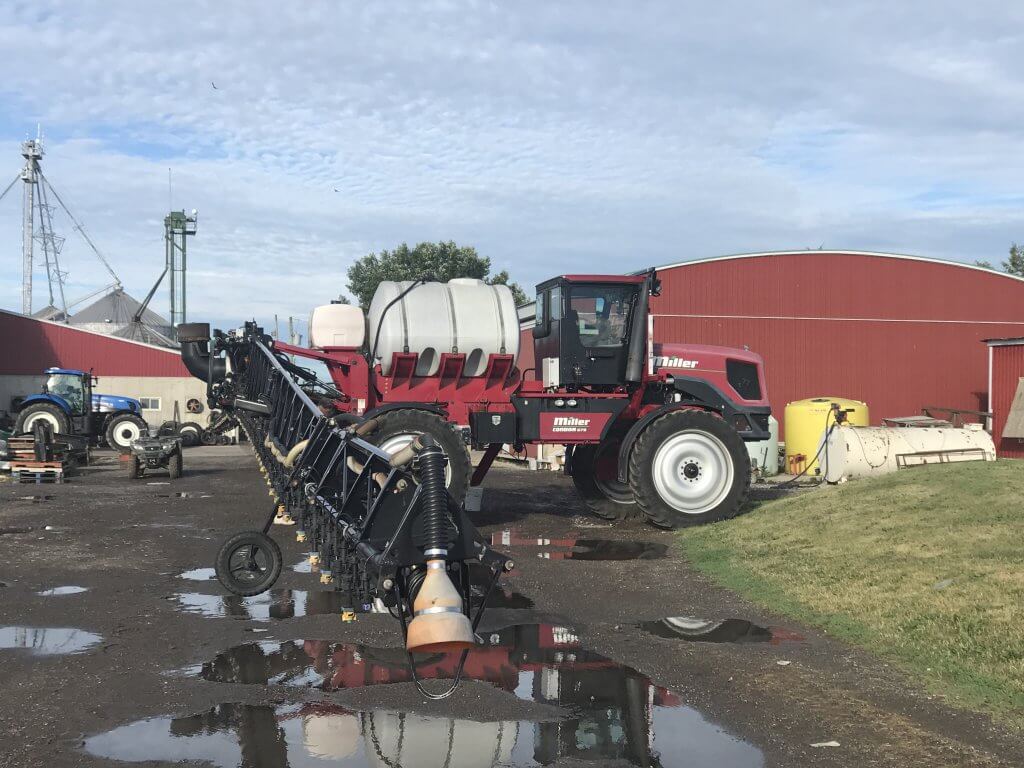
    One operation near Dresden, Ontario was thinking the same way when they bought a used 2010 Miller Condor with a Spray-Air boom from Indiana. In the past, they employed a trailed Hardi sprayer applying 40 gpa using Turbo TeeJets alternating front-to-back in their field tomato and onion crops. They felt they could achieve better coverage with the air assist feature.

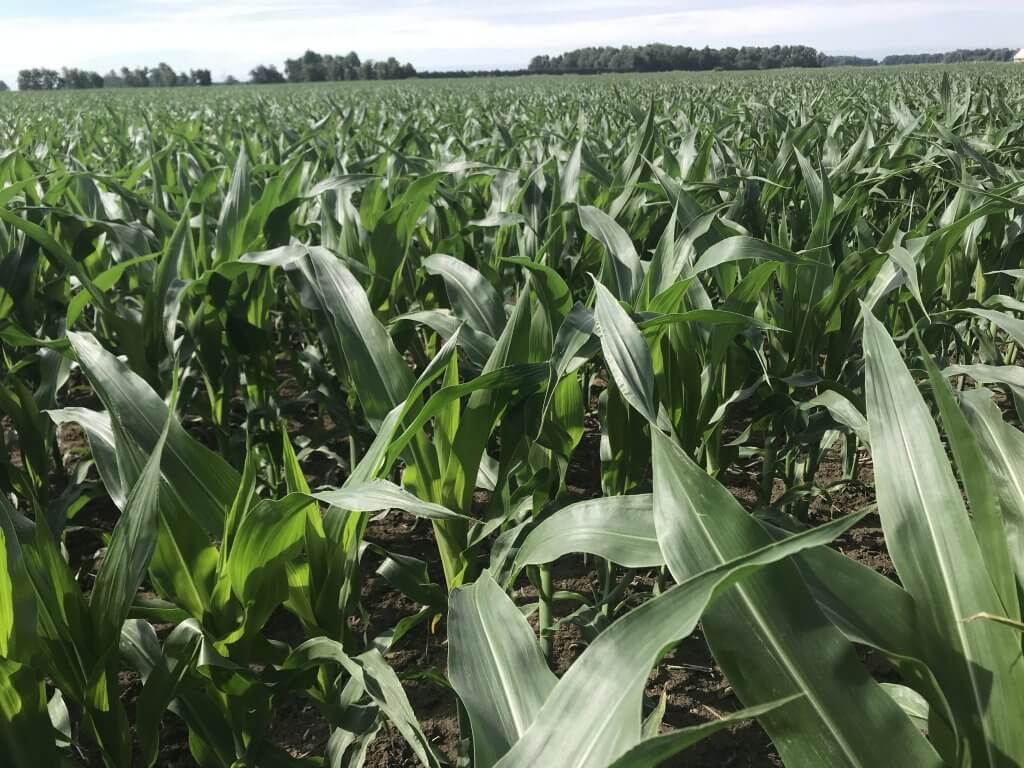
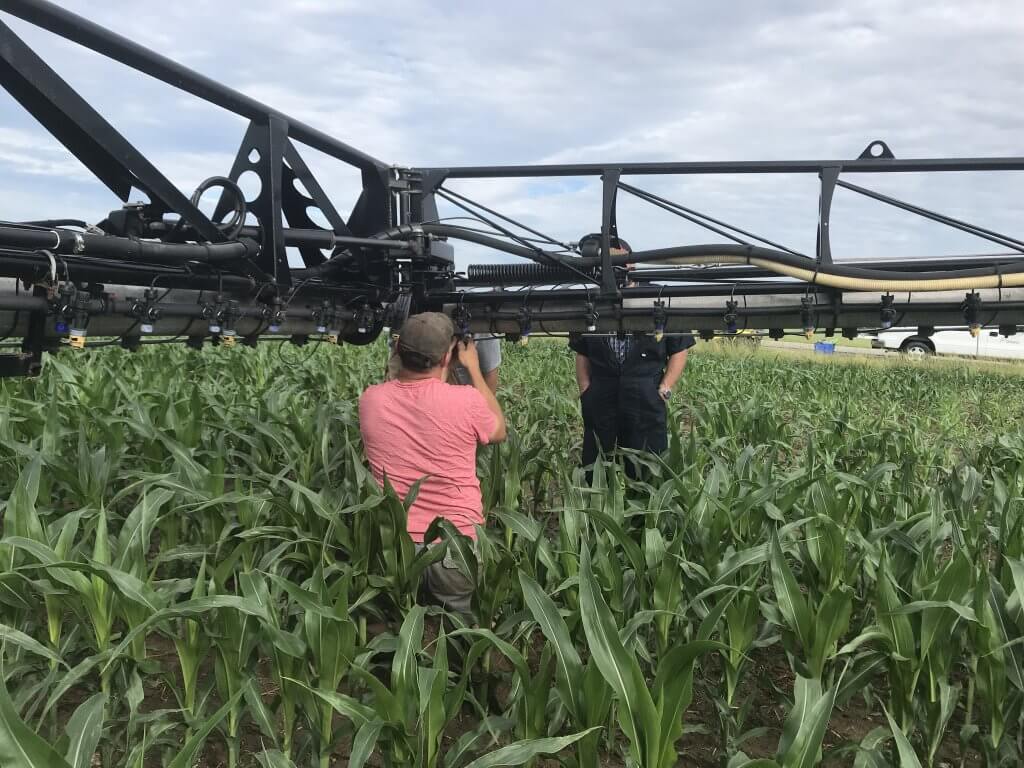
    On June 19 the onion and tomato canopies were still too sparse to be a good testing ground (and the ground was very wet). So, we decided to run coverage trials in a stand of 3 foot high corn on 30 inch centres.

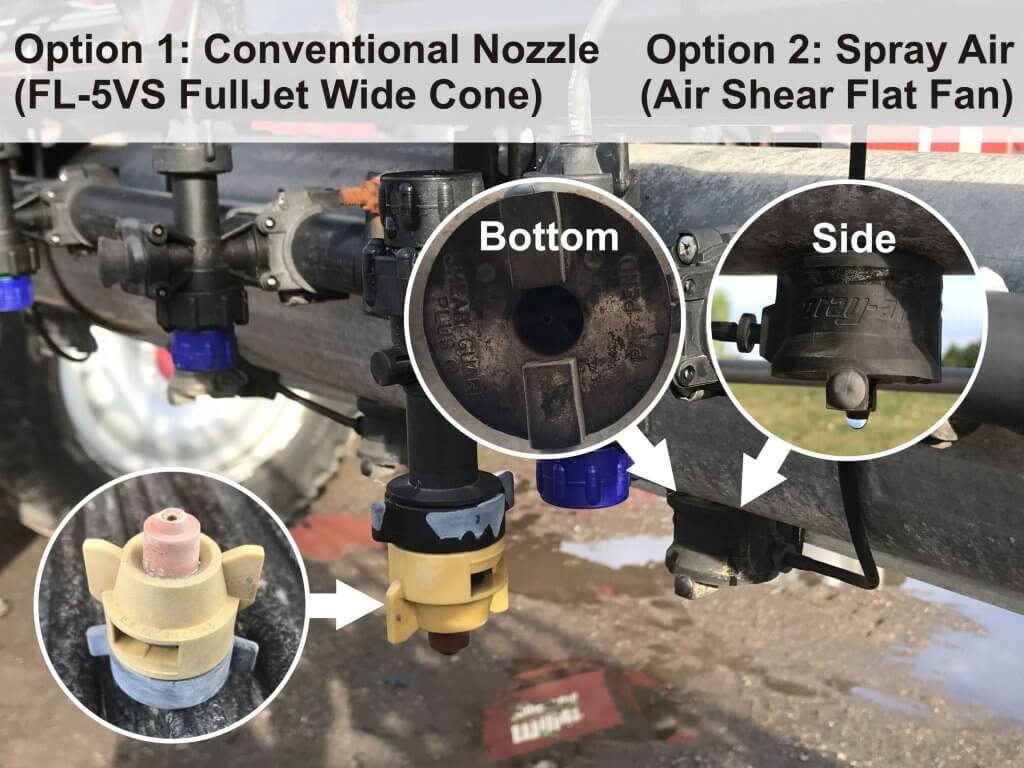
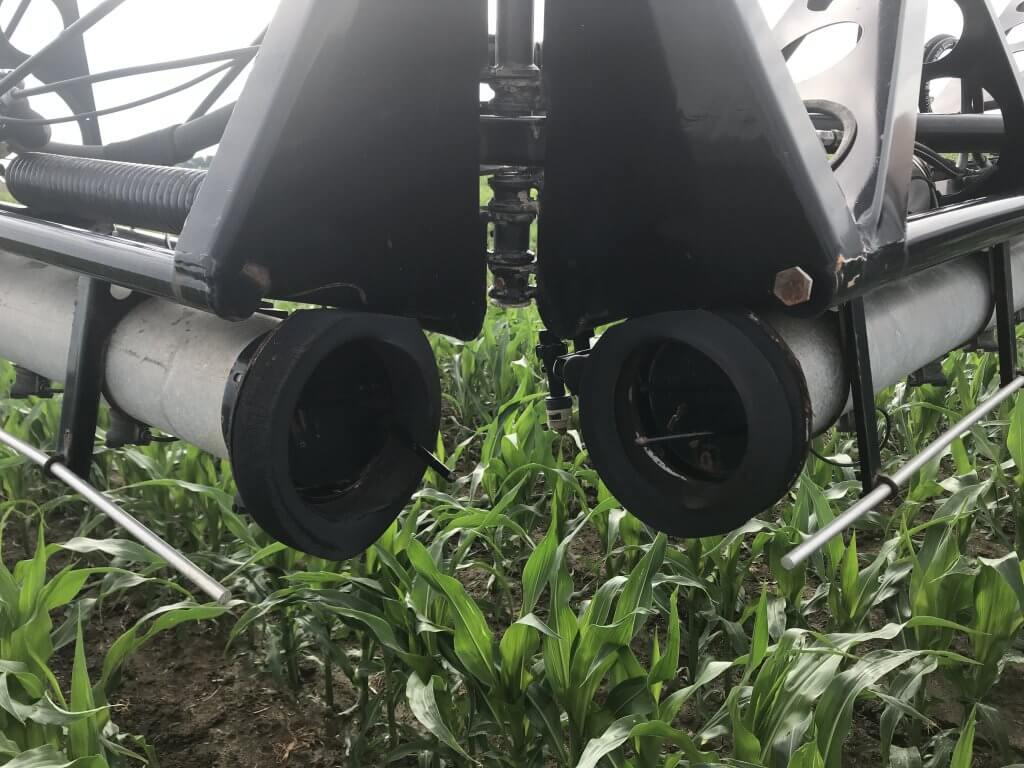
    The Spray Air boom features a series of air shear nozzles on 10 inch centres. A liquid feed line meters spray mix to the orifice, where high-volume air is directed at the flow via two Cross-Flow jets. This shreds the liquid into spray and shapes a 60 inch flat fan pattern. The operator can select from a range of air speed/volume settings that affect spray quality (lower air means Coarser and fewer droplets and a smaller fan angle).

    This particular boom also carried a set of hydraulic nozzles, so the operator could elect to turn off the Spray Air feature and employ a conventional application. This would be appropriate if applying a herbicide using air induction nozzles. In this case, the sprayer was equipped with TeeJet FullJet cones.

    The first thing we noticed was that the air was not distributed evenly across the boom. We inspected the baffles that join each boom section, but found no problem.

    We then suspected the Spray Air combination nozzles might be occluded with debris (it did come all the way from Indiana). This turned out to be the case, so we popped them out and cleared the Cross Flow jets of any obstructions.

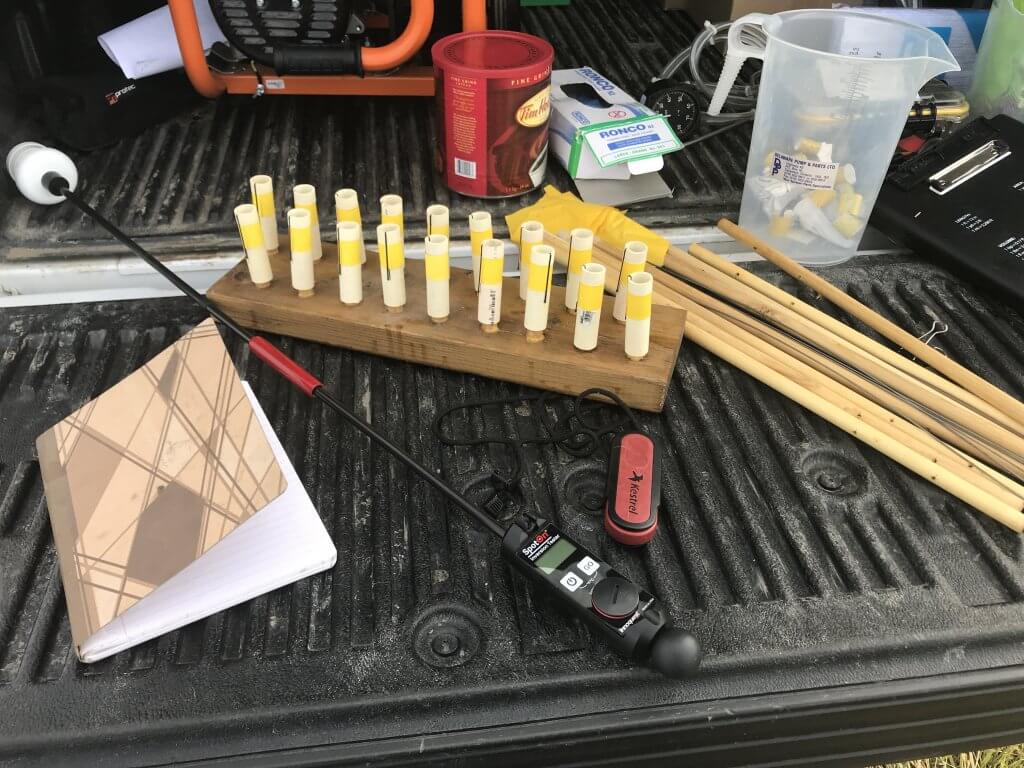
    We then measured the air speed produced by the boom. A Pitot meter proved to be too finicky to get a consistent reading, so we used a Kestrel wind meter held 12 inches from the nozzle. The operator moved between the six air settings in the cab, producing the following air speeds. Note that these speeds were much slower than the 100+ mph (160+ km/h) speeds noted in the Miller brochure. The owner has since told me that they found a number of air leaks in the boom that they have been diligently repairing, and as a result he’s operating at a lower air setting.

    Air SettingApproximate Airspeed at 12”
    14 mph (6.5 km/h)
    26.5 mph (10.5 km/h)
    38.5 mph (13.5 km/h)
    412.5 mph (20 km/h)
    515.5 mph (25 km/h)
    617.5 mph (28 km/h)

    We used water-sensitive paper wrapped around dowels to illustrate potential spray coverage.

    They were placed perpendicular to the spray at three depths in the corn canopy: High, Middle and Bottom. This provided an indication of panoramic coverage and represents a very difficult-to-wet target. In the last two trials, we also added a horizontal target at the Middle (not shown) and Bottom position to illustrate overall canopy penetration, and two at the High condition, angled at 45º into the sprayer’s path and 45º away from the sprayer’s path. These gave an indication of the highest potential coverage available to the canopy. Papers were later unfurled and digitally scanned. The papers were analyzed using DepositScan to determine the total percent coverage, and the droplet density.

    Trials took place between 8:30 and 11:00. Temperature slowly climbed from 20ºC to 23ºC (~ 70ºF). Relative humidity dropped from 69% to 60%. With the exception of Trial 1, we sprayed in a tail wind of 7.5 mph (12 km/h) gusting up to 10 mph (16 km/h). Travel speed was 7 mph (11 km/h).

    In the first five trials we made single, progressive adjustments to the spray settings that we assumed would improve coverage. Finally, we compared what we felt were optimal settings with the Spray Air (Trial 5) to optimal settings for the conventional hydraulic nozzles (Trial 6). Details are as follows:

    TrialAir settingSpray Volume (gpa)Boom Height (inches)
    121420
    23.51420
    361420
    46146
    56206
    6No Air – Fullcones206

    You can watch the passes in the following video. Note the boom height and the trailing spray.

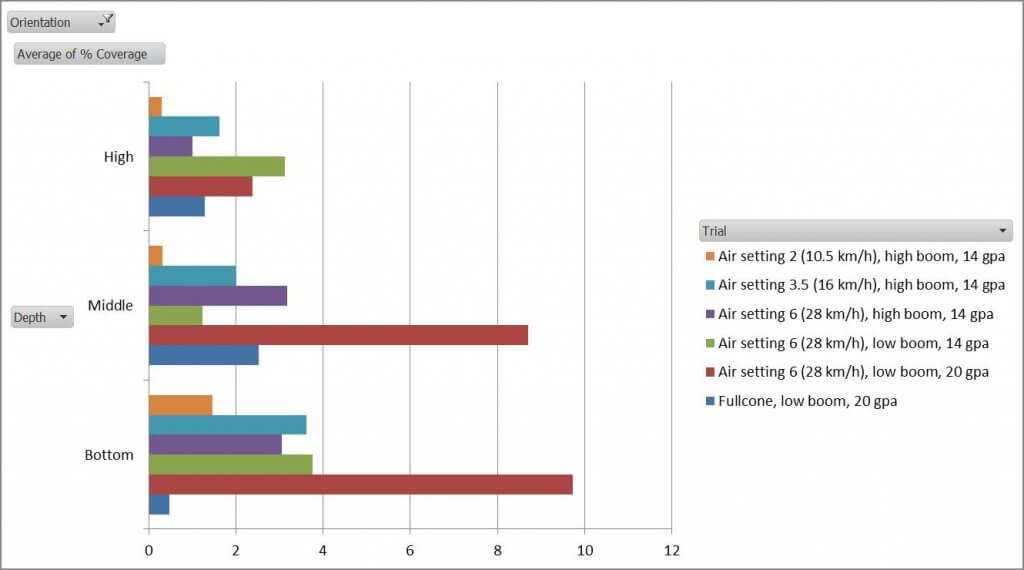
    The following two graphs show the coverage obtained in the High, Middle and Bottom positions for all six trials. The first graph is percent coverage, and the second is droplet density.

    In trial 1 the air was insufficient to properly atomize the spray mix (as seen in the video) and this is evident in both graphs. By increasing the air in trials 2 and 3, we see that coverage increases in the High and Middle positions, but declines a little in the Bottom position. When we lower the boom closer to the canopy in Trial 4, we see increased coverage again in the High and Bottom positions, but lose ground in the Middle. We then increase our water volume for exceptional gains in the Middle and Bottom position, but at the expense of the High. Throughout these changes, overall coverage trended up. Finally, when we turn off the Spray Air system, and switch to the Fullcones, which were set to spray the same volume via the rate controller, there is a drastic reduction in coverage in all positions.

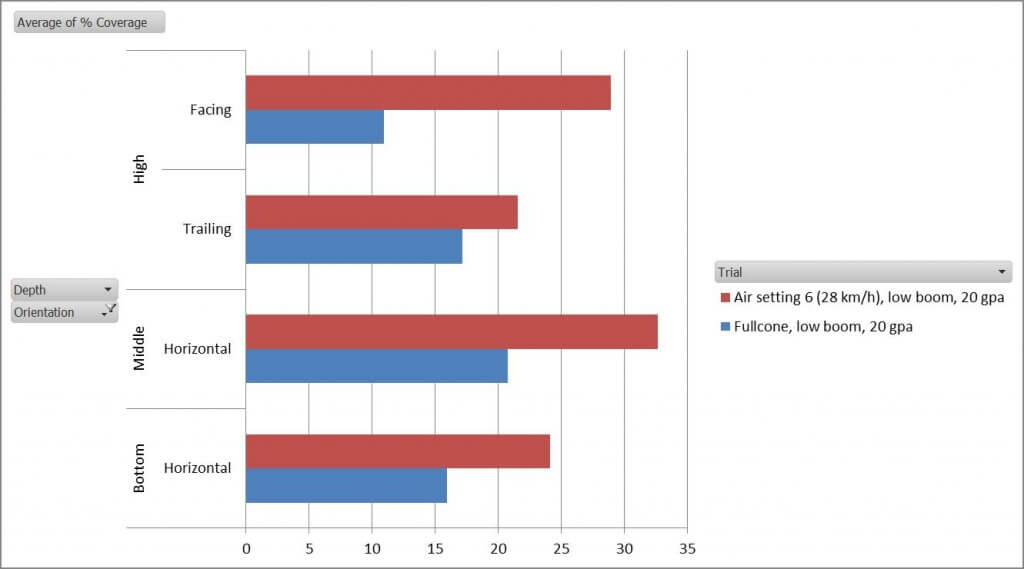
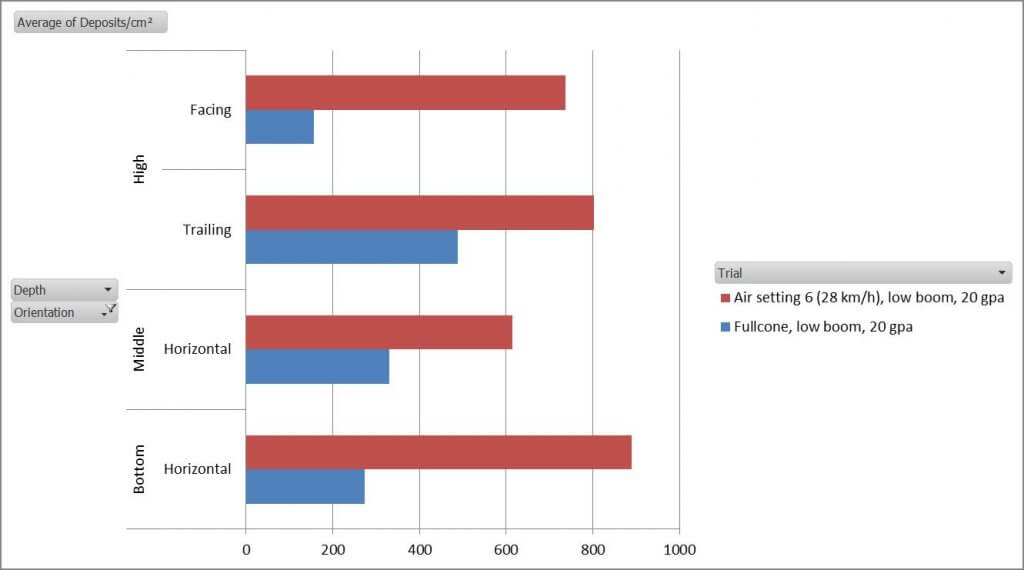
    Let’s look at the additional papers placed for Trials 5 and 6 in the following graphs.

    Even when papers were oriented to intercept the spray as much as possible, The Spray Air system provided superior coverage compared to the hydraulic nozzle.

    This leads us to conclude that there is an advantage to air assist in overall coverage and canopy penetration. Further, it demonstrates that such a system requires careful calibration to ensure it is being used optimally. Water volume, air settings and travel speed should all be reconsidered when the environmental conditions change (e.g. temperature and wind) and when spraying different crops, at different stages of growth.

    Two weeks after this trial, the corn grew too high for the Miller boom, but the grower moved into his onion and tomato and was very pleased with the overall coverage the Spray Air was providing. He’d also replaced the fullcones with 110 degree AI flat fans for herbicide spraying.

    I’d like to see more air-assist booms in Canada.