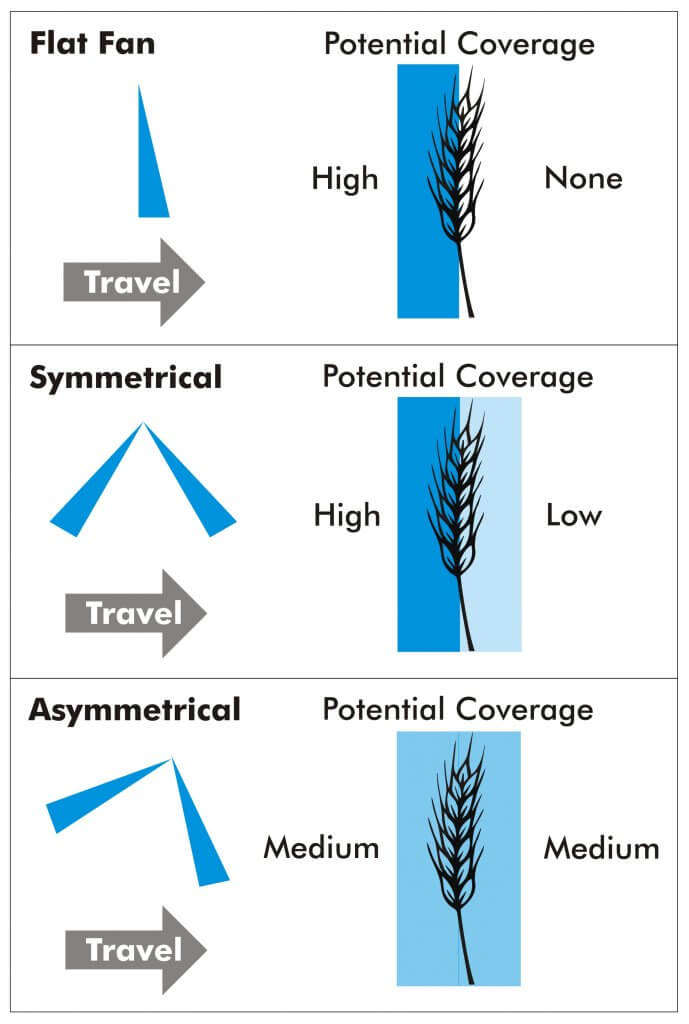
Well, first, understand they are intended for vertical targets, like wheat heads. Here’s a diagram of how they are (ideally) supposed to work:
Here’s is the ideal coverage from fan nozzles on a vertical target. Note that high booms, smaller droplet sizes, high travel speeds, high or changeable wind conditions and uneven emergence can negatively affect coverage.
Here’s our very own Dr. Tom Wolf to tell you all about them.
Now understand they don’t seem improve matters (at conventional pressures) in broad leaf crops. We compared spray coverage from several nozzles in soybean. The lack of any clear cut winner was disheartening, but even messy results can lead to valuable conclusions! Read more about the experiment here and watch the video below:
And finally, understand that choosing a brand or variation of a dual fan nozzle arrangement is likely the least important factor. It falls, in our opinion, last in this sequence of factors:
Spray timing (i.e. crop stage, pest stage)
Product choice
Boom height (Keep ’em low)
Droplet size (Keep ’em Coarse or larger)
Spray volume (Go with more gallons per acre, not less)
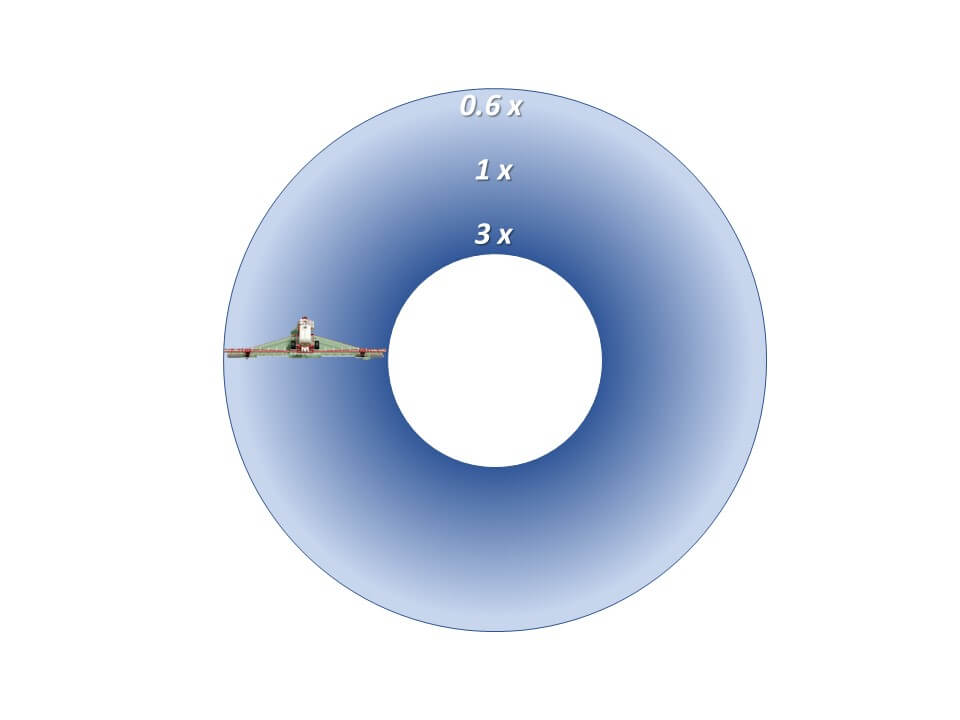
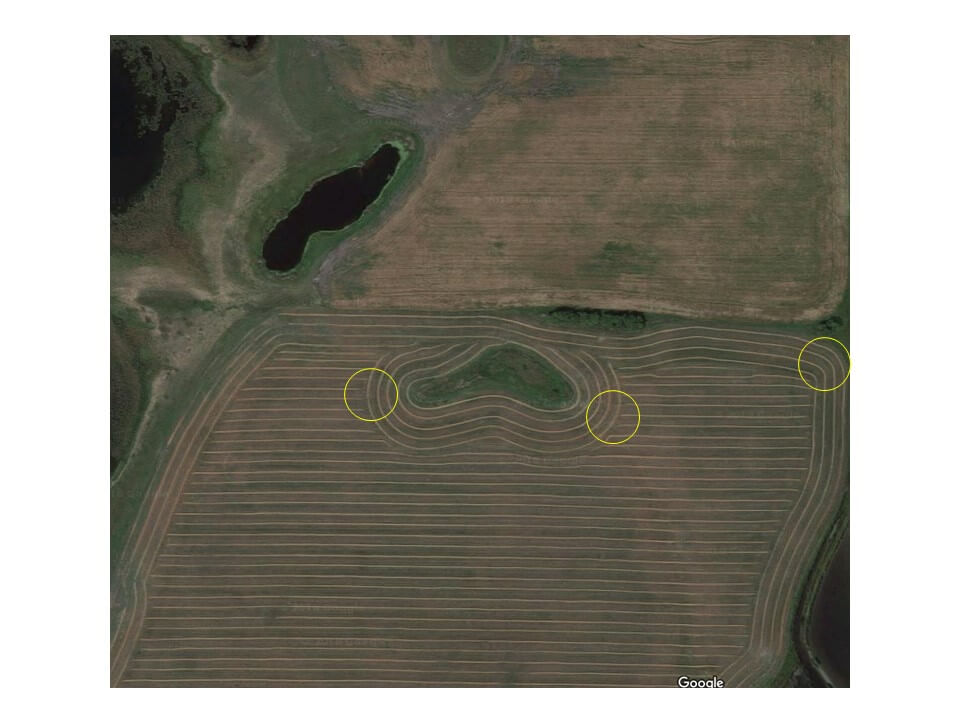
Turn compensation is a feature in pulse width modulation (PWM) sprayers in which nozzle output matches the boom’s speed during a turn. When turning, the inside and outside of a boom travel at different speeds, resulting in over-dosing on the inside and under-dosing on the outside. Read about PWM systems here, here, and here.
The degree of the problem depends on the inside turn diameter. Clearly, the tighter the turn, the more severe the over-and under-dosing. The ability of a PWM sprayer to compensate also depends on the turn tightness, as well as the Duty Cycle (DC) the system is operating at during the turn.
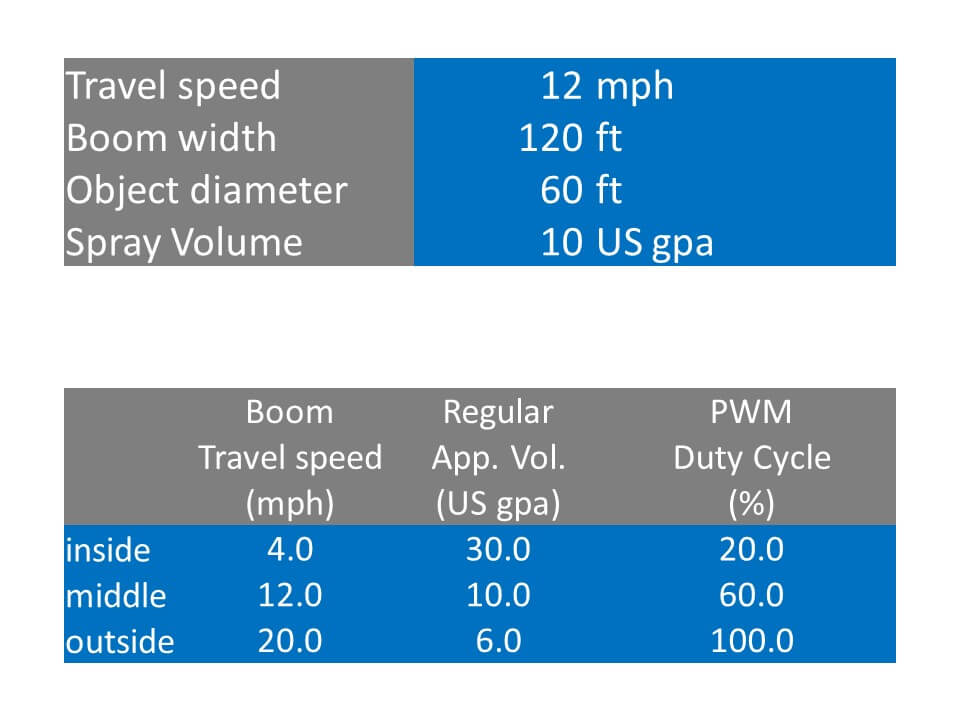
In the above example, a 120 ft boom makes a turn around an object with a 60 ft diameter. Assuming a 12 mph speed and an application volume of 10 gpa, the inside of the boom travels at 4 mph and applies 30 gpa, or 3x. On the outermost nozzle, the speed is 20 mph with an application volume of 6 gpa, or 0.6 x. A sprayer operating at 60% DC would be able to correct the application in this turn by operating at 100% DC on the outside and 20% DC on the inside.
But completing the turn at other DCs may be problematic. In this case, lower sprayer DC would require the inside DC to operate below 20%, which may not be possible, depending on the system. Conducting the turn at higher DC would prevent the outer boom from meeting the flow requirements, resulting in under-dosing.
Optimizing the benefit of turn compensation requires the operator to enter the turn at a DC that meets the objectives. Is it more important to prevent under-dosing of the outside perimeter? If so, slow down in the turn (reducing DC) and maximize the extra capacity at the outside of the boom, possibly at the cost of over-dosing the inside.
Turn compensation is a valuable feature in all agricultural operations where input distribution uniformity is important. Spraying is no exception, and PWM makes it possible.
This research was performed with Dennis Van Dyk (@Dennis_VanDyk), vegetable specialist with the Ontario Ministry of Agriculture, Food and Rural Affairs.
Prior to 2017, Syngenta introduced the UK to the Defy 3D nozzle, which is a 100° flat fan, designed to run alternating 38° forward or backward along the boom. They prescribed a boom height of 50 to 75 cm, 30-40 psi, and travel speeds of 10 to 14 km/h in cereals and vegetables. Compared to a conventional flat fan, they claimed that the angle and Medium-Coarse droplets promise less drift and improved coverage.
In 2017, Hypro and John Deere began distributing the Defy 3D in North America. Our goal was to explore coverage from the 3D in vegetable crops. We compared the nozzle’s performance to common grower practices in onion, potato and carrot in the Holland Marsh area of Ontario.
Experiment
We used a technique called fluorimetry. A fluorescent dye (Rhodamine WT) was sprayed at 2 mL / L from a calibrated sprayer based on protocols generously provided by Dr. Tom Wolf.
Tissue samples from the top, middle and bottom of the canopy were collected from random plants.
The samples were rinsed with a volume of dH2O and this rinsate was then tested to determine how much dye was recovered.
The tissues collected were dried and weighed to normalize the samples to µL of dye per gram dry weight to allow for comparison.
In addition, we used water-sensitive paper as a check in key locations in the canopy to provide laminar and panoramic coverage. Papers were digitized and coverage determined as a percentage of the surface covered.
In carrot and onion, we compared a hollowcone, an air-induction flatfan, and alternating 03 3D’s at 500 L/ha (~40 cm boom height, ~3 km/h travel speed, ~27ºC, 3-9 km/h crosswind, ~65% RH).
In potato we compared the alternating 05 3D’s to a hollowcone at 200 L/ha (~55 cm boom height, ~10.5 km/h travel speed, ~22ºC, 6-8 km/h crosswind, ~65% RH).
Water-sensitive papers were originally intended as a coverage check, and not as a source of analysis, but their use revealed interesting information. The following images are the papers recovered a single pass in each crop.
Carrot
Onion
Potato
Results
The following table represents the percent coverage of these paper targets. Papers were digitized using a WordCard Pro business card scanner and analysis made using DepositScan software. This table is small, but you can zoom in for a quick comparison. The following three histograms show the same data graphically for carrot, onion and potato, respectively. Remember, this only represents a single pass, so don’t draw any conclusions about coverage yet.
Carrot
Onion
Potato
It was interesting to note differences in coverage observed on the papers versus the results of the fluorimetric analysis. It was anticipated that while water-sensitive paper serves for rough approximation of deposition, fluorimetry would be far more accurate. This is because of the droplet spread on the paper, and the evaporation and concentration of a spray droplet en route to the target. Again, here is a small table, and again, the next three histograms show the same data graphically for carrot, onion and potato, respectively.
Carrot
Onion
Potato
Observations
While water-sensitive paper is an excellent diagnostic tool for coverage, fluorimetry allows for greater resolution. The high variability in coverage meant little or no statistical significance, however the means suggested the following:
In carrot, the 3D deposited more spray at the top of the canopy.
In onion, the hollowcone spray had a higher average deposit, and penetrated more deeply into the canopy.
In potato, the hollowcone deposited more spray at the top, with little or no difference mid-canopy.
Each nozzle performed well at the top of the canopy, which is quite easy to hit. Certainly they exceeded any threshold for pest control. With the possible exception of hollowcone in onion, nozzle choice had only minor impact on mid-bottom canopy coverage. And so, if coverage is not a factor for distinguishing between these nozzles, we should consider drift potential. Due to the comparably smaller droplet spray quality, the hollowcone is far more prone to off target movement. This leads us to select the AI flat fan or the 3D as the more drift-conscious alternatives.
Future analysis would benefit from a larger sample size to reduce variability, and the inclusion of an air-assist boom to better direct spray into the canopy.
Applitech Canada (Hypro / SHURflo) is gratefully acknowledged for the 3D nozzles. Thanks to Kevin D Vander Kooi (U of G Muck Crops Station) and Paul Lynch (Producer). Assistance from Will Short, Brittany Lacasse and Laura Riches is gratefully acknowledged. Research made possible through funding from Horticultural Crops Ontario.
The following question arrived from one of our prairie clients last week:
“A retailer is promoting the use of hollow cone nozzles to be used on field sprayers (20” spacing) to apply fungicides which he claims out-perform any regular and twin fan tips. Claims:
create an extra fine droplet for maximum coverage on the canopy
use less water, less time spent filling
apply at 3.5 gpa
add vegetable oil to reduce drift
“So his direction to a specific customer was to use the TEEJET CONEJET TXA8001VK nozzle at 80 psi – travelling at 10 – 12 mph to achieve a 3.4 gpa application rate with a ‘very fine’ droplet size.
“What are your thoughts?”
Here’s how I answered (edited for clarity):
That recommendation sounds familiar – it originates from a consultant with experience in South America, where this idea is promoted to improve (aerial) spray productivity.
I fundamentally disagree with his approach. Adopting and promoting it is not only illegal (contravenes every modern label’s water volume and spray quality requirements), it also puts a generation’s worth of stewardship efforts on drift management at risk.
To be balanced, let’s explore the attractiveness of this approach. Finer sprays do provide superior coverage and save water. Every child knows this. Finer sprays also go places in the canopy where the coarser sprays can’t, for example very dense lentil canopies.
Over the years, we’ve explored the performance of fine fungicide sprays in canola, pulses, and cereals in research trials with the U of S and AAFC. To our surprise, droplet size played only a small role in fungicide performance. Water volume was much more important. Droplet size management with pressure through a low-drift nozzle was enough to get the best disease control.
The main drawbacks of very fine sprays are:
The fine droplets evaporate to dryness very quickly, in seconds. As they shrink, their drift potential is increased even more, and once dry, the remaining particles work much less well. The proponent corrects for this by adding an oily adjuvant as an evaporation retardant. With oil, the fines remain liquid much longer. Although many products become more effective this way, they also become more phytotoxic and less safe for the applicator and bystander. Completely off label, completely risky for crop safety, unknown effects on MRLs, extremely unsafe for the environment and humans. Remember when people dissolved 2,4-D ester in diesel, back in the 40s and 50s and sprayed it with their brass 6501 tips? That’s what this is.
Cone nozzles are designed for airblast sprayers and do not produce good pattern overlaps for boom sprayers. The proponent of this method actually recommends that the boom be raised to overcome the bad patterns and to (believe it or not) simulate aerial application. If this were done, the spray would be re-distributed by air-currents and come down wherever the wind blows it. Probably far away. The concept of on-target, uniform application, the practice that makes product use acceptable, and the thing we try to achieve with flat fans at a low boom height, is completely lost.
Producers will not have the support of pesticide manufacturers should a performance issue arise. Even worse, if regulators find out about this off-label practice, significant fines (fines for fines, get it?) can be charged under the Pest Control Products Act.
Airborne spray drift with an air-induced spray like the AirMix, GuardianAir, AIXR and the like, applying 10 gpa, is about 1% of the applied amount, measured at 5 m downwind of the downwind edge of the swath in a 20 km/h wind. We’ve never measured hollow cone drift from a boom sprayer, but when we used a flat fan at 5 gpa, drift increased to about 8% of applied. I’d guess a high pressure hollow cone would easily double or triple that. Illegal and irresponsible.
Travel and boom turbulence is a part of faster travel speeds. This would affect the finer droplets much more than the coarser ones, as we can imagine. It’s similar to drift. With a low-drift spray, the proportion of the total spray volume that is “fine”, say less than 150 microns, is about 5%. For a very fine hollow cone, it might by 50 to 75%. So a much greater proportion of the sprayed dosage would be susceptible to uncontrollable movement. This could be good, when turbulence redirects the spray to places that are unreachable by larger droplets. Or it could be bad, as turbulence pushes droplets away from an important target, creating a miss. On balance, bad. Very bad.
These types of recommendations are concocted by people who want to tell a unique story that is popular with some. Their approach differentiates them from the rest of the crowd, an old and effective marketing trick. But these proponents do not have the best interests of the industry in mind.
Our individual and collective agricultural practices must be respectful of others. Of safety. Of the law. Of the environment. We have lots of opportunities to make shortcuts…nobody’s watching most of the time. But that doesn’t make it right. It’s certainly not in ag’s long-term interest.
When considering our agricultural practices, imagine describing them to a young non-farming person. Can you justify your actions? Do your practices make you proud? If not, you have work to do.
Here’s a task: If your boom sprayer has nozzles that produce very fine sprays, take them off and throw them in the garbage. Might sound radical, but it’s the right thing to do.