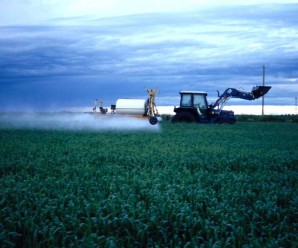
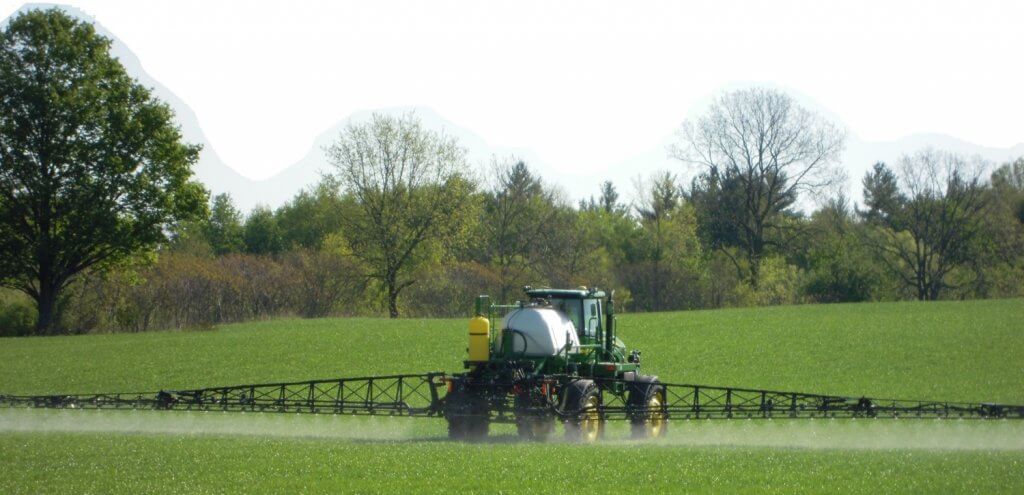
Fungicide use appears to be the fastest growing segment of North American crop protection. Here is some advice on how to get the best bang for the buck.
Timing is the most important part of fungicide application. Diseases can develop and spread quickly. Most fungicides cannot cure a disease infection, they can only protect against it. If an application misses the window, yield is lost. Remember your priorities – become familiar with disease symptoms, the susceptibility of your crop and key growth stages. Make sure your sprayer is ready – your nozzles are installed, calibrated, and you can achieve the necessary boom height. Hire an agronomist to help scout and make recommendations. Make the right decision about whether to spray or not.
Water volume is the most important application parameter for fungicide application. In years of study, increasing water volume had a greater effect on fungicide performance than changes in droplet size or spray pressure. More water is needed for fungicides than herbicides because of the greater amount of plant material present. Getting coverage on leaf areas deeper into the canopy requires more water. Although finer sprays can also help with coverage, this practice is riskier due to drift potential and higher evaporation rates.
Double nozzles, in particular the asymmetric types, are becoming more popular with fungicides. Double nozzles are proven effective and recommended primarily for fusarium head blight, or any other disease where an exposed vertical part of the plant canopy is the primary spray target. Double nozzles are also useful for preventing the spray quality from getting too coarse as higher flow-rate nozzles (which tend to have larger droplets) are used.
Travel speed is important with fungicides. Canopy penetration sometimes improves with slower travel speeds, and this can be used as an advantage by eliminating the need for a special fungicide nozzle. For example, assume a nozzle was used to apply 8 gpa of herbicide at 15 mph at 70 psi (this pressure assumes air-induced tips). For fungicides, this same nozzle and pressure will deliver 12 gpa simply by slowing down to 10 mph.
Boom height and spray quality are both important for single angled sprays or double nozzles. The angle at which a spray leaves a nozzle diminishes quickly as air resistance and gravity exert their influence. If the boom is too high, the initial forward angle will be lost and the spray droplets will actually deposit with gravity and wind. But if the spray is a bit coarser and the boom is low enough, the angle of attack is retained for long enough to make a difference in spray deposition.
Despite these suggestions for making the spray more effective, there is no substitute for an informed decision regarding fungicide use. It’s possible that spraying is unnecessary for a number of reasons, and it’s best to have professional advice help make that call. If you decide to go ahead, ensure that your sprayer is set up to deliver the fungicide to the part of the canopy that needs protection.
It seems simple: The faster you drive the sprayer, the more area you cover. This makes higher travel speeds a seductive method for improving productivity. Sprayer manufacturers knew this 25 years ago when pull-type sprayers first received bigger, suspended outrigger wheels. Since then they’ve delivered more powerful engines, better hydraulic motors, smoother suspension and cruise control.
Each of these innovations still required the operator to consider the relationship between travel speed, pressure, nozzle choice and the desired output per acre. But now we have rate controllers, and we don’t have to think about such mundane things anymore… do we? Do we still do a good job if we go faster? What exactly happens when we speed up?
Before considering the role of the rate controller, you have to decide on an overall target-speed range. Charts, apps, or online tools can help you select nozzles sized to deliver your application volume at a given speed and pressure. This initial travel-speed decision requires an understanding of how spray gets delivered to the target. Let’s start with the spray boom.
As the boom moves through air, the oncoming air does three things to the spray:
It shears the spray, making it a bit finer.
It scrubs the smallest droplets from the pattern, leaving them in the wake of the boom.
Finally, negative pressure behind the pattern sucks even more fine spray into the sprayer wake.
Collectively, these create the dreaded “spray plume” that hangs behind the spray boom… and we’ve lost control over it. The faster we move, the greater the proportion of the spray that ends up in the plume. This can be anywhere from one to 15% of the spray. Once formed, that plume moves with the prevailing winds.
Today’s sprayers have wide booms, and faster speeds often require us to keep these booms higher than we have in the past to prevent impacts. But higher booms reduce our control over the spray’s direction. For example, when spraying vertical targets (e.g. wheat heads) we have begun to employ angled sprays. But droplets lose momentum quickly. The further they are from the target, the more likely they are to slow or even fall vertically before they reach the target. That means that higher booms often negate the benefit of angled sprays.
Still not convinced of the perils of high speeds? Well, think about the aerodynamics of the sprayer itself. As travel speed increases, the sprayer, the boom, and even the spray pattern itself disrupt the air around it. Visualize a sprayer in a wind tunnel with smoke tracer lines. The nice pattern created by the boom gets really messy in a turbulent environment. This can cause a loss of deposit uniformity, resulting in a reduction of overall effectiveness.
So far, we’ve talked about average speeds – choosing to travel eight, 12 or 16 mph overall, and then choosing the nozzle that will suit. Now let’s talk about changes in your travel speed within your target-speed range.
Operators know that even small travel speed changes can result in large pressure changes. That’s because travel speed and pressure enjoy a “square-root relationship”. If you double travel speed, your rate controller needs to quadruple the spray pressure to meet the new flow need!
Even minor changes in speed (to adapt to field conditions) can lead to big fluctuations in pressure, changing average droplet size, and affecting coverage and drift potential. Severe pressure fluctuations are more likely with a faster average travel speed. That’s perhaps why pulse-width modulation, which decouples spray pressure from travel speed and replaces it with a solenoid duty cycle, has a growing role in fast self-propelled sprayers.
To minimize pressure fluctuations, use the pressure gauge as your speedometer. Have the boom pressure displayed prominently in your sprayer cab, and try to operate at speeds that result in a pressure which is optimal for the job you’re trying to do.
So, let’s summarize the effects of fast travel speeds.
Pros:
More area covered per hour
Better contact with vertical targets (if the booms are kept low)
Cons:
More drift
Less uniform deposition
Wider pressure fluctuations
So, how fast is too fast? We won’t draw a line in the sand, but we will emphasize how important it is to consider as much information as you can before deciding on a travel speed. Don’t rely on the rate-controller to think for you – it doesn’t have all the information.
Water-sensitive paper is a useful tool for assessing spray coverage. Here are a few tips for making it work for you.
Water-sensitive paper is manufactured by a number of companies, including Syngenta, Spot On, and WS Paper and is available for purchase (see here for comparisons). The papers are a useful tool for helping calibrate aerial and ground sprayers because spray deposition becomes visible immediately after spraying. With the proper equipment, droplet size and coverage can be estimated from scanned images.
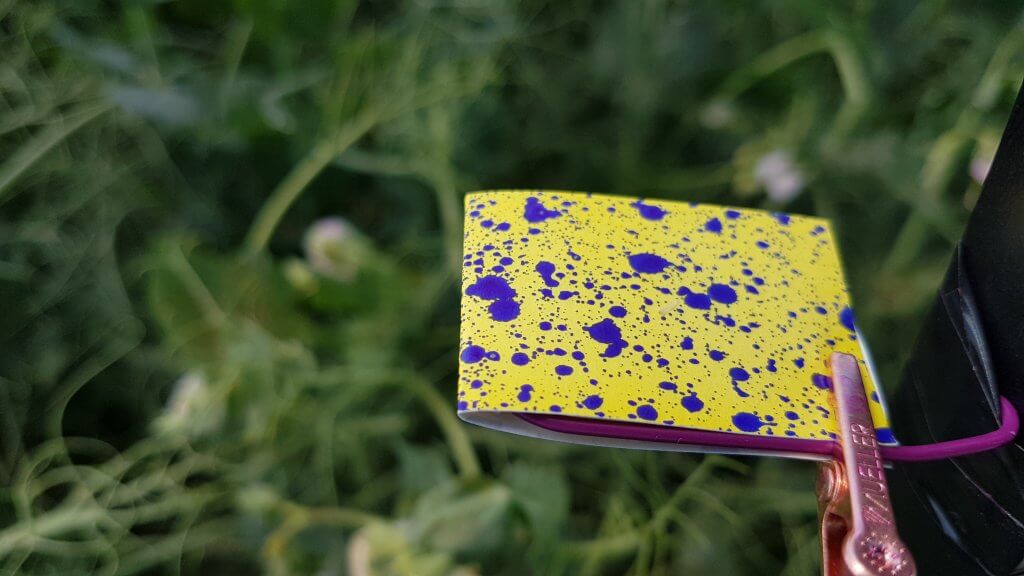
Simply place the paper on or near the target of interest. On most cases for herbicide application, it can be placed on the ground. It can also be attached to leaves or stems using paperclips.
When water comes in contact with the paper, it turns blue, and spray droplets as small as 50 µm become visible. Avoid touching the paper with bare hands except from the edges – you’ll see your fingerprints. Wearing gloves helps if you plan to handle many of them. Wait for the paper to dry before storing or stacking.
If left exposed to air, they will soon turn completely blue from atmospheric humidity. The same will happen if stored in a plastic bag before they are completely dry.
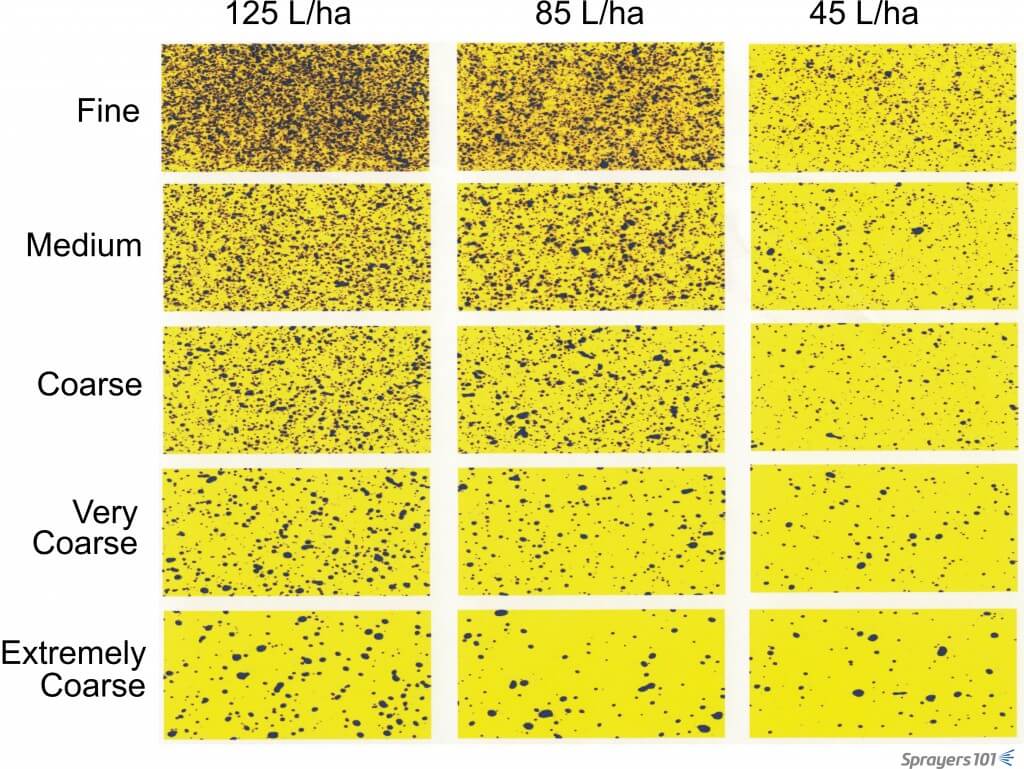
To show how these cards can be useful for an applicator, we prepared 15 cards (five spray qualities at three water volumes each). They can be used as a guide to assess the quality of the spray job. As a start, aim for a Coarse spray quality, and use enough water to achieve coverage about in the middle of the matrix. Avoid low water volumes in combination with extremely coarse sprays.
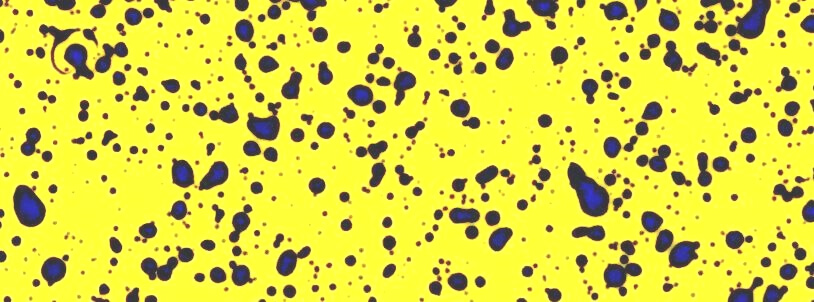
These water-sensitive papers were sprayed under controlled conditions and they demonstrate the role droplet size plays in coverage. As the droplets get finer, there are more of them, increasing coverage. However, this is really only hypothetical as many drift off target before impinging. As the droplets get coarser, there are less of them, and coverage may be compromised. To compensate for this, higher volumes are used. Credit – Dr. T. Wolf, Saskatchewan.
This matrix can be used as a guide to assess approximate coverage of a spray under field conditions.
A high-res pdf of the matrix (in US units) can be downloaded here.
The spray deposits spread out after they hit the paper, and as a result the deposit diameter is about twice the actual droplet diameter. This ratio is known as the spread factor, and it must be known before an accurate droplet size measurement can be done. That’s easier said than done because the spread factor depends on the properties of the spray liquid (surface tension, for example), the diameter of the droplet, and also the humidity at the time of the trial. On humid days, the spread factor increases and in fact the papers may turn entirely blue just from exposure to that humidity.
A practical water volume limit for making an accurate measurement is about 10 US gpa or 100 L/ha. At higher volumes, the droplets coalesce and it’s hard to tell how many droplets for any given deposit.
Low water volumes can mean less effort to apply pesticides. But there is a limit to how low water volumes can go before problems appear. To understand the reasons why, and help applicators use the right volume for a given situation, we briefly outline what happens to a spray cloud as it reaches the crop canopy.
Basic Principles
To choose the right water volume, we have to remember three criteria for sprays to be effective.
First, the spray must reach the target.
Second, there must be enough droplets to sufficiently cover the target.
Third, the droplets have to be in a form (size and pesticide concentration) that allows the pesticide to be efficiently taken up by the target.
Reaching the target
Let’s start with the first criteria, reaching the target. Droplet size is important for minimizing both spray drift and droplet evaporation. Small droplets move off-target easily, they also evaporate to dryness very quickly and may not have the expected performance as a result. Larger droplets clearly reduce drift, but may bounce off the target and offer less coverage per water volume.
Droplets of various sizes are actually important to cover all parts of a target, so we shouldn’t eliminate all the small ones. For example, penetration of dense broadleaf canopies, or coverage of small targets like stems is best achieved with smaller droplets, while larger droplets are useful for penetrating grassy canopies or targeting the top of a broadleaf canopy.
Target coverage
We need to get the right number of droplets to the target. The more leaf area to be covered (i.e., the taller or denser the crop canopy), the more droplets will be required. Leaf Area Index (LAI), defined as the total leaf area per unit ground area, is a good indicator of canopy density.
To put this in perspective, consider a pre-seed burnoff or an early post-emergent herbicide spray vs. a late season fungicide. In the first case, the canopy can be described as being in a single plane near ground level, with leaf areas of target plants fully exposed and with an LAI of <1. High droplet density on the leaves will be achievable with relatively low volumes.
In the second case, the canopy will have more depth, and will contain large leaf areas in each of the lower, mid, and upper canopy regions, with LAI >>1. Providing the same droplet number to each of the regions in the second case will require more droplets, and therefore more volume.
Taken as a whole, the exclusive use of finer droplets can be counterproductive due to evaporation and drift. Higher water volumes have the advantage of allowing larger average droplet sizes to be used, minimizing evaporation, drift, and enhancing deposition.
Deposit efficacy
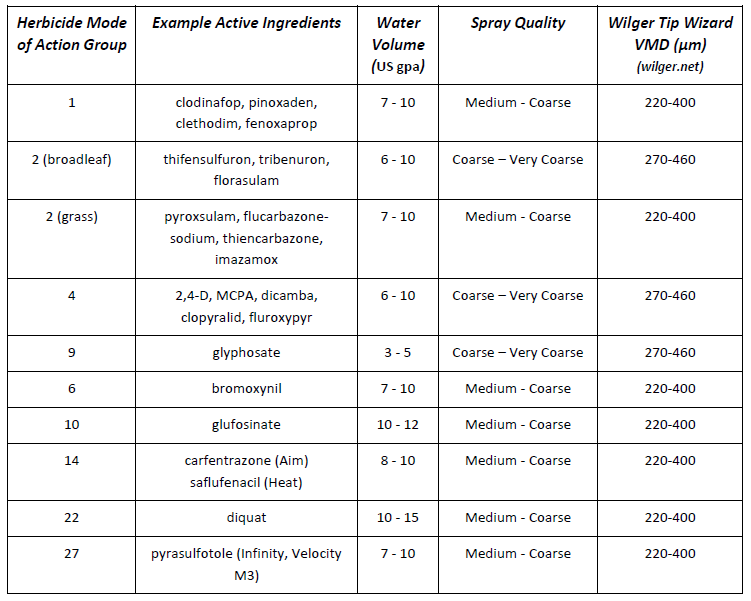
The third criteria, maximizing the performance of specific pesticides with droplet size, is more complicated. Typically, contact modes of action and grassy or difficult-to-wet targets require somewhat finer sprays and higher water volumes (Table 1). With tank mixes, such as glyphosate and Heat or AIM, the higher water volume and finer spray criteria should be used. For any specific herbicide, use the higher volume with coarser sprays.
Table 1. Herbicide modes of action, minimum water volumes with low-drift nozzles, and maximum spray quality
In practice, an applicator rarely encounters just one type of targeting situation. Most herbicides are either broad-spectrum, or are tank mixed to target both grass and broadleaf weeds. As a result, the same spray operation has to be effective on grass weeds and broadleaf weeds, some of which may be near the top of the canopy, or be more mature, whereas others may be just emerging. In these cases, a number of different droplet sizes will be required.
Low-drift nozzles
A low-drift nozzle can be used for most applications, as long as small adjustments are made for specific conditions. Increases in pressure above 60 psi (for finer droplets, Medium to Coarse spray quality) and volume to at least 7 to 10 US gpa (for better penetration) with this nozzle optimizes performance for grassy weeds. Lower pressures (down to 40 psi, Coarse to Very Coarse spray quality) are sufficient for systemic broadleaf products or when additional drift control is necessary. Higher volumes (12 – 15 US gpa) may be needed to obtain coverage in dense canopies. Always check with nozzle manufacturer information to learn what spray quality is produced by the nozzle you’re using – this will vary with nozzle type, flow rate, and spray pressure.
Droplet sizes in sprays
All nozzles produce a wide variety of droplet sizes ranging from 5 µm to 1000 µm in diameter. The main difference between sprays is the proportion of their volume in any given size fraction, with low-drift sprays having less of their volume in the drift-prone sizes.
Size distribution (by volume) of two spray qualities. Not that both of these sprays contain small and large droplets. The difference is the volume (=dosage) in each of these size fractions. Shaded areas highlight drift-prone droplets (left) and bounce-prone droplets (right).
But even low-drift nozzles produce small droplets, and these provide sufficient coverage in most cases. Low-drift sprays do create more larger droplets, and these do not contribute to coverage due to their relatively low number and poor retention.
Our main tools for droplet size selection are spray pressure (higher pressure reduces droplet size) or nozzle choice.
Spray Pressure
Higher pressures are sometimes thought to increase canopy penetration because they force the spray into the canopy. This is not true. While higher pressures create faster moving droplets, this speed quickly diminishes. By the time the spray enters the canopy, the faster velocity is lost, especially for the smaller droplets, and the only effect that remains is the finer spray. Finer droplets will penetrate many canopies further, but only if they are protected from wind. On a windy day, the finer sprays are more likely to blow downstream, or perhaps evaporate. The main benefit of higher pressure is better operation of the nozzle, especially air-induced nozzles, leading to more uniform patterns and better overall results.
Large Droplet Advantages
Although coarser sprays are often thought to work less well, they offer certain advantages.
One advantage is that a coarser spray tends to provide the air assist mentioned above (dragging air into the canopy, and giving smaller droplets a greater chance of moving where they’re needed).
Larger droplets also take longer to evaporate, increasing opportunities for uptake and translocation within the plant.
Larger droplets are more efficient at targeting the exposed, large leaves of plants requiring disease protection, leading to greater deposition and fungicide performance.
Most importantly, coarser sprays produce less drift, enabling application under windier conditions and thus ensuring that the timing of the application with respect to the crop or disease stage can be optimized.
Water Volume
Higher water volumes are the single most effective way of increasing dense canopy penetration. Higher volumes will deliver a greater number of droplets to the lower canopy, leading to greater performance when lower canopy coverage is of importance. When used in combination with lower travel speeds, the downward air flow created by sprays can provide significant benefits in forcing the smaller droplets further down. Larger volumes also decrease sensitivity to droplet size, permitting coarser sprays that reduce spray drift.
Nozzle Angling
Research has shown that exposed (upper canopy) vertical targets such as heads or stems will benefit from an angled spray. Forward-pointed sprays offer a slight advantage over backward-pointed sprays. Since angled sprays must maintain this trajectory to be useful, it is recommended that coarser spray qualities be used to minimize fine droplet production. Angled fine droplets will quickly deflect from their initial angled path and move with prevailing winds. Low booms heights also help in maximizing the benefit of angled sprays. Canopy penetration has not been shown to be improved with forward angled sprays, but backward angled sprays can help place some spray deeper into grassy canopies.
Broadleaf vs Grassy Canopies
How can an applicator decide the most appropriate water volume and spray quality for a specific application scenario? The following guides should help.
First determine the canopy density and form (broadleaf or grassy), and the target site within it (upper, mid, or lower). If the canopy is dense, but fairly vertical (i.e., a cereal), and a significant portion of it needs to be protected, the best strategy is to apply a higher water volume using a reasonably slow ground speed to allow the spray’s built-in air assist to work. If, on the other hand, only the upper layer of leaves, or the heads, are to be targeted, slightly less water can be used. If the water volume is appropriately high for the canopy, larger droplet sizes do not significantly diminish coverage or pesticide performance.
If the canopy is dense but more horizontally oriented (broadleaf crops), similar rules apply for water volume and travel speed, but now the use of a somewhat finer spray may be of benefit. The smaller droplets will be better able to move around and through the leaves to reach deeper into the canopy. Ensuring a downward trajectory of the spray through travel speed and water volume selections will be important.
Nozzle suggestions
A very good starting point for a conventional rate-controlled sprayer is any one of the low-pressure air-induced tips that now form the majority of the market. These tips are similar enough in terms of pressure range (30 – 100 psi), spray quality (Medium-Coarse-Very Coarse, depending on pressure), and spray pattern fan angle (about 100 degrees) to have comparable performance with most pesticides. Such tips are best operated in the middle of their pressure range, which is about 50 – 70 psi, offering some room to move as travel speeds change.
For those with Pulse-Width Modulation (PWM), where most air-induced tips cannot be used, nozzle choice is more limited but growing