Author: Jason Deveau

  • Testing the Effectiveness of Sprayer Rinsing Methods using Dicamba

    Testing the Effectiveness of Sprayer Rinsing Methods using Dicamba

    This work was performed with Mike Cowbrough, Weed Management Specialist (Field Crops) with OMAFA.

    The unprecedented number of dicamba drift complaints in the United States has proven to be a polarizing issue in the agriculture community. The debate continues as to the relative influence of contributing factors.

    The sensitivity of soybeans to trace amounts of dicamba has been known for more than 50 years (Wax et al. 1969). Research has shown that less than 0.2% of the highest recommended use rate can cause a 10% yield loss in non dicamba-tolerant soybean (Robinson et al., 2013). Many horticulture and ornamental crops are equally sensitive to low doses of dicamba.

    Relative volumes of Callisto (33% field rate), Roundup (6% field rate) and Xtend (0.16% field rate) known to cause 10% yield loss in conventional soybean.

    The inherent volatility of the active, and its subsequent potential for off-target movement, is also well known. Research has shown that XtendiMax, Engenia and FeXapan are far less volatile than their predecessors. However, research has also shown that there is some degree of volatilization for 36 hours following application, peaking 6-12 hours after treatment (Mueler, 2017). Studies by Jacobson et al. (2014) showed dicamba present in the air 60-72 hours after treatment.

    While sensitivity and volatility are suspected of being the primary culprits, there are other factors that contributed to the estimated 3.6 million acres of soybean reported damaged in the United States in 2017 (Bradley, 2017):

    • inappropriate sprayer set-up,
    • physical drift,
    • the use of older dicamba chemistries, and
    • contamination of filling or spray equipment (aka carry-over)

    The Experiment

    In 2017, we decided to learn more about sprayer contamination. The following is a summary of the labelled cleaning protocol. It’s noted that rinsate disposal must comply with local regulations:

    1. Drain sprayer immediately after use.
    2. Flush all inner surfaces with water.
    3. Fill sprayer with an ammonia-based solution and soak overnight.
    4. Concurrently, remove and soak strainers, screens and nozzles.
    5. Circulate solution for 15 minutes and flush through the boom for one minute.
    6. Drain sprayer, replace strainers, screens and nozzles, and flush once more with water.

    This thorough protocol is not unique to dicamba, and historically has not been followed by sprayer operators. Instead, operators choose cleaning methods that reflect the risk of damage and the time and effort required to clean the sprayer. The majority flush with water, may or may not perform serial rinses and may or may not address dead end plumbing. Where possible, operators schedule sprays that present the least potential for carry-over damage (e.g. moving into corn following soybean). There is no way to know for certain that the sprayer is sufficiently cleaned.

    Sprayer

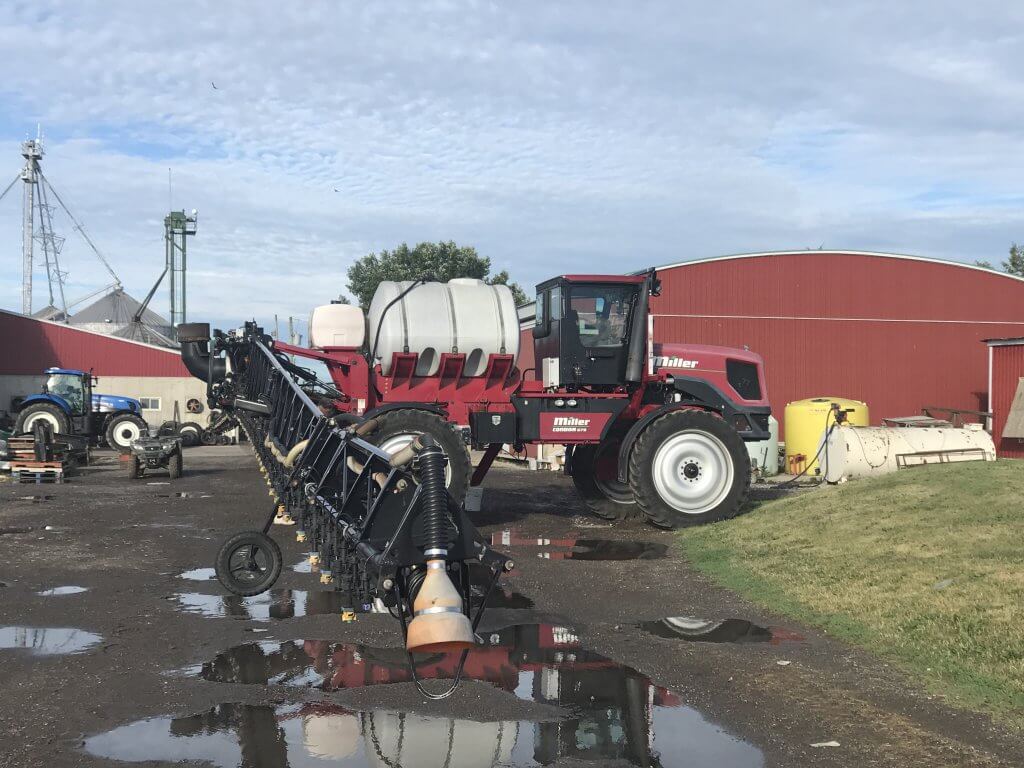
    Our research sprayer had a tank capacity of 60 L and was calibrated to deliver a spray volume of 15 gallons per acre. RoundUp Xtend was added at the highest labeled rate of 2 L/acre (consisting of glyphosate at 1,200 gae/ha and dicamba at 600 gae/ha). We reserved the solution for reuse by collecting spray in jugs.

    Rinses

    Serial rinse

    On a typical sprayer, the capacity of the clean water tank is ~10% that of the product tank. To perform a triple rinse, the operator introduces 1/3 of that volume to the product tank through a washdown nozzle, circulates for 10 minutes, and then sprays the product tank empty. This is repeated two more times to empty the clean water tank.

    Our intent was to scale the process in the same ratio using the research sprayer. That would mean using a 6 L volume of clean water to represent 10% of the 60 L product tank. It follows that we would have to perform three, 2 L rinses.

    However, that was insufficient volume to engage the pump and still provide enough rinsate to spray in our trials. We calculated the minimum required volume to be 8 L per rinse. We circulated for 5 minutes through a washdown nozzle. Following our third rinse, we noted that the rinsate still smelled of dicamba, and elected to run a fourth 8 L rinse. Rinsate was collected from multiple nozzles spaced evenly along the boom.

    We then opened the suction filter and the two line filters and poured the remaining solution into a bucket. We topped the volume up to 8 L with clean water and scrubbed the filters with a brush.

    Continuous rinse

    The continuous rinse process continually introduces clean water via the washdown nozzle via a dedicated pump. Concurrently, the product pump sprays from the nozzles and circulates via the agitation/bypass line. We used 32 L of clean water (a volume equivalent to that used in the serial rinse) and collected rinsate in four, 8 L volumes.

    Rinsate was collected from multiple nozzles spaced evenly along the boom. We then opened the suction filter and the two line filters and poured the remaining solution into a bucket. We topped the volume up to 8 L with clean water and scrubbed the filters with a brush.

    Continuous rinse using 1% ammonia solution

    We followed the continuous rinse process, as previously described, in order to collect the filter residue.

    Possible artifacts

    The limitations involved in scaling down introduce two potential artifacts to this experiment. First, the ratio of clean water to product volume is high compared to typical practices for both rinses. We estimate the volume remaining in the sprayer when “empty” did not exceed 4 L.

    Second, continuous rinsing was sampled in batches, which means the fourth and final volume collected represents an average of the active remaining in the system rather than the final concentration. As such, it would likely be more concentrated than what truly remained in the sprayer.

    Application

    Rinsate was applied to glyphosate tolerant soybean on 30” rows. Rinsate was applied at 20 gpa using a handboom with AIXR 11002 nozzles. Ontario locations were Ridgetown, Elora, Winchester and Woodstock.

    Results

    Crop Injury

    Regardless of rinse procedure, crop injury was greatest after the first rinse cycle and diminished after each subsequent cycle (Table 1). The first half of the continuous rinse procedure caused greater injury than the serial rinse, but injury was equivalent for the final half. Crop injury was less when rinsate was applied to soybeans at an early vegetative stage (V2) compared to when rinsate was applied to soybeans at later vegetative stages (V5-V6) or the early reproductive stage (R1).

    Table 1: Visual Injury (%) of soybean 14 days after the application of rinsate that was collected from two different sprayer cleanout procedures.

    TreatmentEloraRidgetownWinchesterWoodstock
    % Visual Injury at 14 days after application
    Crop stage at applicationV5V2V6R1
    Weed-Free Control0000
    RU Xtend100100100100
    Serial Rinse # 110075100100
    Continuous Rinse # 1 (25% water)10095100100
    Serial Rinse # 275659090
    Continuous Rinse # 2 (50% water)85709595
    Serial Rinse # 355506075
    Continuous Rinse  # 3 (75% water)55506075
    Serial Rinse # 425102535
    Continuous Rinse # 4 (100% water)25102535
    Filters – Serial Rinse15301025
    Filters – Continuous Rinse15301025
    Filters – Continuous with 1% ammonia25452035

    We were surprised to observe dicamba injury even in the final stages of both rinse procedures. This reinforces how sensitive soybeans are to low doses of dicamba and demonstrates the importance of following the labelled water – ammonia – water sequence.

    When comparing damage from filter residue (following a continuous rinse) the rinsate extracted using a 1% ammonia solution was more injurious than rinsate from plain water. Cundiff et al. (2017) found no difference between the use of water or water-and-ammonia when cleaning out a sprayer. We speculate that the ammonia was more effective at removing dicamba from the sprayer, or it increased the residue’s potency.

    Soybean yield

    Yield losses appeared to mirror visual injury; as dicamba injury decreased, so did soybean yield loss. Yield losses were observed following application of all rinsate treatments, which is understandable given that dicamba injury also occurred following the application of all rinsate treatments.

    Yield losses were greater in the first half of the continuous rinse protocol, but were par with the serial rinse for the second half (Table 2). Yield losses were observed following the application of rinsate collected from filters, demonstrating the importance of following a thorough sprayer decontamination that addresses dead-end plumbing, filters and nozzles.

    Table 2: Yield (% of weed-free control) of soybean following the application of rinsate that was collected from two different sprayer cleanout procedures.

    TreatmentEloraRidgetownWinchesterAverage
    Yield (% of weed-free control)
    Crop Stage at applicationV5V2V6V2-V6
    Weed-Free Control100100100100
    RU Xtend0000
    Serial Rinse # 1044115
    Continuous Rinse # 1 (25% water)01304
    Serial Rinse # 233651036
    Continuous Rinse # 2 (50% water)2261328
    Serial Rinse # 374896676
    Continuous Rinse  # 3 (75% water)72895776
    Serial Rinse # 486968689
    Continuous Rinse # 4 (100% water)86978289
    Filters – Serial Rinse939610096
    Filters – Continuous Rinse87979593
    Filters – Continuous with 1% ammonia79859285

    Other observations

    1- Dicamba injury delayed soybean maturity and date of harvest by over 14 days at the Elora site. Delayed maturity was observed at the Winchester locations as well.

    2- Heavy rainfall shortly after the application of rinsate at the Winchester location caused water ponding. Since dicamba is very water soluble, crop injury and yield loss was higher in areas in the trial where water ponded after application.

    3- Dicamba injury appeared to accentuate other stress symptoms at the Elora site, specifically potash deficiency. In the absence of dicamba injury, soybean plants did not exhibit potash deficiency symptoms.

    Take Home

    • Continuous rinsing was as effective as four low-volume rinses.
    • Plots sprayed with the cleanest water rinsate (both protocols) averaged 11% lower yields than unsprayed plots.
    • Filter rinsate (following continuous rinse with water) resulted in an average 7% yield loss.
    • Filter rinsate (following continuous rinse with 1% ammonia) resulted in an average 15% yield loss.

    Citations

    • Bradley, K. 2017. “A Final Report on Dicamba-injured Soybean Acres”. University of Missouri Integrated Pest Management online. https://ipm.missouri.edu/IPCM/2017/10/final_report_dicamba_injured_soybean/
    • Cundiff, G.T., Reynolds, D.B. and T.C. Mueller. 2017. Evaluation of dicamba persistence among various agricultural hose types and cleanout procedures using soybean (Glycine max) as a bio-indicator. Weed Science. 65(2), pp. 305-316.
    • Jacobson, B., Urbanczyk-Wochniak, E., Mueth., M.G., Riter, L.S., Sall, J.H., South, S. and Carver, L. 2014. “Field Volatility of Dicamba Formulation MON 119096 Following a Post-Emerge Applciation Under Field Conditions in Texas”. Monsanto Report Number MSL0027193.
    • Mueller, T. 2017. “Effect of adding Roundup PowerMax to Engenia on vapor losses under field conditions” (Presentation).
    • Robinson, A.P., Simpson, D.M. and W.G. Johnson. 2013. Response of glyphosate-tolerant soybean yield components to dicamba. Weed Science. 61(4), pp. 526-536.
    • Wax, L.M., Knuth L.A., and Slife F.W. 1969. Response of soybean to 2,4-D, dicamba, and picloram. Weed Sci 17, pp. 388-393.
  • Spray Coverage in Carrot, Onion and Potato

    Spray Coverage in Carrot, Onion and Potato

    This research was performed with Dennis Van Dyk (@Dennis_VanDyk), vegetable specialist with the Ontario Ministry of Agriculture, Food and Rural Affairs.

    Prior to 2017, Syngenta introduced the UK to the Defy 3D nozzle, which is a 100° flat fan, designed to run alternating 38° forward or backward along the boom. They prescribed a boom height of 50 to 75 cm, 30-40 psi, and travel speeds of 10 to 14 km/h in cereals and vegetables. Compared to a conventional flat fan, they claimed that the angle and Medium-Coarse droplets promise less drift and improved coverage.

    In 2017, Hypro and John Deere began distributing the Defy 3D in North America. Our goal was to explore coverage from the 3D in vegetable crops. We compared the nozzle’s performance to common grower practices in onion, potato and carrot in the Holland Marsh area of Ontario.

    Experiment

    We used a technique called fluorimetry. A fluorescent dye (Rhodamine WT) was sprayed at 2 mL / L from a calibrated sprayer based on protocols generously provided by Dr. Tom Wolf.

    Tissue samples from the top, middle and bottom of the canopy were collected from random plants.

    The samples were rinsed with a volume of dH2O and this rinsate was then tested to determine how much dye was recovered.

    The tissues collected were dried and weighed to normalize the samples to µL of dye per gram dry weight to allow for comparison.

    In addition, we used water-sensitive paper as a check in key locations in the canopy to provide laminar and panoramic coverage. Papers were digitized and coverage determined as a percentage of the surface covered.

    In carrot and onion, we compared a hollowcone, an air-induction flatfan, and alternating 03 3D’s at 500 L/ha (~40 cm boom height, ~3 km/h travel speed, ~27ºC, 3-9 km/h crosswind, ~65% RH).

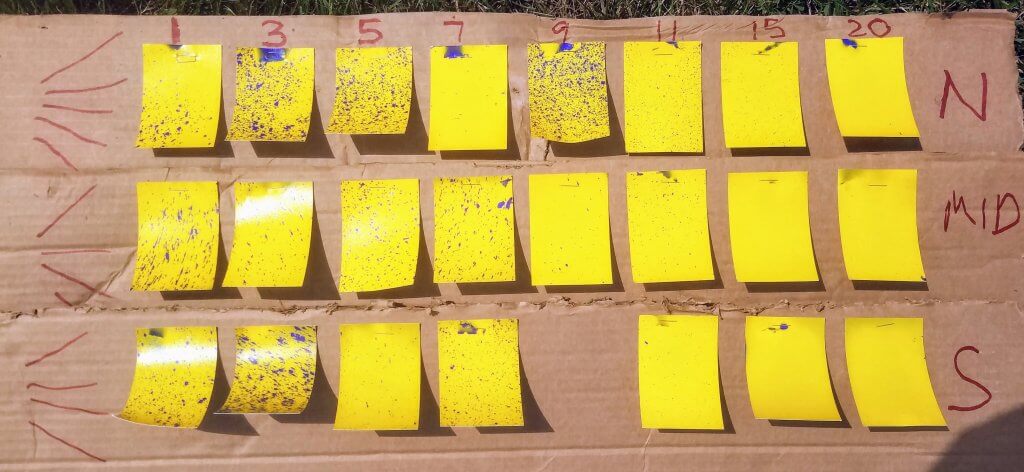
    In potato we compared the alternating 05 3D’s to a hollowcone at 200 L/ha (~55 cm boom height, ~10.5 km/h travel speed, ~22ºC, 6-8 km/h crosswind, ~65% RH).

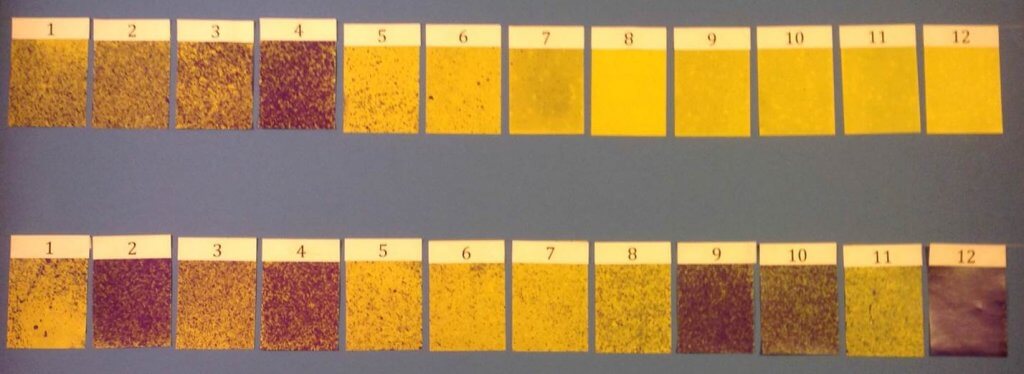
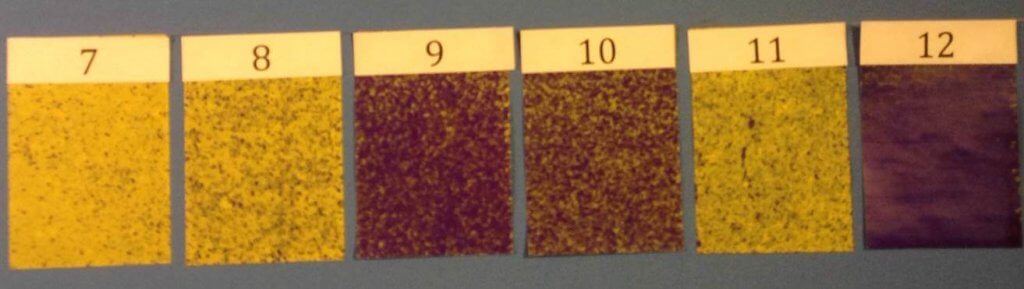
    Water-sensitive papers were originally intended as a coverage check, and not as a source of analysis, but their use revealed interesting information. The following images are the papers recovered a single pass in each crop.

    Carrot

    Onion

    Potato

    Results

    The following table represents the percent coverage of these paper targets. Papers were digitized using a WordCard Pro business card scanner and analysis made using DepositScan software. This table is small, but you can zoom in for a quick comparison. The following three histograms show the same data graphically for carrot, onion and potato, respectively. Remember, this only represents a single pass, so don’t draw any conclusions about coverage yet.

    Carrot

    Onion

    Potato

    It was interesting to note differences in coverage observed on the papers versus the results of the fluorimetric analysis. It was anticipated that while water-sensitive paper serves for rough approximation of deposition, fluorimetry would be far more accurate. This is because of the droplet spread on the paper, and the evaporation and concentration of a spray droplet en route to the target. Again, here is a small table, and again, the next three histograms show the same data graphically for carrot, onion and potato, respectively.

    Carrot

    Onion

    Potato

    Observations

    While water-sensitive paper is an excellent diagnostic tool for coverage, fluorimetry allows for greater resolution. The high variability in coverage meant little or no statistical significance, however the means suggested the following:

    • In carrot, the 3D deposited more spray at the top of the canopy.
    • In onion, the hollowcone spray had a higher average deposit, and penetrated more deeply into the canopy.
    • In potato, the hollowcone deposited more spray at the top, with little or no difference mid-canopy.

    Each nozzle performed well at the top of the canopy, which is quite easy to hit. Certainly they exceeded any threshold for pest control. With the possible exception of hollowcone in onion, nozzle choice had only minor impact on mid-bottom canopy coverage. And so, if coverage is not a factor for distinguishing between these nozzles, we should consider drift potential. Due to the comparably smaller droplet spray quality, the hollowcone is far more prone to off target movement. This leads us to select the AI flat fan or the 3D as the more drift-conscious alternatives.

    Future analysis would benefit from a larger sample size to reduce variability, and the inclusion of an air-assist boom to better direct spray into the canopy.

    Applitech Canada (Hypro / SHURflo) is gratefully acknowledged for the 3D nozzles. Thanks to Kevin D Vander Kooi (U of G Muck Crops Station) and Paul Lynch (Producer). Assistance from Will Short, Brittany Lacasse and Laura Riches is gratefully acknowledged. Research made possible through funding from Horticultural Crops Ontario.

  • The Vermorel Nozzle – Humility in the Face of History

    The Vermorel Nozzle – Humility in the Face of History

    It’s a rainy Friday in 2017 and I decided to deal with the articles, factsheets, manuals and other sprayer-related documents that have been piling up on my desk for a year.

    My filing strategy is based on some advice I got from Dr. Bernard Panneton (Application Tech Guru) back in 2009. He said to read each document and then file them according to content, not by author or date. That way when I need something, I can search up the subject and find everything that might be relevant. More than 1,200 files later, the system works. No Dewey Decimals in my office, thank you.

    What I’ve noticed as I sift through this eclectic pile of wisdom, is that many of the application methods I experiment with, or generally promote, are rarely entirely novel. Crop protection has evolved considerably (think pulse width modulation, crop sensing and remote piloted aerial application systems), but the fundamentals of spraying haven’t changed that much.

    Case in point.

    I just found a photocopy of a 1906 book called “Ginseng – It’s Cultivation, Harvesting, Marketing and Market Value, with a Short Account of Its History and Botany“. Great title. We obviously appreciated florid language in technical manuals 100 years ago. Here’s an excerpt that caught my eye:

    “When applied to plants, the finest nozzle obtainable must be used. The Vermorel is perhaps the best. Now make no mistake: this spray must be a spray, not a dribble, nor a drizzle, nor a squirt, but a mist. It must look like a little fog at the end of the hose and must reach every part of the plant, particularly the undersides of the leaves, mind, just enough so it won’t trickle off.”

    Poetry. And to make my point, it’s similar to what I’d tell a ginseng grower today. Granted, I’d lead them into a lower-range-of-Medium droplet size and help them achieve the described coverage using drop arms. But what on Earth is a “Vermorel nozzle”? That’s not one I have in my motley collection.

    I turned to Virginia Tech’s Museum of Pest Management. I hope they’ll forgive me for lifting their content, but it’s too wonderful not to share. They note the contributions of Charles Valentine Riley. Born in London, England in 1843. He was a multi-talented Renaissance man. He was a pioneer of entomology in the United States and is often referred to as the founder of biological control in America.

    Charles Valentine Riley

    Two of his greatest contributions to pest management included founding the field of biological control and the invention of the Riley spray nozzle (1889). The Riley nozzle was sold as the Vermorel nozzle. It produced a fan pattern and was the primary nozzle used in pesticide application in the United States and Europe well into the 20th century. The auspicious Mr. Riley died in a bicycle accident in 1895.

    The Vermorel nee Riley Nozzle

    It was Riley’s nozzle, and the invention of some other early European pesticide application devices, that inspired W.B. Alwood (publisher of orchard spraying techniques c.1899) to import these devices and adopt them to Virginia conditions. The rest is history.

    I tell you this because of what I found beneath the book touting the Vermorel; A 2015 TeeJet brochure for their TXVK hollow cone nozzles. I’m aware that the engineering behind the TXVK molded poly body and ceramic orifice is considerable compared to the humble Vermoral. But on closer inspection the fundamental designs aren’t so different. That realization both surprised and pleased me and compelled me to write this article.

    I’m not certain what my point is. I suppose it’s just good to be reminded that the next time you want to invest time, money and effort into a “new idea” you might consider a little historical research. Odds are, you’re not the first person to recognize the problem, or propose a solution. A little time in the archives also instills respect for those that were there first. Let’s not waste time repeating their efforts, but stand on their shoulders and advance what they’ve already pioneered.

    And if anyone has one of Riley’s Vermorel nozzles, I’d love to add it to my collection. Drop me a line.

  • Unit conversion tables

    Unit conversion tables

    Canada, like most of the world, is officially Metric. Our American friends are US Imperial. It sounds very cut and dried, doesn’t it?

    Anyone that’s tried to calibrate a sprayer in Canada quickly discovers that we’re really a horrible amalgam of the two systems. Our sprayers and nozzles often hail from the states, and that means US Imperial. Our pesticide labels hail from Health Canada’s Pest Management Regulatory Agency, and that means Metric

    And so, when speaking with applicators about their sprayer practices, we’re often treated to mind-rending sentences like:

    Well, I drive 12 mph, spraying about 150 L/ha and my pressure is about 40 psi. How many ml/min should my nozzles emit for a product that wants 6 oz/acre acid equivalent?

    Cue the quiet sobbing…

    Well, your smoking calculators are in for a treat! In a fit of frustration we created the ultimate set of conversion tables that should set you right for almost any Imperial/Metric emergency! Find one we missed -We DARE you! (update: Tip of the hat to D. Wiens of Saskatchewan, who found one! We added it.)

    Simply find your current units in the left-hand column. Then find the units you are converting to in the upper row. Now multiply by the conversion figure where they intersect in the table.

    Yes, they’re ugly, but they’re absolutely complete! If the tiny ones are too tiny to read, right click and download the image so you can zoom in. It’s a limitation of this website that we can’t make them larger.

  • Should Backpack Sprayers be Used to Test Airblast Products? – Part 2

    Should Backpack Sprayers be Used to Test Airblast Products? – Part 2

    In Part One of this article, we showed that approximately 40% of minor use label expansions and registrant submissions rely on data from hand booms and guns. We also showed that a hydraulic backpack or knapsack will not give the same coverage as an airblast sprayer, and we concluded by suggesting that small plot researchers use spray equipment that reflects grower practices.

    Unfortunately, practical logistics prevent most researchers from using a full-size airblast sprayer. They may not have access to such a sprayer, and if they do, it takes considerable time to mix and clean between treatments. Further, treatments are often only a single row, or even a single plant. It takes too much pesticide, too much time, and too much plot space to justify using a full-sized airblast sprayer, even if the relevance of the results are questionable.

    Would another method of application better emulate an airblast application but retain the convenience of a hand boom or gun?

    The motorized backpack mistblower

    Using the same methods used to compare airblast to hand boom spray coverage in the previous article, we compared airblast sprayer coverage to that of a motorized backpack mistblower in grape, raspberry and peach (July, 2013). Once again, coverage was analyzed as overall percent coverage (see first graph) and droplet density (average droplets per square centimeter – see second graph).

    Comparison of average % coverage in peach, raspberry and grape using a mistblower and air blast sprayer emitting he same volume
    Comparison of droplets per square centimetre in peach, raspberry and grape using a mistblower and air blast sprayer emitting the same volume

    Results and Observations

    The mistblower met, or in the case of droplet density, exceeded the coverage obtained using an air blast sprayer in most crops. The results led to a few observations:

    • The significantly-higher droplet density is a function of the Finer spray quality produced by the mistblower (see water sensitive papers below). This may still represent a confound between small plot work and large scale airblast applications.
    • Drift between proximal treatments may be an issue given how far the mist was blown. This should be considered when planning plots.
    • While not shown here, spray coverage was more consistent throughout each canopy, of each crop, when using the mistblower. This is likely because the operator was able to aim the output as they swept the spray over the canopy, thereby ensuring all surfaces were hit from multiple angles.
    • While we always try to be brand-neutral, it should be noted that we’ve used multiple Solo mistblowers over the years, and all of them required significant maintenance (no matter how they were cleaned and stored). It was very difficult to find brand parts and repair expertise in Ontario. The Stihl brand currently has far more dealers, and more accessible parts, and has not caused us any difficulties (yet).
    • Always use the highest grade gasoline in two-stroke engines to avoid ethanol gumming up the carburetors!
    • Always calibrate mistblowers by volume because raising and lowering the boom will affect the flow rate.

    Conclusion

    Hand booms, and likely hand guns, are not appropriate for testing agrichemical products intended for use with an airblast sprayer. Data derived from these methods should be questioned. An airblast sprayer is the best choice for any such research, but a mistblower is a viable alternative. Transparent, standardized operating protocols for testing products intended for use in airblast sprayers should be required.

    Thanks to Vaughan Agricultural Research Services Ltd. for their assistance in the research performed for this article.