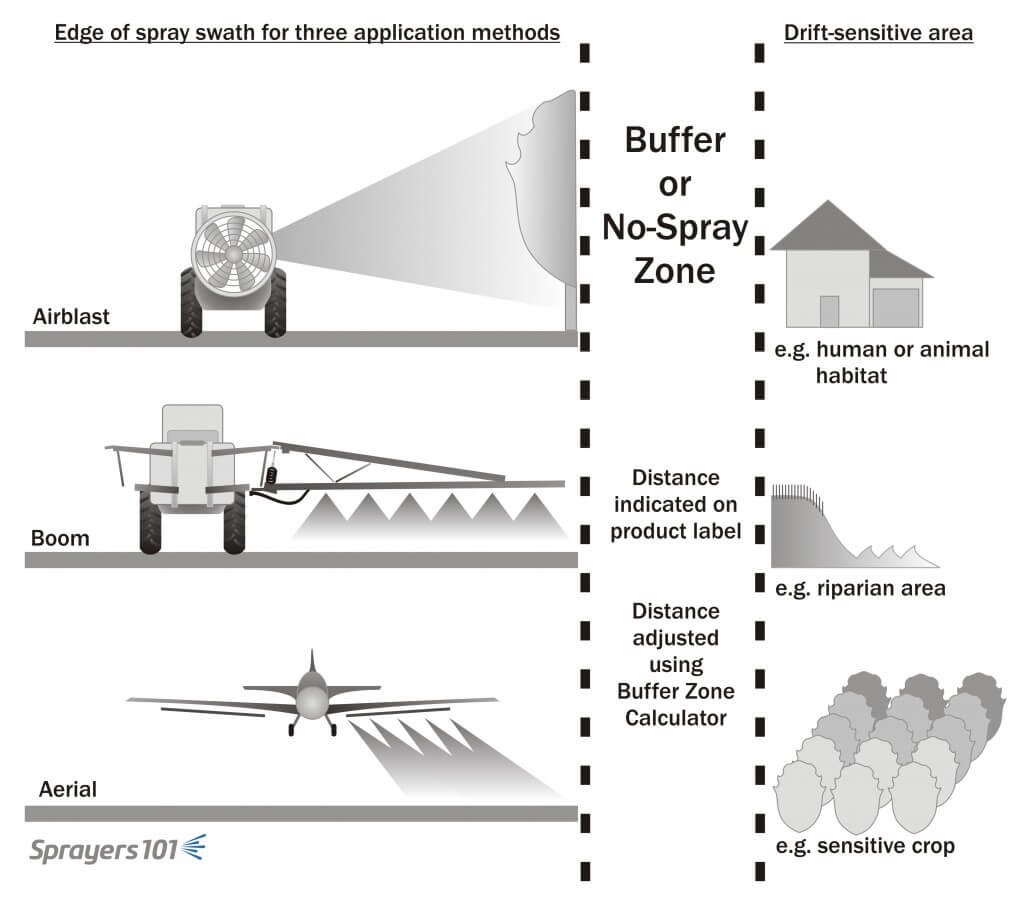
Spray buffer zones are no-spray areas required at the time of application between the area being treated and the closest downwind edge of a sensitive terrestrial or aquatic habitat. Spray buffer zones reduce the amount of spray drift that enters downwind, non-target areas.
Sensitive Terrestrial Habitats
Sensitive terrestrial habitats can include hedgerows, grasslands, shelterbelts, windbreaks, forested areas and woodlots. Crops and private properties adjacent to treated areas are not considered to be sensitive terrestrial habitats and do not require spray buffer zones. However, labelled spray buffer zones are a good indicator of potential damage to adjacent vegetation. Applicators are responsible for ensuring their spraying programs do not adversely affect neighbouring properties.
Sensitive Aquatic Habitats
Sensitive aquatic habitats can include lakes, rivers, streams (channelized or natural), creeks, reservoirs, marshes, wetlands and ponds. Temporary bodies of water resulting from flooding or drainage to low-lying areas are not considered sensitive aquatic habitats. Nor are aquatic drainage ditches or seasonal water courses that are dry at the time of application. Water body depth will determine the buffer zone distance, as indicated on the pesticide label. Downslope open water may also require a vegetative filter strip .
The pesticide label will indicate when a spray buffer zone is required. The distance will depend on the product used, the method of application and the crop being sprayed. In some cases, the buffer zone may be modified using Health Canada’s Spray Buffer Zone Calculator . When provincial and label restrictions differ, or label restrictions differ between tank mix partners, use the greatest distance.
Buffer zones or No-Spray zones physically separate the end of the spray swath for the nearest downwind sensitive area.
Spray Buffer Zone Calculator
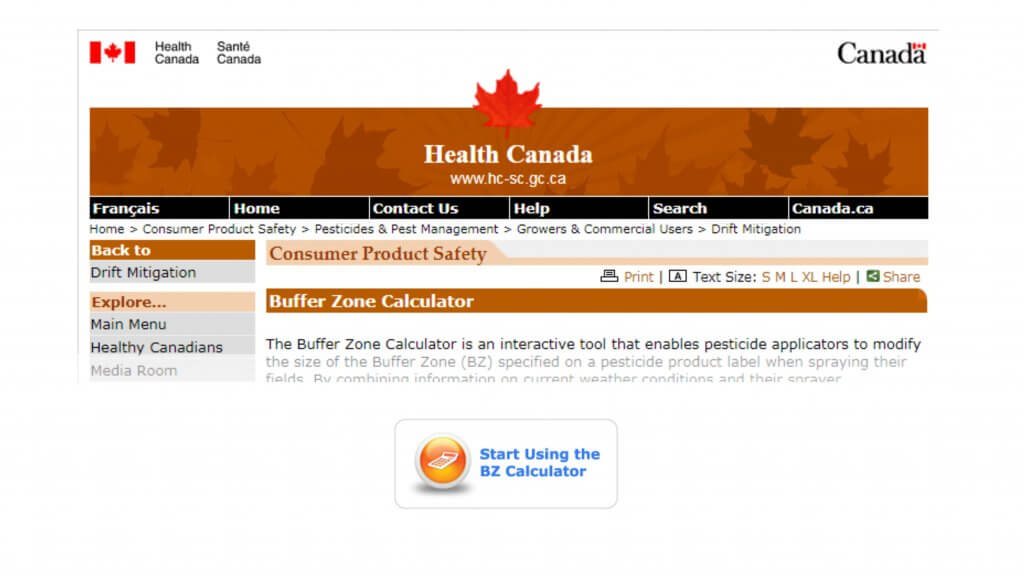
Unless forbidden by the pesticide label, Health Canada’s Spray Buffer Zone Calculator may permit applicators to reduce the size of the spray buffer zone specified on a pesticide label. To be eligible, the product label must specify a field or aerial spray quality coarser than “Very Fine” and finer than “Very Coarse”. All airblast spray qualities are applicable.
Modifications are based on meteorological conditions, sprayer configuration and the application method at the time of application. If modified spray buffer zone distances are less than provincial or municipal distances, use the greater distance.
Applicators that choose to use the calculator must retain a copy of the summary page for at least one year following the application to demonstrate compliance with label directions.
Vegetative Filter Strips
A vegetative filter strip is a permanently vegetated strip of land that sits between an agricultural field and downslope surface waters. Vegetative filter strips reduce the amount of pesticide entering surface waters from runoff by slowing runoff water and filtering out pesticides carried with the runoff.
Pesticide labels may require a vegetative filter strip, or recommend one, as a best management practice. They must be at least 10 metres wide from edge of field to the surface water body and be composed primarily, but not exclusively, of grasses.
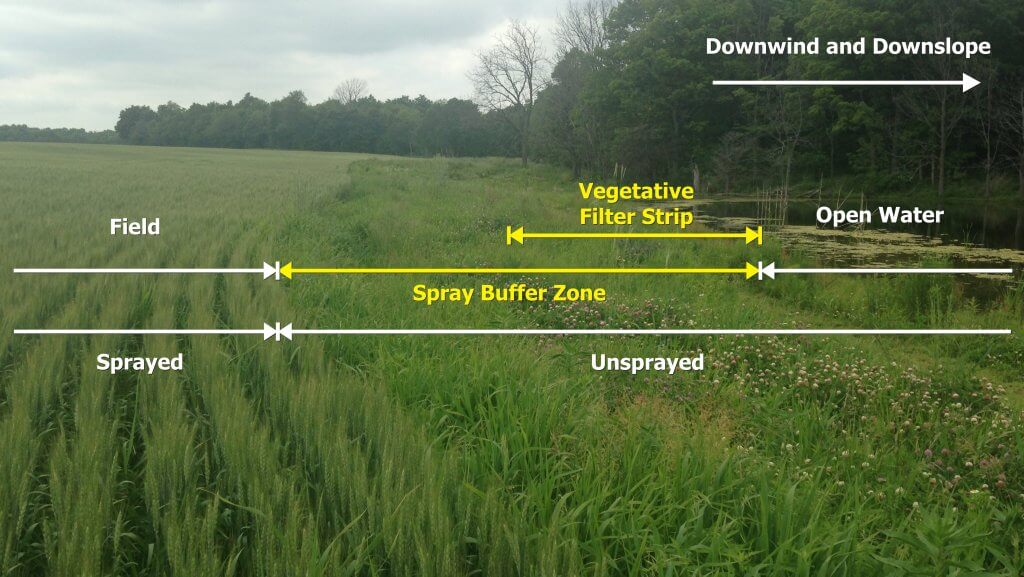
Spray buffer zones do not apply to vegetative filter strips unless there is a pre-existing sensitive terrestrial habitat within them. Therefore, vegetative filter strips may overlap spray buffer zones when open water is both downslope and downwind (see illustration). In this case, the minimum 10 metres vegetative filter strip distance must be observed, but the set-back can be larger based on spray buffer zone, provincial or municipal restrictions.
Soil Fumigant Buffer Zones
Soil Fumigant Buffer Zones are mandatory, untreated perimeters surrounding the treated field. They limit user exposure and increase the protection of workers, bystanders and the environment. The distance will depend on the application method, product rate and field size, as indicated on the pesticide label. An Emergency Response Plan is required when residences or businesses are located within 90 metres of the buffer zone perimeter.
Soil fumigant buffer zones have a time component. This Buffer Zone Period begins at the start of the application and ends a minimum 48 hours following the application. Respiratory protection and stop-work triggers, as specified on the pesticide label, will apply to anyone present in the buffer zone area during the buffer zone period.
Buildings and residential areas within the soil fumigant buffer zone must be unoccupied during this period. Unless in transit, non-handlers (including field workers) must be excluded from the soil fumigant buffer zone during this period. Entry is permitted for fumigant handlers with appropriate certification, emergency personnel and local, provincial, or federal officials performing inspection, sampling, or other similar duties.
Soil fumigant buffer zone signage must be posted within 24 hours prior to the application and remain posted until the buffer zone period expires. Signage must include, but is not limited to, the date and time the buffer zone period ends and the name, address, and telephone number of the applicator. Soil fumigant buffer zone signage must be located at the outer perimeter of the buffer zone, at all entrances to the field, and along likely routes where people not under the owner’s control may approach. Soil fumigant buffer zone signs are in addition to, and do not replace, fumigant application block signage .
Applicators must develop a written Fumigation Management Plan prior to the start of any application. The plan outlines key steps to ensure a safe and effective fumigation, including site conditions, buffer zones and emergency response planning. Both the owner/operator of the fumigated area and the fumigant applicator must retain signed fumigant management plans as well as a summary of Post-Application Procedures for two years following the application.
As originally published by The Grower, August 2020.
Pests such as insects, diseases, and weeds can affect our quality of life in many different ways. Pests can represent a threat to public health and the environment as well as create substantial negative impacts to the economy if they are not sufficiently managed.
Crop protection products or pesticides play an important role in agriculture and other sectors in managing pests. These products can be very broad in scope; they include, as defined by the federal government:
“A product, an organism or a substance, including a product, an organism or a substance derived through biotechnology, that consists of its active ingredient, formulants and contaminants, and that is manufactured, represented, distributed or used as a means for directly or indirectly controlling, destroying, attracting or repelling a pest or for mitigating or preventing its injurious, noxious or troublesome effects.”
While dealing with pests is an important aspect of society, crop protection products can also represent a hazard. If not properly managed, their use has the potential to pose risks to the health and well-being of Canadians and to our environment. As such, crop protection products are highly regulated. So how do we ensure the safety of these products in Canada?
The federal government has the responsibility of reviewing and registering pest management products before they can be sold or used in Canada. This is covered by the Pest Control Products Act (PCPA). The primary objective of the PCPA is the prevention of unacceptable risks to human health and the environment resulting from the use of these products. The PCPA also recognizes that pest management is an important factor to both the economy and quality of life in Canada; however, these are considered secondary objectives to health and the environment.
It is the mission of the Pest Management Regulatory Agency (PMRA) based in Ottawa to execute the implementation of the PCPA and its objectives. Of the 450 employees at PMRA, 73% are scientists, including biologists, toxicologists, epidemiologists, and chemists. Evaluations of products by PMRA are extensive and use a weight of evidence approach that considers the nature and quality of scientific sources in their decision making.
Before the PMRA approves any product for use, regardless of origin, it must undergo a thorough science-based risk assessment and meet strict health and environmental standards. If the proposed use of a product poses unacceptable risks to human health or the environment, it is not registered for use in Canada. It is the responsibility of the company or individual seeking registration to prove their product does not pose unacceptable risks through scientific studies.
During evaluation or re-evaluation of a product, PMRA considers a comprehensive toxicology database to assess potential health effects. Both shorter term and longer-term effects are considered. These include, but are not limited to, studies to characterize acute and chronic toxicity, carcinogenic potential, reproductive and developmental toxicity, immunotoxicity, neurotoxicity, genotoxicity, and endocrine disruption potential. The PMRA assessments are also informed by epidemiological evidence, general scientific knowledge, and published scientific information.
In exposure assessments, sensitive populations and life stages are specifically addressed, including infants, children, and women of child-bearing age. Consideration is given to different activities, dietary habits, food intake, and body weight of children versus adults. A product will only be registered if this estimated exposure raises no concerns. Once this is determined, the PMRA will ensure the label directions indicate the appropriate use instructions to best minimize exposure.
Exposure to a product may occur through different routes (oral, dermal, and inhalation) and pathways (dietary, drinking water, and non-commercial uses). In order to fully assess potential risks, the PMRA conducts aggregate assessments which consider these different pathways and routes. Where it has been demonstrated that a group of pesticides share a common mechanism of toxicity, they are subject to a cumulative risk assessment in which the combined aggregate risks are assessed. In occupational settings such as agriculture and forestry, exposure may occur while handling or applying pesticides. As well, workers re-entering treated areas may be exposed to pesticide residues. These occupational risks are also assessed during the PMRA review.
The PMRA also sets science-based maximum residue limits (MRLs) on food commodities to ensure the food Canadians eat is safe. These limits are enforced by the Canadian Food Inspection Agency. The MRLs established for each crop are set at levels well below the amount that could pose a health concern.
Environmental risk assessment integrates the environmental exposure and ecotoxicity information to evaluate the potential for adverse effects on non-target species. This integration is achieved by comparing estimated environmental concentrations (EECs) with concentrations at which adverse effects may occur. The EECs are concentrations of product in various environments, such as in food, water, soil, and air. The EECs can be estimated using standard models, which take into consideration the application rate(s), chemical properties, and environmental fate properties, including the dissipation of the product between applications. In re-evaluations of registered products, EECs can be taken from empirical data.
Ecotoxicity information includes acute and chronic toxicity data for various organisms or groups of organisms from both terrestrial and aquatic habitats including invertebrates, vertebrates, and plants. Toxicity endpoints used in risk assessments may be adjusted to account for potential differences in species sensitivity as well as varying protection goals such as protection at the community, population, or individual level.
A vast amount of scientific data is reviewed when evaluating the safety of crop protection products in Canada. These extensive reviews are posted publicly and include consultations where any stakeholders are invited to submit comments. There is good reason to have high confidence that crop protection products are safe for Canadians and the environment under the conditions of registration.
How much horsepower (HP) do you need (really) when pairing a tractor and a towed sprayer or any other PTO powered implement? This important question should be asked BEFORE purchasing any towed implement. Surprisingly, there’s not much guidance out there, so you might hear answers like:
Whatever my tractor has must be enough… whatever that happens to be.
What?
The right amount of HP is what I can afford. Erma, grab that milk can full of egg money…
MOAR! (Yes, we know how “more” is spelled, but memes are funny).
Skeletor knows horsepower
Rating Tractor Horsepower
If you thought there was only one way to rate the horsepower of a tractor, well, you’d be wrong. At its simplest, horsepower is:
(torque × engine revolutions) ÷ a constant
We’ll expand on this later. The rub comes in how you define each of these factors and where you measure the power. Let’s start with something simple like engine speed, which is expressed in Revolutions Per Minute or RPM’s.
Engine Speed
So, if horsepower is the result of torque times engine speed, what speed do the manufacturers plug into the formula? One of two values are used:
1. Power Take-Off (PTO) Engine Speed
This is the engine RPM’s that produce the rated operating speed on the PTO. When the PTO is engaged, the engine is directly and mechanically connected to the PTO shaft. Therefore, maintaining the engine at the rated PTO speed, typically between 1,500 and 2,300 RPM depending on if it’s gas, diesel, turbocharged or not, will keep the PTO spinning at a uniform 540 or 1,000 RPM (the two typical PTO speeds) regardless of the driving speed.
2. Maximum Engine Speed.
This is the engine’s maximum intermittent operating speed… just shy of destroying said engine. An engine rated using the maximum speed gives you a false sense of security, because to get that horsepower you’ll be burning a ton of diesel, over-speeding your PTO implement, and wearing your tractor out very, very quickly.You wouldn’t drive your car around town in low gear because you’d redline the engine. Why would you do it to your tractor?
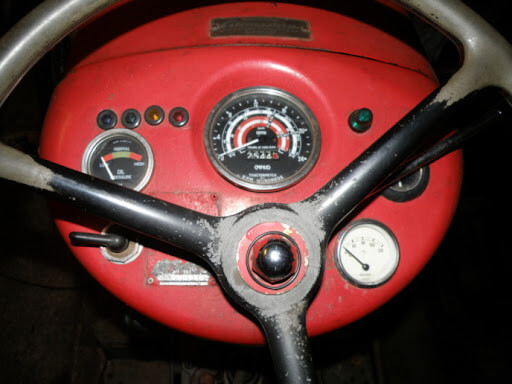
In the speedometer/tachometer (above the steering wheel) on this beautiful old tractor, the first black bar is the PTO rated RPM. The second is PTO Max. Operating with the PTO engaged above PTO Max can be damaging to the implement and to the tractor, and dangerous for the operator.
Horsepower Basics
OK, now we are ready to dig in a little deeper into defining tractor horsepower. What does it mean if, for example, your tractor is rated at 65 HP? We’ll skip the history lesson on watching the output of horses over an average day and move to the modern definition. Horsepower from a rotating shaft (such as the output of an engine) is:
Horsepower = [Torque in foot-pounds × Engine speed in Revolutions Per Minute (RPM)] ÷ 5,252
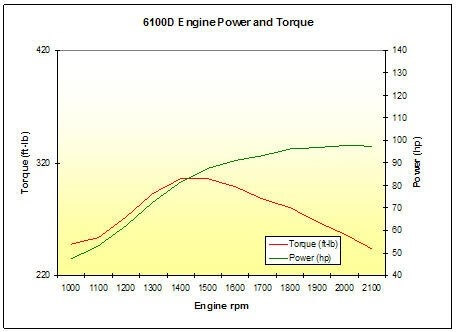
Here is a typical tractor torque curve. Notice how after peak torque, RPM’s climb quickly but net HP doesn’t. Unless specified, we can assume this is Engine Horsepower, not PTO Horsepower. If the above Torque/HP curves were your tractor, the PTO speed would likely be 1,500-1,600 RPM. According to the graph that would equate to about 82 HP. Running the engine up by 40% (2,100 RPM which is the max speed in this case, gets you about 98 horsepower. That’s only a 20% improvement. Remember, this is engine horsepower, not PTO horsepower, so this may not all be available for you to use. Image from JD.
Total Versus PTO Horsepower
Perhaps our tractor’s 65 HP rating describes Engine Peak Horsepower. This is what the engine would produce on a test stand, and it likely uses the maximum engine speed. This rating is a bit disingenuous. Not only because you will probably operate it at rated PTO engine speed, but also because some power is lost to internal processes, like the power steering pump, automatic transmission pump, alternator, auxiliary hydraulics, et cetera. So peak engine horsepower isn’t usually a very useful number unless you are in marketing and like big numbers.
A more accurate and useful rating is the Power Take-Off (PTO) Horsepower. This is the amount of horsepower available to do work at the PTO shaft. This may be at the rated PTO engine speed or the PTO Maximum speed. Estimating power using either speed offers a much more realistic rating of what you have to work with. As previously noted, PTO Rated Speed is usually near the speed where the engine creates the highest torque per revolution. This is often called the Power Band. Operation in this engine speed range will use the least diesel and result in the greatest amount of life in the machine.
Another important thing about PTO Horsepower is that this is the total amount of power available to do work. This could all go to PTO when the tractor is standing still, but both locomotion and the horsepower required to run the implement need to be subtracted from this number. So if your tractor is indeed 65 PTO horsepower, that’s the actual amount of horsepower you likely have to work with in real life.
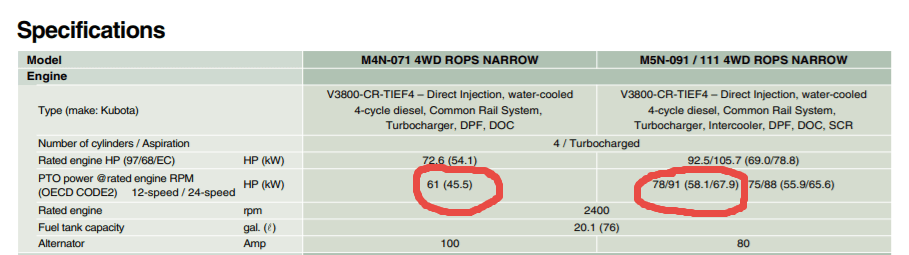
In this excerpt from a Kubota Spec sheet, you see that the Rated Engine horsepower is quite a bit higher than the PTO horsepower. A 72 HP “rated” tractor really has 61 horsepower for you to work with. The 106 horsepower version on the right really has 91 PTO horsepower.
The Horsepower that Matters
To sum things up, PTO Horsepower is the number you really need to care about. All this up to now just to describe the nuances of how horsepower is expressed. No wonder HP is a topic that’s avoided. If you can find or download the manual, now you at least have the tools to get to how much horsepower you have to work with.
Maximum Load
In order to answer the question of how much HP you need, you must consider your operation. You need to size your tractor for the biggest load it will ever be used for, even if you only do that thing once a year. Typically this would be a sprayer, rotavator or a brush flail. The rest of the year you won’t burn much extra diesel if you aren’t using the power in a bigger tractor, but you can’t draw on horsepower that isn’t there in a smaller one.
Though it’s not common, you can have too big a tractor. You need only watch “Clarkson’s Farm” for ample evidence (and a chuckle).
The enormous and infamous Lamborghini tractor that starred in “Clarkson’s Farm” on Amazon Prime is a good example of taking horsepower a little too far.
The Basics of Estimating Load
Now that you have the extremes in mind, let’s get to scratchin’. There are three things you must know to determine the maximum load:
Locomotion – The power needed to move the tractor and implement
Implement Power – The power needed to operate the implement
Safety Factor – This is a buffer that gives us a little extra just in case.
For the following guesstimates let’s assume you are doing orchard and vineyard work with a compact/narrow tractor. There really aren’t any hard and fast equations for this, but these will get you in the ballpark. If you are a nut grower with full sized tractors or a vegetable/field crop grower, you may need to scale up.
Locomotion
People discount it, but the power required just to move the tractor and the implement around is substantial. If the implement is a fixed tower sprayer with a 500 gallon tank, this might require 15-20 HP on flat, dry land. If your topography includes hills, or your terrain includes mud or tall grass, you may need to double that requirement. 45 HP just to move around before you even engage the PTO. Speed matters, too; If you are driving 5 mph, you’ll need twice the HP versus driving 2.5 mph.
The manufacturer of the implement should be able to tell you how much horsepower the implement requires. Small, three-point hitch airblast sprayers may only require 10-15 PTO HP. Larger tower sprayers may require 40-50 PTO HP. Brush flails may take 25-45 HP.
This is where things can get sticky and you need to make sure you’re both talking the same language. Some manufacturers will tell you how much power the implement takes, others will skip all the steps in this article and go right to recommending the size tractor they think you’ll need. If you’re unsure, ask. Be sure to factor in the locomotion requirements discussed earlier, the dealer may not understand your conditions in their general recommendation but usually can provide some clarity with a little more information from you.
Safety Factor
It’s always a bad idea to run at 100% of your power capability. Most of you reading this article are likely working with mid-life or older tractors with a few thousand hours on them. Ol’ Bessie loses some of the pep in her step over time. After engine break-in, the tractor will slowly lose power capability over its life. The harder you work it, the faster this occurs. Enthalpy happens (now that’s a great tee-shirt idea). Plan for it. Once you have an idea of your worst-case locomotion and implement power needs, add them up and give yourself another 15% (That is, multiply by 1.15).
Summing It Up
Now we can finally answer the question. In order to determine how much tractor horsepower you need, follow these steps:
Understand the real PTO horsepower of the tractor you are considering. This is the only thing that matters. You should be able to find online documentation for this if it doesn’t come with the tractor or you’ve filed it somewhere that you’ll never forget…
Establish the maximum load you are likely to encounter. Calculate this by multiplying the sum of Locomotion and Implement Power requirements by a 1.15 Safety Factor.
If you are still unsure, discuss these factors with your trusted local tractor dealer, ensuring you are both speaking the same language. It is better to err on too much tractor than not enough, but do so within reason.
Looking at our original orchard application with a 500 gallon tank and a larger tower type sprayer, travelling around 3 mph:
35 HP for locomotion, 40 HP to run the sprayer and 15% safety puts us at 35 + 40 + [0.15 × (35+40)] = 86.25 PTO HP
Wishing you all MOAR POWER and perfect spraying weather.
This is part two of our three-part monster-article on methods for digitizing and processing water sensitive paper. You can read part one here.
Image analysis software
There are many choices of software designed to analyze digitized WSP images (E.g. Optomax, Stainalysis Freeware, DropVision, ImagePro Plus, DropletScan, AgroScan, DepositScan, UTHSCA ImageTool). Some were developed for aerial applicators to evaluate entire swaths and others to focus on single collectors. Some are more user-friendly than others, some cost money, and some are no longer supported. All of them employ algorithms (a set of rules a computer follows when making calculations) that often make image processing decisions. Sometimes these algorithms are pre-set, which can be convenient but may also restrict our analysis.
ImageJ is a free, open-source application developed at the National Institute of Health by Wayne Rasband to adjust and analyze high-resolution images of small structures. There’s a variation called “Fiji” (Fiji Is Just ImageJ) which bundles ImageJ with tools specifically intended for biologists. Happily, they are equally valuable for analyzing WSP. The interface can be intimidating, but only because there are so many functions that we won’t be using. The learning curve is worthwhile because the user has complete control over the analysis.
The ImageJ menu. Version 1.53e.
Three steps to image analysis
No matter the software, the operations used to analyze a digital image tend follow a three-step progression:
Pre-processing: We select an ROI (a Region Of Interest) in the image and perform a few preliminary operations to improve image quality and contrast. In selecting a specific region, we can avoid unwanted flaws like drips or fingerprints as well as crop the image to some standard size for scaling purposes.
Processing / Detection: Point and Morphological Operations are used to refine the image and establish a threshold so we can differentiate between deposits and the unstained background. The ideal outcome sees the original colour image converted to a binary (typically black and white) image.
Measurement: We use ready-made computational routines to quantify some value. Typically, the percent area covered by deposits, but possibly the count and density of those deposits and perhaps even an estimate of the original droplet size.
Let’s explore each of these steps.
1. Pre-processing step
Pre-processing establishes the scale of the image and allows us to isolate the specific region we want to analyze. Perhaps the water sensitive paper was folded during sampling and we want to analyze each half separately. Perhaps we want to avoid obvious imperfections that would interfere with our results. In some cases, pre-processing might also include adjusting the image brightness to improve the contrast between stains and the yellow background.
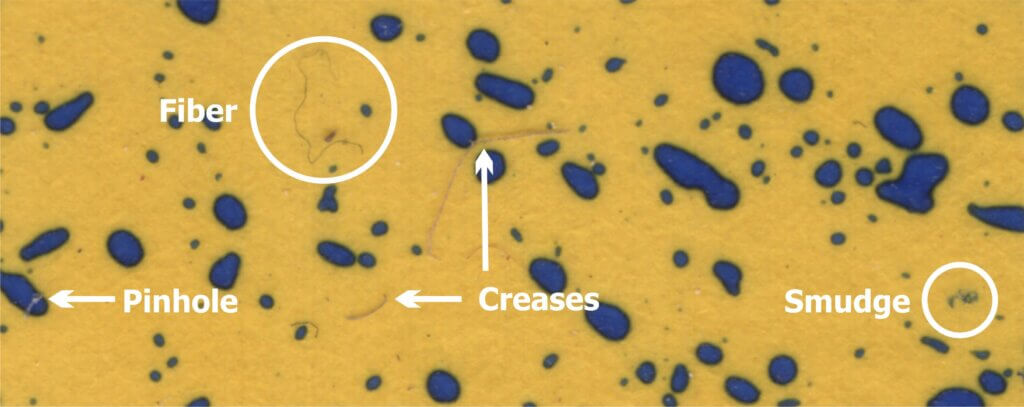
Flaws and imperfections become obvious when water sensitive paper is examined under magnification. Part of pre-processing is to select a region of interest that represents typical coverage and does not include artifacts that might interfere with the analysis.
2. Processing / Detection step
Processing and detection can take time because of the degree of computation involved. The higher the resolution and the larger the ROI, the longer it will take. Depending on what you want to measure, it might be acceptable to sacrifice some accuracy for speed.
We begin by determining which pixels represent part of a deposit stain and which represent part of the unstained background. We can accomplish this through global point operations called Thresholding and Filtering. If you haven’t already noticed, image analysis includes has a lot of jargon: “global” means the entire image and “point” refers to our focus on individual pixels. Ultimately each pixel is assigned one of two values, reducing the image to a binary (or 1-bit) format.
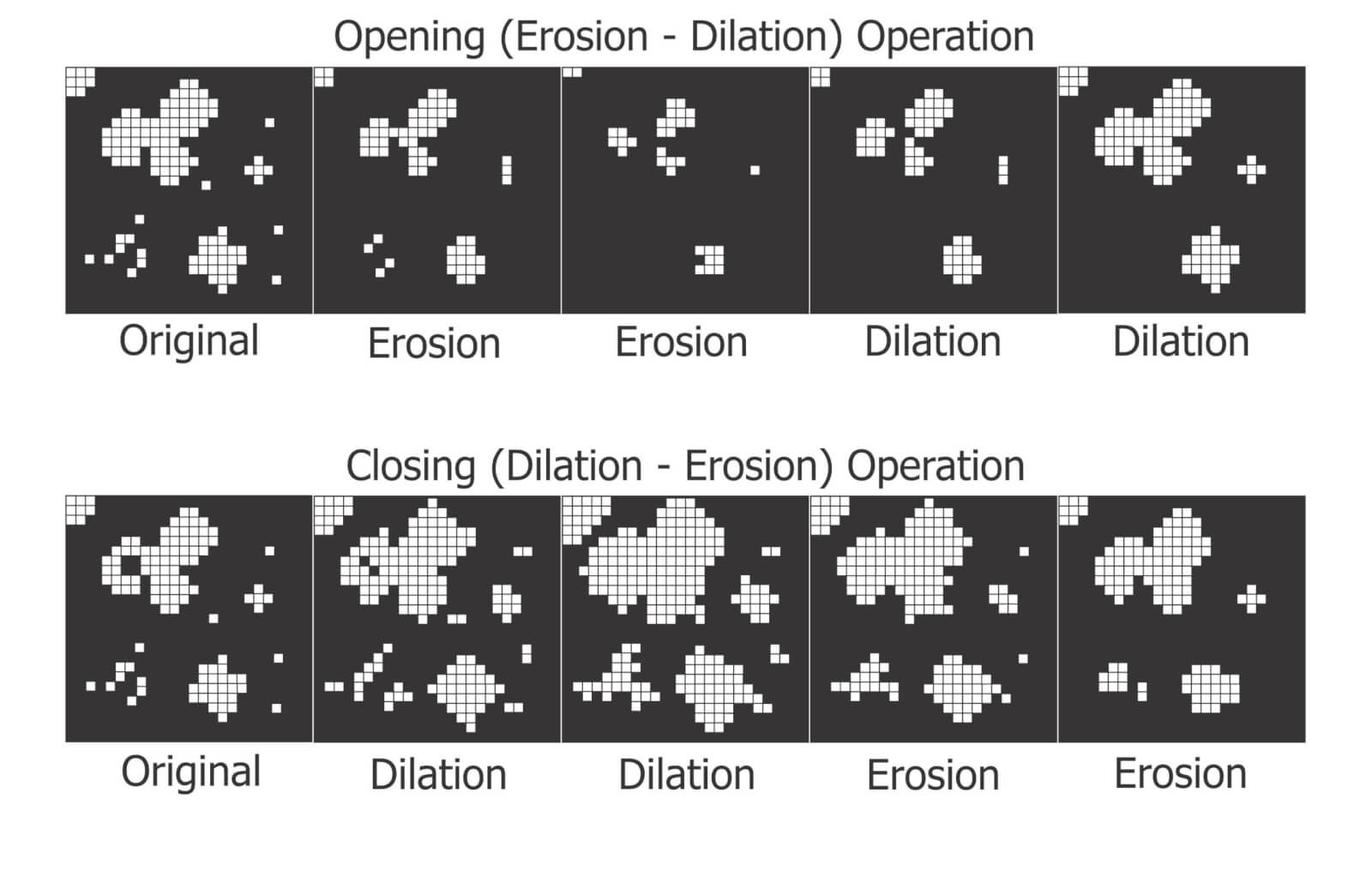
Once we have a binary image, we explore the shapes of the deposits (which are sometimes referred to as objects) to determine the limitations of what we’re confidently able to measure. Morphological operations are used to refine or modify these shapes in order to smooth jagged edges and identify whether an object is the result of a single deposition or multiple overlapping deposits.
3. Measurement step
Depending on the image analysis software, the user may be limited in what they can measure. The spectrum ranges from a single value (usually percent area covered) to in depth data relating to each object in the image. The latter might appear in a pre-formatted report, or as a CSV (Comma Separated Value) file for further exploration in spreadsheet format.
Thresholding
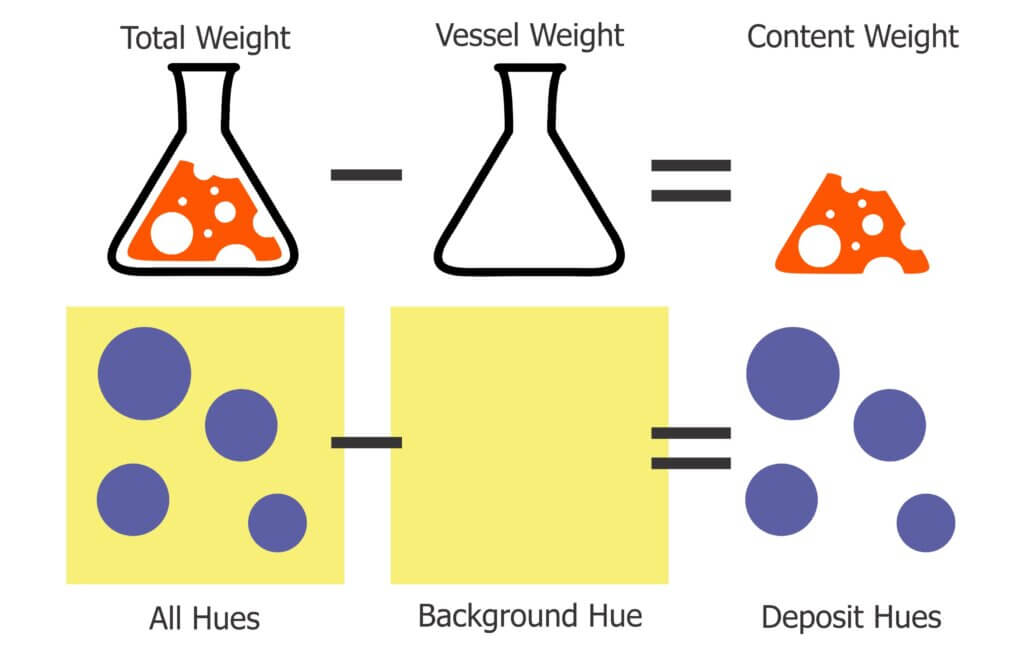
A thresholding operation sorts all the pixels in an image by some characteristic, and then allows us to set a threshold dividing them into two camps. In our case, we want to divide them into “stained” and “unstained”. The process is almost like taring a scale, where anything above the weight of the container is identified as the weight of the contents.
Thresholding is like taring a scale. Just as the weight of the container is isolated from the total weight of the container and contents, the stain colour is isolated from the background colour.
The HIS thresholding operation
ImageJ’s Colour Threshold operation is only one way to threshold an image, but it serves as a good example. This method uses HIS (Hue, Intensity and Saturation) to separate the deposit stain colours (blue-green) from the background colour (Yellow). As discussed, each pixel is represented by one or more 8-bit values. In this case pixels represent 0 – 255 hues, 0 – 255 intensities and 0 – 255 saturations. That may seem intimidating, but we mostly focus on hue.
When the Colour Threshold operation is selected, ImageJ sorts all the pixel values in the image into a binned histogram (where the Y-axis is the pixel count and the X-Axis is the range of pixel values).
a. Hue
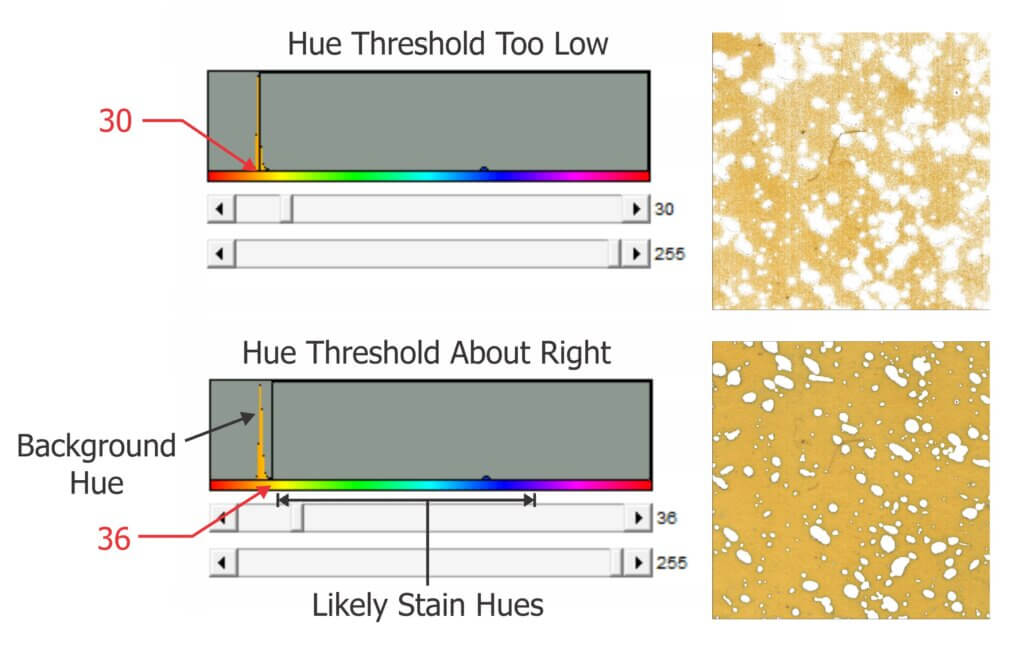
We begin by considering the hue, which is simply another word for colour. An image with no stains would produce a histogram with pixel colours producing a distinct peak in the yellow range. An image with stains would also display peaks in the blue-green range. The user then segments the background from the foreground by manually setting the threshold between these peaks.
(Top) When the threshold overlaps the background yellow hue (set to 30 here), some portion of the background is falsely identified as a stain. (Bottom) When the threshold is adjusted to fall in between background hue and stain hues (set to 36 here), a sharper distinction is made.
The hue thresholding process is less reliable (or can outright fail) when WSP has coverage in excess of 50%. This is because the color of the intermittent unstained areas changes as the distance between stains decreases. Think of it as blue bleeding into the yellow. The result is that the level of contrast between stained and unstained regions is inconsistent, making it difficult to confidently differentiate between “stained pixels” and “unstained pixels”. Similar issues arise when humidity causes the background colour to change but this tends to be more uniform and easier to threshold.
If the hue threshold it is set too low, stains will appear smaller and lose their shapes. If it is set too high, stains will appear larger and the gaps between adjacent, separate stains can disappear. This can have a significant impact on deposit count and distribution assessments, resulting in the loss of thousands of tiny, distinct deposits. Threshold accuracy has less impact on the determination of percent area covered. Research has shown that the use of a single threshold for multiple papers gives an absolute error of +/- 3.5% area covered. This is considered well within the intrinsic variability of spray coverage data.
b. Intensity
Sometimes referred to as “Value”, intensity can be thought of as pixel brightness. No threshold is required here because capturing the entire 256 pixel value range improves the contrast between colours.
c. Saturation
Finally, saturation (a measure of the difference between red, green, and blue levels) is a useful thresholding adjustment when WSP has been exposed to humidity. Humidity does not affect WSP’s ability to resolve stains, but as we mentioned it can cause the background to take on an overall greenish hue. An increase in low end saturation limit can increase the contrast between the stain colour and a less-distinct background colour.
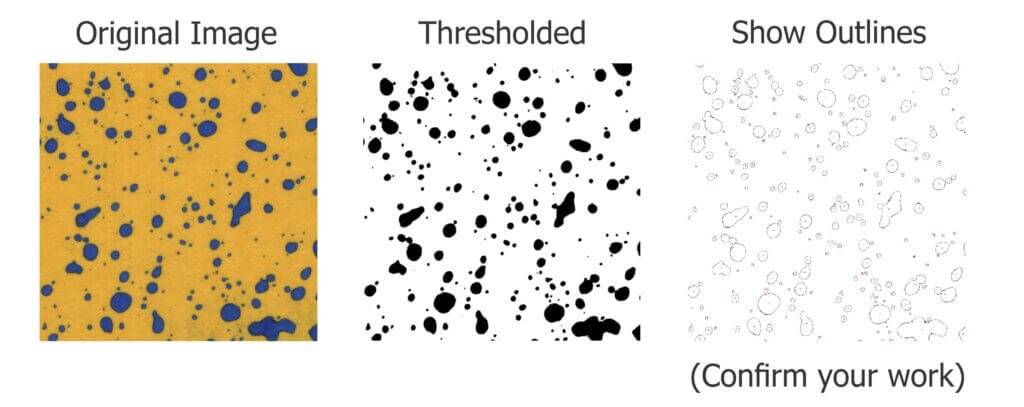
When the HIS thresholds are set, ImageJ converts the pixels values closer to the foreground (stains) to black and those closer to background (yellow) to white. Users can invert this if they wish, or even make the stains red. The important part is that we now have a binary image that makes a clear distinction between the stains and the unstained background. Ideally, thresholding should be performed for each consistent set of samples.
Learn how HIS thresholding is being used to perform weed recognition functions on sprayers in this article.
This 2 cm x 2 cm ROI was HUI thresholded. You can double check your accuracy by having ImageJ “show outlines” which outlines and numbers each distinct object. Zoom in to see if any artifacts remain (or were inadvertently created) and go back to make minor thresholding adjustments if needed.
Pixel filtering
We won’t belabor filtering because it isn’t often required when analyzing WSP. Filtering operations compare pixel values to those of their neighbours and then replace those values with some form of weighted average. This reduces the relative differences between pixel values, smoothing the image and reducing noise (at the cost of lost detail).
This is not a typical article for www.sprayers101.com. We like to develop actionable, data-driven content written in an easily-read format. Some articles discuss the results of research, some describe best practices and techniques, and occasionally there’s a song parody. But this article is different.
We recently wrote about the three commercially-available brands of water sensitive paper (WSP). The article was an impartial comparative evaluation of how these papers resolved spray coverage. But in order to be fair in our evaluation, we had to decide the best method for assessing them. This led us down a rabbit hole far deeper than we could have imagined. The science of image processing is complicated and there are many ways that WSP can be interpreted using a myriad of home-grown and commercial methods. We decided to share what we learned.
Which method is best for you? How far should we take a tool that was originally developed for quick, subjective comparisons? What follows is a three-part primer in digitizing and analyzing water sensitive paper. If you’re a grower that has never used WSP, you need only read to the end of the next sentence. Buy it and try it. If you’re a consultant, a researcher, or just interested in wringing all you can from this excellent agronomic tool, then get comfortable.
Here, in part 1, we’ll explore a brief history of WSP, describe a few limitations in what it is capable of resolving, and start down the road of how to capture a digital picture for later analysis. Welcome to the world of blob-analysis.
Introduction
Spray coverage describes the degree of contact between spray droplets and the target surface area. This metric can be used to predict the success of an application. One of the easiest methods for visualizing coverage is to use water sensitive paper, which is a passive, artificial collector that turns from yellow to blue when contacted by water.
WSP is often used to evaluate iterative changes to a spray program. Placed strategically throughout a target canopy, or directly on the ground, achieving uniform, threshold coverage translates into improved efficacy, reduced waste, reduced off-target contamination and reduced risk of pesticide resistance development. WSP tends to underestimate the spreading effect that can occur on plant surfaces (especially when surfactants are used), but they are effective as a relative index.
The simplest use of WSP, and the primary reason it was commercially developed, is to perform qualitative assessments. For example, when observers judge one paper to be visibly “bluer” than another, subsequent measurements have shown it can represent an increase of 20% in foliar deposit. In other words, if you can perceive a difference with the naked eye, it likely represents a biological impact. This fast and rudimentary use of WSP provides immediate and actionable feedback and is therefore valuable information for any sprayer operator. It has been suggested that manual counts become impractical at ~200 stains/cm2, but higher counts are possible using a loupe or linen tester-style lens.
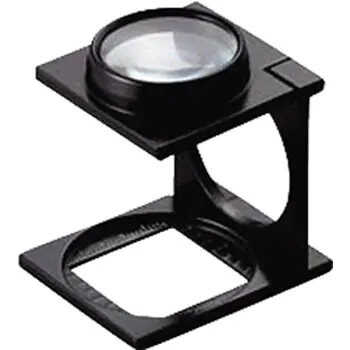
A loupe or folding linen tester (originally designed to check the quality of woven fabrics) provides 5-10x magnification to resolve smaller stains. Every deposit counts.
WSP can also be used for in-depth, quantitative assessments. This requires a camera or scanner to produce a digital image of the WSP and specialized analytical software to extract the relevant data. Considerable research has been performed to establish the limits of what can be learned from WSP. The four pieces of information commonly sought are listed here from easiest and most reliable to hardest and least reliable (or arguably, impossible) to determine.
The percent surface area covered.
The density of deposits on the target area.
The size of the droplets that left the stains.
The dose applied to the target surface.
This document will describe the fundamentals of image analysis and provide examples of commercial tools and protocols used to extract coverage data from WSP. It will also describe the assumptions and the limits intrinsic to these methods so the user can decide the degree of time and effort to invest versus the reliability of the results.
A brief history of WSP
In 1970, a journal article described a new method for sampling and assessing spray droplets. Photographic paper treated with bromoethyl blue created a yellow surface that changed colour when it encountered moisture. The pH-based reaction was fast and irreversible, leaving a distinct blue stain to mark the deposition.
Ciba-Geigy Ltd. made water sensitive paper commercially available in 1985 (later as Novartis in 1996 and as Syngenta since 2000). It is produced in several formats, but aluminum foil packages of 50, 76 x 22 mm (1 x 3 in.) papers are the most popular. Odds are if you’ve ever used water sensitive paper, it originated from Syngenta in Switzerland. Recently, two new options have been made commercially available: Innoquest’s SpotOn Paper (United States) and WSPaper (Brazil).
Once dry, the blue stains on WSP are irreversible and papers can be stored for a few years. However, unstained portions will continue to react to moisture from humidity, dew, or fingerprints, so care must be taken in their handling and storage. According to Syngenta, stains can be permanently fixed using isopropanol (or a similar solvent) to remove the yellow layer, leaving black stains on white paper.
Limitations of water sensitive paper
a. Minimum drop detection diameter
In hot and dry conditions, not all droplets that contact WSP will leave stains. En route from nozzle to target, droplets can concentrate through evaporation, leaving insufficient water to stain the paper. Syngenta states that droplets <100 µm in diameter will not be reliably resolved in “tropical conditions”. For most conditions, their minimum droplet diameter is closer to 50 µm. Innoquest states that their minimum drop detection diameter, under most environmental conditions, is between 60 and 90 µm.
This isn’t to say that smaller droplets can’t be detected. In absolutely ideal conditions, the smallest detectible droplet diameter for any brand of WSP is closer to 30 µm (Syngenta, Innoquest, SprayX – Personal Communication). Microscopic analysis of Syngenta’s papers reveals that droplets finer than this can leave physical “craters” on the surface, but have insufficient water to cause the colour change. The stain diameter created by a droplet is always larger than the droplet diameter, to a degree that is dependent on the spread factor.
b. Spread factor
The size of a stain is sometimes used to extrapolate the size of the droplet that produced it. The stain diameter is divided by a spread factor, which is determined under specific conditions. For example, Syngenta’s spread factors were established using the magnesium oxide and silicon‐oil‐method at 20°C and a 40% relative humidity for droplets at sedimentation velocity. “Sedimentation velocity” can be thought of as terminal velocity, which accounts for the fact that droplets moving at higher speeds will leave larger diameter stains. Consider the splash produced by a water balloon hitting a surface fast or hitting it slow.
Spread factors are not constant for all droplet sizes. For Syngenta’s WSP, a 59 µm droplet is expected to leave a 100 µm diameter stain (a spread factor of 1.7) and a 285 µm droplet is expected to leave a 600 µm diameter stain (a spread factor of 2.1). This relationship is sometimes captured using calculus. One research article employed this formula: feDm = 0.74057 + 0.0001010399 × Dm + 0.02024884 × ln(Dm) (where fe is spread factor and Dm is stain diameter in microns). Volume was then calculated per: Vg = (π × Dg3) / 6 (where Vg is droplet volume in µm3 and Dg is droplet diameter in µm). Innoquest determined their spread factors to be [0.4508 × Ln(Observed Stain Diameter)] – 0.6221 (Personal Communication).
Given that droplet sizing excludes the finest droplets, relies on situation-specific spread factors, assumes the droplet has reached terminal velocity and can be stymied by overlapping and elliptical stains (discussed in the next installment of this document) it is questionable whether there is any practical value in the exercise except perhaps for a relative comparison under highly controlled conditions.
Digitizing WSP
Digital images are produced using cameras or scanners. Cameras employ a grid of light-sensitive sensors, each of which reflect and record their portion of an image. Cameras capture images quickly but are prone to focus and distortion issues because the lens must be held very close to the WSP. SprayX’s DropScope accounts for this by individually calibrating each unit to compensate for variation during assembly and by employing software to account for lens distortion. When high resolution is required, cameras are the more expensive and complicated option. However, when resolution is not an issue, even a smartphone camera can be used (as with the SnapCard app; which as of 2026 is no longer be available, but a new app called SprayDex offers possibilities).
Flatbed scanners press multiple papers against a glass platen fixed above the light-sensitive sensors. This minimizes potential focus issues. Compared to cameras, scanners experience less distortion because they do not use a fixed grid of sensors. Instead, they rely on the speed and consistency of a carriage motor that draws an array of sensors along the image, capturing discrete slices. Scanners are less expensive than cameras, but they are much slower and low-end varieties can sometimes skip tiny slices of the image. This is not an issue when scanning office documents, but it can cause problems when analyzing a high resolution image.
a. Pixels
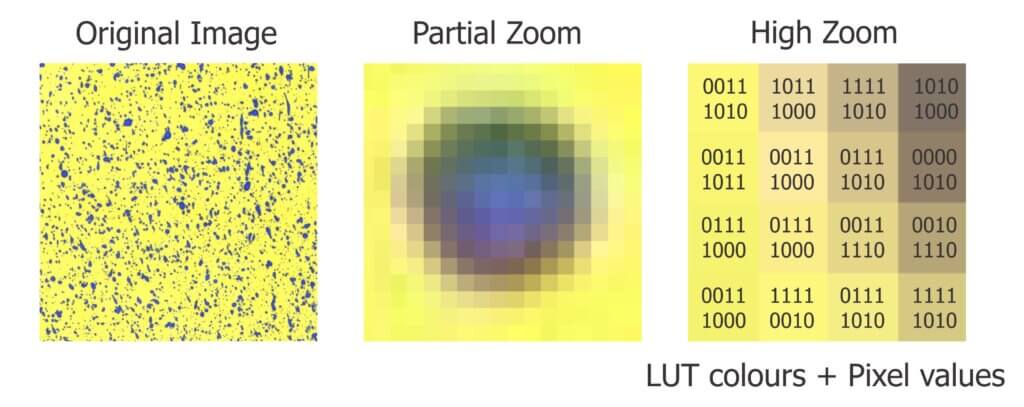
A pixel (a contraction of Picture Element) is the numerical information recorded by a light-sensitive sensor. The word “digitizing” means “converting to numbers”. The most rudimentary pixel value is an eight digit (or 8-bit) number. Each bit is either a 1 or a 0, so each pixel value is one of 28 (that’s 256) possible unique combinations. A picture displayed as a grid of 8-bit numbers wouldn’t make sense, so the computer substitutes shades or colours according to a look-up table.
Today’s sensors report higher pixel values to give more depth to the digitized image. An RGB (Red, Green, Blue) image records separate 8-bit values for red, green and blue colours. That’s 2563, or 16,777,216 possible unique colour combinations for a single 24-bit pixel.
With such a nuanced spectrum, two colours might look the same to the naked eye but represent different pixel values. Therefore, image analysis is more precise when we can work with the pixel values (the actual numerical data) and not shades or colours (an interpretation of the data).
(Left) A digitized scan of water sensitive paper. (Middle) Zoomed in on a single deposit. (Right) Extreme zoom to show the actual pixels, both as look-up table colours and as 8-bit pixel values. The colours may appear similar, but the actual pixel values are different.
b. Resolution (scale)
Before we can analyze an image, we must first know the scale. Each pixel is the smallest element in a grid that makes up the digital image. The scale of the image determines the real-life size that each pixel represents, making it possible to calibrate size measurements. We often refer to image resolution in Dots Per Inch (DPI). In this case, “dots” refers to pixels. The higher the DPI, the higher the resolution as the diameter of each pixel represents a smaller real-life length.
Camera resolution is described in terms of megapixels (MP) where 1 MP represents a grid of light-sensitive sensors capable of producing a 1 million-pixel area. When planning to print an image, the convention is to use a minimum resolution of 300 pixels per inch. For example, a standard 8 x 10 in. print would need 2,400 x 3,000 pixels for a total area of 7.2 million pixels. This would require a 7.2 megapixel camera.
The area we are dealing with is typically less than the entire 1 x 3 in. paper. Even if we captured the entire paper, a 1 MP camera would provide 600 pixels per inch, or approximately twice the resolution required for a typical 8 x 10 in. print. That may seem sufficient, but remember we are examining the image very closely, which would be similar to blowing the print up to the size of a billboard. For reference, the SprayX DropScope uses an 8 MP camera. The iPhone 7 camera used to capture SnapCard images for this document is 12 MP.
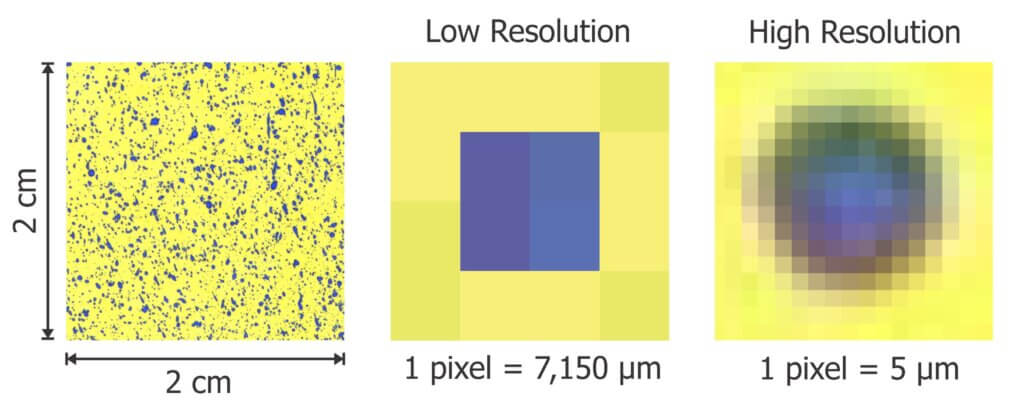
So, what is the ideal resolution and what are the downsides of getting it wrong? A low resolution image has a low pixel density, which might cause us to see multiple deposits as a single deposit or to miss the smallest deposits entirely. The minimum diameter of a detectable deposit must be about the same as the imaging resolution. For example, if a pixel represents a 30 μm diameter, the smallest deposit we could reliably resolve would be about the same size. Software that registers deposits sizes less than the limit of resolution are likely due to an algorithm error and should be ignored.
(Left) The scale of the original image is known. (Middle) A close-up of a low resolution image with pixels calibrated to scale. Is this a single stain or a cluster of multiple stains? (Right) A close-up of a high resolution image with pixels calibrated to scale. It is easier to see this is likely a single deposit.
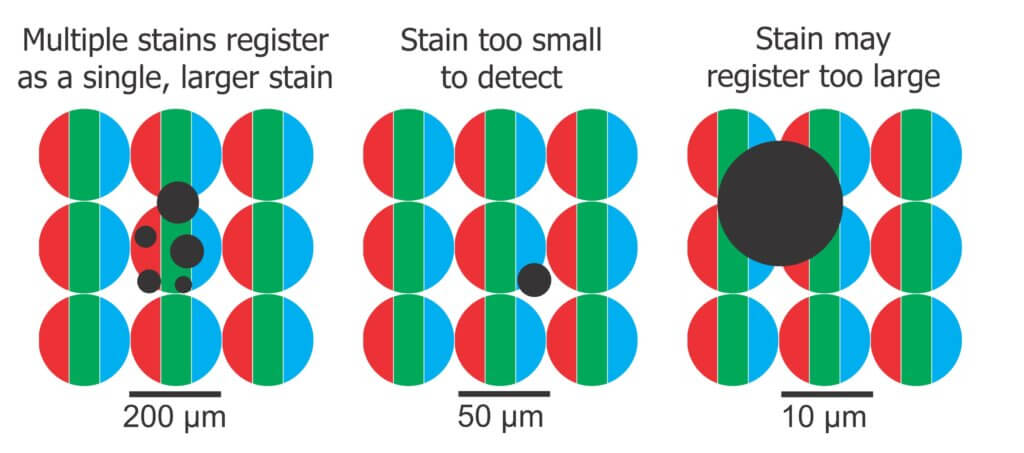
This is further complicated by stains that lie at an intersection overlapping multiple pixels. In this case, more than one pixel might represent a colour that is blue enough to register as stained, reporting a larger deposit than was actually there.
Resolution errors. (Left) Low resolution can cause pixels to misrepresent small, discrete deposits as a single, large stain. (Middle) Pixels may not reflect deposits smaller than their diameter. (Right) Multiple adjacent pixels may falsely represent a single, smaller, intersecting stain.
It is tempting to go to the highest resolution possible, but this can also cause problems, such as detecting and misidentifying inconsistencies in the surface texture of the paper as stains. Additionally, high-res images create logistic issues; They take longer to scan and to process as well as create large files that take up a lot of storage space. Image formats (e.g. JPEG) can compress the image file to make it smaller, but data is lost. Other formats (e.g. TIFF, PNG, BMP) are not as efficient at saving space, but they preserve the original data and are therefore preferred.
We suggest that 10 µm : pixel provides enough resolution, a reasonable processing time and a manageable file size. Further, given that a deposit could overlap multiple pixels, we propose employing a filter that removes any deposits less than a three pixel, or 30 µm, span. This lower limit eliminates artifacts and is still smaller than the smallest stain WSP can possibly produce. Some software allows the user to set this limit, and some make the choice on our behalf.