Category: Spray Basics

  • Smart Spraying Tips and Tricks

    Smart Spraying Tips and Tricks

    This 2018 article was written by Victoria Berry for the Ontario Grain Grower.

    In the era of social media and keyboard warriors, it’s easy to feel like someone is always watching and ready to force their opinion on the world. The “tweet first, think later” mentality often adds to misinformation, and worse, it can leave science as a bystander — especially when it comes to modern farming techniques.

    Farmers feed the world and they need to ensure they are growing high quality, high yielding crops. One of the most important elements of protecting high-quality crops is spraying. As farmers and custom applicators become more innovative and more knowledgeable about spraying techniques they have to strike a delicate balance, according to Jason Deveau, Application Technology Specialist with the Ontario Ministry of Agriculture, Food and Rural Affairs (OMAFRA).

    Deveau recently sat down for a Q&A session to discuss tips and tricks for smart spraying, understanding drift, and how important it is for farmers to share smart practices and be champions to others in the community.

    V.B.: WHAT ARE SOME OF THE KEY AREAS TO SPRAYING? WHAT ARE THE TOP MUST-DOS?
    J.D.: First and foremost, the laws of physics have never changed. We may present the facts in different ways to help people understand, or to make them more accessible, but when it comes to spray coverage and spay drift, there are three speaking points:

    1. We want farmers to use the largest droplet size they can without compromising coverage.
    2. We want the boom at the lowest practicable height to the field.
    3. We want farmers to adjust their spraying practices to match weather conditions, and know when spraying isn’t advisable.

    V.B.: OK. LET’S START FROM THE TOP. WHY AND HOW DO FARMERS CHOOSE THE LARGEST DROPLET SIZE?
    J.D.: Droplet size is an effective tool for combating physical drift. Larger droplets have more mass, which means they are more likely to fall rather than be carried away. But, for a given rate, the number of droplets a nozzle produces decreases as average droplet size increases. It’s the same amount of pie no matter how many slices.

    Fewer droplets might compromise spray coverage, particularly when targeting small weeds or when using a contact pesticide in a dense canopy. The answer is to use more volume to bring the droplet count back up, but that means more refills for the sprayer operator, which is time consuming. A good operator is always considering the balance between drift potential, coverage, and efficiency. Even with sophisticated technologies, these considerations always lead to nozzle choice.

    Traditionally, a grower would choose a nozzle based on the desired rate (e.g. gallons per minute) for a given pressure. As the sprayer changed speed, this would lead to over — or under — application. So, for convenience and consistency, most growers use rate controllers that monitor speed and auto-adjust the rate using pressure. But pressure also changes droplet size and spray pattern. Patterns can collapse at lower pressures (say <30 psi) and average droplet size decreases as pressures increase. You can see that droplet size wasn’t really on the radar. Pulse-width systems have changed this, but they are still few and far between.

    And even if a grower chooses a nozzle with a coarse spray quality, they may be surprised to learn it still produces some fine droplets, too. Look at a bell curve. That’s how a nozzle is rated for droplet size — a lot of average sizes in the middle, and then a few smaller or larger sizes. A coarse nozzle does not make you bullet proof; there will still be some drift. That is why we always observe weather and time-of-day restrictions and adhere to the buffer zones that appear on the pesticide label.

    V.B.: HOW DO LOW BOOMS IMPACT DRIFT AND WHY DO SOME FARMERS RESIST THIS ADVICE?
    J.D.: Imagine holding out your arm and dropping a feather. It will move a ways downwind before landing. Now climb a ladder and do the same thing — it goes considerably further. It’s exactly the same for water droplets. To add insult to injury, releasing spray from a higher point also prolongs evaporation, making it even smaller and exacerbating the problem. And if that weren’t enough incentive to lower booms, the high booms create inconsistent spray coverage, undermining the whole reason for spraying in the first place.

    The resistance to low booms comes from the desire to drive fast. North American booms sway and yaw, even with boom leveling systems. Higher speeds may get the job done faster, but it requires most farmers to raise the boom to prevent it hitting the ground. It may seem counter-intuitive, but there are several ways a farmer can slow down, drop the boom, and spray more acres in a day — it just requires them to look at their spray operation differently. A great deal of time is spent filling, idling, turning, and travelling between jobs. It’s been demonstrated that saving time on sprayer-related tasks has a big impact on efficiency — more than simply driving faster.

    V.B.: HOW DO YOU KNOW WHEN THE WEATHER IS RIGHT FOR SPRAYING?
    J.D.: Everyone knows the obvious cues. If your hat blows off, it’s probably not the time to spray. But, we’re learning that calm conditions may contribute to chemical trespass even more than wind. There’s no hard and fast rule, but three kilometres an hour to 10 kilometres an hour winds are a good range.

    In calm weather, you may find yourself in a thermal inversion, which does not allow fine particles (or volatiles) to disperse and ground. Instead, they hang in a layer of undisturbed air, either moving downhill like water, or eventually moving in an unpredictable direction when the wind picks back up. It’s suspected that this phenomenon has played a significant role in the off target crop damage issues in the U.S. in 2016 and 2017.

    In a very telling demonstration, an Ontario agrichemical rep showed that the smoke from a smoke bomb (representing pesticide vapour) travelled 1.7 kilometres during an inversion. In another demo, he showed it moving back and forth across the same field for hours after the application. Learning how to recognize a strong inversion, and knowing when there is too much or too little wind will require a different way of thinking, but will greatly reduce the potential for chemical trespass.

    V.B.: WHAT OTHER PRACTICES SHOULD FARMERS BE AWARE OF TO COUNTER DRIFT?
    J.D.: There are a lot of other considerations, but let’s highlight two.

    First – Downwind neighbours (residential and agricultural) can take actions based on your spraying schedule. If there’s a possibility of chemical trespass, it’s a courtesy to let them know your plans, or at least make spray records available and be prepared to answer questions. Quite often explaining what’s happening prevents them getting misinformation elsewhere. It may sometimes be a nuisance, but educating others is part of maintaining the public trust. Ontario farmers are experienced and certified and, frankly, the industry needs them to help educate people on all the good work being done.

    Second – Night spraying. Please stop. Time is short and weather can force us to take opportunities where we find them, but calm, clear nights represent the highest potential for a strong thermal inversion. Knowing the weather conditions that affect product performance (for better or for worse), minding pollinator presence, knowing what’s downwind, and STILL following integrated pest management means there seem to be fewer hours left to spray. But, it’s really a matter of understanding which of those factors trumps the others in the decision to spray, or wait. It requires today’s farmer to play an active role when it comes to spraying.

    V.B.: YOU MENTIONED PUBLIC TRUST. HOW WILL SPRAYING AND PUBLIC TRUST IMPACT FARMERS’ BUSINESSES?
    J.D.: We talk about soil, stewardship, and environmental sustainability. But at the core of all those important considerations is the customer driving those agendas. We are getting close to the day (if we’re not there already) where the grocery store dictates farm practices.

    Many broad acre farms are still self-regulating to a large degree. They do their best to maintain high standards for safety, transparency, and record-keeping. But, as specialty crop and livestock operations already know, we are moving towards tracing the history of a farm product from the customer all the way back to the seed. Farmers should adopt best practices proactively, before they become mandatory.

    So, the level of attention on field crops is more acute than ever before. Many are not used to being under the public microscope. Customers are asking when, how, and what was it sprayed, and they want to know the weather and cleaning practices that were followed. We need to have those answers ready to show what we’ve always known — that farmers are self-aware, are stewards, and are responsible partners in public health and safety.

    So spray like everybody’s watching… because they are.

  • Nozzle Sizing and Calibration Charts

    Nozzle Sizing and Calibration Charts

    Need to find the right nozzle size for your application?  Sometimes a simple chart is the easiest way to figure things out.  Print it and place it in your sprayer cab.

    In this chart, identify your water volume along the top row, and follow the column until you encounter the travel speeds you’re interested in.

    Once you’ve encountered your travel speed, move along the row to the left to identify the nozzle size and spray pressure.

    Make sure that your travel speeds are achieved at a pressure that’s right for the nozzle you’re using. For most air-induced nozzles, this will be about 60 to 70 psi (highlighted).

    Once you’ve decided on a nozzle size, the travel speed column for that size becomes the travel speed range at various pressures. Avoid operating a low-drift spray below 30 psi – its pattern will be too narrow and likely its spray quality will be too coarse for good results.

    Click on the images or text below to download a high quality pdf version of each chart, starting from the top with US, 15″ spacing, then US, 20″, then US 30″, then metric, 50 cm. Print, laminate, and place them in your sprayer cab.

    Calibration Chart (US, 15 in)

    Download Application Chart (US units, 15″ spacing)

    Calibration Chart (US, 20 in)

    Download Application Chart (US units, 20″ spacing)

    Calibration Chart (US, 30 in)

    Download Application Chart (US units, 30″ spacing)

    Application Chart 2015 (metric)

    Download Application Chart (metric, 50 cm spacing)

    Make your own chart using this Excel Template.

  • Application Recordkeeping: Focus on Environmental Conditions

    Application Recordkeeping: Focus on Environmental Conditions

    Note: This article was written by Bob Wolf of Wolf Consulting and Research, and first appeared as an NDSU Extension Service publication. Bob has agreed to reproduce the article on our website.

    When applying crop protection products, a good steward is one who can identify and record the environmental factors that may negatively impact making an application; particularly, the possibility of spray drift.

    New label language states: “Avoiding spray drift at the application site is the responsibility of the applicator.” A wise sprayer operator must possess the ability to assess the environmental conditions at the field location to determine how best to spray the field, or maybe decide it would be best not to spray that field, or part of that field, at that time. Instruments that assess environmental conditions are available to assist applicators in making good decisions.

    Making the correct measurement is the critical first step. Record the information measured to document the application conditions. Quality records help mitigate against any misapplication allegations, such as a drift complaint. Many of the items listed below are based on past legal experiences with applications involving spray drift litigation.

    The following guidelines should help you measure and accurately record environmental conditions at the application site.

    1- Document any instrument used by recording the manufacturer and model number. Accurate portable weather instruments are recommended. Portable weather instruments are available that log and store data, and aid in auditing and recordkeeping. Some will have Bluetooth/wireless capabilities.

    2- Environmental measurements include wind speed and direction, temperature, and relative humidity.

    3- At a minimum, record data at the start and finish of the job. Consider more often as conditions change or for a job that lasts over a longer period. For example, make observations when tank refilling for larger fields. Time stamp all observations with a.m., p.m., or military time.

    4- Take meteorological readings as close to the application site as possible. Be advised that the weather data received via a smart phone or local weather station may not be accurate for the location being sprayed.

    Note the specific location where the measurement was made, such as GPS coordinates, field entry point, field location, etc. Check the label to see if it requires a specific observation location in relation to the treatment area.

    5- Make all measurements as close as possible to the nozzle release height (boom height) and in an area not protected from the wind by the spray machine or your body. For aerial applications, six feet is suggested when using a hand held instrument.

    6- Record wind speed averaged over a 1 to 2 minute time span. Note the time the observation was recorded. Most instruments give an average over a period of time. Make sure the instrument’s anemometer is facing directly into the wind.

    Do not record winds as variable or with a range i.e. 4 to 8 mph – an average gives a better indication of the transport energy. Light and variable winds, where directions may change several times over a short period, can be more problematic than higher speed winds in a sustained direction. Observe any label restrictions on wind speed.

    Wind direction requires a similar averaged measurement. Record direction in degrees magnetic from a compass (0-360°). The use of alphabetic characters, i.e., N, S, NW, to indicate wind direction is discouraged. The key for determining direction is to have an accurate assessment method: trees moving, dust, smoke, a ribbon on a short stake, etc. Face directly into the wind and record the direction from which the wind is coming. A ribbon on a stake with the ribbon blowing directly at your body is a simple fail safe approach. Movement of smoke, particularly from moving aircraft, or dust may help determine direction.

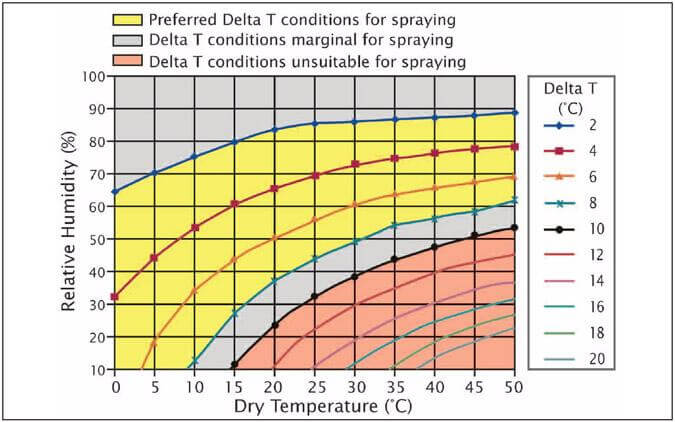
    7- Record temperature and humidity since they can be helpful in determining temperature inversion potential. It may be advisable to record both temperature and humidity well before and after the application for this purpose. In fact, recording a morning low and an afternoon high would be useful regarding determining the potential for an inversion. Take temperature measurements with the instrument out of direct sunlight. Shade the instrument with your body or spray equipment. This is especially critical if you are trying to assess temperature differentials for determining if an inversion is in place.

    8- Be alert to field level temperature inversion conditions which typically occur from late afternoon, can be sustained through the night, and into the next morning. Beware, inversions can start mid-afternoon. Observe conditions such as the presence of ground fog, smoke layers hanging parallel to the ground, dust hanging over the field/gravel road, heavy dew, frost, or intense odors (i.e., smells from manure or stagnant water from ponds are held close to the surface when inversion conditions exist). Inversions commonly occur with low (less than 3 mph) to no wind speeds. Spraying in calm air is not advised. If a mechanical smoker is used note wind direction and smoke dissipation with a time stamp.

    9- Note any variances due to terrain or vegetation differences, tree lines, buildings, etc.

    10- Initial or sign all recordings to indicate who made the observation(s).

  • The Agitation over Agitation

    The Agitation over Agitation

    Sprayers101 recently received a couple of seemingly unrelated questions about airblast sprayers:

    What are the advantages and disadvantages of mechanical versus hydraulic agitation? Why would someone want a stainless tank versus the cheaper poly or fiberglass options?

    Recognizing that each manufacturer has their own reasons for the features and materials used in their sprayers, we posed these questions to Mr. Kim Blagborne (formerly of Slimline Manufacturing). The following article was written from Kim’s response, and it turns out these two questions are very much related. Kim writes:

    This is a great debate among customers and manufacturers, and it’s difficult to stay neutral. Let’s consider the following:

    Hydraulic Agitation

    The flow required for hydraulic agitation requires about 30% of the pumps total capacity. This is very important because many sprayers cannot achieve, or maintain, this minimum requirement whilst spraying. This may be why it’s rare for a sales person to demonstrate agitation while the sprayer is spraying; quite often, the agitation slows or even stops. And, of course, because everyone gets wet.

    Let’s say an airblast sprayer has a pump with a manufacturer-listed capacity of 26 gallons per minute (gpm) (Click to download the spec sheet for the pump). The figure in that output chart is determined on a bench at 540 rpm and at 50 psi. However, when an operator uses that pump in the field, they run it at ~150 psi, and that brings the pump capacity down a bit to 25.5 gpm.

    Now we build in the line pressure drop associated with the sprayer’s plumbing. Effectively, another 8-10% of the pump’s output is lost to plumbing (a figure easily measured by collecting the total output capacity of the pump). Let’s say we are now down to a practical capacity of 23 gpm.

    If the operator’s crops are on 14 foot rows, it would be reasonable to spray 200 gpa at a travel speed of 3 mph at 150 psi. With both booms spraying that’s a required flow of 16.8 gpm.

    Remember, our hypothetical 26 gpm pump can only provide 23 gpm in the field. When we subtract the 16.8 gpm required for spraying, we’re left with 6.3 gpm excess capacity for agitation. But, we said we needed 30% of the pump’s 26 gpm capacity, and that comes out to 7.8 gpm. We’re short by 1.5 gpm, or stated differently, we’re about 20% short of what we need.

    Why don’t we see that deficit? Because the flow to the booms is prioritized, and therefore the sprayer output matches the calibration, so everything seems OK. But no one sees the reduced return flow through the regulator, and certainly no one peeks into the tank while spraying to see that the hydraulic agitation is greatly reduced.

    And so, while everything looked great during loading, the spray mix (especially SC and WDG formulations) may not stay suspended correctly during spraying. In extreme cases, that could lead to burning a crop (high concentration) at the start of a spray job, and reduced efficacy (low concentration) at the end. We’re quick to blame the chemical, but no one ever thinks to question hydraulic agitation.

    Let’s consider it from another angle: TeeJet suggests a model number 62905c-5 jet agitator for a sprayer with a 250 US gallon tank. To correctly agitate the contents of this tank, we will need 30 psi and 7.6 gpm (see the chart below).

    Unfortunately, there is no simple way for an operator to measure the agitation pressure or the flow, so it goes unchecked. The only way to determine if the flow demand is satisfied is to apply the generic rule of 30% of pump capacity and make an estimate. That’s pretty loose math since we’ve already established that the listed capacity may not reflect reality.

    Still another angle: Many operators now employ the Gear Up, Throttle Down (GUTD) approach to match their sprayer air settings to the crop canopy. However, when we reduce PTO input speed we also reduce pump capacity. Remember our piston diaphragm pump with the 26 gpm capacity at 540 rpm? We still need 16.8 gpm to spray, but reducing the rpm’s by 100, per GUTD, drops our pump output to only 23.16 gpm.

    23.16 minus 16.8 equals 6.36, and we needed 7.8 gpm to maintain sufficient hydraulic agitation. Oops.

    Mechanical Agitation and Tank Material

    There are definite advantages to mechanical agitation. It is not affected by the PTO speed because it is already excessive at 540 rpm. This means there is no pump capacity issue and it allows the operator to take advantage of GUTD.

    There are also a few disadvantages. Unlike a hydraulic system, mechanical agitation requires maintenance, such as regular (daily?) greasing. The packing where the the system inserts into the spray tank also requires occasional inspection and adjustment to prevent leaks.

    And of course there’s sticker shock. Many European manufacturers offer hydraulic agitation because it is ~$500.00 CAD less expensive. Further, mechanical agitation creates vibrational stress on tanks walls, which fiberglass or plastic tanks can’t handle for long. The solution is stainless tanks, which is a more expensive material. Further, stainless cannot be moulded around pumps and rotating parts, so more steel is required, adding to expense and weight.

    In my opinion, there is sufficient benefit to stainless to easily recover the investment. Beyond permitting mechanical agitation, there’s durability. We have stainless tanks built in 1948 that are still operating today, and we’ve never found a plastic or fiberglass tank that can claim that. There’s also sprayer sanitation. It has long been know that stainless cleans more easily and more reliably that plastic or fiberglass, especially as the tanks begin to age.

    Closing

    The decision to buy a sprayer with hydraulic agitation or mechanical agitation lies, ultimately, with the consumer. But be sure to look past the price tag, and under the hood. Ensure that you have sufficient agitation to properly suspend your tank mix, and give you the flexibility to Gear Up and Throttle Down to improve your spray coverage and efficacy.

  • Unit conversion tables

    Unit conversion tables

    Canada, like most of the world, is officially Metric. Our American friends are US Imperial. It sounds very cut and dried, doesn’t it?

    Anyone that’s tried to calibrate a sprayer in Canada quickly discovers that we’re really a horrible amalgam of the two systems. Our sprayers and nozzles often hail from the states, and that means US Imperial. Our pesticide labels hail from Health Canada’s Pest Management Regulatory Agency, and that means Metric

    And so, when speaking with applicators about their sprayer practices, we’re often treated to mind-rending sentences like:

    Well, I drive 12 mph, spraying about 150 L/ha and my pressure is about 40 psi. How many ml/min should my nozzles emit for a product that wants 6 oz/acre acid equivalent?

    Cue the quiet sobbing…

    Well, your smoking calculators are in for a treat! In a fit of frustration we created the ultimate set of conversion tables that should set you right for almost any Imperial/Metric emergency! Find one we missed -We DARE you! (update: Tip of the hat to D. Wiens of Saskatchewan, who found one! We added it.)

    Simply find your current units in the left-hand column. Then find the units you are converting to in the upper row. Now multiply by the conversion figure where they intersect in the table.

    Yes, they’re ugly, but they’re absolutely complete! If the tiny ones are too tiny to read, right click and download the image so you can zoom in. It’s a limitation of this website that we can’t make them larger.