Category: Spray Basics

  • Plumbing Projects That Make Spraying Easier and Safer

    Plumbing Projects That Make Spraying Easier and Safer

    Some of our biggest struggles in spraying involve the start and end of each spray day.

    When starting a new field after the sprayer is cleaned, we need to prime the boom. If it’s full of water, that water has to be purged and the question is always for how long and where to do this (pro tip at bottom of article).

    At the end of the day, we should ideally clean the sprayer. During that process, we may struggle with waste disposal, including large rinsate amounts, and course, the uncertainty of whether the job is actually done (since clean water looks exactly the same as contaminated water).

    If not cleaning the entire sprayer plumbing, we should at least rinse the boom, even if we’re returning to the same product the following day. It can prevent future problems.

    These tasks are complicated by the increasingly convoluted plumbing featured on modern sprayers. Ask someone to explain their sprayer’s plumbing system to you one day. It’s a long story! A bright spot is the well-engineered, compact, and accessible Agrifac system.

    Fortunately, virtually any sprayer can be modified to suit your needs. Let’s talk about a few ideas for a winter project:

    1. Boom flush. It’s good practice to flush clean water through your boom at the end of spraying even if the main tank remains full of product. Some sprayers have an air purge system to eliminate liquid from the plumbing and that is a great feature. A water flush should follow that purge so that any residual pesticide is diluted and removed before it can dry on and become hard to remove later.  First you’ll need a clean water tank on the sprayer (150 gal is enough). Second, plumb a feed so that this clean tank can be the sole source of the water supplied to the solution pump. Select this source, shut return lines down or off, and pump clean water through boom.  Sprayers that have an auto-rinse cycle will likely be able to draw clean water, but may not be able to push it to the boom, directing it to the wash-down nozzles instead. Check to see what’s possible, and make the changes you need.
    2. Clean water pump. Installing a second pump dedicated to the clean water tank has several advantages. We’ve talked about continuous rinsing before, here, and here, as a way to dilute the tank remainder faster. It requires installation of a second pump dedicated to clean water. Additionally, give this pump the option to deliver water to the boom, not just the wash-down nozzles. Now it can be used to rinse water through the boom. The main challenge is to obtain a pump capacity that can match the needs of the boom and/or the wash-down nozzles.
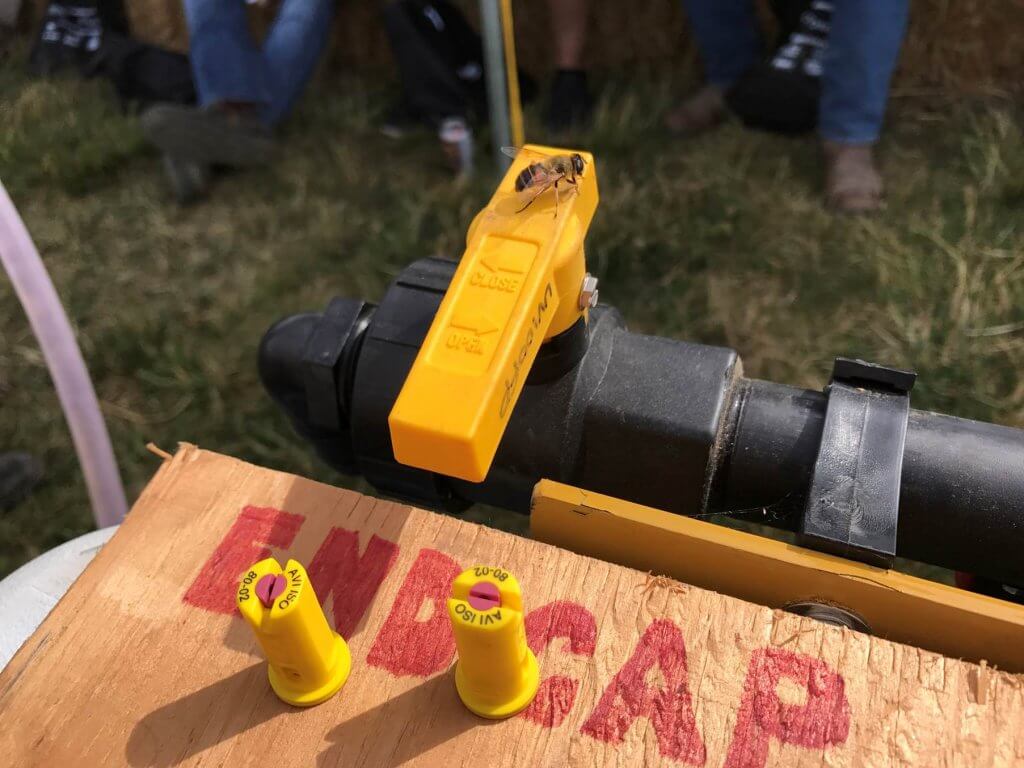
    3. Boom ends. We’ve mentioned this part of the boom many times. Boom ends must be flushed regularly to get rid of product and possibly debris that gets stuck there. A simple way to achieve this is to use the Express Nozzle Body End Caps from Hypro. These bleed air continuously, and also prevent accumulation of dead-end contamination. They do need to be flushed, and this can be done by pulling a plug or rotating the turret to an open (no nozzle ) position.
    1. Recirculating boom. This is a significant change, but worth considering. Conventional plumbed booms are separated into five to 13 sections. Each has two ends at which the spray stops and where air and contamination can accumulate (see point #3). Each section feed has a shutoff valve.  Once the spray mixture leaves the pump and bypass valve, it is committed to leaving the sprayer.  In a recirculating boom, the boom becomes a part of the tank and the liquid can return to the tank if desired. Spray is pressurized at one or both ends, and valve positions determine its flow. Sectional control is achieved with individual nozzle shutoff, air or electric.
      1. Three advantages:
        (a) the boom can be primed with new product without spraying. The surplus goes back to the tank.
        (b) the boom can be flushed with water without spraying while material is still in tank, and without spilling anything on the ground. Again, the surplus goes back to the tank.
        (c)  high resolution sectional control with individual nozzle shutoff is a byproduct of this design. Fast response, high res, saves money.
    2. Steel lines. Steel cleans easier than plastic, and this material makes a lot of sense for booms. But it also makes sense for the boom feeds, currently handled by black rubber hose.  This hose is a literal black box. We can’t see inside it, and we don’t know if and where potential contamination resides. It has considerable surface area. Consider replacing portions of your feed lines with steel. The boom is the obvious candidate. Aside from easier cleanout, it also helps with faster nozzle shutoff because it doesn’t expand with pressure.

    A word about dumping the tank on the ground. It’s a bad practice for many reasons. Let’s examine just one of those. When you spray a product at 10 gpa, you actually cover each square meter with about 10 mL, or 1/3 oz, of spray mix. When you flush your boom ends on the ground, you’re probably dropping 2 or 3 gallons in the same area. That’s 1000 times the label rate at each boom end, 10 to 26 times per boom. If you dump your tank remainder and all the hoses, say 20 or 30 gallons, that’s 10,000 times the label rate if it covers 1 sq meter. That’s leaching, runoff, residual potential, and not a good story.

    Many of the changes we outlined above help prevent that from being necessary.

    Pro Tip: To find out how much water your plumbing (from the pump to the boom ends) holds, do this: After cleaning with water and before spraying an EC formulation (white milky appearance in tank, some crop oils are ECs) reset your sprayed gallons on your rate controller. Start spraying and watch for the last nozzle on your furthest and longest section to spray white. Stop spraying and check your sprayed gallons. That’s your volume. No matter the size of nozzle or application volume, it stays constant. To be sure the boom is primed with a new mix, spray until those gallons are reached and you’re set.

  • Question of the Week: Fine Sprays for Fungicides?

    Question of the Week: Fine Sprays for Fungicides?

    The following question arrived from one of our prairie clients last week:

    “A retailer is promoting the use of hollow cone nozzles to be used on field sprayers (20” spacing) to apply fungicides which he claims out-perform any regular and twin fan tips. Claims:

    • create an extra fine droplet for maximum coverage on the canopy
    • use less water, less time spent filling
    • apply at 3.5 gpa
    • add vegetable oil to reduce drift

    “So his direction to a specific customer was to use the TEEJET CONEJET TXA8001VK nozzle at  80 psi – travelling at 10 – 12 mph to achieve a 3.4 gpa application rate with a ‘very fine’ droplet size.

    “What are your thoughts?”

    Here’s how I answered (edited for clarity):

    That recommendation sounds familiar – it originates from a consultant with experience in South America, where this idea is promoted to improve (aerial) spray productivity.

    I fundamentally disagree with his approach. Adopting and promoting it is not only illegal (contravenes every modern label’s water volume and spray quality requirements), it also puts a generation’s worth of stewardship efforts on drift management at risk.

    To be balanced, let’s explore the attractiveness of this approach. Finer sprays do provide superior coverage and save water. Every child knows this. Finer sprays also go places in the canopy where the coarser sprays can’t, for example very dense lentil canopies.

    Over the years, we’ve explored the performance of fine fungicide sprays in canola, pulses, and cereals in research trials with the U of S and AAFC. To our surprise, droplet size played only a small role in fungicide performance. Water volume was much more important. Droplet size management with pressure through a low-drift nozzle was enough to get the best disease control.

    The main drawbacks of very fine sprays are:

    1. The fine droplets evaporate to dryness very quickly, in seconds. As they shrink, their drift potential is increased even more, and once dry, the remaining particles work much less well. The proponent corrects for this by adding an oily adjuvant as an evaporation retardant. With oil, the fines remain liquid much longer. Although many products become more effective this way, they also become more phytotoxic and less safe for the applicator and bystander. Completely off label, completely risky for crop safety, unknown effects on MRLs, extremely unsafe for the environment and humans. Remember when people dissolved 2,4-D ester in diesel, back in the 40s and 50s and sprayed it with their brass 6501 tips? That’s what this is.
    2. Cone nozzles are designed for airblast sprayers and do not produce good pattern overlaps for boom sprayers. The proponent of this method actually recommends that the boom be raised to overcome the bad patterns and to (believe it or not) simulate aerial application. If this were done, the spray would be re-distributed by air-currents and come down wherever the wind blows it. Probably far away.  The concept of on-target, uniform application, the practice that makes product use acceptable, and the thing we try to achieve with flat fans at a low boom height, is completely lost.
    3. Producers will not have the support of pesticide manufacturers should a performance issue arise. Even worse, if regulators find out about this off-label practice, significant fines (fines for fines, get it?) can be charged under the Pest Control Products Act.
    4. Airborne spray drift with an air-induced spray like the AirMix, GuardianAir, AIXR and the like, applying 10 gpa, is about 1% of the applied amount, measured at 5 m downwind of the downwind edge of the swath in a 20 km/h wind. We’ve never measured hollow cone drift from a boom sprayer, but when we used a flat fan at 5 gpa, drift increased to about 8% of applied. I’d guess a high pressure hollow cone would easily double or triple that. Illegal and irresponsible.
    5. Travel and boom turbulence is a part of faster travel speeds. This would affect the finer droplets much more than the coarser ones, as we can imagine. It’s similar to drift. With a low-drift spray, the proportion of the total spray volume that is “fine”, say less than 150 microns, is about 5%. For a very fine hollow cone, it might by 50 to 75%. So a much greater proportion of the sprayed dosage would be susceptible to uncontrollable movement. This could be good, when turbulence redirects the spray to places that are unreachable by larger droplets. Or it could be bad, as turbulence pushes droplets away from an important target, creating a miss. On balance, bad. Very bad.

    These types of recommendations are concocted by people who want to tell a unique story that is popular with some. Their approach differentiates them from the rest of the crowd, an old and effective marketing trick. But these proponents do not have the best interests of the industry in mind.

    Our individual and collective agricultural practices must be respectful of others. Of safety. Of the law. Of the environment. We have lots of opportunities to make shortcuts…nobody’s watching most of the time. But that doesn’t make it right. It’s certainly not in ag’s long-term interest.

    When considering our agricultural practices, imagine describing them to a young non-farming person. Can you justify your actions? Do your practices make you proud? If not, you have work to do.

    Here’s a task: If your boom sprayer has nozzles that produce very fine sprays, take them off and throw them in the garbage. Might sound radical, but it’s the right thing to do.

  • Deciding on the Right Way to Spray

    Deciding on the Right Way to Spray

    “What is the right way to apply this pesticide?” It’s one of the classic questions. Applicators know that spray method determines the efficacy of the application as well as its environmental impact. And it has to use time and water resources efficiently to make sense.

    To answer the question properly, we need to take things one step at a time.

    1. Canopy: To start, we need to look at the canopy that our application will go into. If it’s an early season spray into a seedling crop, then the canopy won’t be much of a barrier. Lower water volumes can be possible. Droplet size will only depend on the target type and the pesticide mode of action.
    Small weeds require more smaller droplets to secure effective targetting

    If it’s a later application into the bottom of a maturing canopy, the foliage may intercept the spray before it reaches the target area. More water will likely be needed, and droplet size may become more critical for getting the spray to its destination. Dense canopies are a real challenge and lower-canopy deposition usually benefits from finer sprays because the small droplets can turn corners better.

    Dense canopies are very difficult for a spray to penetrate. Higher water volumes and smaller droplets are the key tools that help.

    2. Water Volume: Regardless of canopy, the range of application possibilities will depend on the water volume and spray quality combination. It’s math: assuming some constant amount of coverage on each leaf, more layers of foliage will require more water. Using less water volume will make it necessary to use finer sprays to keep droplet numbers constant. More water will allow coarser sprays. This decision has implications for drift, and by extension, affects the number of hours we can spray in a day. More drift tolerance means better application timing and overall productivity.

    The tradeoffs between water volumes and droplet sizes are seen in this figure. Once a certain threshold of coverage has been reached, a further increase in coverage may not provide any additional control.

    3. Target Type and Droplet Behaviour: Whatever spray we use, the target plant or insect needs to intercept, collect, and retain the spray droplet. This is where the fun begins. Target leaves may be vertical or horizontal, large or small. Their waxy surface may be easy-to-wet or difficult-to-wet. The general rules of thumb are that larger, more horizontal and easy-to-wet surfaces are better suited for coarser sprays – these are intercepted more efficiently and stick readily. That is a reason why most broadleaf weeds and crops are very compatible with low-drift sprays.

    Large targets (left) are most efficient at intercepting larger droplets (provided droplet bounce is not a problem) because smaller droplets may evade capture. Smaller targets are usually missed by larger droplets but are very capable of capturing smaller droplets.

    On the other hand, smaller, vertically oriented and difficult-to-wet plants require finer sprays for effective targetting. Larger drops tend to miss these targets or bounce off them. Most grassy, and some broadleaf weeds (especially at early growth stages) fall into this category.

    4. Mode of Action: There are nearly 30 modes of action on the herbicide world, and another ten modes for insecticides and fifteen for fungicides. The effect of droplet size and water volume on their uptake and translocation varies, and it’s probably not correct to generalize too much. There is one notable product, glyphosate. For this product, research has consistently shown that large droplets and more concentrated mixtures provide better uptake. But we’ve also seen problems when this is over-done, causing localized toxicity and limiting translocation.

    With many products, we’ve sometimes seen better performance with finer sprays due to improved coverage, yet at other times less performance due to rapid evaporation. On the whole, it’s probably still fair to say that contact modes of action require finer sprays and higher water volumes, even if there is the occasional exception. And systemic products can typically handle coarser sprays. We’ve always been surprised just how coarse we seem to be able to push the system before any loss of efficacy.

    What does it all mean? In spraying, we need to accommodate a lot of diversity. The average application is broad-spectrum, targeting large and small broadleaf and grassy plants. Many sprays are tank mixes of several modes of action. It’s impossible to prescribe a specific spray for each situation. We need a little bit of everything. And the spray should not be drift-prone. It’s easy to see that we need to aim for the middle to accommodate everything.

    The traditional flat fan nozzle, either in its conventional or low-drift form, generates a wide range of droplet sizes that can range from 5 µm to about 2000 µm. If we need fine droplets, they’re there. If we need larger droplets, they’re also there. The proportion of the total spray volume in each specific size fraction depends on the nozzle choice and size, the spray pressure, and the adjuvant mix in the tank. Overall, the system is very robust, and although it requires some tweaking, a well chosen average spray can achieve most tasks well enough.

    A typical spray quality chart shows the expected spray quality for a range of nozzle sizes and pressures. Spray quality measurements follow standards set by the ISO and ASABE, these change from time to time and therefore charts tend to become outdated.

    Our research has repeatedly shown that a Coarse spray is a good starting point that does most things well. It is acceptable to move into a Very Coarse or coarser category provided water volumes are also raised, and provided the target types and modes of action are suited for this change.

    It is rarely necessary to spray finer than Coarse, and when this is done, we recommend against spraying finer than a Medium spray. There is simply no advantage from product performance, and drift risk becomes unacceptable.

    Tweaking the System. In order to maximize the performance of your spray, and the efficiency of your overall spray program, here is some advice:

    1. Know the spray quality of your nozzles, and their response to spray pressure. Manufacturers publish this information in their catalogues and on-line. Make this your homework assignment.
    2. Use the coarsest spray that you can afford to. This will make the application safer, it will widen the weather window, and it will simply let you get more done in a day or a season. Coarse sprays work.
    3. Use spray pressure and water volume to fine tune the application for a specific purpose. If using a contact product, you can keep the same nozzle you used for a systemic product. Apply more water or use more spray pressure to generate more droplets.
    4. Do not skimp on water. Higher water volumes tend to make an application more uniform, robust, and crop-safe. Spray coverage improves. Canopy penetration improves. Coarser sprays are possible. The only exception to this rule is glyphosate, which works better in lower water volumes. But with higher glyphosate rates and more tank mixing, even that exception is disappearing.
    5. Learn as much as you can about how your pesticides work and where they need to be in your canopy. Apply your knowledge to select optimal water volumes and spray qualities.
    6. Be wary of people who advise very low water volumes in conjunction with fine sprays. They want to appeal to your need for efficiency, but do so at the cost of consistency and environmental stewardship. Plus these types of applications are illegal for many of our products.
  • Pulse Width Modulation For Newbies

    Pulse Width Modulation For Newbies

    I was recently asked to describe Pulse Width Modulation to a non-farming audience. My instinct was to send them back to what we’d already written about the topic on Sprayers101, here and here. But on reviewing the material, I soon realized that most of our posts assume a certain amount of basic knowledge and understanding. What about people who are new to the business, or just curious? Not that helpful. 

    This is the first in a series of articles that cover off topics which may be too basic for many, but are nonetheless important for others. More to come. And suggestions welcome.

    Sprayers are used to apply crop protection agents to fields, and as with all crop inputs, it’s important to apply the correct dose.  For boom sprayers, dose is a product of the swath width, the sprayer travel speed, and the flow rate of spray liquid through the nozzles. Of these three factors, swath width is taken as constant, whereas travel speed and flow rate are variable. If travel speed changes, flow rate also needs to change to maintain the target application rate.

    The vast majority of nozzles come in fixed sizes. As a consequence, the only way to change their flow is with spray pressure. In a modern sprayer, a computer known as a rate controller takes care of the math and the adjustments.  For example, if the sprayer speeds up, it will need to deliver more liquid to keep the same application volume per acre. The rate controller knows the swath width (entered by the user) and senses travel speed (using radar or gps) and liquid flow rate (using a flow meter). If the travel speed increases, the rate controller causes the spray pressure to increase until the flow rate sensor shows that the flow is enough to maintain the target application rate.

    The problem with this approach is that sprayer nozzles are very sensitive to spray pressure. Too low a pressure will cause the spray pattern to deteriorate, resulting in poor coverage. Too high and the spray will become too fine, creating drift problems. As a result, traditional sprayer operators have to stay within a very specific, narrow speed range. This may not always be possible if, for example, the terrain is hilly or the soil is wet.

    One solution to this problem is to control flow rate differently.  A fairly new way to do it is with Pulse-Width Modulation (PWM). This is a fancy term that describes a well established way that liquid flow rates are controlled in a number of other tasks such as fuel injection or hydraulic oil systems.

    With PWM, each nozzle body is equipped with an electronic solenoid (shut-off valve). The valve turns on and off ten or more times every second, creating an intermittent, pulsed spray. The number of times the valve cycles on and off per second is called the frequency, measured in Hertz (Hz), cycles per second. The proportion of time that the valve is open, called the pulse width or duty cycle, is related to the liquid flow rate passing through the nozzle. Duty cycle can be electronically controlled.

    For example, each nozzle can operate at its full rated flow (100% duty cycle) or a fraction of its flow (say 20% duty cycle). At low frequencies (about 10 to 15 Hz, common in PWM systems) duty cycle is proportional to the flow rate of the nozzle. At 20% duty cycle, the nozzle delivers about one fifth of the flow compared to 100%. The pulses are so quick that it doesn’t affect overall coverage or droplet size. With this system, as a sprayer speeds up or slows down, the duty cycle changes automatically to match the flow rate requirements calculated by the rate controller.

    What does this mean in practice? For one, the sprayer no longer relies on a pressure change to influence the nozzle flow rate because duty cycle has taken over that job. In fact, the operator can set the pressure to whatever is necessary for best coverage or best drift control, whatever is most important. A change in travel speed caused by a hill or a slippery spot doesn’t affect pressure any more. The end result is a spray application that is not only more accurate, but also more consistent over varying conditions.

    Drift control is easier with a PWM system. A common way to reduce drift is to make the spray coarser, and this can be achieved with lower spray pressure. But lowering the pressure results in less liquid flow, and the operator has to slow the sprayer down if the same application rate is to be maintained. With a PWM system, the operator simply lowers the pressure. The system makes up for the lower flow by internally increasing duty cycle, allowing the same travel speed to continue and therefore not affecting the work rate.

    An added side benefit with a PWM system is that it provides opportunities for site-specific management of application rates. Parts of the field needing less or more product can receive what they need. All the operator does is change the rate, via duty cycle, according to a prescription map.

    A further bonus is the highly resolved sectional control that can be achieved. With any wide agricultural implement, overlaps are inevitable. With an advanced version of a PWM system, individual nozzle solenoids can be shut off or turned back on as required, thereby preventing double applications at these overlaps.

    In short, PWM systems give operators much more control over their spray operation. And that’s good for everybody.

  • Storing Pesticide Mix Overnight

    Storing Pesticide Mix Overnight

    Not being able to finish a tank due to weather or any other reason happens to just about everyone. Is it OK to simply leave the sprayer as is, and resume spraying later after some agitation?

    In many cases, the answer is yes. Most pesticide mixtures are stable in short term storage. On resuming spraying, an agitation could be all that’s needed to get back to where you started a day or so earlier.

    But there are three important exceptions.

    When the active ingredient is formulated as a suspension. Suspensions are typically wettable powders and flowables, and rely on a clay carrier to distribute the active in the tank. Because clay is denser than water, these formulations settle out quickly after agitation stops. Sure, they can be brought back into suspension with vigorous agitation. But in lines and booms, boom ends and screens, dislodging a settled clay carrier is much more difficult. It’s also hard to tell if the cleaning has been successful because the problem spots are hidden.

    The best solution is to flush the spray boom with water before materials can settle and lodge. A visual inspection where access is possible, such as strainer bowls and boom ends, is part of the process to ensure the formulated product has been removed.

    Learn to identify which formulations are suspensions. There’s lots of jargon out there. Look for terms such as DC, DF, DG, DS, F, Gr, SP. Even EC formulations are suspensions (oil in water) and require agitation.

    When the active ingredient is chemically unstable. Some pesticides can degrade in the tank, usually due to alkaline (high pH) hydrolysis. The effect is very pesticide specific, but in general, insecticides (particularly organophosphates and carbamates) are more susceptible than other pesticides. This fact sheet by Michigan State University describes the impact of pH on a the half-life of a large number of pesticides.

    Note that in the examples in the MSU fact sheets, pesticide half lives are typically days and weeks, and only rarely hours. Also note that while high pH is most often problematic, low pH can lead to faster breakdown in a small number of products.

    Ensuring tank mix stability requires a pH meter or paper, and possibly a pH modifier such as citric acid. But do your research first! Here’s an article on pH and water quality.

    When the tank previously contained a product known to harm the current crop. This situation is most common and most difficult to address. Some examples from western Canada are Group 2 modes of action sprayed prior to a canola crop. Why are Group 2 products implicated?  Many are formulated as dry products on a clay base, and these can settle in boom ends, adhere to tank walls, or get stuck on screens. Their solubility is pH dependent, as we explain in this article.

    Canola is particularly sensitive to this mode of action, and the most common canola herbicides, Liberty and glyphosate, are formulated with strong detergents that act as tank cleaners.

    Even when applicators think that their tank is clean, they can’t actually be sure and can’t do much about it at that stage. The stripping of tiny amounts of residue off the tank walls, filter screens, or plumbing, can happen during a mid-day stop or an overnight break.  Applicators eventually find out that this happened, usually about two weeks after spraying.

    Our advice is:

    After spraying a herbicide to which a subsequent crop may be sensitive, with the classic case being a Group 2 and moving to canola, be extra diligent with cleaning and pay attention to the tank walls, all screens, and boom ends.

    The best way to solve issues is to avoid them in the first place. If the weather looks unsettled and may interrupt your spray operation, consider mixing smaller batches that can be sprayed out completely even if conditions change quickly. This allows you to rinse the tank and spray water through the boom, thus avoiding a contamination problem developing overnight.

    If that’s not possible, at least do not let a tank mix sit in the boom overnight. Instead, use your clean water tank to push water through the boom prior to storage and double check the screens. The following day, prime the boom with your tank mix as usual and resume spraying the crop.

    If you’re not sure that your sprayer can draw from the clean water tank and push through the booms (the wash-down nozzles are, after all, the intended destination for that water), decipher your system and add the necessary valves that make this possible.

    A useful design that helps flush and prime a boom quickly is the recirculating boom offered by some aftermarket boom manufacturers. These booms are also more common on European sprayers. A nice feature of such designs is that the tank contents can be pumped through the entire boom assembly without actually spraying. This ensures that the boom is primed without any soil contamination. It also dilutes whatever residue there may be in the boom plumbing with the entire tank, likely reducing its concentration enough to be of little concern.

    An additional feature of recirculating booms is that many offer stainless steel tubing throughout most of their feed and return length, minimizing the black rubber hose products that often adsorb, and later release, herbicide contamination.

    Even if a wholesale boom or sprayer change is impractical, consider switching to steel boom lines and tanks tank to minimize residue carryover.

    As is often the case in the spraying business, prevention is easier and less costly than solving a big problem later. Spray mix storage is one of those examples where a small amount of extra effort at the beginning can pay big dividends later.